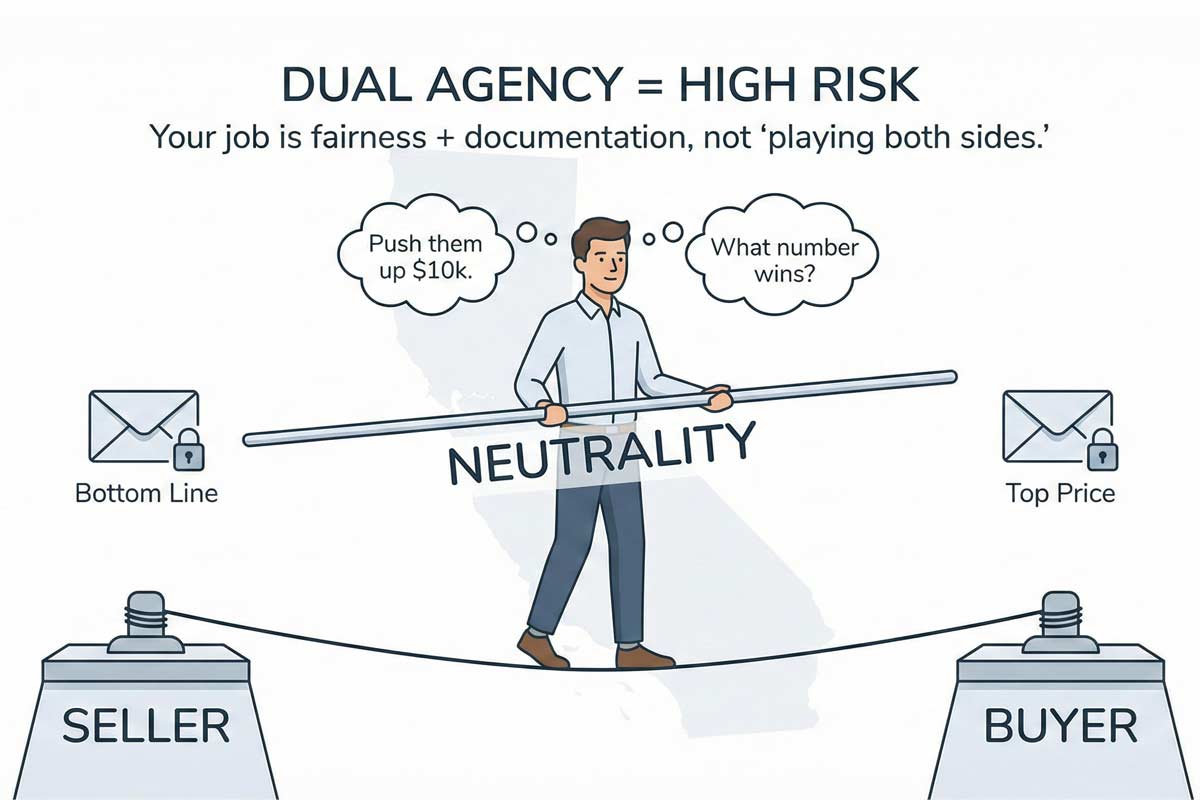
It might start with a text message at 9:30 PM.
You have the listing. You also have a serious buyer who wants to write an offer. The buyer texts you: “I really want this house. Just tell me what Read more...
It might start with a text message at 9:30 PM.
You have the listing. You also have a serious buyer who wants to write an offer. The buyer texts you: “I really want this house. Just tell me what number I need to hit to beat the other offers.”
Or perhaps the seller leans across the kitchen table and whispers, “Since you’re representing that buyer, can’t you just push them up another $10k? You know they have the money.”
In that instant, you are navigating the core conflict of dual agency.
Dual agency is not just about collecting more commission. It is a balancing act where the slightest slip in confidentiality or neutrality can lead to complaints and a tarnished reputation.
What Dual Agency Actually Means
In plain English, dual agency occurs when a single agent (or two agents under the same broker) represents both the buyer and the seller in the same transaction.
In a standard transaction, you are like a gladiator for your client. You fight for the best interests of your client. You use strategy, leverage, and information to win.
In dual agency, you cannot be a gladiator. You become a neutral facilitator. You still owe fiduciary duties to both parties—meaning you must protect their financial interests—but you lose the full ability to advocate for one side at the expense of the other.
Is Dual Agency Legal in California?
Yes, dual agency is legal in California, but only with informed, written consent.
The danger isn’t the dual agency itself; the danger is sloppy disclosure. Best practice (and often required depending on the relationship and timing) is to disclose early—before signatures—so consent is informed and documented rather than rushed at the closing table.
You must provide the Disclosure Regarding Real Estate Agency Relationship (AD form) to the buyer before they sign an offer, and to the seller before they accept an offer.
If you fail to obtain this written consent properly, you may jeopardize your commission and expose yourself to discipline or civil claims. Worse, the transaction can create rescission/voidability risk depending on the facts. To navigate these waters safely, you need a strong grasp of the framework found in our California Real Estate Laws & Compliance Guide, which outlines the statutory foundation for agency relationships.
The Dual Agent’s Tightrope: Do’s and Don’ts
When you step into the role of a dual agent, your behavior must change immediately. You are no longer coaching one side against the other.
The Golden Rule: You owe fiduciary duties to both principals, but you must remain neutral on negotiation strategy and keep each party’s confidential bargaining info confidential unless authorized in writing.
DO
DON’T
DO disclose all material facts about the property condition to the buyer.
DON’T disclose the seller’s bottom line price (unless you have express written permission).
DO treat both parties with "honest and fair dealing."
DON’T disclose the buyer’s maximum budget or motivation (unless you have express written permission).
DO explain the pros and cons of terms neutrally.
DON’T advise the buyer on exactly "what to write" to beat another offer.
DO keep financial positions strictly confidential.
DON’T "silent auction" the deal by leaking terms between parties.
Your obligations aren't just good manners; they are rooted in specific Ethical Duties Under the California Business & Professions Code that mandate honesty and fair dealing even when you can't advocate for price.
The Confidentiality Trap
This is where most dual agents get into trouble. You know too much. For example, you might know the seller is super motivated because of a divorce. You know the buyer is willing to pay $50k over asking. You must firewall this information.
What Must Stay Confidential
Price Strategy: You cannot tell the seller, "The buyer will go higher." You cannot tell the buyer, "The seller will take lower."
Motivation: You cannot reveal why the client is buying or selling if that information compromises their negotiating position.
Terms: You cannot tell the buyer, "The seller is desperate for a 30-day close, so use that."
What Must Be Disclosed
Material Facts: If you know the roof leaks, you must tell the buyer. Dual agency does not protect you from hiding defects.
Inability to Perform: If you know the buyer lost their financing, you must disclose this to the seller.
Agency Relationship: You must disclose the conflict of interest (dual agency) itself and get consent.
You must rigorously adhere to Privacy Rules for Managing Client Information, ensuring that a buyer’s financial ceiling never leaks. Practically, this means: don’t forward pre-approvals blindly, make certain that you redact account numbers, and keep documents inside your transaction system.
Dual Agency in Multiple Offers (High-Risk Zone)
The risk multiplier explodes when you have a dual agency situation inside a multiple-offer scenario.
Imagine you have the listing. You have three offers from outside agents, and one offer from your own buyer client. The outside agents may immediately suspect you are favoring your own buyer to keep the full commission.
The Protocol:
Neutral Presentation: Present all offers to the seller at the same time, in the same format. Do not color the presentation with "My buyer is really solid" while downplaying the others.
Document Everything: If the seller chooses your buyer, ensure the file clearly shows why (better price, more down payment, waived contingencies).
When you hold the listing and also represent a buyer in a bidding war, the situation becomes volatile, requiring specific protocols for Handling Multiple Offers Ethically to ensure no party feels manipulated.
The Paper Trail: Documenting Like a Pro
If a buyer wakes up three months later feeling they overpaid, or a seller feels they left money on the table, they will blame the dual agent. Your file should act as your shield.
Quick Compliance Checklist:
Agency Disclosure (AD Form): Signed by Buyer before offer; signed by Seller before acceptance.
Consent to Dual Agency: Often part of the purchase agreement, but re-verify signatures.
Communication Log: Document every phone call regarding price. "Spoke to Seller at 2:00 PM. Seller instructed to counter at $900k. Conveyed to Buyer at 2:15 PM."
Offer Receipt & Presentation Log: Timestamp each offer received + when presented to seller + seller’s instructions.
Broker Review: Have your broker review the file along the way.
Clear documentation is your best defense against accusations, helping you learn How to Avoid Misrepresentation in CA Transactions by proving exactly what was disclosed and when.
Mandatory Scripts for the Dual Agent
You need to know exactly what to say when the pressure is on. Memorize these to stay safe.
Scenario 1: The Seller wants you to push the buyer
Seller: "You know they have more money. Just get them up to $950k."
You: "I can certainly present a counter-offer at $950k from you. However, because I also represent the buyer, I cannot pressure them or share your confidential strategy. I can present your counter; I cannot coach either side with confidential info."
Scenario 2: The Buyer wants inside info
Buyer: "Come on, what's the lowest they'll take? I don't want to overpay."
You: "I understand, but because I am a dual agent, I cannot disclose the seller's confidential bottom line. My role is to facilitate the transaction fairly. Based on the comps we looked at, what price are you comfortable offering?"
Scenario 3: The Accusation
Buyer/Seller: "You're just pushing this deal to get a double commission."
You: "You're right to be cautious. Here's how I keep it neutral: I use a consistent process, I document every communication, and I have my broker oversee the file. If you prefer separate representation, we can absolutely arrange that."
Mini Scenarios: Compliant vs. Risky
Scenario A: The Simple Transaction
Situation: You represent the seller. An unrepresented buyer calls from the sign, views the home, and wants to write an offer.
Compliant Action: You immediately present the Agency Disclosure form. You explain you will be a dual agent. You recommend they seek independent representation if they want advocacy, because as a dual agent you cannot advise them the same way. If they proceed, you write the offer exactly as dictated, without suggesting a price.
Scenario B: The Material Fact
Situation: You are a dual agent. The seller tells you, "The basement floods in heavy rain, but don't put that on the Transfer Disclosure Statement."
Compliant Action: You explain to the seller that material facts must be disclosed by law. If the seller refuses, you cannot hide it. You must disclose the flooding to the buyer. Your duty of honesty overrides the seller's instruction to conceal defects.
Closing: It’s a System, Not Vibes
Dual agency is not for the faint of heart, and it is certainly not for the disorganized. It requires a rigid adherence to procedure. You must separate your knowledge, document your steps, and prioritize the integrity of the transaction over the commission check.
Follow your broker’s policy.
Protect the file.
When done poorly, dual agency is the fastest way to create a complaint you can’t explain away.
(Note: General education only; follow your broker’s policies and consult counsel for specific legal questions.)
|

The Anxiety is Real (And It’s Your Advantage)
You’re standing on a porch in an Irvine cul-de-sac or a tree-lined street in Sacramento. Your mouth is dry, your hands are slightly clammy, and you’re Read more...
The Anxiety is Real (And It’s Your Advantage)
You’re standing on a porch in an Irvine cul-de-sac or a tree-lined street in Sacramento. Your mouth is dry, your hands are slightly clammy, and you’re staring at the doorbell. You’re worried about being "that agent"—the annoying solicitor who gets the door slammed in their face.
Here is the truth: that anxiety is your greatest asset. In 20 years of coaching California agents, I’ve found that the "licensed and scared" rookie is often the most successful door-knocker because they are empathetic, not pushy. Using a door-knocking script for California neighborhoods isn't about "closing" someone on their porch; it's about professional neighborhood networking.
Reframe the task: You are a local expert providing data to homeowners in a complex market.
The Bridge Line: Your license lets you practice real estate. Prospecting skills like this get you paid.
The 3-Part Mindset: Permission, Context, Micro-Ask
To stop sounding "salesy," every interaction must follow this professional flow:
Permission: Acknowledge their time immediately.
Context: Why are you here specifically today? (e.g., a nearby sale or neighborhood report).
Micro-Ask: A low-stakes question that doesn't require a "yes" to a listing appointment.
Mastering these California Real Estate Agent Skills is the difference between random prospecting and a repeatable system.
The Pro’s Setup: What to Bring (and What to Avoid)
New agent panic usually stems from feeling unprepared. Carry yourself like a consultant by following this gear list:
The "Must-Have" List
Visible Name Badge: Clearly identifying your name and brokerage.
Minimalist Flyer: Exactly one relevant piece of data (e.g., a "Just Sold" flyer or Market Snapshot).
Slim Notepad & Pen: For taking notes after you walk away from the door.
Digital Contact Card: A QR code on your phone or a clean business card.
The "Never-Do" List
No Large Binders: These scream "long presentation" and trigger immediate rejection.
No Clipboard Theatrics: You aren't a city inspector; don't try to look like one.
Never Step Inside: Even if invited, politely decline to keep the interaction professional and safe.
Don't Ramble: If you can't get to your point in 20 seconds, you've lost them.
What to Say When the Door Opens (The 10-Second Version)
If you are nervous about the first few seconds, use this universal, low-pressure opener to lower the homeowner's guard:
"Hi, I'll be very brief—I'm [Name] with [Brokerage]. I’m just doing a quick neighborhood update to provide some info on [specific local house or report]."
Word-for-Word Scripts (For 6 Key Scenarios)
1. "Just Listed / Just Sold" Notice
Goal: Establish yourself as the active agent on the block.
The Opener: "Hi, I'll be brief—I’m [Name] with [Brokerage]. I wanted to give you a quick update that your neighbor’s home on Elm Street just hit the market/sold."
The Micro-Ask: "When a home like that moves, it usually impacts values on the rest of the street. If it's helpful, I can email you the final sales price once it closes so you have the data? If not, no worries at all."
Graceful Exit: "I'll get out of your hair—have a great day!"
2. Open House Invitation
Goal: Invite neighbors to build your local database.
The Opener: "Hi! I’m hosting an open house around the corner at 123 Maple this Saturday. We’re doing a 'Neighbors Only' preview from 10:00 to 11:00."
The Micro-Ask: "Are you curious what this one sells for compared to yours? What’s the best email to send you the final number after it closes?"
Next Step: To fill the room, pair this with an Open House Script for New Agents.
3. "Market Update" Knock
Goal: Provide value to identify future sellers.
The Opener: "Hi, I'm [Name]. I’m doing some research for a report on [Neighborhood] home values. Many neighbors are asking if the market is cooling off or staying hot."
The Micro-Ask: "I’m putting together a 1-page summary of local trends, like median days on market. Would you like me to email that over when it’s finished? No pressure either way."
4. "Buyer Need" / "Pick Your Neighbor"
Goal: Find off-market inventory for a specific client.
The Opener: "Hi, I’m [Name]. I’m working with a family who loves this specific street, but as you know, there’s nothing for sale right now."
The Micro-Ask: "Have you heard of anyone on the block mentioning a move? And totally separately—are you personally considering a move in the next year, or just staying put?"
Next Step: If they mention they might move, transition to the Buyer Consultation Script (California Agents).
5. The "Professional Valuation"
Goal: Move a "What's my home worth?" comment into an appointment.
The Script: "That’s the million-dollar question. Online 'Zestimates' are often off—sometimes by a lot—because they don't know your specific upgrades."
The Micro-Ask: "I can run a quick net sheet and comp set so you have a realistic range of what you’d walk away with in today’s market. Would you want to do that sometime next week?"
Next Step: If they say yes, be ready with The Best Listing Presentation Script for California Agents.
6. The "Professional Valuation"
Goal: End the interaction when they are busy or uninterested.
The Script: "I completely understand! If appropriate for your neighborhood, I’ll leave my card here—it has my cell if you ever have a quick real estate question. Have a great day!"
Objection Handling: Your Quick-Response Bank
Objection
Your Response (Validate + Exit)
"I'm busy."
"I apologize for the interruption! I'll leave this info here for you. Have a productive day."
"We have an agent."
"That's great! It's vital to have a pro you trust. If you ever need a second opinion, I'm always available."
"How'd you get my address?"
"I'm just working the immediate area today because of [Anchor Property/Report]—it's part of how I stay updated on the neighborhood!"
"Not interested."
"No problem at all! I appreciate your time. Have a great afternoon."
The Conversation Outcomes Scorecard
Outcome
Frequency
What to Do Next
No Answer
Most common
Move to the next door immediately.
Polite Rejection
Frequent
Log the address to avoid double-knocking.
Quality Conversation
Occasional
Log name + house color + specific topic.
Contact Captured
Rare / high-value
Send an immediate “nice to meet you” follow-up.
California Reality: Safety, Compliance, & Disclaimers
Professional Standard: Municipal solicitation ordinances and HOA rules vary significantly across California. Respect all posted “No Soliciting” signs and private property restrictions.
Disclaimer: This guide provides practical training on communication and marketing for real estate professionals. It does not constitute legal advice. Always check your local city ordinances, HOA rules, and brokerage policies regarding door-to-door canvassing.
Safety & Access Rules:
Respect gates and access controls; do not "tailgate" into private communities.
Stay outside the threshold at all times and maintain a 6-foot distance from the door.
Carry a charged phone and let a colleague know your route.
End any conversation immediately if your intuition flags a concern.
The Follow-Up System (The 2-Minute Rule)
The moment you walk away from a door where you had a conversation, stop and log it. In my years of coaching, I’ve seen that the "friendly follow-up" is where the commissions are actually made.
Text Message (follow all opt-in laws): "Hi [Name], it was great meeting you on [Street] today! Just sending my digital contact info so you have it. — [Your Name], [Brokerage]"
Value-Add Email: "Hi [Name], as promised, here is that market snapshot for [Neighborhood]. Inventory is currently [high/low] compared to last year. Let me know if you have questions!"
FAQs for Featured Snippets
Q: Is door knocking legal in California?
A: Rules vary by municipality and HOA. You must check local city ordinances, respect all "No Soliciting" signs, and respect gates or access controls in private communities.
Q: What is the best door-knocking script for California neighborhoods?
A: Use a "Context-Based" opener: "Hi, I'm [Name]. I'm not here to sell anything, I just wanted to share an update on a home that recently sold on your block."
Q: What is the best time to door knock?
A: Target 4:00 PM to 6:30 PM on weekdays or 10:00 AM to 12:00 PM on Saturdays for the highest engagement rates.
Q: How do I handle a "No Soliciting" sign?
A: Respect the sign and move to the next house. Maintaining a professional reputation is more important than any single lead.
Your "Quick Start" 1-Hour Plan (Do This Today)
Print 20 flyers for a "Just Listed" or "Market Update."
Pick a 20-house radius (avoid "No Soliciting" zones).
Knock doors 1-5. Your only goal is to say the script out loud.
Log every contact in your phone immediately.
Send a "nice to meet you" text (following all opt-in laws) within 60 minutes to anyone who shared contact info.
Door-knocking is just one spoke in your prospecting wheel. To round out your skills, pair this with the Cold Calling Script That Doesn’t Sound Salesy to keep your pipeline full regardless of the weather.
|
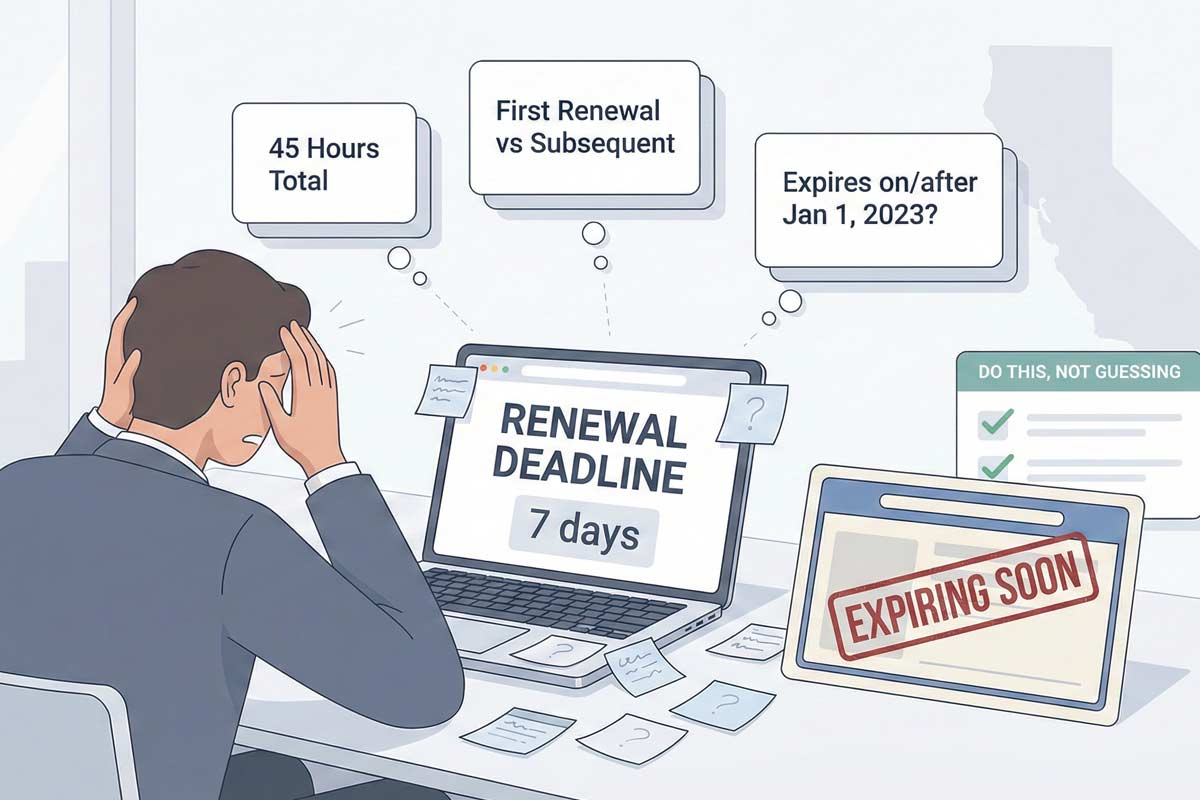
It starts with a notification or a glance at your license. The expiration date is looming—maybe next month, maybe next week—and the panic sets in.
You know you need "Continuing Education," but Read more...
It starts with a notification or a glance at your license. The expiration date is looming—maybe next month, maybe next week—and the panic sets in.
You know you need "Continuing Education," but the rules seem to change every time you check. Do you need the 9-hour survey or separate courses? Is implicit bias required this year? What happens if you take the wrong bundle?
If you are staring at a renewal deadline, stop guessing. Taking the wrong courses can result in a rejected application and a lapsed license—meaning you literally cannot practice real estate until your expired license is renewed.
Here is the no-fluff, compliance-grade breakdown of exactly how many hours you need and, more importantly, which hours count.
Fast Answer: How Many CE Hours Are Required?
The short answer: All California real estate licensees (salespersons and brokers) must complete 45 hours of DRE-approved Continuing Education to renew their license.
The critical nuance: You cannot just take "any" 45 hours. The DRE strictly regulates how those 45 hours are broken down based on three factors:
Your License Type (Salesperson vs. Broker)
Your Renewal Status (First-time renewal vs. Subsequent renewal)
Your Expiration Date (Whether your license expires on/after January 1, 2023, or you are renewing late after that date)
If you just buy the cheapest "45-hour bundle" without checking these factors, you risk taking courses that the DRE will not accept.
Bottom Line: Everyone needs 45 hours. But the composition of those hours changes depending on where you are in your career.
The 45-Hour Breakdown (Make It Simple)
To get your renewal approved, your 45 hours must be stacked correctly. The DRE divides CE into three specific buckets.
Mandatory Subjects: These are the "core" legal topics (like Ethics and Agency). You cannot skip these.
Consumer Protection: You must take a minimum of 18 hours in this category. These courses might cover technical skills like energy efficiency, land use, or valuation.
Consumer Service: These are "elective" topics (like sales skills or marketing).
First Renewal vs. Subsequent Renewals (Where People Get Burned)
This is the #1 source of confusion. The DRE requires first-time renewers to take "separate" courses to ensure they truly learn the basics. Veterans get to choose to take either a "survey" course or each course individually.
Scenario A: First-Time Renewal (Salesperson)
If you are renewing your salesperson license for the very first time, you cannot take the 9-hour survey. You must complete 5 separate 3-hour courses for the mandatory topics.
Your 45-Hour Stack:
Ethics (3 hours)
Agency (3 hours)
Fair Housing (3 hours, must include an interactive participatory component where you role-play as both a consumer and a real estate professional)
Trust Fund Handling (3 hours)
Risk Management (3 hours)
Implicit Bias Training (2 hours)
Consumer Protection (18 hours minimum)
Remaining Hours (Consumer Protection or Consumer Service)
Scenario B: First-Time Renewal (Broker)
Brokers have a higher standard of duty. If you are renewing a broker license for the first time, you have an extra mandatory topic: Management & Supervision.
Your 45-Hour Stack:
All 5 separate courses listed above
PLUS: Management & Supervision (3 hours)
Implicit Bias Training (2 hours)
Consumer Protection (18 hours minimum)
Remaining Hours (Consumer Protection or Consumer Service)
For a complete breakdown of every specific rule, bookmark our master California Real Estate License Renewal Guide.
Scenario C: Subsequent Renewals (All Licensees)
Once you have successfully renewed at least once, you graduate to "Subsequent Renewal" status. This applies to both salespersons and brokers.
Your 45-Hour Stack:
Individual courses or Survey Course: You can choose to take some of coursework either as a bundle or choose to take the courses individually.
Consumer Protection (18 hours minimum)
Remaining Hours (Consumer Protection or Consumer Service)
Warning: If you are a first-timer and you accidentally take the "9-Hour Survey" because it was cheaper or faster, the DRE will reject your renewal. You must take the separate courses.
Do Brokers Have Different CE Requirements?
Yes, but primarily on that first renewal.
As mentioned above, brokers typically need to complete the Management & Supervision course as a standalone 3-hour requirement during their first renewal cycle. The DRE expects brokers to understand how to manage offices and supervise agents from day one.
On subsequent renewals, brokers and salespersons are in the same boat—both can take the survey course, which includes the Management & Supervision module.
For a deeper dive into broker-specific nuances, read Do Brokers Have Different CE Requirements in CA?.
What Counts Toward CE Hours (And What Doesn’t)
Not every real estate class you take counts toward your 45 hours.
1. It Must Be DRE-Approved If you took a weekend seminar on "Luxury Home Marketing" at a hotel, or watched a YouTube series on sales tactics, those likely do not count. Only courses from a DRE-approved sponsor (like ADHI Schools) are valid, and you’ll enter the 8-digit CE course number in eLicensing to prove it.
2. Interactive Fair Housing (The "Interactive" Rule) Since 2023, you cannot just read a PDF on Fair Housing. If your license expires on or after January 1, 2023 (or you are renewing late after that date), your 3-hour Fair Housing course must include an interactive participatory component where you role-play as both a consumer and a real estate professional.
In-Person: This involves live role-play.
Online: This usually involves scenario-based questions where you "act" as the buyer or agent in a digital simulation.
For a full list of valid course types, check out What Courses Count Toward CE in California?
Realistic Time Planning (Stop the Last-Minute Crunch)
I see this happen every month: an agent realizes their license expires in 48 hours and tries to "cram" all 45 hours in one weekend.
This is physically impossible.
Why? Because of the 15-Hour Rule. This isn’t just an ADHI policy—DRE regulations limit correspondence CE to 15 credit hours of final exams in any 24-hour period, which is why true last-minute cramming often fails. These testing periods commence after the maximum of 8 hours per day of study time.
Day 1: Max 15 hours.
Day 2: Max 15 hours.
Day 3: Max 15 hours.
The Math: Including the study time, ADHI’s renewal package requires a minimum of just over 8 days to complete. This means if your license expires tomorrow and you haven’t started, you are going to expire.
My Advice: Start at least 30 days out. Do one course (3 hours) per evening. It’s stress-free, and you’ll actually retain the information rather than just clicking "Next" in a panic.
Common Mistakes That Delay Renewal
Over the last 20 years, we’ve seen thousands of renewals. Here are the most common reasons the DRE kicks them back:
Taking the "Subsequent" Package Too Early: First-time agents love the idea of a 9-hour survey. Don't do it. You need the separate courses.
Missing Implicit Bias: This is a newer requirement (effective 2023). If your bundle is old, check if it includes this. (Read more: Does California Require Implicit Bias Training for Renewal?)
Name Mismatch: If your CE certificate says "Bob Smith" but your license is under "Robert Smith," the eLicensing system might flag it. Ensure your profile matches your certificates.
Letting the license expire: You can renew during the two-year late renewal period, but you cannot perform licensed activity until the DRE renews you. To avoid any lapse, submit before your expiration date.
Assuming the "70/30 Exemption" Applies: Some agents think once they turn 70, they are exempt. You must be 70 AND have 30 years of continuous good standing. If you let your license lapse for a month 10 years ago, that clock might have reset.
To ensure you have the full checklist for this year, review California Real Estate License Renewal Requirements (2026).
Mini-Checklist: "Before You Hit Submit"
Before you log into eLicensing, ensure you have:
45 Hours Total on your certificates.
Correct Mandatory Topics (Separate courses for 1st timers; Survey or individual courses for subsequent).
Implicit Bias certificate (2 hours).
Interactive Fair Housing certificate.
At least 18 hours labeled "Consumer Protection."
Course Numbers (8-digit) ready to type in.
FAQ: California CE Hour Requirements
Is it always 45 hours to renew a California real estate license? Yes. Whether you are a salesperson or a broker, and whether it is your first or tenth renewal, the total requirement is 45 hours. The only exception is for licensees who qualify for the "70/30 Exemption" (70 years old with 30 years of continuous good standing).
Do brokers need more CE hours than salespersons? No, brokers also need 45 hours. However, for their first renewal, brokers must include a specific 3-hour course on "Management & Supervision," whereas salespersons do not. On subsequent renewals, both licensees typically take the same 9-hour survey course.
What if I’m renewing late—do I need extra CE? Generally, no. You can renew late for up to two years after expiration, but you cannot practice while expired. If you don’t complete late renewal within that two-year window, your renewal rights are forfeited.
Does implicit bias training count toward the 45 hours? Yes. The 2-hour Implicit Bias training is part of the 45-hour total. It is a mandatory course, meaning you cannot skip it, but the time spent on it counts toward your total requirement.
Can I finish all 45 hours in one day? No. DRE regulations limit you to completing 15 credit hours of final exams per 24-hour period. This means the fastest you can theoretically complete the 45 hours is over 3 to 4 days after the study period has lapsed.
|

Key Takeaways:
The Supervision Standard: Your broker is a guardian of your license. If they aren't accessible, your professional standing could be at risk.
Effective Split Math: High splits often Read more...
Key Takeaways:
The Supervision Standard: Your broker is a guardian of your license. If they aren't accessible, your professional standing could be at risk.
Effective Split Math: High splits often mask overhead. Always calculate your take-home after potential brand royalties and monthly "junk" fees.
Proof over Promises: Never rely only on a recruiter's verbal promises. Demand to see the written Fee Schedule, Training Calendar, and E&O Policy page.
Compliance is Success: In California, a brokerage without a proactive, early file-review system for disclosures could be a significant professional liability.
TL;DR: The "Instant Exit" Checklist
A "Red Flag" is a symptom of a systemic failure. If a brokerage checks a bunch of these boxes—or any single box in Category 2 (Support & Compliance)—think long and hard about signing with them.
The Unavailable Broker: No designated backup for the Responsible Broker during nights or weekends.
The "Off-the-Top" Surprise: Commission splits calculated after a non-capped franchise royalty or brand fee is deducted.
Pay-to-Play Training: Mandatory monthly fees required even if you aren't closing deals.
Post-Closing Review: Files are audited only after the deal closes, leaving you exposed during the transaction.
Recruitment-Heavy Incentives: Internal focus on agent attraction that outweighs the focus on teaching the Residential Purchase Agreement (RPA).
“Your biggest risk isn’t a low split; it’s a high split with no support—leaving you with 100% of zero.”
Your License is Your Asset
While passing the California real estate exam is a monumental achievement, another important phase of your career begins the day you select a broker. In advising thousands of new licensees, I have watched many talented agents struggle early on because they chose a brokerage that provided zero operational protection.
What is a Brokerage Red Flag?
A red flag is any trait suggesting a brokerage prioritizes its own growth metrics over your professional development and legal safety. Conversely, a Green Flag system is one with transparent math, documented support standards, and a rigorous compliance framework.
Choosing a brokerage is not a branding exercise; it is choosing a Risk Management System for your license. In California, where disclosure requirements are complex, your broker’s supervision is your primary line of defense.
The 18-Point Brokerage Audit
Use these tables to guide How You Interview Brokerages in California. Demand the "Proof Artifact" for every category.
Category 1: Money & Fee Transparency
#
The Red Flag
The Recruiter Pitch
The Real Risk
Exact Verification Question
Proof Artifact
1
"Off-the-top" Fees
"It's a 90/10 split."
Brand royalties can drop your actual take-home significantly.
"Is my split calculated on Gross Commission or Net after brand fees?"
Written Fee Schedule
2
Hidden E&O Costs
"Insurance is included."
You may be liable for a significant out-of-pocket deductible per claim.
"What is my out-of-pocket deductible if a claim is filed against me?"
E&O Policy Dec Page
3
Mandatory Junk Fees
"Low monthly overhead."
Monthly desk/tech fees erode your capital while you are still ramping up.
"What is the total monthly cost to hang my license if I close zero deals?"
ICA (Fee Section)
4
Exit Fee Clawbacks
"Joining is free!"
You may owe "training reimbursements" if you move your license.
"Are there any financial penalties or fee clawbacks if I leave?"
ICA (Termination)
5
No Cap Clarity
"You keep 100% later."
"Caps" may only apply to the broker split, not the brand royalty.
"Does the annual cap include or exclude franchise/royalty fees?"
Commission Policy
6
Admin/Client Fees
"Standard processing."
Hidden fees charged to your clients can damage your reputation.
"Does the brokerage charge my clients any 'administrative' or 'compliance' fees?"
Written Admin Fee Policy
Category 2: Support & Compliance (The "Hard Pass" Category)
#
The Red Flag
The Recruiter Pitch
The Real Risk
Exact Verification Question
Proof Artifact
7
The "Ghost" Broker
"I'm always available."
If the broker is unreachable on weekends, you have no legal supervision.
"Who is the designated backup if the Responsible Broker is unreachable?"
Weekend Duty List
8
Delayed File Audit
"We review for closing."
Late audits can lead to serious legal exposure after the deal closes.
"When is the first compliance review performed on a new escrow?"
File Review SOP
9
Unsupervised AVIDs
"Just get it signed."
Failure to properly inspect (AVID) creates massive liability for new agents.
"Who specifically reviews my Agent Visual Inspection Disclosures?"
Compliance Checklist
10
No Support SLA
"Open-door policy."
You lose a deal because a contract emergency goes unanswered.
"What is the written policy for emergency response times on weekends?"
Escalation Procedure
11
No Legal Hotline
"Ask the manager."
Managers may give non-legal advice; you need expert guidance.
"Do agents have direct access to a legal hotline or staff attorney?"
Policy Manual
12
Part-Time Broker
"I still sell too."
A broker in personal production may prioritize their deals over your safety.
"Who on staff is responsible for performing daily compliance reviews?"
Review Staffing List
Category 3: Training & Culture
#
The Red Flag
The Recruiter Pitch
The Real Risk
Exact Verification Question
Proof Artifact
13
Unstructured Mentors
"Paired with a pro."
A producer may lack the protected time to review your first counter-offer.
"Is the mentor's time specifically compensated for teaching?"
Mentorship Syllabus
14
Video-Only Training
"1,000+ videos."
Passive watching does not build the skill of handling tough objections.
"What time is the weekly live roleplay or script practice session?"
Training Calendar
15
Recruiting Focus
"Growth incentives."
The office may prioritize agent attraction over production support staff.
"Can I see the names of the staff responsible for contract audit?"
Staff Roles List
16
No RPA Training
"You'll learn on the job."
You cannot explain the Purchase Agreement to a skeptical client.
"When is the next live class specifically covering the RPA?"
Training Syllabus
17
"Ramping" Leads
"We provide leads."
Leads are often old or recycled, wasting your prospecting time.
"How are leads distributed, and can I see the age of current lead inventory?"
CRM Lead Routing Rules
18
High Turnover
"We're growing fast!"
High churn indicates a lack of retention through support and value.
"Can I speak with two agents who have been in this office for 3+ years?"
Direct Agent References
The “High Split Trap” (Effective Split Reality)
While commission structures vary significantly across California, the underlying math remains constant. You should calculate your Effective Split.
Scenario: Your First $1M Deal ($25k GCI)
Illustrative scenario assuming you close after 6 months of ramp-up overhead and an example (assumed) 6% franchise royalty rate.
Item
90/10 Model (High Fee)
70/30 Model (All-In)
Gross Commission
$25,000
$25,000
Broker Split
($2,500)
($7,500)
Example (Assumed) Royalty (6%)
($1,500)
$0
Monthly Fees (6 months)
($1,500)
$0
NET TO AGENT
$19,500
$17,500
The Lesson: The 90/10 model netted more here, but if the 70/30 model provided a mentor who helped you close that deal one month faster, you would have gained production momentum that outweighs the split difference. Speed + Supervision often beats raw split.
Broker Access & the “Support SLA”
In California, contract deadlines are unforgiving. If you have a question about a counter-offer or a contingency removal at 4:30 PM on a Friday and your broker is unavailable, you risk a breach of contract for your client.
A Recommended Support Rule of Thumb:
Contract Emergencies: < 1-hour response window.
General Questions: < 24-hour response window.
If the broker is a solo practitioner with high personal production and no backup, verify the actual written support system. Don't assume access just because they were friendly during the interview.
Transaction Review & the Compliance Safety Net
California disclosure requirements (TDS, SPQ, AVID) are legally dense. A Green Flag brokerage uses a Safety Net approach:
Initial Review: Within 24–48 hours of an executed contract.
Milestone Audits: Systematic checks tied to key escrow events (e.g., disclosure package delivery or contingency milestones).
VID Audit: A review of your Agent Visual Inspection Disclosure language before it is delivered to the buyer.
Training Proof vs. Training Marketing
Recruiters sell "The Dream"; brokers sell "The System." To verify the training is real, you should treat the interview like a diagnostic exam. Demand these items:
The Calendar: Show me the classes from the last 30 days.
The Syllabus: Is there a written 30-60-90 day onboarding plan?
The "Why": Ask "What is the #1 mistake your new agents make on the RPA?"
Leads, Teams, and the Hidden Trade-Off
Before deciding Should You Join a Team or Go Solo, analyze the lead-gen model:
The Team is a "Ramp" if: They provide leads AND teach you the skills to eventually generate your own.
The Team is a "Treadmill" if: You are only allowed to work their scraps and you never learn to source business.
The Red Flag Scorecard
Score each 1-5 (1 = Poor, 5 = Excellent). If Compliance or Support SLA is below 4, this brokerage might be a "Pass."
Criteria
Score
Training Proof (Actual syllabus/calendar verified)
Support SLA (Documented response < 1 hour for emergencies)
Compliance Review (Audit within 24-48 hours of execution)
Fee Transparency (Written Schedule of Fees provided)
Mentorship Structure (Time specifically protected/compensated)
Lead Model Clarity (Clear path to self-generated business)
If You Already Joined a Bad Brokerage, Do This in the Next 30 Days
If you suspect you've made a mistake, take these steps:
Read Your Independent Contractor Agreement (ICA): Often, you cannot move a pending deal without a heavy fee.
Interview Early: Start interviewing Best Brokerages for New Agents in California before you resign.
Document Promises: If promised training never happened, keep a log of missed events.
Export Your CRM: Consider what happens to your contact data before you announce a move.
FAQ Section
Is a 100% commission brokerage good for new agents?
Usually no—unless it has documented supervision, training proof, and transparent fees. One disclosure error can create serious exposure that may cost more than any "saved" commission.
What is a "Franchise Fee"?
It is a royalty paid to a national brand. Always verify if it is calculated on the Gross commission and whether the cap applies to the royalty or only the broker split.
What is an E&O Deductible?
IErrors and Omissions insurance protects you, but many brokers have a deductible that can be several thousand dollars. You need to know if you are responsible for that out-of-pocket in the event of a claim.
Your first year in real estate is about survival and skill-building. The brokerage you choose should be your foundation, not your burden. By focusing on risk management and demanding proof, you ensure your career starts on solid ground.
Ready to build your career on a foundation of real education and support?
Start a Real Estate Career in California
|
Disclaimer: This article is for educational purposes only and does not constitute legal advice. For specific legal guidance regarding real estate transactions or Department of Real Estate (DRE) disciplinary Read more...
Disclaimer: This article is for educational purposes only and does not constitute legal advice. For specific legal guidance regarding real estate transactions or Department of Real Estate (DRE) disciplinary matters, please consult a qualified real estate attorney.
The Reality of Ethics: It’s Not About Being “Nice”
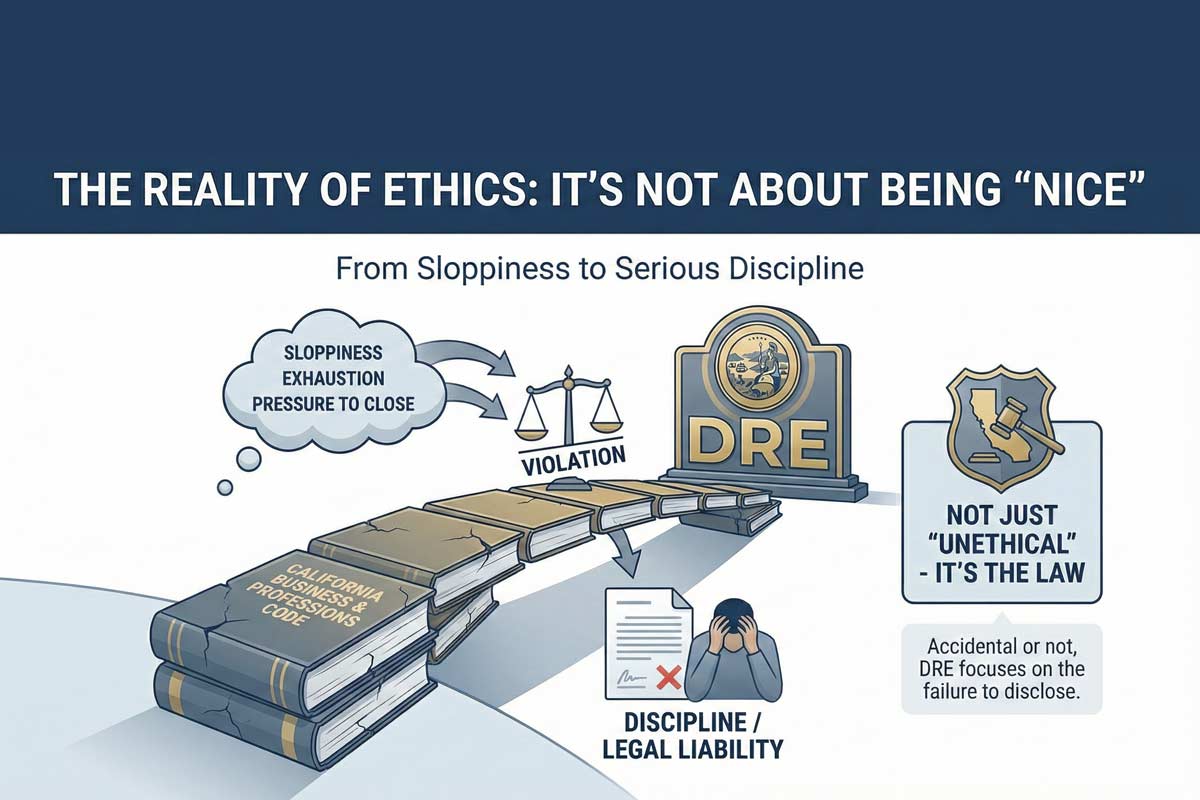
Most real estate discipline doesn’t happen because an agent wakes up one day with a plan to steal a deposit or defraud a senior citizen. In my 20+ years of teaching real estate in California, I’ve seen that many license suspensions come from sloppiness, exhaustion, or the pressure to close a deal “just this once.”
The ethical duties California real estate licensees must follow aren't just abstract moral suggestions. They are codified in the California Business & Professions Code. When you violate them, you aren't just being “unethical”—you can trigger serious discipline and legal liability. Accidental or not, the DRE doesn't focus on why the roof leak was hidden—only that you failed to disclose it.
This guide translates the jargon of the code into the daily behaviors that helps keep your license safe and your clients protected.
At-a-Glance: Ethical Duties & Risk Zones
Concept
The Bottom Line
The Standard
Ethics in CA real estate = Fiduciary Duty + Honesty + Fair Dealing.
Top Failure Point
Disclosure. Assuming a defect isn't "material" enough to mention.
Dual Agency
Legal, but requires neutral fidelity to both sides. No playing favorites.
Money Handling
Commingling funds is one of the fastest ways to trigger discipline.
Competence
Don't go solo beyond your competence—escalate or refer out.
The Golden Rule
If you have to ask, "Is this material?", treat it as material until verified.
What the California Business & Professions Code Actually Is
The California Business & Professions Code (Sections 10000 et seq.) is the rulebook that governs your actions as a licensee. It establishes the Real Estate Commissioner’s authority to investigate complaints and revoke licenses.
Under this code, honesty isn't just a virtue; it's a requirement for licensure. Competence isn't just about intelligence; it's about avoiding negligence.
Honesty isn't just a virtue; it's a requirement for licensure.
Competence isn't just about smarts; it's about not acting negligently.
If you lie in an advertisement, this can be grounds for DRE discipline under Section 10177(c). If you fail to supervise your team, you expose yourself to risk under Section 10159.2.
Clarifying the Terms: Fiduciary vs. Ethical Duties
It is helpful to distinguish between the two types of duties you carry, though they often overlap:
Fiduciary Duties are owed specifically to your client (loyalty, confidentiality, utmost care).
Statutory Duties are owed to everyone (honesty, fair dealing, disclosure of material facts).
Put simply: Fiduciary duties are client-facing; statutory duties are license-facing (DRE discipline risk). Even if you are fighting for your client, you cannot lie to the other side.
Transaction Reality Check: The DRE doesn’t usually patrol the streets looking for violations. They often react to complaints. Your adherence to these rules is your defense shield against those complaints turning into investigations.
The Core Ethical Duties
To stay compliant, you need to master these specific duties. Here is how they break down in the trenches using a consistent safety protocol.
1. Honesty & Truthfulness
What it requires: You must be honest with all parties, including lenders, appraisers, and other agents.
How it fails: A buyer asks if the addition is permitted. You say, "I believe so," to keep the deal alive, even though you never checked the public record.
The Fix:
Never guess. If you don’t know, say "I don't know, but let's find out."
Treat silence about a known negative fact as the same thing as a lie.
Source your data (e.g., "According to the tax records...").
2. Disclosure of Material Facts
What it requires: You must disclose any fact affecting the value or desirability of the property, including what you should have known from a visual inspection.
How it fails: You see water stains on a ceiling but accept the seller’s "it was fixed years ago" story without asking for receipts or noting the stain on the AVID.
The Fix:
Document every visual defect you see on the AVID.
If a seller tells you to "leave that off the form," refuse.
When in doubt, disclose it.
3. Competence & Escalation
What it requires: You generally owe a duty of care to possess the skill of a real estate professional in the same or similar circumstances. If a transaction is beyond your expertise, you must involve someone who is competent.
How it fails: A residential agent tries to lease a warehouse without understanding power requirements or industrial gross lease structures.
The Fix:
Refer out complex commercial, probate, or land deals if you aren't trained in them.
Partner with a senior agent who has the specific experience needed.
Say: "This is outside my scope of expertise; we need to bring in a specialist."
4. Conflicts of Interest (Self-Dealing)
What it requires: You must put the client's interest above your own. Buying your own listing or selling your own property to a client requires massive, written disclosure.
How it fails: You recommend a specific roof inspector because that inspector gives you a kickback (referral fee) under the table.
The Fix:
Disclose any relationship you have with vendors in writing.
Never accept undisclosed compensation.
Recuse yourself if your personal interest clouds your judgment.
5. Advertising & Public Representations
What it requires: Marketing must be true and not misleading. You cannot advertise a price the seller has not agreed to accept just to generate leads.
How it fails: Posting "Coming Soon" signs without written authorization, or using Photoshop to remove power lines from a listing photo.
The Fix:
Ensure all claims in ads are objectively verifiable.
Get written authorization for all signage and price representations.
Include your license identification where required by DRE rules and brokerage policy.
6. Documentation Discipline
What it requires: If it isn't written down, it didn't happen. In disputes, the file wins.
How it fails: Negotiating repairs via phone call and never transferring those agreements to a formal Addendum or Amendment that is signed by all parties.
The Fix:
Screenshot texts and email them to the transaction file immediately.
Use standard forms for all agreements.
Keep a communication log for phone calls.
Discipline Triggers
Trigger Behavior
Why it's a Code Problem
What it Looks Like
Prevention Strategy
Secret Profits
Violation of 10176(g); Secret Profit.
Having your brother-in-law buy the property at a reduced price and flipping it later.
You must disclose that the buyer is related to you before the seller accepts the offer and not disclose any seller secrets to him.
Phantom Offers
Fraud/Misrepresentation.
Telling a buyer "we have another offer" when you don't, just to bump the price.
Never bluff. Only mention offers that physically exist in writing.
Signing for Clients
Forgery/Exceeding Authority.
"My client is on a plane, so I just Docusigned for them."
NEVER sign a client's name.
Trust Fund Mishaps
Commingling/Conversion.
Deposit check sits in your car console for days.
Treat deposits as immediate; follow Commissioner's Regulations & broker trust procedures.
Mini Playbooks: Compliance in Action
Here is how to handle the four biggest ethical traps using correct DRE discipline prevention tactics.
1. How to Avoid Misrepresentation
Misrepresentation is the #1 cause of lawsuits. It happens when you pass along bad info as fact—a risk you can mitigate by learning How to Avoid Misrepresentation in CA Transactions.
Do this every time: Source your data. "According to the Tax Assessor..." not "The square footage is..."
Say this: "The seller states the roof is 5 years old; I recommend we verify that with a roofing certification."
Don't say: "The roof is basically new, you don't need to worry about it."
2. Handling Multiple Offers Ethically
The market heats up, and greed takes over. This is where Handling Multiple Offers Ethically becomes your safety net against bias complaints.
Do this every time: Create a spreadsheet summarizing net proceeds, timelines, and contingencies for the seller.
Say this: "I have received 3 offers. My duty is to present all of them to you objectively so you can decide."
Don't say: "Ignore that low offer, it's a waste of time" (unless you have written instruction to filter).
Rule: Present offers promptly per the seller’s lawful written instructions and your broker’s policy—then document what you did.
3. Dual Agency in California
Representing both sides is legal, but as our Dual Agency in California Guide explains, you must walk a tightrope of neutrality.
Do this every time: Get the "Disclosure Regarding Real Estate Agency Relationship" signed before you act as a dual agent.
Say this: "As a dual agent, I cannot advise you on the top price to pay or the lowest price to accept. I am a neutral facilitator."
Don't say: "I can get the seller to come down for you." (This violates fiduciary duty to the seller).
4. Privacy Rules for Managing Client Information
In the digital age, strict adherence to Privacy Rules for Managing Client Information prevents you from leaking motivation and destroying negotiation power.
Do this every time: Keep client financial docs in a secure, encrypted portal.
Say this: "I cannot discuss why my clients are moving, but I can tell you they are motivated to close quickly."
Don't say: "They're getting divorced and need to sell fast."
What the Exam Tests vs. What Gets You Disciplined
The Exam Focuses On:
Memorizing the 3-year record retention rule.
Defining "commingling" vs. "conversion."
Identifying the protected classes under the Unruh Act and Rumford Acts.
The Real-World "Kill Zone" (Discipline Risks):
Lazy Documentation: Agreeing to terms via phone call and forgetting to formalize them.
Rushed AVIDs: Writing "Nothing noted" on the Visual Inspection simply to save time.
Assumed Knowledge: Telling a buyer the schools are "great" without defining what that means, leading to a lawsuit when they aren't.
Social Media: Posting photos of your clients inside the home without permission, violating privacy.
Exam Alert: On the state exam, the answer is usually the one that offers the most consumer protection. In real life, that principle still holds: protect the consumer, and you protect yourself.
FAQs:
Ethical Duties Under the Microscope
What counts as misrepresentation in California real estate?
Misrepresentation encompasses three things: Innocent (accidental), Negligent (careless), and Fraudulent (intentional). Even if you didn’t mean to deceive, if you stated a fact as true without verifying it—and it turned out to be false—you can face liability for negligent misrepresentation.
Can the DRE discipline an agent for an “honest mistake”?
Yes. Negligence is a failure to use the care and skill that a reasonable real estate agent would use. If an “honest mistake” results in financial harm to a client because you were sloppy or didn’t check the file, the DRE can issue citations or fines.
What is a material fact and who decides?
A material fact is anything that would affect a reasonable person’s decision to buy or the price they would pay. Ultimately, a judge or the DRE decides, but the rule of thumb is: if it affects value, desirability, or safety, it is material.
How should agents handle dual agency ethically?
Dual agency ethical duties require you to be a neutral conduit. You cannot advocate for one side to the detriment of the other. You must disclose all material facts to both, but keep price negotiation strategy and personal motivations confidential unless authorized to share.
What should I do if my client asks me to “leave something out”?
You must explain that your license and the law require full disclosure of material facts. Refuse to follow instructions that violate the law. If a client insists on concealing a known defect, you may need to terminate the listing to avoid being an accessory to fraud.
What records should I keep to protect myself?
Statutorily, you must keep all transaction documents for at least three years (B&P Code 10148). As a best practice, you should also retain email chains and text logs that clarify why decisions were made, as these are often critical in a defense.
The Path to Compliance
Viewing ethics as a burden is a mistake. Ethical duties are your roadmap to a long, profitable career without legal headaches. By adhering to the standards outlined in our California Real Estate Laws & Compliance Guide, you build a reputation as a professional who can be trusted with a client’s largest financial asset.
|
In California real estate, water and access are two of the easiest facts to misstate—and two of the hardest problems to fix after closing. If you market “water rights,” “year-round water,” or Read more...
In California real estate, water and access are two of the easiest facts to misstate—and two of the hardest problems to fix after closing. If you market “water rights,” “year-round water,” or “guaranteed access” without written verification, you’re not just risking a failed deal; you’re risking a misrepresentation claim.
The trap is predictable: agents often confuse legal entitlement with physical reality. A water bill is not the same thing as a legal right to a source, and a driveway you can drive today is not proof of a recorded right to use it tomorrow.
This guide is part of the California Real Estate Laws & Compliance Guide.
Notice: This guide is for informational purposes only and does not constitute legal advice. California water and land-use rules can be highly fact-specific. Always consult the local agency, title/escrow, and a qualified real estate attorney or land-use professional for property-specific guidance.
Fast Answer: Water Rights & Easements in California (What Agents Must Verify)
In California, water service (a meter/account with a district or mutual system) might be different from water rights (a legal claim to use a water source), and physical access is different from legal access (a recorded right to use a path for a defined purpose). Agents reduce liability by verifying: (1) the true water source and any conditions for continued service, and (2) the existence, scope, and map location of any access easement—in writing—before using those claims in marketing.
Verify in writing (minimum):
Water: District/mutual/well source, written confirmation of service availability/conditions, and any fees/limits.
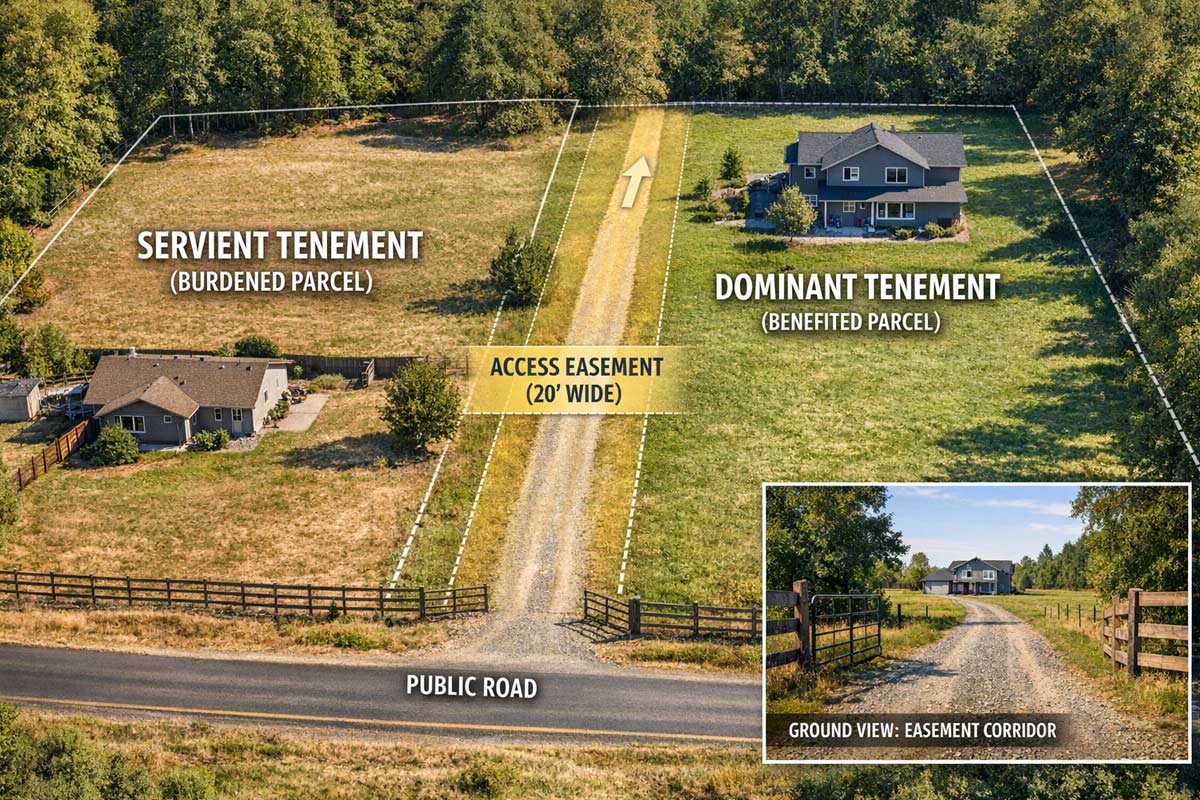
Access: Recorded easement document + scope (ingress/egress, width, permitted uses), plus whether the actual road sits inside the easement boundaries.
Title: Easement exceptions, ambiguous “blanket” easements, or anything requiring a survey and/or legal review.
Water Rights vs. Water Service: The Critical Distinction
The most common mistake is assuming a property has "water rights" just because water is present.
Topic
What it is
What agents should verify
Common marketing mistake
Water Service
Utility delivery (district/mutual)
Service status, transfer requirements, written confirmation of service availability, connection fees, meter availability.
Saying “water rights included” when it’s only a service account.
Water Rights
Legal entitlement/claim to a source
Any documentation/agreements/permits, limitations, transferability, and counsel review when unclear.
Treating a claim as guaranteed capacity or permanent.
Physical Access
A road/driveway exists
Ownership, maintenance responsibility, gates/controls, visible encroachments.
Assuming physical use equals a legal right.
Legal Access
Recorded right to cross land
Recorded document, scope, width, map/exhibit location, and any lender/fire authority concerns.
Saying “deeded access” without reading the easement.
Who This Matters For (High-Risk Scenarios)
Verification is non-negotiable for these property types:
Rural & Ag Parcels: Properties with wells, irrigation, or horse/livestock needs.
Flag Lots & Private Roads: Properties relying on shared driveways or "off-main" access.
Waterfront & Creek-Adjacent: Land bordering natural watercourses where riparian claims may arise.
Development & ADU Sites: Parcels where "legal access" must meet specific fire-code widths or where utility capacity is capped.
California Water Rights Basics
Riparian and Appropriative Concepts
Riparian: Generally tied to land bordering a natural watercourse and typically used on that land; these rights are fact-specific and not something agents should "promise" without appropriate review.
Appropriative: Often tied to priority and permitting. If a property relies on diverted surface water, verification can require complex agency records and legal review.
Groundwater and Wells
Practical Reality: Well performance is a tested condition, not an assumption. Local groundwater rules and basin management can affect drilling, pumping, and long-term reliability.
What Documents Usually Prove What (Quick Reference)
Resource
Evidence/Document to Request
Water District Service
Recent bill + district confirmation of transfer/service status.
Mutual Water
Share certificate + current standing confirmation + transfer rules.
Private Well
Well records (if available) + current yield/flow + potability results.
Shared Well
Written agreement covering access, maintenance, and cost-sharing.
Access Easement
Recorded easement/right-of-way document + map/exhibit showing location.
How to Spot Easements in the Preliminary Title Report (Schedule B)
Your primary defense is the Preliminary Title Report—but only if you treat it like a checklist, not a formality.
Start with Schedule B (Exceptions): This is where easements, rights-of-way, and restrictions can appear.
Pull every referenced document: If an exception cites a recording date/instrument number, ask title/escrow for the actual recorded document—don’t rely on the one-line summary.
Identify scope: Does it allow ingress/egress, utilities, drainage, or something else? Is it limited to certain vehicles or purposes?
Check whether it’s appurtenant or in gross: Does it benefit the parcel (runs with land) or an entity (utility, agency)?
Find the map/exhibit: Many easements live on a plat or exhibit that shows location/width. If the easement isn’t clearly mapped, treat it as a risk flag.
Compare paper to pavement: If the road/driveway doesn’t appear to sit within the easement area, recommend a survey and/or legal review before removing contingencies.
Title Red Flags:
“Blanket” easements that cover large areas without a defined corridor.
Easement exists, but doesn’t connect to a public right-of-way or reach the actual structure.
Language that conflicts with current use (e.g., pedestrian-only vs. vehicle access).
Encroachments (fences/sheds sitting in the easement area).
Agent Workflow: The 6-Step Due Diligence Loop
Ask: Source, history, disputes, and shared agreements.
Pull: Title/prelim + exhibits; read Schedule B and referenced documents.
Confirm: District/mutual status, will-serve terms, and transfer rules.
Test: Yield and potability during contingencies (for wells).
Map: Confirm easement location vs. actual road; survey if needed.
Disclose + Market Safely: Use precise language tied to documents.
Water & Access SOP (Verify in Writing)
Water
Source type: District meter, mutual water company, shared well, or private well.
Transfer requirements: Rules/fees to transfer service or shares; confirm standing with the provider.
Vacant land: Get written confirmation of service availability/conditions (often called a “will-serve” confirmation).
Well properties: Recommend yield/flow and potability testing; ask for prior repair history.
Shared well: Confirm a written agreement exists covering maintenance, cost-sharing, and repair access.
Access / Easements
Recorded document: Obtain and read the recorded easement/right-of-way document.
Scope + width: Confirm permitted uses (vehicle/utility), width, and any restrictions.
Maintenance: Confirm who pays; if shared, verify if a recorded maintenance agreement exists (may be a lender/underwriting concern).
Physical reality: Check for gates, parking conflicts, or fences/encroachments; recommend survey if alignment is unclear.
Local requirements: Confirm emergency access expectations with the local fire authority.
Marketing Language: Safe vs. Risky
Risky Language (Avoid)
Safe Language (Use Instead)
"Unlimited water rights."
"Property served by private well; buyer to verify capacity and rights via current testing."
"Deeded access to the highway."
"Access via recorded ingress/egress easement; see preliminary title report and recorded documents for scope."
"Abundant water for horses."
"Buyer to verify water capacity for specific agricultural needs."
"Easy shared driveway."
"Shared driveway, see recorded maintenance agreement for details."
"Right-of-way guaranteed."
"Recorded right-of-way; see documents for scope and width."
"Build your dream home here."
"Buyer to verify utility availability, permits, and emergency access requirements."
"Water shares included."
"Sale includes shares in [Name] Mutual Water Co.; verify standing."
"Year-round creek access."
"Bordered by [Creek Name]; buyer to verify riparian claims/use."
Navigating the Broader Regulatory Landscape
Understanding the Dominant vs. Servient Tenement relationship is just one piece of the puzzle. This guide is a core component of our larger California Real Estate Laws & Compliance Guide, designed to help agents navigate the state’s complex land-use regulations.
Development and Density Constraints
Easements are often the "make-or-break" factor when a client is looking to increase property value through density. If you want to learn a little more about exploring a lot split, refer to our breakdown of SB 9 Explained for Real Estate Agents; access and utility feasibility are the primary hurdles that can quickly derail development assumptions.
Similarly, when evaluating the addition of secondary units, California ADU Laws Explained will help you distinguish between state-mandated allowances and the real-world water or access constraints that often limit buildable space.
Environmental and Tenant Considerations
For properties in coastal or rural settings, easements often intersect with protected land. Reviewing the Environmental Regulations California Agents Should Know is essential, as these restrictions can strictly limit the grading and drainage work necessary to maintain an easement.
Finally, if you are handling a tenant-occupied property where shared utilities or access rights are in play, our Rent Control Laws in California (Agent Guide) is a vital resource for ensuring that easement maintenance doesn't inadvertently trigger a tenant dispute or a violation of local habitability ordinances.
FAQ
Q: What is a “will-serve” letter?
A: A document from a utility district confirming they have the capacity to serve a property, often under specific conditions or fees.
Q: What’s the difference between an easement and a license?
A: An easement is a general right to use land that runs with the land; a license is personal and revocable.
Q: Can I say “legal access” in marketing?
A: Only if you’ve reviewed the recorded documents (and exhibits) and the claim matches the scope and location; otherwise use “access via recorded easement—buyer to verify.”
Q: What is a “blanket easement”?
A: An easement that isn't clearly defined on a map. It can create major development limits or disputes.
Q: Can a neighbor take away an easement?
A: It is difficult if recorded, but can happen via merger or court action. Always verify with title.
Water and access issues aren’t “rural quirks”—they’re core transaction risks. For the full framework on how agents avoid misrepresentation, read the California Real Estate Laws & Compliance Guide and keep a “verify in writing” file for every listing.
|
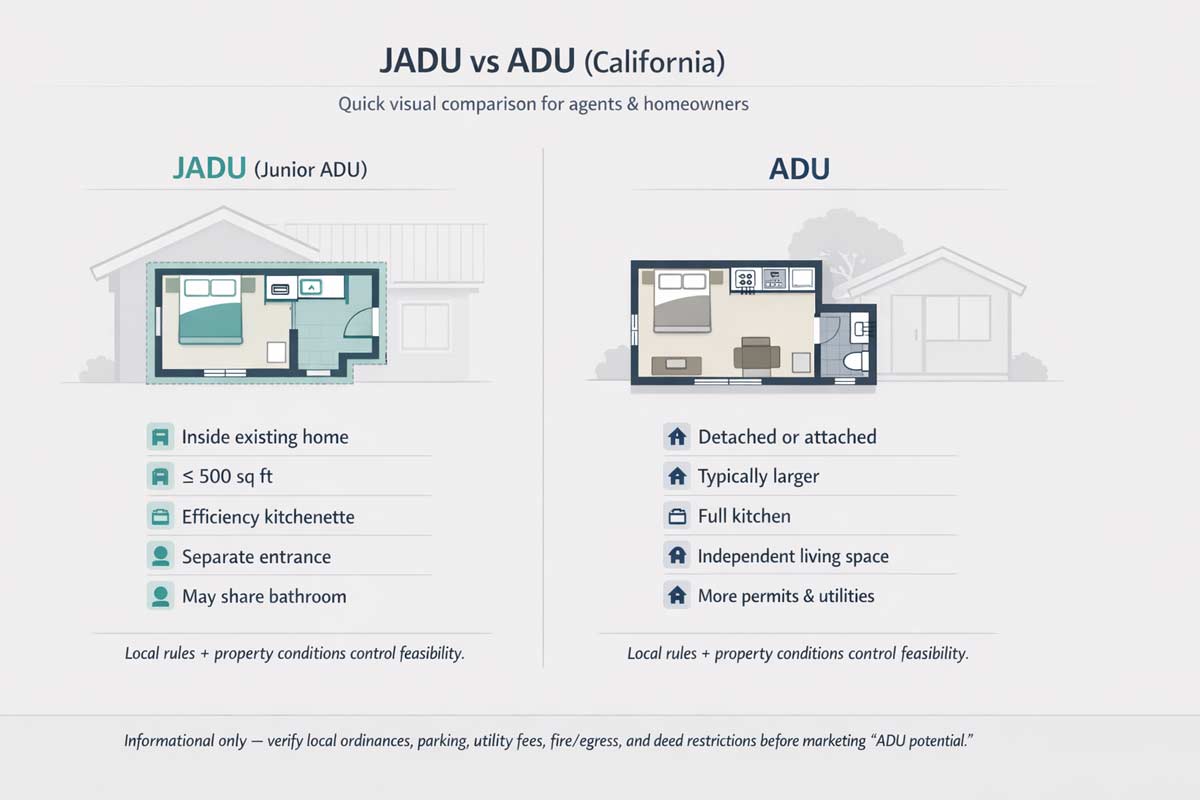
Notice: This guide is for informational purposes only and does not constitute legal advice. California housing laws are subject to frequent legislative updates; always consult with a qualified land-use Read more...
Notice: This guide is for informational purposes only and does not constitute legal advice. California housing laws are subject to frequent legislative updates; always consult with a qualified land-use attorney, local planning department, and the applicable utility agency for property-specific feasibility.
Accessory Dwelling Units (ADUs) can be a major inventory-growth lever in California — but “ADU potential” is also one of the easiest ways for an agent to create liability if it’s marketed like a guarantee. This guide is part of our California Real Estate Laws & Compliance Guide and focuses on what agents need most: the state’s ministerial (no-hearing) process and the administrative “shot clocks” designed to prevent permit stalling — plus the exact items you should verify in writing before you talk numbers.
Fast Answer: What California ADU Law Actually Does
California’s ADU framework is no longer “local preference.” It’s a state-enforced ministerial system: cities must approve ADU applications that meet objective standards, and they must process them on strict timelines.
“Ministerial” just means that there’s a checklist that has to be followed, and as long as everything on that checklist is done the approval doesn’t require a hearing. However, it’s still not a guarantee until the city confirms the application is complete and compliant.
The two clocks agents should know:
1) Completeness clock (15 business days)
Cities have a 15-business-day window to determine whether an application for an ADU is complete. If the permitting agency does not make a timely completeness determination, the application is treated as complete for timing purposes and the next clock starts.
VERIFY IN WRITING (do this every time):
Get a portal timestamp / receipt confirmation showing the submission date and time.
If submitted by email/mail, keep proof of receipt (and ask the agency to confirm the “received” date in writing).
2) Decision clock (60 days after complete)
Once an application is complete, the city generally has 60 days to approve or deny it. Missing that deadline can trigger “deemed approved” status, subject to the statutory mechanics (and tolling if the applicant requests delay).
VERIFY IN WRITING:
Ask the city (email is fine) to confirm the “complete” date that starts the 60-day clock.
If the city denies, request the full written set of correction comments (all departments) in one package — not piecemeal.
Key Considerations
1) State law sets the baseline (and limits local games)
State ADU law preempts conflicting local standards. Cities can add rules, but they must stay within the state framework and use objective standards — not subjective “we don’t like it here” discretion.
VERIFY IN WRITING:
Request the city’s current ADU ordinance + ADU handout/checklist (many cities have an “ADU packet”).
If staff cites a rule that seems to conflict with state standards, ask them to identify the code section in writing.
2) The 60-day clock is real — and denials must be “complete”
If the city denies, it must provide a full written set of correction comments describing what’s wrong and how to fix it. This is designed to prevent the “drip-feed denial” tactic.
VERIFY IN WRITING:
Please provide the complete set of correction comments from all reviewers and confirm this is the full list.
3) Parking: stop making promises; use exemptions carefully
Parking rules are often 0 spaces in common scenarios (especially conversions) but be sure to confirm local and state rules.
Parking may be capped and often waived under specific statutory exemptions (transit proximity, conversion of existing space, historic district rules, permit restrictions, etc.).
Replacement parking is often not required when converting certain existing parking structures — but don’t market that as universal without city confirmation.
VERIFY IN WRITING:
Ask planning to confirm how many parking spaces are required for the specific property and why (which exemption they’re applying).
4) Fees: impact fees ≠ utility connection/capacity charges
This is where agent marketing can get folks in hot water.
Impact fee rules can depend on ADU size thresholds and local fee programs.
Utility connection/capacity charges are a separate universe (water/sewer/power) and can still surprise owners even when impact fees don’t.
VERIFY IN WRITING:
City: “What impact fees apply for an ADU of approximately ___ sq ft?”
Utilities: “What connection/capacity charges apply and under what calculation method?”
Consider brushing up on Water Rights & Easements in California Real Estate (because easements + utility constraints are where projects can fall apart.
5) Short-Term Rentals (Airbnb): keep the warning, tighten the language
California law requires 30+ day rental terms for JADUs and for ADUs approved under the § 66323 “state standards” pathway.
For ADUs approved under a local ordinance, state law gives cities the authority to require 30+ day terms — and many jurisdictions do.
VERIFY IN WRITING:
Never market “ADU short-term rental income” unless you have the city’s short-term rental rule in writing for that parcel.
Agent Tip: To protect your commission and your client, never market “ADU short-term rental income” unless you have verified the city’s specific STR ordinance in writing.
6) Environmental overlays and recorded easements are the silent killers
Most “ADU denials” aren’t philosophical. They’re constraints: hillside grading, coastal, fire severity, biological, historic, sewer/water limitations, or recorded easements.
VERIFY IN WRITING:
Ask the city: “Are there any overlays affecting ADU placement (hillside/coastal/fire/historic/biological)?”
Confirm easements on the prelim/title report before promising anything.
Environmental Regulations California Agents Should Know
Water Rights & Easements in California Real Estate
7) The SB 9 Intersection: When ADUs Aren't Enough
If a client wants more than just an ADU, they may ask about SB 9. While ADUs add "accessory" units, SB 9 allows for primary density increases through ministerial lot splits and two-unit developments.
Summary of SB 9 (2025-2026 Updates):
The "Two-Unit" Rule: On a single-family lot, an owner can ministerially build two primary units (effectively a duplex) instead of a house + ADU.
The "Urban Lot Split": SB 9 allows a single lot to be split into two. Each new lot must be at least 1,200 sq ft.
The "Unit Cap" Trap: If a lot is split under SB 9, the city can limit the total number of units to two per new lot (inclusive of ADUs/JADUs).This means you generally cannot "stack" an SB 9 lot split with multiple ADUs to get 6 or 8 units unless the local ordinance specifically allows it.
Owner-Occupancy (The Big Catch): Unlike ADUs, an SB 9 lot split requires the owner to sign an affidavit stating they intend to occupy one of the units as their primary residence for at least three years.
VERIFY IN WRITING:
"Does this specific parcel qualify for an SB 9 lot split (check for historic districts/fire zones)?"
"If we split the lot, what is the maximum total unit count (including ADUs) allowed per parcel?"
8) The Rental Strategy Trap: Rent Control & AB 1482
This is a critical due diligence item for investors. While a single-family home (SFH) is typically exempt from statewide rent control under the Costa-Hawkins Rental Housing Act, adding an ADU can change that.
Rental strategy trap (state + local): don’t underwrite rents in your head.
If a client wants more than just an ADU, they may ask about SB 9. While ADUs add "accessory" units, under AB 1482 depending on the property type, ownership structure, and required tenant notices
VERIFY IN WRITING: Before you market “rent upside,” have the buyer/owner confirm (a) whether the property is covered by a local rent stabilization ordinance, and (b) whether AB 1482 applies or an exemption applies — preferably with a landlord-tenant attorney or written guidance from a credible local housing/rent authority.
“What to Say in Listing Remarks” (safe, punchy, defensible)
Use language like this:
Property may be eligible for an ADU (subject to city review, utility capacity, and recorded easements). Buyer to verify ADU feasibility, fees, parking, and rental restrictions with the City and utility providers.
Avoid language like:
“Guaranteed ADU”
“By-right ADU” (unless you’re prepared to prove the exact pathway + objective compliance)
“No fees”
“No parking required”
“Airbnb income”
The shift from local control to a state-mandated ADU framework has created a massive opportunity for California homeowners, but for real estate agents, it has also moved the goalposts for professional liability. Mastering ADU rules is no longer just about knowing square footage; it is about protecting your clients from expensive permitting delays and "soft" denials.
As we move through 2026, the key to a successful ADU-focused transaction is transparency. By using the "administrative shot clocks" provided by SB 543 and the streamlined pathways of AB 1154, you can help your clients navigate the process with confidence—provided you never mistake "potential" for a "guarantee."
Your Starter Checklist for Every ADU Listing:
Don't Guess on Fees: Get the city’s impact fee and the utility’s capacity charge schedules in writing.
Watch the Clock: Use timestamped receipts to hold agencies to their 15-business-day and 60-day legal windows.
Build the Professional Team: Always refer your clients to a qualified land-use attorney, a licensed architect, and a contractor to confirm site-specific feasibility.
Staying "compliance-first" is what separates top-tier agents from the rest. By facilitating the right conversations with the right experts, you protect your commission, your reputation, and your client’s investment.
|
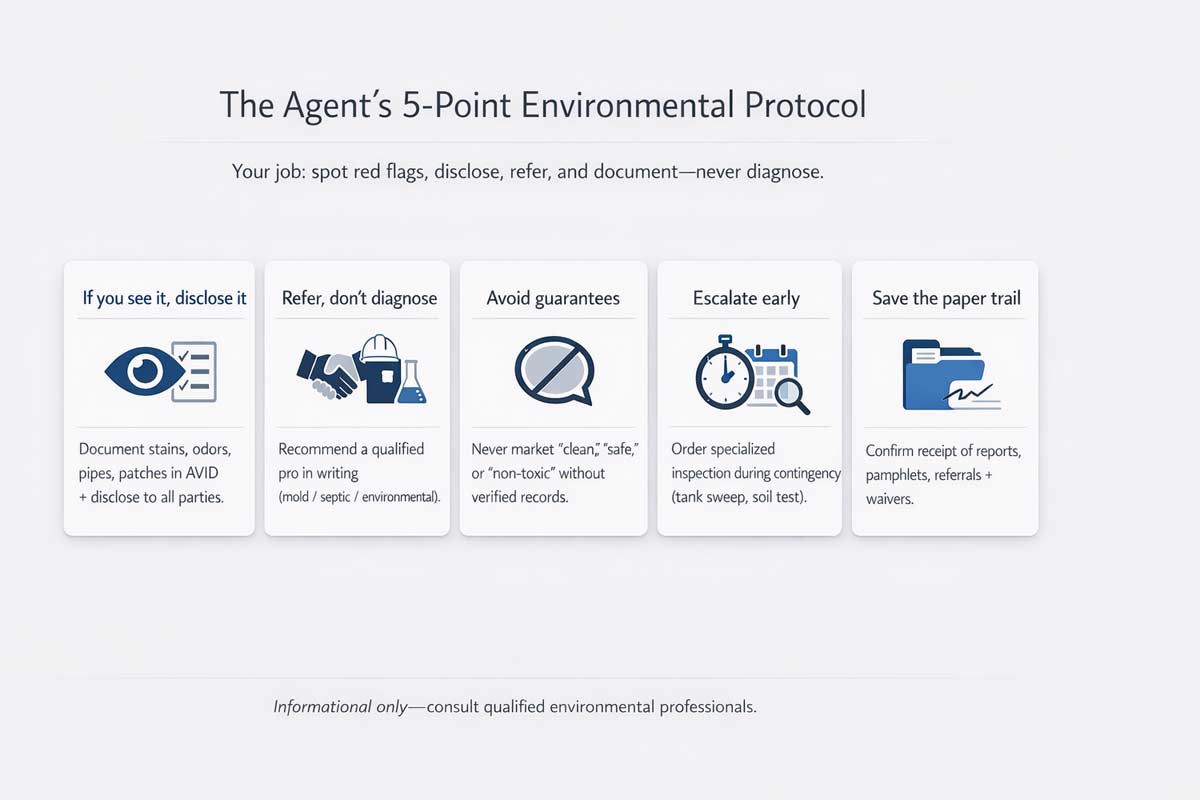
Environmental issues are the "silent deal killers" of California real estate. A single undisclosed underground tank or a mismanaged mold complaint can trigger five-figure remediation costs and six-figure Read more...
Environmental issues are the "silent deal killers" of California real estate. A single undisclosed underground tank or a mismanaged mold complaint can trigger five-figure remediation costs and six-figure lawsuits.
In practice, your job is to surface red flags, disclose material facts, and document referrals—not to diagnose or guarantee property conditions. This guide provides a practice-based protocol for protecting your license and your clients from environmental liability.
Disclaimer: Informational only, not legal or environmental engineering advice. Rules vary by property and local jurisdiction; consult qualified counsel and environmental professionals.
The Agent’s 5-Point Environmental Protocol
If you see it, disclose it: Document visual flags (stains, pipes, odors) in your AVID and disclose them to all parties.
Refer, don't diagnose: Never tell a client "that looks like harmless mildew." Recommend a professional (mold, septic, or environmental pro) in writing.
Avoid Guarantees: Never market a property as "clean," "safe," or "non-toxic" in MLS remarks or conversations.
Escalate Early: Recommend specialized inspections (like tank sweeps or soil tests) during the contingency period, not after.
Save the Paper Trail: 5.Obtain signed receipts for all environmental reports, pamphlets, and written recommendations and any inspection waivers.
The Agent’s "Non-Negotiables"
Problems often stem, not from the hazard itself, but from an agent’s failure to follow these rules:
Rule 1: You are not the expert. Even if you’ve seen a hundred "slurry-filled" oil tanks, do not give an opinion on the safety or cost of removal. Point it out and suggest a specialist.
Rule 2: Perform required visual diligence. Disclose observable red flags where applicable. Missing a blatant red flag can lead to a negligence claim.
Rule 3: Verify claims with records. If a seller says soil is "clean," do not market it as such until you see closure documentation or other credible third-party records (as applicable) and reference those reports in your discussions.
Rule 4: Recommend in writing—even if they decline. If a buyer waives an environmental inspection, send an email (or have them sign a document) confirming they have chosen to assume that risk against your advice.
Hazards: Red Flags
1. Mold & Moisture Intrusion
In California, mold is a primary habitability issue. For rentals, these issues often trigger complex Rent Control Laws in California (Agent Guide) disputes regarding repair timelines and tenant leverage.
Red Flags: Musty odors, water stains, bubbling paint.
Safe Script: "I noticed discoloration; I recommend a mold professional test the air quality."
What NOT to Say: "Bleach will fix it." Do not make health claims like "non-toxic."
2. Asbestos & Lead-Based Paint
In pre-1978 construction, lead based paint may be present. This is a critical consideration before discussing California ADU Laws because construction disturbs suspect materials.
Red Flags: Popcorn ceilings, linoleum, or "shingle" siding in older homes.
Safe Script: "Due to the age of the home, these materials may be present. Consult a specialist before renovating."
Recommend: Delivery of the CalEPA "Environmental Hazards" booklet and other documentation as required by law and your brokerage.
3. Underground Storage Tanks (UST) & Contamination
Red Flags: Metal pipes in the yard, circular concrete patches, or proximity to old dry cleaners.
Safe Script: "This pipe may indicate a former tank; we should recommend a search for closure records."
SB 9 Alert: Feasibility marketing is where agents get sued. Before you market the feasibility of a lot split, ensure environmental constraints don't kill the path for SB 9 Explained for Real Estate Agents.
What NOT to Say: "The tank was definitely removed correctly."
4. Private Wells & Rural Hazards
Environmental due diligence must expand to include water potability, yield, and seasonality.
Red Flags: Nearby industrial sites, agricultural runoff, or "smelly" water.
Safe Script: "Since this property uses a private well, I recommend a professional test for potability and yield."
Pro Tip: Beyond physical service, ensure you understand Water Rights & Easements in California Real Estate.
5. Septic Systems & Leach Fields
Red Flags: Lush green patches in dry weather, soggy soil, or slow drains.
Recommend: Septic inspection, records search, and pumper's report.
What NOT to Say: "It passed before" or "pumping proves it functions perfectly."
6. Former Agricultural Use & Dumping
Red Flags: Abandoned burn pits, distressed vegetation, or historical records of crop spraying.
Recommend: Soil testing by a qualified pro; consult an environmental specialist.
What NOT to Say: "It was just farmland, so it’s clean."
Regulatory Touchpoints
California environmental "regulation" for agents is primarily about disclosure mechanisms:
The NHD Mechanism: The Natural Hazard Disclosure (NHD) flags "zones" (Fire, Flood, Seismic). It does not certify property condition—it only flags state-mapped risks.
Wildfire & Build Feasibility: Treat wildfire exposure as a build-feasibility constraint, especially if your client plans an ADU.
Phase I ESA: A research report used to identify "Recognized Environmental Conditions" (RECs)—signs the property’s history may involve contamination risk.
The TDS: The Transfer Disclosure Statement is where sellers disclose known property conditions, including environmental hazards.
Marketing Language: "Bad vs. Better"
Bad Language (High Risk)
Better Language (Lower Risk)
"No environmental issues"
"Seller reports no known issues; recommend buyer inspection."
"Mold-free home"
"Professional remediation completed [Date]; see attached report."
"Safe well water"
"Water quality to be investigated by buyer during contingency."
"No tank on property"
"No known tanks disclosed; buyer to verify via records/testing."
"Clean Phase I"
"Phase I ESA available for review; buyer to perform due diligence."
Agent Due Diligence Checklist
Review NHD Early: Flag any fire, flood, or fault exposures for the buyer immediately.
Where Relevant, Check Databases: For suspected history, check databases such as GeoTracker or EnviroStor.
Document in AVID: Note all odors, stains, or nearby industrial uses.
Confirm Receipt: Document delivery of all disclosures (NHD, TDS, advisories, and booklets).
Written Referral: Recommend appropriate professional evaluation during contingency; document acceptance/decline.
Frequently Asked Questions
Does "buyer to verify" protect an agent from liability in California?
It is a standard supplement, but it does not absolve you of the duty to disclose a known red flag or material fact.
What should I do if the buyer waives inspections?
Immediately document the waiver in writing. Send an email confirming that you recommended the inspection and they have chosen to assume the risk of the unknown and have the buyer sign a waiver that they are acting against your recommendation.
Is a seller's refusal to allow testing a material fact?
A refusal to allow requested testing is a major red flag and should be communicated to the buyer immediately; ensure this communication is documented in writing.
What is the difference between Phase I and Phase II?
A Phase I is historical research (no drilling). A Phase II involves actual soil or water sampling to determine if contamination exists.
Build Your Compliance System
Environmental risk management is just one piece of a successful real estate practice. If you are building a professional compliance system, start here:
California Real Estate Laws & Compliance Guide
|

TARGET AUDIENCE CHECK
This is for you if: You want a tactical tool to evaluate local California offices and identify which business model fits your specific personality.
This is NOT for you if: You Read more...
TARGET AUDIENCE CHECK
This is for you if: You want a tactical tool to evaluate local California offices and identify which business model fits your specific personality.
This is NOT for you if: You want a ranked list of "top brands" or corporate recruitment fluff.
Choosing your first brokerage in California is a high-stakes decision disguised as a simple choice. Your hard-earned license is a tool, not a trophy, and its value is determined entirely by the support system you choose to wield it.
You’ve passed the exam, but your license is truly tested the moment a client asks a question you can’t answer and you have nowhere to turn. In my 20+ years of experience, I’ve watched the same costly pattern repeat: agents seduced by a charismatic recruiter or a premium office, only to fail months later on a missed deadline or botched disclosure.
The fatal flaw isn’t picking the “wrong” brand—it’s choosing for atmosphere over accountability, for splits over support. This guide is your tactical framework. It replaces hope with strategy, helping you cut through the polish to find the partner that will truly protect your career and answer the phone when you’re in over your head.
The New Agent Brokerage Scorecard
Use this rubric to evaluate every office you visit. Score each category from 1 (poor) to 5 (excellent).
The Scorecard Rule:
If the average score for Training Proof, Compliance Review, and Broker Support is under 4, walk away.
If Broker Support cannot define a specific deadline-response path (how fast they answer on weekends), walk away.
If the All-in Fee Sheet isn't provided in writing, walk away.
Evaluation Rubric
Category
What to Look For
Why It Matters
Training Proof
A physical calendar showing weekly live contract drills and roleplay.
"We have training" is a platitude. You need to see the schedule.
All-In Fee Sheet
Get splits/caps/fees in writing. (Commission Splits Explained for New Agents)
If it isn't in writing, it will be "misremembered" later.
Broker Support
A documented response path for after-hours / deadline questions.
You need a manager with a defined response time when a deal is on the line.
TC Process
A dedicated Transaction Coordinator and a file-review checklist.
CA disclosures are paperwork-heavy; you need a professional safety net.
Mentor Structure
Minimum commitments: Weekly deal desk? Contract review? Shadowing?
You want a mentor with specific, documented responsibilities to you.
Required Tools
Who pays for the CRM, doc-sign software, and website?
Some brokerages hide "tech bundles" in your monthly fees.
Compliance Review
Does a broker review your RPA before it goes to a client?
This prevents expensive legal mistakes before they happen.
Lead Generation
Distribution rules, contact rates, and the specific cost (split/fee).
Avoid vague promises of "leads" without a defined system.
Exit Terms
Who owns team-provided leads? What are the non-solicit terms?
Some agreements restrict your ability to work your database if you leave.
E&O Insurance
A summary of coverage, deductible responsibility, and who pays.
New agents are often blindsided by deductible costs ($1k–$5k) after a mistake.
The "No-Go" Dealbreakers
Can't provide an all-in fee sheet: Hidden costs are a leading cause of first-year "quit" rates.
No broker review process: If no one audits your contracts, you are flying blind with your license on the line.
No training calendar: If they "can't show it right now," the training is unproven and likely inconsistent.
No after-hours support path: Real estate doesn't happen 9-to-5; you need a documented path for weekend deadlines.
The "Closed-Door" Policy: They won’t let you speak to 1–2 agents who joined in the last 12 months.
The Proof Pack (Ask for these in writing)
Full Fee Sheet (E&O, desk fees, franchise fees, deductibles)
Current month's onboarding/training calendar
Example Transaction Checklist / File Review Rubric
Written Mentor Structure (Frequency, responsibilities, and who covers the deal desk)
Copy of the Independent Contractor Agreement (ICA)
The Core: Brokerage Models (Choosing Your Fit)
The right choice depends on your learning style. Verify these details locally and do not rely on a national logo.
1. Training-First Model (The Classroom)
Best for: Career-changers who thrive in a structured environment and want a clear, step-by-step playbook.
The Trade-Off: You’re paying a higher split to buy speed-to-competence.
Verify This: Show me last month’s training recordings or the specific agenda for contract drills.
Failure Mode: If you skip the "reps," you will freeze in front of your first client.
2. Team-Centric Model (The Appointment Engine)
Best for: You want appointments now and accept a lower net commission to buy "reps" and experience.
The Trade-Off: You’re "renting" leads; you’ll pay for them forever unless you build your own pipeline.
Verify This: Show lead distribution rules, minimum activity requirements, and the team agreement. Need more context? I wrote a guide on whether you Should You Join a Team or Go Solo.
3. Boutique/Community Model (The Culture)
Best for: You value direct access to the owner and a localized, non-corporate vibe.
The Trade-Off: You’ll either become self-sufficient fast or you will drift.
Verify This: Show the file-audit checklist and the broker review cadence.
Failure Mode: If you require rigid structure to stay productive, you will likely stall here.
4. Fee-Based / Self-Directed Model (The High Margin)
Best for: You already have an existing pipeline or network and just need a place to "hang" your license.
The Trade-Off: Minimal hands-on supervision and zero provided training.
Verify This: Show support portal response standards and identify exactly who answers legal/compliance questions.
Failure Mode: This model is brutal without an existing pipeline; you will likely stall before your first closing.
5. Outbound Team (The Dialer)
Best for: You can commit to 2–4 hours a day of outbound calling and have a high tolerance for rejection.
The Trade-Off: High burnout risk and very low splits on team-provided leads.
Verify This: Show contact rate expectations and the script coaching cadence.
6. Traditional Full-Service Office (The Hybrid)
Best for: You want a mix of a brand name and on-site resources like transaction coordinators.
The Trade-Off: Mid-range splits; can often feel "sink-or-swim" if the manager is checked out.
Verify This: Show me the actual resources—TC availability, deal desk schedule, and broker-to-agent ratio.
Money Reality Check: The Math of Support
Don't be blinded by a split percentage. Consider this comparison for your first 6–9 months:
Scenario
Example A(High Split / Low Support)
Example B(Lower Split / High Support)
Training/Leads
None (Self-taught)
Intensive Coaching + Mentor
Production (6–9 mo)
0 Deals (Struggled to launch)
2 Deals (at an ~$800k price point)
Gross Commission (GCI)
$0
$40,000
Agent Net (Pre-Tax)
$0
$20,000
Note: Example only—commission rates and splits vary by market, brokerage, and side. Assumes 2.5% commission on a single side before broker fees, team splits, MLS dues, and taxes. The point remains: 2 deals at a lower split beats 0 deals at a high split.
Beginner Traps to Avoid
Paperwork Avoidance: Joining a model that doesn't force you to learn the RPA and disclosures. You cannot "out-sell" a lack of legal competence.
Recruitment Theater: Big promises during the interview but zero calendars, checklists, or accountability once you sign.
The "Invisible" Training: Accepting "we have online videos" as a substitute for live contract training.
Exit Term Surprises: Some team agreements claim ownership over team-provided leads and restrict solicitation. Red Flags When Choosing Your First Brokerage covers this in depth.
California-Specific Context: Compliance is Protection
California’s regulatory environment is demanding. Disclosures like the TDS, SPQ, and AVID are time-sensitive and legally heavy. For most new agents, joining an office without a documented file-audit process is gambling with your license.
Ask This: "Do you perform live RPA clause-by-clause drills and disclosure timeline walkthroughs?"
Ask This: "Who reviews my first 3 contracts before they go out to ensure I don't miss a disclosure deadline?"
The 60-Minute Decision Path
Self-Diagnose: Pick your top 2 needs (e.g., Appointments now vs. Paperwork Training).
Shortlist: Pick three local offices that represent different models.
Interview with a Weapon: Bring the Scorecard. Before you go, read How to Interview a Brokerage as a New Agent.
The Proof Pack: Do not leave without a fee sheet and training calendar.
Your first brokerage is a launchpad, not your final destination. Choose for speed-to-competence today; optimize splits later.
Ready to take the first step?
Start a Real Estate Career in California
FAQ SECTION
Q: Is a 100% commission brokerage good for new agents?
A: Only if you already have a solid lead pipeline and a documented plan for contract support. Without infrastructure, most rookies fail before their first deal.
Q: What should my broker’s response time be?
A: You should expect a response on the same day, and significantly faster during active contingency deadlines.
Q: Should I join a team my first year?
A: If you need a check quickly, a team accelerates the process. However, be aware of the long-term cost and the exit terms regarding lead ownership.
Q: How do I verify training is real?
A: Ask to see the calendar for the current month. If they can't show it, treat it as unproven and likely inconsistent.
TL;DR
Verify Training Proof: "We have training" is a placeholder until you see a live calendar with contract drills and roleplay.
Manager Availability (SLA): Your first crisis won't happen during office hours. You need a documented response path for deadlines.
All-In Cost Sheet: Get every desk, tech, insurance, and franchise fee in writing. If it isn't on the sheet, it doesn't exist.
Skill > Splits: A 100% split of zero is still zero. Prioritize speed-to-competence over high margins for your first 12 months.
|
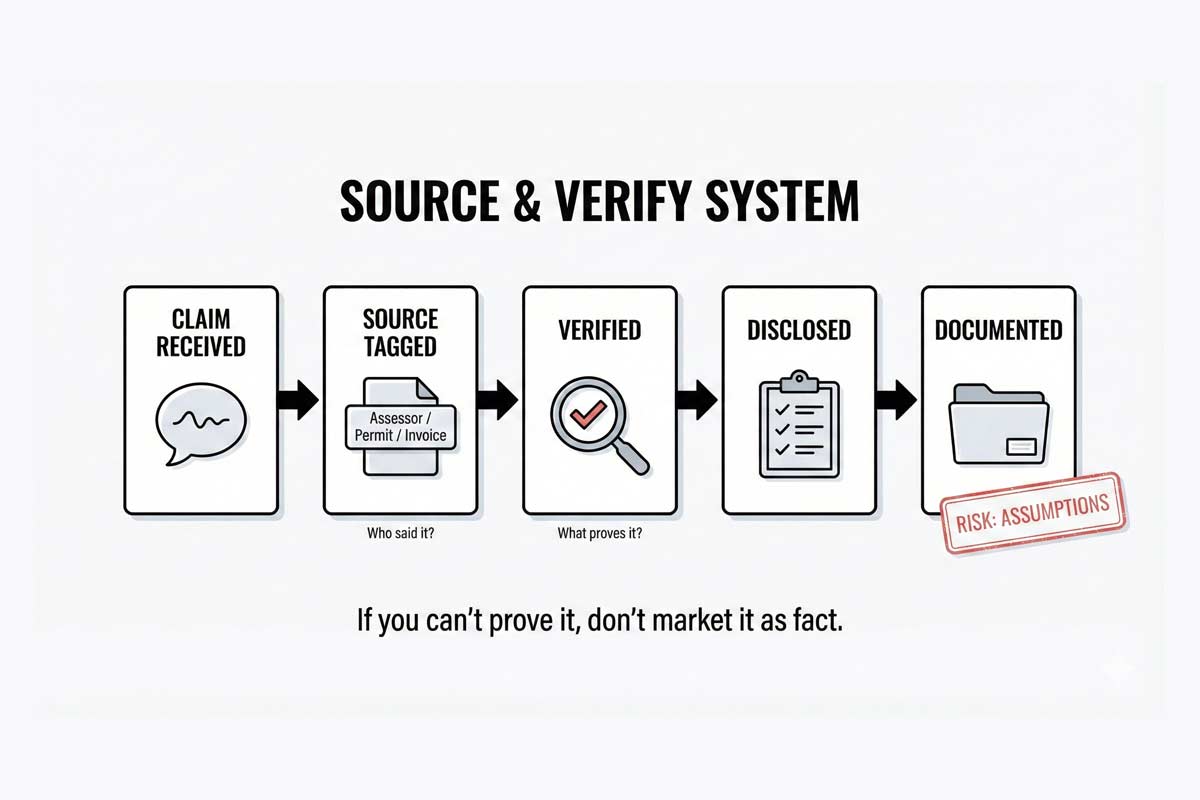
California doesn’t expect agents to be engineers, contractors, or city planners—but it does expect licensees to communicate accurately and avoid passing off assumptions as facts. The goal of this guide Read more...
California doesn’t expect agents to be engineers, contractors, or city planners—but it does expect licensees to communicate accurately and avoid passing off assumptions as facts. The goal of this guide is simple: help you build a repeatable “source → verify → disclose → document” workflow so your MLS remarks, emails, and conversations stay clean and defensible.
Many agents assume lawsuits happen to “bad” people—scammers or fraudsters. But in California real estate, a significant portion of DRE discipline and civil litigation stems from negligent misrepresentation. It’s not that the agent lied on purpose; it’s that they repeated a seller’s claim without verifying it, or they made a casual assumption that turned out to be wrong.
If you want a long career, you must shift your mindset from salesperson to fact-checker.
What “misrepresentation” actually means
In plain English, misrepresentation is a false statement of fact that induces a party to enter into a contract. It isn’t just lying; it’s providing incorrect information that a buyer relies on.
While the definition seems simple, the application is complex because California holds licensees to a higher standard than the general public. That higher standard is the foundation of our California Real Estate Laws & Compliance Guide, and it’s why misrepresentation typically falls into three practical buckets:
1) Intentional misrepresentation (fraud)
This occurs when an agent actively hides a defect or lies about a feature.
Example: "You know the roof leaks, but you paint over the water stains and tell the buyer, 'The roof is in perfect condition.'"
Result: This is considered a career-ending category involving major civil exposure, severe discipline risk, and potentially punitive consequences.
2) Negligent misrepresentation (the danger zone)
This is where most agents get into trouble. It happens when you make a statement you believe is true, but you had no reasonable basis for believing it—usually because you didn’t verify it.
Example: The seller tells you the square footage is 2,500. You put 2,500 in the MLS without checking the source. It turns out to be 2,100.
Result: You’re exposed because you’re expected to treat material facts like verifiable facts, not casual conversation.
3) Innocent misrepresentation
This occurs when an agent makes a false statement that they had reasonable grounds to believe was true.
Example: You rely on a formal report from a licensed surveyor that later turns out to contain an error.
Result: Even without bad intent, deals can unwind and disputes can still happen.
The “material fact” rule
California operates under a strict disclosure standard. A material fact is anything that would affect the value of the property or a buyer’s decision to purchase it. If you are debating whether something is material, it almost certainly is.
The 10 most common misrepresentation traps in California
These are the scenarios where agents unknowingly drift into misrepresentation.
1) “Remodeled with permits”
The trap: The seller says, “We added that master bath with permits.” You list it as “Permitted Master Bath.”
The reality: The seller assumed their contractor pulled permits—but they didn’t.
The fix: Never claim permits exist unless you have seen the final permit sign-off or confirmed city records. Use language like “Buyer to verify all permits.”
2) Square footage & lot size
The trap: Copying the square footage from a prior MLS listing or trusting the owner’s estimate.
The fix: Always cite the source (“Per Assessor,” “Per Appraiser,” “Per Builder”). If there’s a discrepancy between records and the physical home, flag it immediately.
3) “The roof is new”
The trap: The seller says the roof is 5 years old. You market it as “Newer Roof.”
The fix: Avoid acting like a general contractor. State the age only if it’s documented, or treat it as a seller statement and recommend inspection.
4) Zoning and ADU potential
With the ADU boom, agents are eager to advertise “ADU Potential.”
The trap: Telling a buyer, “You can definitely build a back house here.”
The fix: Zoning is complex (setbacks, easements, utilities, overlays). Defer to the city: “Buyer to investigate feasibility with the city.”
5) Nuisances and stigmas
The trap: Failing to mention the loud plant that operates at night or an ongoing neighbor dispute over the fence line.
The fix: If a nuisance affects enjoyment or decision-making, it’s material. Hiding it conflicts with Ethical Duties Under the California Business & Professions Code, where honesty and fair dealing are not optional just because the deal is fragile.
6) Multiple offer pressure
The trap: Telling a buyer’s agent, “We have an offer higher than yours,” when you don’t—just to drive up price.
The fix: Communicate what’s true and only what’s true, especially in hot markets where buyers are already stressed—this is exactly why disciplined conduct matters in Handling Multiple Offers Ethically.
7) Marketing hyperbole vs. fact
The trap: “Walking distance to the beach” (it’s 3 miles) or “quiet street” (it’s a cut-through).
The fix: Let photos and maps do the persuasion. Subjective phrases can become “facts” in a dispute. Stick to measurable statements.
8) Repairs and credits
The trap: The seller agrees to fix a leak. You tell the buyer, “The leak has been fixed.”
The fix: Don’t confirm repairs yourself. Transfer documentation: invoice, contractor statement, permit (if applicable), and buyer re-inspection.
9) Natural hazards
The trap: “This area rarely floods,” or “Fire insurance shouldn’t be a problem.”
The fix: Never minimize hazard risk. Refer clients to the NHD and their insurance professional; keep your language document-based.
10) Minimizing defects
The trap: Seeing a crack and telling the buyer, “That’s just normal settling.”
The fix: Unless you’re a structural engineer, you don’t diagnose. Flag the observed condition and recommend evaluation.
The anti-misrepresentation system
You can eliminate a major share of your liability by adopting a “source and verify” habit.
1) Label fact vs. opinion
If you are sharing an opinion, label it. If you are sharing a fact, cite the source.
Instead of: “1,800 square feet.”
Write: “Approx. 1,800 sq ft per Assessor (buyer to verify).”
2) Verify before you amplify
Before you blast a feature in marketing, ask: “Do I have a document that proves this?” If not, tone it down or remove it.
3) The transaction checklist
Run this check at every stage:
Listing intake: Have the seller complete the TDS and SPQ completely; don’t let blanks slide.
Document handling: Treat client documents and sensitive details like controlled material—careless forwarding, oversharing, or casual disclosure can create liability and negotiation harm, which is exactly why disciplined workflows matter under Privacy Rules for Managing Client Information.
Marketing prep: Review MLS comments against disclosures—do they match?
Negotiation: Ensure counters and emails don’t imply promises that aren’t written.
Closing: Repairs and credits should have documentation attached and traceable.
Safe language toolkit: say this, not that
❌ Risky: “New roof”✅ Safe: “Seller states roof replaced in 2021; buyer to verify.”
❌ Risky: “Permitted guest house”✅ Safe: “Guest house present; buyer to verify permits with the city/county.”
❌ Risky: “Great rental potential”✅ Safe: “Buyer to verify rental restrictions and market rates.”
❌ Risky: “Quiet neighborhood”✅ Safe: “Located on a cul-de-sac” (stick to facts).
❌ Risky: “The plumbing is fine”✅ Safe: “No known plumbing issues per seller disclosures as of [date].”
❌ Risky: “I’m sure they’ll accept X”✅ Safe: “I will present your offer immediately and confirm receipt.”
Mini case studies: California scenarios
Scenario A: The “just cosmetic” crack
The situation: A seller points out a hairline crack and says it's from heavy rain. The agent markets “pristine condition.”
The outcome: A serious foundation issue appears after closing. The agent is sued for negligent misrepresentation.
What the agent should have done: Note the condition on the AVID, ensure disclosure is complete, and recommend specialist evaluation without diagnosing.
Scenario B: The dual agency disconnect
The situation: You represent both buyer and seller. The seller mentions divorce stress and urgency. You tell the buyer to help close the deal.
The outcome: Confidentiality and loyalty get questioned immediately, and parties often argue they relied on a misrepresented level of neutrality or advocacy. That’s why Dual Agency in California (Legal Guide) treats role clarity and confidentiality as non-negotiable.
What the agent should have done: Keep motivation confidential and stick to verifiable property facts and written terms.
Scenario C: The “updated” electrical
The situation: A flipper says the panel is “fully updated.” The agent writes “New Electrical Panel” in MLS.
The outcome: Inspector finds it’s old and painted. Buyer demands a credit and threatens claims for false advertising.
What the agent should have done: Require receipt/permit before using “new,” or describe only what you can prove.
Your license is worth more than one commission
Avoiding misrepresentation isn’t about being paranoid—it’s about being professional. It requires a shift from “selling” to “guiding.”
Your best defense is simple:
Verify what the seller tells you.
Disclose what you know.
Document where it came from.
If you don’t know the answer, “I don’t know, but let’s verify it” is one of the safest phrases in your vocabulary.
|