
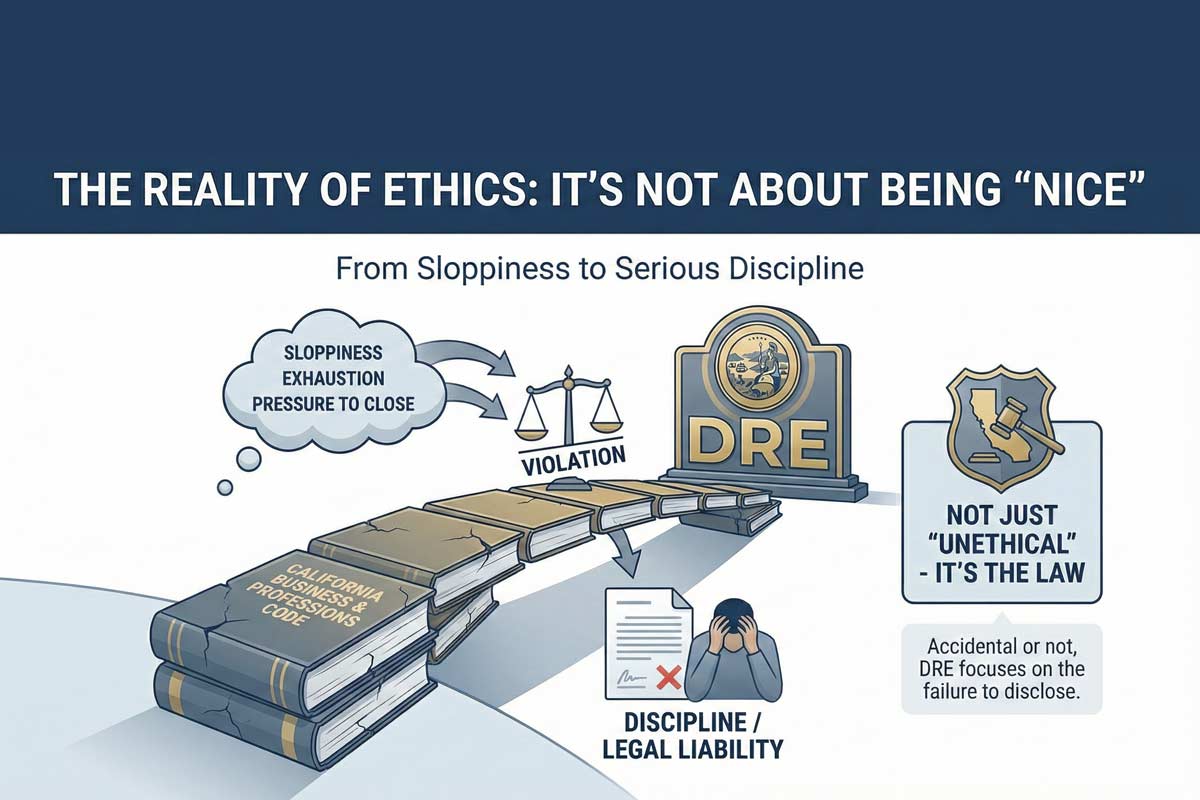
Most real estate discipline doesn’t happen because an agent wakes up one day with a plan to steal a deposit or defraud a senior citizen. In my 20+ years of teaching real estate in California, I’ve seen that many license suspensions come from sloppiness, exhaustion, or the pressure to close a deal “just this once.”
The ethical duties California real estate licensees must follow aren't just abstract moral suggestions. They are codified in the California Business & Professions Code. When you violate them, you aren't just being “unethical”—you can trigger serious discipline and legal liability. Accidental or not, the DRE doesn't focus on why the roof leak was hidden—only that you failed to disclose it.
This guide translates the jargon of the code into the daily behaviors that helps keep your license safe and your clients protected.
The California Business & Professions Code (Sections 10000 et seq.) is the rulebook that governs your actions as a licensee. It establishes the Real Estate Commissioner’s authority to investigate complaints and revoke licenses.
Under this code, honesty isn't just a virtue; it's a requirement for licensure. Competence isn't just about intelligence; it's about avoiding negligence.
If you lie in an advertisement, this can be grounds for DRE discipline under Section 10177(c). If you fail to supervise your team, you expose yourself to risk under Section 10159.2.
Clarifying the Terms: Fiduciary vs. Ethical Duties
It is helpful to distinguish between the two types of duties you carry, though they often overlap:
Put simply: Fiduciary duties are client-facing; statutory duties are license-facing (DRE discipline risk). Even if you are fighting for your client, you cannot lie to the other side.
Transaction Reality Check: The DRE doesn’t usually patrol the streets looking for violations. They often react to complaints. Your adherence to these rules is your defense shield against those complaints turning into investigations.
To stay compliant, you need to master these specific duties. Here is how they break down in the trenches using a consistent safety protocol.
What it requires: You must be honest with all parties, including lenders, appraisers, and other agents.
How it fails: A buyer asks if the addition is permitted. You say, "I believe so," to keep the deal alive, even though you never checked the public record.
The Fix:
What it requires: You must disclose any fact affecting the value or desirability of the property, including what you should have known from a visual inspection.
How it fails: You see water stains on a ceiling but accept the seller’s "it was fixed years ago" story without asking for receipts or noting the stain on the AVID.
The Fix:
What it requires: You generally owe a duty of care to possess the skill of a real estate professional in the same or similar circumstances. If a transaction is beyond your expertise, you must involve someone who is competent.
How it fails: A residential agent tries to lease a warehouse without understanding power requirements or industrial gross lease structures.
The Fix:
What it requires: You must put the client's interest above your own. Buying your own listing or selling your own property to a client requires massive, written disclosure.
How it fails: You recommend a specific roof inspector because that inspector gives you a kickback (referral fee) under the table.
The Fix:
What it requires: Marketing must be true and not misleading. You cannot advertise a price the seller has not agreed to accept just to generate leads.
How it fails: Posting "Coming Soon" signs without written authorization, or using Photoshop to remove power lines from a listing photo.
The Fix:
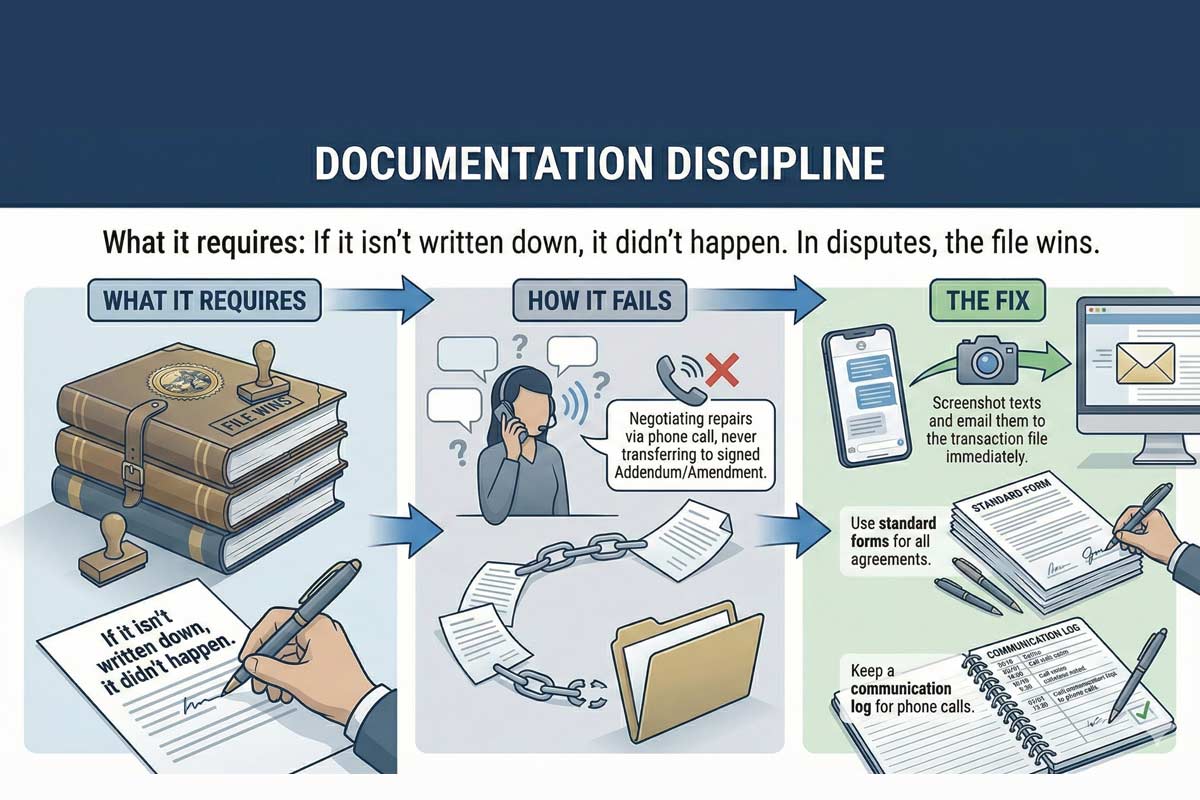
What it requires: If it isn't written down, it didn't happen. In disputes, the file wins.
How it fails: Negotiating repairs via phone call and never transferring those agreements to a formal Addendum or Amendment that is signed by all parties.
The Fix:
Here is how to handle the four biggest ethical traps using correct DRE discipline prevention tactics.
Misrepresentation is the #1 cause of lawsuits. It happens when you pass along bad info as fact—a risk you can mitigate by learning How to Avoid Misrepresentation in CA Transactions.
The market heats up, and greed takes over. This is where Handling Multiple Offers Ethically becomes your safety net against bias complaints.
Representing both sides is legal, but as our Dual Agency in California Guide explains, you must walk a tightrope of neutrality.
In the digital age, strict adherence to Privacy Rules for Managing Client Information prevents you from leaking motivation and destroying negotiation power.
The Exam Focuses On:
The Real-World "Kill Zone" (Discipline Risks):
Exam Alert: On the state exam, the answer is usually the one that offers the most consumer protection. In real life, that principle still holds: protect the consumer, and you protect yourself.
What counts as misrepresentation in California real estate?
Misrepresentation encompasses three things: Innocent (accidental), Negligent (careless), and Fraudulent (intentional). Even if you didn’t mean to deceive, if you stated a fact as true without verifying it—and it turned out to be false—you can face liability for negligent misrepresentation.
Can the DRE discipline an agent for an “honest mistake”?
Yes. Negligence is a failure to use the care and skill that a reasonable real estate agent would use. If an “honest mistake” results in financial harm to a client because you were sloppy or didn’t check the file, the DRE can issue citations or fines.
What is a material fact and who decides?
A material fact is anything that would affect a reasonable person’s decision to buy or the price they would pay. Ultimately, a judge or the DRE decides, but the rule of thumb is: if it affects value, desirability, or safety, it is material.
How should agents handle dual agency ethically?
Dual agency ethical duties require you to be a neutral conduit. You cannot advocate for one side to the detriment of the other. You must disclose all material facts to both, but keep price negotiation strategy and personal motivations confidential unless authorized to share.
What should I do if my client asks me to “leave something out”?
You must explain that your license and the law require full disclosure of material facts. Refuse to follow instructions that violate the law. If a client insists on concealing a known defect, you may need to terminate the listing to avoid being an accessory to fraud.
What records should I keep to protect myself?
Statutorily, you must keep all transaction documents for at least three years (B&P Code 10148). As a best practice, you should also retain email chains and text logs that clarify why decisions were made, as these are often critical in a defense.
Viewing ethics as a burden is a mistake. Ethical duties are your roadmap to a long, profitable career without legal headaches. By adhering to the standards outlined in our California Real Estate Laws & Compliance Guide, you build a reputation as a professional who can be trusted with a client’s largest financial asset.

Founder, Adhi Schools
Kartik Subramaniam is the Founder and CEO of ADHI Real Estate Schools, a leader in real estate education throughout California. Holding a degree from Cal Poly University, Subramaniam brings a wealth of experience in real estate sales, property management, and investment transactions. He is the author of nine books on real estate and countless real estate articles. With a track record of successfully completing hundreds of real estate transactions, he has equipped countless professionals to thrive in the industry.


"Hey guys,
I took the exam today and passed!!!!
It only took me one try which was one of my goals. I took the online
classes and follow your suggestions so I took the crash course,
used the crash course app a lot, took 7 mock tests and went
confident to present the exam. Thank you for the great job you are
doing, you guys are awesome!!!! May God continue to bless you!"
Willie V.