Please be sure to check with your broker/manager on unique circumstances and that you are following local best practices.
The "Paper Trail" Rule: In California real estate, if it isn’t in Read more...
Please be sure to check with your broker/manager on unique circumstances and that you are following local best practices.
The "Paper Trail" Rule: In California real estate, if it isn’t in writing, it didn’t happen. To protect your license and your client’s deposit, you must confirm: deadlines, deposit receipts, disclosure receipts, contingency periods, and repair agreements in the file.
Your buyer wants to write an offer.
Congratulations!
But as the initial rush of adrenaline fades, it’s replaced by a sinking feeling. You’re staring at the C.A.R. California Residential Purchase Agreement (RPA)—the 16-page "operating system" of your deal.
Your client is asking, "What does this paragraph mean?" and your managing broker is asking if you've seen the seller disclosures. I’ve spent over 20 years coaching agents through these moments. This guide is your pseudo-mentor-in-the-room to help you navigate the Residential Purchase Agreement California with confidence.
New Agent Quick-Start: 5 Things to Do Immediately After Acceptance
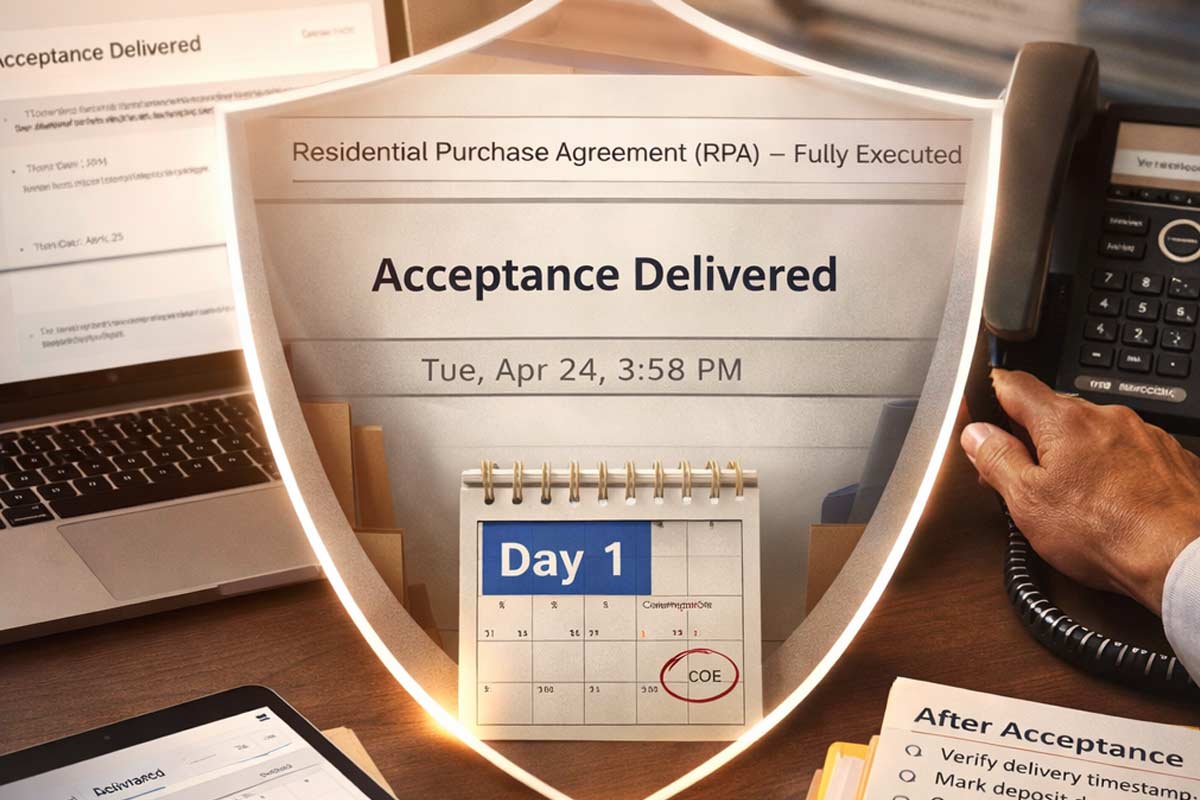
Mark the Calendar: Calculate "Day 1" (the day after acceptance) and circle the COE date.
EMD Verification: Call your buyer and ensure they have a verified phone number for escrow to confirm wire instructions.
Audit the File: Confirm you have a fully executed RPA with all signatures and initials.
Order Inspections: Initiate these immediately to ensure you stay within your investigation window.
Confirm Delivery: Verify that the signed acceptance was delivered to the other side and document the timestamp.
What is the C.A.R. RPA?
The C.A.R. Residential Purchase Agreement (RPA) is the most commonly used standard-form contract used by California real estate agents to facilitate home sales. It acts as the legal "rulebook," outlining price, contingencies, and the specific responsibilities of both buyer and seller.
Main Parts of the RPA Explained:
Agency & Representation Disclosures: Confirmation that the How to Explain Agency Disclosure Form AD was delivered (a separate, mandatory requirement).
Price & Financing Terms: A summary of the purchase price, EMD, and loan details.
Closing & Possession: When the buyer officially gets the keys.
Inclusions/Exclusions: What stays (fixtures) and what goes (personal property).
Allocation of Costs: Who pays for inspections, reports, and home warranties.
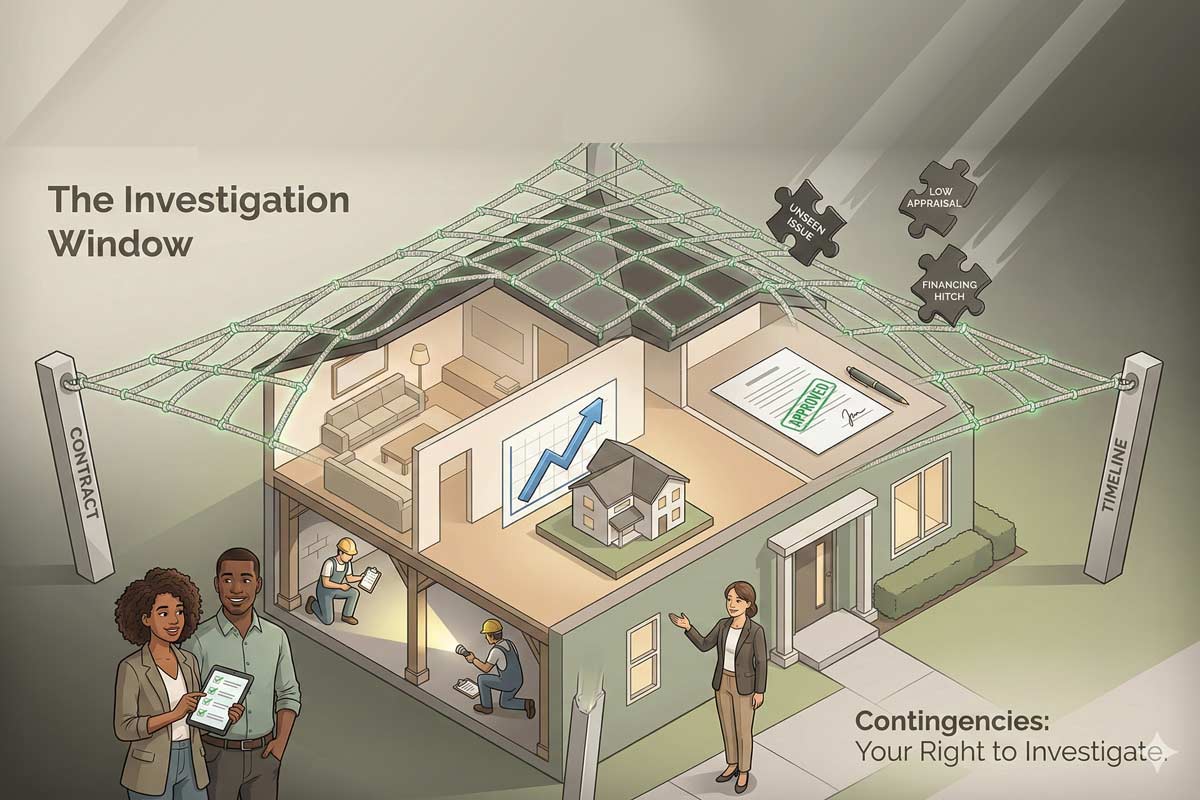
Contingencies: The buyer’s "safety nets" for investigation and financing.
Disclosures: The seller's history and knowledge of the property.
Remedies: What happens in the event of a breach of contract.
Coaching Tip: Open your current digital RPA and use Cmd+F (Mac) or Ctrl+F (Windows) to search these specific keywords for quick navigation: Deposit, Escrow, Time Period, Days, Contingency, Investigation, Disclosures, Repair, Possession, Mediation, Arbitration, Liquidated Damages.
The RPA Map: Decisions & Search Terms
Decision you’re making
Search this in the RPA
What it controls
Rookie mistake
Paper-trail proof
Price & Financing
"Purchase Price", "Loan"
Final sales price and loan terms.
Leaving loan terms blank.
RPA + Proof of Funds in transaction file.
Deposit (EMD)
"Deposit", "Escrow"
How much "skin" the buyer has in the game.
Missing the delivery deadline.
Escrow deposit receipt PDF + email confirmation.
Time Periods
"Time Period", "Days"
Every contractual deadline.
Thinking "days" always means business days.
Digital calendar with all dates circled.
Investigations
"Investigation", "Inspection"
The buyer's right to check the home.
Not ordering inspections immediately.
Reports + written agent confirmation.
Appraisal/Loan
"Appraisal", "Lender"
Buyer’s exit if value or loan fails.
Promising "no problem" with value.
Written appraisal/Loan status update.
Disclosures
"TDS", "SPQ"
Seller’s legal history of home.
Late delivery (triggers exit rights).
Signed Receipt of Disclosures acknowledgment.
Repairs/Credits
"Repairs", "Request"
Negotiated fixes or price drops.
Promising repairs verbally.
C.A.R. addendum + contractor receipts.
Possession
"Possession", "Occupancy"
When the buyer gets the keys.
Giving keys before escrow closes.
C.A.R. possession agreement in file.
Disputes
"Mediation", "Arbitration"
How you fight if things go south.
Forgetting to check initials.
Initial sections in signed RPA.
When is the RPA Binding? (Acceptance & Delivery)
California purchase agreement explained: A contract is not binding just because everyone signed it. It is binding once there is Acceptance AND Delivery.
Where to look: Search "Acceptance" and "Delivery."
The Agent Move: Immediately after the final party signs, email the fully executed document to the other agent.
Paper Trail: Save the email confirming acceptance was delivered with a visible timestamp.
Timelines, Days, and Deadlines
In California, time is a contractual commitment.
Where to look: Search "Time Period" and "Days."
The Evergreen Rule: In many contracts, if a deadline falls on a weekend or holiday, performance may roll to the next business day—confirm this in your specific contract and with your broker.
Client Translation: "We treat every deadline as a hard commitment. If we miss one, the other side may gain the right to cancel our deal."
Inclusions & Exclusions: What Stays?
Arguments over refrigerators and chandeliers can kill a deal at the eleventh hour.
Where to look: Search "Inclusions," "Exclusions," "Fixtures," and "Personal Property."
Rookie Mistake: Writing "All appliances included" is too ambiguous.
Paper Trail: Maintain a written list with photo confirmation. If anything is negotiated during the process, document it with a C.A.R. addendum or possession agreement (this could be done on a few different forms so confirm current form name/version with broker).
Contingencies: Inspection, Appraisal, and Loan
Contingencies are your buyer’s exit ramps. For a deep dive on how to manage these forms, see our guide on CAR Forms Every New Agent Should Know.
Where to look: Search "Contingency" and "Investigation."
The Agent Move: Use the RPA contingency removal (Form CR) to document every step.
Client Translation: "These are your safety nets. We have a set period to do our homework. If the house isn’t what we thought, we can walk away with your deposit intact—as long as we act before the deadline."
Disclosures: Managing Risk
Late or corrected disclosures can reopen investigation windows or create new cancellation rights—treat disclosure delivery as a high-risk clock.
Coach Kartik's Experience: I once worked with an agent who delivered a supplemental disclosure two days before closing. Because it revealed a prior roof leak not mentioned in the SPQ, the buyer gained a fresh right to cancel, and they used it to renegotiate a $10,000 credit. Documentation is your shield here.
Where to look: Search "Disclosures" and "TDS."
The Agent Move: Use the California Real Estate Laws & Compliance Guide to ensure your file meets the statutory requirements.
Repairs, Credits, and Allocation of Costs
Where to look: Search "Costs," "Fees," and "Repairs."
The Compliance Rule: Never promise a specific repair outcome until it is signed by both parties. Ensure the scope is in writing: who is doing the work, what is being fixed, by when, and how proof of completion will be delivered.
Cancellations: Notices and Defaults
Cancellations usually happen after a party fails to meet a deadline.
Where to look: Search “Notice,” “Perform,” “Default,” “Cancel,” and “Remedies.”
The Process: If a buyer misses a deadline, the seller typically issues a Notice to Buyer to Perform (NBP). If the buyer still doesn't comply within the window stated in the contract, the seller may have the right to cancel.
Deep Dive: For a full map of this process, see Cancellation Rights in California Transactions.
Possession and Rent-Backs
Where to look: Search "Possession" and "Occupancy."
The Agent Move: If the seller is staying past the close of escrow, you need a C.A.R. possession agreement (confirm the current form name/version with your broker).
Dispute Resolution and Liquidated Damages
Where to look: Search "Mediation," "Arbitration," and "Liquidated Damages."
The Safeguard: Missing a deadline can trigger contractual remedies or cancellation rights—treat deadlines as hard and confirm with your broker.
Wire Fraud Safeguard: I recently saw a spoof attempt where a buyer received "updated" wire instructions via email. Because they followed the rule to call a known number from the escrow company's official website, they realized the email was fraudulent and saved their $50,000 deposit.
The Move: Confirm the last 4 digits of the account verbally before sending. See California Anti-Fraud Rules in Real Estate for more.
RPA Milestone Checklist
Immediately After Acceptance:
Verify Delivery of Acceptance timestamp.
Mark the Deposit Due Date as stated in your accepted RPA (Common example: 3 days).
Within the Investigation Window:
Order all inspections (Home, Pest, Roof, Drainage, etc.).
Log the Disclosure Delivery Target date.
Before Contingency Removal Deadline:
Review appraisal value and loan status.
Confirm contingency removal strategy with client and broker.
Before Close (COE):
Conduct the final walkthrough.
Verify Escrow deposit receipt PDF is saved to the transaction file.
From Agent to Professional
Mastering the RPA is about becoming a diligent project manager. It’s not about being a lawyer; it’s about protecting your client’s interests through every "search term" and "time period."
This guide is just one piece of the puzzle. For the full picture on staying lawsuit-free, visit our California Real Estate Laws & Compliance Guide.
FAQ
What is the C.A.R. RPA?
The RPA is the most commonly used standard-form contract for California home sales, detailing the terms, conditions, and timelines of the transaction.
Is the RPA legally binding?
Generally, yes, once signed by all parties and delivered. However, specific performance depends on meeting all conditions. Consult your broker for edge cases.
What’s the difference between acceptance and delivery?
Acceptance is the act of signing the agreement. Delivery is the act of providing that signed document to the other party (or their agent). Both must occur for the contract to be binding.
What does liquidated damages mean in plain English?
It is a pre-agreed amount (usually capped at 3% for owner-occupied residential property) that the seller can keep as a penalty if the buyer breaches the contract.
What happens if contingencies aren’t removed?
The contract stays alive, but the seller can issue a Notice to Buyer to Perform (NBP). If the buyer still doesn’t remove them within the cure period stated in the contract, the seller may have the right to cancel.
Can the seller cancel after acceptance?
Generally, no. The seller cannot cancel just because they got a better offer. They can usually only cancel if the buyer fails to perform on contractual obligations.
How do I prevent wire fraud in escrow?
Always verify wire instructions via a phone call to a known, trusted number from a prior transaction or the escrow company's official website.
|
Disclaimer: This is educational information, not legal advice. Your broker is your first stop for contract questions; for legal interpretation, consult a California real estate attorney.
TL;DR: The Read more...
Disclaimer: This is educational information, not legal advice. Your broker is your first stop for contract questions; for legal interpretation, consult a California real estate attorney.
TL;DR: The Quick Framework for Clarity
The Goal: Translate "legalese" into "process." Do not interpret law; explain the mechanics of the transaction.
The Rule: Use the "3-Layer Explanation" (Meaning, Risk, Next Step) or the "2-Sentence Rule" for high-pressure moments.
The Limit: If a client asks for legal consequences or liability, refer them to your broker or an attorney immediately.
Contract Terms Clients Panic Over (Plain-English Index)
Earnest Money Deposit (EMD): The initial deposit that secures the contract. It is held by a third-party escrow holder, not the seller, and its release is governed by the terms of the purchase agreement.
Contingencies: The "safety hatches" that allow for investigation and cancellation.
Deadlines / Notice to Perform (NTP): The "alarm clock" that keeps the deal moving.
Removal of Contingencies (CR): The moment a buyer becomes fully committed to the purchase and risk losing their deposit after all contingencies have been removed.
Repairs vs. Credits: The choice between physical fixes and financial concessions.
Appraisal Gap: What happens when the appraised value doesn't match the purchase price.
Arbitration: How disputes are handled outside of a courtroom.
Liquidated Damages: The pre-set financial consequence (from the deposit) if a buyer fails to complete the purchase without a valid, contractual reason to cancel.
The Hook: The Contract Is Not the Product — Clarity Is
You’ve successfully deployed every negotiation tactic in the California agent’s playbook, and your client’s offer is finally accepted. You open the California Residential Purchase Agreement (RPA) with your client, and the atmosphere shifts. The client rereads the "Liquidated Damages" section and the panic sets in: "Wait, am I being sued? Is my deposit gone?"
In this guide, I’m not showing you how to “interpret” the RPA—I’m showing you how top California agents explain terms as process + timeline + decision points, and when to escalate to your broker.
As I have taught for over 20 years, your job isn't to sound like a lawyer—it’s to create calm through correct expectations. High-performing agents operate with a "clinical" energy. They don't get emotional about the fine print; they explain the machinery of the escrow so the client can make a rational decision. Mastery of these explanations is a foundational Real Estate Agent Skill for anyone moving from "licensee" to "professional operator."
The Frameworks: How to Explain Anything Clearly
The “3-Layer Explanation”
When a client asks about a specific term, structure your response this way:
Plain-English Meaning: A one-sentence summary.
Why It Matters (Risk/Benefit): How it protects them or what they are committing to.
What Happens Next (Timeline + Decision): The specific action required.
The 2-Sentence Rule (For Nervous Clients)
When a client is spiraling, they don’t need a lecture. They need an anchor.
Sentence 1: What it is.
Sentence 2: What decision it controls / what happens next.
Follow-up: "Want the deeper version?"
The 8 Terms That Cause 80% of Confusion
1. Earnest Money Deposit (EMD)
The Fear: "Is the seller taking my money today?"
The Script: "Your deposit is held in a neutral escrow account, not by the seller. What happens to it depends on timing, contingencies, and the paperwork. My job is to protect the timeline, document everything, and loop in my broker if we hit a cancellation question."
2. Contingencies (The "Safety Hatches")
The Fear: "Am I locked in the moment I sign?"
The Script: "Contingencies are your investigation window. If something doesn’t check out, there’s a contract process to respond, negotiate, or cancel—what’s available depends on timing and documentation."
3. Timelines and the Notice to Perform (The “Alarm Clock”)
The Fear: "Are we being sued?"
The Script: "This isn’t a lawsuit. It’s the deal’s alarm clock. It’s the seller saying, ‘Are we moving forward or not?’ Let’s look at what’s due, confirm our timeline, and then we’ll respond properly in writing."
Note: Misunderstanding these deadlines is a leading cause of avoidable, deal-killing mistakes in California.
4. Removal of Contingencies (CR)
The Fear: "What happens if I sign this?"
The Script: "Once these are removed, you’ve reduced your ‘exit ramps,’ and cancellation risk increases—this is a broker-confirm moment if you’re unsure. Signing this means you are satisfied with your investigations and you are moving to 'committing’ and your deposit is generally no longer refundable.
5. Repairs vs. Credits
The Fear: "Can I ask for anything if it's 'as-is'?"
The Script: "We can ask for a credit—which is the seller paying some of your closing costs—so you have the cash to fix this after you move in. It’s often cleaner than asking a seller to do a rush repair. This is where strong negotiation tactics for California agents matter—because you’re trading certainty, timeline, and money."
6. Appraisal Gap Risk
The Fear: "What if the bank says the house isn't worth the price?"
The Script: "If the appraisal is low, the bank only loans based on that number. We then negotiate to bridge the gap. Knowing how to handle appraisal gaps in California before we start is how we protect your down payment."
7. Arbitration (The “Dispute Path”)
The Fear: "Am I losing my rights?"
The Script: "This section is about the process for resolving disputes if something goes sideways. I can explain what the clause is designed to do in the transaction, but for legal interpretation of your rights, we should confirm with an attorney."
8. Liquidated Damages (The “Deposit Risk Concept”)
The Fear: "Do I automatically lose my deposit if I back out?"
The Script: "This addresses potential deposit-related consequences if a buyer breaches after commitment. I can walk you through where this sits in the process, but for legal meaning and exposure, we should confirm with my broker or an attorney."
The Buyer vs. Seller Lens
Term
Buyer Lens (Protection)
Seller Lens (Certainty)
EMD
Shows you are a serious, qualified buyer.
Shows buyer commitment and reduces flake risk.
Contingencies
Your right to "look under the hood."
The hurdles that must be cleared to get to a closed sale.
Appraisal Gap
Protects you from overpaying/under-financing.
The risk that the deal might fall apart late in escrow.
The “Plain-English Summary” You Can Email Clients (Template)
What you signed: (Summarize offer price + key terms)
Your protections: (List inspection/appraisal/loan windows)
Your deadlines: (EMD due date, inspection end date, appraisal date, CR date)
Your next decision: (Remove contingencies vs. renegotiate)
Broker/legal boundary: (We explain process; broker/attorney interprets liability)
Top-Producer Habit: The 3-Email System
Email 1: "The Contract in Plain English" (Sent immediately after offer submission). Summarize the Big 3: Price, Contingency Periods, and Closing Date.
Email 2: "The Timeline & Decision Points" (Sent at Day 1 of Escrow). A bulleted list of dates for EMD deposit, Inspection end, and Appraisal.
Email 3: "Before You Remove Contingencies" (Sent 2 days before CR is due). A checklist of everything discovered so the client feels confident signing the CR.
The “Red Flag” Moment: When to Pause and Escalate
A professional operator knows the edge of their expertise. Stop explaining and route to your broker or an attorney if:
The client asks: "What is the maximum I can be sued for if I breach this?"
The client wants to add custom, "legal-sounding" language to an addendum.
The deal involves complex tenant-occupied issues or probate laws.
The client threatens litigation against the other party.
The "Safety" Script:
"That’s a great question regarding the legal interpretation of this clause. As your agent, I can explain how this usually works in the transaction process, but for a definitive legal opinion on your liability, I recommend we pause and you speak with an attorney."
FAQ: Common Client & Agent Questions
What does "contingency" mean in real estate?
In California, a contingency is a condition that must be met (or waived) for the deal to stay alive. Common ones include home inspections, the appraisal, and final loan approval.
What happens if I miss a deadline in escrow?
If a deadline is missed, the other party may issue a "Notice to Perform." This gives the lagging party a set amount of time (often around 48 hours—always check the actual notice) to complete the task or risk the other party cancelling the deal.
Why are there multiple offers and what do we do?
Multiple offers mean the market is highly competitive. To win, we need to focus on "clean" terms—shorter contingency periods and solid proof of funds. Mastery of how to present multiple offers in California is how we navigate this for sellers and buyers alike.
What is the “as-is” clause in California real estate?
“As-is” usually means the seller isn’t promising repairs, but it does not remove a buyer’s right to investigate or the duty of the seller to disclose known material facts.
What should I do if my agent/buyer/seller is confused about a clause?
Ask for the plain-English “meaning + timeline + next step,” then confirm anything involving liability, legal interpretation, or unusual addenda with your broker/attorney.
Clarity is the ultimate value-add in California real estate. If you can take a 25-page legal document and turn it into a clear, manageable roadmap, you aren't just an agent—you are a consultant.
Your ability to explain these terms safely and clearly protects the deal and your reputation. Ready to level up your full skill stack? Explore our comprehensive guide to Real Estate Agent Skills California.
Stay clinical. Stay clear. Close the deal.
|

The appraisal just came in $40,000 short on a Huntington Beach bungalow, and your seller is screaming that the appraiser "has it out for them." Or perhaps you’re in the tenth hour of a Silicon Valley Read more...
The appraisal just came in $40,000 short on a Huntington Beach bungalow, and your seller is screaming that the appraiser "has it out for them." Or perhaps you’re in the tenth hour of a Silicon Valley bidding war, and your buyer—usually a calm tech executive—is sobbing because they’re afraid of being outbid for the sixth time. In these high-stakes moments, your knowledge of the purchase agreement matters far less than your ability to steady the ship.
Your ability to manage emotions—yours and your clients’—is the #1 determinant of your survival and success in California real estate.
EQ: The Core of Your Professional Skill Stack
At ADHI Schools, we don’t view emotional intelligence for real estate agents as a "soft skill." It is a technical competency. Just as you must learn to navigate the Residential Purchase Agreement (RPA), you also have to learn to navigate the human limbic system. This guide is a deep dive into one specific layer of the Real Estate Agent Skills California framework: the ability to remain the clinical, calm authority when a transaction turns volatile.
To lead others, you must first lead yourself. If you are still finding your footing in the industry, learning How to Build Confidence as a New Agent is the prerequisite for the high-level EQ maneuvers required in today's market.
Why Emotional Intelligence is a Deal-Breaker for California Agents
Most deals don’t die because of the math; they die on tone. In California’s aggressive, high-priced markets, a lack of EQ creates a "feedback loop of anxiety" that leads to terminated escrows and burned bridges.
Terminated Escrows: Clients make permanent decisions based on temporary fears.
Reputation Damage: High-stress reactions can damage your standing with other agents, escrow officers, and lenders.
The "Anxiety Tax": Low EQ acts as a direct tax on your business. The agent pays this price in the form of lost commissions, zero referrals, and a brand associated with chaos rather than competence.
The Reality: EQ is a financial skill. You are either the one calming the room, or you are the one paying the price for the conflict.
The ADHI EQ Protocol: P.A.U.S.E. to Lead
Having trained thousands of California agents over 20+ years, Kartik Subramaniam’s field-tested method for de-escalation is the P.A.U.S.E. protocol. When a deal gets "hot," do not react—lead.
P: Pause Your Physiology. Take a three-second breath. Slow your speech. If your heart is racing, you cannot lead.
A: Acknowledge the Emotion. Name it out loud for the client. "I can see how frustrating this inspection report is for you."
U: Uncover the Need. Fear is usually about security, money, or time. Is the seller mad about the repair, or afraid they won't have the cash for their next down payment?
S: Structure the Path Forward. Offer 2-3 clear, logical options to regain a sense of control.
E: Execute with Calm Authority. Direct the next concrete step immediately to move past the emotional block.
Firefight Scenarios (The Proof)
Here is how the protocol saves deals in real-world California "firefights."
Scenario: The Inspection Renegotiation Standoff
The Amateur's Reaction: "The buyer is being totally unreasonable. This deal might be dead."
The EQ Agent's P.A.U.S.E. Response: "I hear that this request feels like an insult after you've cared for this home for 20 years. But let's look at the goal: getting you to your new home in Arizona by the 15th. We can offer a credit, fix the major items, or hold firm and risk the buyer walking. Which keeps your moving truck on schedule?"
Why This Works: It validates the ego while refocusing on the client's ultimate objective.
Scenario: The Appraisal Gap Crisis
The Amateur's Reaction: "I can't believe this appraiser. We're going to have to ask the seller to drop the price, but they'll never do it."
The EQ Agent's P.A.U.S.E. Response: "The appraisal came in under our price, which is a common hurdle in this market. I know it’s stressful to think about the extra cash, but let’s look at the long-term value of this neighborhood. We can appeal the appraisal, negotiate something with the seller, or cover the gap. Which option feels most manageable for your monthly budget?"
Why This Works: It treats a crisis as a "common hurdle," lowering the client's panic levels through logical choice.
De-escalation Scriptbook for Tense Conversations
Keep these bolded lines in your "mental holster." Effective EQ fails when agents cannot Master Real Estate Terminology Fast and explain complex issues simply under pressure.
The Reframe: “I hear this is frustrating. Let’s look at what we can control in this situation.”
The Empathy Bridge: “If I were in your shoes, I’d feel the exact same way. Here is how we navigate this.”
The Clarity Check: “Before we react to this news, what is the most important outcome for your family right now?”
The Logic Pivot: “I understand the emotion behind that number, but the data the appraiser is looking at says 'X'. How do we bridge that gap?”
The Validation: "It makes total sense why you're feeling defensive about this request."
The Goal Alignment: "I want to make sure we don't let a temporary frustration get in the way of your move to San Diego."
The "Next Step" Directive: "We don't need to solve everything today. Let's just focus on the counter-offer strategy."
By mastering Communication Skills That Separate Top Agents from the Rest, you ensure your delivery remains as professional as your strategy.
The EQ Negotiation Advantage
In California’s aggressive multi-counter environment, emotional intelligence for real estate agents is a secret weapon.
The Strategic Pause: Silence is a powerful tool. After delivering an offer or counter, stop talking. Silence is uncomfortable for low-EQ agents; they will often fill it by revealing their client's bottom line.
Anchoring with Empathy: “I understand why that number feels right to you. Based on the current inventory in this zip code, however, the market is moving closer to...”
Pre-Negotiation EQ Check
Have I identified my client’s core fear (Money, Security, or Time)?
Am I calm enough to hear irrational terms without reacting defensively?
Am I prepared to use the "Strategic Pause" during the next call?
The 5-Minute Daily EQ Drill
You don't build EQ during the crisis; you build it in between deals. Practice The Post-Call 60: After any hard call, take 60 seconds to ask:
What emotion did I feel?
What emotion did my client feel?
Did I lead the conversation or just react to it?
The Path to Mastery
Emotional intelligence is the technical skill of building trust and closing deals when things go wrong. Mastering EQ is one of the Essential Skills Every New California Agent Must Master if they want to move from "surviving" to "thriving."
Reputations are built when deals are falling apart. To build a sustainable, high-income career, you must combine this emotional mastery with the full stack of Real Estate Agent Skills California.
Frequently Asked Questions
How can a real estate agent improve their emotional intelligence?
Improving EQ starts with physiological self-regulation and intentional reflection. Practice the P.A.U.S.E. protocol by consciously slowing your breathing and speech during tense calls, and use the "Post-Call 60" drill to analyze your reactions after every client interaction.
What is an example of emotional intelligence in real estate?
An example is staying neutral when a listing agent is aggressive during a multiple-counter-offer situation. A high-EQ agent recognizes the other agent's stress, refuses to mirror the aggression, and keeps their own client focused on the data rather than the conflict.
Why is EQ more important than IQ for California agents?
While IQ handles contracts and data, EQ keeps the deal alive during the "emotional middle" of escrow. Most California escrows fall through due to unmanaged stress or personality conflicts; EQ is the bridge that keeps buyers and sellers moving toward the finish line.
How does EQ help with real estate negotiations?
EQ provides a strategic advantage by allowing an agent to read the underlying motivations of the opposing party. By identifying what the other side is afraid of—such as a long closing date—you can frame your offer to provide them security while still winning the best terms for your client.
Can emotional intelligence be learned?
Yes, emotional intelligence is a set of skills—self-regulation, empathy, and social management—that can be developed through coaching and deliberate practice. Unlike IQ, which is relatively fixed, your ability to lead others through stress can be significantly improved with training and practice.
|

You are sitting in your car in a driveway in Irvine or Walnut Creek, staring at a repair request that just came in. Your seller is already livid because they feel they "gave away the house" on price. The Read more...
You are sitting in your car in a driveway in Irvine or Walnut Creek, staring at a repair request that just came in. Your seller is already livid because they feel they "gave away the house" on price. The buyer is threatening to walk over a water heater and some minor electrical work. Most agents at this moment start sweating, worried about their commission or the deal falling apart. They start "pushing" both sides, which usually results in everyone feeling like they lost.
Negotiation isn’t about being a "shark" or a "closer." In the California market, negotiation is a technical competency involving the structure of the deal, the flow of information, and the temperature of the room. Negotiation is one layer inside the broader Real Estate Agent Skills California framework—when you master it, everything else (pricing, scripts, client control) gets easier. Having coached thousands of California agents over the last 20+ years, I’ve seen that the most successful negotiators aren't the loudest—they are the most prepared.
Key Takeaways
Control the Frame: Whoever sets the parameters of the conversation usually wins.
Trade, Don't Give: Never concede a point without getting something in return.
Emotion vs. Numbers: Reframe emotional outbursts into transactional math.
Master the RPA: Leverage the timelines built into the California Residential Purchase Agreement.
The ADHI Negotiation Stack: A Five-Step Framework
To win consistently, you need a repeatable process. Use this stack to organize your thoughts before you pick up the phone:
CLARITY: Know exactly what your client needs (e.g., "Must close by the 15th") versus what they want ("A $5,000 credit").
LEVERAGE: Identify the pressure points. Is the seller in escrow on a replacement property? Is the buyer’s rate lock expiring?
OPTIONS: Never present a client with a "Yes/No" choice. Provide 2–3 paths forward to keep them in control.
TIMING: Use the clock and contract timelines to restore urgency. Formal notices can create clarity, but use them strategically and in line with your broker’s process.
DOCUMENT: If it isn't in writing, it didn't happen. Move verbal agreements to a C.A.R. form immediately.
The 30-Second Rule Before Any Negotiation Call
Before dialing the other agent, ensure you can answer these four questions:
What’s the ask? (The specific outcome you want)
What’s the trade? (What you are willing to give up to get it)
What’s the deadline? (When the offer or response expires)
What’s the written next step? (Which C.A.R. form will you send immediately after?)
12 Essential Real Estate Negotiation Tactics
1. Framing & Anchoring
When to use: Presenting the first offer or a counter-offer.
Why it works: The first number or condition mentioned sets the psychological "anchor."
Script: "Based on the four most recent comps in this area, we are coming in at $950k. This number reflects the current market reality while acknowledging the property's condition."
2. The "Two Options" Close
When to use: Resolving a deadlock.
Why it works: It prevents "analysis paralysis" and makes the client feel in control.
Script: ""We can either offer them a $3,000 credit toward their closing costs, or we can fix the roof leak ourselves prior to close. Which path would you prefer?"
3. Strategic Concession (The Trade)
When to use: Presenting the first offer or a counter-offer.
Why it works: If you give for free, they ask for more. If you trade, they realize concessions are expensive.
Script: "My seller is willing to leave the high-end refrigerator, but in exchange, we need to shorten the inspection contingency to 10 days."
4. Strategic Silence
When to use: Immediately after delivering a counter-offer or a hard "no."
Why it works: People are uncomfortable with silence and often talk themselves into a weaker position just to fill the void.
Script: [State your terms clearly]... [Wait 5–10 seconds].
5. Deadline Urgency
When to use: When the other side is dragging their feet on contingency removals.
Why it works: It forces a "fish or cut bait" moment using the contract timeline to restore clarity and urgency.
Script: "We’re past the agreed contingency timeline. My sellers want to stay on track for closing, so we need a clear update today on whether your buyer is removing contingencies or requesting an extension in writing."
6. Information Guarding
When to use: During initial "get to know you" calls with the other agent.
Why it works: Revealing your client's desperation (e.g., "They already bought a house in Texas") kills your leverage.
Script: "My clients are very motivated to find the right buyer who can appreciate the upgrades they've made."
7. Repair-to-Credit Pivot
When to use: After a difficult home inspection.
Why it works: Credits are cleaner for sellers and don't require the agent to manage contractors.
Script: "Rather than having the seller manage these repairs, why don't we do a $4,000 credit? It allows your buyer to choose their own contractors after they move in."
Real-world example: I’ve seen deals nearly die over a 12-item repair list where the seller felt “nickel-and-dimed.” We pivoted to a credit tied to two high-impact concerns (safety + major system), and the buyer accepted within an hour—because they didn’t want contractor scheduling to delay closing.
8. The "What If" Question
When to use: Testing the waters before a formal counter.
Why it works: It allows you to find boundaries without committing in writing first.
Script: "What if we could get closer to your price, but kept the closing date exactly where the seller needs it? Is that something your buyers would entertain?"
9. Escalation Positioning
When to use: In a highly competitive multiple-offer environment.
Why it works: It shows the seller your buyer is serious about winning without starting at their absolute ceiling.
Script: "We’ve included an escalation clause that beats the highest verifiable offer by $5,000, up to a cap of $1.1M." (Note: Ensure you know How to Present and Win Multiple-Offer Situations before using this).
10. The Appraisal Gap Anchor
When to use: When you know a property might not appraise at the offer price.
Why it works: It solves a future problem before it kills the deal.
Script: "We love your offer, but to move forward, we need a 'gap' clause stating the buyer will cover up to $20k if the appraisal comes in short."
Real-world example: In one coastal California deal, the buyer “won” at a premium price—then froze when the appraisal came in short. Because we had already framed a clear plan, the renegotiation became math, not panic, and escrow stayed alive.
11. Reframing Emotions back to Numbers
When to use: When a client is taking a negotiation personally.
Why it works: It detaches ego from the transaction.
Script: "I understand that their offer feels like an insult. But let’s look at the math: at this price, you still walk away with $400k in equity. Does $5,000 in emotion outweigh $400k in reality?"
12. The BATNA (Best Alternative To Negotiated Agreement) Thinking
When to use: Deciding whether to walk away.
Why it works: You cannot negotiate effectively if you are afraid to lose the deal.
Script: "If we can't reach an agreement here, we are prepared to go back on the market on Friday. We had three other parties at the open house who were very interested."
California-Specific Guardrails: Stay Clean, Stay Professional
Negotiation can be a high-wire act. California paperwork and brokerage policies vary—use these tactics as a framework and follow your broker’s specific process for notices, counters, and timelines.
Never Misrepresent Offers: Don’t play games with phantom offers. It’s unethical, risks your license, and can blow up trust with the other side instantly.
Verify the Lender: A high price means nothing if the lender can’t perform. Always call the loan officer.
Document Everything: Verbal agreements are worthless. Use the RR (Request for Repair) and RRRR (Seller Response to RR) forms correctly. If you are unsure of the phrasing, learn How to Explain Contract Terms to Clients Clearly so you don't over-promise.
Follow Broker Policy: Every brokerage has specific rules on escalation clauses. When in doubt, consult your manager.
Mini Playbooks: 3 Quick Scenarios
Scenario 1: Multiple Offers Appear
If you're on the listing side, don't just pick the highest price. A cash offer at $900k is often better than a financed offer at $920k with a massive appraisal gap. Master the strategy for How to Present and Win Multiple-Offer Situations to guide your seller.
Scenario 2: The Appraisal Gap Appears
When the appraisal comes in $30,000 short, you have three choices: price drop, more cash, or meet in the middle. When this happens, follow the step-by-step scripts in How to Handle Appraisal Gaps in California to save the escrow.
Scenario 3: The Repair Showdown
The buyer wants $10,000 in repairs; the seller wants zero. To keep escrow alive, follow How to Avoid Deal-Killing Mistakes—and focus on the "Big Three": Health, Safety, and Structural issues. Everything else is a trade.
Negotiation Is a Skill, Not a Personality
Many new agents believe you have to be born a "natural" negotiator. That is a myth. Negotiation is a practiced skill. When you walk into your next negotiation, remember: you aren't there to fight; you are there to solve a problem. Sticking to the Real Estate Agent Skills California framework ensures you remain the calm, clinical professional your clients hired.
Frequently Asked Questions
How do I negotiate repairs without losing the buyer?
Negotiating repairs requires prioritizing health and safety items while offering a credit for cosmetic or minor issues. This keeps the seller from feeling "nickeled and dimed" while ensuring the buyer feels the property is safe.
What should I say when the other agent goes silent?
When an agent goes silent, do not fill the void with concessions. Use a professional check-in: "I wanted to follow up on our counter-offer. My sellers are looking for a response so they can plan their weekend. Do you have an update from your clients?"
How do I negotiate contingencies in the California RPA?
Contingencies are negotiated by adjusting the number of days for the inspection, appraisal, and loan periods. Shortening these periods is a powerful trade when asking the seller for a lower price or credits.
What is the most important negotiation tactic for real estate agents?
The most important tactic is the Strategic Trade. Never give a concession without asking for something in return to maintain the value of your client's position.
Should I use an escalation clause in California?
Escalation clauses can be effective but must be used with caution and broker approval. Many California sellers prefer a "Highest and Best" call to avoid the complexity of multiple triggers.
Do This Before You Call the Other Agent:
What do we need vs. what do we want?
What is our real Plan B (BATNA)?
What deadline matters most right now?
What can we trade (not give)?
Which C.A.R. form is the cleanest path for this next step?
Ready to level up your professional game? Ensure you have mastered the complete list of Real Estate Agent Skills California to dominate your local market.
|

Imagine an appraisal comes in at $860,000 on a $900,000 California escrow, and the immediate reaction is usually a mixture of panic and blame. The seller feels insulted, the buyer feels they are overpaying, Read more...
Imagine an appraisal comes in at $860,000 on a $900,000 California escrow, and the immediate reaction is usually a mixture of panic and blame. The seller feels insulted, the buyer feels they are overpaying, and both agents often get trapped in an emotional spiral.
In my 20+ years coaching California agents and keeping tons of escrows together, I’ve learned that a low appraisal is not an automatic emergency.
It is a process problem.
When the value doesn't come in at the contract price, you don't need a miracle; you need an operating system. This guide provides the tactical decision tree and scripts necessary to bridge the gap and maintain a broad set of Real Estate Agent Skills.
TL;DR: The Action Filter
If the buyer has cash + and is willing to bridge: Buyer bridges the gap (cap it in writing).
If the seller is motivated + no backups: Price reduction or hybrid split.
If the appraisal is objectively flawed: File an ROV while parallel negotiating a backup plan.
If neither party will move: Prepare for a clean cancellation and backup offer execution.
The Appraisal Gap Math: Why the Deal Stalls
Most agents freeze because they don’t understand the lender's logic. In any financed transaction, the loan amount is based on the lower of the purchase price or the appraised value.
The Example:
Contract Price: $900,000
Appraised Value: $860,000
The Gap: $40,000
If your buyer is putting 20% down ($180,000), they expected a loan of $720,000. Because the appraisal hit $860,000, the bank will now only lend 20% of that value ($688,000). That $32,000 difference in loan proceeds—plus the original down payment—is what the buyer must now "bridge" with cash or negotiation. Knowing how to explain contract terms to clients clearly is the only way to keep them calm when these numbers shift.
The 6 Appraisal Gap Paths (Decision Tree)
1. Price Reduction (Seller Concedes)
The seller drops the price to $860,000.
Use when: The seller is highly motivated or the property has no backup offers.
2. Buyer Bridges (Cash to Close)
The buyer brings the $40,000 difference in cash.
Use when: The buyer waived the appraisal contingency or the property had high multi-offer competition and can afford to do so.
3. Split the Difference (The Hybrid)
Seller drops to $880,000; Buyer brings extra cash but the seller still takes a haircut.
Use when: Both parties are reasonable and want to "meet in the middle." This is where negotiation tactics every California agent should know become critical.
4. Seller Credit / Closing Cost Strategy
The seller gives a credit to the buyer for closing costs, which frees up the buyer’s cash to cover the $40,000 gap.
CRITICAL: Credits are capped by loan type (FHA/VA/Conventional) and occupancy. You must confirm with the lender if the credit is allowed before writing the addendum.
5. Challenge the Appraisal (ROV)
Requesting a Reconsideration of Value (ROV) by providing 3 new comps.
Use when: The appraiser missed a major sale or used properties from a different school district/neighborhood.
6. Second Opinion (Lender Switch)
Moving the file to a new lender to get a fresh appraisal.
CAUTION: This costs time, may involve a higher interest rate, and carries no guarantee of a better result. Only use this if the seller is willing to extend the escrow.
The 48-Hour Operating System (Timeline)
Hour 0–6: Audit & Verify
Verify the Appraisal Contingency deadline in the RPA.
Identify leverage: How many backup offers did we have? If you presented and won a multiple-offer situation, the seller has the upper hand without an appraisal contingency in
place.
Day 1: The Strategy Call
Call the seller to present the "Bottom Line" options.
Draft the proposal. Don't "ask" what they want to do; present the most likely path to closing if in the best interest of the client.
Day 2: Finalize or Pivot
Execute the Addendum.
If no agreement is reached, either file the ROV or prepare the cancellation paperwork.
Tactical Scripts for the Appraisal Gap
To the Seller (The "Normal Constraint" Script)
"The appraisal came in at $860,000. This is a normal lender constraint we see in appreciating markets. To keep this on track for our closing, we need to decide if we want to ask the buyer to bring the $40,000 difference, adjust our price, or find a middle ground. Given our backup offers, I suggest we hold firm on price but offer a small credit to help their liquidity."
To the Buyer’s Agent (The Collaborative Call)
"The report is light by $40,000. My seller knows the value is there. If we were to go back on the market today, we'd have five new offers by Monday. Let’s look at the cash-to-close. If my seller meets you $15k of the way, can your buyer bridge the rest to keep their rate lock in place?"
When the Seller Refuses to Reduce
"I understand the frustration. Practically speaking, however, any new buyer with a loan will likely face this same appraisal value. If we cancel now, we lose 21 days of market time and still have to deal with this $860,000 ceiling with the next lender.""
Paperwork Errors: What NOT to Do
One of the most frequent deal-killing mistakes occurs in the documentation phase.
Avoid Vague Language: Never write "Buyer to pay the difference." Instead, write: "Purchase price shall be $880,000. Buyer to provide a maximum of $20,000 in cash to bridge the appraisal gap."
Missed Deadlines: If you are filing an ROV, you must still address the Appraisal Contingency deadline. Do not let the contingency expire while waiting for the appraiser to "think about it."
Ignoring the Cap: If a buyer agrees to bridge a gap, always specify a maximum dollar amount (e.g., "Buyer to cover a gap up to, but not exceeding, $20,000").
The Professional Standard
An appraisal gap is a test of your ability to manage expectations and math simultaneously. By removing the emotion and applying a clinical operating system, you protect your client’s interests and your commission.
Ready to stop "winging it" and start mastering the full Real Estate Agent Skills California stack?
Frequently Asked Questions (FAQ)
What is an appraisal gap?
It is the difference between the contract price and the appraised value.
Can the seller dispute the appraisal directly?
No. In most cases, the dispute (ROV) must be initiated by the buyer through their lender, though the listing agent provides the data.
How long does an ROV take?
Typically 2 to 5 business days, depending on the lender’s internal review board.
Do seller credits solve a low appraisal?
Only if the buyer’s main hurdle is cash. It does not change the loan-to-value (LTV) limits set by the bank.
Should I release contingencies before the appraisal?
Generally, no. Unless your buyer has explicitly agreed to an "appraisal gap coverage" or waived the contingency to win a bidding war, you should wait for the report.
Disclaimer: This article is for educational purposes only and does not constitute legal or lending advice. Always consult with your broker and the buyer’s mortgage professional regarding specific transaction details.
|
Imagine a Friday afternoon and you’ve just listed a well-priced three-bedroom home. Within 72 hours, your inbox is a graveyard of PDF attachments. You have 12 offers, three "love letters" (which must Read more...
Imagine a Friday afternoon and you’ve just listed a well-priced three-bedroom home. Within 72 hours, your inbox is a graveyard of PDF attachments. You have 12 offers, three "love letters" (which must be handled with extreme caution related to Fair Housing), and a seller who is already mentally spending the overage.
In the high-velocity California real estate market, a multiple-offer situation isn't just a sign of success—it is a high-stakes test of your professional systems. At ADHI Schools, we teach this as a repeatable Multiple-Offer Operating System: a clinical, step-by-step method that removes emotion, protects the seller, and increases the odds of closing without post-acceptance drama.
This article serves as your field manual for presenting, positioning, and closing multiple offers without losing control of the transaction.
Navigation Cue:
Listing Agents: Focus on Sections 1, 2, 4, and 7.
Buyer’s Agents: Focus on Sections 1, 3, 5, and 6.
1. Define the Two Games: Listing-Side vs. Buyer-Side
To successfully present multiple offers in California, you must first acknowledge that your objective shifts depending on which side of the negotiating table you occupy.
The Listing Agent’s Game (Risk Mitigation): Your goal is to organize the data so the seller can make an informed, objective decision based on "certainty of close," not merely the highest number.
The Buyer’s Agent’s Game (Strategic Positioning): Your goal is to make your offer the "path of least resistance" for the listing agent and the highest "certainty" for the seller.
Mastering these dynamics is a foundational component of the Real Estate Agent Skills California framework that separates top-tier producers from the pack.
2. The Listing Agent’s Operating System (Step-by-Step)
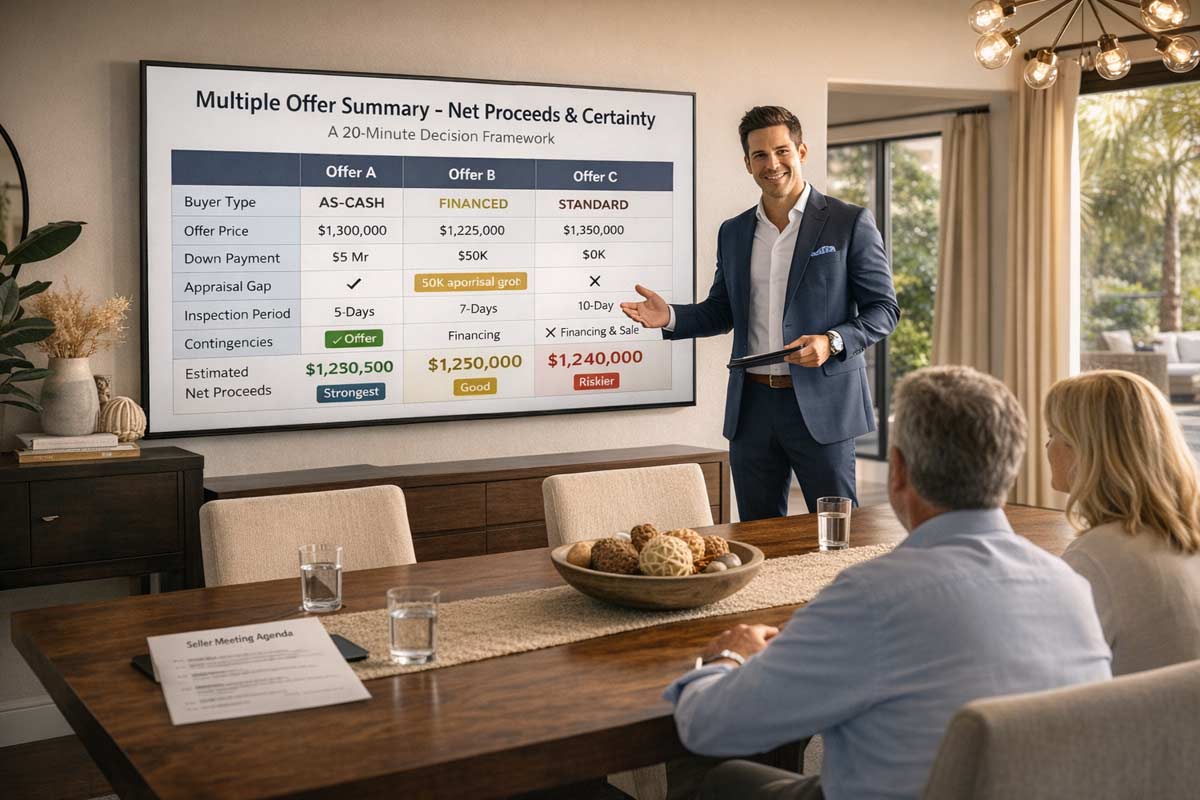
Do not present offers one by one as they arrive, they should be presented together in a non-prejudicial manner. This creates emotional fatigue for the seller and leads to sloppy decision-making. Normalize the data using an Offer Summary Sheet. You are looking for more than just price; you are also looking for the buyer’s "skin in the game."
The Listing-Side Checklist
Before sitting down with your seller, vet every offer for these specific "lethal" details:
Completeness: Is the RPA fully executed? Are all boxes checked, or is it a "sloppy" submission?
Proof of Funds (POF): Does the liquid cash cover the down payment plus estimated closing costs?
Lender Vetting: Have you personally called the buyer’s lender to verify the strength of the pre-approval?
Contingency Periods: Are they standard (17/21 days) or aggressively shortened to 7 or 10?
Verification Risk: Are there any unverifiable claims (gifted funds, bonus income, stock liquidation timelines) that could delay underwriting?
Presentation Script: The "Clinical" Approach
The Script: "Mr. and Mrs. Seller, we have 12 offers. Our goal today isn't just to find the highest price, but the one most likely to cross the finish line. We’re going to look at these through three lenses: Net Proceeds, Certainty of Close, and Post-Closing Flexibility (Rent-backs)."
3. The Buyer’s Agent Playbook: How to Win Without Overpaying
To win a multiple-offer situation, you must address the listing agent's biggest fear: the deal falling out of escrow.
Offer Strength Levers
The Earnest Money Deposit (EMD): Increasing the EMD (within the 3% owner occupied liquidated damages cap) signals serious intent.
Seller-Centric Timing: Matching the seller’s preferred close date or offering a rent-back often outperforms a higher price with rigid timing.
Clean Paperwork: A messy offer is a red flag. Ensure your contract terms are explained clearly and the package is sent as a single, bookmarked PDF.
Script: The Buyer Coaching Call
The Script: "I know the list price is $800,000, but in this micro-market, that’s just the starting whistle. To win, we need to look at what 'winning' actually costs. Are you prepared to cover an appraisal gap of $20,000 if the bank doesn't see value like we do?"
Script: The Listing Agent "Intel" Call
The Script: "Hi [Name], this is [Agent] with [Brokerage]. I’m calling to understand what ‘strength’ looks like for your seller beyond price. Is certainty of close, specific timing, or post-closing flexibility the biggest concern for them right now?"
4. Highest & Best vs. Counters: The Logic Ladder
Choosing the wrong response strategy is one of the most common deal-killing mistakes. Use this logic to decide your next move:
Consider Using “Highest & Best” (SMCO) When:
You have 5+ offers that are materially similar in terms.
Financing types (e.g., all Conventional 20% down) are comparable.
The seller prioritizes simplicity and wants to "clear the field" quickly.
Avoid “Highest & Best” When:
One offer is already dominant in price and terms.
Buyer profiles vary widely (e.g., one cash vs. one hard money).
You want to maintain leverage without reopening the field to everyone and risking "buyer ghosting."
Bottom line: “Highest & Best” is a blunt instrument. Use it to simplify decisions—not to abdicate strategy.
5. Appraisal Gap Risk: A Cautionary Tale
In a multiple-offer situation in California, the purchase price often outpaces recent comparable sales. This is why appraisal strategy is one of the most overlooked factors in a multiple-offer situation in California.
The Failure Scenario: I’ve seen sellers accept the highest offer—$60,000 over list—only to be back on the market 21 days later when the appraisal came in low and the buyer would not cover the difference. This costs the seller momentum, leverage, and credibility.
To prevent this, you must handle appraisal gaps proactively by requiring "Appraisal Gap Coverage" language in the counter-offer, ensuring the buyer has the cash to bridge the difference between the bank’s value and the contract price.
6. Terms That Win Deals vs. Terms That Kill Deals
Winning Terms
Deal-Killing Mistakes
Verified "Pre-Approval" (not Pre-Qual)
Vague "Seller Credits" for repairs
Shortened Inspection/Loan periods
Incomplete disclosures
Appraisal Gap Coverage
Escalation clauses with no "cap"
21-day or shorter escrow
Misaligned closing dates with seller's move
Winning these situations requires high-level negotiation tactics. It’s about finding the "hidden" needs of the other party—often, a seller needs a 30-day rent-back more than they need an extra $5,000.
7. "Present Like a Pro": The Seller Meeting Agenda
This is the 20-Minute Seller Decision Framework we teach agents to use when emotions are highest. When you sit down with your seller to present multiple offers, follow this structure:
The Landscape: Summarize total inquiries vs. showings vs. offers.
The Summary Sheet: Present the top 3–5 offers side-by-side.
The "Certainty" Talk: Highlight which lenders are reputable and which buyers have verified cash "above" the down payment.
The Decision: Select the strategy (Multiple Counter vs. Highest and Best).
Master the System
Agents who master multiple-offer situations don’t rely on luck—they rely on systems. Multiple-offer mastery sits at the intersection of communication, negotiation, contract control, and emotional regulation.
If this article exposed gaps in how you present, negotiate, or structure offers, your next step is to master the full Real Estate Agent Skills California framework. Stop reacting to the market and start commanding the transaction.
|

Imagine it’s Friday at 4:00 PM. You’re 14 days into a transaction in Irvine with a 21-day timeline.
The lender just called: the buyer’s debt-to-income ratio is blown because of a new car lease. Read more...
Imagine it’s Friday at 4:00 PM. You’re 14 days into a transaction in Irvine with a 21-day timeline.
The lender just called: the buyer’s debt-to-income ratio is blown because of a new car lease. Simultaneously, the appraisal came in $25,000 short, and the seller is refusing the Request for Repair because they feel "insulted."
In California’s deadline-driven, high-liability market, this is where most agents panic. They start "hustling"—calling everyone, venting, and hoping for a miracle.
But hope is not a strategy. After 20+ years of coaching California agents, I can tell you that a deal-killing mistake usually isn’t one big error—it’s a sequence of small misses: unclear expectations, missed deadlines, and sloppy communication.
To survive, you don't need more hustle; you need an operating system. California’s escrow structure—strict contingencies, statutory disclosures, and form-driven enforcement—leaves very little margin for improvisation. Mastering these Real Estate Agent Skills California is the difference between a top producer and a former agent.
What is a "Deal-Killer" in Practice?
In the California real estate ecosystem, a "deal-killer" is any process failure that leads to an unnecessary cancellation, a legal impasse, or a lender denial.
California contracts are uniquely deadline-driven. Whether you are using the standard C.A.R. 17-day contingency period or a shortened timeline, there is no room for "handling it later." My experience has shown that the fastest way to lose control of a deal is to negotiate by phone without a written recap email. When you lose the paper trail, you lose the deal.
Most Common Escrow Mistakes in California: The Top 10
1. Contingency Mistakes That Cost Commissions
Real Life: Assuming the "17-day period" is a suggestion and forgetting to deliver a Notice to Perform (NTP).
The Mechanism: It creates a "zombie escrow" where no one is committed, leading to a sudden, emotional cancellation on day 25.
Prevention: Every date goes in a shared calendar on Day 1. Never let a date pass without a formal removal or written extension.
Script: "The contract is our clock. If we don’t move today, we lose our leverage."
Deep Dive: Learn how to explain contract terms to clients clearly to avoid these timeline traps.
2. Poor Expectation Setting
Real Life: Telling a buyer "don’t worry, the seller will fix everything" before the inspection occurs.
The Mechanism: You’ve created a "fantasy" deal. When reality hits, the buyer feels betrayed.
Prevention: Conduct a "Pre-Escrow Reality Check." Explain that escrow is a series of hurdles, not a victory lap.
Script: "My job isn't to tell you what you want to hear; it’s to show you the obstacles before we hit them."
3. Disclosure and Document Sloppiness
Real Life: Delivering a messy, incomplete TDS (Transfer Disclosure Statement) late in the game.
The Mechanism: Late disclosures can re-open questions and trigger new review periods, giving the buyer a clean psychological "exit ramp" exactly when they are feeling most nervous.
Prevention: Sellers should complete all disclosures before going on the market.
Script: "We provide everything upfront so the buyer has no excuses to walk away later."
4. Repair Request Mistakes That Blow Up Negotiations
Real Life: Turning a Request for Repair into a personal conflict over cosmetic items.
The Mechanism: You lose the "Big Picture." The deal dies over a $500 water heater because the parties stopped looking at the math.
Prevention: Focus on "Health and Safety" first. Have a trade strategy—know what a roof repair actually costs before you ask for a credit.
Script: "We aren't solving feelings today; we are solving terms to get you to your next house."
Refine your approach: Review these negotiation tactics every California agent should know.
5. Appraisal Gap Mistakes in California
Real Life: The appraisal comes in $30k low, and you start complaining about the appraiser instead of the data.
The Mechanism: Blame creates paralysis. Without a data-driven plan, the buyer walks.
Prevention: Prepare an "Appraisal Package" for the appraiser at the start. If a gap occurs, have a three-way solution framework ready (buyer funds, seller price adjustment, or commission concessions where appropriate).
Script: "The data gave us a gap. Here are the three ways we bridge it to keep your move on track."
Strategy Guide: See our guide on how to handle appraisal gaps in California.
6. Multiple-Offer Confusion
Real Life: Picking the highest price—which happens to have the weakest financing and a 10-day close.
The Mechanism: The "highest price" often has the highest risk of "Buyer's Remorse."
Prevention: Use an offer comparison grid focusing on certainty and terms.
Script: "A high price is just a number on a page until the lender clears it. Let's look at the certainty."
Win the Bid: Master how to present and win multiple-offer situations.
7. Communication Blackouts (No Written Recap)
Real Life: Having a "great talk" with the other agent on the phone but never sending a follow-up email.
The Mechanism: "He said/She said" becomes the narrative when the deal gets tough.
Prevention: Every phone call ends with an email: "Per our conversation, we agreed to X..."
Script: "I'm going to send a quick recap of what we just discussed so we are both on the same page for our clients."
8. Failure to Control the Cancellation Pathway
Real Life: Letting the other side "drift" past deadlines without using professional forms.
The Mechanism: You lose the ability to control the narrative. If you don't use your forms, you are negotiating from "vibes," not the contract.
Prevention: Use the Notice to Perform (NTP) and Demand to Close Escrow (DCE) as professional tools, not weapons.
Script: "My seller requires me to issue this notice to keep our timelines in compliance with the contract."
9. Unforced Errors (Overpromising)
Real Life: Telling a buyer they can "definitely" build a pool or move a wall without checking local zoning or easements.
The Mechanism: Misrepresenting material facts leads to lawsuits and cancellations during the due diligence period.
Prevention: Never answer a question you aren't 100% sure of. Point to the experts (inspectors, city planning).
Script: "That’s a great question for the inspector/city. Let's get that in writing from them."
The 60-Second Escrow Triage Decision Tree
When a problem hits, stop. Don't react. Use this triage:
Is this a DEADLINE problem?
Action: Request/Grant an extension in writing today.
2.Is this a MONEY problem (Appraisal/Lending)?
Action: Identify the exact gap. Present 3 solutions: Seller credit, Buyer cash, or Price drop.
Is this an EMOTION problem?
Action: Pause. Label the emotion ("I can see you're frustrated"). Reframe to the goal: "Do you still want to be in [City] by next month?"
Quick Checklist: The Deal-Saver (Screenshot This)
Day 1: Calendar every contingency + "48-hour rule" reminders.
The Kickoff: Send a deadline email to all parties (Lender/Escrow/Title).
Weekly: Schedule a Tuesday "Lender Pulse Check."
Audit: Perform a disclosure completeness check by Day 2.
Paper Trail: Send a written recap after every negotiation call.
Escalation: Always have two options ready before calling your client with bad news.
The Escrow Operating System
Success in escrow is a repeatable cadence.
Phase
Action Item
Kickoff
Send a "Milestone Email" to all parties. Schedule an "Expectations Call."
Every Tuesday
Call the lender. Ask: "Is there any reason we won't fund on time?"
48 Hours Pre-Deadline
Confirm the inspection is scheduled or the appraisal is ordered.
Problem Hits
Identify issue → Draft Options A & B → Present recommendation.
Frequently Asked Questions
What are the most common reasons deals fall apart in California?
Beyond the "Big Three" (Appraisal, Inspection, Loan), most deals die because of "buyer's remorse" triggered by an agent who failed to manage the psychological timeline of the escrow.
What if the buyer’s lender changes the terms mid-escrow?
Immediately request a "Loan Commitment Letter" and have your backup local lender review the file. If the terms change significantly, it may trigger a new disclosure period.
How do I keep a deal together when the seller is emotional?
Stop talking about the house and start talking about their "Next Step." Remind them why they are moving. Emotions live in the present; logic lives in the future goal.
Stop Improvising. Start Operating.
Most agents don’t lose deals because they’re lazy—they lose deals because they’re running escrow on improvisation. In California, that is a recipe for a $0 commission check. If you want to move from "surviving escrow" to "mastering the market," you need the full professional skill stack.
Build Your Professional Operating System: Real Estate Agent Skills California
|
Most new agents walk into their first listing appointment with a gut-level fear: “What if they ask how many homes I’ve sold?”
This fear stems from a misunderstanding of seller psychology. Sellers Read more...
Most new agents walk into their first listing appointment with a gut-level fear: “What if they ask how many homes I’ve sold?”
This fear stems from a misunderstanding of seller psychology. Sellers aren’t buying your resume. They are buying a process that protects their equity and reduces mistakes. They aren't looking for a "veteran" as much as they are looking for a professional with a predictable, low-risk system.
In my 20+ years of training thousands of California agents at ADHI Schools, I’ve seen rookies beat top producers because they prioritized clarity over charisma. If you try to wing it, you’ll feel it—and they’ll feel it.
Confidence doesn’t come from your track record—it comes from your sequence.
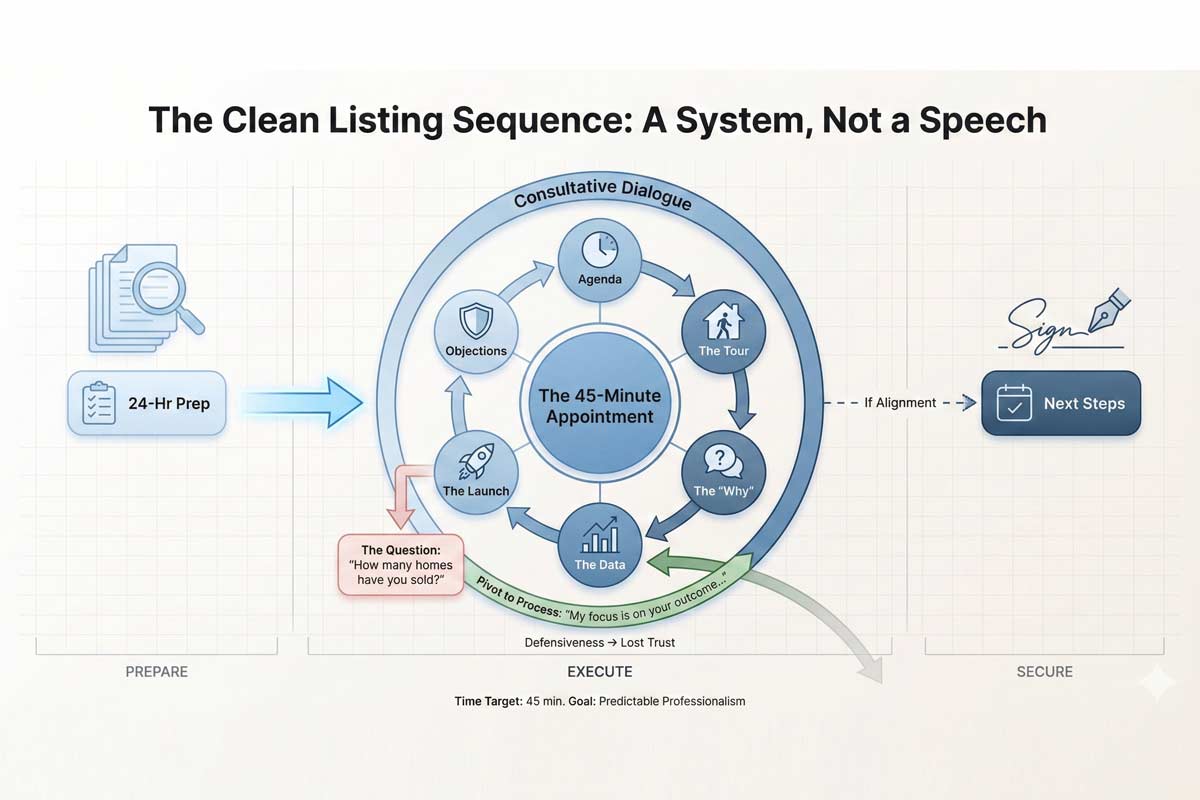
The 7-Step Clean Sequence (One-Page Summary)
Agenda Setting: Confirm the timeline and goal immediately.
The Tour: Walk the property with a consultant’s eye.
The "Why": Deep-dive into seller goals and timeline.
The Data: Review pricing using the three-bucket method.
The Launch: Explain the marketing and feedback loop.
Objection Handling: Resolve concerns using prepared scripts.
The Close: Confirm the decision and set next steps.
Time target: 45 minutes total (10 tour / 25 table / 10 close & next steps).
Pre-Appointment Prep: The 24-Hour Intel Phase
The appointment is won or lost before you ring the doorbell.
The Property Intel Checklist The "Big Three"
CMA: Prepare a Comparative Market Analysis with Actives (competition), Pendings (market direction), and Solds (the reality check).
Title Profile: Check for liens, multiple owners, or solar panel UCC filings.
The "Motivation" Call: 24 hours prior, call to confirm. Ask: "Aside from the price, what is the one thing that must happen for this move to be a success?"
The Minimalist Kit
Sellers can interpret overly flashy materials as in security. Data and a calm process read as competence. Bring an iPad or a neatly organized folder containing:
The CMA
A 1-page "Launch Plan"
The California Residential Listing Agreement (RLA)
A seller net sheet (to show their estimated proceeds at close)
First 5 Minutes: Setting the Frame
You’re the guide. Your job is to run a clean, low-drama decision meeting.
The "Agenda" Script
Warm Seller: "Thanks for having me over. My goal today is to see the home, hear your goals, and show you exactly how we’ll find the right buyer. Does that work for you?"
Skeptical Seller: "I know your time is valuable. I’ve set aside 45 minutes to go over the data and our strategy. At the end, we’ll both know if I’m the right fit to get this sold. Should we start with a quick tour?"
The Walkthrough: Tour Like a Consultant (Not a Compliment Machine)
The biggest mistake new agents make is acting like a guest. You’re there to audit the asset.
Ask, don’t tell: Instead of complimenting the kitchen, ask “When were these appliances last updated?” or “Any HVAC issues during peak summer?”
The “Stay or Go” list: Ask what’s staying vs. leaving (fixtures, appliances, smart devices). This prevents later disputes over chandeliers, Ring cameras, or mounted TVs.
What NOT to do:
Price during the tour: “I have some thoughts, but I want to sit down with the data first so I can give you an accurate range.”
Contractor cosplay: Don’t guess repair costs. Label it a point of inspection and move on.
Insult the house: Stay neutral. “This layout is unique” beats “This room is too small.”
If They Ask How Many Homes You’ve Sold (The Clean Answer)
Handle this moment with zero defensiveness.
The "High-Touch" Pivot
"Fair question. My model is high-touch: fewer clients at a time, tighter communication, and a very structured launch plan. You won’t be competing for my attention."
The "Team-Backed" Angle:
"Great question. I’m your point of contact, and I run the process. And I’m backed by my broker and transaction team on pricing, disclosures, and contract execution—so you get personal attention with professional oversight."
The Table Meeting: 3 Phases of Authority
Phase 1: Motivation Intake
Ask: "If this home doesn't sell for six months, how does that affect your plans?" If you don't know their "Why," you cannot handle their objections later.
Phase 2: Pricing Reality (The Three Buckets)
Show the data. "The market is telling us that homes like yours sell fast... or they start going stale and get negotiated down." We’ll define ‘stale’ using showing volume, online saves, and buyer feedback—not vibes. Understanding negotiation basics for new California agents is critical here—you aren't negotiating against the seller; you are negotiating with the market.
Phase 3: Strategy & Execution
Show them your Launch Plan. This includes professional media, reverse prospecting, and the "Feedback Loop" (your scheduled weekly update).
Objection Handling: Consultative Scripts
If you have practiced how to practice real estate scripts effectively, you will stay calm here.
Objection Handling: The Consultative Response
Objection
Consultative Response
"Another agent said it's worth more."
"Interesting. When they gave you that number, did they anchor it to sold comps, or was it more of a 'marketing price'? I’m not here to win the listing—I’m here to protect your outcome."
"We want to try a higher price."
"If we start too high, we'll miss our best buyers right out of the gate. Then, if we have to lower the price later, we're dealing with buyers who know we couldn't sell it—and that weakens our position."
"Will you cut your commission?"
"I’m happy to talk commission. The real issue is net outcome. My job is to protect your equity and reduce risk. If we cut the steps that produce the result, the price reduction usually costs more than the commission ever would."
"We’re interviewing others."
"I respect that. Professionalism is about finding the right fit. What are you looking for in an agent that we haven't covered yet?"
The Close: Moving to Signature
The Direct Close: "I’m confident we can hit your timeline. Are you ready to get the paperwork started so we can get the photographers out here Monday?"
The "Think About It" Close: "I understand. Usually, when people want to think about it, it’s because I haven't clarified something. Which part of the plan are you still weighing?"
New Agent Mistakes That Kill Listings
Talking Too Much: If you talk more than 30% of the time, you aren't listening.
Ignoring the "Quiet" Owner: The person asking the fewest questions often holds the veto power.
Defending the Price: Never "defend" a price. Let the data do the talking.
No Time Boundary: If you stay for 3 hours, you look desperate.
Tech-Dependency: Always have a paper backup of your presentation.
Over-Promising: Don't promise daily calls if you can't sustain them.
Hiding Your Status: Don't lie about being new; lean on your broker's track record.
Vague Next Steps: Never leave without a clear follow-up date and time.8.. Avoiding these new agent mistakes that hurt credibility is your fastest path to a "Yes."
FAQ: The First Listing Appointment
Q: Should I bring the listing agreement to the first meeting?
A: Bring it every time—even if you don’t pull it out. It signals preparedness and lets you move forward immediately if they are ready.
Q: What if they ask about my experience?
A: Pivot to your process. Experience is just a proxy for "Will you mess this up?" Prove you won't by being the most organized person they meet.
Q: How does this differ from working with buyers?
A: Listings are about asset management; buyers are about search and discovery. You should prepare for a first buyer consultation with the same level of systematic rigor.
Your Professional Foundation
The listing appointment for new agents is a test of your business operating system. You do not need to be the most famous agent in California to win; you just need to be the most prepared.
Read more to see how this fits into our broader California real estate career guide, continue building your library of systems.
Your next step: practice these scripts out loud until they feel natural.
|

You’re at a coffee shop with a potential seller. They lean in and ask: “What’s the risk if we don’t disclose that old roof patch from three years ago?”
You hesitate. You glance at your phone. Read more...
You’re at a coffee shop with a potential seller. They lean in and ask: “What’s the risk if we don’t disclose that old roof patch from three years ago?”
You hesitate. You glance at your phone. You say, “I think…”
In that three-second pause, you just had credibility bleed.
Clients don't fire you because you’re new; they leave because you look unprepared, vague, or chaotic. Professionalism is not a personality trait—it is a system of repeatable signals.
TL;DR: The New Agent Credibility Fix
No Guessing: “I’ll verify and follow up by ___.”
Bring Structure: Agenda + comps + next steps (every time).
Own the Calendar: Deadlines don’t manage themselves.
Disclosures = Risk Management: Early delivery, clean tracking, zero surprises.
Practice Decision Trees: Scripts are branching logic, not lines to memorize.
12 New Agent Mistakes That Kill Your Credibility
1. The "I Think" Guess
The Mistake: Answering a technical or market question with "I think..." or "I’m pretty sure..."
Why It Hurts: In California, “I think” sounds like “I’m gambling with your equity.”
The Professional Fix: Use the Expert Deferral Script: "Great question. I’m not going to guess. I’m going to verify it and text/email you the correct answer by 4:00 PM."
Credibility Phrase Bank (Steal These):
“I’m not guessing.I’ll verify and send you the exact answer by 4:00 PM.”
“Here’s the timeline. I’ll own the next step and keep you ahead of deadlines.”
“Let me translate this into plain English, then we’ll decide.”
“I’ll recap this in writing so nothing gets lost.”
2. Showing Up Without a Printed Agenda
The Mistake: Entering a first listing appointment and asking,
"So, what would you like to talk about?"
Why It Hurts: If the client has to lead the meeting, they don't need you.
The Professional Fix: Bring three copies of a one-page agenda: one for them, one for you, and one as a backup. It signals you have a process for their success from day one.
3. Over-Talking to Fill the Silence
The Mistake: Talking incessantly because you’re nervous.
Why It Hurts: Silence is a high-status negotiation tool; over-talking signals nervousness and uncertainty. Calm beats charisma.
The Professional Fix: Study negotiation basics to understand that the person asking the questions controls the room. The first person who starts explaining is usually the one giving away leverage.
4. Robotic Script Delivery
The Mistake: Using a script exactly as written without adjusting for tone or context.
Why It Hurts: You sound like a telemarketer. Clients can sense when you’re "doing a routine."
The Professional Fix: You must practice real estate scripts until they become "decision trees"—you know the intent of the words, not just the order.
5. Skipping the Buyer Discovery Phase
The Mistake: Taking a buyer to see houses before conducting a formal first buyer consultation.
Why It Hurts: You look like a tour guide. It suggests you have no system for protecting their time.
The Professional Fix: Push for an office or Zoom consultation. Use a standardized questionnaire to uncover their "must-haves" vs. "nice-to-haves."
6. Vagueness on California Timelines
The Mistake: Not explaining the common contingency periods (e.g., 3, 7, or 17 days) clearly.
Why It Hurts: California contracts are timeline-heavy. If a client is surprised by a "Notice to Perform," you lose their trust instantly.
The Professional Fix: Create a "Transaction Calendar" for every client. Explain the most common contingency timelines in your contract before they sign.
Micro-checklist:
Put all deadlines in a shared calendar invite.
Send a one-page timeline PDF the same day.
Confirm the “Next deadline” at the end of every call.
The Contingency Scare: A rookie agent forgot to track the inspection contingency deadline. On day 18, the listing agent sent a "Notice to Perform." The buyer panicked, thinking they were in trouble (they may have been if the inspections weren’t even ordered). The agent had to spend three days in "damage control" because they hadn't pre-framed the timeline.
7. Not Pre-Framing the RPA Before the First Offer
The Mistake: Waiting until the offer is written to introduce the 25-page California Residential Purchase Agreement.
Why It Hurts: Clients feel ambushed by massive paperwork. Ambush destroys trust.
The Professional Fix: Give a 3-minute “RPA orientation” during the consult: what they’ll see, what matters, and how you’ll translate it into plain English.
8. Sloppy Email and Documentation
The Mistake: Missing subject lines, typos, or disorganized attachments.
Why It Hurts: Sloppy emails = sloppy contracts (in the client’s mind).
The Professional Fix: Use a clear format: [Property Address] - [Document Name] - [Action Required].
9. Answering Outside Your Expertise
The Mistake: Giving tax, legal, or structural engineering advice.
Why It Hurts: It’s a liability and makes you look like you don't understand professional boundaries.
The Professional Fix: Build a "Partner List." When asked about taxes, say: "That’s a great question for a CPA. I have two my clients use; would you like their contact info?"
10. Being "Always Available"
The Mistake: Answering every text in 30 seconds at 11:00 PM.
Why It Hurts: It signals you aren't busy. High-demand professionals have boundaries.
The Professional Fix: Set communication expectations early. Tell clients you respond between 8:30 AM and 6:30 PM. Add: "Emergencies are different—if something is truly time-sensitive, call me."
11. Reactionary Negotiation
The Mistake: Passing an offer to a client without a summary or strategy.
Why It Hurts: It makes you a "delivery person," not a negotiator.
The Professional Fix: Before calling the client, analyze the offer against the comps and prepare a "Net Sheet."
12. Treating Disclosures as "Admin" instead of Protection
The Mistake: Treating disclosures like paperwork instead of risk management.
Why It Hurts: The fastest way to lose trust with a real estate client is a surprise after the fact.
The Professional Fix: Always default to the TDS. If you’re asking whether it’s disclosable, treat it as disclosable until your broker says otherwise.
Micro-checklist:
Deliver disclosures as early as possible.
Track the exact date of receipt and review.
Confirm in writing: “No surprises later.”
Common Rookie Realtor Mistakes (Quick List)
Guessing on technical questions instead of verifying.
Winged meetings without a printed agenda.
Filling silence with over-explanations.
Robotic script reading instead of conversational mastery.
Skipping the formal consultation to go "tour" houses.
Fumbling CA timelines like contingency removals.
Ambushing clients with the 25-page RPA at the last minute.
Messy email habits that signal a lack of discipline.
Giving legal/tax advice outside of professional scope.
Lacking boundaries around late-night availability.
Presenting offers without a summary or strategy.
Downplaying disclosures and risking future lawsuits.
The Credibility System: Your Daily Protocol
To Start a Real Estate Career in California and actually thrive, you need to turn these fixes into daily discipline:
Prep (30 min): Comps + form set + agenda + timeline before every meeting.
Lead the Meeting: Frame → Discovery → Recommendation → Next Step.
Recap in Writing (2 hours): Bullets + deadlines + who owns what in an email.
Own the Next Step: If it’s important, it gets a specific date and time on the calendar.
FAQ: Building Credibility in California
How do I sound confident if I’m brand new?
Confidence comes from the process, not the result. If you follow a checklist, you don't have to be confident in yourself—you just have to be confident in the system.
Should I admit I’m new?
Don't lead with it, but don't lie. Pivot to your team:
"I’m a newer associate at [Brokerage Name], so you get my full focus, backed by my broker’s 30 years of experience and our firm's legal team."
What if a client asks how many deals I’ve done?
Don’t inflate numbers. Be honest and pivot to process:
"You’re getting my full focus, plus broker oversight and a transaction system that prevents mistakes in timelines and disclosures."
Your Professional Path Forward
You don’t need a decade of experience to be the most professional person in the room.
You simply need a repeatable process that removes doubt.
Pick Your Lane (Do this this week):
Buyers: Master your first buyer consultation so you stop being a tour guide and start being a decision coach.
Sellers: Run a real first listing appointment with a printed agenda and a clear pricing conversation.
Confidence: Practice real estate scripts as decision trees so you don’t freeze when clients throw curveballs.
Stop trying to sound experienced. Start sounding prepared.
|

A buyer consultation is a structured first meeting where you confirm readiness, set expectations, and build a clear plan to tour and write offers without chaos.
The greatest fear for a newly licensed Read more...
A buyer consultation is a structured first meeting where you confirm readiness, set expectations, and build a clear plan to tour and write offers without chaos.
The greatest fear for a newly licensed agent is the "imposter moment"—that split second during a meeting where you worry the client will realize you’ve never closed a deal.
After 20+ years of training thousands of California agents, I can tell you the secret to overcoming this: System > Vibes. Buyers aren’t buying your resume; they are buying your process. A buyer isn't looking for a historian; they are looking for a pilot. They want someone who can navigate the turbulence of the California market, protect their earnest money, and reduce their risk. Your first buyer consultation isn't a casual chat—it is a structured risk-reduction meeting. When you lead with a system, your experience level becomes secondary to your competence.
Quick Start: The Buyer Consultation Essentials
The Credibility Kit: A physical or digital packet that proves you are organized.
The 45-Minute Agenda: A timed sequence that keeps you in the driver’s seat.
The "Pro" Questions: Moving the conversation from "what" they want to "why" they want it.
Defined Next Steps: Never leave a meeting without a calendar invite for the next milestone.
The Real Purpose of a Buyer Consultation
Most new agents treat the first buyer consultation like a casual meet-and-greet. That’s backwards. The buyer consultation is where you set expectations, confirm readiness, and create a shared plan—so nobody wastes weekends touring homes that were never realistic.
The Two Topics You Must Cover Early: Representation + Compensation
In today's market, transparency is your highest-value currency. Your goal isn’t to “sell” an agreement. It’s to remove confusion: who represents whom, how compensation works, and what gets confirmed before you ever write an offer.
The Script: "Before we look at homes, I’ll explain how representation works and how agents get compensated so there are zero surprises later. My job is to make this simple and protect you."
First Buyer Consultation Checklist (What to Bring)
Don't show up with just a business card. To look like a pro, you should provide a "Credibility Kit" (physical or a clean PDF). This functions as your "silent resume."
1-Page Agenda: Shows you value their time and have a plan.
Buyer Intake Worksheet: A form to capture their needs.
Lender Checklist: Documents needed for a full underwritten pre-approval.
"How I Work" One-Pager: Explicitly states your communication hours and showing protocols.
Buyer Profile Snapshot: A proprietary summary containing:
Core search criteria & geographic "must-haves."
Timeline and move-in constraints.
Financing status and monthly comfort zone.
Top 3 "Dealbreaker" features.
Agreed-upon communication pace.
Offer-Ready Checklist: What must be true before writing an offer (pre-approval verified, proof of funds ready, decision-makers aligned).
The 45-Minute Consultation Agenda
Control the clock, and you control the room. Follow this timed sequence to ensure you cover the essentials without rambling.
Time
Section
Purpose
0–2 Min
The Frame
"Today is about making sure you’re protected and ready."
2–12 Min
Goals & Constraints
Deep dive into their "Why" and their timeline.
12–20 Min
Financing Reality
Verify pre-approval status; discuss monthly comfort vs. max qualification.
20–35 Min
The Market & Process
Explain the CA purchase process and representation/compensation.
35–45 Min
Next Steps
Confirm representation, set the showing plan, and schedule the first tour.
Conversion Scripts: The Open and The Close
The "how" you say it matters as much as the "what."
Opening Frame Script (2 minutes)
"Here’s the plan: we’ll confirm your goals, your financing readiness, today’s market reality, and how we’ll work together. By the end, you’ll have a clear next step on the calendar. Does that sound like a good use of our time?"
Closing Script (Lock Next Step)
"Based on what you told me, the next step is simple: we’ll confirm financing, I’ll send 8–12 verified options, and we’ll tour on [Day]. I’m going to send the calendar invite now—does 10:00 AM or 1:00 PM work better?"
Buyer Consultation Questions for New Agents
A pro asks; an amateur tells. Use these questions to diagnose the situation.
Motivation & Timing
"What happens if we don’t find a home in the next 60 days?"
"On a scale of 1–10, how ready are you to move into a new home right now?"
Financing Readiness
"Are you fully pre-approved (credit run + docs reviewed), or just pre-qualified?"
"What monthly payment feels comfortable—not just what you can technically qualify for?"
"Do you have proof of funds ready for down payment and closing costs if we need to move fast?"
Risk + Offer Strategy
"If we love a home, are you the type who wants to move fast and compete—or do you prefer to wait for a ‘perfect deal’?"
"How do you feel about inspections: are you cautious and thorough, or more comfortable taking calculated risks to win a property?"
Decision + Communication
"When a decision needs to be made, how do you prefer to communicate—call, text, or email?"
"If the right home hits on a weekday, can you tour within 24–48 hours?"
5 Mistakes That Hurt New Agent Credibility
I’ve seen these errors cost agents five-figure commissions.
Selling Yourself Instead of the Process: Buyers care about their house. Talk 20% about you and 80% about the steps you take to protect them.
Skipping the Financing Talk: Make it a standard policy: "Before we do private tours, I need a real pre-approval on file so we don’t fall in love with a home we can’t win."
The "Zillow Trap": Zillow is great for discovery. My job is to verify what’s truly available and what’s already in escrow—so you don’t waste time chasing ghosts.
No Defined Next Step: Never end with "Let me know if you see anything." Always set a specific time for the next follow-up.
Ignoring the Spouse/Partner: Only talking to the "vocal" one. Always ask the quieter partner for their thoughts.
Warning: Rookie Red Flags
Refuses to share any financing info or talk to a lender.
Won't commit to having all decision-makers present for the consult.
Refuses to commit to any calendar date or next step.
Scripts for Success
Avoid high-pressure sales talk. Use these "consultative" lines instead. For more help on delivery, see our guide on how to practice real estate scripts effectively.
Handling Unrealistic Criteria: "I want to be honest—at that price point in this neighborhood, we usually see homes that need significant work. Are you open to a fixer, or should we look one town over?"
The "I Don’t Guess" Rule: "That’s a great question regarding the zoning. I don’t want to give you a 'maybe'—let me verify that with the city and get back to you by 5:00 PM."
FAQ: Buyer Consultation Long-Tail Queries
What if the buyer isn't pre-approved yet?
Don't refuse the meeting and use the consultation to introduce them to your preferred lender and explain that in California, an offer without a pre-approval is usually noncompetitive.
How do I handle a buyer who only talks about Zillow?
Acknowledge it as a discovery tool, then pivot to your MLS access. "My system provides real-time data on which homes are actually available and which are already in escrow."
What if they refuse to sign a Buyer Representation Agreement?
Don't panic. Focus on the value of your "Credibility Kit."
If they still won't sign, work with your broker to offer a "trial period" for the first three showings. This is part of the negotiation basics for new California agents that builds trust through flexibility.
How do I avoid looking "new"?
By learning how to avoid the ‘new agent mistakes’ that hurt credibility, such as being disorganized or over-promising. Professionalism is a choice.
The buyer consultation is your opportunity to move from "agent" to "trusted advisor." By following a system, you remove the anxiety of the unknown. Once you've mastered the buyer side, you'll find these skills translate when you learn how new agents should handle their first listing appointment.
If you are ready to build a business based on systems and results, the first step is getting your foundation right.
Start a Real Estate Career in California with ADHI Schools today.
|

Disclaimer
This article is for educational purposes only and does not constitute legal advice. California real estate practices are governed by state law, evolving MLS rules, and Read more...
Disclaimer
This article is for educational purposes only and does not constitute legal advice. California real estate practices are governed by state law, evolving MLS rules, and specific brokerage policies. Always follow the direction of your broker, counsel or manager, before advising clients, submitting files, or sending notices.
The Escrow Avalanche
Your offer was just accepted. Within minutes, your inbox is flooded with a dozen PDFs, a timeline from escrow, and a frantic text from your client.
Welcome to the Escrow Avalanche.
For a new agent, the volume of paperwork in a real estate transaction can feel like a mountain of red tape. However, these documents are your protective gear. As I often remind our students:
“Amateurs see forms; professionals see a timeline of protection.”
To survive your first two years, you don't need to memorize every form in the library—you need to understand the "usual suspects" and the proof they provide.
The Big 3 Ecosystem
1. The Contractual Foundation: The RPA
The Residential Purchase Agreement (RPA) is the master blueprint. It defines the price, the Close of Escrow (COE), and the contingency periods.
Rookie Pain: If you don't master this, a single missed checkbox could cost your client their deposit or result in your file being kicked back by compliance. Start here: Purchase Agreement Basics (CAR RPA Explained).
2. The Disclosure Shield: TDS, SPQ, and AVID
The Transfer Disclosure Statement (TDS) is the seller’s statutory disclosure document. The Seller Property Questionnaire (SPQ) is a widely used C.A.R. disclosure supplement that often adds detail beyond the TDS.
The AVID: This form documents your visual inspection and what you observed. It doesn’t replace other legal duties—but it can become critical evidence of your standard of care.
Rookie Pain: If you saw something obvious (stains, cracks, water marks) and your file has no documentation, you and your broker become easy targets later when someone claims “the agent must have known.”
3. The 2025 Standard: Buyer Representation (Two Rules, One Deadline)
There are two overlapping requirements—MLS rules (post-settlement) and California law.
MLS rule (post-settlement, effective Aug 17, 2024): If you are an MLS Participant “working with” a buyer, you must have a written buyer agreement BEFORE you “tour” a home with them (in-person or live virtual).
California law (AB 2992 / Civ. Code §1670.50, effective Jan 1, 2025): A buyer-broker representation agreement must be executed as soon as practicable, but no later than the buyer’s execution of an offer to purchase.
Rule of thumb: Treat “before touring” as your default deadline unless your broker requires something even earlier. Also note: AB 2992 limits initial term length (commonly 90 days) and restricts renewals—so don’t use open-ended buyer agreements.
The Transaction Timeline: Protection + Proof
Phase 1: Pre-Touring & Engagement
Form AD (Agency Disclosure): Explains agency relationships and should be delivered early—and no later than the timing required before a buyer signs a representation agreement and/or executes an offer, consistent with broker policy. You must know How to Explain Agency Disclosure Form AD clearly to prevent implied agency disputes and buyer misunderstandings.
Buyer’s Investigation Advisory (BIA): Explicitly reminds the buyer that they—not the agent—are responsible for investigating the property’s condition.
Protection: Clarifies legal roles and inspection duties before the search begins.
Proof: Signed and dated Form AD and BIA in your transaction folder.
Phase 2: The Offer & Acceptance
The RPA: Sets the "clocks" for the entire deal.
Wire Fraud Advisory (WFA): Warns clients not to trust emailed “changes” to wire instructions and to verify all instructions using a known, independently verified phone number.
Protection: Establishes the contract and guards against cyber-scams.
Proof: Fully executed contract with DocuSign completion certificates + platform audit trails (ZipForm/Glide).
Phase 3: Disclosures & Investigation Window
While often 17 days, never assume—always read the negotiated timeline in your specific contract.
TDS, SPQ, and NHD (Natural Hazard Disclosure): Plus any required statutory or local disclosures for your specific area.
Protection: Creates a documented disclosure record and helps establish what was known and when—but it does not eliminate the buyer’s duty to investigate or the agent’s duty to disclose material facts.
Proof: A platform audit trail showing the exact date and time of delivery.
Phase 4: Negotiations & Repairs
Request for Repair (RR) / Seller Response (RRRR): The formal exchange for property fixes.
Amendment of Existing Agreement (AEA): Used if terms like price or credits change after the original contract was executed.
Protection: Moves repair discussions from verbal promises to written, enforceable terms.
Proof: Fully executed forms with platform audit trails. Note: Your brokerage may use different labels; always use the specific repair/amendment forms your broker requires.
Phase 5: If the Deal Starts Dying
If a client misses a deadline or a party wishes to exit, you must understand Cancellation Rights in California Transactions to protect the deposit. Always confirm the correct notice with your broker or TC before sending.
Notice to Buyer to Perform (NBP): The "warning shot" for missed deadlines.
Protection: Prevents the deal from sitting in legal limbo.
Proof: Timestamped email with full headers or platform-generated delivery report.
Phase 6: Closing Week
Verification of Property (VP):The final walkthrough.
Protection: Confirms the home is as promised before the buyer commits to loan funds.
Proof: Form VP signed by the buyer prior to the Close of Escrow.
Kartik’s Compliance Corner
The "Passive" Myth: Contingencies do not automatically expire. You must secure a written Contingency Removal (CR) form. While some brokerages use different labels, the goal is a clear, written record of removal.
The Evidence Log: In a dispute, "I sent it" is not enough. To defend against fraud and disputes, read our guide on California Anti-Fraud Rules in Real Estate and ensure your file contains DocuSign completion certificates or platform audit trails.
The "Backdate" Trap: If a client or another agent asks you to backdate a signature to "save a deadline," stop. This is a major ethical violation. Call your broker immediately.
[ROOKIE MISTAKE] Don't rely on verbal agreements for repair credits. If a credit isn't documented on an Amendment or Seller Response, it is extremely difficult to enforce and creates a dispute magnet for your broker.
Actionable Checklist: Your Compliance System
Consistent File Naming: Save PDFs as PropertyAddress_FormName_Date.
Standard Proof Artifacts: Ensure your file includes DocuSign completion certificates, platform audit trails, or emails with full headers and timestamps for every mandatory disclosure.
Avoid Blanks: Unfilled lines on an RPA create ambiguity. Always consult your manager on how to mark sections that do not apply to your specific deal.
If you can control your delivery and your deadlines, you can control your risk.
We recommend you save this checklist, build a "Proof" folder template in your email, and run your first few files past your broker. For a deeper dive into the regulations shaping your career in 2025, visit our California Real Estate Laws & Compliance Guide.
Frequently Asked Questions
Q: Do I need a buyer agreement to show houses in California now?
Per MLS policies tied to the 2024 settlement, MLS participants are generally required to have a written agreement before "touring" a home (including in-person and live virtual tours). This typically does not apply to visitors walking into an open house. California law (AB 2992) also requires a signed agreement as soon as practicable, but no later than the execution of a buyer’s offer.
Q: Can a seller cancel if contingencies aren’t removed on time?
In residential property in California, contingencies do not typically expire automatically. If a deadline is missed, a seller typically delivers a Notice to Buyer to Perform (NBP), giving the buyer a short cure period (governed by the terms of the notice) to perform before the seller gains the right to cancel.
Q: How often does C.A.R. update their forms?
C.A.R. updates forms on a regular release cycle (commonly mid-year and year-end), and additional revisions can occur when industry rules change. Best practice: always pull forms from the current library in zipForm®/Glide and confirm your brokerage is using the latest release notes.
|

Disclaimer: This article is for educational purposes. It is not legal advice. Always consult your managing broker and/or attorney for guidance.
The "30-Second Elevator Pitch" for Clients
In the Read more...
Disclaimer: This article is for educational purposes. It is not legal advice. Always consult your managing broker and/or attorney for guidance.
The "30-Second Elevator Pitch" for Clients
In the high-speed environment of California real estate, paperwork can feel like an obstacle to a deal. However, the Agency Disclosure (Form AD) is not just "another form"—it is a consumer protection shield. For a new agent, the goal is to present this document as a tool for clarity.
Agent Script: "This form answers one question: Who do I work for? It’s not about commission—it’s about loyalty. It explains your options—buyer’s agent, seller’s agent, or dual agency—so you know exactly where my loyalty sits before we go any further."
What Is the AD Form? (And What It’s Definitely Not)
The sole purpose of Form AD is transparency. It educates the consumer on the types of real estate agency relationships available and the "fiduciary duties" (utmost care, integrity, and loyalty) that brokers owe their clients.
Where You’ll See This Form: Agency disclosure rules apply to transactions covered by the statute’s definitions—commonly 1–4 residential sales/leases, and they also extend to commercial real property transactions under the Civil Code definitions.
California licensing law and brokerage policy still require clear disclosure and consent when your role changes—especially regarding dual agency.
Myth vs. Reality
Myth: "If I sign this, I’m officially hiring you as my exclusive agent."
Reality: This is a disclosure, not a contract. It does not "lock" a client into a representation agreement or guarantee payment.
Myth:"It’s just a formality; I can sign it at the end of the escrow."
Reality: Missing this form is a statutory compliance problem. It is the kind of file defect that shows up when a deal blows up: commission disputes, client complaints, or someone picking apart your paperwork. It weakens your file if a fee dispute or complaint ever erupts.
The 3 Agency Relationships Demystified
As we emphasize in our training courses, you must be able to explain the "Big Three" relationships without hesitation.
Agency Type
Who is the Client?
What You Owe
What You Cannot Do
One-Sentence Client Explanation
Seller’s Agent
The Seller
Utmost care, integrity, honesty and loyalty.
Cannot disclose the client’s confidential bargaining position (bottom line, motivations, price flexibility) without permission.
"I represent the Seller's interests exclusively to get them the best terms possible."
Buyer’s Agent
The Buyer
Utmost care, integrity, and loyalty.
Cannot disclose the client’s confidential bargaining position (bottom line, motivations, price flexibility) without permission.
"I am your advocate, focused solely on finding you the right home and protecting your interests."
Dual Agency
Both Parties
Fiduciary duty (utmost care, integrity, honesty, loyalty) to both parties; honest and fair dealing/good faith; reasonable skill and care; disclosure of known material facts; and required confidentiality.
Cannot disclose the client’s confidential bargaining position (bottom line, motivations, price flexibility) without permission.
"I facilitate the deal for both sides, but I cannot use one side's confidential info to advantage the other."
Legal Timing for Agency Disclosure Form AD in California
These are three separate legal requirements. Treat them like three boxes you must check—for every file.
AD Delivery (Civ. Code §2079.14)
Seller: The listing agent must provide the disclosure before entering into the listing agreement.
Buyer: The buyer’s agent must provide it as soon as practicable before (i) a buyer-broker representation agreement is signed and (ii) execution of the buyer’s offer.
Refusal Protocol (Civ. Code §2079.15)
|

The Cancellation Moment: From Panic to Procedure
It is 4:45 PM on a Friday. You are heading out for the weekend when a text hits your phone. It’s your buyer: “I can’t do this. My job situation Read more...
The Cancellation Moment: From Panic to Procedure
It is 4:45 PM on a Friday. You are heading out for the weekend when a text hits your phone. It’s your buyer: “I can’t do this. My job situation just got shaky, and I need to get out of the deal. Now.” Or perhaps it’s a seller, frustrated that the buyer is two days late on contingency removals, demanding you “cancel the deal and take the backup offer.”
In these moments, your value as an agent isn’t in your salesmanship; it’s in your ability to remain the calmest person in the room. Having coached agents through thousands of transaction crises over the last 20 years at ADHI Schools, I can tell you that successful cancellations aren’t just about emotions—they are about the clock and the contract.
In California, cancellation is a procedure, not a vibe. Your license, your reputation, and your buyer’s deposit depend on your ability to stop the panic and start the process.
Quick Answer: In California, most cancellations fall into three buckets: (1) active contingency exit, (2) disclosure-related rescission windows (when applicable), or (3) default/breach workflows that require written notice and a cure period. Your job is to identify which bucket you’re in, then build a clean paper trail that protects the client and your license.
The 60-Second Triage: Diagnose the Right to Cancel
Before you touch a single form, you must diagnose which "world" the cancellation lives in. Most disputes happen because an agent used a "breach" workflow for a "contingency" problem. To stay within the California Real Estate Laws & Compliance Guide, you must categorize the situation immediately.
The Three-Worlds Model:
World A: Contractual Exit Paths (Contingencies): The buyer is within their active contingency period and chooses to exit based on findings (e.g., an inspection report or loan denial).
World B: Statutory/Disclosure-Based Rescission: Rights that may be triggered by the delivery of specific disclosures (like the TDS or NHD) after the contract has been signed.
World C: Default & Breach Workflows: One party has failed to perform a contractual obligation. This requires a formal notice and a cure period before anyone can walk away.
The Agent’s Script:
"I understand you want to cancel. To protect you and your deposit, I need to know: Is this about an inspection issue, a loan problem, a disclosure you just received, or something the other side didn’t do?"
Buyer's Playbook: The Procedural Exit Paths
Buyers often have the cleanest exit paths, but only while the clock and contingencies still protect them. To protect your buyer, you must master Purchase Agreement Basics, specifically how contingencies function as a safety net.
Operational Examples:
Inspection Findings: A buyer discovers a foundation issue during their investigation period and decides the repair is cost prohibitive.
Loan Denial: A buyer's lender issues a formal denial letter before the loan contingency is removed.
The Contingency Exit Checklist
Identify the Active Contingency: Ensure the specific contingency has not been waived or removed in writing. Be cautious, as commercial transactions might have “passive” contingency removal.
Check the Clock: Verify the deadline in the contract. Even if a deadline has passed, if the seller hasn't given the buyer a formal “notice to perform”, the buyer may still have an exit path—consult your broker immediately.
Document the Basis: The buyer should be able to document a contingency-related basis consistent with the contract and brokerage standards.
Serve Written Notice: Use the appropriate cancellation and release of deposit forms found in your current brokerage library.
Notify Escrow: Ensure a copy of the signed cancellation is delivered to the escrow holder.
Material Change Trigger: If the issue changes money, timing, possession, or legal rights, pause and escalate to your broker before sending notices.
Seller's Playbook: Rights Are a Process, Not a Power
Sellers often feel trapped, and in some ways they are. In California, a seller cannot simply cancel because they found a better offer or "changed their mind." You must use the CAR Forms Every New Agent Should Know to create a defensible paper trail.
Operational Example:
Missed Deposit Deadline: The buyer fails to deposit the Earnest Money Deposit (EMD) within the three-day contractual window. The seller serves a written Notice to Perform. If the buyer fails to "cure" within the specified timeframe, the seller may proceed to cancel.
What a Seller Generally CANNOT Do:
Cancel because the buyer is slightly late (without first serving a formal notice).
Cancel because they want to sell to a different party.
Unilaterally take the deposit from escrow without mutual instructions or a legal directive.
The Seller’s Escalation Sequence:
Notice to Perform: This is the formal warning. It gives the buyer a specific cure period (often 2 days, but check the contract) to perform the required action.
Wait the Cure Period: You cannot cancel while the clock is running.
Cancel for Default: If the buyer still hasn't performed after the cure period ends, the seller may move to cancel.
The contract may include a seller's contingency allowing them to cancel if they cannot find a new home within a set period. However, even with a Seller's Contingency, they must strictly adhere to the timelines in the SPRP (Seller Purchase of Replacement Property) addendum.
The Earnest Money Matrix: Reality vs. Theory
The contract may suggest who should receive the deposit, but in practice, the money often does not move until there are mutual written instructions or a legal resolution. This is a key point to emphasize when you explain Agency Disclosure Form AD to your clients.
Scenario
What the contract often suggests
What happens in practice
Why it gets stuck
Buyer is Inside Contingency Period
Full refund to Buyer
Escrow holds funds
Seller may dispute the buyer’s basis or timing and refuse to sign a release.
After Removal
Seller (Liquidated Damages)
Given to Seller but may result in a prolonged dispute
Liquidated damages require a properly formed clause and specific statutory limits.
Late Disclosure
Full refund to Buyer
Generally released to Buyer if contract permits
If the seller feels the buyer used the disclosure as a "pretext" to exit.
Seller Default
Full refund to Buyer
Escrow holds funds
Seller may dispute that a default actually occurred.
The Deposit Script:
"Escrow typically requires mutual written instructions or a legal directive to release funds. My goal is to make our paperwork so clean and our timelines so defensible that the other side is pressured to sign the release."
Disclosure Rescission: The Rescission Window
A common myth is that every buyer has a universal "3-day cooling-off period." This is false. This right is typically triggered only when certain statutory disclosures (like the TDS) are delivered after the contract is signed. Failure to handle these correctly can lead to claims involving California Anti-Fraud Rules in Real Estate.
Operational Steps for Rescission:
Confirm Delivery: Note the exact timestamp and method (email, hand-delivery, etc.).
Calendar the Deadline: Rescission periods vary, for example with the TDS based on if it is an entirely new disclosure form or a modification to an already delivered TDS.
Send Notice Promptly: If the buyer chooses to rescind, delivery must happen before the window closes.
The Crisis Checklist
If you are facing a potential cancellation right now, follow these steps in order:
Identify the Bucket: Work with your broker/manager to determine whether this a Contingency exit, a Statutory Rescission, or a Default?
Pull Contract Deadlines: What was the original date for performance?
Confirm Contingency Status: Has a formal contingency removal been signed in writing?
Confirm Disclosure Timestamps: When was the disclosure delivered and how?
Decide Workflow: Do you need a Cancellation form or a Notice to Perform first?
Write + Deliver Notice: Use the contractual method and loop in your broker per office policy.
Notify Escrow: Send the signed documents immediately to stop the clock.
The Paper Trail Rule: Summarize all verbal conversations in a follow-up email. "Per our phone call at 2:00 P.M..."
Compliance Traps: Where Good Agents Get Disciplined
The Backdate Trap: Never backdate a signature to make a deadline look met. This is fraud.
The Verbal Authorization Trap: Never sign a cancellation for a client because they "told you to" over the phone.
The Disclosure Hide Trap: If a buyer cancels because of a negative inspection report, that report generally must be disclosed to the next buyer.
The Pressure Tactic Trap: Threatening a buyer with the loss of their deposit to force them into a deal is high-risk behavior.
Your System Is Your Shield
In California real estate, the difference between a veteran and a novice is how they handle a "dead" deal. A novice sees a crisis; a veteran sees a checklist. By leaning on a strict compliance framework, you turn a high-stakes emotional event into a routine administrative procedure.
Document, Deliver, and Disclose.
Disclaimer: This article is for educational purposes only and does not constitute legal advice. California real estate laws and C.A.R. forms are subject to frequent change. Always consult with your broker or a qualified real estate attorney regarding specific transaction disputes or legal interpretations.
|

Disclaimer: This guide is for educational purposes only and does not constitute legal advice. Real estate laws and DRE regulations are subject to change. Always consult with your supervising broker Read more...
Disclaimer: This guide is for educational purposes only and does not constitute legal advice. Real estate laws and DRE regulations are subject to change. Always consult with your supervising broker and legal counsel regarding specific transaction concerns.
Fraud Isn’t a Mask—It’s a Shortcut
In the movies, fraud often looks like a villain in a dark room. In California real estate, fraud usually looks like a "shortcut" on a Tuesday afternoon. It is the pressure to backdate a signature because the client is "on a plane," or the temptation to omit a minor leak in the disclosures to keep a deal from falling apart.
New agents often believe that if they didn't intend to lie, they aren't committing fraud. However, for the Department of Real Estate (DRE), procedural sloppiness often looks identical to intentional deception.
Your job isn't to be overly paranoid (although there is a saying that “only the paranoid survive”); it’s to be procedurally sharp.
This guide provides a little bit of the "armor" you need to ensure your transactions remain compliant and your license remains secure.
Fraud 101: Intent vs. Negligence vs. Document Integrity
To stay compliant, you must understand how the DRE classifies misconduct. Misrepresentation can be "intentional" or "negligent," but both can trigger serious discipline.
Intentional Fraud: A deliberate, knowingly false statement (or omission) made to induce a party to act.
Negligent Misrepresentation: Making a claim without a reasonable basis for believing it is true (e.g., "The HOA allows ADUs" without checking).
Document Integrity Misconduct: Altering documents, forging initials, or backdating signatures. Backdating to make it appear a deadline was met can be treated as misrepresentation and document tampering and can trigger DRE discipline.
7 Fraud Traps (with Scripts + Next Steps)
1. Wire Fraud / Fake Escrow Instructions
An email arrives from "Escrow" at 4:45 PM on a Friday with "updated" wire instructions.
Red Flags: Grammar errors, extreme urgency, or a "look-alike" email domain (e.g., @escrow-title.com vs @escrowtitle.com).
Do This: "I've received an email regarding wire changes. I am calling the escrow officer at my independently verified office number now to confirm this before we proceed."
Don’t Do This: Forward the email to your client without voice verification. This increases the risk of reliance and complications if the client acts on fraudulent data.
2. Identity Impersonation (Seller/Buyer)
A "Seller" contacts you via text to list a vacant lot they own "free and clear." They are permanently "traveling" and cannot meet.
Red Flags: Refusal to video chat; requests for an immediate, below-market cash sale.
Do This: Request a government-issued ID and a recent utility bill. Send a physical mailer to the tax billing address on file to verify the owner received your listing package.
3. Forged Signatures / “Sign for Me” Pressure
The client says, "I can't get to my phone, just hit 'sign' for me so we don't miss the deadline."
Do This: "For your protection and to maintain the legal audit trail, the signatures must be executed by you through the approved platform. I cannot sign on your behalf."
Don’t Do This: Use a client’s login. This nukes the integrity of the entire file.
4. Altered Terms After Signature
You realize you forgot to check a box for a refrigerator after the buyer signed.
Do This: Use an amendment. Both parties must sign any change to an executed document.
Don’t Do This: "Check the box" yourself. This is a material alteration and can trigger serious discipline.
5. Non-Disclosure Pressure
The seller says, "The roof leak was tiny and we patched it. Don’t mention it so we don't scare the buyer."
Do This: "California law requires us to disclose any material fact that affects value or desirability. If a buyer would want to know, we must disclose it." Review the CAR Forms Every New Agent Should Know to document the history properly.
6. Undisclosed Credits / Side Agreements
The buyer and seller agree to a $5,000 "carpet credit" paid outside of escrow to keep the lender from seeing a low appraisal.
Red Flags: Any agreement involving money that isn't on the final settlement statement.
Do This: "All credits and price adjustments must be disclosed to the lender via a formal addendum. Handling this 'outside of escrow' can be considered mortgage fraud."
Don’t Do This: Facilitate "side letters" or cash-under-the-table repairs. This bypasses the spirit of the purchase agreement and creates liability for all parties.
7. Inflated Repair Invoices / Kickbacks
A contractor offers you a "referral fee" for recommending them for the Request for Repair work so they can charge more and “give you the difference”.
Do This: "I don't accept anything tied to referrals; it may violate RESPA and/or brokerage policy. My recommendations are based on quality of service only."
Don't Do This: Accept gift cards or credits tied to referrals.
The Agent Armor System: A Mechanical Approach to Integrity
Compliance isn't a feeling; it's a system. Use these mechanical rules to protect your license:
The Material Change Trigger: If it changes money, timing, possession, agency, or disclosures, you MUST call your broker before you respond or draft the change.
The "Clean Accept" Rule: Never rely on email-only confirmations for contract terms. Use the proper mechanics to finalize changes through the escrow process.
Version Control Naming: Adopt a strict naming convention to prevent using the wrong draft: 123Main_RPA_v3_2025-12-26_BuyerInitials.pdf.
Verification Rule: Never use a contact number provided inside an email asking for money. Only use independently verified numbers from your brokerage directory.
The "Stop the Thread" Rule: If you suspect an email account is compromised, stop replying in that thread immediately.
CAR Form Sloppiness Trap (Audit Triggers)
Data from the DRE Real Estate Bulletin summary (October 2024) indicates that a large portion of audits uncovered recordkeeping violations. Sloppiness creates the appearance of deception. Avoid these audit triggers:
Missing Agency Timing: You must properly explain Agency Disclosure Form AD before the client signs the contract. Doing it "later" looks like you are hiding a conflict.
Inconsistent Timelines: If the "Date of Delivery" on a notice doesn't match the signature timestamp, you are at risk regarding cancellation rights in California transactions.
Unclear Acceptance Trail: Counters or addenda referenced in the RPA that are not fully executed or dated create "who accepted what, when?" ambiguity.
Unchecked Boxes: Leaving critical boxes blank in the RPA creates ambiguity that an auditor may interpret as a post-closing alteration.
Suspecting Fraud Mid-Transaction: The Response Protocol
If a transaction feels "off," execute this five-step protocol:
Pause. Do not let the "closing pressure" force you into a mistake.
Preserve Evidence. Save email headers and screenshot texts immediately.
Switch Channels. Stop communicating through the suspicious channel. Move to a verified phone call.
Notify Broker. Never "fix it quietly." Your broker is your first line of defense.
Document. Write an internal memo for your file detailing the red flag and the steps you took to verify the truth.
California Real Estate Fraud Prevention Checklist
NEVER backdate a signature (even if the party signed late).
NEVER use "white-out" or cross out terms without all parties initialing.
NEVER provide "side-letters" or credits that aren't disclosed to the lender.
NEVER share your Docusign login with a client.
Protecting Your Moat
Compliance is the moat that protects your career. By maintaining a clean audit trail and prioritizing document integrity, you ensure that your focus stays on growth rather than defense. For a complete look at the regulatory landscape, visit our California Real Estate Laws & Compliance Guide.
FAQ: California Anti-Fraud Rules
Is backdating a signature illegal?
It can be unlawful and is always high-risk. If it changes the truth of the timing to deceive a party or a lender, treat it as strictly prohibited.
What is an agent’s duty regarding material facts?
In California, you must disclose any fact known to you (or that should be known via a diligent visual inspection) that affects the value or desirability of the property. When in doubt, disclose.
Can I be disciplined if my client lied and I didn't know?
Yes, if a "reasonable agent" would have noticed the red flags. You are expected to exercise "due diligence," not just passive acceptance.
|
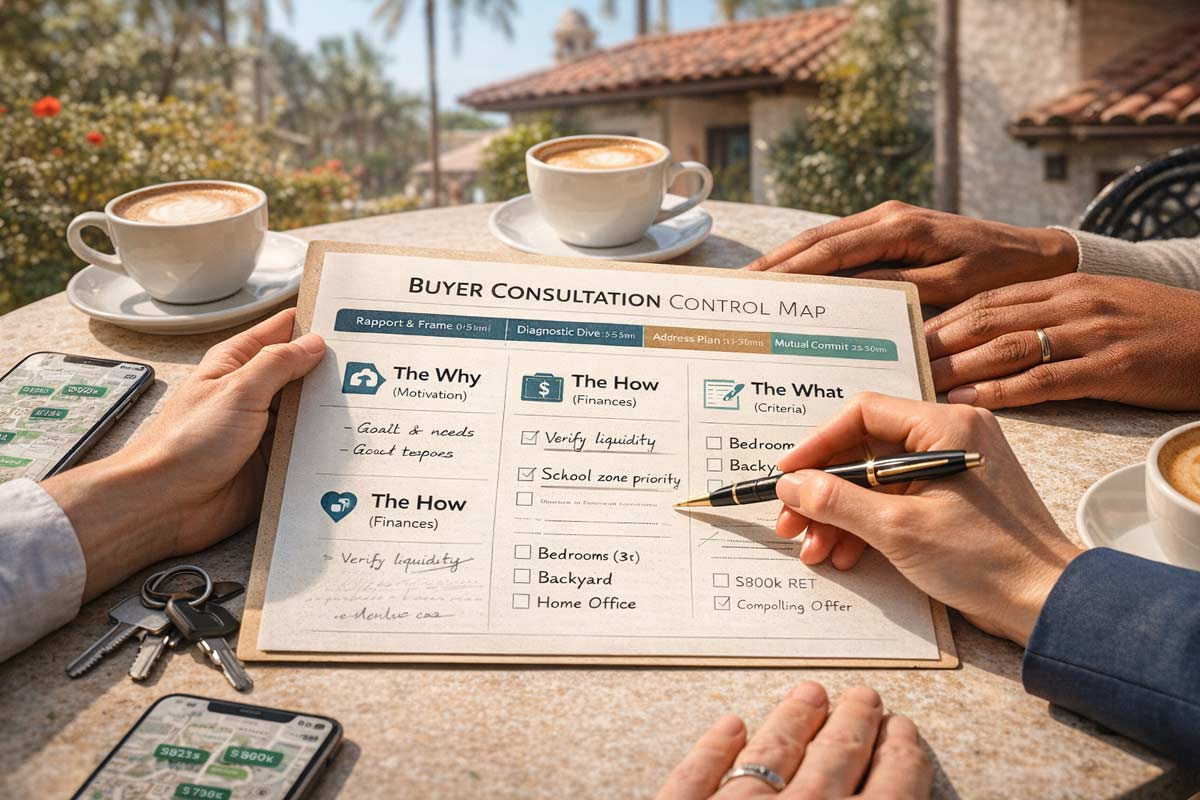
TL;DR: The Agent’s Quick-Start Guide
The Mission: Transition from an "unpaid tour guide" to a "fiduciary consultant" by leading a structured diagnostic process.
The 15-Minute Phone Flow: A verbatim Read more...
TL;DR: The Agent’s Quick-Start Guide
The Mission: Transition from an "unpaid tour guide" to a "fiduciary consultant" by leading a structured diagnostic process.
The 15-Minute Phone Flow: A verbatim script to qualify leads and book the deep-dive consultation.
The 30-Minute Playbook: A timed framework for the in-person meeting to uncover "deal-killer" obstacles.
California Precision: Language focused on the C.A.R. RPA, contingency periods, and deposit protection.
The High-Stakes First Conversation
In the high-speed California market, a transaction rarely dies because of a bad inspection—it dies because of a missed question in the first meeting. I have seen countless escrows in markets like the Inland Empire or Orange County implode because an agent didn't verify if a down payment was liquid, coming from a 1031 exchange, or was a gift fund that hadn't yet been documented.
The buyer consultation is your Transaction Control Room. It is the single most important leverage point for preventing 90% of future transaction drama. By the end of this guide, you will have a word-for-word framework to build trust, verify financial credibility, and establish yourself as a professional advisor.
Agent Action: Print the 30-minute agenda in Section C and place it in a professional folder.
Psychology/Why It Works: : Buyers relax when the process is clearly led. When you lead with a visible agenda, you signal that you are a project manager capable of navigating the complex California disclosure environment.
The 5 Goals of a Flawless Buyer Consult
Before you conclude the meeting, you must have clarity on these five success metrics:
The “Why”: Their true motivation and "hard-stop" timeline (e.g., school start dates or lease ends).
The “How”: Verified financial readiness (Monthly comfort zone vs. max approval).
The “What”: Core non-negotiable criteria vs. lifestyle dealbreakers.
The “Process”: Understanding of the California RPA and how contingency windows protect the deposit.
The “Commitment”: Completion of "Gate 1" (Lender verification) and an agreement on the search cadence.
The 30-Minute Consultation Agenda: The Control Map
Time
Phase
Focus
Verbatim Transition Line
0–5 mins
Rapport & Frame
Establish the agenda and your role as a fiduciary.
"To respect your time and ensure we are prepared to win, I’ve prepared an agenda for our strategy session. Shall we dive in?"
5–15 mins
Diagnostic Dive
Uncover motivation, timeline, and financial documentation.
"Before we look at property, I want to understand the 'why' behind this move. What happens if you don’t find a home in 90 days?"
15–22 mins
Criteria & Reality
Separating needs from wants; neighborhood specifics.
"If we found a home that was perfect but lacked [Feature X], would that be a dealbreaker or a 'maybe'?"
22–27 mins
The CA Process
Explaining the RPA, speed of market, and disclosures.
"In California, clarity is our best tool. Let’s talk about how the contract protects your deposit during the investigation period."
27–30 mins
Next Steps
Securing the first "Commitment Gate" and scheduling.
"Based on our talk, I’m confident we can achieve this. Are you ready to follow the three steps we discussed to get started?"
THE CORE SCRIPT: Verbatim Dialogue
1. The 15-Minute Phone/Zoom Qualification (Initial Contact)
Agent Action: Use this flow to vet leads coming from your Open House Script Script or a recent Cold Calling Script session.
Step / You Say:
Buyer Response / Objection:
Your Verbatim Response:
Opener: "I'd love to help. To ensure you're in a position of strength, I always start with a 15-minute Strategy Call. Do you have your calendar?"
"Can't we just meet at the house today?"
"I understand! To ensure we are credible when we talk to the seller, I need to verify our strategy first. Does 4 PM work for our call?"
Objection: Weekends
"We only want to see houses this weekend."
"I'd love to show you. To be competitive, we need to have our strategy locked in before we hit the field. Let's do a 15-min call now to prep."
Objection: Signing
"We don't want to sign any exclusive agreements yet."
"No problem. Our first meeting is just to see if we're a fit. We'll review representation later per office policy when you're ready to view property."
Objection: Rates
"We're worried about these high rates."
"Valid concern. You may be able to refinance later if market conditions allow, but it’s not guaranteed. Let's find a payment that works today."
The Close (No Pre-App): "Most buyers find it helpful to talk to a local lender before we meet so we know our exact 'Comfort Zone.' Shall I have my partner call you?"
"We haven't talked to a bank yet."
"That's the best first step. I'll have them reach out so we have the numbers ready for our meeting on Tuesday."
2. Core Objection Handling + Consult Spine (In-Person)
0-5 mins: Establishing Leadership
You Say: "My goal today is to move you from 'browsing' to a position of credibility. In California, winning a home means being better prepared than the competition. We’re going to walk through your timeline, your monthly comfort zone, and the contract protections. Ready?"
5-15 mins: The Discovery (Motivation & Money)
You Say: "Regardless of what a bank says you're 'approved' for, what is the absolute maximum monthly check you want to write—including taxes and insurance? Regarding your down payment, are those funds currently liquid in a US bank account, or is any part of that a gift from family?"
If they say "I don't know": "That's exactly why we're meeting. Let’s look at recent sales in [Neighborhood] to see what that monthly payment might look like."
15-22 mins: Criteria vs. Inventory
You Say: "If a home is perfect but near a busy intersection, is that a 'Maybe' or a 'Hard No'?"
If they want to "Keep options open": "I understand, but in this market, being too broad leads to 'search fatigue.' Let’s pick the top 3 'must-haves' so we can act fast when they hit."
22-27 mins: The California RPA Talk
You Say: "In California, the contract provides windows for investigation, appraisal, and loan. Your deposit is generally protected during these windows, but that protection depends on the contract terms, timing, and your performance. We will follow broker supervision at every step to ensure your interests are guarded."
27-30 mins: The Path Forward (Commitment Gates)
You Say: "To get started, we follow these gates: 1. Verify your monthly comfort with my lender. 2. A 'Test Tour' to calibrate your criteria. 3. When you're ready to write offers, we'll formalize representation per office policy. Shall we schedule that tour?"
The Diagnostic Question Bank: Uncovering Deal-Killers
Agent Action: Use these categories to interpret buyer readiness. This is the same diagnostic level required for a successful Listing Presentation Script.
Category
The Questions to Ask
What the Answer Means (Interpretation)
Timeline
"When does your current lease end?" / "When do you start the new job?"
If 12 months, they are "researching."
Another Agent
"How long have you been looking, and have you worked with another pro?"
If they've seen 20+ homes and haven't bought, there may be a deeper motivation/finance issue.
Readiness
"If the perfect home hits on a Tuesday, can you see it that afternoon?"
If they insist on "weekend only," they will likely lose out on the best CA inventory.
Payment vs. Max
"If the bank approves $5k but your comfort is $4k, which number are we using?"
Always search within the "Comfort Zone" to prevent mid-escrow cold feet.
The “California Reality” Talk: Setting Process Expectations
In California, you are a project manager. Use this fiduciary-focused language:
The Credible Offer: "To be competitive, your offer needs to be credible. This means having a lender who has cleared your file. This documentation is commonly required for a credible offer and is sometimes requested by listing agents early in the process."
Contingency Removal Flow: "The RPA has default timelines for you to investigate the property. Deposit protection depends on your performance. Once contingencies are removed, the deposit is at risk if you fail to close. We move with precision at every gate."
The Disclosure Avalanche: "You will receive Natural Hazard Disclosures (NHD), Transfer Disclosures (TDS), and more. My role is to summarize the 'Red Flags' for you."
7 Deadly Sins of the First Buyer Meeting
Sin: Showing homes without a consultation.
Fix: Use the first showing as the "entry" to the strategy session.
Sin: Promising a "guaranteed" refinance.
Fix: "Rates may shift, but we must ensure you are happy with this payment today."
Sin: Failing to identify "Gift Fund" delays.
Fix: Ask: "Is the gift already in your account?" on Day 1.
Sin: Ignoring the "Contingent" Buyer.
Fix: Use your Door-Knocking Script knowledge to see if they have a home to sell first.
Sin: Talking more than listening.
Fix: Follow the 70/30 rule.
Sin: Letting the buyer dictate a "Weekend-Only" search.
Fix: Explain the speed of the CA market.
Sin: Failing to book the next "Gate."
Fix: Never leave the table without the Lender Call or the Test Tour on the calendar.
The Post-Consultation System: Templates
The Immediate Follow-Up Email
"Hi [Name], great meeting today! I’ve set up your custom search for [Area]. I’ve also introduced you to [Lender Name] via CC to verify your Monthly Comfort Zone. Looking forward to our 'Test Tour' this Sunday at 10:00 AM."
The 24-Hour Check-In Text
"Hey [Name], just checking in. Did you have a chance to connect with [Lender] yet? Once that’s verified, we can officially lock in our Sunday tour times. Let me know!"
The "Lost Buyer" Script
"Hi [Name], I haven't heard back, so I'll assume your plans have changed. I’ll pause your search for now. Out of curiosity, was there a specific factor that led to the change? Best of luck!"
The Agent’s One-Page Consultation Checklist
Before: Review their lead source (e.g., from a recent door-knocking or cold-calling session).
During: Verify "Hard-Stop" timeline and liquidity of funds.
During: Explain the RPA contingency flow and deposit risk.
After: Log motivation, timeline, funds source, and dealbreakers in CRM.
After: Schedule the next touchpoint immediately.
FAQ: California Buyer Consultation
"How do I bring up the representation agreement without scaring them?"
"This document simply formalizes my commitment to you. It ensures I am legally bound to protect your interests above everyone else's. We’ll review this in detail before we write our first offer."
"What if they’re not pre-approved—do I show homes?"
"I’m happy to do one 'test tour' so we can calibrate your criteria, but to be credible with sellers and protect your time, we'll need that pre-approval before the second outing."
"How detailed should my CRM notes be?"
Document the operational facts: Motivation, hard-stop dates, funds source, decision-makers, and current lender status. This builds the foundation of your California Real Estate Agent Skills Guide.
From Consult to Career
A professional buyer consultation is the anchor of a high-performance business. To build a sustainable career, you must bridge the gap between finding leads and managing transactions with precision. Whether you are winning a listing or securing a buyer, the principle is the same:
Control the process, or the process will control you.
For more advanced strategies on building your professional foundation, visit the California Real Estate Agent Skills Guide.
Disclaimer: This guide is provided for educational purposes by ADHI Schools. Real estate practices, forms, and laws are subject to change. Always consult with your designated broker regarding specific office policies and legal compliance.
|

TL;DR: Winning a listing in California isn't about being a "closer"; it’s about positioning yourself as the project manager for an owner’s equity. This guide provides a step-by-step system for the Read more...
TL;DR: Winning a listing in California isn't about being a "closer"; it’s about positioning yourself as the project manager for an owner’s equity. This guide provides a step-by-step system for the entire appointment—from the initial tour to the final signature.
Compliance Disclaimer: This article is for educational purposes only. All real estate activities in California must be conducted under the supervision of a licensed broker. Agents must comply with all California Department of Real Estate (DRE) regulations, Fair Housing laws, and local MLS rules. Always verify specific disclosure requirements and local "Clear Cooperation" policies with your broker.
The Role of the Professional Consultant
In the California market, homeowners are looking for a high-level advisor to navigate a complex legal and financial process. When you walk into a home, your goal is to provide a framework that reduces risk and protects the seller's final net check. Mastering this consultative dialogue is a core pillar of the California Real Estate Agent Skills Guide and is what separates top producers from those who simply "wing it."
1. Pre-Appointment Intelligence: The Foundation Call
Walking into a listing appointment blind is a primary cause of agent anxiety. Use this 5-minute conversation to identify potential deal-breakers and earn the right to lead the meeting.
The Script:
"I’m looking forward to our meeting on [Day] at [Time]. To make our time efficient, I have a few quick questions."
"What are the top two or three things you're looking for in the agent you hire to represent you?"
"Besides yourself, are there any other decision-makers who will be involved in the sale or the move?"
"On a scale of 1 to 10, how would you rate the condition of the home? What would it take to make it a 10?"
"If we agree on the marketing plan and the pricing strategy, is there any reason we wouldn't be ready to move forward with the paperwork that night?"
2. THE MAIN SCRIPT: The Consultative Flow
Part 1: The Arrival & The Tour
Stage Direction: Be warm, keep it professional, and stay standing. Let the seller lead the tour, but maintain control of the conversation.
Say: "Before we sit down, show me the home through your eyes. I’ll ask a few 'buyer-style' questions as we walk so I can hear how you describe the features. Also, point out any specific showing friction—like pets, work-from-home schedules, or any repairs you’ve been considering."
The Condition Conversation:
Say: "You mentioned the home is a [Number on a scale of 1-10]. Looking at this [Specific Room/Repair], do you feel this is something we should address before we go live to maximize your price, or would you prefer to price the home 'as-is' and prioritize a faster, more convenient sale?"
Why it works: It frames the repair as a strategic choice for the seller, not a personal criticism.
Part 2: Setting the Agenda & Discovery
Stage Direction: Transition to the kitchen or dining table. Sit where you can see all decision-makers.
Say: "Thank you for the tour. I have a three-part agenda: First, I want to understand what a 'win' looks like for you. Second, I’ll explain the process of taking the property to market. Third, we’ll look at the data to choose a list price. Does that work for you?"
The Discovery Questions (Defining Success):
"What is the one thing you don’t want to happen during this process?"
"Have you sold a home before? What was your favorite (and least favorite) part of that experience?"
"If you had to pick one: is price, timing, or certainty the most important to you?"
"If we received a full-price offer with your preferred closing date tomorrow, would you take it?"
Transition: If they are buying another property, this is the natural moment to mention your Buyer Consultation Script to ensure both sides of their move are synchronized.
Part 3: The Marketing & Launch Strategy
Say: "We don't just 'list' a home; we launch it. Depending on your needs for privacy or speed, we have a few options. Generally, a high-impact launch looks like this:
Professional Assets: High-end photography and 3D tours.
Proper Marketing: We market the property's features (e.g., 'remodeled kitchen,' 'quarter-acre lot') to reach the widest audience while remaining compliant.
The Launch Window: We often go live on a Wednesday or Thursday to build momentum for the weekend.
The Showing Window: Using a targeted Open House Script strategy, we aim to maximize market overlap and compress the showing window to create a sense of demand."
The Condition Conversation:
Say: "You mentioned the home is a [Number on a scale of 1-10]. Looking at this [Specific Room/Repair], do you feel this is something we should address before we go live to maximize your price, or would you prefer to price the home 'as-is' and prioritize a faster, more convenient sale?"
Why it works: It frames the repair as a strategic choice for the seller, not a personal criticism.
Part 4: The Pricing Decision Framework
Say: "The market determines value; I help you position the home to capture it. We generally look at three buckets:
Aspirational: Testing a higher price. This requires patience and may lead to price reductions.
Market Value: Pricing in line with recent sales to attract steady traffic.
The Competitive Launch: Pricing slightly under market to maximize visibility, which often drives the final price to its true ceiling."
The KPI Principle: "We will agree on activity targets based on your specific neighborhood and price point. If we don't see the expected engagement within the first 14 days, the market is telling us we need to adjust our position. Does that seem like a fair way to monitor our progress?"
3. Offer Strategy: Beyond the Price
Say: "Once offers arrive, I provide a summary that goes deeper than just the sales price. We focus on the 'net probability' of the deal:
Contingency Strength: We analyze how long until the buyer's deposit is truly non-refundable.
Appraisal Risk: We address potential appraisal gaps early to avoid mid-escrow price drops.
Lender Strength: I personally vet the buyer's lender to ensure they can close.
Credits/Concessions: We review the likelihood of buyer requests for repair credits, which can eat into your final check. My goal is to protect you from 'deal fall-apart' risk after you’ve already started packing."
4. Objection Playbook: Acknowledge → Clarify → Counsel → Question
"We want to wait until spring / when rates drop."
Acknowledge: "I understand wanting to time the market perfectly."
Clarify: "Are you more concerned about the price you’ll get for this home, or the rate you’ll get on the one you’re buying?"
Counsel: "In California, when rates drop, buyer demand can surge, but so does your competition. Right now, inventory is lower, which gives us more leverage. If you wait, you may get more for your home, but you’ll likely pay more for the next one."
Question: "Would you rather beat the spring competition or join it?"
"Can you cut your commission?"
Acknowledge: "I appreciate you bringing that up. Every dollar of your equity matters."
Clarify: "Are you asking because you’re looking to reduce the total cost of the sale, or have you heard a lower fee elsewhere?"
Counsel: "My fee covers the launch, the professional assets, and the negotiation process that protects your net equity from credits and concessions. If we cut the budget that finds the best buyers, it can result in a lower final check for you."
Question: "Do you want to optimize for the lowest fee or the highest probability of achieving your target net?"
"We don't want open houses / We want privacy."
Acknowledge: "I completely understand. Having strangers in your home is a big ask."
Clarify: "Is it a security concern, or just the inconvenience of the schedule?"
Counsel: "We can do showings by appointment only. However, a compressed showing window shows buyers they have competition, which is often what triggers higher offers. We can set a very limited window—say, two hours on a Saturday—to minimize the disruption."
Question: "If we focused on one managed window to maximize your price, would you be open to that?"
"We’re interviewing 3 agents—why should we choose you?"
Acknowledge: "You should! This is a major decision."
Counsel: "I’m not here to promise you the highest number just to get your signature. I’m here to implement a risk-management system. I focus on proactive marketing, vetting the buyers' financial strength, and a weekly communication loop so you are never left in the dark."
Question: "Do you want the agent who gives you the most optimistic number, or the agent with the most logical plan to protect your net?"
5. Closing: Three Ways to Get the Signature
The Decision-Recap Close: "You said your top priorities were moving by August and protecting your net equity. Based on our launch plan, this is the strategy that hits those marks. Shall we get the paperwork started?"
The "Next Step" Close: "I have the photographer's schedule open for Tuesday or Wednesday. Which works better for you so we can stay on our launch timeline?"
The "No-Sign" Control Move: "I respect that you need to discuss this privately. I’ll leave you the CMA summary, the Net Sheet, and our Launch Calendar. I’ll call you tomorrow—would 10:00 AM or 4:00 PM work better for a 5-minute check-in?"
6. Follow-Up: The "Movement" Sequence
If you are prospecting for new business using a Door-Knocking Script, the same persistence must apply to your follow-up.
Immediate Text: "Great meeting you. I've confirmed my photographer's availability for Tuesday. I'm sending the draft timeline and the three core comps we discussed to your email now."
The "Lost Listing" Move: If they choose another agent, send a polite note: "Congratulations on choosing a partner. I’m always looking to improve—was there one specific thing the other agent offered that I missed?" This is a professional Cold Calling Script technique that often leads to future opportunities even if you lose out on the immediate business.
7. The Printable One-Page Script (Rehearsal Guide)
1. The Agenda
"First, your goals; second, the launch plan; third, the price. Does that work?"
2. Discovery & Condition
"What is the one thing you don't want to happen?"
"Price, timing, or certainty—which is #1?"
"Address this repair now to maximize price, or sell 'as-is' for speed?"
3. Pricing Buckets
Aspirational: Testing the high end; requires patience.
Market: Pricing with the data to attract steady traffic.
Competitive: The "Launch Price" to maximize visibility and offers.
4. Key Objection Responses
Commission: "I negotiate to protect your net equity, not just my fee."
Wait: "Beat the spring competition or join it?"
Privacy: "We can compress the showing window to one managed time."
5. Offer Strategy
"We focus on contingency strength, appraisal risk, and credit protection to ensure we close."
6. The Close
"I have Tuesday open for photos. Shall we get started?"
"I'll call you tomorrow at [Time] for your decision."
FAQ: California Listing Appointments
"What is the Clear Cooperation Policy?"
Rules vary by local MLS and brokerage, but it generally requires a listing to be submitted to the MLS within one business day of being marketed to the public. This often increases exposure and can increase competition compared to "pocket listings." Keep in mind that your broker and local MLS guidelines govern the specific implementation.
"How should I dress?"
Clean, neutral, and professional. Aim for one step more polished than the seller’s everyday attire to reinforce your role as a consultant.
Master your craft. A script is just the foundation; your consistency is what builds the business. For a deep dive into the technical and interpersonal skills required to dominate the California market, visit our California Real Estate Agent Skills Guide.
|

Most new agents treat an open house like a museum tour. They stand near the kitchen, offer a bottle of water, and hope someone asks, "How do I buy this?"
After training California agents for over 20 Read more...
Most new agents treat an open house like a museum tour. They stand near the kitchen, offer a bottle of water, and hope someone asks, "How do I buy this?"
After training California agents for over 20 years, I can tell you that hope is not a strategy. If you leave the house with five names on a sign-in sheet but zero appointments, you didn't run an open house—you ran a free tour for the neighborhood.
The open house is a controlled conversation. Your goal is not to "sell" the house; your goal is to demonstrate enough competence that a visitor chooses you as their advisor.
The California Legal Guardrails
In California, compliance is how you protect your license during small talk. I’ve seen new agents lose trust instantly because they casually implied representation during small talk before establishing agency boundaries.
Agency Representation Clarity
In California, you need to be clear about who you represent to avoid "implied agency," but you don't need to be a buzzkill. Instead of a formal disclosure, weave your role into a question about their situation.
The "Listing Agent" Pivot
Instead of stopping buyers mid-sentence, wait for a natural beat in the conversation and use one of these:
The Casual Mention: "Just so you know how I fit into the puzzle—I’m actually representing the owners on this listing. Are you working with an agent to help you navigate the paperwork, or are you just out exploring on your own today?"
The "Resource" Angle: "Since I'm the listing agent here, I'm focused on the seller's side. If you have an agent already, that’s great—I’ll make sure they get all the reports. If you're unrepresented, I can show you how I help buyers stay protected in these neighborhood searches."
Fair Housing & Steering
Do say: “I can point you to objective resources like public safety data, school boundary maps, and commute-time tools so you can make an informed decision.”
The Gear Checklist: What to Bring
Property Info Packet: A clean, branded sheet with key specs.
The "Comps" Snapshot: A list of 3–5 nearby homes that sold in the last 6 months.
Property Info Packet QR: A flyer with a QR code linking to reports and info.
Sign-In System: Tablet or high-quality physical sheet with a heavy pen.
The "Field Notes" Pad: To jot down details about visitors after they leave.
Business Cards & Shoe Covers: Bring 20% more than you think you need.
The 10-Minute Pre-Open Setup
The Path: Open all interior doors and turn on every light. Identify the "bottleneck" (usually the kitchen) where you will spend most of your time.
3 Value Anchors: Know three facts not on the flyer (e.g., "The HVAC was replaced in 2023 per the seller").
The Safety Check: Ensure you have two exits. If a visitor makes you uncomfortable, trust your gut.
The Open House Flow (10–15 Minute Timeline)
A successful interaction should follow a repeatable system:
0–2 Minutes: Greeting + The Frame. Meet them at the door. Set the expectation for the visit.
2–6 Minutes: Rapport + Context. Let them walk the main area. Ask a "soft" question about their search.
6–10 Minutes: Qualification. Dig into their timeline, motivation, and representation status.
10–15 Minutes: The Strategy Invite. Offer the 15-minute Strategy Session.
How to Capture Contact Info Without Being Weird
If a visitor refuses the sign-in sheet, use these low-friction alternatives:
The QR Option: “No worries on the sheet—if you scan this QR code, it’ll pull up the info packet and I can text you the inspection highlights directly.”
The "Text-to-Get" Option: “If it’s easier, just text ‘PACKET’ to my cell at [Number] and I’ll auto-reply with the link to the disclosures.”
The Minimalist Approach: “I totally understand. If you just want to leave a first name and a phone number, I can send you price updates so you don't miss out.”
The Core Script (Word-for-Word)
The Greeting
Agent: "Hi! Welcome in. Are you folks from the neighborhood, or are you looking for a home in this area?"
The Frame (Sign-In Logic)
Agent: "For security and to ensure I can send you the info packet and property details later, we ask all guests to sign in. While you do that, what’s the one thing you’re looking for that this house must have?"
The Qualifying Question
Agent: "This is a great 3-bedroom, but a lot of people in this price point are also looking at [Nearby Neighborhood]. Have you had a chance to see anything over there yet?"
The Pivot to Value
Agent: "It sounds like you’re looking for a fixer with a view. I’m actually tracking a few homes that match your criteria but aren't widely marketed yet. Would you like me to send those over?"
The 12 Most Common Open House Situations
Situation
Exact Script to Use
Just Looking
"That is the best way to start. Is this the first one you've seen today?"
Have an Agent
"Great! I'll be a resource today. I can send the info packet to you and your agent."
Lowest Price?
"Sellers are looking for fair market value. I have a list of comps here if you'd like to see them."
What's Wrong?
"Every house has a story. I have the info packet and available reports via QR code here."
Roof/HVAC Age?
"I'll check the seller disclosures and listing file and text you the exact year today."
Take Offer Today?
"They are open to offers. Are you in a position to move quickly, or just testing waters?"
Silent Visitor
"Take your time. Tell me what you’re comparing this against—I might know a better fit."
Nosy Neighbor
"You know this street best. What should a buyer know about this block?"
The Investor
"Let’s chat for 2 minutes after this group leaves about cap rates for my other listings."
Tire-Kicker
"I need to stay near the door, but here's my card—the 3D tour is on our website."
Unrepresented
"Buying in CA is a chess match. Are you free Tue at 4:00 or Wed at 6:00 for a strategy session?"
Scouting Agent
"Welcome! Do you have a specific client in mind, or just keeping tabs on inventory?"
Neighbor Pivot: When you meet a neighbor who "knows everything," use that rapport to bridge into The Best Listing Presentation Script for California Agents.
Rookie Mistake List (Hard Truths)
Talking Too Much: If you are talking, you aren't qualifying. Ask a question, then wait.
Speculating on Price: Never say, "I think they'll take $X." It compromises the seller.
Getting Emotionally Hijacked: I once saw a rookie spend 40 minutes talking to a chatty neighbor while three qualified buyers walked through without a greeting. Stay focused.
The Open House Goal: 1 Next Step Per Qualified Visitor
A "lead" is only a lead if they are Qualified.
Qualified = Timeline + Motivation + Financing Clarity + Representation Status.
Your goal for every qualified visitor is a Buyer Consultation Script (California Agents) or a strategy session.
The In-Person Close
"Based on what you told me, you’ll save a lot of time if we do a quick 15-minute strategy session—just to map your timeline, financing, and what a winning offer looks like. What’s better: Tuesday at 4:00 or Wednesday at 6:00?"
The Follow-Up System
Same-Day Text (if they have opted-in): "Hi [Name]—great meeting you at [Street]. If you’re not already working with an agent, I’m happy to do a quick 15-min Strategy Session. Want to do Tue 4:00 or Wed 6:00?"
Same-Day Email: "Subject: As promised: [Street] Info Packet. Attached are the documents. I also included 3 similar homes I'm watching this week."
3-Day Follow-Up: "Hi [Name], did you have a chance to drive the neighborhood again? Most find the traffic is quieter on weekday evenings."
7-Day Follow-Up: "I'm calling 10 buyers who saw the house last weekend for seller feedback. What was your impression of the price vs. condition?"
The Skill Stack: Open House Activity Report
Mastering the open house is the foundation for all Real Estate Agent Skills (California). Use this workflow to turn one open house into three more leads:
The Neighbor Outreach Play:
Same Day: Write 3 bullets of buyer feedback (price/condition/feature complaints).
Next Day: Contact 10 neighbors: “We had X groups through; here’s what buyers are saying.”
Offer: A free “pricing range snapshot” for the block.
CTA: A 10-minute “sell-or-hold” consult.
This is the perfect organic reason to use your Door-Knocking Script for California Neighborhoods or a Use Cold Calling Script That Doesn’t Sound Salesy to demonstrate you are the neighborhood expert.
Frequently Asked Questions (FAQ)
Do I have to sign-in at an open house in California?
There is no state law requiring sign-ins, but it is a standard practice for property security and to fulfill your fiduciary duty to the seller to track interest.
What do I say if someone asks if it’s a safe neighborhood?
Avoid characterizing the area. Say: "I'm not permitted to provide subjective opinions on safety, but I can point you toward the local police department's public data page."
How do I follow up if they don't answer my first text?
Wait 48 hours and send a "Value-Add" follow-up: "Hi [Name], a similar house just hit the market two blocks away at a lower price point. Want me to send you the link?"
Next Step: A script is just the foundation; your consistency is what builds the business. For a deep dive into the technical and interpersonal skills required to dominate the California market, visit our Real Estate Agent Skills (California) to see how this fits into your broader business plan.
|

The Real Reason Cold Calling Feels “Salesy” (And How to Fix It Fast)
Most new agents pick up the phone like a hunter: “How do I get a listing? How do I get an appointment?”
That intent changes Read more...
The Real Reason Cold Calling Feels “Salesy” (And How to Fix It Fast)
Most new agents pick up the phone like a hunter: “How do I get a listing? How do I get an appointment?”
That intent changes your voice. You rush. You over-explain. You push.
To stop sounding salesy, you don’t need a “slicker” script. You need a cleaner objective:
Your job is not to sell on the first dial. Your job is to start a professional conversation.
To stop sounding salesy, you don’t need a “slicker” script. You need a cleaner objective:
We do that with a simple framework:
Permission + Local Context + Micro-Commitment
By the end of this guide, you’ll have 3 word-for-word scripts, a 10-point objection cheat sheet, and a 7-day plan you can run immediately.
The “Conversation-First” Framework: The 5-Step Blueprint
Here’s the structure closers use because it’s low-pressure and repeatable:
Permission Opener (disarm & respect)
Clear Reason for the Call (specific, local, honest)
Tiny Value Hook (a micro-insight)
Easy Diagnostic Question (invites dialogue, not defense)
Low-Pressure Next Step (a micro-commitment, not a meeting)
Script vs. Mindset: Rookie vs. Closer
Feature
Rookie (Salesy) Approach
Closer (Professional) Approach
Primary goal
Get appointment/listing now
Start a professional relationship
Opener
“Hi, I’m looking for the owner…”
“I know I’m calling out of the blue—quick question…”
Value hook
“I can get you top dollar!”
“A couple homes near you moved fast—local activity is changing.”
Handling “No”
Push harder or hang up
Offer a micro-exit (email / quick follow-up time)
Success metric
Appointments set
Quality contacts + scheduled follow-ups
Coaching note: You’re not trying to “win” the call. You’re trying to earn permission to continue.
Script #1: The Universal Permission Opener (Word-for-Word)
Never pitch someone who hasn’t agreed to listen.
Variant A: Friendly & Professional
“Hi [Name], this is [Your Name] with [Brokerage]. I know I’m calling out of the blue—do you have 60 seconds, or did I catch you at a bad time?”
Pacing: Say it slowly. Then stop talking.
Variant B: Neighborly Inquiry
“Hi [Name], [Your Name] here. I’m a local agent—do you mind if I ask you a quick question about the neighborhood?”
Variant C: Calm & Direct
“Hi [Name], [Your Name] with [Brokerage]. I’ll be brief—is now a bad time?”
(This often gets a “No, go ahead.”)
If they say “No” / “I’m busy” (Micro-Exits)
Don’t vanish. Preserve the relationship.
Text pivot: “No problem at all. Would it be easier if I just texted you a one-line local update instead?” (Follow your laws regarding opt-in text messaging)
Time lock: “Totally fair. Would later today or tomorrow morning be better for a 2-minute question?”
Your win: permission to call back at a specific time.
Script #2: California Circle Prospecting (Truthful Versions Only)
Circle prospecting = calling around a real market event (sale, listing, open house activity, inventory shift).Rule: Only say what you can verify. No fake buyers. No fake “off-market” talk.
Before you call: pick ONE true local fact
Examples you can verify quickly:
“A home around the corner sold fast.”
“Inventory is tight in this ZIP.”
“A few homes have been sitting longer recently.”
Keep it simple. You’re not delivering a data report—just a reason you’re relevant.
Version A (ONLY if true): You actually have an active buyer
“Hi [Name], I’m [Your Name] with [Brokerage]. I know this is out of the blue—do you have 60 seconds?”(Pause)“I’m calling because I’m actively representing a buyer looking for a home in this immediate area, and inventory has been tight.”
Diagnostic question (low pressure):
“Have you heard of anyone nearby who might be planning a move in the next few months?”
Version B (always safe): Inventory tracker (no fake buyer)
“Hi [Name], [Your Name] with [Brokerage]. Quick question—do you have 60 seconds?”(Pause)“I’m calling because I’m tracking inventory in this area for a few households who want to move locally, and I’ve noticed there hasn’t been much fresh activity right around you.”
Tiny value hook (no made-up stats):
“In some pockets nearby, homes have been moving quicker than people expect—so I’m checking in locally.”
Diagnostic question:
“If you ever moved—what would trigger it for you? More space, downsizing, job change…?”
Prefer face-to-face over phone? Use: Door-Knocking Script for California Neighborhoods
Script #3: Warm Follow-Up (After Open House, Sign-In, Lead Form)
This is where new agents stop being “random callers” and start being professionals.
Structure: Gratitude → Specific recall → Diagnostic → Easy offer
“Hi [Name], it’s [Your Name] with [Brokerage]. Thanks again for stopping by my open house at [Address] on [Day].”
“Quick question—when you left, was that home a hard ‘no,’ or are you still comparing options?”(Pause)“Based on what you told me you want, would it be helpful if I sent you two or three similar options to look at tonight?”
Coaching note: The goal is not to schedule a 60-minute meeting. It’s to earn the next conversation.
To generate better warm leads (and better follow-up notes), master: Open House Script for New Agents
The 10-Point Objection Cheat Sheet (California Edition)
Use this structure:
Acknowledge → Pivot → Ask (micro-commitment)
1) “Not interested.”
Rookie panic move: “Okay, bye.”
Closer response: “Totally understand. I didn’t expect you to be thinking about selling today. I’m just calling as a local resource—would you be open to me emailing you a one-line local update once in a while so you can track your equity?”
Goal: permission to talk (or permission for a short follow-up)
2) “I already have an agent.”
Rookie panic move: “Oh… okay.”
Closer response: “That’s great—having someone you trust matters most. Quick question: if they were unavailable and you needed a second opinion fast, would you be open to keeping one backup contact?”
Goal: permission to stay in their orbit
3) “Just send me the information.”
Rookie panic move: “What’s your email?” (and they vanish)
Closer response:“Happy to. Quick preference: are you more interested in what’s selling right now, or what your home might be worth in today’s market?”
Goal: steer them into a 2-question conversation, then capture contact
4) “How did you get my number?”
Rookie panic move: “Uhh… a lead provider?”
Closer response: “Fair question. I use lawful, reputable public-record and neighborhood data tools. And if you’d rather not be contacted again, just tell me and I’ll make sure you’re removed.”
Goal: keep trust + respect opt-out
5) “Call me later.”
Rookie panic move: “Okay.” (and they forget you)
Closer response: “No problem—what’s better: today at 5 or tomorrow morning? I’ll keep it to two minutes.”
Goal: lock a specific time
6) “Take me off your list / Stop calling.”
Rookie panic move: argue or explain
Closer response: “Absolutely. I’ll remove you right now. Have a good one.”
Goal: compliance and professionalism (protect your license and your broker)
7) “Are you calling to list my house?”
Rookie panic move: immediate pitch
Closer response: “Not necessarily. I’m calling to be a local resource and understand what homeowners are seeing and planning. If you ever moved, would you stay local or head somewhere else?”
Goal: open dialogue without pressure
8) “What’s your commission?”
Rookie panic move: quote numbers to a stranger
Closer response: “Good question. Fees depend on the service level and the situation. If you ever wanted to explore it, I’d walk you through a clear fee schedule—are you thinking about selling soon or just curious?”
Goal: determine intent and avoid negotiating on cold call
9) “Rates are too high / Market is awful.”
Rookie panic move: debate headlines
Closer response: “Totally fair—headlines are loud. That’s why I focus on local reality. Would it be helpful if I sent you a simple local snapshot so you can see what’s actually happening near you?”
Goal: permission to send local info
10) “Wrong number / I’m a renter.”
Rookie panic move: scramble into a pitch
Closer response: “Thanks for telling me—my mistake. Before I let you go, are you planning to buy in [City] this year, or not on your radar?”
Goal: only if the tone is friendly; otherwise exit clean
Next step when you actually secure a meeting:Prepare for that buyer consult with: Buyer Consultation Script (California Agents)
The System: Scorecard + 7-Day Launch Plan
New Agent Weekly Scorecard
Metric
Target (Week 1)
Notes
Dials
25–50/day
Consistency > hero days
Conversations (2+ min)
2–5/day
If 0, opener/timing/list issue
Contacts captured
1–3/day
Micro-commitment strength
Follow-ups scheduled
1–2/day
Lock times, don’t “floating follow-up”
Appointments
Bonus
Don’t obsess Week 1
Diagnosing your bottleneck (coach yourself)
Low conversations (e.g.,
|

The Anxiety is Real (And It’s Your Advantage)
You’re standing on a porch in an Irvine cul-de-sac or a tree-lined street in Sacramento. Your mouth is dry, your hands are slightly clammy, and you’re Read more...
The Anxiety is Real (And It’s Your Advantage)
You’re standing on a porch in an Irvine cul-de-sac or a tree-lined street in Sacramento. Your mouth is dry, your hands are slightly clammy, and you’re staring at the doorbell. You’re worried about being "that agent"—the annoying solicitor who gets the door slammed in their face.
Here is the truth: that anxiety is your greatest asset. In 20 years of coaching California agents, I’ve found that the "licensed and scared" rookie is often the most successful door-knocker because they are empathetic, not pushy. Using a door-knocking script for California neighborhoods isn't about "closing" someone on their porch; it's about professional neighborhood networking.
Reframe the task: You are a local expert providing data to homeowners in a complex market.
The Bridge Line: Your license lets you practice real estate. Prospecting skills like this get you paid.
The 3-Part Mindset: Permission, Context, Micro-Ask
To stop sounding "salesy," every interaction must follow this professional flow:
Permission: Acknowledge their time immediately.
Context: Why are you here specifically today? (e.g., a nearby sale or neighborhood report).
Micro-Ask: A low-stakes question that doesn't require a "yes" to a listing appointment.
Mastering these California Real Estate Agent Skills is the difference between random prospecting and a repeatable system.
The Pro’s Setup: What to Bring (and What to Avoid)
New agent panic usually stems from feeling unprepared. Carry yourself like a consultant by following this gear list:
The "Must-Have" List
Visible Name Badge: Clearly identifying your name and brokerage.
Minimalist Flyer: Exactly one relevant piece of data (e.g., a "Just Sold" flyer or Market Snapshot).
Slim Notepad & Pen: For taking notes after you walk away from the door.
Digital Contact Card: A QR code on your phone or a clean business card.
The "Never-Do" List
No Large Binders: These scream "long presentation" and trigger immediate rejection.
No Clipboard Theatrics: You aren't a city inspector; don't try to look like one.
Never Step Inside: Even if invited, politely decline to keep the interaction professional and safe.
Don't Ramble: If you can't get to your point in 20 seconds, you've lost them.
What to Say When the Door Opens (The 10-Second Version)
If you are nervous about the first few seconds, use this universal, low-pressure opener to lower the homeowner's guard:
"Hi, I'll be very brief—I'm [Name] with [Brokerage]. I’m just doing a quick neighborhood update to provide some info on [specific local house or report]."
Word-for-Word Scripts (For 6 Key Scenarios)
1. "Just Listed / Just Sold" Notice
Goal: Establish yourself as the active agent on the block.
The Opener: "Hi, I'll be brief—I’m [Name] with [Brokerage]. I wanted to give you a quick update that your neighbor’s home on Elm Street just hit the market/sold."
The Micro-Ask: "When a home like that moves, it usually impacts values on the rest of the street. If it's helpful, I can email you the final sales price once it closes so you have the data? If not, no worries at all."
Graceful Exit: "I'll get out of your hair—have a great day!"
2. Open House Invitation
Goal: Invite neighbors to build your local database.
The Opener: "Hi! I’m hosting an open house around the corner at 123 Maple this Saturday. We’re doing a 'Neighbors Only' preview from 10:00 to 11:00."
The Micro-Ask: "Are you curious what this one sells for compared to yours? What’s the best email to send you the final number after it closes?"
Next Step: To fill the room, pair this with an Open House Script for New Agents.
3. "Market Update" Knock
Goal: Provide value to identify future sellers.
The Opener: "Hi, I'm [Name]. I’m doing some research for a report on [Neighborhood] home values. Many neighbors are asking if the market is cooling off or staying hot."
The Micro-Ask: "I’m putting together a 1-page summary of local trends, like median days on market. Would you like me to email that over when it’s finished? No pressure either way."
4. "Buyer Need" / "Pick Your Neighbor"
Goal: Find off-market inventory for a specific client.
The Opener: "Hi, I’m [Name]. I’m working with a family who loves this specific street, but as you know, there’s nothing for sale right now."
The Micro-Ask: "Have you heard of anyone on the block mentioning a move? And totally separately—are you personally considering a move in the next year, or just staying put?"
Next Step: If they mention they might move, transition to the Buyer Consultation Script (California Agents).
5. The "Professional Valuation"
Goal: Move a "What's my home worth?" comment into an appointment.
The Script: "That’s the million-dollar question. Online 'Zestimates' are often off—sometimes by a lot—because they don't know your specific upgrades."
The Micro-Ask: "I can run a quick net sheet and comp set so you have a realistic range of what you’d walk away with in today’s market. Would you want to do that sometime next week?"
Next Step: If they say yes, be ready with The Best Listing Presentation Script for California Agents.
6. The "Professional Valuation"
Goal: End the interaction when they are busy or uninterested.
The Script: "I completely understand! If appropriate for your neighborhood, I’ll leave my card here—it has my cell if you ever have a quick real estate question. Have a great day!"
Objection Handling: Your Quick-Response Bank
Objection
Your Response (Validate + Exit)
"I'm busy."
"I apologize for the interruption! I'll leave this info here for you. Have a productive day."
"We have an agent."
"That's great! It's vital to have a pro you trust. If you ever need a second opinion, I'm always available."
"How'd you get my address?"
"I'm just working the immediate area today because of [Anchor Property/Report]—it's part of how I stay updated on the neighborhood!"
"Not interested."
"No problem at all! I appreciate your time. Have a great afternoon."
The Conversation Outcomes Scorecard
Outcome
Frequency
What to Do Next
No Answer
Most common
Move to the next door immediately.
Polite Rejection
Frequent
Log the address to avoid double-knocking.
Quality Conversation
Occasional
Log name + house color + specific topic.
Contact Captured
Rare / high-value
Send an immediate “nice to meet you” follow-up.
California Reality: Safety, Compliance, & Disclaimers
Professional Standard: Municipal solicitation ordinances and HOA rules vary significantly across California. Respect all posted “No Soliciting” signs and private property restrictions.
Disclaimer: This guide provides practical training on communication and marketing for real estate professionals. It does not constitute legal advice. Always check your local city ordinances, HOA rules, and brokerage policies regarding door-to-door canvassing.
Safety & Access Rules:
Respect gates and access controls; do not "tailgate" into private communities.
Stay outside the threshold at all times and maintain a 6-foot distance from the door.
Carry a charged phone and let a colleague know your route.
End any conversation immediately if your intuition flags a concern.
The Follow-Up System (The 2-Minute Rule)
The moment you walk away from a door where you had a conversation, stop and log it. In my years of coaching, I’ve seen that the "friendly follow-up" is where the commissions are actually made.
Text Message (follow all opt-in laws): "Hi [Name], it was great meeting you on [Street] today! Just sending my digital contact info so you have it. — [Your Name], [Brokerage]"
Value-Add Email: "Hi [Name], as promised, here is that market snapshot for [Neighborhood]. Inventory is currently [high/low] compared to last year. Let me know if you have questions!"
FAQs for Featured Snippets
Q: Is door knocking legal in California?
A: Rules vary by municipality and HOA. You must check local city ordinances, respect all "No Soliciting" signs, and respect gates or access controls in private communities.
Q: What is the best door-knocking script for California neighborhoods?
A: Use a "Context-Based" opener: "Hi, I'm [Name]. I'm not here to sell anything, I just wanted to share an update on a home that recently sold on your block."
Q: What is the best time to door knock?
A: Target 4:00 PM to 6:30 PM on weekdays or 10:00 AM to 12:00 PM on Saturdays for the highest engagement rates.
Q: How do I handle a "No Soliciting" sign?
A: Respect the sign and move to the next house. Maintaining a professional reputation is more important than any single lead.
Your "Quick Start" 1-Hour Plan (Do This Today)
Print 20 flyers for a "Just Listed" or "Market Update."
Pick a 20-house radius (avoid "No Soliciting" zones).
Knock doors 1-5. Your only goal is to say the script out loud.
Log every contact in your phone immediately.
Send a "nice to meet you" text (following all opt-in laws) within 60 minutes to anyone who shared contact info.
Door-knocking is just one spoke in your prospecting wheel. To round out your skills, pair this with the Cold Calling Script That Doesn’t Sound Salesy to keep your pipeline full regardless of the weather.
|
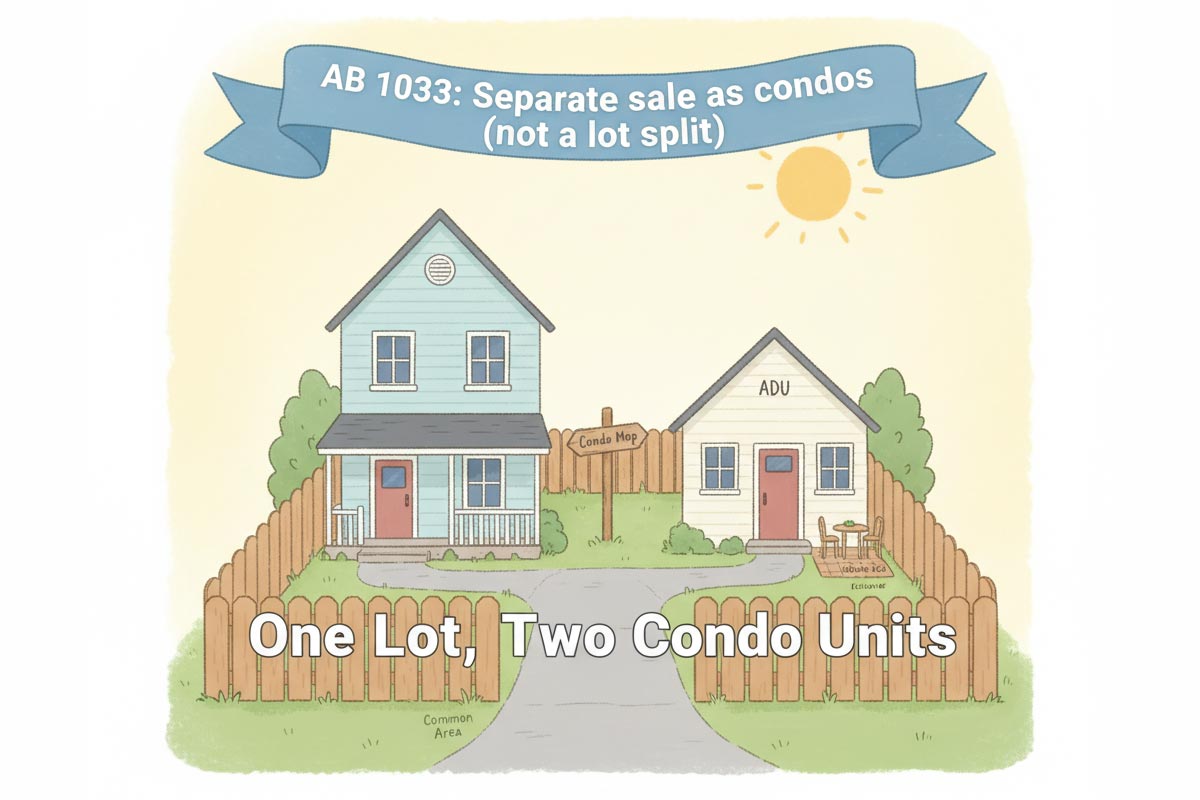
Assembly Bill 1033 has created a new class of real estate in California: the sellable ADU. In jurisdictions that opt in, homeowners can now convert their property into a condominium, allowing the ADU Read more...
Assembly Bill 1033 has created a new class of real estate in California: the sellable ADU. In jurisdictions that opt in, homeowners can now convert their property into a condominium, allowing the ADU to be sold separately from the main residence. This unlocks a brand-new listing category for agents but also brings the complexities of condo law, lender sign-offs, and extensive disclosures into what would otherwise be a simple residential sale. This guide provides the essential details you'll need to navigate these transactions confidently.
What AB 1033 Actually Does (and Why It's Not a "Lot Split")
AB 1033 allows cities and counties to pass an ordinance that lets a homeowner sell their ADU separately from the primary residence. However, it's critical to understand the legal method: this is not a lot split. Instead, you are creating a common interest development—essentially, a small, two-unit condominium project.
Here’s the practical distinction:
A lot split divides the land itself, creating two or more legally independent parcels. Each new lot is owned outright.
An AB 1033 conversion keeps the original lot intact. The land becomes a "common area" jointly owned by the owners of the main home and the ADU with each owner holding a separate interest in their airspace unit.
This brings up a common question: "Won't the two units have different Assessor's Parcel Numbers (APNs)?"
Yes, they most likely will. Once the condominium is legally created, the county assessor will typically assign a separate APN to each unit (the main home and the ADU). However, this is done for property tax purposes only. Since the units can be owned by different people, the county needs a way to send two separate tax bills. The assignment of an APN is an administrative function for taxation and does not change the legal fact that the property is a condominium on a single, shared lot—not two separate lots.
Ultimately, the state law only provides the framework; this entire process is only possible when a local city or county officially opts in and defines the specific local rules.
Where This Is Live (and why adoption is uneven)
Because AB 1033 is opt-in, the map is patchy. San José moved first —adopting an ordinance in July 2024 and green-lighting the state’s first ADU condo sale in August 2025. That milestone proved the concept and kicked off copycat discussions in other cities. Always verify local status before you market or write offers.
The Path for Sellers: From ADU to “micro-condo”
Think of the conversion as three intertwined tracks—legal mapping, habitability sign-off, and lender consent—followed by a familiar marketing and escrow period.
Confirm opt-in & pull the city checklist. If your city hasn’t adopted, you’re done. If it has, the checklist will mirror state guardrails but add local steps and forms.
Assemble the deal team early. You’ll need a land-use or condo attorney, title, a surveyor, and someone who can draft CC&Rs that divide maintenance and spell out access, parking, utilities, noise, and exclusive-use areas.
Plan the disclosure stack. In addition to the standard residential TDS and NHD and other mandated disclosures, the buyer will need condo docs (CC&Rs, bylaws, operating budget/reserves), the condo map/plan, any shared-elements easements, and recorded lienholder consents (more on that below).
Meet the safety inspection requirement. Before the map records, AB 1033 requires proof of a safety inspection—either a certificate of occupancy issued by the local agency or a HUD Housing Quality Standards (HQS) report by a certified inspector. Build time for this into your timeline.
Secure lender consent (non-negotiable). The condo map cannot record without written consent from each lienholder. Lenders can refuse or require conditions (e.g., refinancing, reserve thresholds, or revised collateral language). The consent must include specific statutory language and be recorded with the county. Start these conversations early—this is where otherwise clean deals can stall.
Sort utilities and notify providers. Separate meters may be required by local policy or utility providers; if not, the CC&Rs must clearly allocate costs, access, and shut-off rights. Upon condo creation, the homeowner must notify utility providers of the separate conveyance.
Record, list, and close. Once the map and consents are recorded, market the ADU as a condo. Expect the county assessor to assign separate APNs post-conveyance (timing varies by county). Underwriting, comps, and buyer expectations look different from a standard condo—see below.
The Buyer’s Reality: Financing, monthlys, and resale
Financing. These are condominium loans, and the smaller the unit, the more attention lenders pay to project questionnaires (reserves, insurance coverage, owner-occupancy mix, litigation). Be ready to provide the new HOA budget and reserve plan. Underwriters will model HOA dues and reserves into DTI.
Monthlies. Coach buyers on the full monthly picture: mortgage + taxes + HOA dues (with reserve contributions), potential special assessments, and shared insurance mechanics (e.g., master policy + HO-6). That clarity prevents cold feet at contingency removal.
Resale. Micro-condos trade more like cottages than flats: private entries, small footprints, and the presence (or absence) of exclusive-use outdoor space, storage, and parking drive value. Your comp set will be tiny condos, cottage courts, and—ideally—local ADU-condo comps as they emerge.
Some Documents That Protect Your Client (and you)
Statutory disclosures: TDS (Civ. Code §1102) and NHD (Civ. Code §1103 et seq.) still apply.
Condo packet: recorded CC&Rs, bylaws, operating budget and (if available) reserve study/plan, condo map/plan, shared-elements easements, utility agreements, lienholder consents, and any city notices or checklist forms.
AVID & over-disclosure: Map shared systems (sewer laterals, water lines, shared roofs/driveways) and note any open permits or variances. It’s hard to over-disclose on a first-generation product category.
HOA landmines (and how to avoid them)
Most post-closing drama comes from maintenance responsibility and use rules. Avoid ambiguity by:
Drawing a maintenance matrix that names each component (roof, siding, foundation, shared driveway/gate, landscape, fences, trash enclosure, shared meters) and assigns responsibility and inspection cadence.
Being explicit about exclusive use (patios, side yards, storage sheds) versus common area.
Setting realistic noise and parking expectations in the rules—especially where units are close.
Checking short-term rental rules at both city and HOA levels; do not imply rental income without verifying.
Utilities, access, and parking: the practical stuff
AB 1033 recognizes that upon separate conveyance, a local agency or utility may require a new or separate utility connection (and proportionate connection fees) where it wasn’t otherwise required for a standard, non-separately-conveyed ADU. If services remain shared, the CC&Rs need crystal-clear language on access, meter reading, maintenance, and billing. Record any access and utility easements so future owners—and lenders—aren’t guessing.
Pricing and positioning a micro-condo
Treat these like livable, detached cottages with condo paperwork. Price on privacy and function: no shared corridors, ground-level entries, outdoor space, light, and acoustic separation. Include a to-scale floor plan and a simple site plan (labeling the unit, parking, trash, and paths of travel). For buyers coming from apartment-style condos, the single-story cottage experience can command a premium per square foot despite smaller size.
Compliance notes your clients will thank you for
Don’t oversell “automatic.” Everything depends on local opt-in and meeting statutory conditions (inspection, mapping, consents).
Be precise about the past. Prior law had a narrow nonprofit exception; AB 1033 adds a broad condo pathway via local ordinance.
A quick case study: San José’s “first”
San José’s early adoption set the pattern: pass a clear ordinance, publish a homeowner-facing conversion guide, and coordinate internal teams (planning, building, and code enforcement). The city then approved the first recorded ADU condo in August 2025—an example that has helped normalize lender and title workflows statewide. Use that precedent when socializing the concept with your local stakeholders, but always cite your own city’s ordinance in contracts and disclosures.
What to do this week (agent checklist)
Build a local “opt-in” tracker. Keep links to city ordinances and checklists in one doc.
Collect a lender short-list. Identify originators who’ve already closed small-unit condos and will engage early on questionnaires and reserves.
Template your condo packet. Create a repeatable binder: TDS/NHD + CC&Rs + budget + map/plan + easements + utility agreements + lienholder consents.
Educate your farm. A one-page explainer for ADU owners can generate listing calls months before they’re ready to convert. Make sure to check with your broker on advertising compliance.
Bottom line: AB 1033 turns some backyards into starter homes—but only in jurisdictions that opt in, and only when you clear the condo law hurdles. The agents who win here will be the ones who master the process (mapping, inspection, lender consent), package the disclosures cleanly, and set expectations early on financing and HOA realities. Check with legal counsel and your broker to make sure you are staying compliant and you’ll be the first call when your market’s homeowners decide their ADU is ready for the big leagues.
|