
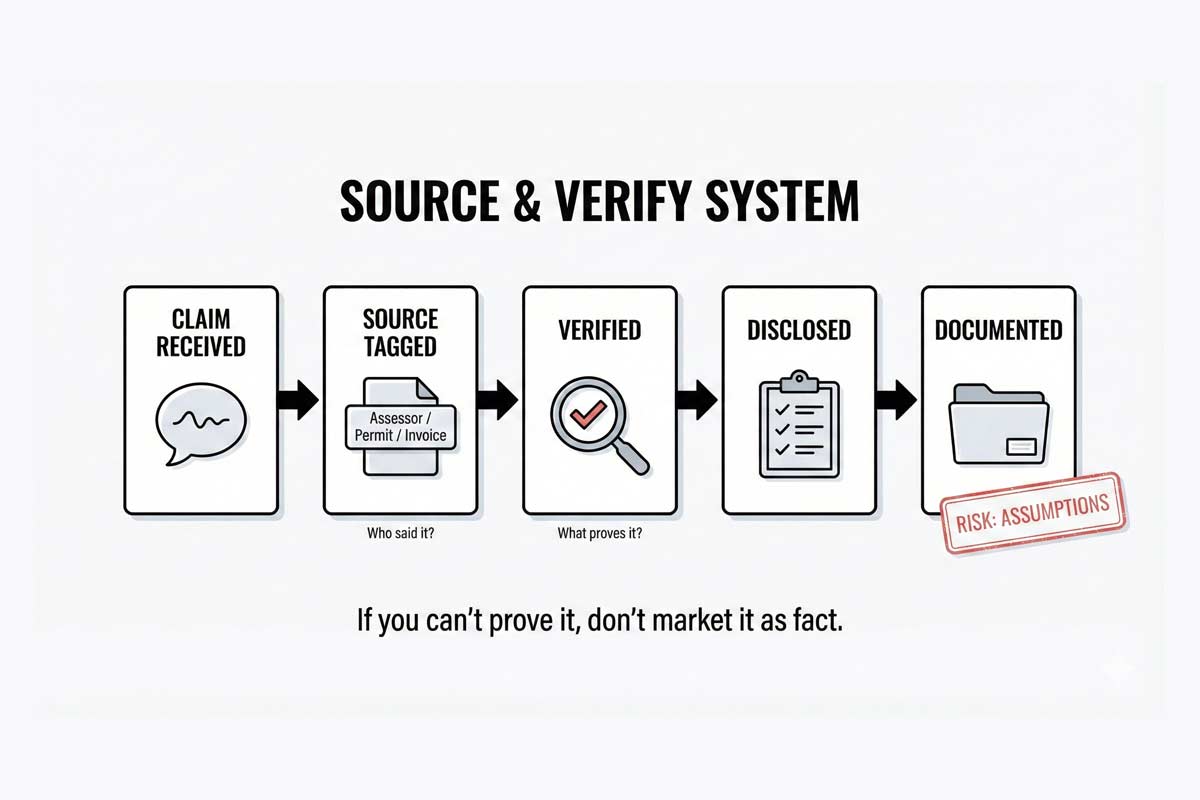
California doesn’t expect agents to be engineers, contractors, or city planners—but it does expect licensees to communicate accurately and avoid passing off assumptions as facts. The goal of this guide is simple: help you build a repeatable “source → verify → disclose → document” workflow so your MLS remarks, emails, and conversations stay clean and defensible.
Many agents assume lawsuits happen to “bad” people—scammers or fraudsters. But in California real estate, a significant portion of DRE discipline and civil litigation stems from negligent misrepresentation. It’s not that the agent lied on purpose; it’s that they repeated a seller’s claim without verifying it, or they made a casual assumption that turned out to be wrong.
If you want a long career, you must shift your mindset from salesperson to fact-checker.
In plain English, misrepresentation is a false statement of fact that induces a party to enter into a contract. It isn’t just lying; it’s providing incorrect information that a buyer relies on.
While the definition seems simple, the application is complex because California holds licensees to a higher standard than the general public. That higher standard is the foundation of our California Real Estate Laws & Compliance Guide, and it’s why misrepresentation typically falls into three practical buckets:
This occurs when an agent actively hides a defect or lies about a feature.
Example: "You know the roof leaks, but you paint over the water stains and tell the buyer, 'The roof is in perfect condition.'"
Result: This is considered a career-ending category involving major civil exposure, severe discipline risk, and potentially punitive consequences.
This is where most agents get into trouble. It happens when you make a statement you believe is true, but you had no reasonable basis for believing it—usually because you didn’t verify it.
Example: The seller tells you the square footage is 2,500. You put 2,500 in the MLS without checking the source. It turns out to be 2,100.
Result: You’re exposed because you’re expected to treat material facts like verifiable facts, not casual conversation.
This occurs when an agent makes a false statement that they had reasonable grounds to believe was true.
Example: You rely on a formal report from a licensed surveyor that later turns out to contain an error.
Result: Even without bad intent, deals can unwind and disputes can still happen.
California operates under a strict disclosure standard. A material fact is anything that would affect the value of the property or a buyer’s decision to purchase it. If you are debating whether something is material, it almost certainly is.
These are the scenarios where agents unknowingly drift into misrepresentation.
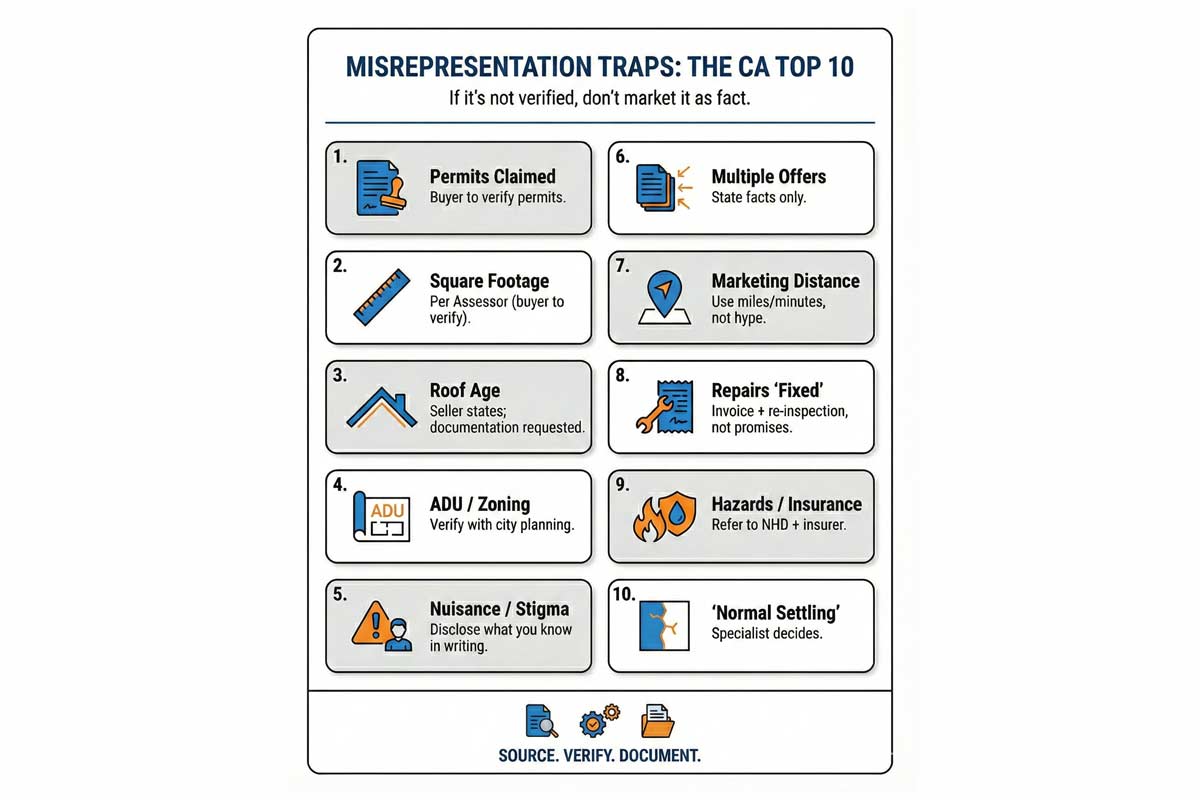
The trap: The seller says, “We added that master bath with permits.” You list it as “Permitted Master Bath.”
The reality: The seller assumed their contractor pulled permits—but they didn’t.
The fix: Never claim permits exist unless you have seen the final permit sign-off or confirmed city records. Use language like “Buyer to verify all permits.”
The trap: Copying the square footage from a prior MLS listing or trusting the owner’s estimate.
The fix: Always cite the source (“Per Assessor,” “Per Appraiser,” “Per Builder”). If there’s a discrepancy between records and the physical home, flag it immediately.
The trap: The seller says the roof is 5 years old. You market it as “Newer Roof.”
The fix: Avoid acting like a general contractor. State the age only if it’s documented, or treat it as a seller statement and recommend inspection.
With the ADU boom, agents are eager to advertise “ADU Potential.”
The trap: Telling a buyer, “You can definitely build a back house here.”
The fix: Zoning is complex (setbacks, easements, utilities, overlays). Defer to the city: “Buyer to investigate feasibility with the city.”
The trap: Failing to mention the loud plant that operates at night or an ongoing neighbor dispute over the fence line.
The fix: If a nuisance affects enjoyment or decision-making, it’s material. Hiding it conflicts with Ethical Duties Under the California Business & Professions Code, where honesty and fair dealing are not optional just because the deal is fragile.
The trap: Telling a buyer’s agent, “We have an offer higher than yours,” when you don’t—just to drive up price.
The fix: Communicate what’s true and only what’s true, especially in hot markets where buyers are already stressed—this is exactly why disciplined conduct matters in Handling Multiple Offers Ethically.
The trap: “Walking distance to the beach” (it’s 3 miles) or “quiet street” (it’s a cut-through).
The fix: Let photos and maps do the persuasion. Subjective phrases can become “facts” in a dispute. Stick to measurable statements.
The trap: The seller agrees to fix a leak. You tell the buyer, “The leak has been fixed.”
The fix: Don’t confirm repairs yourself. Transfer documentation: invoice, contractor statement, permit (if applicable), and buyer re-inspection.
The trap: “This area rarely floods,” or “Fire insurance shouldn’t be a problem.”
The fix: Never minimize hazard risk. Refer clients to the NHD and their insurance professional; keep your language document-based.
The trap: Seeing a crack and telling the buyer, “That’s just normal settling.”
The fix: Unless you’re a structural engineer, you don’t diagnose. Flag the observed condition and recommend evaluation.
You can eliminate a major share of your liability by adopting a “source and verify” habit.
If you are sharing an opinion, label it. If you are sharing a fact, cite the source.
Instead of: “1,800 square feet.”
Write: “Approx. 1,800 sq ft per Assessor (buyer to verify).”
Before you blast a feature in marketing, ask: “Do I have a document that proves this?” If not, tone it down or remove it.
Run this check at every stage:
The situation: You represent both buyer and seller. The seller mentions divorce stress and urgency. You tell the buyer to help close the deal.
The outcome: Confidentiality and loyalty get questioned immediately, and parties often argue they relied on a misrepresented level of neutrality or advocacy. That’s why Dual Agency in California (Legal Guide) treats role clarity and confidentiality as non-negotiable.
What the agent should have done: Keep motivation confidential and stick to verifiable property facts and written terms.
The situation: A flipper says the panel is “fully updated.” The agent writes “New Electrical Panel” in MLS.
The outcome: Inspector finds it’s old and painted. Buyer demands a credit and threatens claims for false advertising.
What the agent should have done: Require receipt/permit before using “new,” or describe only what you can prove.
Avoiding misrepresentation isn’t about being paranoid—it’s about being professional. It requires a shift from “selling” to “guiding.”
Your best defense is simple:
If you don’t know the answer, “I don’t know, but let’s verify it” is one of the safest phrases in your vocabulary.

Founder, Adhi Schools
Kartik Subramaniam is the Founder and CEO of ADHI Real Estate Schools, a leader in real estate education throughout California. Holding a degree from Cal Poly University, Subramaniam brings a wealth of experience in real estate sales, property management, and investment transactions. He is the author of nine books on real estate and countless real estate articles. With a track record of successfully completing hundreds of real estate transactions, he has equipped countless professionals to thrive in the industry.


"Hey guys,
I took the exam today and passed!!!!
It only took me one try which was one of my goals. I took the online
classes and follow your suggestions so I took the crash course,
used the crash course app a lot, took 7 mock tests and went
confident to present the exam. Thank you for the great job you are
doing, you guys are awesome!!!! May God continue to bless you!"
Willie V.