Written and reviewed by Kartik Subramaniam, California Real Estate Broker, DRE License #01356544, and Founder of ADHI Schools
Last reviewed for accuracy: July 15, 2026
California real estate license Read more...
Written and reviewed by Kartik Subramaniam, California Real Estate Broker, DRE License #01356544, and Founder of ADHI Schools
Last reviewed for accuracy: July 15, 2026
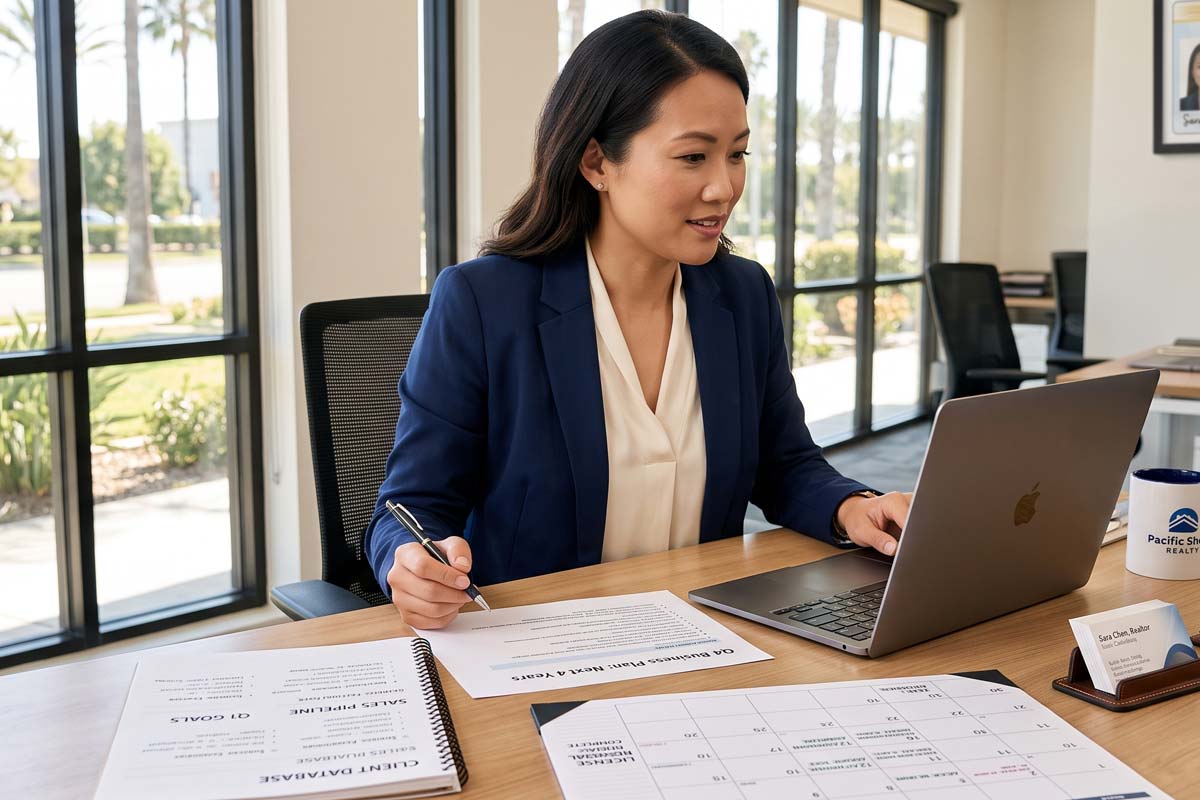
California real estate license renewal is a compliance process—not simply the purchase of a 45-hour course package. A salesperson, broker, or licensed corporation officer must determine the applicable continuing education requirement, complete qualifying courses, submit the correct renewal filing, answer the application’s disclosure questions, pay the Department of Real Estate fee, and verify that the public license record has been updated.
California real estate licenses are generally issued for four years. Most salespersons and brokers must complete 45 clock hours of DRE-approved continuing education during the applicable qualifying period. The required course composition changes depending on whether the licensee is renewing an original license for the first time or completing a second or subsequent renewal. Brokers have an additional Management and Supervision subject requirement at the first renewal of the original broker license.
An expired license does not ordinarily authorize continued licensed activity. A licensee who files a qualifying renewal on time may be permitted to continue operating while the DRE processes the application under Business and Professions Code section 10156.2, unless the DRE notifies the licensee otherwise. That protection is different from the two-year late-renewal period available after a missed expiration date.
Use this guide to identify the correct renewal path, avoid an interruption in licensed authority, and reach the detailed supporting guide for each issue. For unusual facts involving discipline, restricted status, criminal disclosures, military service, entity licensing, or mortgage-loan-originator endorsements, confirm the current procedure directly with the DRE or qualified counsel.
California License Renewal at a Glance
Requirement
Salesperson
Broker
Normal license term
Four years
Four years
Standard CE requirement
45 hours
45 hours
Earliest ordinary filing date
90 days before expiration
90 days before expiration
On-time renewal fee
$350
$450
Late renewal fee
$525
$675
Ordinary late-renewal period
Up to two years after expiration
Up to two years after expiration
Licensed activity while expired
Not permitted
Not permitted
Recommended certificate retention
Up to five years
Up to five years
The DRE—not the CE provider—renews the license. Current requirements appear in the DRE’s continuing education guidance, while filing rules and renewal options appear in itslicense-renewal instructions. Fees and administrative procedures can change, so confirm the current requirements before filing.
Table of Contents
Renewal Decision Framework
1. California Renewal Requirements
2. Active Renewal, Expiration, and Reinstatement
3. Renewal Process, Costs, and Timelines
4. DRE Compliance and Administrative Requirements
5. Special Renewal Situations
6. What to Do After Renewal
California License Renewal Checklist
Common Renewal Errors
Frequently Asked Questions
Renewal Decision Framework
Use the expiration date and the DRE public record to place the license into the correct operating category before buying courses or filing forms.
Active and more than 90 days from expiration
Confirm whether the upcoming renewal is the first renewal of the original license or a subsequent renewal. Inventory any CE already completed during the applicable four-year period, verify that each course was approved, and identify missing mandatory subjects. The application ordinarily cannot be submitted until the 90-day filing window opens, but qualifying CE may be completed earlier.
Active and within 90 days of expiration
Complete any remaining CE, gather course numbers and completion dates, review the application’s disclosure questions, and submit the renewal. eLicensing is generally the most efficient path for an ordinary individual renewal, although certain exemptions, extensions, restricted licenses, officer licenses, and disclosure situations may require paper forms or supporting documentation.
Inactive, referral-only, or not affiliated with a broker
A non-working license status is not the same as an expired license. A salesperson shown as “Licensed NBA” generally has no responsible-broker affiliation and cannot perform acts requiring a real estate license. The license can still be renewed, and the normal CE requirement still applies unless the licensee qualifies for a recognized exemption or extension.
Expired for less than two years
The license generally remains eligible for late renewal, but the licensee cannot perform licensed activity until the late-renewal requirements have been satisfied and the DRE has processed the renewal. The higher late fee applies. Do not wait until the final days of the two-year period to begin CE or prepare the filing.
1. California Renewal Requirements
Start with the license type and renewal number
The baseline California real estate license renewal requirements for 2026 are straightforward: identify the license type, determine whether this is a first or subsequent renewal, complete the correct CE combination, file within the proper window, answer every application question accurately, and pay the required fee.
Problems begin when a licensee treats every advertised “45-hour package” as interchangeable. The total hours may be correct while the mandatory-subject mix is wrong for the license type or renewal number.
A salesperson renewing an original salesperson license for the first time generally must complete:
Three hours of Ethics
Three hours of Agency
Three hours of Trust Fund Handling
Three hours of Risk Management
Three hours of Fair Housing with the required interactive participatory component
Two hours of Implicit Bias Training
At least 18 hours of Consumer Protection courses
Enough additional Consumer Protection or Consumer Service courses to reach 45 hours
A broker or corporation officer renewing an original license for the first time generally follows the same structure but must also complete three hours of Management and Supervision.
For a second or subsequent renewal, a salesperson or broker may generally complete one nine-hour survey course covering the seven mandatory subjects or complete those subjects through separate courses. The renewal must also include at least 18 hours of Consumer Protection education, with the remaining hours in approved Consumer Protection or Consumer Service courses.
Count categories, not merely certificate totals
The detailed California continuing education hour requirements matter because certificates adding up to 45 numerical hours can still produce a deficient renewal.
The DRE considers whether:
The courses were approved
The courses were completed within the applicable qualifying period
Every mandatory subject is represented
At least 18 hours fall within the Consumer Protection category
The course was already used for another renewal
The course number and completion date were entered correctly
For an on-time renewal, CE generally must fall within the four-year period applicable to the renewal. For a late renewal, the relevant four-year lookback generally runs from the date the DRE receives the late application. CE credit expires four years after completion and cannot be reused for a later renewal.
Course-provider study and examination controls also affect how quickly a package can be completed. Do not wait until the expiration date and assume 45 hours can be compressed into a few hours of clicking. Allow time for study requirements, examinations, certificate issuance, corrections, and the state filing itself.
Verify that every course qualifies
Only qualifying DRE-approved offerings should be claimed. The guide to courses that count toward California continuing education explains how to verify the course title, DRE approval number, sponsor identity, approved hours, category, approval period, and completion date.
Prelicensing courses, examination-preparation products, association designations, NMLS education, brokerage onboarding, coaching programs, and general professional-development courses do not automatically satisfy California real estate CE. A course may be useful and still be ineligible for renewal credit.
During renewal, licensees ordinarily enter course information through eLicensing or report it on the applicable CE verification form. Completion certificates are generally retained rather than routinely submitted, unless the DRE requests them during an audit or deficiency review.
Implicit bias and interactive fair housing are separate requirements
The current California implicit bias training requirement is not an optional elective. A first renewal includes a separate two-hour Implicit Bias Training course, and implicit bias is one of the seven mandatory subjects covered during subsequent renewals.
Fair Housing is a separate three-hour requirement. The fair housing course must include the DRE-required interactive participatory component, including role-play from both the consumer’s and real estate professional’s perspectives.
A licensee whose previous renewal occurred before the current rules took effect should not assume that an older CE package remains sufficient. Verify that the current package includes both compliant Fair Housing education and Implicit Bias Training.
Broker renewals include supervision
The California broker continuing education requirements reflect the broker’s responsibility for affiliated licensees, trust funds, advertising, office systems, document review, and licensed activity.
At the first renewal of an original broker license, Management and Supervision is a separate three-hour mandatory course. During a second or subsequent renewal, it is included among the seven subjects covered by the nine-hour survey course or separate-course alternative.
A broker who is also a designated corporation officer should confirm which license or licenses are being renewed. An individual broker license and an officer license should not automatically be treated as a single administrative filing.
Ready to complete the correct 45-hour package? ADHI Schools provides California DRE-approved continuing education designed around the current first- and subsequent-renewal requirements. Start your California CE renewal courses.
2. Active Renewal, Expiration, and Reinstatement
Renewing an active license
The safest process for renewing an active California real estate license begins before the 90-day filing window.
The licensee should:
Confirm the license number, type, public status, and expiration date.
Determine whether the filing is a first or subsequent renewal.
Complete the correct CE requirement.
Resolve inaccurate name, address, or broker information.
Gather records needed to answer disclosure questions.
File through eLicensing when eligible or use the appropriate paper forms.
Save proof of submission and payment.
Verify the renewed public record.
Most eligible individual licensees can renew through eLicensing. Enter each course exactly as shown on the completion certificate, answer every background and disciplinary question accurately, pay the fee, and retain the final confirmation.
Do not assume that a credit-card charge, course certificate, or provider completion email proves the state license was renewed.
When a qualifying renewal is filed on time, Business and Professions Code section 10156.2 may permit continued operation after the printed expiration date while the DRE processes the application. That protection depends on timely filing and can end if the DRE sends notice otherwise.
Recently expired licenses
The procedure to renew a recently expired California license is a late renewal—not an extension of active status.
An individual salesperson or broker generally has two years immediately following expiration to satisfy the late-renewal requirements. Those requirements ordinarily include:
The correct CE
The applicable renewal application
CE course verification
The late-renewal fee
Any required disclosure or supporting records
DRE processing and approval
During the expired period, acts requiring a California real estate license may not be performed. A salesperson should stop solicitation, negotiation, transaction work, property-management activity requiring a license, and other licensed services. The responsible broker should remove the salesperson from active production systems and confirm renewed status before authorizing a return to work.
A late renewal is not effective simply because the application was mailed or submitted. The required filing must be received, accepted, and processed by the DRE.
What expiration changes immediately
The practical consequences of a California real estate license expiring extend beyond the status shown in the public record.
Expiration can affect:
Authority to solicit or negotiate
Active listings and buyer representation
Property-management duties
MLS and association access
Brokerage supervision
Advertising and automated marketing
Referral arrangements
Transaction-management access
Compensation for post-expiration licensed services
A salesperson should notify the responsible broker immediately so active files can be reassigned or handled properly. Compensation questions can depend on when services were performed, whether additional licensed activity occurred after expiration, and the brokerage agreement. Do not assume that compensation is automatically payable or automatically forfeited without reviewing the facts.
Expiration also affects the CE lookback. Courses that would have qualified on the original expiration date can age out while the former licensee waits to file a late renewal.
The two-year period is not a grace period to continue practicing. It is a limited opportunity to apply for late renewal.
Licenses beyond the late-renewal window
A person seeking to reinstate a long-expired California real estate license should first calculate the exact date on which the two-year late-renewal right ended.
Once that right is forfeited, the DRE does not ordinarily process the matter as a renewal. The former licensee generally must apply for a new license under the requirements in effect at that time. The process may involve:
Current education requirements
The applicable state examination
A new license application
Fingerprinting or background review, where required
Current original-license fees
Experience documentation for a broker applicant
Resolution of prior disciplinary or restricted-license issues
Do not state categorically that every former licensee must repeat every prelicensing course. Previously accepted education may remain on file, while changes in law or the applicant’s individual history may create additional requirements.
A formerly licensed broker should not assume that previous broker status can be restored automatically.
Late-renewal deadlines and fees
The California late-renewal fees and deadlines should be treated as hard operating controls.
License
On-time renewal
Late renewal within two years
Salesperson
$350
$525
Broker
$450
$675
The late-renewal deadline is measured from the actual expiration date—not from the date the former licensee discovers the lapse, stops working, receives a reminder, or decides to return to the industry.
Fees are subject to change. Confirm the current amount on the DRE's official fee schedule immediately before filing.
3. Renewal Process, Costs, and Timelines
Submit the correct application
The procedure to submit a California license renewal application should be completed in a controlled sequence:
Verify the license number, status, expiration date, and license type in the DRE public database.
Determine whether the filing is on time or late.
Determine whether the renewal is a first or subsequent renewal.
Complete the correct 45-hour CE package.
Review every course number and completion date.
Review personal information, responsible-broker information, and disclosure questions.
File through eLicensing when eligible or use the applicable paper renewal form.
Pay the correct fee.
Save the confirmation, payment evidence, and copies of submitted materials.
Monitor email, mail, and the public license record.
For an on-time paper filing, preserve evidence of the official U.S. Postal Service postmark. A private postage-meter date may not provide the same proof of timeliness. Use a trackable mailing method and retain the receipt.
Avoid duplicate online and paper submissions unless the DRE instructs you to file again.
Processing times vary
The current California real estate license renewal processing times should be checked close to the filing date because DRE workload and queue dates change.
Processing can differ based on:
Salesperson, broker, or officer filing
On-time versus late renewal
Online versus paper submission
Missing or inconsistent CE information
Payment problems
Disclosure issues
Duplicate filings
Name or identity questions
Additional documentation requests
eLicensing is generally faster for an eligible ordinary renewal, but online filing does not cure an incomplete or inaccurate application. Do not promise a universal number of processing days. Consult the DRE’s current processing timeframes when timing is material.
Budget for the complete renewal
The cost to renew a California real estate license has at least two components:
The DRE renewal fee
The qualifying CE package
Additional costs can arise from:
Trackable or expedited mailing
Replacement certificates
Professional assistance with a disclosure issue
A separate corporation or officer renewal
MLO renewal
Correcting incomplete or outdated licensing records
Lost production time after expiration
Do not choose a CE provider solely on the advertised price. A package that omits a mandatory subject or does not match the renewal type may cost far more in delay and correction than the original savings.
Use a documented checklist
A dedicated California real estate license renewal checklist reduces errors by assigning a completion date to each task.
The renewal file should include:
The DRE public-license lookup
CE certificates
Filing confirmation
Payment record
Supporting disclosure documents
DRE correspondence
A copy of any paper application
Mailing evidence
Proof that the final renewed status was verified
Brokerages should also maintain an internal license-control calendar for affiliated salespersons and broker associates. Office reminders should begin well before the DRE courtesy notice.
Correct predictable mistakes before filing
The most common California license renewal mistakes are usually operational rather than legally complex.
Typical failures include:
Starting CE too late
Purchasing the wrong renewal package
Missing a mandatory subject
Entering a sponsor number instead of a course number
Using a course that has aged out
Filing with outdated contact information
Answering a disclosure question incompletely
Assuming CE completion automatically renews the license
Failing to reach the final eLicensing confirmation
Failing to verify the updated DRE record
When criminal, disciplinary, tax, child-support, or restricted-license issues are involved, obtain case-specific guidance before certifying the application.
Have your expiration date and need a controlled path to completion? Complete the required education early, preserve the certificates, and leave enough time for the state filing. Enroll in ADHI’s California renewal courses.
4. DRE Compliance and Administrative Requirements
Advertising must match the license record
The DRE advertising rules that apply after renewal continue to govern websites, email, social profiles, signs, direct mail, listing presentations, and automated campaigns.
Renewal does not validate advertising that uses an inaccurate:
Licensee name
License identification number
Responsible-broker identity
Brokerage name
Team name
Affiliation
License status
California first-point-of-contact solicitation materials generally require the appropriate licensee and responsible-broker identification. Advertising must also be truthful and not misleading.
After renewal, audit every live profile and automated campaign. If the license expired, pause scheduled advertising and other licensed solicitation until the authority to operate has been restored and verified.
Keep the DRE record current
Use the proper process for updating a name, address, or brokerage with the DRE whenever the licensing record is inaccurate.
eLicensing can handle many address and affiliation changes. Name changes and certain broker, corporation officer, entity, or restricted-license changes may require forms and supporting documentation.
Current email and mailing information are critical because the DRE may send:
Renewal notices
Deficiency letters
CE audit requests
Licensing correspondence
Administrative or disciplinary notices
Failure to receive a courtesy reminder does not extend the expiration date. Review privacy implications before using a residence address on a filing that may become part of the public record.
Verify the provider and each course
A reliable method for choosing a legitimate California CE provider is to verify the exact courses in the DRE’s approved-course database before enrolling.
Check:
Course title
DRE course approval number
Approved hours
Course category
Sponsor identity
Approval period
Registration and completion rules
Examination requirements
Certificate-delivery process
Support availability
The provider should clearly explain whether the package is designed for a salesperson’s first renewal, a broker’s first renewal, or a second or subsequent renewal.
The DRE conducts CE audits. Its current guidance recommends retaining completion certificates for up to five years. Store the records in a durable personal file that will remain accessible after a brokerage, employer, or email-account change.
5. Special Renewal Situations
Renewing from outside California
A licensee can generally renew a California real estate license from out of state through eLicensing when eligible.
Living elsewhere does not eliminate California:
CE requirements
Application requirements
Disclosure obligations
Renewal fees
Recordkeeping duties
An out-of-state licensee should confirm that the DRE has current contact information and that any required Consent to Service of Process is on file. A broker conducting California business may also need to address California business-location requirements.
Proposed activity can implicate the licensing laws of more than one state. Maintaining a California license does not automatically authorize brokerage activity in another jurisdiction.
Military service
The California military renewal rules and exemptions are narrower than a blanket waiver.
Under qualifying circumstances, active-duty service with a permanent assignment outside California during the final portion of the license period may support a request for a limited CE extension. The request ordinarily requires:
The correct DRE form
Supporting military documentation
The renewal application
The renewal fee
Filing before expiration
Military status can also intersect with separate statutory protections or registration pathways for qualifying servicemembers and spouses. Apply the rule to the individual’s actual status and orders rather than assuming every military connection produces the same result.
Attorneys with DRE licenses
The California renewal rules for attorneys are frequently misunderstood.
Membership in the State Bar of California can affect certain original-license educational prerequisites. It does not create a general exemption from the DRE’s 45-hour renewal CE requirement.
An attorney-licensee should expect to complete the applicable real estate CE unless the person independently qualifies for a recognized exemption or extension. Continuing legal education and DRE continuing education are separate systems unless a particular course has the approvals required for both.
Referral status and no-broker affiliation
The industry term “referral status” does not itself create a DRE exemption. A salesperson renewing a California license while on referral status may be shown as Licensed NBA, indicating no responsible-broker affiliation and no current authority to perform licensed acts.
The license can still be renewed to preserve future options. The ordinary CE and filing rules continue to apply unless a recognized exemption or extension applies.
Before making or accepting a referral, confirm:
The public license status
The responsible-broker relationship
Whether the contemplated activity requires an active affiliation
How compensation will be handled
The referral company’s policies
A private company’s “referral status” label cannot expand the authority shown in the DRE record.
Dual real estate and mortgage licensing
The renewal requirements for dual-licensed mortgage and real estate professionals operate on separate calendars.
A California salesperson or broker license generally renews on a four-year cycle and ordinarily requires 45 hours of DRE-approved CE. A mortgage-loan-originator endorsement generally renews annually through NMLS and has separate education, sponsorship, filing, and fee requirements.
DRE CE does not automatically substitute for NMLS CE. The DRE 70/30 exemption does not automatically waive NMLS requirements.
Maintain separate compliance records for:
Real estate-license expiration
MLO annual renewal
DRE CE certificates
NMLS CE records
Fees
Sponsorship
Renewal confirmations
The 70/30 CE exemption
A California real estate licensee may request a continuing education exemption when the licensee:
Is at least 70 years old
Has been a California real estate licensee in good standing for at least 30 continuous years
The exemption is not automatic. A first-time request generally requires the applicable DRE extension/exemption form, the renewal application, the renewal fee, proof of age, and documentation of the qualifying license history.
Once approved, the exemption generally continues for later renewals while the license remains in good standing. If good standing is lost, the previously approved exemption can terminate. Verify the current procedure through the DRE’s 70/30 exemption guidance.
6. What to Do After Renewal
Verify the result before returning to normal operations
The operating checklist for what to do after renewing a California real estate license begins with the DRE public record.
Confirm:
The new expiration date
The license status
The correct legal name
The responsible-broker affiliation
The business and mailing information
Any MLO endorsement information
Any restrictions or public notations
Save the renewed license certificate and provide the updated record to the responsible broker, compliance department, MLS, association, referral company, lender, or employer where appropriate.
Then review:
Email signatures
Websites
Social profiles
Direct-mail templates
Listing presentations
Transaction templates
Team and brokerage profiles
Automated campaigns
For a late renewal, do not assume the renewed license retroactively authorized work performed while the license was expired.
Convert CE into operating controls
The practical value of continuing education in preventing DRE violations depends on whether the material is converted into office procedures.
Mandatory subjects correspond to recurring compliance risks:
Agency disclosures
Fair housing
Implicit bias
Trust fund handling
Risk management
Ethics
Broker supervision
After renewal, select at least one control to update from each major subject. Examples include:
A trust-fund reconciliation calendar
An advertising-approval checklist
An agency-disclosure checkpoint
A fair-housing review standard
A document-retention schedule
A broker-supervision log
A transaction-file audit procedure
A calendar for the next renewal cycle
Renewal should close one compliance cycle and begin the next.
Do not leave the next renewal to chance. Complete the correct CE, retain the records, submit early, and verify the DRE status. Start your California real estate license renewal courses.
California License Renewal Checklist
Use this checklist for an ordinary salesperson or broker renewal. Add case-specific items for disclosures, restricted licenses, corporation officers, entities, military extensions, or MLO endorsements.
Confirm the license number, type, status, and exact expiration date in the DRE public record.
Determine whether this is the first renewal of the original license or a second or subsequent renewal.
Identify every mandatory subject and the required Consumer Protection hours.
Verify each course and approval number.
Complete CE early enough to satisfy study, examination, and certificate rules.
Compare every certificate with the name, course number, approved hours, and completion date that will be reported.
Retain all certificates in a personal compliance file.
Review every criminal, disciplinary, tax, child-support, and background question on the application.
Update the name, mailing address, email address, business information, or broker affiliation when required.
Begin the ordinary filing no earlier than 90 days before expiration unless a specific DRE procedure directs otherwise.
Use eLicensing when eligible or submit the correct paper forms and supporting records.
Pay the applicable fee.
Complete the online transaction or obtain a qualifying postmark before the expiration deadline.
Save proof of filing and payment.
Avoid duplicate submissions.
Monitor email, mail, and the DRE record for a deficiency or approval.
Verify the new expiration date and working status.
Update brokerage, advertising, MLS, association, referral, and MLO records where applicable.
Calendar the next renewal review well before the next four-year deadline.
Common Renewal Errors
Waiting until the expiration date to begin CE
A 45-hour requirement should not be managed as a final-day task. Study periods, examination controls, certificate corrections, and filing problems consume time. Begin several weeks before expiration and preferably before the 90-day filing window opens.
Assuming CE completion renews the license
A CE provider issues education records. It does not renew the state license.
The licensee must still:
Complete the application
Answer required disclosures
Pay the DRE fee
Submit the filing
Confirm the renewed public status
Treating the late-renewal period as permission to work
The two-year late-renewal right preserves an application option. It does not ordinarily preserve authority to perform licensed activity.
Stop licensed work until the renewal becomes effective unless a documented on-time filing provides continued authority under section 10156.2.
Purchasing an unverified or mismatched package
Confirm whether the package is designed for:
A salesperson’s first renewal
A broker’s first renewal
A second or subsequent renewal
The phrase “45-hour package” does not prove that the subject combination is correct.
Entering inaccurate course information
Course numbers, completion dates, and hours should match the certificates. Do not substitute a sponsor number for a course number or guess when eLicensing rejects an entry.
Omitting material application information
Incomplete or inaccurate disclosure responses can delay the application and may create separate compliance problems. Obtain records and appropriate advice before certifying an answer when the response is uncertain.
Failing to maintain current contact information
The DRE sends important correspondence to the addresses on file. Update email and mailing information promptly and monitor both during processing.
Failing to confirm final status
The final control is the DRE public record. A submitted transaction, payment receipt, or course certificate is not a substitute for verifying the renewed license, new expiration date, and correct broker affiliation.
Frequently Asked Questions
1. How often must a California real estate license be renewed?
California salesperson and broker licenses are generally issued for four-year periods. The exact expiration date appears in the DRE public license record and on the license certificate.
2. How many CE hours are required for renewal?
Most renewing salespersons and brokers must complete 45 clock hours of DRE-approved continuing education unless an approved exemption or extension applies.
3. What is the difference between a first and a subsequent renewal?
A first renewal requires separate mandatory courses, including the current Fair Housing and Implicit Bias Training requirements. A second or subsequent renewal may use the nine-hour survey course covering the seven mandatory subjects or complete those subjects separately.
4. Do brokers need more than 45 hours?
No. Brokers generally complete the same 45-hour total. The first renewal of an original broker license includes Management and Supervision as a separate mandatory three-hour subject.
5. How much does a California real estate license renewal cost?
The current on-time DRE fee is $350 for a salesperson and $450 for a broker. The current late-renewal fees are $525 and $675, respectively. CE tuition is separate.
6. How early can I submit the renewal?
The DRE ordinarily accepts a renewal beginning 90 days before the expiration date. Qualifying CE can be completed earlier, provided it remains within the applicable period when used.
7. What makes a renewal filing on time?
An online filing is generally on time when the eLicensing transaction is completed before midnight on the expiration date. A paper filing generally requires a qualifying official postmark by that deadline. Preserve proof.
8. Can I keep working while an on-time renewal is pending?
Possibly. Business and Professions Code section 10156.2 may permit continued operation when a qualifying renewal was submitted on time, unless the DRE provides notice otherwise. This is not the same as filing after expiration.
9. What happens if my license expires?
The licensee ordinarily loses authority to perform acts requiring a real estate license. A salesperson should notify the responsible broker immediately and stop licensed activity until the license is renewed.
10. Can I work during the two-year late-renewal period?
No. The two-year period provides an opportunity to apply for late renewal. It is not authority to practice while the license remains expired.
11. What happens after the two-year late-renewal period?
Ordinary renewal rights are forfeited. The former licensee generally must apply for a new license under the requirements then in effect and pass the applicable examination.
12. Must I submit CE certificates with the renewal?
Not ordinarily. Licensees generally report and certify the course information through eLicensing or the applicable paper form. Keep the certificates because the DRE can request them during an audit or deficiency review.
13. How long should I keep my CE certificates?
The DRE currently recommends retaining completion certificates for up to five years. Keep them in a personal compliance file rather than relying only on a brokerage or old email account.
14. Can a salesperson renew without a responsible broker?
Yes. A salesperson can generally renew without a responsible-broker affiliation and remain or become inactive. The salesperson must be properly affiliated before performing activities requiring a license.
15. Can I renew while living outside California?
Generally, yes. The licensee must still satisfy California CE, filing, fee, disclosure, and recordkeeping requirements and should verify any applicable nonresident filing requirements.
16. Is there an exemption from continuing education?
A narrow exemption is available to qualifying licensees who are at least 70 years old and have been licensed in good standing in California for at least 30 continuous years. The exemption requires DRE approval and is not automatic.
Conclusion
A compliant California real estate license renewal has four completed controls:
Correct continuing education
Accurate filing
Timely payment
Verified DRE status
Begin before the deadline, use only approved courses, distinguish on-time-processing protection from late-renewal eligibility, and stop licensed activity whenever the public record does not support it.
For an ordinary renewal, the workflow is direct: complete the correct 45-hour package, submit the renewal, save the evidence, and verify the new expiration date.
For an expired license, exemption, extension, restricted status, military issue, officer license, out-of-state record, or MLO endorsement, resolve the exception before certifying the application.
Written and reviewed by Kartik Subramaniam
California Real Estate Broker, DRE License #01356544
Founder, ADHI Schools
ADHI Schools DRE Statutory Sponsor ID S0348
ADHI Schools Continuing Education Sponsor No. 6404
|
You’ve spent weeks, perhaps months, mastering contracts, disclosures, and agency relationships. But the most stressful part of the California real estate exam should be making sure you pass the first Read more...
You’ve spent weeks, perhaps months, mastering contracts, disclosures, and agency relationships. But the most stressful part of the California real estate exam should be making sure you pass the first time, not getting through the front door of the testing center.
Every year, well-prepared candidates are turned away before they even see a single exam question.
Why?
Because they forgot a specific document, brought a prohibited item, or arrived with an ID that didn't match their registration. At ADHI Schools, I have spent over 20 years guiding students through this process, and we’ve seen how a simple oversight can derail a career launch.
This is your definitive "bring / don't-bring" checklist. Use this guide to ensure your exam day is focused on the content, not the logistics.
Quick Checklist Preview
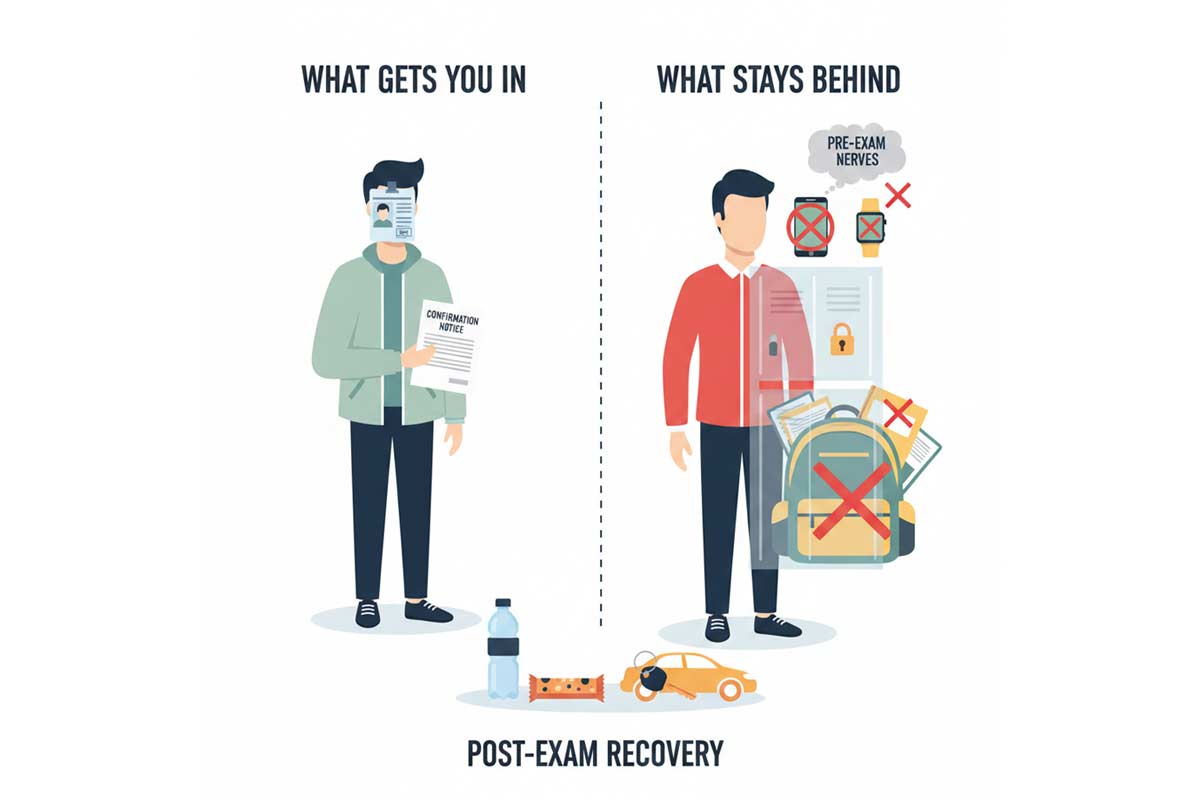
Must Bring: Valid Government-issued Photo ID and Exam Confirmation.
Must Leave: All electronics (phones, smartwatches) and study materials.
Arrive: At least 30 minutes early to handle security and storage.
Can I bring my phone to the California real estate exam?
No. Store it in your locker or leave it secured in your vehicle. Even powered-off devices can trigger a rule violation if they are on your person during the exam.
The 60-Second Checklist (Bring / Don’t Bring)
If you are walking out the door right now, here is the high-confidence version of your day.
BRING THESE
LEAVE THESE (Car or Home)
Valid, current Photo ID
Your Smartphone / Tablet
Printed Exam Confirmation Notice
Smartwatches or Fitbits
A sweater or light jacket
Notebooks, textbooks, or "cheat sheets"
Your car keys (to be stored in a locker)
Bulky backpacks
A calm, focused mindset
Large bags or
Mandatory Items You Must Bring
To sit for the exam, you must prove who you are and that you are authorized to be there. The proctors at the testing center have zero flexibility on these requirements.
1. Valid Government-Issued Photo ID
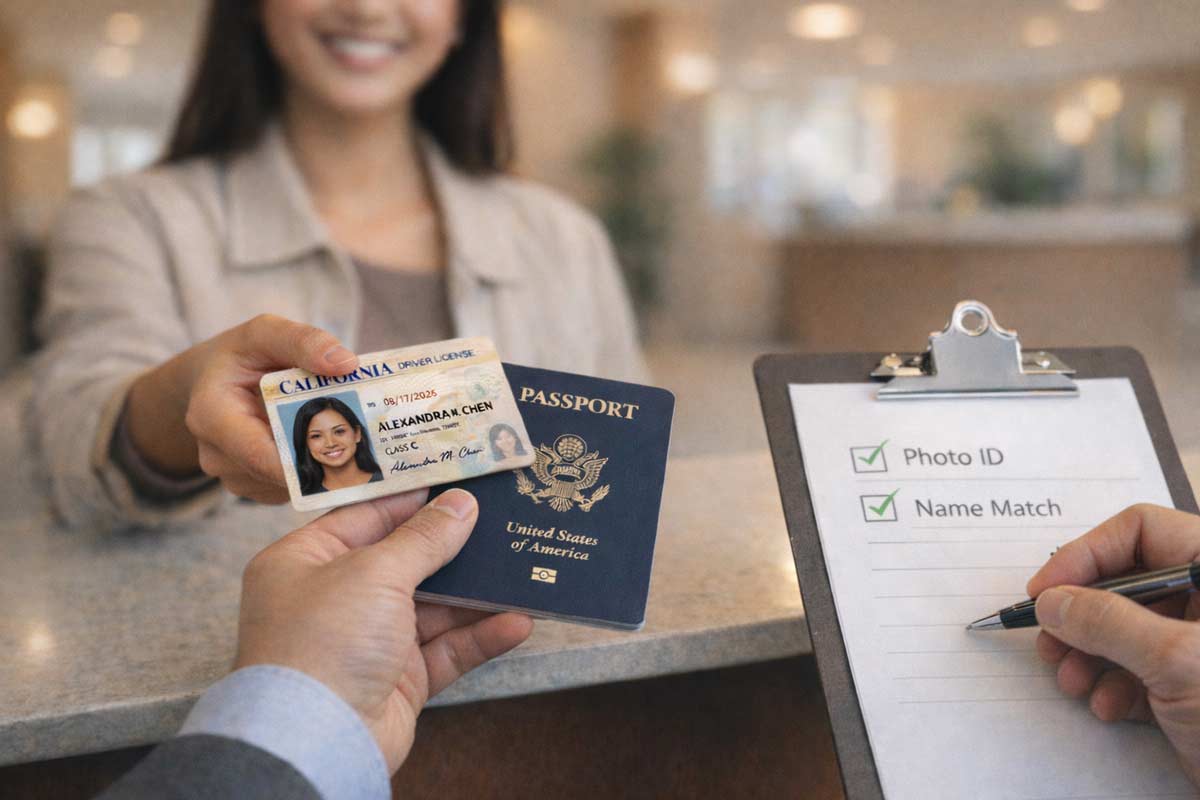
This is the most common point of failure. Your ID must be current (not expired), contain a recognizable photograph, and—most importantly—the name on your ID must match the name on your exam registration.
For a deep dive on what counts as valid (and what causes a turn-away), see Identification Requirements for the CA Exam.
2. Your Exam Confirmation Notice
While many centers can look you up digitally, having a printed copy of your examination confirmation (obtained via the DRE eLicensing system) is your "golden ticket." It contains your exam date, time, and center location. It serves as your proof of scheduling if there is a technical glitch at the check-in desk.
Optional Items That Help (Without Getting You in Trouble)
While the list of what you can take into the testing room is tiny, these items will make your overall experience significantly better:
Layered Clothing: Testing centers are notorious for unpredictable climates. One room might be a freezer, the next a sauna. Bring a light jacket or sweater (without many pockets) so you can adjust.
Parking Plan and Buffer Time: Don't let a hunt for a parking spot raise your cortisol levels. Map out the center 24 hours in advance and aim to be in the parking lot 45 minutes before your start time.
Water and a Snack: You cannot bring these into the testing room, but keep them in your car. After hours of intense mental focus, your blood sugar will be low. Having a "recovery snack" waiting for you is a pro move.
What Not to Bring (Common Turn-Away Triggers)
The California Department of Real Estate (DRE) and its testing partners maintain strict security protocols. Bringing these items into the testing area is often considered a security violation.
Electronics of Any Kind: This includes phones, tablets, and e-readers.
If you leave your phone in your pocket and it's discovered during check-in—even if it's powered off—it can be flagged as a violation.
Watches and Wearable Tech: Smartwatches are strictly prohibited. Policies on analog watches vary by site; to avoid any confusion or delays, it is best to leave all watches in your locker or car.
Calculators: Calculators are no longer provided at the exam site and you aren’t allowed to bring your own. There is no longer any math on the real estate exam.
Bags and Wallets: Most centers provide small lockers, but they are often only large enough for a set of keys and a slim wallet. Avoid bringing large purses or backpacks.
To avoid accidental rule violations, review California Real Estate Exam Rules & Testing Policies before exam day.
What to Expect at Check-In (So Nothing Surprises You)
Checking in for the exam feels a bit like TSA at the airport. You should arrive at least 30 minutes early to ensure you aren't rushed.
The Security Sweep: You may be asked to empty your pockets, turn them inside out, and show your wrists to ensure no prohibited items are being brought in.
The Storage Reality: You will likely be assigned a small locker for your keys and ID. Note that the DRE and the test center take no responsibility for lost or stolen items—leave everything but the essentials in your locked vehicle.
The Name Match: The proctor will compare your ID to the roster. If the names don't match and you lack the documentation mentioned above, you may not be allowed to test.
If You Get Turned Away (Your Next Move)
If the worst happens—you're late, your ID is expired, or you forgot your documents—take a breath. It feels like a disaster, but it is a fixable mistake.
If you are turned away, you will typically have to reschedule and pay a new examination fee. Once you've processed the frustration, you'll need a recovery plan. If you are unable to complete the exam for any reason, check out our guide on What Happens If You Fail the CA Real Estate Exam to learn how to reapply and get back on track.
After the Exam: What Comes Next
When you finish the exam, the screen will eventually reveal your result. Passing is an incredible milestone, but it’s just the start of the licensing process. If you haven’t done your fingerprints yet you will need to do that and apply for your license.
ADHI Schools recommends the combo exam/license application that allows for the exam and license to be applied simultaneously.
For a step-by-step look at how to turn that passing score into an active license, read our breakdown: What Happens After You Pass the CA Real Estate Exam.
FAQ: California Real Estate Exam Day
What ID do I need to bring to the California real estate exam?
You need a current, government-issued photo ID such as a Driver’s License, State ID card, or Passport.
Do I need to print my exam confirmation to take the test?
While not always strictly required at every center, it is highly recommended. It serves as your "receipt" and contains vital information if there is a scheduling dispute.
Can I bring my phone into the exam room?
Absolutely not. Phones must be powered off and stored in a locker or left in your vehicle.
Are smartwatches allowed during the California real estate exam?
No. Smartwatches are treated as prohibited communication devices.
What happens if I arrive late to the exam center?
Most centers enforce a strict cutoff window. If you arrive late, you may be treated as a no-show and required to reschedule—your exam confirmation notice controls the timing rules.
Is there a locker for personal belongings at the test center?
Most testing locations provide small lockers for essential items like keys and wallets, but they cannot accommodate large bags or laptops.
Your Full Exam Roadmap
Looking for the "Big Picture"? Our California Real Estate Exam Guide is the master hub for scheduling, rules, ID, and what to do after you pass or fail.
Printable Checklist
Primary ID: Current, valid, and matches registration name.
Confirmation Notice: Printed from eLicensing.
The "Light" Setup: No heavy bags, no extra tech.
Vehicle Prep: Phone and watch hidden/locked in the car.
Timeline: Directions saved, arriving 30–45 mins early.
Need a focused prep plan? Explore our www.crashcourseonline.com to get exam-ready once you’ve mastered the logistics.
Or warm up with our Free Real Estate Practice Exam to get familiar with question style before test day.
|
You’ve spent weeks—maybe months—memorizing agency relationships, trust fund accounts, and the intricacies of California land use. You are ready to pass the real estate test. But for many candidates, Read more...
You’ve spent weeks—maybe months—memorizing agency relationships, trust fund accounts, and the intricacies of California land use. You are ready to pass the real estate test. But for many candidates, the biggest obstacle isn't the exam questions; it’s the person standing at the check-in desk.
In my 20-plus years of coaching students at ADHI Schools, I’ve seen incredibly well-prepared candidates get turned away before they even touch a keyboard.
Why?
Because of a simple identification mismatch. This guide is your "proctor-proof" checklist to ensure your ID and records are in perfect alignment.
What is the acceptable ID for the CA real estate exam?
According to the California Department of Real Estate (DRE), you must present a valid, current form of photo identification. Only the following are typically accepted: a current state-issued driver’s license or DMV ID card, a U.S. Passport, a foreign government passport, or a U.S. Military ID. You will not be admitted without one of these specific physical documents.
What happens if my name doesn't match my exam ID?
If the name on your photo ID does not match the name on your exam registration, you may be denied entry. While minor formatting differences like a middle initial could be fine, significant discrepancies—such as nicknames or unrecorded name changes—require you to update your DRE record before your exam date to avoid being marked as a "No Show."
The Core Rule: Validation and Alignment
The absolute "Golden Rule" for exam day is that your identification must be current (valid) and it must match the name on your exam registration. The DRE is the final authority on these policies, and testing center proctors follow their handbook strictly. They are not authorized to make "judgment calls." While minor formatting differences are sometimes accepted, you should assume strict matching is required and resolve any discrepancies weeks before your date.
Name Mismatch Risk Assessment
Scenario
Risk Level
Recommendation
Middle Initial vs. Full Middle Name
Low
Usually fine, but full name is the safest bet.
Two Last Names / Spacing (e.g., De La Cruz)
High
Spacing must match your ID exactly.
Accents / Special Characters (José vs Jose)
Medium
Usually system-normalized, but confirm your portal entry.
Nickname (e.g., "Bobby" instead of "Robert")
High
You must update your DRE record to match your ID.
DRE-Aligned Acceptable ID Types
To be admitted into the examination, you must show a valid form of photo identification. Per current DRE guidelines, only the following forms are accepted:
Current state-issued driver’s license
DMV identification card
U.S. Passport
Passport issued by a foreign government
U.S. Military identification card
Important: The DRE is the source of truth for these policies. Always review the most recent "Taking the Exam" guidance from the DRE website before your scheduled date.
High-Risk Situations: Why People Get Sent Home
1. The Expired ID Trap
Even if it only expired yesterday, an expired ID is invalid for testing purposes.
The Fix: Check your expiration date at least 30 days before your exam.
The Risk: You will likely be forced to reschedule and pay a new exam fee.
2. Temporary or Paper IDs
A temporary or paper receipt from the DMV is often not accepted as a primary form of ID because it lacks the required security features of a plastic card.
The Guardrail: If you are waiting on a new license, the safest backup is a valid U.S. Passport that matches your registration exactly. Do not rely on a paper extension unless you have confirmed it meets current testing center compliance.
3. Damaged or Unreadable ID
If your photo is peeling, the plastic is cracked through your name, or the card is heavily worn, a proctor may reject it. If your ID is in poor condition, replace it now.
The 14-Day "Proctor-Proof" Checklist
Two weeks before your exam, perform this final audit:
Confirm Registered Name: Log into the DRE eLicensing portal. Does the name there match your photo ID character-for-character?
Check ID Expiration: Is your ID valid through the date of your exam?
Verify SSN/ITIN Submission: Double-check your initial application records for any typos in your identification numbers.
Locate a Backup ID: If your primary ID is damaged or nearing expiration, ensure your Passport is ready and available.
Print Your Notice: Have your Exam Schedule Notice/confirmation email printed and ready.
What If You Are Turned Away?
If a proctor denies you entry due to an ID issue, you may be marked as a "No Show." This typically means you forfeit your exam fee and must wait for the DRE to process the status before you can reschedule.
If this happens, stay calm. Visit our guide on What Happens If You Fail the CA Real Estate Exam—the process for rescheduling due to a "No Show" is essentially the same as a traditional failure.
To ensure you don't run into other procedural hurdles, be sure to review our comprehensive list of California Real Estate Exam Rules & Testing Policies.
Moving Toward Your License
Being familiar with the check-in process and knowing what to bring to the exam is critical. By having a look at your ID today, you remove the "what-ifs" from exam day. Once you get that "Congratulations" printout at the desk, find out What Happens After You Pass the California Real Estate Exam to finish your journey.
For a complete look at the application process, scheduling, and study strategies, visit our California Real Estate Exam Guide.
|
If you are researching your next career move at 11:00 PM after a long shift or while the kids are finally asleep, you probably have one burning question:
Can you get a California real estate license Read more...
If you are researching your next career move at 11:00 PM after a long shift or while the kids are finally asleep, you probably have one burning question:
Can you get a California real estate license online?
The short answer is: Mostly, but not entirely.
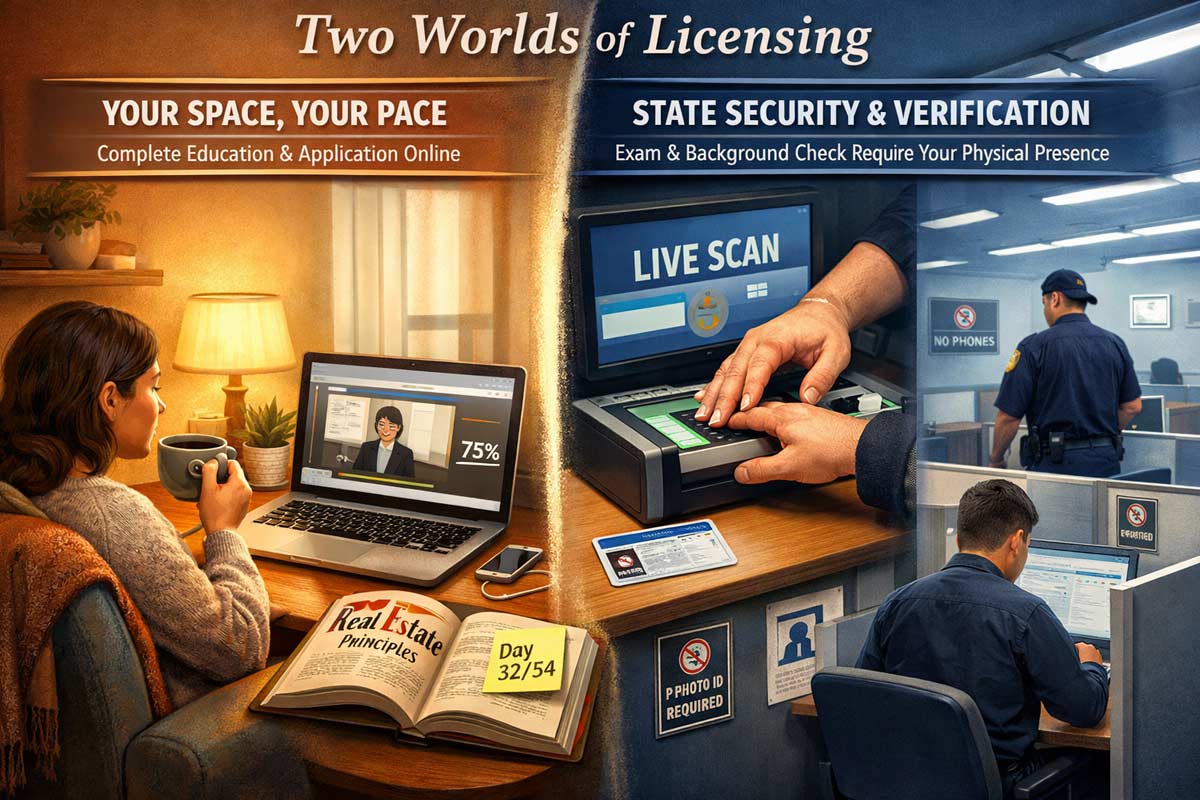
While the California Department of Real Estate (DRE) has embraced digital transformation—allowing you to complete your education and submit your paperwork from your couch—there are still physical "gatekeepers" that require you to show up in person.
The Reality Check: Online vs. In-Person
What You CAN Do Online
What You MUST Do In Person
Complete all 135 hours of pre-licensing courses.
Sit for the actual State Exam at a DRE exam center.
Submit your application via eLicensing.
Get your Live Scan (digital) fingerprints taken.
Pay your application and license fees.
Present valid government-issued photo ID.
Manage your license renewals later on.
Physically attend the testing center.
The Bottom Line: You can complete 100% of your required education online, but the State of California requires you to physically appear for your exam and your background check. It is important to check the fine print: while the "schooling" is digital, the "licensing" still has a few real-world milestones.
Defining "Online" in the California Licensing Process
When people ask about getting a California real estate license online, they are usually referring to the flexibility of the curriculum. In California, you are required to complete three college-level courses: Real Estate Principles, Real Estate Practice, and one elective.
At ADHI Schools, we’ve spent over 20 years helping students navigate this. We know that for a busy professional, the ability to take online real estate courses in California is the difference between starting a career and just dreaming about one.
However, the "license" itself isn't a digital download. It is a credential granted by the state after you prove your knowledge in a proctored, high-security environment.
The 18-Day Regulatory Rule For Coursework
In California, DRE regulations specify that a student must spend a minimum amount of time with their course materials before they are eligible to take a final exam. This is typically implemented as a seat-time requirement of 18 days per course. Because you must take three courses, your total minimum education time is 54 days—a timeline that applies even if you are the fastest reader in the state.
Step-by-Step: What Parts Can Be Done Online?
To help you plan, here is the numbered flow of the licensing process, showing exactly where the "online" part ends and the "real world" begins.
Pre-Licensing Education (Online): Complete your three courses (Real Estate Principles, Practice, and an elective). This takes a minimum of 54 days due to mandated study timers.
Application Submission (Online): Use the DRE eLicensing system to submit your combined Exam/License application.
Live Scan Fingerprints (In Person): You must visit a Live Scan provider to have your fingerprints electronically transmitted to the DOJ and FBI.
The State Exam (In Person): Once your application is processed, you will schedule a date to visit one of the five DRE testing centers (Sacramento, Oakland, Fresno, La Palma, or San Diego).
License Issuance (Digital/Mail): Once you pass, the DRE processes your results. You can often see your license number online before the paper certificate even arrives.
What Must Be Done In Person (And Why)
The DRE takes the integrity of the real estate profession seriously. The reasons you can't do it all from a laptop come down to two things:
Security and Compliance.
Exam Integrity: To prevent cheating and ensure that the person taking the test is actually the applicant, exams are held in monitored facilities where phones and notes are prohibited.
Identity Verification: Live Scan fingerprinting ensures that your criminal background check is tied to your actual identity, which requires a physical "chain of custody" at a licensed provider.
Expert Tip: If you’re in a rush, you’ll want to look into the fastest way to get a real estate license in California.
Timeline Planning
If you are trying to map out your calendar, your "online" progress is the most predictable part of the journey. Once you move into the "in-person" phase, you are at the mercy of DRE processing times and exam seat availability.
For most students, a realistic schedule involves finishing the online coursework while simultaneously preparing their paperwork. For a detailed breakdown of these phases, check out our California real estate license timeline. If you're wondering how those months look on a week-to-week basis, read our deep dive on how long it takes to become a real estate agent in CA.
Cost & Convenience Reality Check
While you save time and gas money by choosing to get a real estate license online in California, you still need to budget for the state-mandated fees.
As of 2026, the DRE fee for a salesperson exam is $100, and the original license fee is $350, totaling $450 paid directly to the state. Additionally, you will need to account for Live Scan fingerprinting. This involves a $49 state processing fee, plus a "rolling fee" charged by the private provider (typically $30–$45).
For a full breakdown of every nickel and dime, see our guide on how much it costs to get a real estate license in California.
Common Misconceptions
"I can take the state exam from home."
No. You must travel to a DRE-approved testing site.
"Online courses are instant."
No. California law requires you to spend a minimum amount of time with the material (typically 18 days per course).
"Once I finish courses, my license is automatic."
No. Finishing courses only makes you eligible to apply for the state exam.
"Online = instant approval."
Even if you submit online, the DRE may take several weeks to review your file and authorize you to test.
FAQ Section
Can I take the California real estate exam online from home?
No. The California State Exam must be taken in person at one of the Department of Real Estate’s designated testing centers to ensure exam security.
Can I complete the required real estate courses online?
Yes. You can complete all 135 hours of required pre-licensing education (Principles, Practice, and an elective) through an approved online provider like ADHI Schools.
Do I have to do Live Scan in person?
Yes. Live Scan requires a physical scan of your fingerprints by a certified technician at a licensed provider. This cannot be done via a smartphone or home scanner.
How long does it take if I do everything possible online?
Most students finish in 3 to 5 months. This accounts for the 54-day mandatory study period and current DRE administrative processing times.
What is the fastest way to get licensed in California?
The fastest route is to submit a "Combined" Exam and License application and complete your Live Scan immediately after finishing your online courses to avoid "dead time" while waiting for your test date.
How much does it cost to get licensed in California?
You should budget roughly $600 to $1,100 total. This includes your online course tuition, the $450 in DRE exam and license fees, and your Live Scan fingerprinting costs.
What is the most common reason people get delayed?
The most common delay is waiting to schedule the state exam. If you wait until after your courses are finished to start your DRE application, you may find yourself in a weeks-long queue for a testing seat.
Ready to Start Your Journey?
The road to a new career starts with the right map. While you can't do everything online, choosing a flexible, high-quality online education provider is the best way to maintain your current lifestyle while building a new one.
For a comprehensive look at the entire process, visit our California Real Estate License Guide.
|
Last Reviewed: February 2026 (Always verify the latest rules on the official California Department of Real Estate (DRE) website before your exam day.)
Quick Summary (TL;DR): To sit for the California Read more...
Last Reviewed: February 2026 (Always verify the latest rules on the official California Department of Real Estate (DRE) website before your exam day.)
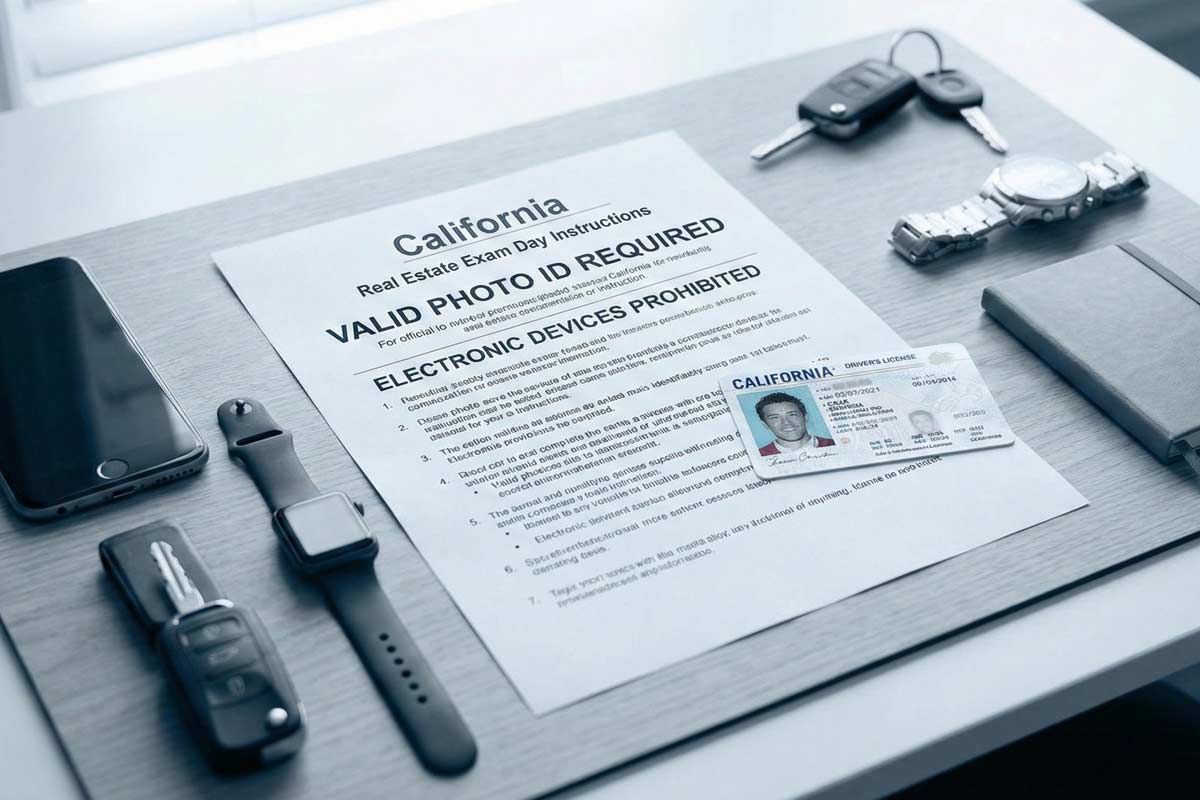
Quick Summary (TL;DR): To sit for the California real estate exam, you must present a valid government-issued photo ID that matches your registration name. Electronic devices—including phones and smartwatches—are prohibited in the testing room. Plan to arrive at least 30 minutes early; severely late arrivals are often denied entry and may need to reschedule.
The biggest obstacle to passing your California real estate exam shouldn’t be the check-in desk. Every year, qualified candidates are turned away or disqualified—not for lack of study, but for violating a small set of non-negotiable exam-day rules.
With over 20 years of preparing candidates, I have seen the preventable errors that delay months of hard work. This guide cuts through the anxiety and gives you the rules you need so your only job on exam day is answering questions.
The 80/20 Rule: The Policies That Most Often Get Candidates in Trouble
Most exam-day issues stem from a handful of avoidable mistakes. Focus your attention here:
Identification issues: An invalid, expired, or unacceptable ID is the fastest way to be denied entry.
Prohibited personal items: Phones, watches, bags, and even your own pens can trigger disqualification if brought into the testing room.
Late arrival: Sessions begin promptly—arrive early or risk being denied entry and potentially forfeiting your exam fee.
Food, drink, and study materials: These are not permitted in the testing environment.
Not following instructions: Proctors enforce exam-security rules strictly.
Identification & Name-Match Policies: Your Non-Negotiable Entry Ticket
Your photo ID is your passport into the exam. The DRE is explicit about what is accepted and what is not.
What you must present
You must show one valid, original, government-issued photo ID from the authorized list:
A current state-issued driver’s license or DMV identification card.
A valid U.S. Passport (or a passport issued by a foreign government).
A valid U.S. Military identification card.
The critical name-match reality
Your registration and application must be under your legal name. Common friction points that lead to entry denial include:
Middle Names: Middle initial on one document vs. full middle name on another.
Life Changes: Marriage/divorce name changes not reflected consistently across your documents.
Shortened Names: Using nicknames like “Mike” vs. the legal name “Michael.”
Pro-Tip: If your identity cannot be verified cleanly against the roster, proctors may deny entry. Reconcile any discrepancies at least two weeks before your exam date.
For a full breakdown of documentation and common mismatch fixes, see Identification Requirements for the CA Exam.
Security Screening & Personal Belongings
Knowing the “logistics of the lobby” reduces day-of stress. Here is the standard flow at many exam sites:
Check-in: A proctor verifies your ID and matches you to the roster.
Storage: You will be directed to store personal belongings (typically in lockers, or a designated storage process if lockers are limited).
The Phone Rule: Phones must be powered off and stored as directed. Possession or use of a phone during the exam session—including during breaks—can lead to immediate disqualification.
Final Entry: Once cleared of personal items, you will be assigned a seat.
Best practice: Leave valuables at home or secured in your vehicle. Bring as little as possible to the site.
Prohibited Items: What Not to Bring
The DRE maintains an “Examination Control Information” list. Bringing prohibited items into the testing room can lead to immediate disqualification.
Category
Prohibited Items
Electronics
Cell phones, smartwatches, fitness trackers, tablets, laptops, cameras/recording devices.
Personal Items
Purses, wallets, keys, backpacks, briefcases, suitcases.
Stationery
Your own pens/pencils, paper, notes, flashcards.
Accessories
Hats/caps, lapel pins, tie tacks, smart glasses.
Consumables
Food, drinks/water bottles, gum, and candy.
"Bring Less, Bring Right" Checklist
To ensure a frictionless check-in, only have these items on your person when you approach the proctor:
Your valid, original government-issued photo ID.
Your car key (if not attached to a bulky keychain).
A light sweater or jacket (testing rooms can be chilly).
If you want the “positive list” of what to bring (so you don’t over-pack), read What to Bring to the California Real Estate Exam.
Timing Rules: Arrival, Late Policy, and Breaks
Arrival: Plan to arrive at least 30 minutes early to allow time for check-in, storage, and security.
Late policy: If you arrive after the session has started, you may be denied entry and required to reschedule (which can mean losing your slot and paying again).
Breaks: The exam is a continuous sitting. If you step out for any reason, assume your exam clock continues and follow the proctor’s procedure.
Test-Day Conduct: Disqualification & “Don’t Do This”
To protect exam integrity, follow these rules:
No communication: Don’t speak to or signal other candidates.
No copying: Don’t look at other screens or attempt to reconstruct questions to share later.
Absolute compliance: Follow proctor instructions immediately and without argument.
Violations can result in the exam being terminated and may affect future licensing applications.
Special Situations: Accommodations and “What If…”
Testing accommodations: If you need accommodations (e.g., extra time), you must request and receive approval through the official DRE process well before your exam date.
Medical/comfort aids: Items like insulin pumps or braces may require advance notice for screening—handle this early.
If you are turned away: Don’t panic. Fix the underlying issue (renew ID, correct name mismatch, etc.) and follow our recovery plan in What Happens If You Fail the CA Real Estate Exam.
Final Exam Day Checklist & Next Steps
If you follow these rules, you’ll clear check-in smoothly and can spend your mental energy on the exam itself.
If you pass, read: What Happens After You Pass the CA Real Estate Exam
For the complete roadmap and context, visit the: California Real Estate Exam Guide
Frequently Asked Questions (FAQ)
1. Can I wear a watch during the exam?
No. Watches (including smartwatches) are commonly prohibited. Plan to rely on the on-screen timer.
2. Can I bring my phone if it stays in the locker?
Yes, but it must be powered off and stored exactly as instructed. Do not access it during breaks.
3. What if my ID expired yesterday?
You will likely not be admitted. Your ID must be valid on the exam date.
4. Can I bring my own calculator?
Typically no. There is no longer any math on the California real estate exam and the testing sites no longer provide calculators or dry erase boards.
5. How early should I arrive?
At least 30 minutes before your scheduled start time.
|
Seeing the word "PASS" after you leave the Department of Real Estate (DRE) testing center is a massive milestone. You’ve successfully navigated the 150-question hurdle that stalls thousands of aspiring Read more...
Seeing the word "PASS" after you leave the Department of Real Estate (DRE) testing center is a massive milestone. You’ve successfully navigated the 150-question hurdle that stalls thousands of aspiring agents every year.
However, after over 20 years of preparing candidates for this moment, the most important truth I can share is this:
Passing the real estate exam is the end of your studies, but it is only the beginning of the licensing process. Understanding exactly what happens after you pass the CA real estate exam is critical to ensuring you don’t get stuck in a months-long "administrative gap" caused by paperwork errors or timing mistakes.
The Big Distinction: "Pass" vs. "License Issued"
A common mistake new candidates make is assuming they can hit the ground running the second they walk out of the testing center.
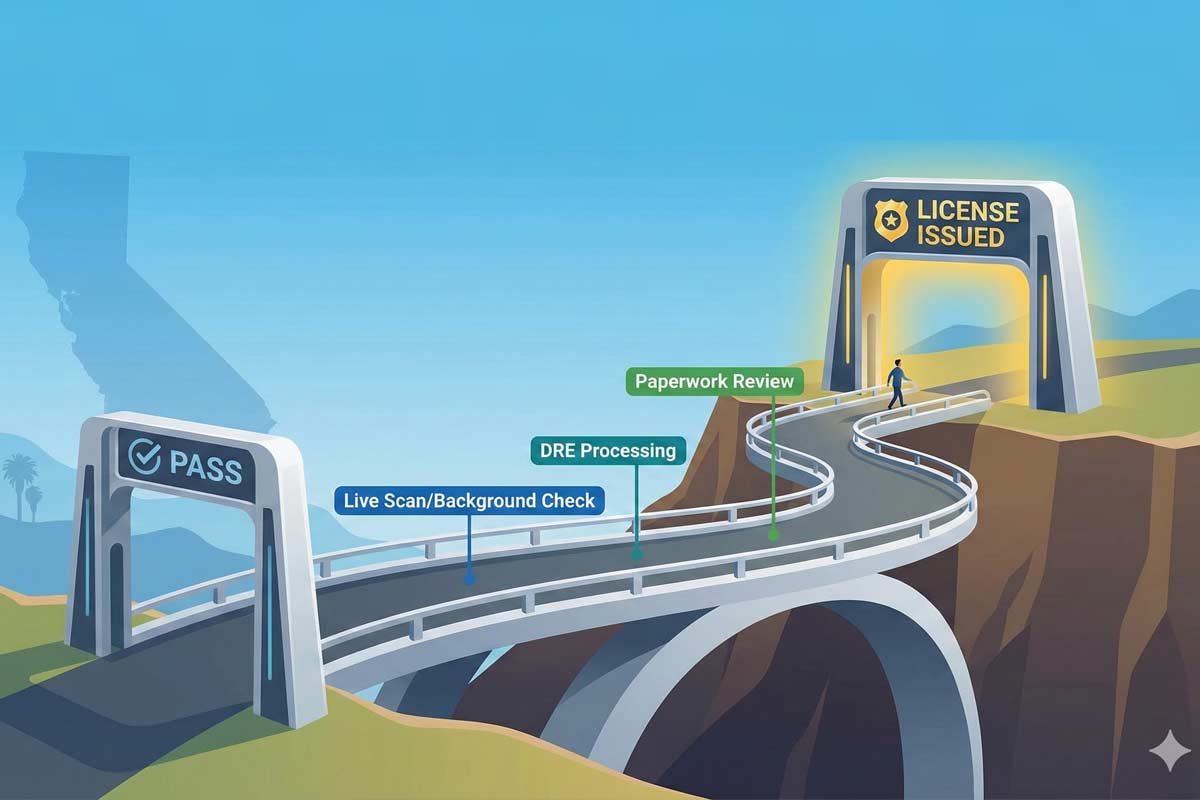
The Professional Reality: You do not have a license yet; you have a passing score. You cannot legally perform any activities that require a license—including representing yourself as a licensed salesperson to the public—until the DRE officially issues your license number and your status reflects as "Licensed" in their public database and your license is placed with a broker.
Consider this scenario: A candidate passes on Tuesday, celebrates on social media by calling themselves a "licensed agent," and begins soliciting clients on Wednesday. Because their license hasn't been officially issued, they are technically practicing without a license, which can lead to disciplinary action before their career even begins.
Two Common Paths After You Pass
Your next steps depend entirely on which application path you chose at the beginning of this journey.
Path 1: Exam + License Combo Applicants
If you filed the Salesperson Exam/License Application (RE 435) and paid both fees upfront, your path is generally the most streamlined.
What Happens Now: The DRE already has your intent to be licensed. Once your passing score is uploaded (usually within a few business days), they move straight to your background check and licensee issuance.
Your Move: Check if your license was issued here. This path is often the fastest when your file is clean and your fingerprints clear quickly.
Path 2: Exam-Only Applicants
If you only applied to take the test using form RE 400A, the DRE has no record of your license application yet.
What Happens Now: You must log into the DRE eLicensing system to download the Salesperson License Application (RE 202). You have exactly one year from your pass date to submit this application; if you miss that window, you must retake the exam - This is one of many reasons ADHI Schools recommends the combo exam/license application.
Your Move: This form must be submitted along with your Live Scan Service Request (RE 237) and the required licensing fee. Follow the DRE instructions for the current submission method (mail or other accepted electronic methods).
Decision Helper: Which path did I choose?
If you paid $450 in DRE fees up front, you are likely a "Combo" applicant. If you only paid the $100 exam fee and never submitted license materials, you are "Exam-Only." You can verify your application history by logging into your DRE eLicensing profile.
The Post-Pass Checklist: Actionable Steps to Your License
To avoid the "delay cycle," follow this checklist with the precision of a professional agent.
Verify Your Identity Consistency: Ensure the name on your application matches your government-issued ID exactly. For a refresher on why name matching is vital for identity consistency, see our guide on Identification Requirements for the CA Exam.
Access Forms via eLicensing: Use the DRE’s eLicensing portal to download your RE 202 (if applicable) and to track your status. Ensure you follow all current DRE instructions for how to submit these documents once completed.
Handle the Live Scan: If you haven't completed your fingerprints, do so immediately. The DRE cannot issue a license until they receive fingerprint responses from the DOJ and FBI.
Secure Your Sponsoring Broker: While the DRE can issue your license as Licensed NBA (No Broker Affiliation), you cannot perform licensed acts or earn commissions until you are affiliated with a responsible broker.
Maintain Professional Standards: Exam-day policies are strict, and the licensing process is strict too—don’t treat either casually. Refer to the California Real Estate Exam Rules & Testing Policies to remember the level of discipline the DRE expects from its applicants.
How Long Does It Take After Passing?
Processing times for after passing the California real estate exam fluctuate based on the DRE’s current volume. The DRE regularly updates their processing timeframes on their website, showing the "as of" dates for the applications they are currently reviewing.
Reviewable files (no missing signatures, correct fees, clear fingerprints) move through the system as soon as they are reached in the queue.
Deficient files (missing initials, mismatched names, or incorrect fees) are sent back to the applicant, which can add significant delays to the timeline.
To speed up the process:
Use the exact, current fee amount
Keep a copy of your Live Scan RE 237 with your ATI number to prove the fingerprints were transmitted.
Ensure all required signatures—including your sponsoring broker’s—are in the correct boxes.
If Something Goes Wrong: The Two Failure Modes
Even after passing, two common issues can stall your career:
The Administrative Loop: This is usually caused by sloppy paperwork. Revisit our list of What to Bring to the California Real Estate Exam as a reminder that professional success always starts with meticulous documentation and clean logistics.
The Support Gap: If you have colleagues who didn't make it this time, they may need to review our guide on What Happens If You Fail the CA Real Estate Exam to help them plan their retake.
Pro-Level Guidance: Think Like a Professional Already
The transition from "student" to "licensee" is your first official real estate transaction. Success in this business depends on paperwork discipline and responsiveness.
Be Meticulous: Real estate is a game of contracts. Treat your RE 202 with the same care you would a million-dollar purchase agreement.
Be Proactive: Check eLicensing regularly to see if your license number has been generated.
Build Habits Early: Use this waiting period to interview brokers and set up your business foundation.
FAQ: Post-Exam Essentials
How long after passing the CA real estate exam do I get my license?
It varies based on the DRE's current queue. "Combo" applicants often see results faster, but separate applications generally take several weeks for processing and background clearance.
Can I work as an agent after I pass the exam?
No. You cannot legally perform any acts requiring a license until your status is officially "Licensed" in the DRE database and you are working under a broker.
What if my name doesn’t match my documents?
This will cause an administrative delay. The DRE requires your legal name to be consistent across your ID, exam record, and background check.
What’s the difference between passing and getting a license issued?
Passing means you've met the testing requirement. "Issued" means the DRE has verified your application, fees, and background, granting you the legal authority to practice.
Your Next Step
Your journey to a successful real estate career is just beginning. To ensure you stay on the right track and avoid common pitfalls, bookmark our master guide:
California Real Estate Exam Guide
|
If you just saw the word "FAIL" on your exam results, take a breath.
The California real estate exam is a rigorous barrier to entry designed to ensure only prepared professionals enter the industry. Read more...
If you just saw the word "FAIL" on your exam results, take a breath.
The California real estate exam is a rigorous barrier to entry designed to ensure only prepared professionals enter the industry. At ADHI Schools, I have spent over 20 years helping thousands of students navigate this exact moment.
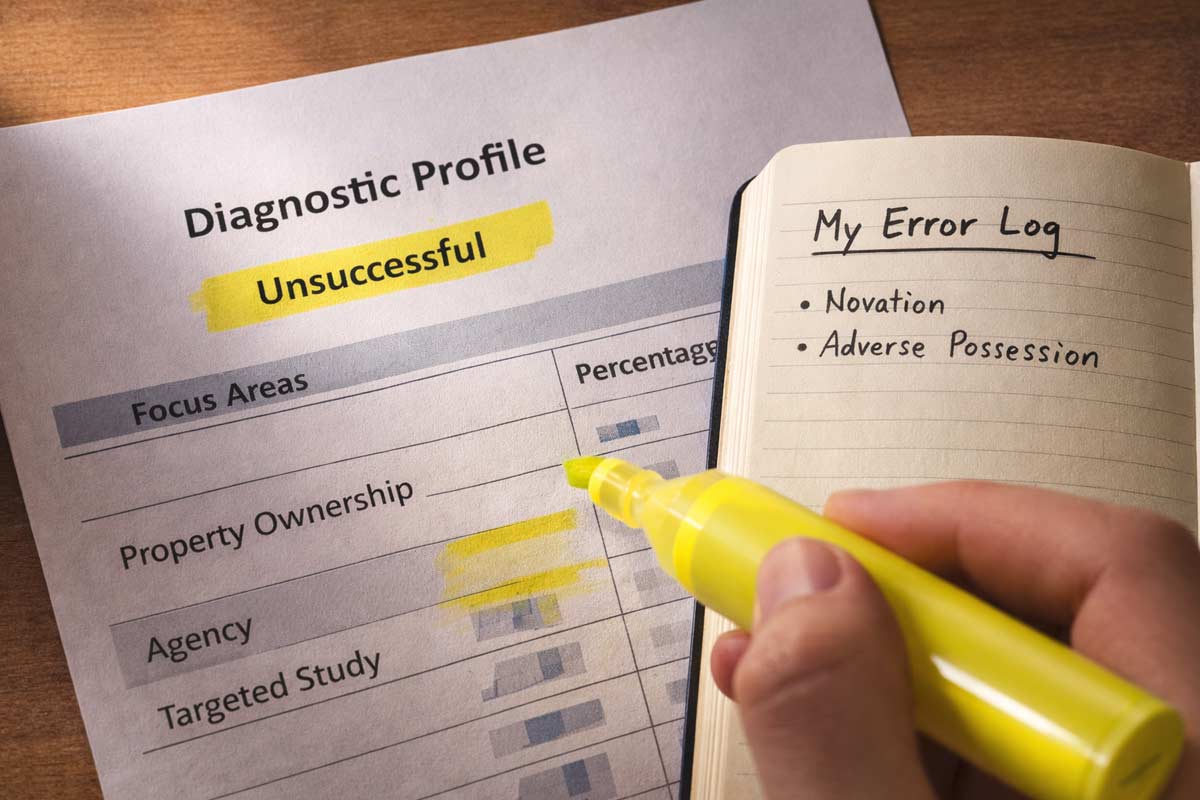
What happens if you fail the CA real estate exam isn’t the end of your career—it is a reconnaissance mission. You now have firsthand experience with the testing environment and the specific phrasing of the questions. Here is your professional recovery plan to turn this detour into a license.
First: What Failing Actually Means
Procedurally, failing simply means you didn’t hit the required scoring threshold. According to the California Department of Real Estate (DRE) standards:
Salesperson Candidates: Must score at least 70%.
Broker Candidates: Must score at least 75%.
Quick Snapshot: Your Immediate To-Do List
Review Today: Analyze your diagnostic profile to see which of the seven categories (e.g., Property Ownership, Land Use) need work.
Confirm Eligibility: Ensure you are still within your two-year application window.
Wait for the System: Do not attempt to reschedule until the DRE has fully processed your "Unsuccessful" result.
What Happens Immediately After You Fail
In California, you typically receive your results at the testing center. If you didn’t pass, you will receive a notification containing a diagnostic profile. This document is your roadmap; it breaks down your performance percentage in each major category.
The "Golden Hour" Reconnaissance
Before the specific details of the questions fade, perform a "brain dump":
Recall 10 Questions: Write down ten topics or specific questions that confused you.
Analyze Pacing: Did you finish with an hour to spare, or were you rushing to beat the clock?
The "Strategy" Check: Did you change your answers frequently? Real-world scenario: We often see students second-guess themselves from a passing score down to a failing one. Trust your first instinct.
Protecting Your Focus
Avoid a "panic spiral" by staying off unverified forums or Reddit. Every test-taker’s experience is subjective; trust your official diagnostic data over internet anecdotes that may lead to conflicting advice or wasted study time.
How to Retake the Exam
To reschedule the CA real estate exam, you must apply for a re-examination and pay the current fee.
The Re-Examination Rules
The Two-Year Eligibility Window: You must pass the examination within the two-year period following the date your initial application was filed. If you do not pass within this window, your application expires, and you must re-establish eligibility to try again.
Waiting for Results: DRE does not publish a fixed "waiting period" (such as 30 days) between attempts. However, you must wait until your results have been officially processed and received before you are eligible to reapply.
The "Submit Once" Rule: DRE explicitly warns candidates to submit their reschedule application only once—either online or by mail. Multiple submissions can lead to duplicate charges or your records being flagged for review.
One Date at a Time: You can only be scheduled for one exam date at a time. Rescheduling an existing appointment typically removes your current date.
Avoid the "System Flag": Attempting to obtain a new exam date before your previous results are processed can result in your records being withheld and the assessment of additional fees.
Verify Your Logistics
Before you head back, review the Identification Requirements for the CA Exam and the California Real Estate Exam Rules & Testing Policies to ensure no administrative errors disrupt your next attempt.
Why People Fail (and How to Fix It Fast)
Most failures fall into one of four patterns. Identify yours to adjust your strategy:
Failure Pattern
What it looks like
The Professional Fix
The Content Gap
Seeing terms like "Novation" or "Adverse Possession" and feeling lost.
Focus on the glossary. Real estate is a vocabulary test at its core.
The Strategy Gap
Narrowing it to two answers and always picking the wrong one.
Practice the "distractor" method: find why three answers are wrong instead of why one is right.
The Physiology Gap
Crashing or losing focus around question 100.
Build stamina. Take full-length, timed sets to mimic the 3-to-4-hour window.
The Logistics Gap
Arriving stressed due to traffic, ID issues, or prohibited items.
Review What to Bring to the California Real Estate Exam 48 hours early.
The 14-Day Comeback Plan
Don’t wait months to retake. Momentum is your ally.
Days 1–3 (Weakness Blitz): Study the two lowest-scoring categories on your diagnostic profile.
Days 4–7 (The Error Log): Take practice questions and write down why you missed them. Understanding the "why" prevents repeat mistakes.
Days 8–11 (Simulated Testing): Take full-length sets (150 questions for Salesperson, 200 for Broker). Build your sitting stamina for the actual 3-to-4-hour exam window.
Days 12–13 (High-Probability Review): Review Agency, Contracts, and Practice of Real Estate and Mandated Disclosures.
Day 14 (The Reset): Light review only. Confirm your location and pack your ID.
Simulating Success: The CrashCourseOnline.com Method
If your diagnostic profile showed gaps in specific areas, the most common mistake is to "just study more." You don't need more study; you need simulation. While nobody has the exact questions that are on the test, our proprietary system at crashcourseonline.com is engineered to closely simulate the concepts tested on the exam. We categorize our 1,100+ practice questions into the same seven categories found on your official results notice, allowing you to hyper-focus on your weakest subjects.
Frequently Asked Questions
How soon can I retake the California real estate exam?
DRE does not publish a fixed numeric wait time; however, you must wait until your current results are processed and received before the system will allow you to reapply.
How do I reschedule or reapply after failing?
The most efficient method is using the DRE eLicensing portal. You will select "Re-Examination," pay the fee, and select a new date.
Do my pre-license course certificates expire?
No. According to the DRE, pre-license course approvals for the three required college-level courses do not expire. You only need to focus on passing the state exam itself.
What happens if my two-year application window expires?
If you don't pass within two years of your application date, you must submit a new application, pay the initial fees, and re-establish eligibility.
Your Next Steps
This attempt didn't give you a license, but it gave you data. Now, we execute the plan. Once you clear this hurdle—and you will—you can look forward to What Happens After You Pass the CA Real Estate Exam.
For a comprehensive look at the entire journey, consult our California Real Estate Exam Guide.
Step 1: Download your diagnostic profile from the DRE eLicensing portal.
Step 2: Schedule your re-exam once the system allows to lock in your momentum.
Step 3: Start your Error Log based on your 10 "reconnaissance" questions.
Need a hand with the data?
If you have your diagnostic profile and aren't sure how to prioritize your study hours, reach out. We can help you build a targeted schedule based on your specific score breakdown.
|
The "License Cliff": Why Agents Can Stall in the First 30 Days
You pass the state exam, celebrate, and then the email arrives from the DRE: "Your license is active." Suddenly, the guided path of mandatory Read more...
The "License Cliff": Why Agents Can Stall in the First 30 Days
You pass the state exam, celebrate, and then the email arrives from the DRE: "Your license is active." Suddenly, the guided path of mandatory courses and proctored exams ends. You are no longer a student with a syllabus; you are a business owner with a blank canvas.
If you aren’t careful, you can end up on the wrong side of what we call the “License Cliff”.
Without guidance or deadlines, new agents can drift into "luxury cosplay"—spending weeks on logos and business cards while their momentum evaporates. Here’s what to do after you get your California real estate license in the first 30 days to move from "licensed" to "in business."
The 30-Day Launch Sequence
✅ The Day 1–2 Checklist: Immediate Momentum
Identify 3 Brokerages: Do not over-analyze. Pick three based on proximity and reputation.
Call the Managers: Request a "New Agent Interview." Do not wait for an "opening."
Audit Your Finances: Make sure you can cover 3–6 months of dues + basic expenses.
Phase 1: The Mandatory First Step – Hang Your License
Practically speaking, you can’t operate solo in California. Your license becomes usable when it’s placed under a supervising broker. Your broker sponsors your license and provides the supervision and compliance umbrella that lets you practice.
Who is this for?
The Solo Agent: You want to build your own brand from Day 1 and keep a higher split.
The Team Agent: You want provided leads and high accountability.
ADHI Recommendation: For most brand-new agents, training beats split—by a lot. A training-heavy team environment provides the systems you need to survive Year 1.
The Brokerage Interview Scorecard
Onboarding: Is there a structured 30-day plan or just a desk?
Costs: What are the monthly tech, desk, and E&O (Errors & Omissions) fees?
Live Training: Can you shadow a listing presentation or an inspection this week?
Directive: Schedule 3–5 interviews. Your goal is a qualified launchpad for your first 12–24 months. If you’re still navigating the timing of your application, read Do You Need to Join a Brokerage Before Applying for a License?.
Phase 2: Setup Week – Activating Your Toolkit
Once sponsored, your first week is about technical setup. Avoid the "Branding Black Hole" and focus on permission-to-play tasks.
Your First 7-Day Setup Checklist
Task
Action Item
Compliant Signature
Include your Name, DRE License #, and Brokerage info (required for compliant advertising).
CRM Import
Export your phone and social media contacts. This is your "Sphere of Influence."
MLS & Supra
Get your MLS login and set up your Supra key for lockbox access.
The "Ask" Rule
Bookmark your broker's guidelines. When unsure on a disclosure, pause and ask your broker.
Phase 3: Your First 30 Days – The "Conversation Engine"
In real estate, Activity > Results. You cannot control a closing, but you can control your scoreboard.
Your First 30-Day Activity Scoreboard
10 New Conversations: Direct, two-way dialogues about the market.
5 Value-Add Follow-Ups: Sending a useful report or link (not just "checking in").
1 Hosted/Shadowed Open House: Your field laboratory for meeting neighbors.
1 Practice RPA: Write a mock Purchase Agreement using your broker’s templates.
Reality Snapshots
The “Ghost” Agent: I’ve seen students pass the exam but wait 60 days to pick a broker. By then, their momentum is dead. The knowledge from the exam has a half-life; use it immediately.
The Branding Trap: One agent spent $500 on a custom logo before their first sphere call. Six months later, they were out of the business with a beautiful, empty website.
The Open House Win: A new agent hosted an open house for a top producer. They didn't sell that house, but met a neighbor who listed with them four months later. That one conversation turned into a $25k commission.
The Top 3 Post-License Traps
"I need a perfect brand first": Your brand is competence and responsiveness. Use your brokerage's templates for 6 months while you learn the contracts.
Tool Overload: You will be pitched "guaranteed leads" by dozens of vendors. The Fix: Use only what your brokerage provides for the first 90 days.
The Expert Fear: You don't need to know everything. Your script is: "That's a great question. Let me confirm this with my broker/manager so I give you the exact answer."
FAQ
"Can I get my license first and choose a broker later?"
Technically yes, but you are losing momentum. Read Top Reasons People Fail to Get Licensed in California to see why delay is the enemy of success.
"What if I feel unprepared?"
The exam proves you know the law; the first 30 days prove you can follow a system. If you haven't finished your hours yet, check Can You Take the Exam Before Completing All 135 Hours? to speed up your timeline.
"What does my broker actually do?"
They are your regulatory partner. They review your files for compliance, provide legal contracts, and pay your commissions. They are the "adult in the room" for your professional liability.
Your Next Step
Getting licensed was the "license to learn." Now, you must execute. If you are still navigating the pre-license requirements, solidify your foundation with our complete California Real Estate License Guide.
Open your calendar now and block 9:00 AM – 11:00 AM tomorrow for "Brokerage Research and Outreach." Treat it like an appointment.
|
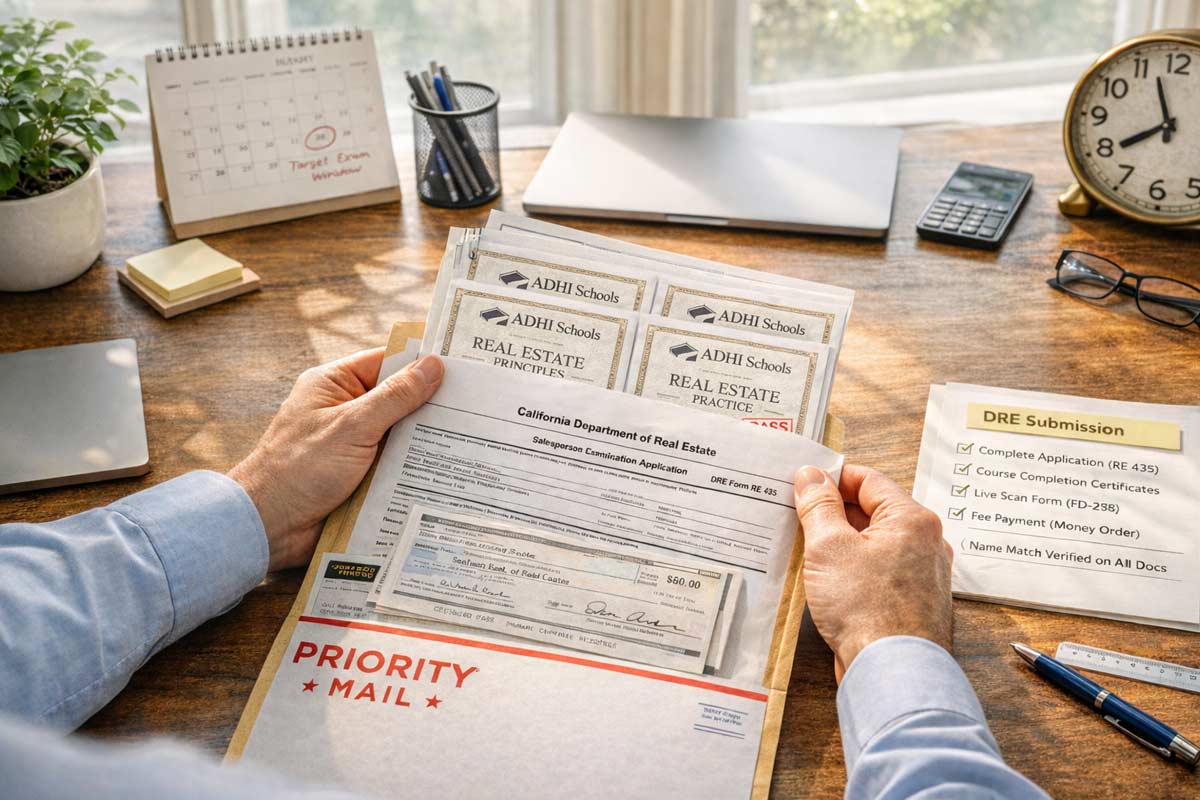
TL;DR: The Bottom Line
The Answer (in plain English): No — you can’t be authorized to schedule or take the California real estate exam until the Department of Real Estate Read more...
TL;DR: The Bottom Line
The Answer (in plain English): No — you can’t be authorized to schedule or take the California real estate exam until the Department of Real Estate (DRE) verifies you’ve completed all 135 hours (three 45-hour courses).
The Risk: Submitting your application while you’re “still finishing” your last course is the fastest way to trigger a DRE deficiency notice and delay.
The Solution: Finish your courses, secure your certificates, and follow the "clean-file sequence" to move from candidate to licensee without bureaucratic friction.
Most confusion comes from mixing up applying to the DRE with scheduling an exam date—scheduling your state exam can only happen after DRE approval.
The Truth Table: What You Can (and Can’t) Do Right Now
Action
Possible before 135 hours?
Outcome / Practical Advice
Submit DRE application
Yes (don’t)
Triggers a deficiency notice and adds weeks of delay.
Get Authorization to Schedule
No
The DRE won’t issue an exam invite until your file is 100% complete.
Choose an exam date
No
You can’t access the eLicensing calendar until you’re approved.
Study & exam prep
Yes
Recommended — this is the only “shortcut” that actually works.
The Speed Trap: Why "Almost Done" Is Still a "No"
In my 20-plus years of training thousands of agents at ADHI Schools, I’ve seen one mistake repeat more than any other: the Speed Trap.
It usually starts with a highly motivated candidate who is halfway through their third course. They look at the DRE’s current processing times—which fluctuate—and think they’ve found a loophole. They decide to mail their exam application today, assuming that by the time a DRE processor actually opens their envelope, they will have finished the course and can just "send in the final certificate later."
This is a high-stakes gamble that almost nobody wins. The DRE does not "hold" your spot in line while you finish your homework. If a processor opens your application and the course completion certificate is missing, the process doesn’t pause—it breaks. You won’t just lose time; you’ll lose your momentum and you'll be waiting for a deficiency notice and a new review cycle before you can fix it.
The DRE’s system is built to verify eligibility first — clean files move faster than hopeful ones. In practice, the fastest candidates aren’t the ones who rush—they’re the ones who submit a file with nothing for the DRE to question.
The 135-Hour Rule, Explained Simply
To qualify for the California real estate salesperson exam, state law requires the completion of three DRE-approved pre-licensing courses, totaling 135 hours:
Real Estate Principles (45 hours)
Real Estate Practice (45 hours)
An Elective Course (45 hours—most of our students choose Finance, Appraisal, or Legal Aspects)
Enrollment in these courses is subject to California’s minimum time-in-course rules (usually enforced as a minimum number of days per course). You cannot "crash" these courses in a weekend; the regulatory framework is designed to ensure a minimum level of exposure to the material before you are given the ability to test out.
The "Completed" Checklist
The DRE only considers a course "complete" when you have checked these three boxes:
Time Requirement: You have spent the mandated number of days enrolled in the course (18 calendar days typically).
Examination: You have passed the final exam for that specific course with a score of 60% or higher with ADHI Schools.
Documentation: You have received a formal course completion certificate or transcript showing the exact course title and your legal name as it appears on your government-issued ID.
Until you have all three certificates in your possession, you are not an eligible candidate for the state exam.
The Real Answer: "Exam Before Hours" Scenarios
Let’s break down the specific scenarios candidates use to try and bypass the timeline.
Can I schedule the exam before finishing 135 hours?
No. In California, you don’t simply call a testing center and pick a date like you would for a haircut. You must first apply to the DRE. They review your education proof, and only then do they issue an Authorization to Schedule (also known as an Exam Invite). Until you’re approved, you’re not “in line” for an exam seat.
Can I take the state exam before finishing 135 hours?
No. There is no "provisional" testing. The education is a statutory prerequisite. Without the 135 hours, you aren't a candidate; you're just someone with an incomplete application.
What if I’m 90% done with my last course?
No. The DRE does not recognize partial credit. Whether you have 0 hours or 134 hours, the result is the same: Ineligible. You must wait until the final certificate is issued before mailing your application packet.
What if my course is done, but I’m waiting for my certificate?
No. Do not mail your application with a note saying "Certificate coming soon."
What if I finished courses years ago?
Only If. In many cases, older course completion records can still be usable, but the safest move is to verify your course titles and the provider's approval status to make sure you're applying under current DRE rules. If you are unsure if your older classes still count, check our California Real Estate License Guide to ensure your education aligns with today’s standards.
The Fastest Path: The "Clean-File" Sequence
If you want to get licensed as quickly as possible, stop looking for shortcuts and follow this proven sequence. This is the timeline we see work most efficiently for our students.
Complete the 135 Hours: Finish Principles, Practice, and your Elective.
Gather Your Proof: Secure all three course completion certificates. Ensure your name matches your government-issued ID exactly.
Submit the "Combined" Application: Use form RE 435 (Salesperson Exam/License Application). Most first-time applicants should use the combined path so you don’t create a second processing cycle after passing.
The Waiting Window: Once your application is mailed, the DRE enters a review period where they process your file.
Pro-Tip: If you want the full, granular step-by-step from choosing your courses to passing the state exam, start with our California Real Estate License Guide.
What You Should Do While Waiting for Your Exam Date
The period between mailing your application and receiving your Authorization to Schedule is not "dead time." If you just sit and wait, you are actually slowing yourself down. Use this window to handle the "back-office" of your new career:
Live Scan Fingerprints:You don't have to wait until you pass the exam to do your background check. Doing it now means your license can be issued almost immediately after you pass.
Master the Material: The 135 hours of pre-licensing education is the "what." Now you need to learn the "how" of passing the exam. This is when you should be high-quality exam prep tools.
Brokerage Interviews: You can't actually sell real estate without a broker. Use this time to interview different firms. You can learn more about this by reading: Do You Need to Join a Brokerage Before Applying for a License?.
Planning Your Launch: And if you’re trying to plan the first 30 days after activation, read: What Happens After You Get Your California Real Estate License?.
Name Matching Audit: Double-check that your certificates, your application, and your driver’s license all use the same name. If one says "Jim" and the others say "James," fix it now.
3 Costly Mistakes That Will Slow You Down
1. The "In-Progress" Application
As discussed, mailing your application while still enrolled in a course is a guaranteed delay. The DRE is a high-volume government agency; they do not have the resources to "match" a late certificate to an existing file easily. Your file will be set aside, a DRE deficiency notice will be generated, and you will likely have to start the waiting clock all over again.
2. Using the Wrong Application Form
Candidates often use the "Exam Only" form (RE 400) because it's shorter. However, this means after you pass the exam, you have to submit another application for the license itself. This can add significant time to the total process. Always use the combined exam and license application to bypass that second wait.
3. Underestimating the State Exam
I've seen students finish their 135 hours, wait for an exam date, and then fail the exam because they thought the state test would be as easy as the course quizzes. If you fail, you have to reschedule and pay the fee again. This is one of the Top Reasons People Fail to Get Licensed in California.
FAQ: Your Timeline Questions, Answered
Can I apply to the DRE before finishing classes?
Technically, you can mail the form, but it will be treated as a deficient file and you’ll receive a deficiency notice. The DRE requires all three course completion certificates to be included in the initial packet to prove eligibility.
What is an "Authorization to Schedule"?
This is the document the DRE sends you once they have approved your 135 hours and your application. It grants you access to the eLicensing system where you can finally pick your date, time, and location for the exam.
How long are the course certificates valid?
Currently, there is no expiration date on pre-licensing course completions in California.
Is there any way to skip the 135 hours?
Only if you are a member of the California State Bar.
What happens if I pass the exam but haven't picked a broker?
Your license will be issued in "Inactive" status. You won't be able to perform any acts requiring a license or earn commissions until you officially "hang your license" with a broker. See What Happens After You Get Your California Real Estate License? for the next steps.
Speed Comes From Sequence, Not Shortcuts
In the world of California real estate, "slow is smooth, and smooth is fast." The desire to rush the process is understandable—this is a career that offers incredible freedom and income potential. But trying to take the California real estate exam before completing 135 hours is a tactical error that almost always backfires.
True efficiency is found in the "clean-file" sequence: complete your courses, gather your proof, and submit a perfect application. By doing the work correctly the first time, you ensure that once you pass the exam, you are ready to hit the ground running.
Next step (don’t guess):
Start here: California Real Estate License Guide
Ready to begin your courses? → ADHI Schools Pre-Licensing Packages
Choosing a broker next? → Do You Need to Join a Brokerage Before Applying for a License?
|

It starts with a burst of energy. You decide to take control of your career, enter a new industry, and prepare to get your first clients.
But then, life happens. The 135-hour requirement feels like Read more...
It starts with a burst of energy. You decide to take control of your career, enter a new industry, and prepare to get your first clients.
But then, life happens. The 135-hour requirement feels like a mountain. The DRE website looks like a maze of 1990s-era forms. Suddenly, six months have passed, and you haven’t even scheduled your exam.
This is the "Licensing Spiral": a cycle where administrative confusion and life interruptions kill your momentum until your goals disappear entirely.
In my 20+ years of coaching thousands of candidates at ADHI Schools, I’ve realized that failing to get licensed is rarely about a lack of intelligence. It is almost always a result of predictable, procedural friction points. If you fix the one friction point you’re stuck on, the rest becomes straightforward.
Key Takeaways
Process > Intelligence: Administrative errors kill more careers than the actual exam does.
Timelines Matter: Processing times and scheduling delays can quietly derail you.
Momentum is King: If you aren't moving forward, you are moving backward. Use the rescue checklist below to restart.
The 60-Second Licensing Map
To get your license, you must follow this exact sequence. If you are currently stalled, you are stuck at exactly one of these five steps:
Complete 135 Hours: Finish three approved college-level courses.
Apply & Schedule: Submit your Combined Exam/License Application to the DRE.
Pass the State Exam: Score 70% or better on the 150-question test.
Submit License Application: Ensure background checks and fees are finalized.
Affiliate with a Broker: Find a sponsoring broker to "activate" your license.
For a complete, step-by-step blueprint of the licensing journey, see the California Real Estate License Guide.
10 Reasons People Fail (And How to Fix Each)
1. The "Casual Study" Fallacy
The Mistake: Picking up the material only when you "have time."
The Consequence: You lose continuity and momentum, making it harder to retain complex legal concepts as you move through the modules.
Fix Today: Open your calendar and block out exactly 90 minutes for tomorrow morning. Consistency beats intensity every time.
2. Misunderstanding the Application Window
The Mistake: Waiting until you have "mastered" every page of the material before looking at the DRE application.
The Consequence: DRE processing can take weeks. Waiting to “feel like you’re ready” before applying adds a massive "dead zone" where your knowledge goes cold.
Fix Today: Understand the nuances of the timeline by reading Can You Take the Exam Before Completing All 135 Hours? to see when you should actually apply.
3. The "Name Mismatch" Error
The Mistake: Using a nickname or maiden name on your Live Scan (fingerprints) that doesn’t match your official DRE application.
The Consequence: This creates a manual "flag" in the DRE system, potentially delaying your eligibility by 30–60 days while they reconcile your files.
Fix Today: Look at your government-issued ID. Ensure every form you sign matches that ID character-for-character.
4. The Memorization Trap
The Mistake: Taking the same practice quiz 50 times until you "know the answers."
The Consequence: You aren’t learning the law; you’re learning the pattern of a quiz. When the DRE rephrases the question on exam day, you will fail.
Fix Today: Do mixed sets of questions and track wrong answers by topic. If you can’t explain the logic of the correct answer out loud, you don’t know it yet.
5. The "Post-Pass" Momentum Kill
The Mistake: Celebrating the passing score but failing to file the final paperwork or pay the licensing fees.
The Consequence: Your passing score has an expiration date. If you don't file the application for your license promptly, you will have to retake the entire state exam.
Fix Today: Decide whether you are going inactive vs. active, and complete the post-pass steps immediately. Follow our guide on What Happens After You Get Your California Real Estate License? to ensure you cross the finish line.
6. Paralysis by Analysis (The Research Trap)
The Mistake: Spending weeks in online forums asking "Which school is best?" instead of starting.
The Consequence: Research is often just a sophisticated form of procrastination used to mask the fear of starting a new career.
Fix Today: Start with ADHI Schools—ideally today—and finish Lesson 1 of your first course. Clarity comes from action.
7. Distraction by Brokerage Interviews
The Mistake: Interviewing 10 different brokerages before you even have an exam date.
The Consequence: You are focusing on Step 5 when you are still at Step 1. This drains the mental energy you need for the state exam.
Fix Today: Realize you don't need a broker to get the process started. Get the facts here: Do You Need to Join a Brokerage Before Applying for a License?
8. Underestimating Logistics & Fees
The Mistake: Failing to budget for the multi-step fee structure.
The Consequence: You pass the exam but "wait for the next paycheck" to pay the licensing fee, which turns into a multi-month delay.
Fix Today: Set aside the DRE exam/license fees plus Live Scan vendor fees now so money never becomes a stall point.
9. Trusting Forum Myths Over DRE Facts
The Mistake: Following advice from "someone on Reddit" regarding current DRE regulations.
The Consequence: Regulations change. Relying on outdated anecdotes can lead to rejected applications or missed deadlines.
Fix Today: Only trust official DRE publications or ADHI Schools that handles these filings daily.
The 10-Minute Rescue Checklist
If you are here...
Your next 60 minutes...
The Momentum Builder...
Haven't started courses
Enroll in ADHI Schools.
Complete Chapter 1 immediately.
Stuck mid-course
Audit your calendar; identify the "leak."
Block 90 mins for tomorrow; no excuses.
Finished courses, no exam date
Submit your application (eLicensing preferred).
Verify your ID name matches exactly.
Waiting for DRE processing
Establish a "Study Retention" schedule.
Keep studying 20–30 min/day to prevent decay.
Passed, but no license yet
Check your status on eLicensing.
If not a combo app, submit the license app quickly.
FAQ: Common Licensing Questions
Can I take the California real estate exam before finishing my 135 hours?
You must complete the three required courses to be eligible for an exam date. However, you can often save time by understanding exactly when to submit your application and what documentation to send so you don’t create a "dead zone" while the DRE processes your file. See our 135-hour timing guide for the specific strategy.
Do I have to use eLicensing for my application?
No, but the DRE states that eLicensing is significantly faster for processing. If you choose to use paper (Form RE 435), it must be mailed with original signatures.
What’s the most common reason people fail the California real estate exam?
Over-thinking. Candidates often try to apply "real world" logic or stories they heard from friends rather than relying on the specific legal definitions found in the textbook.
The Path Forward: Stop Stalling
Stalling is a normal part of the process, but it doesn't have to be the end of your story. The difference between a "former student" and a "top producer" is simply the willingness to fix these procedural errors and keep moving.
For the step-by-step map: Start with the California Real Estate License Guide.
For the "After-Pass" plan: Read What Happens After You Get Your California Real Estate License?
For a proven system: If you want the courses, the structure, and the veteran coaching to avoid these mistakes entirely, ADHI Schools is built for exactly that.
Let’s get to work.
|
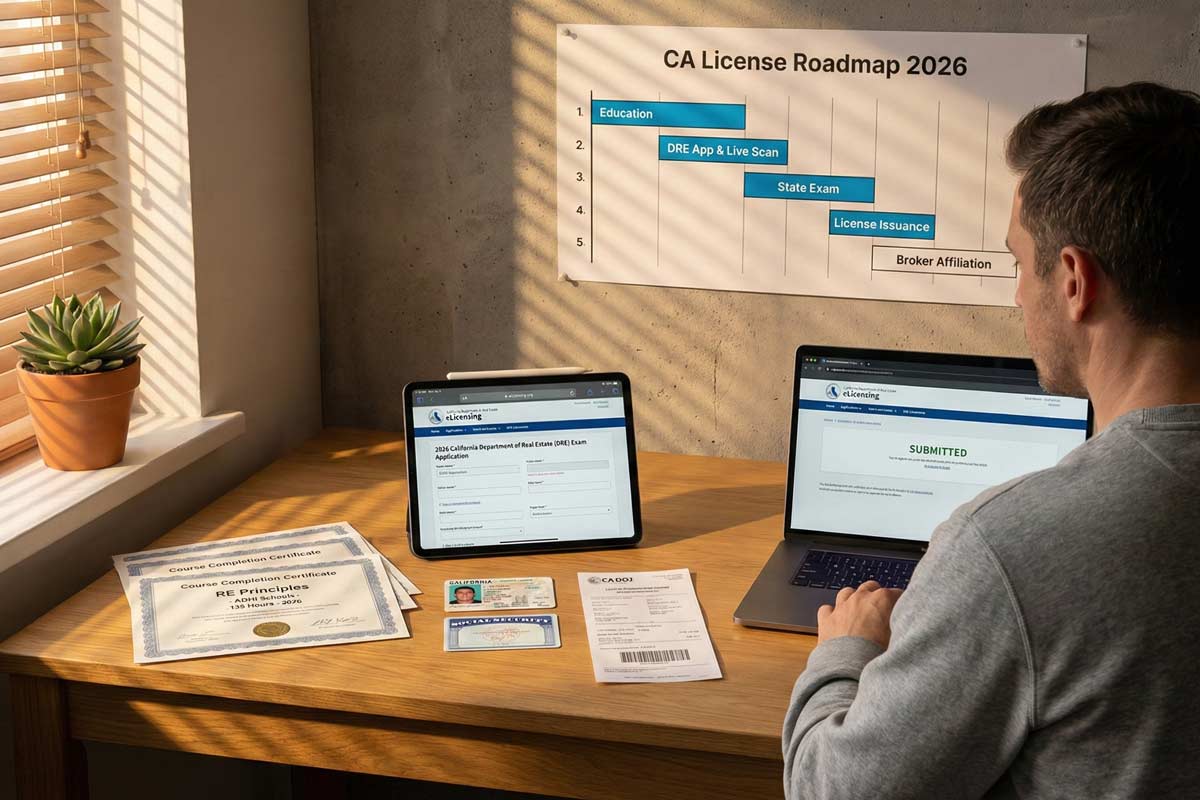
The “Order of Operations” Confusion
The path to a California real estate license is often clouded by outdated advice, social media "gurus," and aggressive brokerage recruiting scripts. This creates Read more...
The “Order of Operations” Confusion
The path to a California real estate license is often clouded by outdated advice, social media "gurus," and aggressive brokerage recruiting scripts. This creates a massive point of confusion: many aspiring real estate professionals believe they must be "hired" before they can even apply for the state exam.
Mistaking this sequence leads to lost momentum and unnecessary procedural errors.
The typical order is: pre-license school → exam application → passing the state exam → license number issuance → brokerage affiliation.
In my 20+ years of guiding thousands of students at ADHI Schools, I’ve seen this confusion cause more delays than the exam itself. This guide provides the exact roadmap to avoid those traps.
Do You Need a Broker to Apply for a California Real Estate License?
No—you don’t need a broker to apply for or take the California real estate exam. You can complete the education and application without a sponsoring broker affiliation. But you can’t legally practice real estate or earn commissions until your license is placed with a supervising brokerage.
Do You Need a Broker to Take the California Real Estate Exam?
Absolutely not. The Department of Real Estate (DRE) allows any individual who has met the 135-hour education requirement to sit for the exam. You are applying as an individual, not as a representative of a firm. You can take the exam as an individual, regardless of brokerage affiliation.
The Correct California Timeline: A Step-by-Step Roadmap
Following the state-mandated order of operations is the only way to ensure you don’t waste time.
Complete Your 135 Hours of Pre-License Education: You must finish three college-level courses. Can You Take the Exam Before Completing All 135 Hours? No—you must have your certificates in hand first.
Apply for the State Exam & Submit Fingerprints: You submit your application and Live Scan fingerprints to the DRE. You do not need a broker’s signature for the exam application.
Note: The biggest avoidable delays are simple mismatches—your name, ID, and course certificates must match exactly.
Pass the California Real Estate Salesperson Exam: This is your primary hurdle.
Receive Your License Number from the DRE: The DRE issues your license number after clearing criminal background. You can complete this entire process independently and without broker affiliation.
Affiliate with a Brokerage to Practice (“Hang Your License”): Once you have a license number, you must place your license with a supervising broker so you can legally practice and earn commissions.
Pro Tip: If you want the full start-to-finish roadmap, use our California Real Estate License Guide.
Key Terms Demystified
Understanding DRE terminology prevents "bureaucratic paralysis."
“Applying for a License” vs. “Practicing”: Applying is between you and the State. Practicing is between you and a Broker. You can do the first without the second.
“Hanging/Placing Your License”: This means officially associating your license with a Broker of Record. This is what moves your license into a status that allows for commissions.
Independent Contractor Reality: You are a 1099 contractor. The broker supervises your licensed activity; however, you generate your own business unless the brokerage specifically provides leads.
What Happens After You Get Your California Real Estate License? The focus shifts from "passing the test" to "building a business."
When (and Why) to Talk to Brokerages Early
Research is smart; commitment is premature. You should interview brokerages while you wait for your exam date to assess:
New Agent Training: Does the broker have a formal mentorship program?
Commission Splits & Fees: What is the actual "take-home" after all fees?
Lead Generation Support: Do they provide leads or just "coaching"?
Compliance Support: Who reviews your contracts to keep you out of court?
Costly Mistakes to Avoid
Waiting to Apply Until You Find a Broker: I’ve watched students wait 90 days "shopping brokerages" while their exam eligibility window and motivation evaporated. Don't wait. Apply the moment you have your certificates.
Choosing a Brand Over Training: I once spoke to an agent who picked a famous global brand for the "vibe," but quit after 4 months because no one showed them how to actually get business. Top Reasons People Fail to Get Licensed in California often trace back to a lack of early support.
Losing Momentum After the Exam: The gap between passing the exam and finding a broker should be days, not months.
Your 7-Day Action Plan
Day 1-2: Finish your current education course module.
Day 3: Draft a shortlist of 3-5 local brokerages to research.
Day 4: Prepare 8 questions to ask future brokers (focus on training and splits).
Day 5: Double-check your DRE exam/license application for errors (name match, IDs, and certificates).
Day 6-7: Submit your application to the DRE.
Frequently Asked Questions (FAQ)
Can I apply for the CA real estate exam without a brokerage?
Yes. Affiliation is not required to apply for or take the exam.
Do I need a sponsor broker for the exam?
No. Sponsoring brokers are required for practicing, not for taking the exam.
Can I interview brokerages before I’m licensed?
Yes, and you should. Most brokers are happy to speak with prospective agents who are currently in school.
What if I join a brokerage now—does it speed up the DRE?
No. The DRE processes applications in the order received, regardless of which brokerage you intend to join.
What if I pass the exam but don’t pick a brokerage?
You will have a license number, but you cannot legally represent clients or collect a penny in commission until you associate your license with a broker.
Can my license expire if I don’t join a brokerage right away?
Your license remains valid once issued, but you must still meet renewal requirements and continuing education deadlines every four years, regardless of whether you are affiliated with a broker.
Next Steps on Your Licensing Journey
The brokerage choice is critical for your success in the field, but it is not a prerequisite for the state exam. Focus on your 135 hours and your application first.
For the complete, step-by-step licensing roadmap (start to finish), use our California Real Estate License Guide.
|

Agency Is Where Agents Get Sued
If you ask a seasoned real estate attorney where most lawsuits begin, they won’t tell you that it’s always about a leaky roof or a cracked slab. They will tell you Read more...
Agency Is Where Agents Get Sued
If you ask a seasoned real estate attorney where most lawsuits begin, they won’t tell you that it’s always about a leaky roof or a cracked slab. They will tell you it’s about a broader concept known as "agency".
Many new licensees treat "agency" as a vocabulary word they memorized to pass the state exam, but in reality, California real estate agency relationships are the legal foundation of your entire career.
Understanding how agency fits into the broader framework of California real estate laws—like the rules we cover in our California Real Estate Laws & Compliance Guide—is an important step in a long and prosperous career. If you get agency right, you can avoid the vast majority of problems.
If you don’t, you are walking through a minefield blindfolded.
What Is “Agency” in California Real Estate?
In plain English, agency is a legal relationship where one person (the principal) authorizes another person (the agent) to act on their behalf with third parties.
In California real estate, there are three key players:
The Principal: The client (buyer or seller).
The Agent: Technically, this is the Broker under whom your license hangs.
The Third Party: The person on the other side of the deal who you don’t technically represent.
Important Concept: There is a common misconception that you—the salesperson—are the "agent." Under California law, the Broker is the agent of the principal. You are an agent of the Broker. You act on the Broker's behalf to serve the client.
How an Agency Relationship Is Created
This might sound strange, but you don’t always need a signed contract to create an agency relationship. California law recognizes several ways to create this relationship:
1. Express Agency The "typical" and safest way to create agency. The principal and agent expressly agree to the relationship, usually via a written contract.
Crucial Update: Following the August 2024 NAR Settlement, "Express Agency" is no longer just a best practice for buyers—it is the rule. You are now required to have a signed Buyer Representation Agreement before touring a home. If you unlock a door without this contract, you are starting your career non-compliant.
Scenario: A seller signs a Residential Listing Agreement authorizing you to market their home, or a buyer signs a Representation Agreement before you show them a property.
2. Implied Agency Your actions lead a person to believe you represent them, even without a written contract.
Scenario: You represent the seller, but you start giving a potential buyer negotiation advice. Your conduct leads the buyer to reasonably believe you are advocating for them, creating an implied agency.
3. Ostensible (Apparent) Agency A principal allows a third party to believe someone is their agent, even if they aren’t formally authorized.
Scenario: A landlord knows you are showing their vacant units to tenants and doesn't stop you. Because the landlord allowed this, the tenants reasonably believe you have authority to act.
4. Agency by Ratification A principal accepts the benefits of an action performed by an unauthorized agent (or an agent acting outside their authority), effectively creating the agency retroactively.
Scenario: You present an offer to a "For Sale By Owner" seller who has not hired you. The seller likes the price, accepts the offer, and agrees to pay you. By accepting the benefit of your work, the seller "ratifies" the agency relationship for that transaction.
Crucial Note: Agency is about authority and behavior, not who pays you. You can owe fiduciary duties in real estate even if you’re not getting a commission.
Types of Agency You Must Know
Seller’s Agent (Listing Agent): You represent the seller exclusively. Your goal is to get the best terms for the seller while treating the buyer honestly.
Buyer’s Agent: You represent the buyer exclusively. This protects the buyer's interests in price and terms.
Dual Agency: The same broker represents both the buyer and the seller.
The Catch: In California, the Broker is the dual agent, meaning every salesperson under that broker falls under the dual agency umbrella for that transaction.
The Rule: You must remain neutral. You cannot tell the seller the buyer will pay more, nor tell the buyer the seller will take less, without express written permission. Undisclosed dual agency is one of the fastest ways to lose your commission and face a lawsuit. Courts and the DRE view undisclosed dual agency as a serious betrayal of trust.
Exam Tip: On the California real estate exam, agency questions often focus on how these relationships are created, what fiduciary duties you owe a client, and when dual agency must be disclosed. Expect questions that test whether you understand who the broker represents and what happens when you slip into undisclosed dual agency.
Fiduciary Duties: The “OLD CAR” Framework
Once you are an agent, you owe your client fiduciary duties—the highest duties known to law. I teach students the acronym OLD CAR to remember them:
O – Obedience: You must obey lawful instructions. If the client says “no open houses,” you don’t hold open houses.
L – Loyalty: You must put the client’s interest above your own. You cannot steer a client to a house just to get a higher commission.
D – Disclosure: You must disclose all material facts affecting the property’s value or desirability.
C – Confidentiality: You must keep your client’s price, terms, and motivation private forever.
A – Accounting: You must properly handle all money and documents entrusted to you.
R – Reasonable Care: You must act with the skill of a professional. If you don’t know the answer, don’t guess.
Agency Is the Hub of Compliance
Agency doesn’t exist in a vacuum. Your status as a fiduciary connects directly to every other major compliance area. Here is what agency looks like in the real world:
Disclosure (The “D” in OLD CAR)
Because you represent the client, you are the filter for information. You must strictly follow California disclosure laws to ensure every material fact reaches the client, protecting them from bad investments and you from negligence claims.
Trust Funds (The “A” in OLD CAR)
Your fiduciary duty of accounting means you must be meticulous with money. You must avoid commingling in California real estate, which involves mixing client trust funds with your own money—a major violation that triggers immediate DRE action.
Fair Housing (Duty of Care & Obedience)
Your duty of reasonable care requires you to understand California fair housing laws. You must treat all parties fairly and never inadvertently discriminate or steer clients, as this violates both federal law and your agency responsibilities.
Advertising (Honest Representation)
Even your marketing is tied to agency. The advertising laws for California real estate agents mandate that you clearly identify your license status and brokerage so the public is never confused about who you actually represent.
Required Agency Disclosure Forms (The DEC Process)
In most one-to-four unit residential transactions, you’ll follow the DEC process to ensure compliance:
Disclose: Provide the “Disclosure Regarding Real Estate Agency Relationship” (Form AD) before you sign a listing or write an offer.
Elect: Elect who you represent in your Listing Agreement or Buyer Representation Agreement.
Confirm: Confirm that same agency relationship again in the Purchase Agreement (RPA).
The Cost of Failure: This isn’t just paperwork. If you mishandle or fail to disclose agency properly, a court can decide you’re not entitled to a commission, even if you did all the work and closed the deal. A judge will not care how hard you worked if you were not legally authorized to perform the service.
Common Agency Mistakes to Avoid
In my years of consulting, I see the same agency mistakes repeated constantly. Here is what they look like in real life:
Accidental Dual Agency: You answer detailed strategy questions from a buyer at your open house and then write the offer without clearly disclosing dual agency. If the buyer later claims you were supposed to protect them, you’re now exposed as an undisclosed dual agent, which courts and the DRE treat very harshly.
Breach of Confidentiality: You tell a buyer’s agent, “My sellers are divorcing and need to sell fast,” without authorization. You’ve just handed the other side leverage and opened the door to a claim that you sabotaged your own client’s negotiating position.
Improper Trust Fund Handling: You accept an earnest money check made out to you personally instead of the title company or broker. Handling checks this way looks like commingling and can trigger an immediate trust account audit and potential license discipline.
How to Explain Agency to a Client (Script)
New agents often struggle to explain their role. Here is a simple script you can use to explain agency to a buyer or seller in 20 seconds:
“Mr./Ms. Client, I represent you in this transaction, which means I have a legal duty to put your financial interests ahead of my own. Everything you tell me stays confidential, and I’m required to disclose any facts that affect the value of the property so you can make the best decision possible.”
Using plain language like this builds trust immediately and sets the tone for a professional relationship.
Consequences of Violating Agency Law
The stakes are high. Violating agency law can lead to:
Civil litigation - Clients suing for damages if they overpaid or undersold because you mishandled agency.
DRE discipline - Suspension or revocation of your license.
Commission forfeiture - Courts can deny you a commission if your agency was not properly disclosed, even if you closed the deal.
Agency law is learnable. If you want to see how agency fits alongside disclosure, advertising, fair housing, and trust fund rules, spend time with our California Real Estate Laws & Compliance Guide so your entire business rests on solid ground.
|
In the high-stakes world of California real estate disclosure laws, lawsuits rarely happen because a house was sold for $5,000 less than asking. They happen because the garage floods every January, the Read more...
In the high-stakes world of California real estate disclosure laws, lawsuits rarely happen because a house was sold for $5,000 less than asking. They happen because the garage floods every January, the seller knew about it, and nobody told the buyer.
For most new agents, the first serious risk of a lawsuit or DRE complaint comes from inaccurate and incomplete disclosures—not from writing a weak offer.
You might be terrified of missing a checkbox, "forgetting" a document, or getting dragged into court because your seller hid an active leak behind a fresh coat of paint. I’ve been teaching real estate for over 20 years at ADHI Schools, and I’m also a practicing broker who has watched real disclosure disputes play out in the real world
I tell my students constantly: Disclosures aren’t busywork. They are your shield.
When done correctly, they protect your client, your paycheck, and your license. This guide is a practical, street-level breakdown of real estate disclosure requirements in California, the forms you must master, and the scripts you need to stay out of trouble.
(Disclaimer: This article is for educational purposes only. If you are facing a specific legal situation or complex transaction, always consult your managing broker or a qualified real estate attorney.)
What Are “Disclosures” in California Real Estate?
In plain English, a disclosure is the formal act of revealing material facts about a property.
California is a strict "consumer protection" state. Unlike "Caveat Emptor" (Buyer Beware) states where the buyer is on their own, California places a heavy burden on the seller and the agents to reveal what they know.
The "Material Fact" Standard
A material fact is any information that would affect the value or desirability of the property to a reasonable person.
Does the roof leak? Material fact.
Was the garage converted without a permit Material fact.
Is there a noisy firing range a mile away? Likely a material fact.
The "Loud Party" Rule (A Real-World Example)
To understand "desirability," consider this scenario: I once saw a deal where the seller didn’t mention a neighbor who hosted loud backyard parties every single weekend. The buyer called the listing agent at 11:30 p.m. on their first Saturday in the home, furious.
Was the house physically broken? No. Was the desirability affected? Absolutely. If you find yourself wondering, "Should we mention this?" the answer is almost always yes.
The Core California Real Estate Disclosure Laws Framework (The Big 6 Forms)
While there are dozens of forms, these are the heavy hitters that form the backbone of California disclosure rules.
1. The Transfer Disclosure Statement (TDS)
The TDS is the holy grail. It is a statutory form where the seller must list items included in the sale, whether they work, and any significant defects (walls, fences, electrical, plumbing).
Crucial Rule: The seller must fill this out—not the agent. You can explain the form, but never put the pen to paper for them.
2. Seller Property Questionnaire (SPQ)
While the TDS is law, the SPQ is a standard C.A.R. form used by most brokerages to expand on the disclosures in the TDS. It asks pointed questions about deaths on the property, insurance claims, pets, and neighborhood nuisances, among others.
3. Agent Visual Inspection Disclosure (AVID)
This is your duty. California Civil Code requires real estate agents to conduct a "reasonably competent and diligent visual inspection" of accessible areas.
What to write: Observations. "Stain on ceiling in bedroom 2," "Cracked tile in entryway."
What NOT to write: Diagnoses. Do not write "Roof was leaking, but no longer active." You are not a roofer.
4. Natural Hazard Disclosure (NHD) Statement
California is beautiful but high-risk from a natural hazard standpoint. The NHD report tells the buyer if the home sits in flood, fire, or earthquake zones.
Pro Tip: Most agents order this from third-party companies to reduce liability. However, a third-party report doesn't erase your duty. You still must read the report and flag major issues for your client.
5. Condo/HOA Disclosures
If you are selling a condo or a home in an HOA, the standard forms aren't enough. You must provide the CC&Rs, bylaws, financial statements, and meeting minutes.
Why it matters: Many disputes arise because a buyer didn't know about a "special assessment" coming down the pipe or a rule banning their pickup truck from the driveway.
6. Lead-Based Paint Disclosure
If the home was built prior to 1978, federal and state law requires this disclosure and the provision of the "Protect Your Family from Lead in Your Home" pamphlet.
Deep Dive: To see how these forms fit into the bigger legal picture, check out our California Real Estate Laws & Compliance Guide.
Who Must Disclose What? (And What to Say)
A common source of confusion is figuring out who is "on the hook" for specific information.
The Seller's Duty (and the "Investor" Myth)
The seller must disclose known material facts. They don't have to hire inspectors to find new defects, but they cannot hide what they know, or should know.
The "I Never Lived There" Trap: Many investors, flippers, or heirs selling a probate property believe they are exempt from disclosures because they "never lived there." This is false. While they may be exempt from the TDS in specific cases (like a trustee selling a property at a trustee sale foreclosure auction), they are generally not exempt from disclosing known material facts. "I never lived there" is not a magic shield against known material facts.
The "Flipper" Law (AB 968): The End of "I Don't Know" For years, investors used the "I never lived there" excuse to avoid disclosing property defects. As of July 1, 2024, that loophole is gone for flippers.
Under Assembly Bill 968, if you are selling a single-family home (1-4 units) within 18 months of buying it, you have a heightened duty. You cannot just hand over a blank TDS. You must legally disclose:
The Work Done: A written list of every renovation, modification, or repair.
The Contractors: The names and contact info for the contractors who did the work.
The Permits: Copies of the permits. If you don't have them, you must provide the contact info for the third party who does.
The trap: If you hired cheap, unlicensed labor to paint over a problem and didn't pull permits, you now have to hand that evidence directly to the buyer. If you fail to do this, you aren't just risking a lawsuit; you are handing the buyer a roadmap to win it.
The Listing Agent's Duty
You have a duty of honest dealing and a duty to inspect. You cannot hide behind your seller.
The "Don't Tell Them" Script: If a seller says, "The roof leaks, but don't tell the buyer," and you obey, you can get yourself in hot water. Here is the script to handle that:
"Mr. Seller, I am required by law and by my real estate license to disclose this. If we hide it, we open ourselves up to a lawsuit we will have a tough time defending against."
The Buyer's Agent's Duty
You must review disclosures with your buyer and point out red flags.
The "CYA" Email Script: Don't just verbally tell a buyer to get an inspection. Document it.
"Hi [Buyer Name], per our conversation, I strongly recommend we hire a licensed specialist to inspect the roof before your contingency period ends on Tuesday. The general inspection noted wear, and I want to ensure you know the full scope."
This email could save you one day. For a deeper dive into your fiduciary duties and how they relate to disclosures, read California Agency Law Explained for New Agents.
Timing, Delivery & Documentation
It’s not enough to fill out the forms; you have to deliver them correctly.
The Timeline
In a standard California Residential Purchase Agreement (RPA), the seller typically has 7 days after acceptance to deliver full disclosures, unless otherwise agreed in writing.
Handling Prior Reports
If a previous escrow fell out and the buyer left you with their inspection report, can you ignore it?
No.
If you or the seller have a report in your possession, it is now part of what you know about the property. Talk to your broker about office policy, but in most cases you should provide it to the new buyer.
Script: "Please find the attached inspection report from a previous transaction, provided for informational purposes only. We recommend you conduct your own investigations."
High-Risk Topics Agents Must Never Gloss Over
In my experience, these are the landmines that cause the most explosions:
1. Water Intrusion & Mold
Never let a seller paint over a water stain without disclosing the cause.
2. Unpermitted Work
Did they turn the garage into a gym? Disclose it.
3. Death on the Property
You must disclose death on the property within the last 3 years. If a buyer asks directly about death anytime in the past, you must answer honestly.
4. Neighborhood Nuisances
Noises, odors, or disputes that affect "desirability."
The "Compliance Stack": How It All Connects
California real estate disclosure laws are just one layer of your compliance defense. Think of your "Compliance Stack" like this:
Disclosures: What you tell the buyer about the house.
Agency: Who you represent and your fiduciary duties.
Fair Housing: What you never say (avoiding discrimination).
Read more: California Fair Housing Laws Agents Must Know
Advertising: What you put in print/online (avoiding false claims).
Read more: Advertising Laws for California Real Estate Agents
Trust Funds: How you handle the money (avoiding commingling).
Read more: What Is “Commingling” in California Real Estate?
Most serious lawsuits involve a failure in two or three of these layers at once.
The Cost of Silence: What Happens If You Fail to Disclose?
If you fail to follow seller disclosure laws in California, the consequences are severe:
Rescission: The deal unwinds.
Damages: You pay for the difference in value and repairs.
DRE Discipline: You have suspension or revocation of your license.
Practical Checklists & Scripts
To protect yourself, use these tools in every transaction.
The "Mental Stop" Checklist
Before you send a packet, ask:
Did the seller answer every question on the TDS/SPQ? (No blanks).
Did I walk the property and write down exactly what I saw on the AVID?
Did we disclose any unpermitted work we are aware of?
Are we sitting on any old inspection reports that need to be shared?
Script: Explaining the AVID to a Buyer
"I’ve completed my Agent Visual Inspection Disclosure. Please keep in mind, I am a real estate agent, not a contractor. I’m noting what I see—like a stain or a crack—but I cannot tell you if it’s structural or cosmetic. That is why we need a professional home inspection."
Frequently Asked Questions About California Disclosure Laws
Do seller disclosure laws in California apply to “as-is” sales?
Yes. “As-is” usually means the seller doesn’t plan to make repairs, but they still must disclose known material defects.
Do I have to disclose a death on the property in California?
Yes, if it occurred within the last three years. If a buyer asks directly about any past death, you must answer honestly.
Are investors exempt from real estate disclosure requirements in California?
No. Even if they never lived in the property, they must disclose any material facts they know.
Can I rely only on the NHD company and inspector reports?
No. They help reduce risk, but you’re still expected to read them and flag major issues for your client.
Understanding California disclosure laws is about more than just passing your exam. It’s about building a career that lasts. When you master these forms, you aren't just pushing paper—you are establishing yourself as a pro who knows how to navigate risk.
If you’re not licensed yet and this article made you realize how serious this business is, that’s a good thing.
Read our California Real Estate Laws & Compliance Guide to see the big picture, or explore our classes to get the kind of training that actually prepares you for the real world.
|
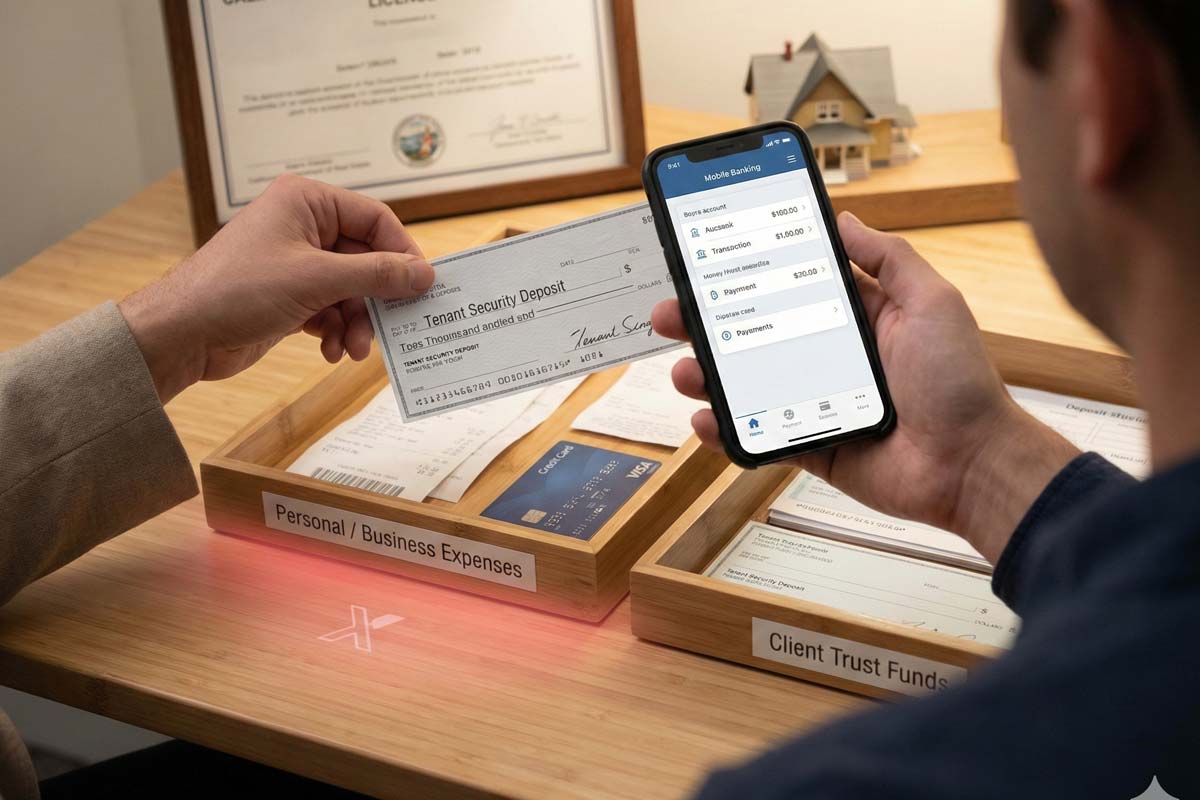
The Fastest Way to Lose Your License
Imagine this scenario: You are a broker with a busy property management division. A tenant hands you a security deposit check for $2,000. You’re in a rush, so Read more...
The Fastest Way to Lose Your License
Imagine this scenario: You are a broker with a busy property management division. A tenant hands you a security deposit check for $2,000. You’re in a rush, so you deposit it into your general business operating account, intending to transfer it to the trust account on Monday.
Even if you transfer the money on Monday morning, you have already broken the law.
In California real estate, that mistake has a name: commingling of trust funds – illegally mixing a client’s money with your own.
Mishandling of trust funds is one of the most common reasons the California Department of Real Estate (DRE) disciplines licensees.
This article is part of our California Real Estate Laws & Compliance Guide, designed to keep you safe, compliant, and in business. Let’s break down exactly what commingling is, how it differs from conversion, and how you can avoid the audit nightmares that end careers.
What Is Commingling in California Real Estate?
In California real estate, commingling is the illegal practice of mixing a client’s money (trust funds) with the broker’s or agent’s personal or general business funds.
Think of it this way: As a real estate professional, you have two distinct "pockets."
Pocket A: Your money (commissions earned, operating funds).
Pocket B: The client’s money (earnest money, rents, security deposits).
Commingling happens when you put Pocket B money into Pocket A. Even if you don't spend it, the mere act of mixing the funds is a violation of the California Business and Professions Code.
Commingling vs. Conversion
New agents often confuse these two terms. You will see this distinction on the real estate exam, so memorize it now:
Commingling (Mixing): Depositing client funds into a personal account. You haven't necessarily spent it, but you’ve mixed it with your own money.
Conversion (Essentially Theft): Actually using that client money for your own purposes (e.g., paying your car payment with a client’s earnest money).
The Golden Rule: Commingling is the gateway drug to conversion. That’s why the DRE comes down hard on commingling even when “no one got hurt.”
Trust Funds in California Real Estate (What Money Is Dangerous to Commingle?)
To avoid commingling, you must identify "Trust Funds" immediately. Trust funds are anything of value received by a broker or salesperson on behalf of a principal or another person in a transaction.
Common examples include:
Earnest money deposits from buyers.
Rents collected for landlords.
Security deposits from tenants.
Repair reserves held for property management.
Homeowner Association (HOA) dues (if managed by the broker).
Because you have a fiduciary duty to your client—a concept we dive deeper into in our California Agency Law Explained for New Agents article—you are holding this money in trust. It is not yours.
How Commingling Happens in Real Life
Often commingling isn't malicious; it’s sloppy. Here are the street-level scenarios where new agents get into trouble.
1. The "Personal App" Trap
The Scenario: A tenant wants to pay rent via Venmo or Zelle. You let them send it to your personal Venmo account, planning to write a check to the owner later.
The Violation: You have just commingled. That rent money is sitting in your personal account ecosystem.
The Fix: Never accept trust funds into a personal digital wallet. Use a designated business trust account or have the tenant pay the landlord directly.
2. The "Desk Drawer" Deposit
The Scenario: You get an earnest money check on Friday. You leave it in your desk drawer over the weekend and forget about it until the following Thursday. You realize you’re late, so you deposit it into your personal account just to "get it in the bank."
The Violation: Leaving the check in your desk that long is mishandling trust funds. But if you then panic and deposit it into your personal account, you’ve now committed commingling – which is far more serious.
The Fix: Deposit funds immediately (usually within 3 business days) into the proper trust account or escrow.
3. The "Short-Term Loan"
The Scenario: Your business account is short $500 for a marketing bill. You "borrow" $500 from the trust account, knowing you have a commission check coming tomorrow to replace it.
The Violation: This is conversion (theft), fueled by commingling.
The Fix: Never, ever touch trust funds for operating expenses.
Transparency is key here. Just as you must follow California Disclosure Laws (Complete Breakdown) regarding property defects, you must be transparent about where the money is going.
DRE Rules, Audits & Consequences
The California DRE has the power to audit your books at any time. They do not need a warrant; your license grants them that right.
What Triggers an Audit?
Consumer Complaints: A client feels their money was mishandled.
Random Selection: The DRE conducts spot checks.
Red Flags: Irregularities in your paperwork or renewals.
The Consequences
Commingling trust funds is one of the most serious trust account violations in California real estate, and the penalties reflect that severity:
Citations and Fines: Monetary penalties that stay on your record.
Suspension: You cannot practice real estate for a set period.
Revocation: You lose your license entirely.
The DRE takes this seriously because it is a matter of public trust. When you promote yourself, you're telling the public they can trust you with their money. That's why our Advertising Laws for California Real Estate Agents aren’t just about fonts and disclaimers – they’re about not misleading people about how safely you handle deposits and rent.
How California Real Estate Agents Avoid Commingling Trust Funds
Compliance is about habits, not willpower. Implement these best practices immediately.
The Anti-Commingling Checklist
Create a Designated Trust Account: If you handle client funds, open a separate bank account labeled "Trust Account" or "Fiduciary Account."
The 3-Day Rule: Under California rules, trust funds must generally be placed into a neutral escrow depository, the hands of the principal, or a trust account within three business days of receipt.
Zero Personal Funds: The only personal money a broker can keep in a trust account is a small amount (up to $200 in California) specifically to cover bank service charges. Any more than that is commingling.
Reconcile Monthly: Reconcile your trust account regularly (monthly is standard) so the balance always matches what you owe clients.
Treat Everyone Equally: Treating every tenant and buyer’s money with the same strict procedures doesn’t just prevent commingling – it also supports your obligations under California Fair Housing Laws Agents Must Know, because “special treatment” around deposits can quickly drift into discrimination territory.
Script: Explaining Trust Funds to Clients
Client: "Can I just write the deposit check to you personally?"
Agent: "To protect your money and comply with California law, I can’t have you make the check payable to me personally or deposit it into my personal account. Please make the check payable to [Escrow Company Name] or [Brokerage Trust Account]. That way your funds are held in a proper trust or escrow account and are legally protected throughout the transaction."
How “Commingling” Shows Up on the Test
If you are studying for your California real estate exam, expect at least a handful of questions on this topic. The exam writers love to trick you with the difference between commingling and conversion.
The "Trap" Question Logic
Scenario A: Broker Bob puts a $1,000 deposit into his personal checking account.
Verdict: Commingling. (He mixed it).
Scenario B: Broker Bob takes that $1,000 and buys a new suit.
Verdict: Conversion. (He spent it).
Scenario C: Broker Bob keeps $5,000 of his own money in the trust account “just in case.”
Verdict: Commingling. (You cannot store your savings in a trust account, even if you don’t touch the client’s money).
Exam Tip: If the question mentions “mixing” funds, the answer is commingling. If the question mentions “misappropriating” or “using” funds, the answer is conversion.
FAQ: Commingling Trust Funds in California Real Estate
Is commingling illegal in California real estate? Yes. It is a violation of the California Business and Professions Code and is grounds for license suspension or revocation.
How long does a broker have to deposit trust funds in California? Generally, a broker has three business days following the receipt of funds to deposit them into a trust account, a neutral escrow, or give them to the principal.
What is the difference between commingling and conversion? Commingling is the mixing of client funds with personal/business funds. Conversion is the actual use or theft of those funds for the agent’s benefit.
Can a broker keep their own money in a trust account? A broker may only keep a very small amount (typically up to $200) of their own funds in the trust account for the sole purpose of covering bank service fees. Anything beyond that is commingling.
Stay Compliant, Stay in Business
Commingling is a preventable risk. By setting up the right accounts and following a strict "hands-off" policy with client money, you protect your license and your clients.
I’ve watched smart, well-meaning agents lose years of work over a single sloppy trust-fund decision. There is no commission big enough to justify that risk.
Ready to master the rest of the rulebook? Continue your study with our California Real Estate Laws & Compliance Guide to ensure you are fully prepared for both the state exam and your first year in the field.
|
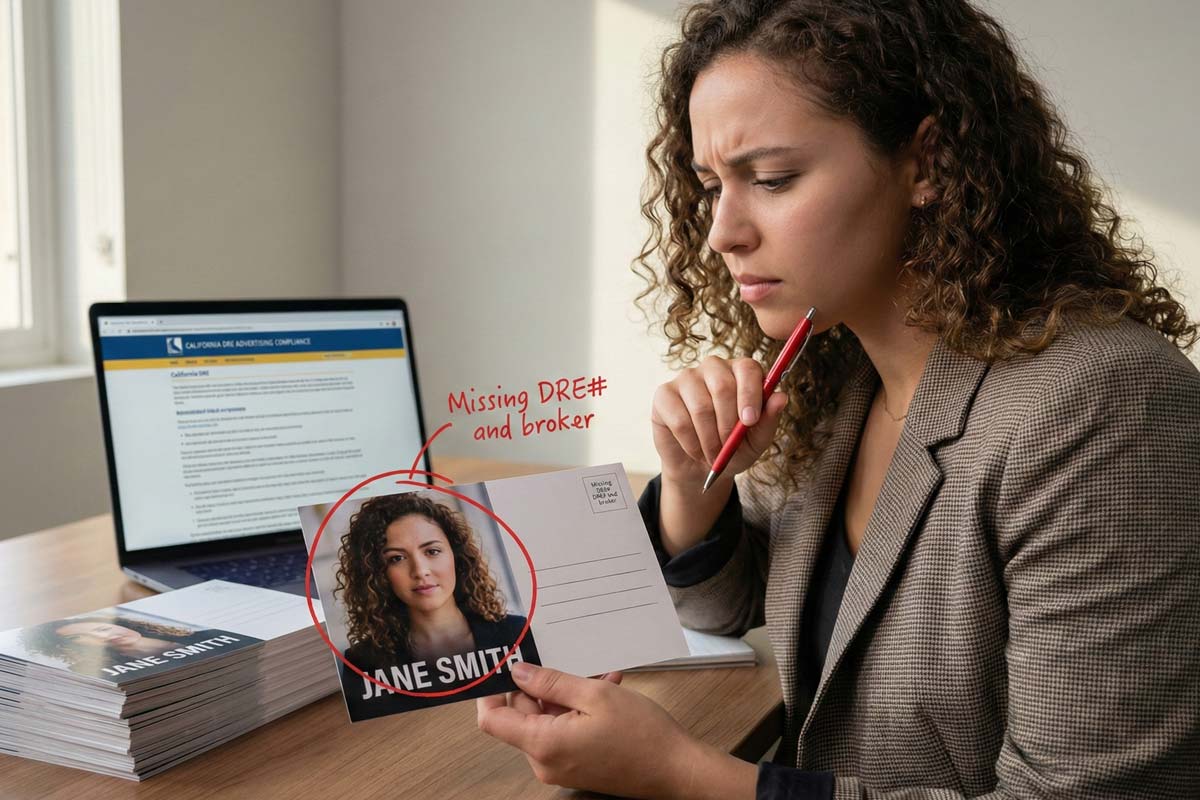
You’ve passed your exam, you’ve hung your license with a broker, and you are ready to take over your local real estate market. You want to blast your face and name everywhere—billboards, Instagram, Read more...
You’ve passed your exam, you’ve hung your license with a broker, and you are ready to take over your local real estate market. You want to blast your face and name everywhere—billboards, Instagram, business cards, and flyers.
But before you order 5,000 glossy postcards, hit the brakes.
In my 20+ years of training agents, I’ve learned a hard truth: Most new agents don’t get in trouble for stealing money—they get in trouble because they violated DRE rules in their marketing and they might not have even known it.
You do not want your first letter from the Department of Real Estate to be an accusation. The DRE does audit websites, postcards, and social profiles—especially when a complaint comes in—so assume your advertising will be reviewed at some point.
The DRE is incredibly strict about how licensees present themselves. If you don’t follow the specific DRE advertising rules, you aren't just looking at a warning; you could be facing citations, fines, and a permanent mark on your record.
Here is your plain-English guide to marketing yourself aggressively without getting flagged.
The "First Point of Contact" Rule
The most fundamental concept in California real estate advertising is the "First Point of Contact."
This is the moment a consumer first encounters you professionally. Because the public relies on these materials to verify your identity, the DRE mandates strict transparency here. Think of your license status as the very first disclosure you make to a client. (For more on what you must reveal later in the transaction, see our California Disclosure Laws (Complete Breakdown)).
What Counts as "First Point of Contact" Materials?
The DRE defines this broadly. If you use it to get business, it counts. In the regulations, these are called "solicitation materials"—anything you use to solicit business from the public. These include:
Business cards
Stationery and letterhead
Email signatures
Flyers, door hangers, and mailers
"For Sale" and open house signs
Website homepages and landing pages
Online lead forms and "contact me" pages
The Mandatory Trio
For any of the materials listed above, you must include three specific items:
Your Name: Exactly as it appears on your license (no nicknames unless filed as a "DBA").
Your License Identification Number: This is non-negotiable.
Your Responsible Broker’s Identity: You cannot advertise as a "lone wolf." The public must know which brokerage employs you.
Digital & Social Media Compliance
The internet moves fast, but the law keeps up. Under Commissioner's Regulation 2770, electronic and online advertising is treated just like traditional solicitation—your license status must still be clear.
Here is how to stay compliant on different platforms:
Social Media Bios (Instagram, TikTok, Facebook)
Your bio is your digital business card. It must include:
Your name.
Your DRE license number.
Your responsible broker’s identity.
Warning: Do not bury this information deep inside a Linktree. If a consumer clicks your link, and then has to click again to find your license info, you are technically "two clicks" away. That is a violation. Put the DRE# directly in your bio text.
Individual Posts, Reels, and Stories
Does your license number need to be in the caption of every single Instagram story or Tweet? Generally, no—provided you follow the "One-Click Rule."
You are compliant if your individual posts clearly relate back to a main profile (your bio) where the mandatory information is displayed. As long as the consumer can find your license status with one single click from the post, you are safe.
Websites, Landing Pages, and Lead Forms
Websites are different. You cannot rely on the "one-click" rule here. Your license number and broker identity should appear on the homepage or, ideally, globally in the footer of every page. If a consumer lands on a blog post or a listing page, they should not have to hunt to see who you are.
"Team Name" Advertising Pitfalls
This is where I see the most citations for established agents. Everyone wants a flashy team name like "The Luxury Living Group," but the DRE sees "Teams" as a potential source of consumer confusion.
If you follow these real estate team advertising rules California sets out, your signs and online branding will stay out of trouble:
1. The Surname Rule
A team name must include the surname (last name) of at least one licensee on the team.
Illegal: "The Magic City Team"
Legal: "The Smith Group."
2. The Permitted Words
Your team name must include a term like "Group," "Team," or "Associates." You cannot use words that imply you are a standalone brokerage, such as "Real Estate," "Brokerage," or "Company."
3. The Font Size Rule (The "Ego Check")
This is a technicality that leads to fines. When you advertise a team name, the Responsible Broker’s identity must be displayed as prominently as the team name.
This ties directly to agency relationships. As we explain in California Agency Law Explained for New Agents, you represent the broker, and the broker represents the client. Your ads must reflect that legal hierarchy.
Discriminatory Advertising
Advertising rules aren't just about font sizes; they are about civil rights. When writing listing copy, you must avoid language that suggests a preference or limitation based on a protected class.
In California, that includes: race, color, religion, sex, gender, gender identity, sexual orientation, marital status, national origin, ancestry, familial status, disability, and source of income.
Bad: "Perfect bachelor pad" (implies sex/familial status preference).
Bad: "Walking distance to synagogue" (implies religious preference).
Good: "Great starter home" or "Close to places of worship."
For a full list of words that can trouble you, read our guide: California Fair Housing Laws Agents Must Know.
Misleading Advertising & "Blind Ads"
Honesty is the baseline. Under the Business and Professions Code, making any substantial misrepresentation is grounds for license suspension.
Puffery vs. Fraud
"Puffery" is an opinion that isn't expected to be taken as literal fact (e.g., "The most beautiful view in the city!").
This is allowed.
Fraud is retouching a photo to remove power lines or claiming a home is 3,000 sq. ft. when tax records say 2,200.
False Authority & Inventory Tricks (Don't Do This)
The "Top Producer" Trap: Do not call yourself the "#1 Agent in the City" unless you have verifiable data to prove it for that specific timeframe.
The "Just Sold" Trick: Do not advertise a property as "Just Sold" if you were not the listing or selling agent, unless you explicitly credit the actual agent.
The "Specialist" Claim: Be careful claiming you are a "Probate Specialist" or "REO Expert" if you have no certification or track record in those niches.
Blind Ads
A Blind Ad is any advertisement that hides the fact that you are a licensed real estate agent or fails to identify your broker.
Bad: "I buy homes for cash, call 555-0199" with no name, license status, or broker.
Good: "Fred Smith, XYZ Real Estate, Licensed Real Estate Broker (DRE# 09944), buys homes for cash. Call 555-0199."
Just like commingling is the top financial violation, improper advertising is the top administrative violation. (See: What Is “Commingling” in California Real Estate?).
Safe Advertising Checklist (2026 Edition)
Before you hit "publish" or "print," run your materials through this checklist.
Business Cards
Name (as licensed)
California real estate license number on business cards (labeled "DRE#" or "Lic#")
Responsible Broker’s Name/Logo
Email Signature
Full Name
DRE License #
Broker Name (must be present in every email sent to clients)
Social Media Bio
Name
DRE License # (Directly in text, not hidden in a link)
Broker Affiliation
Postcards & Flyers
Does the sign identify the broker?
If a team name is used, does it have a surname or valid DBA?
Font Check: Is the broker's name equal to or larger than the team name?
Online Ads (Google/Facebook)
Is your license number and brokerage affiliation in the ad?
Website / Landing Pages
DRE License # appears on the homepage or in a global footer visible from every page.
Broker’s name/logo appears in the header or footer.
Lead forms make it clear you are a licensed real estate agent.
Next Step: Lock In Your Compliance Knowledge
Advertising is just one piece of your legal footprint. Your license is your livelihood—don’t risk it for a cute slogan or minimalist design.
For a complete breakdown of the rules that govern your career—from trust funds to agency disclosures—bookmark and study our California Real Estate Laws & Compliance Guide. That is your roadmap to staying safe, compliant, and in business for the long term.
Frequently Asked Questions
Q: What must be included on a California real estate business card?
A: Under DRE "First Point of Contact" rules, your business card must include three mandatory items: your name exactly as it appears on your license, your DRE license identification number, and the identity of your responsible broker. Omitting the broker’s name is a common violation.
Q: Do I need to put my DRE license number on every Instagram post or Story?
A: Generally, no. Under the "One-Click Rule" (Commissioner's Regulation 2770), you do not need your license number on every individual post if that post links directly to a profile (like your Bio) where your name, license number, and broker affiliation are clearly displayed.
Q: Can I put my real estate license number in my Linktree or bio link?
A: No, this is risky. The DRE requires your license status to be accessible within "one click." If a consumer clicks your bio link and then has to click again inside a menu (like Linktree) to find your license number, you are technically two clicks away, which can be considered a violation. Place your DRE# directly in your Instagram or TikTok bio text.
Q: What are the rules for real estate team names in California?
A: A team name must include the surname (last name) of at least one licensee on the team and a term like "Group," "Team," or "Associates." You cannot use terms that imply you are a separate brokerage, such as "Real Estate," "Company," or "Corp."
Q: Does my broker’s name have to be the same size as my team name on signs?
A: Yes. The DRE requires that the responsible broker’s identity be displayed as prominently as the team name. If your team name is in a large font, your broker’s name cannot be a tiny footnote; it must be reasonably equivalent in size to prevent consumer confusion.
Q: What is a "blind ad" in real estate?
A: A blind ad is any solicitation material that fails to identify the advertiser as a licensed real estate agent or fails to identify their responsible broker. For example, a Craigslist ad saying "I buy homes for cash" without a license number or broker name is a prohibited blind ad.
|
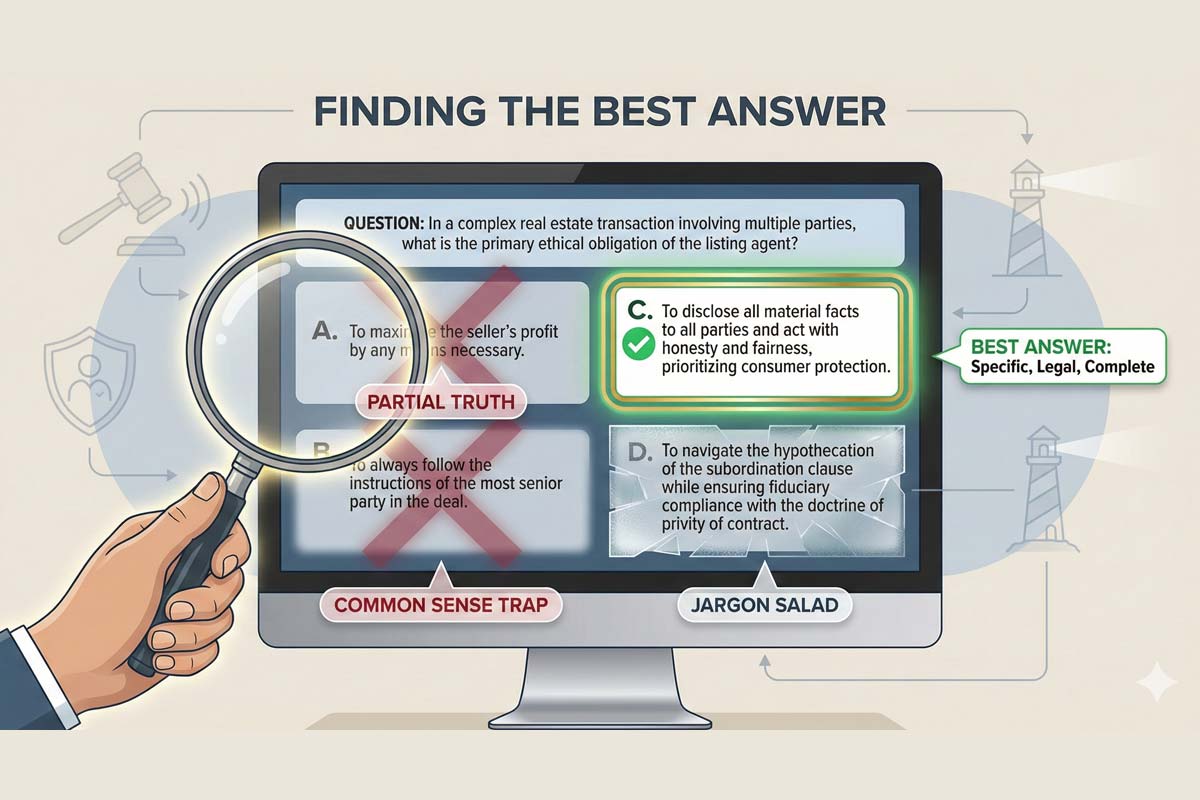
Deep knowledge of real estate principles is non-negotiable. However, even the most dedicated students can stumble if they rely on memorization alone.
That’s because the Department of Real Estate (DRE) Read more...
Deep knowledge of real estate principles is non-negotiable. However, even the most dedicated students can stumble if they rely on memorization alone.
That’s because the Department of Real Estate (DRE) isn’t simply checking your memory; the exam tests your professional judgment. They want to ensure you can protect a client in a complex scenario. To pass, you need to combine your command of the facts with a clear understanding of how the exam measures critical thinking.
This article teaches you how to think like the DRE—because passing is as much about mental process as it is about content.
What You Will Learn
The "Best Answer" Logic: Why two answers can be right, but only one aligns with DRE scoring.
The Keyword Radar: How to spot trap words like "Always" and "Must" that signal incorrect answers.
Scenario Mastery: How to filter out the irrelevant "noise" in complex story problems.
Psychometric Hacks: How to mathematically increase your guessing odds from 25% to 50%.
This article is the strategic companion to our California Real Estate Exam (2026 Complete Guide). If that guide is your roadmap, this article is your instruction manual for driving the car.
How to Outsmart DRE Multiple-Choice Logic
To beat the exam, you have to deconstruct the weapon formed against you. The DRE does not write random questions; they write questions that follow a specific hierarchy of correctness.
The “Best Answer” Theory
If you take nothing else from this article, take this: In the DRE world, correct is not enough.
This is where smart people fail. They read option (A), see that it is technically a true statement, mark it, and move on. They never read option (C), which was more specific or more applicable to the exact scenario described.
Insider Insight: The DRE almost never rewards the answer that is merely technically accurate—they reward the one that aligns with legal intent and consumer protection.
Insider Tip: Never mark an answer until you have read all four choices. Often, option (A) is a "Partial Truth"—a statement that is true in a vacuum but doesn't solve the specific problem in the question stem.
When Two Answers Look the Same
This is the #1 anxiety point for students. You will see two answers that both look "right." Usually, the difference comes down to scope.
Broad vs. Specific: If the question asks about a specific violation (e.g., commingling), the answer that cites the specific code or action is better than the answer that just says "unethical behavior."
The Scope Mismatch:
Question: "What is the primary duty of a property manager?"
Choice A: To keep the building fully occupied.
Choice B: To generate the highest net income consistent with the owner's objectives.
Analysis: Choice A is good. Choice B is better because it encompasses the owner's goals, not just occupancy. The DRE rewards precision.
Anatomy of a DRE Question
Let’s break down the components of the items you’ll face.
1. The Stem
This is the setup. It might be a direct question (“What is an easement?”) or a scenario (“Broker Bob lists a property…”).
Insider Tip: Read the last sentence of the stem first. This tells you exactly what they are looking for before you get bogged down in the story details.
Clarification: This is a preview technique. Once you know the goal, you must still read the full scenario. Do not skip the middle, or you will miss the twist.
2. The Distractors (The Traps)
These are the wrong answers. They aren’t random; they are designed to trap you.
The "Common Sense" Trap: An answer that sounds logical to a layperson but violates real estate law.
Example: "The broker should return the deposit because the buyer is sad." (Kind, but legally wrong).
The "Jargon Salad": An answer that throws in impressive words just to intimidate you.
Example: "The hypothecation of the subordination clause." (If it sounds like nonsense, it usually is).
Scenario-Based Question Mastery
Now that you understand distractors, let’s look at the DRE’s favorite testing style: long scenario questions.
The DRE loves to test whether you can separate signal from noise. They will give you a paragraph full of details, but often only one fact matters. This is why it’s important to not only understand the content of the real estate exam but also how to cut through the fluff to get to what the state is actually asking.
The "Red Herring" Technique:The exam writers will include facts that have nothing to do with the legal issue.
Example: "A buyer looks at a Victorian home built in 1977. It is painted blue, has a large swimming pool, and the seller is going through a messy divorce..."
The Trap: You focus on the pool, the color, or the seller's emotional state.
The Reality: The year "1977" is the only thing that matters (Lead-Based Paint Disclosure).
Beware of Details That Seem Important but Aren't :
Exact square footage.
Emotional descriptions ("distressed seller," "anxious buyer").
"Curb appeal" descriptions.
Rule: If the detail doesn't change the legal outcome, ignore it.
The Keyword Radar System
The English language is flexible. The law is not. The DRE uses specific qualifiers to signal whether an answer is likely right or wrong.
The "Always" and "Never" Trap (Absolutes)
Real estate is rarely black and white. There are exceptions to almost every rule. If you see these words, the answer is highly likely to be incorrect:
Always
Never
Must
Everyone
Example: "A broker must disclose a death on the property." (False. You only must disclose it if it occurred within 3 years or if the buyer asks. The absolute "must" makes this answer incorrect).
The Exception: When the law deals with Fair Housing, "Never" is often correct. You never discriminate based on race.
The "Generally" and "Most" Safety Net (Conditionals)
The DRE prefers answers that leave room for nuance. If you are forced to guess, these words often signal the correct answer:
Generally
Typically
Most likely
May
Example: "The agent must generally obey the client." (Safe, accurate, allows for exceptions).
The Skip-and-Return Strategy
Based on the number of questions on the real estate exam, it’s evident that time management is crucial. You have roughly 1.2 minutes per question on both the sales and broker exams.
Do not let your ego lose you points.
If you encounter a scenario question that is a paragraph long: Mark it for review and skip it.
Momentum: Answering 10 easy questions in a row builds confidence.
Subconscious Processing: Your brain will continue to work on the hard question in the background.
Process of Elimination (POE)
If you don’t know the answer, you can still manufacture a higher probability of passing.
Psychometricians intentionally design four-option items with two distractors that are easy to eliminate—because this increases reliability and makes POE mathematically powerful.
Blind Guess: 25% chance of success.
Eliminating 2 Distractors: 50% chance.
The Math of Passing: As detailed in our guide on How the California Real Estate Exam Is Scored, you need a 70% to pass. That means you can miss 45 questions. If you can use POE to get your guessing success rate up to 50% on the hard questions, you are mathematically on the path to passing.
Full-Question Reading Discipline
Speed is your enemy. The DRE writes questions that pivot in the middle.
The "Except" and "Not" Twist
The DRE loves negative stems:
"All of the following are necessary for a valid contract, EXCEPT..."
If you read too fast, your brain skips "EXCEPT." You mark option (A) because it is necessary, and you fail the question.
Technique: When you see "EXCEPT," mentally rephrase the question: "I am looking for the WRONG statement."
Stop Overthinking (The Anxiety Check)
Most test-takers sabotage themselves by letting adrenaline override logic—strategy is how you stay in control.
The Exam is Not Evil: It is designed to assess competence, not to prank you.
Trust Your First Instinct: Once you have used the Process of Elimination, your first instinct is statistically more likely to be correct. Second-guessing without new information usually leads to changing a right answer to a wrong one.
Default to Safety: If you are stuck, ask yourself: "Which answer best protects the consumer?" That is usually the direction the DRE wants you to go.
The 2026 Angle: What Has Changed?
While the core mechanics of multiple-choice psychometrics remain consistent, the DRE updates its exam with some regularity to ensure that the content of the real estate exam reflects the reality of the real estate landscape.
In 2026, we are seeing a continued emphasis on ethics and transparency.
What to Expect:
Scenario Questions: Testing whether you recognize when a disclosure is required or when a duty to a non-client arises.
Fair Housing Granularity: Expect questions that drill down into subtle discrimination, not just obvious bias.
Agency Duties: A shift away from "closing the deal" toward "fiduciary transparency."
Key Exam-Day Takeaways
Read the last sentence first to identify the goal of the question.
Eliminate absolutes (Always/Never) unless it's a Fair Housing question.
Identify the scope: If the question is specific, the answer must be specific.
Don't over-read: If the fact isn't in the paragraph, it doesn't exist.
Apply these four rules, and the exam becomes a formality rather than a hurdle.
Strategy is vital, but it cannot replace content mastery. You need to combine these test-taking tactics with a comprehensive study plan.
Start with the full roadmap here: California Real Estate Exam (2026 Complete Guide).
Inside, you'll find the complete content breakdown, registration steps, preparation timelines, and scoring explanations you need to pass on the first try.
FAQ: Cracking the DRE Code
Q: What is the "Best Answer" strategy for the CA Real Estate Exam?
A: "Best Answer" logic means ignoring options that are merely true and selecting the one that is most specific to the scenario. Based on how the DRE scores the exams, while two answers could “look” correct, choose the one that aligns with consumer protection and specific legal intent rather than a broad generalization.
Q: Are there specific "trap words" that signal a wrong answer?
A: Yes. Be suspicious of absolute words like "Always," "Never," "Must," and "Everyone." Since real estate law almost always has exceptions, these are usually incorrect. Exception: In Fair Housing questions, "Never" discriminate is often the right answer.
Q: How do I handle long, confusing scenario questions?
A: Use the "Last Sentence First" technique. Read the very end of the question prompt before reading the story. This tells you exactly what legal issue to look for so you can filter out "noise" like emotional descriptions or irrelevant house details.
Q: How can I improve my odds if I have to guess?
A: Use Process of Elimination (POE). The DRE includes two "distractors" (obvious wrong answers) in almost every question. By crossing these out, you mathematically double your chance of guessing correctly from 25% to 50%.
Q: What is the "Red Herring" technique on the exam?
A: A Red Herring is an irrelevant fact designed to distract you. For example, a question about Lead-Based Paint might mention a "messy divorce." The divorce is the Red Herring; the year the house was built is the only fact that matters.
Q: How should I handle "EXCEPT" or "NOT" questions?
A: These negative stems cause high failure rates due to speed reading. When you see "EXCEPT," mentally rephrase the question to: "I am looking for the FALSE statement." This prevents you from accidentally marking the first true statement you see.
|
One of the most frequent questions we hear from students after they finish thceir statutory college-level courses is, "Okay, I’m done with the classes. Now, how long will it take me to actually prepare Read more...
One of the most frequent questions we hear from students after they finish thceir statutory college-level courses is, "Okay, I’m done with the classes. Now, how long will it take me to actually prepare for the state test?"
Valid.
The California Department of Real Estate (DRE) salesperson exam consists of 150 multiple-choice questions to be answered in 3 hours and 15 minutes. It covers everything from property ownership to mandated disclosures. Study too little, and you risk failing and waiting weeks for a re-test. Study too long, and you risk "information decay"—forgetting the material you learned at the start of your prep.
The broker exam is 200 questions and you are given up to 4 hours to complete it.
After over 20 years of teaching real estate in California and analyzing the habits of thousands of successful agents, I can tell you there is no single "magic number" that applies to every human being. However, by looking at data from our most successful students, we can identify a distinct "success window."
This guide will help you determine where you fall on that spectrum so you can build a study timeline that maximizes your chances of passing on the first try.
The Short Answer: The 40–90 Hour Rule
For the vast majority of students, the sweet spot for exam preparation lies between 40 and 90 hours of focused study after completing the three required pre-licensing courses.
The Full-Time Student (2–3 Weeks): If you can treat studying like a job (4–6 hours a day), you can be ready in just a few weeks. This immersion method is highly effective because the material stays fresh.
The Working Professional (4–6 Weeks): If you are balancing a full-time job and can only study 1–2 hours a day and more on weekends, you will need about a month to six weeks. This requires discipline to prevent the "forgetting curve" from eroding your progress.
The Crash Course Hybrid (1–2 Weeks): Students who combine independent review with a crash course often reduce their total necessary study hours because the instruction is condensed. Instructors help with pattern recognition and point out specific exam cues, which speeds up the learning process.
FAQ: Can you pass with less than 40 hours of study?
While outlier students with extensive legal or financial backgrounds sometimes pass with 20–30 hours of prep, we strongly advise against it. The DRE exam relies heavily on specific vocabulary and tricky syntax. Under-preparing significantly increases the risk of failing, which triggers a mandatory waiting period before you can re-test.
FAQ: How many weeks should you study for the California real estate exam?
Most successful candidates schedule their exam 4 to 8 weeks after finishing their college-level courses. Extending the process beyond 8 weeks often leads to diminishing returns, as you begin to forget early material while trying to learn new concepts.
Factors That Influence Your Study Timeline
1. Prior Industry Knowledge
If you have worked as an assistant to a broker or in property management, you might be familiar with terms like "escrow" or "fiduciary." However, be careful—real estate "street knowledge" is often different from the "book knowledge" the DRE tests. You still need to study, but you may grasp concepts faster.
2. Reading Comprehension Speed
The California real estate exam is a vocabulary and reading comprehension test. Questions are often complex scenarios spanning 2–4 sentences. If you have working memory limitations or cognitive bottlenecks that make it hard to hold multiple variables in your head while reading, you will need more time to practice deconstructing these questions.
3. Chronotypes and Study Habits
When do you study? Data suggests that aligning study blocks with your natural circadian rhythm (chronotype) can improve retention by 20–30%. A morning person studying at 8:00 AM retains significantly more than when they force themselves to study at 10:00 PM while exhausted.
4. Decision Fatigue
If you spend the first 15–20 minutes of every study session deciding what to study, you are wasting valuable cognitive energy. Students who use a structured syllabus or prep course move faster because they eliminate decision fatigue.
5. Study Environment and Distraction Levels
Are you studying in a quiet office or at a kitchen table with distractions? Studies show that multitasking and constant interruptions can reduce retention by up to 40%. A fragmented hour of study is worth only about 20 minutes of "deep work." Students with high-distraction environments inevitably push their timeline toward the 90-hour mark.
Recommended Study Timelines
Note: These timelines assume you have already completed the required 135 hours of statutory coursework. Your actual pace may shift depending on your learning environment and retention style.
Based on our experience at ADHI Schools, here are three structured plans. Choose the one that fits your life.
The "Standard" Plan (4 Weeks)
Ideal for: Working professionals.
Schedule: 90 minutes every weeknight; 4–5 hours on weekends.
Focus:
Week 1: Property ownership and land use controls.
Week 2: Law of agency and valuation/market analysis.
Week 3: Financing and contracts.
Week 4: Practice exams and review of weak areas.
The "Accelerated" Plan (2 Weeks)
Ideal for: Students between jobs or with open schedules.
Schedule: 4–5 hours daily.
Focus: This is an immersion technique. You will cover two major topics per day, utilizing spaced repetition in the evenings to reinforce what you learned in the morning.
The "Hybrid" Plan (Crash Course + Self Study)
Ideal for: Visual/Auditory learners who struggle with textbooks.
Strategy: You might wonder, should you take a crash course for the CA real estate exam
If you struggle with self-motivation or complex legal jargon, a crash course acts as a force multiplier. Instructors help identify the most frequently tested concepts, cutting down your self-study time.
Schedule: Review terminology for one week, attend a weekend crash course twice and schedule your exam for the following week while the information is peak-accessible in your short-term memory.
Note: Determining your timeline is just one step. To see how this fits into the broader roadmap of prerequisites and applications, refer to our comprehensive California Real Estate Exam Guide.
How Long Is Too Long?
While under-studying is dangerous, over-studying is a real trap. We generally advise against study timelines extending beyond 8 to 10 weeks.
If your prep stretches past three months, you encounter The Forgetting Curve. By the time you are studying Week 10's topic (e.g., Taxation), you have likely forgotten the nuances of Week 1's topic (e.g., Estates in Land).
Extended timelines also can lead to emotional fatigue and procrastination. The urgency to study fades, and confidence erodes as the material starts to feel stale rather than fresh. If life circumstances force a long timeline, you must dedicate specific days to reviewing older material to keep it active.
Signs You Are Ready to Take the Exam
How do you know when you have studied enough? It isn't a feeling; it's a metric. The biggest mistake students make is scheduling their exam date based on a hope rather than data. You are ready when:
You are consistently scoring 85% or higher: At ADHI, we recommend aiming for 85–90% on practice exams regularly. The actual state exam is stressful, and your score will likely drop a few points due to nerves. You need a buffer.
You have completed at least 3–5 full-length simulations: You need to know how to take practice exams for the California real estate license test properly. This means taking full-length, 150-question mock exams in one sitting without checking your phone or notes. If you haven't simulated the fatigue of the actual test, you aren't ready.
You understand the "Why": When you answer a question correctly, can you explain why the other three answers are wrong? If you can, you have mastered the concept.
Study Smarter, Not Longer: Methods That Compress the Timeline
You can brute-force your way through 100 hours of reading, or you can use learning science to get the same result in 50 hours.
In teaching thousands of students through ADHI Schools, I have found that those who pass fastest use these specific techniques:
Retrieval Practice (Active Recall): Instead of re-reading a chapter, look at the heading and force yourself to summarize the content out loud. This strengthens neural pathways far better than passive reading.
Strategic Topic Weighting: The DRE weights the exam heavily toward specific topics like Agency and Disclosures. Focusing your energy on these high-value areas is the best way to study for the California real estate exam, ensuring you don't waste time on low-yield topics like riparian rights.
Spaced Repetition: Instead of cramming vocabulary all at once, review terms in increasing intervals (1 day, 3 days, 1 week). This relies on memorization techniques that work for the CA exam to move data from short-term to long-term memory.
When You Should Not Schedule the Exam Yet
If you are eager to get your license, it is tempting to rush. However, postpone your exam date if:
You haven't taken a timed mock exam without pausing: If you are used to taking breaks every 20 questions, you will struggle with the 3+ hour endurance required for the real test.
You are relying on memorizing answer keys: If you are memorizing "C is the answer for the question starting with 'The Truth in Lending Act'," you will fail. The DRE changes question wording constantly.
You are scoring wildly inconsistently: Scoring 90% on one topic and 50% on another indicates a knowledge gap, not exam readiness.
Vocabulary is still a struggle: If you are tripping over terms like "hypothecation" or "alienation," you are not fluent enough in the language of real estate to pass.
Putting It All Together
There is no badge of honor for studying 200 hours if you could have passed with 60 hours of focused effort. Your goal is to reach a level of "unconscious competence" where the definitions and laws come to you naturally.
Start with a diagnostic practice exam to see where you stand.
Commit to a schedule. Bring the same discipline to studying that you plan to bring to the job, and this exam becomes just the first of many deals you close.
For a full understanding of the entire testing journey, see our comprehensive California Real Estate Exam Guide.
|
You’re staring at pages of California real estate law and you still can’t explain “constructive notice” five minutes later. If that feels familiar, you’re not alone — the DRE exam overwhelms Read more...
You’re staring at pages of California real estate law and you still can’t explain “constructive notice” five minutes later. If that feels familiar, you’re not alone — the DRE exam overwhelms thousands of students every month.
The reason is simple: the CA real estate exam doesn’t reward passive readers. It rewards students who use the right memory techniques designed for scenario-based questions.
I’m Kartik. For more than 20 years, I’ve taught students exactly how to retain DRE vocabulary, apply it under pressure, and avoid the traps baked into the exam. Everything below comes from real results — these are the techniques that consistently produce ADHI passers.
For the full roadmap of your licensing journey, start with our master guide:California Real Estate Exam Guide.
Why Simple Memorization Fails the CA Exam
Most students rely on rereading definitions, which creates a false feeling of familiarity. But the DRE exam doesn’t test direct recall.
Compare these:
Rote recall: “What is an easement appurtenant?”
Actual exam style: “A property owner grants permanent access to a neighbor. Which type of easement has been created?”
You can recognize the term and still get the question wrong. That is the trap.
Two things cause most CA test-takers to fail despite “studying”:
1. Recognition Illusion
You highlighted the page.
You nodded as you read.
You saw the term before.
But you can’t distinguish easement appurtenant from easement in gross when the DRE mixes them into four answer choices.
2. Category Confusion
The DRE doesn’t ask for definitions — it tests your ability to classify.
Examples:
Students mix up general liens vs. specific liens
Students misidentify estate types
Students confuse agency duties under pressure
If you want to avoid these traps, you need a system built for real estate exam thinking, not for a psychology class. These principles make far more sense once you see how they fit into a structured study routine, which I outline in Best Way to Study for the California Real Estate Exam.
The ADHI 4-Layer Memory Method (CA Exam Edition)
This is not abstract theory. This is the exact memory system ADHI students use to pass — built around how the DRE writes questions.
Layer 1: Vocabulary Compression (“Decluttering the Law”)
The DRE exam is vocabulary-heavy: encumbrances, estates, liens, agency, contracts — hundreds of terms that must be instantly recognizable.
We compress big concepts into tight, memorable anchors:
JT Unities → TTIPTime, Title, Interest, Possession
Bundle of Rights → DEEP CDisposition, Enjoyment, Exclusion, Possession, Control
These mnemonics accomplish two goals:
They shrink long definitions into manageable pieces
They help you recall terms correctly even when the exam twists the wording
Action Step: Pick a chapter (like Agency) and rewrite every major idea into a 3–5 letter mnemonic or short phrase.
Layer 2: Retrieval Cycles (“Training Your Exam Brain”)
Passive reading builds recognition — retrieval practice builds retention. The DRE exam rewards the latter.
Action Step: The Brain DumpChoose a topic (e.g., Encumbrances). Close your notes.
Write down everything you know — cold.
Most ADHI students see a 25–40% jump in recall after one week of doing this instead of rereading.
Retrieval, not rereading, is the reason ADHI students outperform passive readers.
Layer 3: Scenario Conversion (“Turning Definitions Into Answers”)
This is where the DRE separates passers from near-missers.
A definition alone won’t help you. You need to be able to apply it.
Action Step: Teaching-Back
Explain the difference between a Net Lease and a Gross Lease without looking at your notes.
If you can explain it, you own it.
If you stumble, the memory is incomplete.
Action Step: Build 1-Page Maps
Create a simple mind map for categories like:
Voluntary vs. involuntary liens
Freehold vs. less-than-freehold estates
These maps train your brain to identify categories — exactly what the exam demands. You’ll see how these category skills translate into higher accuracy on practice questions in our guide on How to Practice Exams for the CA Real Estate License Test.
Layer 4: Spaced Reinforcement (“Locking in Your Definitions”)
Cramming works for 24 hours.
Spacing works for 30 days.
This layer builds long-term exam recall.
Flashcard Triage System (A/B/C)
Sort your flashcards into:
A (Known Cold)
B (Shaky / Confused)
C (No clue yet)
Your schedule:
Review B every 1 hour → 1 day → 3 days → 7 days
Review C daily until it becomes a B
If you struggle with the time management needed for reinforcement, you’ll benefit from the structured study timelines we outline in How Long Should You Study for the CA Real Estate Exam?
Exam-Day Recall Simulation (Your Final Test Before the Test)
Before your official exam, test recall the same way the DRE will:
20-Question Sprint
Pick 20 practice exam questions
Answer them under time pressure
Explain why the correct answer is right
Explain why each wrong answer is wrong
If you can do this, you’re ready.
If you can’t, stay in Layers 2 and 3 until you can.
Stop These Common Memory Mistakes
These mistakes destroy DRE scores:
❌ Over-highlighting
You highlighted entire pages. That’s recognition, not retention.
❌ “I’ve read this” syndrome
If you can’t explain easement appurtenant out loud, you don’t know it.
❌ Marathon cramming sessions
They guarantee you will forget the material by test day.
❌Confusing categories
Without a mental map, the test’s scenario questions will crush you.
How a Crash Course Fits Into Memory Training
A crash course doesn’t replace memorization — it accelerates Layer 3.
During the crash course, we:
Convert definitions into real-world examples
Show you how the DRE twists vocabulary
Teach you to eliminate wrong answers quickly
Reinforce your category maps
It’s the difference between knowing a term and being able to use it under pressure. For help deciding if a crash course fits your study plan, read our guide on Should You Take a Crash Course for the CA Real Estate Exam?
FAQ
What is the best memorization technique for the CA real estate exam?
Retrieval practice (Layer 2). Nothing beats it.
How do I memorize real estate vocabulary faster?
Use mnemonics like TTIP and DEEP C to compress information.
Does the CA real estate exam require a lot of memorization?
Yes — but success comes from applying the vocabulary, not just knowing it.
Your 72-Hour ADHI Prep Protocol
72 Hours Out → Review TTIP, DEEP C, and your Pile A flashcards
48 Hours Out → Take a full 150-question timed exam
24 Hours Out → Review scenario maps only
Exam Morning → Quick review of B-pile only
Your Memory Is Your License
The California real estate exam is a test of application, not just recognition. If you walk into the testing center relying on passive reading, you will fall victim to the traps of Recognition Illusion and Category Confusion that defeat most test-takers.
The good news is that passing is a matter of strategy. By adopting the ADHI 4-Layer Memory Method, you shift your focus from simply reading the law to actively owning it.
Layer 1 (Compression): Use mnemonics like TTIP and DEEP C to declutter hundreds of terms into memorable anchors.
Layer 2 (Retrieval): Replace passive rereading with the Brain Dump technique to hardwire vocabulary into your long-term memory.
Layer 3 (Scenario Conversion): Build simple 1-Page Maps and practice Teaching-Back to master the crucial skill of classification.
Layer 4 (Reinforcement): Use the Flashcard Triage System and Spaced Reinforcement to lock in your knowledge until exam day.
Your success hinges on your ability to confidently move from knowing the definition of an easement to correctly classifying it in a complex scenario. Start implementing the Brain Dump today and begin turning your hard work into a guaranteed result.
|
Most students use practice tests to measure what they already know. That is a fatal mistake.
To pass the California real estate exam, you must use practice tests to diagnose how you think under pressure.
After Read more...
Most students use practice tests to measure what they already know. That is a fatal mistake.
To pass the California real estate exam, you must use practice tests to diagnose how you think under pressure.
After twenty years of preparing students for the Department of Real Estate (DRE) exam, I have seen a consistent pattern. Students who score 85% on their couch often fail in the testing center.
Why?
Because the DRE doesn’t just test your memory. They test your ability to retrieve information while fighting decision fatigue. Understanding this disconnect is the key to designing a practice-exam strategy that actually prepares you for the conditions you’ll face at the DRE testing center.
This guide breaks down the exact system I’ve used to help thousands of California real estate students pass on their first attempt.
The False Confidence Trap (How Students Misuse Exams)
The most dangerous moment in exam prep isn’t when a student fails a practice test—it’s when they pass one too easily.
I see it constantly. A student taps through an untimed quiz on their phone while distracted. They score an 82% and assume they are ready.
But untimed success is an illusion.
The real exam is engineered to amplify pressure:
Questions are longer and often scenario-based.
Distractors are trickier and designed to catch skimmers.
The clock is always moving, creating constant pressure.
When you sit in a silent testing room with no phone, no breaks, and no instant feedback, that comfortable 82% quickly drops to a 67%.
To pass, you must stop "reviewing" and start "simulating." Before diving deeper into simulation strategy, if you’re still building your foundational study habits, I cover that process in much more depth in my guide on the best way to study for the California real estate exam.
Why Timed Exams Matter (The Neuroscience)
You need to train for the physical and neurological reality of a 3-hour exam.
The California real estate sales exam consists of 150 questions. You have 3 hours and 15 minutes. That is roughly 1 minute and 18 seconds per question.
For the broker exam it’s 200 questions over 4 hours.
Decision Fatigue
Cognitive science tells us that decision fatigue sets in significantly around the 90-minute mark. By question #75, your brain becomes less efficient at filtering out wrong answers. If you haven't trained for this endurance, you will make sloppy mistakes in the second half of the test. This is why students often miss easy vocabulary questions late in the exam—they're not fatigued intellectually, they're fatigued neurologically.
The Cognitive Switching Tax
Here is something most students ignore.
Every time you switch from an advertising to a vocabulary question to a legal scenario, your brain incurs a "switching cost." You lose about 3 to 9 seconds resetting your mental context. Over lots of questions, that "tax" adds up to 10–15 minutes of lost time. Only timed simulations can train your brain to reduce this lag.
Simulating the Environment
You cannot simulate a marathon by walking around the block. You must recreate the hostility of the testing environment.
Hard Surface, Hard Chair: Do not study in bed. Sit at a desk. Your brain needs to associate this posture with "focus mode."
Digital Silence: The testing center is quiet. Put your phone in another room. Close all browser tabs except the exam simulator.
Use a Monitor, Not a Phone: The DRE exam uses desktop screens with dense blocks of text. Your eyes need to train for that format. Scrolling on a phone creates a false sense of ease that disappears on a larger screen.
Testing Center Lighting: The testing center uses bright fluorescent lighting. If you normally study in soft or dim lighting, the contrast alone can increase eye strain. Practice under similar lighting conditions.
No Pausing: In the real exam, the clock doesn’t stop if you need a snack or a bathroom break. If you take a 150-question mock exam, sit for the full duration, or keep the clock counting down during your restroom break.
How to Analyze Your Results
Most students review their results incorrectly. They only check which letter they missed. A deep dive forces you to understand the thinking error behind each miss. Taking the test is only 50% of the work. The real learning happens here.
Here’s the framework my students use:
Error Type
The Cause
The Fix
Knowledge Gap
You simply didn’t know the definition or concept.
Go back to the textbook. Re-read the chapter.
Reading Error
You missed a key word like “NOT,” “EXCEPT,” or “buyer/seller.”
Slow down. Read the question twice before looking at answers and watch the video on our crash course website.
Logic Trap
You knew the facts but fell for a specific distractor.
Analyze why the wrong answer looked right.
If you find that you are constantly making Knowledge Gap errors, you need to revisit how you are absorbing data. If specific terms won’t stick, incorporate the memorization techniques that work for the CA exam—like mnemonics or active recall—before your next simulation.
Building a Study Rhythm
How often should you take a practice exam?
Your practice-test rhythm also depends on your overall study timeline—I outline typical timelines and prep durations in my breakdown of how long you should study for the CA real estate exam.
Generally, you want to align your testing with your body’s natural circadian rhythm. If your actual exam is scheduled for 8:00 AM, take your practice exams at 8:00 AM. Train your brain to be alert at that specific time.
The Loop:
Day 1: Full 150-question mock exam (Timed).
Day 2: The Autopsy. Deep review of missed questions.
Day 3 & 4: Targeted study on weak categories only.
Day 5: Repeat.
When students run this five-day loop even twice, their scores typically jump 10–15 points.
However, if you find that certain topics still aren’t clicking even after targeted review, that’s a sign you may benefit from structured instruction. Sometimes hearing me explain concepts like “hypothecation” or “amortization” is the only way to make it click. This is often why students decide they should take a crash course for the CA real estate exam.
When to Taper Off
A common mistake is cramming heavy mock exams right up to the finish line. This is counterproductive.
48 Hours Before the Exam: Take full simulated tests with caution. You risk burnout or shaking your confidence with a difficult outlier score.
The Final Day:
Review your glossary and Error Journal.
Mental Freshness: Your brain consolidates memory during sleep. The final 24 hours should be about reinforcing existing knowledge—not adding new material.
Circadian Reset: Go to bed and wake up at the exact same time you will on exam day. Even a small circadian shift can reduce recall by 10–12%.
Fuel Up: Focus on sleep and nutrition. Your brain consumes massive amounts of glucose during an exam; eat a solid meal with complex carbohydrates.
Action Plan: 7 Steps to Exam Success
Establish a Baseline: Take one timed exam early to see where you stand.
Isolate Weaknesses: Use the category breakdown to identify your worst subjects.
Simulate Reality: No music, no phone, hard chair, desktop monitor.
Respect the Clock: Get comfortable with the 1-minute-per-question pace.
Perform the Autopsy: Never waste a mistake; analyze the logic behind it.
Taper Down: Switch to light review 48 hours before the test.
Trust the Process: If you are consistently scoring 85-90% on timed simulations, you are ready.
Frequently Asked Questions
1. How many practice exams should I take before the real test?
I typically recommend students take at least 5 to 7 full, timed mock exams. You are looking for consistency. One passing score could be luck; three passing scores in a row is readiness.
2. How should I pace the exam to avoid timing out?
Aim to complete 50 questions every hour. This leaves you with roughly 15 minutes at the end to review flagged questions. If you aren’t at question #50 by the one-hour mark, you need to speed up slightly.
3. What percentage should I be scoring halfway through my prep?
Don't panic if you are scoring in the 50-60% range early on. That is normal. Your goal is to see a steady 5% increase with every "Autopsy" loop you complete.
4. How many questions should I expect to flag and return to?
On a healthy exam run, you should expect to flag about 15–25 questions. These are the ones where you narrowed it down to two answers but weren’t 100% sure. Flag them, guess, and move on. Do not let them stall your momentum.
5. Is the practice test harder or easier than the actual DRE exam?
Good practice exams for California real estate license test prep are designed to be slightly harder or equal to the difficulty of the real test. If a practice test feels easy, it’s likely not rigorous enough.
6. How does the DRE weight the content categories?
The exam covers seven major areas. “Practice of Real Estate” and “Agency” usually have the highest weight, often comprising 40-50 questions combined. There is no Real Estate Math on the test.
7. How do I handle “scenario” questions?
The DRE loves questions that start with “Broker A does X…” These test the application of law. Read the end of the question first to see what they are actually asking, then read the scenario to find the relevant facts.
8. What should I do if I keep failing my practice exams?
Stop testing and start studying. Repeated failure reinforces negative neural pathways. Go back to your course materials or try a different learning modality (like video or audio lectures) before testing again.
If you want to see how practice testing fits into the entire licensing journey, you can explore the full California Real Estate Exam Guide, which connects every stage of the process.
|

As the date of your California Department of Real Estate (DRE) exam approaches, a familiar panic often sets in. You’ve finished the mandatory 135 hours of pre-licensing coursework, but looking at Read more...
As the date of your California Department of Real Estate (DRE) exam approaches, a familiar panic often sets in. You’ve finished the mandatory 135 hours of pre-licensing coursework, but looking at a textbook filled with property codes and legalese can feel overwhelming.
Many students ask me, "Kartik, is it worth paying for a crash course, or should I just study on my own?"
It is a valid question. You have likely already spent money on the pre-license courses and application fees. However, the state exam is notorious for its difficulty—pass rates often hover around 50%. Students usually seek out crash courses because they feel unstructured, have run out of time, or simply don’t trust that their solo reading was enough to retain the information.
In my 20+ years of teaching real estate in California, I have seen crash courses save careers, but I have also seen students treat them like magic pills. A crash course amplifies existing knowledge; it doesn’t replace it. Let’s break down exactly what these courses offer, the learning science behind them, and whether one is right for you.
What Exactly Is a Crash Course?
A crash course is distinct from your statutory college-level courses (Real Estate Principles, Practice, and an Elective). It is not about satisfying a legal requirement; it is about pure exam performance.
Think of it as the difference between learning to play a sport and studying the playbook right before the big game. A crash course typically takes place over a weekend (or two full days) and provides accelerated instruction focused on:
High-Yield Topics: Focusing on the concepts the DRE tests most frequently (like Agency and Property Ownership) rather than obscure laws that rarely appear.
Because the DRE heavily weights topics like Agency and Disclosures, crash courses prioritize the sections that move your score the most.
Pattern Recognition: Learning to spot how the state constructs "distractor" answers designed to trick you.
Vocabulary Density: Rapid-fire review of the specific terminology used on the test.
Who Benefits Most?
Not every student needs a crash course. Some people are autodidacts who can read a glossary once and retain it perfectly. However, based on thousands of students I’ve observed, the following learner profiles benefit the most from live or livestreamed exam prep:
The Visual/Auditory Learner: If reading a 600-page textbook makes your eyes glaze over, hearing an instructor explain why a dual agency violation is risky makes the concept stick.
The “Rusty” Student: Perhaps you finished your certificates six months ago and life got in the way. You have forgotten the difference between a freehold and a less-than-freehold estate.
The Working Professional: You don't have hours to study every evening. You need a forced, immersive environment to clear your schedule and focus.
The Retaker: If you have failed once, you likely know the material but are falling for the DRE’s trick wording.
A crash course also acts as a litmus test for your timeline. If you sit through a weekend review and feel completely lost, it is a sign you need to push your exam date back. Conversely, if you are unsure how long should you study for the CA real estate exam, a crash course can serve as a final validation that you are ready to schedule your test immediately.
How Crash Courses Improve Exam Readiness
There is cognitive science at play in a good cram session. It isn't just about stuffing facts into your brain; it’s about retrieval practice.
When you study alone, you often suffer from "illusion of competence"—you read a chapter and think you know it. In a crash course, the instructor asks questions that force you to retrieve information under pressure. This highlights your blind spots immediately.
Furthermore, these courses reduce decision fatigue. When studying alone, you waste energy deciding what to study. In a structured review, the instructor curates the curriculum based on the DRE’s weighted content outline.
Most importantly, expert instructors teach you how to practice exams for the California real estate license test by decoding the structure of the questions themselves. They show you how to identify the "stem" of the question, eliminate the two obviously wrong answers, and navigate the subtle differences between the remaining two choices.
When a Crash Course Alone Is Not Enough
I want to be transparent: a crash course is a catalyst, not a replacement for foundational knowledge. It cannot teach you an entire semester’s worth of law in 16 hours.
A crash course will likely fail you if:
You have zero prior knowledge: If you skimmed through your online courses without reading, a crash course will move too fast for you.
Your reading comprehension is low: The exam is as much a reading test as it is a real estate test.
You expect a shortcut: You cannot passively listen to a lecture and expect to pass. You must actively engage.
If your grasp of the terminology is weak, you will need to spend time mastering specific memorization techniques that work for the CA exam — such as flashcards or mnemonics — before a weekend review can truly help you.
The Hybrid Approach (Best for Most Students)
The students who pass on the first try rarely use only self-study or only a crash course. They use a hybrid strategy.
In my experience, best way to study for the California real estate exam involves a specific sequence:
Foundation: Skim your textbooks and finish your qualification courses.
Immersion: Take the crash course 1–2 weeks before your test day to organize your mental filing cabinet while the content is still fresh.
Application: Spend the final week doing nothing but timed, challenging mock exams to build stamina.
This “sandwich” approach ensures you have the background knowledge to understand the crash course, and the practice time afterward to cement what you learned.
Is It Worth It?
Deciding whether a crash course is worth it starts with understanding the critical tradeoff between time saved and clarity gained.
From a cost-benefit perspective, consider the cost of failure. If you fail the exam, you have to pay the state re-application fee, but more importantly, you lose weeks of potential income and momentum.
A crash course provides clarity, and it reduces anxiety by demystifying the exam. It allows you to walk into the testing center knowing you didn’t leave your preparation to chance. If the course helps you answer just five or six difficult questions correctly that you otherwise would have missed, it has paid for itself in the form of a passing grade.
Ultimately, the decision to take a crash course depends on your learning style and your confidence level. If you are disciplined, organized, and testing above 85% on practice exams at home, you might be fine on your own. But for most students, the structure, expert guidance, and pattern recognition taught in a weekend review are the difference between a confusing failure and a confident pass.
Assess your timeline, be honest about your study habits, and use the course to amplify your existing knowledge.
If you want to see how a crash course fits into the full licensing timeline and find resources for the next step, check out our comprehensive guide:
➡ California Real Estate Exam Guide
FAQ
1. Is a crash course required to take the California real estate exam?
No. A crash course is optional and not required by the California Department of Real Estate (DRE). The mandatory requirement is completing the 135 hours of pre-licensing education. A crash course is simply a performance booster designed to improve exam readiness.
2. Will a crash course help me pass the CA real estate exam on the first try?
For most students, yes. Crash courses improve your chances by focusing on the highest-weighted exam topics, teaching test-taking patterns, and reinforcing retention through active recall. Many students say the review helped them answer tricky “distractor” questions they would have otherwise missed.
3. How do I know if I actually need a crash course?
You may benefit from a crash course if you feel unstructured, haven’t studied in weeks, struggle with vocabulary, or score inconsistently on practice exams. If you’re unsure how long you should study for the CA real estate exam, attending a review session can confirm whether you’re ready to schedule the test.
4. Can a crash course replace studying the textbooks?
No. A crash course amplifies what you already know—it does not substitute the foundational material in your Principles, Practice, and elective courses. If you haven’t mastered basic vocabulary or concepts, you should reinforce those first with memorization techniques that work for the CA exam.
5. Should I take a crash course right before the exam?
Yes. Most students benefit most when they take a crash course 1–2 weeks before test day, then follow it with a week of timed practice exams. This sequence helps the material stay fresh and improves endurance for the 3+ hour state test.
6. Will a crash course help if I already failed the exam once?
Absolutely. Retakers often know the content but struggle with the DRE’s tricky question structure. Crash courses teach pattern recognition, how to identify the question “stem,” and how to eliminate wrong answer choices—skills that improve second-attempt success rates.
7. Is a livestream or online crash course as effective as an in-person one?
For most students, yes. Online crash courses still allow for real-time Q&A, instructor interaction, and guided pattern recognition. If you prefer learning from home or have limited time, a remote session can be equally effective.
8. What should I do after finishing a crash course?
The most important next step is taking full-length, timed practice exams to cement what you learned. This builds stamina and exposes any weak areas. Continue reviewing high-yield topics until you consistently score 85% or higher.
|