
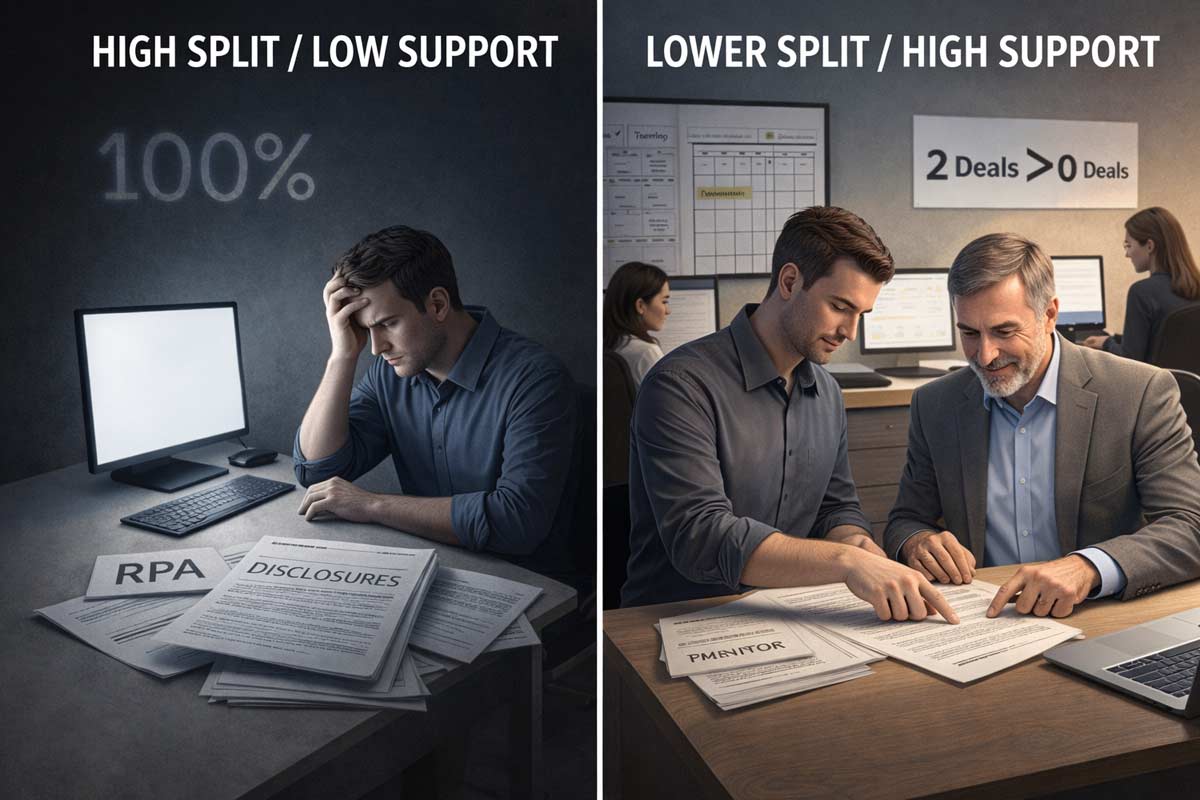
Choosing your first brokerage in California is a high-stakes decision disguised as a simple choice. Your hard-earned license is a tool, not a trophy, and its value is determined entirely by the support system you choose to wield it.
You’ve passed the exam, but your license is truly tested the moment a client asks a question you can’t answer and you have nowhere to turn. In my 20+ years of experience, I’ve watched the same costly pattern repeat: agents seduced by a charismatic recruiter or a premium office, only to fail months later on a missed deadline or botched disclosure.
The fatal flaw isn’t picking the “wrong” brand—it’s choosing for atmosphere over accountability, for splits over support. This guide is your tactical framework. It replaces hope with strategy, helping you cut through the polish to find the partner that will truly protect your career and answer the phone when you’re in over your head.
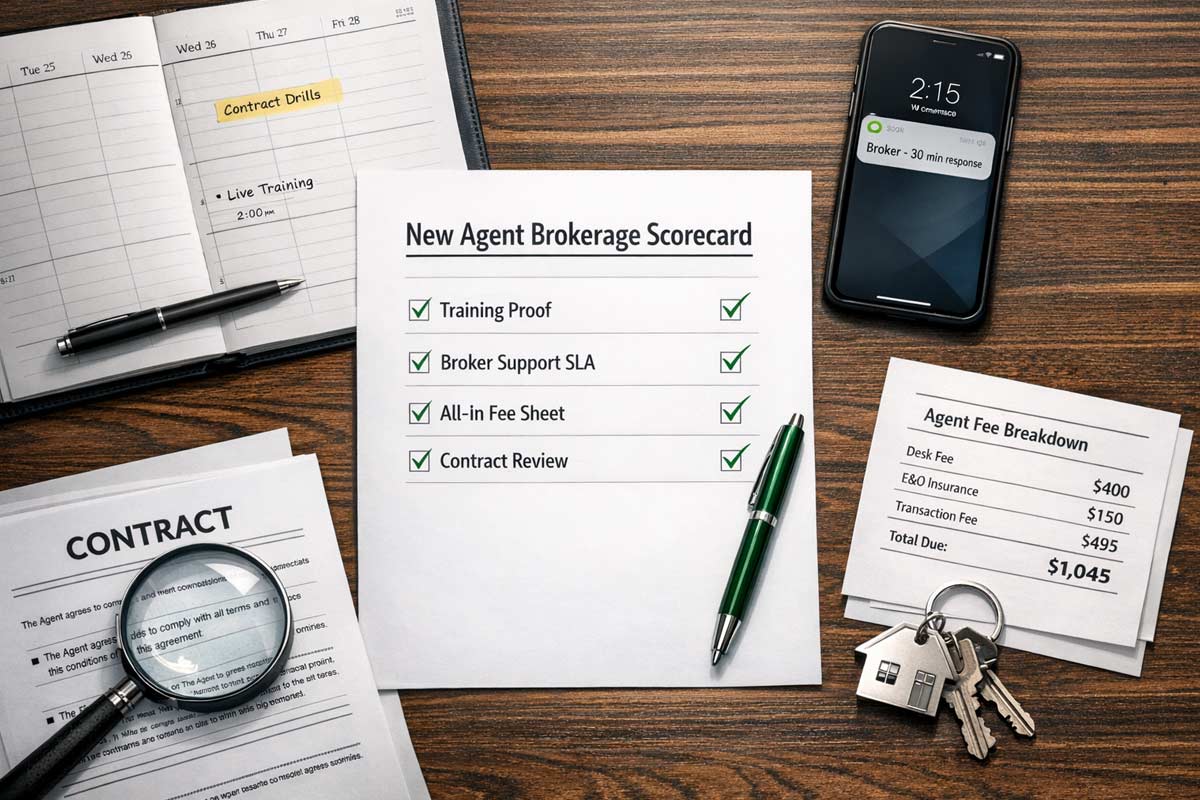
Use this rubric to evaluate every office you visit. Score each category from 1 (poor) to 5 (excellent).
The Scorecard Rule:
| Category | What to Look For | Why It Matters |
|---|---|---|
| Training Proof | A physical calendar showing weekly live contract drills and roleplay. | "We have training" is a platitude. You need to see the schedule. |
| All-In Fee Sheet | Get splits/caps/fees in writing. (Commission Splits Explained for New Agents) | If it isn't in writing, it will be "misremembered" later. |
| Broker Support | A documented response path for after-hours / deadline questions. | You need a manager with a defined response time when a deal is on the line. |
| TC Process | A dedicated Transaction Coordinator and a file-review checklist. | CA disclosures are paperwork-heavy; you need a professional safety net. |
| Mentor Structure | Minimum commitments: Weekly deal desk? Contract review? Shadowing? | You want a mentor with specific, documented responsibilities to you. |
| Required Tools | Who pays for the CRM, doc-sign software, and website? | Some brokerages hide "tech bundles" in your monthly fees. |
| Compliance Review | Does a broker review your RPA before it goes to a client? | This prevents expensive legal mistakes before they happen. |
| Lead Generation | Distribution rules, contact rates, and the specific cost (split/fee). | Avoid vague promises of "leads" without a defined system. |
| Exit Terms | Who owns team-provided leads? What are the non-solicit terms? | Some agreements restrict your ability to work your database if you leave. |
| E&O Insurance | A summary of coverage, deductible responsibility, and who pays. | New agents are often blindsided by deductible costs ($1k–$5k) after a mistake. |
The right choice depends on your learning style. Verify these details locally and do not rely on a national logo.
Best for: Career-changers who thrive in a structured environment and want a clear, step-by-step playbook.
Best for: You want appointments now and accept a lower net commission to buy "reps" and experience.
Best for: You value direct access to the owner and a localized, non-corporate vibe.
Best for: You already have an existing pipeline or network and just need a place to "hang" your license.
Best for: You can commit to 2–4 hours a day of outbound calling and have a high tolerance for rejection.
Best for: You want a mix of a brand name and on-site resources like transaction coordinators.
Don't be blinded by a split percentage. Consider this comparison for your first 6–9 months:
| Scenario | Example A (High Split / Low Support) |
Example B (Lower Split / High Support) |
|---|---|---|
| Training/Leads | None (Self-taught) | Intensive Coaching + Mentor |
| Production (6–9 mo) | 0 Deals (Struggled to launch) | 2 Deals (at an ~$800k price point) |
| Gross Commission (GCI) | $0 | $40,000 |
| Agent Net (Pre-Tax) | $0 | $20,000 |
Note: Example only—commission rates and splits vary by market, brokerage, and side. Assumes 2.5% commission on a single side before broker fees, team splits, MLS dues, and taxes. The point remains: 2 deals at a lower split beats 0 deals at a high split.
California’s regulatory environment is demanding. Disclosures like the TDS, SPQ, and AVID are time-sensitive and legally heavy. For most new agents, joining an office without a documented file-audit process is gambling with your license.
Your first brokerage is a launchpad, not your final destination. Choose for speed-to-competence today; optimize splits later.
Ready to take the first step?
Start a Real Estate Career in California
Q: Is a 100% commission brokerage good for new agents?
A: Only if you already have a solid lead pipeline and a documented plan for contract support. Without infrastructure, most rookies fail before their first deal.
Q: What should my broker’s response time be?
A: You should expect a response on the same day, and significantly faster during active contingency deadlines.
Q: Should I join a team my first year?
A: If you need a check quickly, a team accelerates the process. However, be aware of the long-term cost and the exit terms regarding lead ownership.
Q: How do I verify training is real?
A: Ask to see the calendar for the current month. If they can't show it, treat it as unproven and likely inconsistent.

Founder, Adhi Schools
Kartik Subramaniam is the Founder and CEO of ADHI Real Estate Schools, a leader in real estate education throughout California. Holding a degree from Cal Poly University, Subramaniam brings a wealth of experience in real estate sales, property management, and investment transactions. He is the author of nine books on real estate and countless real estate articles. With a track record of successfully completing hundreds of real estate transactions, he has equipped countless professionals to thrive in the industry.

"Hey guys,
I took the exam today and passed!!!!
It only took me one try which was one of my goals. I took the online
classes and follow your suggestions so I took the crash course,
used the crash course app a lot, took 7 mock tests and went
confident to present the exam. Thank you for the great job you are
doing, you guys are awesome!!!! May God continue to bless you!"
Willie V.