
When people walk into my office or call ADHI Schools for the first time, they often wonder the same thing: “Am I actually cut out for this?”
They’re usually picturing a "high-gloss" TV agent with infinite charisma and a Rolodex of celebrities. If that doesn't feel like them, they worry they’ll fail. Having coached thousands of students through the licensing process, I can tell you the truth:
You don’t need the perfect personality—you need the right operating system.
The winners in our industry aren't necessarily the loudest people in the room; they are the most consistent, ethical, and system-driven. Before you decide whether or not you should become a real estate agent in California, you need to evaluate your willingness to build these 12 traits.
There is a difference between a personality tendency (like being an extrovert) and a professional trait (like being tenacious). A tendency might make the first five minutes of a conversation easier, but a trait ensures you actually follow up six months later when the client is finally ready to buy.
In California’s high-stakes real estate market, we view success as a set of behaviors you can practice until they become your default "Operating System." To evaluate your fit, look at these 12 traits through this three-part lens:
The Behavior: What it looks like in a real California transaction.
The Cost: What happens to your business if this trait is missing.
The Practice: One specific system you can use to build this trait.
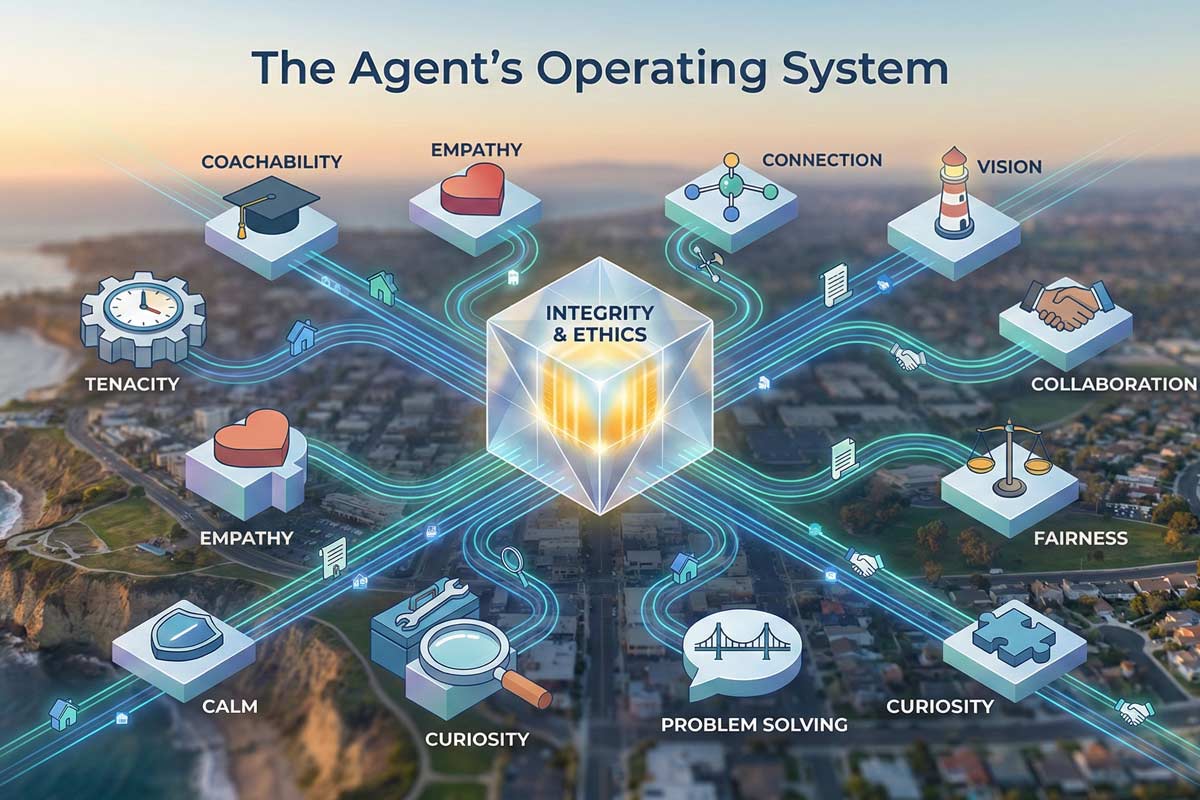
| Trait | What the Client Experiences | The System/Tool | First Step Today |
|---|---|---|---|
| 1. Integrity | Peace of mind and total trust | Disclosure Checklist | Download a standard TDS form and review it with your manager |
| 2. Tenacity | A proactive, tireless advocate | Prospecting Calendar | Block 9 AM – 10 AM for calls |
| 3. Coachability | Faster results, better advice | Win/Loss Debrief | Book 15 mins with your broker |
| 4. Consistency | Reliable follow-through | CRM Sunset Ritual | Log 100% of today’s contacts |
| 5. Empathy | Feeling heard and protected | Onboarding Form | Add "What scares you?" to intake |
| 6. Calm | Stability during escrow stress | 24-Hour Solution Rule | Research 2 fixes before calling |
| 7. Initiative | Rapid problem solving | Vendor Rolodex | Add 5 local pros to your contacts |
| 8. Clarity | Professionalism and certainty | Post-Call Summary | Add "What scares you?" to intake |
| 9. Time Mgmt | An agent who is always "on" | Time-Blocking | Move "To-Do" items to a calendar |
| 10. Tech | Modern, efficient service | Monthly Tech Sandbox | Master one CRM automation |
| 11. Confidence | Firm, data-driven guidance | Evidence-Based Scripts | Use market stats in your next chat |
| 12. Curiosity | Cutting-edge local expertise | Daily Hot Sheet Review | Check local "Solds" for 15 mins |
Rate yourself on a scale of 1 (Not me yet) to 5 (This is a core strength) for the following:
You can have the greatest personality in the world, but it won't pay your mortgage in the first few months. One of the biggest trust-builders I can offer you is the unvarnished truth: even with these traits, you will face a "ramp time."
To calibrate expectations, see How Much Do New Real Estate Agents Make in California?.
Then map your runway with How Long Does It Take to Start a Real Estate Career?
Understanding that timeline is part of the "Confidence Without Ego" trait—knowing that you need a financial runway to match your professional ambition.
If you currently struggle with avoiding follow-up because you’re afraid of being "pushy," or if you find yourself cutting corners on documentation to save time, you are in a high-risk zone for failure.
The fix: Stop viewing these as personality flaws and start viewing them as "software bugs." Install a CRM that forces the follow-up and find a broker who demands the documentation.
Can introverts be top agents?
Yes. In fact, introverts often out-perform extroverts because they tend to be better listeners and more diligent with their "As Discussed" documentation.
What if I hate cold calling?
You don't have to cold call, but you must have a system for finding business. Whether it’s through your "Vendor Rolodex," social media, or geographic farming, you need a tenacity for the process.
What if I’m doing this part-time?
Part-time agents can succeed, but they must be "Full-Time Professionals." Your systems for time management and communication clarity must be twice as good as a full-timer's.
Do you need to be “salesy”?
No. In California, clients want an advisor and a project manager. Being "salesy" often creates a lack of trust.
What’s the #1 trait clients care about most?
Integrity. It’s the trait clients feel immediately—and the one they punish fastest when it’s missing.
What’s the #1 trait you can build fastest?
Communication Clarity. You can start sending "As Discussed" emails today in your current job or personal life.
What trait causes most new agents to quit?
A lack of Process Tenacity. They quit when they realize that "waiting for the phone to ring" isn't a business strategy.
If you've read through these traits and feel that "insider spark," it’s time to move from assessment to action. If you’re ready to move from "thinking" to "doing," start here: Start a Real Estate Career in California.
Whether you are worried about money, the timeline, or balancing a current job, we are here to help you move past the anxiety and into a plan. Contact ADHI Schools today to speak with a mentor.
Founder, Adhi Schools
Kartik Subramaniam is the Founder and CEO of ADHI Real Estate Schools, a leader in real estate education throughout California. Holding a degree from Cal Poly University, Subramaniam brings a wealth of experience in real estate sales, property management, and investment transactions. He is the author of nine books on real estate and countless real estate articles. With a track record of successfully completing hundreds of real estate transactions, he has equipped countless professionals to thrive in the industry.

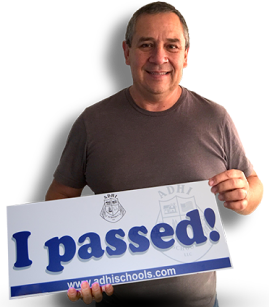
"Hey guys,
I took the exam today and passed!!!!
It only took me one try which was one of my goals. I took the online
classes and follow your suggestions so I took the crash course,
used the crash course app a lot, took 7 mock tests and went
confident to present the exam. Thank you for the great job you are
doing, you guys are awesome!!!! May God continue to bless you!"
Willie V.