
Searching for a "California real estate agent salary" is a frustrating exercise. You'll find averages from $45,000 to six figures—a range so wide it's meaningless. Here’s why: those numbers lump together top-performing veterans with brand-new agents who may go months without a single check.
After 20+ years coaching professionals at ADHI Schools, I can tell you the real question isn't about averages. It's about your first-year reality. Let's replace the confusing hype with a clear, mechanics-based framework you can use to plan your survival and success.
To understand your income, you must stop thinking about a "paycheck" and start thinking about "net profit."
The Core Formula:
What You Sold × What You Keep × - What It Costs = Actual Check
As an example, let’s say you sold a $800,000 house and you are on a 70% commission split at a 2% commission.
$800,000 x 2% (gross commission earned) x 70% (your commission split) = $11,200
Every number we discuss below is an attempt to solve for that final variable. If you don't track these levers, you aren't running a business; you're just hoping for a miracle.
The following tiers represent common outcomes we see in the California market based on an $800,000 sales price and a roughly 70% commission split. These are model outputs based on assumptions, not guarantees.
| Scenario Profile | Est. Closed Deals | Gross Comm. (To Brokerage) | Net to Agent (Pre-Tax) |
|---|---|---|---|
| The Part-Time Learner | 1–2 | $20,000 – $40,000 | $10,000 – $25,000 |
| The Hustling Newcomer | 4–7 | $80,000 – $140,000 | $50,000 – $90,000 |
| The Team Player | 8–12 | $160,000 – $240,000 | $60,000 – $100,000 |
Context for the Math:
Many new agents assume a 3% commission is a fixed rule. In reality, commission rates and splits vary by market and brokerage. This is a simplified model to show the mechanics.
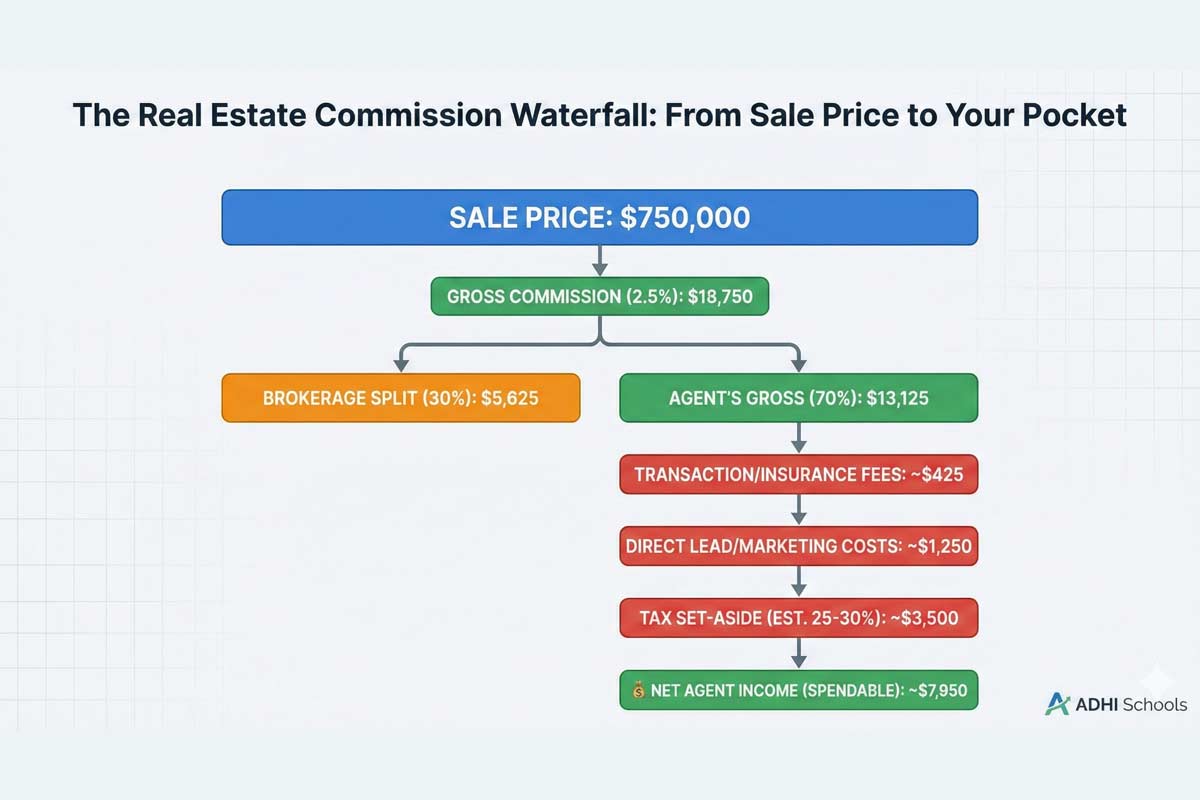
| Step | Assumption/Range | Remaining Balance |
|---|---|---|
| Sale Price | $750,000 | — |
| Gross Commission to Broker (2.5%) | Model Assumption | $18,750 |
| Brokerage Split (70/30) | Typical solo agent starting split | $13,125 |
| Transaction/Insurance Fees | $250 – $600 (Per-deal variable) | $12,625 |
| Direct Lead/Marketing Cost | $0 (Sphere) – $2,500 (Paid Leads) | $10,125 |
| Tax Set-Aside | Varies by situation—confirm with CPA | Variable |
The Takeaway: On a $750,000 sale, your actual spendable income is often less than half of the initial gross commission.
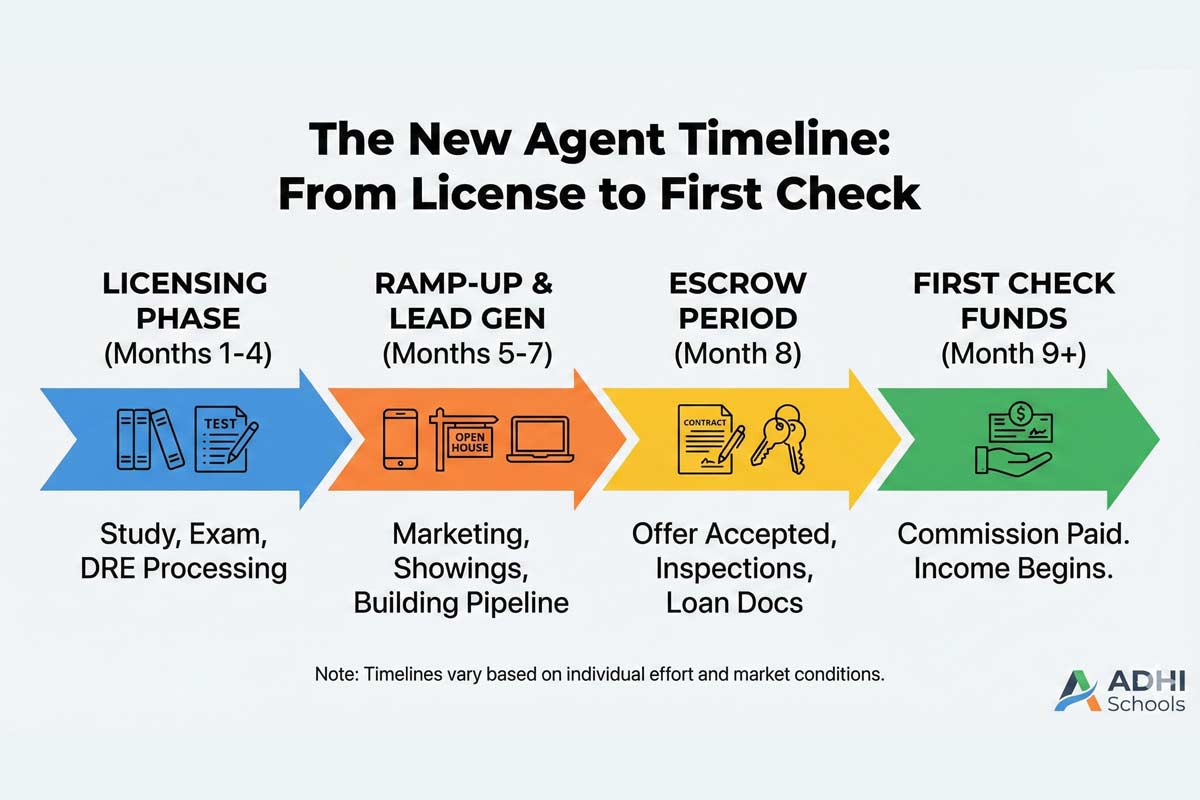
The biggest threat to a new agent isn't a lack of talent; it's a lack of capital during the "lag." Understanding how long it takes to start a real estate career is the first step in managing your cash flow, as the licensing process itself often takes a few months.
Once licensed, the wait for your first dollar of income is months, not weeks.
Runway Reality: If you are going full-time, a 6–9 month cushion for living expenses is a common safety threshold.
You are a business owner, and businesses have overhead. The "gotcha" is that expenses hit before income. You will be paying for access to the market while you are still trying to find your first client.
| Category | Item | Est. Annual Range |
|---|---|---|
| Fixed/Initial | Licensing, Exam, Fingerprints, Board Dues | $2,000 – $3,500 |
| Operational | E&O Insurance, CRM, Signage | $1,500 – $4,000 |
| Recurring Dues | Quarterly MLS Fees / Annual Association | $800 – $1,500 |
| Transportation | Gas, vehicle maintenance, travel time | $1,500 – $4,000 |
| Marketing | Mailers, Digital Ads, Lead Gen | $2,000 – $10,000+ |
| TOTAL | $7,800 – $23,000+ |
Cash Flow Warning: Many board and MLS dues are due in full upon joining. Budget at least $2,000 for your "Day 1" operating costs.
The reality of starting real estate part-time in CA is a common way to manage the financial gap while you learn the ropes. While your availability for mid-day tasks is limited—potentially extending your timeline—you bypass the immediate pressure of zero income during the ramp-up.
Before diving in, ask yourself:
If you have the temperament, see if you align with the personality traits of successful California agents. If you're still on the fence, we have an honest assessment of whether you should become a real estate agent in California.
“Do new agents really make $100,000 in their first year?”
It is possible, particularly in high-priced markets, but typically requires joining a high-volume team or having an existing, massive network.
“How many deals do I need to close to make $X in California?”
Don't use "rules of thumb." Use the formula: Calculate your local average price, subtract your broker's split, subtract your estimated expenses, and see how many deals it takes to reach your target.
“Is joining a team worth the split cut for a new agent?”
Usually. A 50/50 split of a closed deal is better than a 100% split of a deal that never happens. Teams offer immediate leads and coaching.
“What’s the fastest way to get my first commission check?”
Focusing on buyers is the most direct path to a contract, though "fast" in real estate still often means multiple weeks to months from meeting the client to getting paid.
“Can I survive on part-time real estate income in CA?”
Only if it is supplemental. Fixed costs remain the same whether you sell one house or twenty. You must close at least 1-2 deals a year just to cover your professional dues and expenses.
“What’s the biggest financial surprise for new agents?”
The self-employment tax and the fact that most business expenses hit your bank account before your first commission check does.
Now that you understand the math, the next variable is execution. If you want the step-by-step path from decision → licensing → first clients, the start a real estate career in California roadmap we use can help you build the right foundation.
TL;DR: * Gross vs. Spendable: You are a business owner. Your "take-home" is the remainder after brokerage splits, recurring dues, marketing costs, and tax obligations.
The Pipeline Lag: Due to licensing cycles and escrow, a common pattern we see is a multi-month wait for your first dollar of income.
Upfront Costs: Expect to pay $2,000–$4,000 in licensing and board fees before your first closing.

Founder, Adhi Schools
Kartik Subramaniam is the Founder and CEO of ADHI Real Estate Schools, a leader in real estate education throughout California. Holding a degree from Cal Poly University, Subramaniam brings a wealth of experience in real estate sales, property management, and investment transactions. He is the author of nine books on real estate and countless real estate articles. With a track record of successfully completing hundreds of real estate transactions, he has equipped countless professionals to thrive in the industry.

"Hey guys,
I took the exam today and passed!!!!
It only took me one try which was one of my goals. I took the online
classes and follow your suggestions so I took the crash course,
used the crash course app a lot, took 7 mock tests and went
confident to present the exam. Thank you for the great job you are
doing, you guys are awesome!!!! May God continue to bless you!"
Willie V.