
In California real estate, water and access are two of the easiest facts to misstate—and two of the hardest problems to fix after closing. If you market “water rights,” “year-round water,” or “guaranteed access” without written verification, you’re not just risking a failed deal; you’re risking a misrepresentation claim.
The trap is predictable: agents often confuse legal entitlement with physical reality. A water bill is not the same thing as a legal right to a source, and a driveway you can drive today is not proof of a recorded right to use it tomorrow.
This guide is part of the California Real Estate Laws & Compliance Guide.
Notice: This guide is for informational purposes only and does not constitute legal advice. California water and land-use rules can be highly fact-specific. Always consult the local agency, title/escrow, and a qualified real estate attorney or land-use professional for property-specific guidance.
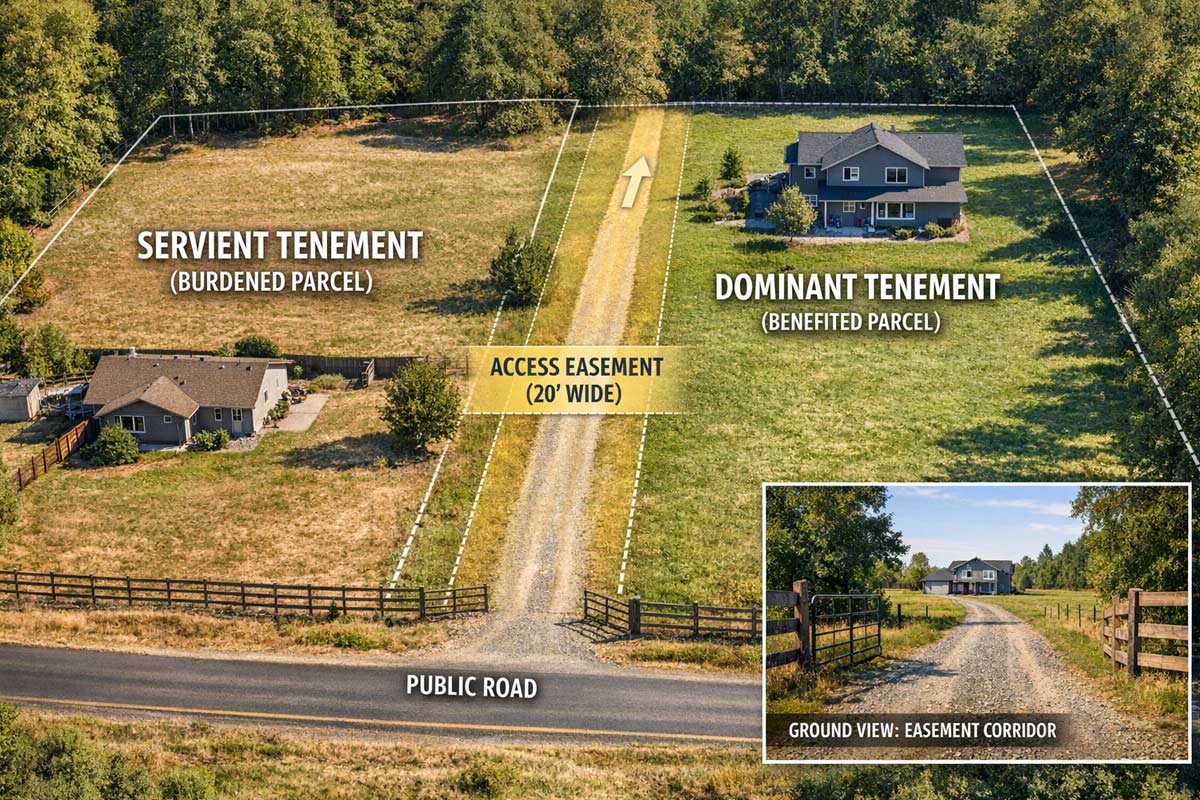
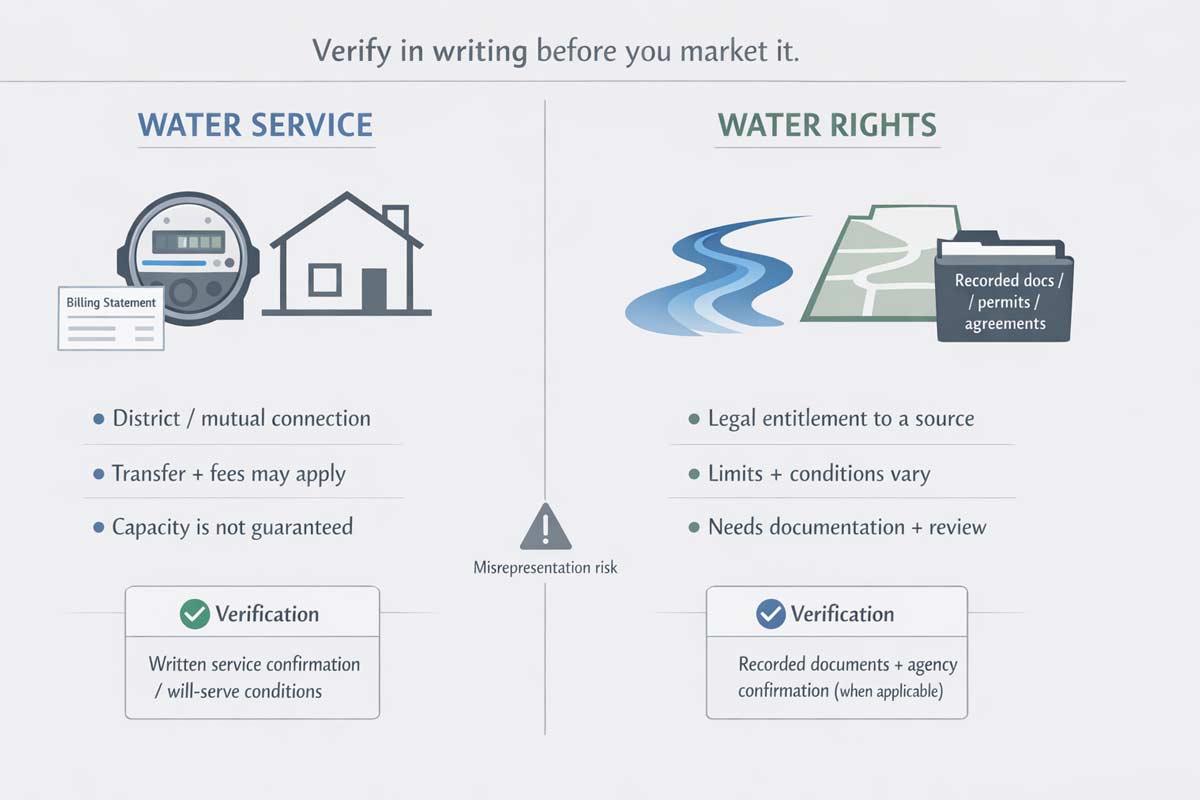
In California, water service (a meter/account with a district or mutual system) might be different from water rights (a legal claim to use a water source), and physical access is different from legal access (a recorded right to use a path for a defined purpose). Agents reduce liability by verifying: (1) the true water source and any conditions for continued service, and (2) the existence, scope, and map location of any access easement—in writing—before using those claims in marketing.
The most common mistake is assuming a property has "water rights" just because water is present.
| Topic | What it is | What agents should verify | Common marketing mistake |
|---|---|---|---|
| Water Service | Utility delivery (district/mutual) | Service status, transfer requirements, written confirmation of service availability, connection fees, meter availability. | Saying “water rights included” when it’s only a service account. |
| Water Rights | Legal entitlement/claim to a source | Any documentation/agreements/permits, limitations, transferability, and counsel review when unclear. | Treating a claim as guaranteed capacity or permanent. |
| Physical Access | A road/driveway exists | Ownership, maintenance responsibility, gates/controls, visible encroachments. | Assuming physical use equals a legal right. |
| Legal Access | Recorded right to cross land | Recorded document, scope, width, map/exhibit location, and any lender/fire authority concerns. | Saying “deeded access” without reading the easement. |
Verification is non-negotiable for these property types:
| Resource | Evidence/Document to Request |
|---|---|
| Water District Service | Recent bill + district confirmation of transfer/service status. |
| Mutual Water | Share certificate + current standing confirmation + transfer rules. |
| Private Well | Well records (if available) + current yield/flow + potability results. |
| Shared Well | Written agreement covering access, maintenance, and cost-sharing. |
| Access Easement | Recorded easement/right-of-way document + map/exhibit showing location. |
Your primary defense is the Preliminary Title Report—but only if you treat it like a checklist, not a formality.
| Risky Language (Avoid) | Safe Language (Use Instead) |
|---|---|
| "Unlimited water rights." | "Property served by private well; buyer to verify capacity and rights via current testing." |
| "Deeded access to the highway." | "Access via recorded ingress/egress easement; see preliminary title report and recorded documents for scope." |
| "Abundant water for horses." | "Buyer to verify water capacity for specific agricultural needs." |
| "Easy shared driveway." | "Shared driveway, see recorded maintenance agreement for details." |
| "Right-of-way guaranteed." | "Recorded right-of-way; see documents for scope and width." |
| "Build your dream home here." | "Buyer to verify utility availability, permits, and emergency access requirements." |
| "Water shares included." | "Sale includes shares in [Name] Mutual Water Co.; verify standing." |
| "Year-round creek access." | "Bordered by [Creek Name]; buyer to verify riparian claims/use." |
Understanding the Dominant vs. Servient Tenement relationship is just one piece of the puzzle. This guide is a core component of our larger California Real Estate Laws & Compliance Guide, designed to help agents navigate the state’s complex land-use regulations.
Easements are often the "make-or-break" factor when a client is looking to increase property value through density. If you want to learn a little more about exploring a lot split, refer to our breakdown of SB 9 Explained for Real Estate Agents; access and utility feasibility are the primary hurdles that can quickly derail development assumptions.
Similarly, when evaluating the addition of secondary units, California ADU Laws Explained will help you distinguish between state-mandated allowances and the real-world water or access constraints that often limit buildable space.
For properties in coastal or rural settings, easements often intersect with protected land. Reviewing the Environmental Regulations California Agents Should Know is essential, as these restrictions can strictly limit the grading and drainage work necessary to maintain an easement.
Finally, if you are handling a tenant-occupied property where shared utilities or access rights are in play, our Rent Control Laws in California (Agent Guide) is a vital resource for ensuring that easement maintenance doesn't inadvertently trigger a tenant dispute or a violation of local habitability ordinances.
Q: What is a “will-serve” letter?
A: A document from a utility district confirming they have the capacity to serve a property, often under specific conditions or fees.
Q: What’s the difference between an easement and a license?
A: An easement is a general right to use land that runs with the land; a license is personal and revocable.
Q: Can I say “legal access” in marketing?
A: Only if you’ve reviewed the recorded documents (and exhibits) and the claim matches the scope and location; otherwise use “access via recorded easement—buyer to verify.”
Q: What is a “blanket easement”?
A: An easement that isn't clearly defined on a map. It can create major development limits or disputes.
Q: Can a neighbor take away an easement?
A: It is difficult if recorded, but can happen via merger or court action. Always verify with title.
Water and access issues aren’t “rural quirks”—they’re core transaction risks. For the full framework on how agents avoid misrepresentation, read the California Real Estate Laws & Compliance Guide and keep a “verify in writing” file for every listing.

Founder, Adhi Schools
Kartik Subramaniam is the Founder and CEO of ADHI Real Estate Schools, a leader in real estate education throughout California. Holding a degree from Cal Poly University, Subramaniam brings a wealth of experience in real estate sales, property management, and investment transactions. He is the author of nine books on real estate and countless real estate articles. With a track record of successfully completing hundreds of real estate transactions, he has equipped countless professionals to thrive in the industry.

"Hey guys,
I took the exam today and passed!!!!
It only took me one try which was one of my goals. I took the online
classes and follow your suggestions so I took the crash course,
used the crash course app a lot, took 7 mock tests and went
confident to present the exam. Thank you for the great job you are
doing, you guys are awesome!!!! May God continue to bless you!"
Willie V.