Many aspiring agents begin their journey with a specific conviction:
"I need to be in a classroom”
It makes sense. To get a California real estate license, you must complete 135 hours of college-level Read more...
Many aspiring agents begin their journey with a specific conviction:
"I need to be in a classroom”
It makes sense. To get a California real estate license, you must complete 135 hours of college-level pre-licensing education. For many, the idea of sitting alone in front of a computer screen for weeks on end is a recipe for procrastination.
You aren’t necessarily looking for a physical desk; you are looking for the "in-person effect"—the structure of a schedule, the ability to ask a live human a question, and the accountability that comes from knowing a class is starting with or without you.
In this guide, we evaluate how to find the best in-person real estate schools in California and explore how modern "live instruction" provides a viable path for busy professionals.
Defining Your Options: Classroom vs. Live Online vs. Self-Paced
Choosing the wrong format is one of the most common reasons we see students struggle to reach the state exam. In California, the Department of Real Estate (DRE) permits both "Live" and "correspondence" (home study) formats. Most modern live-instruction programs—including those delivered via Zoom—are often classified as distance or correspondence delivery, but they aim to replicate the traditional classroom experience.
Format
Best For...
What You Get
The Trade-off
Physical Classroom
Total separation from home distractions.
In-room energy & local networking.
Commute time, parking, & rigid schedules.
Live Instructor-Led (Zoom)
The "In-Person Effect" without the drive.
Live real estate classes with real-time Q&A.
Requires a quiet space and stable Wi-Fi.
Self-Paced Online
Maximum flexibility or strict budgeting.
Pre-recorded or text-based modules.
Requires strong self-discipline and time blocks.
If you are currently weighing your budget against your learning style, you may want to cross-reference the cheapest real estate schools in California to see how these formats impact your total investment.
How to Evaluate Any "In-Person Style" Program
Based on my 20+ years of preparing California license applicants, a school shouldn't just be "near you"—it needs to be effective. Use these criteria to evaluate any provider:
DRE Approval & Compliance: Verify the school is legally vetted by the California Department of Real Estate for the required three courses.
Instructor Access: If you are stuck on a concept like Negative Amortization, can you get a live answer?
Schedule Reliability: Does the school have a consistent calendar, or do they frequently cancel sessions?
Student Support: Is there a team available to help with certificates and DRE applications?
Exam-Prep Synergy: The 135-hour certificates are the legal requirement, but the state exam is the hurdle. The most popular real estate schools in California often weave exam strategy into every live session.
The Reality of Physical Classrooms in California
Who Should Still Choose a Physical Classroom?
While digital options are growing, the traditional classroom still serves a specific group of learners. You should consider a true in-person school if:
You lack a quiet, private space at home to attend a live digital session.
You thrive on the physical energy of a room and prefer face-to-face networking.
You live or work within 15 minutes of a reputable classroom.
The "Commute Friction" Factor
In practice, we’ve observed that for students in high-traffic hubs like LA, Orange County, or the Inland Empire, the commute is the friction that kills consistency. If a class starts at 6:00 PM and you are stuck on the 405 or the 10, the stress of the drive often leads to missed sessions. In our experience, we often see completion rates fall off fast after two missed sessions.
For those who need to finish quickly, it’s worth comparing these logistics against the fastest real estate license programs in California.
The Modern Solution: Live Instructor-Led Zoom Classes
At ADHI Schools, we focus on delivering the "in-person effect" through scheduled, live-streamed sessions. This format is designed for the modern California life:
The Full-Time Professional: Join class after work without needing to find parking downtown.
The Parent: Stay home and engage in high-level instruction while remaining accessible to your family.
The "Accountability" Learner: You show up because there is a live expert waiting to teach you. This is why many consider it among the best online real estate schools in California for those who dislike traditional "self-paced" modules.
Related Deep Dives
The Big Picture: Best Real Estate Schools in California
Speed: Fastest Real Estate License Programs in California
Budget: Cheapest Real Estate Schools in California
Flexibility: Best Online Real Estate Schools in California
Reputation: Most Popular Real Estate Schools in California
Decision Framework: Finding Your Fit
Do you have the self-discipline to read 1,000+ pages of dry material alone?
Yes: Self-paced online might work.
No: You need a live instructor. (Go to Step 2).
Is there a DRE-approved physical classroom nearby and you can reliably attend?
Yes: Physical classroom is a solid option.
No: The drive will likely become a barrier. (Go to Step 3).
Do you want the structure of a classroom with the comfort of home?
Yes: Live Instructor-Led Zoom is your best bet.
No: If you just want the lowest price and no schedule, self-paced is your default.
FAQ: In-Person Schools vs. Live Instruction
Are in-person real estate classes required in California?
No. You can fulfill your 135-hour requirement via classroom or correspondence formats.
Is live Zoom considered "in-person"?
Legally, it is usually categorized as correspondence or distance learning, but functionally, it offers the same real-time interaction as a physical classroom.
What if I work full time?
Live Zoom instruction is a top choice for full-time workers. It provides the rigid schedule needed for discipline without the added 5–10 hours a week of California traffic.
Choosing Your Path
The "best" school is the one that fits your life well enough to let you finish. While a physical building has its benefits, the flexibility of live instructor-led classes has become the most practical option for many busy Californians.
Ready to see how ADHI Schools stacks up? Explore our comprehensive breakdown of the Best Real Estate Schools in California or join one of our upcoming live sessions to experience the "in-person effect" for yourself.
|
Choosing an online real estate school can feel like an endless loop of open tabs and conflicting opinions. And in real estate licensing, “close enough” isn’t close enough—if you enroll in a program Read more...
Choosing an online real estate school can feel like an endless loop of open tabs and conflicting opinions. And in real estate licensing, “close enough” isn’t close enough—if you enroll in a program that’s hard to use, light on support, or weak on exam prep, you don’t just lose money.
You lose momentum.
Over the last 20+ years, I have seen the same truth play out: the “best” online school isn’t a universal winner. It’s the one that fits how you actually learn and how your life actually runs. In the next 10 minutes, you’ll know which online format fits you, what to verify for compliance with the California Department of Real Estate, and which tradeoffs matter most—support, speed, or exam readiness.
What “Online” Really Means in 2026
In California, “online” can mean very different study experiences depending on the delivery method:
Self-Paced Online: Log in anytime. Move through modules/videos on your schedule. Maximum flexibility—requires self-discipline.
Livestream / Virtual Classroom: Scheduled sessions (often via Zoom-style platforms). Best for accountability and real-time instructor access.
Hybrid Programs: Self-paced core hours + optional live Q&A, crash reviews, or office hours to reinforce understanding.
Mobile-First Platforms: Purpose-built mobile study vs. “mobile responsive.” If you study during commutes or breaks, mobile usability becomes a deciding factor.
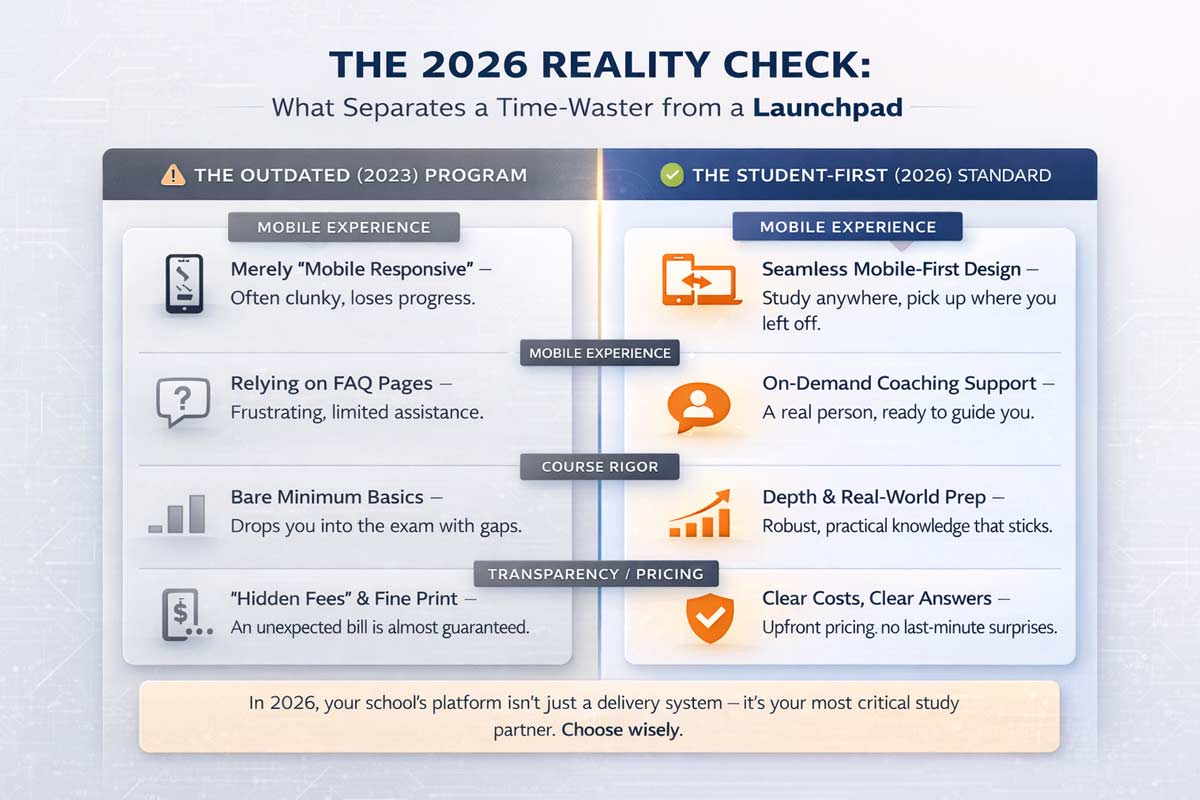
What’s Different About Online Schools Now (2026 Reality Check)
Three things separate “just acceptable” programs from programs that actually help students finish and pass:
Mobile-first study is no longer optional. The best programs let you move seamlessly between laptop and phone without losing your place.
Support quality varies wildly. “Support” is a buzzword unless you can reach a real person quickly when you’re stuck.
Course rigor matters more than ever. The DRE approves individual statutory courses and assigns sponsor IDs/approval numbers—so “thin,” outdated, or sloppy delivery isn’t just annoying; it creates avoidable exam friction.
The 2026 Rankings Framework: Finding Your “Best”
Instead of pretending there’s one perfect school for everyone, use this outcome-based framework. Find the category that matches your situation, then choose the program that checks the right boxes.
0. Best Overall for Most Students (The Balanced Choice)
What to look for: A structured path, real human support, strong real estate exam prep, and a clean user experience.
Red Flags: Unclear support channels, short access lengths (too little runway if life gets busy), and constant upsells for basics.
1. Best for Maximum Support (The “I Have Questions” Choice)
What to look for: Direct instructor access, weekly live Q&A, and a responsive student success team.
Red Flag: Ticket-only support with slow turnaround times when you’re on a deadline.
2. Best for Fast Completion (The “I Need This Done” Choice)
What to look for: A streamlined interface, clear progress tracking, and a smooth certificate process (no bottlenecks).
Red Flag: Clunky navigation that turns study time into frustration time.
Deep Dive: If speed is your primary driver, read the deeper breakdown here: Fastest Real Estate License Programs in California.
3. Best for Exam Prep Strength (The “One-and-Done” Choice)
What to look for: High-volume practice questions, exam-style simulations, and strong explanations (not just “right/wrong”).
Red Flag: Exam prep treated as a “bonus” instead of an essential part of passing.
4. Best for Budget-Focused Students (The “Value” Choice)
What to look for: Transparent pricing and packages that clearly include your required courses.
Red Flag: Teaser pricing that later charges extra for key items (certificates, support, prep tools).
Deep Dive: Before you pick the lowest sticker price, read the tradeoffs here: Cheapest Real Estate Schools in California (Pros & Cons).
🔶 The ADHI Standard (What a “Student-First” Program Should Include)
This isn’t about hype—it’s about what actually helps students finish. It’s also how ADHI designs programs internally:
Clarity: A step-by-step study path so you’re never guessing what’s next.
Support: Real help when you’re stuck (not a black-hole ticket system).
Prep Depth: Enough practice to build confidence before exam day.
Usability: Mobile-friendly study that fits into a working schedule.
No Surprises: Transparent inclusions so you’re not nickel-and-dimed later.
Use that as your checklist when comparing options—no matter what provider you’re looking at.
📘 Related Guides
Best In-Person Real Estate Schools in California
Cheapest Real Estate Schools in California (Pros & Cons)
Fastest Real Estate License Programs in California
Most Popular Real Estate Schools in California (Student Volume)
The Non-Negotiables Checklist
Quick note: the DRE approves individual statutory courses (and assigns sponsor IDs/approval numbers). Always verify the course approvals—not just marketing claims.
DRE Course Approval: Verify the specific course approval/sponsor ID in the DRE database (secure.dre.ca.gov).
Statutory Hours: Ensure the program satisfies the required 135 hours of statutory coursework.
Device Compatibility: Does it work smoothly on phone + laptop (without glitches)?
Access Duration: Enough time to finish without stress (6–12 months).
Refund Policy: Clear, written, and easy to find.
Online vs. In-Person: The Final Decision
A lot of students start by looking for the Most Popular Real Estate Schools in California, but popularity doesn’t guarantee fit.
Choose online if you need schedule flexibility and you’re comfortable learning independently. Choose in-person if you need a structured environment to stay consistent.
To compare online, in-person, cheapest, fastest, and popularity-based options side-by-side, use our Best Real Estate Schools in California hub.
FAQ
Is online real estate school allowed in California?
Yes—California allows pre-license/statutory coursework to be completed through approved offerings, including online formats, as long as the course is properly approved/listed. (California Department of Real Estate)
How do I verify DRE approval?
Use the DRE statutory course search and confirm the specific course approval and sponsor details. Remember: DRE approval is tied to courses (with sponsor IDs/approval numbers), not blanket marketing claims. (California Department of Real Estate)
Self-paced vs. livestream—what’s better?
Self-paced is best for flexibility. Livestream is best for accountability and real-time Q&A. Hybrid works well if you want both.
Can I finish faster online?
Online programs can help you move efficiently because you aren’t waiting for scheduled class dates. That said, California rules limit how quickly statutory courses can be completed: a single course may not be completed in less than 2½ weeks, and no more than two courses may be completed in any five-week period. (California Department of Real Estate)
Does an online school include exam prep?
It varies. Some include robust prep tools in the base package; others treat it as an add-on. If you want to pass with fewer attempts, prioritize programs in the “Exam Prep Strength” category.
How long do I have access to the course?
Access lengths vary by provider. The key is to choose enough runway so you don’t feel forced to rush if work or life gets busy.
Key Takeaways
Verify course approval (not marketing). Confirm sponsor/course approvals in the DRE database.
Choose the format that matches your life. Self-paced vs. livestream vs. hybrid is the real decision.
Exam prep is what gets you across the finish line. Courses earn credit; prep earns confidence.
Avoid surprise fees and weak support. Transparent inclusions + real help matter.
Plan your timeline around DRE pacing rules. 2½ weeks per course; max two courses per five weeks.
Ready to choose?
Compare online, in-person, cheapest, fastest, and popularity-based paths in our Best Real Estate Schools in California hub.
|
The most stressful mail a licensee can receive isn't a lost commission check—it's an inquiry letter from the California Department of Real Estate (DRE).
Most agents don’t set out to break the law; Read more...
The most stressful mail a licensee can receive isn't a lost commission check—it's an inquiry letter from the California Department of Real Estate (DRE).
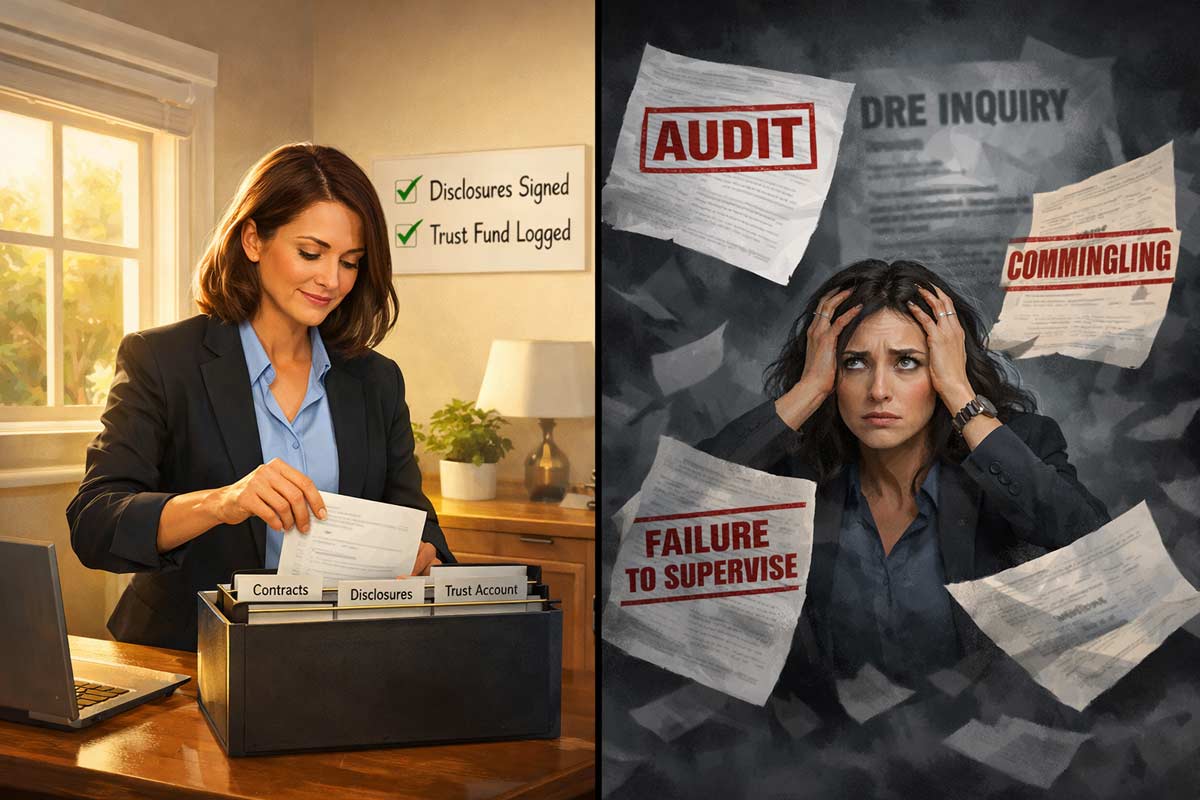
Most agents don’t set out to break the law; they fall into "DRE trouble" because of outdated habits or misunderstood regulations. In my 20-plus years of advising California licensees, I’ve seen that the best defense isn't a legal team—it’s a solid operational foundation. This is where Continuing Education (CE) shifts from a bureaucratic hurdle to a professional firewall to help agents avoid DRE violations.
Key Takeaways
Reduces Complaint Risk: Identifies the "red flag" behaviors that trigger consumer grievances.
Prevents Audit Deficiencies: Ensures your trust fund and transaction records meet DRE standards.
Forces Documentation Habits: Moves compliance from a "memory task" to a repeatable system.
What “DRE Trouble” Actually Looks Like
DRE trouble rarely starts with a "bad" person; it starts with a bad process. Here is how the regulatory machinery typically moves:
Consumer Complaints: Often triggered by a frustrated client, these lead to an investigative inquiry that can open up your entire file history.
Audit/Document Requests: Whether random or "for cause," an auditor will scrutinize your transaction folders and trust fund records for technical accuracy.
Renewal Delays: Simple errors in your CE reporting or incomplete requirements can lead to a "deficiency" notice, potentially causing your license to expire while you scramble to fix it.
Disciplinary Actions: This can range from a private citation and fine to a public "Accusation" that may result in a restricted license or revocation.
Disclaimer: This article provides educational information on compliance and is not intended as legal advice.
The 80/20 of What Gets Agents in Trouble
The DRE focuses on patterns. Most violations happen in these high-risk zones:
Advertising & Representation: Improper team names that omit the broker’s identity or missing license numbers on social media marketing.
Disclosure Failures: Missing "material facts" or failing to provide Agency Disclosure forms at the earliest practical moment.
Trust Funds & Records: The "cardinal sin." Commingling funds or failing to maintain a proper 3-column record of client money.
Management & Supervision: A major magnet for DRE trouble. Brokers are responsible for the oversight of salespersons and unlicensed assistants; a lack of a "reasonable system of supervision" is a frequent cause for discipline.
Records & Documentation: Failing to retain transaction-related documents for the required three-year period. If it isn't in the file, as far as an auditor is concerned, it didn't happen.
How CE Prevents Violations
When you approach your California Real Estate License Renewal with a focus on compliance, you treat each CE bucket as a defensive strategy.
1. Ethics & Disclosure
The Misunderstanding: "I only need to disclose things that are physically broken."
The Reality: California requires disclosure of anything that affects the value or desirability of the property.
The Scenario: An agent fails to mention a neighbor's recurring noise complaint. The buyer finds out, files a DRE complaint, and the agent faces an inquiry around misrepresentation.
CE Takeaway: Use your Risk Management CE to audit a recent Transfer Disclosure Statement (TDS) and Agent Visual Inspection Disclosure (AVID). If you're unsure, disclose it.
2. Fair Housing (Interactive Requirements)
The Misunderstanding: "I'm a good person, so I'm not violating fair housing."
The Reality: Bias in marketing and "steering" are primary DRE focus areas.
The Scenario: An agent tells a caller, "You'd probably be more comfortable in the neighborhood across town." Even if meant "helpfully," this is steering.
CE Takeaway: DRE renewal requirements now include interactive fair housing and implicit bias components. Use this training to practice compliant responses to client questions about "neighborhood demographics."
3. Trust Fund Handling
The Misunderstanding: "My broker handles the money, so the timing doesn't matter for me."
The Reality: If you touch a check, you are responsible for the record-keeping and handling according to DRE and brokerage-specific timelines.
The Scenario: An agent holds an earnest money check for several days without a written agreement to do so. An audit reveals the delay, leading to a citation for improper handling.
CE Takeaway: Implement a "Monday Morning" rule: any funds received must be logged and processed according to your broker's compliance manual immediately.
“Audit-Proof” CE Choices
To ensure your renewal goes smoothly and your files stay clean, use this checklist:
Verify Sponsor: Ensure the provider is a DRE-approved sponsor, like ADHI Schools, with a valid ID.
Interactive Requirements: Confirm you’ve completed the mandatory interactive fair housing and implicit bias components.
Correct Hours: Confirm you have the full 45 hours (or the required amount for your specific renewal cycle).
Storage: Save your certificates in a dedicated folder named CE-2026-Renewal-Certs.
DRE eLicensing: Upload your info early to avoid the last-minute "system is down" panic.
Post-Renewal: Your 30-Day “Stay-Out-of-Trouble” Plan
Once you’ve completed your CE, don't just file the certificates. Implement these operational habits:
Task
Action
Ad Audit
Review your Instagram bio, email signature, and website. Do they include your DRE number and brokerage name?
Complaint-Proofing
Start a "Communication Log" for every transaction. Document all verbal instructions from clients via a "confirming email."
File Hygiene
Spend 10 minutes every Friday reviewing your active transaction files for missing signatures or incomplete disclosures.
SOP Update
Ask your broker or manager for a simple one-page Standard Operating Procedure (SOP) for how your team handles "material fact" discoveries.
Once you’ve handled the technical side of the law, you can focus on the growth side of your business. For more on what to do once the renewal is submitted, see our guide on What to Do After Renewing Your CA Real Estate License.
Staying Compliant Is a Choice
At ADHI Schools, we build our CE courses around real-world compliance outcomes because we know a license is more than a piece of paper—it’s your livelihood. Think of CE as your biennial "compliance tune-up." It’s the most cost-effective insurance policy you can buy.
|
One of the most common questions we hear sounds like: “I upgraded to a broker license—do I have extra CE hours now?” or “Do I have to take different classes than when I had my sales license?”
The Read more...
One of the most common questions we hear sounds like: “I upgraded to a broker license—do I have extra CE hours now?” or “Do I have to take different classes than when I had my sales license?”
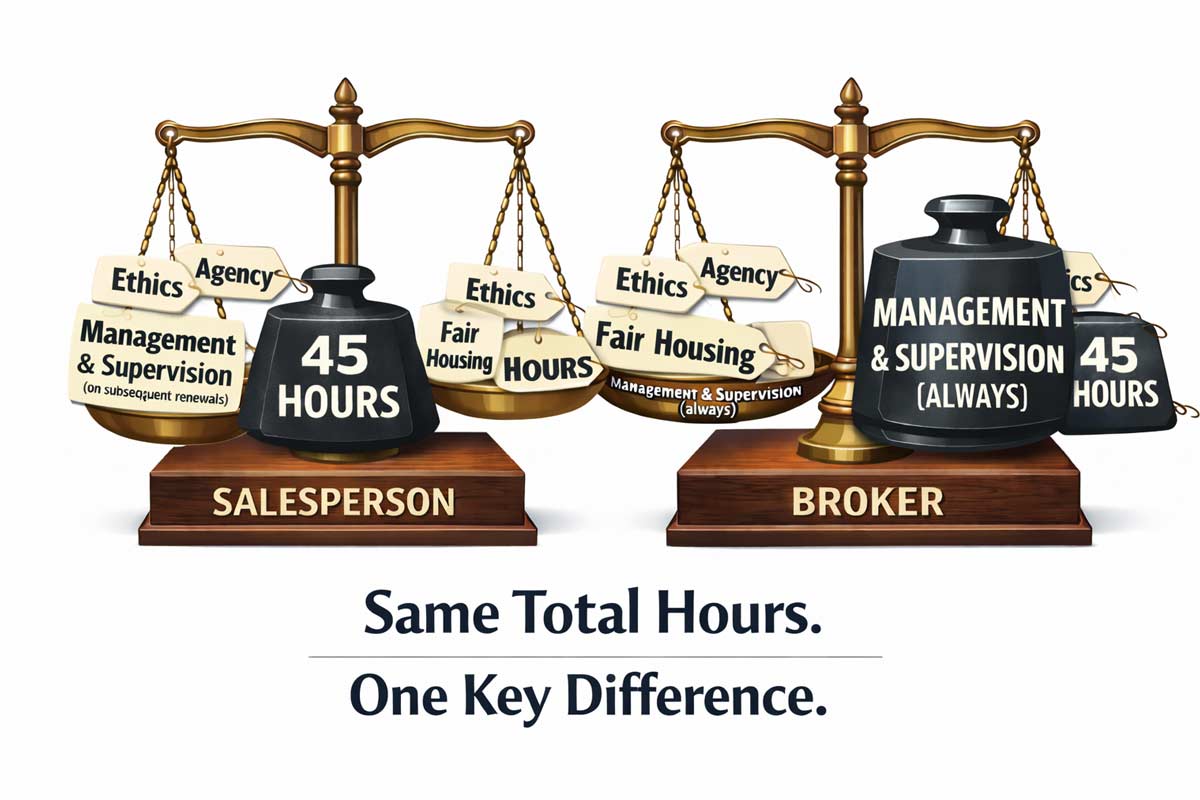
The confusion is understandable. In California, brokers carry a higher level of legal responsibility—so it feels like the DRE should require more education. The reality is simpler: the total hours are the same, but the required subject mix is where brokers can get tripped up.
Key Takeaways
Total Hours: Brokers and salespersons both complete 45 hours of DRE-approved CE each 4-year renewal cycle.
The Content Mix: Brokers must include Management and Supervision as a mandatory topic (salespersons don’t on their first renewal).
The 9-Hour Survey: For second and subsequent renewals (for licenses expiring on/after Jan 1, 2023), a 9-hour survey can cover all mandatory topics in one course.
Interactive Requirement: For licenses expiring on/after Jan 1, 2023, Fair Housing must include an interactive, participatory component.
Quick Answer: Broker vs. Salesperson CE
In California, brokers and salespersons both need 45 hours of continuing education to renew. The difference is what’s inside the 45 hours: brokers must ensure they complete Management and Supervision as part of their mandatory topic mix. While the total hour count is identical, the DRE requires brokers to undergo specific training related to their role as a potential supervisor.
Comparison Table: Salesperson vs. Broker Renewal
Feature
Salesperson (First Renewal)
Broker (First Renewal)
Second+ Renewals (Both)*
Total Hours
45 hours
45 hours
45 hours
Mandatory Core Courses
4 Subjects (3-hrs each)
5 Subjects (3-hrs each)
Included in 9-hour survey
Fair Housing
3-hr + Interactive Implicit Bias
3-hr + Interactive Implicit Bias
Included in 9-hour survey
Implicit Bias
2-hr Required
2-hr Required
Included in 9-hour survey
Mgmt. & Supervision
Not Required
Required
Included in 9-hour survey
*Applies to licenses expiring on/after Jan 1, 2023, and late renewals filed after that date.
What’s the Same for Everyone?
Regardless of license type, the DRE’s CE structure is built around consumer protection—so the baseline framework stays consistent. That’s why the California Real Estate License Renewal Requirements don’t "punish" brokers with extra hours.
The 4-year renewal cycle applies to everyone.
The total is always 45 hours—no "broker bonus hours."
Mandatory topics + consumer protection hours are the backbone of every renewal package.
What’s Different for Brokers?
If the hours are the same, why does broker CE feel different? Accountability.
A broker isn’t just responsible for their own files—they’re responsible for the supervision standard in the office: policies, advertising compliance, trust fund handling, and risk reduction. That’s why Management and Supervision is explicitly part of the broker requirement - even on the first renewal.
Operator Scenarios: Where Brokers Actually Get Exposed
The Supervision Trap: A broker assumes "supervision" just means reviewing contracts. In reality, brokers can be on the hook for agent advertising and compliance breakdowns across the entire team.
Trust Fund Risk: Most salespersons never touch trust fund handling—brokers live inside it. Small process errors can turn into big consequences during a DRE audit.
First Renewal vs. Subsequent Renewals
This is where people accidentally choose the wrong package. Your path depends on your renewal "generation."
1) First Renewal
First renewal requires the mandatory subjects as individual courses, plus the required Fair Housing and Implicit Bias components.
Salespersons: 4 separate 3-hour courses (Ethics, Agency, Trust Funds, Risk Management) + 3-hour interactive Fair Housing + 2-hour Implicit Bias.
Brokers: All of the above PLUS a 3-hour Management and Supervision course.
To avoid confusion, view the full roadmap here: California Real Estate License Renewal Guide
2) Second and Future Renewals
For licenses expiring on/after Jan 1, 2023, the DRE allows a 9-hour survey course that covers all mandatory topics (including Management and Supervision) in a single module. You then complete the remaining hours with electives—ideally from clearly qualified Courses That Count Toward CE in California.
7 Common Mistakes That Trigger Delays
REALTOR® Ethics vs. DRE Ethics: Assuming NAR training counts (it usually doesn’t unless the provider specifically issued a DRE-approved CE certificate).
Non-Interactive Fair Housing: Taking an old-style text course for Fair Housing when your license expires after Jan 1, 2023.
Missing Implicit Bias: Failing to ensure the 2-hour standalone course is in your package. See: Does California Require Implicit Bias Training for Renewal?
Overbuying Hours: Thinking brokers need more than 45. Confirm your California CE hour requirements before paying.
Unverified Providers: Using a "national" school that lacks a California DRE Sponsor Number.
Waiting Until the Final 24 Hours: Because of the 15-hour exam limit (see below), you literally cannot finish 45 hours in one day.
Wrong Package Type: A broker taking a salesperson package and missing the Management and Supervision credit.
Step-by-Step: Choosing the Right CE Package
Verify Sponsor Details: Ensure the school is DRE-approved.
Check Fair Housing: Confirm it includes the "interactive participatory component."
Respect the 24-Hour Rule: The DRE limits licensees to completing final examinations for a maximum of 15 credit hours per 24-hour period. If you have 45 hours of testing to do, you need at least three separate 24-hour windows to complete your exams.
FAQ
Do brokers need more CE hours than salespersons in California?
No. Both license types require 45 hours every four years.
Is Management and Supervision required for brokers?
Yes. It is mandatory for all broker renewals (first and subsequent).
What is the 9-hour survey course?
It's a condensed course covering all seven mandatory subjects, available only for second and subsequent renewals.
Does Fair Housing have to be interactive?
For licenses expiring on or after Jan 1, 2023, yes. This includes late renewals filed after that date.
How early can I renew?
You can submit your renewal via eLicensing up to 90 days before your expiration date.
Broker renewal shouldn’t create uncertainty or cause you to buy the wrong package. The goal is simple: meet the DRE requirements cleanly, protect your license, and keep your business.
|
The most common question I’ve heard over the last 20+ years helping students get licensed in California is: "How fast can I get this done?"
It’s an understandable question. You’re ready for a Read more...
The most common question I’ve heard over the last 20+ years helping students get licensed in California is: "How fast can I get this done?"
It’s an understandable question. You’re ready for a career change, and the only thing standing between you and your first commission is three courses and an exam. However, there is a massive difference between "finishing the courses" and "being ready to pass the exam."
Marketing headlines often promise "Get your license in weeks," but the reality of the California Department of Real Estate (DRE) requirements and your own life schedule usually tell a different story.
Quick Take: The Reality Check
While the absolute legal minimum time to complete your pre-licensing education is roughly 54 days (due to DRE-mandated holding periods), most successful students finish in 3 to 5 months. Speed is a tool, but consistency is what actually gets you to the finish line.
In California, most students are completing 135 hours of statutory pre-licensing education (three 45-hour courses)—but calendar time depends on consistency and minimum completion windows.
The California Baseline: What You Must Complete
In California, the DRE requires you to complete three college-level courses before you can even apply for the state exam:
Real Estate Principles
Real Estate Practice
One Elective (e.g., Legal Aspects, Finance, or Appraisal)
Each of these courses is designed around a 45-hour curriculum. For home-study/online statutory courses, providers generally can’t allow the student to test out of a course if fewer than 18 days pass from the date you’re granted access to the materials—so the course final typically won't unlock until at least Day 18.
With three courses, that means the mathematical minimum is 54 days. If a school tells you that you can finish all three in a single weekend, they aren't being honest about California law.
Realistic Timelines: 3 Common Student Paths
How long you will take depends entirely on your weekly cadence. Over the decades, I’ve seen students fall into one of these three tracks:
The California Real Estate Completion Timeline
Track
Weekly Hours
Est. Completion
Who It’s For
Fast Track
18–20 Hours
8–10 Weeks
Full-time students or those between jobs.
Balanced Track
9–10 Hours
4–5 Months
Professionals with a 9-to-5 and families.
Slow & Steady
3–5 Hours
6–12 Months
Busy schedules; highest risk of drop-off.
1. The Fast Track
This requires a "deep work" approach. You are treating school like a part-time job.
What causes delays: Burning out by Week 4 or hitting a wall on complex topics like Finance.
Next Step: If this is you, block out time every morning before the world wakes up.
2. The Balanced Track
This is where 70% of our students live. It’s sustainable and allows for life to happen without derailing your progress.
What causes delays: Skipping a full week due to a work project and losing "the thread" of the material.
Next Step: Commit to a non-negotiable "Saturday Study Session" to supplement short weekday bursts.
3. The Slow & Steady Track
While possible, this track has the highest risk of drop-off. The longer you take, the more you forget what you learned in the first course.
What causes delays: Passive reading and the "start-stop" cycle.
Next Step: You need a high-accountability structure or a physical class to keep you moving.
Real Estate School Time vs. Total Time to Get Licensed
Finishing school is just Phase 1. To plan your career launch, you must account for the DRE’s administrative timeline:
School Completion: 8 weeks to 6 months (as shown above).
DRE Application Processing: After finishing your 135 hours, you submit your application. As of January 12, 2026, the DRE was processing Sales Combo Exam/License applications received approximately one month prior. You should check the the DRE processing page regularly for live updates.
Exam Scheduling: Once approved, qualified examinees can self-schedule via eLicensing as late as 6:00 AM on the day of the exam, depending on site availability.
Exam Day: The Salesperson exam is a 3-hour session consisting of 150 multiple-choice questions. You need a 70% to pass the sales exam and a 75% to pass the brokers.
What Actually Slows Students Down (The Hidden Time Traps)
Most students don't fail because the material is too hard; they fail because they lose their momentum. After 20 years of observation, these are the biggest "time killers":
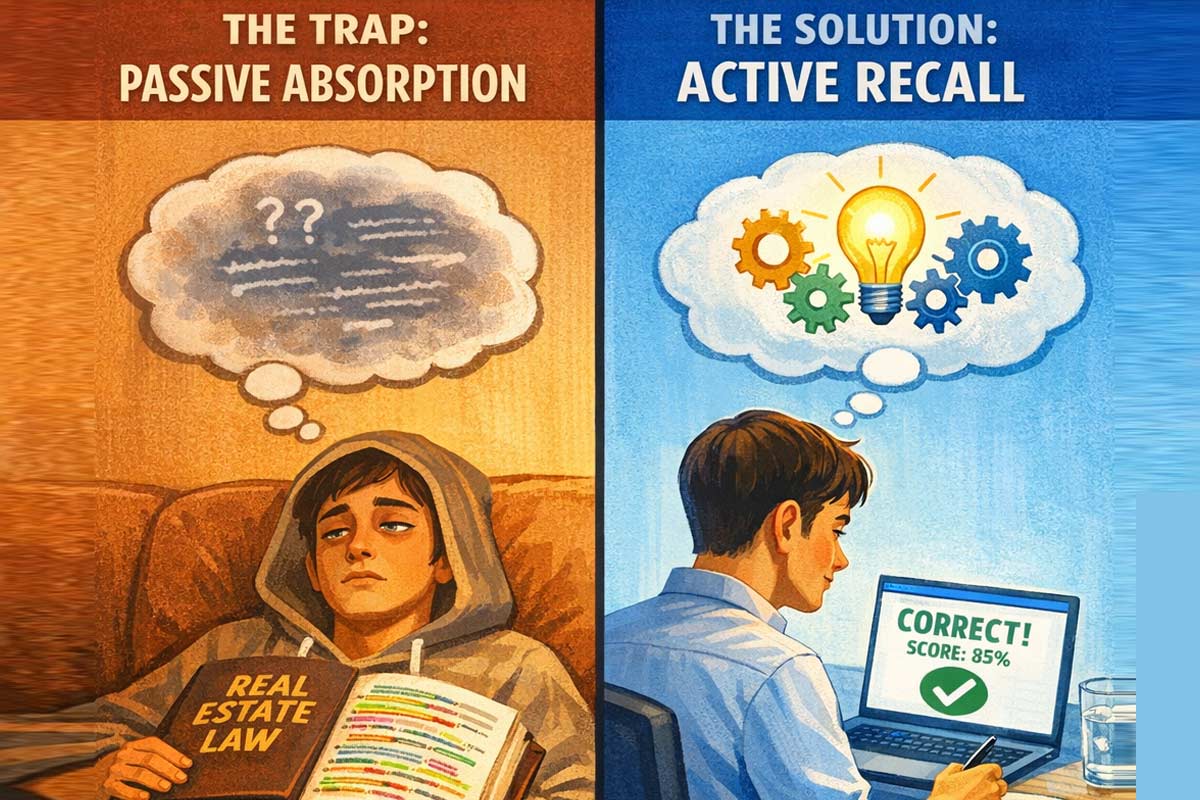
Trap #1: Passive Studying
I’ve seen students spend three weeks "reading and highlighting" a textbook without taking a single practice quiz. They feel like they are working, but they aren't retaining anything. When they finally take a quiz and fail, they get discouraged. This cycle of effort without retention is what leads to the common question: do online real estate classes actually prepare you? The answer hinges on your strategy.
Trap #2: The "Sequential" Prep Mistake
A common trap is waiting until you finish all three courses to even look at exam prep materials. This often leads to a "re-learning" phase that can add weeks to your timeline. My advice: start lightweight recall on Principles while you are still working through Practice.
Trap #3: The "Week 3" Motivation Dip
The first two weeks are fueled by excitement. By week three, the novelty wears off. Without a system, this is where most people quit. If you find yourself stalling, you need to learn how to stay motivated during real estate school to push through the mid-course slump.
How to Finish Faster Without Cutting Corners
If you want to move quickly, you don't skip the material—you optimize how you consume it.
Audit Your Environment: You can't learn "Legal Aspects of Real Estate" while watching TV. Success requires the optimal study setup for real estate school—a dedicated space where your brain knows it’s time to work.
Use the "Error Log" Method: Instead of re-reading chapters you already know, spend 80% of your time on the 20% of topics you keep getting wrong in practice quizzes.
Ask for Help Early: Don't spend three days Googling a concept. Use your instructor access. A five-minute explanation from an expert who responds quickly when you’re stuck can save you five hours of frustration.
The Planning Framework: Pick a Timeline, Then a School Structure
Your timeline shouldn't just be a wish; it should dictate which school you choose. If you need to be done in 3 months, you need a school that provides a clear roadmap, recorded or live instruction, and a support team that responds quickly when you're stuck.
Don't just take my word for it. Look at the data and what students say about online real estate schools (2026) to see which formats actually lead to completion versus which ones just leave you with a PDF and a prayer.
Frequently Asked Questions
Can I finish real estate school in 2 weeks? No. For online courses, providers generally cannot unlock the final exam until at least Day 18 of the course. Since you need three courses, the absolute minimum in California is 54 days.
What if I work a full-time job? Most students do. Expect a timeline of 4 to 6 months. By dedicating a little time every night and some time on the weekends, you can stay on track without burning out.
Can I take the three courses at the same time? It depends on the provider's structure. Most successful students find that focusing on one course at a time maintains better momentum, though you can start the 18-day clock for the next course as soon as the previous block has lapsed.
What is the fastest realistic schedule if I work full-time? A sample plan: 60 minutes of study every weekday morning, 30 minutes of practice quizzes during lunch, and one 4-hour "deep dive" on Saturday. This puts you on the "Balanced Track" (4-5 months).
What happens if I take a long break? A good course provider can keep your enrollment active for up to one year. However, if you take a break longer than two weeks, you will likely need to spend extra time reviewing previous material to reset, which extends your total timeline.
Final Thoughts
A realistic timeline is the sum of California’s legal requirements, your weekly consistency, and the support structure of your chosen school. Don't aim for the "fastest" possible route if it means you'll be unprepared for the actual state exam.
Ready to see which program aligns with your goals?
Compare the Best Real Estate Schools in California
|
You’re staring at your 45-hour renewal options and you notice a new line item: “Implicit Bias Training.”
The real question isn’t what it is—it’s whether missing it can delay your renewal.
Read more...
You’re staring at your 45-hour renewal options and you notice a new line item: “Implicit Bias Training.”
The real question isn’t what it is—it’s whether missing it can delay your renewal.
For California renewals tied to the post–January 1, 2023 CE rules, Implicit Bias is a mandatory DRE-required topic—and the only “gotcha” is how it must appear on your CE completion records depending on whether this is your first renewal or a later renewal.
This guide clarifies the rules so you can renew your license without a rejection.
Quick Answer: Do I Need This?
Yes. Implicit Bias Training is required as part of California’s renewal CE.
Requirement: 2 hours of DRE-approved Implicit Bias Training.
Does it add hours? No—it's part of your required 45 hours (not extra).
Key difference: First-time renewals must complete a standalone 2-hour Implicit Bias course. Subsequent renewals can satisfy it via the 9-hour survey course or by taking the mandatory topics as individual courses.
Related Resources:
California Real Estate License Renewal Guide
California Real Estate License Renewal Requirements (2026)
Why Is This Required? (SB 263)
This requirement comes from California’s CE rule updates implementing Senate Bill 263, which added a two-hour implicit bias training component and expanded the survey/update course to nine hours to cover the mandatory topics.
The curriculum focuses on understanding historical and systemic housing barriers and providing actionable steps to recognize unconscious bias in client interactions. The goal is risk management: protecting your license and ensuring compliance with Fair Housing laws.
The "First Renewal" vs. "Subsequent" Rule
The Department of Real Estate (DRE) has precise rules for how this training appears on your certificate. This is where most licensees make mistakes.
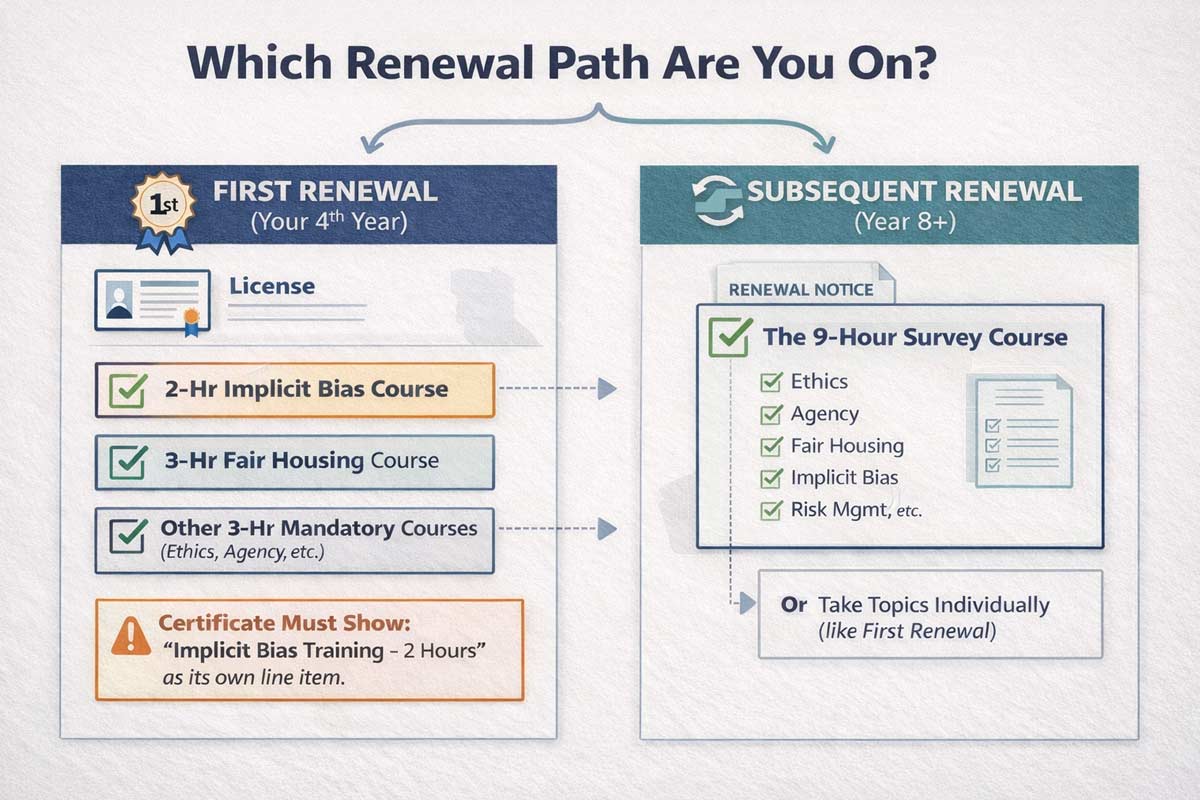
Scenario A: This is Your First Renewal
If you are renewing for the very first time (your 4-year anniversary), you cannot use the "survey course" shortcut. You must take separate courses.
If you are a Salesperson:
Your 45 hours must include:
Four separate 3-hour courses: Ethics, Agency, Trust Fund Handling, Risk Management.
One 3-hour Fair Housing course (with the required interactive component).
One 2-hour Implicit Bias Training course.
At least 18 hours of Consumer Protection, plus remaining hours in Consumer Protection or Consumer Service.
If you are a Broker (or Officer):
The structure is similar, but adds one more mandatory topic:
Five separate 3-hour courses: Ethics, Agency, Trust Fund Handling, Risk Management, Management & Supervision.
One 3-hour Fair Housing course (with the interactive component).
One 2-hour Implicit Bias Training course.
At least 18 hours of Consumer Protection, plus remaining hours in Consumer Protection or Consumer Service.
The Certificate Rule: You need a completion record that clearly shows "Implicit Bias Training – 2 Hours" as its own course line item.
Operator Note: If you want the full breakdown of what counts and how the DRE buckets these hours, read our guide on California Real Estate License Renewal Requirements (2026).
Scenario B: This is a Second (or Later) Renewal
For second and subsequent renewals, you have two compliant paths:
The Survey Option: Take the single 9-hour CE survey course that covers all mandatory topics (including Implicit Bias).
The Individual Option: Take the mandatory topics as individual courses instead of the survey.
Broker licensees will often ask ADHI Schools if brokers have different CE requirements in CA? A key difference is all broker licensees renewing must take a Management and Supervision course, but first time salespersons renewing do not.
Does It Count Toward My 45 Hours?
Yes. Implicit Bias is not "extra" work. It fits inside your existing bucket.
License Renewal Type
Total Hours Required
Does Implicit Bias Count?
First Renewal
45 Hours
Yes (Counts as 2 mandatory hours)
Subsequent Renewal
45 Hours
Yes (Could be taken in a 9-hr Survey course)
Late Renewal
45 Hours
Yes (Same rules apply)
To see exactly how the math works for your specific license type, check our breakdown of how many CE hours are required for CA license renewal?
"Audit-Proofing" Your Renewal
The DRE audits a percentage of renewals every month. If you are pulled for an audit simply follow the requests that the DRE makes and respond in a timely manner.
The Audit Checklist:
Check the Provider: Ensure the course provider is DRE-approved. A "Diversity Training" certificate from your other corporate job does not count. It must have an four-digit DRE Sponsor Number listed on the certificate of completion. Learn exactly what courses count toward CE in California to avoid registering for an invalid course.
Verify the Year: If you took a Fair Housing course in 2021 that didn't have the new interactive component or implicit bias module, it is invalid for a 2026 renewal.
Keep Your Records: Keep your certificates longer than you think. DRE recommends retaining CE completion certificates up to five years in case of audit, and providers are required to maintain participant records for five years.
Common Mistakes That Reject Renewals
We see licensees panic-renew 24 hours before their license expires. That is when mistakes happen.
Mistake #1: The "HR" Course. Submitting a workplace harassment or bias certificate from a non-real estate employer.
Result: Rejected.
Mistake #2: The "Old" Course. DRE rule of thumb: Continuing education credit expires four years from the course completion date, so older certificates can trigger rejection codes during renewal processing.
Mistake #3: Taking Courses From a Provider That is Not Approved. Make sure to ask for the 4 digit sponsor number of any course provider before registering.
Stay Compliant, Stay Active
Implicit Bias training is now a standard part of doing business in California. It isn't just about checking a box; it's about protecting your license and serving a diverse client base professionally.
Don't let a missing 2-hour certificate pause your career. If you are unsure exactly which courses you need based on your license status, check the full roadmap below.
California Real Estate License Renewal Guide →
FAQ
1. Can I take Implicit Bias training online?
Yes. As long as the provider is DRE-approved for correspondence or online study, you can take the course entirely online.
2. Does my Fair Housing course cover Implicit Bias?
No. They are separate requirements. However, if you take the 9-Hour Survey Course (for subsequent renewals), both Fair Housing and Implicit Bias are included in that single 9-hour block.
3. I am over 70 years old. Do I still need this?
If you are eligible for the "70/30" exemption (70+ years old AND 30 years of continuous good standing), you are exempt from all CE, including Implicit Bias. You simply submit the exemption form.
4. What happens if I renew late?
If you renew within your two-year grace period, the requirements are the same: you must complete the 45 hours, including Implicit Bias, before you can reinstate your license and pay the appropriate late fee.
|
The greatest fear for any aspiring agent isn't the difficulty of the exam—it’s the fear of wasting money and months of hard work on coursework the Department of Real Estate (DRE) won't accept.
Read more...
The greatest fear for any aspiring agent isn't the difficulty of the exam—it’s the fear of wasting money and months of hard work on coursework the Department of Real Estate (DRE) won't accept.
In California, if your school isn't properly approved, your application will be rejected, and you’ll be forced to start over from day one. I’m Kartik Subramaniam, and over the last 20+ years, I’ve helped thousands of students navigate these requirements.
This guide provides a simple, 10-minute verification system to ensure you are enrolling in a legit real estate school in California. Before you commit your time and money, you should also consult our guide on the Best Real Estate Schools in California to understand vetted and high-quality options.
The 5 Proofs a Real Estate School Is Legit in California
For California licensing eligibility, the DRE’s course approval is the only thing that matters. Use this framework to verify any provider.
1. A Valid DRE Sponsor ID
Every DRE course provider is assigned a Sponsor ID. While the DRE technically approves individual courses, these IDs are the primary way the Department tracks the entities offering them.
What to look for: A Sponsor ID (often formatted like S#### for statutory/pre-license providers).
The Check: If a school cannot or will not provide this number prominently on their website, pause immediately.
2. Presence in the Right DRE Lookup
Legitimacy isn't a vibe—it's a database entry. However, many students make the mistake of using the “Public License Lookup,” which is for agents and brokers.
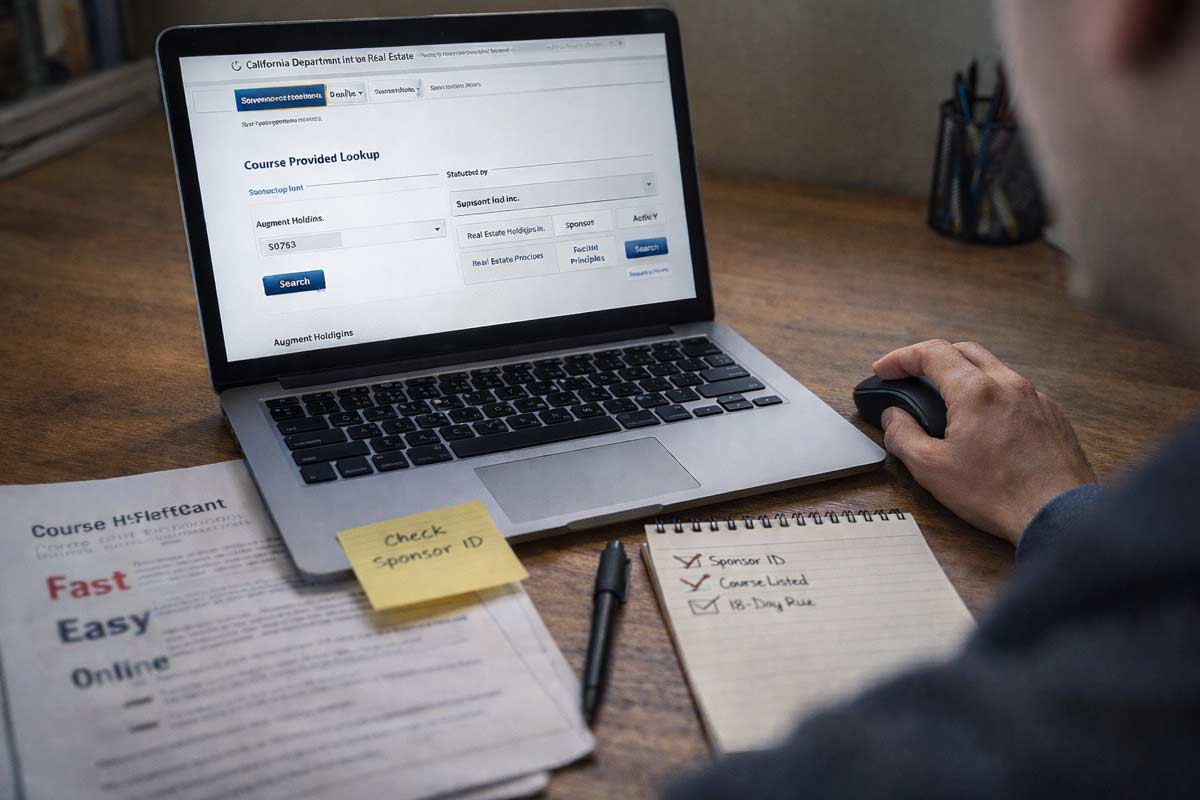
Action: You must use the Statutory Course Provider Lookup to verify a legit real estate school in California.
Deep Dive: For more on how to spot deceptive marketing, read our guide on Avoiding Fake or Unaccredited CA Real Estate Schools.
3. Exact Course Approval
A school might be a valid provider, but that doesn't mean every course they sell is approved for your specific license.
Pre‑licensing: Must be “Statutory” (45‑hour courses).
Renewal: Must be “Continuing Education” (CE).
The Verification: Ensure the specific course title (e.g., Real Estate Principles) is listed under that provider’s Sponsor ID in the DRE database.
4. Adherence to the “18‑Day Rule”
Per DRE regulations, students cannot receive credit for completing a 45‑hour statutory correspondence course in fewer than 18 days per course.
Common Trap: “Get licensed in a weekend” or bundles that allow you to take all three finals in under 54 days (18 days × 3 courses).
The Consequence: Attempting to bypass this timeline is a common reason education gets questioned or rejected by the state.
5. Transparent Policies and Physical Support
A legit real estate school in California should provide a physical office address, a working phone number, and clear refund policies.
Scenario: You sign up through an “education partner” page, but the entity charging your card isn’t the sponsor shown in the DRE database. This is a common sign of a middleman with no actual support.
Step-by-Step: How to Verify (Action Section)
Follow this exact walkthrough to confirm your California real estate pre‑licensing course is approved.
Open the Correct Lookup: Do not use the broker/salesperson lookup. Go to the DRE Statutory Course Provider Search.
Search by Name or ID: Enter the school’s name or their California real estate school Sponsor ID.
Confirm Course Listings: Click on the provider's name. You should see “Real Estate Principles,” “Real Estate Practice,” and your chosen elective listed as active.
Check for Formal Actions: Visit the DRE Formal Actions page to see if the Department has recently filed disciplinary actions against the provider.
Quick Take: The 10‑Minute Legitimacy Check
Find the Sponsor ID (e.g., S####) — ADHI Schools is S0348, as an example.
Search that ID in the DRE Statutory Lookup.
Verify the specific courses are listed under that ID.
Ensure the school’s address and phone number are reachable.
Red Flags: Fast Scan
If you see these, it’s time to pause and investigate further:
Vague "Accredited" labels: While colleges and universities are legitimate, they must still offer courses the DRE accepts for licensing. Be wary of schools claiming generic “accreditation” without a DRE Sponsor ID.
Bundle Confusion: A student buys a “bundle” but receives a generic “certificate of completion” that doesn’t include a DRE course approval number.
For a full list of warning signs, see Red Flags When Choosing a Real Estate School.
If You Already Enrolled in Something Questionable
If you suspect your school isn't legitimate, take these steps:
Verify the Course Number: Ask the school for the specific DRE Sponsor ID.
Cross‑Reference: Check those numbers on the DRE website. If they don't match, your coursework may not count.
Don't Compound the Loss: It is better to cut your losses and switch to a verified provider than to waste another 54 days of study time on certificates the state will reject.
Reviews: Where They Help (and Where They Mislead)
Reviews are excellent for judging the quality of instructors or the ease of a school's online platform. However, a 5‑star rating on Google does not equal DRE approval.
Prioritize DRE verification first, then use reviews to find the best fit for your learning style. To understand the balance, read How Important Are Online Reviews for Real Estate Schools and Why DRE Accreditation Matters More Than Online Reviews.
A legit real estate school in California is one that is transparent with its DRE credentials and respects the state‑mandated learning timelines.
If you want a provider that clearly publishes Sponsor IDs and course listings, verify those details before you enroll. To see how top schools compare across the state, we recommend using the Best Real Estate Schools in California guide as your primary resource.
FAQ
Q: How do I verify a real estate school is DRE approved?
A: Use the DRE Statutory Course Provider Lookup tool. Search by the school’s name or Sponsor ID and confirm that the specific courses you need are listed as active.
Q: What is a DRE Sponsor ID?
A: It is an identification number (often formatted like S####) assigned to schools that offer DRE‑approved courses. It is the most reliable way to verify a provider’s standing with the state.
Q: Will the DRE accept online real estate courses?
A: Yes, as long as the provider is a DRE course provider and the course includes the mandatory 18‑day study period per 45‑hour course.
Q: What happens if my school isn’t approved?
A: The DRE will reject your exam application. You will not receive credit for the time spent, and you will have to retake the courses through an approved provider.
Q: Do real estate course certificates expire in California?
A: Pre‑license course credit generally doesn't have an expiration window like Continuing Education, so older courses can still count toward credit.
Q: What if the provider is legit, but the course isn’t listed?
A: The DRE approves individual courses, not schools. If the specific course name isn’t in the DRE database, that course cannot be used for license eligibility—even if the school itself has other courses approved.
Q: How do I check if a school has had formal action taken against it?
A: You can check the “Formal Actions and Pending Actions” page on the DRE website. This lists providers that have faced disciplinary measures or had their approvals questioned.
|
In California, the Department of Real Estate (DRE) maintains a rigorous standard for what must be taught. Because of this, many students assume that every DRE-approved real estate school is essentially Read more...
In California, the Department of Real Estate (DRE) maintains a rigorous standard for what must be taught. Because of this, many students assume that every DRE-approved real estate school is essentially the same. After all, if they all cover the same 135 hours of mandated material, why does it matter where you go?
The reality is that while the curriculum is standardized, the delivery, support, and outcomes vary wildly. This framework helps you evaluate real estate school quality in California without relying on price or marketing claims. In my two decades of coaching students to pass the California exam and launch their careers, I’ve watched many come to us after a false start elsewhere. They often chose a program based on the lowest price, only to lose months—and momentum—in the process.
In this guide, “quality” means: (1) you finish the coursework, (2) you get real help when stuck, and (3) you’re actually prepared for the state exam.
Course Format — What Actually Matters
The "best" format is the one you will actually finish. Life in California is busy, and a format that worked for your friend might not work for your particular schedule. When evaluating a school, you need to look at how the content is delivered and reinforced.
Choosing Your Delivery Method
Self-Paced Online: Best for the self-motivated student who needs total flexibility.
Livestream or In-Person (Zoom-based): Best for those who need accountability and real-time interaction.
The Operator Criteria Most Schools Dodge
Deadline & Extension Policy: What happens if life hits? Ask what it costs to extend your access if you don't finish in the initial window.
Certificate Speed & Reliability: How fast do certificates generate after you pass a final? If a school takes a week to "process" a digital certificate, you lose a week of your DRE application window.
Mobile Experience: You should be able to study on your phone as easily as a desktop. If the dashboard is clunky on mobile, you won't use it during small pockets of free time.
Kartik’s Insider Tip: Understanding Online vs. In-Person Real Estate Schools in CA: Pros & Cons is the first step in narrowing your search.
Student Support — The Hidden Differentiator
Most students don't think about support until they are stuck on a complex concept or facing a technical glitch. In practice, most preventable delays come from certificate processing issues or unanswered support tickets—not from course difficulty. This is where budget schools usually cut corners.
What "Good" Support Looks Like
Support isn't just a "Contact Us" page; it’s a dedicated system. Look for:
Content Support: Access to instructors who can explain the why behind the question.
Published Response-Time Standard: A professional school should set clear expectations. Ideally, you receive a human response within one business day.
Technical & Admin Help: Assistance with DRE applications is just as important as the coursework.
Real-World Scenario: Imagine you have a tech issue the night before a self-imposed deadline. If the school has no support or escalation path, you lose your momentum.
Before you pay, run the Support Test today. Email a specific question about the California exam. You’ll know who’s real pretty quickly.
Understanding What Matters Most When Choosing a Real Estate School? often comes down to who is there to pick up the phone when you’re confused.
Exam Readiness & Pass Rate Transparency
"99% Pass Rate!" is a common marketing headline, but these numbers are often noise. To find the truth, you must look for exam readiness transparency.
The DRE does not publish a public school-by-school pass-rate leaderboard, so most pass-rate claims you see are self-reported. To verify these claims, ask these questions:
Which exam does this rate refer to? Is it the school final or the actual California State Exam?
What is the time period and sample size?
Is it first-time test takers only?
Are "inactive students" excluded from the denominator?
If they won’t define the metric, treat it as a marketing number.
If a school cannot provide a clear methodology, look at The 10 Biggest Differences Between California Real Estate Schools to see how they stack up in areas like practice exam quality. High-quality practice exams with detailed rationales are a better predictor of your success than a vague marketing percentage.
The Quality Scorecard
If you want a full shortlist approach, start with Best California Real Estate Schools and then apply this rubric to your top choices.
Category
What to Look For
Score (0–2)
Format Fit
Matches your schedule and learning style.
/2
Mobile UX
High-quality interface on all devices.
/2
Support Speed
Human response within 24 business hours.
/2
Assessment Quality
Practice exams mirror state exam difficulty.
/2
Transparency
Clear extension, refund, and pass-rate policies.
/2
Total Score
/10
8–10: High-confidence choice.
6–7: Acceptable, but verify support and practice exam quality before paying.
0–5: High risk; likely to cost you more time and money in the long run.
Before you commit, it helps to know How to Compare California Real Estate Schools (Step-by-Step Guide) so you can compare apples to apples.
FAQ (California‑Specific)
Q: Does DRE approval guarantee quality?
A: No. It only means the school meets the minimum legal requirements. It says nothing about the quality of the teaching or support.
Q: What support do I need if I work full‑time?
A: You need a school with a published response‑time standard—the ability to get a clear, helpful answer waiting for you the next morning.
Q: How long should the courses take realistically?
A: While the legal minimum is 7.5 weeks, most working adults take 10–16 weeks to finish without rushing and truly master the material.
Wrapping it Up
Choosing a school is the first business decision you make as a future agent. Don't base it on the lowest price; base it on the highest probability of success.
12 Questions to Ask Any California Real Estate School
Use this list to separate schools with real systems from schools with good sales pages. Copy and paste these into an email or ask them over the phone:
Can I see a sample lesson and the actual student dashboard today?
What does the mobile experience look like for quizzes and videos?
What’s your average response time for student questions?
Do you offer phone support, or only email/tickets?
What hours is support available (evenings/weekends)?
If my certificate doesn’t generate, what’s the escalation path?
How long do I have to finish each course? What do extensions cost?
What’s your refund policy in plain English?
What practice exams do you provide—and do they include rationales?
Is exam prep included, or sold separately?
When you say “pass rate,” which exam is that—and what’s the methodology?
If I fail the state exam, what’s your remediation or study plan?
|
A DRE-approved real estate school is a California provider authorized to deliver the 135 hours of prelicensing education required for licensure.
If you are researching how to get your real estate license, Read more...
A DRE-approved real estate school is a California provider authorized to deliver the 135 hours of prelicensing education required for licensure.
If you are researching how to get your real estate license, you have likely seen the phrase “DRE-approved real estate school” and a statutory sponsor ID on every website you visit. In California, this isn’t just some kind of badge of honor—it is a legal necessity.
However, there is a common misconception among applicants that "approval" is a seal of excellence or a guarantee of a high pass rate. In my 20+ years of helping students navigate the California Department of Real Estate (DRE) requirements, I have seen many students get a false start at another program based solely on the word "approved," only to realize later that the curriculum was outdated or the support was non-existent and they come to us to actually finish.
This guide clarifies exactly what DRE approval means, what it doesn't mean, and how to verify a provider in minutes so you don't waste time or money.
Quick Take: DRE Approval Basics
The Minimum Standard: Approval means the DRE has verified the school’s curriculum meets the state's 135-hour prelicensing requirement.
The Sponsor ID: Every legitimate provider must have a DRE-issued Sponsor ID number that starts with the letter “S” for pre-license coursework.
Course-Specific: Approval is granted to specific courses, not the school as a whole.
Certificate Validity: Only DRE-approved courses issue completion certificates accepted with a California exam application.
Not an Endorsement: The DRE does not "rank" schools or vouch for the quality of the student experience.
What Does “DRE-Approved” Actually Mean?
In plain English, a California DRE-approved real estate school is a private vocational provider that has submitted its curriculum, policies, and instructors to the Department of Real Estate for review and received authorization to offer statutory courses.
When a school is approved, it means the DRE has determined that their courses satisfy the legal requirements for licensure. This is tied to two things:
The Provider: The entity (the school) is registered with a DRE Sponsor ID.
The Course: Each specific course (Real Estate Principles, Practice, and an elective) has its own individual six-digit approval number.
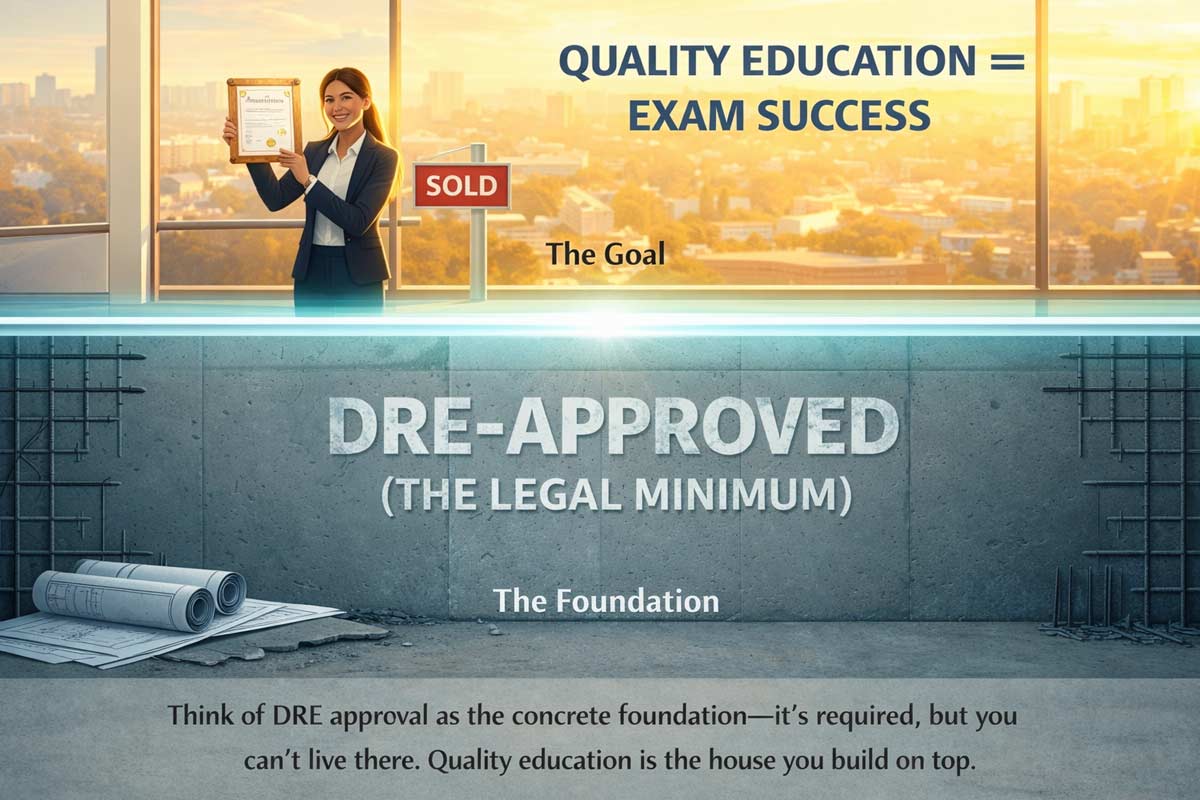
It is important to understand that DRE approval is the "floor," not the "ceiling." It ensures the school follows the law, but it does not measure how well the school actually teaches the material or supports its students.
What the DRE Approval Process Generally Covers
The DRE doesn't just hand out approvals. To become a DRE-approved real estate school, a provider typically must demonstrate compliance in several administrative and academic areas:
Required Curriculum: Courses must cover the specific California-mandated topics. For prelicensing, this is the DRE-approved 135-hour structure (three 45-hour courses).
Administrative Record-Keeping: Schools must have a system to track student registration, completion dates, and exam scores for at least five years.
Course Final Exams: The DRE sets rules on how final exams are proctored and timed.
Instructor Standards: While the DRE sets basic qualifications for who can teach, the role of instructors in CA real estate education varies widely between schools in terms of actual daily availability and engagement.
Takeaway: Approval ensures the "paperwork" of your education is valid so the state will accept your application.
How to Check if a Real Estate School is Truly DRE Approved
Never take a school’s word for it. In my experience, students occasionally run into "national" providers whose courses are not specifically formatted for California's unique legal landscape. Use this DRE course provider verification checklist to protect your investment:
Locate the Sponsor ID: Look for a 4-digit number (e.g., S0XXX) on the school’s website, usually in the footer or on the "About" page.
Search the Official DRE Course Lookup: Use the Department of Real Estate’s statutory course search tool (not a school’s internal list).
Verify the Course Type: Select "Statutory/Pre-License" from the dropdown menu.
Match the Name: Search by the School/Sponsor name. Ensure the results show the specific courses you need (Principles, Practice, and an Elective).
Red Flags: Misleading Language to Watch For
When comparing programs, you may encounter marketing language designed to sound like "approval" without meeting the DRE’s specific criteria:
"Nationally Accredited" with no DRE mention: Accreditation is different from DRE approval. A school can be accredited by a third party but still not be a California real estate prelicensing course DRE-approved provider.
Guarantees without Transparency: Be wary of schools that offer a "money-back guarantee" but hide the requirements in fine print. Before you buy, you should understand what to look for in a CA real estate exam pass guarantee to ensure it actually protects you.
Ambiguous Course Hours: If a school claims you can finish the "135 hours" in three days, they are likely out of compliance. California law requires a minimum time frame (usually 18 days per course) to complete the material.
Approval vs. Quality: The Next Step
Once you have verified that a school is legally approved, your work isn't done. Approval only means the DRE says the school can teach; it doesn't say they should be the ones teaching you.
To find the best real estate schools in California, you need to look past the Sponsor ID and evaluate the actual learning experience.
Feature
DRE Approval (The Minimum)
High-Quality Standards (The Goal)
Curriculum
Covers legal topics
Regularly updated for current state exam trends
Support
Required to have a contact
Live, California-based experts available daily
UX/Tech
Must function
Modern, mobile-friendly, and intuitive
Exam Prep
Not required for approval
Deep banks of practice questions and crash courses
FAQs About DRE-Approved Schools
Q: Is every real estate school in California DRE-approved?
A: No. There are many "educational" sites that offer coaching or "secrets," but unless they have a Sponsor ID and approved statutory courses, they cannot issue the certificates you need to take the state exam.
Q: What does DRE-approved mean for my certificate?
A: It means the certificate of completion you receive will be recognized by the DRE when you submit your Salesperson Exam Application.
Q: Can a school be approved but still provide a bad experience?
A: Absolutely. Many students regret choosing the cheapest “approved” school because the material was a "wall of text" with zero instructor support.
Q: Is a DRE-approved course enough to pass the state exam?
A: Typically, no. Prelicensing courses teach you the law. Passing the exam requires specific "test-taking" logic. This is why many students ask are crash courses worth it in California? to bridge the gap between "learning" and "passing."
Choosing the Right Path
Verifying approval protects your eligibility. Choosing the right school protects your time, confidence, and momentum. Verifying that a program is a DRE-approved real estate school is step one. It protects you from fraud and ensures your hours will count. However, step two is choosing a partner that will actually help you start your career.
If you are ready to move beyond the basics of "approval" and want to find a program that fits your learning style, read our full breakdown on how to choose a real estate school in California.
For a complete look at the top-rated providers in the state, visit our guide on the Best Real Estate Schools in California.
|

If you are currently researching how to get your real estate license, you’ve likely noticed that most programs look similar on the surface. They all offer the required 135 hours of pre-licensing curriculum, Read more...
If you are currently researching how to get your real estate license, you’ve likely noticed that most programs look similar on the surface. They all offer the required 135 hours of pre-licensing curriculum, and they all promise to help you succeed. However, the biggest hidden variable in your success isn't the syllabus—it’s what happens when you get stuck.
In over 20 years of preparing students for the California Department of Real Estate (DRE) exam, I have seen a consistent pattern: students don’t usually fail because the material is "too hard." They fail because they encounter a confusing concept, can’t get a clear answer, and their momentum dies.
As a practicing real estate broker, I regularly see how academic theory meets the high-stakes reality of commercial and residential transactions. That bridge between the textbook and the "street" is built by your instructor.
While a DRE-approved real estate school is the baseline for legal compliance, high-quality instruction is the multiplier that turns "hours completed" into "exam-ready understanding." This guide provides an objective framework to help you evaluate instructor support before you spend a dime on tuition.
What California Real Estate Instructors Actually Do (Beyond "Teaching")
In a self-paced world, some believe an instructor’s only job is to read slides. In reality, an elite instructor functions as a bridge between dense legal text and a passing score. Their role includes:
Clarifying High-Stakes Concepts: Topics like agency relationships and trust fund handling are nuanced. An instructor should provide the "why" behind the law, often using a "Deal Autopsy" approach—breaking down exactly why a specific contract clause exists.
Correcting Misconceptions: It is common for students to "calcify" a wrong idea early. Instructors catch these errors—like the difference between a fixture and personal property—before they lead to missed questions on the state exam.
Teaching Exam Strategy: The DRE writes questions in a specific way. Instructors show you how to identify "distractor" answers and decode the logic of the exam.
Providing Real-World Context: Understanding how a $12 million lease negotiation hinges on a single "Exclusive Use" clause makes the theory of contracts much easier to memorize.
Maintaining Momentum: Knowing you have a lifeline reduces the friction of studying, making it more likely you’ll actually finish the 135-hour requirement.
The 5-Part “Instructor Quality Scorecard”
When you choose a real estate school in California, use this rubric to grade their support model:
Criteria
What to Look For
1. Access Model
Does the school offer live Q&A, scheduled office hours, or direct messaging?
2. Response Time
Will you get an answer within 24–48 business hours, or do questions sit for a week?
3. Explanation Depth
Do they provide a personalized explanation, or just point you to a page number?
4. Exam Alignment
Can the instructor map your confusion to how the topic is framed on the state exam?
5. Consistency
Is help available for all three required courses (Principles, Practices, and Elective)?
Verification Questions to Ask Before You Enroll:
"If I don’t understand the math for a prorated tax question, who can I talk to?"
"Are your instructors active brokers with California-specific experience?"
"Can I see a sample of a recent Q&A session or instructor-led webinar?"
Identifying "Bad Support" Patterns
You should be wary of schools that treat instructional support as an afterthought. Common red flags include:
The Black-Hole Inbox: You email a question and receive no response, or a generic "read chapter 4" reply.
Technical-Only Support: The school is great at fixing login issues but has no one available to explain the "Rule against Perpetuities."
"Forum-Only" Help: You are forced to rely on other students in a forum who may be just as confused as you are.
No Support for Working Adults: If office hours are only held during business hours, they aren't helpful for students with full-time jobs.
Instructor Support vs. Self-Paced Learning
Self-paced models can work for students with a background in law or finance. However, you should prioritize a school with high instructor access if:
This is your first time taking a professional licensing exam.
It has been several years since you were in a traditional classroom setting.
English is your second language (ESL).
How Support Translates to Exam Readiness: Real Scenarios
To illustrate the difference, consider these real-world scenarios handled by instructors:
The "Smart Fridge" Trap: A student is confused about the difference between fixtures and personal property. We share a real-world example where an agent wrote "All appliances included" instead of specifying the brand-new smart fridge, leading to a major dispute at closing. This story makes the "Method of Attachment" test (MARIA) unforgettable for the exam.
The $15,000 Disclosure Error: We often discuss a scenario where a missing disclosure cost an agent $15,000 in a settlement because they lacked broker review. This emphasizes the "Agency" and "Disclosure" sections of the exam, showing students that these aren't just definitions—they are career-saving protocols.
The Complex Lease: When students struggle with contract clauses, we look at how an "Exclusive Use" clause can make or break a commercial deal. Seeing how a high-stakes deal (like securing an art studio for an Academy Award winner) depends on contract clarity helps students master the "Contracts" portion of the pre-licensing curriculum.
The "Crash Course" Factor: While a CA real estate exam pass guarantee sounds nice, the instruction leading up to the test is what sticks. Often, crash courses worth it in California are only effective if you’ve had solid instructor support during your initial 135 hours.
Final Thoughts on School Choice
DRE approval is the legal minimum; instructor access is the variable that determines whether you pass efficiently or get stuck in a cycle of retakes. As you evaluate the Best Real Estate Schools in California, don't just look at the price tag—look at the experience behind the curriculum.
Frequently Asked Questions
Q: Does the California DRE require schools to have instructors?
A: Yes, DRE-approved schools must have designated instructors, but the level of access varies wildly between "budget" schools and "full-service" schools.
Q: Can I talk to an instructor if I’m doing an online-only course?
A: In a quality program, yes. Online courses should still offer "office hours" or a dedicated messaging system where licensed instructors answer questions.
Q: How much does instructor support usually cost?
A: At most reputable schools, it is built into the tuition. Be cautious of schools that charge "per question" or require a secondary subscription for access to live help.
|
The moment you get your DRE exam scheduling confirmation, curiosity can turn into cold, hard panic. You’ve finished your three mandatory 45-hour courses, but as you look at your notes, the vocabulary Read more...
The moment you get your DRE exam scheduling confirmation, curiosity can turn into cold, hard panic. You’ve finished your three mandatory 45-hour courses, but as you look at your notes, the vocabulary feels like a foreign language. You’re wondering if a weekend "crash course" is the magic bullet that will save you from failing the real estate exam.
In the California real estate world, crash courses are everywhere. They promise "insider secrets" and "guaranteed passes," but the reality is more nuanced. If you’re feeling behind, the pressure to buy a quick fix is intense.
This guide is designed to help you cut through the marketing noise. Based on over 20 years of experience helping thousands of students navigate the DRE exam, I’ve seen exactly where these courses succeed and where they fail.
The Quick Take
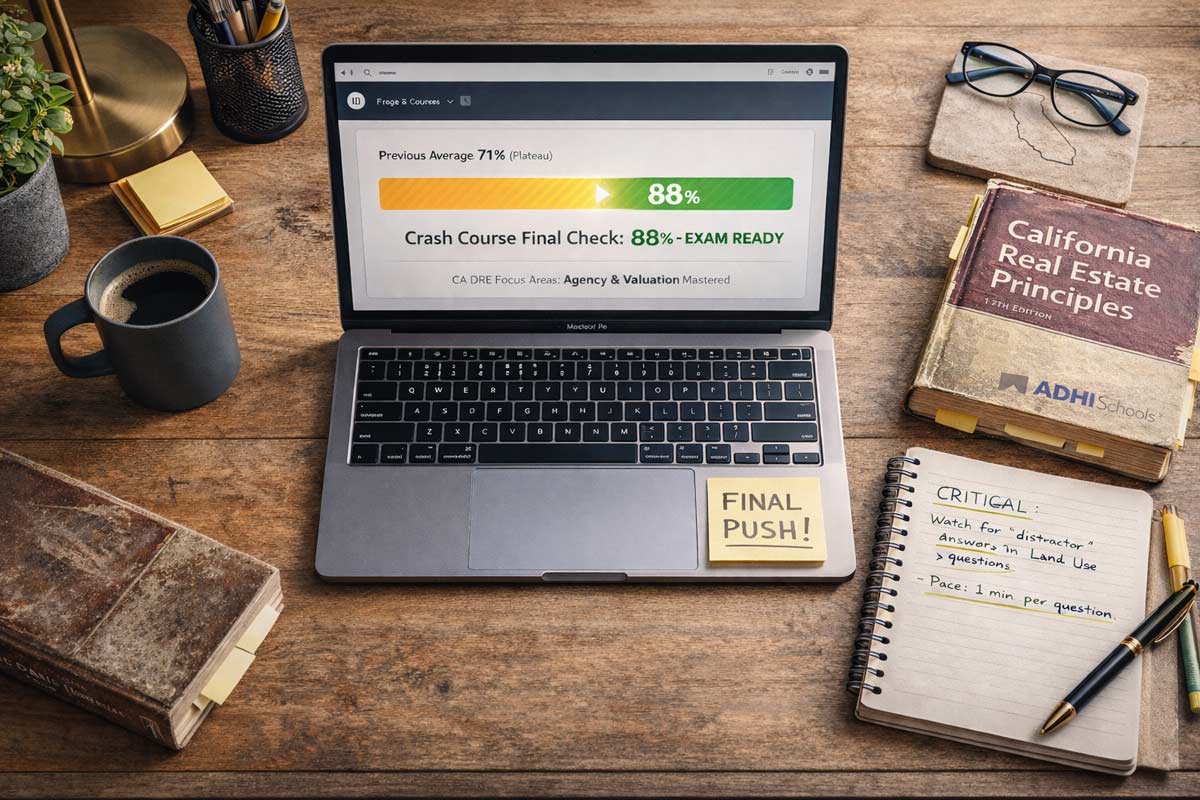
A crash course is a "gap-closer," not a foundation-builder.
It is worth it if you are scoring 65–72% on practice exams and need a strategy boost.
It is less worth it if you haven’t really read the primary material or understand basic concepts like agency and ownership.
Quality matters: Look for California-specific instructors, not generic national providers.
In practice, I see two common patterns:
Scenario #1: You’re stuck at 68–72% because you understand concepts, but you miss points on wording, pacing, and distractor answers. A crash course helps.
Scenario #2: You’re at 55–60% because the fundamentals never “clicked.” A crash course feels productive—but it usually just overwhelms you.
What a “Crash Course” Actually Means in California
In California, a real estate exam prep crash course is an intensive review session typically held over one weekend (two days) or pre-recorded and on-demand.
Unlike your 135 hours of mandatory pre-license education, which are designed to give you a broad understanding of law and practice, a crash course is a tactical strike. It focuses on:
High-frequency topics: The concepts that appear most often on the 150-question exam.
Exam strategy: How to identify "distractor" answers and manage your 3-hour time limit for the sales exam or the 4-hour time limit for the broker test.
Vocabulary translation: Taking complex DRE terminology and making it "sticky" for exam day.
Crucial Distinction: A crash course is not a legal substitute for your mandatory education. It is an optional layer of preparation designed to sharpen your "test-taking" muscles.
When a Crash Course Is Worth It (Decision Triggers)
A crash course can raise your score fast if you already have a foundation. If you don’t, it mostly raises your stress. If you find yourself in the following scenarios, the ROI of a crash course is likely high:
The "Worth It" Checklist
The Plateau: You are consistently scoring between 68% and 72% on practice exams and can't seem to break through to a safe 80%.
Topic Blind Spots: You understand the basics but keep getting tripped up on specific clusters like "Land Use Controls" or "Valuation/Appraisal."
The Time Crunch: Your exam is in 7–10 days and you need a structured environment to force a set number of hours of focused review.
Strategy Deficit: You know the material but "overthink" the questions, often changing right answers to wrong ones.
When a Crash Course is Not Worth It (Red Flags)
There are times when spending money on a crash course is essentially throwing it away. If you fall into these categories, your time and money are better spent elsewhere:
You haven't finished the books: If you haven't read the core principles or practice material, a crash course will feel like a firehose of information you can't retain.
You're scoring below 50%: A crash course cannot teach you three months of material in two days. You need remediation, not a "crash" review.
You expect a "leak": Anyone promising they have the "actual questions" from the DRE is lying. The DRE rotates questions constantly. A good crash course teaches you how to answer, not what to memorize.
It's generic: California is a non-uniform state. Your prep should be California-specific—and your selection framework should match your learning style. Start here: How to Choose a Real Estate School in California.
What a High-Quality CA Crash Course Includes
Not all prep classes are created equal. Use this scorecard to evaluate whether a provider is offering a professional tool or just a "tips and tricks" session.
The Quality Scorecard
Feature
Why It Matters
The Ideal Standard
Instructor Depth
Crash courses move fast. A strong instructor turns confusing DRE language into clear decision rules.
Instructor-led, California-specific teaching. Learn more about The Role of Instructors in CA Real Estate Education.
Diagnostic Feedback
You need to know why you are failing.
The course should offer a pre-assessment to identify your specific weak areas.
Question Database
Practice makes permanent.
Access to at least 1,000+ DRE-style questions with detailed explanations for every answer.
Pacing Strategy
Anxiety often leads to "rushing."
A dedicated module on how to pace yourself through 150 questions without burnout.
Post-Class Support
Questions arise after the class.
Access to the instructor or a support team for follow-up questions until exam day.
The ROI Reality: Cost vs. Time
Many students look at the price of a prep class as an "extra" expense. However, I encourage you to look at the Cost of Failure.
The Retake Delay :If you fail, you must re-apply and wait days or weeks for a new date.
The Opportunity Cost: Every month you aren't licensed is a month you aren't building a pipeline or earning commissions.
The Momentum Killer: Failing the exam once often leads to a "death spiral" of anxiety.
Remember: DRE approval is the legal minimum, not a quality signal. Here’s what it actually means: What Makes a Real Estate School DRE-Approved?
How to Choose Without Getting Played
Before you put down your credit card, ask the provider these concrete evaluation questions:
"Is the material updated for the current DRE year?" Laws change; your prep should too.
"Do you provide explanations for the practice questions?" Memorizing "A, B, C" is useless if the DRE rewords the question.
"What’s included in your exam pass guarantee—and what disqualifies me?" A real guarantee has clear terms and real support (not fine print designed to deny you). Read this before you buy: What to Look for in a CA Real Estate Exam Pass Guarantee.
"Can I talk to the instructor?" You want a teacher, not a proctor.
Recommended Paths: Which One Are You?
Path A: "The Polished Pro"
Profile: Finished coursework, scoring 70%+, feeling "ready but nervous."
Plan: The 7-Day Sprint. Take a crash course the weekend before your exam. Spend the following Monday–Wednesday doing 100 targeted practice questions per day on your weak areas. Take Thursday off to rest your brain. Pass on Friday.
Path B: "The Re-Taker"
Profile: Failed once with a 65–69%.
Plan: Do not just take another crash course. Identify your "weakest area" via your DRE result letter, remediate those chapters first, then use a crash course for final strategy.
Path C: "The Anxious Beginner"
Profile: Finished the certificates but didn't actually read the material. Scoring
|

You’ve seen the ads. You’ve read the promises of "get your license in weeks." But as you sit in front of your laptop, a nagging question remains: “Will online real estate classes actually prepare Read more...
You’ve seen the ads. You’ve read the promises of "get your license in weeks." But as you sit in front of your laptop, a nagging question remains: “Will online real estate classes actually prepare me—or am I just buying a stack of PDFs and some videos?”
It’s a valid fear.
The California Department of Real Estate (DRE) exam is notorious for its difficulty—with pass rates often hovering around 50%—and the real-world business of selling homes is even tougher.
I’ve spent over 20 years helping students navigate the California licensing process. I can tell you this:
Online classes can absolutely prepare you for success, but only if the program provides the right structure and you—the student—bring the right system.
Quick Take: The Reality of Online Prep
The Goal: Most courses focus only on the 135 hours required by the DRE.
The Gap: Finishing the hours is not the same as being "exam-ready."
The Solution: Success requires active recall, practice testing, and a bridge to real-world application.
The Verdict: Online works for self-starters who treat the screen like a classroom.
Defining "Prepared" in Two Separate Lanes
To answer if online real estate courses work, we have to define what you are preparing for. In my experience, there are two distinct lanes of readiness:
Lane 1: Preparing to Pass the CA Exam
This is about academic knowledge. You need to understand agency, disclosure, property ownership, and financing. You must be able to navigate the California-specific phrasing, disclosure logic, and legal nuance (like the 2026 updates to AI-image disclosures) that the DRE exam is known for.
Lane 2: Preparing to Operate as an Agent
This is the "Monday Morning" reality. Can you explain a purchase agreement? Do you know how to handle a difficult client? Many programs don’t fully cover this lane because pre-licensing is built around theory and legal foundations first—so you need a plan to bridge into application.
What Online Real Estate Classes Do Well
Online learning isn't just a "budget" version of a classroom; it has specific advantages that can lead to better retention if used correctly.
Self-Paced Repetition: Unlike a live lecture where the information is gone once the teacher speaks, online modules allow you to rewatch a complex video on "Encumbrances" five times until it clicks.
Consistency and Flexibility: You can study when your brain is sharpest. For some, that’s 5:00 AM; for others, it’s midnight.
Modular Learning: Content is usually broken into "bite-sized" pieces, which is scientifically proven to prevent cognitive overload.
Immediate Feedback Loops: Most online platforms offer instant grading on quizzes, allowing you to see exactly where your logic failed.
What this means for you: If you are a working adult, an online real estate school in California offers the only realistic way to fit 135 hours of education into a busy life.
Where Online Classes Can Fall Short (The Gaps)
Without a physical instructor staring at you, it’s easy to fall into certain traps. If you don't account for these, you'll reach the end of the course and realize you've learned very little.
Passive Consumption: Scrolling through slides while Netflix is playing in the background is not studying. You might "finish" the hours, but you won't retain the law.
The "Stuck" Factor: If you don't have a way to ask questions, a confusing concept can become a permanent mental block.
Motivation Drop-off: The "Middle-of-the-Course Slump" is real. Without a cohort or deadline, many students stop halfway through. To avoid this, you should learn how to stay motivated during real estate school before you start.
Real Scenario: I've seen students who get stuck on one concept (like agency relationships or trust fund handling), keep moving forward anyway, and that gap can snowball.
What a Good Online Real Estate Program Must Include (Non-Negotiables)
Online can absolutely work—but not all online programs are built the same. Here are the features that actually move students from “completed the hours” to “ready for the CA exam and real clients”:
California-style practice questions: Not generic national content that ignores CA-specific laws.
Answer rationales: Explanations that tell you why choices are wrong, not just which one is correct.
Timed exams: Tools that help you build the 3-hour test stamina required by the DRE.
A clear help path: Access to instructor support, office hours, or an escalation path when you hit a wall.
Progress tracking: Analytics that show your weak areas early so you can pivot your study focus.
Active recall systems: Quizzes and checkpoints that force you to remember, not just recognize.
What this means for you: You’re not looking for “more videos.” You’re looking for a program that builds correct thinking under pressure.
The Readiness Test: 7 Signals You’re Actually Prepared
Before you schedule that state exam, use this "scorecard" to evaluate your readiness.
Practice Exam Scores: Consistent 80% or higher on 4+ different full-length exams.
Plain English Test: You can explain Agency, Disclosure, and Contracts without looking at your notes.
Vocabulary Mastery: You know the difference between Grantor and Grantee instantly.
Error Log Review: You have a list of every question you missed and why you missed it.
Logic over Memorization: You can spot "distractor" answers that look right but are legally wrong.
Physical Readiness: You have a plan for the exam-day commute, sleep, and nutrition.
Real Scenario: A student finishes the 135 hours quickly, feels confident, then scores 62–68% on timed practice exams because they never trained recall under pressure. The fix isn’t “more studying”—it’s structured timed sets + error log review.
If you’re wondering how your timeline should look based on these readiness markers, read How Long Should Students Expect Real Estate School to Take?
The Online Student Success System
To make online classes work, you need more than just a login. You need a routine.
The "Frictionless" Setup: Create a dedicated study space. If you have to clear off the kitchen table every time you study, you won't do it. Follow the optimal study setup for real estate school to minimize distractions.
The Active Recall Cycle: Read a section then Close the book then Summarize it out loud then Take the quiz.
The Error Log Method: Never just look at your score. Write down every topic you don’t understand. If you don't understand the explanation, that is the concept you must research until you do.
Spaced Repetition: Don't just study Chapter 10 today. Review the "must-know" facts from Chapters 1–9 for a few minutes first.
The “Online + Real World” Bridge
Passing the exam makes you a "Licensee," but it doesn't make you competent. To bridge that gap while you are still in school, try these Kartik-approved tactics:
Script Roleplay: Take the concepts of "Disclosure" and practice saying them to a spouse or friend. "I have a duty to disclose all material facts that affect the value of this property."
The Contract Deep-Dive: Don't just memorize the names of contracts. Find a sample California Residential Purchase Agreement and read it paragraph by paragraph.
Scenario Thinking: When you learn about "Ethics," ask yourself: "If a seller told me their roof leaked but asked me not to tell the buyer, what exactly would I say?"
Real Scenario: I once met a student who passed the exam with flying colors but told me they froze when a potential client asked about a basic disclosure form. They had the academic knowledge but never practiced the "bridge" to real-world conversation.
Common Myths About Online Prep
"Online is easier." False. It requires more discipline because there is no one to hold your hand.
"Finishing the hours means I'm ready." False. The hours are a legal requirement; the study is a personal requirement.
"More videos = better prep." Not necessarily. You need high-quality content that mimics the California exam's specific logic. Read what students say about online real estate schools (2026) to see which formats actually lead to passes.
FAQs
Are online real estate courses legit in California?
Yes, as long as the provider is approved by the California Department of Real Estate (DRE). Always check the DRE website for a provider's sponsor number before enrolling.
Can I pass the CA real estate exam on the first try with just online classes?
Yes, but you usually need supplemental practice exams and a crash course. The "pre-license" hours teach you the law, but "crash course" style practice exams teach you how to pass the test.
What happens if I fail the online course final?
Most reputable schools allow you to retake the final exam after a short waiting period (mandated by the DRE). It’s a sign you need to go back and review your error log.
Do online real estate classes prepare you for being an agent?
Online classes prepare you for the exam. Becoming an effective agent requires additional application, role-play, and real-world exposure—which is why bridging theory to practice is critical during school.
Is an online course better than an in-person one?
It depends on your learning style. Online is better for flexibility and repetition; in-person is better for networking and immediate Q&A. Many students find a "hybrid" approach is the most effective.
Your Next Step
Online classes can prepare you for a legendary career in California real estate, but they are just one tool in your belt. Success comes down to the quality of the curriculum and the rigor of your study habits.
If you’re still weighing your options and want to see how different programs stack up against these standards, explore our comprehensive guide on the best real estate schools in California to find the right fit for your learning style.
|
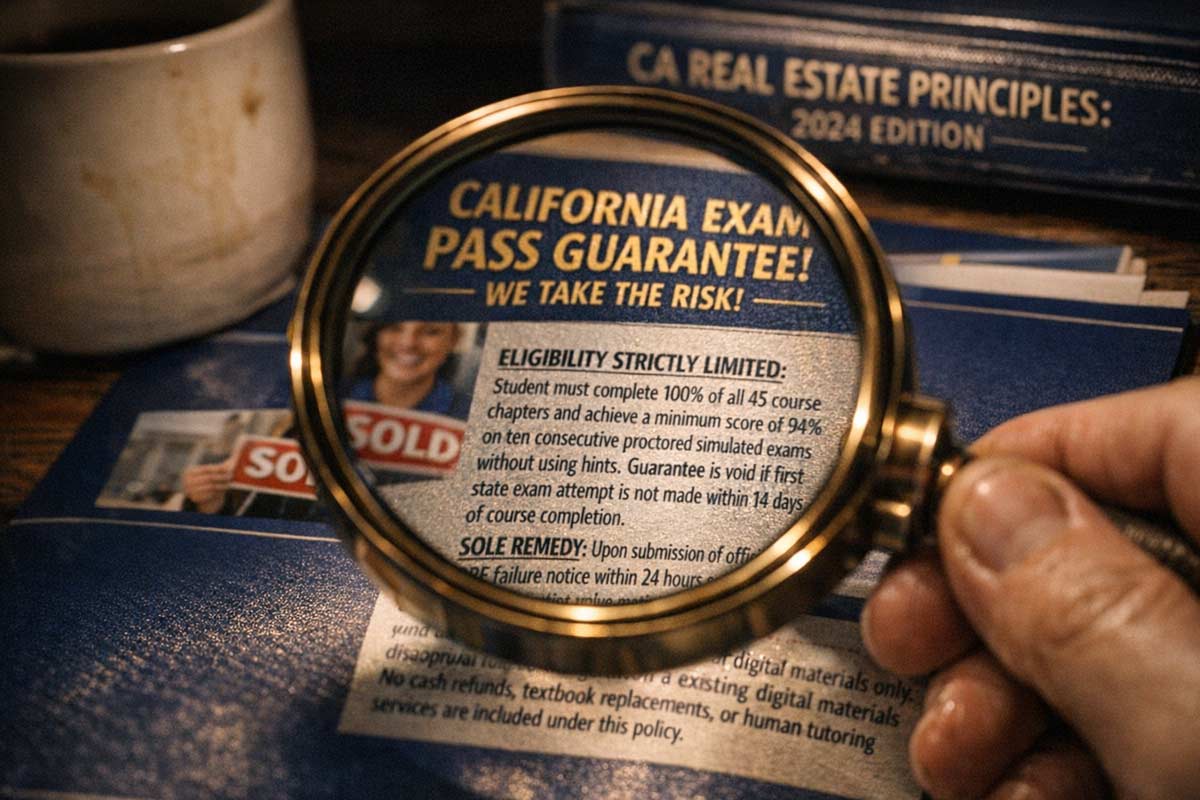
For most aspiring agents, the road to licensure can feel like a high-stakes race. You’ve invested time in your pre-licensing courses, and now the state exam stands between you and your new career. It Read more...
For most aspiring agents, the road to licensure can feel like a high-stakes race. You’ve invested time in your pre-licensing courses, and now the state exam stands between you and your new career. It is natural to feel a sense of anxiety during this phase; most students aren’t looking for "magic" solutions—they are looking for certainty.
This is exactly why some education providers offer a CA real estate exam pass guarantee. At first glance, these claims act as a safety net, promising that if you don't pass, the school will "make it right." However, for the discerning student, it is important to understand that a "guarantee" is often a marketing label rather than a meaningful protection of your time or money.
By understanding the fine print behind these claims, you can avoid the common traps of real estate school marketing. This guide provides an insider’s framework to help you audit these policies so you can choose a program based on actual support rather than just a slogan.
Defining the Two Common "Guarantees"
Before you sign up, you must distinguish between the two primary types of "safety nets" offered by California real estate schools.
1. The Pass Guarantee
This is a claim that the school stands behind its curriculum’s effectiveness. Typically, it suggests that if you fail the state exam, you are entitled to a specific remedy. While the name implies you are "guaranteed" to pass, the reality is that the school is simply defining what happens if you don't. Knowing how to choose a real estate school in California requires looking past the title of the guarantee to the actual remedy provided.
2. The Satisfaction Guarantee
A satisfaction guarantee is usually focused on the initial experience. It typically offers a refund window (e.g., "money back within 48 hours") if you decide the course format or the user interface isn't a good fit for your learning style. These are often heavily restricted once you have accessed a certain percentage of the course material.
Why Many Guarantees Don't Actually Protect Students
It sounds comforting to hear that a school "guarantees" your success, but many of these policies don't reduce the actual risks involved: lost time, weak preparation, and lack of support.
Consider the remedy. In many cases, a real estate school satisfaction guarantee or pass guarantee simply offers "continued access" to the same materials you just used. If the system didn't work for you the first time, simply using it longer may not solve the underlying issue.
Furthermore, many guarantees come with "performance requirements" that are often difficult to meet, such as achieving a 90% or higher on every single practice exam before your state date. If you miss one requirement, the guarantee is void.
The core point is simple: if the remedy is just "keep using the same system," it may not be addressing why you struggled in the first place. You also need to ensure the school is legitimate by understanding what makes a real estate school DRE-approved.
The "Guarantee Audit Checklist": What to Ask
When evaluating a CA real estate exam pass guarantee, use this checklist to peel back the marketing layers:
Eligibility and "Gotchas"
Attendance & Completion: Do you have to complete 100% of the course and every quiz?
Score Requirements: Must you pass a "proctored" final with a specific high score?
Attempt Limits: Does the guarantee only apply to your very first attempt at the state exam?
The Actual Remedy
Refund vs. Extension: Are they giving your money back, or just extending your login for another 30 days?
Coaching: Does the guarantee trigger actual one-on-one help, or just more automated practice questions?
Hidden Fees: Are there "re-enrollment" fees or costs for updated physical textbooks?
Timeline and Documentation
The Time Window: How long is the access, and is it realistic for CA’s current exam scheduling wait times?
Proof of Failure: What documentation (like the DRE fail notice) do they require, and how quickly must you submit it?
What Actually Matters More Than a Guarantee
In my 20+ years of preparing candidates for the California real estate exam, I have seen that "guarantees" rarely correlate with high pass rates. Instead, the most successful students prioritize specific quality signals that actually predict a passing score.
Instructor Availability: Can you actually get help from a human when you are stuck on a concept like "negative amortization"? The role of instructors in CA real estate education cannot be overstated.
Question Bank Realism: Does the exam prep pass guarantee come with a simulator that mirrors the actual DRE interface and phrasing?
Deep Explanations: Quality prep tells you why an answer is wrong, not just which one is right.
Support Response Speed: If you email a question on Wednesday, do you get an answer before your exam on Monday?
Structured Study Plans: A school that provides a clear milestone-based plan is more valuable than one that just offers a "guarantee" without a map.
The "Try Before You Buy" Decision Rule
If a school is confident in their product, they shouldn't need to hide behind a pass guarantee. The best way to judge a school is through a guest pass or a sample lesson.
The Rule: If a school won’t let you preview the learning experience or watch a sample lecture, treat the guarantee as noise. You are better off seeing if the teaching style clicks with you before you commit your time and money. This is especially true when deciding are crash courses worth it in California, as the intensity of those sessions requires a teaching style you can actually follow.
Evaluating Support Windows as Policy
Rather than looking for a "guarantee," look for a school’s "support window." Some programs offer extended access—for instance, providing four months of access to a crash course—specifically because they recognize that the DRE scheduling process can be slow.
View these not as guarantees of a result, but as support structures. A policy that gives you ample time to study, review, and retake practice exams is a practical tool. It acknowledges the reality of the California licensing timeline without making empty marketing promises.
Choosing the Right Path
Choosing a school is the first major business decision you will make in your real estate career. Don't let a "pass guarantee" distract you from checking the essentials: instructor quality, content freshness, and institutional transparency.
If you are ready to compare options objectively, use our comprehensive guide on the Best Real Estate Schools in California to see how different providers stack up beyond the marketing headlines.
FAQ: CA Real Estate Exam Guarantees
What does an exam pass guarantee mean in California?
Typically, it means if you fail the state exam, the school will provide some form of compensation—usually an extension of your course access or, more rarely, a partial refund—provided you met all their study requirements.
Are "Money Back" guarantees real?
They exist, but they are often "Satisfaction Guarantees" that expire a few days after purchase or after you have opened a certain number of course chapters. Always read the refund policy before buying.
What is the best way to ensure I pass the CA exam?
Consistent practice with a modern exam simulator, attending live or recorded instructor-led sessions, and following a structured 60-day study plan are much more effective than relying on a guarantee policy.
|

Every real estate school in California shares one thing: they must be approved by the Department of Real Estate (DRE) and will have a 4-digit sponsor ID number. Because the curriculum is regulated, many Read more...
Every real estate school in California shares one thing: they must be approved by the Department of Real Estate (DRE) and will have a 4-digit sponsor ID number. Because the curriculum is regulated, many students make the mistake of assuming the schools themselves are identical. They treat the pre-license course like a commodity, shopping strictly on price or the "fastest" promise.
However, after 20 years of coaching students through the licensing process, I can tell you that while the certificate at the end looks the same, the experience of getting it varies wildly. The "commodity" is the credit; the differentiator is the path to passing the real estate exam.
How to use this article: Use the TL;DR to shortlist schools, then use the verification questions at the end of each section to confirm reality before you buy.
Key Takeaways
Approval is the floor, not the ceiling: Every school is DRE-approved, but "approval" doesn't guarantee the content is modern or easy to navigate.
Friction kills momentum: Technical glitches and poor support are the leading reasons students drop out before finishing.
The "Final" isn't the end: The school's final exam is a hurdle; the California State Exam is the finish line. Choose a school that builds a bridge between the two.
Quick TL;DR: The 10 Differences at a Glance
/* Mobile-only scroll */
@media (max-width: 768px) {
.responsive-scroll {
overflow-x: auto !important;
-webkit-overflow-scrolling: touch !important;
}
}
Difference
What to Look For (The Check)
Impact
1. Course Format
True self-paced vs. scheduled sessions.
Flexibility vs. Accountability.
2. Tech & UX
Mobile-responsive + progress auto-saves.
Reduces study friction.
3. Student Support
Published hours + phone availability.
Faster resolution of DRE hurdles.
4. Instructor Access
Direct paths to clarify complex concepts.
Better grasp of legal nuances.
5. Exam Prep Tools
Timed simulated exams + "why" explanations.
Higher first-time pass odds.
6. Content Quality
Updated for current California law changes.
Prevents learning "stale" info.
7. Compliance Ease
Automated tracking of mandatory hours and enrolled time.
Prevents DRE rejection of hours.
8. Price Transparency
All-in pricing vs. hidden retake/book fees.
Protects your total budget.
9. Speed to Cert
Streamlined reporting to the DRE.
Gets you to the state exam faster.
10. Career Bridge
Post-course coaching and guidance.
Smooths transition to a brokerage.
1. Course Format & Time Flexibility
What it is: The delivery method—ranging from independent reading to live-streamed webinars.
Why it matters: California’s pre-licensing courses are time-regulated. Most providers enforce a minimum time window per 45-hour course (commonly 18 days), which creates a realistic floor for your timeline. If a school’s format doesn’t match your life, you will fall behind.
How to verify: Check if the "online" component is just a static PDF or an interactive platform.
Verification Question: "If I miss a scheduled session, what is the specific process and cost to make it up?"
2. Technology & User Experience (UX)
What it is: The stability and intuitiveness of the learning management system.
Why it matters: I’ve seen students lose hours of progress because a platform didn't save their quiz scores. If the tech is frustrating, you won't study.
How to verify: Ensure the platform works in modern browsers (Chrome/Safari) and auto-saves progress. Evaluate course format, student support, and pass rates carefully before committing.
Verification Question: "Does your platform allow me to switch between my laptop and my phone without losing my place in the chapter?"
3. Student Support Quality
What it is: The ability to get a human on the phone when you have a DRE paperwork question.
Why it matters: The DRE application process is notoriously bureaucratic. A school with poor support leaves you to figure out background checks and transcripts alone.
How to verify: Call the school before you buy. If you can’t get a human during sales, you likely won't during support.
Verification Question: "What is your average response time for student support emails during business days?"
4. Instructor Access & Clarification Path
What it is: A direct line to an expert who can explain complex fiduciary duties or legal concepts.
Why it matters: Some concepts in California real estate are counter-intuitive. Without an instructor to clarify, you'll end up memorizing answers without understanding them, which leads to surprises on the state exam.
How to verify: Ask specifically who answers content-related questions—a licensed instructor or a general clerk?
Verification Question: "If I don't understand a concept in Chapter 4, is there a licensed instructor I can speak with or email directly?"
5. Exam Readiness Tools
What it is: Tools beyond the basic quizzes, such as simulated state exams and performance analytics.
Why it matters: Passing the state exam is where many candidates get surprised—the questions are scenario-based, time-pressured, and unforgiving if you’re only memorizing. You need tools that target your weak areas.
How to verify: Look for "simulated exams" that mimic the DRE’s phrasing and provide "why" explanations for every answer.
Verification Question: "Does your exam prep software track my 'weak areas' across different categories like Agency or Contracts?"
6. Content Quality & Updates
What it is: Whether the material reflects current California law and disclosure practices.
Why it matters: Real estate law changes. If your school is using a curriculum from several years ago, you're learning outdated information that won't match how questions are framed today.
How to verify: Low price sometimes correlates with older platforms or less frequent updates—verify the revision date before buying.
Verification Question: "What major legislative or forms updates were incorporated into your curriculum in the last 12 months?"
7. Completion Tracking & Compliance Friction
What it is: How the school tracks your mandatory hours and issues the certificate.
Why it matters: If the school’s tracking isn't DRE-compliant, your application could be rejected weeks after you think you’ve finished.
How to verify: Check what matters most when choosing a real estate school regarding their reporting reputation.
Verification Question: "Is my completion certificate issued automatically the moment I complete the course requirements and meet the pacing/time requirements?"
8. Pricing Structure & Hidden Fees
What it is: The "all-in" cost versus the "teaser" price.
Why it matters: These fees don't just raise cost—they slow you down when you’re trying to finish. Some schools lure you with a low price but charge for certificate reprints, final exam retakes, and course extensions.
How to verify: Read the refund and extension policy before clicking "Buy."
Verification Question: "Are there any additional fees for retaking a school final exam or extending my access if I don't finish in six months?"
9. Speed to Certificate
What it is: The actual time it takes from payment to being eligible for the state exam.
Why it matters: Even if you’re highly motivated, there’s a built-in pacing floor for completing three 45-hour courses, so any ‘finish instantly’ marketing should trigger verification.
How to verify: Use a step-by-step guide on how to compare California real estate schools to map out your realistic timeline.
Verification Question: "How long after I pass my third exam will it take for me to receive the transcripts I need for the DRE?"
10. Career Bridge After the Certificate
What it is: What the school does for you once you have your certificate but before you have your license.
Why it matters: The "gap" between finishing the course and taking the state exam can be months. A good school provides resources to keep your knowledge fresh during that wait.
How to verify: Ask if they offer post-completion study groups or crash courses.
Verification Question: "Do I still have access to the practice exams and instructors after I receive my completion certificates?"
Decision Framework: Match the School to the Student
Not every student needs the same features. When researching the Best Real Estate Schools in California, prioritize based on your profile:
The Full-Time Professional: Prioritize Tech & UX and Mobile Flexibility. You need to be able to study during a commute or lunch break without a clunky interface slowing you down.
The Procrastinator: Prioritize Instructor Access and Live Components. You likely need to weigh the Online vs. In-Person Real Estate Schools in CA: Pros & Cons to see if you need the structure of a classroom.
The "Bad" Test Taker: Prioritize Exam Readiness Tools. You need a school that provides detailed explanations for why an answer is wrong, mimicking the state exam's style.
The Fast Tracker: Prioritize Compliance Ease and Support Speed. You want a school that ensures you hit the "pacing floor" accurately so your DRE application isn't delayed.
The Budget-Conscious Strategist: Prioritize Price Transparency. Cheapest isn't actually cheapest if you have to pay $100 for a course extension because life got in the way.
FAQ
Are all DRE-approved schools basically the same?
No. While they teach the same legal requirements, the delivery, technology, and level of student support vary significantly. A school is a service, not just a textbook.
Does online vs. in-person affect passing?
It depends on the student. Online offers convenience, but in-person offers immediate clarification. The best schools often offer a hybrid approach to provide both.
Do pass-rate claims matter?
The DRE does not officially publish pass rates for individual schools. Any school claiming a "99% pass rate" should be viewed with healthy skepticism—ask them how they verify that data.
How long does it take to finish?
Most providers enforce a minimum time window of 18 days per course. For the three required courses, this creates a realistic floor of about 54 days, though most students finish in 3 to 4 months.
What should I compare before buying?
Look at the "hidden" costs (retakes/extensions), the age of the technology, and whether you can actually communicate with a human when you have a question.
Choosing Your Path
Selecting a school is the first professional decision you make in your real estate career. It sets the tone for your licensing journey—either one of constant technical frustration or one of focused, supported growth.
Use Best Real Estate Schools in California to compare these factors side-by-side. Your goal isn't just to get the certificates; it’s to walk into the state exam with the confidence that you actually know the material.
|
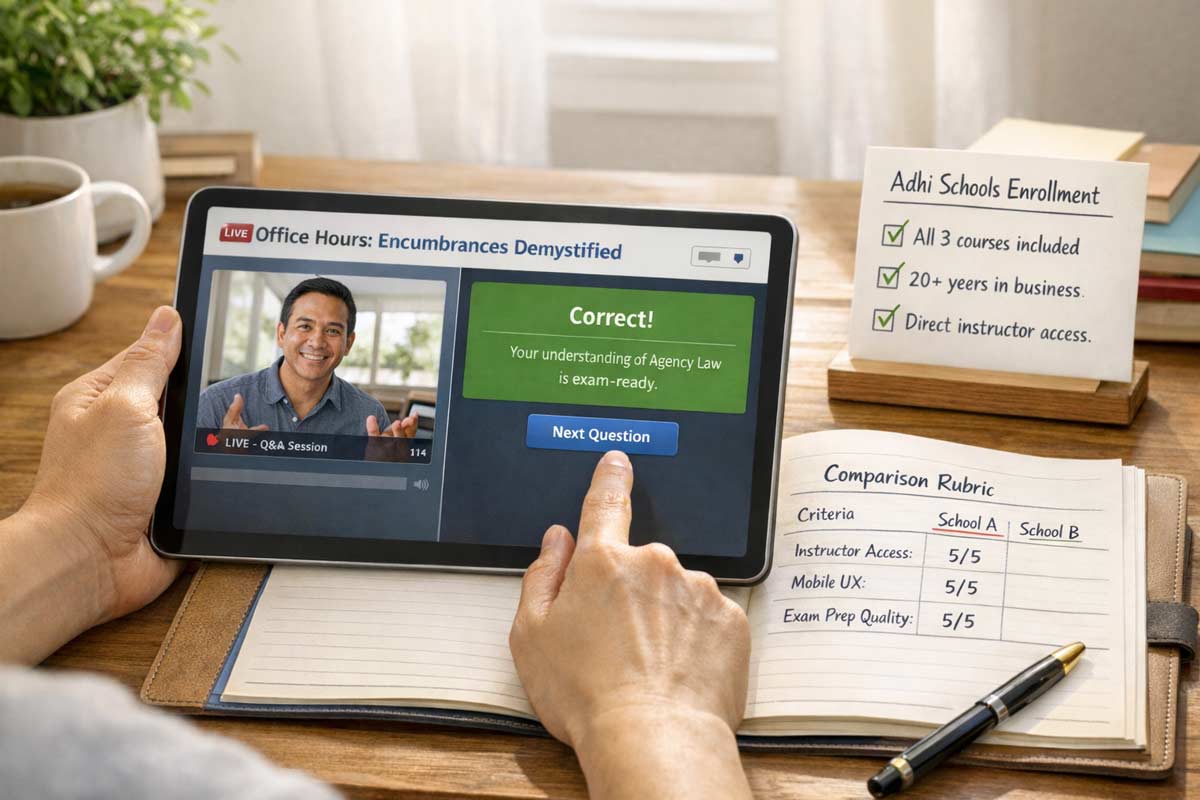
Choosing a real estate school in California often feels like looking at a dozen identical houses. On the surface, every provider promises the same outcome: a certificate that allows you to take the state Read more...
Choosing a real estate school in California often feels like looking at a dozen identical houses. On the surface, every provider promises the same outcome: a certificate that allows you to take the state exam.
However, once you sign up, the differences in technology, support, and actual "readiness" become glaringly apparent. Choosing the wrong provider doesn't just cost you money; it costs you weeks of momentum.
You are in the right place if:
You are confused by "guaranteed pass" claims.
You aren’t sure if a cheap online course is enough to actually pass the state exam.
You need a framework to filter out schools that don't align with your learning style.
This guide provides an operator-level system to compare schools objectively so you can move forward with confidence.
Quick Take:
All California real estate schools teach the same required subjects—but they do not teach them the same way. The difference between passing smoothly and stalling out usually comes down to support, platform quality, and hidden policies—not price.
The 9-Step Comparison Framework
Use these steps to audit any school you are considering. Do not rely on the marketing copy on their homepage; look for these specific indicators of quality.
Step 1: Confirm DRE Approval
Every school must be approved by the Department of Real Estate (DRE). If they aren't, your completion certificates are worthless.
Why it matters: The DRE sets the curriculum. Any DRE-approved real estate course must meet the 135-hour requirement (three 45-hour courses).
How to verify: Don't just look for a logo. Navigate to the official DRE website to search the DRE’s approved provider list.
Step 2: Match the Format to Your Life
Are you a self-starter, or do you need a coach? California allows for purely elective online study, but that doesn't work for everyone
Why it matters: Some students thrive in a self-paced environment, while others need the accountability of a live instructor.
How to verify: Look at the Online vs. In-Person Real Estate Schools in CA: Pros & Cons to see which environment fits your current schedule and focus level.
Step 3: Evaluate Student Support
When you have a question about "joint tenancy", who answers?
Why it matters: Many budget schools provide the materials but zero access to human experts.
How to verify: Email the school a technical question before you buy. If it takes them three days to respond to a sales lead, imagine how long they’ll take to help a student. This is a key factor when you evaluate evaluate real estate school quality in California.
Step 4: Check Course UX and Materials
The platform you use shouldn't be a relic from 2005. It should work on your phone, tablet, and laptop.
Why it matters: If the interface is clunky, you will find excuses to avoid studying.
How to verify: Ask for a demo or a "look inside" video. Check if the quizzes are interactive or just static PDFs.
Step 5: Understand Pass-Rate Claims
Be wary of schools claiming "100% pass rates." The DRE does not officially track or publish pass rates for individual schools in a way that is easily verifiable for marketing.
Why it matters: Statistics can be manipulated (e.g., only counting students who pass a "pre-test" first).
How to verify: Look for transparency. A reputable school will tell you that the state exam is difficult and requires significant effort. When asking what matters most when choosing a real estate school, look for schools that emphasize preparation over "shortcuts."
Step 6: Compare Total Cost
The "sticker price" is rarely the final price.
Why it matters: Some schools charge extra for physical textbooks, retaking final exams, or extending your course access if life gets in the way.
How to verify: Read the "Terms and Conditions" specifically for "re-enrollment fees" or "extension fees."
Step 7: Compare Completion Speed & Flexibility
In California, generally there is a legal minimum time frame of 18 days per course. You cannot finish the entire program in a weekend.
Why it matters: Some schools have rigid schedules; others allow you to pause for months if needed.
How to verify: Check the expiration date of your enrollment. A good California real estate license course should give you at least 6–12 months of access.
Step 8: Verify Reputation Signals
Look past the five-star reviews on the school's own website.
Why it matters: Public platforms (Google, Yelp, Reddit) provide a more honest look at the student experience.
How to verify: Look for patterns. Are people complaining about the tech? The differences between real estate schools in California often come down to how they handle student frustrations.
Step 9: Make the Final Decision
Use the scoring rubric below to weigh your options. Don't choose based on price alone—choose based on the path that ensures you actually get your license.
Comparison Rubric: How to Grade a School
Criteria
Weight
School A
School B
School C
DRE Approval
Essential
Instructor Access
High
Mobile UX
Medium
Total Price (Fees included)
Medium
Reputation/Reviews
High
Exam Prep Quality
High
Real-World Scenarios: Which Profile Are You?
In my 20+ years of coaching California students, I’ve seen that the "best" school is the one that matches your lifestyle.
1. The Full-Time Worker
The Need: Maximum flexibility and mobile access.
The Advice: Look for an online real estate school in California that offers "on-demand" video or high-quality reading material that you can digest in 20-minute windows. Avoid schools with rigid "live session" requirements if your work schedule is unpredictable.
2. The Fast-Tracker
The Need: Efficiency and clear milestones.
The Advice: You need a system that tracks your 18-day windows automatically and alerts you the moment you are eligible to take your next final.
3. The High-Support Learner
The Need: Accountability and the ability to ask "Why?"
The Advice: Don't buy a budget, text-only course. You will likely get stuck on complex topics like "encumbrances" or "agency relationships." Invest in a school that offers live Q&A sessions or direct instructor access.
Common Mistake to Avoid: Buying a course based on a "coupon" only to find out the school charges $50 every time you need to ask a question or $100 to renew after 3 months. Screenshot the "Terms" page before you buy.
The Ultimate Comparison Checklist
Before you enter your credit card info, check these boxes:
Is the school listed on the DRE website?
Does the price include all three required 45-hour courses?
Are the textbooks digital, physical, or both? (Is there an extra fee?)
Is there a dedicated "Exam Prep" component available?
Can I access the materials on my phone without a headache?
What is the "hidden fee" for retaking a final exam if I fail?
How do I contact an instructor if I'm confused?
Red Flags to Watch For:
No physical office or phone number listed.
"Guaranteed" pass rates (nobody can guarantee what you'll do in the state exam room).
Outdated websites that look like they haven't been updated since the 90s.
Lack of clarity on how long you have to finish the course.
Comparing schools shouldn't be a guessing game. By focusing on support, transparency, and format, you move from being a "lead" to being an informed student.
If you want a broader look at the landscape of providers, visit our comprehensive guide on the Best Real Estate Schools in California, where we break down providers using the same criteria above. This comparison framework is just one part of choosing the right path toward your California real estate license.
Frequently Asked Questions
1. Are all California real estate schools the same since the curriculum is the same?
No. While the topics are mandated by the DRE, the delivery (video vs. text), the quality of exam prep, and the level of instructor support vary wildly between providers.
2. How much should I expect to pay for a good school?
In California, prices typically range from $150 to $600. Be cautious of "bottom-dollar" schools; they often make up the difference with hidden fees for books or support.
3. Is an online real estate school in California better than in-person?
It depends on your discipline. Online is more convenient, but in-person (or "live stream") offers better networking and immediate answers to your questions.
4. How do I know if a school’s pass rate is real?
You don't. Since there is no independent, third-party audit of school pass rates required by the DRE, treat extreme claims as a red flag. Look for schools that offer extensive practice exams instead.
5. Can I switch schools if I don't like the one I chose?
Yes, but you usually cannot transfer "partial" credit. If you finished one 45-hour course, you can take the remaining two elsewhere.
6. What happens if my course access expires?
Most schools allow you to pay a "re-enrollment" or "extension" fee. Always check this cost before signing up, as it can be as much as 50% of the original tuition.
|
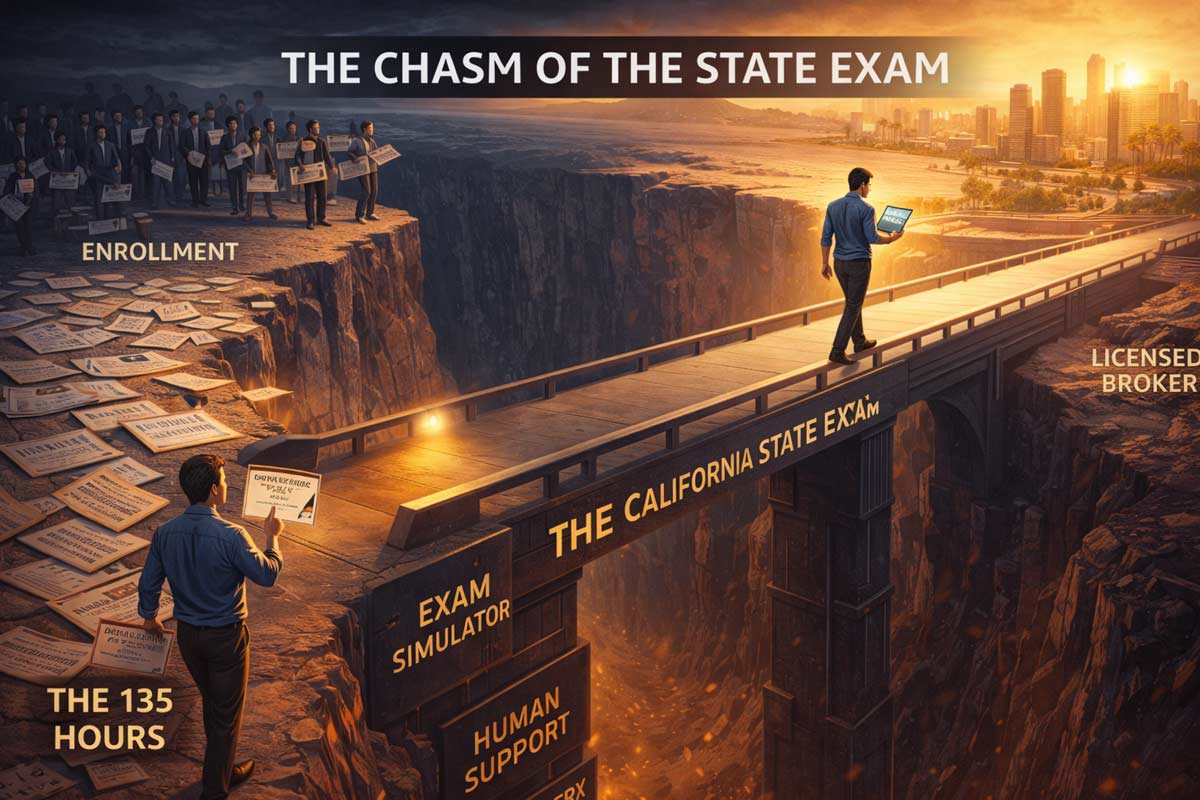
When you decide to get your California real estate license, you are immediately flooded with ads. Some schools scream about being the cheapest; others promise "100% pass rates."
But after 20 years in Read more...
When you decide to get your California real estate license, you are immediately flooded with ads. Some schools scream about being the cheapest; others promise "100% pass rates."
But after 20 years in this industry, I can tell you that most of those metrics are noise. If you choose a school based on the wrong criteria, you might end up with certificates of completion but zero confidence when you sit down for the actual real estate exam.
Here is what actually determines your success.
Quick Take:
Your goal isn't just to "finish the hours"—it's also to pass the state exam on the first try. To do that, you need a school that prioritizes support, exam-readiness, and policy transparency over just being the lowest bidder.
Quality of Student Support (The "Ghosting" Factor)
In California, you have to complete 135 hours of education. At some point, you will get confused by a concept like "negative amortization" or "easements by prescription."
The Problem: Budget schools often automate everything. If you have a question, you might wait 48–72 hours for an emailed response from someone who isn't even an instructor.
What Matters: Can you get in touch with a human? Is there a live Q&A session? Access to experienced instructors is one of the 10 biggest differences between California real estate schools.
Exam Prep vs. Course Completion
Completing the required DRE-approved real estate courses in California is just Step 1. Passing the final for those courses is "open book." The state exam is not.
The Problem: Many schools give you the 135 hours but very little "Crash Course" or "Exam Prep" material.
What Matters: Look for a school that includes a robust state exam simulator. You need to practice with the same wording, timing, and difficulty level you’ll face at the DRE testing center. This is a vital part of how you evaluate course format, student support, and pass rates.
Hidden Costs and Enrollment Length
In California, you cannot legally finish all three courses in less than 54 days. Life often gets in the way of that perfect timeline.
The Problem: Some schools give you only 3 or 6 months of access. If you don't finish, they charge you a "re-enrollment fee" that can cost as much as the original course.
What Matters: Transparency. Look for a one-year enrollment period and clear policies on retaking final exams (it should be free or very low cost).
Platform Usability (The "UX" Factor)
If the website looks like it was built in 1998, your learning experience will likely suffer.
The Problem: Clunky interfaces make it harder to track your progress or study on your mobile device.
What Matters: A modern online real estate school in California should allow you to jump between your phone and laptop seamlessly. If the technology is a hurdle, you won't finish the course.
Decision Checklist: The "Big 5" Questions
Before you enroll, ask these five questions to ensure the school is a fit:
Who is the instructor? (Are they a practicing broker or just a paid actor?)
How long do I have to finish? (Is the timeline 6 months or a full year?)
Does the school offer exam prep? (Passing the state exam is critical.)
How do I get help? (Is there a community or a help desk?)
What is the "Total" price? (Does it include books, shipping, and exam prep.)
The Reality of Pass Rates
Any school can claim a high pass rate. But since the DRE doesn't publish these figures for private schools, you have to look for reputation signals:
Check independent reviews (Google/Yelp).
Ask local brokers which school their most successful new agents attended.
Check if the school offers an "open door" policy to try a class before you buy.
If you are still stuck between two schools, you should learn how to compare California real estate schools using a side-by-side rubric.
The "best" school isn't the one with the biggest discount code. It’s the one that respects your time and provides the tools to ensure you only have to take the state exam once.
For a final ranking of the top options in the state based on these criteria, see our master guide: Best Real Estate Schools in California.
FAQ
What is the most important factor in choosing a real estate school?
Instructor access and the quality of state exam prep software. Passing the 135 hours is easy; passing the state exam is the real hurdle.
Can I switch from an online course to an instructor-led one later?
It depends on the school. Some allow a "hybrid" approach, but it's easier to decide your format upfront. See our guide on Online vs. In-Person Real Estate Schools in CA for more.
Does a more expensive school mean I’m more likely to pass?
Not necessarily, but "too cheap" often can indicate a lack of human support and outdated materials. Aim for the mid-to-high range for the best balance of value and quality.
|

Most students don’t fail the California real estate exam because the material is "too hard." They fail because they pick a learning format that doesn’t match their actual life.
You might be tempted Read more...
Most students don’t fail the California real estate exam because the material is "too hard." They fail because they pick a learning format that doesn’t match their actual life.
You might be tempted to choose the cheapest online real estate school in California versus an instructor-led real estate school closest to your house, but without a framework, you risk losing weeks of momentum to procrastination or burnout.
This guide provides an objective look at the trade-offs between formats, helping you choose the best format for California real estate license course success.
Quick Take:
All California real estate schools teach the same required subjects—but they do not teach them the same way. The difference between passing smoothly and stalling out usually comes down to support, platform quality, and hidden policies—not price. Our full breakdown of providers is covered in the Best Real Estate Schools in California guide.
Quick Answer: Which One Should You Choose?
If you need a fast decision, match your profile below:
Choose Online if: You are a disciplined self-starter with a full-time job, have strong tech comfort, and need to fit studying into "pockets" of time.
Choose Instructor-Led if: You struggle with self-motivation, learn best through discussion, and need a "destination" to focus.
Online is risky when: You have zero student support and a "buy it and forget it" mentality.
In-person is inefficient when: The commute takes longer than the class or the fixed schedule forces you to miss critical business opportunities.
The Deciding Factor: It isn't just about the screen vs. the classroom; it’s about accountability + support + schedule reality.
If you want to go deeper into how support, accountability, and policies impact outcomes, see our breakdown on What Matters Most When Choosing a Real Estate School.
Defining the Formats For This Article
Before comparing, it’s important to understand what these terms actually mean under Department of Real Estate (DRE) regulations:
Self-Paced Online: You log in and read text or watch videos. You move as fast or slow as you want (within the 18-day-per-course legal minimum).
Livestream (The Hybrid): Classes are held over Zoom at specific times. You get the classroom feel without the commute.
Physical Classroom: Traditional in-person instruction at a physical campus.
Regardless of format, ensure you are taking DRE-approved real estate courses in California. The curriculum is standardized, but the experience—and your results—will vary based on the school's platform and instructor quality.
Online Real Estate Schools in California — Pros & Cons
The self-paced online real estate course in California has become the most popular option for a reason: flexibility.
The Pros
Total Flexibility: Study at 2 AM or during your lunch break.
Cost Efficiency: Generally 30–50% cheaper than instructor-led equivalents.
Pacing Control: Breeze through topics you know and spend more time on complex concepts like Trust Fund Handling.
Repeatability: You can re-watch videos or re-read chapters as many times as needed.
The Cons
Procrastination: Without a "teacher" waiting for you, it’s easy to push studying to "tomorrow."
Isolation: You don’t have a cohort of peers to "bump brains" with.
Tech Friction: If the school's platform is outdated, the user experience can be frustrating.
Best for: Erratic schedules, full-time employees, and those with a high degree of self-discipline.
Watch-outs: Look for hidden fees for "extensions" and check the quality of their real estate school student support in California.
In-Person Real Estate Schools in California — Pros & Cons
For some, the "four walls" of a classroom are the only way to ensure the work gets done.
The Pros
Built-in Accountability: If you show up to the building, you’re going to study for those hours.
Real-Time Q&A: You can stop an instructor and ask for a real-world example the moment you’re confused.
Community: You meet people who will eventually be your colleagues and potential referral partners.
The Cons
Rigid Schedule: If you miss a class, you might have to wait weeks for that topic to cycle back.
Time Cost: A two-hour class plus an LA commute can equal four hours of your day.
Lack of Review: Once the lecture is over, you can’t "rewind" a live instructor.
The Decision Framework: Your Scoring Checklist
Be honest—this isn’t about what sounds good, it’s about what you’ll actually do. Rank each category from 0–5 (5 being highest importance).
Category
Score (0–5)
Schedule Control: I need to study at random times.
Self-Discipline: I can sit down and work without being told to.
Need for Live Instruction: I need to ask "Why?" to understand.
Tech Comfort: I am comfortable navigating web platforms.
Timeline Urgency: I need to finish as fast as legally possible.
How to Interpret:
Higher on Schedule/Discipline/Speed: Go Online.
Higher on Live Instruction/Accountability: Go In-Person or Livestream
If you are still torn, you should learn how to compare California real estate schools by looking at the specific student support levels each offers.
Format Myths vs. Reality
Myth 1: "In-person students have higher pass rates."
Reality: Success is tied to study behavior. An online student using a high-quality simulator often outperforms an in-person student who only listens passively. You must evaluate course format, student support, and pass rates as a total package.
Myth 2: "Online is easier."
Reality: The 135-hour curriculum is the same. In many ways, online is harder because it requires more mental stamina to stay engaged with a screen than a human.
Format alone doesn’t explain why students have wildly different experiences. Many of the real differences come down to policies, platforms, and support structures—which we break down in The 10 Biggest Differences Between California Real Estate Schools.
Choose the Format You’ll Actually Finish
The "best" school is the one you will actually finish on time while staying exam-ready. Don't let a $50 price difference or a "prestige" label distract you from your own learning habits.
If you’re ready to see how the top providers in the state stack up, check out our master guide: Best Real Estate Schools in California. This comparison framework is just one part of choosing the right path toward your California real estate license.
FAQ
Is livestream or Zoom real estate school considered online in California?
Yes. Livestream or Zoom-based courses are considered an approved delivery method as long as the provider is DRE-approved and properly tracks completion. These hybrid formats often combine live accountability with the convenience of remote access.
How long does an online California real estate course take compared to in-person?
It usually takes the same total time—but online might feel faster because you control the pace. California has an 18-day minimum per course, so you can’t legally finish instantly. The real difference is efficiency: online lets disciplined students stack study blocks daily and finish near the minimum, while in-person schedules can stretch the timeline if classes meet only certain days or if you miss a session.
What should I look for in student support if I choose an online school?
Look for support that prevents “stall-outs,” not generic customer service.
Specifically:
Fast response times (same-day or next business day)
Clear extension and refund policies (no surprise fees)
Real exam-prep tools (practice exams/simulators + explanations)
Progress tracking + reminders (anything that adds accountability)
If the school can’t clearly explain how they keep students moving, it’s a red flag.
|
You’ve worked hard to build your business, but nothing halts momentum like a DRE deficiency notice—or worse, a license that slips into expired status. I’ve spent over 20 years helping California Read more...
You’ve worked hard to build your business, but nothing halts momentum like a DRE deficiency notice—or worse, a license that slips into expired status. I’ve spent over 20 years helping California agents and brokers at ADHI Schools navigate this process, and I’ve watched too many professionals pay an unnecessary "tax": late fees, avoidable delays, and lost commission because they didn’t budget for time and money.
If you plan ahead, the cost to renew a California real estate license is predictable. If you wait until the last minute, the price goes up—not just in dollars, but in stress.
The Quick Answer: CA Renewal Cost Snapshot
Below are the renewal fees set by the California Department of Real Estate (DRE). These figures reflect the official DRE fee schedule (fees effective July 1, 2024, and current as of March 2026).
License Type
On-Time Renewal Fee
Late Renewal Fee (within 2 years)
Salesperson
$350
$525
Broker
$450
$675
Important: These are DRE filing fees only. Your total cost also includes continuing education (CE), which is provider-dependent. A realistic "total budget" for an on-time renewal is typically:
Salesperson: ~$400–$480 (DRE fee + CE range)
Broker: ~$550–$625 (DRE fee + CE range)
The Fee You Can’t Avoid: DRE Renewal Fees
The DRE renewal fee is non-negotiable. The cleanest way to pay is through the DRE eLicensing system, because it creates a clear electronic transaction record and supports the DRE’s standard online renewal workflow.
The on-time renewal nuance most agents miss
If you renew on time, California Business & Professions Code Section 10156.2 permits you to continue operating under your existing license after its expiration date unless the DRE notifies you of a deficiency. Your renewal is considered "on-time" if your eLicensing transaction is completed—or your mailed application is postmarked—by midnight on your expiration date.
Why the late fee is a trap
Miss the deadline and a Salesperson renewal jumps from $350 to $525—a $175 penalty (a 50% increase). Most importantly, if your license is expired and you haven’t submitted the complete renewal application, you cannot perform any activities requiring a license until your renewal is officially processed.
Plan your submission: Check our guide on How to Submit Your CA License Renewal Application for the smoothest filing flow.
The Second Big Cost: Continuing Education (CE) Tuition
Renewing a real estate license in California requires 45 hours of DRE-approved continuing education. The cost depends on the provider and delivery method.
Typical CE cost range: ~$99–$199.
First renewal vs. Subsequent renewal: First-time renewals require individual courses in specific mandatory topics. For subsequent renewals, licensees whose licenses expire on or after January 1, 2023, have the option to complete a 9-hour CE survey course that covers the seven mandatory subjects.
Provider Tip: Bundled 45-hour packages are almost always the best value. Buying courses "à la carte" often leads to missing a required component and paying twice.
Hidden Costs That Blindside People (The "Late Tax")
Beyond standard fees, these cost multipliers can inflate your real total:
Deficiency delays: Typos or incorrect course numbers trigger DRE follow-up. While there is no "fine," the cost is measured in weeks of business disruption while you wait for manual processing.
Multiple licenses: If you maintain a corporation license or an additional officer license, each carries its own renewal fee under the DRE fee schedule.
Rush premiums: Waiting until the last minute for CE often results in less time to shop around to make sure you are getting the best deal on CE.
To stay organized, use our Checklist for Renewing a California Real Estate License.
3 Budget Scenarios: What Will You Actually Pay?
1) Proactive Salesperson (Clean & On-Time)
DRE fee: $350
CE package: $50–$120
Total: ~$400–$470
3) "Scramble" Renewal (Late Salesperson)
Late DRE fee: $525
Last-minute CE: Cost doesn’t change but you are less likely to cross shop if under time pressure.
Total: ~$625+ (Plus the risk of commission loss during the gap).
How to Avoid Paying More Than You Need To
Finish CE early: Build at least a 30-day buffer for any certificate issues.
Submit early: eLicensing accepts applications up to 90 days before expiration.
Save proof: Save or print the confirmation page as a PDF and screenshot the transaction/confirmation number immediately after paying.
Audit your application: Double-check your 8-digit CE course numbers to avoid the common renewal mistakes agents make.
Frequently Asked Questions
What is the late renewal fee in California for a real estate license?
The late renewal cost is $525 for Salespersons and $675 for Brokers. This applies if you renew within two years after your license expires.
If I renew on time, can I keep working after my expiration date?
In many cases, yes. If your renewal is submitted on time, California law (B&P 10156.2) may allow you to continue operating unless the DRE notifies you of a deficiency and instructs you to stop. That’s why submitting early and saving proof of your transaction is critical.
Is the CE cost included in the DRE fee?
No. The DRE fee covers state processing; CE is paid separately to your chosen education provider.
Can I renew early?
Yes—renewals can be submitted up to 90 days before expiration.
Do brokers pay more than salespersons?
Yes. An on-time Broker renewal is $450, while a Salesperson renewal is $350.
Your Next Steps
Budgeting is just step one. Timing is step two.
First: Read How Long Does It Take to Process a CA Renewal? so you submit early enough to avoid a gap.
Then: Follow the clean filing workflow in How to Submit Your CA License Renewal Application (and save your confirmation as proof).
Finally: Anchor your entire renewal strategy with the full field manual: California Real Estate License Renewal Guide.
|

Imagine this: You’re three days away from taking a career-best listing when your broker calls. Your license has officially expired but you had no idea.
At ADHI Schools, I’ve spent over 20 years Read more...
Imagine this: You’re three days away from taking a career-best listing when your broker calls. Your license has officially expired but you had no idea.
At ADHI Schools, I’ve spent over 20 years helping California agents navigate the DRE rules. I’ve seen hundreds of agents lose momentum because they treated their renewal like a "quick five-minute form." In reality, a single typo or a misunderstood deadline can trigger weeks of DRE renewal delays.
If you want to keep your license active and your commissions flowing, you need to avoid these 10 common California real estate license renewal mistakes.
The 10 Most Common Renewal Mistakes
1. Waiting Until the Final Week To Register For Courses
Why it happens: Agents prioritize lead generation over paperwork, assuming they can cram all the hours into one day.
What it costs: Professional paralysis. If you miss the window, your license is technically "Expired," meaning you cannot legally perform any licensed activity or claim a commission for work done during that gap.
Audit Trigger: Attempting to complete 45 hours of CE within 48 hours of your expiration date.
Hard Control: * The 9-Day Minimum: ADHI Schools requires that you schedule a minimum of 9 calendar days to complete 45 hours of CE.
The 15-Hour Cap: In practice, the DRE only allows credit for 15 hours of courses per 24-hour period. You cannot "speed-run" the 45-hour requirement in a single day.
The 8-Hour Study Lock: The system mandates 8 hours of study time per day before the final exams for those hours are unlocked.
Deadline: Aim to have your CE finished no later than Day 80 of your 90 day renewal window to leave a buffer for DRE processing.
Pro Tip: Before you gamble on a last-minute submission, read: How Long Does It Take to Process a CA Renewal?
2. Assuming CE is "Automatically" Posted
Why it happens: Thinking your education provider notifies the DRE on your behalf - CE providers don’t do this it must be done by the licensee.
What it costs: Your renewal can get delayed or kicked into manual review if your CE completion can't be verified cleanly.
The Fix: Manually verify your certificates and upload the course completion numbers to the DRE through eLicensing. Keep every completion certificate saved and ready for data entry.
3. Data Entry Typos in eLicensing
Why it happens: Rushing through the online portal on a mobile phone or tablet.
What it costs: Mismatched records that require manual DRE intervention, adding weeks to your renewal processing time.
The Fix: Only renew on a desktop with your physical license and CE certificates in front of you.
Pro Tip: Copy and paste your license number and eight digit course approval numbers directly from ADHI’s documents to avoid "fat-finger" errors.
4. Paying the Wrong Fee
Why it happens: Confusing "On-Time" fees with "Late" fees, or Salesperson fees with Broker fees.
What it costs: Underpayment stops the application entirely. Review How Much Does It Cost to Renew a CA Real Estate License? to ensure you are authorized for the correct amount.
The Fix: Double-check your current license status (Salesperson vs. Broker) and the date before submitting payment.
5. Submitting Without Completing All Courses
Why it happens: Agents assume they know the steps and skip a requirement (like the Fair Housing or Implicit Bias modules).
What it costs: An incomplete application triggers a manual review or a request for more information.
The Fix: Use a dedicated Checklist for Renewing a California Real Estate License before hitting "Submit."
6. Failing to Save the "Success" Screen
Why it happens: Thinking the email confirmation is instantaneous (it isn't always).
What it costs: No proof of "good faith" submission if there is a technical glitch.
The Fix: Take a screenshot of the final "Transaction Successful" page and the Transaction ID number immediately.
The "Paper Trail" Box: Save These 3 Things
The Transaction Confirmation: Displayed immediately after payment.
CE Certificates: Keep digital copies of all 45 hours of credit.
PDF Copy of Application: If renewing via mail (though eLicensing is safer).
7. Miscalculating the 2-Year Grace Period
Why it happens: Thinking you can still practice during the 2-year "late renewal" window.
What it costs: You can renew for up to two years after expiration, but you cannot perform licensed activity during that time.
The Fix: If you miss the deadline, stop all licensed activity immediately and file a late renewal application.
8. Using the Wrong Submission Path
Why it happens: Attempting a standard renewal when you are actually in "Reinstatement" territory with regard to fees.
What it costs: This can trigger delays, rework, or additional fees depending on your current status.
The Fix: Follow the correct steps in: How to Submit Your CA License Renewal Application
9. Broker Affiliation Mismatches
Why it happens: Changing brokerages near your renewal date without updating the DRE first.
What it costs: The DRE may flag the renewal if your supervising broker’s information doesn't match their current database records.
The Fix: Ensure your "Main Office Address" and "Responsible Broker" are updated in eLicensing before you start the renewal flow.
10. Ignoring Disclosure Requirements
Why it happens: Failing to disclose new criminal convictions or pending disciplinary actions as required.
What it costs: Serious licensing penalties for non-disclosure.
The Fix: Be transparent. If you have a reportable event, consult with a licensing expert and provide the required documentation upfront to avoid problems.
"If You're Already in Trouble" Triage
If you’ve already made a mistake, follow this decision tree:
"I submitted but it's not moving": Check the DRE’s current processing timeframes online. If they are processing applications from a date after yours, contact the DRE directly.
"My license is close to expiring": Use eLicensing renewal immediately. Do not mail it. eLicensing is typically faster and reduces avoidable delays compared to mail.
"It already expired": Stop all real estate activity. Check if you are within the 2-year window for a late renewal. You will pay a higher fee, but you won't have to retake the exam.
Always call the DRE at 877-373-4542 with questions.
The Clean Renewal Sequence
To avoid the headaches above, follow this 5-step countdown sequence:
Day 90: Confirm your eligibility window and verify your login on eLicensing and sign up for the 45 hour renewal courses.
Day 80: Finish your continuing education and download all certificates.
Day 75: Review the renewal checklist to ensure you meet all current DRE requirements.
Day 70: Submit correctly via eLicensing.
Day 69: Save proof of payment and confirm your status update on the DRE public database.
Ready to Renew?
Don't let a simple clerical error sideline your career. This article is just one part of our complete system to keep your license active. For the full, step-by-step breakdown of every requirement, fee, and deadline, see our: California Real Estate License Renewal Guide.
Pro move: Set 90/80/75/70-day reminders in your calendar using the Clean Renewal Sequence above to ensure you never miss a deadline.
|
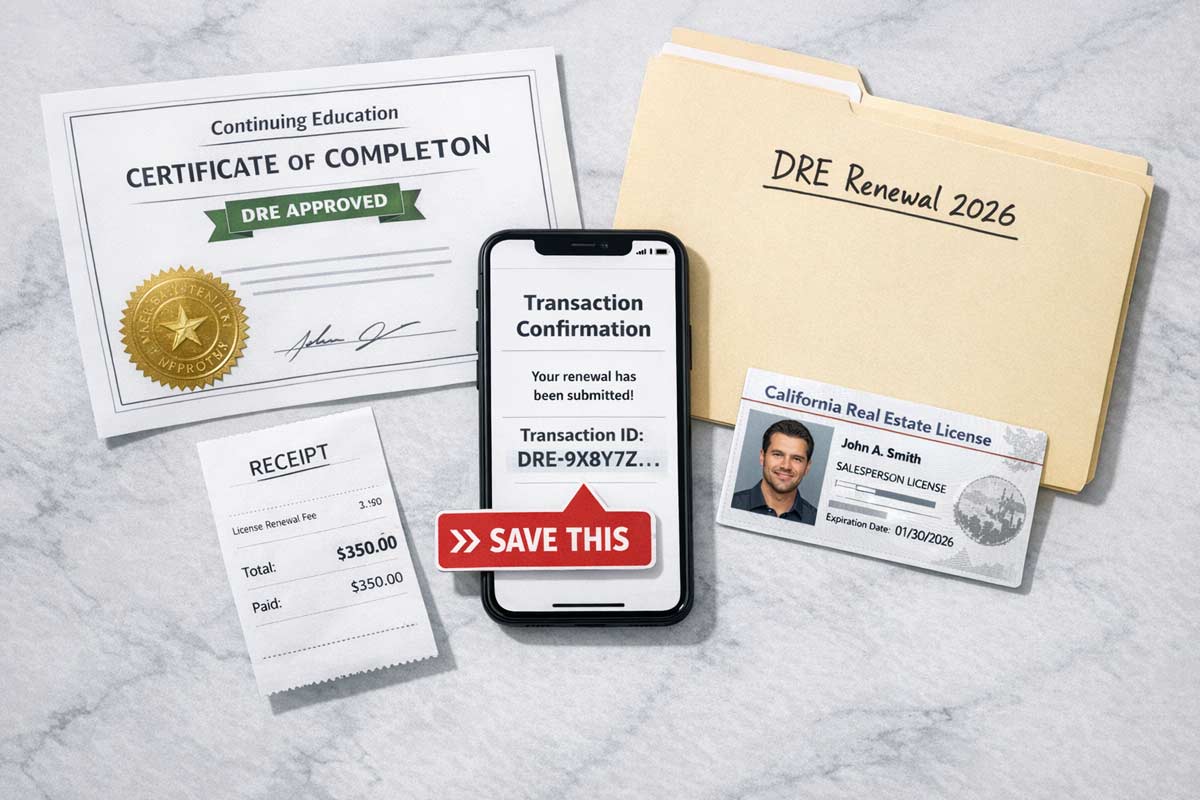
Renewing your California real estate license is a high-stakes administrative task. A single oversight—a mismatched name, an incomplete CE certificate, or a missed deadline—can trigger a deficiency Read more...
Renewing your California real estate license is a high-stakes administrative task. A single oversight—a mismatched name, an incomplete CE certificate, or a missed deadline—can trigger a deficiency notice or halt your ability to work legally. Your goal isn’t just to submit; it’s to achieve a clean, provable, and on-time renewal that avoids manual review and a potential late fee.
This checklist distills decades of experience into a direct, phase-by-step action plan. It is designed to steer you clear of the common data and documentation errors that cause renewal problems, helping to ensure that your submission is seamless from the moment you start your continuing education to the final confirmation.
The 30-Second "If You Do Nothing Else" Checklist
Verify expiration date via the DRE Public License Lookup today.
Finish CE early (target at least 15–30 days before your deadline).
Confirm CE requirements for your specific cycle (First-time vs. Subsequent).
Submit via eLicensing (renewals open 90 days before expiration).
Save proof immediately: Transaction ID + confirmation page PDF + timestamped screenshot.
The Phased Renewal Checklist
Phase 1: Prep (90–60 Days Out)
Audit Your DRE Profile
Why it matters: Your name should match across elicensing and CE records closely enough to avoid a manual review (same first/last; consistent format).
Common mistake: An old mailing address means you’ll miss critical DRE deficiency notices in the event you get mailed a letter.
Proof to save: Screenshot of your current “Licensee Information” page.
Verify CE Mix & Exemptions
Why it matters: Ensure your CE includes the required topic mix for your renewal cycle (mandated topics include agency, ethics, fair housing, implicit bias and others). Some licensees may qualify for a 70/30 exemption (age 70+ and 30 years in good standing) if applicable to you.
Common mistake: Taking a package that misses required topic coverage for your cycle.
Phase 2: Execution (60–30 Days Out)
Complete DRE-Approved CE
Why it matters: Only courses with valid DRE approval/provider info count. Finishing early gives you a buffer for provider or portal issues.
Common mistake: Assuming a course is DRE-approved without verifying the current approval status and provider number at the time of your completion.
What to check: Before you enroll or start a course, verify it is currently approved using the DRE’s Approved Courses Lookup.
Budget for Fees
Why it matters: Know your on-time vs late fee and keep your payment method ready.
(On-time renewal fees: $350 salesperson / $450 broker; late renewal within 2 years: $525 salesperson / $675 broker.)
Common mistake: Using a debit/credit card that is near its limit, has expired, or has new billing information the bank’s fraud filter flags, causing the transaction to fail.
How to fix: 2-3 days before submitting: confirm it’s not expired, has sufficient available credit, and its billing address matches your bank’s record.
Phase 3: Submission (30–10 Days Out)
Enter CE Details in eLicensing
Why it matters: Accurate entry of CE details prevents delays. Use the DRE-approved course/provider 8-digit identifiers exactly as shown on your certificate—don’t guess, don’t retype from memory if you can copy/paste.
Common mistake: Inverting digits in course approval numbers.
Proof to save: Screenshot of the “Review Information” page before you click submit.
Refer to: How to Submit Your CA License Renewal Application
Capture Submission Proof
Why it matters: I’ve seen agents see a “spinning wheel” and close the tab. Without a Transaction ID, you have no proof of filing if the system crashes.
Common mistake: Closing the browser before the “Success” page loads.
Proof to save (all three): Transaction ID, PDF of the confirmation page, and the confirmation email.
🚩 RED FLAG: PAUSE SUBMISSION IF...
You have new criminal charges or convictions since your last renewal (may require disclosure/review).
Your CE certificates haven’t been issued yet.
Submitting with these issues often triggers a deficiency notice. Review Common Renewal Mistakes Agents Make before you hit submit.
Phase 4: Monitoring & Escalation
Verify Status & Track Timeframes
Why it matters: Check the Public License Lookup after 24–48 hours to confirm the record is moving the right direction. These time frames are important so you are aware how long it takes to process a California real estate license renewal.
Escalation Protocol: If it doesn’t update, compare against published DRE renewal processing timeframes; if you’re beyond published dates, contact the DRE with your Transaction ID ready.
Proof to save: PDF printout/screenshot of your updated license record once it updates.
Handle Deficiency Notices (Don’t Panic-Resubmit)
Why it matters: When you get a deficiency notice, sloppy “resubmits” can create duplicate transactions and confusion.
Do this instead:
Match the deficiency line-item to your proof (certificates, receipt, Transaction ID).
Respond using the method the notice specifies.
Save a copy of everything you send + the date sent.
STEP 1 — VERIFY
Confirm your facts before you do anything else
Check license expiration date
Confirm renewal window is open (90 days before expiration)
Verify name + address match across DRE & CE records
Goal: No profile mismatches → no manual review
STEP 2 — COMPLETE
Finish the right CE, early
Complete DRE-approved CE for your renewal cycle
Confirm required topics are included (Agency, Ethics, Fair Housing, Implicit Bias, etc.)
Download final CE certificates (with provider + course numbers)
Goal: CE finished 15–30 days early
STEP 3 — SUBMIT
Enter data once, carefully
Enter CE details into eLicensing (copy/paste — don’t retype)
Submit renewal application + fee
Wait for the success confirmation screen
Goal: One clean submission, no errors
STEP 4 — PROVE
Lock in your paper trail immediately
Save Transaction ID
Download confirmation PDF
Take a timestamped screenshot of success page
Save confirmation email
Goal: You can prove on-time filing instantly
(Optional but Recommended)
STEP 5 — MONITOR
Verify it actually moved
Check license status after 24–48 hours
Save screenshot once status updates
Respond carefully if a deficiency notice appears
Goal: Catch problems early, avoid downtime
FAQ
How early can I renew?
You can renew via eLicensing starting 90 days before your expiration date.
Can I practice while my renewal is “Pending”?
If you renew on time, California law may allow continued operations after expiration unless the DRE notifies you of a deficiency. Practically: confirm your transaction is complete, watch for deficiency notices, and follow your broker’s compliance policy.
What if I miss the deadline?
Your license becomes expired and you cannot practice while expired. California generally allows late renewal for up to two years after expiration, but you’ll pay the late renewal fee (e.g., $525 vs $350 for salesperson; $675 vs $450 for broker).
Does my broker get notified?
Often, brokers monitor status through internal systems—but don’t rely on it. You are responsible for your own status.
This checklist ensures you don’t miss a step. For the full deep dive on requirements, fee schedules, and legal updates, visit our California Real Estate License Renewal Guide.
|