AdhiSchools Blog

Are Crash Courses Worth It in California? (CA Real Estate Exam Prep)

Crashcourses are they worth it2

Reading Time :  5 minutes

The moment you get your DRE exam scheduling confirmation, curiosity can turn into cold, hard panic. You’ve finished your three mandatory 45-hour courses, but as you look at your notes, the vocabulary feels like a foreign language. You’re wondering if a weekend "crash course" is the magic bullet that will save you from failing the real estate exam.

In the California real estate world, crash courses are everywhere. They promise "insider secrets" and "guaranteed passes," but the reality is more nuanced. If you’re feeling behind, the pressure to buy a quick fix is intense.

This guide is designed to help you cut through the marketing noise. Based on over 20 years of experience helping thousands of students navigate the DRE exam, I’ve seen exactly where these courses succeed and where they fail.

The Quick Take

  • A crash course is a "gap-closer," not a foundation-builder.
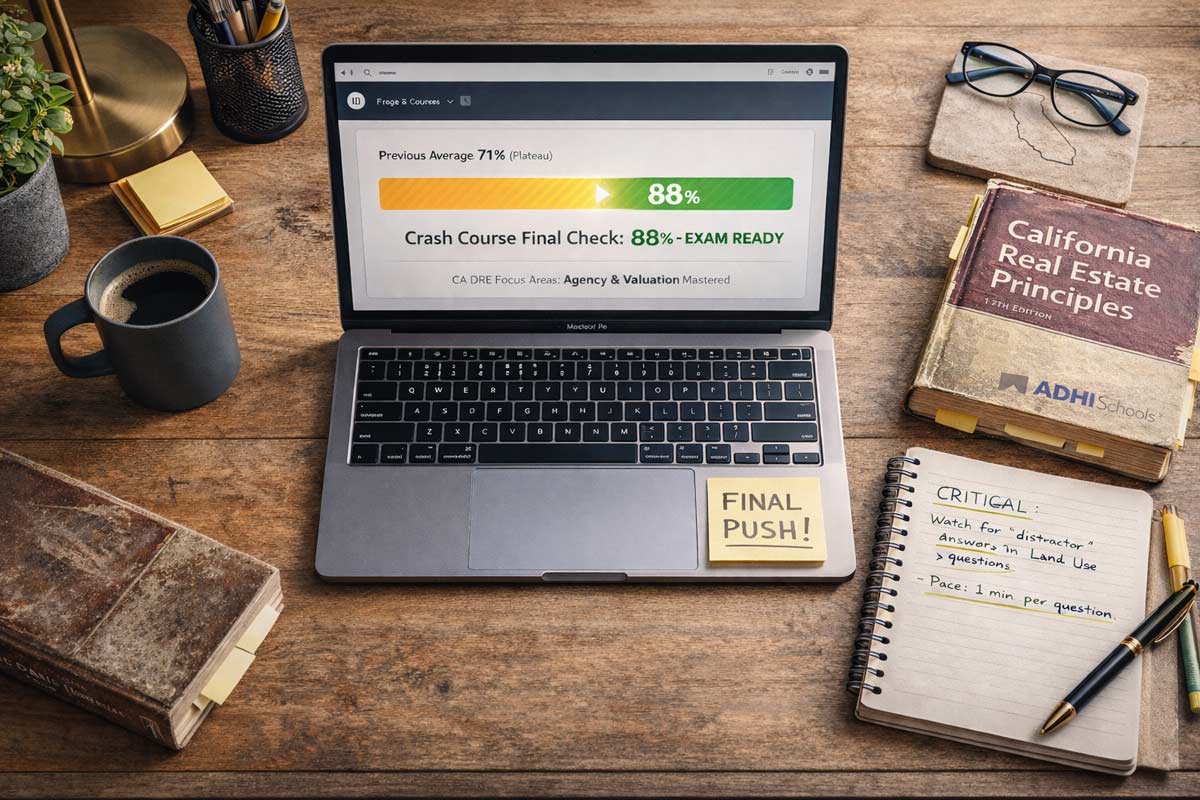
  • It is worth it if you are scoring 65–72% on practice exams and need a strategy boost.
  • It is less worth it if you haven’t really read the primary material or understand basic concepts like agency and ownership.
  • Quality matters: Look for California-specific instructors, not generic national providers.

In practice, I see two common patterns:

  • Scenario #1: You’re stuck at 68–72% because you understand concepts, but you miss points on wording, pacing, and distractor answers. A crash course helps.
  • Scenario #2: You’re at 55–60% because the fundamentals never “clicked.” A crash course feels productive—but it usually just overwhelms you.

What a “Crash Course” Actually Means in California

In California, a real estate exam prep crash course is an intensive review session typically held over one weekend (two days) or pre-recorded and on-demand.

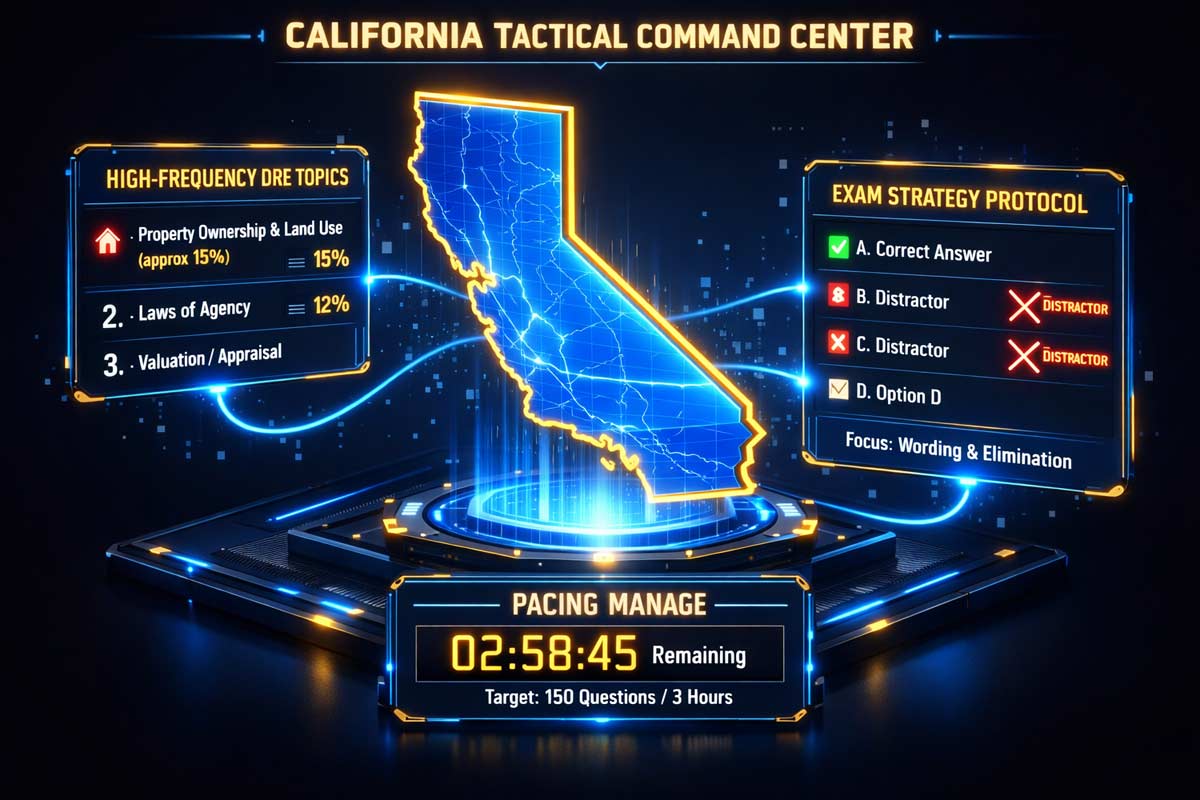
Unlike your 135 hours of mandatory pre-license education, which are designed to give you a broad understanding of law and practice, a crash course is a tactical strike. It focuses on:

  • High-frequency topics: The concepts that appear most often on the 150-question exam.
  • Exam strategy: How to identify "distractor" answers and manage your 3-hour time limit for the sales exam or the 4-hour time limit for the broker test.
  • Vocabulary translation: Taking complex DRE terminology and making it "sticky" for exam day.

Crucial Distinction: A crash course is not a legal substitute for your mandatory education. It is an optional layer of preparation designed to sharpen your "test-taking" muscles.

When a Crash Course Is Worth It (Decision Triggers)

A crash course can raise your score fast if you already have a foundation. If you don’t, it mostly raises your stress. If you find yourself in the following scenarios, the ROI of a crash course is likely high:

The "Worth It" Checklist

  • The Plateau: You are consistently scoring between 68% and 72% on practice exams and can't seem to break through to a safe 80%.
  • Topic Blind Spots: You understand the basics but keep getting tripped up on specific clusters like "Land Use Controls" or "Valuation/Appraisal."
  • The Time Crunch: Your exam is in 7–10 days and you need a structured environment to force a set number of hours of focused review.
  • Strategy Deficit: You know the material but "overthink" the questions, often changing right answers to wrong ones.

When a Crash Course is Not Worth It (Red Flags)

There are times when spending money on a crash course is essentially throwing it away. If you fall into these categories, your time and money are better spent elsewhere:

  • You haven't finished the books: If you haven't read the core principles or practice material, a crash course will feel like a firehose of information you can't retain.
  • You're scoring below 50%: A crash course cannot teach you three months of material in two days. You need remediation, not a "crash" review.
  • You expect a "leak": Anyone promising they have the "actual questions" from the DRE is lying. The DRE rotates questions constantly. A good crash course teaches you how to answer, not what to memorize.
  • It's generic: California is a non-uniform state. Your prep should be California-specific—and your selection framework should match your learning style. Start here: How to Choose a Real Estate School in California.

What a High-Quality CA Crash Course Includes

Not all prep classes are created equal. Use this scorecard to evaluate whether a provider is offering a professional tool or just a "tips and tricks" session.

The Quality Scorecard

Feature Why It Matters The Ideal Standard
Instructor Depth Crash courses move fast. A strong instructor turns confusing DRE language into clear decision rules. Instructor-led, California-specific teaching. Learn more about The Role of Instructors in CA Real Estate Education.
Diagnostic Feedback You need to know why you are failing. The course should offer a pre-assessment to identify your specific weak areas.
Question Database Practice makes permanent. Access to at least 1,000+ DRE-style questions with detailed explanations for every answer.
Pacing Strategy Anxiety often leads to "rushing." A dedicated module on how to pace yourself through 150 questions without burnout.
Post-Class Support Questions arise after the class. Access to the instructor or a support team for follow-up questions until exam day.

The ROI Reality: Cost vs. Time

Many students look at the price of a prep class as an "extra" expense. However, I encourage you to look at the Cost of Failure.

  1. The Retake Delay :If you fail, you must re-apply and wait days or weeks for a new date.
  2. The Opportunity Cost: Every month you aren't licensed is a month you aren't building a pipeline or earning commissions.
  3. The Momentum Killer: Failing the exam once often leads to a "death spiral" of anxiety.

Remember: DRE approval is the legal minimum, not a quality signal. Here’s what it actually means: What Makes a Real Estate School DRE-Approved?

crash_courses_are_they_worth_it_1

How to Choose Without Getting Played

Before you put down your credit card, ask the provider these concrete evaluation questions:

  • "Is the material updated for the current DRE year?" Laws change; your prep should too.
  • "Do you provide explanations for the practice questions?" Memorizing "A, B, C" is useless if the DRE rewords the question.
  • "What’s included in your exam pass guarantee—and what disqualifies me?" A real guarantee has clear terms and real support (not fine print designed to deny you). Read this before you buy: What to Look for in a CA Real Estate Exam Pass Guarantee.
  • "Can I talk to the instructor?" You want a teacher, not a proctor.

Recommended Paths: Which One Are You?

Path A: "The Polished Pro"

  • Profile: Finished coursework, scoring 70%+, feeling "ready but nervous."
  • Plan: The 7-Day Sprint. Take a crash course the weekend before your exam. Spend the following Monday–Wednesday doing 100 targeted practice questions per day on your weak areas. Take Thursday off to rest your brain. Pass on Friday.

Path B: "The Re-Taker"

  • Profile: Failed once with a 65–69%.
  • Plan: Do not just take another crash course. Identify your "weakest area" via your DRE result letter, remediate those chapters first, then use a crash course for final strategy.

Path C: "The Anxious Beginner"

  • Profile: Finished the certificates but didn't actually read the material. Scoring <60%.
  • Plan: Skip the crash course for now. Invest in a comprehensive "Mastery" program or re-read your principles textbook. A crash course will only overwhelm you further.

Finding Your Support System

Choosing the right exam prep is a major part of how you choose a real estate school in California. A crash course shouldn't be a desperate "Hail Mary" pass—it should be the final, confident step in a well-built education plan.

If you are looking for the broader framework of how to evaluate schools and preparation ecosystems, visit our comprehensive guide on the Best Real Estate Schools in California.

Common FAQ

Q: Should I take a crash course before I’ve taken a full practice exam?

A: No. You need a baseline first. Take at least one full, timed practice exam to identify your current score and "struggle areas" so you know what to focus on during the crash course.

Q: Can I pass the CA exam using only a crash course?

A: Legally, no. You must complete 135 hours of approved education. Practically, it’s highly unlikely. The exam covers too much ground for a 16-hour review to suffice without prior study.

Q: When should I take the crash course?

A: Ideally, as close to your exam date as possible—usually the weekend immediately preceding your test.

Remember

  1. A California real estate crash course is a tactical review of high-frequency exam topics, not a replacement for fundamental learning.
  2. The best time to take a crash course is when you are scoring near-passing marks (68–72%) and need an exam-day strategy boost.
  3. Avoid "National" prep courses; California is a non-uniform state that requires specific instruction on DRE-style questions and state-specific laws.
  4. The real ROI of a crash course is the prevention of the "cost of delay"—the lost commissions and time caused by failing and waiting months for a retake.
  5. A high-quality prep course must include diagnostic feedback that tells you exactly which of the seven DRE categories you need to study further.

Kartik Subramaniam

Founder, Adhi Schools

Kartik Subramaniam is the Founder and CEO of ADHI Real Estate Schools, a leader in real estate education throughout California. Holding a degree from Cal Poly University, Subramaniam brings a wealth of experience in real estate sales, property management, and investment transactions. He is the author of nine books on real estate and countless real estate articles. With a track record of successfully completing hundreds of real estate transactions, he has equipped countless professionals to thrive in the industry.

Enjoy what you read?

Sign up for our newsletter and get weekly updates on our latest articles