You’ve seen the ads. You’ve read the promises of "get your license in weeks." But as you sit in front of your laptop, a nagging question remains: “Will online real estate classes actually prepare Read more...
You’ve seen the ads. You’ve read the promises of "get your license in weeks." But as you sit in front of your laptop, a nagging question remains: “Will online real estate classes actually prepare me—or am I just buying a stack of PDFs and some videos?”
It’s a valid fear.
The California Department of Real Estate (DRE) exam is notorious for its difficulty—with pass rates often hovering around 50%—and the real-world business of selling homes is even tougher.
I’ve spent over 20 years helping students navigate the California licensing process. I can tell you this:
Online classes can absolutely prepare you for success, but only if the program provides the right structure and you—the student—bring the right system.
Quick Take: The Reality of Online Prep
The Goal: Most courses focus only on the 135 hours required by the DRE.
The Gap: Finishing the hours is not the same as being "exam-ready."
The Solution: Success requires active recall, practice testing, and a bridge to real-world application.
The Verdict: Online works for self-starters who treat the screen like a classroom.
Defining "Prepared" in Two Separate Lanes
To answer if online real estate courses work, we have to define what you are preparing for. In my experience, there are two distinct lanes of readiness:
Lane 1: Preparing to Pass the CA Exam
This is about academic knowledge. You need to understand agency, disclosure, property ownership, and financing. You must be able to navigate the California-specific phrasing, disclosure logic, and legal nuance (like the 2026 updates to AI-image disclosures) that the DRE exam is known for.
Lane 2: Preparing to Operate as an Agent
This is the "Monday Morning" reality. Can you explain a purchase agreement? Do you know how to handle a difficult client? Many programs don’t fully cover this lane because pre-licensing is built around theory and legal foundations first—so you need a plan to bridge into application.
What Online Real Estate Classes Do Well
Online learning isn't just a "budget" version of a classroom; it has specific advantages that can lead to better retention if used correctly.
Self-Paced Repetition: Unlike a live lecture where the information is gone once the teacher speaks, online modules allow you to rewatch a complex video on "Encumbrances" five times until it clicks.
Consistency and Flexibility: You can study when your brain is sharpest. For some, that’s 5:00 AM; for others, it’s midnight.
Modular Learning: Content is usually broken into "bite-sized" pieces, which is scientifically proven to prevent cognitive overload.
Immediate Feedback Loops: Most online platforms offer instant grading on quizzes, allowing you to see exactly where your logic failed.
What this means for you: If you are a working adult, an online real estate school in California offers the only realistic way to fit 135 hours of education into a busy life.
Where Online Classes Can Fall Short (The Gaps)
Without a physical instructor staring at you, it’s easy to fall into certain traps. If you don't account for these, you'll reach the end of the course and realize you've learned very little.
Passive Consumption: Scrolling through slides while Netflix is playing in the background is not studying. You might "finish" the hours, but you won't retain the law.
The "Stuck" Factor: If you don't have a way to ask questions, a confusing concept can become a permanent mental block.
Motivation Drop-off: The "Middle-of-the-Course Slump" is real. Without a cohort or deadline, many students stop halfway through. To avoid this, you should learn how to stay motivated during real estate school before you start.
Real Scenario: I've seen students who get stuck on one concept (like agency relationships or trust fund handling), keep moving forward anyway, and that gap can snowball.
What a Good Online Real Estate Program Must Include (Non-Negotiables)
Online can absolutely work—but not all online programs are built the same. Here are the features that actually move students from “completed the hours” to “ready for the CA exam and real clients”:
California-style practice questions: Not generic national content that ignores CA-specific laws.
Answer rationales: Explanations that tell you why choices are wrong, not just which one is correct.
Timed exams: Tools that help you build the 3-hour test stamina required by the DRE.
A clear help path: Access to instructor support, office hours, or an escalation path when you hit a wall.
Progress tracking: Analytics that show your weak areas early so you can pivot your study focus.
Active recall systems: Quizzes and checkpoints that force you to remember, not just recognize.
What this means for you: You’re not looking for “more videos.” You’re looking for a program that builds correct thinking under pressure.
The Readiness Test: 7 Signals You’re Actually Prepared
Before you schedule that state exam, use this "scorecard" to evaluate your readiness.
Practice Exam Scores: Consistent 80% or higher on 4+ different full-length exams.
Plain English Test: You can explain Agency, Disclosure, and Contracts without looking at your notes.
Vocabulary Mastery: You know the difference between Grantor and Grantee instantly.
Error Log Review: You have a list of every question you missed and why you missed it.
Logic over Memorization: You can spot "distractor" answers that look right but are legally wrong.
Physical Readiness: You have a plan for the exam-day commute, sleep, and nutrition.
Real Scenario: A student finishes the 135 hours quickly, feels confident, then scores 62–68% on timed practice exams because they never trained recall under pressure. The fix isn’t “more studying”—it’s structured timed sets + error log review.
If you’re wondering how your timeline should look based on these readiness markers, read How Long Should Students Expect Real Estate School to Take?
The Online Student Success System
To make online classes work, you need more than just a login. You need a routine.
The "Frictionless" Setup: Create a dedicated study space. If you have to clear off the kitchen table every time you study, you won't do it. Follow the optimal study setup for real estate school to minimize distractions.
The Active Recall Cycle: Read a section then Close the book then Summarize it out loud then Take the quiz.
The Error Log Method: Never just look at your score. Write down every topic you don’t understand. If you don't understand the explanation, that is the concept you must research until you do.
Spaced Repetition: Don't just study Chapter 10 today. Review the "must-know" facts from Chapters 1–9 for a few minutes first.
The “Online + Real World” Bridge
Passing the exam makes you a "Licensee," but it doesn't make you competent. To bridge that gap while you are still in school, try these Kartik-approved tactics:
Script Roleplay: Take the concepts of "Disclosure" and practice saying them to a spouse or friend. "I have a duty to disclose all material facts that affect the value of this property."
The Contract Deep-Dive: Don't just memorize the names of contracts. Find a sample California Residential Purchase Agreement and read it paragraph by paragraph.
Scenario Thinking: When you learn about "Ethics," ask yourself: "If a seller told me their roof leaked but asked me not to tell the buyer, what exactly would I say?"
Real Scenario: I once met a student who passed the exam with flying colors but told me they froze when a potential client asked about a basic disclosure form. They had the academic knowledge but never practiced the "bridge" to real-world conversation.
Common Myths About Online Prep
"Online is easier." False. It requires more discipline because there is no one to hold your hand.
"Finishing the hours means I'm ready." False. The hours are a legal requirement; the study is a personal requirement.
"More videos = better prep." Not necessarily. You need high-quality content that mimics the California exam's specific logic. Read what students say about online real estate schools (2026) to see which formats actually lead to passes.
FAQs
Are online real estate courses legit in California?
Yes, as long as the provider is approved by the California Department of Real Estate (DRE). Always check the DRE website for a provider's sponsor number before enrolling.
Can I pass the CA real estate exam on the first try with just online classes?
Yes, but you usually need supplemental practice exams and a crash course. The "pre-license" hours teach you the law, but "crash course" style practice exams teach you how to pass the test.
What happens if I fail the online course final?
Most reputable schools allow you to retake the final exam after a short waiting period (mandated by the DRE). It’s a sign you need to go back and review your error log.
Do online real estate classes prepare you for being an agent?
Online classes prepare you for the exam. Becoming an effective agent requires additional application, role-play, and real-world exposure—which is why bridging theory to practice is critical during school.
Is an online course better than an in-person one?
It depends on your learning style. Online is better for flexibility and repetition; in-person is better for networking and immediate Q&A. Many students find a "hybrid" approach is the most effective.
Your Next Step
Online classes can prepare you for a legendary career in California real estate, but they are just one tool in your belt. Success comes down to the quality of the curriculum and the rigor of your study habits.
If you’re still weighing your options and want to see how different programs stack up against these standards, explore our comprehensive guide on the best real estate schools in California to find the right fit for your learning style.
|
For most aspiring agents, the road to licensure can feel like a high-stakes race. You’ve invested time in your pre-licensing courses, and now the state exam stands between you and your new career. It Read more...
For most aspiring agents, the road to licensure can feel like a high-stakes race. You’ve invested time in your pre-licensing courses, and now the state exam stands between you and your new career. It is natural to feel a sense of anxiety during this phase; most students aren’t looking for "magic" solutions—they are looking for certainty.
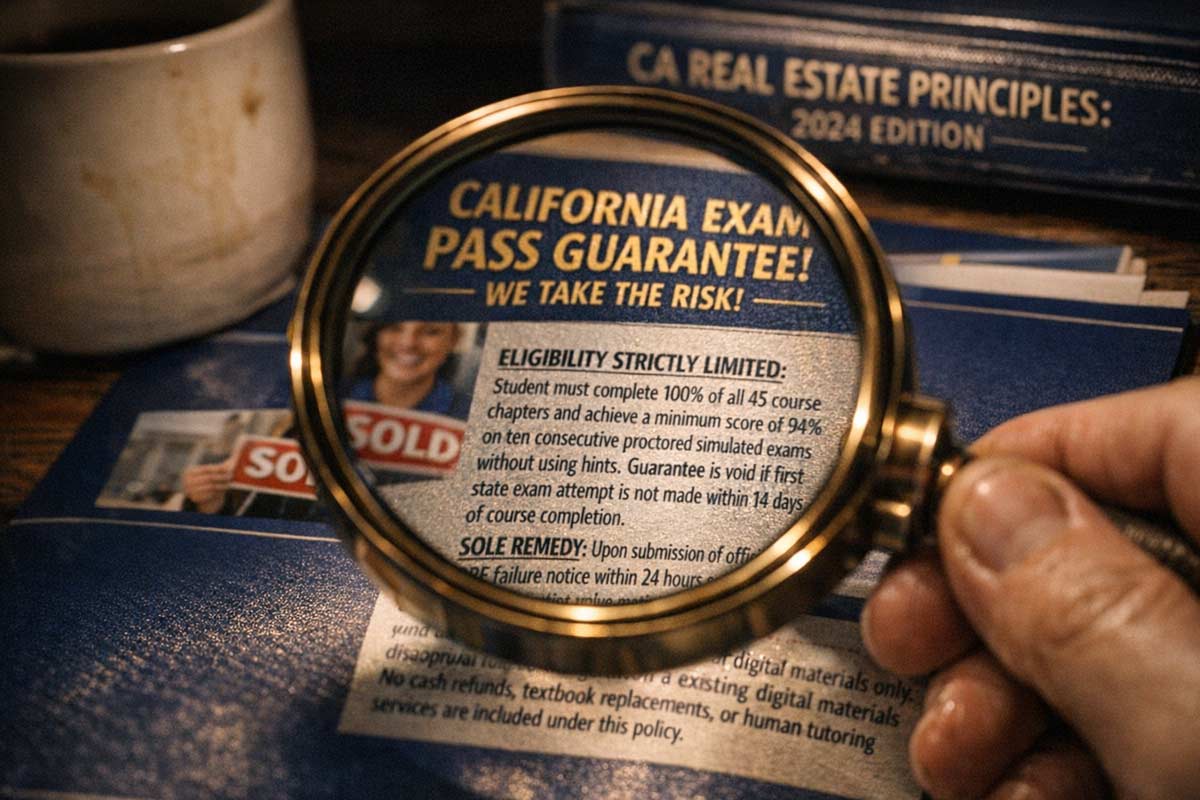
This is exactly why some education providers offer a CA real estate exam pass guarantee. At first glance, these claims act as a safety net, promising that if you don't pass, the school will "make it right." However, for the discerning student, it is important to understand that a "guarantee" is often a marketing label rather than a meaningful protection of your time or money.
By understanding the fine print behind these claims, you can avoid the common traps of real estate school marketing. This guide provides an insider’s framework to help you audit these policies so you can choose a program based on actual support rather than just a slogan.
Defining the Two Common "Guarantees"
Before you sign up, you must distinguish between the two primary types of "safety nets" offered by California real estate schools.
1. The Pass Guarantee
This is a claim that the school stands behind its curriculum’s effectiveness. Typically, it suggests that if you fail the state exam, you are entitled to a specific remedy. While the name implies you are "guaranteed" to pass, the reality is that the school is simply defining what happens if you don't. Knowing how to choose a real estate school in California requires looking past the title of the guarantee to the actual remedy provided.
2. The Satisfaction Guarantee
A satisfaction guarantee is usually focused on the initial experience. It typically offers a refund window (e.g., "money back within 48 hours") if you decide the course format or the user interface isn't a good fit for your learning style. These are often heavily restricted once you have accessed a certain percentage of the course material.
Why Many Guarantees Don't Actually Protect Students
It sounds comforting to hear that a school "guarantees" your success, but many of these policies don't reduce the actual risks involved: lost time, weak preparation, and lack of support.
Consider the remedy. In many cases, a real estate school satisfaction guarantee or pass guarantee simply offers "continued access" to the same materials you just used. If the system didn't work for you the first time, simply using it longer may not solve the underlying issue.
Furthermore, many guarantees come with "performance requirements" that are often difficult to meet, such as achieving a 90% or higher on every single practice exam before your state date. If you miss one requirement, the guarantee is void.
The core point is simple: if the remedy is just "keep using the same system," it may not be addressing why you struggled in the first place. You also need to ensure the school is legitimate by understanding what makes a real estate school DRE-approved.
The "Guarantee Audit Checklist": What to Ask
When evaluating a CA real estate exam pass guarantee, use this checklist to peel back the marketing layers:
Eligibility and "Gotchas"
Attendance & Completion: Do you have to complete 100% of the course and every quiz?
Score Requirements: Must you pass a "proctored" final with a specific high score?
Attempt Limits: Does the guarantee only apply to your very first attempt at the state exam?
The Actual Remedy
Refund vs. Extension: Are they giving your money back, or just extending your login for another 30 days?
Coaching: Does the guarantee trigger actual one-on-one help, or just more automated practice questions?
Hidden Fees: Are there "re-enrollment" fees or costs for updated physical textbooks?
Timeline and Documentation
The Time Window: How long is the access, and is it realistic for CA’s current exam scheduling wait times?
Proof of Failure: What documentation (like the DRE fail notice) do they require, and how quickly must you submit it?
What Actually Matters More Than a Guarantee
In my 20+ years of preparing candidates for the California real estate exam, I have seen that "guarantees" rarely correlate with high pass rates. Instead, the most successful students prioritize specific quality signals that actually predict a passing score.
Instructor Availability: Can you actually get help from a human when you are stuck on a concept like "negative amortization"? The role of instructors in CA real estate education cannot be overstated.
Question Bank Realism: Does the exam prep pass guarantee come with a simulator that mirrors the actual DRE interface and phrasing?
Deep Explanations: Quality prep tells you why an answer is wrong, not just which one is right.
Support Response Speed: If you email a question on Wednesday, do you get an answer before your exam on Monday?
Structured Study Plans: A school that provides a clear milestone-based plan is more valuable than one that just offers a "guarantee" without a map.
The "Try Before You Buy" Decision Rule
If a school is confident in their product, they shouldn't need to hide behind a pass guarantee. The best way to judge a school is through a guest pass or a sample lesson.
The Rule: If a school won’t let you preview the learning experience or watch a sample lecture, treat the guarantee as noise. You are better off seeing if the teaching style clicks with you before you commit your time and money. This is especially true when deciding are crash courses worth it in California, as the intensity of those sessions requires a teaching style you can actually follow.
Evaluating Support Windows as Policy
Rather than looking for a "guarantee," look for a school’s "support window." Some programs offer extended access—for instance, providing four months of access to a crash course—specifically because they recognize that the DRE scheduling process can be slow.
View these not as guarantees of a result, but as support structures. A policy that gives you ample time to study, review, and retake practice exams is a practical tool. It acknowledges the reality of the California licensing timeline without making empty marketing promises.
Choosing the Right Path
Choosing a school is the first major business decision you will make in your real estate career. Don't let a "pass guarantee" distract you from checking the essentials: instructor quality, content freshness, and institutional transparency.
If you are ready to compare options objectively, use our comprehensive guide on the Best Real Estate Schools in California to see how different providers stack up beyond the marketing headlines.
FAQ: CA Real Estate Exam Guarantees
What does an exam pass guarantee mean in California?
Typically, it means if you fail the state exam, the school will provide some form of compensation—usually an extension of your course access or, more rarely, a partial refund—provided you met all their study requirements.
Are "Money Back" guarantees real?
They exist, but they are often "Satisfaction Guarantees" that expire a few days after purchase or after you have opened a certain number of course chapters. Always read the refund policy before buying.
What is the best way to ensure I pass the CA exam?
Consistent practice with a modern exam simulator, attending live or recorded instructor-led sessions, and following a structured 60-day study plan are much more effective than relying on a guarantee policy.
|

Every real estate school in California shares one thing: they must be approved by the Department of Real Estate (DRE) and will have a 4-digit sponsor ID number. Because the curriculum is regulated, many Read more...
Every real estate school in California shares one thing: they must be approved by the Department of Real Estate (DRE) and will have a 4-digit sponsor ID number. Because the curriculum is regulated, many students make the mistake of assuming the schools themselves are identical. They treat the pre-license course like a commodity, shopping strictly on price or the "fastest" promise.
However, after 20 years of coaching students through the licensing process, I can tell you that while the certificate at the end looks the same, the experience of getting it varies wildly. The "commodity" is the credit; the differentiator is the path to passing the real estate exam.
How to use this article: Use the TL;DR to shortlist schools, then use the verification questions at the end of each section to confirm reality before you buy.
Key Takeaways
Approval is the floor, not the ceiling: Every school is DRE-approved, but "approval" doesn't guarantee the content is modern or easy to navigate.
Friction kills momentum: Technical glitches and poor support are the leading reasons students drop out before finishing.
The "Final" isn't the end: The school's final exam is a hurdle; the California State Exam is the finish line. Choose a school that builds a bridge between the two.
Quick TL;DR: The 10 Differences at a Glance
/* Mobile-only scroll */
@media (max-width: 768px) {
.responsive-scroll {
overflow-x: auto !important;
-webkit-overflow-scrolling: touch !important;
}
}
Difference
What to Look For (The Check)
Impact
1. Course Format
True self-paced vs. scheduled sessions.
Flexibility vs. Accountability.
2. Tech & UX
Mobile-responsive + progress auto-saves.
Reduces study friction.
3. Student Support
Published hours + phone availability.
Faster resolution of DRE hurdles.
4. Instructor Access
Direct paths to clarify complex concepts.
Better grasp of legal nuances.
5. Exam Prep Tools
Timed simulated exams + "why" explanations.
Higher first-time pass odds.
6. Content Quality
Updated for current California law changes.
Prevents learning "stale" info.
7. Compliance Ease
Automated tracking of mandatory hours and enrolled time.
Prevents DRE rejection of hours.
8. Price Transparency
All-in pricing vs. hidden retake/book fees.
Protects your total budget.
9. Speed to Cert
Streamlined reporting to the DRE.
Gets you to the state exam faster.
10. Career Bridge
Post-course coaching and guidance.
Smooths transition to a brokerage.
1. Course Format & Time Flexibility
What it is: The delivery method—ranging from independent reading to live-streamed webinars.
Why it matters: California’s pre-licensing courses are time-regulated. Most providers enforce a minimum time window per 45-hour course (commonly 18 days), which creates a realistic floor for your timeline. If a school’s format doesn’t match your life, you will fall behind.
How to verify: Check if the "online" component is just a static PDF or an interactive platform.
Verification Question: "If I miss a scheduled session, what is the specific process and cost to make it up?"
2. Technology & User Experience (UX)
What it is: The stability and intuitiveness of the learning management system.
Why it matters: I’ve seen students lose hours of progress because a platform didn't save their quiz scores. If the tech is frustrating, you won't study.
How to verify: Ensure the platform works in modern browsers (Chrome/Safari) and auto-saves progress. Evaluate course format, student support, and pass rates carefully before committing.
Verification Question: "Does your platform allow me to switch between my laptop and my phone without losing my place in the chapter?"
3. Student Support Quality
What it is: The ability to get a human on the phone when you have a DRE paperwork question.
Why it matters: The DRE application process is notoriously bureaucratic. A school with poor support leaves you to figure out background checks and transcripts alone.
How to verify: Call the school before you buy. If you can’t get a human during sales, you likely won't during support.
Verification Question: "What is your average response time for student support emails during business days?"
4. Instructor Access & Clarification Path
What it is: A direct line to an expert who can explain complex fiduciary duties or legal concepts.
Why it matters: Some concepts in California real estate are counter-intuitive. Without an instructor to clarify, you'll end up memorizing answers without understanding them, which leads to surprises on the state exam.
How to verify: Ask specifically who answers content-related questions—a licensed instructor or a general clerk?
Verification Question: "If I don't understand a concept in Chapter 4, is there a licensed instructor I can speak with or email directly?"
5. Exam Readiness Tools
What it is: Tools beyond the basic quizzes, such as simulated state exams and performance analytics.
Why it matters: Passing the state exam is where many candidates get surprised—the questions are scenario-based, time-pressured, and unforgiving if you’re only memorizing. You need tools that target your weak areas.
How to verify: Look for "simulated exams" that mimic the DRE’s phrasing and provide "why" explanations for every answer.
Verification Question: "Does your exam prep software track my 'weak areas' across different categories like Agency or Contracts?"
6. Content Quality & Updates
What it is: Whether the material reflects current California law and disclosure practices.
Why it matters: Real estate law changes. If your school is using a curriculum from several years ago, you're learning outdated information that won't match how questions are framed today.
How to verify: Low price sometimes correlates with older platforms or less frequent updates—verify the revision date before buying.
Verification Question: "What major legislative or forms updates were incorporated into your curriculum in the last 12 months?"
7. Completion Tracking & Compliance Friction
What it is: How the school tracks your mandatory hours and issues the certificate.
Why it matters: If the school’s tracking isn't DRE-compliant, your application could be rejected weeks after you think you’ve finished.
How to verify: Check what matters most when choosing a real estate school regarding their reporting reputation.
Verification Question: "Is my completion certificate issued automatically the moment I complete the course requirements and meet the pacing/time requirements?"
8. Pricing Structure & Hidden Fees
What it is: The "all-in" cost versus the "teaser" price.
Why it matters: These fees don't just raise cost—they slow you down when you’re trying to finish. Some schools lure you with a low price but charge for certificate reprints, final exam retakes, and course extensions.
How to verify: Read the refund and extension policy before clicking "Buy."
Verification Question: "Are there any additional fees for retaking a school final exam or extending my access if I don't finish in six months?"
9. Speed to Certificate
What it is: The actual time it takes from payment to being eligible for the state exam.
Why it matters: Even if you’re highly motivated, there’s a built-in pacing floor for completing three 45-hour courses, so any ‘finish instantly’ marketing should trigger verification.
How to verify: Use a step-by-step guide on how to compare California real estate schools to map out your realistic timeline.
Verification Question: "How long after I pass my third exam will it take for me to receive the transcripts I need for the DRE?"
10. Career Bridge After the Certificate
What it is: What the school does for you once you have your certificate but before you have your license.
Why it matters: The "gap" between finishing the course and taking the state exam can be months. A good school provides resources to keep your knowledge fresh during that wait.
How to verify: Ask if they offer post-completion study groups or crash courses.
Verification Question: "Do I still have access to the practice exams and instructors after I receive my completion certificates?"
Decision Framework: Match the School to the Student
Not every student needs the same features. When researching the Best Real Estate Schools in California, prioritize based on your profile:
The Full-Time Professional: Prioritize Tech & UX and Mobile Flexibility. You need to be able to study during a commute or lunch break without a clunky interface slowing you down.
The Procrastinator: Prioritize Instructor Access and Live Components. You likely need to weigh the Online vs. In-Person Real Estate Schools in CA: Pros & Cons to see if you need the structure of a classroom.
The "Bad" Test Taker: Prioritize Exam Readiness Tools. You need a school that provides detailed explanations for why an answer is wrong, mimicking the state exam's style.
The Fast Tracker: Prioritize Compliance Ease and Support Speed. You want a school that ensures you hit the "pacing floor" accurately so your DRE application isn't delayed.
The Budget-Conscious Strategist: Prioritize Price Transparency. Cheapest isn't actually cheapest if you have to pay $100 for a course extension because life got in the way.
FAQ
Are all DRE-approved schools basically the same?
No. While they teach the same legal requirements, the delivery, technology, and level of student support vary significantly. A school is a service, not just a textbook.
Does online vs. in-person affect passing?
It depends on the student. Online offers convenience, but in-person offers immediate clarification. The best schools often offer a hybrid approach to provide both.
Do pass-rate claims matter?
The DRE does not officially publish pass rates for individual schools. Any school claiming a "99% pass rate" should be viewed with healthy skepticism—ask them how they verify that data.
How long does it take to finish?
Most providers enforce a minimum time window of 18 days per course. For the three required courses, this creates a realistic floor of about 54 days, though most students finish in 3 to 4 months.
What should I compare before buying?
Look at the "hidden" costs (retakes/extensions), the age of the technology, and whether you can actually communicate with a human when you have a question.
Choosing Your Path
Selecting a school is the first professional decision you make in your real estate career. It sets the tone for your licensing journey—either one of constant technical frustration or one of focused, supported growth.
Use
|
Choosing a real estate school in California often feels like looking at a dozen identical houses. On the surface, every provider promises the same outcome: a certificate that allows you to take the state Read more...
Choosing a real estate school in California often feels like looking at a dozen identical houses. On the surface, every provider promises the same outcome: a certificate that allows you to take the state exam.
However, once you sign up, the differences in technology, support, and actual "readiness" become glaringly apparent. Choosing the wrong provider doesn't just cost you money; it costs you weeks of momentum.
You are in the right place if:
You are confused by "guaranteed pass" claims.
You aren’t sure if a cheap online course is enough to actually pass the state exam.
You need a framework to filter out schools that don't align with your learning style.
This guide provides an operator-level system to compare schools objectively so you can move forward with confidence.
Quick Take:
All California real estate schools teach the same required subjects—but they do not teach them the same way. The difference between passing smoothly and stalling out usually comes down to support, platform quality, and hidden policies—not price.
The 9-Step Comparison Framework
Use these steps to audit any school you are considering. Do not rely on the marketing copy on their homepage; look for these specific indicators of quality.
Step 1: Confirm DRE Approval
Every school must be approved by the Department of Real Estate (DRE). If they aren't, your completion certificates are worthless.
Why it matters: The DRE sets the curriculum. Any DRE-approved real estate course must meet the 135-hour requirement (three 45-hour courses).
How to verify: Don't just look for a logo. Navigate to the official DRE website to search the DRE’s approved provider list.
Step 2: Match the Format to Your Life
Are you a self-starter, or do you need a coach? California allows for purely elective online study, but that doesn't work for everyone
Why it matters: Some students thrive in a self-paced environment, while others need the accountability of a live instructor.
How to verify: Look at the Online vs. In-Person Real Estate Schools in CA: Pros & Cons to see which environment fits your current schedule and focus level.
Step 3: Evaluate Student Support
When you have a question about "joint tenancy", who answers?
Why it matters: Many budget schools provide the materials but zero access to human experts.
How to verify: Email the school a technical question before you buy. If it takes them three days to respond to a sales lead, imagine how long they’ll take to help a student. This is a key factor when you evaluate evaluate real estate school quality in California.
Step 4: Check Course UX and Materials
The platform you use shouldn't be a relic from 2005. It should work on your phone, tablet, and laptop.
Why it matters: If the interface is clunky, you will find excuses to avoid studying.
How to verify: Ask for a demo or a "look inside" video. Check if the quizzes are interactive or just static PDFs.
Step 5: Understand Pass-Rate Claims
Be wary of schools claiming "100% pass rates." The DRE does not officially track or publish pass rates for individual schools in a way that is easily verifiable for marketing.
Why it matters: Statistics can be manipulated (e.g., only counting students who pass a "pre-test" first).
How to verify: Look for transparency. A reputable school will tell you that the state exam is difficult and requires significant effort. When asking what matters most when choosing a real estate school, look for schools that emphasize preparation over "shortcuts."
Step 6: Compare Total Cost
The "sticker price" is rarely the final price.
Why it matters: Some schools charge extra for physical textbooks, retaking final exams, or extending your course access if life gets in the way.
How to verify: Read the "Terms and Conditions" specifically for "re-enrollment fees" or "extension fees."
Step 7: Compare Completion Speed & Flexibility
In California, generally there is a legal minimum time frame of 18 days per course. You cannot finish the entire program in a weekend.
Why it matters: Some schools have rigid schedules; others allow you to pause for months if needed.
How to verify: Check the expiration date of your enrollment. A good California real estate license course should give you at least 6–12 months of access.
Step 8: Verify Reputation Signals
Look past the five-star reviews on the school's own website.
Why it matters: Public platforms (Google, Yelp, Reddit) provide a more honest look at the student experience.
How to verify: Look for patterns. Are people complaining about the tech? The differences between real estate schools in California often come down to how they handle student frustrations.
Step 9: Make the Final Decision
Use the scoring rubric below to weigh your options. Don't choose based on price alone—choose based on the path that ensures you actually get your license.
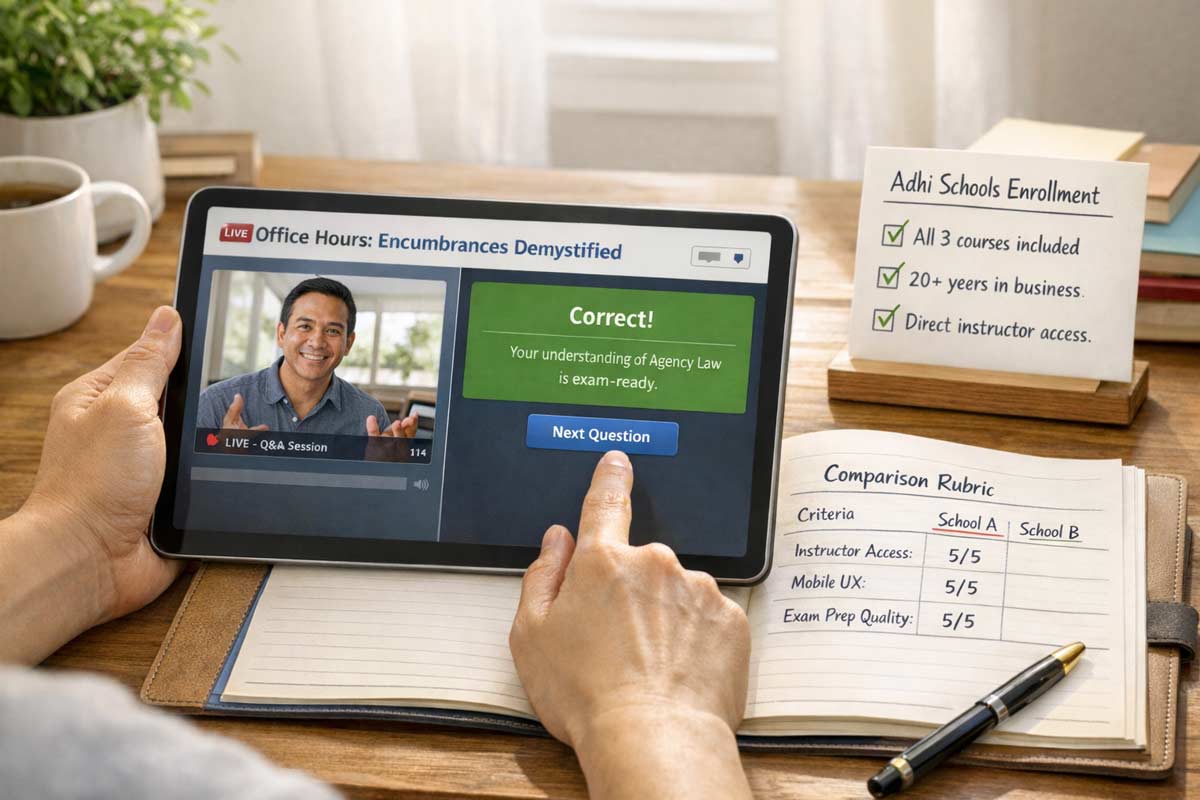
Comparison Rubric: How to Grade a School
Criteria
Weight
School A
School B
School C
DRE Approval
Essential
Instructor Access
High
Mobile UX
Medium
Total Price (Fees included)
Medium
Reputation/Reviews
High
Exam Prep Quality
High
Real-World Scenarios: Which Profile Are You?
In my 20+ years of coaching California students, I’ve seen that the "best" school is the one that matches your lifestyle.
1. The Full-Time Worker
The Need: Maximum flexibility and mobile access.
The Advice: Look for an online real estate school in California that offers "on-demand" video or high-quality reading material that you can digest in 20-minute windows. Avoid schools with rigid "live session" requirements if your work schedule is unpredictable.
2. The Fast-Tracker
The Need: Efficiency and clear milestones.
The Advice: You need a system that tracks your 18-day windows automatically and alerts you the moment you are eligible to take your next final.
3. The High-Support Learner
The Need: Accountability and the ability to ask "Why?"
The Advice: Don't buy a budget, text-only course. You will likely get stuck on complex topics like "encumbrances" or "agency relationships." Invest in a school that offers live Q&A sessions or direct instructor access.
Common Mistake to Avoid: Buying a course based on a "coupon" only to find out the school charges $50 every time you need to ask a question or $100 to renew after 3 months. Screenshot the "Terms" page before you buy.
The Ultimate Comparison Checklist
Before you enter your credit card info, check these boxes:
Is the school listed on the DRE website?
Does the price include all three required 45-hour courses?
Are the textbooks digital, physical, or both? (Is there an extra fee?)
Is there a dedicated "Exam Prep" component available?
Can I access the materials on my phone without a headache?
What is the "hidden fee" for retaking a final exam if I fail?
How do I contact an instructor if I'm confused?
Red Flags to Watch For:
No physical office or phone number listed.
"Guaranteed" pass rates (nobody can guarantee what you'll do in the state exam room).
Outdated websites that look like they haven't been updated since the 90s.
Lack of clarity on how long you have to finish the course.
Comparing schools shouldn't be a guessing game. By focusing on support, transparency, and format, you move from being a "lead" to being an informed student.
If you want a broader look at the landscape of providers, visit our comprehensive guide on the Best Real Estate Schools in California, where we break down providers using the same criteria above. This comparison framework is just one part of choosing the right path toward your California real estate license.
Frequently Asked Questions
1. Are all California real estate schools the same since the curriculum is the same?
No. While the topics are mandated by the DRE, the delivery (video vs. text), the quality of exam prep, and the level of instructor support vary wildly between providers.
2. How much should I expect to pay for a good school?
In California, prices typically range from $150 to $600. Be cautious of "bottom-dollar" schools; they often make up the difference with hidden fees for books or support.
3. Is an online real estate school in California better than in-person?
It depends on your discipline. Online is more convenient, but in-person (or "live stream") offers better networking and immediate answers to your questions.
4. How do I know if a school’s pass rate is real?
You don't. Since there is no independent, third-party audit of school pass rates required by the DRE, treat extreme claims as a red flag. Look for schools that offer extensive practice exams instead.
5. Can I switch schools if I don't like the one I chose?
Yes, but you usually cannot transfer "partial" credit. If you finished one 45-hour course, you can take the remaining two elsewhere.
6. What happens if my course access expires?
Most schools allow you to pay a "re-enrollment" or "extension" fee. Always check this cost before signing up, as it can be as much as 50% of the original tuition.
|

Most students don’t fail the California real estate exam because the material is "too hard." They fail because they pick a learning format that doesn’t match their actual life.
You might be tempted Read more...
Most students don’t fail the California real estate exam because the material is "too hard." They fail because they pick a learning format that doesn’t match their actual life.
You might be tempted to choose the cheapest online real estate school in California versus an instructor-led real estate school closest to your house, but without a framework, you risk losing weeks of momentum to procrastination or burnout.
This guide provides an objective look at the trade-offs between formats, helping you choose the best format for California real estate license course success.
Quick Take:
All California real estate schools teach the same required subjects—but they do not teach them the same way. The difference between passing smoothly and stalling out usually comes down to support, platform quality, and hidden policies—not price. Our full breakdown of providers is covered in the Best Real Estate Schools in California guide.
Quick Answer: Which One Should You Choose?
If you need a fast decision, match your profile below:
Choose Online if: You are a disciplined self-starter with a full-time job, have strong tech comfort, and need to fit studying into "pockets" of time.
Choose Instructor-Led if: You struggle with self-motivation, learn best through discussion, and need a "destination" to focus.
Online is risky when: You have zero student support and a "buy it and forget it" mentality.
In-person is inefficient when: The commute takes longer than the class or the fixed schedule forces you to miss critical business opportunities.
The Deciding Factor: It isn't just about the screen vs. the classroom; it’s about accountability + support + schedule reality.
If you want to go deeper into how support, accountability, and policies impact outcomes, see our breakdown on What Matters Most When Choosing a Real Estate School.
Defining the Formats For This Article
Before comparing, it’s important to understand what these terms actually mean under Department of Real Estate (DRE) regulations:
Self-Paced Online: You log in and read text or watch videos. You move as fast or slow as you want (within the 18-day-per-course legal minimum).
Livestream (The Hybrid): Classes are held over Zoom at specific times. You get the classroom feel without the commute.
Physical Classroom: Traditional in-person instruction at a physical campus.
Regardless of format, ensure you are taking DRE-approved real estate courses in California. The curriculum is standardized, but the experience—and your results—will vary based on the school's platform and instructor quality.
Online Real Estate Schools in California — Pros & Cons
The self-paced online real estate course in California has become the most popular option for a reason: flexibility.
The Pros
Total Flexibility: Study at 2 AM or during your lunch break.
Cost Efficiency: Generally 30–50% cheaper than instructor-led equivalents.
Pacing Control: Breeze through topics you know and spend more time on complex concepts like Trust Fund Handling.
Repeatability: You can re-watch videos or re-read chapters as many times as needed.
The Cons
Procrastination: Without a "teacher" waiting for you, it’s easy to push studying to "tomorrow."
Isolation: You don’t have a cohort of peers to "bump brains" with.
Tech Friction: If the school's platform is outdated, the user experience can be frustrating.
Best for: Erratic schedules, full-time employees, and those with a high degree of self-discipline.
Watch-outs: Look for hidden fees for "extensions" and check the quality of their real estate school student support in California.
In-Person Real Estate Schools in California — Pros & Cons
For some, the "four walls" of a classroom are the only way to ensure the work gets done.
The Pros
Built-in Accountability: If you show up to the building, you’re going to study for those hours.
Real-Time Q&A: You can stop an instructor and ask for a real-world example the moment you’re confused.
Community: You meet people who will eventually be your colleagues and potential referral partners.
The Cons
Rigid Schedule: If you miss a class, you might have to wait weeks for that topic to cycle back.
Time Cost: A two-hour class plus an LA commute can equal four hours of your day.
Lack of Review: Once the lecture is over, you can’t "rewind" a live instructor.
The Decision Framework: Your Scoring Checklist
Be honest—this isn’t about what sounds good, it’s about what you’ll actually do. Rank each category from 0–5 (5 being highest importance).
Category
Score (0–5)
Schedule Control: I need to study at random times.
Self-Discipline: I can sit down and work without being told to.
Need for Live Instruction: I need to ask "Why?" to understand.
Tech Comfort: I am comfortable navigating web platforms.
Timeline Urgency: I need to finish as fast as legally possible.
How to Interpret:
Higher on Schedule/Discipline/Speed: Go Online.
Higher on Live Instruction/Accountability: Go In-Person or Livestream
If you are still torn, you should learn how to compare California real estate schools by looking at the specific student support levels each offers.
Format Myths vs. Reality
Myth 1: "In-person students have higher pass rates."
Reality: Success is tied to study behavior. An online student using a high-quality simulator often outperforms an in-person student who only listens passively. You must evaluate course format, student support, and pass rates as a total package.
Myth 2: "Online is easier."
Reality: The 135-hour curriculum is the same. In many ways, online is harder because it requires more mental stamina to stay engaged with a screen than a human.
Format alone doesn’t explain why students have wildly different experiences. Many of the real differences come down to policies, platforms, and support structures—which we break down in The 10 Biggest Differences Between California Real Estate Schools.
Choose the Format You’ll Actually Finish
The "best" school is the one you will actually finish on time while staying exam-ready. Don't let a $50 price difference or a "prestige" label distract you from your own learning habits.
If you’re ready to see how the top providers in the state stack up, check out our master guide: Best Real Estate Schools in California. This comparison framework is just one part of choosing the right path toward your California real estate license.
FAQ
Is livestream or Zoom real estate school considered online in California?
Yes. Livestream or Zoom-based courses are considered an approved delivery method as long as the provider is DRE-approved and properly tracks completion. These hybrid formats often combine live accountability with the convenience of remote access.
How long does an online California real estate course take compared to in-person?
It usually takes the same total time—but online might feel faster because you control the pace. California has an 18-day minimum per course, so you can’t legally finish instantly. The real difference is efficiency: online lets disciplined students stack study blocks daily and finish near the minimum, while in-person schedules can stretch the timeline if classes meet only certain days or if you miss a session.
What should I look for in student support if I choose an online school?
Look for support that prevents “stall-outs,” not generic customer service.
Specifically:
Fast response times (same-day or next business day)
Clear extension and refund policies (no surprise fees)
Real exam-prep tools (practice exams/simulators + explanations)
Progress tracking + reminders (anything that adds accountability)
If the school can’t clearly explain how they keep students moving, it’s a red flag.
|

When you decide to get your California real estate license, you are immediately flooded with ads. Some schools scream about being the cheapest; others promise "100% pass rates."
But after 20 years in Read more...
When you decide to get your California real estate license, you are immediately flooded with ads. Some schools scream about being the cheapest; others promise "100% pass rates."
But after 20 years in this industry, I can tell you that most of those metrics are noise. If you choose a school based on the wrong criteria, you might end up with certificates of completion but zero confidence when you sit down for the actual real estate exam.
Here is what actually determines your success.
Quick Take:
Your goal isn't just to "finish the hours"—it's also to pass the state exam on the first try. To do that, you need a school that prioritizes support, exam-readiness, and policy transparency over just being the lowest bidder.
Quality of Student Support (The "Ghosting" Factor)
In California, you have to complete 135 hours of education. At some point, you will get confused by a concept like "negative amortization" or "easements by prescription."
The Problem: Budget schools often automate everything. If you have a question, you might wait 48–72 hours for an emailed response from someone who isn't even an instructor.
What Matters: Can you get in touch with a human? Is there a live Q&A session? Access to experienced instructors is one of the 10 biggest differences between California real estate schools.
Exam Prep vs. Course Completion
Completing the required DRE-approved real estate courses in California is just Step 1. Passing the final for those courses is "open book." The state exam is not.
The Problem: Many schools give you the 135 hours but very little "Crash Course" or "Exam Prep" material.
What Matters: Look for a school that includes a robust state exam simulator. You need to practice with the same wording, timing, and difficulty level you’ll face at the DRE testing center. This is a vital part of how you evaluate course format, student support, and pass rates.
Hidden Costs and Enrollment Length
In California, you cannot legally finish all three courses in less than 54 days. Life often gets in the way of that perfect timeline.
The Problem: Some schools give you only 3 or 6 months of access. If you don't finish, they charge you a "re-enrollment fee" that can cost as much as the original course.
What Matters: Transparency. Look for a one-year enrollment period and clear policies on retaking final exams (it should be free or very low cost).
Platform Usability (The "UX" Factor)
If the website looks like it was built in 1998, your learning experience will likely suffer.
The Problem: Clunky interfaces make it harder to track your progress or study on your mobile device.
What Matters: A modern online real estate school in California should allow you to jump between your phone and laptop seamlessly. If the technology is a hurdle, you won't finish the course.
Decision Checklist: The "Big 5" Questions
Before you enroll, ask these five questions to ensure the school is a fit:
Who is the instructor? (Are they a practicing broker or just a paid actor?)
How long do I have to finish? (Is the timeline 6 months or a full year?)
Does the school offer exam prep? (Passing the state exam is critical.)
How do I get help? (Is there a community or a help desk?)
What is the "Total" price? (Does it include books, shipping, and exam prep.)
The Reality of Pass Rates
Any school can claim a high pass rate. But since the DRE doesn't publish these figures for private schools, you have to look for reputation signals:
Check independent reviews (Google/Yelp).
Ask local brokers which school their most successful new agents attended.
Check if the school offers an "open door" policy to try a class before you buy.
If you are still stuck between two schools, you should learn how to compare California real estate schools using a side-by-side rubric.
The "best" school isn't the one with the biggest discount code. It’s the one that respects your time and provides the tools to ensure you only have to take the state exam once.
For a final ranking of the top options in the state based on these criteria, see our master guide: Best Real Estate Schools in California.
FAQ
What is the most important factor in choosing a real estate school?
Instructor access and the quality of state exam prep software. Passing the 135 hours is easy; passing the state exam is the real hurdle.
Can I switch from an online course to an instructor-led one later?
It depends on the school. Some allow a "hybrid" approach, but it's easier to decide your format upfront. See our guide on Online vs. In-Person Real Estate Schools in CA for more.
Does a more expensive school mean I’m more likely to pass?
Not necessarily, but "too cheap" often can indicate a lack of human support and outdated materials. Aim for the mid-to-high range for the best balance of value and quality.
|
You’ve worked hard to build your business, but nothing halts momentum like a DRE deficiency notice—or worse, a license that slips into expired status. I’ve spent over 20 years helping California Read more...
You’ve worked hard to build your business, but nothing halts momentum like a DRE deficiency notice—or worse, a license that slips into expired status. I’ve spent over 20 years helping California agents and brokers at ADHI Schools navigate this process, and I’ve watched too many professionals pay an unnecessary "tax": late fees, avoidable delays, and lost commission because they didn’t budget for time and money.
If you plan ahead, the cost to renew a California real estate license is predictable. If you wait until the last minute, the price goes up—not just in dollars, but in stress.
The Quick Answer: CA Renewal Cost Snapshot
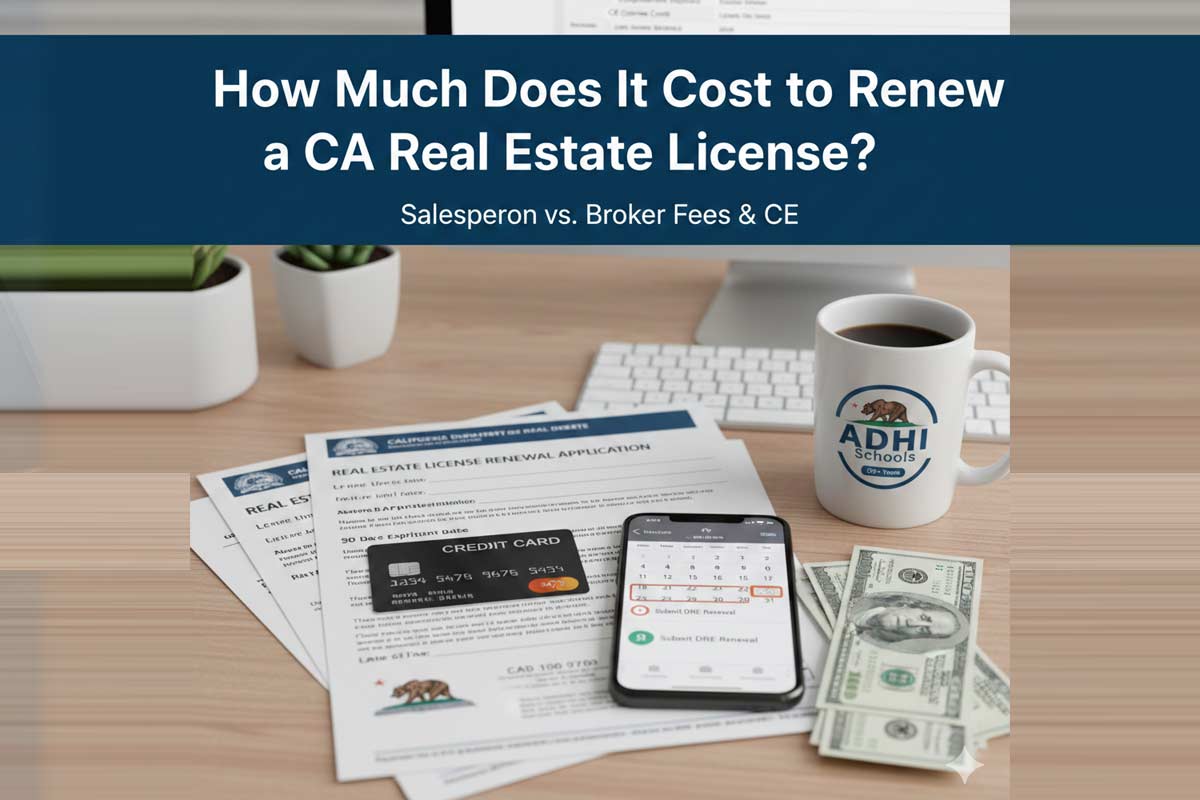
Below are the renewal fees set by the California Department of Real Estate (DRE). These figures reflect the official DRE fee schedule (fees effective July 1, 2024, and current as of March 2026).
License Type
On-Time Renewal Fee
Late Renewal Fee (within 2 years)
Salesperson
$350
$525
Broker
$450
$675
Important: These are DRE filing fees only. Your total cost also includes continuing education (CE), which is provider-dependent. A realistic "total budget" for an on-time renewal is typically:
Salesperson: ~$400–$480 (DRE fee + CE range)
Broker: ~$550–$625 (DRE fee + CE range)
The Fee You Can’t Avoid: DRE Renewal Fees
The DRE renewal fee is non-negotiable. The cleanest way to pay is through the DRE eLicensing system, because it creates a clear electronic transaction record and supports the DRE’s standard online renewal workflow.
The on-time renewal nuance most agents miss
If you renew on time, California Business & Professions Code Section 10156.2 permits you to continue operating under your existing license after its expiration date unless the DRE notifies you of a deficiency. Your renewal is considered "on-time" if your eLicensing transaction is completed—or your mailed application is postmarked—by midnight on your expiration date.
Why the late fee is a trap
Miss the deadline and a Salesperson renewal jumps from $350 to $525—a $175 penalty (a 50% increase). Most importantly, if your license is expired and you haven’t submitted the complete renewal application, you cannot perform any activities requiring a license until your renewal is officially processed.
Plan your submission: Check our guide on How to Submit Your CA License Renewal Application for the smoothest filing flow.
The Second Big Cost: Continuing Education (CE) Tuition
Renewing a real estate license in California requires 45 hours of DRE-approved continuing education. The cost depends on the provider and delivery method.
Typical CE cost range: ~$99–$199.
First renewal vs. Subsequent renewal: First-time renewals require individual courses in specific mandatory topics. For subsequent renewals, licensees whose licenses expire on or after January 1, 2023, have the option to complete a 9-hour CE survey course that covers the seven mandatory subjects.
Provider Tip: Bundled 45-hour packages are almost always the best value. Buying courses "à la carte" often leads to missing a required component and paying twice.
Hidden Costs That Blindside People (The "Late Tax")
Beyond standard fees, these cost multipliers can inflate your real total:
Deficiency delays: Typos or incorrect course numbers trigger DRE follow-up. While there is no "fine," the cost is measured in weeks of business disruption while you wait for manual processing.
Multiple licenses: If you maintain a corporation license or an additional officer license, each carries its own renewal fee under the DRE fee schedule.
Rush premiums: Waiting until the last minute for CE often results in less time to shop around to make sure you are getting the best deal on CE.
To stay organized, use our Checklist for Renewing a California Real Estate License.
3 Budget Scenarios: What Will You Actually Pay?
1) Proactive Salesperson (Clean & On-Time)
DRE fee: $350
CE package: $50–$120
Total: ~$400–$470
3) "Scramble" Renewal (Late Salesperson)
Late DRE fee: $525
Last-minute CE: Cost doesn’t change but you are less likely to cross shop if under time pressure.
Total: ~$625+ (Plus the risk of commission loss during the gap).
How to Avoid Paying More Than You Need To
Finish CE early: Build at least a 30-day buffer for any certificate issues.
Submit early: eLicensing accepts applications up to 90 days before expiration.
Save proof: Save or print the confirmation page as a PDF and screenshot the transaction/confirmation number immediately after paying.
Audit your application: Double-check your 8-digit CE course numbers to avoid the common renewal mistakes agents make.
Frequently Asked Questions
What is the late renewal fee in California for a real estate license?
The late renewal cost is $525 for Salespersons and $675 for Brokers. This applies if you renew within two years after your license expires.
If I renew on time, can I keep working after my expiration date?
In many cases, yes. If your renewal is submitted on time, California law (B&P 10156.2) may allow you to continue operating unless the DRE notifies you of a deficiency and instructs you to stop. That’s why submitting early and saving proof of your transaction is critical.
Is the CE cost included in the DRE fee?
No. The DRE fee covers state processing; CE is paid separately to your chosen education provider.
Can I renew early?
Yes—renewals can be submitted up to 90 days before expiration.
Do brokers pay more than salespersons?
Yes. An on-time Broker renewal is $450, while a Salesperson renewal is $350.
Your Next Steps
Budgeting is just step one. Timing is step two.
First: Read How Long Does It Take to Process a CA Renewal? so you submit early enough to avoid a gap.
Then: Follow the clean filing workflow in How to Submit Your CA License Renewal Application (and save your confirmation as proof).
Finally: Anchor your entire renewal strategy with the full field manual: California Real Estate License Renewal Guide.
|

Imagine this: You’re three days away from taking a career-best listing when your broker calls. Your license has officially expired but you had no idea.
At ADHI Schools, I’ve spent over 20 years Read more...
Imagine this: You’re three days away from taking a career-best listing when your broker calls. Your license has officially expired but you had no idea.
At ADHI Schools, I’ve spent over 20 years helping California agents navigate the DRE rules. I’ve seen hundreds of agents lose momentum because they treated their renewal like a "quick five-minute form." In reality, a single typo or a misunderstood deadline can trigger weeks of DRE renewal delays.
If you want to keep your license active and your commissions flowing, you need to avoid these 10 common California real estate license renewal mistakes.
The 10 Most Common Renewal Mistakes
1. Waiting Until the Final Week To Register For Courses
Why it happens: Agents prioritize lead generation over paperwork, assuming they can cram all the hours into one day.
What it costs: Professional paralysis. If you miss the window, your license is technically "Expired," meaning you cannot legally perform any licensed activity or claim a commission for work done during that gap.
Audit Trigger: Attempting to complete 45 hours of CE within 48 hours of your expiration date.
Hard Control: * The 9-Day Minimum: ADHI Schools requires that you schedule a minimum of 9 calendar days to complete 45 hours of CE.
The 15-Hour Cap: In practice, the DRE only allows credit for 15 hours of courses per 24-hour period. You cannot "speed-run" the 45-hour requirement in a single day.
The 8-Hour Study Lock: The system mandates 8 hours of study time per day before the final exams for those hours are unlocked.
Deadline: Aim to have your CE finished no later than Day 80 of your 90 day renewal window to leave a buffer for DRE processing.
Pro Tip: Before you gamble on a last-minute submission, read: How Long Does It Take to Process a CA Renewal?
2. Assuming CE is "Automatically" Posted
Why it happens: Thinking your education provider notifies the DRE on your behalf - CE providers don’t do this it must be done by the licensee.
What it costs: Your renewal can get delayed or kicked into manual review if your CE completion can't be verified cleanly.
The Fix: Manually verify your certificates and upload the course completion numbers to the DRE through eLicensing. Keep every completion certificate saved and ready for data entry.
3. Data Entry Typos in eLicensing
Why it happens: Rushing through the online portal on a mobile phone or tablet.
What it costs: Mismatched records that require manual DRE intervention, adding weeks to your renewal processing time.
The Fix: Only renew on a desktop with your physical license and CE certificates in front of you.
Pro Tip: Copy and paste your license number and eight digit course approval numbers directly from ADHI’s documents to avoid "fat-finger" errors.
4. Paying the Wrong Fee
Why it happens: Confusing "On-Time" fees with "Late" fees, or Salesperson fees with Broker fees.
What it costs: Underpayment stops the application entirely. Review How Much Does It Cost to Renew a CA Real Estate License? to ensure you are authorized for the correct amount.
The Fix: Double-check your current license status (Salesperson vs. Broker) and the date before submitting payment.
5. Submitting Without Completing All Courses
Why it happens: Agents assume they know the steps and skip a requirement (like the Fair Housing or Implicit Bias modules).
What it costs: An incomplete application triggers a manual review or a request for more information.
The Fix: Use a dedicated Checklist for Renewing a California Real Estate License before hitting "Submit."
6. Failing to Save the "Success" Screen
Why it happens: Thinking the email confirmation is instantaneous (it isn't always).
What it costs: No proof of "good faith" submission if there is a technical glitch.
The Fix: Take a screenshot of the final "Transaction Successful" page and the Transaction ID number immediately.
The "Paper Trail" Box: Save These 3 Things
The Transaction Confirmation: Displayed immediately after payment.
CE Certificates: Keep digital copies of all 45 hours of credit.
PDF Copy of Application: If renewing via mail (though eLicensing is safer).
7. Miscalculating the 2-Year Grace Period
Why it happens: Thinking you can still practice during the 2-year "late renewal" window.
What it costs: You can renew for up to two years after expiration, but you cannot perform licensed activity during that time.
The Fix: If you miss the deadline, stop all licensed activity immediately and file a late renewal application.
8. Using the Wrong Submission Path
Why it happens: Attempting a standard renewal when you are actually in "Reinstatement" territory with regard to fees.
What it costs: This can trigger delays, rework, or additional fees depending on your current status.
The Fix: Follow the correct steps in: How to Submit Your CA License Renewal Application
9. Broker Affiliation Mismatches
Why it happens: Changing brokerages near your renewal date without updating the DRE first.
What it costs: The DRE may flag the renewal if your supervising broker’s information doesn't match their current database records.
The Fix: Ensure your "Main Office Address" and "Responsible Broker" are updated in eLicensing before you start the renewal flow.
10. Ignoring Disclosure Requirements
Why it happens: Failing to disclose new criminal convictions or pending disciplinary actions as required.
What it costs: Serious licensing penalties for non-disclosure.
The Fix: Be transparent. If you have a reportable event, consult with a licensing expert and provide the required documentation upfront to avoid problems.
"If You're Already in Trouble" Triage
If you’ve already made a mistake, follow this decision tree:
"I submitted but it's not moving": Check the DRE’s current processing timeframes online. If they are processing applications from a date after yours, contact the DRE directly.
"My license is close to expiring": Use eLicensing renewal immediately. Do not mail it. eLicensing is typically faster and reduces avoidable delays compared to mail.
"It already expired": Stop all real estate activity. Check if you are within the 2-year window for a late renewal. You will pay a higher fee, but you won't have to retake the exam.
Always call the DRE at 877-373-4542 with questions.
The Clean Renewal Sequence
To avoid the headaches above, follow this 5-step countdown sequence:
Day 90: Confirm your eligibility window and verify your login on eLicensing and sign up for the 45 hour renewal courses.
Day 80: Finish your continuing education and download all certificates.
Day 75: Review the renewal checklist to ensure you meet all current DRE requirements.
Day 70: Submit correctly via eLicensing.
Day 69: Save proof of payment and confirm your status update on the DRE public database.
Ready to Renew?
Don't let a simple clerical error sideline your career. This article is just one part of our complete system to keep your license active. For the full, step-by-step breakdown of every requirement, fee, and deadline, see our: California Real Estate License Renewal Guide.
Pro move: Set 90/80/75/70-day reminders in your calendar using the Clean Renewal Sequence above to ensure you never miss a deadline.
|
Renewing your California real estate license is a high-stakes administrative task. A single oversight—a mismatched name, an incomplete CE certificate, or a missed deadline—can trigger a deficiency Read more...
Renewing your California real estate license is a high-stakes administrative task. A single oversight—a mismatched name, an incomplete CE certificate, or a missed deadline—can trigger a deficiency notice or halt your ability to work legally. Your goal isn’t just to submit; it’s to achieve a clean, provable, and on-time renewal that avoids manual review and a potential late fee.
This checklist distills decades of experience into a direct, phase-by-step action plan. It is designed to steer you clear of the common data and documentation errors that cause renewal problems, helping to ensure that your submission is seamless from the moment you start your continuing education to the final confirmation.
The 30-Second "If You Do Nothing Else" Checklist
Verify expiration date via the DRE Public License Lookup today.
Finish CE early (target at least 15–30 days before your deadline).
Confirm CE requirements for your specific cycle (First-time vs. Subsequent).
Submit via eLicensing (renewals open 90 days before expiration).
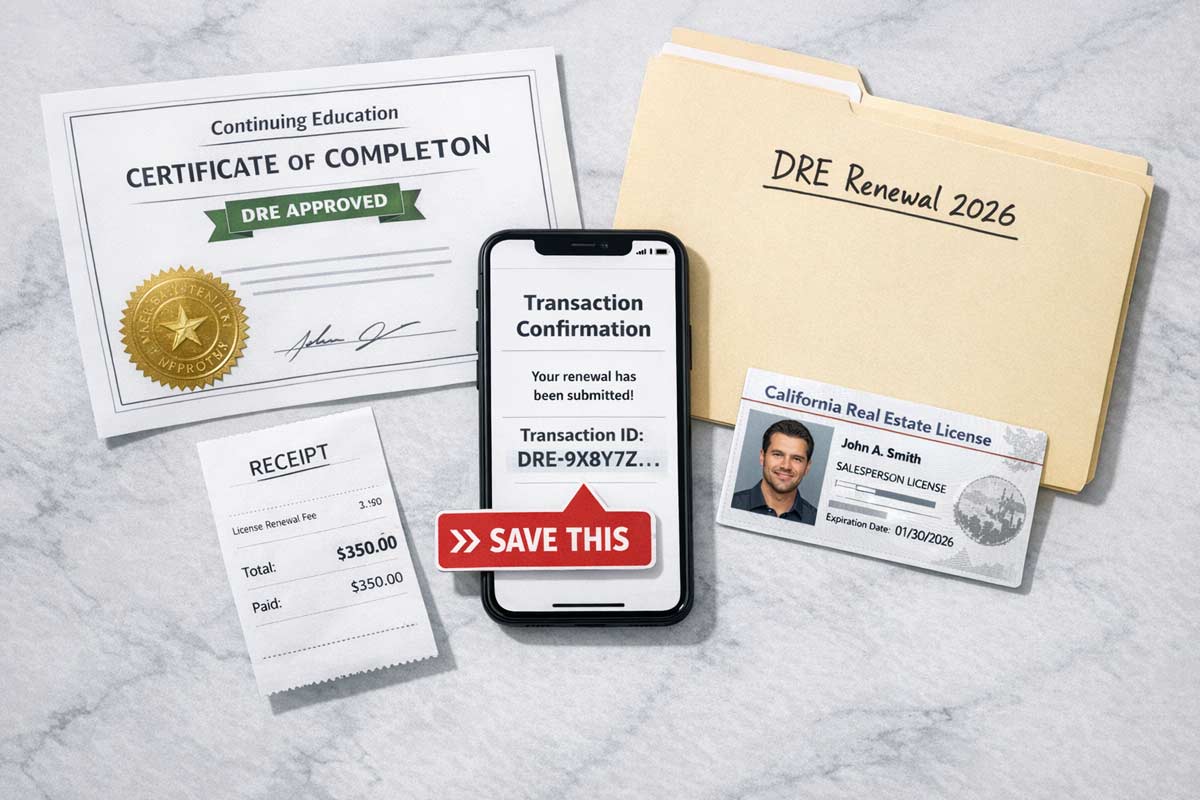
Save proof immediately: Transaction ID + confirmation page PDF + timestamped screenshot.
The Phased Renewal Checklist
Phase 1: Prep (90–60 Days Out)
Audit Your DRE Profile
Why it matters: Your name should match across elicensing and CE records closely enough to avoid a manual review (same first/last; consistent format).
Common mistake: An old mailing address means you’ll miss critical DRE deficiency notices in the event you get mailed a letter.
Proof to save: Screenshot of your current “Licensee Information” page.
Verify CE Mix & Exemptions
Why it matters: Ensure your CE includes the required topic mix for your renewal cycle (mandated topics include agency, ethics, fair housing, implicit bias and others). Some licensees may qualify for a 70/30 exemption (age 70+ and 30 years in good standing) if applicable to you.
Common mistake: Taking a package that misses required topic coverage for your cycle.
Phase 2: Execution (60–30 Days Out)
Complete DRE-Approved CE
Why it matters: Only courses with valid DRE approval/provider info count. Finishing early gives you a buffer for provider or portal issues.
Common mistake: Assuming a course is DRE-approved without verifying the current approval status and provider number at the time of your completion.
What to check: Before you enroll or start a course, verify it is currently approved using the DRE’s Approved Courses Lookup.
Budget for Fees
Why it matters: Know your on-time vs late fee and keep your payment method ready.
(On-time renewal fees: $350 salesperson / $450 broker; late renewal within 2 years: $525 salesperson / $675 broker.)
Common mistake: Using a debit/credit card that is near its limit, has expired, or has new billing information the bank’s fraud filter flags, causing the transaction to fail.
How to fix: 2-3 days before submitting: confirm it’s not expired, has sufficient available credit, and its billing address matches your bank’s record.
Phase 3: Submission (30–10 Days Out)
Enter CE Details in eLicensing
Why it matters: Accurate entry of CE details prevents delays. Use the DRE-approved course/provider 8-digit identifiers exactly as shown on your certificate—don’t guess, don’t retype from memory if you can copy/paste.
Common mistake: Inverting digits in course approval numbers.
Proof to save: Screenshot of the “Review Information” page before you click submit.
Refer to: How to Submit Your CA License Renewal Application
Capture Submission Proof
Why it matters: I’ve seen agents see a “spinning wheel” and close the tab. Without a Transaction ID, you have no proof of filing if the system crashes.
Common mistake: Closing the browser before the “Success” page loads.
Proof to save (all three): Transaction ID, PDF of the confirmation page, and the confirmation email.
🚩 RED FLAG: PAUSE SUBMISSION IF...
You have new criminal charges or convictions since your last renewal (may require disclosure/review).
Your CE certificates haven’t been issued yet.
Submitting with these issues often triggers a deficiency notice. Review Common Renewal Mistakes Agents Make before you hit submit.
Phase 4: Monitoring & Escalation
Verify Status & Track Timeframes
Why it matters: Check the Public License Lookup after 24–48 hours to confirm the record is moving the right direction. These time frames are important so you are aware how long it takes to process a California real estate license renewal.
Escalation Protocol: If it doesn’t update, compare against published DRE renewal processing timeframes; if you’re beyond published dates, contact the DRE with your Transaction ID ready.
Proof to save: PDF printout/screenshot of your updated license record once it updates.
Handle Deficiency Notices (Don’t Panic-Resubmit)
Why it matters: When you get a deficiency notice, sloppy “resubmits” can create duplicate transactions and confusion.
Do this instead:
Match the deficiency line-item to your proof (certificates, receipt, Transaction ID).
Respond using the method the notice specifies.
Save a copy of everything you send + the date sent.
STEP 1 — VERIFY
Confirm your facts before you do anything else
Check license expiration date
Confirm renewal window is open (90 days before expiration)
Verify name + address match across DRE & CE records
Goal: No profile mismatches → no manual review
STEP 2 — COMPLETE
Finish the right CE, early
Complete DRE-approved CE for your renewal cycle
Confirm required topics are included (Agency, Ethics, Fair Housing, Implicit Bias, etc.)
Download final CE certificates (with provider + course numbers)
Goal: CE finished 15–30 days early
STEP 3 — SUBMIT
Enter data once, carefully
Enter CE details into eLicensing (copy/paste — don’t retype)
Submit renewal application + fee
Wait for the success confirmation screen
Goal: One clean submission, no errors
STEP 4 — PROVE
Lock in your paper trail immediately
Save Transaction ID
Download confirmation PDF
Take a timestamped screenshot of success page
Save confirmation email
Goal: You can prove on-time filing instantly
(Optional but Recommended)
STEP 5 — MONITOR
Verify it actually moved
Check license status after 24–48 hours
Save screenshot once status updates
Respond carefully if a deficiency notice appears
Goal: Catch problems early, avoid downtime
FAQ
How early can I renew?
You can renew via eLicensing starting 90 days before your expiration date.
Can I practice while my renewal is “Pending”?
If you renew on time, California law may allow continued operations after expiration unless the DRE notifies you of a deficiency. Practically: confirm your transaction is complete, watch for deficiency notices, and follow your broker’s compliance policy.
What if I miss the deadline?
Your license becomes expired and you cannot practice while expired. California generally allows late renewal for up to two years after expiration, but you’ll pay the late renewal fee (e.g., $525 vs $350 for salesperson; $675 vs $450 for broker).
Does my broker get notified?
Often, brokers monitor status through internal systems—but don’t rely on it. You are responsible for your own status.
This checklist ensures you don’t miss a step. For the full deep dive on requirements, fee schedules, and legal updates, visit our California Real Estate License Renewal Guide.
|
Most agents believe their license status is in jeopardy the second their printed expiration date passes. In reality, California Business and Professions Code §10156.2 provides a vital safety net: if Read more...
Most agents believe their license status is in jeopardy the second their printed expiration date passes. In reality, California Business and Professions Code §10156.2 provides a vital safety net: if you submitted a complete renewal on time, you are legally authorized to continue operating, regardless of administrative backlogs.
The real challenge isn't the expiration date—it’s the transparency of the process. How long does the DRE actually take to move your file from "received" to "renewed"? By anchoring your expectations to the DRE’s official "date received" backlog, you can replace anxiety with a predictable timeline.
Here is how to track your status like a pro.
Quick Answer: The only “real” processing timeline is whatever date the DRE is currently working.
The Backlog Rule: DRE publishes a rolling backlog (“Currently processing applications received: ___”). That date—not a guess—is your best estimate of where you are in line. Mailed in renewals are processed in date received order - this is why renewing through eLicensing is so much more reliable and easier.
The Safety Rule: If you renew on time and all renewal requirements are properly submitted, Business and Professions Code §10156.2 allows continued operations under the existing license after expiration unless notified otherwise by the DRE. Keep your eLicensing Transaction ID/receipt as your proof.
eLicensing vs. Paper: Paper renewals move much slower because they must be opened and keyed manually. DRE recommends eLicensing for faster service, though there is no true "expedited" lane.
Pro Tip: Search “DRE current processing timeframes renewals” to find the official page. If the DRE is processing dates before yours, you’re still in the queue.
For a comprehensive look at the entire cycle, see our California Real Estate License Renewal Guide.
The Fastest Way to Estimate Your Renewal Date
To get a realistic answer to "how long will this take," follow this two-step method:
Find your submission date: Look at your eLicensing receipt or check your bank statement to see when your fee was processed (DRE notes this as a primary confirmation of receipt).
Compare to the Backlog: Check the DRE’s "Current Processing Timeframes" page. Use the backlog date as your best directional estimate and re-check it every few days. This is less relevant if you submit online through eLicensing.
Many agents confuse submission with approval. While eLicensing is faster, your Public License Lookup won't update until the system verifies your Continuing Education (CE). This is why we recommend checking the Checklist for Renewing a California Real Estate License before you start.
What Affects DRE Renewal Processing Time?
Clean Submission vs. Deficiency Notice: A "clean" app goes through faster. A "deficient" app (missing info or wrong CE numbers) gets kicked to a manual reviewer.
CE Completion Timing: You may use eLicensing or submit your renewal application 90 days prior to your license expiration date. If you wait until the last minute, you lose your buffer for system syncs.
Mismatched Personal Info: Using a nickname on your CE certificate that doesn't match your DRE record can trigger a manual review delay.
Payment Issues: Check the cost to renew a CA real estate license to ensure your fees are exact. Incorrect fees on paper applications will stop the process entirely.
The Renewal Timeline: Managing Expectations
Scenario
What you should expect
Action Item
Clean eLicensing renewal
After your broker certifies your application, your license should show renewed online quickly.
Save Transaction ID + receipt. Check Lookup every 2–3 days.
CE reporting mismatch
Renewal may stall until course info is recognized/verified.
Re-check eight digit course numbers and confirm CE requirements are satisfied.
Deficiency Notice
Longer + unpredictable until the error is corrected.
Respond immediately; delays are fixable but can stop your ability to work.
Paper renewal
Not recommended as is typically slower due to mail + manual handling.
Avoid if timing is tight; eLicensing is recommended for faster service.
Visualizing the Flow:
Step 1: Submit via eLicensing 60–90 days early.
Step 2: Save your Transaction ID (this is your legal "Safety Rule" proof).
Step 3: System cross-references CE numbers.
Step 4: Public License Lookup updates after the renewal is processed.
What to Do If Processing is Taking Too Long
IF you submitted on time and have a receipt: B&P Code §10156.2 protects you as long as all requirements were properly submitted. You may continue in business without a renewed license until you are notified of a deficiency.
IF you are within 1 week of expiration and the status hasn't changed: Re-verify your CE certificates. Ensure the course numbers you entered into eLicensing are 100% accurate.
IF you receive a "Deficiency Notice": Respond immediately. You may be instructed to cease operations if the renewal is deficient.
IF you made a mistake on the form: Review our list of common renewal mistakes agents make to see if you need to contact the DRE with a correction.
If you are unsure how to navigate the portal, follow our guide on how to submit your CA license renewal application.
The “Delay Prevention” Checklist
Finish CE 30+ days before your expiration.
Use eLicensing (DRE recommends it for faster service—there’s no true ‘expedite’ lane).
Submit within the 90-day window.
Confirm your CE requirements are satisfied for your specific cycle.
Save your Transaction ID and check your bank statement for fee processing.
Double-check name formatting (e.g., "Jon" vs "Jonathan").
Renewal timing becomes predictable when you follow the full system. By submitting early and monitoring the DRE backlog, you protect your "Active" status and your commissions.
Ready to get started?
Visit our California Real Estate License Renewal Guide to map out your 90-day plan.
FAQ
Can I still work while my renewal is "Pending"?
Yes, per B&P Code §10156.2, if you renewed on time and submitted all requirements, you can continue operating unless notified otherwise by the DRE.
How do I know the DRE received my application?
Check for an eLicensing Transaction ID or verify that the fee has been processed on your bank/credit card statement.
What is the current DRE backlog?
As of January 5, 2026, the DRE is processing salesperson renewals (on time) received on November 26, 2025.
How long do paper renewals take?
Paper applications are manually processed and typically take several weeks longer than eLicensing submissions.
What happens if I receive a deficiency notice?
You must correct the error immediately. These notices take effect five days after mailing, and you may be instructed to cease operations until corrected.
|