If you just saw the word "FAIL" on your exam results, take a breath.
The California real estate exam is a rigorous barrier to entry designed to ensure only prepared professionals enter the industry. Read more...
If you just saw the word "FAIL" on your exam results, take a breath.
The California real estate exam is a rigorous barrier to entry designed to ensure only prepared professionals enter the industry. At ADHI Schools, I have spent over 20 years helping thousands of students navigate this exact moment.
What happens if you fail the CA real estate exam isn’t the end of your career—it is a reconnaissance mission. You now have firsthand experience with the testing environment and the specific phrasing of the questions. Here is your professional recovery plan to turn this detour into a license.
First: What Failing Actually Means
Procedurally, failing simply means you didn’t hit the required scoring threshold. According to the California Department of Real Estate (DRE) standards:
Salesperson Candidates: Must score at least 70%.
Broker Candidates: Must score at least 75%.
Quick Snapshot: Your Immediate To-Do List
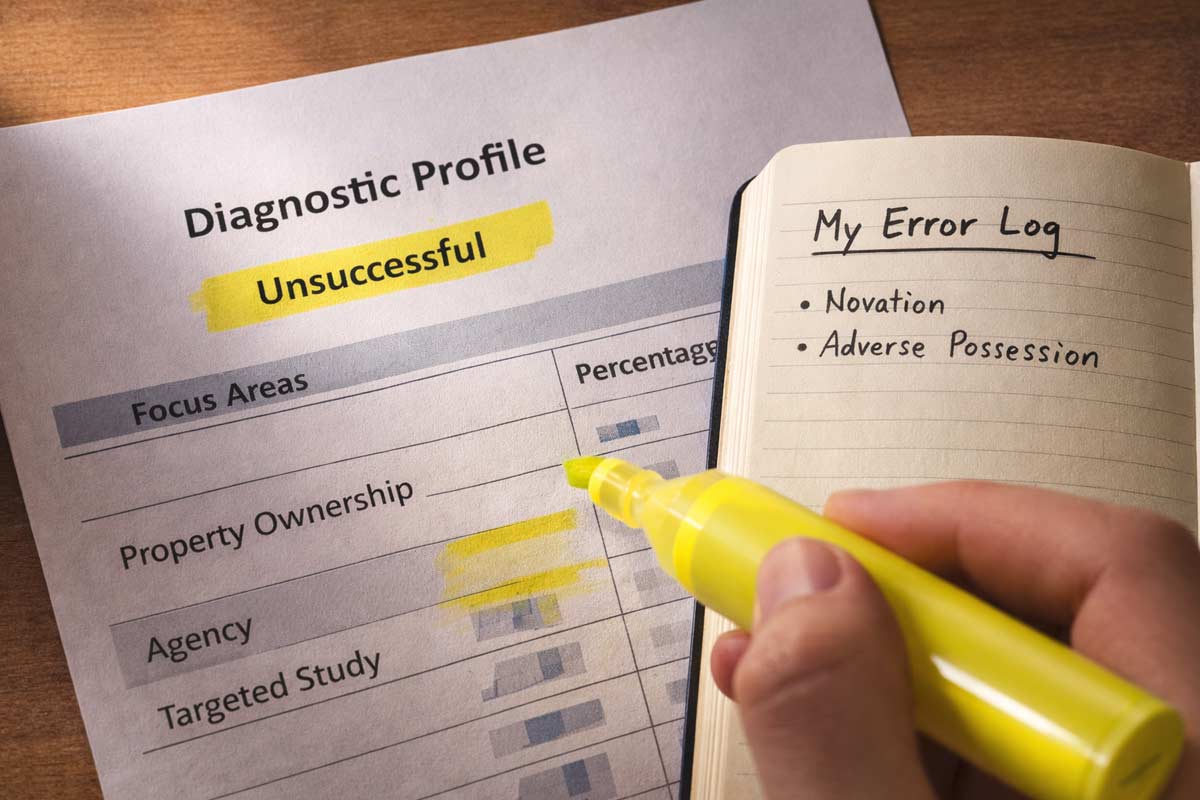
Review Today: Analyze your diagnostic profile to see which of the seven categories (e.g., Property Ownership, Land Use) need work.
Confirm Eligibility: Ensure you are still within your two-year application window.
Wait for the System: Do not attempt to reschedule until the DRE has fully processed your "Unsuccessful" result.
What Happens Immediately After You Fail
In California, you typically receive your results at the testing center. If you didn’t pass, you will receive a notification containing a diagnostic profile. This document is your roadmap; it breaks down your performance percentage in each major category.
The "Golden Hour" Reconnaissance
Before the specific details of the questions fade, perform a "brain dump":
Recall 10 Questions: Write down ten topics or specific questions that confused you.
Analyze Pacing: Did you finish with an hour to spare, or were you rushing to beat the clock?
The "Strategy" Check: Did you change your answers frequently? Real-world scenario: We often see students second-guess themselves from a passing score down to a failing one. Trust your first instinct.
Protecting Your Focus
Avoid a "panic spiral" by staying off unverified forums or Reddit. Every test-taker’s experience is subjective; trust your official diagnostic data over internet anecdotes that may lead to conflicting advice or wasted study time.
How to Retake the Exam
To reschedule the CA real estate exam, you must apply for a re-examination and pay the current fee.
The Re-Examination Rules
The Two-Year Eligibility Window: You must pass the examination within the two-year period following the date your initial application was filed. If you do not pass within this window, your application expires, and you must re-establish eligibility to try again.
Waiting for Results: DRE does not publish a fixed "waiting period" (such as 30 days) between attempts. However, you must wait until your results have been officially processed and received before you are eligible to reapply.
The "Submit Once" Rule: DRE explicitly warns candidates to submit their reschedule application only once—either online or by mail. Multiple submissions can lead to duplicate charges or your records being flagged for review.
One Date at a Time: You can only be scheduled for one exam date at a time. Rescheduling an existing appointment typically removes your current date.
Avoid the "System Flag": Attempting to obtain a new exam date before your previous results are processed can result in your records being withheld and the assessment of additional fees.
Verify Your Logistics
Before you head back, review the Identification Requirements for the CA Exam and the California Real Estate Exam Rules & Testing Policies to ensure no administrative errors disrupt your next attempt.
Why People Fail (and How to Fix It Fast)
Most failures fall into one of four patterns. Identify yours to adjust your strategy:
Failure Pattern
What it looks like
The Professional Fix
The Content Gap
Seeing terms like "Novation" or "Adverse Possession" and feeling lost.
Focus on the glossary. Real estate is a vocabulary test at its core.
The Strategy Gap
Narrowing it to two answers and always picking the wrong one.
Practice the "distractor" method: find why three answers are wrong instead of why one is right.
The Physiology Gap
Crashing or losing focus around question 100.
Build stamina. Take full-length, timed sets to mimic the 3-to-4-hour window.
The Logistics Gap
Arriving stressed due to traffic, ID issues, or prohibited items.
Review What to Bring to the California Real Estate Exam 48 hours early.
The 14-Day Comeback Plan
Don’t wait months to retake. Momentum is your ally.
Days 1–3 (Weakness Blitz): Study the two lowest-scoring categories on your diagnostic profile.
Days 4–7 (The Error Log): Take practice questions and write down why you missed them. Understanding the "why" prevents repeat mistakes.
Days 8–11 (Simulated Testing): Take full-length sets (150 questions for Salesperson, 200 for Broker). Build your sitting stamina for the actual 3-to-4-hour exam window.
Days 12–13 (High-Probability Review): Review Agency, Contracts, and Practice of Real Estate and Mandated Disclosures.
Day 14 (The Reset): Light review only. Confirm your location and pack your ID.
Simulating Success: The CrashCourseOnline.com Method
If your diagnostic profile showed gaps in specific areas, the most common mistake is to "just study more." You don't need more study; you need simulation. While nobody has the exact questions that are on the test, our proprietary system at crashcourseonline.com is engineered to closely simulate the concepts tested on the exam. We categorize our 1,100+ practice questions into the same seven categories found on your official results notice, allowing you to hyper-focus on your weakest subjects.
Frequently Asked Questions
How soon can I retake the California real estate exam?
DRE does not publish a fixed numeric wait time; however, you must wait until your current results are processed and received before the system will allow you to reapply.
How do I reschedule or reapply after failing?
The most efficient method is using the DRE eLicensing portal. You will select "Re-Examination," pay the fee, and select a new date.
Do my pre-license course certificates expire?
No. According to the DRE, pre-license course approvals for the three required college-level courses do not expire. You only need to focus on passing the state exam itself.
What happens if my two-year application window expires?
If you don't pass within two years of your application date, you must submit a new application, pay the initial fees, and re-establish eligibility.
Your Next Steps
This attempt didn't give you a license, but it gave you data. Now, we execute the plan. Once you clear this hurdle—and you will—you can look forward to What Happens After You Pass the CA Real Estate Exam.
For a comprehensive look at the entire journey, consult our California Real Estate Exam Guide.
Step 1: Download your diagnostic profile from the DRE eLicensing portal.
Step 2: Schedule your re-exam once the system allows to lock in your momentum.
Step 3: Start your Error Log based on your 10 "reconnaissance" questions.
Need a hand with the data?
If you have your diagnostic profile and aren't sure how to prioritize your study hours, reach out. We can help you build a targeted schedule based on your specific score breakdown.
|
Seeing the word "PASS" after you leave the Department of Real Estate (DRE) testing center is a massive milestone. You’ve successfully navigated the 150-question hurdle that stalls thousands of aspiring Read more...
Seeing the word "PASS" after you leave the Department of Real Estate (DRE) testing center is a massive milestone. You’ve successfully navigated the 150-question hurdle that stalls thousands of aspiring agents every year.
However, after over 20 years of preparing candidates for this moment, the most important truth I can share is this:
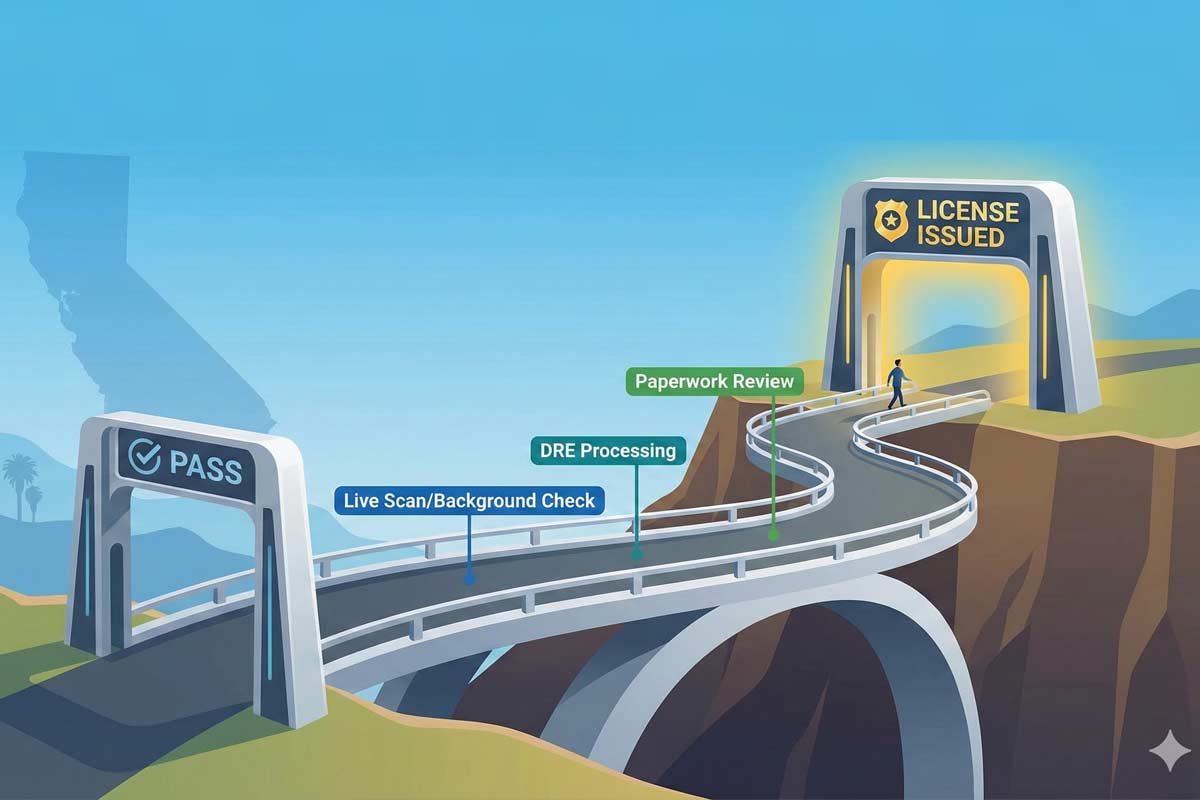
Passing the real estate exam is the end of your studies, but it is only the beginning of the licensing process. Understanding exactly what happens after you pass the CA real estate exam is critical to ensuring you don’t get stuck in a months-long "administrative gap" caused by paperwork errors or timing mistakes.
The Big Distinction: "Pass" vs. "License Issued"
A common mistake new candidates make is assuming they can hit the ground running the second they walk out of the testing center.
The Professional Reality: You do not have a license yet; you have a passing score. You cannot legally perform any activities that require a license—including representing yourself as a licensed salesperson to the public—until the DRE officially issues your license number and your status reflects as "Licensed" in their public database and your license is placed with a broker.
Consider this scenario: A candidate passes on Tuesday, celebrates on social media by calling themselves a "licensed agent," and begins soliciting clients on Wednesday. Because their license hasn't been officially issued, they are technically practicing without a license, which can lead to disciplinary action before their career even begins.
Two Common Paths After You Pass
Your next steps depend entirely on which application path you chose at the beginning of this journey.
Path 1: Exam + License Combo Applicants
If you filed the ,b>Salesperson Exam/License Application (RE 435) and paid both fees upfront, your path is generally the most streamlined.
What Happens Now: The DRE already has your intent to be licensed. Once your passing score is uploaded (usually within a few business days), they move straight to your background check and licensee issuance.
Your Move: Check if your license was issued here. This path is often the fastest when your file is clean and your fingerprints clear quickly.
Path 2: Exam-Only Applicants
If you only applied to take the test using form RE 400A, the DRE has no record of your license application yet.
What Happens Now: You must log into the DRE eLicensing system to download the Salesperson License Application (RE 202). You have exactly one year from your pass date to submit this application; if you miss that window, you must retake the exam - This is one of many reasons ADHI Schools recommends the combo exam/license application.
Your Move: This form must be submitted along with your Live Scan Service Request (RE 237) and the required licensing fee. Follow the DRE instructions for the current submission method (mail or other accepted electronic methods).
Decision Helper: Which path did I choose?
If you paid $450 in DRE fees up front, you are likely a "Combo" applicant. If you only paid the $100 exam fee and never submitted license materials, you are "Exam-Only." You can verify your application history by logging into your DRE eLicensing profile.
The Post-Pass Checklist: Actionable Steps to Your License
To avoid the "delay cycle," follow this checklist with the precision of a professional agent.
Verify Your Identity Consistency: Ensure the name on your application matches your government-issued ID exactly. For a refresher on why name matching is vital for identity consistency, see our guide on Identification Requirements for the CA Exam.
Access Forms via eLicensing: Use the DRE’s eLicensing portal to download your RE 202 (if applicable) and to track your status. Ensure you follow all current DRE instructions for how to submit these documents once completed.
Handle the Live Scan: If you haven't completed your fingerprints, do so immediately. The DRE cannot issue a license until they receive fingerprint responses from the DOJ and FBI.
Secure Your Sponsoring Broker: While the DRE can issue your license as Licensed NBA (No Broker Affiliation), you cannot perform licensed acts or earn commissions until you are affiliated with a responsible broker.
Maintain Professional Standards: Exam-day policies are strict, and the licensing process is strict too—don’t treat either casually. Refer to the California Real Estate Exam Rules & Testing Policies to remember the level of discipline the DRE expects from its applicants.
How Long Does It Take After Passing?
Processing times for after passing the California real estate exam fluctuate based on the DRE’s current volume. The DRE regularly updates their processing timeframes on their website, showing the "as of" dates for the applications they are currently reviewing.
Reviewable files (no missing signatures, correct fees, clear fingerprints) move through the system as soon as they are reached in the queue.
Deficient files (missing initials, mismatched names, or incorrect fees) are sent back to the applicant, which can add significant delays to the timeline.
To speed up the process:
Use the exact, current fee amount
Keep a copy of your Live Scan RE 237 with your ATI number to prove the fingerprints were transmitted.
Ensure all required signatures—including your sponsoring broker’s—are in the correct boxes.
If Something Goes Wrong: The Two Failure Modes
Even after passing, two common issues can stall your career:
The Administrative Loop: This is usually caused by sloppy paperwork. Revisit our list of What to Bring to the California Real Estate Exam as a reminder that professional success always starts with meticulous documentation and clean logistics.
The Support Gap: If you have colleagues who didn't make it this time, they may need to review our guide on What Happens If You Fail the CA Real Estate Exam to help them plan their retake.
Pro-Level Guidance: Think Like a Professional Already
The transition from "student" to "licensee" is your first official real estate transaction. Success in this business depends on paperwork discipline and responsiveness.
Be Meticulous: Real estate is a game of contracts. Treat your RE 202 with the same care you would a million-dollar purchase agreement.
Be Proactive: Check eLicensing regularly to see if your license number has been generated.
Build Habits Early: Use this waiting period to interview brokers and set up your business foundation.
FAQ: Post-Exam Essentials
How long after passing the CA real estate exam do I get my license?
It varies based on the DRE's current queue. "Combo" applicants often see results faster, but separate applications generally take several weeks for processing and background clearance.
Can I work as an agent after I pass the exam?
No. You cannot legally perform any acts requiring a license until your status is officially "Licensed" in the DRE database and you are working under a broker.
What if my name doesn’t match my documents?
This will cause an administrative delay. The DRE requires your legal name to be consistent across your ID, exam record, and background check.
What’s the difference between passing and getting a license issued?
Passing means you've met the testing requirement. "Issued" means the DRE has verified your application, fees, and background, granting you the legal authority to practice.
Your Next Step
Your journey to a successful real estate career is just beginning. To ensure you stay on the right track and avoid common pitfalls, bookmark our master guide:
California Real Estate Exam Guide
|
Last Reviewed: February 2026 (Always verify the latest rules on the official California Department of Real Estate (DRE) website before your exam day.)
Quick Summary (TL;DR): To sit for the California Read more...
Last Reviewed: February 2026 (Always verify the latest rules on the official California Department of Real Estate (DRE) website before your exam day.)
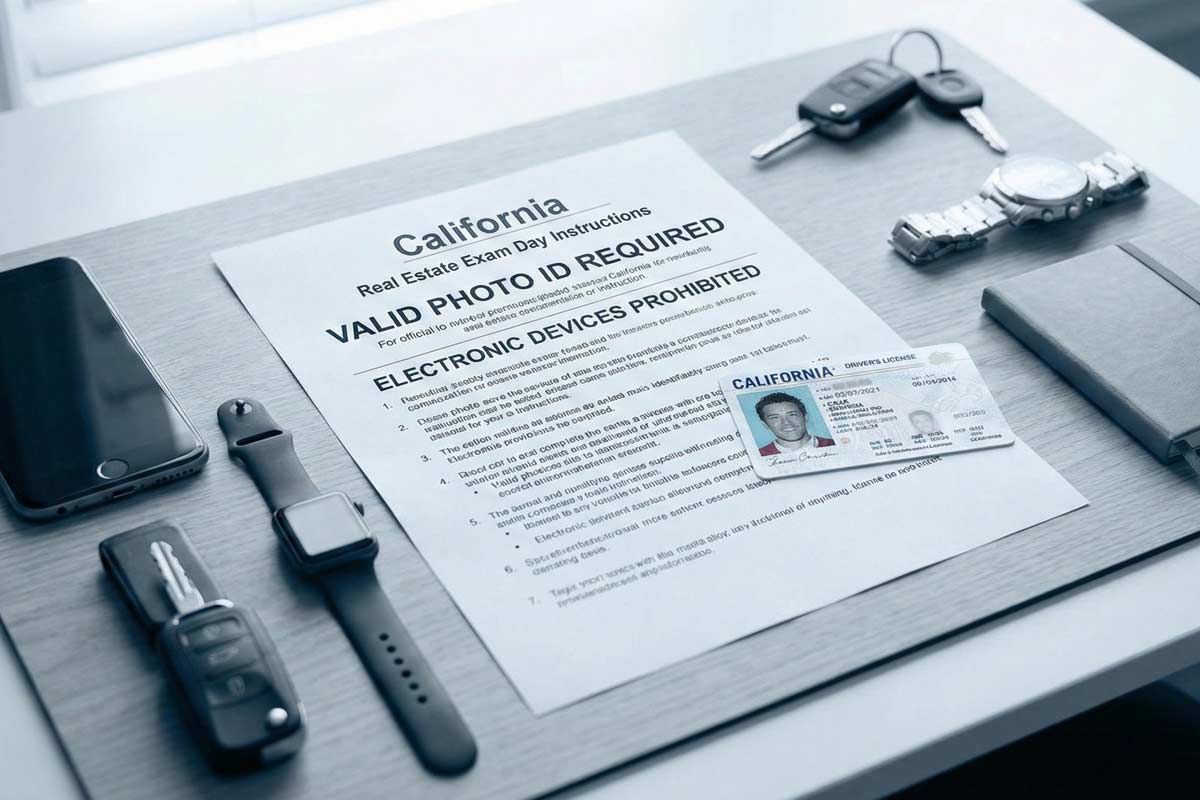
Quick Summary (TL;DR): To sit for the California real estate exam, you must present a valid government-issued photo ID that matches your registration name. Electronic devices—including phones and smartwatches—are prohibited in the testing room. Plan to arrive at least 30 minutes early; severely late arrivals are often denied entry and may need to reschedule.
The biggest obstacle to passing your California real estate exam shouldn’t be the check-in desk. Every year, qualified candidates are turned away or disqualified—not for lack of study, but for violating a small set of non-negotiable exam-day rules.
With over 20 years of preparing candidates, I have seen the preventable errors that delay months of hard work. This guide cuts through the anxiety and gives you the rules you need so your only job on exam day is answering questions.
The 80/20 Rule: The Policies That Most Often Get Candidates in Trouble
Most exam-day issues stem from a handful of avoidable mistakes. Focus your attention here:
Identification issues: An invalid, expired, or unacceptable ID is the fastest way to be denied entry.
Prohibited personal items: Phones, watches, bags, and even your own pens can trigger disqualification if brought into the testing room.
Late arrival: Sessions begin promptly—arrive early or risk being denied entry and potentially forfeiting your exam fee.
Food, drink, and study materials: These are not permitted in the testing environment.
Not following instructions: Proctors enforce exam-security rules strictly.
Identification & Name-Match Policies: Your Non-Negotiable Entry Ticket
Your photo ID is your passport into the exam. The DRE is explicit about what is accepted and what is not.
What you must present
You must show one valid, original, government-issued photo ID from the authorized list:
A current state-issued driver’s license or DMV identification card.
A valid U.S. Passport (or a passport issued by a foreign government).
A valid U.S. Military identification card.
The critical name-match reality
Your registration and application must be under your legal name. Common friction points that lead to entry denial include:
Middle Names: Middle initial on one document vs. full middle name on another.
Life Changes: Marriage/divorce name changes not reflected consistently across your documents.
Shortened Names: Using nicknames like “Mike” vs. the legal name “Michael.”
Pro-Tip: If your identity cannot be verified cleanly against the roster, proctors may deny entry. Reconcile any discrepancies at least two weeks before your exam date.
For a full breakdown of documentation and common mismatch fixes, see Identification Requirements for the CA Exam.
Security Screening & Personal Belongings
Knowing the “logistics of the lobby” reduces day-of stress. Here is the standard flow at many exam sites:
Check-in: A proctor verifies your ID and matches you to the roster.
Storage: You will be directed to store personal belongings (typically in lockers, or a designated storage process if lockers are limited).
The Phone Rule: Phones must be powered off and stored as directed. Possession or use of a phone during the exam session—including during breaks—can lead to immediate disqualification.
Final Entry: Once cleared of personal items, you will be assigned a seat.
Best practice: Leave valuables at home or secured in your vehicle. Bring as little as possible to the site.
Prohibited Items: What Not to Bring
The DRE maintains an “Examination Control Information” list. Bringing prohibited items into the testing room can lead to immediate disqualification.
Category
Prohibited Items
Electronics
Cell phones, smartwatches, fitness trackers, tablets, laptops, cameras/recording devices.
Personal Items
Purses, wallets, keys, backpacks, briefcases, suitcases.
Stationery
Your own pens/pencils, paper, notes, flashcards.
Accessories
Hats/caps, lapel pins, tie tacks, smart glasses.
Consumables
Food, drinks/water bottles, gum, and candy.
"Bring Less, Bring Right" Checklist
To ensure a frictionless check-in, only have these items on your person when you approach the proctor:
Your valid, original government-issued photo ID.
Your car key (if not attached to a bulky keychain).
A light sweater or jacket (testing rooms can be chilly).
If you want the “positive list” of what to bring (so you don’t over-pack), read What to Bring to the California Real Estate Exam.
Timing Rules: Arrival, Late Policy, and Breaks
Arrival: Plan to arrive at least 30 minutes early to allow time for check-in, storage, and security.
Late policy: If you arrive after the session has started, you may be denied entry and required to reschedule (which can mean losing your slot and paying again).
Breaks: The exam is a continuous sitting. If you step out for any reason, assume your exam clock continues and follow the proctor’s procedure.
Test-Day Conduct: Disqualification & “Don’t Do This”
No communication: Don’t speak to or signal other candidates.
No copying: Don’t look at other screens or attempt to reconstruct questions to share later.
Absolute compliance: Follow proctor instructions immediately and without argument.
Violations can result in the exam being terminated and may affect future licensing applications.
Special Situations: Accommodations and “What If…”
Testing accommodations: If you need accommodations (e.g., extra time), you must request and receive approval through the official DRE process well before your exam date.
Medical/comfort aids: Items like insulin pumps or braces may require advance notice for screening—handle this early.
If you are turned away: Don’t panic. Fix the underlying issue (renew ID, correct name mismatch, etc.) and follow our recovery plan in What Happens If You Fail the CA Real Estate Exam.
Final Exam Day Checklist & Next Steps
If you follow these rules, you’ll clear check-in smoothly and can spend your mental energy on the exam itself.
If you pass, read: What Happens After You Pass the CA Real Estate Exam
For the complete roadmap and context, visit the: California Real Estate Exam Guide
Frequently Asked Questions (FAQ)
1. Can I wear a watch during the exam?
No. Watches (including smartwatches) are commonly prohibited. Plan to rely on the on-screen timer.
2. Can I bring my phone if it stays in the locker?
Yes, but it must be powered off and stored exactly as instructed. Do not access it during breaks.
3. What if my ID expired yesterday?
You will likely not be admitted. Your ID must be valid on the exam date.
4. Can I bring my own calculator?
Typically no. There is no longer any math on the California real estate exam and the testing sites no longer provide calculators or dry erase boards.
5. How early should I arrive?
At least 30 minutes before your scheduled start time.
|
If you are researching your next career move at 11:00 PM after a long shift or while the kids are finally asleep, you probably have one burning question:
Can you get a California real estate license Read more...
If you are researching your next career move at 11:00 PM after a long shift or while the kids are finally asleep, you probably have one burning question:
Can you get a California real estate license online?
The short answer is: Mostly, but not entirely.
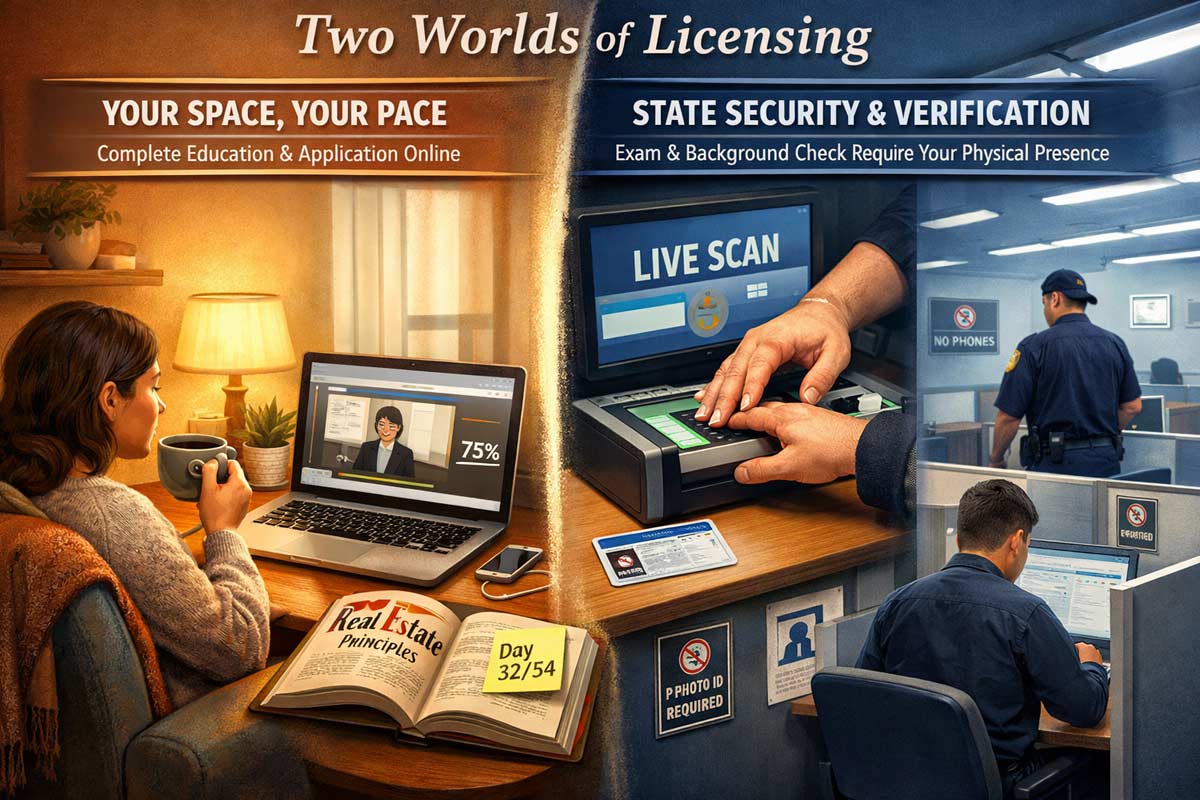
While the California Department of Real Estate (DRE) has embraced digital transformation—allowing you to complete your education and submit your paperwork from your couch—there are still physical "gatekeepers" that require you to show up in person.
The Reality Check: Online vs. In-Person
What You CAN Do Online
What You MUST Do In Person
Complete all 135 hours of pre-licensing courses.
Sit for the actual State Exam at a DRE exam center.
Submit your application via eLicensing.
Get your Live Scan (digital) fingerprints taken.
Pay your application and license fees.
Present valid government-issued photo ID.
Manage your license renewals later on.
Physically attend the testing center.
The Bottom Line: You can complete 100% of your required education online, but the State of California requires you to physically appear for your exam and your background check. It is important to check the fine print: while the "schooling" is digital, the "licensing" still has a few real-world milestones.
Defining "Online" in the California Licensing Process
When people ask about getting a California real estate license online, they are usually referring to the flexibility of the curriculum. In California, you are required to complete three college-level courses: Real Estate Principles, Real Estate Practice, and one elective.
At ADHI Schools, we’ve spent over 20 years helping students navigate this. We know that for a busy professional, the ability to take online real estate courses in California is the difference between starting a career and just dreaming about one.
However, the "license" itself isn't a digital download. It is a credential granted by the state after you prove your knowledge in a proctored, high-security environment.
The 18-Day Regulatory Rule For Coursework
In California, DRE regulations specify that a student must spend a minimum amount of time with their course materials before they are eligible to take a final exam. This is typically implemented as a seat-time requirement of 18 days per course. Because you must take three courses, your total minimum education time is 54 days—a timeline that applies even if you are the fastest reader in the state.
Step-by-Step: What Parts Can Be Done Online?
To help you plan, here is the numbered flow of the licensing process, showing exactly where the "online" part ends and the "real world" begins.
Pre-Licensing Education (Online): Complete your three courses (Real Estate Principles, Practice, and an elective). This takes a minimum of 54 days due to mandated study timers.
Application Submission (Online): Use the DRE eLicensing system to submit your combined Exam/License application.
Live Scan Fingerprints (In Person): You must visit a Live Scan provider to have your fingerprints electronically transmitted to the DOJ and FBI.
The State Exam (In Person): Once your application is processed, you will schedule a date to visit one of the five DRE testing centers (Sacramento, Oakland, Fresno, La Palma, or San Diego).
License Issuance (Digital/Mail): Once you pass, the DRE processes your results. You can often see your license number online before the paper certificate even arrives.
What Must Be Done In Person (And Why)
The DRE takes the integrity of the real estate profession seriously. The reasons you can't do it all from a laptop come down to two things:
Security and Compliance.
Exam Integrity: To prevent cheating and ensure that the person taking the test is actually the applicant, exams are held in monitored facilities where phones and notes are prohibited.
Identity Verification: Live Scan fingerprinting ensures that your criminal background check is tied to your actual identity, which requires a physical "chain of custody" at a licensed provider.
Expert Tip: If you’re in a rush, you’ll want to look into the fastest way to get a real estate license in California.
Timeline Planning
If you are trying to map out your calendar, your "online" progress is the most predictable part of the journey. Once you move into the "in-person" phase, you are at the mercy of DRE processing times and exam seat availability.
For most students, a realistic schedule involves finishing the online coursework while simultaneously preparing their paperwork. For a detailed breakdown of these phases, check out our California real estate license timeline. If you're wondering how those months look on a week-to-week basis, read our deep dive on California real estate license timeline.
Cost & Convenience Reality Check
While you save time and gas money by choosing to get a real estate license online in California, you still need to budget for the state-mandated fees.
As of 2026, the DRE fee for a salesperson exam is $100, and the original license fee is $350, totaling $450 paid directly to the state. Additionally, you will need to account for Live Scan fingerprinting. This involves a $49 state processing fee, plus a "rolling fee" charged by the private provider (typically $30–$45).
For a full breakdown of every nickel and dime, see our guide on how much it costs to get a real estate license in California.
Common Misconceptions
"I can take the state exam from home." No. You must travel to a DRE-approved testing site.
"Online courses are instant." No. California law requires you to spend a minimum amount of time with the material (typically 18 days per course).
"Once I finish courses, my license is automatic." No. Finishing courses only makes you eligible to apply for the state exam.
"Online = instant approval." Even if you submit online, the DRE may take several weeks to review your file and authorize you to test.
FAQ Section
Can I take the California real estate exam online from home?
No. The California State Exam must be taken in person at one of the Department of Real Estate’s designated testing centers to ensure exam security.
Can I complete the required real estate courses online?
Yes. You can complete all 135 hours of required pre-licensing education (Principles, Practice, and an elective) through an approved online provider like ADHI Schools.
Do I have to do Live Scan in person?
Yes. Live Scan requires a physical scan of your fingerprints by a certified technician at a licensed provider. This cannot be done via a smartphone or home scanner.
How long does it take if I do everything possible online?
Most students finish in 3 to 5 months. This accounts for the 54-day mandatory study period and current DRE administrative processing times.
What is the fastest way to get licensed in California?
The fastest route is to submit a "Combined" Exam and License application and complete your Live Scan immediately after finishing your online courses to avoid "dead time" while waiting for your test date.
How much does it cost to get licensed in California?
You should budget roughly $600 to $1,100 total. This includes your online course tuition, the $450 in DRE exam and license fees, and your Live Scan fingerprinting costs.
What is the most common reason people get delayed?
The most common delay is waiting to schedule the state exam. If you wait until after your courses are finished to start your DRE application, you may find yourself in a weeks-long queue for a testing seat.
Ready to Start Your Journey?
The road to a new career starts with the right map. While you can't do everything online, choosing a flexible, high-quality online education provider is the best way to maintain your current lifestyle while building a new one.
For a comprehensive look at the entire process, visit our California Real Estate License Guide.
|
You’ve seen the word "PASS" on the screen at the exam center. It is a massive milestone, but it is important to understand one thing immediately:
Passing the real estate exam is not the same as having Read more...
You’ve seen the word "PASS" on the screen at the exam center. It is a massive milestone, but it is important to understand one thing immediately:
Passing the real estate exam is not the same as having a license issued.
Until the California Department of Real Estate (DRE) processes your formal application and issues a license number, you cannot legally perform acts requiring a license or collect a commission. This is the final administrative step between passing and practicing, and navigating it correctly prevents administrative delays that can push back your start date in the market.
ADHI Schools typically recommends the DRE Exam/License Combo application for speed. While it requires paying both the exam and license fees upfront, it often reduces the back-and-forth after you pass and helps you move from ‘passed’ to ‘license issued’ faster. That said, many applicants don’t choose the combo (or aren’t sure which path they’re on), so this guide walks you through exactly what to do after passing—step by step.
Quick Summary
Determine your path: Confirm if you filed a "Combo" or "Exam Only" application via eLicensing.
Background clearance: Ensure your Live Scan fingerprints are submitted; issuance is gated by the DRE's receipt and screening of DOJ/FBI reports.
Documentation: Submit the appropriate application and the required $350 fee (if not already paid).
Activation: Decide whether you’ll issue as "Inactive" or "Active" with an employing broker.
Verification: Check your status and Current Processing Timeframes on the official DRE website.
The 60-Second Post-Pass Checklist
Verify Exam Status: Confirm "Pass" reflects in your eLicensing account.
Check Application Type: If you filed the Combo, track your status—do not submit a second application.
Live Scan: Have you performed your fingerprints?
Broker Info: Do you have your employing broker’s license number? (Optional for issuance, required for "Active" status).
Form Accuracy: Ensure your name matches your government ID exactly to avoid identity mismatches.
Step 1: Identify Which Path You’re On
Before you fill out new forms, you must know if the DRE already has your license application.
If you...
Your Path is...
Your Next Move...
Paid the $450 combo fee
Combo Application
Monitor eLicensing. Ensure Live Scan is done.
Paid the exam fee only
Post-Pass Path
Submit Salesperson License Application + $350 fee.
If you are unsure which path you followed, review your initial How to Apply for the California Real Estate Exam steps or check your payment history in eLicensing.
Operator Tip: If you’re unsure, check your eLicensing payment and application history before submitting anything new—duplicate filings can slow the review process.
Step 2: Complete the Application Correctly
If you are on the "Post-Pass" path, you must submit the Salesperson License Application (RE 202).
Name Consistency: Use your legal name exactly as it appears on your ID.
Disclosure Accuracy: Be thorough regarding past criminal convictions or disciplinary actions. Inconsistencies here commonly trigger follow-up requests and delay issuance.
Avoid This Delay: Check the Common Mistakes Applicants Make on DRE Forms to ensure your paperwork doesn't get kicked back for a simple oversight.
Step 3: Live Scan & Background Clearance
The DRE will not issue an original license until DOJ and FBI reports are received and screened. This is often the "pending trap" where applications sit for weeks while background checks process.
The Form: Use the official Live Scan Service Request (RE 237).
The Process: Review the DRE’s Fingerprint Requirements to ensure you are using a certified provider.
Tracking: Keep your ATI number (found on the bottom of your Live Scan form) in case the DRE asks you to reference your submission.
Step 4: Fees and Document Hygiene
Fees must be exact. According to the official DRE Fee Schedule:
Salesperson Original License: $350
Salesperson Exam & License (Combo): $450
Operator Tip: Confirm the payment processed successfully and save the confirmation/receipt from eLicensing. If filing by mail, ensure you haven't missed a signature or a page. Unreadable uploads or incomplete paper packets are common "paper cuts" that add weeks to the process.
Step 5: Understanding Broker Affiliation
You can get your license number issued even if you haven't picked a company yet.
Active Status: Your employing broker provides their license number and signs your application (manually or via eLicensing).
Inactive Status: You submit the application without broker info. You will receive a license number, but you cannot legally perform real estate activities until you affiliate with an employing broker and activate your status.
What Delays Licenses (Operator Warnings)
Name Mismatch: Ensure your name on your Live Scan matches your DRE application exactly.
Missing Signatures: A single missing signature on a mail-in RE 202 will result in a deficiency letter.
Failed Payments: Always verify your transaction status in eLicensing before closing your browser.
Unreadable Uploads: Avoid blurry phone photos; use a proper scanner for all document uploads to the portal.
Real Scenarios from 20+ Years of Experience
The "Identity Mismatch" Delay: A student passed and mailed their RE 202 using a nickname. The DRE couldn't match the application to the Live Scan results (filed under a legal name), resulting in the application being set aside.
The Fix: Check your Live Scan receipt against your application before hitting "submit."
The "Sponsorship" Wait: A candidate believed they couldn't apply for their license until they were hired. They waited three weeks to even start the paperwork.
The Fix: Submit your license application immediately after passing; you can update your "employing broker" status in minutes once you make a hiring decision.
FAQ
How long after I pass does it take to get my license?
There is no "standard" time, but you can track progress via the DRE Current Timeframes page.
Do I need fingerprints if I already did Live Scan for the exam?
If the DRE already has your fingerprints on file for this application cycle, you typically don’t need to redo them.
What happens if my application is incomplete?
The DRE will notify you of the "deficiency." You will have to correct the error, which essentially puts your application at the back of the processing queue.
Can I work immediately after passing?
No. You must wait until your status shows as "Active" on the DRE Public License Lookup.
Your Next Step
Navigating the final steps of California licensing is about precision. By following this sequence, you reduce the risk of your application sitting on a desk for the wrong reasons.ADHI Schools typically recommends the DRE Exam/License Combo application for speed, but this guide ensures you can reach the finish line regardless of which path you chose.
Ready to ensure your paperwork is perfect?
Explore our California Real Estate License Guide for a complete roadmap.
|
Choosing a real estate school in California is the first major "business decision" you will make. It’s also the first time you’ll encounter the noise of the internet in the real estate world. If you Read more...
Choosing a real estate school in California is the first major "business decision" you will make. It’s also the first time you’ll encounter the noise of the internet in the real estate world. If you spend five minutes looking for student reviews of online real estate schools in California, you will find two extremes: glowing 5-star testimonials that sound like marketing copy, and 1-star "rage reviews" from students who felt abandoned by a computer screen.
In over 20 years of helping thousands of Californians through this process, I’ve noticed a consistent pattern: a school’s 'user experience' and its 'educational results' aren't always the same thing.
The truth?
Reviews are a tool, but only if you know how to read between the lines. Here is how to filter the noise and find a school that actually gets you licensed.
Quick Take: The 2026 Review Filter
Look for Outcomes, Not Ease: A "fast and easy" course often leads to a "difficult and repeated" state exam.
Check the Date: California DRE regulations and exam topics shift; reviews older than 12-18 months are less relevant.
Identify the Support Model: "Great support" should mean access to human experts, not just a technical help desk.
The Goal is the License: Prioritize reviews that mention "passing the state exam" over those that only mention "finishing the hours."
What Students Most Commonly Praise (and what it actually indicates)
When you see a 5-star review, you need to determine if the student is praising the convenience or the effectiveness.
“The platform was so simple and fast.”
In 2026, user experience matters, but "simple" can be a double-edged sword. If a platform is too simple, it may be because it lacks the depth required to pass a high-stakes exam. Students often praise a school for letting them click through quickly, but this rarely translates to retention. This is why many online real estate school reviews in California overemphasize convenience while underreporting exam outcomes. How long students should expect real estate school to take depends on the quality of the material, not just the speed of the software.
“Great support whenever I had a question.”
You must define what "support" means in these reviews. Does it mean a live person answered a question about contract law, or does it mean someone helped them reset their password? Real support—the kind that actually gets you licensed—is about how you learn, not just how the website works. Look for reviews that mention instructors who clarify complex topics like encumbrances or agency disclosure.
“The practice questions were just like the exam.”
This is the gold standard of praise. If multiple reviewers mention that the school's preparation tools mirrored the actual California State Exam environment, that is a high-value signal. It suggests the school prioritizes exam readiness over course completion.
While the exact exam questions are never public, a great program prepares you for the logic behind them. This ensures that no matter how a question is framed, you have the knowledge to answer it correctly.
What Students Most Commonly Complain About
Negative reviews are often more revealing than positive ones, but they require a "root cause" analysis.
“No one would help me / I felt like a number.”
The Root Cause: Many online schools are "set it and forget it" models. They provide the PDFs but no bridge to a human being.
How to Verify: Before enrolling, call the school. If you can’t get a human on the phone during business hours now, you won't get one when you’re stuck on Chapter 7 later.
“The materials felt outdated.”
The Root Cause: The California real estate market and laws change. A school using a curriculum from ten years ago is doing you a disservice.
How to Verify: Check if the school mentions 2026 updates or current DRE standards.
Do online real estate classes actually prepare you?
Only if the content reflects the current exam pool.
“I fell behind and lost my motivation.”
The Root Cause: Purely self-paced courses require 100% of the discipline to come from the student. Repeated complaints like this point to a system problem, not a character flaw.
The Reality: This isn't always the school's "fault," but it indicates a lack of an accountability framework. If you see this often, it means the school provides the "what" but not the "how" of staying engaged.
The Review Pattern Test: Your 3-Minute Audit
Don't read every review. Apply this framework to the top 20 reviews you find for any California real estate school.
Rule
What to Look For
The Specificity Rule
Does the reviewer mention a specific chapter, instructor, or "lightbulb moment"? (High Value)
The Recency Rule
Is the review from 2025 or 2026? Tech and DRE rules move fast. (High Value)
The Outcome Rule
Does it say "I passed the state exam"? That is the only metric that matters. (Highest Value)
The Support Signal Rule
Do multiple reviews mention access to instructors or real humans beyond tech support? (Trust Signal)
The 1-Star Filter
Is the reviewer mad about a refund policy they didn't read, or a fundamental lack of teaching? (Context is Key)
Student Checklist for Review Auditing:
Did the reviewer pass on the first or second attempt?
Does the school offer physical textbooks (often a sign of a more serious program)?
Are there mentions of "live" components or webinars?
Does the "clunkiness" mentioned in reviews affect the learning or just the aesthetics?
What Reviews Can’t Tell You (The "Hidden" Factors)
Even the best online real estate school reviews in California have blind spots. There are things you must verify directly with the school:
DRE Compliance: Is the school currently approved for the specific courses you need? Check the DRE website directly.
Repetition Logic: Does the system force you to review what you got wrong, or does it just let you move on?
Your Study Environment: A 5-star school won't help you if you’re studying on a phone in a noisy coffee shop. The optimal study setup for real estate school is as important as the curriculum itself.
Holding Periods: California law requires a minimum of 18 days per course. This is one reason timelines in reviews often conflict with reality. Some reviews complain about "delays" that are actually legal requirements the student didn't understand.
Decision Matrix: Which School Type Fits You?
Based on common student feedback, here is how to choose your path:
The "Busy Professional": Look for reviews mentioning mobile-friendly formats but high-quality physical books for weekend deep-dives.
The "Anxious Test-Taker": Prioritize schools with "heavy" practice question banks and live exam-prep crash courses.
The "Discipline Challenged": Avoid "pure" self-paced schools. Look for reviews that mention how to stay motivated during real estate school through instructor check-ins or structured schedules.
Reviews are Input, Not the Decision
In my experience, the students who succeed are those who treat their education like a job interview. They don't just look for the cheapest or "easiest" option. They look for a partner that provides the structure they lack and the expertise they need.
Reviews tell you about the experiences of others, but they don't guarantee your outcome. Your success depends on your ability to find a school that balances modern convenience with old-fashioned academic rigor.
To see how we categorize the different types of programs available today, view our complete guide on the Best Real Estate Schools in California.
|
Submitting your renewal in eLicensing feels like the finish line—and emotionally, it is. But operationally, the next 48 hours are where most avoidable problems happen. Between payment clearing lags, Read more...
Submitting your renewal in eLicensing feels like the finish line—and emotionally, it is. But operationally, the next 48 hours are where most avoidable problems happen. Between payment clearing lags, public lookup delays, and administrative roster updates, the transition from one license cycle to the next requires a few specific "operator" moves.
I have spent 20+ years helping California agents navigate licensing and compliance, and have seen the same pattern repeatedly: the biggest renewal headaches don’t happen during renewal—they happen when agents don’t document and verify what they just submitted.
The “I Just Renewed” Quick Checklist (10–20 Minutes)
Verify status + new expiration date in the DRE Public License Lookup.
Download/save your eLicensing receipt or transaction summary.
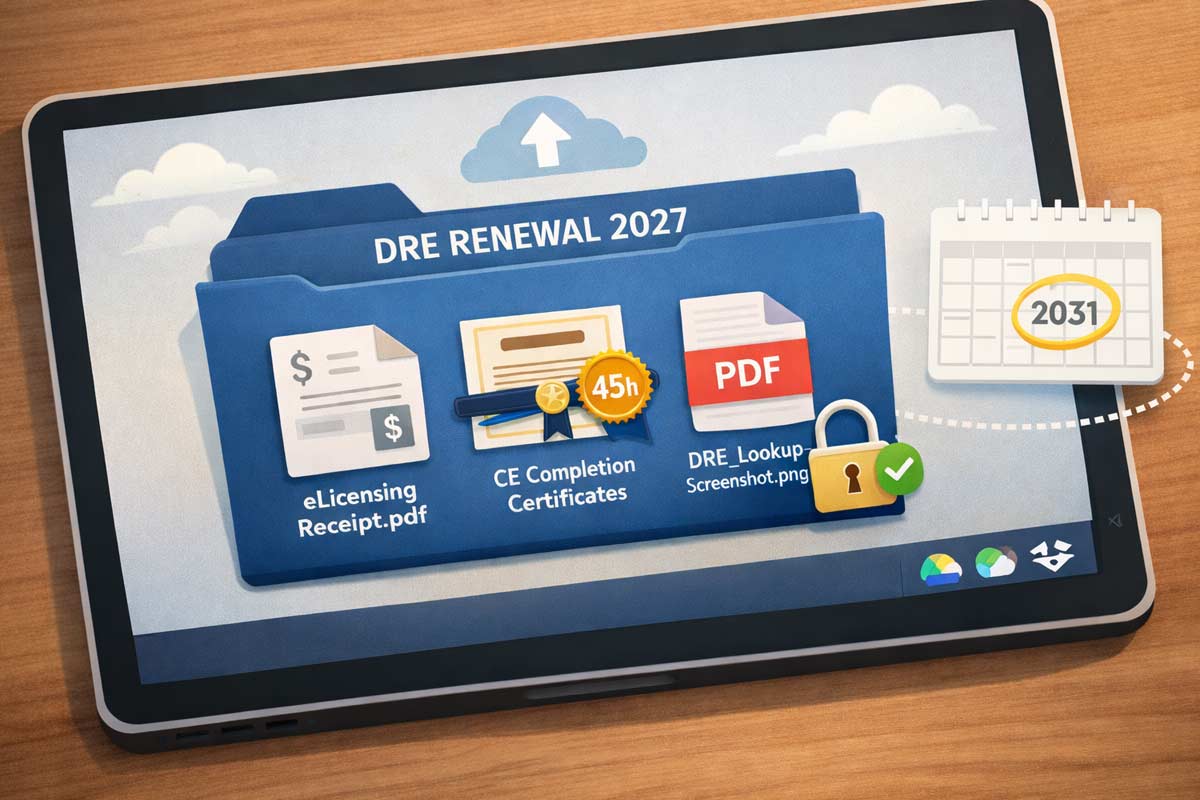
Store all 45-hour CE completion certificates in one “Audit Folder.”
Provide updated proof to your broker/office admin (if your brokerage requires it).
Add renewal reminders to your calendar for the next cycle (set for 3 years, 9 months out).
Quick compliance sweep: Audit your email signature and key marketing touchpoints for DRE # placement (common best practice).
How to Verify Your California Real Estate License Renewal Status
Don’t assume the final confirmation screen means everything is fully complete. Occasionally, payment issues, data-entry mistakes, or processing delays can leave your renewal in a “pending” state longer than expected.
What to check in the DRE Public License Lookup:
Expiration Date: This is the most important indicator. Has it officially advanced to the new four-year cycle?
Status: Does it show "Active" (or the correct current status for your situation)?
Accuracy: Confirm name and license number details look correct.
Real-World Scenario:You renew over the weekend. Monday morning, your office admin says your status hasn’t updated yet. This doesn't necessarily mean something is wrong, but you should monitor the portal until the expiration date officially moves forward.
Step 2: Build Your “Renewal Proof” File (DRE Audit Ready)
The DRE can request CE documentation after renewal. If you can’t produce proof when asked, it can create a serious compliance issue regarding a task you already completed.
CA DRE > Renewals > 2026 Renewal (CE + Receipt)
We recommend keeping these records for at least five years. In practice, you should assume you are the primary record-keeper; the DRE will not "call your school" to reconstruct your file during an inquiry.
Notify Your Broker and Update Compliance Records
Many brokerages maintain internal compliance files and may ask for proof your renewal is complete. This is essential risk reduction. You don't want a lender, title company, or office compliance officer flagging your license status as "Expired" or "Pending" in the middle of an active escrow.
Make sure your license status in internal systems aligns with the public record. For more context on why CE and documentation matter long-term, see How CE Helps Agents Stay Out of DRE Trouble.
Resetting the 4-Year Clock: Planning Your Next Renewal
The best time to plan your next renewal is the day after you complete this one.
Calendar it: Set a reminder for 3 years and 9 months from now so you’re never scrambling at the 11th hour.
Plan smarter: Requirements and options often differ between first vs. subsequent renewals. Don’t guess—use the California Real Estate License Renewal Guide as your reference point for the next cycle.
Step 5: Turn Renewal Into Momentum
Renewal clears mental bandwidth—use it to restart your pipeline with a simple relaunch.
Two-week relaunch sprint:
Database touches: Reach out to 30–50 past clients or warm contacts. Use the "new license cycle" as a subtle reason to confirm your contact info is current in their records.
Marketing sweep: Spend 15 minutes ensuring your DRE license number is present on all "first point of contact" materials, as this is a common compliance expectation.
Red-Flag Mistakes to Avoid
Losing certificates: Assuming "the system has them." You should always maintain your own copies.
Losing the receipt: This is your only proof of payment and submission if a technical error occurs.
Ignoring the date: Not verifying that the expiration date actually moved forward in the public lookup.
Address/Email changes: Forgetting to update your profile in eLicensing if you moved during the renewal period.
Frequently Asked Questions
How long does it take for my renewal to show up in the public lookup?
It often updates quickly, but allow 24–48 hours for processing. If it hasn’t updated within that window, use your receipt as proof of submission and contact the DRE licensing department.
What if I entered a course number incorrectly?
Handle it early. Keep your receipt and contact DRE licensing support to correct the record rather than waiting for an inquiry later.
Do I need to mail certificates to the DRE?
Typically no—renewals are handled through eLicensing—but you must keep digital copies of certificates in case documentation is requested during an audit.
Can I work if my status says “Pending”?
If you are uncertain about what “pending” means for your ability to perform licensed activity, coordinate with your broker or office compliance department immediately.
I lost my certificates—what now?
Contact your CE provider. Reputable schools (like ADHI Schools) usually retain course completion records for a specific period and can reissue proof upon request.
Your Post-Renewal Action Plan (Do This Today)
Verify your status and expiration date in the DRE public lookup.
Archive your receipt and CE certificates into one permanent cloud folder.
Check the California Real Estate License Renewal Guide to ensure you're set for the next cycle.
|
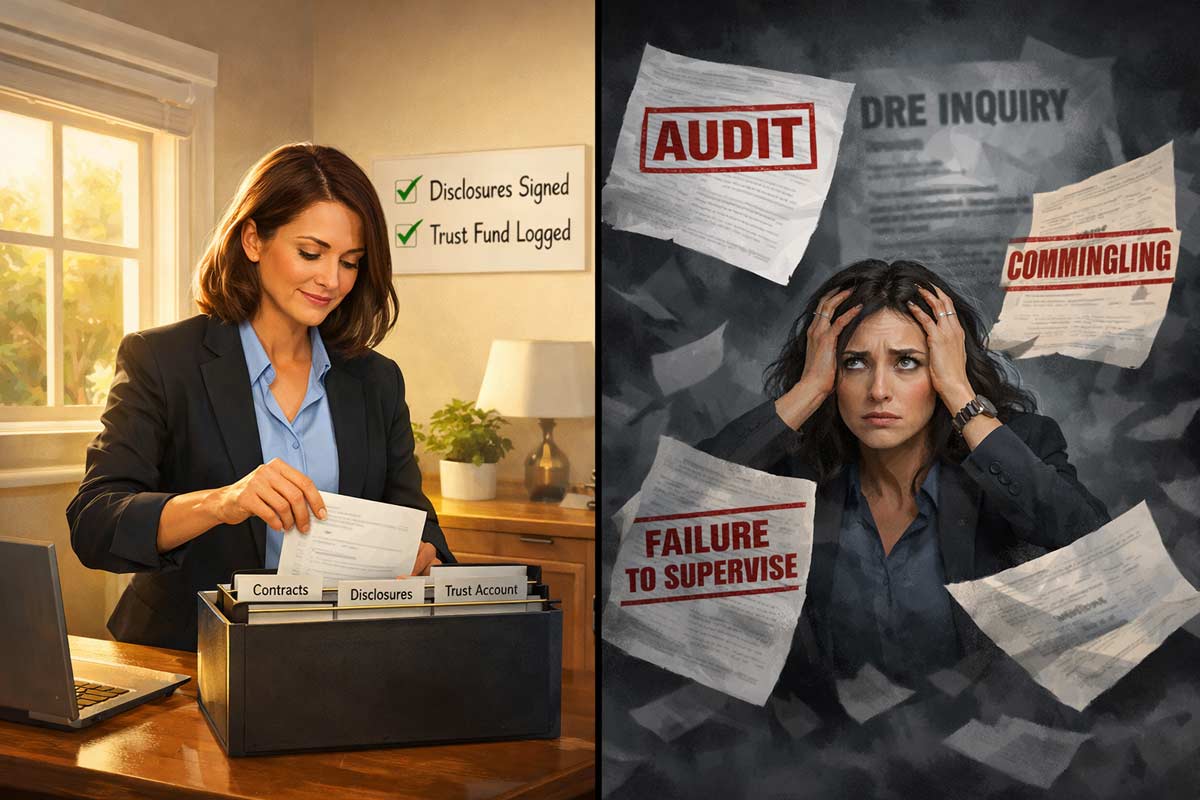
The most stressful mail a licensee can receive isn't a lost commission check—it's an inquiry letter from the California Department of Real Estate(DRE).
Most agents don’t set out to break the law; Read more...
The most stressful mail a licensee can receive isn't a lost commission check—it's an inquiry letter from the California Department of Real Estate(DRE).
Most agents don’t set out to break the law; they fall into "DRE trouble" because of outdated habits or misunderstood regulations. In my 20-plus years of advising California licensees, I’ve seen that the best defense isn't a legal team—it’s a solid operational foundation. This is where Continuing Education (CE) shifts from a bureaucratic hurdle to a professional firewall to help agents avoid DRE violations.
Key Takeaways
Reduces Complaint Risk: Identifies the "red flag" behaviors that trigger consumer grievances.
Prevents Audit Deficiencies: Ensures your trust fund and transaction records meet DRE standards.
Forces Documentation Habits: Moves compliance from a "memory task" to a repeatable system.
What “DRE Trouble” Actually Looks Like
DRE trouble rarely starts with a "bad" person; it starts with a bad process. Here is how the regulatory machinery typically moves:
Consumer Complaints: Often triggered by a frustrated client, these lead to an investigative inquiry that can open up your entire file history.
Audit/Document Requests: Whether random or "for cause," an auditor will scrutinize your transaction folders and trust fund records for technical accuracy.
Renewal Delays: Simple errors in your CE reporting or incomplete requirements can lead to a "deficiency" notice, potentially causing your license to expire while you scramble to fix it.
Disciplinary Actions: This can range from a private citation and fine to a public "Accusation" that may result in a restricted license or revocation.
Disclaimer: This article provides educational information on compliance and is not intended as legal advice.
The 80/20 of What Gets Agents in Trouble
The DRE focuses on patterns. Most violations happen in these high-risk zones:
Advertising & Representation: Improper team names that omit the broker’s identity or missing license numbers on social media marketing.
Disclosure Failures: Missing "material facts" or failing to provide Agency Disclosure forms at the earliest practical moment.
Trust Funds & Records: The "cardinal sin." Commingling funds or failing to maintain a proper 3-column record of client money.
Management & Supervision: A major magnet for DRE trouble. Brokers are responsible for the oversight of salespersons and unlicensed assistants; a lack of a "reasonable system of supervision" is a frequent cause for discipline.
Records & Documentation: Failing to retain transaction-related documents for the required three-year period. If it isn't in the file, as far as an auditor is concerned, it didn't happen.
How CE Prevents Violations
When you approach your California Real Estate License Renewal with a focus on compliance, you treat each CE bucket as a defensive strategy.
1. Ethics & Disclosure
The Misunderstanding: "I only need to disclose things that are physically broken."
The Reality: California requires disclosure of anything that affects the value or desirability of the property.
The Scenario: An agent fails to mention a neighbor's recurring noise complaint. The buyer finds out, files a DRE complaint, and the agent faces an inquiry around misrepresentation.
CE Takeaway: Use your Risk Management CE to audit a recent Transfer Disclosure Statement (TDS) and Agent Visual Inspection Disclosure (AVID). If you're unsure, disclose it.
2. Fair Housing (Interactive Requirements)
The Misunderstanding: "I'm a good person, so I'm not violating fair housing."
The Reality: Bias in marketing and "steering" are primary DRE focus areas.
The Scenario: An agent tells a caller, "You'd probably be more comfortable in the neighborhood across town." Even if meant "helpfully," this is steering.
CE Takeaway: DRE renewal requirements now include interactive fair housing and implicit bias components. Use this training to practice compliant responses to client questions about "neighborhood demographics."
3. Trust Fund Handling
The Misunderstanding: "My broker handles the money, so the timing doesn't matter for me."
The Reality: If you touch a check, you are responsible for the record-keeping and handling according to DRE and brokerage-specific timelines.
The Scenario: An agent holds an earnest money check for several days without a written agreement to do so. An audit reveals the delay, leading to a citation for improper handling.
CE Takeaway: Implement a "Monday Morning" rule: any funds received must be logged and processed according to your broker's compliance manual immediately.
“Audit-Proof” CE Choices
To ensure your renewal goes smoothly and your files stay clean, use this checklist:
Verify Sponsor: Ensure the provider is a DRE-approved sponsor, like ADHI Schools, with a valid ID.
Interactive Requirements: Confirm you’ve completed the mandatory interactive fair housing and implicit bias components.
Correct Hours: Confirm you have the full 45 hours (or the required amount for your specific renewal cycle).
Storage: Save your certificates in a dedicated folder named CE-2026-Renewal-Certs.
DRE eLicensing: Upload your info early to avoid the last-minute "system is down" panic.
Post-Renewal: Your 30-Day “Stay-Out-of-Trouble” Plan
Once you’ve completed your CE, don't just file the certificates. Implement these operational habits:
Task
Action
Ad Audit
Review your Instagram bio, email signature, and website. Do they include your DRE number and brokerage name?
Complaint-Proofing
Start a "Communication Log" for every transaction. Document all verbal instructions from clients via a "confirming email."
File Hygiene
Spend 10 minutes every Friday reviewing your active transaction files for missing signatures or incomplete disclosures.
SOP Update
Ask your broker or manager for a simple one-page Standard Operating Procedure (SOP) for how your team handles "material fact" discoveries.
Once you’ve handled the technical side of the law, you can focus on the growth side of your business. For more on what to do once the renewal is submitted, see our guide on What to Do After Renewing Your CA Real Estate License.
Staying Compliant Is a Choice
AtADHI Schools, we build our CE courses around real-world compliance outcomes because we know a license is more than a piece of paper—it’s your livelihood. Think of CE as your biennial "compliance tune-up." It’s the most cost-effective insurance policy you can buy.
|
One of the most common questions we hear sounds like: “I upgraded to a broker license—do I have extra CE hours now?” or “Do I have to take different classes than when I had my sales license?”
The Read more...
One of the most common questions we hear sounds like: “I upgraded to a broker license—do I have extra CE hours now?” or “Do I have to take different classes than when I had my sales license?”
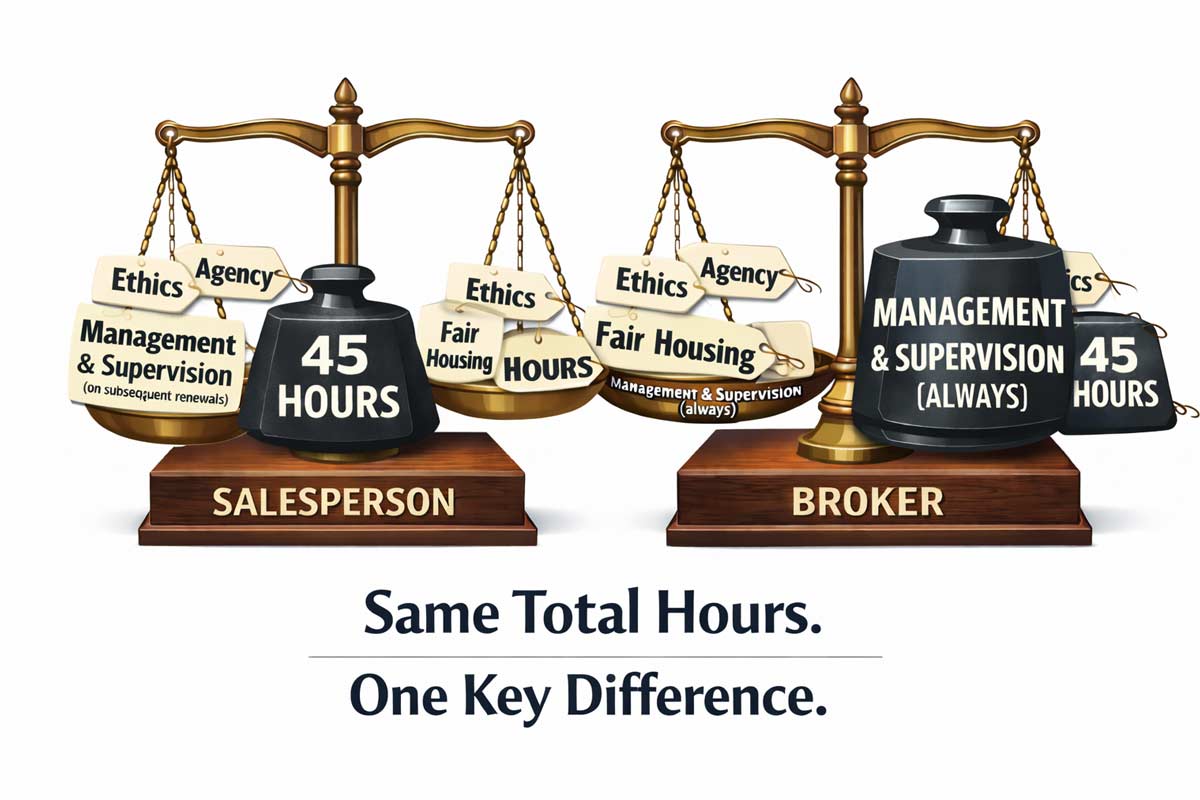
The confusion is understandable. In California, brokers carry a higher level of legal responsibility—so it feels like the DRE should require more education. The reality is simpler: the total hours are the same, but the required subject mix is where brokers can get tripped up.
Key Takeaways
Total Hours: Brokers and salespersons both complete 45 hours of DRE-approved CE each 4-year renewal cycle.
The Content Mix: Brokers must include Management and Supervision as a mandatory topic (salespersons don’t on their first renewal).
The 9-Hour Survey: For second and subsequent renewals (for licenses expiring on/after Jan 1, 2023), a 9-hour survey can cover all mandatory topics in one course.
Interactive Requirement: For licenses expiring on/after Jan 1, 2023, Fair Housing must include an interactive, participatory component.
Quick Answer: Broker vs. Salesperson CE
In California, brokers and salespersons both need 45 hours of continuing education to renew. The difference is what’s inside the 45 hours: brokers must ensure they complete Management and Supervision as part of their mandatory topic mix. While the total hour count is identical, the DRE requires brokers to undergo specific training related to their role as a potential supervisor.
Comparison Table: Salesperson vs. Broker Renewal
Feature
Salesperson (First Renewal)
Broker (First Renewal)
Second+ Renewals (Both)*
Total Hours
45 hours
45 hours
45 hours
Mandatory Core Courses
4 Subjects (3-hrs each)
5 Subjects (3-hrs each)
Included in 9-hour survey
Fair Housing
3-hr + Interactive Implicit Bias
3-hr + Interactive Implicit Bias
Included in 9-hour survey
Implicit Bias
2-hr Required
2-hr Required
Included in 9-hour survey
Mgmt. & Supervision
Not Required
Required
Included in 9-hour survey
*Applies to licenses expiring on/after Jan 1, 2023, and late renewals filed after that date.
What’s the Same for Everyone?
Regardless of license type, the DRE’s CE structure is built around consumer protection—so the baseline framework stays consistent. That’s why the California Real Estate License Renewal Requirements don’t "punish" brokers with extra hours.
The 4-year renewal cycle applies to everyone.
The total is always 45 hours—no "broker bonus hours."
Mandatory topics + consumer protection hours are the backbone of every renewal package.
What’s Different for Brokers?
If the hours are the same, why does broker CE feel different? Accountability.
A broker isn’t just responsible for their own files—they’re responsible for the supervision standard in the office: policies, advertising compliance, trust fund handling, and risk reduction. That’s why Management and Supervision is explicitly part of the broker requirement - even on the first renewal.
Operator Scenarios: Where Brokers Actually Get Exposed
The Supervision Trap: A broker assumes "supervision" just means reviewing contracts. In reality, brokers can be on the hook for agent advertising and compliance breakdowns across the entire team.
Trust Fund Risk: Most salespersons never touch trust fund handling—brokers live inside it. Small process errors can turn into big consequences during a DRE audit.
First Renewal vs. Subsequent Renewals
This is where people accidentally choose the wrong package. Your path depends on your renewal "generation."
1) First Renewal
First renewal requires the mandatory subjects as individual courses, plus the required Fair Housing and Implicit Bias components.
Salespersons: 4 separate 3-hour courses (Ethics, Agency, Trust Funds, Risk Management) + 3-hour interactive Fair Housing + 2-hour Implicit Bias.
Brokers: All of the above PLUS a 3-hour Management and Supervision course.
To avoid confusion, view the full roadmap here: California Real Estate License Renewal Guide
2) Second and Future Renewals
For licenses expiring on/after Jan 1, 2023, the DRE allows a 9-hour survey course that covers all mandatory topics (including Management and Supervision) in a single module. You then complete the remaining hours with electives—ideally from clearly qualified Courses That Count Toward CE in California.
7 Common Mistakes That Trigger Delays
REALTOR® Ethics vs. DRE Ethics: Assuming NAR training counts (it usually doesn’t unless the provider specifically issued a DRE-approved CE certificate).
Non-Interactive Fair Housing: Taking an old-style text course for Fair Housing when your license expires after Jan 1, 2023.
Missing Implicit Bias: Failing to ensure the 2-hour standalone course is in your package. See: Does California Require Implicit Bias Training for Renewal?
Overbuying Hours: Thinking brokers need more than 45. Confirm your California CE hour requirements before paying.
Unverified Providers: Using a "national" school that lacks a California DRE Sponsor Number.
Waiting Until the Final 24 Hours: Because of the 15-hour exam limit (see below), you literally cannot finish 45 hours in one day.
Wrong Package Type: A broker taking a salesperson package and missing the Management and Supervision credit.
Step-by-Step: Choosing the Right CE Package
Verify Sponsor Details: Ensure the school is DRE-approved.
Check Fair Housing: Confirm it includes the "interactive participatory component."
Respect the 24-Hour Rule: The DRE limits licensees to completing final examinations for a maximum of 15 credit hours per 24-hour period. If you have 45 hours of testing to do, you need at least three separate 24-hour windows to complete your exams.
FAQ
Do brokers need more CE hours than salespersons in California?
No. Both license types require 45 hours every four years.
Is Management and Supervision required for brokers?
Yes. It is mandatory for all broker renewals (first and subsequent).
What is the 9-hour survey course?
It's a condensed course covering all seven mandatory subjects, available only for second and subsequent renewals.
Does Fair Housing have to be interactive?
For licenses expiring on or after Jan 1, 2023, yes. This includes late renewals filed after that date.
How early can I renew?
You can submit your renewal via eLicensing up to 90 days before your expiration date.
Broker renewal shouldn’t create uncertainty or cause you to buy the wrong package. The goal is simple: meet the DRE requirements cleanly, protect your license, and keep your business.
|
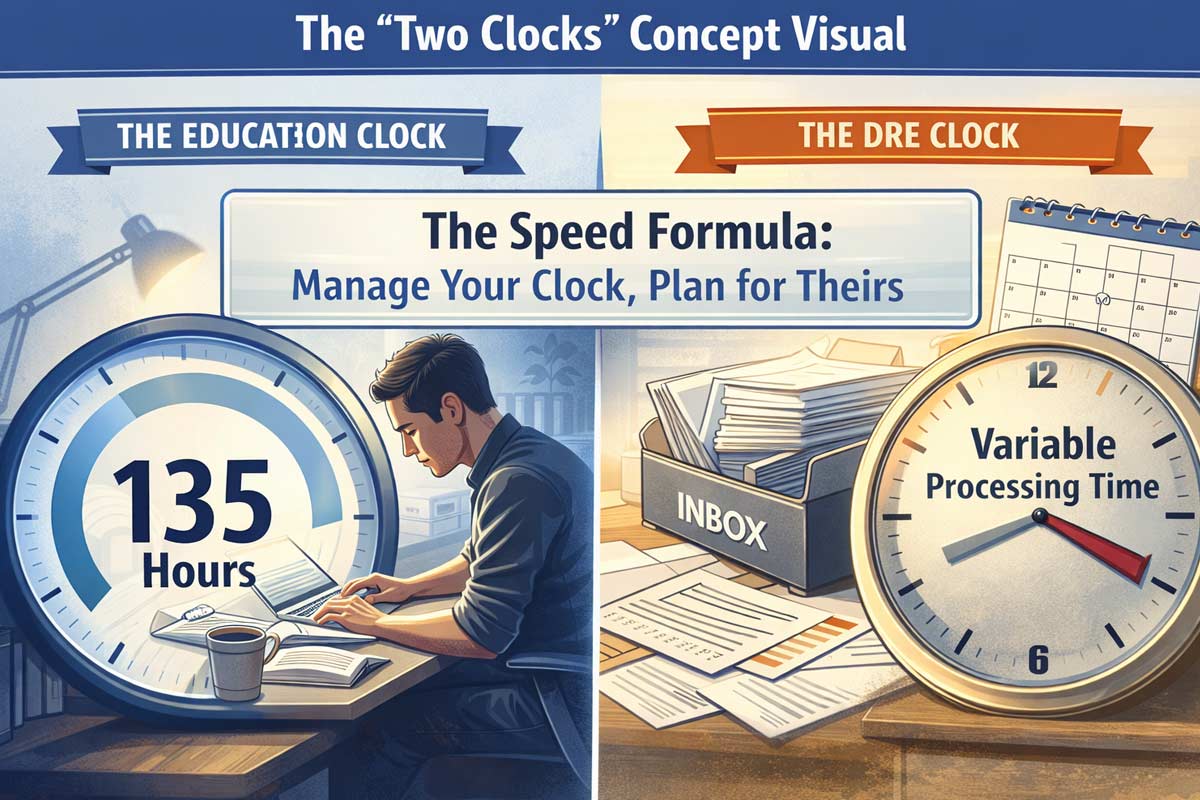
If you are eyeing a career change or a major commission goal, you probably want your license like yesterday. But in California, "fast" is governed by two different clocks that most students confuse:
Read more...
If you are eyeing a career change or a major commission goal, you probably want your license like yesterday. But in California, "fast" is governed by two different clocks that most students confuse:
The Education Clock: This covers the 135 hours of required coursework. Provider rules vary, and approved DRE-approved providers enforce a minimum access period before you can attempt a course final. The absolute "minimum" timeframe assumes you never miss a day of study and your provider’s pacing rules allow for aggressive, back-to-back completion.
The DRE Clock: This is the time it takes the Department of Real Estate (DRE) to process your exam/license application and move you forward in the system. The important detail is that processing speed isn’t fixed—it changes based on volume and the submission method. The most accurate way to set expectations is to check the DRE’s published Current Processing Timeframes and plan your education pace around that reality.
The "fastest" program isn't the one that makes empty promises; it’s the one that removes friction so you don't spend a single extra day in limbo.
TL;DR: The Speed Formula
Min. Education Time: Dependent on provider access rules - typically minimum of 54 days to complete all three courses. (18 days per course x 3 courses = 54 days)
DRE Processing: Varies by season—check DRE “Current Processing Timeframes” before you plan your target test month.
The Strategy: Finish your 135 hours while simultaneously preparing for the state exam so you pass on the first try.
What “Fastest” Actually Means in California
Speed is relative. A "fast" program helps you avoid the "Typical Path" where students stall out due to a lack of structure.
Phase
Typical Path
The Fast Path
135 Hours of Education
6–12 Months (Procrastination)
+/- 2 Months (Consistent Pace)
Application Submission
2 Weeks after finishing
Same day certificates arrive
Exam Prep
Starts after getting an exam date
Starts during the 135 hours
Passing the Exam
2–3 attempts
1 attempt (High Readiness)
The 4 Biggest Speed Levers (The Framework)
After 20 years of helping students at ADHI Schools, I’ve seen that speed isn't about how fast you read—it's about how you manage these four levers:
Format Fit: If you hate reading screens, a self-paced online course will be your slowest option because you’ll avoid it. Pick the format you will actually show up for.
Weekly Pace: Speed requires a calendar. We find that students who commit to 10 hours per week finish with the highest momentum.
Support Speed: When you’re stuck on a concept, waiting three days for an email reply kills your drive. Fast programs offer immediate clarity.
Completion Workflow: The fastest schools (like ADHI Schools) have automated certificate delivery and clear "Next Step" checklists. You shouldn't have to wonder how to apply for the state exam.
Speed Tip #1: The Concurrent Strategy
Don't wait until you finish your 135 hours to look at real estate exam prep. Start reviewing practice questions by your third week of study to keep the material fresh.
Fastest Education Formats (Pros/Cons)
There is no "best" format, only the one that keeps you moving.
Self-Paced Online
Best for: Highly disciplined individuals with erratic schedules.
Pros: Access 24/7; move as fast as the provider’s minimum access rules allow.
Cons: High "stall-out" rate. Without a teacher, many students stop mid-way.
Compare options in our guide to the Best Online Real Estate Schools in California (2026 Rankings).
Live Online (Livestream)
Best for: Career changers who need a "place" to be.
Pros: Scheduled classes prevent procrastination; real-time Q&A removes hurdles instantly.
Cons: You must adhere to the school's lecture calendar.
Check out the Best In-Person Real Estate Schools in California to see how structured environments compare to livestream.
The Hidden Bottlenecks That Slow People Down
Most students lose weeks to avoidable errors. I call these "Speed-Killers."
The Paperwork Trap: Sending an incomplete application to the DRE can result in a 60 day delay.
The Procrastination Gap: Taking a "break" between finishing Course 1 and starting Course 2.
The Overconfident Crammer: Trying to learn everything the night before the state exam, failing, and having to wait weeks for a re-take.
Speed-Killer Checklist:
Did you include your Live Scan (fingerprints) with your application?
Is your check/credit card info for the DRE accurate?
Have you scheduled 2 hours of study for tomorrow?
Speed Tip #3: Treat Live Scan like a first-week task
Many delays happen when students finish their education, then start gathering documents. If you’re trying to move fast, handle Live Scan and your application checklist early so you’re ready to submit immediately when certificates are issued.
How to Build a 30–60 Day “Fast Track” Plan
To finish the education portion efficiently, follow one of these blueprints:
Plan 1: The Aggressive Track (Full-Time Focus)
Monday–Friday: 3 hours of reading/quizzes (Morning block).
Saturday: 2 hours of review.
Goal: Complete each course the moment your provider’s access period allows.
Plan 2: The Busy Professional (Nights & Weekends)
Tuesday/Thursday: 2 hours (Evening).
Saturday/Sunday: 4 hours each day.
Goal: Finish the 135 hours in 8 weeks without burning out.
What to Look For in a “Fast” California Real Estate School
When evaluating schools, use this rubric to ensure they won't hold you back:
Transparent Access Rules: Do they explain their minimum course duration clearly?
Exam Prep Integration: Is the "how to pass" part of the "how to finish" process?
Mobile-Friendly: Can you knock out 15 minutes of reading while waiting for a coffee?
Alumni Volume: Large schools often have more streamlined systems. (See the Most Popular Real Estate Schools in California).
Price vs. Value: The Cheapest Real Estate Schools in California might save you $50 but cost you months in slow support or outdated materials.
FAQ
What is the fastest possible time to get licensed in California?
Realistically, the “fast track” is a few months, assuming you (1) keep a consistent weekly pace through the 135 hours, (2) submit your application immediately when your certificates are issued, and (3) prepare during the coursework so you pass on the first attempt. Because DRE volume changes, the most accurate planning tool is the DRE’s Current Processing Timeframes page.
Can I do all 135 hours in a weekend?
No. Pre-licensing is not the same as continuing education. A compliant pre-license program must document and administer the course in a way that matches the approved instructional time and delivery rules for licensing credit. If a provider implies you can complete the full 135-hour requirement in a weekend, the risk is simple: the credit may not hold up when you apply.
Does in-person make it faster?
Only if you are someone who won't study at home. Accountability is a massive speed booster.
Is self-paced always the fastest?
On paper, yes. In practice, no. Without a schedule, many students take a year to finish what should take two to three months.
What delays the DRE process?
Errors on the application, missing fingerprint receipts, or peak seasons when thousands of people apply at once.
Your Next Step
Speed is a byproduct of a good system. Choosing a program that aligns with your learning style is the single most important decision you will make. While you might be tempted by the "easiest" or "cheapest" option, the fastest way to start earning commissions is to choose a school that provides a clear, friction-free path to the state exam.
Ready to find the right fit?
Check out our comprehensive breakdown of the Best Real Estate Schools in California to compare programs and start your journey today.
TLDR: To get your California real estate license as fast as realistically possible, you must complete 135 hours of DRE-required pre-licensing education (Principles, Practice, and an elective) and then clear the DRE’s application + exam scheduling timeline. Course pacing depends on the provider’s access rules and your weekly schedule, while the DRE timeline fluctuates throughout the year—so the true “fast track” is finishing your education on a strict plan while preparing for the state exam at the same time, so you pass on the first attempt.
|