
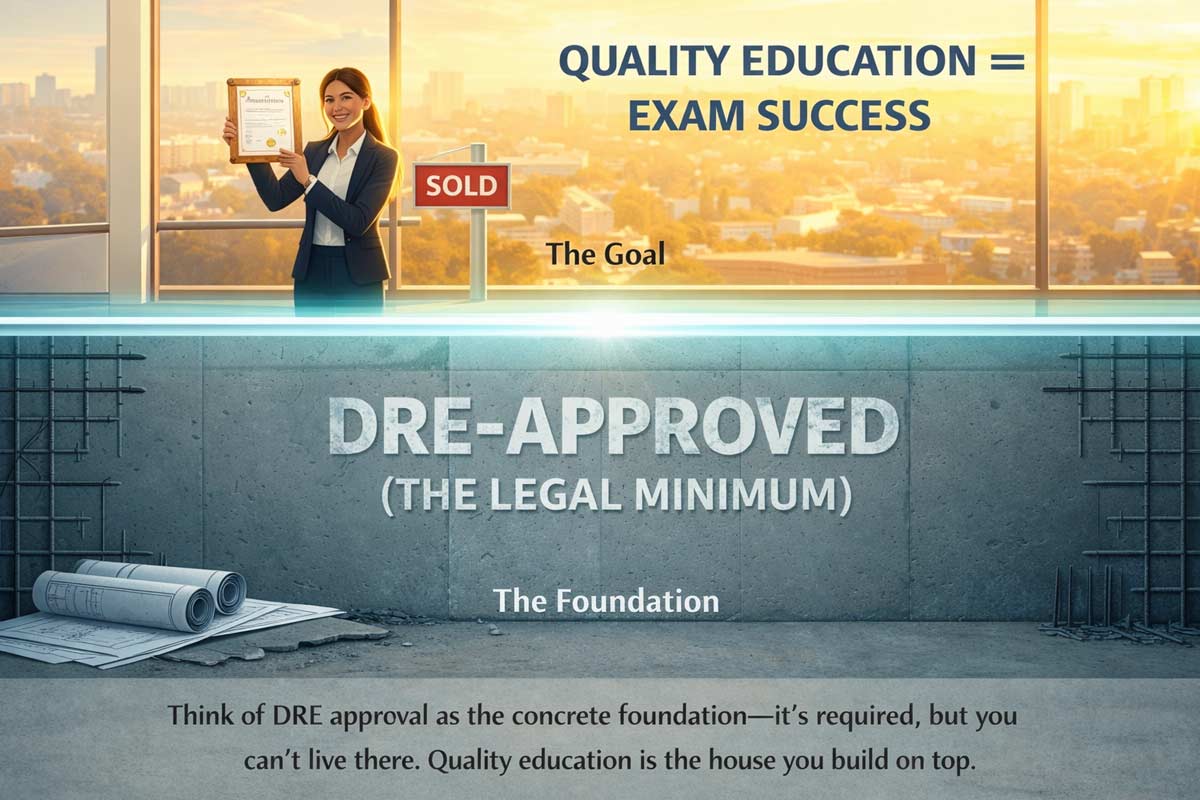
A DRE-approved real estate school is a California provider authorized to deliver the 135 hours of prelicensing education required for licensure.
If you are researching how to get your real estate license, you have likely seen the phrase “DRE-approved real estate school” and a statutory sponsor ID on every website you visit. In California, this isn’t just some kind of badge of honor—it is a legal necessity.
However, there is a common misconception among applicants that "approval" is a seal of excellence or a guarantee of a high pass rate. In my 20+ years of helping students navigate the California Department of Real Estate (DRE) requirements, I have seen many students get a false start at another program based solely on the word "approved," only to realize later that the curriculum was outdated or the support was non-existent and they come to us to actually finish.
This guide clarifies exactly what DRE approval means, what it doesn't mean, and how to verify a provider in minutes so you don't waste time or money.
In plain English, a California DRE-approved real estate school is a private vocational provider that has submitted its curriculum, policies, and instructors to the Department of Real Estate for review and received authorization to offer statutory courses.
When a school is approved, it means the DRE has determined that their courses satisfy the legal requirements for licensure. This is tied to two things:
It is important to understand that DRE approval is the "floor," not the "ceiling." It ensures the school follows the law, but it does not measure how well the school actually teaches the material or supports its students.
The DRE doesn't just hand out approvals. To become a DRE-approved real estate school, a provider typically must demonstrate compliance in several administrative and academic areas:
Takeaway: Approval ensures the "paperwork" of your education is valid so the state will accept your application.
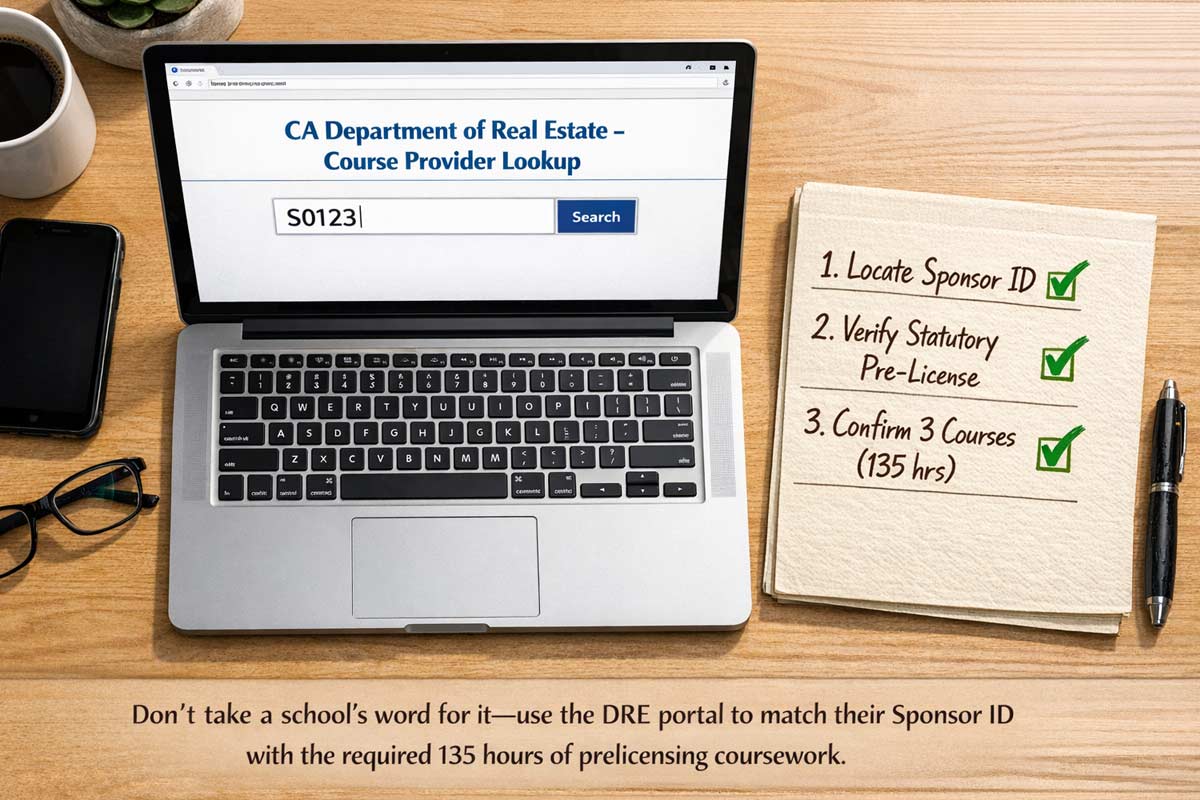
Never take a school’s word for it. In my experience, students occasionally run into "national" providers whose courses are not specifically formatted for California's unique legal landscape. Use this DRE course provider verification checklist to protect your investment:
When comparing programs, you may encounter marketing language designed to sound like "approval" without meeting the DRE’s specific criteria:
Once you have verified that a school is legally approved, your work isn't done. Approval only means the DRE says the school can teach; it doesn't say they should be the ones teaching you.
To find the best real estate schools in California, you need to look past the Sponsor ID and evaluate the actual learning experience.
Q: Is every real estate school in California DRE-approved?
A: No. There are many "educational" sites that offer coaching or "secrets," but unless they have a Sponsor ID and approved statutory courses, they cannot issue the certificates you need to take the state exam.
Q: What does DRE-approved mean for my certificate?
A: It means the certificate of completion you receive will be recognized by the DRE when you submit your Salesperson Exam Application.
Q: Can a school be approved but still provide a bad experience?
A: Absolutely. Many students regret choosing the cheapest “approved” school because the material was a "wall of text" with zero instructor support.
Q: Is a DRE-approved course enough to pass the state exam?
A: Typically, no. Prelicensing courses teach you the law. Passing the exam requires specific "test-taking" logic. This is why many students ask are crash courses worth it in California? to bridge the gap between "learning" and "passing."
Verifying approval protects your eligibility. Choosing the right school protects your time, confidence, and momentum. Verifying that a program is a DRE-approved real estate school is step one. It protects you from fraud and ensures your hours will count. However, step two is choosing a partner that will actually help you start your career.
If you are ready to move beyond the basics of "approval" and want to find a program that fits your learning style, read our full breakdown on how to choose a real estate school in California.
For a complete look at the top-rated providers in the state, visit our guide on the Best Real Estate Schools in California.

Founder, Adhi Schools
Kartik Subramaniam is the Founder and CEO of ADHI Real Estate Schools, a leader in real estate education throughout California. Holding a degree from Cal Poly University, Subramaniam brings a wealth of experience in real estate sales, property management, and investment transactions. He is the author of nine books on real estate and countless real estate articles. With a track record of successfully completing hundreds of real estate transactions, he has equipped countless professionals to thrive in the industry.

"Hey guys,
I took the exam today and passed!!!!
It only took me one try which was one of my goals. I took the online
classes and follow your suggestions so I took the crash course,
used the crash course app a lot, took 7 mock tests and went
confident to present the exam. Thank you for the great job you are
doing, you guys are awesome!!!! May God continue to bless you!"
Willie V.