
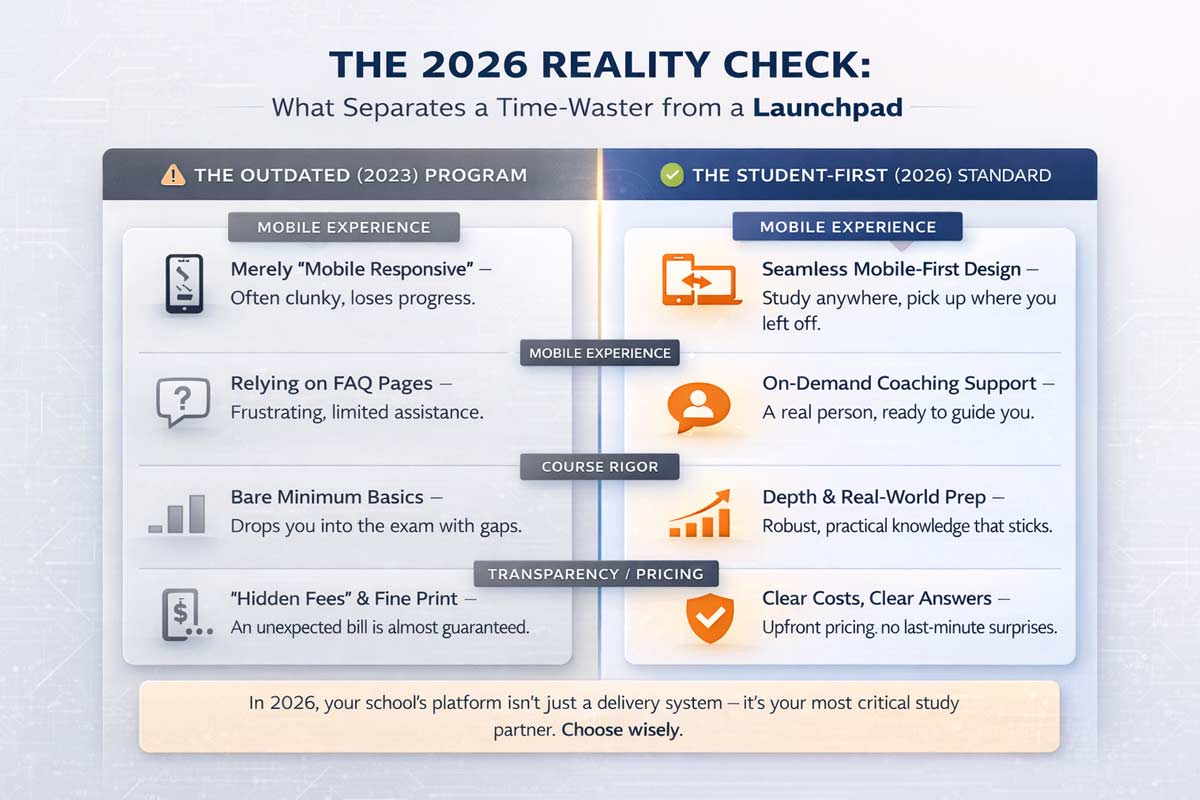
Choosing an online real estate school can feel like an endless loop of open tabs and conflicting opinions. And in real estate licensing, “close enough” isn’t close enough—if you enroll in a program that’s hard to use, light on support, or weak on exam prep, you don’t just lose money.
You lose momentum.
Over the last 20+ years, I have seen the same truth play out: the “best” online school isn’t a universal winner. It’s the one that fits how you actually learn and how your life actually runs. In the next 10 minutes, you’ll know which online format fits you, what to verify for compliance with the California Department of Real Estate, and which tradeoffs matter most—support, speed, or exam readiness.
In California, “online” can mean very different study experiences depending on the delivery method:
Three things separate “just acceptable” programs from programs that actually help students finish and pass:
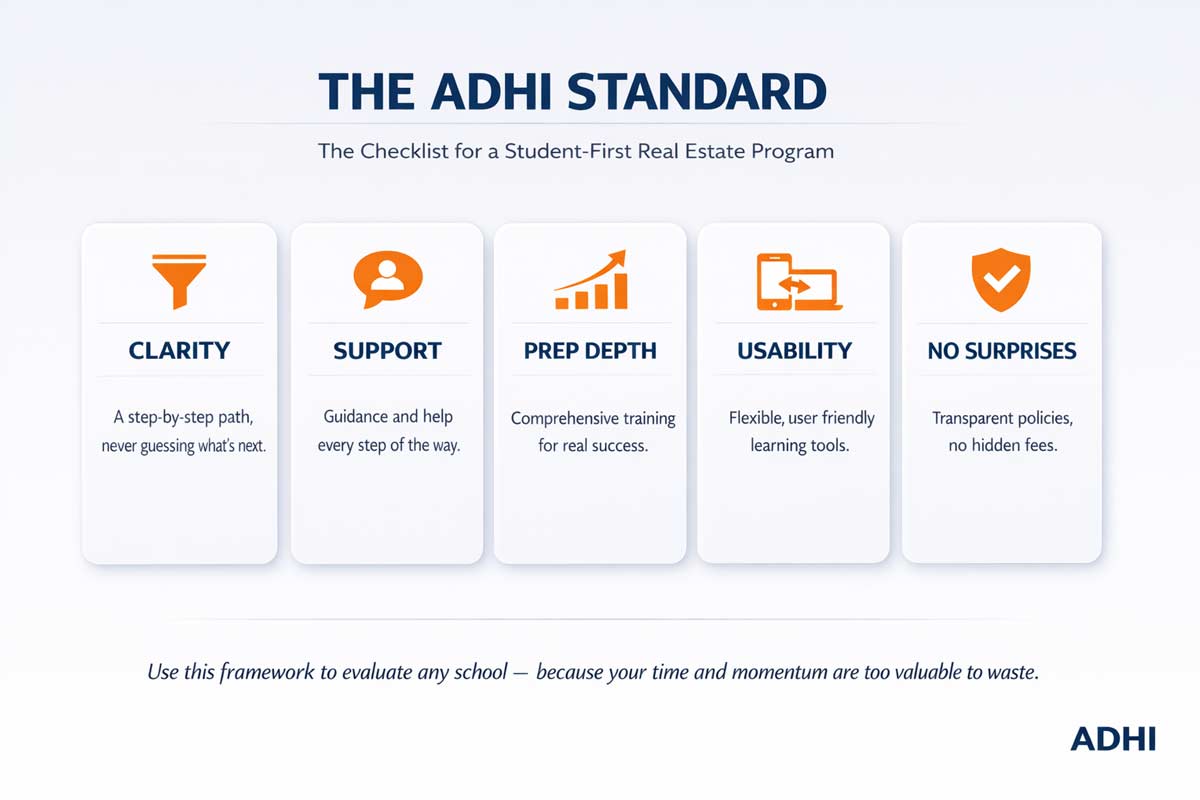
Instead of pretending there’s one perfect school for everyone, use this outcome-based framework. Find the category that matches your situation, then choose the program that checks the right boxes.
This isn’t about hype—it’s about what actually helps students finish. It’s also how ADHI designs programs internally:
Use that as your checklist when comparing options—no matter what provider you’re looking at.
Quick note: the DRE approves individual statutory courses (and assigns sponsor IDs/approval numbers). Always verify the course approvals—not just marketing claims.
DRE Course Approval: Verify the specific course approval/sponsor ID in the DRE database (secure.dre.ca.gov).
A lot of students start by looking for the Most Popular Real Estate Schools in California, but popularity doesn’t guarantee fit.
Choose online if you need schedule flexibility and you’re comfortable learning independently.
Choose in-person if you need a structured environment to stay consistent.
To compare online, in-person, cheapest, fastest, and popularity-based options side-by-side, use our Best Real Estate Schools in California hub.
Is online real estate school allowed in California?
Yes—California allows pre-license/statutory coursework to be completed through approved offerings, including online formats, as long as the course is properly approved/listed. (California Department of Real Estate)
How do I verify DRE approval?
Use the DRE statutory course search and confirm the specific course approval and sponsor details. Remember: DRE approval is tied to courses (with sponsor IDs/approval numbers), not blanket marketing claims. (California Department of Real Estate)
Self-paced vs. livestream—what’s better?
Self-paced is best for flexibility. Livestream is best for accountability and real-time Q&A. Hybrid works well if you want both.
Can I finish faster online?
Online programs can help you move efficiently because you aren’t waiting for scheduled class dates. That said, California rules limit how quickly statutory courses can be completed: a single course may not be completed in less than 2½ weeks, and no more than two courses may be completed in any five-week period. (California Department of Real Estate)
Does an online school include exam prep?
It varies. Some include robust prep tools in the base package; others treat it as an add-on. If you want to pass with fewer attempts, prioritize programs in the “Exam Prep Strength” category.
How long do I have access to the course?
Access lengths vary by provider. The key is to choose enough runway so you don’t feel forced to rush if work or life gets busy.
Ready to choose?
Compare online, in-person, cheapest, fastest, and popularity-based paths in our Best Real Estate Schools in California hub.

Founder, Adhi Schools
Kartik Subramaniam is the Founder and CEO of ADHI Real Estate Schools, a leader in real estate education throughout California. Holding a degree from Cal Poly University, Subramaniam brings a wealth of experience in real estate sales, property management, and investment transactions. He is the author of nine books on real estate and countless real estate articles. With a track record of successfully completing hundreds of real estate transactions, he has equipped countless professionals to thrive in the industry.

"Hey guys,
I took the exam today and passed!!!!
It only took me one try which was one of my goals. I took the online
classes and follow your suggestions so I took the crash course,
used the crash course app a lot, took 7 mock tests and went
confident to present the exam. Thank you for the great job you are
doing, you guys are awesome!!!! May God continue to bless you!"
Willie V.