
AdhiSchools Blog

Cheapest Real Estate Schools in California (Pros & Cons)

Real estate schools cheap

Reading Time :  4 minutes

Starting a new career is an investment, and in California, the barrier to entry for real estate is relatively low. Naturally, finding an affordable path is a top priority for many students—whether you are a career-changer, a busy parent, or a full-time worker.

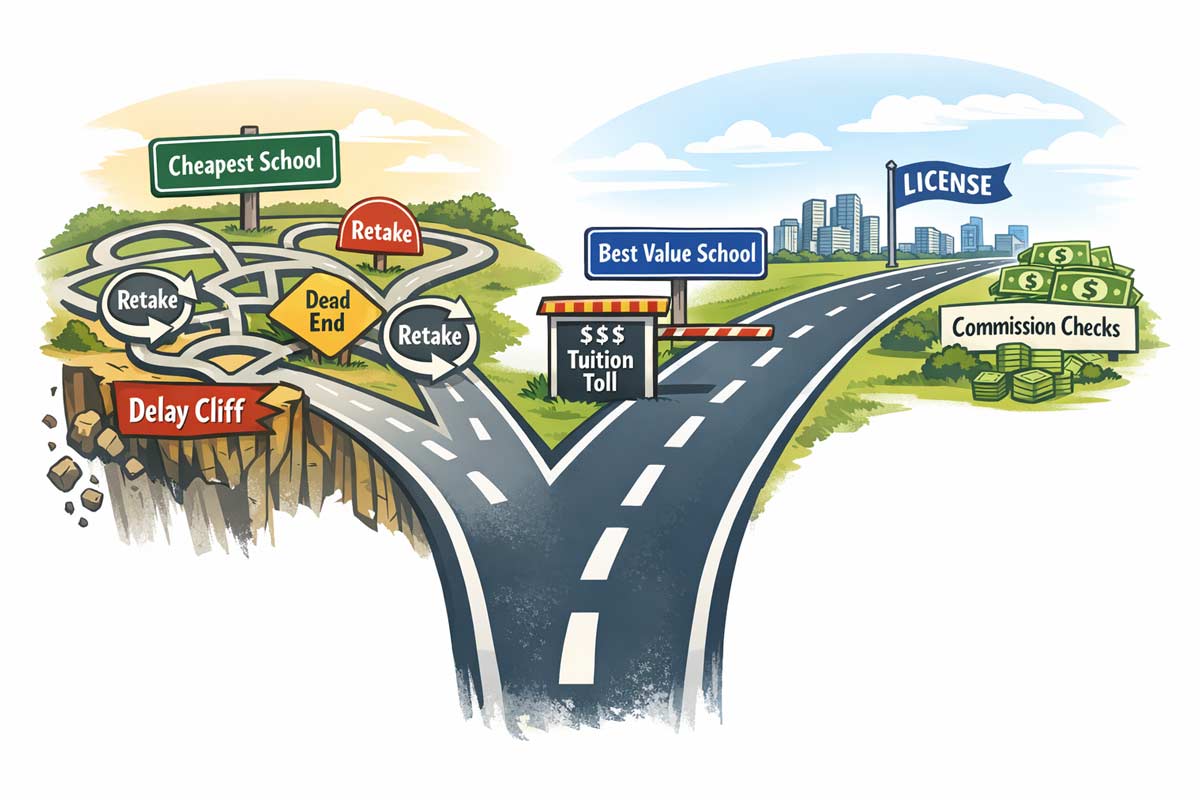
However, after 20 years of helping students navigate the California Department of Real Estate requirements, I’ve seen a consistent pattern: the "cheapest" school on paper can often become the most expensive in terms of time and frustration.

The goal isn't just to find the lowest checkout price; it’s to find the lowest total cost to get your license in your hand and start earning commissions.

What is the cheapest real estate school in California?

    The Short Answer: The cheapest real estate schools in California are typically 100% self-paced, online programs that provide the mandatory 135 hours of DRE-approved coursework with minimal instructor support. While you will sometimes see these "budget" packages advertised for under $150, the real value is found by balancing the sticker price against support quality and exam prep depth to avoid the high costs of retakes and study delays.

What "Cheap" Really Means in Real Estate Education

When you see a price that seems too good to be true, it’s usually because the school has "unbundled" the experience. To offer a rock-bottom price, schools often cut the very things that help students actually finish.

Common characteristics of ultra-budget programs include:

  • Minimal Instructor Access: You are often left to learn the material entirely on your own with no one to ask when a complex concept like "Joint Tenancy" or "Agency Disclosure" gets confusing.
  • Limited Exam Prep: The 135 hours of required education is not the same as passing the state exam. Cheap programs often provide the bare minimum to meet legal requirements but leave you hanging when it comes to the actual test.
  • Slow Support Response: If you have a technical issue or a question about your certificate, a budget school might take days to respond.
  • Hidden Fees: Watch out for "add-ons" for proctoring fees, certificate processing, or course extensions if you don't finish within a tight window (e.g., 90 days).

The "True Cost" Framework

To evaluate if a school is actually a bargain, you have to look past the "Add to Cart" button. Use this framework to calculate the real investment required.

Cheap vs. Best Value: What Changes?

Feature Ultra-Budget Program Pattern Best-Value Program Pattern Why it Matters
Support Email only (24–48 hour delay) Phone/Live Chat/Direct Access Delays in answers lead to "study stall-outs."
Exam Prep Basic PDF or none included Simulated exams & video reviews Passing the state exam the first time saves money on retakes.
Platform Older, non-mobile friendly Modern, responsive interface If you can't study on your phone, you won't study as often.
Accountability None (Self-study only) Optional live sessions/reminders Students in ultra-budget courses often stall out without structure.

Pros of Choosing the Cheapest Option

There are absolutely times when going for the lowest price is a smart, tactical move.

  • Lowest Upfront Spend: If cash flow is the primary barrier to entry, a budget program gets you into the system for the least amount of money today.
  • Maximum Flexibility: These programs are almost always self-paced, which is perfect for someone working a 60-hour week who can only study at 2:00 AM.
  • Great for Self-Motivated Learners: If you have a history of teaching yourself complex subjects and don't need a "coach," you can save money here.
  • Existing Support Systems: If you already have a mentor at a brokerage (or a family member in the business) teaching you the ropes, you may simply need a DRE-approved provider to log the required hours efficiently. For the full decision framework, see Best Real Estate Schools in California.

The Risks: When "Cheap" Becomes Expensive

In my experience, I’ve seen three "failure modes" for students who choose a school based solely on price:

  1. The 9-Month Delay: A student buys a budget course, hits a boring chapter, has no one to talk to, and stops studying. Months later, the course expires, and they have to pay a "re-enrollment fee" just to start over.
  2. The Retake Loop: A student finishes a cheap program but fails the state exam multiple times because the prep resources didn’t match the depth or style of the state exam. They end up spending more in DRE re-application fees.
  3. The Tech Wall: The program doesn't work well on mobile devices, meaning they can only study when sitting at a desktop. This friction often leads to students giving up entirely.

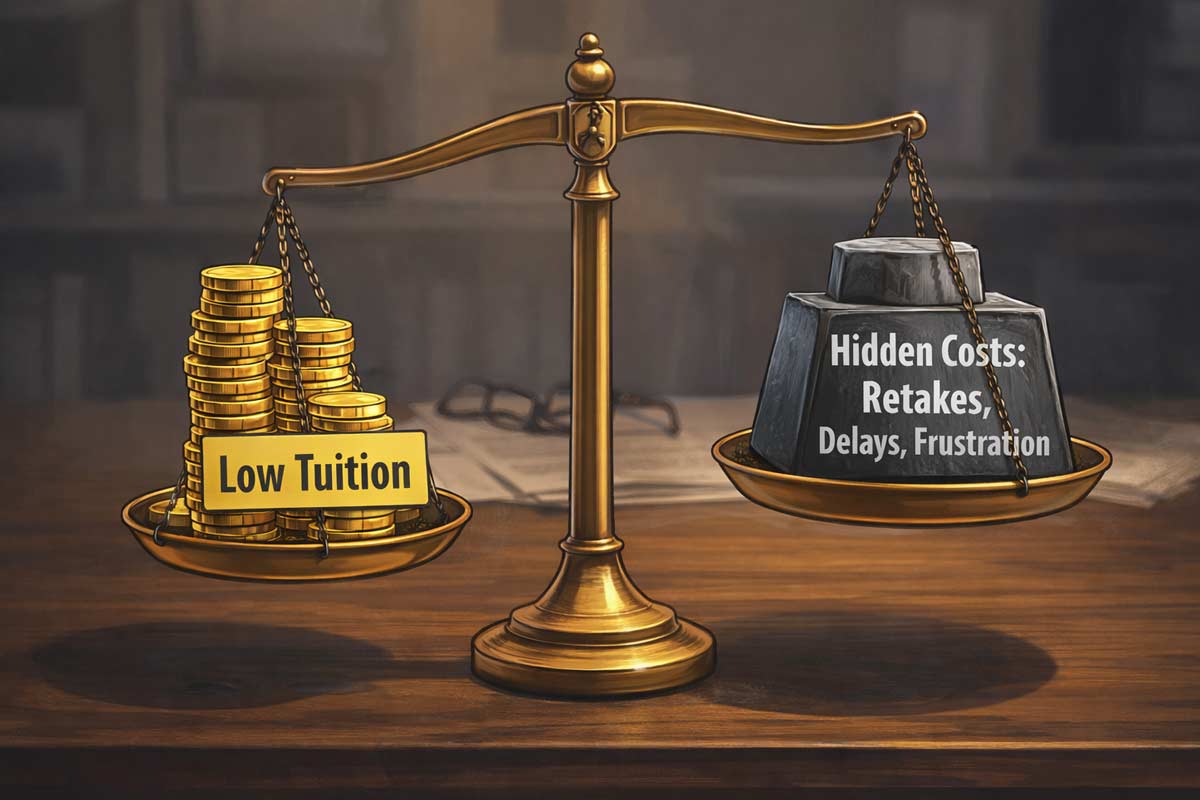
If a $100 savings on tuition leads to a three-month delay in starting your career, you’ve actually "lost" thousands of dollars in potential commissions.
cheap_real_estate_schools

Decision Filter: Which Path is Yours?

You’re a good fit for the cheapest option if…

  • You are highly disciplined and never struggle with procrastination.
  • You are a "natural" test-taker who rarely needs extra help.
  • You are on a very strict budget and are willing to trade your time for a lower price.

You should pay for more support if…

  • You haven't taken a professional exam in several years.
  • You learn better by hearing and seeing rather than just reading.
  • You want a structured schedule to keep you on track.

If you find that you need more structure, you might look into the Best Real Estate Schools in California that offer livestream options to keep you accountable.

How to Get the Lowest Price Without the Risk

If you are determined to go the budget route, follow these steps to protect your investment:

  1. Verify DRE Approval: Never pay a dime until you verify the school on the DRE’s official list of approved education providers.
  2. Check the "Format Fit": While self-paced is often the affordable online option, some schools offer "hybrid" models that provide a middle ground.
  3. Audit the Exam Prep: Does the "cheap" price include a practice exam? If not, factor in the cost of a third-party prep tool later.
  4. Look for "Hidden" Popularity: Sometimes the most popular real estate schools in California are affordable because of their high student volume, not because they cut corners on quality.
  5. Set a Milestone Plan: Don't just "wing it." Commit to finishing one module every few days to ensure you don't hit expiration fees.

Cheapest by Format

  • Self-Paced Online: Always the lowest sticker price. Best for the "lone wolf" student.
  • Live Online / Livestream: Moderate price. This is often the fastest real estate license program because the fixed schedule prevents procrastination.
  • In-Person: Usually the highest cost. You are paying for the physical facility and the instructor's presence. However, the best in-person real estate schools in California often create higher completion momentum because the structure is built in—fixed times, real-time accountability, and fewer distractions.

FAQ

What is the cheapest way to get a real estate license in California?

The cheapest way is typically an online, text-based, self-paced course package. These packages cover the three required courses for a single flat fee.

How much do real estate schools cost in California?

You’ll commonly see pricing from roughly $125 for basic self-study to $900+ for in-person or premium livestream packages with heavy coaching.

Are cheap real estate schools DRE-approved?

Most are, but you must verify. If a school is not on the DRE's approved list, the state will not recognize your education, making the course a total loss.

How long does it take to finish the 135 hours?

Per DRE rules, a statutory course requires a minimum of 18 days of study before the final exam can be taken. For all three courses, the fastest you can legally finish is 54 days. Any program implying completion faster than that should be double-checked for compliance.

Cheap is a Tool

Choosing a real estate school is your first business decision as a future agent. If you have more time than money, a budget-friendly school can be a great tool. Just be sure you aren't sacrificing the support you need to actually pass the exam and start your career.

If you're still not sure which direction to head, check out our comprehensive guide to the Best Real Estate Schools in California to compare your options.

Kartik Subramaniam

Founder, Adhi Schools

Kartik Subramaniam is the Founder and CEO of ADHI Real Estate Schools, a leader in real estate education throughout California. Holding a degree from Cal Poly University, Subramaniam brings a wealth of experience in real estate sales, property management, and investment transactions. He is the author of nine books on real estate and countless real estate articles. With a track record of successfully completing hundreds of real estate transactions, he has equipped countless professionals to thrive in the industry.

Enjoy what you read?

Sign up for our newsletter and get weekly updates on our latest articles