California doesn’t expect agents to be engineers, contractors, or city planners—but it does expect licensees to communicate accurately and avoid passing off assumptions as facts. The goal of this guide Read more...
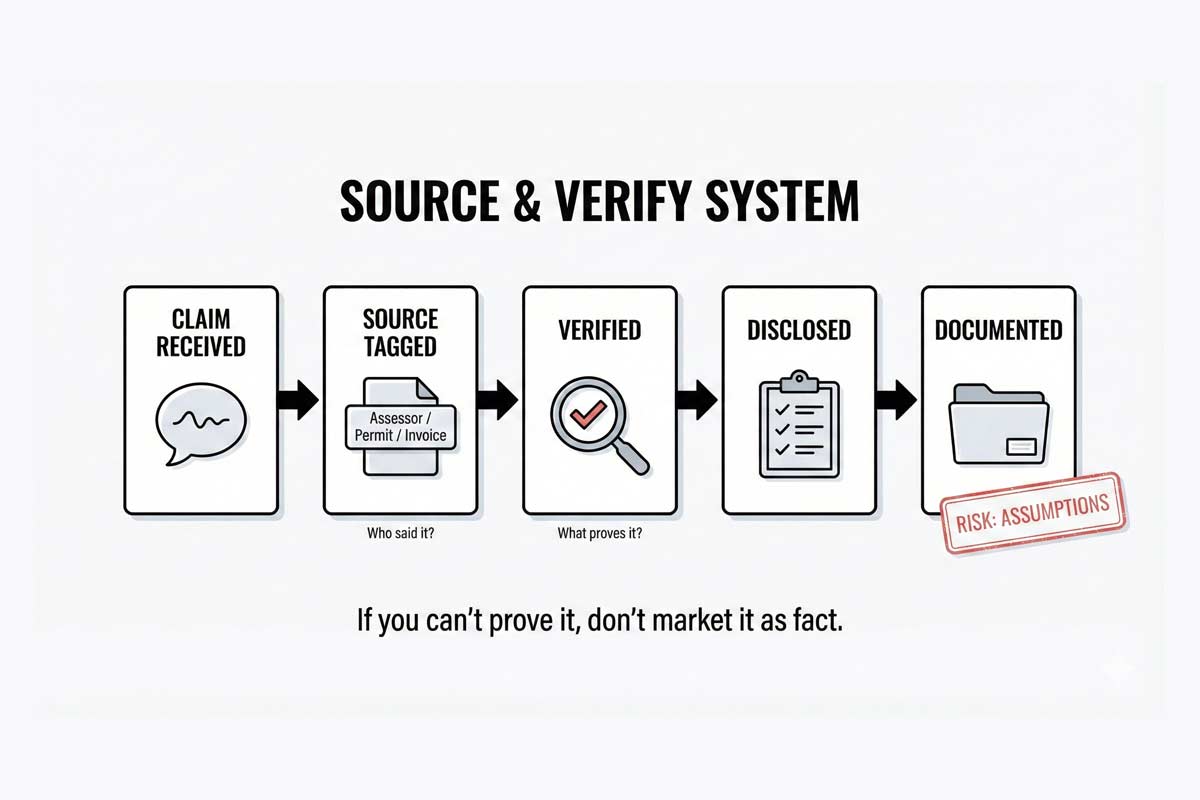
California doesn’t expect agents to be engineers, contractors, or city planners—but it does expect licensees to communicate accurately and avoid passing off assumptions as facts. The goal of this guide is simple: help you build a repeatable “source → verify → disclose → document” workflow so your MLS remarks, emails, and conversations stay clean and defensible.
Many agents assume lawsuits happen to “bad” people—scammers or fraudsters. But in California real estate, a significant portion of DRE discipline and civil litigation stems from negligent misrepresentation. It’s not that the agent lied on purpose; it’s that they repeated a seller’s claim without verifying it, or they made a casual assumption that turned out to be wrong.
If you want a long career, you must shift your mindset from salesperson to fact-checker.
What “misrepresentation” actually means
In plain English, misrepresentation is a false statement of fact that induces a party to enter into a contract. It isn’t just lying; it’s providing incorrect information that a buyer relies on.
While the definition seems simple, the application is complex because California holds licensees to a higher standard than the general public. That higher standard is the foundation of our California Real Estate Laws & Compliance Guide, and it’s why misrepresentation typically falls into three practical buckets:
1) Intentional misrepresentation (fraud)
This occurs when an agent actively hides a defect or lies about a feature.
Example: "You know the roof leaks, but you paint over the water stains and tell the buyer, 'The roof is in perfect condition.'"
Result: This is considered a career-ending category involving major civil exposure, severe discipline risk, and potentially punitive consequences.
2) Negligent misrepresentation (the danger zone)
This is where most agents get into trouble. It happens when you make a statement you believe is true, but you had no reasonable basis for believing it—usually because you didn’t verify it.
Example: The seller tells you the square footage is 2,500. You put 2,500 in the MLS without checking the source. It turns out to be 2,100.
Result: You’re exposed because you’re expected to treat material facts like verifiable facts, not casual conversation.
3) Innocent misrepresentation
This occurs when an agent makes a false statement that they had reasonable grounds to believe was true.
Example: You rely on a formal report from a licensed surveyor that later turns out to contain an error.
Result: Even without bad intent, deals can unwind and disputes can still happen.
The “material fact” rule
California operates under a strict disclosure standard. A material fact is anything that would affect the value of the property or a buyer’s decision to purchase it. If you are debating whether something is material, it almost certainly is.
The 10 most common misrepresentation traps in California
These are the scenarios where agents unknowingly drift into misrepresentation.
1) “Remodeled with permits”
The trap: The seller says, “We added that master bath with permits.” You list it as “Permitted Master Bath.”
The reality: The seller assumed their contractor pulled permits—but they didn’t.
The fix: Never claim permits exist unless you have seen the final permit sign-off or confirmed city records. Use language like “Buyer to verify all permits.”
2) Square footage & lot size
The trap: Copying the square footage from a prior MLS listing or trusting the owner’s estimate.
The fix: Always cite the source (“Per Assessor,” “Per Appraiser,” “Per Builder”). If there’s a discrepancy between records and the physical home, flag it immediately.
3) “The roof is new”
The trap: The seller says the roof is 5 years old. You market it as “Newer Roof.”
The fix: Avoid acting like a general contractor. State the age only if it’s documented, or treat it as a seller statement and recommend inspection.
4) Zoning and ADU potential
With the ADU boom, agents are eager to advertise “ADU Potential.”
The trap: Telling a buyer, “You can definitely build a back house here.”
The fix: Zoning is complex (setbacks, easements, utilities, overlays). Defer to the city: “Buyer to investigate feasibility with the city.”
5) Nuisances and stigmas
The trap: Failing to mention the loud plant that operates at night or an ongoing neighbor dispute over the fence line.
The fix: If a nuisance affects enjoyment or decision-making, it’s material. Hiding it conflicts with Ethical Duties Under the California Business & Professions Code, where honesty and fair dealing are not optional just because the deal is fragile.
6) Multiple offer pressure
The trap: Telling a buyer’s agent, “We have an offer higher than yours,” when you don’t—just to drive up price.
The fix: Communicate what’s true and only what’s true, especially in hot markets where buyers are already stressed—this is exactly why disciplined conduct matters in Handling Multiple Offers Ethically.
7) Marketing hyperbole vs. fact
The trap: “Walking distance to the beach” (it’s 3 miles) or “quiet street” (it’s a cut-through).
The fix: Let photos and maps do the persuasion. Subjective phrases can become “facts” in a dispute. Stick to measurable statements.
8) Repairs and credits
The trap: The seller agrees to fix a leak. You tell the buyer, “The leak has been fixed.”
The fix: Don’t confirm repairs yourself. Transfer documentation: invoice, contractor statement, permit (if applicable), and buyer re-inspection.
9) Natural hazards
The trap: “This area rarely floods,” or “Fire insurance shouldn’t be a problem.”
The fix: Never minimize hazard risk. Refer clients to the NHD and their insurance professional; keep your language document-based.
10) Minimizing defects
The trap: Seeing a crack and telling the buyer, “That’s just normal settling.”
The fix: Unless you’re a structural engineer, you don’t diagnose. Flag the observed condition and recommend evaluation.
The anti-misrepresentation system
You can eliminate a major share of your liability by adopting a “source and verify” habit.
1) Label fact vs. opinion
If you are sharing an opinion, label it. If you are sharing a fact, cite the source.
Instead of: “1,800 square feet.”
Write: “Approx. 1,800 sq ft per Assessor (buyer to verify).”
2) Verify before you amplify
Before you blast a feature in marketing, ask: “Do I have a document that proves this?” If not, tone it down or remove it.
3) The transaction checklist
Run this check at every stage:
Listing intake: Have the seller complete the TDS and SPQ completely; don’t let blanks slide.
Document handling: Treat client documents and sensitive details like controlled material—careless forwarding, oversharing, or casual disclosure can create liability and negotiation harm, which is exactly why disciplined workflows matter under Privacy Rules for Managing Client Information.
Marketing prep: Review MLS comments against disclosures—do they match?
Negotiation: Ensure counters and emails don’t imply promises that aren’t written.
Closing: Repairs and credits should have documentation attached and traceable.
Safe language toolkit: say this, not that
❌ Risky: “New roof”✅ Safe: “Seller states roof replaced in 2021; buyer to verify.”
❌ Risky: “Permitted guest house”✅ Safe: “Guest house present; buyer to verify permits with the city/county.”
❌ Risky: “Great rental potential”✅ Safe: “Buyer to verify rental restrictions and market rates.”
❌ Risky: “Quiet neighborhood”✅ Safe: “Located on a cul-de-sac” (stick to facts).
❌ Risky: “The plumbing is fine”✅ Safe: “No known plumbing issues per seller disclosures as of [date].”
❌ Risky: “I’m sure they’ll accept X”✅ Safe: “I will present your offer immediately and confirm receipt.”
Mini case studies: California scenarios
Scenario A: The “just cosmetic” crack
The situation: A seller points out a hairline crack and says it's from heavy rain. The agent markets “pristine condition.”
The outcome: A serious foundation issue appears after closing. The agent is sued for negligent misrepresentation.
What the agent should have done: Note the condition on the AVID, ensure disclosure is complete, and recommend specialist evaluation without diagnosing.
Scenario B: The dual agency disconnect
The situation: You represent both buyer and seller. The seller mentions divorce stress and urgency. You tell the buyer to help close the deal.
The outcome: Confidentiality and loyalty get questioned immediately, and parties often argue they relied on a misrepresented level of neutrality or advocacy. That’s why Dual Agency in California (Legal Guide) treats role clarity and confidentiality as non-negotiable.
What the agent should have done: Keep motivation confidential and stick to verifiable property facts and written terms.
Scenario C: The “updated” electrical
The situation: A flipper says the panel is “fully updated.” The agent writes “New Electrical Panel” in MLS.
The outcome: Inspector finds it’s old and painted. Buyer demands a credit and threatens claims for false advertising.
What the agent should have done: Require receipt/permit before using “new,” or describe only what you can prove.
Your license is worth more than one commission
Avoiding misrepresentation isn’t about being paranoid—it’s about being professional. It requires a shift from “selling” to “guiding.”
Your best defense is simple:
Verify what the seller tells you.
Disclose what you know.
Document where it came from.
If you don’t know the answer, “I don’t know, but let’s verify it” is one of the safest phrases in your vocabulary.
|

If you choose your first brokerage based on the commission split alone, you will lose money—probably a lot of it.
I have spent over 20 years watching new agents walk into a recruiter’s office, see Read more...
If you choose your first brokerage based on the commission split alone, you will lose money—probably a lot of it.
I have spent over 20 years watching new agents walk into a recruiter’s office, see a “90/10” split on a whiteboard, and start spending the money in their heads. Then reality hits. The "Smiling Recruiter" forgot to mention the $500 monthly desk fee, the transaction fees, and the fact that there is zero training to help you actually get a contract signed.
As you Start a Real Estate Career in California, your biggest risk isn't a low split; it's a high split that comes with no support, leaving you with 100% of zero.
TL;DR: The Bottom Line
Effective Split > Nominal Split: The "90/10" on the wall isn't what you take home.
Year 1 is Flight School: You are paying for supervision so you don't lose your license.
Fees are the "Silent Killer": Desk, franchise, and tech fees can eat 20% of your check before you see it.
Negotiability: By law, commissions and splits are negotiable; there is no "standard" rate.
The Goal: Choose the brokerage that gives you the highest probability of closing beyond Deal #1.
Decode the Pitch: The Real Vocabulary
To make a smart decision, you must stop using recruiter jargon and start using mine.
Gross Commission Income (GCI): This is the total pie. If you sell a $1.2M home at a 2.5% commission, the GCI is $30,000.
The Split: The first slice. If you are on a 70/30 split, the broker takes $9,000 and your "Initial Share" is $21,000.
Off-The-Top: Off the top fees are brokerage expenses deducted from a realtor's commission before they receive their share of the split.
Fees: The silent nibblers. They eat your slice from the edges after the split is taken.
Effective Split (The King Metric): The net percentage of the GCI that actually hits your bank account.
Kartik’s Rule of Thumb: The Effective Split Formula
To find the truth, use this calculation. "Your Share" is the dollar amount the broker hands you after their split but before they subtract desk fees, insurance, or transaction costs.
Takeaway: A "90% split" often results in a 65% effective split once the monthly "rent" is paid.
The Five Models: Who Are They Really For?
Model
The Pitch
The Reality
Choose This ONLY If...
The Apprenticeship
"We'll teach you everything."
50/50 or 60/40. High support.
You need a mentor to review every file.
The Ladder
"Earn more as you grow."
Graduated splits (e.g., 60% to 80% as you grow).
You have a clear 12-month lead-gen plan.
The Illusion
"Keep 100% of the cash."
You are a tenant, not a partner.
You have a massive, proven database.
The Gauntlet
"Cap your fees, then keep it all."
High pressure to hit the "cap" fast.
You have cash reserves.
The Safety Net
"We pay you a base salary."
Rare; heavy oversight/shackles.
You value stability over high upside.
Takeaway: Match the model to your current skill level, not your future ego.
The Fee Menu: What They Charge You For
I once reviewed a contract for a student who was promised an 80/20 split. After we calculated the "menu" below, their effective split was 52%. They walked away. Here is how those fees are usually grouped:
"The Rent" (Desk Fees): Monthly fees ranging from $50 to $1,000+.
Kartik’s Note: Paying over $200/month for a desk without a documented, daily training schedule is a major red flag when choosing a brokerage.
Errors & Omissions (E&O): Professional liability insurance. Some brokers charge this annually; others charge a flat fee per transaction.
"The Franchise Tax": Typically 5%–8%. As mentioned above, this may be deducted "off the top" before the split or calculated into your specific fee schedule.
Compliance/Risk Management Fee: A per-file fee charged for the broker's staff to review your disclosures and contracts for legal errors.
The Partnership Tax: If you join a team, expect them to also take a cut. See Should You Join a Team or Go Solo? for the math.
The War Game Scenarios
Scenario 1: The "High Split" vs. The Traditional Partner
Assumption: A $1M sale at 2.5% ($25,000 GCI).
Metric
85/15 "Cloud/Boutique"
60/40 Traditional
Initial Share
$21,250
$15,000
Monthly Desk Fee
–$500
$0
Franchise/Admin Fee
–$1,500
$0
Transaction Fee
–$500
–$250
NET TO AGENT
$18,750
$14,750
Effective Split
75%
59%
Support Provided
Software login + FAQ
Structured coaching & contract review
The Logic: If the 60/40 model provides the systems that help you close one deal a month, while the 85/15 model leaves you to figure out lead-gen alone (leading to zero deals), the "lower" split is more profitable over time.
Scenario 2: The Cap Crusher (The Cash Flow Trap)
An agent joins a "Cap" brokerage with a $20,000 annual cap and $800/month in fixed fees.
The Math: If that agent goes 6 months without a deal, they have spent $4,800 out of pocket.
The Risk: Most new agents quit by month 7. The "Cap" only benefits you if you have the volume to hit it. For a rookie, a no-monthly-fee 50/50 split is safer than a "100%" model that drains your savings while you're learning.
Scenario 3: The Team Tango (The Double Split)
You join a team on an 80/20 brokerage split. The team takes a 50% split for providing the lead.
GCI: $10,000.
Brokerage takes 20%: $8,000 left.
Team takes 50%: $4,000 left.
Effective Split: 40%. Is this lead worth 60% of the commission? If they handle the TC, lead gen and the marketing, it often is.
Audit Checklist: Offer A vs. Offer B
Before signing, put both offers side-by-side:
Item to Audit
Brokerage A
Brokerage B
Nominal Split %
Monthly Fixed Costs ($)
Per-Transaction Fees ($)
Off-the-top Franchise %
Who pays for the CRM?
Documented Weekly Training?
The Interview Playbook: Scripts for the Audit
Don't ask "what is the split?" That's a rookie question. Use these scripts from our guide on How to Interview a Brokerage as a New Agent:
"Can you provide a written, all-in fee schedule and walk me through the net income on a $1.25M sale?"
"What is your documented process for a new agent to get an offer reviewed under time pressure on a Sunday night?"
"If I use a company-provided lead, what is the total effective split after referral fees are deducted?"
The Verdict: What a New Agent MUST Do (Year 1)
For 19 out of 20 new agents, the Apprenticeship/Traditional model is the only logical choice.
I’ve seen too many agents go for a 100% split only to miss a critical disclosure contingency because no one was available to review their file on a weekend. That "saved" commission disappears the moment you're hit with a legal claim.
Year one is about risk mitigation. You need a broker who is financially incentivized to make sure you don't crash. Once you've closed three deals, you have the leverage to look at the Best Brokerages for New Agents in California that offer higher splits for producers.
Takeaway: Buy the education in Year 1 so you can own the market in Year 5.
FAQ: The Blunt Truth
1. Can I negotiate my split?
Yes, but as a new agent, your leverage is low. Focus on negotiating for better tools or waived initial fees rather than the split.
2. What is a "Cap"?
A ceiling on what the broker takes. After you pay them a set amount (e.g., $20k), you keep 100% for the rest of the anniversary year.
3. What is a typical split for a new agent in CA?
Usually between 50/50 and 70/30. Anything higher often indicates a lack of provided leads or support.
4. Is 100% commission ever worth it?
Only if you are a "business in a box" with your own systems, leads, and staff. For a rookie, it's a liability.
5. Do teams take another split?
Yes. Team splits are separate from and usually in addition to brokerage splits.
6. What fees are "normal" in California?
A transaction fee ($250-$500) and E&O insurance are standard. Watch out for hidden "marketing" or "admin" fees.
7. What if the brokerage provides the leads?
Expect a referral fee (25-40%) to be taken before the split is calculated.
8. What is a transaction fee vs. a TC fee?
Transaction fees go to the broker. TC (Transaction Coordinator) fees go to the professional who manages your escrow paperwork.
9. How do splits work on leases?
Often a flat fee or a much higher split (e.g., 50/50) because the dollar amounts are lower.
10. Should I join a high-split brokerage if I'm part-time?
No. Part-time agents need more supervision because they aren't in the office daily to catch changes in law or contracts.
11. Does the split change if I represent the buyer vs. the seller?
Usually no, but check your independent contractor agreement.
12. How do I avoid Red Flags When Choosing Your First Brokerage?
If they talk about the "split" for 30 minutes but can't show you a training calendar, walk out.
The Call to Arms
Your goal is not to find the perfect split. Your goal is to find the first broker who will turn you from a liability into an asset.
The commission split is just one piece of your launch plan. To build your complete, step-by-step career blueprint and avoid the "learning tax" most rookies pay, start here: Start a Real Estate Career in California.
|
The Real Numbers for Year One.
Disclaimer: Real estate income is highly variable. There are no salary guarantees. Your earnings depend on market conditions, brokerage choice, and individual effort. Read more...
The Real Numbers for Year One.
Disclaimer: Real estate income is highly variable. There are no salary guarantees. Your earnings depend on market conditions, brokerage choice, and individual effort. All numbers provided are scenario-based assumptions used to illustrate business mechanics, not a promise of future earnings.
Why You Can’t Find a Straight Answer
Searching for a "California real estate agent salary" is a frustrating exercise. You'll find averages from $45,000 to six figures—a range so wide it's meaningless. Here’s why: those numbers lump together top-performing veterans with brand-new agents who may go months without a single check.
After 20+ years coaching professionals at ADHI Schools, I can tell you the real question isn't about averages. It's about your first-year reality. Let's replace the confusing hype with a clear, mechanics-based framework you can use to plan your survival and success.
The Framework (The Only Formula That Matters)
To understand your income, you must stop thinking about a "paycheck" and start thinking about "net profit."
The Core Formula:
What You Sold × What You Keep × - What It Costs = Actual Check
As an example, let’s say you sold a $800,000 house and you are on a 70% commission split at a 2% commission.
$800,000 x 2% (gross commission earned) x 70% (your commission split) = $11,200
Every number we discuss below is an attempt to solve for that final variable. If you don't track these levers, you aren't running a business; you're just hoping for a miracle.
Quick Answer: Realistic First-Year Income Ranges (Scenario Models)
The following tiers represent common outcomes we see in the California market based on an $800,000 sales price and a roughly 70% commission split. These are model outputs based on assumptions, not guarantees.
Scenario Profile
Est. Closed Deals
Gross Comm. (To Brokerage)
Net to Agent (Pre-Tax)
The Part-Time Learner
1–2
$20,000 – $40,000
$10,000 – $25,000
The Hustling Newcomer
4–7
$80,000 – $140,000
$50,000 – $90,000
The Team Player
8–12
$160,000 – $240,000
$60,000 – $100,000
Context for the Math:
Part-Time: 10–15 hours/week; primarily referral-based.
Hustling: 40+ hours/week; includes weekly open houses and daily lead generation.
Team: High volume via provided leads; typically involves a 50/50 split with the team leader.
Important: These figures are pre-tax; taxes and your personal burn rate determine what is "livable."
Volatility Note: A single cancelled escrow can wipe out weeks of income projections.
Commission Math Decoded (From Sale Price to Your Bank Account)
Many new agents assume a 3% commission is a fixed rule. In reality, commission rates and splits vary by market and brokerage. This is a simplified model to show the mechanics.
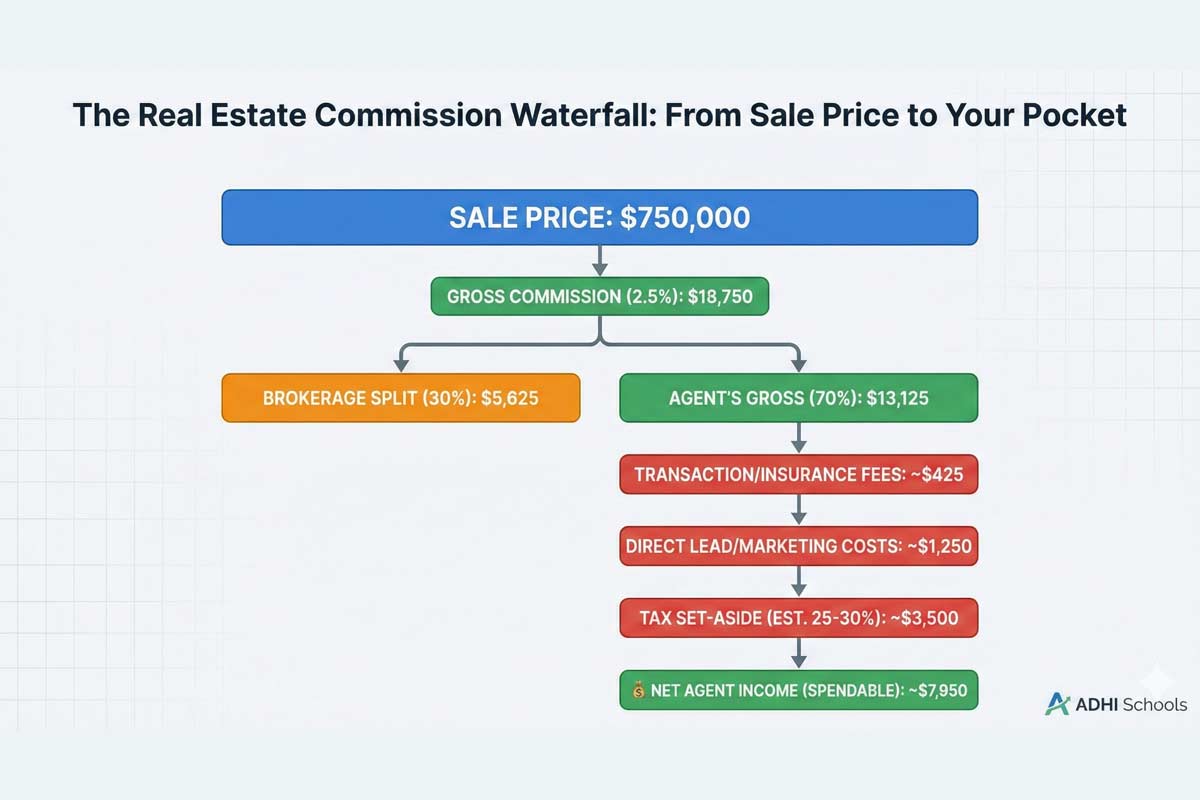
Example: The $750,000 Sale (Assumption Model)
Step
Assumption/Range
Remaining Balance
Sale Price
$750,000
—
Gross Commission to Broker (2.5%)
Model Assumption
$18,750
Brokerage Split (70/30)
Typical solo agent starting split
$13,125
Transaction/Insurance Fees
$250 – $600 (Per-deal variable)
$12,625
Direct Lead/Marketing Cost
$0 (Sphere) – $2,500 (Paid Leads)
$10,125
Tax Set-Aside
Varies by situation—confirm with CPA
Variable
The Takeaway: On a $750,000 sale, your actual spendable income is often less than half of the initial gross commission.
Timeline to Your First Commission Check (The Lag)
The biggest threat to a new agent isn't a lack of talent; it's a lack of capital during the "lag." Understanding how long it takes to start a real estate career is the first step in managing your cash flow, as the licensing process itself often takes a few months.
Once licensed, the wait for your first dollar of income is months, not weeks.
The Ramp: Active lead generation before an offer is accepted.
The Escrow: 30–45 days of waiting for the deal to fund and the check to clear.
Runway Reality: If you are going full-time, a 6–9 month cushion for living expenses is a common safety threshold.
What Slows You Down (Traps)
Administrative Perfectionism: Spending weeks on "branding" instead of talking to human beings.
Escrow Fallouts: In CA, inspections or loan issues can kill a deal late in the game, resetting your income timeline.
What Speeds It Up (Levers)
Focusing on Buyers: A motivated buyer can often be put into escrow faster than a listing can be prepped, staged, and marketed.
Open Houses: This is the fastest face-to-face way to meet unrepresented buyers without an upfront ad spend.
Hidden Expenses (Your First-Year “Cost of Existence”)
You are a business owner, and businesses have overhead. The "gotcha" is that expenses hit before income. You will be paying for access to the market while you are still trying to find your first client.
First-Year Expense Budget (Estimates)
Category
Item
Est. Annual Range
Fixed/Initial
Licensing, Exam, Fingerprints, Board Dues
$2,000 – $3,500
Operational
E&O Insurance, CRM, Signage
$1,500 – $4,000
Recurring Dues
Quarterly MLS Fees / Annual Association
$800 – $1,500
Transportation
Gas, vehicle maintenance, travel time
$1,500 – $4,000
Marketing
Mailers, Digital Ads, Lead Gen
$2,000 – $10,000+
TOTAL
$7,800 – $23,000+
Cash Flow Warning: Many board and MLS dues are due in full upon joining. Budget at least $2,000 for your "Day 1" operating costs.
Scenarios: Applying the Formula to Real Life
1. The Part-Time Learner
Assumptions: 2 deals/year ($800k avg), 70/30 split.
Math: ($40k Gross) x 0.70 = $28k. Minus $7k expenses.
Approx. Net Outcome: $21,000 (Pre-tax).
2. The Hustling Newcomer
Assumptions: 6 deals/year ($800k avg), 80/20 split (achieved via production or boutique brokerage; many start closer to 70/30).
Math: ($120k Gross) x 0.80 = $96k. Minus $15k expenses.
Approx. Net Outcome: $81,000 (Pre-tax).
Verdict: This is a common target for a dedicated full-time solo agent in their first year.
3. The Team Player
Assumptions: 10 deals/year ($800k avg), 50/50 team split.
Math: ($200k Gross) x 0.50 = $100k. Minus $8k expenses.
Approx. Net Outcome: $92,000 (Pre-tax).
What Moves the Needle Fastest (Highest-ROI Actions)
Lead Source Consistency: Pick two sources (e.g., Open Houses and Geographic Farming) and do them every week without fail.
Daily Lead Gen: A non-negotiable 3-hour block every morning dedicated to finding new business.
Database Mining: Your "Sphere of Influence" is your highest-ROI asset.
Common Mistakes That Keep New Agents Broke
Living on the Gross: Spending the full commission check and forgetting that a portion belongs to the IRS.
Compliance & Documentation: Missed signatures, missing disclosures, or late paperwork can delay funding and create liability.
Part-Time vs. Full-Time (The Financial Truth)
The reality of starting real estate part-time in CA is a common way to manage the financial gap while you learn the ropes. While your availability for mid-day tasks is limited—potentially extending your timeline—you bypass the immediate pressure of zero income during the ramp-up.
Fit Check (Should You Pursue This?)
Before diving in, ask yourself:
Runway: Do I have the cash to cover my life and my new business for several months?
Discipline: Can I work 40+ hours a week without a boss directing my daily tasks?
Risk: Am I comfortable with "lumpy" income where zero-dollar months are possible?
If you have the temperament, see if you align with the personality traits of successful California agents. If you're still on the fence, we have an honest assessment of whether you should become a real estate agent in California.
FAQs
“Do new agents really make $100,000 in their first year?”
It is possible, particularly in high-priced markets, but typically requires joining a high-volume team or having an existing, massive network.
“How many deals do I need to close to make $X in California?”
Don't use "rules of thumb." Use the formula: Calculate your local average price, subtract your broker's split, subtract your estimated expenses, and see how many deals it takes to reach your target.
“Is joining a team worth the split cut for a new agent?”
Usually. A 50/50 split of a closed deal is better than a 100% split of a deal that never happens. Teams offer immediate leads and coaching.
“What’s the fastest way to get my first commission check?”
Focusing on buyers is the most direct path to a contract, though "fast" in real estate still often means multiple weeks to months from meeting the client to getting paid.
“Can I survive on part-time real estate income in CA?”
Only if it is supplemental. Fixed costs remain the same whether you sell one house or twenty. You must close at least 1-2 deals a year just to cover your professional dues and expenses.
“What’s the biggest financial surprise for new agents?”
The self-employment tax and the fact that most business expenses hit your bank account before your first commission check does.
Key Takeaways + Your Next Step
You are a business: Gross commission is not your salary. Track your net income post-split and post-expense.
Mind the Lag: Budget for a multi-month ramp-up period.
Upfront Costs: Expect $2,000+ in startup fees before you can even begin marketing.
Now that you understand the math, the next variable is execution. If you want the step-by-step path from decision → licensing → first clients, the start a real estate career in California roadmap we use can help you build the right foundation.
TL;DR: * Gross vs. Spendable: You are a business owner. Your "take-home" is the remainder after brokerage splits, recurring dues, marketing costs, and tax obligations.
The Pipeline Lag: Due to licensing cycles and escrow, a common pattern we see is a multi-month wait for your first dollar of income.
Upfront Costs: Expect to pay $2,000–$4,000 in licensing and board fees before your first closing.
|
Fast Answer: Your 2026 Renewal Snapshot
If you are staring at a real estate license renewal notice (or dreading its arrival), here is the bottom line. Most (there’s an exception I will discuss in Read more...
Fast Answer: Your 2026 Renewal Snapshot
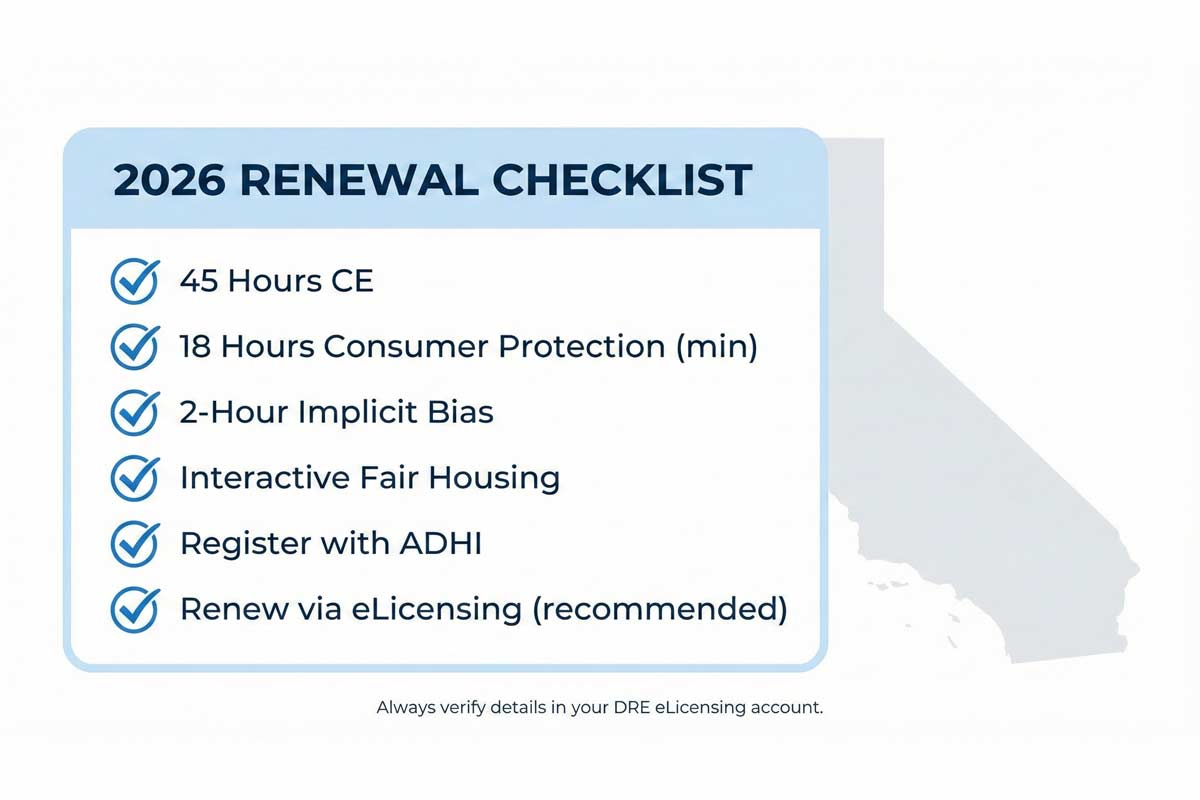
If you are staring at a real estate license renewal notice (or dreading its arrival), here is the bottom line. Most (there’s an exception I will discuss in a bit) licensees cannot renew their California real estate license without checking these boxes.
Total CE Hours: 45 hours (generally required, unless you qualify for the 70/30 exemption).
Renewal Cycle: Typically every 4 years.
The "New" Standards: If your license expires on or after Jan 1, 2023, you must have the 2-hour Implicit Bias course and the Interactive Fair Housing course. (Older certificates without these specific components will not satisfy current renewal requirements).
Submission Method: DRE eLicensing system (recommended and fastest) or mail (slower).
Earliest You Can Renew: Often about 90 days before expiration (check your eLicensing account for your specific window).
Absolute Minimum Time to Complete CE: ADHI Schools’ renewal program can be completed in about 8 days from the time of registration to completion. CE providers enforce a limit of 15 credit hours per 24-hour period to prevent "speed clicking" under DRE rules. This means you cannot cram 45 hours of course completion into a single weekend.
Who This Applies To (Read This First)
Before you buy a package, verify your status. The California real estate license renewal requirements for 2026 differ depending on where you are in your career.
First-Time Renewal vs. Subsequent Renewal
First-Time Salesperson: You cannot take the shortcut "Survey" course. You must take five separate 3-hour courses (Agency, Ethics, Trust Fund Handling, Risk Management, Fair Housing) plus the 2-hour Implicit Bias course, and at least 18 hours of Consumer Protection.
Subsequent Renewal (2nd, 3rd, etc.): You are eligible for the 9-hour Survey Course. Per DRE rules, this single course covers all 7 mandatory topics (the five above, plus Implicit Bias and Management & Supervision). It is streamlined, but you still must enter the completion details for the remaining hours.
Broker vs. Salesperson
Brokers: You must include "Management & Supervision" in the required subject set on your first renewal.
Salespersons: For subsequent renewals, Management & Supervision is effectively required because it is included in the standard 9-hour Survey Course.
Kartik’s Insider Note: "I’ve seen veteran agents assume they know the rules because they’ve renewed five times. Then they get flagged because they missed the Implicit Bias requirement or took a Fair Housing course that lacked the 'interactive' component. Don't coast on autopilot."
For a complete breakdown of the entire process from start to finish, bookmark our master California Real Estate License Renewal Guide.
The 2026 Renewal Requirements (Detailed Breakdown)
The DRE (Department of Real Estate) is strict about course validity. If your course completion dates or course numbers don't match the current requirements, your renewal may be flagged.
1. The 45-Hour CE Requirement
Most licensees must complete 45 hours of DRE-approved Continuing Education. These hours are broken down into Mandatory Subjects and Consumer Protection (with a limit on Consumer Service hours).
How Many CE Hours Are Required for CA License Renewal?
First-Time Salespersons: 5 separate 3-hour courses (Ethics, Agency, Fair Housing, Trust Funds, Risk Management) + 2-hour Implicit Bias + 18 hours Consumer Protection + remaining hours (Consumer Service max 27 hrs).
First-Time Brokers: 6 separate 3-hour courses (Adds Management & Supervision) + 2-hour Implicit Bias + 18 hours Consumer Protection + remaining hours.
Subsequent Renewals (All): 9-hour Survey Course or individual courses (covering mandatory topics) + 18 hours Consumer Protection + remaining hours.
2. The "Must-Have" Courses (Current Standard)
Two specific requirements trip people up the most:
Implicit Bias Training (2 Hours): This is non-negotiable. Does California Require Implicit Bias Training for Renewal? Yes, effective Jan 1, 2023.
Interactive Fair Housing: You cannot just read a PDF. The course must include an "interactive participatory component." While DRE mandates role-play, in online on-demand courses, this is typically built in as scenario-based interactions (you generally aren't performing live, but you must actively engage with the module).
3. Broker-Specific Rules
If you hold a broker license, you must ensure you are covered on "Management & Supervision."
Do Brokers Have Different CE Requirements in CA? Yes, specifically on the first renewal. Brokers must take "Management & Supervision" as a standalone 3-hour course. (On subsequent renewals, it is included in the 9-hour survey for everyone).
Timeline: When to Start (Don't Ignore This)
Real estate is stressful enough without losing your license because you forgot a deadline.
60 Days Out: Check your eLicensing account. Is your email address current? Do you have any citation fines outstanding?
45 Days Out: Purchase your CE package. Give yourself a buffer.
14 Days Out (The "Safe Zone"): Finish your exams. DRE systems can go down for maintenance. Certificates can get misplaced. Do not be the person finishing their exam at 11:30 PM on your expiration date.
Expiration Date: If you submit your renewal on time (before midnight), you can typically continue operating even if the processing takes a few days (under B&P Code 10156.2). However, if you miss the deadline, you are late. Once late, you cannot legally perform licensed activities until the renewal is fully processed.
Common Mistakes That Delay Renewal
After helping thousands of students, here are the real-world scenarios where I see agents get stuck.
Scenario A: The "Fast Reader" Trap
The Situation: Agent Mike waits until 3 days before his license expires. He buys a 45-hour package and tries to power through it in one weekend.
The Result: The renewal will be late. DRE rules require CE platforms to enforce a limit of 15 credit hours per 24-hour period once the exams are unlocked to prevent "speed clicking." Mike’s license expired because the platform physically wouldn't let him take the final exam in time.
Scenario B: The "Wrong Course" Disaster
The Situation: Broker Sarah takes a generic "Fair Housing" course from a cheap provider that wasn't updated for California's interactive requirement.
The Result: She submits her renewal. A week later, the DRE flags it: "Missing Interactive Component." She has to find a new course, pay again, and re-submit. What Courses Count Toward CE in California? Only those with specific DRE approval numbers that meet current legislative standards.
Step-by-Step: How to Renew Without Drama
Verify Your Expiration Date: Log into DRE eLicensing.
Complete Your 45 Hours: Ensure your provider gives you course completion certificates for each course. You will need the 8-digit Course Number for the next step.
Log in to eLicensing: Select "Renew License."
Enter Course Numbers: Use the 8-digit number printed on your CE completion certificate (the one eLicensing asks for) and the completion date exactly as they appear on your documents. Don’t share these secret codes with anyone.
Pay the On-Time Fee:
Salesperson: Check DRE fee schedule (approx. $350).
Broker: Check DRE fee schedule (approx. $450).
Print Your Receipt: If your application is on time and clean (no background issues), your status should update to "Licensed" with a new 4-year expiration date often immediately.
FAQ: Quick Renewal Answers
Q: Can I renew my license after it expires? A: Yes. You have a two-year "grace period" (Late Renewal). You must pay a higher late fee and you cannot practice real estate during this gap until the renewal is fully processed and your status shows "Licensed" again.
Q: Do I need to submit my printed certificates to the DRE? A: Usually, no. You enter the course numbers into eLicensing under penalty of perjury. However, the DRE can audit you. Keep your PDF certificates for at least 4 years.
Q: I am over 70 years old. Do I still need CE? A: Maybe not. If you are 70+ and have been licensed in good standing for 30 continuous years, you can apply for the "70/30 Exemption."
Q: How much does the renewal cost in 2026? A: Fees are subject to change. Always check the DRE fee schedule directly before paying.
Q: What is the difference between Consumer Protection and Consumer Service? A: Consumer Protection courses cover topics that directly protect the public (like laws and disclosures). Consumer Service courses focus on professional skills (like marketing). You must have at least 18 hours of Consumer Protection, meaning you are limited to a maximum of 27 hours of Consumer Service.
Don't Let a Paperwork Error Cost You a Commission
Renewal shouldn't be a guessing game. If you are approaching your deadline, get your CE done with a trusted provider like ADHI Schools, and get your application in early.
Need a deeper dive on the forms, fees, and reinstating a lapsed license? Read the full California Real Estate License Renewal Guide next.
|
It happens in a split second.
You’re negotiating a deal at 9:45 PM. The listing agent says, “My seller is worried your buyers can’t close.” To prove them wrong, you pull up your client’s Proof Read more...
It happens in a split second.
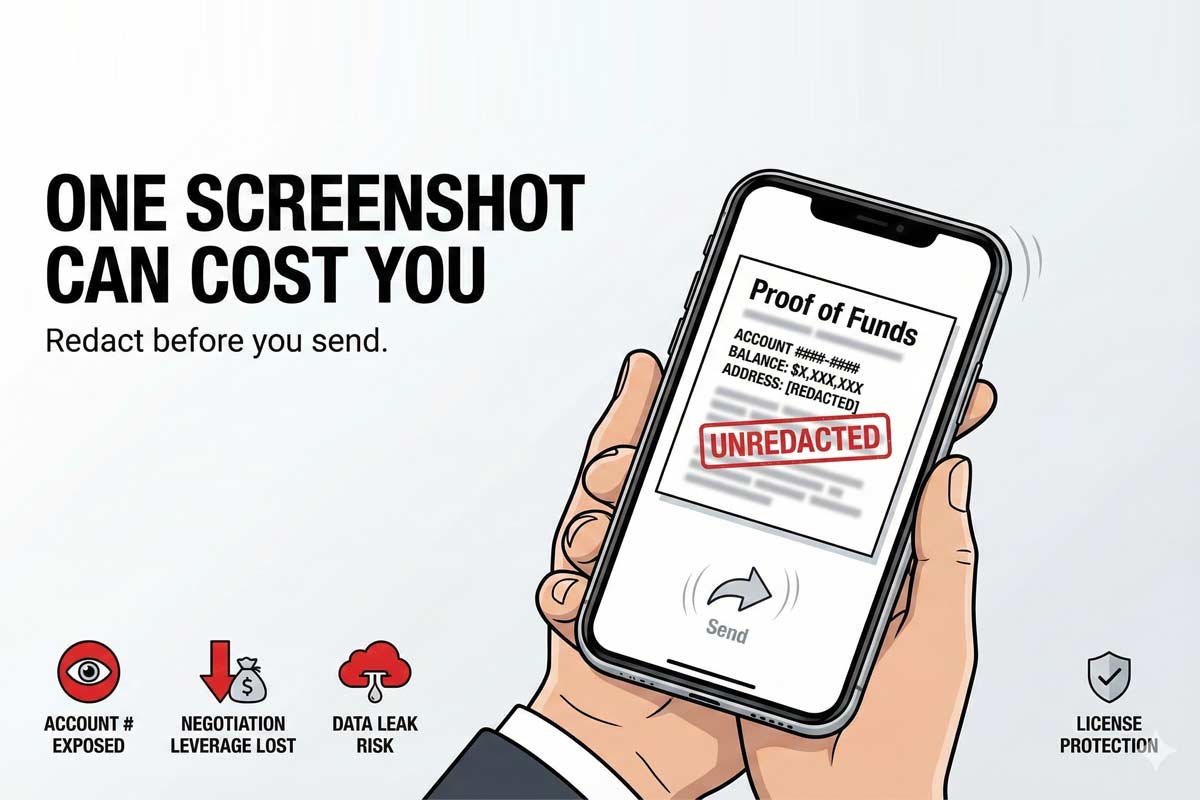
You’re negotiating a deal at 9:45 PM. The listing agent says, “My seller is worried your buyers can’t close.” To prove them wrong, you pull up your client’s Proof of Funds (POF) on your phone, take a screenshot, and text it to the listing agent.
You just sent a text containing your client’s full account number, current balance (which is $300k higher than the offer price), and home address to a third party.
That single screenshot just violated your client’s financial privacy and compromised their negotiating leverage (now the seller knows they can pay more). If that image gets forwarded or saved to an unsecured cloud, you may be blamed for the leak and exposed to discipline or civil claims.
Privacy in real estate isn’t just about being polite. It is about protecting your license from the kinds of complaints that start with “My agent gave away my personal information.”
What Counts as Confidential Client Information in California Real Estate?
Many agents think “privacy” just means not giving out the gate code. In reality, the definition is much broader. As an agent, you routinely handle private identity, financial, and negotiation information that can harm a client if mishandled.
The Four Big Categories:
Identity & Contact Info: Names, personal email addresses, phone numbers, and current home addresses.
Financials: Bank statements, 401(k) balances, credit score screenshots, and pre-approval letters with specific conditions.
Negotiation Strategy: Motivation ("They have to move by June"), bottom line ("They'll take $850K"), or urgency ("They're divorcing").
Transaction Documents: The purchase agreement itself, counter-offers, and transfer disclosure statements (TDS).
Safeguarding this data is a critical part of real estate practice. Understand the statutory framework that governs these responsibilities. Review the California Real Estate Laws & Compliance Guide, which outlines the baseline for agency relationships and duty of care.
What Can I Share With the Listing Agent?
The guiding principle for privacy is "Minimum Necessary." Share only what’s necessary to move the transaction forward, only with parties who need it, and never share strategy or financial details without explicit client authorization.
Who is a "Need-to-Know" Party?
Client(s): The principal.
Broker / Office Compliance: For file review and oversight.
Escrow / Title: As needed to open orders and clear title.
Lender: As needed for funding conditions.
Appraiser / Inspector: Only access/property details required for their job.
Other Side’s Agent: Minimum necessary to close; never client strategy.
The Golden Rule: If it helps your client’s position and you have permission, share it. If it hurts them or they haven’t authorized it, keep it private.
DO
DON'T
DO share the pre-approval letter (after redacting sensitive info).
DON'T forward a raw bank statement showing account numbers.
DO redact account numbers and excess balances before sending.
DON'T send full bank statements or unedited screenshots.
DO use secure transaction management platforms (DocuSign, SkySlope).
DON'T leave physical files visible in your car or on a coffee shop table.
DO discuss material facts about the property condition.
DON'T discuss your client’s divorce or job transfer as “negotiating leverage” without written consent.
Strict adherence to these boundaries is not optional
It is rooted in your Ethical Duties Under the California Business & Professions Code, which mandates that agents treat all parties with honesty while maintaining loyalty to their principal.
Can I Share Proof of Funds With the Listing Agent?
Yes, but you must do it carefully to balance credibility with privacy.
When it’s appropriate: To prove your buyer has the ability to close, especially for cash offers or large down payments.
What to send: A redacted bank statement or a letter from the financial institution stating "verified funds in excess of purchase price."
What NOT to send: Unedited statements, screenshots from your phone, or documents showing the client’s total net worth far beyond the purchase price.
How to send: Upload to a secure transaction platform or send a password-protected PDF link; avoid standard email attachments if possible.
Proof of Funds: What to Redact (And What Not to Send)
Sending unredacted financial documents is one of the most common ways agents expose their clients to identity theft and negotiation loss.
Redaction Rules That Are Non-Negotiable:
Black out account numbers: Show the last 4 digits only.
Black out SSN/DOB: They should not be visible in anything you transmit to the other side.
Remove full balances: Show only the amount needed to support the offer’s funding story (cash to close or down payment + reserves), and redact excess.
Remove home address: Unless necessary for the lender, black it out.
Convert to PDF: Never send screenshots; they are unprofessional and harder to secure.
Rename the file: Add "REDACTED" to the filename so you know it’s the safe version.
The 5 Most Common Privacy Failures (And the Fix for Each)
In 20+ years of training California agents, I’ve seen that most privacy violations aren't malicious—they are sloppy.
1. The "Forward" Button Fiasco
What happens: You forward an email chain to the lender or other agent, forgetting that three emails down, your client vented about their bottom line.
Why it’s risky: You just handed the other side your playbook.
Do this instead: Never forward chains. Start a new email. Copy-paste only the relevant text.
2. The Unredacted Proof of Funds
What happens: You send a bank statement showing $1.2M in liquid cash when the offer is only $900k.
Why it’s risky: The seller now knows your buyer can pay full price, weakening your client’s bargaining position.
Do this instead: Redact strictly. Only show enough funds to cover the down payment and closing costs.
3. The Screenshot Camera Roll
What happens: You take photos of checks, IDs, or docs. They save to your personal camera roll, which backs up to your family iCloud.
Why it’s risky: Your client’s IDs, account numbers, and private financial info are now mixing with your vacation photos.
Do this instead: Use a scanning app that saves directly to a secure drive or your transaction platform (e.g., SkySlope) and does not save to the camera roll.
4. The Accidental Group Text
What happens: You start a group text with the lender, escrow, and buyer, then accidentally add the Listing Agent to discuss repairs.
Why it’s risky: You might accidentally reveal your client’s desperation or strategy to the opposing negotiator.
Do this instead: Avoid group texts for strategy. Keep sensitive discussions verbal or in one-on-one emails.
5. Sloppy Fact Transmission
What happens: You are managing five deals and accidentally send Client A’s counter-offer to Client B, or mix up their repair requests.
Why it’s risky: Failing to verify what you share is a primary way to learn How to Avoid Misrepresentation in CA Transactions the hard way.
Do this instead: Verify the source and accuracy of every fact before you hit send.
If You Already Messed Up: Containment Protocol
If you realize you sent sensitive info to the wrong person, act immediately.
Ask recipient to delete: Call immediately (don't text) and ask them to delete the email/text and confirm.
Notify broker: Inform your manager so they can prepare for any fallout. Do not try to "fix it quietly"—that's how small mistakes become disciplinary events.
Notify client: Be professional and brief. "I inadvertently sent X to Y. I have asked them to delete it."
Document it: Keep a log of what happened and who received it.
Change access: If you sent a link to a folder, rotate the link or revoke access immediately.
Dual Agency: Confidentiality Rules That Will Get You Disciplined
Privacy becomes mission-critical when you represent both the buyer and the seller. Dual agency is where confidentiality mistakes happen fastest.
The Sealed Envelope Rule
Treat confidential strategy like it’s in a sealed envelope. You don’t open it for the other side. Information about material facts (the roof leaks) must flow freely. Information about price, terms, and motivation must stay sealed.
Mini Scenario:
Your buyer asks, "Why are they selling?"
Risky Answer (reveals confidential motivation): "They are getting divorced and need cash fast."
Safe Answer: "I can’t discuss the seller’s personal motivations, but I can address objective terms: timing, possession, and contingencies."
For a deeper dive into the specific disclosures and boundaries required here, refer to our Dual Agency in California (Legal Guide).
The Paper Trail & Systems: Your Privacy Operating Procedure
You need a repeatable system so you don't have to think about privacy—you just execute it.
Privacy Checklist Before You Hit Send:
Redaction: Are account numbers and SSNs blacked out?
Relevance: Does the recipient actually need this document?
Format: Is it a secure PDF link, or a loose screenshot?
Recipient: Did I check the "CC" line for accidental additions?
Your SOP
Centralize Docs: All documents live in your transaction management platform.
Naming Conventions: Name files clearly (e.g., "123_Main_St_POF_REDACTED.pdf") so you don't attach the wrong version.
Device Security: Enable 2-Factor Authentication (MFA) on your email. Your email is the master key to your client’s data.
Privacy is License Protection
Privacy is not about secrecy; it is about security. When you treat your client’s information with care, you build trust and maintain a clean file.
Tighten your systems. Redact the account numbers. Follow your broker's policy.
Protect the file, and the file will protect you.
(Note: General education only; follow your broker’s policies and consult counsel for specific legal questions.)
|
The single biggest mistake I see agents make during renewal isn’t failing a test—it’s finishing 45 hours of education only to realize none of it counts.
Just because a class is about real estate Read more...
The single biggest mistake I see agents make during renewal isn’t failing a test—it’s finishing 45 hours of education only to realize none of it counts.
Just because a class is about real estate doesn’t mean the California Department of Real Estate (DRE) accepts it for your license renewal. Your office sales training? Probably doesn’t count. That motivating weekend seminar? Likely doesn’t count.
If you rely on unapproved courses, you risk a lapse in your license status where you cannot legally conduct business.
Here is the no-nonsense guide to exactly what counts, what doesn’t, and how to verify your courses before you spend a dime.
The Fast Answer: What You Need to Know
If you are in a rush, here is the bottom line on course eligibility:
Only DRE-Approved Counts: If the provider doesn’t have a DRE Sponsor Number and the course doesn’t have a DRE Course Number, it does not exist in the eyes of the state.
The Math Matters: You must complete your Mandatory Subjects first, then a minimum of 18 hours of Consumer Protection. Only the remaining hours can be Consumer Service or Consumer Protection.
Interactive Rule: Your Fair Housing course must include an interactive participatory component where you role-play as both a consumer and a professional. A PDF-only read-through is not enough.
Implicit Bias is Mandatory: For licenses expiring on or after Jan 1, 2023, you must complete an Implicit Bias training course.
Verify First: Always check the course number in the DRE database before paying.
Start Here: If you are unsure about the big picture, bookmark our California Real Estate License Renewal Guide for the complete roadmap.
What Does “DRE-Approved” Actually Mean?
For a course to count toward your Continuing Education (CE), it must meet two criteria:
It is offered by a DRE-approved Sponsor (a school or provider).
The specific course has been reviewed and assigned a DRE Course Number.
The DRE measures education in “clock hours.” When we say you need 45 hours, we mean 45 credit hours approved by the state—not necessarily 45 hours of sitting in a chair if you are a fast reader, but the content must match that volume.
Crucial: You must receive an official Completion Certificate featuring an 8-digit certificate number. You should retain these certificates for four years after your renewal in case you are audited.
The 60-Second Decision Tree: What Counts for You?
What you need depends entirely on where you are in your career.
1. Are you a Salesperson renewing for the FIRST time?
What counts: You have a strict list. You need 5 separate three-hour courses in Ethics, Agency, Trust Funds, Fair Housing (with interactive role-play), and Risk Management.
Plus: You need a 2-hour Implicit Bias course and a minimum of 18 hours of Consumer Protection.
Warning: You cannot take the Survey Course yet. You must take separate, dedicated courses.
2. Are you a Broker renewing for the FIRST time?
What counts: Same as the salesperson list above, but you also need a course in Management & Supervision. For a deep dive on this, read Do Brokers Have Different CE Requirements in CA?
3. Is this your SECOND or SUBSEQUENT renewal (Broker or Salesperson)?
What counts: You have more flexibility. You can take a single Survey Course (which covers the mandatory subjects: Ethics, Agency, Trust Funds, Fair Housing, Risk Management, Management & Supervision, and Implicit Bias).
Plus: You need a minimum of 18 hours of Consumer Protection.
Remaining Hours: The rest of your 45 hours can be filled with either Consumer Protection or Consumer Service.
To check the exact math on totals, check out How Many CE Hours Are Required for CA License Renewal?
The Three Buckets: Mandatory, Consumer Protection, and Consumer Service
To build a valid 45-hour package, you need to prioritize the categories in this order:
1. Mandatory Subjects
These are the non-negotiables. The state requires you to stay updated on the laws that protect the public.
The List: Ethics, Agency, Fair Housing, Trust Fund Handling, Risk Management, Management & Supervision, and Implicit Bias.
The “Survey” Shortcut: If you are on a subsequent renewal, a 9-hour Survey Course counts as covering all these topics.
Note: Not sure if the new bias rules apply to you? Read Does California Require Implicit Bias Training for Renewal?
2. Consumer Protection (The "Primary" Elective)
This category is the gold standard for electives.
Requirement: You generally need a minimum of 18 hours in this category.
Definition: Courses that help you protect the client’s interest.
What Counts (Common Examples):
Real Estate Valuation/Appraisal
Property Management logic
Green Real Estate/Energy Efficiency
Real Estate Finance and Truth-in-Lending
Landlord/Tenant Relationships
3. Consumer Service (The "Leftover" Elective)
This is the most confusing category. These are courses that improve your skills but don't necessarily protect the public legally.
The Rule: Consumer Service hours only count after you have satisfied your Mandatory subjects and your 18 hours of Consumer Protection. You can fill the remaining gap with these.
What Counts (Common Examples):
Real Estate Marketing
Negotiation Skills
Computer Applications/Tech for Real Estate
General Sales Skills
My Advice: Stick to Mandatory + Consumer Protection. It’s the safest path to ensure you never accidentally short yourself on the required protection hours.
What Does NOT Count (Don’t Waste Your Money)
I have seen agents spend hundreds of dollars and weekends of time on things that count for zero hours toward renewal.
Training from your Broker: Unless your brokerage is an official DRE-approved CE sponsor and issued you a course number and certificate, that Tuesday morning sales training does not count.
Motivational Seminars: Tony Robbins is great, but the DRE doesn’t care. Personal development is not CE.
Pre-License Courses: You cannot retake “Real Estate Principles” and have it count for CE. Pre-license and Continuing Ed are two different legal buckets.
Out-of-State CE: Licensed in Nevada too? Your Nevada CE usually does not count for California unless that specific provider registered that specific course with the California DRE.
Expired Courses: If you took a CE course 5 years ago, you cannot use it for this renewal. It must be completed within your current four-year license term.
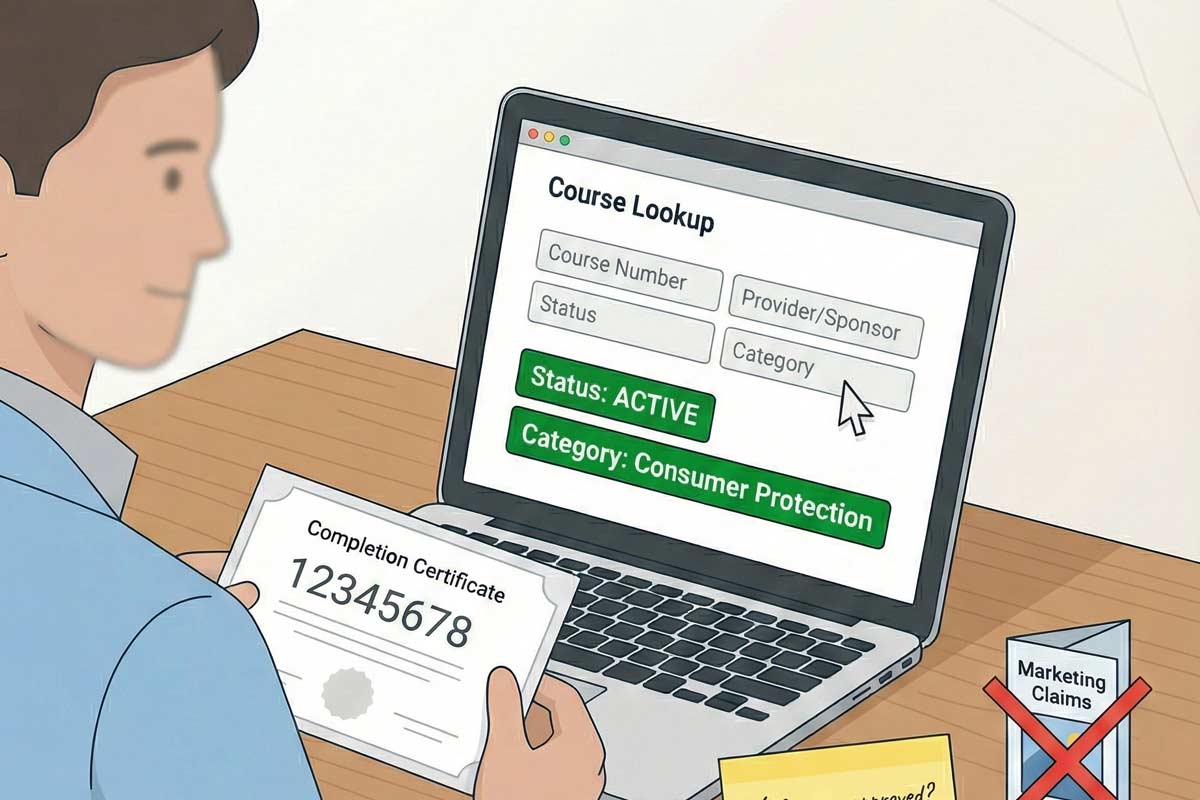
How to Verify a Course Counts (Step-by-Step)
Don’t trust the marketing on a website. Trust the database.
Get the Course Number: Ask the school for the 8-digit DRE course number.
Go to the Source: Visit the DRE’s Approved Continuing Education Courses lookup (on the DRE website).
Search: Enter the course number or the provider name.
Check the Status: Ensure the status is “Active.”
Check the Category: Make sure the category (e.g., Consumer Protection) matches what you need to fill your gap.
Verification Checklist:
Is the sponsor approved?
Is the course status "Active"?
Does the course category match my renewal requirements?
Will I receive a certificate with an 8-digit number immediately upon completion?
Real-World Scenarios: Where Agents Get Stuck
The “Cheap Bundle” Trap Agent Mark found a $30 renewal package online. He finished it in a weekend. When he uploaded it to eLicensing, he was rejected. Why? The bundle was old. The Fair Housing course lacked the required interactive participatory component (role-playing as both consumer and professional), and it was missing the Implicit Bias module entirely.
Lesson: Cheap often means outdated. Ensure the package is current for 2026 standards.
The “I Thought My Designation Counted” Trap Agent Sarah took a grueling 3-day course to get a luxury home designation. She assumed 24 hours of class time meant 24 hours of CE. It turned out the provider never registered the course with the California DRE. She got a nice pin for her lapel, but zero CE credits.
Lesson: Never assume. Check the DRE database.
Frequently Asked Questions
Do webinars count for CE? Yes, BUT only if the webinar provider is DRE-approved and they have a method to verify your attendance (like monitoring your login time or requiring exit quizzes). Live DRE-approved webinars are a valid way to knock out hours.
Can I repeat the same course every renewal? Generally, the DRE allows you to repeat courses in subsequent renewal cycles, provided the course material is still current and approved.
What is the difference between Consumer Protection and Consumer Service? Consumer Protection courses teach you how to protect the client (laws, disclosure, financing). Consumer Service courses teach you how to do your job better (marketing, computer skills). You must have at least 18 hours of Protection; Service hours only count toward the remaining balance.
How do I know if my Fair Housing course is “Interactive”? The course description should explicitly state it includes an "Interactive Participatory Component." The DRE requires this to include role-play as both a consumer and a real estate professional. If you just read a PDF and take a final exam, it likely does not meet the requirement.
What happens if my license expires before I renew? If you submit your renewal application and fees on time (before midnight of your expiration date), you can generally continue operating under B&P Code 10156.2 while the DRE processes it. However, if you are late, you enter a two-year grace period where you can still renew, but you cannot perform any licensed activity until your license is officially renewed.
What if I finish my CE early? That is great. You can upload your courses to the DRE eLicensing system up to 90 days before your expiration date. Do not wait until the last night.
Don’t Risk Your License
Renewing your license is not the time to experiment with unverified courses. The DRE audits renewals, and mistakes can delay your ability to work.
Make sure every hour counts. Stick to approved sponsors, verify your certificates, and get it done early so you can get back to selling.
Next Step: Ready to see the full roadmap? Go to our California Real Estate License Renewal Guide to get started.
|

Agency Is Where Agents Get Sued
If you ask a seasoned real estate attorney where most lawsuits begin, they won’t tell you that it’s always about a leaky roof or a cracked slab. They will tell you Read more...
Agency Is Where Agents Get Sued
If you ask a seasoned real estate attorney where most lawsuits begin, they won’t tell you that it’s always about a leaky roof or a cracked slab. They will tell you it’s about a broader concept known as "agency".
Many new licensees treat "agency" as a vocabulary word they memorized to pass the state exam, but in reality, California real estate agency relationships are the legal foundation of your entire career.
Understanding how agency fits into the broader framework of California real estate laws—like the rules we cover in our California Real Estate Laws & Compliance Guide—is an important step in a long and prosperous career. If you get agency right, you can avoid the vast majority of problems.
If you don’t, you are walking through a minefield blindfolded.
What Is “Agency” in California Real Estate?
In plain English, agency is a legal relationship where one person (the principal) authorizes another person (the agent) to act on their behalf with third parties.
In California real estate, there are three key players:
The Principal: The client (buyer or seller).
The Agent: Technically, this is the Broker under whom your license hangs.
The Third Party: The person on the other side of the deal who you don’t technically represent.
Important Concept: There is a common misconception that you—the salesperson—are the "agent." Under California law, the Broker is the agent of the principal. You are an agent of the Broker. You act on the Broker's behalf to serve the client.
How an Agency Relationship Is Created
This might sound strange, but you don’t always need a signed contract to create an agency relationship. California law recognizes several ways to create this relationship:
1. Express Agency The "typical" and safest way to create agency. The principal and agent expressly agree to the relationship, usually via a written contract.
Crucial Update: Following the August 2024 NAR Settlement, "Express Agency" is no longer just a best practice for buyers—it is the rule. You are now required to have a signed Buyer Representation Agreement before touring a home. If you unlock a door without this contract, you are starting your career non-compliant.
Scenario: A seller signs a Residential Listing Agreement authorizing you to market their home, or a buyer signs a Representation Agreement before you show them a property.
2. Implied Agency Your actions lead a person to believe you represent them, even without a written contract.
Scenario: You represent the seller, but you start giving a potential buyer negotiation advice. Your conduct leads the buyer to reasonably believe you are advocating for them, creating an implied agency.
3. Ostensible (Apparent) Agency A principal allows a third party to believe someone is their agent, even if they aren’t formally authorized.
Scenario: A landlord knows you are showing their vacant units to tenants and doesn't stop you. Because the landlord allowed this, the tenants reasonably believe you have authority to act.
4. Agency by Ratification A principal accepts the benefits of an action performed by an unauthorized agent (or an agent acting outside their authority), effectively creating the agency retroactively.
Scenario: You present an offer to a "For Sale By Owner" seller who has not hired you. The seller likes the price, accepts the offer, and agrees to pay you. By accepting the benefit of your work, the seller "ratifies" the agency relationship for that transaction.
Crucial Note: Agency is about authority and behavior, not who pays you. You can owe fiduciary duties in real estate even if you’re not getting a commission.
Types of Agency You Must Know
Seller’s Agent (Listing Agent): You represent the seller exclusively. Your goal is to get the best terms for the seller while treating the buyer honestly.
Buyer’s Agent: You represent the buyer exclusively. This protects the buyer's interests in price and terms.
Dual Agency: The same broker represents both the buyer and the seller.
The Catch: In California, the Broker is the dual agent, meaning every salesperson under that broker falls under the dual agency umbrella for that transaction.
The Rule: You must remain neutral. You cannot tell the seller the buyer will pay more, nor tell the buyer the seller will take less, without express written permission. Undisclosed dual agency is one of the fastest ways to lose your commission and face a lawsuit. Courts and the DRE view undisclosed dual agency as a serious betrayal of trust.
Exam Tip: On the California real estate exam, agency questions often focus on how these relationships are created, what fiduciary duties you owe a client, and when dual agency must be disclosed. Expect questions that test whether you understand who the broker represents and what happens when you slip into undisclosed dual agency.
Fiduciary Duties: The “OLD CAR” Framework
Once you are an agent, you owe your client fiduciary duties—the highest duties known to law. I teach students the acronym OLD CAR to remember them:
O – Obedience: You must obey lawful instructions. If the client says “no open houses,” you don’t hold open houses.
L – Loyalty: You must put the client’s interest above your own. You cannot steer a client to a house just to get a higher commission.
D – Disclosure: You must disclose all material facts affecting the property’s value or desirability.
C – Confidentiality: You must keep your client’s price, terms, and motivation private forever.
A – Accounting: You must properly handle all money and documents entrusted to you.
R – Reasonable Care: You must act with the skill of a professional. If you don’t know the answer, don’t guess.
Agency Is the Hub of Compliance
Agency doesn’t exist in a vacuum. Your status as a fiduciary connects directly to every other major compliance area. Here is what agency looks like in the real world:
Disclosure (The “D” in OLD CAR)
Because you represent the client, you are the filter for information. You must strictly follow California disclosure laws to ensure every material fact reaches the client, protecting them from bad investments and you from negligence claims.
Trust Funds (The “A” in OLD CAR)
Your fiduciary duty of accounting means you must be meticulous with money. You must avoid commingling in California real estate, which involves mixing client trust funds with your own money—a major violation that triggers immediate DRE action.
Fair Housing (Duty of Care & Obedience)
Your duty of reasonable care requires you to understand California fair housing laws. You must treat all parties fairly and never inadvertently discriminate or steer clients, as this violates both federal law and your agency responsibilities.
Advertising (Honest Representation)
Even your marketing is tied to agency. The advertising laws for California real estate agents mandate that you clearly identify your license status and brokerage so the public is never confused about who you actually represent.
Required Agency Disclosure Forms (The DEC Process)
In most one-to-four unit residential transactions, you’ll follow the DEC process to ensure compliance:
Disclose: Provide the “Disclosure Regarding Real Estate Agency Relationship” (Form AD) before you sign a listing or write an offer.
Elect: Elect who you represent in your Listing Agreement or Buyer Representation Agreement.
Confirm: Confirm that same agency relationship again in the Purchase Agreement (RPA).
The Cost of Failure: This isn’t just paperwork. If you mishandle or fail to disclose agency properly, a court can decide you’re not entitled to a commission, even if you did all the work and closed the deal. A judge will not care how hard you worked if you were not legally authorized to perform the service.
Common Agency Mistakes to Avoid
In my years of consulting, I see the same agency mistakes repeated constantly. Here is what they look like in real life:
Accidental Dual Agency: You answer detailed strategy questions from a buyer at your open house and then write the offer without clearly disclosing dual agency. If the buyer later claims you were supposed to protect them, you’re now exposed as an undisclosed dual agent, which courts and the DRE treat very harshly.
Breach of Confidentiality: You tell a buyer’s agent, “My sellers are divorcing and need to sell fast,” without authorization. You’ve just handed the other side leverage and opened the door to a claim that you sabotaged your own client’s negotiating position.
Improper Trust Fund Handling: You accept an earnest money check made out to you personally instead of the title company or broker. Handling checks this way looks like commingling and can trigger an immediate trust account audit and potential license discipline.
How to Explain Agency to a Client (Script)
New agents often struggle to explain their role. Here is a simple script you can use to explain agency to a buyer or seller in 20 seconds:
“Mr./Ms. Client, I represent you in this transaction, which means I have a legal duty to put your financial interests ahead of my own. Everything you tell me stays confidential, and I’m required to disclose any facts that affect the value of the property so you can make the best decision possible.”
Using plain language like this builds trust immediately and sets the tone for a professional relationship.
Consequences of Violating Agency Law
The stakes are high. Violating agency law can lead to:
Civil litigation - Clients suing for damages if they overpaid or undersold because you mishandled agency.
DRE discipline - Suspension or revocation of your license.
Commission forfeiture - Courts can deny you a commission if your agency was not properly disclosed, even if you closed the deal.
Agency law is learnable. If you want to see how agency fits alongside disclosure, advertising, fair housing, and trust fund rules, spend time with our California Real Estate Laws & Compliance Guide so your entire business rests on solid ground.
|

Imagine it’s 7:42 PM on a Tuesday. You are the listing agent on a home in Los Angeles and your phone is buzzing non-stop. You have nine offers in your inbox, three agents texting you for a "verbal status," Read more...
Imagine it’s 7:42 PM on a Tuesday. You are the listing agent on a home in Los Angeles and your phone is buzzing non-stop. You have nine offers in your inbox, three agents texting you for a "verbal status," and a seller who is overwhelmed and asking:
"Can we just pick the highest one and be done?"
This is the moment where careers are made or broken.
In a hot market, multiple offer scenarios are a standard pressure test. They are also a frequent trigger for disciplinary action because, under pressure, agents often cut corners. They might get sloppy with communication, inadvertently "shop" an offer, or fail to present every option clearly. To survive this without risking your license, you need a system rooted in the California Real Estate Laws & Compliance Guide.
You need a process that protects you and serves your client. Here is exactly how to handle the multiple-offer pressure cooker without crossing legal lines.
The "All Offers" Rule (No Exceptions)
Let’s start with the absolute baseline. Under California fiduciary duties, a listing agent is expected to present offers and counteroffers promptly and diligently unless the seller has previously directed the agent otherwise in writing.
It doesn’t matter if the offer is $50,000 under ask. It doesn’t matter if it’s written on a standardized form or a less formal document—if it is a bona fide offer, the seller needs to see it.
Agents often get into trouble here by "pocketing" lowball offers because they don't want to waste their time. That is a violation of your fiduciary duty. To understand the risks of filtering information, read our guide on How to Avoid Misrepresentation in CA Transactions, which details why you must never lie about the existence or number of offers to drive up the price. If you claim you have five offers, you must actually have five offers in hand.
The Spreadsheet Method & The Paper Trail
When you are juggling six different offers, relying on your memory is a recipe for disaster. You need a standardized way to present data to your client so they can make an informed decision based on facts, not just the purchase price. There are so many components in determining what constitutes a “good” offer and certainly price is one piece of the puzzle, but what about downpayment? What about credit score? What about the “certainty of close”?
Step 1: Secure Written Instructions First
Before you even respond to the first agent, get the seller’s game plan in writing. Do they want to counter everyone? Do they want to accept the best one immediately? Do not act on a verbal "just handle it."
Step 2: Build the Summary
I teach my agents to build a "Summary of Offers" spreadsheet for the seller. It should include:
Offer Price: The headline number.
Down Payment & Loan Type: Cash vs. Conventional vs. FHA.
Earnest Money Deposit (EMD): Is it 1% or 3%? Is it released early?
Contingencies: Inspection, Appraisal, Loan. How long are the timelines?
Close of Escrow: Does it align with the seller’s move-out date?
Any other notes: When does the buyer want possession?
By stripping the emotion out, you help the seller see the net value. A higher offer with no lender commitment and 45-day contingencies is often worth less than a slightly lower, fully underwritten offer with a 10-day close.
Navigating the "Best and Final" Round
Once you have reviewed the initial batch, you rarely accept one outright. You usually issue a Seller Multiple Counter Offer (SMCO).
This is where the ethics get tricky. You must treat all potential buyers fairly. You cannot give one agent a "heads up" on the price to beat while keeping the others in the dark. Your Ethical Duties require you to treat all parties honestly and fairly, even if you strictly represent the seller.
The Script for "What’s the highest offer?"
Buyer’s agents will ask you: "What do we need to write to get it?" or "What is the top offer right now?"
Be very careful. In California, offer terms are not automatically "confidential" unless the parties have a written confidentiality agreement—but disclosure still needs to be seller-directed, truthful, and applied consistently to avoid misrepresentation or favoritism.
If you tell Agent A that the high mark is $850k, and they bid $855k, you have effectively "shopped" the other buyer’s offer without giving them a chance to respond.
The Safer Approach: Communicate to all parties: "We have multiple competitive offers. The seller is requesting your highest and best offer by 5:00 PM tomorrow. Please maximize your price and tighten your terms."
The Privacy Trap: What You Can and Cannot Share
When the heat turns up, it is tempting to leverage one buyer against another by sharing details. "Hey, I have an offer from a cash buyer, so you need to waive your appraisal."
Is that true? Or are you bluffing? If it’s true, you are likely safe (provided you have seller permission). If you are bluffing, you risk serious liability for misrepresentation and deceit.
Furthermore, you need to protect the data. You are collecting proof of funds, bank statements, and pre-approval letters. Adhering to strict Privacy Rules for Managing Client Information means you generally should not disclose the specific financial details or identity of a competing buyer to other agents. Keep those bank statements redacted or hidden when you are reviewing terms with anyone other than your client.
The Dual Agency Landmine
The most dangerous scenario in a multiple-offer situation is when you represent one of the buyers.
You are now a Dual Agent. You have a listing with five offers, and one of them is yours. The other agents will immediately suspect foul play. They will assume you are guiding the seller toward your buyer to increase your commission.
How to Handle It
Disclose to Principals: Disclose dual agency to the buyer and seller and obtain their written consent immediately.
Stay Neutral: Present and document all offers objectively; don’t use inside knowledge from one side to advantage the other.
Manager Review: Ensure that your broker and manager are in the loop.
The risks multiply when you are navigating Dual Agency in California. If another offer fits the seller’s criteria better, your job is to present that clearly and document the seller’s decision—even if it’s not the outcome you’d personally prefer.
Process Protects You
When the market is moving fast, you don't rise to the occasion; you fall to the level of your training.
If you don't have a systematic way to log, present, and counter offers, you will eventually make a mistake. You will forget to respond to an agent, or you will accidentally disclose a price cap when you shouldn't have.
Work with your broker or manager to create your spreadsheet template today. Script your "highest and best" response today. When that Tuesday night rush comes, you won't be panicking—you’ll be executing.
Note: This article is general education, not legal advice; when in doubt, follow your broker’s policy and get broker/legal guidance.
|

In the high-stakes world of California real estate disclosure laws, lawsuits rarely happen because a house was sold for $5,000 less than asking. They happen because the garage floods every January, the Read more...
In the high-stakes world of California real estate disclosure laws, lawsuits rarely happen because a house was sold for $5,000 less than asking. They happen because the garage floods every January, the seller knew about it, and nobody told the buyer.
For most new agents, the first serious risk of a lawsuit or DRE complaint comes from inaccurate and incomplete disclosures—not from writing a weak offer.
You might be terrified of missing a checkbox, "forgetting" a document, or getting dragged into court because your seller hid an active leak behind a fresh coat of paint. I’ve been teaching real estate for over 20 years at ADHI Schools, and I’m also a practicing broker who has watched real disclosure disputes play out in the real world
I tell my students constantly: Disclosures aren’t busywork. They are your shield.
When done correctly, they protect your client, your paycheck, and your license. This guide is a practical, street-level breakdown of real estate disclosure requirements in California, the forms you must master, and the scripts you need to stay out of trouble.
(Disclaimer: This article is for educational purposes only. If you are facing a specific legal situation or complex transaction, always consult your managing broker or a qualified real estate attorney.)
What Are “Disclosures” in California Real Estate?
In plain English, a disclosure is the formal act of revealing material facts about a property.
California is a strict "consumer protection" state. Unlike "Caveat Emptor" (Buyer Beware) states where the buyer is on their own, California places a heavy burden on the seller and the agents to reveal what they know.
The "Material Fact" Standard
A material fact is any information that would affect the value or desirability of the property to a reasonable person.
Does the roof leak? Material fact.
Was the garage converted without a permit Material fact.
Is there a noisy firing range a mile away? Likely a material fact.
The "Loud Party" Rule (A Real-World Example)
To understand "desirability," consider this scenario: I once saw a deal where the seller didn’t mention a neighbor who hosted loud backyard parties every single weekend. The buyer called the listing agent at 11:30 p.m. on their first Saturday in the home, furious.
Was the house physically broken? No. Was the desirability affected? Absolutely. If you find yourself wondering, "Should we mention this?" the answer is almost always yes.
The Core California Real Estate Disclosure Laws Framework (The Big 6 Forms)
While there are dozens of forms, these are the heavy hitters that form the backbone of California disclosure rules.
1. The Transfer Disclosure Statement (TDS)
The TDS is the holy grail. It is a statutory form where the seller must list items included in the sale, whether they work, and any significant defects (walls, fences, electrical, plumbing).
Crucial Rule: The seller must fill this out—not the agent. You can explain the form, but never put the pen to paper for them.
2. Seller Property Questionnaire (SPQ)
While the TDS is law, the SPQ is a standard C.A.R. form used by most brokerages to expand on the disclosures in the TDS. It asks pointed questions about deaths on the property, insurance claims, pets, and neighborhood nuisances, among others.
3. Agent Visual Inspection Disclosure (AVID)
This is your duty. California Civil Code requires real estate agents to conduct a "reasonably competent and diligent visual inspection" of accessible areas.
What to write: Observations. "Stain on ceiling in bedroom 2," "Cracked tile in entryway."
What NOT to write: Diagnoses. Do not write "Roof was leaking, but no longer active." You are not a roofer.
4. Natural Hazard Disclosure (NHD) Statement
California is beautiful but high-risk from a natural hazard standpoint. The NHD report tells the buyer if the home sits in flood, fire, or earthquake zones.
Pro Tip: Most agents order this from third-party companies to reduce liability. However, a third-party report doesn't erase your duty. You still must read the report and flag major issues for your client.
5. Condo/HOA Disclosures
If you are selling a condo or a home in an HOA, the standard forms aren't enough. You must provide the CC&Rs, bylaws, financial statements, and meeting minutes.
Why it matters: Many disputes arise because a buyer didn't know about a "special assessment" coming down the pipe or a rule banning their pickup truck from the driveway.
6. Lead-Based Paint Disclosure
If the home was built prior to 1978, federal and state law requires this disclosure and the provision of the "Protect Your Family from Lead in Your Home" pamphlet.
Deep Dive: To see how these forms fit into the bigger legal picture, check out our California Real Estate Laws & Compliance Guide.
Who Must Disclose What? (And What to Say)
A common source of confusion is figuring out who is "on the hook" for specific information.
The Seller's Duty (and the "Investor" Myth)
The seller must disclose known material facts. They don't have to hire inspectors to find new defects, but they cannot hide what they know, or should know.
The "I Never Lived There" Trap: Many investors, flippers, or heirs selling a probate property believe they are exempt from disclosures because they "never lived there." This is false. While they may be exempt from the TDS in specific cases (like a trustee selling a property at a trustee sale foreclosure auction), they are generally not exempt from disclosing known material facts. "I never lived there" is not a magic shield against known material facts.
The "Flipper" Law (AB 968): The End of "I Don't Know" For years, investors used the "I never lived there" excuse to avoid disclosing property defects. As of July 1, 2024, that loophole is gone for flippers.
Under Assembly Bill 968, if you are selling a single-family home (1-4 units) within 18 months of buying it, you have a heightened duty. You cannot just hand over a blank TDS. You must legally disclose:
The Work Done: A written list of every renovation, modification, or repair.
The Contractors: The names and contact info for the contractors who did the work.
The Permits: Copies of the permits. If you don't have them, you must provide the contact info for the third party who does.
The trap: If you hired cheap, unlicensed labor to paint over a problem and didn't pull permits, you now have to hand that evidence directly to the buyer. If you fail to do this, you aren't just risking a lawsuit; you are handing the buyer a roadmap to win it.
The Listing Agent's Duty
You have a duty of honest dealing and a duty to inspect. You cannot hide behind your seller.
The "Don't Tell Them" Script: If a seller says, "The roof leaks, but don't tell the buyer," and you obey, you can get yourself in hot water. Here is the script to handle that:
"Mr. Seller, I am required by law and by my real estate license to disclose this. If we hide it, we open ourselves up to a lawsuit we will have a tough time defending against."
The Buyer's Agent's Duty
You must review disclosures with your buyer and point out red flags.
The "CYA" Email Script: Don't just verbally tell a buyer to get an inspection. Document it.
"Hi [Buyer Name], per our conversation, I strongly recommend we hire a licensed specialist to inspect the roof before your contingency period ends on Tuesday. The general inspection noted wear, and I want to ensure you know the full scope."
This email could save you one day. For a deeper dive into your fiduciary duties and how they relate to disclosures, read California Agency Law Explained for New Agents.
Timing, Delivery & Documentation
It’s not enough to fill out the forms; you have to deliver them correctly.
The Timeline
In a standard California Residential Purchase Agreement (RPA), the seller typically has 7 days after acceptance to deliver full disclosures, unless otherwise agreed in writing.
Handling Prior Reports
If a previous escrow fell out and the buyer left you with their inspection report, can you ignore it?
No.
If you or the seller have a report in your possession, it is now part of what you know about the property. Talk to your broker about office policy, but in most cases you should provide it to the new buyer.
Script: "Please find the attached inspection report from a previous transaction, provided for informational purposes only. We recommend you conduct your own investigations."
High-Risk Topics Agents Must Never Gloss Over
In my experience, these are the landmines that cause the most explosions:
1. Water Intrusion & Mold
Never let a seller paint over a water stain without disclosing the cause.
2. Unpermitted Work
Did they turn the garage into a gym? Disclose it.
3. Death on the Property
You must disclose death on the property within the last 3 years. If a buyer asks directly about death anytime in the past, you must answer honestly.
4. Neighborhood Nuisances
Noises, odors, or disputes that affect "desirability."
The "Compliance Stack": How It All Connects
California real estate disclosure laws are just one layer of your compliance defense. Think of your "Compliance Stack" like this:
Disclosures: What you tell the buyer about the house.
Agency: Who you represent and your fiduciary duties.
Fair Housing: What you never say (avoiding discrimination).
Read more: California Fair Housing Laws Agents Must Know
Advertising: What you put in print/online (avoiding false claims).
Read more: Advertising Laws for California Real Estate Agents
Trust Funds: How you handle the money (avoiding commingling).
Read more: What Is “Commingling” in California Real Estate?
Most serious lawsuits involve a failure in two or three of these layers at once.
The Cost of Silence: What Happens If You Fail to Disclose?
If you fail to follow seller disclosure laws in California, the consequences are severe:
Rescission: The deal unwinds.
Damages: You pay for the difference in value and repairs.
DRE Discipline: You have suspension or revocation of your license.
Practical Checklists & Scripts
To protect yourself, use these tools in every transaction.
The "Mental Stop" Checklist
Before you send a packet, ask:
Did the seller answer every question on the TDS/SPQ? (No blanks).
Did I walk the property and write down exactly what I saw on the AVID?
Did we disclose any unpermitted work we are aware of?
Are we sitting on any old inspection reports that need to be shared?
Script: Explaining the AVID to a Buyer
"I’ve completed my Agent Visual Inspection Disclosure. Please keep in mind, I am a real estate agent, not a contractor. I’m noting what I see—like a stain or a crack—but I cannot tell you if it’s structural or cosmetic. That is why we need a professional home inspection."
Frequently Asked Questions About California Disclosure Laws
Do seller disclosure laws in California apply to “as-is” sales?
Yes. “As-is” usually means the seller doesn’t plan to make repairs, but they still must disclose known material defects.
Do I have to disclose a death on the property in California?
Yes, if it occurred within the last three years. If a buyer asks directly about any past death, you must answer honestly.
Are investors exempt from real estate disclosure requirements in California?
No. Even if they never lived in the property, they must disclose any material facts they know.
Can I rely only on the NHD company and inspector reports?
No. They help reduce risk, but you’re still expected to read them and flag major issues for your client.
Understanding California disclosure laws is about more than just passing your exam. It’s about building a career that lasts. When you master these forms, you aren't just pushing paper—you are establishing yourself as a pro who knows how to navigate risk.
If you’re not licensed yet and this article made you realize how serious this business is, that’s a good thing.
Read our California Real Estate Laws & Compliance Guide to see the big picture, or explore our classes to get the kind of training that actually prepares you for the real world.
|
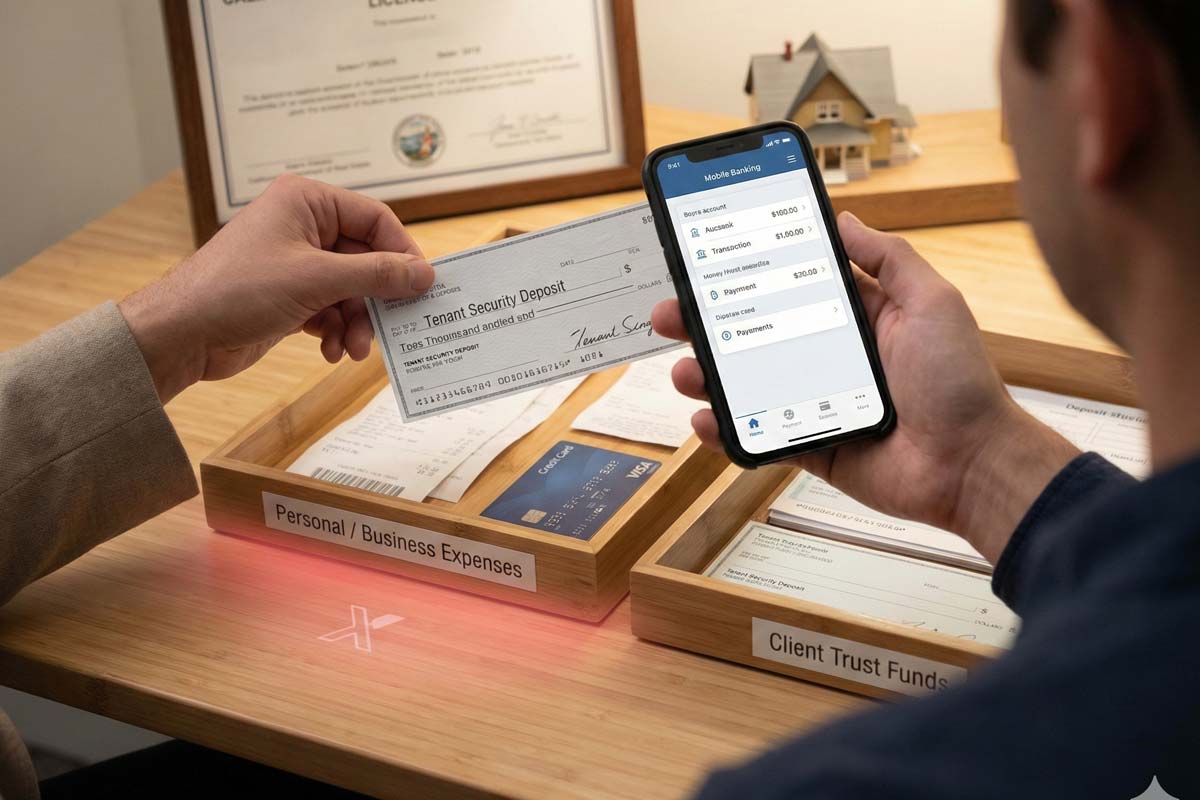
The Fastest Way to Lose Your License
Imagine this scenario: You are a broker with a busy property management division. A tenant hands you a security deposit check for $2,000. You’re in a rush, so Read more...
The Fastest Way to Lose Your License
Imagine this scenario: You are a broker with a busy property management division. A tenant hands you a security deposit check for $2,000. You’re in a rush, so you deposit it into your general business operating account, intending to transfer it to the trust account on Monday.
Even if you transfer the money on Monday morning, you have already broken the law.
In California real estate, that mistake has a name: commingling of trust funds – illegally mixing a client’s money with your own.
Mishandling of trust funds is one of the most common reasons the California Department of Real Estate (DRE) disciplines licensees.
This article is part of our California Real Estate Laws & Compliance Guide, designed to keep you safe, compliant, and in business. Let’s break down exactly what commingling is, how it differs from conversion, and how you can avoid the audit nightmares that end careers.
What Is Commingling in California Real Estate?
In California real estate, commingling is the illegal practice of mixing a client’s money (trust funds) with the broker’s or agent’s personal or general business funds.
Think of it this way: As a real estate professional, you have two distinct "pockets."
Pocket A: Your money (commissions earned, operating funds).
Pocket B: The client’s money (earnest money, rents, security deposits).
Commingling happens when you put Pocket B money into Pocket A. Even if you don't spend it, the mere act of mixing the funds is a violation of the California Business and Professions Code.
Commingling vs. Conversion
New agents often confuse these two terms. You will see this distinction on the real estate exam, so memorize it now:
Commingling (Mixing): Depositing client funds into a personal account. You haven't necessarily spent it, but you’ve mixed it with your own money.
Conversion (Essentially Theft): Actually using that client money for your own purposes (e.g., paying your car payment with a client’s earnest money).
The Golden Rule: Commingling is the gateway drug to conversion. That’s why the DRE comes down hard on commingling even when “no one got hurt.”
Trust Funds in California Real Estate (What Money Is Dangerous to Commingle?)
To avoid commingling, you must identify "Trust Funds" immediately. Trust funds are anything of value received by a broker or salesperson on behalf of a principal or another person in a transaction.
Common examples include:
Earnest money deposits from buyers.
Rents collected for landlords.
Security deposits from tenants.
Repair reserves held for property management.
Homeowner Association (HOA) dues (if managed by the broker).
Because you have a fiduciary duty to your client—a concept we dive deeper into in our California Agency Law Explained for New Agents article—you are holding this money in trust. It is not yours.
How Commingling Happens in Real Life
Often commingling isn't malicious; it’s sloppy. Here are the street-level scenarios where new agents get into trouble.
1. The "Personal App" Trap
The Scenario: A tenant wants to pay rent via Venmo or Zelle. You let them send it to your personal Venmo account, planning to write a check to the owner later.
The Violation: You have just commingled. That rent money is sitting in your personal account ecosystem.
The Fix: Never accept trust funds into a personal digital wallet. Use a designated business trust account or have the tenant pay the landlord directly.
2. The "Desk Drawer" Deposit
The Scenario: You get an earnest money check on Friday. You leave it in your desk drawer over the weekend and forget about it until the following Thursday. You realize you’re late, so you deposit it into your personal account just to "get it in the bank."
The Violation: Leaving the check in your desk that long is mishandling trust funds. But if you then panic and deposit it into your personal account, you’ve now committed commingling – which is far more serious.
The Fix: Deposit funds immediately (usually within 3 business days) into the proper trust account or escrow.
3. The "Short-Term Loan"
The Scenario: Your business account is short $500 for a marketing bill. You "borrow" $500 from the trust account, knowing you have a commission check coming tomorrow to replace it.
The Violation: This is conversion (theft), fueled by commingling.
The Fix: Never, ever touch trust funds for operating expenses.
Transparency is key here. Just as you must follow California Disclosure Laws (Complete Breakdown) regarding property defects, you must be transparent about where the money is going.
DRE Rules, Audits & Consequences
The California DRE has the power to audit your books at any time. They do not need a warrant; your license grants them that right.
What Triggers an Audit?
Consumer Complaints: A client feels their money was mishandled.
Random Selection: The DRE conducts spot checks.
Red Flags: Irregularities in your paperwork or renewals.
The Consequences
Commingling trust funds is one of the most serious trust account violations in California real estate, and the penalties reflect that severity:
Citations and Fines: Monetary penalties that stay on your record.
Suspension: You cannot practice real estate for a set period.
Revocation: You lose your license entirely.
The DRE takes this seriously because it is a matter of public trust. When you promote yourself, you're telling the public they can trust you with their money. That's why our Advertising Laws for California Real Estate Agents aren’t just about fonts and disclaimers – they’re about not misleading people about how safely you handle deposits and rent.
How California Real Estate Agents Avoid Commingling Trust Funds
Compliance is about habits, not willpower. Implement these best practices immediately.
The Anti-Commingling Checklist
Create a Designated Trust Account: If you handle client funds, open a separate bank account labeled "Trust Account" or "Fiduciary Account."
The 3-Day Rule: Under California rules, trust funds must generally be placed into a neutral escrow depository, the hands of the principal, or a trust account within three business days of receipt.
Zero Personal Funds: The only personal money a broker can keep in a trust account is a small amount (up to $200 in California) specifically to cover bank service charges. Any more than that is commingling.
Reconcile Monthly: Reconcile your trust account regularly (monthly is standard) so the balance always matches what you owe clients.
Treat Everyone Equally: Treating every tenant and buyer’s money with the same strict procedures doesn’t just prevent commingling – it also supports your obligations under California Fair Housing Laws Agents Must Know, because “special treatment” around deposits can quickly drift into discrimination territory.
Script: Explaining Trust Funds to Clients
Client: "Can I just write the deposit check to you personally?"
Agent: "To protect your money and comply with California law, I can’t have you make the check payable to me personally or deposit it into my personal account. Please make the check payable to [Escrow Company Name] or [Brokerage Trust Account]. That way your funds are held in a proper trust or escrow account and are legally protected throughout the transaction."
How “Commingling” Shows Up on the Test
If you are studying for your California real estate exam, expect at least a handful of questions on this topic. The exam writers love to trick you with the difference between commingling and conversion.
The "Trap" Question Logic
Scenario A: Broker Bob puts a $1,000 deposit into his personal checking account.
Verdict: Commingling. (He mixed it).
Scenario B: Broker Bob takes that $1,000 and buys a new suit.
Verdict: Conversion. (He spent it).
Scenario C: Broker Bob keeps $5,000 of his own money in the trust account “just in case.”
Verdict: Commingling. (You cannot store your savings in a trust account, even if you don’t touch the client’s money).
Exam Tip: If the question mentions “mixing” funds, the answer is commingling. If the question mentions “misappropriating” or “using” funds, the answer is conversion.
FAQ: Commingling Trust Funds in California Real Estate
Is commingling illegal in California real estate? Yes. It is a violation of the California Business and Professions Code and is grounds for license suspension or revocation.
How long does a broker have to deposit trust funds in California? Generally, a broker has three business days following the receipt of funds to deposit them into a trust account, a neutral escrow, or give them to the principal.
What is the difference between commingling and conversion? Commingling is the mixing of client funds with personal/business funds. Conversion is the actual use or theft of those funds for the agent’s benefit.
Can a broker keep their own money in a trust account? A broker may only keep a very small amount (typically up to $200) of their own funds in the trust account for the sole purpose of covering bank service fees. Anything beyond that is commingling.
Stay Compliant, Stay in Business
Commingling is a preventable risk. By setting up the right accounts and following a strict "hands-off" policy with client money, you protect your license and your clients.
I’ve watched smart, well-meaning agents lose years of work over a single sloppy trust-fund decision. There is no commission big enough to justify that risk.
Ready to master the rest of the rulebook? Continue your study with our California Real Estate Laws & Compliance Guide to ensure you are fully prepared for both the state exam and your first year in the field.
|