
The single biggest mistake I see agents make during renewal isn’t failing a test—it’s finishing 45 hours of education only to realize none of it counts.
Just because a class is about real estate doesn’t mean the California Department of Real Estate (DRE) accepts it for your license renewal. Your office sales training? Probably doesn’t count. That motivating weekend seminar? Likely doesn’t count.
If you rely on unapproved courses, you risk a lapse in your license status where you cannot legally conduct business.
Here is the no-nonsense guide to exactly what counts, what doesn’t, and how to verify your courses before you spend a dime.
If you are in a rush, here is the bottom line on course eligibility:
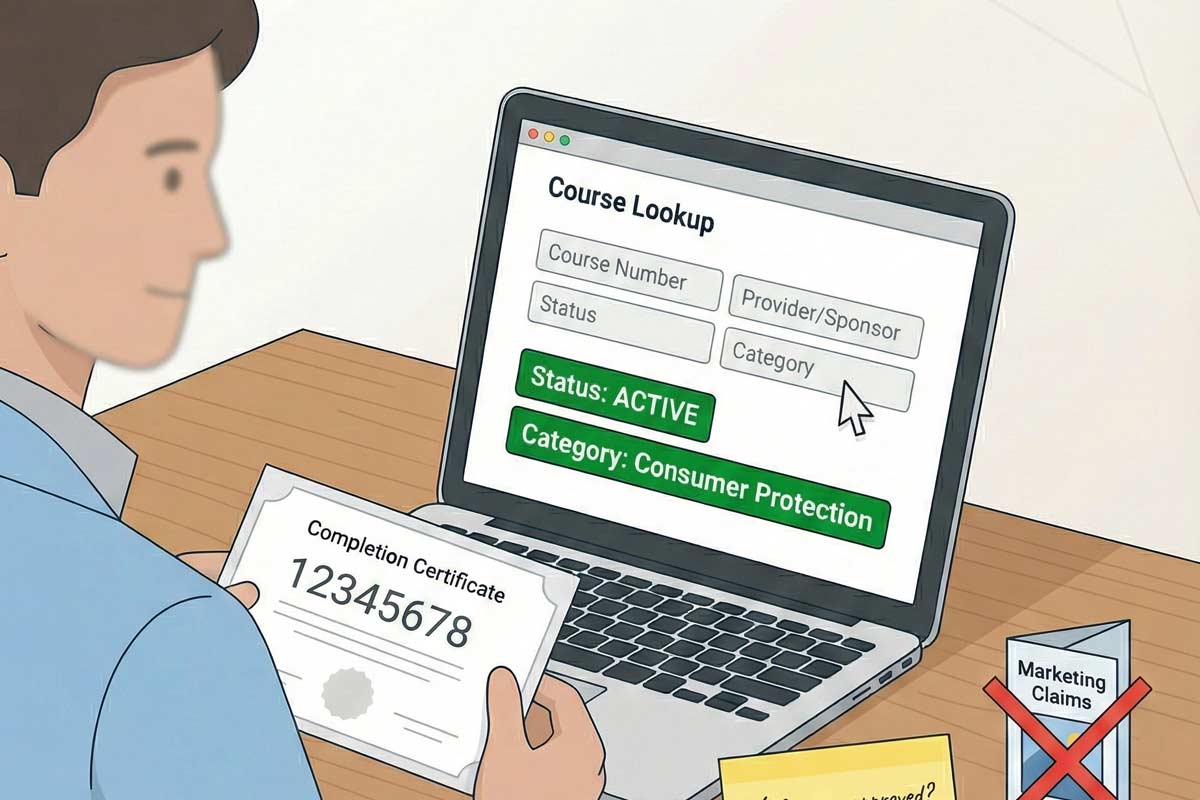
For a course to count toward your Continuing Education (CE), it must meet two criteria:
The DRE measures education in “clock hours.” When we say you need 45 hours, we mean 45 credit hours approved by the state—not necessarily 45 hours of sitting in a chair if you are a fast reader, but the content must match that volume.
Crucial: You must receive an official Completion Certificate featuring an 8-digit certificate number. You should retain these certificates for four years after your renewal in case you are audited.

What you need depends entirely on where you are in your career.
To build a valid 45-hour package, you need to prioritize the categories in this order:
These are the non-negotiables. The state requires you to stay updated on the laws that protect the public.
This category is the gold standard for electives.
This is the most confusing category. These are courses that improve your skills but don't necessarily protect the public legally.
My Advice: Stick to Mandatory + Consumer Protection. It’s the safest path to ensure you never accidentally short yourself on the required protection hours.
I have seen agents spend hundreds of dollars and weekends of time on things that count for zero hours toward renewal.
Don’t trust the marketing on a website. Trust the database.
The “Cheap Bundle” Trap Agent Mark found a $30 renewal package online. He finished it in a weekend. When he uploaded it to eLicensing, he was rejected. Why? The bundle was old. The Fair Housing course lacked the required interactive participatory component (role-playing as both consumer and professional), and it was missing the Implicit Bias module entirely.
The “I Thought My Designation Counted” Trap Agent Sarah took a grueling 3-day course to get a luxury home designation. She assumed 24 hours of class time meant 24 hours of CE. It turned out the provider never registered the course with the California DRE. She got a nice pin for her lapel, but zero CE credits.
Do webinars count for CE? Yes, BUT only if the webinar provider is DRE-approved and they have a method to verify your attendance (like monitoring your login time or requiring exit quizzes). Live DRE-approved webinars are a valid way to knock out hours.
Can I repeat the same course every renewal? Generally, the DRE allows you to repeat courses in subsequent renewal cycles, provided the course material is still current and approved.
What is the difference between Consumer Protection and Consumer Service? Consumer Protection courses teach you how to protect the client (laws, disclosure, financing). Consumer Service courses teach you how to do your job better (marketing, computer skills). You must have at least 18 hours of Protection; Service hours only count toward the remaining balance.
How do I know if my Fair Housing course is “Interactive”? The course description should explicitly state it includes an "Interactive Participatory Component." The DRE requires this to include role-play as both a consumer and a real estate professional. If you just read a PDF and take a final exam, it likely does not meet the requirement.
What happens if my license expires before I renew? If you submit your renewal application and fees on time (before midnight of your expiration date), you can generally continue operating under B&P Code 10156.2 while the DRE processes it. However, if you are late, you enter a two-year grace period where you can still renew, but you cannot perform any licensed activity until your license is officially renewed.
What if I finish my CE early? That is great. You can upload your courses to the DRE eLicensing system up to 90 days before your expiration date. Do not wait until the last night.
Renewing your license is not the time to experiment with unverified courses. The DRE audits renewals, and mistakes can delay your ability to work.
Make sure every hour counts. Stick to approved sponsors, verify your certificates, and get it done early so you can get back to selling.

Founder, Adhi Schools
Kartik Subramaniam is the Founder and CEO of ADHI Real Estate Schools, a leader in real estate education throughout California. Holding a degree from Cal Poly University, Subramaniam brings a wealth of experience in real estate sales, property management, and investment transactions. He is the author of nine books on real estate and countless real estate articles. With a track record of successfully completing hundreds of real estate transactions, he has equipped countless professionals to thrive in the industry.

"Hey guys,
I took the exam today and passed!!!!
It only took me one try which was one of my goals. I took the online
classes and follow your suggestions so I took the crash course,
used the crash course app a lot, took 7 mock tests and went
confident to present the exam. Thank you for the great job you are
doing, you guys are awesome!!!! May God continue to bless you!"
Willie V.