
You’ve passed your exam, you’ve hung your license with a broker, and you are ready to take over your local real estate market. You want to blast your face and name everywhere—billboards, Instagram, Read more...
You’ve passed your exam, you’ve hung your license with a broker, and you are ready to take over your local real estate market. You want to blast your face and name everywhere—billboards, Instagram, business cards, and flyers.
But before you order 5,000 glossy postcards, hit the brakes.
In my 20+ years of training agents, I’ve learned a hard truth: Most new agents don’t get in trouble for stealing money—they get in trouble because they violated DRE rules in their marketing and they might not have even known it.
You do not want your first letter from the Department of Real Estate to be an accusation. The DRE does audit websites, postcards, and social profiles—especially when a complaint comes in—so assume your advertising will be reviewed at some point.
The DRE is incredibly strict about how licensees present themselves. If you don’t follow the specific DRE advertising rules, you aren't just looking at a warning; you could be facing citations, fines, and a permanent mark on your record.
Here is your plain-English guide to marketing yourself aggressively without getting flagged.
The "First Point of Contact" Rule
The most fundamental concept in California real estate advertising is the "First Point of Contact."
This is the moment a consumer first encounters you professionally. Because the public relies on these materials to verify your identity, the DRE mandates strict transparency here. Think of your license status as the very first disclosure you make to a client. (For more on what you must reveal later in the transaction, see our California Disclosure Laws (Complete Breakdown)).
What Counts as "First Point of Contact" Materials?
The DRE defines this broadly. If you use it to get business, it counts. In the regulations, these are called "solicitation materials"—anything you use to solicit business from the public. These include:
Business cards
Stationery and letterhead
Email signatures
Flyers, door hangers, and mailers
"For Sale" and open house signs
Website homepages and landing pages
Online lead forms and "contact me" pages
The Mandatory Trio
For any of the materials listed above, you must include three specific items:
Your Name: Exactly as it appears on your license (no nicknames unless filed as a "DBA").
Your License Identification Number: This is non-negotiable.
Your Responsible Broker’s Identity: You cannot advertise as a "lone wolf." The public must know which brokerage employs you.
Digital & Social Media Compliance
The internet moves fast, but the law keeps up. Under Commissioner's Regulation 2770, electronic and online advertising is treated just like traditional solicitation—your license status must still be clear.
Here is how to stay compliant on different platforms:
Social Media Bios (Instagram, TikTok, Facebook)
Your bio is your digital business card. It must include:
Your name.
Your DRE license number.
Your responsible broker’s identity.
Warning: Do not bury this information deep inside a Linktree. If a consumer clicks your link, and then has to click again to find your license info, you are technically "two clicks" away. That is a violation. Put the DRE# directly in your bio text.
Individual Posts, Reels, and Stories
Does your license number need to be in the caption of every single Instagram story or Tweet? Generally, no—provided you follow the "One-Click Rule."
You are compliant if your individual posts clearly relate back to a main profile (your bio) where the mandatory information is displayed. As long as the consumer can find your license status with one single click from the post, you are safe.
Websites, Landing Pages, and Lead Forms
Websites are different. You cannot rely on the "one-click" rule here. Your license number and broker identity should appear on the homepage or, ideally, globally in the footer of every page. If a consumer lands on a blog post or a listing page, they should not have to hunt to see who you are.
"Team Name" Advertising Pitfalls
This is where I see the most citations for established agents. Everyone wants a flashy team name like "The Luxury Living Group," but the DRE sees "Teams" as a potential source of consumer confusion.
If you follow these real estate team advertising rules California sets out, your signs and online branding will stay out of trouble:
1. The Surname Rule
A team name must include the surname (last name) of at least one licensee on the team.
Illegal: "The Magic City Team"
Legal: "The Smith Group."
2. The Permitted Words
Your team name must include a term like "Group," "Team," or "Associates." You cannot use words that imply you are a standalone brokerage, such as "Real Estate," "Brokerage," or "Company."
3. The Font Size Rule (The "Ego Check")
This is a technicality that leads to fines. When you advertise a team name, the Responsible Broker’s identity must be displayed as prominently as the team name.
This ties directly to agency relationships. As we explain in California Agency Law Explained for New Agents, you represent the broker, and the broker represents the client. Your ads must reflect that legal hierarchy.
Discriminatory Advertising
Advertising rules aren't just about font sizes; they are about civil rights. When writing listing copy, you must avoid language that suggests a preference or limitation based on a protected class.
In California, that includes: race, color, religion, sex, gender, gender identity, sexual orientation, marital status, national origin, ancestry, familial status, disability, and source of income.
Bad: "Perfect bachelor pad" (implies sex/familial status preference).
Bad: "Walking distance to synagogue" (implies religious preference).
Good: "Great starter home" or "Close to places of worship."
For a full list of words that can trouble you, read our guide: California Fair Housing Laws Agents Must Know.
Misleading Advertising & "Blind Ads"
Honesty is the baseline. Under the Business and Professions Code, making any substantial misrepresentation is grounds for license suspension.
Puffery vs. Fraud
"Puffery" is an opinion that isn't expected to be taken as literal fact (e.g., "The most beautiful view in the city!").
This is allowed.
Fraud is retouching a photo to remove power lines or claiming a home is 3,000 sq. ft. when tax records say 2,200.
False Authority & Inventory Tricks (Don't Do This)
The "Top Producer" Trap: Do not call yourself the "#1 Agent in the City" unless you have verifiable data to prove it for that specific timeframe.
The "Just Sold" Trick: Do not advertise a property as "Just Sold" if you were not the listing or selling agent, unless you explicitly credit the actual agent.
The "Specialist" Claim: Be careful claiming you are a "Probate Specialist" or "REO Expert" if you have no certification or track record in those niches.
Blind Ads
A Blind Ad is any advertisement that hides the fact that you are a licensed real estate agent or fails to identify your broker.
Bad: "I buy homes for cash, call 555-0199" with no name, license status, or broker.
Good: "Fred Smith, XYZ Real Estate, Licensed Real Estate Broker (DRE# 09944), buys homes for cash. Call 555-0199."
Just like commingling is the top financial violation, improper advertising is the top administrative violation. (See: What Is “Commingling” in California Real Estate?).
Safe Advertising Checklist (2026 Edition)
Before you hit "publish" or "print," run your materials through this checklist.
Business Cards
Name (as licensed)
California real estate license number on business cards (labeled "DRE#" or "Lic#")
Responsible Broker’s Name/Logo
Email Signature
Full Name
DRE License #
Broker Name (must be present in every email sent to clients)
Social Media Bio
Name
DRE License # (Directly in text, not hidden in a link)
Broker Affiliation
Postcards & Flyers
Does the sign identify the broker?
If a team name is used, does it have a surname or valid DBA?
Font Check: Is the broker's name equal to or larger than the team name?
Online Ads (Google/Facebook)
Is your license number and brokerage affiliation in the ad?
Website / Landing Pages
DRE License # appears on the homepage or in a global footer visible from every page.
Broker’s name/logo appears in the header or footer.
Lead forms make it clear you are a licensed real estate agent.
Next Step: Lock In Your Compliance Knowledge
Advertising is just one piece of your legal footprint. Your license is your livelihood—don’t risk it for a cute slogan or minimalist design.
For a complete breakdown of the rules that govern your career—from trust funds to agency disclosures—bookmark and study our California Real Estate Laws & Compliance Guide. That is your roadmap to staying safe, compliant, and in business for the long term.
Frequently Asked Questions
Q: What must be included on a California real estate business card?
A: Under DRE "First Point of Contact" rules, your business card must include three mandatory items: your name exactly as it appears on your license, your DRE license identification number, and the identity of your responsible broker. Omitting the broker’s name is a common violation.
Q: Do I need to put my DRE license number on every Instagram post or Story?
A: Generally, no. Under the "One-Click Rule" (Commissioner's Regulation 2770), you do not need your license number on every individual post if that post links directly to a profile (like your Bio) where your name, license number, and broker affiliation are clearly displayed.
Q: Can I put my real estate license number in my Linktree or bio link?
A: No, this is risky. The DRE requires your license status to be accessible within "one click." If a consumer clicks your bio link and then has to click again inside a menu (like Linktree) to find your license number, you are technically two clicks away, which can be considered a violation. Place your DRE# directly in your Instagram or TikTok bio text.
Q: What are the rules for real estate team names in California?
A: A team name must include the surname (last name) of at least one licensee on the team and a term like "Group," "Team," or "Associates." You cannot use terms that imply you are a separate brokerage, such as "Real Estate," "Company," or "Corp."
Q: Does my broker’s name have to be the same size as my team name on signs?
A: Yes. The DRE requires that the responsible broker’s identity be displayed as prominently as the team name. If your team name is in a large font, your broker’s name cannot be a tiny footnote; it must be reasonably equivalent in size to prevent consumer confusion.
Q: What is a "blind ad" in real estate?
A: A blind ad is any solicitation material that fails to identify the advertiser as a licensed real estate agent or fails to identify their responsible broker. For example, a Craigslist ad saying "I buy homes for cash" without a license number or broker name is a prohibited blind ad.
|

Disclaimer: This guide is intended for educational purposes only and should not be taken as legal advice or used as a substitute for professional counsel. While every effort has been made to Read more...
Disclaimer: This guide is intended for educational purposes only and should not be taken as legal advice or used as a substitute for professional counsel. While every effort has been made to ensure accuracy, fair housing laws and DRE regulations are subject to change. Please consult a licensed attorney or your broker regarding specific compliance scenarios.
In real estate, we often worry about low appraisals, difficult inspections, or financing falling through.
But fair housing is another place where careers go sideways. You can price a home perfectly and negotiate like a shark, but if you mishandle a protected class issue, you aren't just looking at a lost commission; you're looking at DRE discipline, federal lawsuits, and a destroyed reputation.
This isn't just about memorizing a list of laws for your exam. This is a survival manual for California agents who want to stay compliant, stay ethical, and stay in business.
What Is Fair Housing? (The "Plain English" Version)
Simply put, fair housing means everyone gets a fair shot at a home, no matter where they come from or what they look like. It's a simple idea that can get complicated in real-world application.
It is illegal to discriminate in the sale, rental, or financing of housing. This includes refusing to rent or sell, setting different terms or conditions, or advertising any preference or limitation based on protected characteristics.
While the Federal Fair Housing Act of 1968 set the baseline (protecting race, religion, sex, etc.), California took those rules and expanded them. Historically, California led with the Rumford Fair Housing Act, but today we operate primarily under the Fair Employment and Housing Act (FEHA) and the Unruh Civil Rights Act.
Note: While federal statutes don't explicitly list "Sexual Orientation" or "Gender Identity," HUD currently enforces the Fair Housing Act to protect these classes. California law, however, explicitly codifies them.
The Golden Rule: Never assume that complying with the basic federal list is enough. California’s protections are broader, covering everything from marital status to source of income.
Protected Classes
If you memorize only the federal list, you might be leaving yourself exposed in California. Here is the breakdown of who is protected.
Federal Protected Classes
Race
Color
Religion
Sex (includes sexual orientation and gender identity per HUD enforcement)
National Origin
Familial Status (families with children under 18, pregnant persons, and those securing child custody)
Disability (mental and physical)
California Additional Protections (FEHA) In California, the Fair Employment and Housing Act (FEHA) explicitly adds:
Source of Income (Crucial for Section 8/Voucher holders)
Sexual Orientation (Explicitly stated in CA statute)
Gender Identity and Gender Expression
Marital Status
Military or Veteran Status
Ancestry
Genetic Information
Protections Under the Unruh Civil Rights Act In addition to FEHA, California’s Unruh Civil Rights Act prohibits discrimination in all business establishments (including housing) based on arbitrary characteristics. This covers:
Age
Medical Condition
Citizenship / Immigration Status
Primary Language
Arbitrary Discrimination
The takeaway: If a client asks you to filter buyers or tenants based on who they are rather than financial qualification, your internal alarm bells should be ringing.
Common Ways Agents Get in Trouble (Real-World Scenarios)
In my classes, I often hear agents say, "I would never discriminate!" But discrimination is rarely a mustache-twirling villain slamming a door. It’s usually subtle, accidental, or done with "good intentions."
Here are some common traps agents fall into.
1. The "Perfect Neighborhood" Trap (Steering)
The Scenario: A buyer asks, "I have young kids. Which of these neighborhoods is the best fit for a family like mine?"
The Mistake: The agent replies, "Oh, you want the north side. The south side is mostly singles and retirees, you wouldn't be comfortable there."
Why It’s Illegal: This is steering. It is illegal to direct a client toward or away from a neighborhood based on familial status or age composition.
The Fix: Stick to objective criteria. Suggested response: "I can’t steer you based on demographics, but I can show you homes near the specific schools, parks, or amenities you’re interested in."
2. The "No Vouchers" Landlord (Source of Income)
The Scenario: You are the listing agent for a rental. The landlord tells you, "I don’t want to deal with Section 8 paperwork. Just put 'No Section 8' in the private remarks."
The Mistake: You follow instructions.
Why It’s Illegal: In California, "source of income" is a protected class. Denying a tenant solely because they use a housing subsidy is illegal.
The Fix: View the voucher as a valid income source. Under California law (SB 267/SB 329), when calculating rent-to-income ratios (e.g., 3x rent), it must be based only on the tenant’s portion of the rent, not the total rent amount. Using the full rent amount to disqualify a voucher holder is discriminatory.
3. The "Ideal Buyer" Ad (Discriminatory Advertising)
The Scenario: You’re listing a cute 1-bedroom condo near a university. You write: "Perfect bachelor pad!" or "Great for active young professionals!"
The Mistake: You described the person, not the property.
Why It’s Illegal: This implies a preference for single people or younger people, potentially discriminating against families or older adults.
The Fix: Focus on the features. "Cozy 1-bedroom with low maintenance yard and close proximity to nightlife." For a deeper dive on what you can and cannot say in marketing, review our guide on Advertising Laws for California Real Estate Agents.
How to Handle Discriminatory Client Requests (Scripts)
This is the hardest part for new agents. You want to please your client, but you cannot break the law. When a client asks you to discriminate, you need a script ready so you don’t freeze.
Scenario A: The Seller who wants to pick "Neighbors like us"
Client says: "I want to make sure the buyer is a 'good fit' for this Christian community."
Your Script: "I understand you care about the neighborhood, but as a real estate professional, I am legally required to show your home to all qualified buyers regardless of their religion. Restricting the sale based on religion would violate fair housing laws and put both of us at risk. We need to focus on the best offer with the strongest financial terms."
Scenario B: The Landlord refusing Section 8
Client says: "I'm not doing the voucher thing. Just tell them the place is rented."
Your Script: "I cannot do that. In California, refusing a tenant based on their source of income—including vouchers—is illegal. If they meet your credit score requirement and income threshold, we have to process their application just like anyone else’s. Disqualifying them for a voucher could lead to a significant fine for you."
Scenario C: The Buyer asking about crime/race
Client says: "Is this a 'safe' area? What kind of people live here?"
Your Script: "I can’t discuss demographics, as that violates fair housing guidelines. However, I can direct you to the local police department’s website for crime statistics so you can make an informed decision based on the data."
You have a fiduciary duty to your client, but that duty never extends to breaking the law. For more on navigating these duties, read how California Agency Law Explained for New Agents outlines your responsibilities.
Fair Housing in Advertising: Do’s and Don’ts
Your MLS remarks and social media captions are permanent records. If you use discriminatory language, you are creating evidence against yourself.
The Golden Rule of Ad Copy: Describe the property, not the person.
DON'T Use: "Perfect for families," "Bachelor pad," "No kids," "Able-bodied only," "Empty nesters' dream."
DO Use: "Large backyard," "Near places of worship," "Studio apartment," "Second-floor walk-up," "Quiet neighborhood."
Advertising is one of the easiest ways to get flagged. For an intro to this topic, check out our California Real Estate Laws & Compliance Guide before hitting publish.
Reasonable Accommodations & Assistance Animals
Many landlords (and agents) get confused here.
Reasonable Accommodation: A change in rules or policies. (e.g., Waiving a "guest parking only" rule for a caregiver).
Reasonable Modification: A physical change to the property (e.g., Installing a ramp). In most rentals, the tenant pays for this, but the landlord must allow it.
The "No Pets" Policy vs. Assistance Animals Service animals and support animals are not pets. You cannot charge a "pet deposit" or "pet rent" for them, and you cannot enforce a "no pets" policy against them.
The Financial Rule: While you cannot charge a fee upfront, the tenant is still financially liable for any actual damage the animal causes to the property.
Denial: You can only deny the request if it poses an undue financial/administrative burden or a direct threat to health/safety—a very high bar to prove.
Risk Management & Compliance Checklist
Before you take a listing or sign a lease, run through this mental checklist
Initial Client Briefing: Have you explained to the seller/landlord that you adhere strictly to fair housing laws? (Do this before they ask you to discriminate).
Ad Review: Have you removed all references to prohibited demographics in your marketing?
Uniform Screening: Are you asking every applicant the exact same questions? Inconsistency is the breeding ground for discrimination claims.
Documentation: If you reject an offer or application, do you have a written, legal reason why (e.g., credit score, income ratio, lower price)?
Disclosure: Are you being transparent? Transparency prevents lawsuits. Check our California Disclosure Laws (Complete Breakdown) to ensure you aren't hiding facts that could look like discrimination later.
Enforcement: The Reality Check
Who watches this? The California Civil Rights Department (CRD) and federal HUD investigators.
If a complaint is filed against you:
Investigation: It is invasive, stressful, and time-consuming.
Penalties: You could face actual damages (money to the victim), civil penalties (fines to the government), and attorney’s fees.
License Discipline: The DRE can suspend or revoke your license.
Ignorance is not a defense. Saying you didn’t know source of income was protected won’t work. Fair housing violations are treated as seriously as mishandling trust funds. Just as you need to understand What Is "Commingling" in California Real Estate?, you must understand fair housing to keep your license safe.
Final Thoughts
Fair housing law can feel complex, but if you build the right habits—focusing on objective criteria, using the right scripts, and treating every person with the same professional standard—it becomes second nature.
Don't treat this as just "compliance homework." Treat fair housing as a core skill of being a top-tier agent. It protects your community, and it protects your career.
Need to brush up on other critical regulations? Head over to our California Real Estate Laws & Compliance Guide for the full breakdown.
Fair Housing FAQs: The Survival Guide
Q: Is following the Federal Fair Housing Act enough to keep me safe in California?
A: No. California took federal laws and "supersized" them. While federal law covers the basics (race, religion, sex), California adds strict protections for Source of Income, Marital Status, and Immigration Status. If you only memorize the federal list, you are leaving yourself exposed to liability.
Q: My landlord doesn’t want to accept Section 8 vouchers. Can I put "No Section 8" in the remarks?
A: Absolutely not. In California, "Source of Income" is a protected class. You cannot deny a tenant solely because they use a housing subsidy. Furthermore, you cannot disqualify them because they don't make 3x the total rent. You must calculate their income threshold based on the tenant’s portion of the rent.
Q: A buyer asked for a "safe" neighborhood with "families like ours." Can I steer them to the right area?
A: You cannot. "I cannot provide personal opinions on 'safety' or demographics, as subjective comments can be interpreted as 'steering,' which violates fair housing laws. However, I can direct you to the local police department’s website for objective crime statistics so you can make an informed decision based on data."
Q: Can I market a small condo as a "Perfect Bachelor Pad"?
A: No. That implies a preference for single men and discriminates against families or women.
The Golden Rule of Ad Copy: Describe the property (e.g., "cozy 1-bedroom," "near nightlife"); not the person you think should live there.
Q: Can a landlord charge a pet deposit for a service animal?
A: Never. Service and support animals are not pets—they are accommodations for a disability. You cannot charge pet rent or deposits, and "No Pet" policies do not apply to them.
|

You’ve spent weeks staring at practice real estate exams and memorizing the difference between joint tenancy and community property.
You passed.
You have that provisional sense of accomplishment. Read more...
You’ve spent weeks staring at practice real estate exams and memorizing the difference between joint tenancy and community property.
You passed.
You have that provisional sense of accomplishment. But here is the unvarnished truth: Passing the California real estate exam tested your memory. Choosing your brokerage will test your judgment—and the wrong choice can be more expensive than a failed test.
In California, your broker is your supervisor. Your brokerage isn't just a place to hang your license; it is a professional partnership where they are responsible for your conduct and you are responsible for their reputation. This interview is a risk audit.
Imagine this: It’s 8:00 PM on a Thursday. You’re in your first escrow. The buyer’s agent is screaming about a missed disclosure deadline on the Transfer Disclosure Statement (TDS). If you miss this window, you risk triggering cancellation disputes, the potential loss of your client’s deposit, a DRE complaint, and significant professional liability. You call your broker. It goes to voicemail. You call the office manager. No answer. You are alone, and your license is on the line.
New agents don’t fail because they lack “hustle.” They fail because they lack structured support. This guide is designed to transform you from a nervous applicant into a confident investigator.
THE 10-MINUTE PRE-INTERVIEW CHECKLIST
Do not walk into the office until you have these items in your hand:
The Scorecard: A physical copy of the scoring rubric found at the bottom of this guide.
My Goals Sheet: Your target hours per week and your monthly “keep the lights on” budget.
The Evidence Folder: A notepad ready to document specific proof (calendars, checklists, and fee schedules).
The Deal Timeline: A printed sheet showing the lifecycle of a deal (Offer → Acceptance → Disclosures → Contingencies → Closing) to ask exactly where their review gates occur.
1. Your Pre-Interview Intelligence Gathering
Before you step into an office, you need to know who you are talking to. Not every brokerage is built for a rookie. First, you must Decode the Model. Is this a training-centric firm, a “desk-fee farm,” or a high-volume team? If you aren't sure which path fits your personality, stop and read Should You Join a Team or Go Solo before you schedule the meeting.
Next, scan for online red flags. Look at their social media. Are they constantly recruiting “unlimited potential” but showing zero photos of actual training sessions? For a deeper dive into the specific warning signs I’ve seen over the last 20 years, see our guide on Red Flags When Choosing Your First Brokerage.
2. The Five-Point Interrogation (The System Audit)
Category 1: Training PROOF, Not Promises
Core Question: Does this brokerage have a repeatable system to turn a student into a producer?
Ask the Script: “Walk me through the exact training schedule for my first 30 days. Can I see the syllabus for your contract writing role-play?”
Proof to Demand: Demand to see a Live Calendar, a Course Syllabus, and an Invitation to sit in as a guest at the next session.
Good Answer: “We have a 4-week ‘Launch’ program. It’s live every Tuesday and Thursday. Here is a copy of the calendar; you are welcome to attend the 10 AM session this Thursday to see for yourself.”
Dangerous Answer: “We have an amazing culture of learning. Everyone here is an open book, and you can watch our library of videos whenever you want.”
Category 2: Broker Access & Supervision (Your License SLA)
Core Question: Who saves you when a deal goes sideways at 9:00 PM?
Ask the Script: “What is your agent-to-supervisor ratio? What is your guaranteed response time for a contract emergency? If you aren't available, who is the designated backup by name and title?”
Proof to Demand: Demand a Written Service Level Agreement (SLA) or a clear, documented protocol for after-hours support.
Good Answer: “Our ratio is 25:1. I am available until 9 PM, after which [Name], our Assistant Manager, takes over. We guarantee a 30-minute response for active escrows.”
Dangerous Answer: “We’re like a family here. Someone is always around, and you can just text the group chat if you get stuck.”
Category 3: Compliance & Risk Protection
Core Question: How do they prevent you from making a career-ending disclosure error?
Ask the Script: “Where is your transaction checklist stored and who enforces it? Show me your broker review gates in writing—at what exact points am I blocked from proceeding without your signature?”
Proof to Demand: Demand to see a Transaction Checklist.
Good Answer: “We use [Software]. You cannot send an offer or release contingencies until our compliance officer signs off on these four specific gates. Here is the checklist we use.”
Dangerous Answer: “We trust our agents to be professional. Just upload everything to the folder before the deal closes so we can pay you.”
REALITY CHECK: Policy Varies, Presence Doesn't Exact review gates vary by brokerage based on their specific insurance requirements and workflow, but the presence of these gates is non-negotiable. If there is no formal checkpoint, you are flying without a parachute.
Category 4: The TRUE Cost (Splits & Effective Split)
Core Question: What do I actually take home after the "house" takes its cut?
Ask the Script: “I need a written fee schedule. Show me a sample commission breakdown for a new agent on a $10,000 gross commission with your exact fees, E&O, and franchise costs deducted.”
Proof to Demand: Demand a Written Fee Schedule and a $10,000 Net Commission Sample Printout.
Good Answer: “Here is a printed sheet showing that on a $10k check, your take-home is exactly $6,200 after all costs. We call this your ‘Effective Split.”
Dangerous Answer: “We offer a 70/30 split, which is the best in the area! The other fees are just standard industry stuff that comes out at the end.”
CRITICAL: If you don’t understand how “off-the-top” fees can gut your paycheck, stop and read Commission Splits Explained for New Agents before you sign anything.
Category 5: Lead Flow Mechanics
Core Question: How are leads (if any) distributed, and what is the "pay-to-play" reality?
Ask the Script: “How are office leads distributed? If I take a lead from the office, what is the split? More importantly, do I own my Sphere of Influence (SOI) leads if I choose to leave?”
Proof to Demand: Demand to see the Lead Distribution Rules and the Lead Ownership clause in the independent contractor agreement.
Good Answer: “Office leads are round-robin to ready agents at a 50/50 split. Your personal sphere leads are yours to keep, and the split on those is 70/30.”
Dangerous Answer: “We have more leads than we know what to do with! If you’re hungry, you’ll get your fair share. We put everyone in the company CRM.”
REALITY CHECK: Lead Ownership Trap (Teams) I’ve seen agents join a team and bring in a $1.2M listing from their own cousin. Because they hadn't audited the agreement, the team leader took 50% despite providing zero help. Worse, when the agent left, the leader claimed "ownership" of the cousin in the CRM. Audit your lead ownership before you sign.
3. THE MASTER QUESTION LIST
Group these into your notes to pressure-test their operations.
Systems & Evidence
What is the agent-to-supervisor ratio for new licensees?
Show me your transaction checklist (redacted).
Can I see your broker review gates in writing?
Who is the backup supervisor by name and title when the primary is on vacation?
Money & Ownership
Show me a sample commission breakdown for a $10,000 gross check.
In the event of a claim, what is the E&O insurance deductible I am personally responsible for?
Do I own my Sphere of Influence (SOI) leads if I choose to leave the brokerage?
What happens to my pending escrows if I move to another firm?
Lead Generation
Are there mandatory floor time requirements?
Do teams require giving up ownership of SOI leads to the team CRM?
How many agents who joined in the last 6 months have closed at least 2 deals?
THE “3+1” NON-NEGOTIABLES
Walk out of the room if they cannot provide these four things:
A Written Fee Schedule: No verbal promises on splits.
The $10k Breakdown: A clear example of take-home pay after all deductions.
A Live Training Calendar: Proof that support is a schedule, not a theory.
A Designated Supervisor: A specific person (not a group chat) responsible for your file.
4. THE 5-MINUTE TIE-BREAKER
If you are comparing two brokerages, lay their proof side-by-side and compare only these four data points:
The Net Check: Which $10k breakdown is higher?
The Support Ratio: Which agent-to-supervisor ratio is lower?
The Training Density: Which calendar has more live sessions in the next 14 days?
The Review Gates: Which checklist has more mandatory "Stop" points before an offer is sent?
5. THE SCORECARD & DECISION TOOL
Grade each brokerage from 1 (Poor) to 5 (Excellent) in these categories:
Training Proof: (Syllabus shown/Guest invite offered)
Broker Access: (SLA committed/Backup named)
Compliance Systems: (Checklist shown/Review gates enforced)
Cost Transparency: (Written fee schedule/$10k breakdown provided)
Lead Mechanics: (Clear distribution rules/No SOI ownership traps)
The Walk-Away Rule: If Training, Broker Access, or Compliance average below a 4, do not join. No split compensates for a failed deal, a DRE complaint, or a damaged reputation in your first year.
Now that you know how to audit a firm, see our list of the Best Brokerages for New Agents in California to see who tends to score well on these criteria.
Your Career, Your Choice
The brokerage you choose is the most important business decision of your first year. Treat it like a million-dollar acquisition. Once you have chosen the right supervisor to protect your license, your next step is to master the roadmap to actually close deals. Follow our sequence to Start a Real Estate Career in California correctly.
Frequently Asked Questions
What if no brokerage in my area meets a “4” on the scorecard? Keep looking. In major California markets, there are hundreds of options. If you must compromise, never compromise on Broker Access or Compliance. You can buy your own training, but you cannot buy protection from a DRE audit or a ruined reputation.
What should I email the broker after the meeting if they didn’t provide proof? Send this: "Thank you for the time today. To help me make my final decision, could you please email over the written fee schedule, the $10,000 commission breakdown example, and the training syllabus for next month that we discussed?"
In the event of a claim, am I always responsible for the E&O deductible? Usually, yes. It can range from $1,000 to $5,000 or more. You need to know this number upfront so you can budget for it in your "keep the lights on" plan.
Should my broker review offers before submission in California? Yes. While the DRE allows for various supervisory structures, it is a professional best practice to have a broker or manager review your first several offers and disclosure packets to protect your license and your client.
How do I verify training is real? Ask to be a guest. A brokerage with a strong training program is proud to show it off. If they claim it is "proprietary" and can only be seen after you sign a contract, they are likely hiding a lack of substance.
|
If you’re a California real estate salesperson ready to take the next step and become a broker, you’ll need more than coursework and an exam — you’ll need to prove your experience.
That’s Read more...
If you’re a California real estate salesperson ready to take the next step and become a broker, you’ll need more than coursework and an exam — you’ll need to prove your experience.
That’s where the RE 226 — Licensed Experience Verification — comes in. It’s one of the most important documents in your broker license application, and completing it correctly can mean the difference between a smooth approval and a DRE delay.
Let’s break it down.
What Is Form RE 226?
Form RE 226 is the California Department of Real Estate’s official method for confirming that you’ve been licensed — and actually working — long enough to qualify for the broker’s exam.
In plain English, it answers the question:
“Has this person truly gained enough real estate experience to become a broker?”
The form must be completed and signed by your supervising or responsible broker — not by you alone — and submitted with either your Broker Exam Application (RE 400B) or your Combined Exam/License Application (RE 436).
The Experience Requirement
To qualify for the broker exam, you must demonstrate at least two years of full-time licensed salesperson experience within the five years immediately preceding your application.
Here’s what that means:
Full-time = roughly 40 hours per week (part-time experience is prorated).
Experience must be earned under an active California real estate license.
Out-of-state licensees can use equivalent experience but must still verify it via RE 227.
Older experience (more than five years before applying) won’t be counted.
What Your Broker Must Complete
Your supervising broker certifies your experience by completing several key sections of RE 226, including:
Employment period: The dates you worked under their supervision.
Average weekly hours: Full-time or part-time.
Types of activities handled: Listings, sales, leases, loans, etc.
Approximate earnings or income: Or a signed explanation if income was minimal.
Nature of duties: A brief description of what you did — e.g., residential listings, commercial leasing, property management.
Your broker must sign, date, and include their license number and contact details.
If you’ve worked under multiple brokers, you’ll need a separate RE 226 for each one.
Common Mistakes That Delay Applications
Small errors on RE 226 often cause major delays. Avoid these pitfalls:
Missing broker signatures or dates
Leaving blank fields (use “N/A” or “none” where applicable)
Overlapping or incorrect employment dates
Reporting low transaction volume without a written explanation
Submitting an outdated form version
What If You Don’t Have Enough Experience?
If you don’t meet the full two-year salesperson requirement, you may still qualify through equivalent experience in related fields, such as:
Real estate escrow or title work
Mortgage or loan processing
Property management or development
In that case, you’ll use Form RE 227 (Equivalent Experience Verification) instead — a similar form tailored for non-salesperson roles.
Pro Tip from ADHI Schools
Start thinking about your RE 226 early. Don’t wait until you’re ready to submit your broker application.
Track down past brokers ahead of time and confirm they’re willing to sign.
Provide them with a partially pre-filled version to save time.
Double-check that their license number, business address, and phone are current — the DRE may contact them for verification.
How ADHI Schools Can Help
At ADHI Schools, we’ve helped thousands of California agents move from their first real estate class to earning their broker license. We know exactly how to make the paperwork simple.
If you’re ready to make the jump:
Enroll in our Broker Course Package (Real Estate Appraisal, Finance, Legal Aspects, and more).
Schedule a one-on-one advisor session to review your experience documentation before submission.
Final Thoughts
Form RE 226 isn’t as intimidating as it looks — it’s simply the DRE’s way of confirming that you’ve put in the work and earned your experience in the field.
Fill it out carefully, coordinate with your broker, and you’ll be one step closer to joining California’s broker ranks.
For more tips and step-by-step licensing guidance, visit ADHISchools.com — your trusted partner from first class to broker license.
|
Assembly Bill 1033 has created a new class of real estate in California: the sellable ADU. In jurisdictions that opt in, homeowners can now convert their property into a condominium, allowing the ADU Read more...
Assembly Bill 1033 has created a new class of real estate in California: the sellable ADU. In jurisdictions that opt in, homeowners can now convert their property into a condominium, allowing the ADU to be sold separately from the main residence. This unlocks a brand-new listing category for agents but also brings the complexities of condo law, lender sign-offs, and extensive disclosures into what would otherwise be a simple residential sale. This guide provides the essential details you'll need to navigate these transactions confidently.
What AB 1033 Actually Does (and Why It's Not a "Lot Split")
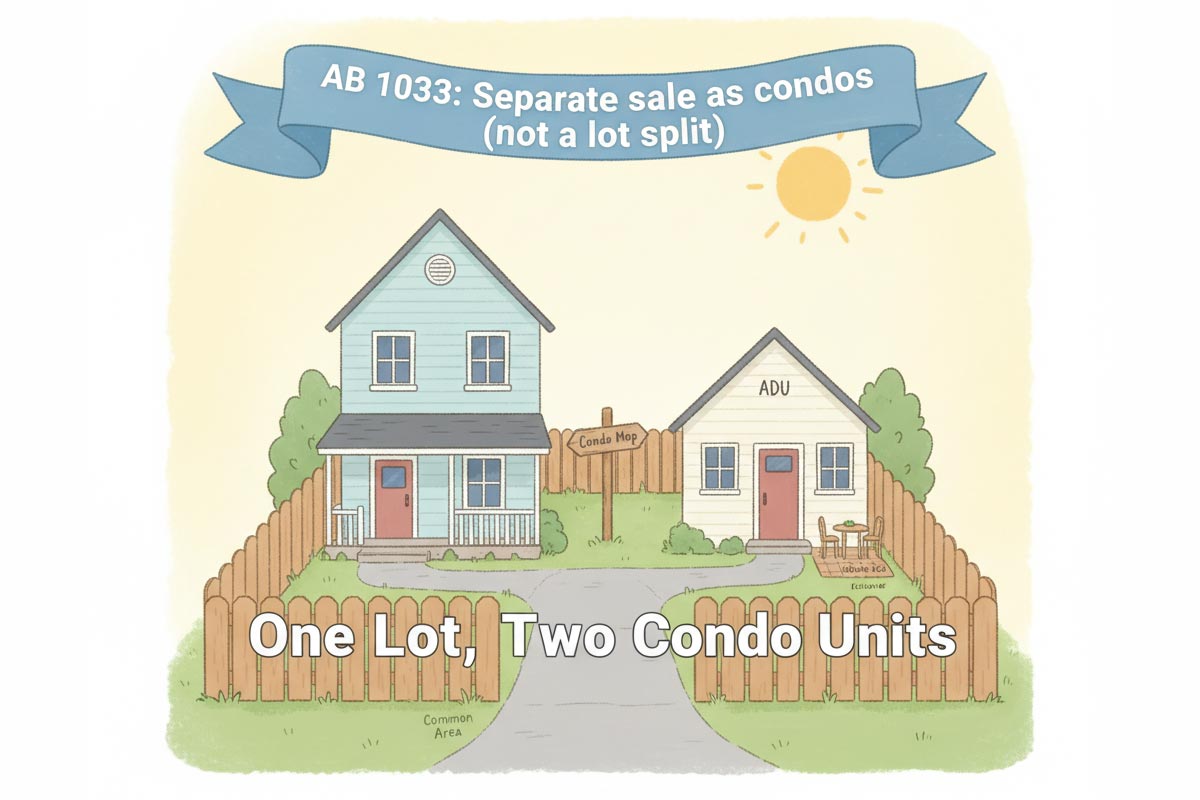
AB 1033 allows cities and counties to pass an ordinance that lets a homeowner sell their ADU separately from the primary residence. However, it's critical to understand the legal method: this is not a lot split. Instead, you are creating a common interest development—essentially, a small, two-unit condominium project.
Here’s the practical distinction:
A lot split divides the land itself, creating two or more legally independent parcels. Each new lot is owned outright.
An AB 1033 conversion keeps the original lot intact. The land becomes a "common area" jointly owned by the owners of the main home and the ADU with each owner holding a separate interest in their airspace unit.
This brings up a common question: "Won't the two units have different Assessor's Parcel Numbers (APNs)?"
Yes, they most likely will. Once the condominium is legally created, the county assessor will typically assign a separate APN to each unit (the main home and the ADU). However, this is done for property tax purposes only. Since the units can be owned by different people, the county needs a way to send two separate tax bills. The assignment of an APN is an administrative function for taxation and does not change the legal fact that the property is a condominium on a single, shared lot—not two separate lots.
Ultimately, the state law only provides the framework; this entire process is only possible when a local city or county officially opts in and defines the specific local rules.
Where This Is Live (and why adoption is uneven)
Because AB 1033 is opt-in, the map is patchy. San José moved first —adopting an ordinance in July 2024 and green-lighting the state’s first ADU condo sale in August 2025. That milestone proved the concept and kicked off copycat discussions in other cities. Always verify local status before you market or write offers.
The Path for Sellers: From ADU to “micro-condo”
Think of the conversion as three intertwined tracks—legal mapping, habitability sign-off, and lender consent—followed by a familiar marketing and escrow period.
Confirm opt-in & pull the city checklist. If your city hasn’t adopted, you’re done. If it has, the checklist will mirror state guardrails but add local steps and forms.
Assemble the deal team early. You’ll need a land-use or condo attorney, title, a surveyor, and someone who can draft CC&Rs that divide maintenance and spell out access, parking, utilities, noise, and exclusive-use areas.
Plan the disclosure stack. In addition to the standard residential TDS and NHD and other mandated disclosures, the buyer will need condo docs (CC&Rs, bylaws, operating budget/reserves), the condo map/plan, any shared-elements easements, and recorded lienholder consents (more on that below).
Meet the safety inspection requirement. Before the map records, AB 1033 requires proof of a safety inspection—either a certificate of occupancy issued by the local agency or a HUD Housing Quality Standards (HQS) report by a certified inspector. Build time for this into your timeline.
Secure lender consent (non-negotiable). The condo map cannot record without written consent from each lienholder. Lenders can refuse or require conditions (e.g., refinancing, reserve thresholds, or revised collateral language). The consent must include specific statutory language and be recorded with the county. Start these conversations early—this is where otherwise clean deals can stall.
Sort utilities and notify providers. Separate meters may be required by local policy or utility providers; if not, the CC&Rs must clearly allocate costs, access, and shut-off rights. Upon condo creation, the homeowner must notify utility providers of the separate conveyance.
Record, list, and close. Once the map and consents are recorded, market the ADU as a condo. Expect the county assessor to assign separate APNs post-conveyance (timing varies by county). Underwriting, comps, and buyer expectations look different from a standard condo—see below.
The Buyer’s Reality: Financing, monthlys, and resale
Financing. These are condominium loans, and the smaller the unit, the more attention lenders pay to project questionnaires (reserves, insurance coverage, owner-occupancy mix, litigation). Be ready to provide the new HOA budget and reserve plan. Underwriters will model HOA dues and reserves into DTI.
Monthlies. Coach buyers on the full monthly picture: mortgage + taxes + HOA dues (with reserve contributions), potential special assessments, and shared insurance mechanics (e.g., master policy + HO-6). That clarity prevents cold feet at contingency removal.
Resale. Micro-condos trade more like cottages than flats: private entries, small footprints, and the presence (or absence) of exclusive-use outdoor space, storage, and parking drive value. Your comp set will be tiny condos, cottage courts, and—ideally—local ADU-condo comps as they emerge.
Some Documents That Protect Your Client (and you)
Statutory disclosures: TDS (Civ. Code §1102) and NHD (Civ. Code §1103 et seq.) still apply.
Condo packet: recorded CC&Rs, bylaws, operating budget and (if available) reserve study/plan, condo map/plan, shared-elements easements, utility agreements, lienholder consents, and any city notices or checklist forms.
AVID & over-disclosure: Map shared systems (sewer laterals, water lines, shared roofs/driveways) and note any open permits or variances. It’s hard to over-disclose on a first-generation product category.
HOA landmines (and how to avoid them)
Most post-closing drama comes from maintenance responsibility and use rules. Avoid ambiguity by:
Drawing a maintenance matrix that names each component (roof, siding, foundation, shared driveway/gate, landscape, fences, trash enclosure, shared meters) and assigns responsibility and inspection cadence.
Being explicit about exclusive use (patios, side yards, storage sheds) versus common area.
Setting realistic noise and parking expectations in the rules—especially where units are close.
Checking short-term rental rules at both city and HOA levels; do not imply rental income without verifying.
Utilities, access, and parking: the practical stuff
AB 1033 recognizes that upon separate conveyance, a local agency or utility may require a new or separate utility connection (and proportionate connection fees) where it wasn’t otherwise required for a standard, non-separately-conveyed ADU. If services remain shared, the CC&Rs need crystal-clear language on access, meter reading, maintenance, and billing. Record any access and utility easements so future owners—and lenders—aren’t guessing.
Pricing and positioning a micro-condo
Treat these like livable, detached cottages with condo paperwork. Price on privacy and function: no shared corridors, ground-level entries, outdoor space, light, and acoustic separation. Include a to-scale floor plan and a simple site plan (labeling the unit, parking, trash, and paths of travel). For buyers coming from apartment-style condos, the single-story cottage experience can command a premium per square foot despite smaller size.
Compliance notes your clients will thank you for
Don’t oversell “automatic.” Everything depends on local opt-in and meeting statutory conditions (inspection, mapping, consents).
Be precise about the past. Prior law had a narrow nonprofit exception; AB 1033 adds a broad condo pathway via local ordinance.
A quick case study: San José’s “first”
San José’s early adoption set the pattern: pass a clear ordinance, publish a homeowner-facing conversion guide, and coordinate internal teams (planning, building, and code enforcement). The city then approved the first recorded ADU condo in August 2025—an example that has helped normalize lender and title workflows statewide. Use that precedent when socializing the concept with your local stakeholders, but always cite your own city’s ordinance in contracts and disclosures.
What to do this week (agent checklist)
Build a local “opt-in” tracker. Keep links to city ordinances and checklists in one doc.
Collect a lender short-list. Identify originators who’ve already closed small-unit condos and will engage early on questionnaires and reserves.
Template your condo packet. Create a repeatable binder: TDS/NHD + CC&Rs + budget + map/plan + easements + utility agreements + lienholder consents.
Educate your farm. A one-page explainer for ADU owners can generate listing calls months before they’re ready to convert. Make sure to check with your broker on advertising compliance.
Bottom line: AB 1033 turns some backyards into starter homes—but only in jurisdictions that opt in, and only when you clear the condo law hurdles. The agents who win here will be the ones who master the process (mapping, inspection, lender consent), package the disclosures cleanly, and set expectations early on financing and HOA realities. Check with legal counsel and your broker to make sure you are staying compliant and you’ll be the first call when your market’s homeowners decide their ADU is ready for the big leagues.
|
Real‑estate transactions live and die by what is written—and signed—in the contract. Yet nearly every deal, from a starter‑home purchase to a multimillion‑dollar commercial lease, must be tweaked Read more...
Real‑estate transactions live and die by what is written—and signed—in the contract. Yet nearly every deal, from a starter‑home purchase to a multimillion‑dollar commercial lease, must be tweaked after that first signature. That’s where two deceptively similar tools come in: the addendum and the amendment. Because the terms sound alike, many buyers, sellers, and even new agents mix them up—sometimes with expensive consequences.
This guide cuts through the confusion. You’ll learn the fundamental difference, see practical language examples, spot common pitfalls, and walk away knowing exactly which document to use, when, and why.
The Core Distinction: Adding vs. Altering
.table{
border: 1px solid gray !important;
border-collapse: collapse !important;
margin: 10px !important;
padding: 10px !important;
font-size: 16px !important;
}
th, td{
border: 1px solid gray !important;
border-collapse: collapse !important;
margin: 10px !important;
padding: 10px !important;
font-size: 16px !important;
}
th{
text-align: center !important;
}
@media(max-width:428px){
.table-responsive{
max-width: 100%;
overflow-x: scroll;
}
}
Tool
What It Does
One‑Sentence Analogy
Addendum
Supplements the contract by adding entirely new terms, conditions, or disclosures without touching existing text.
Like attaching a new appendix to a report.
Amendment
Modifies the contract by changing, deleting, or replacing language that is already there.
Like editing a paragraph in the report’s body.
Addendum Defined
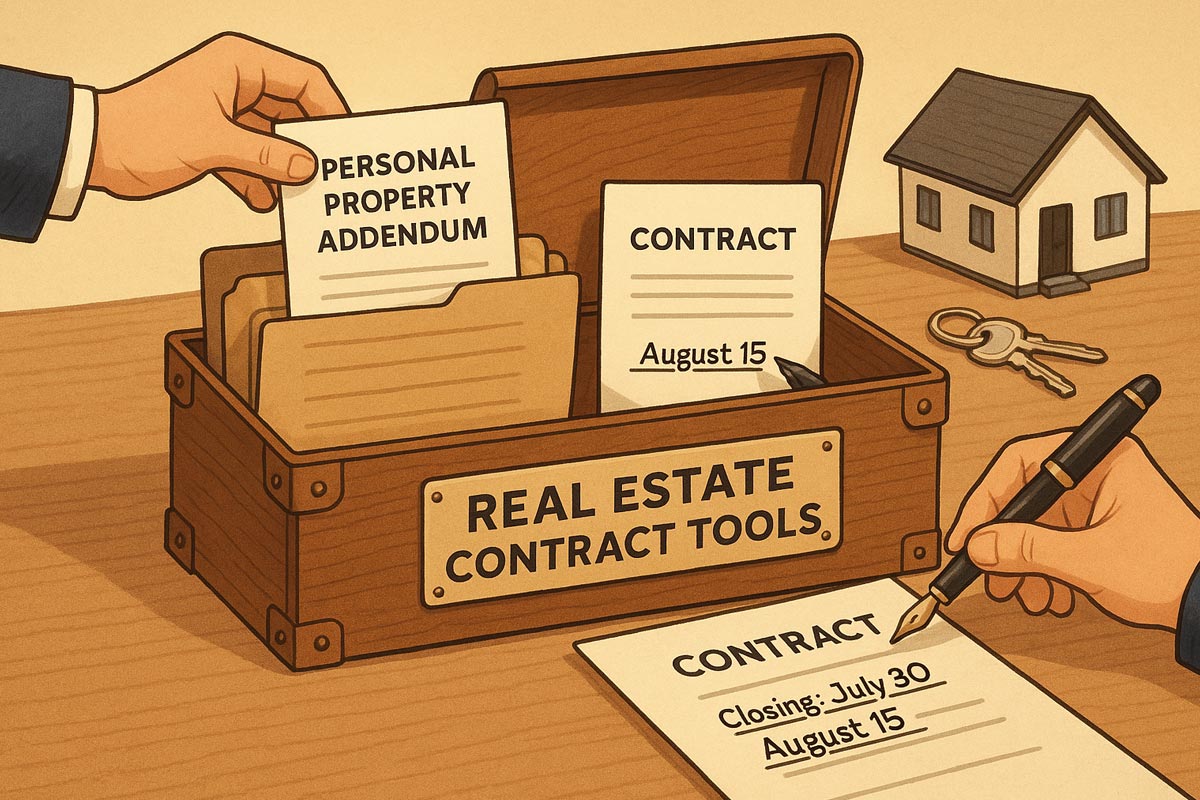
An addendum (sometimes called a “rider” or “attachment”) is a separate, signed document that becomes part of the original agreement, but nothing in the original contract is struck, deleted, or replaced.
Analogy: You finished your book and later decide to add a bonus chapter—the original chapters stay exactly as written; you just hand readers an extra section.
Amendment Defined
An amendment rewrites part of the original agreement. You are altering the existing language—price, dates, contingencies, or even simple typos.
Analogy: You catch a typo in Chapter 3 of your book. Instead of adding a new chapter, you open the manuscript and correct that specific sentence.
When to Use Which: Practical Applications
Below are the most common scenarios you’ll encounter in both residential and commercial deals. For each, notice whether new material is added (addendum) or existing material is changed (amendment).
A. Addendum Scenarios & Examples
.table{
border: 1px solid gray !important;
border-collapse: collapse !important;
margin: 10px !important;
padding: 10px !important;
font-size: 16px;
}
th, td{
border: 1px solid gray !important;
border-collapse: collapse !important;
margin: 10px !important;
padding: 10px !important;
}
th{
text-align: center;
}
Scenario
Example Property Type
“Before” (excerpt)
Addendum Language (conceptual)
New contingency
Rural residence
Contract silent on septic system.
“This agreement is contingent on Buyer’s receipt and approval of a satisfactory septic inspection report on or before August 5.”
Personal property inclusion
Suburban home
Contract lists fixtures only.
“Seller shall include the following personal property at no additional cost: LG washer, LG dryer, and GE refrigerator (Model XYZ).”
Disclosure attachment
Pre‑1978 home
Contract mentions lead‑based paint but no form attached.
“Lead‑Based Paint Disclosure (EPA‑approved form) is attached hereto as Addendum A and incorporated herein.”
Lease pet clause
Apartment lease
Lease prohibits pets.
“Notwithstanding Paragraph 10, Tenant may keep one spayed cat under 15 lbs; Tenant assumes all liability for pet damage.”
Typical timing: Often drafted with the initial offer or immediately post‑acceptance (e.g., delivery of mandatory disclosures).
B. Amendment Scenarios & Examples
Scenario
Example Property Type
“Original Clause”
Amendment Language (conceptual)
Price change
Residential purchase
“Purchase Price: $500,000.”
“Paragraph 2 is hereby amended to state: ‘Purchase Price: $490,000.’”
Closing‑date extension
Vacant land
“Closing Date: July 30 2025.”
“Closing Date is amended to August 15 2025.”
Repair credit
Condo
“Seller to repair roof leaks.”
“Seller shall instead credit Buyer $7,500 at closing in lieu of repairs; Paragraph 12 is amended accordingly.”
Loan‑type switch
Single‑family home
“Buyer financing: FHA loan.”
“Paragraph 5 is amended to read ‘Conventional 30‑year fixed loan.’”
Scrivener’s error
Commercial lease
Suite number misstated as 320.
“Suite number corrected from 320 to 302; all other terms remain unchanged.”
Typical timing: After the contract is executed when inspections, financing, or negotiations reveal the need to alter agreed‑upon terms.
Quick‑Decision Flowchart – Addendum or Amendment?
Is the information completely new and not addressed anywhere in the contract?
Yes → Addendum
Are you changing, deleting, or replacing wording that already appears in the contract?
Yes → Amendment
Need to do both?
Use both documents (e.g., add a new contingency and extend closing).
Proper Formatting & Language Tips
Best Practice
Why It Matters
Reference the underlying contract by date, parties, and property address at the top of the addendum or amendment.
Prevents arguments over which agreement the change attaches to.
Number each addendum/amendment (e.g., “Addendum #1”).
Aids tracking when deal requires multiple modifications.
Use clear headings such as “Purchase‑Price Adjustment” or “Inspection Contingency Addendum.”
Improves readability for all parties and attorneys.
State the effective date (often the last dated signature).
Clarifies when obligations begin.
For amendments, quote the original clause before showing the revised language (or cite the paragraph number).
Reduces ambiguity over what is being altered.
Obtain signatures from every party to the contract (and their spouses if required by local law).
An unsigned modification is unenforceable.
Common Mistakes & How to Avoid Them
Using the wrong document: Adding a new contingency with an amendment may accidentally overwrite existing clauses.
Leaving blanks or ambiguous wording: Courts interpret vagueness against the drafter.
Missing deadlines: An addendum or amendment delivered after a contingency expires may be ineffective.
Relying on verbal agreements: In most states, real‑estate contracts must be in writing (Statute of Frauds).
Failing to attach required disclosures: Violations can trigger rescission rights or fines.
Pro Tip: Keep a running “contract log” noting each modification, date sent, date signed, and current key dates (closing, inspection, loan approval).
State‑Specific Variations
While the concepts of addendums and amendments are universal, forms and statutory disclosures vary:
California: The Residential Purchase Agreement (RPA) uses a “Contract Addendum” (CAR Form) for new terms and a separate “Amendment of Existing Terms” for changes; specific addenda are mandatory for HOA docs, Mello‑Roos, etc.
Texas: The Texas Real Estate Commission (TREC) publishes promulgated addenda (e.g., Third‑Party Financing Addendum) and employs a universal “Amendment to Contract” form.
New York: Attorneys often custom‑draft riders (addenda) at contract formation; later changes are typically handled via attorney letters that serve as amendments.
Always consult local forms and professionals to ensure compliance.
Key Takeaways
Addendum = Add. Amendment = Alter.
Use addendums to introduce brand‑new terms without disturbing the original text.
Use amendments to change terms that are already written.
Clear drafting, proper referencing, and obtaining all signatures are non‑negotiable.
Laws and standard forms differ by state—check locally.
Beyond your time in real estate school, understanding the difference between an addendum and an amendment gives you powerful leverage in negotiations and protects you from costly missteps. If you are a buyer, remember that before signing—or sending—either document, consult your real‑estate agent and, for complex or high‑value transactions, a qualified real‑estate attorney. With the right tool and sound advice, you’ll keep your deal on track and your interests safeguarded.
Love,
Kartik
|

Your Blueprint for Referrals and Repeat Business
The moment you receive your real estate license marks the beginning, not the end, of your professional journey. While our real estate school teaches Read more...
Your Blueprint for Referrals and Repeat Business
The moment you receive your real estate license marks the beginning, not the end, of your professional journey. While our real estate school teaches you the fundamentals of property law and transaction mechanics, the true art of building a career centered on client retention lies in what happens after the closing.
In today's competitive market, the most successful agents understand a fundamental truth: relationships are a form of currency. The cost of acquiring a new client can be five to seven times higher than nurturing an existing one. Yet many agents, caught in the endless cycle of chasing new leads, overlook the goldmine sitting in their past client database. This shift from transactional thinking to cultivating luxury client relationships isn't just good karma—it's innovative business that generates consistent real estate referrals, repeat transactions, and a personal brand that stands the test of time.
For newer agents fresh out of real estate school, developing this client-centric mindset early establishes the foundation for long-term success. Seasoned brokers will find advanced strategies here to deepen existing relationships, particularly within luxury markets where discretion and personalization are paramount.
Mastering Client Engagement: Tech-Powered, Human-Centric
Forget the old days of just holiday cards. Today's top agents blend cutting-edge tech with authentic human connection to create systematic, personalized client touchpoints that scale.
Develop a tiered communication rhythm. In the first 30 days post-closing, check in weekly. These aren't sales calls; they're genuine inquiries about their move, new home, or local recommendations. As time goes on, these touchpoints become less frequent but more valuable, shifting from problem-solving to relationship-building.
Modern CRM systems like Follow Up Boss, Chime, or HubSpot, supercharge this process. They use AI to analyze client behavior, predict needs, and suggest optimal contact times. These platforms segment your database by transaction type, property value, communication preferences, and even life events. Imagine your CRM alerting you that a past client's child is nearing college age—perfect for discussing downsizing or investment properties. Tech handles the remembering and organizing, freeing you to focus on the human connection.
The real magic is when high-tech efficiency meets high-touch authenticity. Your CRM prompts the outreach, but the message should feel like it's from a friend.
Send a handwritten note within 48 hours of closing—it speaks volumes in our digital world. Mark home purchase anniversaries not with a generic email, but with a personalized video message showing their home's appreciation.
Creating Value Beyond the Transaction
Your digital presence should position you as a trusted advisor and community connector, not just another agent flooding social media with listing photos. Think about what your past clients need and want to know. They're not shopping for homes anymore—they're living in them. They're wondering when to refinance, how to maximize their home's value, which local contractor won't overcharge them, and where to find the best pizza in their new neighborhood.
This is where your content strategy becomes crucial:
Social Media Excellence: Share seasonal home maintenance tips that save them from costly repairs. Spotlight the local coffee shop owner who remembers everyone's order, or the family-run hardware store that still offers personalized service. Celebrate community events and milestones. When you position yourself as a curator of local knowledge and lifestyle enhancement, you remain valuable long after the sold sign comes down.
Newsletter Mastery: Your monthly newsletter shouldn't read like a market report designed for economists. Instead, translate those statistics into stories your clients care about. Rather than simply stating that home values increased 8%, explain what this means for their family's wealth-building journey. Include practical guides like "Five Weekend Projects That Add $10,000 to Your Home Value" or "The Hidden Gems of [Neighborhood Name] Only Locals Know About."
Website as Resource Hub: Transform your website from a listing showcase into a comprehensive resource center. Create downloadable seasonal maintenance guides, maintain a vetted vendor directory, and publish neighborhood insights that keep past clients returning for valuable information.
The Art of Memorable Client Appreciation
Moving beyond generic closing gifts requires understanding what creates lasting impressions. That standard gift basket gets regifted or forgotten, but the client who loves cooking will remember the private chef who prepared a gourmet meal in their new kitchen. The wine enthusiast will talk for years about the sommelier-led tasting you arranged at their housewarming. The family with young children will be touched by the custom treehouse plans you commissioned for their backyard oak.
These thoughtful gestures extend beyond closing day. When you learn through your ongoing conversations that a client received a promotion, send congratulations. When their child graduates, take a moment to acknowledge the milestone. When they mention training for their first marathon, surprise them with a gift certificate to the local running store. These moments of recognition build emotional equity that no competitor can match.
Creating exclusive experiences amplifies this effect exponentially. Your annual client appreciation event shouldn't feel like a networking mixer—it should feel like a reunion of friends. Some agents host summer barbecues in local parks where clients' kids play together while adults swap renovation stories. Others organize holiday cookie decorating parties that become cherished traditions.
For luxury clientele, discretion is paramount. Ensure your outreach respects their privacy, providing value without intrusion. The bar for experiences rises accordingly: private art gallery tours with the curator, sunset yacht cruises, or exclusive wine harvest experiences at boutique vineyards. The key to these events isn't their extravagance—it's their authenticity combined with impeccable attention to privacy preferences.
Building Your Referral Engine
The most successful agents never have to ask for referrals—they create experiences so remarkable that clients naturally want to share them. However, there's an art to facilitating this process without appearing pushy or transactional.
The best moments for referral conversations arise organically during your regular touchpoints. When a client expresses gratitude for your help resolving a post-sale issue, that's your cue. When they mention at your summer barbecue that their coworker is house-hunting, that's your opportunity.
Here's a simple script that works: "Thank you so much for your trust in working with me. If anyone you care about mentions real estate—whether buying, selling, or just curious about the market—I'd be honored if you'd pass along my contact information. I'm never too busy for your referrals."
Make referring effortless by providing these tools:
Digital business cards they can text instantly
Pre-written introduction emails like: "I wanted to connect you with [Your Name], who helped us find our dream home. They made the entire process smooth and stress-free, and I think you'd appreciate their approach."
Social media templates for sharing experiences
QR codes linking to your testimonial page
When legal and ethical, some agents enhance referral relationships through thoughtful incentives that strengthen bonds rather than create obligations. Consider donating to a client's favorite charity in their name as a reward for successful referrals or as a way to provide exclusive experiences, such as tickets to local cultural events. The key is to ensure that any incentive feels like a natural extension of your relationship, not a transaction.
Becoming the Indispensable Advisor
The transformation from a transaction-focused agent to a trusted advisor occurs when you expand your value proposition beyond buying and selling. Offer annual home equity reviews that help clients understand their growing wealth. Provide market updates contextualized to their investment strategies. Connect them with resources for renovations, refinancing, or navigating real estate implications of significant life changes.
Sarah, a luxury agent specializing in equestrian properties, exemplifies this approach perfectly. When clients close on horse properties, she doesn't just hand over keys—she delivers custom stable signs featuring their property name and includes a year's membership to the local riding club. Her monthly "Saddle Up" newsletter has become a must-read in the equestrian community, featuring regional event calendars, seasonal property maintenance tips tailored to horse facilities, and spotlights on trusted veterinarians and trainers.
But Sarah's genius lies in her "Equestrian Services Directory"—a carefully vetted list of providers from farriers to fence contractors, all offering preferred rates to her clients. She introduces each client to relevant providers, hosts quarterly "Boots & Bourbon" networking events at a local ranch, and has positioned herself as the hub of the luxury equestrian real estate community.
The result?
Sixty percent of her business comes from referrals and repeat clients; she commands premium commissions, and she has built a list of potential clients who seek her out specifically.
Measuring What Matters
Success in relationship-based real estate isn't measured solely in transaction volume. Here's how to track what truly matters:
Referral Rate: Aim for 20-30% of new business from past client referrals . Track this through your CRM by tagging lead sources and running quarterly reports to monitor progress.
Client Lifetime Value (CLV): Calculate total revenue per client relationship using this formula: Initial transaction commission + repeat transaction commissions + referral-generated commissions. Most CRMs can automatically generate these reports.
Repeat Business Rate: Monitor the percentage of clients who complete multiple transactions with you. Set up annual reviews in your CRM to track this metric over time.
Engagement Metrics: Use email marketing platforms to track open rates (target 25%+), click-through rates, and event RSVPs. Tools like Mailchimp or Constant Contact can provide detailed analytics.
Net Promoter Score (NPS): Send quarterly surveys using tools like SurveyMonkey or Google Forms, asking: "On a scale of 1-10, how likely are you to recommend me to a friend?" Scores of 9-10 indicate strong advocates.
These metrics tell a story far more valuable than monthly sales figures. They indicate whether you're building a sustainable practice or just churning through transactions.
Your Path Forward
Your real estate license opens doors, but your relationships determine how far you'll walk through them. In an industry where lots of agents fail within five years, those who thrive understand that each closed transaction isn't an ending—it's the beginning of a potentially lifelong professional relationship.
The lessons from our real estate school lay the foundation, but applying these relationship strategies truly builds the skyscraper of your career. This approach requires a fundamental mindset shift. Instead of viewing your database as a list of past clients, see them as your professional community. Instead of measuring success by the number of new leads generated, measure it by the relationships deepened. Instead of chasing the next transaction, invest in creating such remarkable experiences that transactions naturally follow.
The choice is yours: continue the exhausting chase for cold leads, or invest in the warm relationships already in your sphere. Your future success in real estate isn't determined by how many people you meet—it's defined by how many relationships you nurture.
Take a moment today to revisit your past client list. Identify five clients to reconnect with this week—perhaps send a handwritten note, share a relevant market update, or check in on how they're enjoying their home. Your future business depends on these small but significant actions.
Love,
Kartik
|

1 | Why Video Now?
Video: A Game-Changer for New Real Estate Agents
In today's attention-driven market, video is crucial for new real estate agents. Social media algorithms favor video Read more...
1 | Why Video Now?
Video: A Game-Changer for New Real Estate Agents
In today's attention-driven market, video is crucial for new real estate agents. Social media algorithms favor video content, with short real estate clips often getting more than twice the engagement of simple still images.
More importantly, video helps build trust. When prospective clients can see your face and hear your voice, it significantly shortens the sales cycle. This is especially beneficial for newer agents looking to establish credibility quickly. Instead of just relying on written advice or static images, showcasing properties, explaining market trends, or sharing client testimonials through video can rapidly build rapport and confidence with potential buyers and sellers.
2 | Before You Hit Record
The best lens in the world can’t fix a fuzzy objective. Before you even open the camera app, answer three questions and tape the answers to your tripod:
Defining Your Video Strategy as a New Real Estate Agent
Before you even hit record, taking a few minutes to plan your video will save you hours in editing and wasted ad spend. Here's a quick framework tailored for new real estate agents:
.why-video-now-one-table{
border: 1px solid gray !important;
border-collapse: collapse !important;
margin: 10px !important;
padding: 10px !important;
}
.why-video-now-one-table th,.why-video-now-one-table td{
border: 1px solid gray !important;
border-collapse: collapse !important;
margin: 10px !important;
padding: 10px !important;
}
.why-video-now-one-table th{
text-align: center;
}
Question
Example Answer for New Agents
Who is the target viewer?
First-time homebuyers in your local area (e.g., Rancho Cucamonga)
What action should they take?
Schedule a free consultation or attend your next open house
How will you measure success?
New client inquiries or sign-ups for your open house
3 | Pre-Production Toolkit for New Real Estate Agents
Planning is where your creative ideas meet practical research. For new real estate agents, a solid pre-production workflow is essential to create effective video content without breaking the bank. Here are some tools to help you get started:
AnswerThePublic (freemium): Use this tool to uncover common questions your target audience is searching for, such as "What do I need to know about buying my first home in Rancho Cucamonga?" Incorporating these questions directly into your video scripts will ensure you're addressing your viewers' needs.
ChatGPT or Google Gemini (free to paid tiers): These AI tools can help you draft compelling video hooks, YouTube titles, and calls-to-action that align with your brand's voice. They can save you significant time in crafting engaging copy.
Teleprompter apps (free to $29): Apps like PromptSmart or Teleprompter Pro scroll your script automatically and even pause when you do, making it easy to deliver your lines naturally and avoid that "reading off a cue card" look. This is especially helpful when you're just starting out and want to appear confident and polished on camera.
Simple Storyboard Template: Before you shoot, sketch out your video plan. A basic template with columns for "Scene #," "Location," "Shot Size," "Audio Notes," and "B-roll ideas" can keep you organized. While offering a PDF opt-in is great for brokerages, for a new agent, simply using this as an internal planning tool will ensure a smoother shooting and editing process.
By using these tools, you'll be well on your way to creating professional and impactful videos that help you connect with clients and grow your real estate business. What kind of video are you thinking of creating first?
4 | Filming Toolkit
Picking Gear by Growth Stage
.why-video-now-two-table{
border: 1px solid gray !important;
border-collapse: collapse !important;
margin: 10px !important;
padding: 10px !important;
}
.why-video-now-two-table th,.why-video-now-two-table td{
border: 1px solid gray !important;
border-collapse: collapse !important;
margin: 10px !important;
padding: 10px !important;
}
.why-video-now-two-table th{
text-align: center;
}
Category
Starter (≤ $50)
Growth (≤ $300)
Pro (> $300)
Camera
Latest smartphone
Sony ZV‑1
Full‑frame mirrorless (Canon R8)
Stabilization
Mini tripod
DJI Osmo Mobile SE
Zhiyun Crane M4
Lighting
12″ ring light
Two‑light LED kit
Aputure Amaran 60x
Audio
BOYA BY‑M1 lav
Rode Wireless GO II
Sennheiser AVX
Drone¹
—
DJI Mini 3 Pro
DJI Air 3
¹Always verify Part 107 licensing requirements; see Section 6 for compliance.
Why tiers? Because the last thing a new agent—or a real estate‑license student moonlighting as a creator—needs is a $4,000 rig before the first transaction closes. Start where you are and upgrade only when video revenue or referral traffic—not gear envy—warrants it.
5 | Post‑Production Toolkit
Editing is where raw footage becomes a trust‑building asset for your brokerage or real estate school:
iMovie (Mac) or Clipchamp (Windows): Drag‑and‑drop simplicity for “just sold” reels.
CapCut Desktop: Auto‑generates captions; exports ratio presets for every social network.
Descript: Edit video by editing text—delete filler words with a keystroke.
Canva Pro: Batch‑create on‑brand thumbnails (1280 × 720) that match the color palette of your real estate school or brokerage.
Caption everything. Captions boost watch‑time by ~12 % and help satisfy ADA accessibility guidelines.
6 | Compliance & Legal Must‑Knows
.why-video-now-three-table{
border: 1px solid gray !important;
border-collapse: collapse !important;
margin: 10px !important;
padding: 10px !important;
}
.why-video-now-three-table th,.why-video-now-three-table td{
border: 1px solid gray !important;
border-collapse: collapse !important;
margin: 10px !important;
padding: 10px !important;
}
.why-video-now-three-table th{
text-align: center;
}
@media(max-width: 428px){
.table-wrapper{
max-width: 100%;
overflow: scroll;
}
}
Topic
Common Mistake
Quick Fix
Drone footage
Flying over people without an FAA Part 107 license
Pass the $175 Remote Pilot test or hire a licensed pilot
Music
Using Top‑40 tracks
Subscribe to royalty‑cleared libraries such as Artlist or Epidemic Sound
Occupied properties
No written release from sellers
Use a standard location‑release form
Fair‑housing language
Saying “family neighborhood”
Stick to facts: “three‑bed, two‑bath near Lincoln Park”
A robust compliance framework not only protects your brokerage but also models best practices to your real‑estate‑license students.
7 | Distribution, SEO, & Accessibility
Where to Host?
.why-video-now-four-table{
border: 1px solid gray !important;
border-collapse: collapse !important;
margin: 10px !important;
padding: 10px !important;
}
.why-video-now-four-table th,.why-video-now-four-table td{
border: 1px solid gray !important;
border-collapse: collapse !important;
margin: 10px !important;
padding: 10px !important;
}
.why-video-now-four-table th{
text-align: center;
}
Platform
Pros
Cons
YouTube
Unmatched reach and Google SEO benefits
Competing ads and suggested videos
Vimeo
Clean, brandable player; swap files without changing URLs
Monthly subscription
Wistia
Heat‑maps and built‑in lead‑capture forms
Higher cost
Five‑Point SEO Checklist
Front‑load your keyword: e.g., “Video marketing tips — Adhi Schools’ real estate license school.”
500‑character description peppered with local terms—“Los Angeles real estate license,” “Orange County broker.”
Chapters: 00 : 00 Intro, 00 : 45 Pre‑production, etc.
Tags: “real‑estate video,” “real estate license,” “real estate school.”
SRT captions: Improve accessibility and Google indexing.
8 | Measuring Success: Analytics in 10 Minutes
Metric
Where to Find
Improvement Tip
Audience Retention
YouTube Studio → Content tab
Insert B‑roll at the 30‑second drop‑off
Click‑Through Rate
YouTube Studio → Overview
A/B‑test thumbnail copy
Leads Generated
Google Analytics 4 + UTM links
Give each video its own landing page so ROI is unmistakable
Allocate ten minutes every Friday to review these metrics. Then create one small experiment—new title, fresh hook, different thumbnail—and implement it before Monday.
9 | Advanced Gear Roadmap
Once your video channel starts generating predictable business—or when your real estate school wants to film premium coursework—consider:
A motorized slider (~$499) for buttery parallax kitchen shots.
A Godox SL60W key light with soft‑box for cinematic interviews under $300.
A Blackmagic Pocket 6K body when annual marketing revenue exceeds $250 k; shoot in BRAW to unlock professional color‑grading latitude.
10 | Emerging Formats to Watch
Vertical shorts (Reels, TikTok): Fifteen‑second teasers that funnel viewers to your full YouTube tour.
Live‑streamed open houses: Field buyer questions in real time; archive the replay to compound reach.
Interactive 3D tours: Pair a Matterport scan with voice‑over for an “always‑open” showing.
AI‑assisted clipping: Premiere Pro’s Text‑Based Editing feature finds quotable moments and auto‑exports them as micro‑content.
These formats are already part of curriculum refreshes at ADHI Schools.
11 | Key Takeaways for New Real Estate Agents
To truly leverage video in your burgeoning real estate career, keep these core principles in mind:
Lead with strategy, not gear. Don't get caught up in buying the most expensive camera. A clear plan for what you want to achieve and who you're speaking to is far more important than 8K resolution. Your smartphone is likely more than capable of producing excellent content.
Audio and lighting beat high resolution every time. Even if your video isn't shot in cinematic quality, clear audio and good lighting make your message understandable and professional. Invest in a simple lavalier microphone and understand how to use natural light or basic ring lights to your advantage.
Stay compliant. This is crucial for new agents. Be mindful of regulations around drone usage (especially in areas like Rancho Cucamonga), copyright for music, and ensure all your language adheres to fair housing guidelines. Ignorance is not an excuse for non-compliance.
Optimize every upload around your target audience's search terms. For instance, if you're showcasing homes in Rancho Cucamonga, use keywords like "Rancho Cucamonga real estate," "homes for sale Rancho Cucamonga," or "first-time homebuyer guide Rancho Cucamonga" in your video titles, descriptions, and tags. Think about what your ideal client is typing into search engines.
Measure and iterate. Don't just post and forget. Pay attention to your video analytics. Which videos get the most views? Which ones lead to inquiries? Learn from what works and what doesn't, and continuously refine your approach. This iterative process is key to long-term success in real estate video marketing.
Ready to Level Up?
This guide provides a practical roadmap for new real estate agents, taking you from initial concept to analyzing your video's performance. Whether you're focused on securing your first listing, building your personal brand, or simply looking to connect with potential clients, understanding video strategy is essential in today's market.
For more in-depth coaching, editable templates, and strategies to help you start filming faster and closing sooner, consider exploring specialized marketing resources tailored for new agents. These resources can accelerate your growth and establish your presence in the competitive real estate landscape.
Love,
Kartik
|

Embarking on a career in real estate is an exciting venture, but the path to success can sometimes feel overwhelming for new agents. As you navigate the complexities of lead generation, marketing, transactions, Read more...
Embarking on a career in real estate is an exciting venture, but the path to success can sometimes feel overwhelming for new agents. As you navigate the complexities of lead generation, marketing, transactions, and client management, you'll undoubtedly encounter two common terms: real estate coaching and real estate training. While often used interchangeably, they offer distinct benefits and cater to different needs. Understanding the nuances between the two is crucial for new agents looking to invest in their professional development wisely.
Real Estate Training: The Foundation of Knowledge
Think of real estate training as the classroom education for your real estate career. It's about acquiring fundamental knowledge, learning industry best practices, and understanding the "how-to" of the business.
Key characteristics of real estate training:
Structured Curriculum: Training programs typically follow a predefined curriculum, covering topics like contracts, agency relationships, ethics, marketing strategies, negotiation tactics, CRM software usage, and local market trends.
Broad Applicability: The information provided in training is generally applicable to a wide range of agents, regardless of their individual strengths or weaknesses.
Focus on Information Transfer: The primary goal is to impart knowledge and skills. This often involves lectures, webinars, workshops, manuals, and online modules.
Group Setting: Training can occur in a group setting, allowing for peer learning and questions.
Often Transaction-Focused: Many training programs focus on the mechanics of a real estate transaction, from listing to closing.
Examples: Pre-licensing real estate courses, broker-provided onboarding programs, real estate software tutorials, continuing education classes, and workshops on specific topics like social media marketing or and workshops on specific topics like open house strategies.
Who benefits most from real estate training?
New agents who are still learning the ropes, need to understand the legal and ethical frameworks of the industry, or require instruction on specific tools and processes will find training invaluable. It provides the essential building blocks for a successful career. Even experienced agents can benefit from training if it is timely and relevant to current events in the real estate industry.
Real Estate Coaching: Personalized Guidance for Growth
Real estate coaching, on the other hand, is meant to be a more personalized and iterative process focused on helping agents apply their knowledge, overcome specific challenges, and achieve their individual goals. It's less about what to do and more about how to do it effectively in the unique situation of an individual agent.
Key characteristics of proper real estate coaching:
Individualized Approach: Coaching is tailored to the agent's specific needs, strengths, weaknesses, and aspirations.
Action-Oriented: Coaches work with agents to develop actionable plans, set measurable goals, and hold them accountable for their progress - This personal accountability piece is an important distinction.
Focus on Application and Mindset: Coaching helps agents translate theoretical knowledge into practical application, address limiting beliefs, improve time management, and develop a winning mindset.
Problem-Solving and Strategy: Coaches help agents troubleshoot challenges, refine their strategies, and identify opportunities for growth.
Ongoing Support and Accountability: Coaching relationships are typically viewed as ongoing, with regular check-ins and performance reviews.
Examples: One-on-one sessions with a real estate coach, accountability partnerships, and personalized business planning sessions.
Who benefits most from real estate coaching?
New agents who have a grasp of the basics but are struggling with implementation, feeling stuck, or looking to accelerate their growth will benefit immensely from coaching. It's for those who want to refine their approach, develop stronger habits, and achieve higher levels of success.
A Word of Caution
Real estate coaching can turbocharge your career—but only if your coach has actually fought in the trenches. Beware of self-proclaimed 'gurus' who’ve never closed a deal themselves. These charlatans often dazzle with slick marketing and empty promises of overnight success, peddling textbook strategies they’ve never tested.
Real estate isn’t a theoretical playground—it’s a fast-paced, cutthroat industry defined by shifting markets, high-stakes negotiations, and emotionally charged clients. A coach without skin in the game can’t grasp these realities, leaving you with generic advice that crumbles under real-world pressure.
Steer clear of upselling imposters. If they haven’t survived a market crash, outmaneuvered a bidding war, or rebuilt their pipeline from scratch, their guidance is worthless. Demand proof of their sales track record: closed transactions, client testimonials, and battle scars.
Your career isn’t a lab experiment. Invest in coaches who’ve done it, not just taught it.
The Interplay: Why Both Are Important
It's not a matter of choosing one over the other; rather, real estate training and real estate coaching are complementary forces that contribute to a well-rounded and successful real estate career.
Training provides the knowledge base. You can't effectively implement strategies if you don't understand the fundamentals.
Coaching helps you apply that knowledge effectively. It bridges the gap between theory and practice, helping you navigate real-world scenarios.
For new agents, a common progression might look like this:
Initial Training: Complete pre-licensing courses and broker-provided onboarding to gain foundational knowledge and skills.
Early Coaching: Once you've entered the field, consider engaging a coach to help you set up your business, generate your first leads, and overcome initial hurdles.
Ongoing Training: Continue to attend workshops and continuing education to stay updated on market trends, legal changes, and new technologies.
Ongoing Coaching: As your business evolves, a coach can help you scale, refine your niche, improve your sales process, and navigate market shifts.
Making the Right Choice
When deciding between training and coaching (or how to incorporate both), consider the following:
Your current knowledge level: Are you completely new, or do you have a basic understanding?
Your specific challenges: Are you lacking fundamental knowledge, or are you struggling with implementation or mindset?
Your learning style: Do you thrive in structured learning environments, or do you prefer personalized guidance?
Your budget: Training programs often have a fixed cost, while coaching can be an ongoing investment.
By understanding the distinct roles of real estate coaching and real estate training, new agents can strategically invest in their professional development, build a strong foundation, and accelerate their journey towards a thriving career in real estate.
Love,
Kartik
|

Congratulations—you completed the real estate license courses, passed the real estate exam and landed your license! Now the real work begins: prospecting, showings, more than a little paperwork, and Read more...
Congratulations—you completed the real estate license courses, passed the real estate exam and landed your license! Now the real work begins: prospecting, showings, more than a little paperwork, and a CRM that won't fill itself. Trying to do it all solo is the fastest route to 14-hour days.
The fix?
Delegate smart, even if your business is getting off the ground.
You might think, "I just got my license, and now I need to think about delegation?" The answer is a resounding "yes!" While our real estate license school focused on the essential knowledge to get you started, mastering the art of delegation early on is crucial for scaling and long-term growth as a businessperson.
Delegation doesn’t necessarily mean that you have a huge team - it's really about establishing efficiency right away.
Key Takeaways
Delegate Early, Not Later: Freeing up hours lets you close your first few deals faster—without the late-night inbox grind.
Start Simple: Begin by offloading administrative tasks or transaction coordination.
Leverage Cloud Tools: Simple online platforms can streamline communication and task management from the start.
Why Delegation is Your New Best Friend (Even as a Rookie Agent)
Your plate is likely full of learning the ropes: familiarizing yourself with the MLS, practicing your sales pitch, and getting comfortable with whatever CRM you have chosen. If every single administrative detail bogs you down, you'll burn out before closing your first few deals. Delegation, even in its simplest forms, means strategically offloading tasks so you can focus on revenue generating activities.
Focus on Client Connections: While our real estate license school taught you the legalities, remember that genuine client relationships are built on time and attention.
Hone Your Sales Acumen: The more you focus on lead generation, showing properties, and negotiating, the faster you'll build expertise and finalize transactions.
Build a Sustainable Business: Instead of just surviving, you build your foundation for consistent growth.
Delegation isn't just about handing things off; it's about innovative task management to ensure everything gets done accurately and efficiently, allowing your business to flourish.
Starting Smart: What to Delegate First
Even as a new agent, you can start identifying tasks that, while necessary, might be consuming valuable time you could be using to connect with potential clients or learn more about the market. Think about the areas that might be slowing you down:
Top Time-Drains to Delegate First
Early Transaction Prep: Even before a deal is fully underway, paperwork and coordination can be time-consuming.
Basic Marketing: Setting up social media posts, sending introductory emails, and creating simple flyers.
Consider tasks that are repetitive or don't require your direct, licensed expertise.
Your First Support System: Who to Consider
You're not ready for a whole team yet, but considering where your biggest time drains are will help you decide if and when to bring in support.
Rule of thumb: Once you're juggling ≥5 active buyers or your first two listings, you're ready for at least five virtual assistant hours/week.
Considering an Administrative Assistant (Part-Time/Virtual)
If your calendar is a mess, your inbox is overflowing, or you're spending too much time on data entry, even a few hours a week from a virtual administrative assistant could be a game-changer. Typical hourly rates for a virtual assistant are reasonable depending on where they are located.
They can handle:
Managing emails and phone inquiries.
Scheduling appointments and organizing your calendar.
Basic data entry and CRM maintenance.
Exploring a Real Estate Transaction Coordinator (Part-Time/Per Transaction)
Once you start getting escrows going, you'll quickly realize the sheer volume of paperwork and deadlines. A transaction coordinator (TC) specializes in this, even on a per-transaction basis. A TC typically charges around $350−$450 per deal. They can be invaluable for: Managing contracts, disclosures, and legal documents.
Ensuring all deadlines are met.
Communicating with lenders, title companies, and other parties.
If you go back 20 years the concept of a transaction coordinator wasn’t as wide spread as it is today. The thought was that agents should instead handle their first few deals themselves. Working every step—contract, disclosures, deadlines, contingencies, and escrow—gives them real-world insight no classroom can match. That hands-on immersion sharpens problem-solving, reveals common pitfalls, and builds confidence. After running a couple of transactions solo, they’ll have the practical know-how to supervise a TC effectively and deliver truly informed service to clients.
Work with your broker or manager to determine the right path for your first few deals.
Clear Expectations: Even for a simple task, be clear about what to do.
Finding Help: Look for local college students seeking internships or explore online platforms for virtual assistants. Networking with other agents might also reveal good recommendations.
Basic Onboarding: When you hire someone, even for a limited role, clearly explain your business, your processes, and what you expect. A simple checklist of their responsibilities can go a long way.
Tools to Make Delegation Easier
You don't need fancy software to start. Simple tools can help you manage tasks and communicate effectively:
Your CRM: Use your CRM to track client interactions and set follow-up reminders. Many CRMs have basic task management features.
Shared Documents/Cloud Storage: Tools like Google Drive or Dropbox can help you share documents and keep everything organized for anyone assisting you.
Simple Automation: Even setting up automated email responses for basic inquiries can save you time.
As you grow, you might look into more specialized task management tools, but for now, focus on what helps you keep things organized. Having clear, written steps for everyday tasks (Standard Operating Procedures or SOPs) is also constructive, even if they're just notes for yourself.
Mini SOP Example:
New Lead Intake Process (5 steps, 10 min total):
Receive Lead: Check email/CRM for new lead notifications.
Initial CRM Entry: Input name, contact info, lead source, and initial notes.
Automated Welcome Email: Trigger pre-written welcome email from CRM.
Calendar Invite: Schedule the initial call/meeting on the agent's calendar.
Task Assignment: Create a follow-up task for an agent in CRM.
Developing Your Support (and Yourself!)
Even with a small amount of delegated work, consider it a partnership.
Learn and Grow Together: Encourage whoever is helping you to learn more about the real estate industry. Your success is their success.
Feedback is Key: Provide clear and constructive feedback. This helps them improve and ensures tasks are completed to your standards.
Daily Focus: Even for a new agent, creating a "Daily Action Checklist" helps you stay focused on revenue-generating activities, knowing that other tasks are being handled.
A daily action checklist is crucial for new real estate agents because it maintains focus on revenue-generating activities, preventing distraction by administrative tasks. By knowing other responsibilities are delegated, agents can prioritize client interactions, lead generation, and showings. This structured approach builds discipline and efficiency, ensuring consistent progress toward closing deals. Ultimately, it maximizes productivity during a critical learning phase, establishing habits essential for long-term success.
The "Admin" Side of Having Help
Even for small engagements, think about:
Compensation Models: How will you compensate them? Hourly? Per task?
Legal Considerations: For very small, casual engagements, it might be simple, but as you grow, you'll want to understand the difference between independent contractors and employees. This is something you'll learn more about as your business expands.
Trusting the Process
As a new agent, wanting to control every detail is tempting. However, the essence of delegation is to train someone on a task and then trust them to do it. This frees you up to focus on what you're truly licensed to do: connect with clients, show properties, and negotiate deals.Your real estate license was the first step. Mastering delegation, even in its earliest stages, is how you truly begin to build a successful and sustainable real estate career. Don't wait until you're overwhelmed; start thinking about how to work smarter from day one.
Love,
Kartik
|

California dreaming? Suppose your dreams involve navigating the exciting world of real estate and helping people find their perfect rental haven. In that case, a career as a property manager in Read more...
California dreaming? Suppose your dreams involve navigating the exciting world of real estate and helping people find their perfect rental haven. In that case, a career as a property manager in California might be your calling! With a booming rental market, diverse properties (from beachfront bungalows to chic city apartments), and a dynamic landscape of laws and regulations, California offers a unique and rewarding experience for property management professionals.
But hold on! Before you jump headfirst into showing properties and collecting rent, let's break down what it really takes to thrive as a property manager in the Golden State. This guide will be your roadmap, covering everything from licensing and essential skills to the quirks of the California market and the tech tools that'll make your life easier.
Licensed vs. Unlicensed: Finding Your Path
To begin, it's important to understand California property management licensing. Your role will determine whether you need a real estate license or not.
Licensed property managers hold a real estate license, which opens doors to a broader range of responsibilities and higher earning potential. Consider negotiating leases, collecting rent, and even representing clients in property sales. It's like having a VIP pass to the California real estate scene!
On the other hand, unlicensed managers might be working as a resident property manager, for example. Alternatively, they may be working as a w2 employee at a large apartment complex. Maybe they are an assistant to a licensed property manager and handling administrative tasks like coordinating maintenance. They're essential team members, but they must work under the supervision of a licensed broker. Think of it as being the Robin to a licensed Batman!
The Journey to Becoming a Licensed Pro
Ready to take the plunge and get your real estate license? Here's the lowdown:
Check the Basics: Make sure you're at least 18, have a high school diploma or equivalent, and are legally allowed to work in the U.S. (No surprises here!)
Hit the Books: It's time to dive into the world of real estate! Enroll in an accredited real estate school like ADHI Schools and complete the required coursework. You'll cover topics like real estate principles and practices and even choose an elective (hint: Property Management is excellent!).
Conquer the Exam: Once you've mastered the fundamentals, it's time to prove your knowledge. The California real estate license exam will test your understanding of national and state-specific laws, so study hard and utilize practice tests to boost your confidence.
Find Your Brokerage: Freshly licensed and ready to roll? Not so fast! In California, licensees must partner with a licensed broker who should be providing valuable mentorship, legal oversight, and a chance to learn the ropes from seasoned professionals.
Level Up with Certification (Optional but Recommended): Want to stand out? Consider earning a Property Management Certification from the California Association of Realtors (CAR) or the Certified Property Manager (CPM) designation from the Institute of Real Estate Management. It's not mandatory, but it adds serious credibility to your name and demonstrates your commitment to excellence.
Mastering the Property Management Game in California
Now that you've sorted out the licensing let's discuss the skills you'll need to succeed in the California market.
Marketing Maestro: California's rental market is competitive! You'll need to be a marketing whiz to attract tenants. Leverage online platforms like Zillow, social media, and even good old-fashioned networking to showcase your properties beyond basic listings.
Tenant Whisperer: Building strong relationships with tenants is key. Be responsive, approachable, and proactive in addressing their concerns. Remember, happy tenants = happy landlords!
Financial Guru: You must be comfortable with numbers, from collecting rent to managing budgets. Utilize property management software to streamline accounting tasks and provide transparent financial reports to owners.
Legal Eagle: California has a unique set of laws and regulations, including rent control (AB 1482), eviction rules, and security deposit limits. Stay informed and ensure your practices comply with all applicable laws.
Tech-Savvy: Embrace technology to boost efficiency. Property management software like AppFolio or Buildium can automate tasks, improve communication, and keep you organized.
Navigating the California Rental Landscape
California's rental market is as diverse as its landscape. Each region has quirks, from bustling city centers with sky-high rents to laid-back beach towns with seasonal demand.
Market Trends: Stay updated on rental trends in your area. For example, you might encounter fierce competition for units and strict rent control policies in San Francisco. In contrast, a beach town might experience seasonal fluctuations in demand.
Key Laws: Familiarize yourself with California-specific laws like AB 1482 (rent caps), eviction rules, and security deposit limits. These regulations can significantly impact your day-to-day operations.
Building Your Property Management Empire
Are you dreaming of running your own property management company? Here's how to get started:
Legal Foundation: In California, you'll typically need to form a corporation to operate a property management company. Make sure you obtain all necessary licenses and permits.
Operational Excellence: Set up efficient systems for rent collection, maintenance requests, and tenant communication. Invest in reliable property management software to streamline your workflow.
Client Acquisition: To attract clients, build a professional website, leverage social media, and network with real estate agents. Offer competitive rates and exceptional service to build a strong reputation.
FAQs: Your Burning Questions Answered
Q: Do I need a real estate license to manage properties in California?
A: It depends! If you're involved in activities like negotiating leases or handling rent, then yes, a license is mandatory. However, unlicensed individuals can perform limited tasks that do not require a real estate license.
Q: What's the average salary for a property manager in California?
A: Salaries can vary based on experience, location, and the types of properties you manage. However, you can expect to earn a comfortable living, with the average salary ranging from $68,000 to $85,000 per year. Major cities like San Francisco and Los Angeles often offer higher earning potential.
Q: Is the Property Management Certification (PMC) or Certified Property Management (CPM) designation essential?
A: While not required, the PMC from CAR can give you a competitive edge. It demonstrates your expertise and commitment to professional development, which can attract clients and employers.
Q: Can I manage short-term rentals like Airbnb in California?
A: Absolutely! However, local regulations regarding short-term rentals can vary significantly. Ensure you research and comply with your area's applicable permits and restrictions.
The Bottom Line: A Rewarding Career Awaits
Becoming a successful property manager in California requires dedication, knowledge, and a passion for real estate. Following the steps outlined in this guide, mastering essential skills, and staying informed about the ever-evolving California market, you can build a thriving career and help people find their perfect homes. So, are you ready to take on the challenge? The Golden State awaits!
Love,
Kartik
|

As an agent, you spend much of your time analyzing sales data, advising clients, and networking to uncover hidden deals. You understand how every piece of a transaction impacts a buyer’s bottom line. Read more...
As an agent, you spend much of your time analyzing sales data, advising clients, and networking to uncover hidden deals. You understand how every piece of a transaction impacts a buyer’s bottom line. Yet many agents forget to leverage these advantages when purchasing their homes. By representing yourself, you tap into exclusive resources like the Multiple Listing Service (MLS), have the ability to apply your negotiation expertise directly, and even earn the buyer’s side of the commission. But you’ll also need to remain objective—sometimes easier said than done—and work closely with your brokerage to ensure a smooth process.
Unlocking the Power of the MLS
Your first major advantage as a real estate professional is your direct access to the MLS. Unlike public-facing sites, the MLS offers comprehensive, up-to-the minute information on available properties.
Exclusive and Pre-Market Listings: You can learn about “coming soon” properties and other MLS statuses that never appear on the popular real estate portals. This early access allows you to submit offers before a surge of interest.
Brokerage Variations: Some brokerages provide different commission splits to their sales staff when they buy their own home. Know your brokerage’s policies to get the most out of the system.
Real-Time Updates: The MLS refreshes listings more quickly than general real estate platforms. By staying on top of these updates, you can move fast in competitive markets and gain an edge over other buyers.
By using the MLS to its full potential, you can uncover properties the public doesn’t even know about—often leading to less competition and potentially better deals.
Working with Your Brokerage
Before you dive headfirst into self-representation, it’s wise to have a conversation with your broker. Establishing clear expectations and understanding all office policies upfront can prevent misunderstandings later.
Commission Splits: As mentioned, confirm your office's commission policy for self-representation. Some brokerages let you keep most (or all) of the buyer’s agent commission, while others require a standard split.
Broker Support: Make sure your broker fully supports your plan. An ally in the office can help you navigate administrative or compliance-related hurdles.
Legal and Ethical Guidelines: Even if you act as a buyer and agent, you must follow all licensing laws, ethical rules, and local regulations—Double-check before making an offer, double-check office guidelines regarding disclosures, escrow processes, and contracts.
Having these details worked out ahead of time can prevent potential conflicts down the road and ensure that you remain on good terms with your brokerage.
Market Mastery: Navigating Trends and Pricing
Your experience analyzing market trends, comparable sales, and property data is one of your most valuable assets. Applying this insight to your purchase can help you spot undervalued homes and avoid overpaying.
Neighborhood Patterns: You know which neighborhoods are up-and-coming or experiencing price reductions. Buying in a neighborhood on the rise can lead to increased equity over time.
Data-Driven Comparables: Rather than relying on general online estimates, you can analyze the exact sale prices of similar homes. This data helps you craft a competitive but fair offer.
Timing the Market: Knowing when to act can be crucial, but remember that perfectly timing the market is notoriously tricky. Focus on finding the right property for your needs and negotiating the best price within current market conditions.
You can minimize risks and maximize your potential gains by combining real-time data and local insight and focusing on long-term benefits.
The Art of the Deal: Negotiating Like a Pro
Negotiation is often deciding how much you save on a home. As a real estate agent, you negotiate daily—but it can feel different when it’s your own money on the line.
Set Clear Goals: Just as you would advise a client, define your must-haves and deal-breakers early. This clarity will guide your decisions and keep you from overextending yourself when emotions are high.
Maintain Objectivity: Even seasoned negotiators can become emotionally invested when purchasing their home. Try to apply the same detachment and professionalism you would use for a client.
Price Negotiation Strategies: If a property is overpriced or needs substantial updates, don’t hesitate to offer below asking—or request closing cost credits. Your market data and experience can back up these requests.
Contingency Clauses: Whether you include financing, inspection, or appraisal contingencies, you can protect your interests without making your offer unattractive to sellers.
Flexible Closing Terms: Offering a quick close or adjusting the closing date to the seller’s preference can give you leverage. Often, these terms are just as appealing as a higher purchase price.
By applying your negotiation expertise and staying level-headed, you can secure favorable terms that reflect your best interests.
Due Diligence and Risk Mitigation
A thorough approach to due diligence is crucial for avoiding costly surprises. Remember - you’re protecting yourself.
Comprehensive Inspections: Beyond a general home inspection, consider specialized inspections such as termite, roof, sewer, or plumbing, especially if you suspect any underlying issues.
Environmental Assessments: If the property is older or in an area with potential ecological risks, look into environmental reports or assessments to ensure you know exactly what you’re buying.
Title Reports and Disclosures: Carefully review the title report for liens or easements, and don’t gloss over seller disclosures. Past water damage or unpermitted work can affect property value and safety.
Legal Requirements: Your day-to-day experience with contracts means you know how small mistakes can lead to significant legal problems. Double-check every clause to ensure your interests are fully protected.
Appraisal Considerations: Collaborate with your lender (or use your market knowledge if you’re paying cash) to ensure the property’s value aligns with the agreed purchase price.
Putting in the extra effort now can save you from expensive repairs or legal disputes after the deal closes.
Financial Benefits: Quantifying Your Savings
One of the most compelling reasons to represent yourself and earn your real estate license is the potential to keep a significant portion of the buyer’s agent commission.
Example: On a $600,000 home with a 3% buyer’s agent commission, that’s $18,000. Depending on your brokerage agreement, you might keep most—or all—of that amount.
Potential Uses for Savings: You could use these funds to make your down payment, cover closing costs, or invest in renovations.
A Caveat: Actual savings will depend on your brokerage policies and the specifics of the transaction. However, the financial benefits of self-representation are often substantial—and can provide a powerful boost to your overall home investment.
This extra capital can lower your monthly mortgage, bolster your equity position, and offer more options for future investments.
Maximizing the Advantage: Self-Representation Done Right
So, how can you ensure you get the most out of representing yourself?
Streamlined Communication: Because you’re both the buyer and the agent, you eliminate potential miscommunication about your needs and decisions.
Tailored Strategies: Every action you take—from market research to negotiations—directly supports your personal goals, allowing for a seamless, customized approach.
Efficient Process: You already know how to coordinate inspections, work with lenders, and manage paperwork, saving time and reducing stress.
Balancing Emotion and Expertise: Recognize that buying a home can be as emotional for an agent as it is for a client. Rely on your professional discipline to keep negotiations on track.
By merging your personal needs with your professional skill set, you can transform a typical real estate transaction into a highly strategic move.
As a real estate agent, you possess invaluable knowledge about listings, market trends, and negotiation tactics. By representing yourself, you can leverage all those strengths to find your dream home before it hits the market—potentially saving thousands of dollars. Be sure to have an open discussion with your broker, maintain objectivity, and follow through with thorough due diligence. With these steps, you’ll be well on turning your professional expertise into a significant personal advantage.
TLDR:
Don’t leave money on the table. Leverage your expertise, represent yourself, and find the perfect home while maximizing your savings.
Want to learn more about getting your real estate license and being able to represent yourself? Visit www.adhischools.com to get started.
Love,
Kartik
|

California Title Insurance: Protect Against Hidden Encumbrances
Have you ever heard a story about someone purchasing a home only to discover later that someone else claimed partial ownership or that Read more...
California Title Insurance: Protect Against Hidden Encumbrances
Have you ever heard a story about someone purchasing a home only to discover later that someone else claimed partial ownership or that an unpaid lien remained attached to the property? Issues like these can turn a dream home into a financial nightmare.
A property can have various ‘burdens’ on its title and while California law requires sellers to disclose known encumbrances, unforeseen issues can still surface. That’s where title insurance comes in. This article explains what title insurance is, what it covers, how it works, and why it’s so crucial for homebuyers in California.
What is Title Insurance?
Title insurance is a specialized insurance policy designed to protect your ownership rights and financial investment in real estate. Unlike homeowners’ insurance, which covers future events like fire or theft, title insurance safeguards you against past events that might affect the validity of your property’s title.There are two main types of title insurance policies:
Owner’s Policy: This policy protects the buyer’s interest in the property. It covers you up to the purchase price, shielding you from potential legal costs or financial losses if any undiscovered issues arise.
Lender’s Policy: Almost always required by lenders, this policy protects the mortgage company’s interest (usually up to the loan amount). If you finance your home with a mortgage, your lender will insist on a lender’s policy to ensure its investment is protected.
What Does Title Insurance Cover?
Title insurance shields you from problems that could emerge from previous owners or mistakes in the public record. Below are five common scenarios (out of many) that title insurance might cover:
Undisclosed Encumbrances: Sometimes, encumbrances such as easements or liens don’t appear in the initial public record search. For example, an easement that wasn’t properly recorded could give third-party rights to your property. Additionally, unpaid property taxes, mechanic’s liens (filed by contractors or builders for unpaid work), judgment liens, or even unrecorded mortgages may exist without your knowledge.
Errors in Public Records: Even minor clerical errors in deeds or misindexed documents can create significant complications. Mistakes like a misspelled name or wrong property description could lead to ownership disputes.
Fraud and Forgery: Unfortunately, identity theft and document forgery are realities in real estate. A past owner’s signature might have been forged on a deed or other legal document. Title insurance covers financial losses you could incur if you must defend your ownership against fraudulent claims.
Claims from Heirs: In some cases, a property might have been passed down through inheritance, and an undisclosed heir could appear, claiming rightful ownership or interest in the property. Title insurance protects you from these unexpected claims.
Boundary Disputes: Encroachments, as we learned, are a type of encumbrance. They arise when a fence, shed, or other structure crosses a boundary line. If a past survey was inaccurate or if a structure was built in the wrong place, you could face legal or financial consequences.
Real-World Example:
Imagine buying a home, moving in, and then receiving a notice stating that a builder had never been paid for renovations done by the prior owner. This builder filed a mechanic’s lien, which went unnoticed. Title insurance would pay off or resolve this lien, sparing you a significant financial burden.
The Title Search and Commitment
Before issuing a title insurance policy, the title company thoroughly examines county records, court filings, and other public documents to uncover any problems or “clouds” on the title. This extensive research helps identify mortgages, liens, easements, or other encumbrances that might affect ownership.
Once the search is complete, the title company issues a “title commitment” or “preliminary report.” This document details all the findings and lists any “exceptions” that the policy will not cover. Standard exceptions might include existing easements or restrictions on the property. It’s crucial for buyers (and their real estate agents or attorneys) to carefully review the title commitment before finalizing the purchase. If any red flags appear, you can address them or negotiate with the seller before closing.
How Much Does Title Insurance Cost?
Title insurance is typically a one-time premium paid at the real estate transaction's closing. In California, the cost varies based on the home’s purchase price and the county. It’s customary in many parts of California for the seller to pay for the owner’s policy, but this is negotiable.
Why is Title Insurance Important?
Financial Protection: Title insurance can save you from hefty legal fees or financial losses if a hidden title defect surfaces.
Peace of Mind: Knowing your ownership is shielded from past claims helps you focus on enjoying your new home.
Facilitates Future Transactions: A clear and insured title makes it easier to sell or refinance. Prospective buyers or lenders feel more comfortable knowing your property’s title is clean.
Legal Defense: Many title insurance policies cover the costs of defending against lawsuits challenging your ownership. In short, title insurance protects your wallet and your peace of mind.
Title insurance is crucial in the California home-buying process, ensuring that hidden encumbrances or past errors won’t jeopardize your investment. Discuss coverage details with your real estate agent, lender, or attorney for the best protection—putting into practice what you learned in real estate school.
Love,
Kartik
|

Effective January 1, 2025, Assembly Bill 2622 (AB 2622) significantly changes California's contractor licensing requirements. This update directly affects real estate agents, brokers, investors, Read more...
Effective January 1, 2025, Assembly Bill 2622 (AB 2622) significantly changes California's contractor licensing requirements. This update directly affects real estate agents, brokers, investors, and homeowners who hire individuals for home improvement or construction projects. Below, I will explore the key elements of AB 2622, why it matters even if you are just starting real estate school, and how real estate professionals can use this knowledge to serve their clients better and protect their interests.
Key Changes Introduced by AB 2622
A. Increased Exemption Limit
Under prior law, unlicensed individuals could perform construction work if the total cost of labor, materials, and other project expenses did not exceed $500. Under AB 2622, this threshold is raised to $1,000, effectively allowing unlicensed persons to handle more minor jobs without violating California's Contractors State License Law.
B. Building Permit Requirement
The new exemption applies only if no building permit is required. If the scope of work triggers a building permit—for example, electrical rewiring, plumbing changes, or structural modifications—an unlicensed individual cannot legally take the job. In such cases, a licensed contractor is mandatory.
C. Restriction on Employing Others
A critical addition is that unlicensed individuals under this exemption cannot employ any other person to perform or assist with the work. When another individual is brought on board—whether paid or unpaid—the exemption no longer applies, and a contractor's license is required.
Impact on the Real Estate Industry
A. Real Estate Agents and Brokers
1. Avoiding Liability
Proper Disclosures: When representing clients, listing agents and sellers should confirm whether any recent renovations fall under this new $1,000 limit and whether permits were required but not obtained. Disclosing unpermitted or incorrectly permitted work could expose liability issues.
Compliance Check: By understanding AB 2622, agents can spot red flags—like multiple small jobs potentially split to avoid licensing requirements—thereby safeguarding clients from legal disputes.
2. Negotiation Leverage
Price Adjustments: Knowledge of whether work was performed by a licensed contractor or an unlicensed individual can significantly affect property valuations. Unpermitted work or questionable quality might justify a lower offer or prompt a repair request. Conversely, adequately documented upgrades can bolster a seller’s asking price.
Confidence in Transactions: A firm grasp of these regulations allows agents to negotiate more effectively. Agents identifying compliance issues can use that information to protect their clients' interests and potentially secure better terms.
3. Building Trust and Credibility
Demonstrating Expertise: Clients value real estate professionals who can expertly navigate the complex web of state regulations. By explaining AB 2622 and its implications, agents position themselves as a trusted advisor, which can lead to stronger referrals and repeat business.
Professional Growth: Continued real estate education on legislative updates helps agents maintain a competitive edge and enhances their reputation in a crowded marketplace.
B. Real Estate Investors
1. Permitting Nuances
Local Codes: Depending on local building codes, even smaller jobs—like adding electrical outlets or replacing certain plumbing fixtures—might trigger permit requirements. Investors should do due diligence before starting any project.
Avoiding Costly Mistakes: Failing to secure permits when required can lead to fines, forced rework, and delayed timelines that eat into profit margins.
2. Cost Savings vs. Quality Concerns
Safety Issues: Hiring an unlicensed individual can save money, but the risk of subpar workmanship is real. Poor electrical or plumbing work can create health or safety hazards, hurting the property's long-term value.
Hidden Problems: Unlicensed work may introduce latent defects, issues that surface after the project is complete and potentially cause expensive repairs.
Insurance and Financing: Coverage or financing can be jeopardized if an insurer or lender discovers that work was done improperly or without the proper permits. Some insurance policies may exclude damages stemming from unlicensed or unpermitted work.
3. Long-Term Marketability
Resale Considerations: When an investor plans to flip or rent out a property, prospective buyers and tenants often ask about the quality of renovations.
Balancing Act: Using an unlicensed individual may make sense for tiny, simple tasks under $1,000. However, hiring a licensed contractor is often safer for anything potentially requiring a permit or multiple workers and may improve the property's overall appeal.
C. Homeowners
1. Due Diligence
Insurance Review: Before hiring an unlicensed individual for small projects, homeowners should check whether their insurance covers injuries or damages from unlicensed work. Some policies have exclusions.
Written Contracts: Even for minor tasks, having a written agreement that outlines the scope of work, payment terms, and timelines can prevent disputes.
Confirm Permits: Always verify if a building permit is required. If so, the homeowner must hire a licensed contractor regardless of the project's cost.
2. Risks and Benefits
Potential Cost Savings: The increased $1,000 threshold can make minor repairs or aesthetic updates more affordable for homeowners.
Liability and Quality: Hiring an unlicensed individual may leave the homeowner limited legal recourse if the job goes wrong. Always weigh immediate cost savings against the potential for future headaches.
3. Staying Compliant
Avoiding Fines: Projects without the required permit can lead to penalties and complications during a future sale.
Protecting Property Value: Quality, properly documented work generally enhances a home's value, while unpermitted or shoddy work could detract from it.
Advertising Changes Under AB 2622
Unlicensed individuals may now legally advertise for jobs under $1,000 provided:
No Permit Required: The work doesn't trigger any building permit requirements.
Clear Disclosures: The advertisement explicitly states: "I am not a licensed contractor."
Solo Work: Unlicensed people cannot employ anyone else to assist with the job.
Misrepresenting licensure status or splitting a more extensive project into multiple smaller ones (each under $1,000) to evade these rules is illegal and can lead to penalties.
or lead to financial losses.
Your Next Steps
1. Read the Full Text of AB 2622
For the exact language of the law, visit the California Legislative Information website and review Business and Professions Code Sections 7027.2 and 7048.
2. Consult the Contractors State License Board (CSLB)
Check a contractor's license status or learn more about licensing requirements by visiting the CSLB website.
3. Consider Continuing Education
Whether you're an agent seeking to differentiate yourself, an investor optimizing your strategies, or a homeowner ensuring compliance, staying educated on these laws is crucial. Find reputable real estate courses or legal resources that delve into contractor licensing, property disclosures, and best practices.
4. Perform Due Diligence
Confirm if a building permit is required. Always get references, a written scope of work, and proof of insurance—even if the work seems small.
AB 2622 introduces critical updates to California's contractor licensing laws by raising the exemption threshold to $1,000, clarifying the need for building permits, and restricting unlicensed individuals from hiring help. These changes affect real estate agents, brokers, investors, and homeowners, influencing how renovations are approached, disclosed, and negotiated.
Understanding these regulations can provide:
Liability Protection for real estate professionals who accurately disclose property improvements.
Investment Security for those fixing and flipping properties or building their rental portfolios.
Peace of Mind for homeowners making small-scale improvements while avoiding legal pitfalls.
Staying informed is half the battle, and resources are available to help you succeed. By taking advantage of educational programs and consistently monitoring regulatory updates, you'll be well-prepared to navigate California's evolving real estate landscape.
With AB 2622 having taken effect on January 1, 2025, now is the time to proactively adapt, ensuring you and your clients remain compliant and well-informed in California real estate.
Love,
Kartik
|
Want to be a top-performing real estate agent? Then you need to go
beyond the basics of real estate license school and understand the
practical roles of home inspectors, appraisers, and title officers.
Mastering Read more...
Want to be a top-performing real estate agent? Then you need to go
beyond the basics of real estate license school and understand the
practical roles of home inspectors, appraisers, and title officers.
Mastering these collaborations is the key to smoother transactions,
happier clients, and a str
|

Why Understanding Market Indicators Matters
Want to excel as a real estate agent? Mastering market analysis is essential, and it's a skill you can start developing now, even while you're still Read more...
Why Understanding Market Indicators Matters
Want to excel as a real estate agent? Mastering market analysis is essential, and it's a skill you can start developing now, even while you're still in real estate school. Understanding market trends empowers you to advise clients effectively, price properties accurately, and anticipate market shifts. This guide breaks down the key indicators—median and average home prices, days on market (DOM), inventory levels, interest rates, foreclosure rates, and the absorption rate—providing clear explanations and practical examples. I’ll show you why a holistic approach to market analysis is crucial and how local conditions and seasonality influence these metrics. By the end, you'll have the knowledge and confidence to navigate any market.
Median vs. Average Home Price
Median Home Price:
The median home price is the middle price of all homes sold in a particular area during a given time.
For example, if five homes sold for:
$200,000
$220,000
$250,000
$600,000
$700,000
The median is $250,000 (the one in the middle).
The median, being less affected by outliers, is a reliable measure when there are a few very expensive or very cheap homes that could make the average less accurate.
Average Home Price:
To find the average home price, you simply add up all the sold home prices and divide by the number of homes. Using the same prices above, the total is $1,970,000. Divide that by five, and you get an average of $394,000.The average, while useful for spotting general trends, can be heavily skewed by extremely high or low prices, making it less reliable in such cases.
What These Prices Tell Us:
If median and average prices are rising, it often means home values are going up. If they’re falling, it might mean the market is slowing down.
Days on Market (DOM)
Days on Market (DOM) measures how long a home takes to sell.
Short DOM (under 30 days): Suggests a hot market with many interested buyers. This is often called a seller’s market because sellers have the upper hand.
Medium DOM (30-60 days): A balanced market where buyers and sellers have similar power.
Long DOM (60+ days): Suggests a more extraordinary market with fewer buyers. This is often called a buyer’s market because buyers have more choices and bargaining power.
Inventory Levels (Months’ Supply of Inventory)
Ever wondered how long it would take to sell all the homes on the market if no new ones were listed? That's what a month's supply of inventory tells us.
How to Calculate:
Months’ Supply = (Number of Homes for Sale) ÷ (Number of Homes Sold per Month)For instance, if there are 600 homes for sale and 200 sell each month, you can easily calculate the months’ supply as 600 ÷ 200 = 3 months, giving you a clear picture of the market conditions.
Low Inventory (Under 4 Months): Seller’s market.
4-6 Months: Balanced market.
Over 6 Months: Buyer’s market.
Interest Rates
Interest rates affect how much it costs to borrow money to buy a home.
Low Interest Rates: More people can afford homes, so demand usually goes up.
High Interest Rates: Fewer people can afford homes, so demand usually slows down.
The Federal Reserve’s policies can influence these rates, so it’s smart to keep an eye on their announcements.
Foreclosure Rates
Foreclosure rates tell us how many homes are being taken back by lenders because their owners cannot pay their loans.
If foreclosures are high, it can mean that the economy is struggling, and home prices might drop because many distressed properties hit the market.
Foreclosure data can be found on local government websites, local MLS systems, or online real estate data providers.
Absorption Rate
The absorption rate shows how fast homes are selling in a certain area.
How to Calculate: Absorption Rate (%) = (Number of Homes Sold in a Given Period ÷ Number of Homes Available) × 100
For example, if 100 homes are for sale and 20 sell in one month, the absorption rate is (20 ÷ 100) × 100 = 20%.
A higher absorption rate means homes sell quickly (seller’s market), while a lower rate means they sell slowly (buyer’s market).
Seasonality: How the Time of Year Affects Indicators
Real estate activity often changes with the seasons.
Spring and Summer:
These seasons are a hotbed for real estate activity. Many buyers are on the lookout for homes when the weather is pleasant and before the new school year begins. This surge in demand often results in shorter DOM and escalating prices.
Fall and Winter: These seasons bring a shift in real estate dynamics. With fewer buyers in the market due to colder weather and holiday distractions, homes may take longer to sell. Prices, in turn, tend to remain stable or experience a slight dip.Understanding how seasonality affects your local market is not just a skill, it's a responsibility. It can help you advise clients on the best time to list or buy a home, ensuring they make the most informed decisions.
Looking at Indicators Together: Two Scenarios
Relying on one number can be misleading. By using multiple indicators, you get a clearer picture.
Scenario 1: Seller’s Market
Median Home Price: Rising for the last six months.
DOM: Dropped from 40 days to 15 days.
Inventory: Went from 5 months to 2 months of supply.
Interest Rates: Remain low.
Foreclosures: Very few.
Absorption Rate: Increased to 25%.
Analysis: Everything points to a seller’s market. Prices are going up, homes sell fast, inventory is low, rates are low, and there aren’t many distressed sales. This means sellers can expect strong offers and may not need to lower their asking prices.
Scenario 2: Buyer’s Market
Median Home Price: Flat or slightly decreasing.
DOM: Increased from 30 days to 60 days.
Inventory: Rose from 4 months to 7 months of supply.
Interest Rates: Slightly higher than last year.
Foreclosures: A bit higher than normal.
Absorption Rate: Dropped to 10%.
Analysis: In this market, buyers have more choices, and homes sit on the market longer. With rising inventory and slower sales, buyers can negotiate more and might get lower prices or better terms.
How Market Indicators Affect Appraisals
Appraisers look at recent home sales and market trends to determine a home’s value. It's crucial to understand that market conditions can significantly influence appraisal values. In a hot seller’s market with rising prices and low inventory, an appraisal might come in higher because comparable homes sell quickly and at higher prices. In a slower buyer’s market, appraisals might reflect lower prices, especially if there are many homes for sale and fewer sales to compare against.
Focusing on Local Data: More Specific Sources
Real estate is local. National numbers can give you a big-picture idea, but local data tells you what’s really happening in your area. Here are a few resources to help you find local information:
Local MLS Systems: For example, CRMLS in California or Stellar MLS in Florida provide data on listings, sales, and DOM.
Government Websites: The U.S. Census Bureau can provide population and housing data. Some cities and counties also have their own websites with housing reports, like NYC Housing and Vacancy Survey.
Real Estate Portals: Websites like Realtor.com Local Market Trends or Zillow Research can offer local statistics on prices, rent, and more.
By checking these sources, you can get the most accurate information for the neighborhoods where you work.
The Limits of Market Analysis
Market indicators can help you understand what’s happening, but they aren’t crystal balls. Conditions can change quickly due to new jobs in town, changes in mortgage rules, or shifts in the local economy. Also, predictions based on indicators are not guaranteed. It's crucial to be cautious and mindful, remembering that these tools guide your decision-making but don’t always tell you exactly what will happen in the future.
Putting Your Knowledge into Action
By learning about these market indicators, you can better guide your clients, set fair prices, and know when to act. Remember to look at multiple indicators at once to get the full story. Also, focus on local and seasonal trends, pay attention to how conditions affect appraisals, and understand that no analysis is perfect.
If you want to dig deeper, we encourage you to take action:
Enroll in our real estate licensing course to gain more in-depth market analysis skills.
Contact us for a free consultation to discuss your real estate career goals.
By staying informed, you can make smarter decisions and stand out as a trusted real estate professional.
Love,
Kartik
|

What Are HOA Fees?
Homeowners Association fees are regular payments made by every property owner in a condominium or townhome community. They help cover shared expenses like maintenance, insurance, Read more...
What Are HOA Fees?
Homeowners Association fees are regular payments made by every property owner in a condominium or townhome community. They help cover shared expenses like maintenance, insurance, and the amenities you enjoy, ensuring everyone contributes their fair share. This shared responsibility keeps the property’s appearance, safety, and value consistent, benefiting all residents.
What Do HOA Fees Cover?
Most HOA fees focus on four main areas: maintenance, insurance, amenities, and reserve funds. Let’s break each one down further.
Maintenance
Landscaping: Caring for lawns, bushes, trees, and flowers to keep the community looking fresh and inviting.
Snow Removal: Clearing driveways, walkways, and parking areas during the winter to keep residents safe.
Common Area Cleaning and Repairs: Maintaining hallways, elevators, lobbies, and other shared spaces so everyone enjoys a clean, well-kept environment.
Insurance
A master insurance policy protects the building and common areas against fires, storms, or vandalism damage. While individual homeowners still need personal property insurance (often called an HO-6 policy) to cover belongings and the interior of their units, the HOA’s insurance takes care of the larger structure and shared grounds.
Amenities
Amenities vary, but your HOA fees might cover:
Pool Maintenance: Keeping the pool clean, safe, and ready for use.
Gym Maintenance: Ensuring exercise equipment is well-maintained for convenient, on-site workouts.
Clubhouse Maintenance: Preserving shared gathering spaces for parties, meetings, or community events.
These perks can increase your quality of life and enhance your property’s resale value.
Reserve Funds
A portion of your monthly fee goes into a reserve fund, which acts like a community savings account. It’s used for capital improvements and major repairs, such as replacing the roof or repaving the parking lot. By saving over time, the HOA can handle these larger projects without surprising you with big, last-minute bills, providing financial stability and peace of mind.
How Are HOA Fees Calculated?
Your HOA board creates an operating budget each year. They often conduct a reserve study to predict future maintenance and repair needs, providing a sense of security and preparedness. The HOA ensures fair contributions by estimating the total annual costs and dividing them among all units.
As a homeowner, you have the right to access the HOA’s budget documents and reserve studies, often through the HOA management company’s website or an online portal. This transparency empowers you to understand how your fees are used and ensures community accountability.
High vs. Low HOA Fees: What’s the Difference?
While lower fees might initially seem appealing, it's important to consider the long-term implications. They can sometimes lead to limited maintenance, fewer amenities, and smaller reserve funds. Over time, this can cause deferred maintenance, which may lower your home’s resale value. By being aware of these potential outcomes, you can make an informed decision about your investment.
For instance, let's consider a community in Rancho Cucamonga with low HOA fees of $ 100 per month and a community in Newport Beach with high HOA fees of $ 500 per month.
Scenario A (Low HOA Fees): The fees are low, so the community provides only basic landscaping and minimal exterior upkeep. Amenities are scarce, and repairs are postponed due to limited funds. Over the years, the property’s appearance has suffered, which may reduce its overall value.
Scenario B (High HOA Fees): The fees are higher, enabling the community to maintain beautifully landscaped grounds, conduct regular exterior building maintenance, and offer luxurious amenities such as a resort-style pool and a state-of-the-art fitness center. With well-funded reserves, the HOA can handle significant repairs without issuing special assessments. This ensures that the property remains attractive and can even increase in value over time, providing a sense of security for your investment.When choosing a community, it's crucial to consider what you get in return for the fees. Sometimes, paying more each month means fewer surprises and a more enjoyable living experience. By understanding the role of HOA fees in shaping your living experience, you can make a decision that aligns with your lifestyle and preferences.
Understanding Special Assessments
While the regular budget and reserve funds are crucial, they may not always cover unexpected issues like severe storm damage or sudden major repairs. In such cases, the HOA might issue a special assessment, a one-time fee in addition to your regular dues. This can be seen as a proactive measure to protect your investment and ensure the community's well-being.
Before buying, ask about the community’s history of special assessments.
It’s important to find out how often they’ve occurred and why they were needed. Understanding this can give you insight into how well the HOA plans for the future and handles emergencies.
Why HOA Fees Matter
Property values, community upkeep, curb appeal, and resale value all benefit from a well-funded and well-managed HOA. By paying HOA fees, you actively contribute to keeping common areas attractive, ensuring repairs are done on time, and maintaining amenities that enhance your quality of life and your home’s value. Your fees are not just a financial obligation, but a direct investment in your community's improvement.
These fees aren’t just another bill but an investment in your community’s future. With substantial financial planning, the HOA can keep your property looking great, making it a place you’re proud to call home. By understanding and being part of this planning, you can feel more empowered and informed about your community's future.
HOA fees (condo fees or HOA dues) are essential to condo or townhome ownership, and your role in understanding them is crucial. They pay for upkeep, insurance, amenities, and future repairs that keep your property safe, comfortable, and visually appealing. By taking time to understand the HOA’s budget, reserve funds, and history of special assessments, you can make a well-informed decision, knowing that your input is valuable.
If you’re still exploring your housing options, remember there’s a difference between condos and apartments. Equipped with this knowledge, you can feel confident you’re making the right choice for your lifestyle, budget, and long-term investment.
Love,
Kartik
|

Searching for the perfect place to call home can feel overwhelming, especially when you’re faced with a choice between condos and apartments. Both can offer comfortable living spaces and attractive Read more...
Searching for the perfect place to call home can feel overwhelming, especially when you’re faced with a choice between condos and apartments. Both can offer comfortable living spaces and attractive amenities, but they provide very different experiences. By understanding how they differ in ownership, costs, responsibilities, and lifestyle, you can decide which option is the best fit for you.
Defining Condos and Apartments
An apartment is a unit you rent in a building owned by a landlord, who could be a company, investment group or even an individual. When you rent an apartment, you don’t own the property and must follow the landlord’s rules.
A condo is a unit you own within a larger building or community. You’re responsible for maintaining your individual unit, while you and the other owners share the upkeep and costs of common areas—like hallways, lobbies, and fitness centers—through a homeowners association (HOA). You are also subject to the rules of the HOA.
Regional Variations
Keep in mind that condos and apartments can vary depending on where you live. Different cities and states have their own rules and customs about tenant rights, condo associations, and typical amenities. Before you choose, do some research on local laws, common fees, and the general housing market in your area.
Ownership: The Core Difference
Apartments: You pay rent to live in a space you do not own. The landlord makes key decisions about maintenance, upgrades, and rules.
Condos: You own your unit and share common areas with other owners. You have more decision-making power through the HOA, but must also follow the HOA’s rules and pay fees.
Responsibilities: Who Takes Care of What?
Apartments: The landlord usually handles repairs and maintenance. If something breaks, you call them to fix it.
Condos: Condo owners are responsible for repairs inside their unit. If something breaks, it’s your job to hire someone to fix it. The HOA often maintains common areas, handles larger building issues, and pays for those with the monthly fees collected from owners.
Costs: Rent vs. Mortgage, Taxes, and Fees
Apartments: You pay monthly rent, which may increase when you renew your lease. You might also have extra charges for parking or pets.
Condos: Owning a condo often means paying a mortgage, property taxes, and monthly HOA fees. The fees paid to the HOA funds insurance for common areas, building maintenance, and amenities. Sometimes, if the building needs a major repair—like a new roof—owners may have to pay a special assessment fee in the event there aren’t adequate reserves to pay for the item.
Insurance Considerations
Apartments: Renters typically need renter’s insurance, which is usually low-cost and covers personal belongings.
Condos: Owners need a homeowners insurance policy (often called an HO-6 policy) for the inside of their unit. The HOA’s master policy may cover the building’s exterior and shared areas. It’s important to understand what the HOA’s insurance covers so you know what your responsibilities are.
Amenities and Management
Apartments: Amenities, such as pools or fitness centers, are managed by the landlord or property management company. Renters have little say in how these spaces are run.
Condos: Amenities are managed by the HOA, which is made up of owners. This gives you a voice in how the building is maintained but also makes you partly responsible for its upkeep and improvement.
Lifestyle Considerations and Condo Association Dynamics: Flexibility vs. Stability
Apartments: Renting offers flexibility. When your lease is up, you can move easily without having to sell anything. However, you don’t build equity, and rent can increase over time.
Condos: Owning a condo can provide more stability and the chance to build equity if the property’s value rises. Still, selling a condo takes more effort than ending a lease, and you must follow HOA rules. These rules are outlined in documents like bylaws and CC&Rs (Covenants, Conditions, and Restrictions), and they can affect things like whether you can have pets, how you decorate, and where you park. As an owner, you can attend HOA meetings and vote on important matters like repairs, fee changes, or updates to common areas.
A well-managed HOA can help preserve or even boost a condo’s value by keeping the building in good shape and maintaining a healthy financial reserve. On the other hand, a poorly run HOA can lead to neglected maintenance, higher fees, and conflicts among owners, which can hurt property values. This means that while there’s potential for your condo to appreciate over time, there’s also the risk of depreciation if the building isn’t managed well.
Making the Right Choice
When choosing between a condo and an apartment, consider:
Do you prefer flexibility, or are you looking for long-term stability and equity building?
Can you handle the costs of a mortgage, property taxes, and HOA fees?
Are you comfortable following HOA rules and taking part in building decisions?
How long do you plan to live in this home?
By weighing these factors and researching local conditions, you’ll be better prepared to pick the option that fits your lifestyle, budget, and future goals.
If you're unsure whether condo ownership is right for you, consider attending informational sessions or workshops offered by a local real estate school. They can provide valuable insights and help you make an informed decision.
|

Real estate can be a powerful tool for building wealth throughout your career. As a real estate professional, you possess unique knowledge about properties and markets, giving you a distinct advantage Read more...
Real estate can be a powerful tool for building wealth throughout your career. As a real estate professional, you possess unique knowledge about properties and markets, giving you a distinct advantage when investing and planning for retirement. With a solid education—often starting at a reputable real estate school—you can transform your day-to-day job into a long-lasting financial foundation, empowering you to take control of your financial future.
Why Real Estate Helps You Build Wealth
Real estate provides a valuable physical asset that usually gains value over time. Unlike stocks, which can rise or fall quickly in the short term, property values often hold steady and even appreciate. As a Realtor, you know how to read market cycles and identify neighborhoods on the rise. Over time, the income you earn from rents and the increase in property value can create a steady path to long-term wealth.
Looking for the Right Opportunities
Choosing the right property at the right time is one of the most critical steps. Focus on neighborhoods that show growth, such as new jobs, improved transportation, and better schools. For example, consider a once-overlooked area where a new tech company is opening offices, and more people want to live there. With your training in real estate school, you can read these signals before others catch on.
Key Things to Consider When Selecting a Property:
Location and Growth Potential: Look for places with strong job markets and upcoming infrastructure projects.
Property Condition: Check that the building is in good shape. If it needs major repairs, factor those costs into your plans.
Cash Flow Potential: Consider how much rent you can collect after expenses. You want a property that generates more income than it costs to maintain.
Facing the Realities of Investing
While real estate can help you build wealth, it’s not always easy. Rental properties can sit empty for months, leaving you with no income. You might have tenants who don’t pay on time or cause expensive damage. Unexpected repairs, like a broken furnace or leaky roof, can happen at the worst possible time and cost you thousands of dollars. It’s essential to be prepared for these challenges. That means setting aside some extra money, being ready to screen tenants carefully, and responding quickly to maintenance issues.
Building a Diverse Portfolio
Just like you wouldn’t invest all your money in one stock, don’t put all your real estate investments into one property type. Diversify by owning different kinds of real estate:
Residential Rentals: Single-family homes or small apartment buildings often have steady demand.
Multi-Family Properties: Larger apartment complexes can create multiple income streams from one investment.
Commercial Properties can include offices, retail stores, or warehouses. They may offer higher returns but require more work to manage or lease out.
Short-Term Rentals: Vacation homes or properties aimed at traveling professionals can bring in high rents, but these might have more turnover and require more active management.
Overcoming the Capital Hurdle
Accessing the money to invest in real estate can take time and effort. Approval for a mortgage often requires a strong credit history, reliable income, and enough savings for a down payment. For beginners, it may seem like a big hurdle. However, by saving carefully, improving your credit score, and partnering with other investors, you can find ways to break into the market. It might mean starting with a smaller or more affordable property and working your way up over time.
Smart Use of Financing
When you qualify for a loan, using it wisely can help you grow. A mortgage can allow you to buy a property with less money upfront. As tenants pay rent, they help cover your loan, building your equity. Equity is the difference between the market value of your property and the amount you owe on the mortgage. As your tenants pay rent and your property appreciates, your equity grows. Just remember not to take on more debt than you can handle. Too many loans can backfire if rents drop or you face costly repairs.
Real-World Examples Make It Real
For instance, consider a Realtor named Sarah who starts small by buying a two-bedroom condo in a growing part of town. The mortgage and fees are manageable, and she quickly finds a responsible tenant. After a few years of steady rent payments and rising home values, she uses her equity to buy a duplex in another promising neighborhood. Over time, as rents go up and the properties appreciate, Sarah earns enough to reinvest and grow her portfolio, eventually retiring comfortably with several income-producing assets. Her journey is a testament to the rewards of making wise investment decisions, leaving her with a sense of pride and satisfaction.
On the other hand, consider David, who jumps into an expensive commercial property in a hot market and needs more research. He needs help finding quality tenants, dealing with unexpected roof repairs, and facing long vacancy periods. His experience shows why it’s essential to understand the risks, have extra cash on hand, and remain patient, even in a strong market. This emphasis on patience can reassure you that challenges are part of the journey, and with the right approach, they can be overcome.
Keeping Up with Maintenance and Management
Once you own property, you have to keep it well-maintained. This doesn’t just keep your tenants happy—it also protects your investment. Taking care of repairs quickly and screening tenants carefully can reduce vacancies and avoid more considerable costs.
Scaling Up and Timing the Market
As you gain experience, you can sell some properties and use the profits to buy others with better potential. For example, selling a house with increased value might give you enough money to buy two smaller homes in a new, up-and-coming neighborhood. Your continued education in real estate will help you recognize these opportunities.
Balancing Real Estate With Other Investments
While real estate is a great cornerstone, it shouldn’t be your only investment. Keeping some money in stocks, bonds, or savings accounts can help you endure tough times. For example, if the real estate market slows down, you can still rely on other investments to carry you through. It’s also wise to set up traditional retirement accounts like IRAs or 401(k)s.
Leaving a Legacy
Real estate wealth can last beyond your lifetime. You can pass properties on to your children without major headaches by setting up proper legal arrangements, such as trusts. This way, your family can continue to benefit from the wealth you worked so hard to create. The properties you can pass on include residential properties, commercial properties, and even vacation homes, depending on your preferences and the needs of your heirs.
Continuing Your Education
The most successful investors always continue learning. Laws change, interest rates shift, and new technologies appear. You can stay on top of these changes by taking classes at a real estate school, or attending workshops. This helps you make better decisions and keep growing your wealth.
For real estate professionals, owning property is more than a paycheck—it’s a long-term strategy. Although it can be complex and comes with risks like vacancies, tough tenants, and repair surprises, the potential rewards are enormous. Just remember that building wealth in real estate often takes patience, careful planning, and a willingness to learn from your successes and mistakes. With the proper education, a solid financial plan, and an open mind, you can turn your everyday work into a secure future that lasts for decades.
Love,
Kartik
|

Imagine listing a home and it sitting on the market for months, or worse, selling it for far less than it's worth.
The key to avoiding these pitfalls? A Comparative Market Analysis (CMA).
Read more...
Imagine listing a home and it sitting on the market for months, or worse, selling it for far less than it's worth.
The key to avoiding these pitfalls? A Comparative Market Analysis (CMA).
Understanding a home's true market value is crucial when buying or selling a home. A CMA is a detailed report used by real estate professionals to determine a property's fair market value based on current market conditions and recent sales of comparable properties.
What Is a CMA and Why Is It Important?
A CMA is a data-driven approach to pricing a home, ensuring it's neither overpriced nor underpriced. An accurate asking price not only attracts serious buyers but also empowers buyers to make informed offers, giving them a sense of control. A CMA removes much of the guesswork from home valuation by using up-to-date data, instilling confidence in both parties.
How Do Real Estate Professionals Use CMAs?
Agents use CMAs to guide clients in making strategic decisions, providing them with professional guidance and reassurance. For sellers, a CMA helps determine the optimal listing price. For buyers, it ensures they don't overpay. Agents typically gain CMA expertise through real estate education and training, further enhancing their strategic role.
The Steps Involved in Creating a CMA
Here's a breakdown of the CMA process:
Identify the Subject Property: Agents gather details about the property, including size, bedrooms, bathrooms, amenities, condition, style, and unique features. They also consider the neighborhood, schools, and nearby amenities.
Select Comparable Properties ("Comps"): Agents choose "comps"—similar properties based on location, size, condition, style, and age. These are typically sourced from the Multiple Listing Service (MLS) and should ideally have sold within the last three to six months and be located near the subject property.
Adjust for Differences: Since no two homes are identical, agents adjust the prices of comps to reflect the subject property's value. This involves adding or subtracting value based on key differences.
Analyze Market Conditions: Agents consider current market conditions, including supply and demand, interest rates, and economic trends. This step is crucial in the CMA process as it provides a broader understanding of the real estate landscape, making the audience feel more informed.
Review the Data and Present the Findings: The agent creates a report summarizing the comps, adjustments, and conclusions, which are presented clearly to the client.
Adjust for Differences: A Closer Look
This crucial step involves adjusting comp prices to account for differences from the subject property. Here are some examples:
Size: If a comp is 100 square feet smaller, and a similar space is valued at $100/sq ft, the agent adds $10,000.
Bedrooms/Bathrooms: Based on local market data, an extra bathroom might cost $5,000- $10,000.
Garage/Parking: A two-car garage is typically worth more than a one-car garage or street parking (e.g., $5,000-$10,000).
Updates/Renovations: A renovated kitchen adds value; an outdated kitchen in the subject property compared to a renovated one in a comp might result in a deduction.
Lot Size/Location: A more considerable or desirable location (e.g., corner lot) can increase value.
Using consistent, market-based adjustment values is essential for accuracy.
Analyzing Market Conditions
Beyond individual property features, market conditions play a significant role.
Agents consider:
Absorption Rate: How quickly homes are selling.
Days on Market (DOM): The average time for selling homes.
Inventory Levels: The number of homes for sale.
Seasonal Trends: Market changes throughout the year.
Interest Rates: Affect buyer affordability and demand.
The Role of Technology in CMAs
Modern CMAs leverage technology:
MLS Data: Direct access to comprehensive sales data.
CMA Software: Streamlines data analysis and report generation.
Automated Valuation Models (AVMs): While useful for quick estimates, AVMs lack the nuanced analysis of a CMA performed by an agent.
Benefits of a CMA
For Sellers: A data-backed listing price attracts buyers and reduces time on the market.
For Buyers: Confidence in making fair offers and more vigorous negotiation.
Common Questions About CMAs
Is a CMA the same as an appraisal? No. An appraisal is a formal valuation by a licensed appraiser, often required by lenders. A CMA is a less formal estimate by a real estate professional.
Can a CMA guarantee a sale price? While a CMA provides a strong indication of market value, the final sale price depends on various factors, including negotiation and market fluctuations.
Making Informed Real Estate Decisions
A CMA is an essential tool for informed real estate decisions. A CMA provides a clear picture of a home's fair market value by analyzing comparable properties, adjusting for differences, and factoring in market conditions.
Love,
Kartik
|