
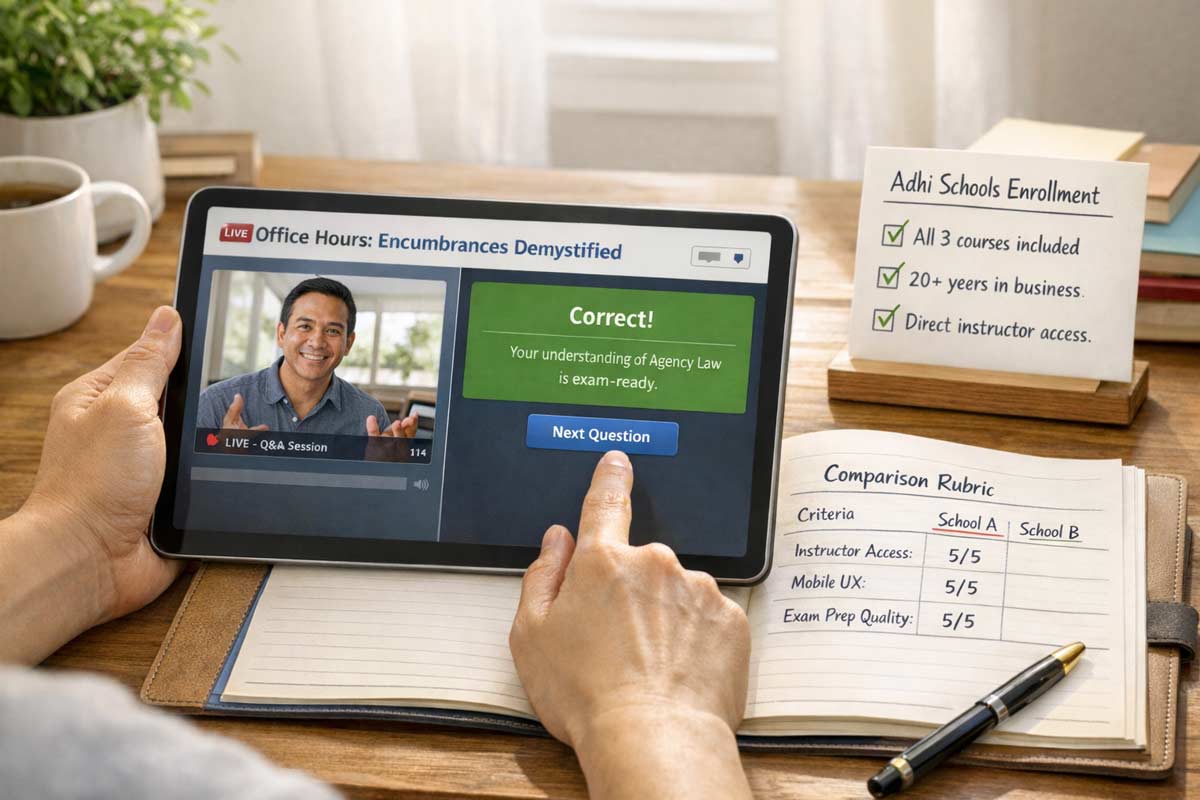
Choosing a real estate school in California often feels like looking at a dozen identical houses. On the surface, every provider promises the same outcome: a certificate that allows you to take the state exam.
However, once you sign up, the differences in technology, support, and actual "readiness" become glaringly apparent. Choosing the wrong provider doesn't just cost you money; it costs you weeks of momentum.
You are in the right place if:
This guide provides an operator-level system to compare schools objectively so you can move forward with confidence.
Quick Take:
All California real estate schools teach the same required subjects—but they do not teach them the same way. The difference between passing smoothly and stalling out usually comes down to support, platform quality, and hidden policies—not price.
Use these steps to audit any school you are considering. Do not rely on the marketing copy on their homepage; look for these specific indicators of quality.
Every school must be approved by the Department of Real Estate (DRE). If they aren't, your completion certificates are worthless.
Are you a self-starter, or do you need a coach? California allows for purely elective online study, but that doesn't work for everyone
When you have a question about "joint tenancy", who answers?
The platform you use shouldn't be a relic from 2005. It should work on your phone, tablet, and laptop.
Be wary of schools claiming "100% pass rates." The DRE does not officially track or publish pass rates for individual schools in a way that is easily verifiable for marketing.
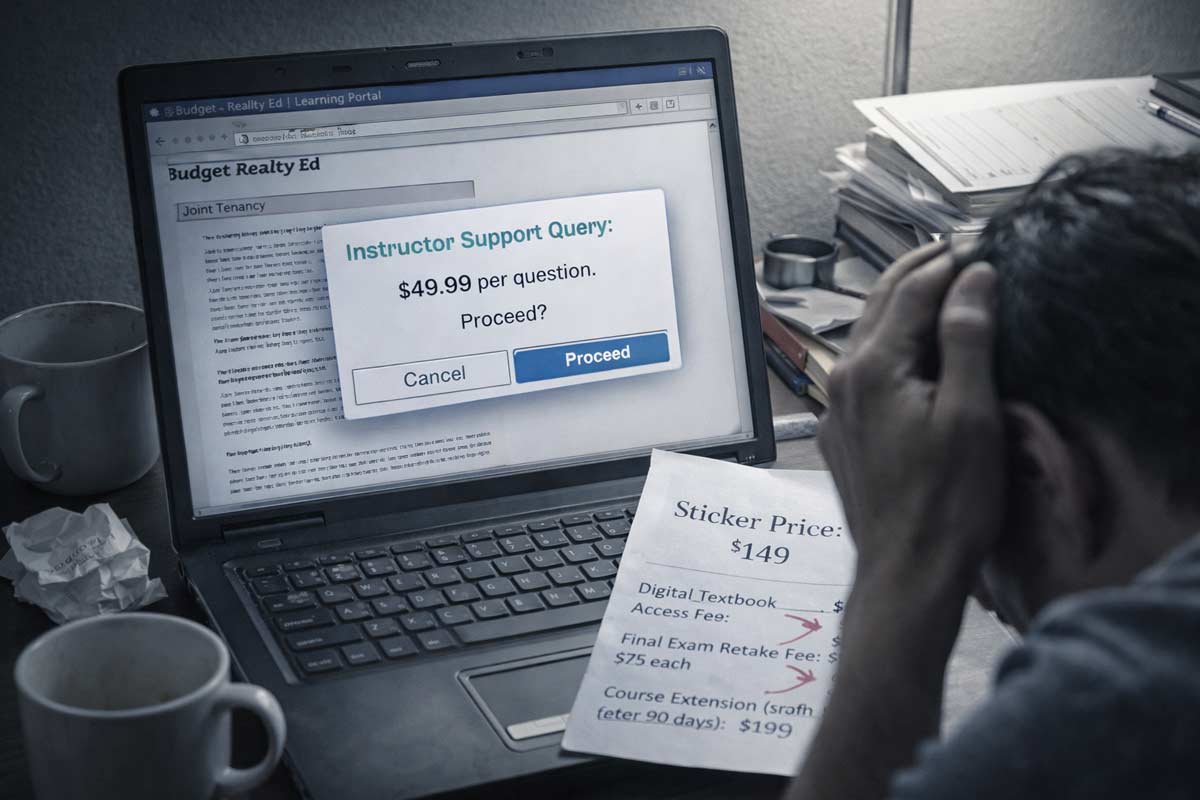
The "sticker price" is rarely the final price.
In California, generally there is a legal minimum time frame of 18 days per course. You cannot finish the entire program in a weekend.
Look past the five-star reviews on the school's own website.
Use the scoring rubric below to weigh your options. Don't choose based on price alone—choose based on the path that ensures you actually get your license.
In my 20+ years of coaching California students, I’ve seen that the "best" school is the one that matches your lifestyle.
The Need: Maximum flexibility and mobile access.
The Advice: Look for an online real estate school in California that offers "on-demand" video or high-quality reading material that you can digest in 20-minute windows. Avoid schools with rigid "live session" requirements if your work schedule is unpredictable.
The Need: Efficiency and clear milestones.
The Advice: You need a system that tracks your 18-day windows automatically and alerts you the moment you are eligible to take your next final.
The Need: Accountability and the ability to ask "Why?"
The Advice: Don't buy a budget, text-only course. You will likely get stuck on complex topics like "encumbrances" or "agency relationships." Invest in a school that offers live Q&A sessions or direct instructor access.
Common Mistake to Avoid: Buying a course based on a "coupon" only to find out the school charges $50 every time you need to ask a question or $100 to renew after 3 months. Screenshot the "Terms" page before you buy.
Before you enter your credit card info, check these boxes:
Comparing schools shouldn't be a guessing game. By focusing on support, transparency, and format, you move from being a "lead" to being an informed student.
If you want a broader look at the landscape of providers, visit our comprehensive guide on the Best Real Estate Schools in California, where we break down providers using the same criteria above. This comparison framework is just one part of choosing the right path toward your California real estate license.
1. Are all California real estate schools the same since the curriculum is the same?
No. While the topics are mandated by the DRE, the delivery (video vs. text), the quality of exam prep, and the level of instructor support vary wildly between providers.
2. How much should I expect to pay for a good school?
In California, prices typically range from $150 to $600. Be cautious of "bottom-dollar" schools; they often make up the difference with hidden fees for books or support.
3. Is an online real estate school in California better than in-person?
It depends on your discipline. Online is more convenient, but in-person (or "live stream") offers better networking and immediate answers to your questions.
4. How do I know if a school’s pass rate is real?
You don't. Since there is no independent, third-party audit of school pass rates required by the DRE, treat extreme claims as a red flag. Look for schools that offer extensive practice exams instead.
5. Can I switch schools if I don't like the one I chose?
Yes, but you usually cannot transfer "partial" credit. If you finished one 45-hour course, you can take the remaining two elsewhere.
6. What happens if my course access expires?
Most schools allow you to pay a "re-enrollment" or "extension" fee. Always check this cost before signing up, as it can be as much as 50% of the original tuition.

Founder, Adhi Schools
Kartik Subramaniam is the Founder and CEO of ADHI Real Estate Schools, a leader in real estate education throughout California. Holding a degree from Cal Poly University, Subramaniam brings a wealth of experience in real estate sales, property management, and investment transactions. He is the author of nine books on real estate and countless real estate articles. With a track record of successfully completing hundreds of real estate transactions, he has equipped countless professionals to thrive in the industry.

"Hey guys,
I took the exam today and passed!!!!
It only took me one try which was one of my goals. I took the online
classes and follow your suggestions so I took the crash course,
used the crash course app a lot, took 7 mock tests and went
confident to present the exam. Thank you for the great job you are
doing, you guys are awesome!!!! May God continue to bless you!"
Willie V.