
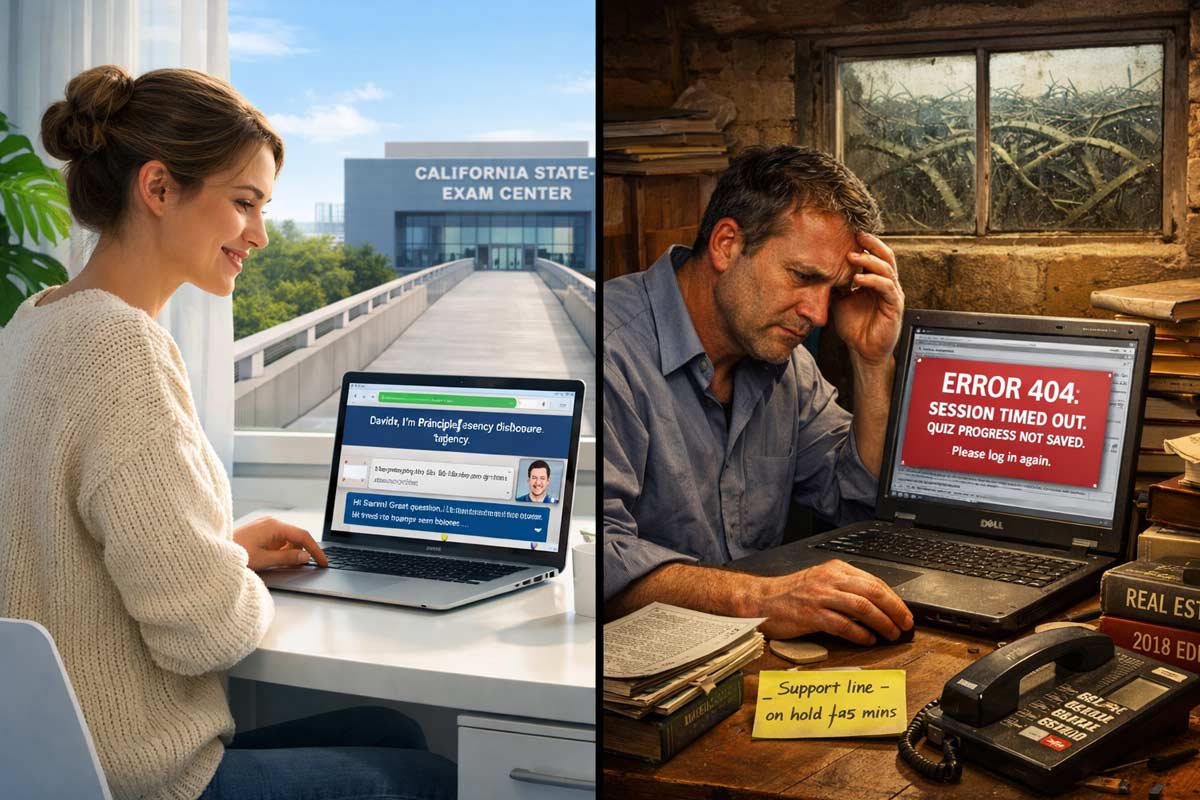
Every real estate school in California shares one thing: they must be approved by the Department of Real Estate (DRE) and will have a 4-digit sponsor ID number. Because the curriculum is regulated, many students make the mistake of assuming the schools themselves are identical. They treat the pre-license course like a commodity, shopping strictly on price or the "fastest" promise.
However, after 20 years of coaching students through the licensing process, I can tell you that while the certificate at the end looks the same, the experience of getting it varies wildly. The "commodity" is the credit; the differentiator is the path to passing the real estate exam.
How to use this article: Use the TL;DR to shortlist schools, then use the verification questions at the end of each section to confirm reality before you buy.
What it is: The delivery method—ranging from independent reading to live-streamed webinars.
Why it matters: California’s pre-licensing courses are time-regulated. Most providers enforce a minimum time window per 45-hour course (commonly 18 days), which creates a realistic floor for your timeline. If a school’s format doesn’t match your life, you will fall behind.
How to verify: Check if the "online" component is just a static PDF or an interactive platform.
Verification Question: "If I miss a scheduled session, what is the specific process and cost to make it up?"
What it is: The stability and intuitiveness of the learning management system.
Why it matters: I’ve seen students lose hours of progress because a platform didn't save their quiz scores. If the tech is frustrating, you won't study.
How to verify: Ensure the platform works in modern browsers (Chrome/Safari) and auto-saves progress. Evaluate course format, student support, and pass rates carefully before committing.
Verification Question: "Does your platform allow me to switch between my laptop and my phone without losing my place in the chapter?"
What it is: The ability to get a human on the phone when you have a DRE paperwork question.
Why it matters: The DRE application process is notoriously bureaucratic. A school with poor support leaves you to figure out background checks and transcripts alone.
How to verify: Call the school before you buy. If you can’t get a human during sales, you likely won't during support.
Verification Question: "What is your average response time for student support emails during business days?"
What it is: A direct line to an expert who can explain complex fiduciary duties or legal concepts.
Why it matters: Some concepts in California real estate are counter-intuitive. Without an instructor to clarify, you'll end up memorizing answers without understanding them, which leads to surprises on the state exam.
How to verify: Ask specifically who answers content-related questions—a licensed instructor or a general clerk?
Verification Question: "If I don't understand a concept in Chapter 4, is there a licensed instructor I can speak with or email directly?"
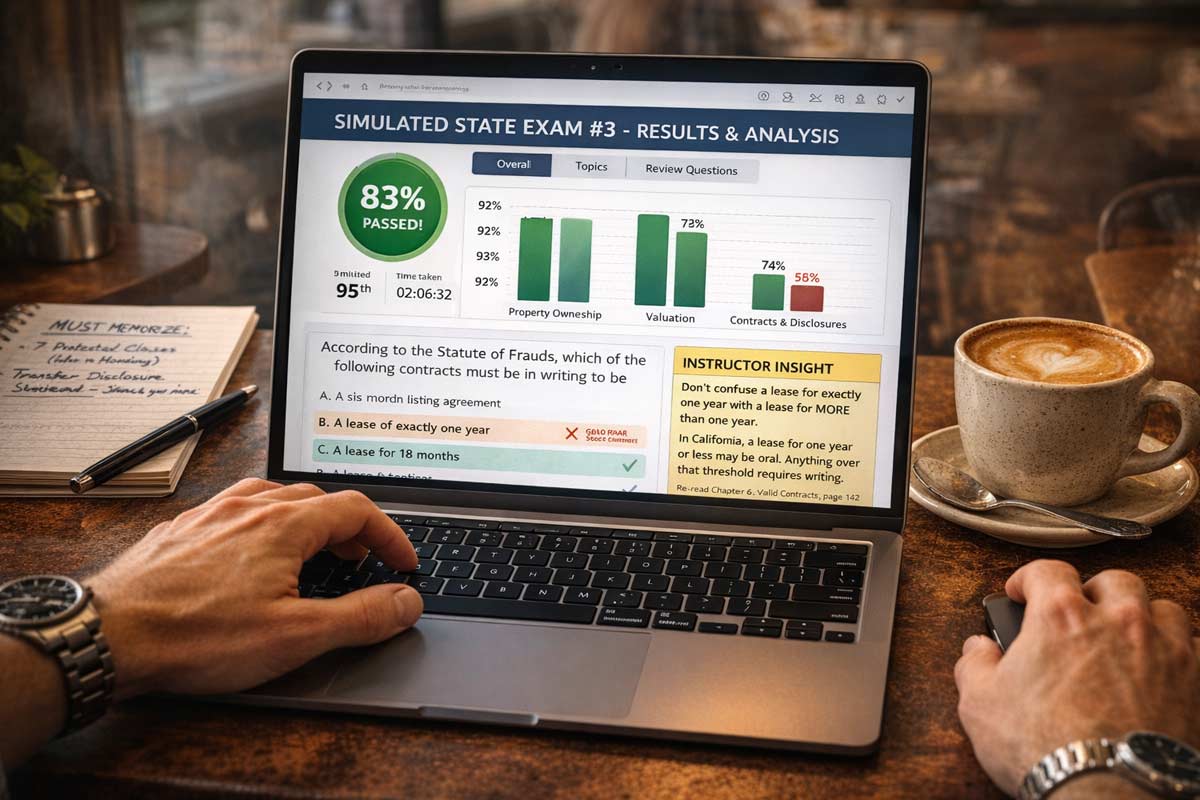
What it is: Tools beyond the basic quizzes, such as simulated state exams and performance analytics.
Why it matters: Passing the state exam is where many candidates get surprised—the questions are scenario-based, time-pressured, and unforgiving if you’re only memorizing. You need tools that target your weak areas.
How to verify: Look for "simulated exams" that mimic the DRE’s phrasing and provide "why" explanations for every answer.
Verification Question: "Does your exam prep software track my 'weak areas' across different categories like Agency or Contracts?"
What it is: Whether the material reflects current California law and disclosure practices.
Why it matters: Real estate law changes. If your school is using a curriculum from several years ago, you're learning outdated information that won't match how questions are framed today.
How to verify: Low price sometimes correlates with older platforms or less frequent updates—verify the revision date before buying.
Verification Question: "What major legislative or forms updates were incorporated into your curriculum in the last 12 months?"
What it is: How the school tracks your mandatory hours and issues the certificate.
Why it matters: If the school’s tracking isn't DRE-compliant, your application could be rejected weeks after you think you’ve finished.
How to verify: Check what matters most when choosing a real estate school regarding their reporting reputation.
Verification Question: "Is my completion certificate issued automatically the moment I complete the course requirements and meet the pacing/time requirements?"
What it is: The "all-in" cost versus the "teaser" price.
Why it matters: These fees don't just raise cost—they slow you down when you’re trying to finish. Some schools lure you with a low price but charge for certificate reprints, final exam retakes, and course extensions.
How to verify: Read the refund and extension policy before clicking "Buy."
Verification Question: "Are there any additional fees for retaking a school final exam or extending my access if I don't finish in six months?"
What it is: The actual time it takes from payment to being eligible for the state exam.
Why it matters: Even if you’re highly motivated, there’s a built-in pacing floor for completing three 45-hour courses, so any ‘finish instantly’ marketing should trigger verification.
How to verify: Use a step-by-step guide on how to compare California real estate schools to map out your realistic timeline.
Verification Question: "How long after I pass my third exam will it take for me to receive the transcripts I need for the DRE?"
What it is: What the school does for you once you have your certificate but before you have your license.
Why it matters: The "gap" between finishing the course and taking the state exam can be months. A good school provides resources to keep your knowledge fresh during that wait.
How to verify: Ask if they offer post-completion study groups or crash courses.
Verification Question: "Do I still have access to the practice exams and instructors after I receive my completion certificates?"
Not every student needs the same features. When researching the Best Real Estate Schools in California, prioritize based on your profile:
Are all DRE-approved schools basically the same?
No. While they teach the same legal requirements, the delivery, technology, and level of student support vary significantly. A school is a service, not just a textbook.
Does online vs. in-person affect passing?
It depends on the student. Online offers convenience, but in-person offers immediate clarification. The best schools often offer a hybrid approach to provide both.
Do pass-rate claims matter?
The DRE does not officially publish pass rates for individual schools. Any school claiming a "99% pass rate" should be viewed with healthy skepticism—ask them how they verify that data.
How long does it take to finish?
Most providers enforce a minimum time window of 18 days per course. For the three required courses, this creates a realistic floor of about 54 days, though most students finish in 3 to 4 months.
What should I compare before buying?
Look at the "hidden" costs (retakes/extensions), the age of the technology, and whether you can actually communicate with a human when you have a question.
Selecting a school is the first professional decision you make in your real estate career. It sets the tone for your licensing journey—either one of constant technical frustration or one of focused, supported growth.
Use Best Real Estate Schools in California to compare these factors side-by-side. Your goal isn't just to get the certificates; it’s to walk into the state exam with the confidence that you actually know the material.

Founder, Adhi Schools
Kartik Subramaniam is the Founder and CEO of ADHI Real Estate Schools, a leader in real estate education throughout California. Holding a degree from Cal Poly University, Subramaniam brings a wealth of experience in real estate sales, property management, and investment transactions. He is the author of nine books on real estate and countless real estate articles. With a track record of successfully completing hundreds of real estate transactions, he has equipped countless professionals to thrive in the industry.

"Hey guys,
I took the exam today and passed!!!!
It only took me one try which was one of my goals. I took the online
classes and follow your suggestions so I took the crash course,
used the crash course app a lot, took 7 mock tests and went
confident to present the exam. Thank you for the great job you are
doing, you guys are awesome!!!! May God continue to bless you!"
Willie V.