

Most students don’t fail the California real estate exam because the material is "too hard." They fail because they pick a learning format that doesn’t match their actual life.
You might be tempted to choose the cheapest online real estate school in California versus an instructor-led real estate school closest to your house, but without a framework, you risk losing weeks of momentum to procrastination or burnout.
This guide provides an objective look at the trade-offs between formats, helping you choose the best format for California real estate license course success.
Quick Take:
All California real estate schools teach the same required subjects—but they do not teach them the same way. The difference between passing smoothly and stalling out usually comes down to support, platform quality, and hidden policies—not price. Our full breakdown of providers is covered in the Best Real Estate Schools in California guide.
If you need a fast decision, match your profile below:
The Deciding Factor: It isn't just about the screen vs. the classroom; it’s about accountability + support + schedule reality.
If you want to go deeper into how support, accountability, and policies impact outcomes, see our breakdown on What Matters Most When Choosing a Real Estate School.
Before comparing, it’s important to understand what these terms actually mean under Department of Real Estate (DRE) regulations:
Regardless of format, ensure you are taking DRE-approved real estate courses in California. The curriculum is standardized, but the experience—and your results—will vary based on the school's platform and instructor quality.
The self-paced online real estate course in California has become the most popular option for a reason: flexibility.
Best for: Erratic schedules, full-time employees, and those with a high degree of self-discipline.
Watch-outs: Look for hidden fees for "extensions" and check the quality of their real estate school student support in California.
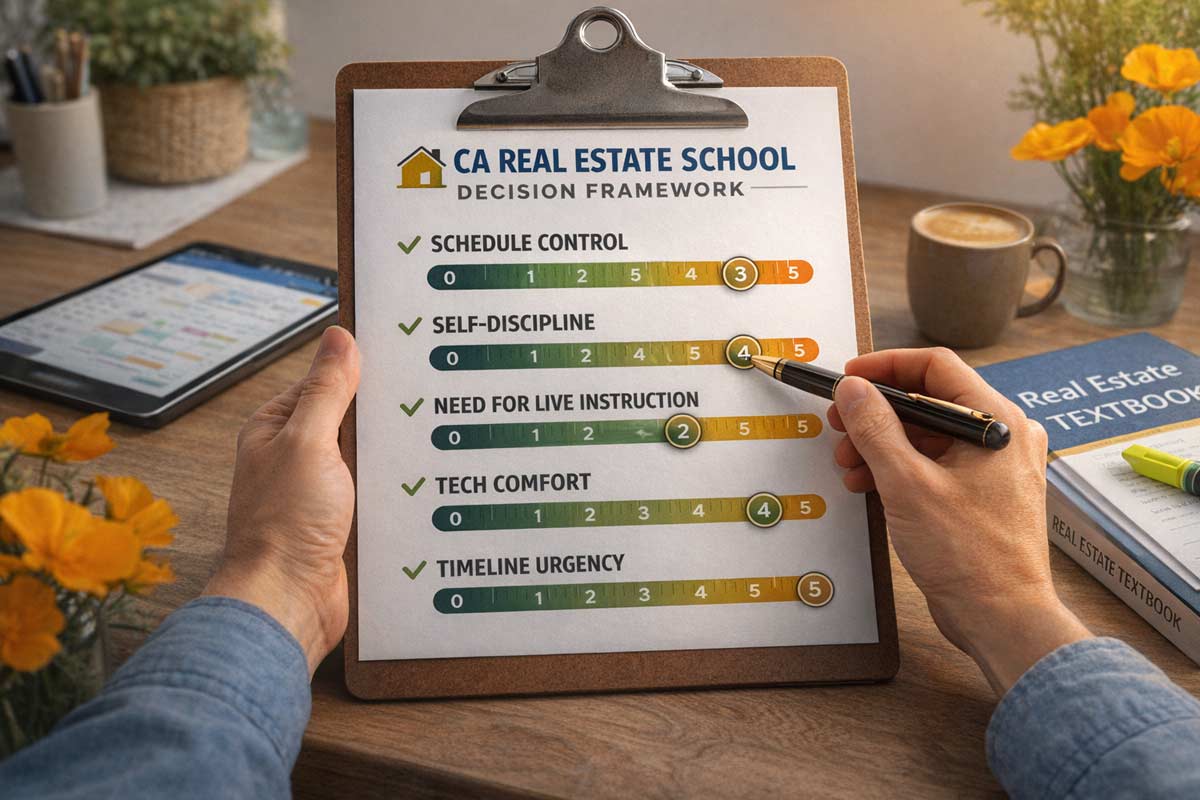
For some, the "four walls" of a classroom are the only way to ensure the work gets done.
Be honest—this isn’t about what sounds good, it’s about what you’ll actually do. Rank each category from 0–5 (5 being highest importance).
If you are still torn, you should learn how to compare California real estate schools by looking at the specific student support levels each offers.
Myth 1: "In-person students have higher pass rates."
Reality: Success is tied to study behavior. An online student using a high-quality simulator often outperforms an in-person student who only listens passively. You must evaluate course format, student support, and pass rates as a total package.
Myth 2: "Online is easier."
Reality: The 135-hour curriculum is the same. In many ways, online is harder because it requires more mental stamina to stay engaged with a screen than a human.
Format alone doesn’t explain why students have wildly different experiences. Many of the real differences come down to policies, platforms, and support structures—which we break down in The 10 Biggest Differences Between California Real Estate Schools.
The "best" school is the one you will actually finish on time while staying exam-ready. Don't let a $50 price difference or a "prestige" label distract you from your own learning habits.
If you’re ready to see how the top providers in the state stack up, check out our master guide: Best Real Estate Schools in California. This comparison framework is just one part of choosing the right path toward your California real estate license.
Yes. Livestream or Zoom-based courses are considered an approved delivery method as long as the provider is DRE-approved and properly tracks completion. These hybrid formats often combine live accountability with the convenience of remote access.
It usually takes the same total time—but online might feel faster because you control the pace. California has an 18-day minimum per course, so you can’t legally finish instantly. The real difference is efficiency: online lets disciplined students stack study blocks daily and finish near the minimum, while in-person schedules can stretch the timeline if classes meet only certain days or if you miss a session.
Look for support that prevents “stall-outs,” not generic customer service.
Specifically:

Founder, Adhi Schools
Kartik Subramaniam is the Founder and CEO of ADHI Real Estate Schools, a leader in real estate education throughout California. Holding a degree from Cal Poly University, Subramaniam brings a wealth of experience in real estate sales, property management, and investment transactions. He is the author of nine books on real estate and countless real estate articles. With a track record of successfully completing hundreds of real estate transactions, he has equipped countless professionals to thrive in the industry.

"Hey guys,
I took the exam today and passed!!!!
It only took me one try which was one of my goals. I took the online
classes and follow your suggestions so I took the crash course,
used the crash course app a lot, took 7 mock tests and went
confident to present the exam. Thank you for the great job you are
doing, you guys are awesome!!!! May God continue to bless you!"
Willie V.