TL;DR: The System Summary
A successful real estate CRM is a daily follow-up machine, not a contact list.
To make it work, you need:
Minimalist Data: Only track what helps you make the Read more...
TL;DR: The System Summary
A successful real estate CRM is a daily follow-up machine, not a contact list.
To make it work, you need:
Minimalist Data: Only track what helps you make the next call.
Strict Pipeline Stages: Define exactly where a lead sits in the journey.
The Golden Rule: Every contact must have a Next Step and a Next Date.
Daily Discipline: A 10-minute "CRM Block" to clear your tasks.
The CRM Graveyard: Why Most Systems Fail
Let’s be honest: Most California real estate agents have a "CRM graveyard." It’s a software subscription you pay for every month, filled with names you haven't called in 90 days and "leads" from an open house three years ago that were never categorized.
I’ve spent over 20 years coaching and operating in the California real estate education space, and I see the same mistake everywhere. Agents try to build a "database" when they should be building a real estate lead follow-up system.
If your CRM isn’t telling you exactly who to contact by 9:00 AM today, it’s not a CRM—it’s a hobby. In a market where you’re fighting 101 freeway traffic and juggling multiple escrows, speed-to-lead is the only metric that matters. If you aren't contacting an inbound lead within minutes, you are often competing with 3–5 other agents. Your CRM is what allows you to win that race.
CRM Setup in 30 Minutes (Beginner-Proof)
Don't spend weeks "researching" software. Pick a tool and follow this 30-minute sprint:
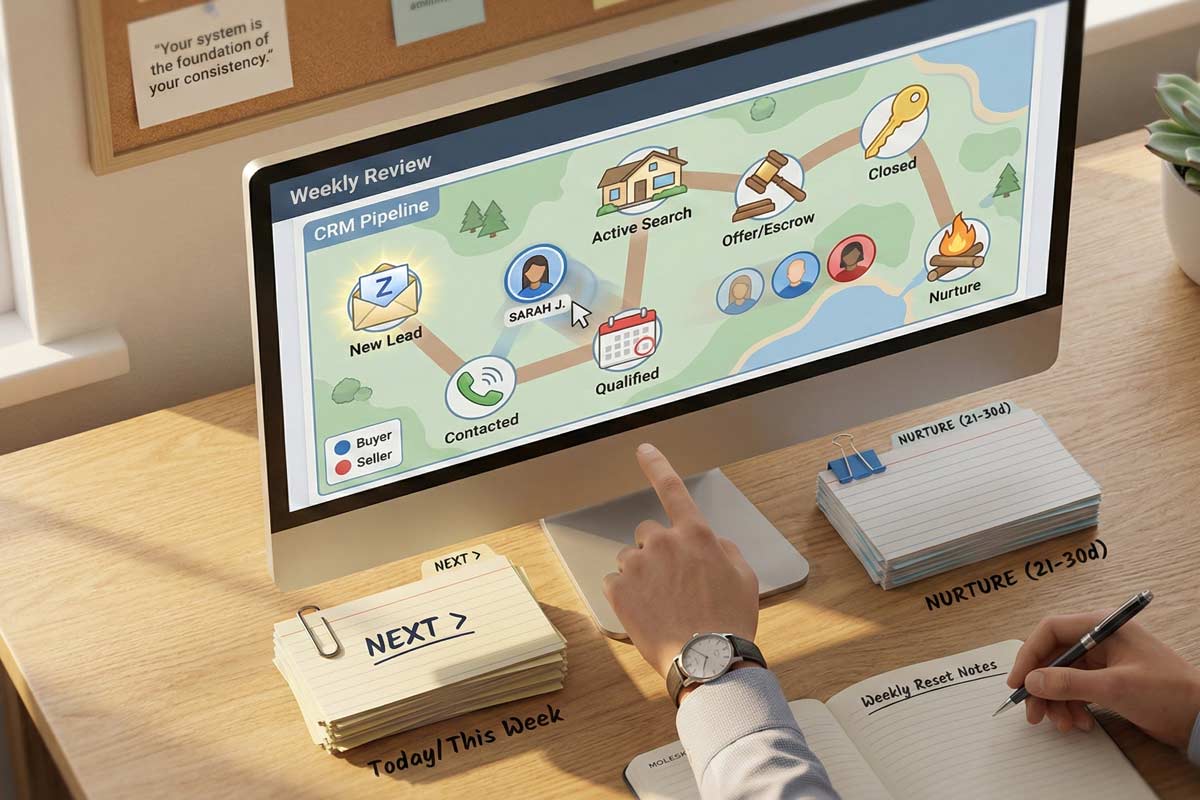
Create your 7 stages: (Use the framework in the table below).
Set your required fields: Source, Lead Type, Stage, Next Follow-Up Date, Tags.
Configure 3 saved views: Today, This Week, Nurture.
Import 10 contacts: Start with your phone’s "recent" list or warm sphere.
Assign a "Next Step + Next Date": Do this for every single one.
Calendar it: Put a recurring 10-minute CRM Block on your calendar for every weekday morning.
The CRM Build: Your Minimum Viable System
To build a real estate CRM that sticks, you need to strip away the "tech-bro" features most CRM for real estate agents are bloated with and focus on the core structure.
1.The Only Fields You Actually Need
Stop trying to fill out 50 fields of data. You’ll burn out. Stick to these:
Name & Contact Info: (Phone/Email)
Source: (Zillow, Open House, Sphere, Referral)
Lead Type: (Buyer, Seller, Investor, Renter)
Pipeline Stage: (Where are they in the process?)
Next Follow-Up Date: (The most important field in your business)
Tags: FHA-Buyer, Inland-Empire-Retail, Probate, Past-Client, Hot-Lead.
Common Mistake
Don't create a "custom field" for every little detail. Use the "Notes" section for the story; use "Tags" for the category. Over-complicating fields is the fastest way to stop using the system.
2. Your Pipeline Stages (Entry/Exit Criteria)
Your pipeline stages real estate logic must be tight. If you don't know why someone is in a specific stage, the system breaks.
Stage
What it means
Move forward when...
New Lead
Inbound or added, not contacted
You’ve attempted contact + set Next Date
Contacted
Two-way exchange happened
You have timeline + motivation basics
Qualified
Budget + timeline + reason confirmed
You scheduled consult/showing/listing appt
Active Search
You’re actively working inventory
They’re ready to offer or pause
Offer / Escrow
Under contract
You close or deal dies (then re-stage)
Closed / Past
Transaction complete
You set post-close follow-up + nurture
Nurture
6+ months out
They re-engage (then re-qualify)
The Follow-Up Engine (The Real Product)
Your real estate CRM workflow is only as good as your persistence. Most agents stop after two attempts. Top operators go further.
The “No-Response” Ladder
Use this framework when a lead goes quiet:
Touch 1 (Day 1): Call + short text: “Hey [Name], it’s Kartik—saw your inquiry about [area]. Quick question: are you looking to move in the next 30–90 days or just researching?”
Touch 2 (Day 2–3): Value text: “If you tell me your target city + price range, I’ll send 3 options that match your criteria today.”
Touch 3 (Day 5–7): Close-the-loop: “I don’t want to spam you—should I stop reaching out, or is there a better time next week?”
If no response occurs after Touch 3, move them to the Nurture stage and set a Next Date for 21–30 days out.
Workflow: The Daily Execution
A CRM is only as good as your Daily Habits. To stay organized, stop looking at "All Contacts." Instead, use these three saved views:
Today: Shows only leads where the Next Date = Today or is Overdue.
This Week: Shows leads with a Next Date within the next 7 days (for planning).
Nurture: Shows leads with a Next Date 21–30 days out.
The Daily & Weekly Rhythm
Success requires a Time Management for California Real Estate Agents strategy that protects your "system time."
Daily (10 Mins): Clear your "Today" view every morning. Log outcomes in one sentence. Set the next date.
Weekly Reset (15 Mins): Every Friday at 4:30 PM, review your pipeline. Drag leads back to the correct stages and ensure no one is missing a Next Date.
Automation vs. Human Touch
Automation should support you, not replace you.
Do Automate: Immediate "Thanks for reaching out" texts; Appointment reminders.
Don't Automate: Deep relationship building. If an automation can’t be answered with a human reply, it probably shouldn’t be sent.
Common Failure Points and Fixes
"I don't have time to update it."
Fix: Make the update process smaller. Log the outcome immediately after the call, not at the end of the day.
"I'm burning out on follow-up."
Fix: Read our guide on Burnout Prevention for Real Estate Professionals. Usually, burnout comes from the anxiety of forgetting someone, not the act of calling them.
"I'm in escrow chaos all week."
Fix: Use your CRM to set "reminders" for your active leads so you don't ignore your future income while processing current checks.
The Bigger Picture: Your CRM Is One Skill in the Stack
A CRM that works is revenue insurance—but it only performs when it’s paired with daily execution, clear targets, and protected time. As you Set Goals as a New Real Estate Agent, remember that your system is the foundation of your consistency.
If you want the complete operator framework behind follow-up, pipeline control, and professional consistency, start here: Real Estate Agent Skills California.
FAQ: Building Your Real Estate CRM
1. What should I put in the ‘Notes’ vs. ‘Tags’?
Tags are for categories you want to filter (e.g., "Buyer," "Past Client"). Notes are for the "story" and specific details from your last conversation (e.g., "Daughter is moving to San Diego in August").
2. What’s the best follow-up schedule for Zillow or open house leads?
High intensity for the first 10 days (5–7 touches), then transition to a 21-day "Nurture" cycle. Speed is everything in the first 48 hours.
3. How do I use a CRM when I’m in escrow all week?
The CRM is what protects your next paycheck while you’re busy earning the current one. Treat your escrow tasks like lead tasks. Use the CRM to remind you of contingency removals, but don't let your "Today" view of new leads go uncleared. Spend 5 minutes on leads, then 55 minutes on your escrow.
4. How many stages should my real estate pipeline have?
Keep it between 5 and 8 stages. Any more and you will spend more time organizing the list than calling the people on it.
|
Choosing a real estate school in California often feels like looking at a dozen identical houses. On the surface, every provider promises the same outcome: a certificate that allows you to take the state Read more...
Choosing a real estate school in California often feels like looking at a dozen identical houses. On the surface, every provider promises the same outcome: a certificate that allows you to take the state exam.
However, once you sign up, the differences in technology, support, and actual "readiness" become glaringly apparent. Choosing the wrong provider doesn't just cost you money; it costs you weeks of momentum.
You are in the right place if:
You are confused by "guaranteed pass" claims.
You aren’t sure if a cheap online course is enough to actually pass the state exam.
You need a framework to filter out schools that don't align with your learning style.
This guide provides an operator-level system to compare schools objectively so you can move forward with confidence.
Quick Take:
All California real estate schools teach the same required subjects—but they do not teach them the same way. The difference between passing smoothly and stalling out usually comes down to support, platform quality, and hidden policies—not price.
The 9-Step Comparison Framework
Use these steps to audit any school you are considering. Do not rely on the marketing copy on their homepage; look for these specific indicators of quality.
Step 1: Confirm DRE Approval
Every school must be approved by the Department of Real Estate (DRE). If they aren't, your completion certificates are worthless.
Why it matters: The DRE sets the curriculum. Any DRE-approved real estate course must meet the 135-hour requirement (three 45-hour courses).
How to verify: Don't just look for a logo. Navigate to the official DRE website to search the DRE’s approved provider list.
Step 2: Match the Format to Your Life
Are you a self-starter, or do you need a coach? California allows for purely elective online study, but that doesn't work for everyone
Why it matters: Some students thrive in a self-paced environment, while others need the accountability of a live instructor.
How to verify: Look at the Online vs. In-Person Real Estate Schools in CA: Pros & Cons to see which environment fits your current schedule and focus level.
Step 3: Evaluate Student Support
When you have a question about "joint tenancy", who answers?
Why it matters: Many budget schools provide the materials but zero access to human experts.
How to verify: Email the school a technical question before you buy. If it takes them three days to respond to a sales lead, imagine how long they’ll take to help a student. This is a key factor when you evaluate evaluate real estate school quality in California.
Step 4: Check Course UX and Materials
The platform you use shouldn't be a relic from 2005. It should work on your phone, tablet, and laptop.
Why it matters: If the interface is clunky, you will find excuses to avoid studying.
How to verify: Ask for a demo or a "look inside" video. Check if the quizzes are interactive or just static PDFs.
Step 5: Understand Pass-Rate Claims
Be wary of schools claiming "100% pass rates." The DRE does not officially track or publish pass rates for individual schools in a way that is easily verifiable for marketing.
Why it matters: Statistics can be manipulated (e.g., only counting students who pass a "pre-test" first).
How to verify: Look for transparency. A reputable school will tell you that the state exam is difficult and requires significant effort. When asking what matters most when choosing a real estate school, look for schools that emphasize preparation over "shortcuts."
Step 6: Compare Total Cost
The "sticker price" is rarely the final price.
Why it matters: Some schools charge extra for physical textbooks, retaking final exams, or extending your course access if life gets in the way.
How to verify: Read the "Terms and Conditions" specifically for "re-enrollment fees" or "extension fees."
Step 7: Compare Completion Speed & Flexibility
In California, generally there is a legal minimum time frame of 18 days per course. You cannot finish the entire program in a weekend.
Why it matters: Some schools have rigid schedules; others allow you to pause for months if needed.
How to verify: Check the expiration date of your enrollment. A good California real estate license course should give you at least 6–12 months of access.
Step 8: Verify Reputation Signals
Look past the five-star reviews on the school's own website.
Why it matters: Public platforms (Google, Yelp, Reddit) provide a more honest look at the student experience.
How to verify: Look for patterns. Are people complaining about the tech? The differences between real estate schools in California often come down to how they handle student frustrations.
Step 9: Make the Final Decision
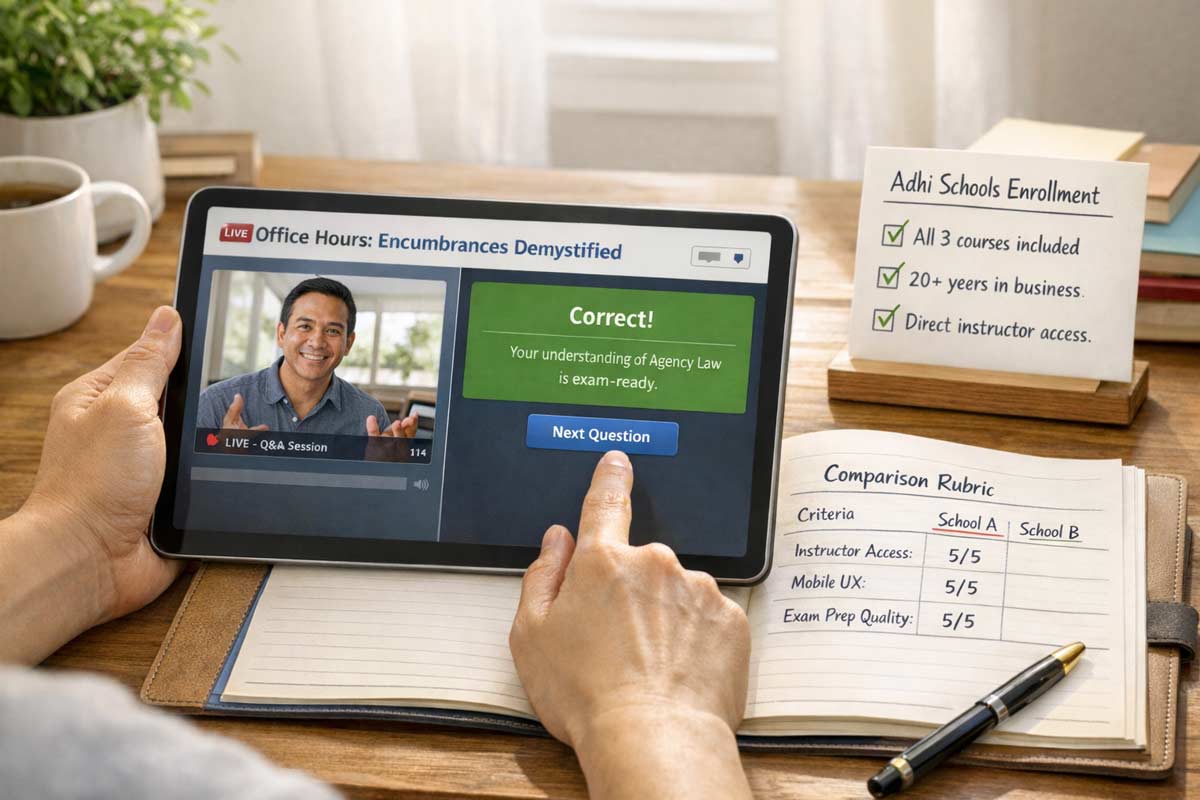
Use the scoring rubric below to weigh your options. Don't choose based on price alone—choose based on the path that ensures you actually get your license.
Comparison Rubric: How to Grade a School
Criteria
Weight
School A
School B
School C
DRE Approval
Essential
Instructor Access
High
Mobile UX
Medium
Total Price (Fees included)
Medium
Reputation/Reviews
High
Exam Prep Quality
High
Real-World Scenarios: Which Profile Are You?
In my 20+ years of coaching California students, I’ve seen that the "best" school is the one that matches your lifestyle.
1. The Full-Time Worker
The Need: Maximum flexibility and mobile access.
The Advice: Look for an online real estate school in California that offers "on-demand" video or high-quality reading material that you can digest in 20-minute windows. Avoid schools with rigid "live session" requirements if your work schedule is unpredictable.
2. The Fast-Tracker
The Need: Efficiency and clear milestones.
The Advice: You need a system that tracks your 18-day windows automatically and alerts you the moment you are eligible to take your next final.
3. The High-Support Learner
The Need: Accountability and the ability to ask "Why?"
The Advice: Don't buy a budget, text-only course. You will likely get stuck on complex topics like "encumbrances" or "agency relationships." Invest in a school that offers live Q&A sessions or direct instructor access.
Common Mistake to Avoid: Buying a course based on a "coupon" only to find out the school charges $50 every time you need to ask a question or $100 to renew after 3 months. Screenshot the "Terms" page before you buy.
The Ultimate Comparison Checklist
Before you enter your credit card info, check these boxes:
Is the school listed on the DRE website?
Does the price include all three required 45-hour courses?
Are the textbooks digital, physical, or both? (Is there an extra fee?)
Is there a dedicated "Exam Prep" component available?
Can I access the materials on my phone without a headache?
What is the "hidden fee" for retaking a final exam if I fail?
How do I contact an instructor if I'm confused?
Red Flags to Watch For:
No physical office or phone number listed.
"Guaranteed" pass rates (nobody can guarantee what you'll do in the state exam room).
Outdated websites that look like they haven't been updated since the 90s.
Lack of clarity on how long you have to finish the course.
Comparing schools shouldn't be a guessing game. By focusing on support, transparency, and format, you move from being a "lead" to being an informed student.
If you want a broader look at the landscape of providers, visit our comprehensive guide on the Best Real Estate Schools in California, where we break down providers using the same criteria above. This comparison framework is just one part of choosing the right path toward your California real estate license.
Frequently Asked Questions
1. Are all California real estate schools the same since the curriculum is the same?
No. While the topics are mandated by the DRE, the delivery (video vs. text), the quality of exam prep, and the level of instructor support vary wildly between providers.
2. How much should I expect to pay for a good school?
In California, prices typically range from $150 to $600. Be cautious of "bottom-dollar" schools; they often make up the difference with hidden fees for books or support.
3. Is an online real estate school in California better than in-person?
It depends on your discipline. Online is more convenient, but in-person (or "live stream") offers better networking and immediate answers to your questions.
4. How do I know if a school’s pass rate is real?
You don't. Since there is no independent, third-party audit of school pass rates required by the DRE, treat extreme claims as a red flag. Look for schools that offer extensive practice exams instead.
5. Can I switch schools if I don't like the one I chose?
Yes, but you usually cannot transfer "partial" credit. If you finished one 45-hour course, you can take the remaining two elsewhere.
6. What happens if my course access expires?
Most schools allow you to pay a "re-enrollment" or "extension" fee. Always check this cost before signing up, as it can be as much as 50% of the original tuition.
|

When you decide to get your California real estate license, you are immediately flooded with ads. Some schools scream about being the cheapest; others promise "100% pass rates."
But after 20 years in Read more...
When you decide to get your California real estate license, you are immediately flooded with ads. Some schools scream about being the cheapest; others promise "100% pass rates."
But after 20 years in this industry, I can tell you that most of those metrics are noise. If you choose a school based on the wrong criteria, you might end up with certificates of completion but zero confidence when you sit down for the actual real estate exam.
Here is what actually determines your success.
Quick Take:
Your goal isn't just to "finish the hours"—it's also to pass the state exam on the first try. To do that, you need a school that prioritizes support, exam-readiness, and policy transparency over just being the lowest bidder.
Quality of Student Support (The "Ghosting" Factor)
In California, you have to complete 135 hours of education. At some point, you will get confused by a concept like "negative amortization" or "easements by prescription."
The Problem: Budget schools often automate everything. If you have a question, you might wait 48–72 hours for an emailed response from someone who isn't even an instructor.
What Matters: Can you get in touch with a human? Is there a live Q&A session? Access to experienced instructors is one of the 10 biggest differences between California real estate schools.
Exam Prep vs. Course Completion
Completing the required DRE-approved real estate courses in California is just Step 1. Passing the final for those courses is "open book." The state exam is not.
The Problem: Many schools give you the 135 hours but very little "Crash Course" or "Exam Prep" material.
What Matters: Look for a school that includes a robust state exam simulator. You need to practice with the same wording, timing, and difficulty level you’ll face at the DRE testing center. This is a vital part of how you evaluate course format, student support, and pass rates.
Hidden Costs and Enrollment Length
In California, you cannot legally finish all three courses in less than 54 days. Life often gets in the way of that perfect timeline.
The Problem: Some schools give you only 3 or 6 months of access. If you don't finish, they charge you a "re-enrollment fee" that can cost as much as the original course.
What Matters: Transparency. Look for a one-year enrollment period and clear policies on retaking final exams (it should be free or very low cost).
Platform Usability (The "UX" Factor)
If the website looks like it was built in 1998, your learning experience will likely suffer.
The Problem: Clunky interfaces make it harder to track your progress or study on your mobile device.
What Matters: A modern online real estate school in California should allow you to jump between your phone and laptop seamlessly. If the technology is a hurdle, you won't finish the course.
Decision Checklist: The "Big 5" Questions
Before you enroll, ask these five questions to ensure the school is a fit:
Who is the instructor? (Are they a practicing broker or just a paid actor?)
How long do I have to finish? (Is the timeline 6 months or a full year?)
Does the school offer exam prep? (Passing the state exam is critical.)
How do I get help? (Is there a community or a help desk?)
What is the "Total" price? (Does it include books, shipping, and exam prep.)
The Reality of Pass Rates
Any school can claim a high pass rate. But since the DRE doesn't publish these figures for private schools, you have to look for reputation signals:
Check independent reviews (Google/Yelp).
Ask local brokers which school their most successful new agents attended.
Check if the school offers an "open door" policy to try a class before you buy.
If you are still stuck between two schools, you should learn how to compare California real estate schools using a side-by-side rubric.
The "best" school isn't the one with the biggest discount code. It’s the one that respects your time and provides the tools to ensure you only have to take the state exam once.
For a final ranking of the top options in the state based on these criteria, see our master guide: Best Real Estate Schools in California.
FAQ
What is the most important factor in choosing a real estate school?
Instructor access and the quality of state exam prep software. Passing the 135 hours is easy; passing the state exam is the real hurdle.
Can I switch from an online course to an instructor-led one later?
It depends on the school. Some allow a "hybrid" approach, but it's easier to decide your format upfront. See our guide on Online vs. In-Person Real Estate Schools in CA for more.
Does a more expensive school mean I’m more likely to pass?
Not necessarily, but "too cheap" often can indicate a lack of human support and outdated materials. Aim for the mid-to-high range for the best balance of value and quality.
|

I have spent over 20 years as a broker in California, training and supervising thousands of new licensees. In that time, I’ve developed a sixth sense for the “Quiet Quit.”
It starts with a subtle Read more...
I have spent over 20 years as a broker in California, training and supervising thousands of new licensees. In that time, I’ve developed a sixth sense for the “Quiet Quit.”
It starts with a subtle avoidance. An agent might stop showing up for the Tuesday sales meetings because they don’t have any "wins" to report. They tell their family that “it’s just a slow season” while watching their credit card balance climb to cover local association dues.
Often there isn’t a dramatic resignation; they simply fade out of the industry, seeing that the new career touted on LinkedIn six months ago never actually materialized.
This isn’t just the loss of a job; it’s the identity built in front of everyone that withers.
In California, the first-year dropout rate is high because the industry sells a dream while the reality requires surgical discipline. Most agents don't quit because they lack talent—they quit because they were never told how to survive this compounding decline.
1. No Business Plan (Productive Procrastination)
The biggest mistake I see is "productive procrastination." This is when an agent spends four days color-coding a CRM that contains zero leads or obsessing over the font on a business card.
This is where most agents fool themselves into thinking they are "building a business" when they are actually just maintaining an expensive hobby. If you don't have a daily lead-generation block—actual conversations with prospects, not administrative setup work—you are a tourist, not an agent yet. To stop the bleed, you must learn How to Create a Real Estate Business Plan (New Agents).
2. No Personal Brand (The Invisible Decline)
Invisibility is a death sentence in California's competitive markets. Many new agents hide behind their big-box brokerage’s logo, thinking the name on the building will do the heavy lifting. It won't.
The danger here is the lag factor. The damage of a weak brand isn’t felt today; it’s felt six months from now when the pipeline is bone-dry. The consequence is a phone that stays silent even when inventory shifts or interest rates drop. Essentially becoming a "secret agent," and secrets don't get paid. Overcoming this requires Branding Tips for New California Agents that force the agent into the public eye before the silence becomes entrenched.
3. Cash-Flow Shock (The Panic Check)
Let's talk about the moment the "dream" hits the bank account. Between DRE fees, REALTOR® association dues, and marketing costs, you are likely thousands of dollars in before the first escrow even opens.
In California, a standard escrow is 30 to 45 days. If it takes you four months to find a client, you are six months away from a check. Most agents quit when they hit the "Panic Check"—the moment they realize they have to retreat to their old 9-to-5 and explain to their peers why they couldn't make it. Cash-flow shock is a public retreat that most egos can't survive.
The Hard Truth: You were given a license, but you weren't given a survival manual. Quitting is a rational response to a lack of systems. If you find yourself avoiding your broker or lying to your spouse about how "busy" you are, it’s not a character flaw—it’s a systemic failure.
4. Social Media Confusion (Digital Noise vs. Value)
I see new agents posting photos of their lunch or generic "Happy Monday" graphics and wondering why their DMs are empty. This random posting is actually worse than silence because it creates a false sense of accomplishment.
In the current market cycle, the public is too sophisticated for "guru" posturing. If your digital presence doesn't provide data or inventory insights, you are just adding to the noise. You need a strategy for How New Agents Should Use Social Media in 2026 that builds authority rather than just seeking "likes."
5. Isolation & The Shame of "Looking Stupid"
Real estate can be a lonely business. When a deal falls apart, the isolation leads to a rapid collapse in motivation.
But the real killer is shame. New agents often stop asking questions because they don't want to "look stupid" in front of the high-producers in the office. They isolate themselves to hide their lack of progress, which only accelerates the Quiet Quit. Breaking this cycle requires a specific strategy on How to Stay Motivated as a New Agent that acknowledges the psychological toll of the first year.
6. The "Licensing Lie"
The California Department of Real Estate (DRE) exam ensures you know the basics of real estate law; passing does not guarantee you will make money. The industry’s onboarding narrative often suggests that "getting your license" is the hard part.
That is the Licensing Lie. Your license is merely a "permit to learn." The reality is that the first year is 10% real estate and 90% grueling lead acquisition. Lead acquisition isn't a chore you do to get to the real estate; lead acquisition is the real estate business.
The Survivor Mindset: Boring Consistency
The agents I’ve seen survive and thrive over the last two decades don't have "hustle" posters on their walls. They have boring consistency.
Survivors rely on observable behaviors:
The Calendar: Guarding lead-generation blocks like a doctor guards surgery time.
The CRM: Documenting every interaction, no matter how small or unlikely.
The Follow-Up: Calling when you said you would, even when there is no "news" to report.
The Decision Window
If you are currently feeling the weight of the Quiet Quit, you are at a fork in the road. You can continue to fade out, or you can admit that your current "plan" isn't working and reset your systems.
The first year is an exercise in attrition. Survival depends on your willingness to stop "playing house" and start operating a business. To move past the danger zone and build something that lasts, you need to understand the full career arc. It’s time to stop guessing and learn how to properly Start a Real Estate Career in California with your eyes wide open.
|

Most students don’t fail the California real estate exam because the material is "too hard." They fail because they pick a learning format that doesn’t match their actual life.
You might be tempted Read more...
Most students don’t fail the California real estate exam because the material is "too hard." They fail because they pick a learning format that doesn’t match their actual life.
You might be tempted to choose the cheapest online real estate school in California versus an instructor-led real estate school closest to your house, but without a framework, you risk losing weeks of momentum to procrastination or burnout.
This guide provides an objective look at the trade-offs between formats, helping you choose the best format for California real estate license course success.
Quick Take:
All California real estate schools teach the same required subjects—but they do not teach them the same way. The difference between passing smoothly and stalling out usually comes down to support, platform quality, and hidden policies—not price. Our full breakdown of providers is covered in the Best Real Estate Schools in California guide.
Quick Answer: Which One Should You Choose?
If you need a fast decision, match your profile below:
Choose Online if: You are a disciplined self-starter with a full-time job, have strong tech comfort, and need to fit studying into "pockets" of time.
Choose Instructor-Led if: You struggle with self-motivation, learn best through discussion, and need a "destination" to focus.
Online is risky when: You have zero student support and a "buy it and forget it" mentality.
In-person is inefficient when: The commute takes longer than the class or the fixed schedule forces you to miss critical business opportunities.
The Deciding Factor: It isn't just about the screen vs. the classroom; it’s about accountability + support + schedule reality.
If you want to go deeper into how support, accountability, and policies impact outcomes, see our breakdown on What Matters Most When Choosing a Real Estate School.
Defining the Formats For This Article
Before comparing, it’s important to understand what these terms actually mean under Department of Real Estate (DRE) regulations:
Self-Paced Online: You log in and read text or watch videos. You move as fast or slow as you want (within the 18-day-per-course legal minimum).
Livestream (The Hybrid): Classes are held over Zoom at specific times. You get the classroom feel without the commute.
Physical Classroom: Traditional in-person instruction at a physical campus.
Regardless of format, ensure you are taking DRE-approved real estate courses in California. The curriculum is standardized, but the experience—and your results—will vary based on the school's platform and instructor quality.
Online Real Estate Schools in California — Pros & Cons
The self-paced online real estate course in California has become the most popular option for a reason: flexibility.
The Pros
Total Flexibility: Study at 2 AM or during your lunch break.
Cost Efficiency: Generally 30–50% cheaper than instructor-led equivalents.
Pacing Control: Breeze through topics you know and spend more time on complex concepts like Trust Fund Handling.
Repeatability: You can re-watch videos or re-read chapters as many times as needed.
The Cons
Procrastination: Without a "teacher" waiting for you, it’s easy to push studying to "tomorrow."
Isolation: You don’t have a cohort of peers to "bump brains" with.
Tech Friction: If the school's platform is outdated, the user experience can be frustrating.
Best for: Erratic schedules, full-time employees, and those with a high degree of self-discipline.
Watch-outs: Look for hidden fees for "extensions" and check the quality of their real estate school student support in California.
In-Person Real Estate Schools in California — Pros & Cons
For some, the "four walls" of a classroom are the only way to ensure the work gets done.
The Pros
Built-in Accountability: If you show up to the building, you’re going to study for those hours.
Real-Time Q&A: You can stop an instructor and ask for a real-world example the moment you’re confused.
Community: You meet people who will eventually be your colleagues and potential referral partners.
The Cons
Rigid Schedule: If you miss a class, you might have to wait weeks for that topic to cycle back.
Time Cost: A two-hour class plus an LA commute can equal four hours of your day.
Lack of Review: Once the lecture is over, you can’t "rewind" a live instructor.
The Decision Framework: Your Scoring Checklist
Be honest—this isn’t about what sounds good, it’s about what you’ll actually do. Rank each category from 0–5 (5 being highest importance).
Category
Score (0–5)
Schedule Control: I need to study at random times.
Self-Discipline: I can sit down and work without being told to.
Need for Live Instruction: I need to ask "Why?" to understand.
Tech Comfort: I am comfortable navigating web platforms.
Timeline Urgency: I need to finish as fast as legally possible.
How to Interpret:
Higher on Schedule/Discipline/Speed: Go Online.
Higher on Live Instruction/Accountability: Go In-Person or Livestream
If you are still torn, you should learn how to compare California real estate schools by looking at the specific student support levels each offers.
Format Myths vs. Reality
Myth 1: "In-person students have higher pass rates."
Reality: Success is tied to study behavior. An online student using a high-quality simulator often outperforms an in-person student who only listens passively. You must evaluate course format, student support, and pass rates as a total package.
Myth 2: "Online is easier."
Reality: The 135-hour curriculum is the same. In many ways, online is harder because it requires more mental stamina to stay engaged with a screen than a human.
Format alone doesn’t explain why students have wildly different experiences. Many of the real differences come down to policies, platforms, and support structures—which we break down in The 10 Biggest Differences Between California Real Estate Schools.
Choose the Format You’ll Actually Finish
The "best" school is the one you will actually finish on time while staying exam-ready. Don't let a $50 price difference or a "prestige" label distract you from your own learning habits.
If you’re ready to see how the top providers in the state stack up, check out our master guide: Best Real Estate Schools in California. This comparison framework is just one part of choosing the right path toward your California real estate license.
FAQ
Is livestream or Zoom real estate school considered online in California?
Yes. Livestream or Zoom-based courses are considered an approved delivery method as long as the provider is DRE-approved and properly tracks completion. These hybrid formats often combine live accountability with the convenience of remote access.
How long does an online California real estate course take compared to in-person?
It usually takes the same total time—but online might feel faster because you control the pace. California has an 18-day minimum per course, so you can’t legally finish instantly. The real difference is efficiency: online lets disciplined students stack study blocks daily and finish near the minimum, while in-person schedules can stretch the timeline if classes meet only certain days or if you miss a session.
What should I look for in student support if I choose an online school?
Look for support that prevents “stall-outs,” not generic customer service.
Specifically:
Fast response times (same-day or next business day)
Clear extension and refund policies (no surprise fees)
Real exam-prep tools (practice exams/simulators + explanations)
Progress tracking + reminders (anything that adds accountability)
If the school can’t clearly explain how they keep students moving, it’s a red flag.
|

You are sitting in your car in a driveway in Irvine or Walnut Creek, staring at a repair request that just came in. Your seller is already livid because they feel they "gave away the house" on price. The Read more...
You are sitting in your car in a driveway in Irvine or Walnut Creek, staring at a repair request that just came in. Your seller is already livid because they feel they "gave away the house" on price. The buyer is threatening to walk over a water heater and some minor electrical work. Most agents at this moment start sweating, worried about their commission or the deal falling apart. They start "pushing" both sides, which usually results in everyone feeling like they lost.
Negotiation isn’t about being a "shark" or a "closer." In the California market, negotiation is a technical competency involving the structure of the deal, the flow of information, and the temperature of the room. Negotiation is one layer inside the broader Real Estate Agent Skills California framework—when you master it, everything else (pricing, scripts, client control) gets easier. Having coached thousands of California agents over the last 20+ years, I’ve seen that the most successful negotiators aren't the loudest—they are the most prepared.
Key Takeaways
To successfully present multiple offers in California, you must first acknowledge that your objective shifts depending on which side of the negotiating table you occupy.
Control the Frame: Whoever sets the parameters of the conversation usually wins.
Trade, Don't Give: Never concede a point without getting something in return.
Emotion vs. Numbers: Reframe emotional outbursts into transactional math.
Master the RPA: Leverage the timelines built into the California Residential Purchase Agreement.
The ADHI Negotiation Stack: A Five-Step Framework
To win consistently, you need a repeatable process. Use this stack to organize your thoughts before you pick up the phone:
CLARITY: Know exactly what your client needs (e.g., "Must close by the 15th") versus what they want ("A $5,000 credit").
LEVERAGE: Identify the pressure points. Is the seller in escrow on a replacement property? Is the buyer’s rate lock expiring?
OPTIONS: Never present a client with a "Yes/No" choice. Provide 2–3 paths forward to keep them in control.
TIMING: Use the clock and contract timelines to restore urgency. Formal notices can create clarity, but use them strategically and in line with your broker’s process.
DOCUMENT: If it isn't in writing, it didn't happen. Move verbal agreements to a C.A.R. form immediately.
The 30-Second Rule Before Any Negotiation Call
Before dialing the other agent, ensure you can answer these four questions:
What’s the ask? (The specific outcome you want)
What’s the trade? (What you are willing to give up to get it)
What’s the deadline? (When the offer or response expires)
What’s the written next step? (Which C.A.R. form will you send immediately after?)
12 Essential Real Estate Negotiation Tactics
1. Framing & Anchoring
When to use: Presenting the first offer or a counter-offer.
Why it works: The first number or condition mentioned sets the psychological "anchor."
Script: "Based on the four most recent comps in this area, we are coming in at $950k. This number reflects the current market reality while acknowledging the property's condition."
2. The "Two Options" Close
When to use: Resolving a deadlock.
Why it works: It prevents "analysis paralysis" and makes the client feel in control.
Script: ""We can either offer them a $3,000 credit toward their closing costs, or we can fix the roof leak ourselves prior to close. Which path would you prefer?"
3. Strategic Concession (The Trade)
When to use: Presenting the first offer or a counter-offer.
Why it works: If you give for free, they ask for more. If you trade, they realize concessions are expensive.
Script: "My seller is willing to leave the high-end refrigerator, but in exchange, we need to shorten the inspection contingency to 10 days."
4. Strategic Silence
When to use: Immediately after delivering a counter-offer or a hard "no."
Why it works: People are uncomfortable with silence and often talk themselves into a weaker position just to fill the void.
Script: [State your terms clearly]... [Wait 5–10 seconds].
5. Deadline Urgency
When to use: When the other side is dragging their feet on contingency removals.
Why it works: It forces a "fish or cut bait" moment using the contract timeline to restore clarity and urgency.
Script: "We’re past the agreed contingency timeline. My sellers want to stay on track for closing, so we need a clear update today on whether your buyer is removing contingencies or requesting an extension in writing."
6. Information Guarding
When to use: During initial "get to know you" calls with the other agent.
Why it works: Revealing your client's desperation (e.g., "They already bought a house in Texas") kills your leverage.
Script: "My clients are very motivated to find the right buyer who can appreciate the upgrades they've made."
7. Repair-to-Credit Pivot
When to use: After a difficult home inspection.
Why it works: Credits are cleaner for sellers and don't require the agent to manage contractors.
Script: "Rather than having the seller manage these repairs, why don't we do a $4,000 credit? It allows your buyer to choose their own contractors after they move in."
Real-world example: I’ve seen deals nearly die over a 12-item repair list where the seller felt “nickel-and-dimed.” We pivoted to a credit tied to two high-impact concerns (safety + major system), and the buyer accepted within an hour—because they didn’t want contractor scheduling to delay closing.
8. The "What If" Question
When to use: Testing the waters before a formal counter.
Why it works: It allows you to find boundaries without committing in writing first.
Script: "What if we could get closer to your price, but kept the closing date exactly where the seller needs it? Is that something your buyers would entertain?"
9. Escalation Positioning
When to use: In a highly competitive multiple-offer environment.
Why it works: It shows the seller your buyer is serious about winning without starting at their absolute ceiling.
Script: "We’ve included an escalation clause that beats the highest verifiable offer by $5,000, up to a cap of $1.1M." (Note: Ensure you know How to Present and Win Multiple-Offer Situations before using this).
10. The Appraisal Gap Anchor
When to use: When you know a property might not appraise at the offer price.
Why it works: It solves a future problem before it kills the deal.
Script: "We love your offer, but to move forward, we need a 'gap' clause stating the buyer will cover up to $20k if the appraisal comes in short."
Real-world example: In one coastal California deal, the buyer “won” at a premium price—then froze when the appraisal came in short. Because we had already framed a clear plan, the renegotiation became math, not panic, and escrow stayed alive.
11. Reframing Emotions back to Numbers
When to use: When a client is taking a negotiation personally.
Why it works: It detaches ego from the transaction.
Script: "I understand that their offer feels like an insult. But let’s look at the math: at this price, you still walk away with $400k in equity. Does $5,000 in emotion outweigh $400k in reality?"
12. The BATNA (Best Alternative To Negotiated Agreement) Thinking
When to use: Deciding whether to walk away.
Why it works: You cannot negotiate effectively if you are afraid to lose the deal.
Script: "If we can't reach an agreement here, we are prepared to go back on the market on Friday. We had three other parties at the open house who were very interested."
California-Specific Guardrails: Stay Clean, Stay Professional
Negotiation can be a high-wire act. California paperwork and brokerage policies vary—use these tactics as a framework and follow your broker’s specific process for notices, counters, and timelines.
You have 5+ offers that are materially similar in terms.
Financing types (e.g., all Conventional 20% down) are comparable.
The seller prioritizes simplicity and wants to "clear the field" quickly.
Avoid “Highest & Best” When:
Never Misrepresent Offers: Don’t play games with phantom offers. It’s unethical, risks your license, and can blow up trust with the other side instantly.
Verify the Lender: A high price means nothing if the lender can’t perform. Always call the loan officer.
Document Everything: Verbal agreements are worthless. Use the RR (Request for Repair) and RRRR (Seller Response to RR) forms correctly. If you are unsure of the phrasing, learn How to Explain Contract Terms to Clients Clearly so you don't over-promise.
Follow Broker Policy: Every brokerage has specific rules on escalation clauses. When in doubt, consult your manager.
Mini Playbooks: 3 Quick Scenarios
Scenario 1: Multiple Offers Appear
If you're on the listing side, don't just pick the highest price. A cash offer at $900k is often better than a financed offer at $920k with a massive appraisal gap. Master the strategy for How to Present and Win Multiple-Offer Situations to guide your seller.
Scenario 2: The Appraisal Gap Appears
When the appraisal comes in $30,000 short, you have three choices: price drop, more cash, or meet in the middle. When this happens, follow the step-by-step scripts in How to Handle Appraisal Gaps in California to save the escrow.
Scenario 3: The Repair Showdown
The buyer wants $10,000 in repairs; the seller wants zero. To keep escrow alive, follow How to Avoid Deal-Killing Mistakes—and focus on the "Big Three": Health, Safety, and Structural issues. Everything else is a trade.
Negotiation Is a Skill, Not a Personality
Many new agents believe you have to be born a "natural" negotiator. That is a myth. Negotiation is a practiced skill. When you walk into your next negotiation, remember: you aren't there to fight; you are there to solve a problem. Sticking to the Real Estate Agent Skills California framework ensures you remain the calm, clinical professional your clients hired.
Frequently Asked Questions
How do I negotiate repairs without losing the buyer?
Negotiating repairs requires prioritizing health and safety items while offering a credit for cosmetic or minor issues. This keeps the seller from feeling "nickeled and dimed" while ensuring the buyer feels the property is safe.
What should I say when the other agent goes silent?
When an agent goes silent, do not fill the void with concessions. Use a professional check-in: "I wanted to follow up on our counter-offer. My sellers are looking for a response so they can plan their weekend. Do you have an update from your clients?"
How do I negotiate contingencies in the California RPA?
Contingencies are negotiated by adjusting the number of days for the inspection, appraisal, and loan periods. Shortening these periods is a powerful trade when asking the seller for a lower price or credits.
What is the most important negotiation tactic for real estate agents?
The most important tactic is the Strategic Trade. Never give a concession without asking for something in return to maintain the value of your client's position.
Should I use an escalation clause in California?
Escalation clauses can be effective but must be used with caution and broker approval. Many California sellers prefer a "Highest and Best" call to avoid the complexity of multiple triggers.
Do This Before You Call the Other Agent:
What do we need vs. what do we want?
What is our real Plan B (BATNA)?
What deadline matters most right now?
What can we trade (not give)?
Which C.A.R. form is the cleanest path for this next step?
Ready to level up your professional game? Ensure you have mastered the complete list of Real Estate Agent Skills California to dominate your local market.
|

In California, the gap between getting your real estate license and closing your first deal is a "post-license cliff" where most agents quit. It’s not for lack of effort; it’s a lack of systems and Read more...
In California, the gap between getting your real estate license and closing your first deal is a "post-license cliff" where most agents quit. It’s not for lack of effort; it’s a lack of systems and processes.
After you get licensed, you don’t need more motivation—you need a system. Most new agents aren't failing because they aren't working; they are failing because they are fragmented. If you’re still building your full launch plan, bookmark our guide on how to Start a Real Estate Career in California to see the big picture.
Put simply, your calendar is your pipeline. If a task doesn't live on your calendar, it doesn't exist.
The simplest rule in real estate:
If your calendar doesn’t include a protected daily block for prospecting + lead follow-up, you will drift into admin, content, and “busy work.” That drift is what kills new agents—not lack of talent.
Your job for the next 30 days is not ‘real estate.’
Your job is: new conversations + follow-up = appointments.
Everything else supports that.
The 80/20 Rule: What Actually Makes Money
In real estate, 80% of your results come from 20% of your activities. As an operator who has coached agents for over two decades, I categorize these as Money-Making Activities (MMAs).
New Conversations: Active outreach to the best lead sources. Lead sources don’t fix your pipeline—execution does. This schedule is how you actually run those systems.
Follow-Up: Moving people from "met" to "appointment."
Appointments Set: Conducting buyer presentations or listing appointments.
Why Time Management Is Non-Negotiable
California isn't a "casual" market. High competition and geographic sprawl mean that time management is your only real edge.
Consumer Behavior: In CA, buyers shop on weekends; your calendar must match their availability.
Speed-to-Lead: Buyers often talk to three agents. If you don't call back within 5 minutes, you're invisible.
Geography & Commutes: Commute time is a profit-killer. A "system" means clustering appointments by area.
Open House Consistency: This is the fastest way to get "conversation reps" in California. They are a core pillar of your weekly rhythm.
8 Time Management Traps (and the Swaps)
Starting in the Inbox:
Swap: Start with 10 outbound touches before opening email.
The CRM Rabbit Hole:
Swap: Spend only 15 minutes on data entry after calls are done.
Waiting to "Feel Ready":
Swap: Use a simple script; don't freestyle or overthink.
Admin during Prime Hours:
Swap: Move all paperwork and flyers to after 4:00 PM.
Avoiding "Awkward" Follow-Up:
Swap: Schedule the next touch during the current conversation.
No Protected Prospecting Block:
Swap: Mark 8:30 AM – 10:30 AM as "Busy" on your calendar.
Open Houses without a Plan:
Swap: Use a checklist for Friday prep and Monday follow-up.
Treating Weekends as Optional:
Swap: View Saturday/Sunday as your "Game Day."
Do This Today (15 Minutes)
Create a recurring calendar block: 8:30–10:30 Prospecting.
Create another recurring block: 11:00–12:00 Follow-up.
Write your “Top 10” follow-up list for tomorrow morning.
The ADHI “Weekly Operating System”
The Daily Template (Mon–Fri)
8:00–8:30: Hot leads + “yesterday follow-up”
8:30–10:30: Pipeline Block (Prospecting)
10:30–11:00: Log notes + schedule next actions
11:00–12:00: Follow-up block (top 10 active)
12:00–1:00: Lunch + admin triage
1:00–4:00: Appointments/showings/fieldwork
4:00–5:00: Admin + learning
5:00–5:15: Plan tomorrow’s “Big 3”
The Weekly Map
Time
Monday – Friday
Saturday
Sunday
8:00–8:30
Hot Lead Follow-up
Prep for Open House
Prep for Open House
8:30–10:30
Prospecting Block
Market Research
Personal Time
10:30–12:00
Follow-up Block
Travel to Site
Travel to Site
12:00–1:00
Lunch / Admin Triage
Set up Open House
Set up Open House
1:00–4:00
Appointments / Showings
Open House
Open House
4:00–6:00
Admin / Learning
Wrap-up
Monday Prep
The Minimum Effective Dose (90 Minutes)
If life blows up, do not scrap the day. Run the minimum:
15 minutes: Pick 10 people who haven’t heard from you in 72 hours.
45 minutes: Call + text all 10 using one script (no freestyle).
30 minutes: Log notes and schedule the next action for every person.
Simple script: “Hey [Name]—quick one. I saw a couple of new listings in [Neighborhood] and thought of you. Are you still thinking about buying this year, or has your timeline shifted?”
A Follow-Up System That Works
You must have a "Next Action" rule: No contact remains in your database without a scheduled next step. If you don’t have a clean place to track these actions, start by learning how to build a real estate database from scratch.
Use 3 Follow-Up Lanes:
Hot (0–14 days): Touch every 48–72 hours.
Warm (15–60 days): Weekly touch.
Nurture (61+ days): Monthly touch + quarterly call.
Open Houses Are a 3-Day System
An open house isn't a four-hour event; it’s a strategy for generating "now" business. Understanding how new agents should hold open houses is how you maximize your weekend time.
Friday: Prep materials and study neighborhood comps.
Sat/Sun: Execute the event and capture contact data.
Monday Morning: Execute your most important follow-up block by 11:00 AM.
The 30-Day Consistency Challenge
Do not worry about closings in your first 30 days. Focus on the scoreboard.
Week 1: Finalize your schedule + build your database.
Week 2: Complete 5 "reps" of your 2-hour prospecting blocks.
Week 3: Focus on "The Ask"—book your first buyer consult.
Week 4: Track your KPIs and tighten your scripts.
Your goal is to find your first 3 clients as a new agent by strictly hitting these daily numbers:
New conversations: 10+
Follow-up touches: 10
Appointments set: 1/week minimum
Database adds: 2/day
FAQ
Q: How many hours should a new agent work per week?
A: Plan for 40–50 hours. However, the quality of those hours matters. 20 hours of prospecting is worth more than 60 hours of admin.
Q: What’s the best time of day to prospect in real estate?
A: Primary: 8:30 AM – 10:30 AM. This is when you are freshest. Secondary: 4:30 PM – 6:00 PM for reaching working people. Test your market, but protect the block.
Q: "I get a lead at 7:40 PM. Do I wait until my morning block to call?"
A: No. Respond within 5 minutes with a text or call to acknowledge them. Move the deeper analysis into your morning follow-up block.
Q: "I feel behind on a Tuesday—how do I reset?"
A: Delete the minor admin tasks and do a 60-minute outreach power hour. One "Yes" from a lead fixes your mood faster than a clean desk.
Run This Schedule for 14 Days
Consistency is the only "secret" in this business. You don’t need a better personality; you need a better calendar. Run this system for 14 days without modification. Then adjust—don't abandon.
If you need the full roadmap for your new business, it’s in our Start a Real Estate Career in California guide.
|

The appraisal just came in $40,000 short on a Huntington Beach bungalow, and your seller is screaming that the appraiser "has it out for them." Or perhaps you’re in the tenth hour of a Silicon Valley Read more...
The appraisal just came in $40,000 short on a Huntington Beach bungalow, and your seller is screaming that the appraiser "has it out for them." Or perhaps you’re in the tenth hour of a Silicon Valley bidding war, and your buyer—usually a calm tech executive—is sobbing because they’re afraid of being outbid for the sixth time. In these high-stakes moments, your knowledge of the purchase agreement matters far less than your ability to steady the ship.
Your ability to manage emotions—yours and your clients’—is the #1 determinant of your survival and success in California real estate.
EQ: The Core of Your Professional Skill Stack
At ADHI Schools, we don’t view emotional intelligence for real estate agents as a "soft skill." It is a technical competency. Just as you must learn to navigate the Residential Purchase Agreement (RPA), you also have to learn to navigate the human limbic system. This guide is a deep dive into one specific layer of the Real Estate Agent Skills California framework: the ability to remain the clinical, calm authority when a transaction turns volatile.
To lead others, you must first lead yourself. If you are still finding your footing in the industry, learning How to Build Confidence as a New Agent is the prerequisite for the high-level EQ maneuvers required in today's market.
Why Emotional Intelligence is a Deal-Breaker for California Agents
Most deals don’t die because of the math; they die on tone. In California’s aggressive, high-priced markets, a lack of EQ creates a "feedback loop of anxiety" that leads to terminated escrows and burned bridges.
Terminated Escrows: Clients make permanent decisions based on temporary fears.
Reputation Damage: High-stress reactions can damage your standing with other agents, escrow officers, and lenders.
The "Anxiety Tax": Low EQ acts as a direct tax on your business. The agent pays this price in the form of lost commissions, zero referrals, and a brand associated with chaos rather than competence.
The Reality: EQ is a financial skill. You are either the one calming the room, or you are the one paying the price for the conflict.
The ADHI EQ Protocol: P.A.U.S.E. to Lead
Having trained thousands of California agents over 20+ years, Kartik Subramaniam’s field-tested method for de-escalation is the P.A.U.S.E. protocol. When a deal gets "hot," do not react—lead.
P: Pause Your Physiology Take a three-second breath. Slow your speech. If your heart is racing, you cannot lead.
A: Acknowledge the Emotion. Name it out loud for the client. "I can see how frustrating this inspection report is for you."
U: Uncover the Need Fear is usually about security, money, or time. Is the seller mad about the repair, or afraid they won't have the cash for their next down payment?
S: Structure the Path Forward. Offer 2-3 clear, logical options to regain a sense of control.
E: Execute with Calm Authority. Direct the next concrete step immediately to move past the emotional block.
Firefight Scenarios (The Proof)
Here is how the protocol saves deals in real-world California "firefights."
Scenario: The Inspection Renegotiation Standoff
The Amateur's Reaction: "The buyer is being totally unreasonable. This deal might be dead."
The EQ Agent's P.A.U.S.E. Response: "I hear that this request feels like an insult after you've cared for this home for 20 years. But let's look at the goal: getting you to your new home in Arizona by the 15th. We can offer a credit, fix the major items, or hold firm and risk the buyer walking. Which keeps your moving truck on schedule?"
Why This Works: It validates the ego while refocusing on the client's ultimate objective.
Scenario: The Appraisal Gap Crisis
The Amateur's Reaction: "I can't believe this appraiser. We're going to have to ask the seller to drop the price, but they'll never do it."
The EQ Agent's P.A.U.S.E. Response: "The appraisal came in under our price, which is a common hurdle in this market. I know it’s stressful to think about the extra cash, but let’s look at the long-term value of this neighborhood. We can appeal the appraisal, negotiate something with the seller, or cover the gap. Which option feels most manageable for your monthly budget?"
Why This Works: It treats a crisis as a "common hurdle," lowering the client's panic levels through logical choice.
De-escalation Scriptbook for Tense Conversations
Keep these bolded lines in your "mental holster." Effective EQ fails when agents cannot Master Real Estate Terminology Fast and explain complex issues simply under pressure.
The Reframe: “I hear this is frustrating. Let’s look at what we can control in this situation.”
The Empathy Bridge: “If I were in your shoes, I’d feel the exact same way. Here is how we navigate this.”
The Clarity Check: “Before we react to this news, what is the most important outcome for your family right now?”
The Logic Pivot: “I understand the emotion behind that number, but the data the appraiser is looking at says 'X'. How do we bridge that gap?”
The Validation: "It makes total sense why you're feeling defensive about this request."
The Goal Alignment: "I want to make sure we don't let a temporary frustration get in the way of your move to San Diego."
The "Next Step" Directive: "We don't need to solve everything today. Let's just focus on the counter-offer strategy."
By mastering Communication Skills That Separate Top Agents from the Rest, you ensure your delivery remains as professional as your strategy.
The Strategic Pause: Silence is a powerful tool. After delivering an offer or counter, stop talking. Silence is uncomfortable for low-EQ agents; they will often fill it by revealing their client's bottom line.
Anchoring with Empathy: “I understand why that number feels right to you. Based on the current inventory in this zip code, however, the market is moving closer to...”
Pre-Negotiation EQ Check
Have I identified my client’s core fear (Money, Security, or Time)?
Am I calm enough to hear irrational terms without reacting defensively?
Am I prepared to use the "Strategic Pause" during the next call?
The 5-Minute Daily EQ Drill
You don't build EQ during the crisis; you build it in between deals. Practice The Post-Call 60: After any hard call, take 60 seconds to ask:
What emotion did I feel?
What emotion did my client feel?
Did I lead the conversation or just react to it?
The Path to Mastery
Emotional intelligence is the technical skill of building trust and closing deals when things go wrong. Mastering EQ is one of the Essential Skills Every New California Agent Must Master if they want to move from "surviving" to "thriving."
Reputations are built when deals are falling apart. To build a sustainable, high-income career, you must combine this emotional mastery with the full stack of Real Estate Agent Skills California.
Frequently Asked Questions
How can a real estate agent improve their emotional intelligence?
Improving EQ starts with physiological self-regulation and intentional reflection. Practice the P.A.U.S.E. protocol by consciously slowing your breathing and speech during tense calls, and use the "Post-Call 60" drill to analyze your reactions after every client interaction.
What is an example of emotional intelligence in real estate?
An example is staying neutral when a listing agent is aggressive during a multiple-counter-offer situation. A high-EQ agent recognizes the other agent's stress, refuses to mirror the aggression, and keeps their own client focused on the data rather than the conflict.
Why is EQ more important than IQ for California agents?
While IQ handles contracts and data, EQ keeps the deal alive during the "emotional middle" of escrow. Most California escrows fall through due to unmanaged stress or personality conflicts; EQ is the bridge that keeps buyers and sellers moving toward the finish line.
How does EQ help with real estate negotiations?
EQ provides a strategic advantage by allowing an agent to read the underlying motivations of the opposing party. By identifying what the other side is afraid of—such as a long closing date—you can frame your offer to provide them security while still winning the best terms for your client.
Can emotional intelligence be learned?
Yes, emotional intelligence is a set of skills—self-regulation, empathy, and social management—that can be developed through coaching and deliberate practice. Unlike IQ, which is relatively fixed, your ability to lead others through stress can be significantly improved with training and practice.
|
Passing the real estate exam is a milestone, but it isn’t the finish line.
The blunt truth that many schools won't tell you is this: The hardest part of real estate isn't the knowledge you've memorized—it's Read more...
Passing the real estate exam is a milestone, but it isn’t the finish line.
The blunt truth that many schools won't tell you is this: The hardest part of real estate isn't the knowledge you've memorized—it's performing under pressure.
In your first 90 days, you will face "jargon paralysis," inconsistent leads, and the crushing anxiety of an awkward conversation with a potential client. I’ve spent over 20 years at ADHI Schools building real-world competence in California agents, and I can tell you that the difference between the agents who wash out and those who thrive isn't luck. It is the intentional mastery of a specific "Skill Stack."
Key Takeaways
Execution Over Education: Real estate is a performance art; you must practice "doing," not just "knowing."
The 5-Layer Stack: Master Confidence, Communication, Terminology, EQ, and Self-Management.
Micro-Habits Win: 10-minute daily drills are more effective than 5-hour weekend cram sessions.
California Context: High consumer expectations in CA require a higher level of professional polish.
The New Agent Skill Stack (California Edition)
To succeed in the California real estate market, you need more than a license. You need a framework that allows you to handle complex transactions and high-stress negotiations.
1. Confidence (Execution Under Pressure)
What It Is: The ability to deliver information clearly even when you are uncertain or being challenged.
Why It’s Critical in California: California buyers and sellers are savvy. If they smell blood—or even a hint of hesitation—they will look for a more "experienced" veteran. To survive, you must learn how to build confidence as a new agent through repeated, controlled exposure to pressure.
Common Beginner Mistake: Over-apologizing for being new or saying "I don't know" without a confident follow-up plan.
10-Minute Daily Drill: Record yourself explaining agency on your phone. Listen back and delete "um," "uh," and "I think."
Improvement Signal: You stop feeling a "pit in your stomach" when the phone rings from an unknown number.
2. Communication (Clarity and Control)
What It Is: The art of leading a conversation rather than just participating in one.
Why It’s Critical in California: With high home prices, the stakes are massive. Clear communication prevents lawsuits and builds the trust necessary to close six-figure commissions. These are the communication skills that separate top agents from the rest in a crowded market.
Common Beginner Mistake: Talking too much. New agents often "oversell" because they are nervous, instead of asking discovery questions.
10-Minute Daily Drill:Practice "Active Listening" with a friend. Let them talk for two minutes; your only job is to summarize what they said back to them before responding.
Improvement Signal: Clients start saying, "I never thought of it that way," or "Thank you for explaining that so clearly."
3. Terminology (Speed-to-Competence)
What It Is: Fluency in the language of the California Residential Purchase Agreement (RPA) and local market trends.
Why It’s Critical in California: Ca: You lose authority the moment you misuse a term like "contingency" or "escrow." You need to understand how to master real estate terminology fast to gain instant respect from peers and clients.
Common Beginner Mistake: Using improper terms for important concepts, which can lead to misinterpretation of contract deadlines.
10-Minute Daily Drill:Open the RPA. Pick three paragraphs. Explain them out loud as if you were talking to a fifth-grader.
Improvement Signal: You can explain a "Notice to Perform" without looking at a cheat sheet.
4. Emotional Intelligence (EQ)
What It Is: Managing your own stress while navigating the high emotions of buyers and sellers.
Why It’s Critical in California: Real estate is a high-emotion, high-finance game. Emotional intelligence for real estate agents is what allows you to stay calm when a deal is falling apart at the eleventh hour.
Common Beginner Mistake: Taking a client’s frustration personally or getting "commission breath" (prioritizing your paycheck over their needs).
10-Minute Daily Drill: Journal about a recent stressful interaction. Identify exactly what triggered you and how you could respond with "neutral empathy" next time.
Improvement Signal: You remain the calmest person in the room during a heated negotiation.
5. Self-Management (Systems and Routines)
What It Is: The "bonus" skill. It is the ability to treat your career like a business, not a hobby.
Why It’s Critical in California: Without a boss hovering over you, it's easy to waste days on "busy work" that doesn't lead to a paycheck.
Common Beginner Mistake: Waiting for the "perfect time" to prospect instead of following a strict calendar.
10-Minute Daily Drill: Plan your next day's "Big 3" tasks the night before.
Improvement Signal: You start your workday at the same time every morning, regardless of how many appointments you have.
Why These Skills Matter More in the California Market
Skill
Why It Matters in CA
Daily Drill
Confidence
Defends your commission
Record and review your "elevator pitch."
Communication
Prevents transaction friction
Practice summarizing client needs.
Terminology
Establishes instant authority
Define 3 contract terms out loud.
EQ
Keeps deals from dying
Practice "Neutral Response" exercises.
Self-Management
Ensures long-term survival
Set your "Big 3" goals every evening.
Essential Skills Every New California Real Estate Agent Needs in the First 90 Days
Week
Focus Area
Primary Action
Week 1
The Lingo
Pick 5 terms from the RPA daily; define them without hesitation.
Week 2
The Script
Role-play "The Introduction" 10 times daily to build muscle memory.
Week 3
The Market
Visit 5 local open houses; practice asking listing agents high-value questions.
Week 4
The Routine
Execute a 2-hour "Lead Gen" block every morning; focus on EQ to handle rejection.
Success Metric: Success isn't a closed deal in 14 days; it's the ability to deliver your scripts without looking at a piece of paper.
Real-World Scenarios: Putting Skills into Practice
Scenario 1: The "New Agent" Question
Situation: A buyer asks, "How many homes have you sold?"
Default (Bad) Response: "Um, I'm actually new, but I'm really hardworking!"
Skilled Response: "I am a newer part of a team at my brokerage that has overseen hundreds of transactions, and I have the full resources of our office behind every move I make for you."
Skill Tied To: Confidence
Scenario 2: The Jargon Trap
Situation: A seller asks what "escrow" actually does.
Default (Bad) Response: "It’s like... where the money goes during the deal."
Skilled Response: "Escrow is a party that holds funds and documents to ensure all conditions of the contract are met before the title transfers."
Skill Tied To: Terminology
Scenario 3: The Cold Shoulder
Situation: You’re door-knocking and a neighbor tells you to "get a real job."
Default (Bad) Response: Getting angry, arguing back, or going home to quit.
Skilled Response: "I understand you're busy! Have a great afternoon," then moving to the next door without a change in heart rate.
Skill Tied To: Emotional Intelligence
Scenario 4: The Vague Lead
Situation: A lead says, "I'm thinking of moving soon."
Default (Bad) Response: "Great! Let me know when you're ready."
Skilled Response: "That's exciting. Usually, when people say 'soon,' they have a specific goal in mind—are you looking to be in a new home before the school year starts, or are you just testing the waters?"
Skill Tied To: Communication
Master the Foundation
Think of your first year as a “competence-building year.” Your goal isn't just to sell a house; it's to build a version of yourself that is capable of selling any house. Mastery doesn't happen in the classroom; it happens in the daily drills and the uncomfortable conversations you choose to have anyway.
This article is part of a comprehensive framework designed to move you from "licensed" to "competent." To see how these skills integrate into a long-term career strategy, explore our full guide on Real Estate Agent Skills California
|

You’ve passed the real estate exam, joined a brokerage, and printed your business cards. Now comes the hard part: actually talking to people. Whether it’s fumbling with a lockbox while a client looks Read more...
You’ve passed the real estate exam, joined a brokerage, and printed your business cards. Now comes the hard part: actually talking to people. Whether it’s fumbling with a lockbox while a client looks over your shoulder, blanking on a disclosure requirement mid-conversation, or fearing a lead will ask a question you can’t answer, these moments can stall a career before it starts.
In my 20+ years coaching California agents through the high-pressure "first 90 days," I’ve seen that a lack of confidence as a new real estate agent is the single most common reason new licensees stall out. Most agents don't quit because they lack talent; they quit because they lack a system to handle the discomfort of being new.
Confidence is not a personality trait; it is a byproduct of competence and repetition. You don’t need more "motivation"; you need more reps.
Key Takeaways
Action Creates Feeling: You will never "feel ready" until you start doing the work.
The 14-Day Shift: In my experience, agents who follow a structured "rep" schedule report a significant drop in call anxiety within two weeks.
Competence = Trust: Clients don't need you to be a veteran; they need you to be a calm, prepared professional.
The ADHI Confidence Loop
Elite agents don't wing it. They train like athletes. This loop is specifically designed for solo agents who don't have an assistant or a team lead to lean on. It is a critical layer of the broader skill stack every California agent must build. To accelerate your growth, use the ADHI Confidence Loop for 20 minutes every morning:
Learn: Study one specific micro-topic (e.g., how to explain a "contingency").
Script: Write out a 3-sentence explanation in your own voice.
Rehearse: Say it out loud 10 times. Reading silently only trains your eyes; speaking out loud trains your brain and mouth to work together under pressure. If you skip this step, the loop breaks.
Execute: Use that term in a real conversation or social media video today.
Review: Briefly note what felt clunky and fix it for tomorrow.
7 Tactical Ways to Build Confidence Fast
Mastering California Real Estate Agent Skills isn't about knowing everything; it's about having a reliable process. Use these seven tactics to build your professional backbone:
1. Own Your "Newness" with Default Scripts
Confidence is knowing what to say when you don't know the answer.
The Move: If a client asks about a specific disclosure or a recent price adjustment on a neighboring property you haven't studied yet, don't guess.
The Line: "I want to make sure I give you the most accurate data on that specific property—let me verify the latest records and get back to you by 4:00 PM."
Do this today: Write down three questions you're afraid of and draft your "I'll find out" response.
2. Practice Out Loud (Vocal Muscle Memory)
In my experience, agents who rehearse out loud freeze far less on live calls than those who only study silently. Speaking your scripts builds the muscle memory required to stay calm when a client pushes back.
Do this today: Record yourself explaining the home-buying process on your phone. Listen back. It will be awkward—that's the feeling of growth.
3. Eliminate "Jargon Paralysis"
If you’re afraid of looking like an amateur, you need to master real estate terminology fast. When you speak the language of the industry fluently, your internal anxiety drops.
Do this today: Pick the three terms that confuse you most and explain them to a friend until they understand them.
4. Use a Physical Pre-Call Cue
Anxiety lives in the body. Before picking up the phone, fix your physiology.
The Move: Stand up or sit upright with your feet planted. Never call from your car while slouched or cramped; your posture directly affects your vocal tone and perceived authority.
5. Track Inputs, Not Outcomes
You can't control if a lead says "yes," but you can control that you made 10 calls.
Do this today: Redefine a "win" as completing your daily outreach. This builds new real estate agent confidence by removing the fear of rejection.
6. The Post-Conversation Debrief
After every client interaction, ask yourself: "At what exact moment did I feel my heart rate spike?"
The Example: If you felt awkward when they asked about commissions, that is your signal to roleplay that specific objection tomorrow. This prevents a single awkward moment from becoming a mental block and improves your emotional intelligence as a real estate agent.
7. Leverage Checklists
Confidence is the absence of the "did I forget something?" feeling.
The Move: Build a "Go Bag" for your car with the essentials: a flashlight, extra batteries for lockboxes, and a printed Buyer Consultation checklist.
Do this today: Create a step-by-step checklist for a property showing so you can focus on the client, not the keys.
Low-Pressure Scripts for New Agents
To build communication skills that separate top agents from the rest, you must be authentic. Use these verbatim at first. It may feel robotic—that's normal. Confidence comes only after you have the foundation of repetition.
Script 1: The "Sphere" Introduction
Target: People you already know.
Script: "Hi [Name], I’m officially moving my focus into the [Neighborhood] real estate market. I’m spending my first 90 days building a resource list for local homeowners. If you ever need real estate advice or just want to know what the house down the street sold for, I’m your person."
Script 2: The "Just Looking" Response
Target: Leads who are hesitant.
Script: "I completely understand—most of my clients start out 'just looking' for months. My job is to make sure you have the best data so that when you are ready, you feel 100% confident. Is it okay if I send you a quick weekly update on what's actually selling?"
Script 3: Handling the "We’re Not Ready" Objection
Target: Keeping the relationship alive.
Script: "No problem at all. Real estate is about timing, and only you know when that's right. I'll keep an eye on the market for you in the meantime. If you see something that catches your eye, just reach out."
Confidence Killers (and how to fix them)
Unidentified Knowledge Gaps: If you don't understand the RPA (Residential Purchase Agreement), you will be subconsciously terrified of a listing.
Fix: Identify the essential skills every new California agent must master and tackle one contract section per day.
Taking Rejection Personally: A "no" is usually about their timing, not your talent.
Fix: : Treat every "no" as data. Your goal is to collect 10 "no's" a day to find the one "yes."
Productive Procrastination: Researching for 5 hours to avoid 5 minutes of calling is just a "fancy" way of being scared.
Fix: Cap your study time to 30 minutes. Real learning happens in the field.
Talking Too Much: Nerves lead to rambling.
Fix: Practice the "Power of the Pause." Ask a question and wait 3 seconds after they finish talking before you respond.
Trying to Sound "Fancy": Using complex jargon makes you sound insecure.
Fix: Speak like a human being. Clear is better than clever.
The 14-Day Confidence Plan
In my experience, agents who follow this plan report a significant drop in call anxiety by the final day. Once you finish this cycle, repeat it with new scripts and higher targets.
Day
Task 1: Vocal Reps (10 Min)
Task 2: Knowledge Gap
Task 3: The Action
1–3
Practice Intro Script out loud
Learn "Escrow" & "Earnest Money"
Call 5 people you know
4–6
Roleplay "Just Looking"
Learn "Contingency" periods
Text 10 "Resource" offers
7-9
Record your "Value Prop"
Learn "Title" & "Lien"
Visit 3 local Open Houses
10-12
Practice "Follow-up" scripts
Learn "Appraisal" vs "BPO"
Follow up with all leads
13-14
Review your progress
Final review of terms
Shadow a veteran agent's call
Success Metric: Success isn't a closed deal in 14 days; it's the ability to deliver your scripts without looking at a piece of paper.
FAQ
How long does it take to feel confident as a new agent?
Most agents find their "stride" after 20–30 real-world conversations. If you commit to 3 conversations a day, you will feel the shift within 10–14 days.
What if I’m naturally introverted?
Introversion can be an advantage in real estate because it usually comes with better listening skills. Confidence for introverts comes from being the most prepared person in the room. If you follow the scripts and checklists, you don't need to be "high energy" to be successful.
Confidence Compounds
Confidence is the glue that holds your business together. Without it, your knowledge stays trapped in your head.
But remember: if you skip building this skill stack now, your confidence problems will only resurface later when the stakes are higher and the commissions are larger.
Ready to move beyond the basics and master the full range of California Real Estate Agent Skills California? Confidence compounds—the sooner you build it, the cheaper the lessons are.
|