
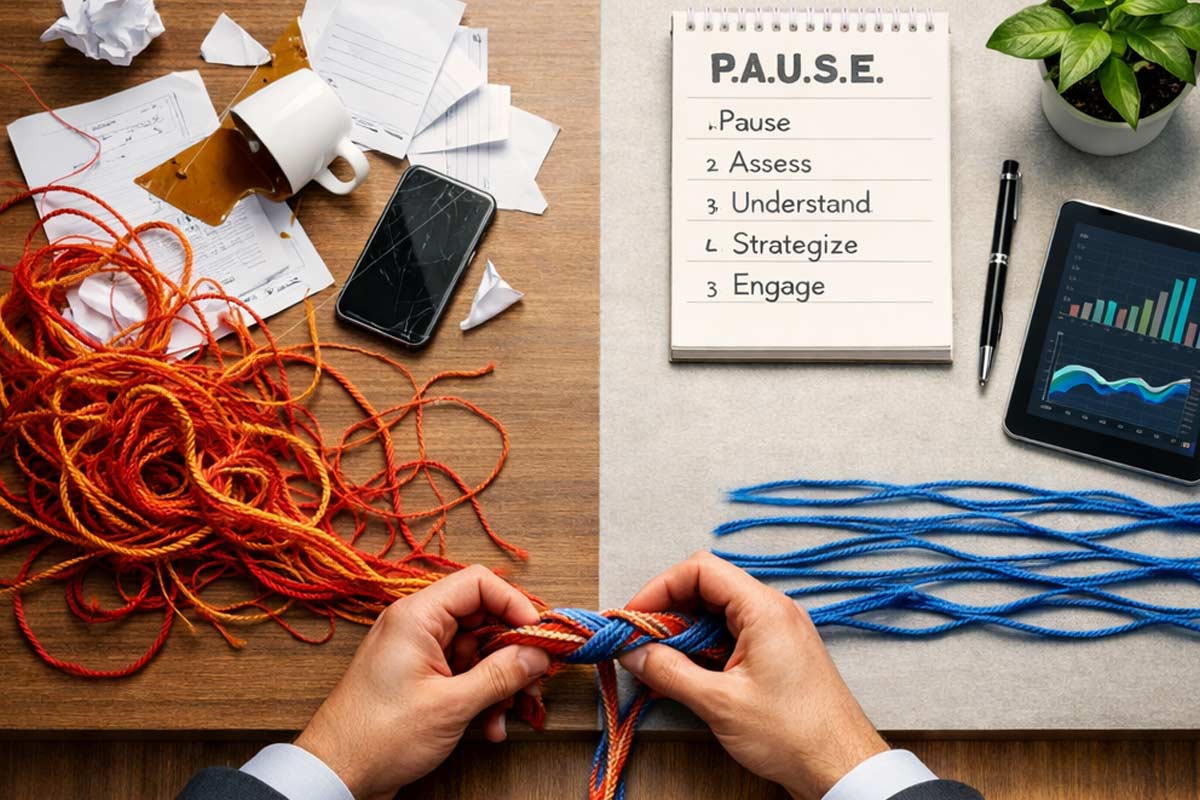
The appraisal just came in $40,000 short on a Huntington Beach bungalow, and your seller is screaming that the appraiser "has it out for them." Or perhaps you’re in the tenth hour of a Silicon Valley bidding war, and your buyer—usually a calm tech executive—is sobbing because they’re afraid of being outbid for the sixth time. In these high-stakes moments, your knowledge of the purchase agreement matters far less than your ability to steady the ship.
Your ability to manage emotions—yours and your clients’—is the #1 determinant of your survival and success in California real estate.
At ADHI Schools, we don’t view emotional intelligence for real estate agents as a "soft skill." It is a technical competency. Just as you must learn to navigate the Residential Purchase Agreement (RPA), you also have to learn to navigate the human limbic system. This guide is a deep dive into one specific layer of the Real Estate Agent Skills California framework: the ability to remain the clinical, calm authority when a transaction turns volatile.
To lead others, you must first lead yourself. If you are still finding your footing in the industry, learning How to Build Confidence as a New Agent is the prerequisite for the high-level EQ maneuvers required in today's market.
Most deals don’t die because of the math; they die on tone. In California’s aggressive, high-priced markets, a lack of EQ creates a "feedback loop of anxiety" that leads to terminated escrows and burned bridges.
The Reality: EQ is a financial skill. You are either the one calming the room, or you are the one paying the price for the conflict.
Having trained thousands of California agents over 20+ years, Kartik Subramaniam’s field-tested method for de-escalation is the P.A.U.S.E. protocol. When a deal gets "hot," do not react—lead.
Here is how the protocol saves deals in real-world California "firefights."
Scenario: The Inspection Renegotiation Standoff
The Amateur's Reaction: "The buyer is being totally unreasonable. This deal might be dead."
The EQ Agent's P.A.U.S.E. Response: "I hear that this request feels like an insult after you've cared for this home for 20 years. But let's look at the goal: getting you to your new home in Arizona by the 15th. We can offer a credit, fix the major items, or hold firm and risk the buyer walking. Which keeps your moving truck on schedule?"
Why This Works: It validates the ego while refocusing on the client's ultimate objective.
Scenario: The Appraisal Gap Crisis
The Amateur's Reaction: "I can't believe this appraiser. We're going to have to ask the seller to drop the price, but they'll never do it."
The EQ Agent's P.A.U.S.E. Response: "The appraisal came in under our price, which is a common hurdle in this market. I know it’s stressful to think about the extra cash, but let’s look at the long-term value of this neighborhood. We can appeal the appraisal, negotiate something with the seller, or cover the gap. Which option feels most manageable for your monthly budget?"
Why This Works: It treats a crisis as a "common hurdle," lowering the client's panic levels through logical choice.

Keep these bolded lines in your "mental holster." Effective EQ fails when agents cannot Master Real Estate Terminology Fast and explain complex issues simply under pressure.
By mastering Communication Skills That Separate Top Agents from the Rest, you ensure your delivery remains as professional as your strategy.
In California’s aggressive multi-counter environment, emotional intelligence for real estate agents is a secret weapon.
You don't build EQ during the crisis; you build it in between deals. Practice The Post-Call 60: After any hard call, take 60 seconds to ask:
Emotional intelligence is the technical skill of building trust and closing deals when things go wrong. Mastering EQ is one of the Essential Skills Every New California Agent Must Master if they want to move from "surviving" to "thriving."
Reputations are built when deals are falling apart. To build a sustainable, high-income career, you must combine this emotional mastery with the full stack of Real Estate Agent Skills California.
Improving EQ starts with physiological self-regulation and intentional reflection. Practice the P.A.U.S.E. protocol by consciously slowing your breathing and speech during tense calls, and use the "Post-Call 60" drill to analyze your reactions after every client interaction.
An example is staying neutral when a listing agent is aggressive during a multiple-counter-offer situation. A high-EQ agent recognizes the other agent's stress, refuses to mirror the aggression, and keeps their own client focused on the data rather than the conflict.
While IQ handles contracts and data, EQ keeps the deal alive during the "emotional middle" of escrow. Most California escrows fall through due to unmanaged stress or personality conflicts; EQ is the bridge that keeps buyers and sellers moving toward the finish line.
EQ provides a strategic advantage by allowing an agent to read the underlying motivations of the opposing party. By identifying what the other side is afraid of—such as a long closing date—you can frame your offer to provide them security while still winning the best terms for your client.
Yes, emotional intelligence is a set of skills—self-regulation, empathy, and social management—that can be developed through coaching and deliberate practice. Unlike IQ, which is relatively fixed, your ability to lead others through stress can be significantly improved with training and practice.

Founder, Adhi Schools
Kartik Subramaniam is the Founder and CEO of ADHI Real Estate Schools, a leader in real estate education throughout California. Holding a degree from Cal Poly University, Subramaniam brings a wealth of experience in real estate sales, property management, and investment transactions. He is the author of nine books on real estate and countless real estate articles. With a track record of successfully completing hundreds of real estate transactions, he has equipped countless professionals to thrive in the industry.

"Hey guys,
I took the exam today and passed!!!!
It only took me one try which was one of my goals. I took the online
classes and follow your suggestions so I took the crash course,
used the crash course app a lot, took 7 mock tests and went
confident to present the exam. Thank you for the great job you are
doing, you guys are awesome!!!! May God continue to bless you!"
Willie V.