When most students enroll in real estate classes and receive their textbooks, a frequent reaction is overwhelm.
You are staring at thousands of pages covering everything from freehold estates Read more...
When most students enroll in real estate classes and receive their textbooks, a frequent reaction is overwhelm.
You are staring at thousands of pages covering everything from freehold estates to trust fund accounting, and the pressure to memorize it all can be paralyzing. But here is the truth: You do not need to memorize every single word to pass. You need a specific strategy.
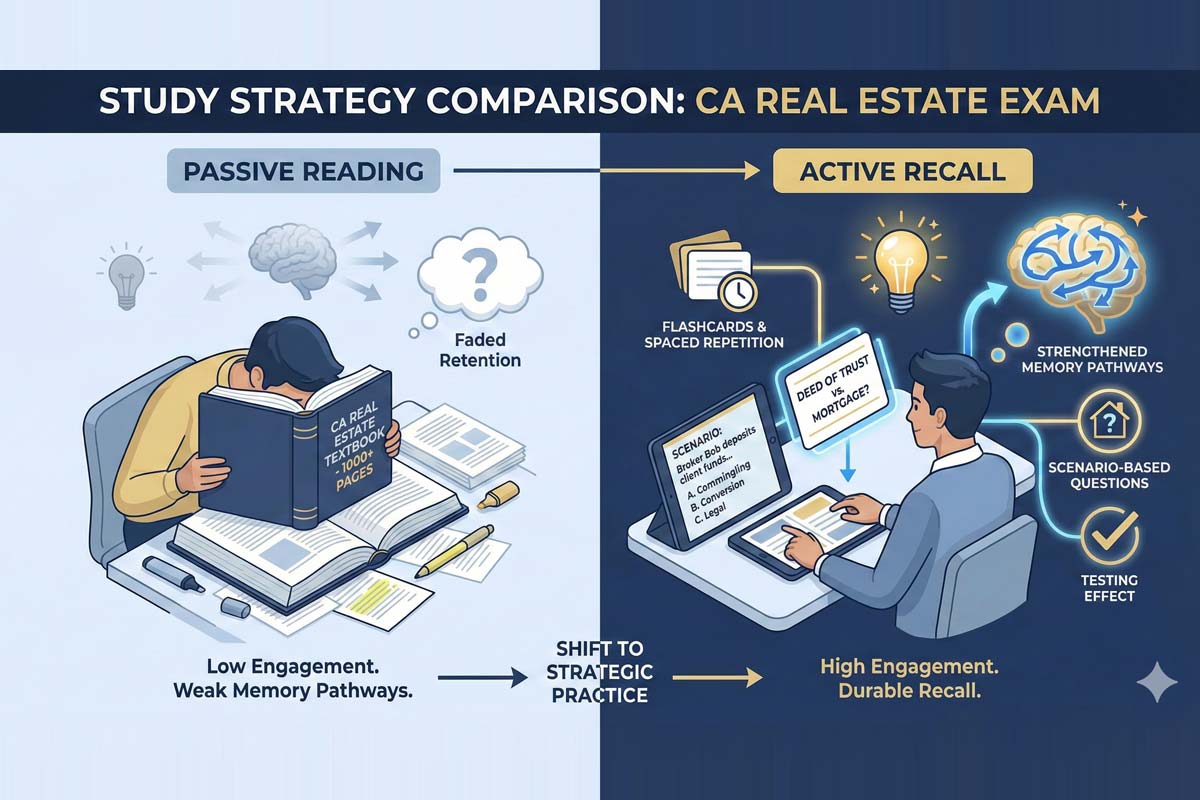
The best way to study for the California real estate exam is to shift from passive reading to active, strategic practice aligned with the DRE blueprint.
While our comprehensive California Real Estate Exam Guide covers the broader scope of eligibility and the application process, this article focuses entirely on the tactical side of preparation—the specific study methods that transform confusion into passing scores.
What Is the Best Way to Study for the California Real Estate Exam?
The most effective study method is a targeted approach that prioritizes high-weight content areas and learns them through application rather than mere memorization. Think of it this way: The student who reads the textbook three times often fails, while the student who reads it once but spends their time analyzing practice scenarios usually passes.
To study effectively, you must first stop studying "everything" and start studying what matters. Your study time gains the biggest return on investment when you prioritize the sections that appear most frequently.
The California salesperson exam consists of 150 multiple-choice questions to be completed in 3 hours. The broker exam is 200 multiple-choice questions and you are given up to 4 hours to complete it. To pass, you need a score of 70% or 75% respectively. However, remember that the questions are weighted toward specific areas. While the DRE may update specific questions, these category weights remain consistent year after year.
Practice of Real Estate and Mandated Disclosures (approx. 25%)
Laws of Agency and Fiduciary Duties (approx. 17%)
Property Ownership and Land Use Controls (approx. 15%)
If you master Practice and Agency, you have already covered nearly half the exam. Your study time should reflect this distribution.
Decode the Question Style: Scenarios Over Definitions
One of the biggest shocks for students on exam day is the format of the questions. They rarely ask for simple definitions. Instead, the DRE uses scenarios to test if you understand the spirit of the law, not just the letter of it.
The "Story Problem" Pattern
Most questions are disguised as simple stories. These scenarios reflect how nearly every DRE question is structured—they present a situation and ask you to identify the legal implication. Success here comes down to pattern recognition.
Scenario A (Trust Funds): A broker named Bob deposits a client’s rent check into his personal account because he was in a rush. The test won’t ask “Define Commingling.” It asks what violation Bob committed.
Scenario B (Agency Disclosure): An agent representing a buyer writes an offer on a property listed by her own firm. She waits until the offer is accepted to tell the buyer she also represents the seller. The test won’t ask “What is Dual Agency?” It asks if the agent’s timing was legal (it wasn’t).
If you study isolated terms without applying them to these “story problems,” you may struggle to recognize the answer when it is wrapped in a real-world situation especially if you haven’t memorized and internalized the vocabulary.
Active Recall and Spaced Repetition
The “Forgetting Curve” is real. If you study contracts on Monday and don’t look at them again until Friday, you will have forgotten a significant portion of what you learned.
Why Active Recall Works
Simply re-reading a chapter feels comfortable, but it is passive. Remember: Comfort ≠ Learning. If it feels easy, you probably aren’t retaining it.
Active recall—testing yourself before looking at the answer—forces your brain to work harder to retrieve the information. For example, instead of reading a definition, cover the page and ask yourself: “What is the definition of constructive eviction?” This mental exertion strengthens neural pathways, making the memory more durable.
Build a Study Routine You Can Stick To
One of the biggest mistakes students make is waiting for "free time" to study. In our busy lives, free time rarely exists; it has to be created. You need a schedule that treats studying like a non-negotiable appointment.
Sample Weekly Plan for a Busy Adult
This schedule focuses on consistency over intensity.
Day
Focus
Activity
Monday
Learning (1 hr)
Read 1 chapter + Take notes.
Tuesday
Reinforcement (30 min)
Review Monday's notes. Do 20 practice questions on that topic.
Wednesday
Learning (1 hr)
Read the next chapter + Take notes.
Thursday
Review (30 min)
Review Mon/Wed notes. Explain concepts out loud.
Friday
Rest
No studying. Let your brain recover.
Saturday
Testing (2 hrs)
Full practice exam or comprehensive quiz. Review missed answers.
Sunday
Analysis (1 hr)
Review weak areas identified on Saturday.
The 4-Week Roadmap
To maintain momentum, visualize your month like this:
Weeks 1–2: Build foundational knowledge (Read, Note-take, Quiz).
Week 3: Transition to comprehensive practice exams and error correction. Note: Only move to this stage when you can consistently score ~70% on section quizzes.
Week 4: High-yield review of weak spots and vocabulary drills.
Note: If you work full-time or have a busy family life, don’t force a 4-week timeline. Extend this roadmap to 6–8 weeks to ensure you retain what you learn.
Establishing a routine is crucial, but determining your total timeline is personal; understanding How Long Should You Study for the CA Real Estate Exam depends heavily on your background knowledge and how many hours per week you can honestly commit. A student with a legal background might need four weeks, while someone completely new to the industry might need three months of steady preparation.
Use Practice Exams Intentionally
Taking practice exams is not about seeing what score you get; it is about diagnosing why you are getting questions wrong.
When to Start Full Mock Exams
Avoid taking full 150-question mock exams until you can consistently score 70–75% on topic-based quizzes. Taking them too early leads to discouragement. Once you hit that threshold, aim to take one full mock exam per week in a quiet environment to build stamina.
Track your errors by type to see which patterns repeat. Taking mock tests is essential, but simply churning through questions won't improve your score unless you know how to use Practice Exams for the CA Real Estate License Test to diagnose your weak spots effectively. The goal is to condition your brain to recognize how the state asks questions, which is often tricky and filled with double negatives.
When a Crash Course Can Supercharge Your Prep
Self-study requires immense discipline. Sometimes, despite your best efforts, certain concepts—like the difference between a trust deed and a mortgage—just don’t click when reading a book.
Signs You Might Need Help
The Plateau: You have been stuck at scoring 60% for two weeks.
The "Why": You know the answer is B, but you don’t understand why it isn’t C.
The Application Gap: You understand definitions but consistently miss scenario questions.
If you reach this point, deciding whether You Should Take a Crash Course for the CA Real Estate Exam often comes down to whether you need structured, instructor-led guidance—not just more reading or random YouTube videos. A well-designed crash course like crashcourseonline.com acts as a final filter, stripping away irrelevant information and focusing purely on what is likely to appear on the state exam. The right course clarifies confusing topics, shows you how questions are actually phrased, and reinforces the high-yield concepts that move your score the fastest.
Common Mistakes That Sabotage Students
Even smart students fail because they study inefficiently or panic on the big day. Avoid these common traps:
Study Pitfalls
The Highlighter Fallacy: Highlighting everything in your book makes you feel productive, but it doesn’t help you learn. It is better to write notes in the margins.
Binge Studying: Studying for eight hours straight on a Sunday is far less effective than studying for one hour a day for eight days. Your brain needs sleep to consolidate memory.
Exam-Day Trap
The Second-Guessing Trap: On exam day, avoid changing your answers unless you have found clear evidence you were wrong. Your gut instinct is usually based on your study prep; second-guessing is usually based on anxiety.
Why ADHI's System Works
At ADHI Schools, we have spent nearly two years refining our curriculum not just to meet DRE standards, but to match how students actually learn. We don’t believe in drowning you in data. Our approach focuses on the “why” behind the laws. These methods mirror the principles we teach in our courses because they consistently produce results.
FAQs
1. What is the most effective way to study for the California real estate exam?
The most effective study method is a targeted approach that focuses on the highest-weighted exam topics and uses active recall and scenario-based practice. Students who move beyond passive reading and spend more time analyzing question patterns consistently score higher than those who simply reread the textbook.
2. How many hours a day should I study for the California real estate exam?
Most students do well with 1–2 hours per day, 4–6 days a week. What matters more than total hours is consistency. Short, focused sessions with spaced repetition outperform long cram sessions. Your timeline also depends on your background—some students need four weeks; others need two to three months.
3. When should I start taking practice exams?
Start full-length practice exams only after you can consistently score 70–75% on topic-based quizzes. Taking them too early leads to discouragement and doesn’t improve retention. Once ready, take one mock exam per week and spend equal time reviewing your mistakes to identify patterns.
4. Do I need a crash course to pass the California real estate exam?
A crash course isn’t mandatory, but many students see their biggest score jumps after following a structured review program. When you’re stuck or unsure why answers are wrong, guided review—such as the approach used at crashcourseonline.com—can help you quickly identify weak areas and understand how the exam actually phrases its scenarios.
|
You have spent months studying principles, practices, and finance. You’ve memorized the difference between a freehold estate and a leasehold estate. You’ve taken practice tests until your eyes Read more...
You have spent months studying principles, practices, and finance. You’ve memorized the difference between a freehold estate and a leasehold estate. You’ve taken practice tests until your eyes blurred. But there is one variable that textbooks cannot fully replicate: the environment of the testing center itself.
Anxiety often stems from the unknown. For many students, the fear isn’t just about the questions; it is about the logistics. Where do I park? What can I bring into the room? What does the computer interface look like? When do I find out if I passed?
At ADHI Schools, we believe that removing the mystery of the process allows your brain to focus entirely on the content. By understanding the flow of the day, you can walk in with confidence rather than apprehension. This overview is an essential component of our comprehensive California Real Estate Exam Guide, designed to help you navigate every step of the licensing journey.
The DRE Difference: Who Runs the Exam?
First, it is important to understand who is in charge. Unlike many other states that outsource their testing to third-party vendors like Pearson VUE or PSI, California does things differently. The California Department of Real Estate (DRE) both creates the exam and administers it.
This means that when you walk into the testing center, you are walking into a state-controlled environment. The proctors are state employees or contracted strictly by the state, and the security protocols come directly from the DRE.
Before You Leave Home
Your exam day strategy begins before you even start your car. The DRE is incredibly strict regarding punctuality and identification. If you are late, you may be denied entry and will forfeit your exam fee.
The Identification Rule: You must bring one current, valid (not expired), government-issued ID with a photograph and signature. This is usually a driver’s license, state ID, or passport. The name on your ID must exactly match the name on your exam registration. If you recently got married or changed your name and your ID doesn't reflect that yet, you will be turned away.
The "Car Strategy": Since you cannot bring personal items into the testing room, and locker space is sometimes limited or cramped, the best place for your phone, wallet, and study notes is often the trunk of your car. However, do not leave your ID and exam schedule notice in the car. Double-check that you have them in your hand before locking the vehicle.
Successful candidates often plan these logistics weeks in advance when they figure out how to schedule the California real estate exam through the eLicensing system, ensuring they have ample travel time buffered into their morning commute.
Arrival and Check-In Process
Plan to arrive at the testing site at least 30 to 45 minutes before your scheduled start time. This buffer is necessary for parking, locating the suite within the building, and the check-in line.
Once you enter the facility, the atmosphere shifts. It is generally quiet and sterile. You will approach the reception desk where a proctor will verify your ID. You can choose to place your belongings inside a locker for personal items like car keys. Do not try to sneak anything into the testing room. The proctors are vigilant, and the rules are generally uniform regardless of which of the California real estate exam testing centers you selected for your test.
Security Procedures
The security measures at DRE centers feel comparable to airport screening. This is to ensure the integrity of the state exam. Be prepared for the following:
Empty Pockets: You will likely be asked to turn your pockets inside out to prove they are empty.
Visual Inspection: You may be asked to roll up your sleeves or lift pant legs slightly to ensure no notes are hidden.
Jewelry and Accessories: Large jewelry, heavy coats, and brimmed hats are generally prohibited. You cannot wear a smartwatch or a Fitbit. Analog watches are also usually banned to prevent hidden cameras or timing devices.
Calculators: Since there is no longer any math on the real estate exam, no calculators can be brought into the exam site nor will the state provide you with one.
The Testing Room Environment
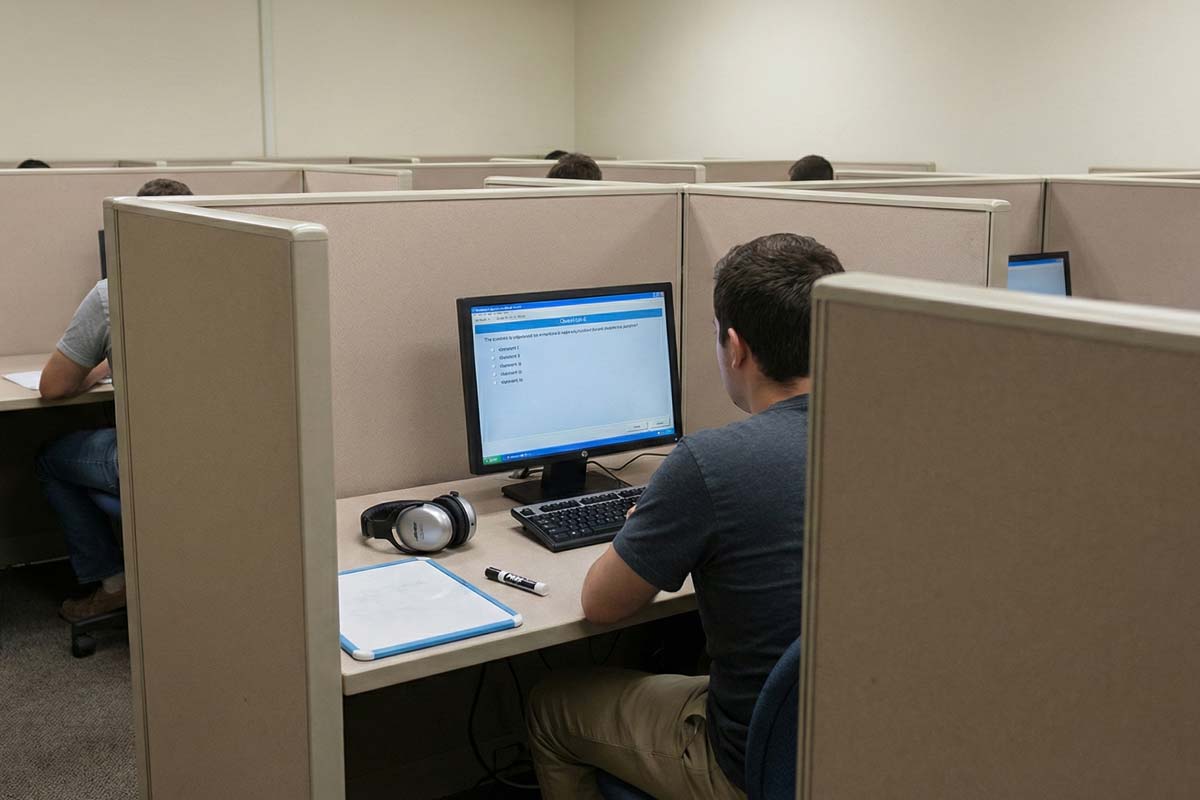
Once you pass security, you are escorted into the testing room. It is typically a room filled with cubicles, similar to a computer lab or a call center. You will be assigned a specific workstation.
Expect the First 5 Minutes to Feel Strange
It is completely normal to feel a surge of panic during these first few minutes. Most students report a spike in heart rate as they sit in the chair. This is a physiological response to stress, not a reflection of your preparation. Acknowledge it, take a deep breath, and trust that it usually fades once you answer the first five questions.
The Interface: The exam is taken on a computer. This is not a sleek or modern testing interface; it is functional, simple, and dated. You will use the mouse to select A, B, C, or D—there are no fill-in-the-blank or essay questions.
The Restroom Rule: You are permitted to use the restroom during the exam, but be aware that the exam timer does not stop. If you take a 10-minute break, that is 10 minutes less you have to answer questions. Plan your water intake accordingly.
It is important to remember that you must be physically present at the proctored center; current DRE regulations do not allow you to take the California real estate exam online remotely.
Top 5 Things That Surprise Students
The "Old School" Tech: The mouse might be clunky, and the screen resolution low.
Unpredictable Temps: The room might be freezing cold or uncomfortably warm. Dress in layers.
No Immediate Score: You won't see "PASS" on the screen the moment you finish (more on that below).
Ambient Noise: You will hear mouse clicks, coughing, and chairs shifting.
Small Lockers: If you bring a giant backpack, it might not fit.
Pacing, Fatigue, and Strategy
You have 3 hours to answer 150 multiple-choice questions for the salesperson exam and 4 hours and 200 questions for the broker test. This breaks down to roughly 1 minute and 12 seconds per question. However, this is an average, not a rigid rule. Some vocabulary questions will take you 10 seconds; some longer “story type” questions might take you 3 minutes.
The "Halfway" Landmark: A good rule of thumb for pacing is to check the timer when you are halfway through the questions. Based on where you are at the halfway mark you might need to speed it up.
The Fatigue Factor: The hardest part of the exam often isn't the difficulty of question #1, but the brain fog that sets in by question #115. Decision fatigue is real. Toward the end of the exam, your brain may try to rush you just to escape the uncomfortable environment.
Pro Tip: Watch out for "overthinking." As fatigue sets in, students often stare at simple questions and convince themselves there must be a trick. Usually, there isn't. If you know the definition, mark it and move on.
Recognizing your own biological clock is vital here; if you know your focus crashes after lunch, you should have considered the best time of day to take the California real estate exam to ensure you are testing during your peak mental performance window.
What Happens After You Click “Submit”
This is the moment that causes the most heart palpitations.
You do not see your result on the screen immediately in the testing cubicle. The screen typically goes blank or returns to a welcome page. You must gather your things and walk out to the proctor at the front desk.
The Result: The proctor will print a piece of paper, fold it, and hand it to you.
If you passed: The paper will typically say "CONGRATULATIONS" and provide instructions on how to apply for your license. It will not tell you your score. Whether you got 80% or 100%, a pass is a pass.
If you failed: The paper will show you your actual numerical score and a breakdown of the percentages you scored in each of the seven topic areas. This is diagnostic, helping you know where to study for the next attempt.
Final Exam-Day Checklist
To ensure a smooth experience, run through this mental checklist before walking out the door:
Valid ID: Check it twice.
Directions: Have the address loaded in your GPS.
Comfortable Clothing: Dress in layers to handle unpredictable room temps.
Keys and Wallet: Ready to be locked in the provided locker or your trunk.
Positive Mindset: Leave the panic at home.
Walk In Prepared
The California Real Estate Exam is designed to be rigorous, but it is not impossible. By knowing exactly what to expect when you walk through those doors, you eliminate the element of surprise.
Trust your preparation. You have put in the work, you understand the material, and now you understand the logistics. If you want a complete step-by-step walkthrough of the entire journey—from qualifying to scheduling to test day—the California Real Estate Exam Guide ties everything together to ensure you are ready to launch your new career.
FAQs
1. What identification is required to check in at the testing center? You must present one current, valid, government-issued ID with a photograph and signature (such as a driver’s license, state ID, or passport). The name on the ID must exactly match the name on your exam registration.
2. Can I bring a calculator into the exam room? No, there is no longer any math on the California real estate exam.
3. Will I see my pass/fail result on the computer screen immediately? No. After you click "Submit," the screen will typically return to a welcome page. You must exit the room to receive a printed report from the proctor. If you pass, it will not list a score; if you fail, it will provide your numerical score and a breakdown.
4. Can I use the restroom during the exam? Yes, you are permitted to use the restroom, but the exam timer does not stop. Any time taken for a break is deducted from your total testing time.
5. How many questions are on the exam and what is the time limit? The salesperson exam consists of 150 multiple-choice questions and you have up to 3 hours to complete. The broker exam is 200 multiple-choice questions and you get 4 hours to complete it.
|
Selecting a date for your state licensing exam is a milestone, but selecting the right time of day is a strategy.
Most students treat the time slot as a matter of convenience—scheduling around Read more...
Selecting a date for your state licensing exam is a milestone, but selecting the right time of day is a strategy.
Most students treat the time slot as a matter of convenience—scheduling around work shifts or childcare. However, when you are preparing to sit for an exam that could determine your career future, convenience should be secondary to cognitive performance.
The Department of Real Estate (DRE) typically offers morning and afternoon sessions. The content of the exam does not change based on the time, nor does the scoring criteria. However, your ability to focus, recall information, and manage anxiety absolutely fluctuates. By aligning your exam slot with the two biggest variables—your biological chronotype and local logistics—you give yourself a statistical edge.
Quick Decision Matrix
Choose Morning (AM) If: You are an "Early Bird" who wakes up alert, you have high anticipatory anxiety (need to "get it over with"), or your route involves driving against rush hour traffic.
Choose Afternoon (PM) If: You are a "Night Owl" who feels groggy before 10:00 AM, you are traveling a long distance that risks morning gridlock, or you rely on a slow warm-up routine to manage stress.
Is There a Best Time of Day to Take the Exam?
There is no officially mandated "correct" time that guarantees a passing grade. However, research suggests there is a best time for your specific physiology.
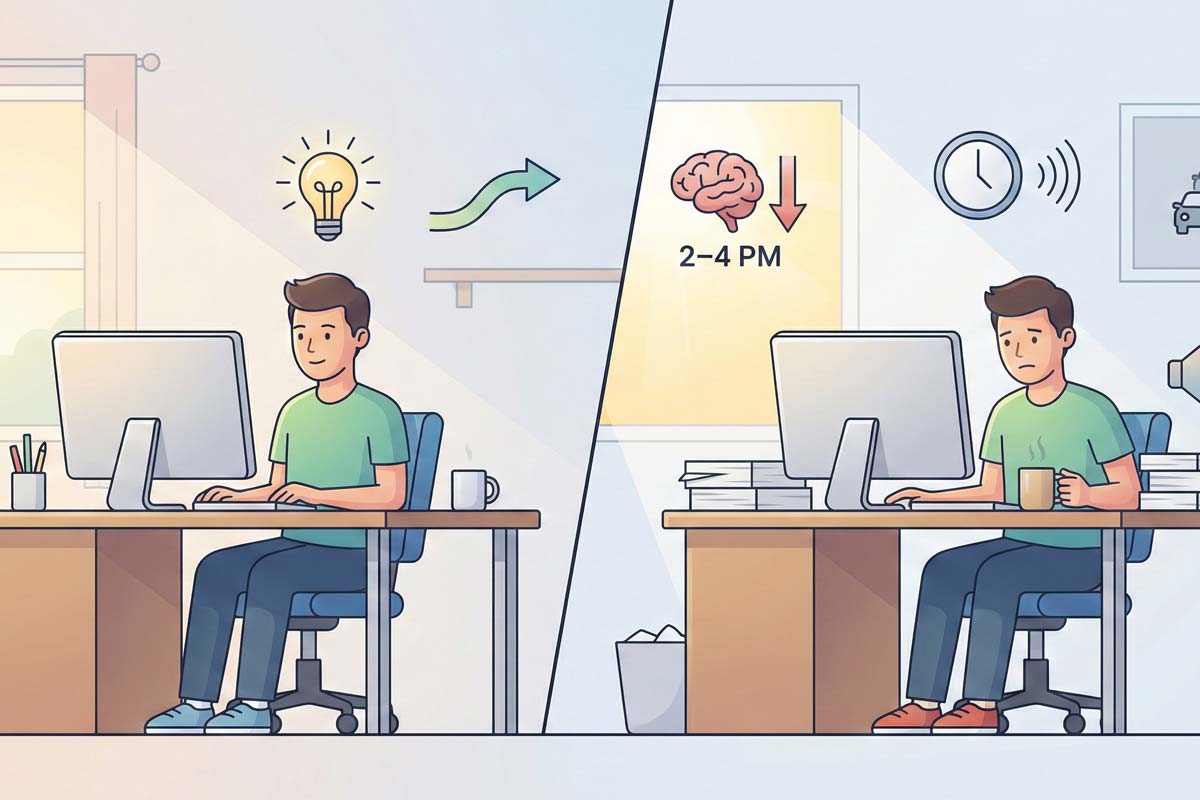
Cognitive science indicates that for approximately 75% of adults, analytical thinking and focus peak in the late morning. Conversely, the "post-lunch dip"—a documented circadian trough occurring between 2:00 PM and 4:00 PM—can significantly impact mental endurance. However, biology is adaptable; if you are forced into a time slot that doesn't match your rhythm, you can shift your circadian peak by taking practice exams at that specific time for a couple of weeks prior to the test.
But biology isn't the only factor. Your choice must also account for:
Traffic density at the specific arrival time.
Parking availability at the test site.
Commute stress and its effect on your adrenaline levels.
Because the 2026 California real estate exam contains no math questions and allows no calculators, the test consists entirely of conceptual questions, vocabulary, and scenario-based reading comprehension. You do not need calculation power; you need sustained mental endurance. You must choose a time slot that aligns with your peak mental alertness.
How Time of Day Affects Your Performance
Your brain’s performance on a standardized test is influenced by three main biological factors: cortisol levels, body temperature, and decision fatigue.
Cortisol and Alertness
Cortisol is the "waking hormone." For most people, it peaks around 30 to 45 minutes after waking up. This natural spike helps clear morning grogginess. If you schedule an 8:00 AM exam but usually wake up at 7:30 AM, you may be sitting in the testing chair before your brain has fully engaged.
Decision Fatigue vs. Scenario Questions
Decision fatigue is real. As the day progresses, the brain becomes tired of making choices. By the afternoon, after navigating traffic, scrolling through emails, or handling domestic tasks, your "willpower battery" is depleted. Because the California exam is heavily weighted toward scenario-based questions ("What should the agent do next?"), decision fatigue is particularly dangerous here. It can lead to careless errors on nuance questions you actually know the answers to.
The "No-Math" Factor
Since the DRE removed math from the exam, the test is less about formulas and more about linguistic nuance. Reading 150 or more scenario-based questions requires high-level executive function. If you are prone to afternoon slumps, the sheer volume of reading in a PM session can feel overwhelming compared to an AM session.
Morning Exam Slots — Pros and Cons
Morning slots (typically starting between 8:00 AM and 9:00 AM) are the most popular choice for first-time test takers, but they come with specific trade-offs.
The Pros:
Peak Cognitive Freshness: You capture the natural late-morning cognitive peak.
Reduced Anticipatory Anxiety: You wake up, get ready, and go. You have less time to sit around stressing about the outcome.
Operational Smoothness: Testing centers are generally cleaner and quieter in the morning. Additionally, morning sessions rarely face delays caused by technical bottlenecks or check-in backlogs from previous groups.
The Cons:
Rush Hour Traffic: If your testing center is in a metro area like Los Angeles or Oakland, getting there by 7:45 AM means battling peak traffic.
Sleep Deprivation: If you are too nervous to sleep the night before, an early alarm can leave you exhausted before you start.
Do NOT Choose Morning If:
You are a "night owl" who feels groggy until 10:00 AM.
Your commute is unpredictable (e.g., crossing major bridges or freeways prone to accidents).
You know that anxiety keeps you awake past midnight.
Afternoon Exam Slots — Pros and Cons
Afternoon slots (typically starting between 1:00 PM and 1:30 PM) offer a buffer for those who need a slower start to their day.
The Pros:
Traffic Avoidance: You can usually travel to the testing center after the morning rush has subsided.
Warm-Up Time: You have time to eat a decent meal and review the material one last time (though cramming is not recommended).
Ideal for Night Owls: If your brain doesn't fully "turn on" until 11:00 AM, this is your only viable option.
The Cons:
The Post-Lunch Slump: The body’s natural circadian dip occurs between 2:00 PM and 4:00 PM. If your exam starts at 1:30 PM, this fatigue hits you exactly around question #60 or #70—right in the middle of the test.
Ambient Noise: Afternoon sessions often contend with higher ambient noise from hallway traffic, deliveries, and street sounds as the city fully wakes up.
Accumulated Stress: You spend the whole morning waiting for the event, which can spike adrenaline levels prematurely and lead to a crash during the test.
Logistics That Influence Your Time Choice
Biology is important, but geography often dictates your schedule. California is vast, and the location of your test center should heavily influence whether you choose an AM or PM slot.
For example, if you are testing in San Diego or Oakland, an 8:00 AM exam requires arriving by 7:30 AM at the latest. This places you on the freeway during the absolute worst congestion of the day.
Remember: Traffic conditions are determined by your arrival time, not your appointment time. The stress of being late can spike your heart rate and scramble your focus before you even see the first question.
When evaluating specific California real estate exam testing centers, consider the local traffic patterns surrounding the facility. If the center is located in a high-density office park, parking might be scarce in the mid-morning but open in the early morning. Conversely, some centers have dedicated lots that fill up by 8:30 AM.
How Scheduling Works
The DRE uses a "first come, first served" model through the eLicensing system.
Morning slots tend to fill up faster than afternoon slots because many professionals prefer to take the exam and then head to work. This is especially true during the busy spring season (Q1 and Q2), where morning availability can become scarce. Once you've chosen the testing time that aligns with your chronotype, make sure you know how to schedule the California real estate exam properly—popular morning slots often fill quickly. Delaying your scheduling may force you into a less ideal time block.
What Your Exam Time Means for Exam-Day Prep
Your strategy for the day changes based on your clock.
For Morning Exams: Focus on a high-protein breakfast. Avoid heavy carbohydrates that induce sleepiness. Your goal is immediate, sustained energy. Arrive early enough to use the restroom and acclimate to the room temperature.
For Afternoon Exams: Eat a moderate lunch. A heavy meal right before a 1:00 PM test precipitates cognitive decline and drowsiness. Use the morning to relax, not to panic-study. Your arrival protocol changes slightly based on the time of day, understand what to expect on exam day regarding check-in lines and lobby congestion. Afternoon lobbies are often crowded with morning test-takers leaving as afternoon candidates arrive.
Why You Can’t Take a “Flexible Online Exam”
In the modern era, students often assume they can take the test at midnight from their home computer. This is a dangerous misconception.
Because it is currently impossible to take the California real estate exam online, you are bound to the physical constraints and operating hours of a brick-and-mortar test center. While rigid, this standardized schedule offers predictability. You cannot choose a random start time like 10:45 AM, and you cannot control the environment. This makes your choice of the standard AM or PM block even more critical. You must perform on their schedule, in person, under proctored conditions.
Final Thoughts
There is no magical time slot that makes the questions easier. The DRE creates a standardized difficulty level regardless of when you sit for the test. However, you can control the variables surrounding the test.
Choose Morning if: You wake up early, you want to avoid anticipation anxiety, and you have a clear commute.
Choose Afternoon if: You are a night owl, you have a long commute through heavy traffic, or you need the morning to settle your nerves.
Aligning your biological clock with your testing schedule is just one component of a broader strategy found in our comprehensive California Real Estate Exam Guide. Success is about preparation—both of your mind and your logistics.
Frequently Asked Questions
Is the morning or afternoon real estate exam easier? Statistically, neither exam is "easier." The difficulty level is identical, and time of day does not impact scoring. However, some students find morning exams subjectively easier because their brains are fresher and less fatigued by the day's events.
Do testing centers ever run behind schedule? Yes. While morning sessions almost always start on time, afternoon sessions can occasionally face delays if the morning check-out process runs long or if there are technical glitches at the facility.
Should I try a practice exam at the same time of day I plan to test? Yes. This is highly recommended. Taking a full-length simulated exam at the exact time of your scheduled test helps train your brain to be alert during that specific window, effectively shifting your circadian rhythm.
Should I drink coffee before the exam? If you normally drink coffee, yes. Do not change your caffeine routine on exam day. However, avoid drinking too much liquid immediately before the test, as unscheduled restroom breaks eat into your exam time.
Are morning exam slots quieter? Generally, yes. Morning sessions often have fewer distractions because the office building or testing complex hasn't fully "woken up" yet. Afternoon sessions may have more ambient noise from hallway traffic or street noise.
How early should I arrive for a morning exam? You should aim to arrive at the testing center at least 30 minutes before your scheduled start time. For an 8:00 AM exam, this means arriving by 7:30 AM to handle parking and check-in procedures.
|
You’ve done the heavy lifting. You’ve read the textbooks, highlighted the key terms, and passed your three required college-level courses. Congratulations on reaching this milestone! But now, a new Read more...
You’ve done the heavy lifting. You’ve read the textbooks, highlighted the key terms, and passed your three required college-level courses. Congratulations on reaching this milestone! But now, a new mix of excitement and nerves is likely setting in.
You are standing at the threshold of your new career, and there is just one major logistical hurdle left before you can earn your license: getting your test date on the books.
By the end of this article, you’ll know every step required to get approved and schedule your exam date successfully using the DRE’s eLicensing system.
Scheduling your exam is the turning point where you stop being a student and get a little closer to becoming a real estate licensee. However, the process isn’t as simple as clicking a button on a calendar. The California Department of Real Estate (DRE) has a specific workflow that must be followed.
To help you navigate this process without the headache, we’ve broken down exactly how to secure your spot. For a broader look at the entire testing landscape, be sure to bookmark our comprehensive California Real Estate Exam Guide, which covers everything from study tactics to licensing requirements.
Prerequisites Before You Can Schedule
Before you even log into a computer to pick a date, you must ensure you are actually eligible to sit for the exam. The DRE will not allow you to schedule an exam until your application has been fully processed and approved.
To reach the scheduling phase, you must have the following ready:
Required Courses: You must have finished your Real Estate Principles, Real Estate Practice, and one elective course (like Legal Aspects or Finance).
Certificates You Need: You must possess the physical or digital certificates/transcripts from your school (like ADHI) proving completion.
Submitting Your Application: You must submit your Salesperson Examination Application (Form RE 400A) or the Combined Examination and License Application (RE 435), along with the required fees. In theory, you could fill out the forms online.
Crucial Note: The DRE does not allow walk-ins or same-day scheduling. All appointments must be booked in advance through eLicensing.
How the DRE eLicensing System Works
Once your application is in the mail, the waiting game begins. California does not use third-party testing vendors like PSI or Pearson VUE; everything is handled directly through the DRE’s internal systems. The hub for this activity is the eLicensing portal.
Timeline Expectations
To give you a birds-eye view of how long this usually takes, here is the standard sequence:
Complete 3 required courses.
Mail application packet to the DRE.
Wait for processing/approval: This can take several weeks depending on the backlog. Always check the DRE website for current processing timeframes.
Receive eligibility notification: You get the “Green Light” via email or letter.
Log into eLicensing: Select your exam date and location.
What You’ll See in eLicensing
Once you have created your account and logged in, you need to know what to look for.
If your application is still processing, Your dashboard will likely show your license information as “NO RECORDS FOUND”.
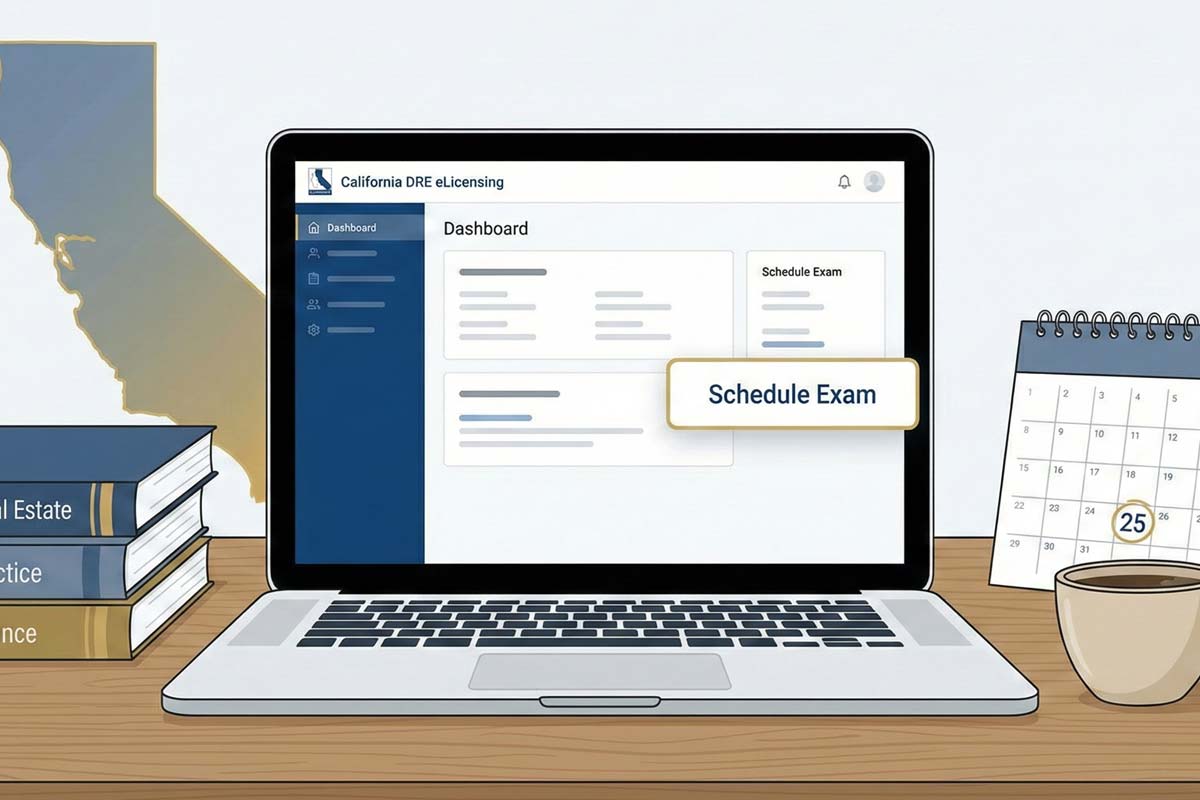
Once approved, You will see a new menu option labeled “Schedule Examination.”
If this button does not appear, Your application is not yet eligible, and you cannot book a slot.
Step-by-Step Scheduling Overview
Create Your Account: If you haven’t already, go to the DRE website and register for an eLicensing account.
Wait for Approval: Be patient during the mail processing window.
Log In and Schedule: Click the “Schedule Examination” button once it appears.
Select Your Slot: You will be able to view the calendar, filter by location, and select the date and time that works for you.
Choosing Your Exam Location
While California is massive, the DRE only operates five specific testing centers. Unlike the vast network of DMV offices, you have limited choices, so you will need to plan your travel accordingly.
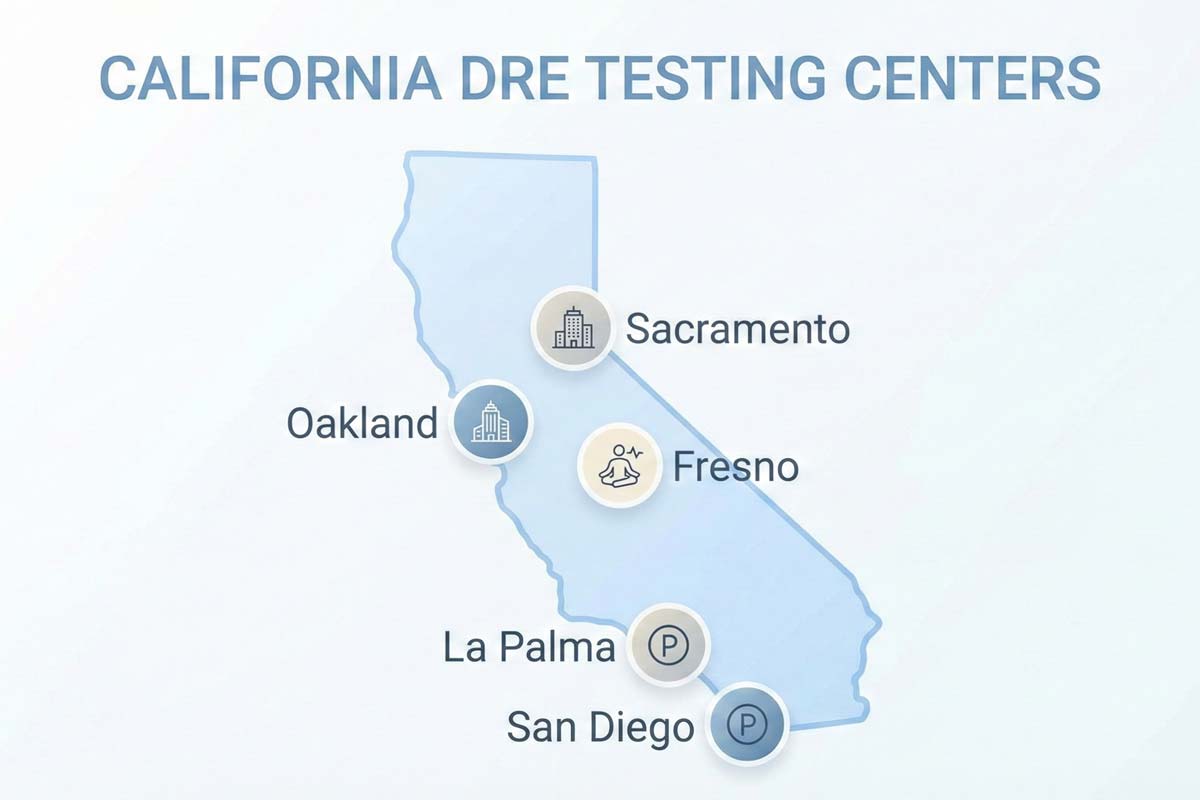
The five official DRE exam centers are located in:
Fresno
Los Angeles area (La Palma)
Oakland
Sacramento
San Diego
Peak Season Note: Late spring and early summer are peak testing seasons. Exam slots—especially in the popular La Palma location—can fill up weeks in advance. If you're deciding which center fits your commute, explore our guide to explore our guide to California real estate exam testing center locations, parking instructions, and security policies. It breaks down the specifics of each site so you aren't stressing about parking meters on the big day.
Can You Take the Exam Online?
We hear this question almost daily. In an era where you can order groceries, attend college, and even buy a car from your phone, it is natural to assume you can take the real estate exam online also.
The answer is No.
The DRE requires in-person testing to maintain exam security, prevent identity fraud, and ensure standardized administration. While the exam is administered electronically (on a computer terminal), it must be taken physically at one of the five DRE centers listed above. There is no remote proctoring option.
Choosing the Right Date & Time
Once you are in the eLicensing system and looking at the calendar, you might be tempted to just grab the first available slot. However, strategy matters here.
We recommend a "Goldilocks" approach to scheduling:
Don't schedule too far out: If you book a date three months away, you risk "knowledge decay." You want the material fresh in your mind.
Don't schedule too soon: If you book for tomorrow but haven't touched your notes in weeks, you're setting yourself up for anxiety.
Check your biology: For example, many students who test on Tuesday mornings report feeling more rested and less rushed than those trying to squeeze it in on a Friday afternoon.
For a deeper dive into strategy, read our article on the best time of day to take the California real estate exam to maximize your chances of passing on the first try.
Common Scheduling Mistakes to Avoid
Even smart students can hit road bumps. Watch out for these common errors:
Trying to use an expired ID: This is a critical error. Even if your driver’s license expired yesterday, the DRE will turn you away at the door. Check your expiration date now.
Scheduling before you are ready: Don’t book a date just to “get it over with.” Only book when you are scoring well on your practice exams.
Name Mismatches: Ensure the name on your application matches your Government ID exactly. If your ID says “Robert” and you apply as “Bob,” you will likely face issues at the testing center.
Final Preparations After You Schedule
Once you hit “Confirm” on your exam date, the countdown clock begins. This is the time to shift your focus from bureaucracy to performance.
Quick Exam-Day Prep Checklist:
Printed Exam Schedule Notice (from eLicensing)
Valid, unexpired Government ID (Driver’s License/Passport)
Route planned (account for traffic/parking)
Backup alarm set
Light review of key concepts
Once scheduled, make sure you review what to expect on exam day so nothing catches you off guard. Knowing the rules about lockers, cell phones, and bathroom breaks will help keep your heart rate down so you can focus on the questions.
Scheduling your exam is the moment this journey becomes real. It’s a commitment to yourself and your future career. While the DRE website can be a little clunky and the wait times can be frustrating, thousands of agents navigate this process every year—and you will too.
If you have your date set and want to ensure you walk in with total confidence, now is the time to buckle down. Most students who pass on their first attempt combine their coursework with a structured crash course or dedicated exam prep. ADHI Schools is here to help you cross that finish line.
Good luck scheduling, and happy studying!
Frequently Asked Questions About Scheduling the California Real Estate Exam
1. How long does it take for the DRE to approve my exam application?
Processing can take several weeks, depending on backlog and volume. You cannot schedule your exam until the DRE has officially approved your application and the “Schedule Examination” button appears in your eLicensing account.
How to Schedule the California …
2. Why does my eLicensing dashboard say “NO RECORDS FOUND”?
This simply means your application is still processing. Once you’re approved, your dashboard will update and the exam-scheduling option will appear automatically.
How to Schedule the California …
3. Can I schedule the California real estate exam online?
Yes — but only the scheduling part. The exam must be taken in person at one of the five DRE testing centers. There is no online or remote-proctored option.
How to Schedule the California …
4. Where can I take the exam?
California offers only five official DRE testing centers:
Fresno
La Palma (Los Angeles area)
Oakland
Sacramento
San DiegoThese fill up quickly during peak seasons (especially La Palma), so book early once eligible.
How to Schedule the California …
5. Can I walk in or schedule the exam same-day?
No. Walk-ins and same-day appointments are not allowed. All scheduling must be done through the DRE’s eLicensing system once you’ve been approved.
How to Schedule the California …
6. What if the date I want is unavailable?
Exam seats open and fill continuously. Students often check eLicensing daily—sometimes even multiple times a day—because cancellations do happen. Securing your preferred date requires persistence.
7. What should I consider when choosing my exam date?
Use the “Goldilocks strategy”:
Not too far out: Avoid losing study momentum.
Not too soon: Only book when your practice-test scores show you’re ready.
Pick your best time of day: Morning testers tend to feel fresher and less rushed.
How to Schedule the California …
8. What ID do I need on exam day?
A valid, unexpired government-issued ID. Even being one day expired will get you turned away — no exceptions. Double-check before scheduling and again before exam day.
How to Schedule the California …
9. What happens if the name on my ID doesn’t match my application?
You may be denied entry. Make sure your application reflects your legal name exactly as it appears on your ID (e.g., “Robert” vs. “Bob”).
How to Schedule the California …
10. What should I bring on exam day?
At minimum,
Printed Exam Schedule Notice
Valid ID
Your planned travel route
Final light study notes
These basics help prevent last-minute stress and ensure a smooth check-in.
How to Schedule the California …
11. Can I reschedule my exam?
Yes — as long as you log into eLicensing and change your appointment before your scheduled date. Seats are limited, so expect availability to vary.
12. When should I start serious exam prep?
Immediately after scheduling. The period between confirmation and test day should be used for structured review, practice exams, and tuning your test-taking strategy. Most first-time passers follow a crisp study plan and often add a crash course.
|
The California real estate exam is administered only in five official Department of Real Estate (DRE) testing centers, each with unique parking, security, and arrival requirements. While mastering the Read more...
The California real estate exam is administered only in five official Department of Real Estate (DRE) testing centers, each with unique parking, security, and arrival requirements. While mastering the material is critical, understanding the logistics of these exam facilities is just as important to lowering stress on game day.
For a complete roadmap of the entire licensing journey—from application to license issuance—be sure to bookmark our comprehensive California Real Estate Exam Guide.
Many students assume they can simply log in and take the test from home. However, as we cover in our article on taking the CA Real Estate Exam Online, the answer is currently no. To ensure exam integrity, you must physically travel to one of the five specific DRE exam locations listed below.
How to Decide Which Center to Choose
Before you book, don't just pick the one closest to your house on a map. Consider these factors:
Parking Anxiety: If hunting for a meter stresses you out, avoid the downtown locations (Oakland/Fresno) and opt for La Palma or Sacramento.
Traffic Patterns: A 20-mile drive can take 90 minutes in Los Angeles. Choose a center where the commute is reliable.
Morning vs. Afternoon: Your brain power varies by time of day. Match your location choice with a time slot that suits your biology, a concept we explore in our guide on the Best Time of Day to Take the CA Real Estate Exam.
The Five California DRE Testing Locations
Here are the specific details for every active testing site in California. We have included notes on the "vibe" of each location to help you mentally prepare.
1. La Palma (Orange County)
Address: 1 Centerpointe Drive, Suite 370, La Palma, CA 90623
Parking: Do not park directly in front of the building. Head to the parking structure at Centerpointe Drive (usually the top deck).
The Vibe: This is a standard business park. It is generally quiet, landscaped, and calm.
Emotional Check: If you are prone to exam nerves, this location’s orderly, low-chaos environment is excellent for keeping your heart rate down.
2. San Diego
Address: 8620 Spectrum Center Blvd, Suite 301B, San Diego, CA 92123
Parking: Onsite parking is available but expect to pay a fee (approx. $2/hr). Have a credit/debit card ready.
The Vibe: Located in the Kearny Mesa area, this is a very busy commercial district.
Emotional Check: Because the area is bustling, give yourself extra time to park so you aren't rushing into the lobby feeling flustered.
3. Oakland
Address: 1515 Clay Street, Oakland, CA 94612
Parking: Notoriously difficult. Do not use 2-hour street meters—you cannot leave the exam to feed them, and you will get ticketed or towed. Use a long-term garage or take BART.
The Vibe: This is a government building in a dense urban center.
Emotional Check: The logistics here are high-stress. If you drive during rush hour, traffic can be brutal. If this is your only option, consider booking a time slot that avoids peak commute hours (see our Best Time to Take the Exam guide for strategies on this).
4. Sacramento
Address: 651 Bannon Street, Sacramento, CA 95811
Parking: Public lots across the street (approx. $8).
The Vibe: As the DRE headquarters, this location is efficient but sits in a somewhat industrial area.
Emotional Check: The parking lots can fill up fast in the morning. Arriving early here is mandatory to secure a spot so you aren't circling the block while your exam clock is ticking.
5. Fresno
Address: 2550 Mariposa Mall, Room 3070, Fresno, CA 93721
Parking: Metered or use the ParkMobile app.
The Vibe: Located right in the heart of downtown.
Emotional Check: Like Oakland, strict parking enforcement can cause anxiety. Pay for more time than you think you need so you aren't distracted during the test wondering if your meter expired.
Scheduling & Timing Your Arrival
Once you've picked your ideal location, you need to lock it in. If you haven't confirmed your date yet, follow the steps in our tutorial on How to Schedule the California Real Estate Exam.
Pro-Tip: Arrive at the testing center at least 30 minutes early. But don't walk in immediately. Park your car, turn off the radio, and sit in silence for 5 minutes. Deep breathing in the safety of your car before entering the building can significantly lower your cortisol levels.
Security Procedures: What to Expect Inside
The DRE treats these testing facilities like airport security. Knowing the rules prevents awkward moments at check-in.
The "No Phone" Policy: Cell phones are strictly prohibited. Lockers are sometimes available, but they are small and not guaranteed. Best advice: Leave your phone in the car.
Identification: You must have a valid photo ID (Driver’s License, Passport, Military ID).
Restroom Strategy: You can use You can use the restroom during the exam, but the clock does not stop. Micro-Tip: Use the restroom before you enter the secure exam room. Losing 5 minutes to a break can be the difference between finishing and timing out.
Getting through security is just the first step. For a full walkthrough of the check-in process and the exam interface, read our guide on What to Expect on Exam Day.
Frequently Asked Questions (FAQ)
Which California real estate testing center is the easiest? The exam content is identical at all five locations. However, students often find the La Palma and Sacramento locations "easiest" logistically because parking is more straightforward than in Oakland or Fresno.
How early should I arrive for my real estate exam? We recommend arriving at the building 30 minutes before your scheduled time. This allows for parking, finding the suite, and using the restroom without rushing.
Can I switch my exam location after booking? Yes, you can reschedule your exam location through the eLicensing system, provided there are open slots available at your desired center. However, rescheduling must be done at least four business days prior to your exam date to avoid forfeiting your fee.
Final Thoughts
Success on the California Real Estate Exam requires three things: preparation, logistics, and confidence. By verifying your exam location and parking situation now, you remove the "unknowns" from your big day.
ADHI Schools students walk into these testing centers prepared—not just academically, but logistically.
Drive safe, arrive early, and go crush that exam!
|

Failing the California real estate exam can feel confusing and discouraging—especially if you studied hard and thought you were prepared. After teaching thousands of students at ADHI Schools, I can tell Read more...
Failing the California real estate exam can feel confusing and discouraging—especially if you studied hard and thought you were prepared. After teaching thousands of students at ADHI Schools, I can tell you this: good people fail this exam for predictable, fixable reasons.
Most students who fail aren’t lacking intelligence. They’re dealing with:
Studying the wrong material
Misreading the way the DRE writes questions
Mismanaging time and anxiety
Not truly understanding the concepts
This 2026 update breaks down why people fail—and how to avoid doing it again. If you need the full roadmap, revisit our California Real Estate Exam Guide for big-picture context.
1. Studying the Wrong Material
This is the most common failure point for people that don’t pass the real estate exam on the first attempt.
Most students think they know what’s important, but the DRE’s actual blueprint tells a different story. People over-study math, obscure facts, or random topics—and under-study the heavy hitters like Practice of Real Estate and Mandated Disclosures, Agency, and Contracts.
If the exam felt “nothing like what I studied,” it’s usually a blueprint mismatch not because the California real estate exam is inherently hard.
Fix: Study according to weighting, not feeling. Your score follows the blueprint—your study plan should too.
2. Memorizing Instead of Understanding Concepts
The DRE exam is not a vocabulary quiz. It’s a psychometric, scenario-based exam.
Even when two answers look right, only one reflects the best professional judgment.
Examples:
Knowing the definition of “fiduciary” isn’t enough—you must know how it applies in real situations.
Memorizing loan definitions won’t help if you can’t apply financing concepts to a buyer scenario.
Students who memorize instead of understanding get crushed by paragraph-style questions.
Fix:
Study concepts, not sentences.
Ask: “How would this play out in practice?”
Practice explaining rules out loud as if teaching a new agent.
Understanding beats memorization every time.
3. Weak Test-Taking Strategy
Even with strong knowledge, poor strategy sinks scores.
The CA exam is designed with:
Four options per question
Distractors that look reasonable
Trap words like always, never, must, only
Questions that hide the real ask behind long paragraphs
Weak strategy leads to:
Rushing
Misreading
Overthinking
Getting tricked by distractors
Fix:
Slow your brain, not your pace.
Your process should be:
Identify what the question is actually asking.
Eliminate two bad choices.
Choose the best remaining answer—not the first one that feels right.
4. Not Completing the 135 Hours Effectively
Yes, you “completed” the hours. But did you learn the material?
Common problems:
Clicking through content while multitasking
Rushing to unlock final exams
Treating quizzes as speed bumps instead of diagnostics
Finishing the course fast but retaining very little
The DRE requires structured pacing for a reason: cramming destroys comprehension.
Fix:
Go back into your course with intentionality:
Redo chapter quizzes
Slow down on mandated disclosures, agency, and practice
Take notes instead of scanning
Your 135 hours are the foundation. If the foundation is weak, the exam will expose it.
5. Mismanaging Exam-Day Timing and Anxiety
The pacing is strict:
150 questions in 180 minutes
≈ 1.2 minutes per question
Two patterns cause failure:
A. Poor timing
Spending too long on early questions → panic later → rushed guesses at the end.
B. Snowball anxiety
When tension rises, accuracy drops. Even easy questions start to feel hard.
You can know the material and still fail simply from mismanaging the clock or stress.
Fix:
If a question hits 90 seconds, mark it and move on
Answer all “easy confidence” questions first.
Use structured breathing to reset between sections.
The exam rewards calm, not perfection.
6. Overconfidence After Practice Exams
Practice tests help—but they can also mislead.
Students score 80–85% on practice questions and assume the real test will feel similar. But:
Practice questions are often easier
Some aren’t written in true DRE style
Students memorize patterns instead of concepts
Most don’t simulate full, timed testing conditions
Overconfidence destroys focus on test day.
Fix:
Treat practice scores as data, not predictions.
Switch question banks to avoid memorization.
Take at least one full-length timed exam to feel real pacing.
If you “crushed the practice tests” but failed the DRE exam, this is likely the reason.
7. Not Reviewing Weak Areas Using Data
Most people study based on what feels comfortable, not what the data shows.
Real patterns:
Students love reviewing topics they already understand
They avoid areas where they miss questions
They never measure category-level performance
But the DRE doesn’t care about your feelings—it cares whether you get the heavy-weighted categories right.
Fix:
Track your misses by category:
Agency
Practice & Disclosures
Contracts
Financing
Property Ownership
Land Use & Regulation
Then study ONLY your weakest two or three areas until they improve.
This is how repeat test-takers turn scores around fast.
8. Misunderstanding How the DRE Scores the Exam
There is so much myth around how the exam is scored.
Here’s the truth:
Raw scoring only
No curve
70% required for salesperson, 75% for broker
Different exam forms exist but are statistically balanced
Missing “easy questions” hurts exactly as much as missing hard ones
When students misunderstand scoring, they:
Over-focus on hard questions
Ignore high-weighted fundamentals
Think the curve will “save” them
If scoring confuses you, read How the CA Real Estate Exam Is Scored for a full breakdown.
Fix:
Aim for consistent accuracy—not perfection or “beating the curve.”
You can miss many questions and still pass. You just can’t miss the wrong ones.
If You’ve Already Failed Once (or More): What To Do Next
Failing once is common. Failing repeatedly happens only when students don’t change their approach.
Here’s your reset plan.
1. Shift mindset
Give yourself a day to be upset. Then move into diagnosis-mode:
“Where exactly did things break down?”
2. Rebuild using the blueprint
Anchor everything to the California Real Estate Exam Guide and the Content Breakdown.
3. Identify your three weakest categories
Use chapter quizzes, practice tests, and memory from the exam.
4. Fix your strategy
If timing or distractors tripped you up, revisit our Multiple-Choice Strategy article.
5. Re-engage the 135 hours
Slow down. Relearn. Retest.
6. Plan your retake intentionally
If you need reassurance about retake limits, see How Many Times Can You Take the CA Real Estate Exam?
You have time—and unlimited attempts within your application window.
7. Treat your next attempt like a professional dry run
Your goal isn’t to “beat the test.”
Your goal is to perform like the licensee the DRE is willing to approve.
Ready to Finally Pass?
At ADHI Schools, everything we teach—including exam prep, crash courses, and strategy coaching—is built around California-specific DRE standards, psychometrics, and student performance data.
If you’re tired of guessing, overwhelmed with conflicting advice, or don’t want another exam fee on your credit card, we can help you approach the next attempt correctly, confidently, and strategically.
You don’t have to be the person who almost became an agent.
With the right structure, the right content, and the right test strategy, you will pass this exam.
Ready when you are.
1. What is the number one reason people fail the California real estate exam?
Most students fail because they study the wrong material. The DRE blueprint emphasizes topics like Practice of Real Estate and Mandated Disclosures, Agency, and Contracts, not the random facts or formula-heavy topics many students focus on. Aligning your study plan with the actual DRE weighting dramatically improves pass rates.
2. Is the California real estate exam harder than people expect?
Yes—mainly because the exam is a psychometric, scenario-based test, not a memorization test. Students who rely on flashcards or definitions often struggle with paragraph-style questions that require judgment, application, and analysis.
3. What score do I need to pass the California real estate exam?
You must score at least:
70% on the Salesperson Exam → 105 correct out of 150 questions
75% on the Broker Exam → 113 correct out of 150 questions
The DRE uses raw scoring, not a curve. A miss is a miss—whether the question was “easy” or difficult.
4. Why do I pass practice tests but fail the real exam?
This is extremely common. Practice tests often:
Use easier or differently phrased questions
Encourage memorization instead of true understanding
Don’t simulate real timing or pressure
Lack scenario depth compared to DRE questions
Students should treat practice test scores as data, not predictions. Using an Error Log to categorize missed questions is one of the most effective ways to improve.
5. Does anxiety really cause people to fail the California real estate exam?
Absolutely. The exam is a timed endurance test, and anxiety causes students to:
Overspend time on early questions
Second-guess correct answers
Rush the last 20–30 questions
Misread wording or fall for distractors
Using a simple reset phrase like “One question at a time” or “Slow is smooth” helps regain focus.
6. Can you fail the CA real estate exam even if you know the material?
Yes. Many students understand the concepts but still fail due to:
Poor pacing
Weak test-taking strategy
Missing fundamentals instead of difficult questions
Misinterpreting what the question is really asking
Knowledge without a strategy leads to preventable mistakes.
7. How many times can I take the California real estate exam if I fail?
California allows unlimited retakes within your two-year application window. There is no penalty for failing besides paying the exam fee again. See our guide: How Many Times Can You Take the CA Real Estate Exam?
8. What should I do after failing the California real estate exam?
You should follow a structured reset plan:
Diagnose your weakest categories
Re-align with the DRE content outline
Re-engage your 135 hours with intention
Practice full-length timed exams
Strengthen test-taking strategy
Track mistakes using an Error Log
Repeat test-takers improve fastest when they take a data-driven approach, not a “study everything again” approach.
9. Is the California real estate exam curved?
No. The DRE does not curve, scale, or adjust scores. Each question carries equal weight. Different exam forms are equated psychometrically to ensure fairness, meaning the difficulty level is balanced statistically—not curved.
10. What topics should I focus on to avoid failing the exam again?
Focus on the highest-weighted categories, which often include:
Practice of Real Estate & Mandated Disclosures
Agency & Fiduciary Duties
Contracts
Property Ownership & Regulations
These areas make up a significant portion of the exam and must be mastered to pass. See our California Real Estate Exam Content Breakdown for details.
|
The short answer is no. You cannot take the California real estate salesperson or broker license exam online from your home or office.
While many states have adopted remote proctoring for their Read more...
The short answer is no. You cannot take the California real estate salesperson or broker license exam online from your home or office.
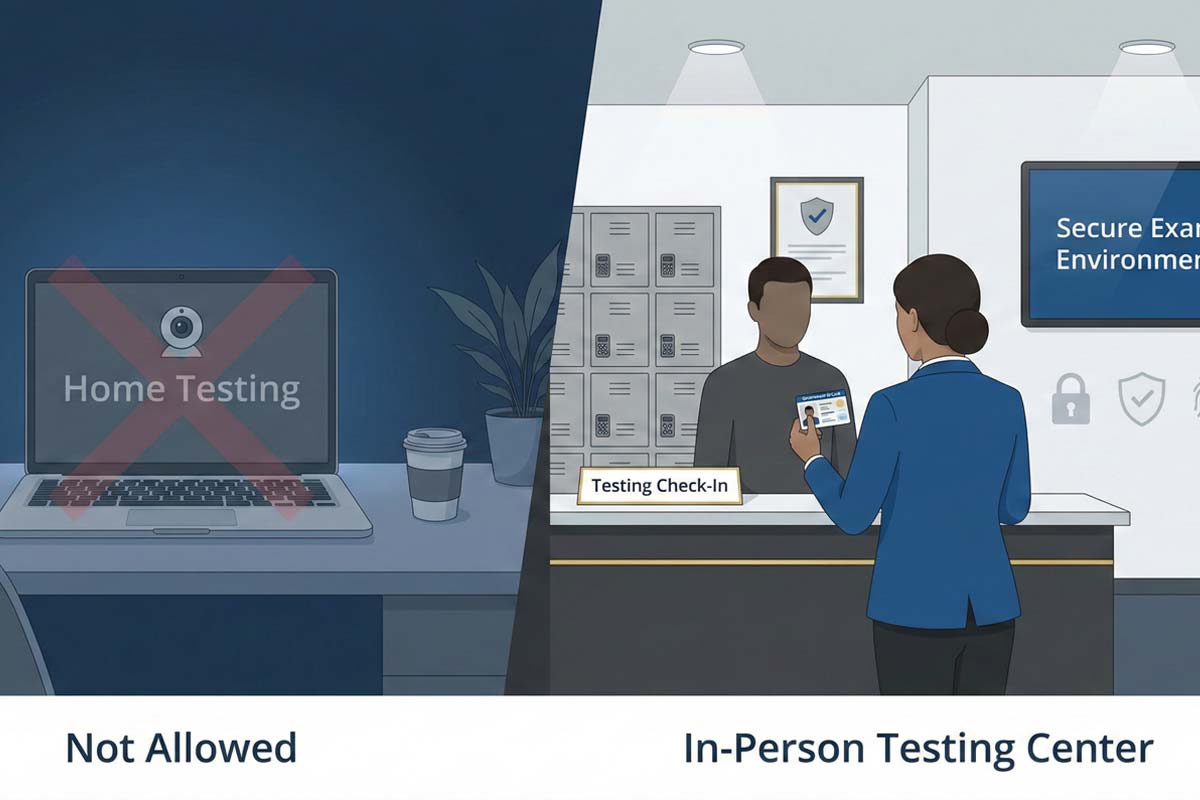
While many states have adopted remote proctoring for their licensing tests, the California Department of Real Estate (DRE) strictly requires all candidates to take the exam in person at one of five official testing centers.
As of 2026, the DRE has not adopted an online “remote” alternative for any candidates. While the state provides robust on-site accommodations for candidates with disabilities who apply for them, there is currently no option to take the exam off-site.
Why the California Real Estate Exam Is Not Offered Online
The DRE’s refusal to move the exam online revolves around one core principle: exam integrity.
The California real estate license grants significant legal and financial authority. To maintain the value of this license, the DRE must ensure that every person who passes the exam does so fairly and without outside assistance. Because California has the largest licensee population in the country, the risk of widespread fraud is higher here than in smaller states, leading to stricter protocols.
Many students are surprised by how different the DRE’s rules are from their school exams. Understanding this distinction early prevents confusion later in the process.
Security and Identity Verification
Remote proctoring—where a webcam watches you take the test—has improved, but it is not yet foolproof. The DRE enforces strict identity verification standards that are difficult to replicate remotely. At a physical test center, proctors can physically inspect government-issued IDs, verify that the person taking the test matches the photo, and ensure no one else is in the room.
Preventing Exam Subversion
California Business and Professions Code explicitly prohibits "subverting or attempting to subvert any licensing examination." This basically means trying to remove exam content from the site or cheat on the exam. The DRE views the controlled environment of a physical test center as the most effective way to prevent subversion techniques, such as using hidden earpieces, having a third party take the test, or accessing unauthorized notes.
By keeping the exam offline, the DRE ensures that the test score accurately reflects the candidate's actual knowledge, not their ability to bypass security software.
Why People Confuse Online Coursework With the Exam
A common source of confusion for students is the difference between pre-licensing education and the state licensing exam.
Pre-Licensing Coursework (Online Allowed): You can complete your required 135 hours of college-level education online. ADHI Schools offers these courses digitally, and the final exams for these specific classes are open-book and taken online.
State Licensing Exam (In-Person Only): Once you finish school and receive your certificates, you must apply to the state. The final hurdle—the state exam—is a completely separate event that must be taken at a DRE facility.
Students often assume the state uses the same rules as schools—it doesn’t. It is critical to mentally prepare for the shift from a relaxed home environment to a formal, secure testing facility.
The Only Approved Way to Take the Exam
Since remote testing is unavailable, you must schedule your exam at a designated proctoring facility. The DRE currently operates five locations across the state: Fresno, La Palma (Orange County/Los Angeles), Oakland, Sacramento, and San Diego.
Students often start by reviewing the California real estate exam testing centers before choosing where to test. It is important to note that you cannot use third-party testing sites (like Pearson VUE centers used for other exams); you must use one of these five specific DRE locations. Furthermore, availability varies by center, so securing a seat requires forward planning.
Once you have selected your location, you should also consider the best time to take the California real estate exam to ensure you avoid heavy traffic and align the date with your peak study readiness.
What the In-Person Testing Process Looks Like
Taking the exam in person is a formal process, similar to airport security. Understanding the protocol beforehand can help reduce anxiety.
Arrival and Check-In
You should plan on arriving at least 30 minutes before your scheduled exam time. Upon arrival, you will check in at the reception desk where your identification will be rigorously scrutinized. You must present a valid, current government-issued photo ID.
Security Measures
The testing room is a secure environment. You are not allowed to bring personal items to your desk. This includes:
Cell phones (must be powered off and stored).
Watches and smartwatches.
Wallets, purses, and backpacks.
Most centers provide small lockers for your personal belongings. Your arrival routine is similar to what’s described in what to expect on exam day, where the focus is on minimizing distractions so you can focus entirely on the questions.
Note-Taking Materials
You cannot bring your own scratch paper, and the DRE no longer provides any note-taking materials. Fortunately, the state exam no longer includes math questions, so you will not need to perform calculations during the test. All questions can be answered directly on the computer screen without the need for any written work.
Will California Ever Offer an Online Version?
The testing industry is moving toward remote proctoring, and large providers already have the technology to facilitate secure online exams.
However, the California DRE has historically been conservative regarding changes to the licensing process, often lagging behind national testing trends by 5 to 10 years due to regulatory caution. They prioritize the security of the "gatekeeper" exam over convenience. While they have modernized other aspects of the process, there have been no official announcements regarding a pilot program for online testing. For now, candidates should plan their timeline assuming they will need to travel.
What Parts of the Licensing Process Can Be Done Online?
While you can't take the test online, almost every other step of the licensing journey is digital. You can streamline your experience by handling the logistics from your computer.
Coursework: Complete all 135 hours of required education.
Application: Submit your exam and license application via the eLicensing system.
Scheduling: After completing your coursework, the next logistical step is understanding how to schedule the California real estate exam using the DRE’s online portal.
Results: While you don't get them instantly on screen, you can view your pass/fail status online shortly after the results are officially posted by the DRE.
Final Thoughts
The requirement to test in person ensures that every licensed agent in California has met the same high standard of competency. While it requires a bit more logistical planning than an online test, the process is straightforward if you are prepared.
Focus your energy on studying the material rather than worrying about the format. A solid grasp of the concepts in the California Real Estate Exam Guide is the best way to ensure that, when you sit down at that computer in the testing center, you are ready to pass.
Frequently Asked Questions (FAQ)
Can I use a calculator on the California real estate exam? No. This is a critical point where many online resources are outdated. You are not allowed to bring a calculator of any kind (including basic or silent models). Furthermore, the testing center does not provide calculators, and the exam software does not have a calculator function. There’s no longer any math on the exam.
Is the California real estate exam open book? No. The state licensing exam is closed book. You cannot use notes, textbooks, or outside resources during the test.
Can I take the California real estate exam out of state? No. You must take the exam at one of the five approved testing centers located within California (Fresno, La Palma, Oakland, Sacramento, or San Diego).
Is the exam on a computer or paper? The exam is electronic. You will sit at a computer terminal at the testing center to answer the multiple-choice questions. It is not a "paper and pencil" test, but strictly an in-person electronic exam.
What happens if I’m late to the testing center? If you arrive after your scheduled start time, you may be denied entry and will likely forfeit your exam fee. It is highly recommended to arrive at least 30 minutes early.
|
The California real estate exam isn’t a secret code you have to crack in order to pass. The DRE actually publishes a blueprint that tells the world exactly what’s on the test. Once you know how the Read more...
The California real estate exam isn’t a secret code you have to crack in order to pass. The DRE actually publishes a blueprint that tells the world exactly what’s on the test. Once you know how the questions are weighted, you can stop wasting time and start studying the right way and focusing on the things that matter.
I’m going to map it all out for you below.
But first, here is some good news: the biggest section on the exam isn’t necessarily the hardest one.
If you are just beginning your licensing journey, start with our comprehensive California real estate exam guide for a full roadmap.
The 7 Major DRE Exam Categories
The DRE divides the exam into seven competency areas. While the official titles can sound academic, it is easier to understand them as the practical responsibilities of a licensee.
Property Ownership and Land Use Controls and Regulations: This tests your knowledge of what you are selling—the rights, interests, and restrictions attached to the land.
Laws of Agency and Fiduciary Duties: This covers who you represent and the legal obligations you owe to your clients.
Property Valuation and Financial Analysis: This requires you to understand how value is determined and how investment properties are analyzed.
Financing: This covers the systems, laws, and instruments used to borrow money for real estate.
Transfer of Property: This tests the mechanics of how ownership moves from one person to another (deeds, escrow, and title).
Practice of Real Estate and Mandated Disclosures: This is the "day-to-day" work of an agent, including fair housing, truth-in-advertising, and trust funds.
Contracts: This covers the agreements that make the transaction legally binding.
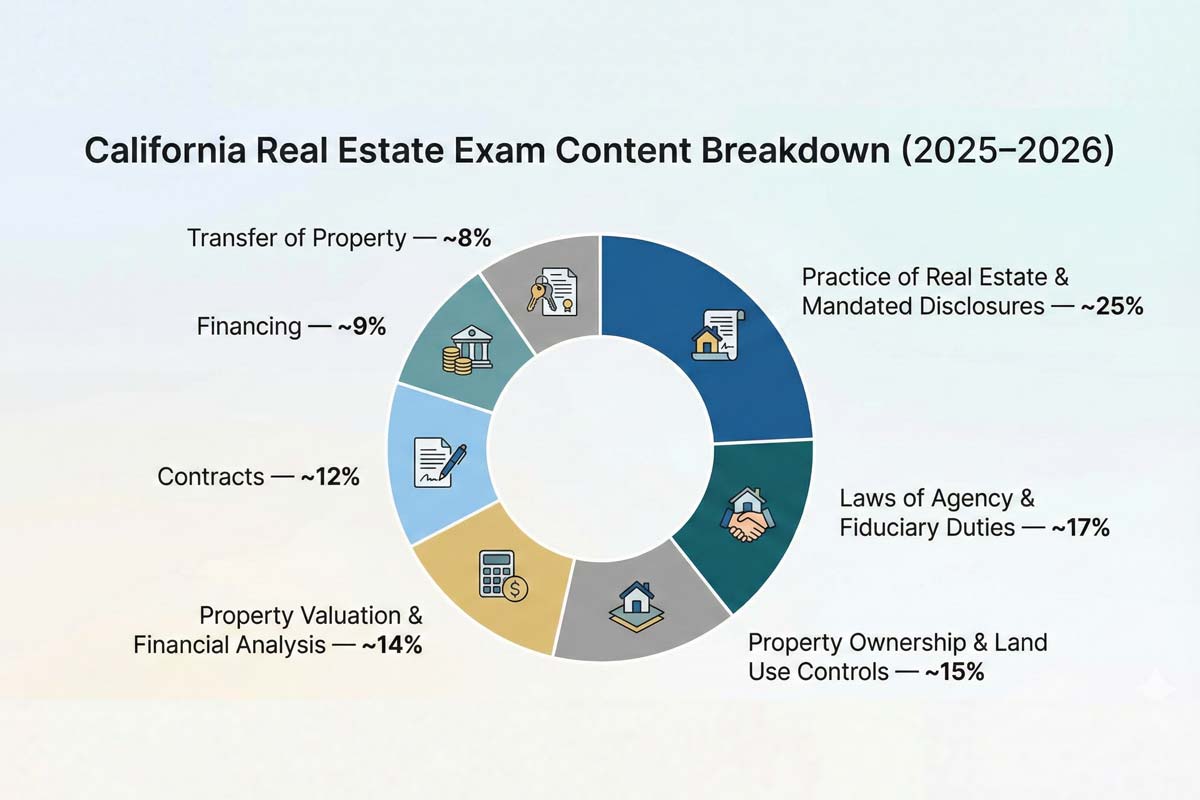
Which exam category is worth the most points? The Practice of Real Estate and Mandated Disclosures is the heavyweight champion of the exam, accounting for roughly 25% of the questions. However, as we will discuss below, this category is actually a mix of several different skill sets.
These seven categories are the standard framework for both the salesperson and broker exams.
Category-by-Category Weighting (2025–2026)
The DRE provides a percentage range for each topic. Below, we break down these weights into a practical study guide.
Practice of Real Estate and Mandated Disclosures (~25%)
What It Really Covers: This is the largest section of the exam. It includes Trust Fund handling, Fair Housing laws (Federal and State), the purpose of the Transfer Disclosure Statement (TDS), and strict rules regarding advertising and ethics.
Instructor’s Study Tip: Do not be intimidated by the 25% figure. This category is not one giant topic; it breaks down between disclosures, ethics, fair housing and general real estate practice scenarios. If you master Fair Housing and the rules of Trust Funds (commingling and conversion), you have conquered the hardest part of this section.
Laws of Agency and Fiduciary Duties (~17%)
What It Really Covers: This tests how agency is created (express vs. implied), how it is terminated, and the specific duties owed to principals versus third parties. It heavily features "dual agency" scenarios.
Instructor’s Study Tip: Focus on the timing of the Agency Disclosure Form (Disclosure, Election, Confirmation). The DRE loves to test on when these disclosures must happen in a transaction sequence.
Property Ownership and Land Use Controls (~15%)
What It Really Covers: This covers the different ways to hold title (Joint Tenancy, Community Property), encumbrances (liens, easements), and government powers (Zoning, Eminent Domain).
Instructor’s Study Tip: Understand the "Bundle of Rights." Many questions here are definition-heavy. If you know the difference between a specific lien and a general lien, you can pick up easy points here.
Property Valuation and Financial Analysis (~14%)
What It Really Covers: This is about appraisal theory (Cost, Income, and Market Data approaches) and economic principles of value (Substitution, Contribution).
Instructor’s Study Tip: Don't worry about complex math. The exam tests concepts, not calculations. Focus on knowing when to use the Income Approach (commercial/rentals) versus the Cost Approach (libraries/new schools).
Contracts (~12%)
What It Really Covers: This section deals with the validity of contracts (Competence, Mutual Consent, Lawful Object, Consideration) and the specific types of listings (Exclusive Right to Sell vs. Exclusive Agency).
Instructor’s Study Tip: Memorize the four essentials of a valid contract. Also, ensure you understand the "Safety Clause" in listing agreements—it’s a frequent exam target.
Financing (~9%)
What It Really Covers: This covers the primary vs. secondary mortgage markets, loan types (FHA, VA, Conventional), and consumer protection laws like TILA (Reg Z) and RESPA.
Instructor’s Study Tip: This is the smallest section for a reason. Do not spend weeks studying mortgage tables. Focus on the difference between the Trustor, Trustee, and Beneficiary in a Deed of Trust.
Transfer of Property (~8%)
What It Really Covers: This deals with deeds (Grant vs. Quitclaim), title insurance (CLTA vs. ALTA), and the escrow process.
Instructor’s Study Tip: This is often the easiest section to master because it is procedural. If you understand that a deed must be delivered and accepted to be valid (but not necessarily recorded), you are halfway there.
Salesperson vs. Broker Exam Content: What’s Different?
While both exams utilize the exact same seven categories, the lens through which you are tested changes.
The Salesperson exam focuses on the application of rules: "What form do I use?" or "What must I disclose?"
The Broker exam focuses on the above as well as a little more on supervision and management. In addition to the standard content, Broker candidates must understand:
Office management and supervision of salespersons.
Deeper liability regarding Trust Fund accounting.
More complex financial analysis and investment scenarios.
Is the content breakdown the same for salesperson and broker exams? Yes. The DRE uses the same "Content Outline" for both. However, the Broker exam contains 200 questions compared to the Salesperson's 150 and you have to score slightly better on the broker exam to pass.
For more on passing thresholds, read our breakdown of How the California Real Estate Exam is Scored.
How Content Weighting Should Shape Your Study Plan
Do not study every topic with equal intensity. The weighting reveals that the DRE values certain competencies over others.
High-Value vs. Low-Effort Topics
High-Value / High-Complexity: "Laws of Agency" and "Practice of Real Estate" combine for over 40% of your score. These require deep study because they are scenario-based. You cannot just memorize definitions; you must understand how to apply the law to a situation.
Low-Effort / Easy Points: "Transfer of Property" and "Property Ownership" often rely on static definitions (e.g., "What is a freehold estate?"). These are "low-effort" points. Master the vocabulary here to bank easy points, which gives you a buffer for the harder scenario questions.
Which exam topics give you the easiest points? Contracts and Transfer of Property. The rules in these sections are rigid and rarely change, making the questions straightforward if you know your definitions.
How the DRE Uses Weighting to Build and Score the Exam
The DRE uses a psychometric process called "equating" to ensure fairness. Whether you take the exam on a Tuesday in San Diego or a Friday in Oakland, the computer algorithm pulls questions to match this exact percentage blueprint.
Because the DRE uses this fixed blueprint, ADHI Schools’ practice exams mirror the real exam’s balance. When you take our mock tests, you are conditioning your brain to handle the exact distribution of topics you will face on test day.
How does knowing the content breakdown improve your odds on exam day?
It prevents panic. If you hit a hard run of Finance questions, you can relax knowing that Finance is only 9% of the exam. You can afford to miss a few hard finance questions and still easily pass if your Agency and Practice knowledge is solid.
To refine your testing tactics further, review our Multiple-Choice Strategy for the CA Real Estate Exam.
Mastering the blueprint gives you an immediate edge over other test-takers who are just memorizing flashcards without a plan.
Ready to start your structured preparation? Return to our California real estate exam guide to take the next step toward your license.
Frequently Asked Questions regarding DRE Exam Content
Do I need to pass each of the seven content areas individually?
No. Your score is cumulative. You do not need to score 70% in every single category to pass. For example, if you struggle with Financing (9%), you can make up for those missed points by scoring highly in Practice of Real Estate (25%) and Agency (17%).
Does the high weighting for Valuation and Financing mean there is a lot of math?
No. While Property Valuation (~14%) and Financing (~9%) make up nearly a quarter of the exam, the DRE focuses on concepts, not calculations. You will be tested on the principles of value and loan structures, but you will not be asked to perform complex arithmetic.
How strict are these percentages?
They are approximations provided by the DRE. On any given exam version, the specific number of questions may fluctuate slightly.
Is the "Practice of Real Estate" the hardest section because it is the largest?
Not necessarily. While it has the most questions (approx. 25%), many of them cover straightforward topics like Fair Housing and Truth-in-Advertising. Many students find the Laws of Agency section more difficult because it relies heavily on interpreting complex scenarios rather than memorizing facts.
|
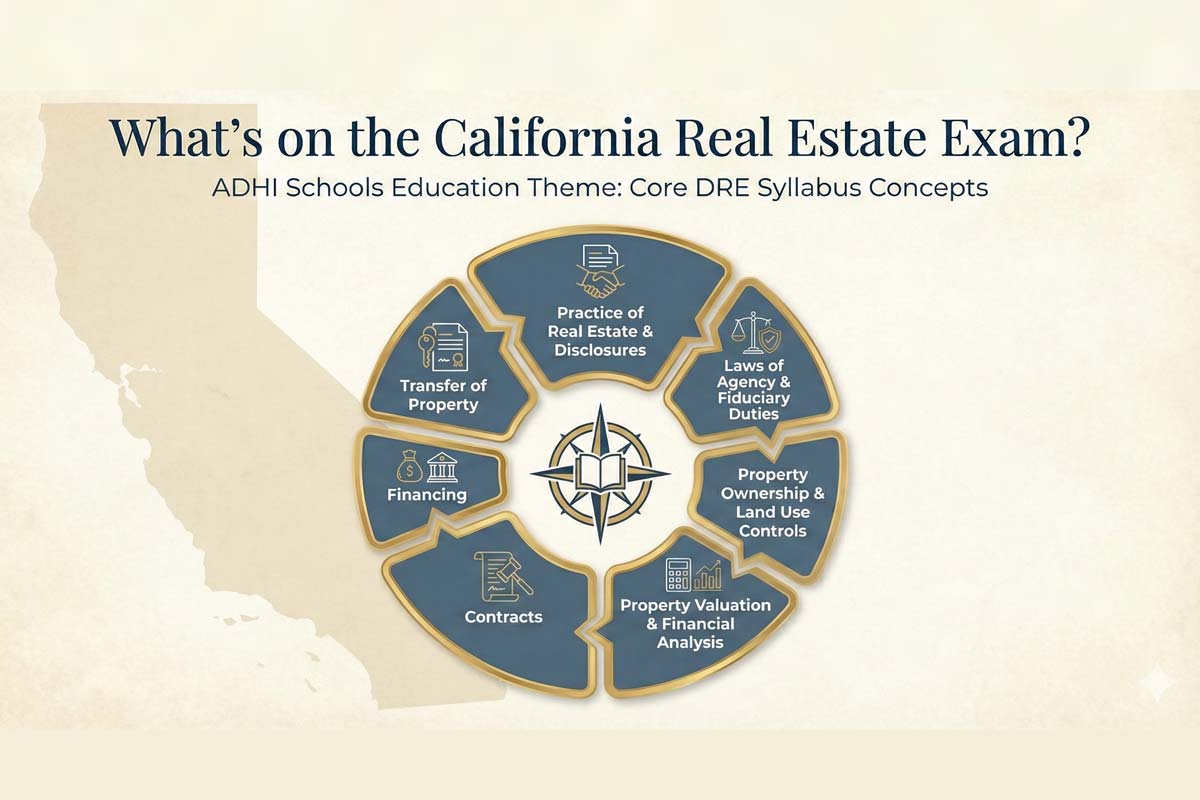
The California Department of Real Estate (DRE) salesperson exam is notorious for its 50% fail rate, but that number is misleading. It’s not an impossible test; it’s just a specific one. Most students Read more...
The California Department of Real Estate (DRE) salesperson exam is notorious for its 50% fail rate, but that number is misleading. It’s not an impossible test; it’s just a specific one. Most students fail because they study the wrong things. Here is the good news: the DRE tells us exactly what matters. Master these core areas, and you remove the mystery—and the risk—from exam day.
If you haven’t already reviewed our comprehensive California real estate exam guide, start there for an overview of the full licensing journey.
The 7 Major Content Areas (DRE Syllabus)
The DRE structures the real estate license syllabus into seven competency areas. Each represents a skill set you must demonstrate to pass the DRE salesperson exam. Below is a clear breakdown of what you’re expected to know in each and this is true regardless of the sales or broker exams. Sure, the number of questions on each exam is different, but the topics are the same across both tests.
Practice of Real Estate and Mandated Disclosures
This is the heart of the DRE exam and the section where students commonly underestimate the depth of material. Expect scenario-based questions that test whether you can apply real estate principles, ethical rules, and disclosure laws correctly.
Key concepts include:
Trust Fund Handling: Proper receipt, deposit, reconciliation, recordkeeping, and the consequences of commingling or conversion.
Fair Housing Laws: Federal and California anti-discrimination statutes, protected classes, blockbusting, steering, and reasonable accommodation requirements.
Transfer Disclosure Statements: What must be disclosed, who must sign, defects that trigger disclosure, and exemptions.
Ethics & Prohibited Conduct: Unlawful misrepresentation, duties of honesty and fair dealing, advertising rules, and handling offers.
Laws of Agency and Fiduciary Duties
You’ll be tested on how agency relationships are created, how they are terminated, and what fiduciary duties a licensee owes.
Key concepts include:
Agency Disclosure Timing: When and how the Agency Disclosure form must be delivered, acknowledged, and confirmed in a transaction.
Creation of agency: express, implied, ostensible, ratification.
Disclosure obligations in agency relationships.
Fiduciary duties — loyalty vs. honesty and fairness to all parties.
Dual agency rules and the unique risks and requirements involved.
Consequences of breaching fiduciary duties and permitted vs. prohibited conduct.
Property Ownership and Land Use Controls
This section examines the legal framework that governs how property is held, controlled, and regulated in California.
Key concepts include:
Types of ownership: joint tenancy, tenancy in common, community property.
Land use controls: zoning, variances, conditional use permits.
Government powers: police power, eminent domain, taxation, escheat.
Public and private restrictions (CC&Rs, HOA rules).
Legal property descriptions and boundaries.
Property Valuation and Financial Analysis
You don’t need to be an appraiser, but you do need a solid grasp of how value is estimated and how income-producing properties are analyzed.
Key concepts include:
Three approaches to value: market, cost, and income.
Appraisal fundamentals: substitution, conformity, contribution, and regression.
Income concepts: gross rent multiplier (GRM), net operating income (NOI), and capitalization basics.
What affects property value: supply and demand, neighborhood cycles, economic forces.
Understanding when each valuation approach is appropriate.
Contracts
Contracts appear all over the exam because they appear all over real estate practice.
Key concepts include:
Essential elements of a valid contract (capacity, mutual consent, lawful object, consideration).
Listing agreements: exclusive right to sell, exclusive agency, open listings.
Residential purchase agreements and common contingencies.
Offer and acceptance rules, counteroffers, termination.
Enforceability and consequences of breach.
Financing
Expect questions that test your understanding of lending systems and consumer protection laws.
Key concepts include:
Primary vs. secondary mortgage markets.
Loan products: conventional, FHA, VA, adjustable-rate, and seller financing.
TILA/RESPA integration (TRID) requirements and timing.
Points, loan origination, and discount points.
Mortgage defaults, foreclosure basics, and rights of reinstatement or redemption.
Transfer of Property
This section deals with how real estate actually changes hands — legally and procedurally.
Key concepts include:
Deeds: grant, quitclaim, warranty, essential elements, delivery.
Title insurance: CLTA vs. ALTA, exclusions, and protections.
Escrow process: prorations, instructions, trustworthiness requirements.
Recording and priority rules.
Property taxes, assessments, and transfer fees.
Is the Exam Content the Same Every Year?
The core real estate principles remain remarkably stable year to year, but the DRE updates exam questions periodically to reflect changes in law, disclosures, lending rules, and fair housing standards. For a deeper breakdown of how topics evolve, review our current California Real Estate Exam content breakdown.
How Deeply Do You Need to Know These Topics?
Whether you are taking the sales license or broker exam, passing is not about memorizing isolated facts — it tests whether you can apply concepts to realistic scenarios. The better you understand the underlying real estate principles, the easier it becomes to eliminate wrong answers. To fully prepare, you should also understand how the real estate exam is scored and exactly how many questions are on the exam so you can manage your time effectively.
Strategy for Mastering the Material
Focus on understanding, not cramming. Most students waste time over-studying math (there isn’t any math on the exam) or memorizing obscure details. Instead:
Study in short, focused bursts.
Use process-of-elimination on questions with similar answer choices.
Prioritize practice questions that mirror DRE logic.
Review mistakes deliberately — they reveal pattern gaps.
To sharpen your testing approach, study our multiple-choice strategies, which are specifically designed for the DRE salesperson exam.
Mastering the seven core areas of the real estate license syllabus is the most reliable path to passing the California Department of Real Estate exam. With the right preparation, consistent practice, and a clear understanding of what the DRE is looking for, you’ll walk into the testing center confident and ready.
Begin your focused review today — the exam is challenging, but absolutely conquerable with the right strategy and guidance.
FAQ: What’s on the California Real Estate Exam?
Is the California real estate exam hard?
It’s challenging, but not because the material is impossible. The exam is hard for people who study the wrong things. If you understand the seven DRE content areas and practice scenario-based questions, it becomes very manageable.
How many questions are on the California real estate exam?
The salesperson exam has 150 questions and the broker exam has 200 questions. Both are multiple-choice and both are timed.
How long do you get to finish the exam?
Salesperson: 3 hours and 15 minutes
Broker: 4 hours
There are no scheduled breaks, so pacing matters.
Does the exam include math?
No. The DRE removed math years ago. You may see questions about valuation concepts (like cap rates or GRM), but you won’t be asked to calculate formulas.
What score do you need to pass?
Salesperson: 70%
Broker: 75%
The DRE does not curve scores and does not release which questions you missed.
Is every exam the same?
No. There are multiple versions in circulation, and the DRE updates questions periodically. However, the content areas and competency weights stay consistent year to year.
Does the DRE test more scenarios or definitions?
Scenarios dominate. Many questions test whether you can apply a rule—not just recognize a definition. This is especially true in agency, disclosures, ethics, and trust fund handling.
Which section of the exam is the hardest?
Most students struggle with:
Practice of Real Estate & Disclosures
Agency & Fiduciary DutiesThese are heavily scenario-based and require understanding, not memorization.
Can you bring notes, calculators, or reference materials?
No. The exam is closed-book, and the testing center provides everything you’re allowed to use.
Are the salesperson and broker exams based on the same topics?
Yes. The subject areas are the same, but the broker exam goes deeper and includes more questions per topic.
How often can you retake the exam?
As many times as needed. There is no waiting period. The only requirement is paying the re-exam fee and scheduling a new appointment.
What’s the best way to prepare for the content areas?
Use practice questions that mirror DRE logic, focus on the most heavily weighted topics, and study in short, consistent sessions. Understanding beats cramming.
Are exam questions pulled from a public question bank?
No. The DRE does not publish exam questions. Any company claiming to have “real exam questions” is misleading you.
What topics should I NOT waste time studying?
Detailed math
Obscure federal laws that rarely appear
Commercial-only concepts not tied to the syllabus
Hyper-technical appraisal jargon
The DRE sticks closely to the seven official content areas.
Does the exam focus on California-specific laws?
Yes. Proper disclosures, agency rules, trust fund handling, and fair housing compliance are all tested from a California perspective, not a national one.
|
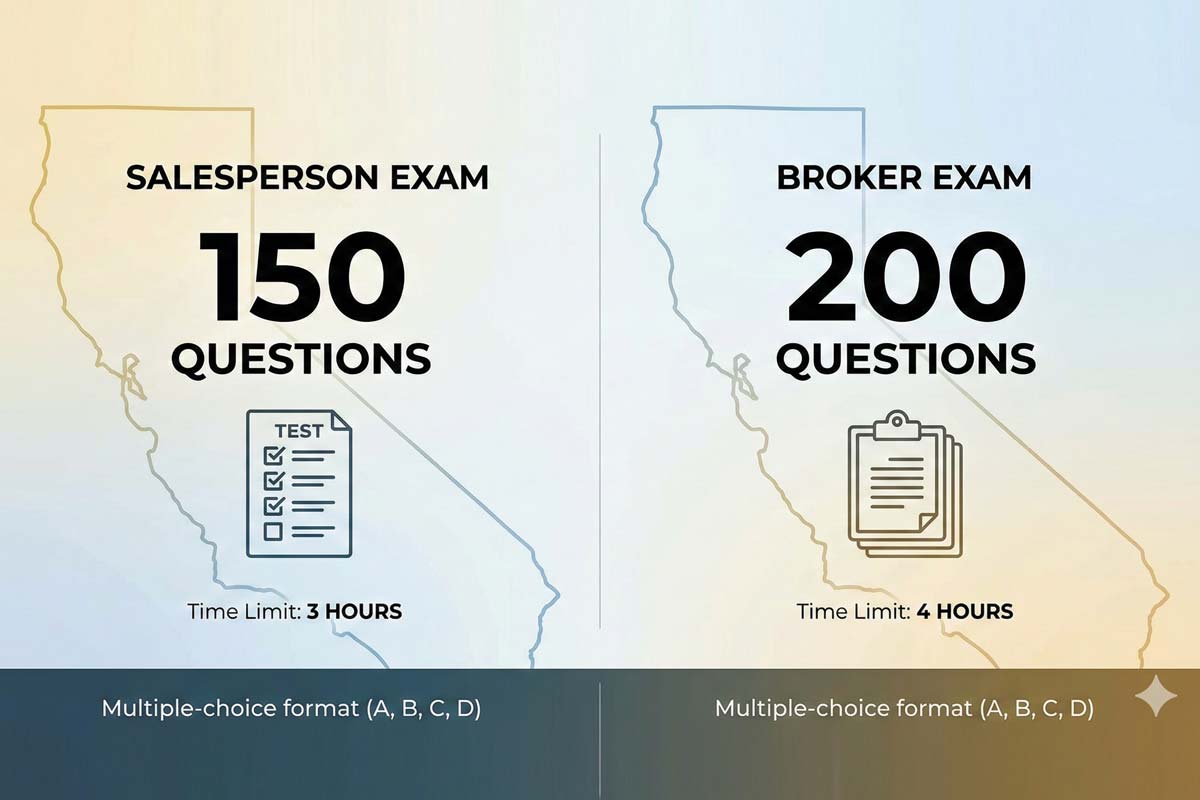
If you're gearing up for your California licensing test, one of the most practical details to lock down is the exam's length. How many questions are on the California real estate exam? Knowing the exact Read more...
If you're gearing up for your California licensing test, one of the most practical details to lock down is the exam's length. How many questions are on the California real estate exam? Knowing the exact number is the cornerstone of an effective study plan and confident test-day pacing. Here’s the straightforward answer:
The California Real Estate Salesperson Exam contains 150 multiple-choice questions.
The California Real Estate Broker Exam contains 200 multiple-choice questions.
This structure directly influences your time-management strategy. For a full picture of the entire testing process, from scheduling to scoring, our California real estate exam guide walks you through every step. To see how these questions are distributed by topic, review our guide to what’s on the California real estate exam — it outlines all testable areas.
The Salesperson Exam Breakdown (150 Questions)
The salesperson licensing exam is a 150-question test, with every item presented in a multiple-choice format with four options (A, B, C, D). The questions are pulled from specific content areas with predetermined weighting. For example, roughly a quarter of the exam focuses on the Practice of Real Estate and Duties to Clients, while Financing makes up a smaller percentage. Understanding this weighting is critical for efficient study.
The Broker Exam Breakdown (200 Questions)
The broker exam increases in both scope and depth, featuring 200 multiple-choice questions, also in A, B, C and D format. While the core subject categories align with the salesperson test, the broker version delves slightly deeper into areas like real estate law, brokerage management, and trust fund handling. The additional questions reflect the content around supervisory knowledge required for a broker's license.
Time Management: The “Minute-Per-Question” Rule
With standardized time limits, a simple calculation gives you a powerful pacing tool:
Salesperson Exam: 150 questions / 180 minutes = 1.2 minutes per question.
Broker Exam: 200 questions / 240 minutes = 1.2 minutes per question.
This consistent pace is very manageable if you avoid getting stalled. The best approach is to answer known questions quickly, mark uncertain ones for review, and maintain forward momentum. Returning to challenging items at the end ensures you capture all the points available from questions you find easier.
Passing Scores: How Many You Can Get Wrong
It’s a relief to many students that perfection is not required. The passing percentages are clear:
Salesperson Exam: A 70% score means you need 105 correct answers. You can miss 45 questions and still pass.
Broker Exam: A 75% score requires 150 correct answers, allowing you to get 50 questions wrong.
This margin for error is built into the exam design. For a deeper look into the scoring process, including how "equating" questions work, our article on how the California real estate exam is scored provides clarity.
Format Consistency: Every Question Is Multiple Choice
Since the exam sticks to a simple four-option multiple-choice format, you don’t have to adjust your thinking from question to question. Learn one solid strategy and you can use it throughout the test—whether you know the answer or you’re narrowing it down to the best option. Honing this skill is a major part of effective preparation, and a dedicated multiple-choice strategy for the CA real estate exam can significantly boost your confidence and accuracy.
So, to recap: the sales license exam has 150 questions, and the broker test has 200 questions. When you understand the question count, timing, and pass thresholds, the exam stops feeling mysterious and becomes a numbers game you can win. With focused study and smart test-taking tactics, you’re well-positioned for success. For a complete step-by-step journey to your license, your central reference should always be our main California real estate exam guide.
Frequently Asked Questions
Q: Is there math on the California real estate exam? A: No. Since calculators are strictly prohibited, the DRE has removed math calculation questions from the test. You may need to recall specific numbers (like knowing there are 43,560 square feet in an acre), but you will not be asked to perform arithmetic.
Q: Do all 150 questions count toward my score? A: Treat every question as if it counts. While the DRE may include a few unscored "experimental" questions to test them for future exams, they are not labeled.
Q: Is the Broker exam harder than the Salesperson exam? A: Yes, primarily due to endurance. Answering 200 questions over 4 hours is a mental marathon. It also tests supervisory topics that aren't on the salesperson exam.
Q: What happens if I don't finish in time? A: Any blank answer is marked wrong. There is no penalty for guessing, so if you are running out of time, pick a letter and fill in every remaining bubble before the clock stops.
|
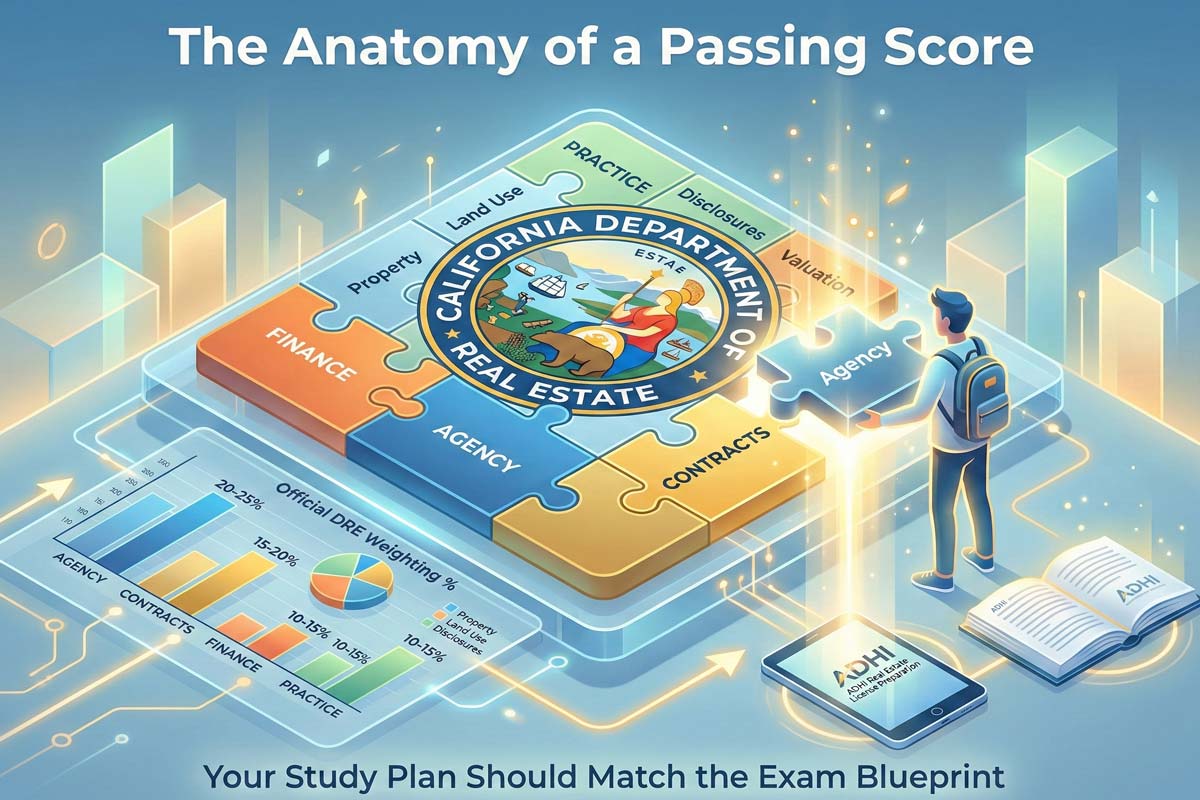
Most students walk into the California real estate exam feeling confident—until they start wondering how the DRE actually scores it. Is the test curved? Do different people get different versions? Does Read more...
Most students walk into the California real estate exam feeling confident—until they start wondering how the DRE actually scores it. Is the test curved? Do different people get different versions? Does getting exactly 70% guarantee a pass?
Here’s the truth:
The DRE does NOT curve the exam and you can absolutely pass on the first attempt once you understand how their scoring system works.
In this guide, I’ll break down every scoring rule the DRE uses—clearly, accurately, and in plain English—so you know exactly what it takes to pass.
If you’re just getting started, make sure you are also reviewing our full California Real Estate Exam Guide for the complete exam roadmap.
The California Real Estate Exam Scoring System Explained
The most important thing to understand is this:
The California real estate exam uses raw scoring, not curved scoring.
This is the backbone of how the DRE ensures fairness.
Minimum Passing Scores
Salesperson Exam: You must achieve the equivalent of 70%
Broker Exam: You must achieve the equivalent of 75%
Those percentages are absolute—not relative to how anyone else performs.
Why Raw Scoring Makes the Exam Fair
The California DRE uses a raw scoring system to determine a pass or fail. This means your score is based directly on the number of questions you answer correctly, measured against a fixed, non-negotiable threshold.
However, to ensure this raw score is a fair measure for every test-taker, the DRE employs a rigorous process of exam form equating before any candidate ever sees the questions.
What this means for you:
The target is fixed: You must achieve a set number of correct answers.
It is NOT a curve: Your score is never compared to other test-takers on your day. Equating adjusts the exam, not your grade based on others' performance.
In essence, raw scoring gives you a clear target, while expert equating guarantees that hitting that target means the same thing, no matter which exam form you receive.
Debunking the "Scaled Score" Myth
You'll hear many prep courses and forums talk about the DRE's "scaled scoring." This is a widespread misconception. The California DRE does not use a traditional scaled score to determine your pass/fail result.
Here’s the reality:
1. The DRE uses a raw score against a fixed standard.
Your exam is scored on a straightforward, raw percentage basis. To pass, you must correctly answer a specific percentage of questions (approx. 70% for salesperson, 75% for broker). The result is a direct comparison of your correct answers to this absolute benchmark.
2. "Equating" happens before you take the test, not after.
The process often mistaken for "scaling" is called equating. This is a psychometric calibration performed by the DRE during the exam development phase. Experts adjust and validate questions so that the difficulty of reaching the passing raw score is consistent across all exam versions. This means:
You are not compared to other test-takers.
Your score is not statistically manipulated after you finish.
The fairness is built into the exam design itself.
3. The system protects every test-taker.
By using equated exam forms with a raw score threshold, the DRE ensures that:
Every candidate faces an equivalent challenge to demonstrate competency.
No one is penalized for receiving a version with statistically “harder” questions.
The meaning of a "pass" is uniform across the entire state and testing period.
Think of it like a race:
A true "scaled" score might change the finish line based on who's running. The DRE's system, instead, carefully calibrates the track so that everyone runs the same distance to reach the fixed, unmoving finish line. Your raw score simply tells you if you crossed it.
You will NOT receive a numeric score when you pass
The DRE releases only:
PASS
FAIL
When you pass the exam, they do not tell you how close you were or how many you missed.
However, if you fail the exam, the DRE will report your overall score as well as how you did in each of the seven exam categories so you know where to focus your efforts.
Does the DRE Curve the Exam?
Let’s say it as clearly as possible:
No. The California real estate exam is NOT curved.
There is:
No bell curve
No percentile ranking
No grading against other students
How Fast the DRE Scores Your Exam
Since the state exam is computer based you receive your result immediately after finishing.
Important scoring rules
No partial credit
No appeals
No score breakdowns
Pass/Fail only
Retakes
If you fail:
You may retake the exam after paying the re-exam fee
Your previous exam performance has no impact on future tests
Common Myths About Exam Scoring
❌ Myth #1: “Only a certain percentage of students pass each day.”
False.
There is no quota. Passing is based only on your performance relative to the published standard.
❌ Myth #2: “If you test in the afternoon, your exam is harder.”
Completely false.
Versions are pre-set and rotated randomly.
❌ Myth #3: “Different categories are weighted differently for each student.”
Partially true but misunderstood.
The exam blueprint allocates topics by percentage, but every student receives the same category weighting.
Scaling does not adjust category weight per individual.
See our Exam Content Breakdown for exact percentages.
❌ Myth #4: “The DRE tells you your raw score if you call.”
They do not.
No one at the DRE can release that information.
Ready to Pass on the First Attempt?
If you want the highest probability of passing the first time, start with ADHI Schools.
ADHI offers:
California salesperson pre-license courses
Broker licensing courses
Live crash courses taught by real instructors
Exam prep tools that mirror the DRE’s weighting and question style
Our students pass because our test taking strategies are built around how the DRE actually scores the exam—not myths, shortcuts, or generic national content.
Is the California real estate exam curved? No. The California DRE uses a raw scoring system, not a curve. Your score is based solely on the number of questions you answer correctly, and it is never graded against or compared to the performance of other students.
What is the passing score for the California real estate exam? For the Salesperson Exam, you must achieve a score of 70%. For the Broker Exam, the passing threshold is 75%. These percentages are fixed and non-negotiable.
Does the DRE use scaled scoring? No. While the DRE uses a process called "equating" to ensure different versions of the test have the same difficulty level, this happens before you take the test. Your final grade is a simple raw score based on your correct answers, not a statistically manipulated "scaled" score.
Will I see my actual final score? Only if you fail. If you pass, the DRE only releases a "PASS" notification with no numeric score or breakdown. If you fail, you will receive your numerical score and a breakdown of your performance across the seven exam categories.
Is there a limit to how many people can pass each day? No. There is no quota for passing grades. Every single student who hits the required 70% (or 75% for brokers) will pass, regardless of how many other people are testing that day.
How long does it take to get my exam results? You will receive your results immediately. Because the California exam is computer-based, your pass/fail status is provided at the testing center the moment you finish.
Does the time of day affect exam difficulty? No. It is a myth that afternoon exams are harder. Exam versions are pre-set and rotated randomly; the time of day you test has absolutely no impact on which version you receive.
|

Worrying about your ID for the exam is more common than you think. Over two decades of teaching, I've seen that anxiety firsthand - often at the last minute (don’t do this!).
The good news Read more...
Worrying about your ID for the exam is more common than you think. Over two decades of teaching, I've seen that anxiety firsthand - often at the last minute (don’t do this!).
The good news is, this is one of the easiest problems to solve. Here’s the definitive guide to what you need.
Let me be totally direct:
Not every “photo ID” works.
Only four specific IDs are accepted.
Show up with the wrong one, and you won’t be allowed into the testing room.
Let’s break down exactly what the DRE requires — in plain English.
Why This Matters (Exam Day Consequences)
Here’s the hard truth:
If you don’t bring an approved ID, the DRE will NOT admit you to the exam site.
No exceptions.
No second chances that day.
No “but I have a picture of it on my phone.”
You’ll lose your exam slot, forfeit your fee, and have to reschedule — sometimes weeks out.
The ID rules are strict because they’re tied to exam security. Eligibility and education requirements are one thing.
Exam-day check-in is another.
The ONLY DRE Approved Forms of Identification
The California Department of Real Estate accepts only four IDs at check-in:
✔ Current state-issued driver’s license or DMV identification card
✔ U.S. Passport
✔ Foreign government-issued passport
✔ U.S. Military ID
That’s the entire list.
Some quick real-world examples:
Your Arizona or Texas driver’s license? ✔ Yes — totally valid. (Out-of-state examinees should also read our guide on Residency Requirements.)
Your passport from India, Mexico, or the Philippines? ✔ Yes — if it’s valid and unexpired.
Your military CAC card? ✔ Yes — fully acceptable.
The ID must be physical, valid, and unexpired.
The proctor must be able to check it in-hand at the door.
❌ What the DRE Will NOT Accept
If it’s not on the four-item list above, assume it’s not acceptable.
That includes:
❌ Student IDs
❌ Temporary paper licenses
❌ Digital IDs (Apple Wallet, Google Wallet, photos, screenshots)
❌ Work badges
❌ Costco or membership cards (I love Costco - but the card isn’t going to get you into the exam site! Not even the Executive one!)
❌ Photo bank/debit cards
Even if they have your picture.
Even if another agency randomly accepted them.
The DRE won’t.
❌ Expired or Damaged IDs (Important Clarification)
The DRE requires that your ID must be:
Valid
Unexpired
Able to clearly establish your identity
Here’s what that means in practice at DRE testing centers:
❌ Expired = Not accepted
Even by one day.
❌ Damaged enough that the proctor cannot verify your identity = May be rejected
The DRE does not publish a detailed “damaged ID list,” but proctors are required to reject IDs that look altered or cannot be read clearly.
The types of damage that often cause problems include:
Cracks that run through your photo or information
Peeling laminate that obscures text
Scratches across the photo
Chipped edges cutting into your name or expiration date
Water damage on a passport page
Warping that prevents scanning or visual verification
Minor cosmetic wear is usually fine.
But if your ID looks questionable or unreadable, you’re taking a real risk.
Bring the cleanest, most legible version of your ID — and if in doubt, renew it.
What If You Don’t Have One of These Approved IDs?
You’re not out of luck — but you need to plan ahead.
✔ If your driver’s license is expired
Renew at the DMV.
But remember: interim/temporary paper licenses are NOT accepted.
You must wait for the physical card.
✔ If you need a passport
Standard processing: 6–8 weeks
Expedited: 2–3 weeks
Don’t schedule your exam until you have the physical passport in hand.
✔ If you lost your only accepted ID
You’ll need to replace it before taking the exam.
The DRE will not make exceptions.
ID Rules vs. Eligibility Rules — Don’t Mix Them Up
A lot of students confuse exam-day identification with overall eligibility to take the exam.
Let’s separate them clearly.
Eligibility Requirements = What allows you to apply for the exam.
For a full breakdown of the application steps, read our definitive guide on how to get a real estate license in California.
These include:
Being at least 18
Having a valid SSN/ITIN
Completing the required courses
Passing a background check after the exam
Living in California isn’t a requirement
ID Requirements = What allows you to walk into the testing room.
Only four IDs qualify — nothing else.
Two different sets of rules.
📋 Quick Exam-Day Checklist (Screenshot This!)
Here’s the exact checklist I give my ADHI students:
✔ Bring one of the four approved IDs
✔ Verify it’s valid and unexpired
✔ Check that your name matches your DRE registration
✔ Bring a clean, readable ID (no cracks or peeling)
✔ Arrive 30 minutes early
✔ Leave your phone off and stored away
Follow this and your check-in will be smooth.
🔍 Myth vs. Reality (Rapid Clarifications)
Myth: “Any government ID should work.”
Reality: Only four specific IDs are allowed.
Myth: “The DMV temporary license counts.”
Reality: It doesn’t.
Myth: “If my ID is expired but I look the same, they’ll let me in.”
Reality: They won’t.
Myth: “Digital IDs are fine now.”
Reality: Not for the real estate exam.
Myth: “A slightly damaged ID is okay.”
Reality: Minor wear is fine, but if the damage affects readability or legitimacy, the proctor must reject it.
✅ You’re Now Fully Prepared
When you understand the ID rules, exam day becomes much less stressful.
Bring one of the four approved IDs.
Make sure it’s valid.
Make sure your name matches
And make sure the ID is readable and clearly establishes who you are.
Do that — and you’ll walk into the testing center confident, calm, and focused on one thing:
Passing.
You’ve got this.
FAQ: California Real Estate License ID Requirements
1. Does the DRE accept out-of-state driver’s licenses?
Yes. Any valid U.S. state-issued license or ID is acceptable.
2. Will they accept a temporary paper license from the DMV?
No. Only physical, permanent IDs are accepted.
3. Can I take the exam with a slightly damaged ID?
If it’s minor wear, usually yes.
If the proctor cannot clearly verify your identity, they may reject it. When in doubt, replace it.
4. Can I use a digital ID on my phone?
No. Digital IDs, photos, and screenshots are not accepted.
5. What if my name changed?
Bring legal documents linking your old and new names and update the DRE record early.
{
"@context": "https://schema.org",
"@type": "WebPage",
"url": "https://www.adhischools.com/blog/california-license-id-requirements",
"speakable": {
"@type": "SpeakableSpecification",
"xpath": [
"/html/body//section[1]",
"/html/body//section[2]"
]
},
"name": "California Real Estate License ID Requirements",
"description": "Exact DRE-approved identification requirements for California real estate exam day."
}
|
Key Takeaways (Read This First):
Match your name exactly across every certificate and application.
Verify your provider’s DRE sponsor number is valid and active.
Make sure your course titles and Read more...
Key Takeaways (Read This First):
Match your name exactly across every certificate and application.
Verify your provider’s DRE sponsor number is valid and active.
Make sure your course titles and completion dates are correct and align with DRE expectations.
You’ve completed your real estate courses, downloaded your certificates, and submitted your application — but your real estate exam application still hasn’t been approved. For most applicants, the delay begins with one easily overlooked issue: Education Verification.
The DRE’s system is designed to move efficiently when everything aligns, but it slows down immediately when it encounters inconsistencies. Understanding how the DRE evaluates education documents is key to avoiding weeks of unnecessary waiting.
How the DRE Automated Verification Works
The DRE processes thousands of applications every month (crazy right?), and most of that work happens through automated checks. The system verifies whether your certificates match what their database expects: your name, your provider, your course titles, and the timing of your completions.
If anything looks unusual — mismatched names, unexpected dates, incorrect titles, inactive provider numbers — the automated flow stops. Your file leaves the fast lane and drops into manual review, which is where delays begin.
Most applicants assume that as long as the courses are completed, the DRE will read the certificates and approve them. But the DRE’s process is literal and exact. Even small formatting errors or inconsistencies can trigger a complete review.
Top 4 Reasons for Education Verification Failure
1. The Name Match Requirement
The biggest cause of delays comes from name inconsistencies.
Your certificates must reflect your legal name exactly as it appears on your DRE application.
If your application says one thing, your ID says another, and your certificate uses a shortened version or a hyphen that appears nowhere else, the system assumes there’s a potential identity mismatch.
You may see a harmless variation. The DRE sees a documentation discrepancy that must be reviewed manually.
Example of a Name Mismatch That Triggers a DRE Delay
Name on DRE Application: Maria Laura Hernandez
Name on Driver’s License: Maria L. Hernandez-Wilson
Name on Course Certificates: Maria Hernandez
To the applicant, these all feel like harmless variations — a middle initial here, an abbreviated last name there, a maiden name.
But to the DRE’s automated system, these are three different names.
The system cannot confidently verify that the education belongs to the same person who submitted the application, so your file is pulled out of the automated queue and into manual review.
A small inconsistency that seems meaningless to you is treated by the DRE as a potential identity mismatch, and that’s enough to slow the entire licensing process down.
2. Incorrect or “Marketing” Course Titles
Course titles create another major slowdown.
The DRE expects titles to match their official naming conventions. Providers often rename courses for branding, but the DRE doesn’t process branding — they process compliance.
If the DRE expects “Legal Aspects of Real Estate” and your certificate says ““Intro to RealEstate Fundamentals,” the system may not recognize it, pushing your file into manual review.
This is not the DRE being picky. It’s the DRE preventing misclassification.
3. Invalid or Inactive Provider Numbers
Provider issues are more common than people realize.
Not every website selling real estate courses is a DRE-approved school (be careful!). Some operate as resellers.
If the DRE cannot verify the provider number printed on your certificate, the application pauses immediately because the system cannot confirm your education source.
This is one of the quickest ways for an applicant to fall into a long delay without understanding why.
4. Timestamp and Study Period Errors
Completion dates also matter. California requires minimum study periods.
If your coursework appears to be completed too quickly… you fall into manual review.
The DRE checks whether your completion timeline aligns with legally required pacing. If your provider uses a faulty timestamping system, or if your certificates don’t reflect legal timing, your application will be held until an analyst can review it manually.
Even when the student did everything correctly, tech errors on the provider side can stall an otherwise clean application.
Remember, no one course can be finished faster than 18 days and no two courses can be finished faster than 36 days, etc. Also, no course can take longer than one year to complete.
The Danger of Fragmented Submissions
Fragmented submissions are another overlooked cause of delays. Applicants sometimes send things piecemeal into the DRE.
When your education record appears split across multiple submissions, your application leaves the automated lane and waits for an analyst to reorganize the documents.
This is especially critical for broker applicants. The DRE requires all eight college-level courses submitted together. Anything less creates complications.
The DRE Submission Checklist (Use This Before You Hit “Submit”)
My name matches exactly across all certificates, application forms, and ID
Course titles match official DRE titles
Completion dates comply with minimum study periods
My provider’s DRE sponsor number was active and valid at the time of completion
All certificates are submitted together in one complete upload
PDFs are clean, readable, and fully visible
No duplicate or outdated certificate versions are included
@media(max-width:1200px){
.example{
display: inline;
}
}
Checking every box eliminates nearly all common verification delays.
When you submit clean, consistent, DRE-verified certificates, your licensing process runs exactly the way it should. And the easiest way to make that happen is to start with a provider that understands the DRE’s requirements and formats everything correctly from day one. If you want to avoid delays, start your coursework with a DRE-approved school that guarantees compliant certificates — and keeps your licensing timeline on track.
|
If you’re a California real estate salesperson ready to take the next step and become a broker, you’ll need more than coursework and an exam — you’ll need to prove your experience.
That’s Read more...
If you’re a California real estate salesperson ready to take the next step and become a broker, you’ll need more than coursework and an exam — you’ll need to prove your experience.
That’s where the RE 226 — Licensed Experience Verification — comes in. It’s one of the most important documents in your broker license application, and completing it correctly can mean the difference between a smooth approval and a DRE delay.
Let’s break it down.
What Is Form RE 226?
Form RE 226 is the California Department of Real Estate’s official method for confirming that you’ve been licensed — and actually working — long enough to qualify for the broker’s exam.
In plain English, it answers the question:
“Has this person truly gained enough real estate experience to become a broker?”
The form must be completed and signed by your supervising or responsible broker — not by you alone — and submitted with either your Broker Exam Application (RE 400B) or your Combined Exam/License Application (RE 436).
The Experience Requirement
To qualify for the broker exam, you must demonstrate at least two years of full-time licensed salesperson experience within the five years immediately preceding your application.
Here’s what that means:
Full-time = roughly 40 hours per week (part-time experience is prorated).
Experience must be earned under an active California real estate license.
Out-of-state licensees can use equivalent experience but must still verify it via RE 227.
Older experience (more than five years before applying) won’t be counted.
What Your Broker Must Complete
Your supervising broker certifies your experience by completing several key sections of RE 226, including:
Employment period: The dates you worked under their supervision.
Average weekly hours: Full-time or part-time.
Types of activities handled: Listings, sales, leases, loans, etc.
Approximate earnings or income: Or a signed explanation if income was minimal.
Nature of duties: A brief description of what you did — e.g., residential listings, commercial leasing, property management.
Your broker must sign, date, and include their license number and contact details.
If you’ve worked under multiple brokers, you’ll need a separate RE 226 for each one.
Common Mistakes That Delay Applications
Small errors on RE 226 often cause major delays. Avoid these pitfalls:
Missing broker signatures or dates
Leaving blank fields (use “N/A” or “none” where applicable)
Overlapping or incorrect employment dates
Reporting low transaction volume without a written explanation
Submitting an outdated form version
What If You Don’t Have Enough Experience?
If you don’t meet the full two-year salesperson requirement, you may still qualify through equivalent experience in related fields, such as:
Real estate escrow or title work
Mortgage or loan processing
Property management or development
In that case, you’ll use Form RE 227 (Equivalent Experience Verification) instead — a similar form tailored for non-salesperson roles.
Pro Tip from ADHI Schools
Start thinking about your RE 226 early. Don’t wait until you’re ready to submit your broker application.
Track down past brokers ahead of time and confirm they’re willing to sign.
Provide them with a partially pre-filled version to save time.
Double-check that their license number, business address, and phone are current — the DRE may contact them for verification.
How ADHI Schools Can Help
At ADHI Schools, we’ve helped thousands of California agents move from their first real estate class to earning their broker license. We know exactly how to make the paperwork simple.
If you’re ready to make the jump:
Enroll in our Broker Course Package (Real Estate Appraisal, Finance, Legal Aspects, and more).
Schedule a one-on-one advisor session to review your experience documentation before submission.
Final Thoughts
Form RE 226 isn’t as intimidating as it looks — it’s simply the DRE’s way of confirming that you’ve put in the work and earned your experience in the field.
Fill it out carefully, coordinate with your broker, and you’ll be one step closer to joining California’s broker ranks.
For more tips and step-by-step licensing guidance, visit ADHISchools.com — your trusted partner from first class to broker license.
|
Choosing the right California real estate exam prep course is crucial for passing the state licensing exam on your first try. With the statewide first-time pass rate hovering around 50 percent, Read more...
Choosing the right California real estate exam prep course is crucial for passing the state licensing exam on your first try. With the statewide first-time pass rate hovering around 50 percent, inadequate prep can mean retakes, extra fees, and months of delayed income. This guide walks you through the decision process so you can select a program you trust—and start your career sooner.
table, th, td{
border:1px solid gray !important;
border-style: dashed !important;
border-collapse: collapse !important;
}
@media (max-width: 768px) {
.table-over-flow {
width: 100%;
overflow-x: scroll;
}
}
Online vs. Live: Which Prep Style Fits You Best?
Format
Key Advantages
Possible Drawbacks
Ideal For
Online Courses
24/7 access on any device
Self-paced—great for “weekend warriors”
Often lower cost
Requires discipline & tech comfort
Less face-to-face accountability
Busy professionals, parents, or anyone far from a major city
Live Classes
Live instructor Q&A
Fixed schedule builds routine
Networking with peers
Commute & parking costs if in person
Higher cost on average
Learners who thrive in a classroom or need real-time coaching
Pro tip: Love flexibility but crave structure? Our real estate exam prep course offers an instructor-led option through Zoom offering the best of both worlds. You eliminate the need to park and commute but still have the option of asking questions and getting live feedback.
Five Questions to Think About Before Enrolling
Why Is a California-Specific Real Estate Exam Curriculum Important?
Generic national courses skip crucial California real estate exam state specific topics like agency relationships as defined under California law, community property laws, probate and trust sales specific to California, California Landlord-Tenant laws, the California Real Estate Recovery Fund, and natural hazard disclosure requirements mandated by the state to name a few. A curriculum written by Californians for Californians keeps you laser-focused on what appears on the DRE exam—saving study hours and frustration.
What Makes Experienced Instructors Crucial for Real Estate Exam Prep?
Our seasons trainers:
Translate dense statutes into real-life stories.
Flag “trick” questions we have seen candidates be confused by.
Score reports let you refine study plans—critical for those who need guided feedback.
Why Are Realistic Practice Exams Vital for California Real Estate?
A simulated DRE exam interface reduces exam-day anxiety.
Adaptive scoring pinpoints weak areas early.
Score reports let you refine study plans—critical for those who need guided feedback.
What Study Materials Should a Good Real Estate Prep Course Offer?
Beyond PDFs: expect concise video walkthroughs, audio lectures for your commute, and a mobile app. Mixing formats boosts recall and keeps burnout at bay.
What is the Course's Track Record and Student Success Rate in California?
Look for evidence of the course's effectiveness specifically for California test-takers. Testimonials from past students who successfully passed the California exam, along with any reported pass rates, can provide valuable insight into the course's quality and how well it prepares individuals for the specific nuances of the California DRE exam.
Why ADHI Schools Is the Smart Choice for California Real Estate License Success
ADHI Advantage
How It Benefits You
California-Focused Since 2003
No time wasted on irrelevant national laws—every minute of study targets the DRE outline, maximizing efficiency.
Instructors Who Still Close Deals
Real-world examples make tough concepts stick and show exactly how laws apply in practice.
Adaptive Mock Exams & Analytics
An algorithm adjusts question difficulty, then displays color-coded score reports so you know when you’re ready.
Multimedia Mastery Suite
Video, audio, and printable guides fit any learning style—perfect for on-the-go real estate exam takers.
Thousands of students credit ADHI with accelerating their path to licensure—and the industry knows it.
Ready to Pass on Your First Attempt?
Failing to prepare properly can delay your career, cost extra exam fees, and postpone commission checks. Don’t risk it.
|
Studying for the California Real Estate Exam can feel overwhelming.
According to data from the California Department of Real Estate (DRE), the pass rate often hovers between 40-55% for first-time test Read more...
Studying for the California Real Estate Exam can feel overwhelming.
According to data from the California Department of Real Estate (DRE), the pass rate often hovers between 40-55% for first-time test takers—so
every point matters! One thing that frequently trips students up is how
questions are
|

Is the exam difficult?
It will be if you don’t prepare. With a first-time pass rate hovering near 50%, the California Real Estate Exam is statistically one of the toughest licensure tests in the Read more...
Is the exam difficult?
It will be if you don’t prepare. With a first-time pass rate hovering near 50%, the California Real Estate Exam is statistically one of the toughest licensure tests in the nation.
Why is it hard?
It prioritizes application over memorization. You cannot simply recite definitions; you must apply legal concepts to complex scenarios.
The Good News:
It is entirely beatable. By shifting your focus from rote learning to conceptual understanding, you can pass on your first attempt.
Why Students Think the Exam Is Hard
Many applicants underestimate the depth of the exam, expecting simple vocabulary instead of complex legal scenarios.
If you are asking, "Is the CA real estate exam hard?" you are likely intimidated by the sheer scope of the material. Most students enter the pre-licensing phase expecting a simple vocabulary quiz. Instead, they are met with a massive volume of content ranging from Property Ownership and Land Use Controls to the intricate nuances of Agency Law.
The anxiety often stems from the unknown. The California Department of Real Estate (DRE) is responsible for protecting the public, and they design the test to screen for competence. The difficulty is intentional—it serves as a barrier to entry to ensure only qualified professionals obtain a license.
What Makes the Exam Actually Difficult
The real challenge lies not in the number of questions, but in the logic required to answer them correctly.
The structural basics are standard: 150 multiple-choice questions to be completed in 3 hours and 15 minutes. To pass, you need a score of 70% (105 correct answers). However, the format isn't the challenge—the question logic is.
The "Application" Trap The exam rarely asks simple definition questions like "What is a dual agency?" Instead, you will face paragraph-long scenarios that test your ability to think like an agent.
Example: “A buyer tells her agent she plans to rent out a detached ADU on the property. Which disclosure is the agent required to provide?”
Questions like these test practical application, not recall.
The "Best Answer" Dilemma A common source of failure is the "Best Answer" format. You may see four options, two of which appear legally correct. You must identify which one is the most correct based on DRE guidelines and fiduciary duty. This requires high-level critical thinking.
For a complete breakdown of the exam structure and weighted topics, refer to our comprehensive California Real Estate Exam Guide.
Pass Rates & What They Really Mean
Statistical trends reveal that nearly half of all test-takers fail on their first attempt.
The numbers provide a stark reality check. While data fluctuates by quarter, the DRE generally reports a first-time pass rate of roughly 50% for the salesperson exam. Statistically, the person sitting next to you at the testing center is likely to fail.
Why is the failure rate so high? It is rarely because the material is "impossible." It is because students underestimate the California real estate exam difficulty. Many treat it like a driver's ed test rather than a professional board exam.
Common Reasons People Fail
Failure often stems from specific, avoidable traps like vocabulary gaps and test anxiety.
As an instructor, I see the same patterns of failure repeat annually. The students who struggle generally fall into one of three specific traps:
Vocabulary Gaps: The exam utilizes precise industry lexicon. If you cannot distinguish between "void," "voidable," and "unenforceable" contracts, you cannot answer the question correctly.
Reading Speed & Comprehension: Rushing leads to missing key qualifiers like "EXCEPT," "NOT," or "MOST LIKELY," which completely invert the meaning of a question.
Test Anxiety: The pressure of the moment causes students to second-guess their first instincts, often changing correct answers to incorrect ones.
We have analyzed these pitfalls in detail. Before you schedule your test date, review our breakdown of Why People Fail the California Real Estate Exam to ensure you don't become a statistic.
How to Make the Exam Feel Easier
Strategic preparation, not just memorization, can significantly reduce the exam's difficulty.
You can flip the odds in your favor with specific real estate exam test-taking strategies:
Master "Real Estate Practice": This single subject area makes up approximately 25% of the exam. If you master Practice and Agency law, you have already conquered nearly half the test.
Simulate Test Conditions: Do not study on the couch. Practice taking 150-question blocks at a desk, in silence, without your phone. This builds the mental stamina required for a marathon.
Focus on Concepts: Don't memorize 5,000 practice questions. Understand the why behind the law. If you understand the concept of "Fiduciary Duty," you can answer ten different questions about it.
Quick Tip: If two answers sound correct, choose the one that protects the consumer—that’s how the DRE frames questions.
For a step-by-step study roadmap, check out our guide on Tips for Passing the CA Real Estate Exam on the First Try.
Mistakes to Avoid
Avoiding common logistical and mental errors is just as important as knowing the material.
The most dangerous mistake is the "I'll just wing it" mindset. While you can retake the exam, it comes with a significant cost—both financial and emotional. You must pay the exam fee again, wait for a new test date (which can take weeks), and delay your career launch.
If you are curious about the logistics of retaking the test, read How Many Times Can You Take the CA Real Estate Exam?—but your goal should be to never need that page.
Instructor Insights
Success requires discipline and a professional mindset, treating the study process like a job.
I have guided thousands of students through this process. The ones who succeed aren't necessarily the "smartest"—they are the most disciplined.
Successful students treat studying like a job. They prioritize physical well-being (sleep and nutrition) because a fatigued brain makes simple errors. They arrive at the testing center early to control their environment.
View the difficulty of this exam as a gatekeeper. It ensures that when you finally hand a client a contract involving hundreds of thousands (or millions) of dollars, you are competent, ethical, and ready.
Frequently Asked Questions
Is the California Real Estate Exam the hardest in the country? It is consistently ranked in the top 5 hardest state exams due to California's complex agency and disclosure laws, combined with a roughly 50% pass rate.
How many questions do I need to get right to pass? You need to answer 105 out of 150 questions correctly to achieve the required 70% score.
What happens if I fail the exam? You will receive a notification of failure with your actual percentage score. You can apply to retake the exam immediately, but you must pay the exam fee again.
Can I bring a calculator to the exam? Yes, but it must be a basic, non-programmable, silent calculator. The testing center usually provides a calculator function within the computer interface as well.
How long should I study before taking the exam? Most successful students spend 4–6 weeks explicitly reviewing for the state exam after completing their three required college-level courses.
|

Stepping into the real estate world? Whether you're a student eyeing the licensing exam, a rookie agent aiming for professionalism, or a seasoned pro sharpening your skills, mastering industry terminology Read more...
Stepping into the real estate world? Whether you're a student eyeing the licensing exam, a rookie agent aiming for professionalism, or a seasoned pro sharpening your skills, mastering industry terminology is key. But with a mountain of jargon to learn, it's easy to feel overwhelmed. Fortunately, powerful memory techniques can make even the most complex real estate terms stick.
In this guide, we’ll explore powerful and practical methods—like acronyms, mnemonics, visualization, association, and more—to help you lock real estate terminology into long-term memory. These memory tricks not only make studying more effective but also help you quickly recall important concepts when you need them most.
Pro Tip:
"Real estate terms? Overwhelming at first. My secret weapons: mnemonics and visuals. Learned them, owned them, and clients saw the difference."
— Nikil Balakrishnan - Licensed Realtor and ADHI alum
Ready to transform the way you learn real estate vocab? Let’s dive in.
Acronyms
What Are Acronyms?
An acronym is a word or phrase formed by taking the first letter of each word in a series. By turning multiple words into a single catchy “code,” acronyms simplify recall and help the terms stick in your mind.
Common Real Estate Acronyms
MLS – Multiple Listing Service
Meaning: A database used by real estate brokers to share information about properties for sale.
Context: Agents rely on the MLS to find properties for clients and to list their own sellers’ properties.
LTV – Loan-to-Value
Meaning: A ratio comparing the amount of a loan to the value of the property purchased.
Context: Lenders use the LTV ratio to gauge risk; a lower LTV is seen as safer for the lender.
PITI – Principal, Interest, Taxes, Insurance
Meaning: The four main components of a mortgage payment.
Context: Understanding PITI is crucial when calculating monthly home ownership costs.
ARM – Adjustable-Rate Mortgage
Meaning: A mortgage with an interest rate that can change periodically based on market conditions.
Context: ARMs often start with lower rates but can rise over time, affecting monthly payments.
HOA – Homeowners Association
Meaning: An organization in a subdivision or condominium complex that makes and enforces rules for the properties within its jurisdiction.
Context: Members pay HOA fees for communal services and maintenance.
Tips for Creating Memorable Acronyms
Keep It Simple: Use one to three syllables if possible.
Make It Personal: Incorporate your initials or a favorite word to spark a personal connection.
Use Humor: Funny acronyms are more likely to stick.
Be Consistent: If you create your own acronyms for study, keep them in a personal “Acronym Glossary” so you can reference them easily.
Mnemonics
What Are Mnemonics?
Mnemonics are memory aids that help you remember information through patterns like rhymes, acrostics, associations, or even songs. Below are a few mnemonic methods you can adapt for real estate terms.
Mnemonic Methods and Examples
Acrostics
An acrostic uses the first letter of each word to form a memorable phrase or sentence.
Example: “Lovely Houses Are Fun” to remember the four elements of a valid contract:
L- Lawful Object
H- Honest Consideration (often simply “Consideration”)
A- Agreement of the Parties
F- Form Prescribed by Law
Rhymes or Songs
Tunes and catchy rhymes make facts harder to forget.
Example: “When interest rates go up, bond prices go down.”
This helps you remember the inverse relationship between interest rates and bond prices, which is useful for understanding financial trends that affect real estate.
Storytelling or Association
Weave terms into a mini-story or scenario.
Example: If you need to remember the steps in a mortgage application process (pre-approval, property hunting, official application, underwriting, closing), imagine a character named “Preston” searching for a dream home, who then “applies” for a mortgage, is “underwritten” by a wise banker, and finally “closes” on his new property in a celebratory scene.
Short, Catchy Phrases
Condensing complicated terms into concise phrases can trigger your memory.
Example: “Check the Comps” as a quick reminder that you should always review comparable sales before listing a property or making an offer.
Alliteration
Use repeated consonant sounds for emphasis.
Example: “Frankly, Fair Market Value Finds Financial Feasibility.”
Other Memory Aids
3.1 Visualization
Method: Create a vivid mental image that connects with the meaning of the term.
Example: For the term “lien,” visualize a giant chain wrapped around a house, symbolizing that the property is “tied up” by a claim.
Visual Ideas:
Easement: A simple sketch of a path running across a property to illustrate the concept of a legal right to cross.A simple sketch of a path running across a property to illustrate the concept of a legal right to cross.
Equity: A balance scale graphic with the home’s value on one side and mortgage debt on the other to represent the difference.
3.2 Association
Method: Relate new real estate terms to something familiar.
Example: To remember “appraisal,” think of appraising the value of your favorite personal item, like a cherished watch or piece of jewelry. The idea of determining worth stays consistent.
3.3 Chunking
Method: Group related terms under a common category to reduce mental load.
Concrete Example: You can create study blocks based on specific categories:
Financing Terms: LTV, ARM, PITI, amortization, points, origination fee, equity
Legal Terms: Title, deed, encumbrance, lien, easement, fiduciary
Property Types: Single-family, condominium, townhouse, multi-family, commercial
By focusing on one category at a time, you reduce cognitive overload and can more easily see the relationships among related concepts.
3.4 Spaced Repetition
Method: Revisit your study material at increasing intervals—e.g., 1 day, 3 days, 7 days, 14 days—to reinforce long-term retention.
Tip: Use flashcards or mobile apps like Anki or Quizlet to schedule reviews automatically.
Examples of Real Estate Terms and Memory Tricks
Below are some key real estate terms, their definitions, and suggested memory aids.
Term:Easement
Definition: A legal right to use someone else’s land for a specific purpose.
Memory Trick: Visualization - Picture an “easy” walkway cutting across your neighbor’s lawn, emphasizing that it’s an “easement” granting passage.
(Possible Visual): A property diagram with a dotted line indicating the path.
Term:Amortization
Definition: The process of gradually paying off a debt (mortgage) over time through regular payments.
Memory Trick: Acrostic - Ann Makes Only Regular Payments To Incrementally Zero the balance (AMORTIZ…).
(Possible Visual): A decreasing bar chart showing how principal and interest change over time.
Term:Fiduciary
Definition: A relationship of trust, especially between a real estate agent (or broker) and a client, requiring loyalty and care.
Memory Trick: Rhyme - “The duty to be true, a FIDUCIARY through and through.”
(Possible Visual): Two hands shaking, symbolizing trust.
Term:Title
Definition: A legal document that serves as evidence of ownership of a property.
Memory Trick: Association - Think of the “title” of a book, which declares the book’s name and who wrote it. A property’s title declares who owns it.
Term:Deed
Definition: A written instrument that conveys property from seller to buyer.
Memory Trick: Alliteration - "Deed Delivers Dirt." (Remember: a deed delivers the rights to real property—often referred to as “dirt.”)
Term:Equity
Definition: The difference between the property’s market value and the amount still owed on the mortgage.
Memory Trick: Visualization - Imagine an equal sign (“=”) balancing what you owe on one side and what the home is worth on the other. The balance in the middle is your equity.
(Possible Visual): A simple scale showing “Home Value” on one side and “Mortgage Owed” on the other.
Term:Encumbrance
Definition:A claim, lien, or liability that limits the use or transfer of property.
Memory Trick: Association - Think of “encumbered with worry”; an encumbrance is a burden on the property.
Term:Escrow
Definition: A neutral holding account managed by a third party during a real estate transaction for funds or documents until certain conditions are met.
Memory Trick: Story - Envision a character named “Es Crow” (a crow) perched on a fence, safely holding a shiny key in its beak until the sale conditions are fulfilled.
Mastering real estate terminology doesn’t have to be an uphill battle. By using creative memory techniques—acronyms, mnemonics, visualization, association, chunking, and spaced repetition—you can transform dense vocabulary into readily accessible knowledge. These strategies not only boost your confidence but also elevate your professional credibility.
Remember to practice regularly, find the techniques that best match your learning style, and enjoy the process. Above all, stay motivated by reminding yourself how crucial this terminology is to your success in the real estate industry.
By engaging with these resources and practicing consistently, you’ll become a bona fide real estate terminology expert—and impress clients and colleagues alike. Good luck with your studies, and remember: learning can be fun when you use the right tools!
Love,
Kartik
|

The digital classroom is revolutionizing real estate education, offering aspiring agents unprecedented flexibility. But the convenience of online learning comes with a hidden hurdle: the distractions Read more...
The digital classroom is revolutionizing real estate education, offering aspiring agents unprecedented flexibility. But the convenience of online learning comes with a hidden hurdle: the distractions of home. This article unlocks the secrets to transforming your living space into a focused learning sanctuary, ensuring you not only survive but thrive in your online real estate school journey, setting the stage for a successful career.
Different Learning Styles
Everyone processes information a bit differently. Some people are visual learners who benefit from color-coding notes and creating mind maps. Others are auditory learners who learn best by listening to recorded lectures or podcasts. There are also kinesthetic learners, who prefer hands-on activities and physical engagement with the material. When creating your study environment, keep these learning styles in mind:
Visual Learners: Use color-coded notes, diagrams, and visual aids. Post relevant charts or property market infographics in your study area.
Auditory Learners: Record lectures (if allowed) and play them back while taking notes. Consider using noise-cancelling headphones to focus on course audio.
Kinesthetic Learners: Incorporate interactive elements like explaining real estate concepts to a friend or family member.
By tailoring your space and study approach to your natural learning style, you’ll maximize comprehension and retention as you progress through our online real estate courses.
Setting Up Your Workspace
Choose the Right Location
One of the first steps in setting up a productive home study environment is finding a dedicated space. This should be an area in your home that is relatively free from foot traffic and can be reserved solely for study purposes. If you have an unused spare room, convert it into your personal "real estate school" office. If space is limited, carve out a corner in your living room or bedroom where you can add a desk and a comfortable chair. The key is to ensure you have enough room for your study materials, computer, and other essentials without feeling cramped.
Invest in the Necessary Equipment
Just as a real estate agent needs the right office tools to close deals, you’ll want to equip your home workspace with the essentials. A reliable computer or tablet, a high-speed internet connection, and an ergonomic chair are non-negotiables. Consider a desk with enough surface area to spread out textbooks, notes, and other real estate exam study materials. An external monitor can also be beneficial for those enrolled in online real estate courses, as it allows you to keep multiple windows open for research, note-taking, and real estate course videos.
Optimize Lighting
Proper lighting can make a world of difference in your productivity. If possible, position your desk near a window so you can take advantage of natural light. Not only does natural light help reduce eye strain, but it can also boost your mood and energy levels—both important factors for online learning of real estate concepts. If you don’t have sufficient natural light, invest in a good desk lamp or overhead lighting that simulates daylight. Avoid harsh glare on your screens by using blinds or curtains when necessary.
Keep It Organized
Maintaining an organized workspace helps you stay in control of your study sessions. Use shelves, drawers, or desk organizers to store textbooks, stationery, and other supplies. Keep digital files neatly arranged in folders on your computer, and consistently back up important documents. A clutter-free space promotes clearer thinking and allows you to focus on mastering real estate concepts rather than scrambling to find misplaced study materials.
Minimizing Distractions
Set Boundaries with Family and Roommates
When you’re juggling daily obligations while attending an online real estate school, establishing boundaries is crucial. Let your family or roommates know your real estate study schedule in advance. Post a sign on your door or designate times when you’re “off-limits” to minimize interruptions. If you have children, consider scheduling study times during their naps or after they’ve gone to bed.
Manage Digital Distractions
Social media notifications and email alerts can be major productivity killers. Turn off non-essential notifications on your phone and computer while studying. If you need extra help staying focused, use popular website-blocking tools which can restrict access to distracting sites for a set amount of time.
Create a Distraction-Free Zone
Pets, household chores, and a TV playing in the background can all disrupt your concentration. If possible, choose a study area away from the TV or your pet’s favorite hangout. Keep a to-do list nearby to jot down pressing household tasks that pop into your mind. This will let you quickly note them and return to your studies without lingering distractions.
Scheduling Effectively
Implement Time-Blocking
Time-blocking involves dividing your day into distinct blocks dedicated to specific tasks—like reading real estate textbooks, watching video lectures, or taking practice quizzes. This approach keeps you on a structured path and prevents overwhelm. It also mirrors the schedule you might keep once you’re a practicing real estate agent, who often juggles showings, client meetings, and administrative tasks.
Set Specific Study Goals
Whether you’re learning about property law, real estate finance, or marketing strategies, having clear goals for each study session can help you stay engaged. For example, aim to read a certain number of pages in your textbook, review a specific chapter, or practice a set of exam questions during one study block. When you set achievable mini-goals, it’s easier to measure your progress and maintain momentum.
Incorporate Breaks Wisely
Taking regular breaks can boost your productivity, allowing you to return to your tasks with renewed focus. While studying for your online real estate courses, schedule short 5–10-minute breaks every hour to stretch, hydrate, or briefly check personal emails. Plan longer breaks—20–30 minutes—every few hours for meals or a quick walk. Breaks not only help you recharge but also prevent burnout, a common pitfall for students immersed in rigorous online learning schedules.
Stay Consistent
Once you’ve created a schedule that works for you, stick to it. Consistency builds discipline and helps turn studying into a habit rather than a chore. This discipline will be invaluable once you transition into your career, where self-management is essential for staying on top of listings, client communications, and real estate market updates.
Tips for Staying Motivated
Reward Yourself
Motivation often wanes when you’re studying alone at home. Combat this by rewarding yourself when you hit key milestones—like completing a unit in your online real estate courses or scoring well on a practice test. Rewards can be as simple as indulging in a favorite snack, watching a short show, or treating yourself to coffee from your favorite café.
Visualize Your Future Success
Sometimes, staying motivated is as simple as remembering your end goal. Visualize yourself successfully passing your real estate exams and flourishing as a confident real estate agent. Imagine touring properties with clients, closing deals, and advancing your career. Keeping the bigger picture in mind can push you to stay on track, even during tougher study sessions.
A productive home study environment is integral to your success in our online real estate school. By setting up a dedicated workspace, minimizing distractions, creating a well-structured schedule, and staying motivated—while also considering your unique learning style—you’re laying the groundwork for both academic achievements and a thriving real estate career. Developing these habits now will benefit you long after you’ve passed your licensing exams.
Ready to take the first step toward a successful career in real estate? Enroll in our online real estate courses today and experience a flexible, comprehensive curriculum designed to fit your lifestyle and career aspirations. Turn your at-home study setup into a launching pad for achieving your real estate goals!
Love,
Kartik
|

Passing the real estate licensing exam is a significant milestone in your journey to becoming a real estate agent. The exam can be daunting, as it not only tests your knowledge but also your ability to Read more...
Passing the real estate licensing exam is a significant milestone in your journey to becoming a real estate agent. The exam can be daunting, as it not only tests your knowledge but also your ability to manage time and apply what you’ve learned. This can be particularly stressful if you're unsure of what to expect.
However, the use of practice real estate exams can significantly reduce this stress by providing a familiar format and helping you prepare for the actual test. These tests look and feel like the real thing, helping you get comfortable with the format before the exam day. A good real estate school will ensure you have these practice tests as part of your preparation. Instead of just telling you to study, the school will show you how and give you the tools to do it right.
While no real estate school has access to the exact questions on your state licensing exam (those are kept confidential!), rest assured that our practice exams are designed to thoroughly prepare you. We meticulously align our questions with the concepts and topics published by the Department of Real Estate and our team of expert instructors crafts each question to mirror the style and difficulty of the actual exam, ensuring you build the knowledge and confidence needed to succeed. Unlike the official exam, we provide detailed answer explanations and feedback, allowing you to learn from any mistakes and solidify your understanding.
Why Practice Exams Matter
Practice exams are not just a “nice-to-have” but a key part of preparing for your real estate test. Here are the main reasons they help:
They Feel Like the Real Test: Practice exams should show the types of questions you’ll face and how the test is structured. By taking them, you won’t be caught off guard when you see the actual exam.
They Show You Your Weak Spots: A practice exam helps determine what to study. Maybe you’re good at finance questions but struggle with laws about property ownership. Once you know your weak areas, you can focus on fixing them.
They Teach You to Manage Time: You only have so much time to answer all the questions on test day. Practice exams help you learn how to pace yourself so you don’t run out of time.
They Build Your Confidence: The more you practice, the more comfortable you’ll feel. One student, for example, was initially nervous about the test. After taking several practice exams on crashcourseonline, they got used to the question types, and their scores improved. When they took the exam, they felt much calmer and better prepared.
They Help You Remember What You Learn: Studying isn’t just about reading notes. Trying to answer exam questions helps lock information into your memory. You learn by doing, not just by looking over pages of text.
Choosing a Real Estate School That Helps You Succeed
Only some real estate schools put the same effort into helping you pass the exam. When picking a school, look for these features:
Suitable Study Materials: You’ll want to make sure the school’s lessons match what your state’s test will cover. Up-to-date textbooks, online lessons, and a clear course outline ensure you aren’t wasting time on outdated information.
Expert Feedback: Knowing which answers you got wrong is not enough. The best schools give detailed explanations and may even have teachers to help you understand why you missed a question. This way, you turn mistakes into lessons.
Flexible Schedules: Everyone’s life is different. Good schools offer different ways to learn—online classes, in-person sessions, or a blend of both—so you can fit studying into your routine.
A Good Reputation: Check out what past students have to say. If many people pass the exam after taking the school’s course, that’s a good sign. You can also review the school’s track record with your state’s real estate board.
How to Use Practice Exams Effectively
Having practice exams isn’t enough—you need to use them correctly. Here are some tips:
Copy the Real Test Setting: When you take a practice exam, act like it’s real. Find a quiet spot, set a timer, and try not to take breaks. Getting used to this feeling will help you stay calm on exam day.
Look at Your Mistakes: After you finish a practice exam, go through the answer key. Don’t just skip the questions you got wrong—study them. Find out why you missed them so you won’t repeat the same error.
Focus Your Review: If you notice you keep missing questions on a particular topic, spend extra time studying that area. By focusing on your weaknesses, you’ll use your study time more wisely.
Start Small and Build Up: Begin with shorter quizzes on single topics before trying a full-length practice exam. This helps you get used to the material step-by-step before facing the test.
Try Different Types of Practice Tests: Don’t stick to just one set of questions. Mix it up by using different practice exams. This way, you’ll see many question styles and won’t be surprised on test day.
Beyond the Exam
While the primary goal of practice real estate exams is to help you pass the licensing exam, the skills you develop through these tests will continue to benefit your career. These exams teach you to think on your feet, manage your time, and handle challenging questions. These same skills will be invaluable when you work with clients, discuss contracts, or explain property details. The long-term benefits of practice exams extend far beyond the licensing exam, making them a valuable investment in your real estate career.
Practice real estate exams are an innovative and powerful tool. They help you get comfortable with the test format, find and fix your weaknesses, manage your time, and become more confident. By choosing a real estate school that provides high-quality practice tests and offers solid support, you set yourself up for success—not just on exam day but for your entire career as a real estate professional.
Practice real estate exams are more than just a stepping stone to passing the licensing exam; they're a strategic tool for building a strong foundation for your entire real estate career. By familiarizing yourself with the exam format, identifying your weaknesses, and honing your time management skills, you'll gain the confidence and knowledge needed to excel.
Love,
Kartik
|