You have spent months studying principles, practices, and finance. You’ve memorized the difference between a freehold estate and a leasehold estate. You’ve taken practice tests until your eyes blurred. But there is one variable that textbooks cannot fully replicate: the environment of the testing center itself.
Anxiety often stems from the unknown. For many students, the fear isn’t just about the questions; it is about the logistics. Where do I park? What can I bring into the room? What does the computer interface look like? When do I find out if I passed?
At ADHI Schools, we believe that removing the mystery of the process allows your brain to focus entirely on the content. By understanding the flow of the day, you can walk in with confidence rather than apprehension. This overview is an essential component of our comprehensive California Real Estate Exam Guide, designed to help you navigate every step of the licensing journey.
First, it is important to understand who is in charge. Unlike many other states that outsource their testing to third-party vendors like Pearson VUE or PSI, California does things differently. The California Department of Real Estate (DRE) both creates the exam and administers it.
This means that when you walk into the testing center, you are walking into a state-controlled environment. The proctors are state employees or contracted strictly by the state, and the security protocols come directly from the DRE.
Your exam day strategy begins before you even start your car. The DRE is incredibly strict regarding punctuality and identification. If you are late, you may be denied entry and will forfeit your exam fee.
The Identification Rule: You must bring one current, valid (not expired), government-issued ID with a photograph and signature. This is usually a driver’s license, state ID, or passport. The name on your ID must exactly match the name on your exam registration. If you recently got married or changed your name and your ID doesn't reflect that yet, you will be turned away.
The "Car Strategy": Since you cannot bring personal items into the testing room, and locker space is sometimes limited or cramped, the best place for your phone, wallet, and study notes is often the trunk of your car. However, do not leave your ID and exam schedule notice in the car. Double-check that you have them in your hand before locking the vehicle.
Successful candidates often plan these logistics weeks in advance when they figure out how to schedule the California real estate exam through the eLicensing system, ensuring they have ample travel time buffered into their morning commute.
Plan to arrive at the testing site at least 30 to 45 minutes before your scheduled start time. This buffer is necessary for parking, locating the suite within the building, and the check-in line.
Once you enter the facility, the atmosphere shifts. It is generally quiet and sterile. You will approach the reception desk where a proctor will verify your ID. You can choose to place your belongings inside a locker for personal items like car keys. Do not try to sneak anything into the testing room. The proctors are vigilant, and the rules are generally uniform regardless of which of the California real estate exam testing centers you selected for your test.
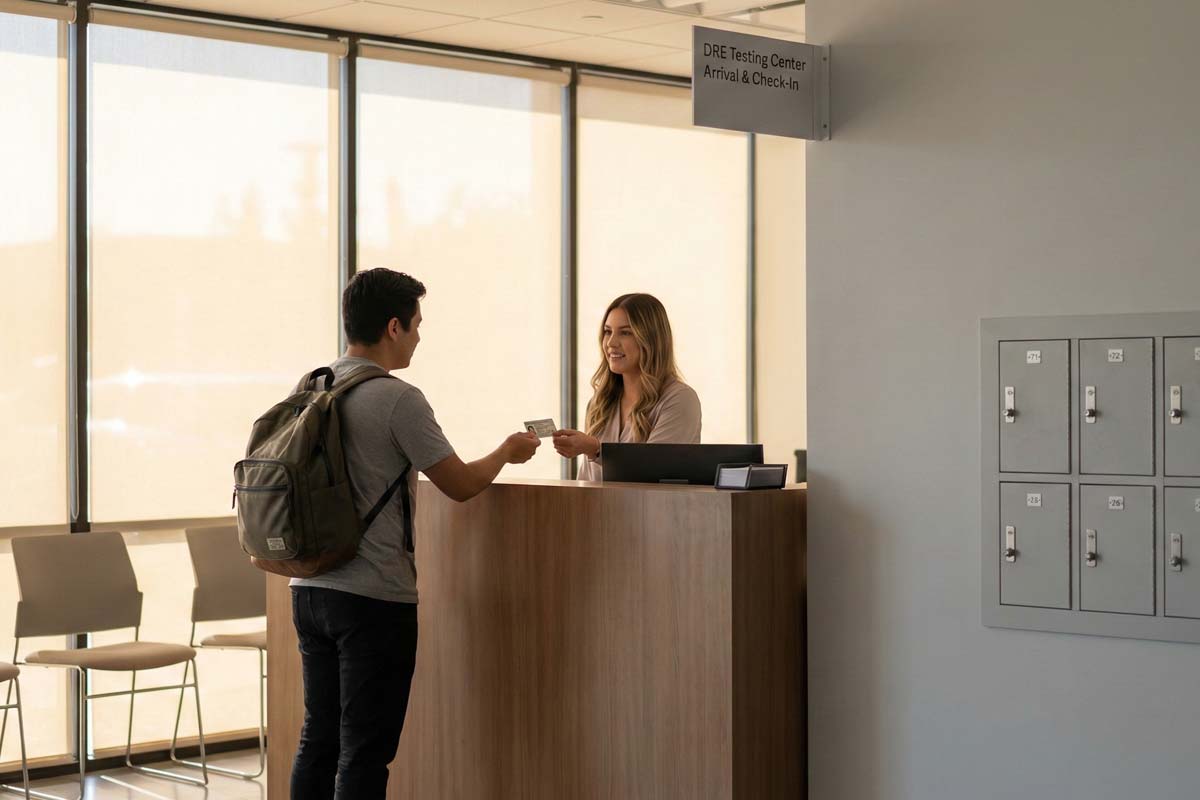
The security measures at DRE centers feel comparable to airport screening. This is to ensure the integrity of the state exam. Be prepared for the following:
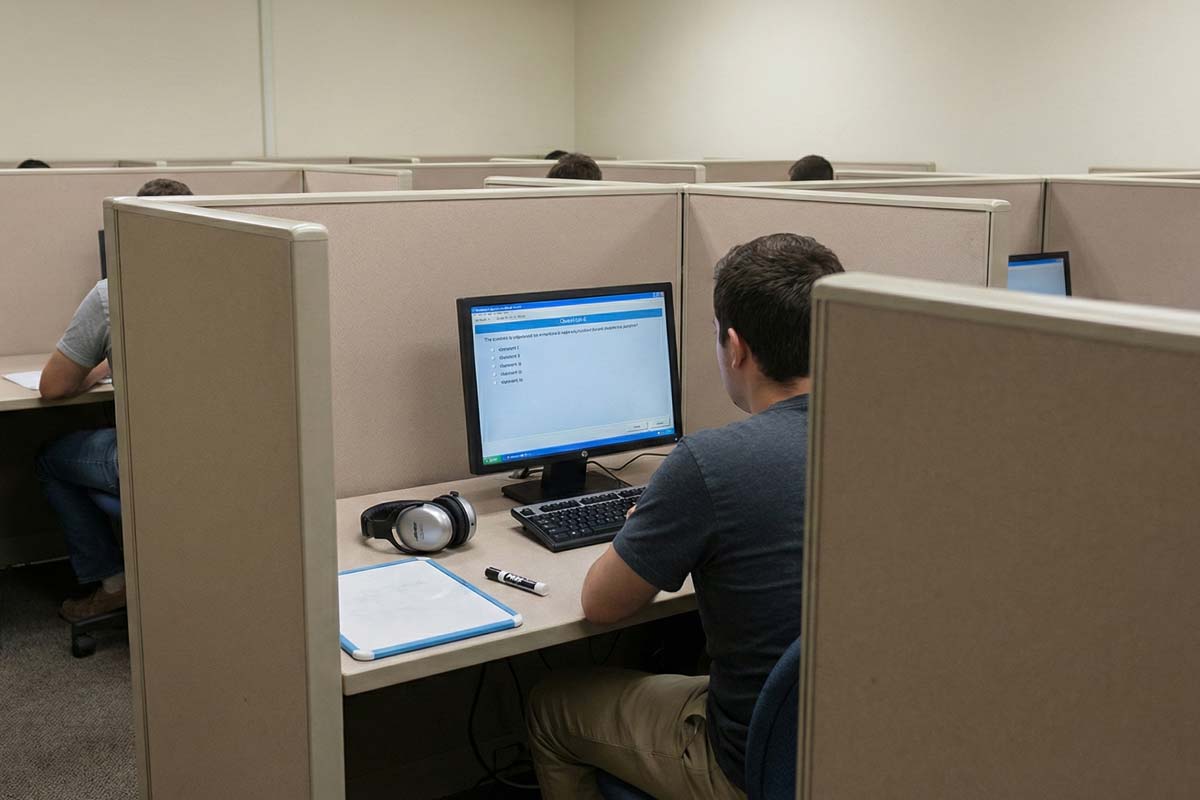
Once you pass security, you are escorted into the testing room. It is typically a room filled with cubicles, similar to a computer lab or a call center. You will be assigned a specific workstation.
It is completely normal to feel a surge of panic during these first few minutes. Most students report a spike in heart rate as they sit in the chair. This is a physiological response to stress, not a reflection of your preparation. Acknowledge it, take a deep breath, and trust that it usually fades once you answer the first five questions.
The Interface: The exam is taken on a computer. This is not a sleek or modern testing interface; it is functional, simple, and dated. You will use the mouse to select A, B, C, or D—there are no fill-in-the-blank or essay questions.
The Restroom Rule: You are permitted to use the restroom during the exam, but be aware that the exam timer does not stop. If you take a 10-minute break, that is 10 minutes less you have to answer questions. Plan your water intake accordingly.
It is important to remember that you must be physically present at the proctored center; current DRE regulations do not allow you to take the California real estate exam online remotely.
You have 3 hours to answer 150 multiple-choice questions for the salesperson exam and 4 hours and 200 questions for the broker test. This breaks down to roughly 1 minute and 12 seconds per question. However, this is an average, not a rigid rule. Some vocabulary questions will take you 10 seconds; some longer “story type” questions might take you 3 minutes.
The "Halfway" Landmark: A good rule of thumb for pacing is to check the timer when you are halfway through the questions. Based on where you are at the halfway mark you might need to speed it up.
The Fatigue Factor: The hardest part of the exam often isn't the difficulty of question #1, but the brain fog that sets in by question #115. Decision fatigue is real. Toward the end of the exam, your brain may try to rush you just to escape the uncomfortable environment.
Recognizing your own biological clock is vital here; if you know your focus crashes after lunch, you should have considered the best time of day to take the California real estate exam to ensure you are testing during your peak mental performance window.
This is the moment that causes the most heart palpitations.
You do not see your result on the screen immediately in the testing cubicle. The screen typically goes blank or returns to a welcome page. You must gather your things and walk out to the proctor at the front desk.
The Result: The proctor will print a piece of paper, fold it, and hand it to you.
To ensure a smooth experience, run through this mental checklist before walking out the door:
The California Real Estate Exam is designed to be rigorous, but it is not impossible. By knowing exactly what to expect when you walk through those doors, you eliminate the element of surprise.
Trust your preparation. You have put in the work, you understand the material, and now you understand the logistics. If you want a complete step-by-step walkthrough of the entire journey—from qualifying to scheduling to test day—the California Real Estate Exam Guide ties everything together to ensure you are ready to launch your new career.
1. What identification is required to check in at the testing center? You must present one current, valid, government-issued ID with a photograph and signature (such as a driver’s license, state ID, or passport). The name on the ID must exactly match the name on your exam registration.
2. Can I bring a calculator into the exam room? No, there is no longer any math on the California real estate exam.
3. Will I see my pass/fail result on the computer screen immediately? No. After you click "Submit," the screen will typically return to a welcome page. You must exit the room to receive a printed report from the proctor. If you pass, it will not list a score; if you fail, it will provide your numerical score and a breakdown.
4. Can I use the restroom during the exam? Yes, you are permitted to use the restroom, but the exam timer does not stop. Any time taken for a break is deducted from your total testing time.
5. How many questions are on the exam and what is the time limit? The salesperson exam consists of 150 multiple-choice questions and you have up to 3 hours to complete. The broker exam is 200 multiple-choice questions and you get 4 hours to complete it.
Founder, Adhi Schools
Kartik Subramaniam is the Founder and CEO of ADHI Real Estate Schools, a leader in real estate education throughout California. Holding a degree from Cal Poly University, Subramaniam brings a wealth of experience in real estate sales, property management, and investment transactions. He is the author of nine books on real estate and countless real estate articles. With a track record of successfully completing hundreds of real estate transactions, he has equipped countless professionals to thrive in the industry.

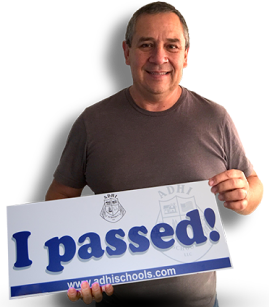
"Hey guys,
I took the exam today and passed!!!!
It only took me one try which was one of my goals. I took the online
classes and follow your suggestions so I took the crash course,
used the crash course app a lot, took 7 mock tests and went
confident to present the exam. Thank you for the great job you are
doing, you guys are awesome!!!! May God continue to bless you!"
Willie V.