
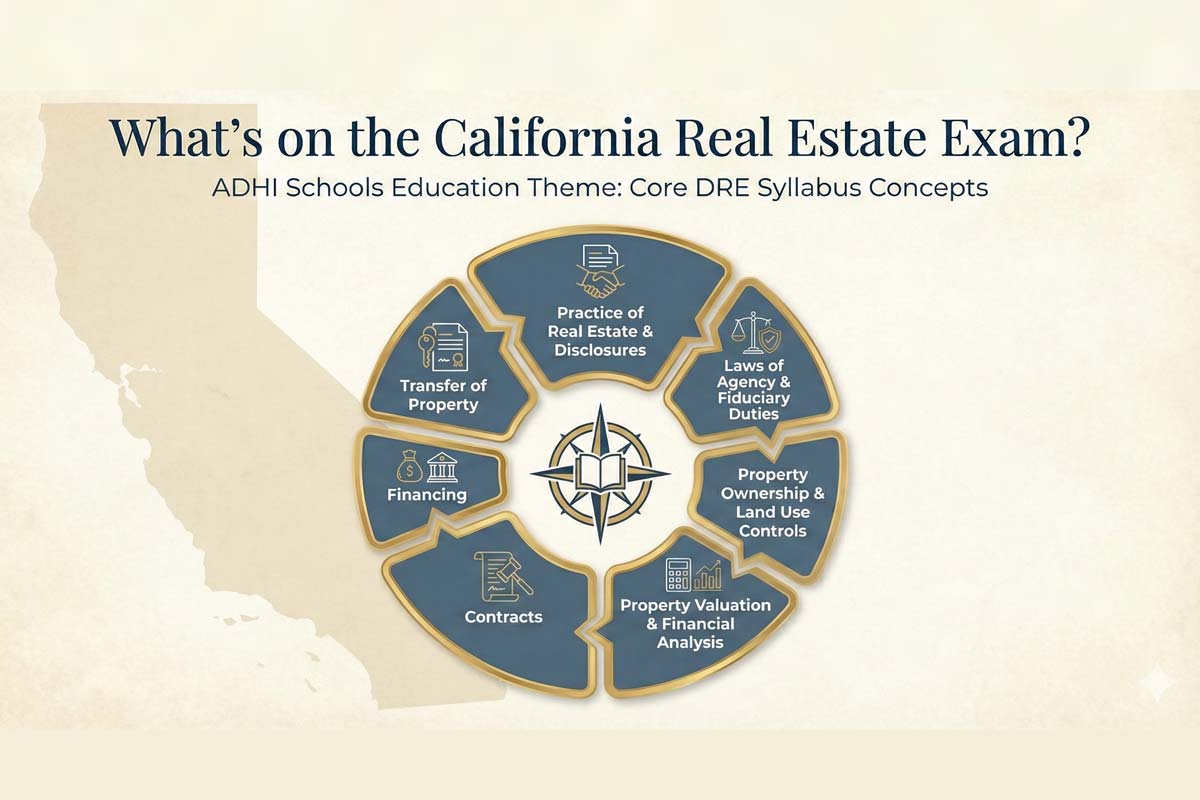
The California Department of Real Estate (DRE) salesperson exam is notorious for its 50% fail rate, but that number is misleading. It’s not an impossible test; it’s just a specific one. Most students fail because they study the wrong things. Here is the good news: the DRE tells us exactly what matters. Master these core areas, and you remove the mystery—and the risk—from exam day.
If you haven’t already reviewed our comprehensive California real estate exam guide, start there for an overview of the full licensing journey.
The DRE structures the real estate license syllabus into seven competency areas. Each represents a skill set you must demonstrate to pass the DRE salesperson exam. Below is a clear breakdown of what you’re expected to know in each and this is true regardless of the sales or broker exams. Sure, the number of questions on each exam is different, but the topics are the same across both tests.
This is the heart of the DRE exam and the section where students commonly underestimate the depth of material. Expect scenario-based questions that test whether you can apply real estate principles, ethical rules, and disclosure laws correctly.
Key concepts include:
You’ll be tested on how agency relationships are created, how they are terminated, and what fiduciary duties a licensee owes.
Key concepts include:
This section examines the legal framework that governs how property is held, controlled, and regulated in California.
Key concepts include:
You don’t need to be an appraiser, but you do need a solid grasp of how value is estimated and how income-producing properties are analyzed.
Key concepts include:
Contracts appear all over the exam because they appear all over real estate practice.
Key concepts include:
Expect questions that test your understanding of lending systems and consumer protection laws.
Key concepts include:
This section deals with how real estate actually changes hands — legally and procedurally.
Key concepts include:

The core real estate principles remain remarkably stable year to year, but the DRE updates exam questions periodically to reflect changes in law, disclosures, lending rules, and fair housing standards. For a deeper breakdown of how topics evolve, review our current California Real Estate Exam content breakdown.
Whether you are taking the sales license or broker exam, passing is not about memorizing isolated facts — it tests whether you can apply concepts to realistic scenarios. The better you understand the underlying real estate principles, the easier it becomes to eliminate wrong answers. To fully prepare, you should also understand how the real estate exam is scored and exactly how many questions are on the exam so you can manage your time effectively.
Focus on understanding, not cramming. Most students waste time over-studying math (there isn’t any math on the exam) or memorizing obscure details. Instead:
To sharpen your testing approach, study our multiple-choice strategies, which are specifically designed for the DRE salesperson exam.
Mastering the seven core areas of the real estate license syllabus is the most reliable path to passing the California Department of Real Estate exam. With the right preparation, consistent practice, and a clear understanding of what the DRE is looking for, you’ll walk into the testing center confident and ready.
Begin your focused review today — the exam is challenging, but absolutely conquerable with the right strategy and guidance.
Is the California real estate exam hard?
It’s challenging, but not because the material is impossible. The exam is hard for people who study the wrong things. If you understand the seven DRE content areas and practice scenario-based questions, it becomes very manageable.
How many questions are on the California real estate exam?
The salesperson exam has 150 questions and the broker exam has 200 questions. Both are multiple-choice and both are timed.
How long do you get to finish the exam?
Salesperson: 3 hours and 15 minutes
Broker: 4 hours
There are no scheduled breaks, so pacing matters.
Does the exam include math?
No. The DRE removed math years ago. You may see questions about valuation concepts (like cap rates or GRM), but you won’t be asked to calculate formulas.
What score do you need to pass?
Salesperson: 70%
Broker: 75%
The DRE does not curve scores and does not release which questions you missed.
Is every exam the same?
No. There are multiple versions in circulation, and the DRE updates questions periodically. However, the content areas and competency weights stay consistent year to year.
Does the DRE test more scenarios or definitions?
Scenarios dominate. Many questions test whether you can apply a rule—not just recognize a definition. This is especially true in agency, disclosures, ethics, and trust fund handling.
Which section of the exam is the hardest?
Most students struggle with:
Can you bring notes, calculators, or reference materials?
No. The exam is closed-book, and the testing center provides everything you’re allowed to use.
Are the salesperson and broker exams based on the same topics?
Yes. The subject areas are the same, but the broker exam goes deeper and includes more questions per topic.
How often can you retake the exam?
As many times as needed. There is no waiting period. The only requirement is paying the re-exam fee and scheduling a new appointment.
What’s the best way to prepare for the content areas?
Use practice questions that mirror DRE logic, focus on the most heavily weighted topics, and study in short, consistent sessions. Understanding beats cramming.
Are exam questions pulled from a public question bank?
No. The DRE does not publish exam questions. Any company claiming to have “real exam questions” is misleading you.
What topics should I NOT waste time studying?
The DRE sticks closely to the seven official content areas.
Does the exam focus on California-specific laws?
Yes. Proper disclosures, agency rules, trust fund handling, and fair housing compliance are all tested from a California perspective, not a national one.

Founder, Adhi Schools
Kartik Subramaniam is the Founder and CEO of ADHI Real Estate Schools, a leader in real estate education throughout California. Holding a degree from Cal Poly University, Subramaniam brings a wealth of experience in real estate sales, property management, and investment transactions. He is the author of nine books on real estate and countless real estate articles. With a track record of successfully completing hundreds of real estate transactions, he has equipped countless professionals to thrive in the industry.

"Hey guys,
I took the exam today and passed!!!!
It only took me one try which was one of my goals. I took the online
classes and follow your suggestions so I took the crash course,
used the crash course app a lot, took 7 mock tests and went
confident to present the exam. Thank you for the great job you are
doing, you guys are awesome!!!! May God continue to bless you!"
Willie V.