
The California real estate exam isn’t a secret code you have to crack in order to pass. The DRE actually publishes a blueprint that tells the world exactly what’s on the test. Once you know how the questions are weighted, you can stop wasting time and start studying the right way and focusing on the things that matter.
I’m going to map it all out for you below.
But first, here is some good news: the biggest section on the exam isn’t necessarily the hardest one.
If you are just beginning your licensing journey, start with our comprehensive California real estate exam guide for a full roadmap.
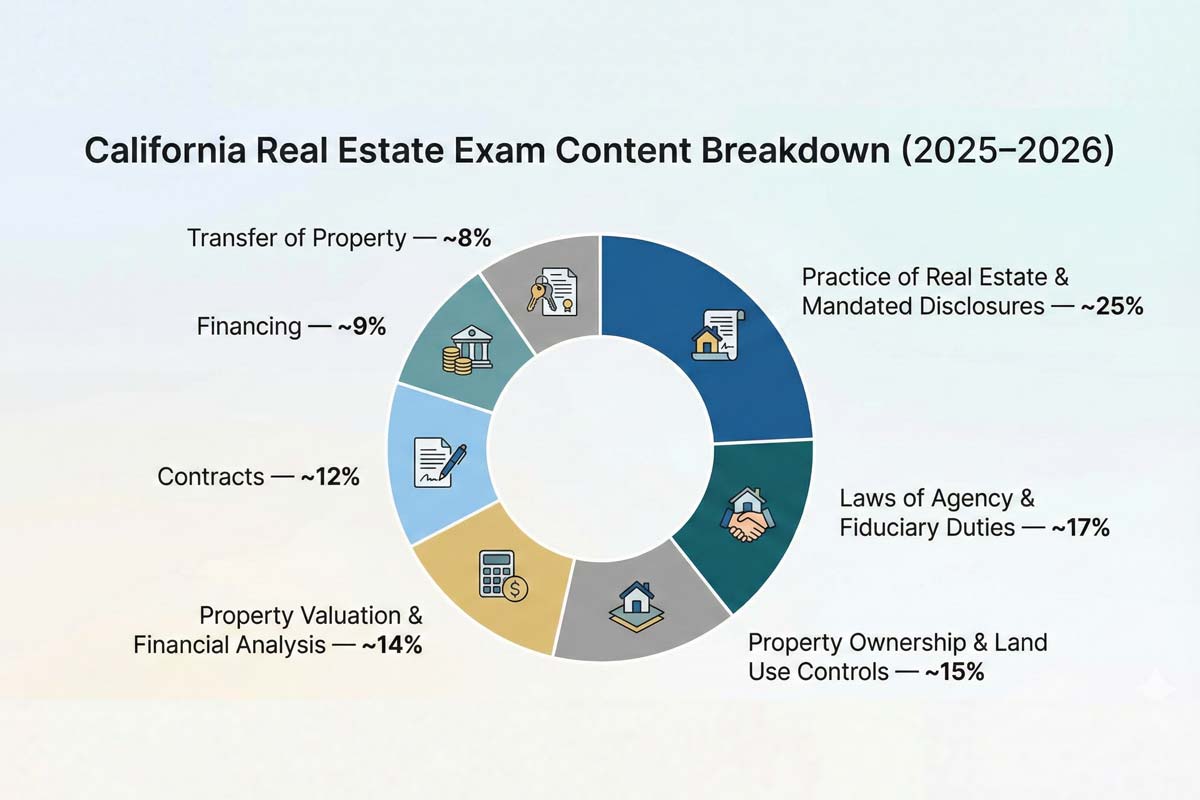
The DRE divides the exam into seven competency areas. While the official titles can sound academic, it is easier to understand them as the practical responsibilities of a licensee.
Which exam category is worth the most points? The Practice of Real Estate and Mandated Disclosures is the heavyweight champion of the exam, accounting for roughly 25% of the questions. However, as we will discuss below, this category is actually a mix of several different skill sets.
These seven categories are the standard framework for both the salesperson and broker exams.
The DRE provides a percentage range for each topic. Below, we break down these weights into a practical study guide.
What It Really Covers: This is the largest section of the exam. It includes Trust Fund handling, Fair Housing laws (Federal and State), the purpose of the Transfer Disclosure Statement (TDS), and strict rules regarding advertising and ethics.
What It Really Covers: This tests how agency is created (express vs. implied), how it is terminated, and the specific duties owed to principals versus third parties. It heavily features "dual agency" scenarios.
What It Really Covers: This covers the different ways to hold title (Joint Tenancy, Community Property), encumbrances (liens, easements), and government powers (Zoning, Eminent Domain).
What It Really Covers: This is about appraisal theory (Cost, Income, and Market Data approaches) and economic principles of value (Substitution, Contribution).
What It Really Covers: This section deals with the validity of contracts (Competence, Mutual Consent, Lawful Object, Consideration) and the specific types of listings (Exclusive Right to Sell vs. Exclusive Agency).
What It Really Covers: This covers the primary vs. secondary mortgage markets, loan types (FHA, VA, Conventional), and consumer protection laws like TILA (Reg Z) and RESPA.
What It Really Covers: This deals with deeds (Grant vs. Quitclaim), title insurance (CLTA vs. ALTA), and the escrow process.
While both exams utilize the exact same seven categories, the lens through which you are tested changes.
The Salesperson exam focuses on the application of rules: "What form do I use?" or "What must I disclose?"
The Broker exam focuses on the above as well as a little more on supervision and management. In addition to the standard content, Broker candidates must understand:
Is the content breakdown the same for salesperson and broker exams? Yes. The DRE uses the same "Content Outline" for both. However, the Broker exam contains 200 questions compared to the Salesperson's 150 and you have to score slightly better on the broker exam to pass.
For more on passing thresholds, read our breakdown of How the California Real Estate Exam is Scored.
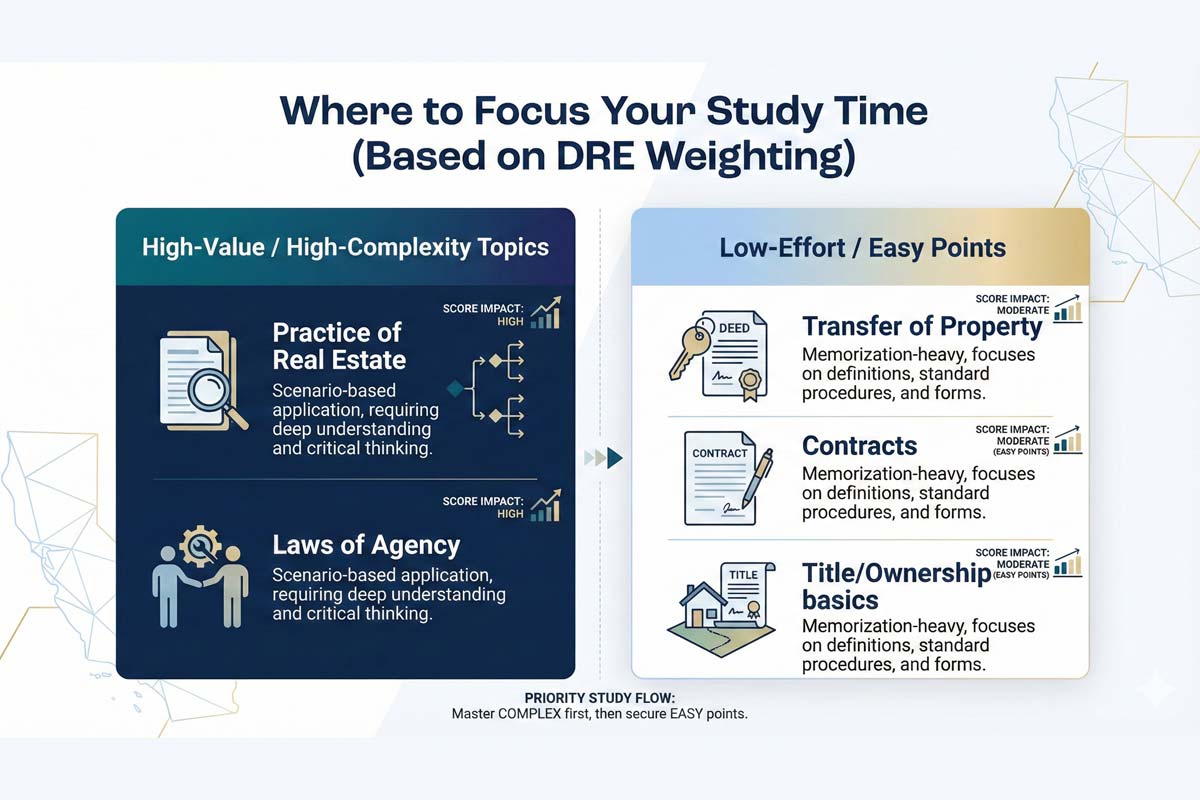
Do not study every topic with equal intensity. The weighting reveals that the DRE values certain competencies over others.
Which exam topics give you the easiest points? Contracts and Transfer of Property. The rules in these sections are rigid and rarely change, making the questions straightforward if you know your definitions.
The DRE uses a psychometric process called "equating" to ensure fairness. Whether you take the exam on a Tuesday in San Diego or a Friday in Oakland, the computer algorithm pulls questions to match this exact percentage blueprint.
Because the DRE uses this fixed blueprint, ADHI Schools’ practice exams mirror the real exam’s balance. When you take our mock tests, you are conditioning your brain to handle the exact distribution of topics you will face on test day.
It prevents panic. If you hit a hard run of Finance questions, you can relax knowing that Finance is only 9% of the exam. You can afford to miss a few hard finance questions and still easily pass if your Agency and Practice knowledge is solid.
To refine your testing tactics further, review our Multiple-Choice Strategy for the CA Real Estate Exam.
Mastering the blueprint gives you an immediate edge over other test-takers who are just memorizing flashcards without a plan.
Ready to start your structured preparation? Return to our California real estate exam guide to take the next step toward your license.
Do I need to pass each of the seven content areas individually?
No. Your score is cumulative. You do not need to score 70% in every single category to pass. For example, if you struggle with Financing (9%), you can make up for those missed points by scoring highly in Practice of Real Estate (25%) and Agency (17%).
Does the high weighting for Valuation and Financing mean there is a lot of math?
No. While Property Valuation (~14%) and Financing (~9%) make up nearly a quarter of the exam, the DRE focuses on concepts, not calculations. You will be tested on the principles of value and loan structures, but you will not be asked to perform complex arithmetic.
How strict are these percentages?
They are approximations provided by the DRE. On any given exam version, the specific number of questions may fluctuate slightly.
Is the "Practice of Real Estate" the hardest section because it is the largest?
Not necessarily. While it has the most questions (approx. 25%), many of them cover straightforward topics like Fair Housing and Truth-in-Advertising. Many students find the Laws of Agency section more difficult because it relies heavily on interpreting complex scenarios rather than memorizing facts.

Founder, Adhi Schools
Kartik Subramaniam is the Founder and CEO of ADHI Real Estate Schools, a leader in real estate education throughout California. Holding a degree from Cal Poly University, Subramaniam brings a wealth of experience in real estate sales, property management, and investment transactions. He is the author of nine books on real estate and countless real estate articles. With a track record of successfully completing hundreds of real estate transactions, he has equipped countless professionals to thrive in the industry.

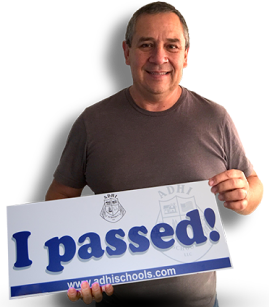
"Hey guys,
I took the exam today and passed!!!!
It only took me one try which was one of my goals. I took the online
classes and follow your suggestions so I took the crash course,
used the crash course app a lot, took 7 mock tests and went
confident to present the exam. Thank you for the great job you are
doing, you guys are awesome!!!! May God continue to bless you!"
Willie V.