
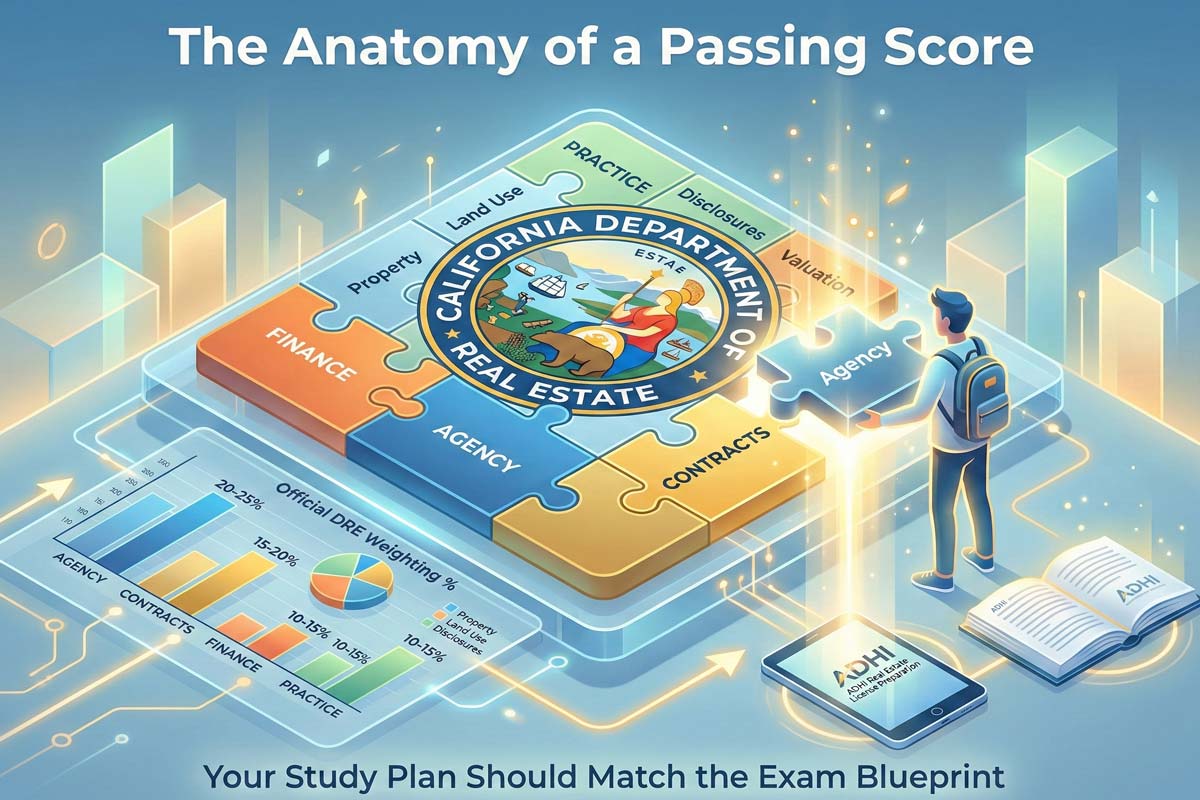
Most students walk into the California real estate exam feeling confident—until they start wondering how the DRE actually scores it. Is the test curved? Do different people get different versions? Does getting exactly 70% guarantee a pass?
Here’s the truth:
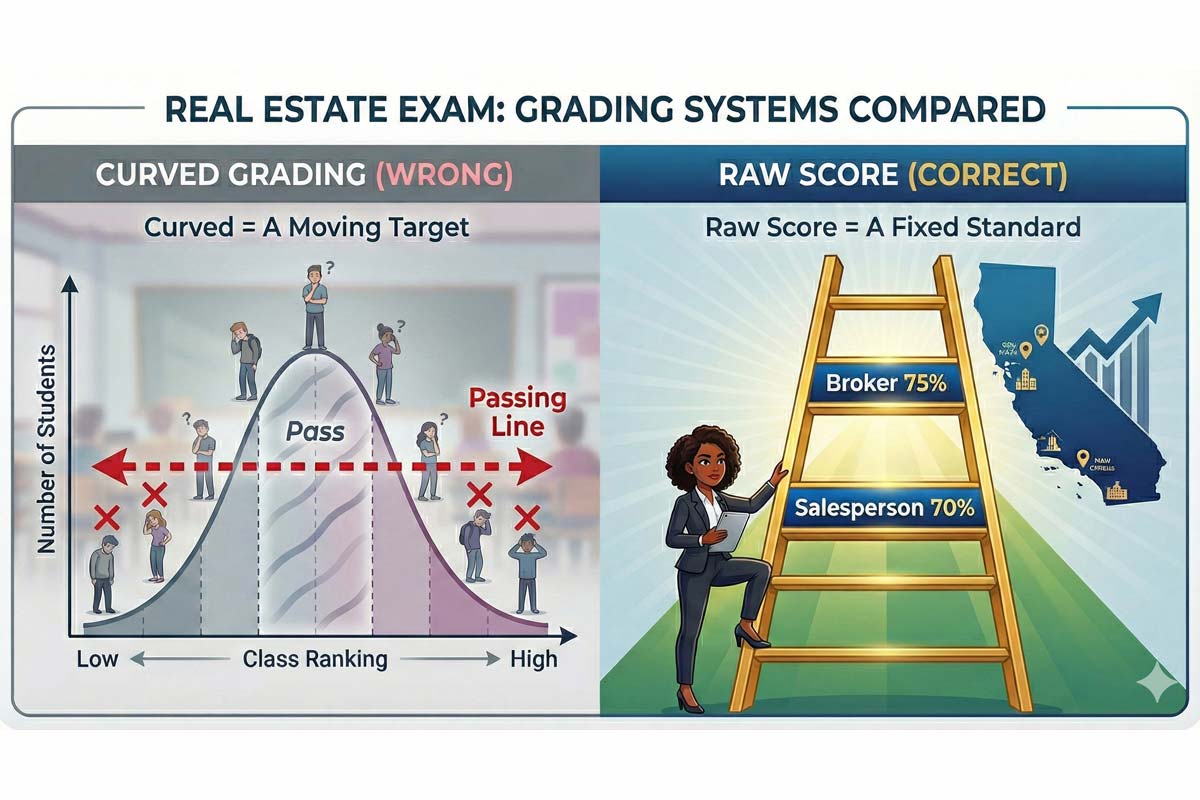
The DRE does NOT curve the exam and you can absolutely pass on the first attempt once you understand how their scoring system works.
In this guide, I’ll break down every scoring rule the DRE uses—clearly, accurately, and in plain English—so you know exactly what it takes to pass.
If you’re just getting started, make sure you are also reviewing our full California Real Estate Exam Guide for the complete exam roadmap.
The most important thing to understand is this:
This is the backbone of how the DRE ensures fairness.
Those percentages are absolute—not relative to how anyone else performs.
The California DRE uses a raw scoring system to determine a pass or fail. This means your score is based directly on the number of questions you answer correctly, measured against a fixed, non-negotiable threshold.
However, to ensure this raw score is a fair measure for every test-taker, the DRE employs a rigorous process of exam form equating before any candidate ever sees the questions.
In essence, raw scoring gives you a clear target, while expert equating guarantees that hitting that target means the same thing, no matter which exam form you receive.
You'll hear many prep courses and forums talk about the DRE's "scaled scoring." This is a widespread misconception. The California DRE does not use a traditional scaled score to determine your pass/fail result.
Here’s the reality:
Your exam is scored on a straightforward, raw percentage basis. To pass, you must correctly answer a specific percentage of questions (approx. 70% for salesperson, 75% for broker). The result is a direct comparison of your correct answers to this absolute benchmark.
The process often mistaken for "scaling" is called equating. This is a psychometric calibration performed by the DRE during the exam development phase. Experts adjust and validate questions so that the difficulty of reaching the passing raw score is consistent across all exam versions. This means:
By using equated exam forms with a raw score threshold, the DRE ensures that:
A true "scaled" score might change the finish line based on who's running. The DRE's system, instead, carefully calibrates the track so that everyone runs the same distance to reach the fixed, unmoving finish line. Your raw score simply tells you if you crossed it.
The DRE releases only:
When you pass the exam, they do not tell you how close you were or how many you missed.
However, if you fail the exam, the DRE will report your overall score as well as how you did in each of the seven exam categories so you know where to focus your efforts.
Let’s say it as clearly as possible:
There is:
How Fast the DRE Scores Your Exam
Since the state exam is computer based you receive your result immediately after finishing.
If you fail:
False.
There is no quota. Passing is based only on your performance relative to the published standard.
Completely false.
Versions are pre-set and rotated randomly.
Partially true but misunderstood.
The exam blueprint allocates topics by percentage, but every student receives the same category weighting.
Scaling does not adjust category weight per individual.
See our Exam Content Breakdown for exact percentages.
They do not.
No one at the DRE can release that information.
If you want the highest probability of passing the first time, start with ADHI Schools.
ADHI offers:
Our students pass because our test taking strategies are built around how the DRE actually scores the exam—not myths, shortcuts, or generic national content.
Is the California real estate exam curved? No. The California DRE uses a raw scoring system, not a curve. Your score is based solely on the number of questions you answer correctly, and it is never graded against or compared to the performance of other students.
What is the passing score for the California real estate exam? For the Salesperson Exam, you must achieve a score of 70%. For the Broker Exam, the passing threshold is 75%. These percentages are fixed and non-negotiable.
Does the DRE use scaled scoring? No. While the DRE uses a process called "equating" to ensure different versions of the test have the same difficulty level, this happens before you take the test. Your final grade is a simple raw score based on your correct answers, not a statistically manipulated "scaled" score.
Will I see my actual final score? Only if you fail. If you pass, the DRE only releases a "PASS" notification with no numeric score or breakdown. If you fail, you will receive your numerical score and a breakdown of your performance across the seven exam categories.
Is there a limit to how many people can pass each day? No. There is no quota for passing grades. Every single student who hits the required 70% (or 75% for brokers) will pass, regardless of how many other people are testing that day.
How long does it take to get my exam results? You will receive your results immediately. Because the California exam is computer-based, your pass/fail status is provided at the testing center the moment you finish.
Does the time of day affect exam difficulty? No. It is a myth that afternoon exams are harder. Exam versions are pre-set and rotated randomly; the time of day you test has absolutely no impact on which version you receive.

Founder, Adhi Schools
Kartik Subramaniam is the Founder and CEO of ADHI Real Estate Schools, a leader in real estate education throughout California. Holding a degree from Cal Poly University, Subramaniam brings a wealth of experience in real estate sales, property management, and investment transactions. He is the author of nine books on real estate and countless real estate articles. With a track record of successfully completing hundreds of real estate transactions, he has equipped countless professionals to thrive in the industry.

"Hey guys,
I took the exam today and passed!!!!
It only took me one try which was one of my goals. I took the online
classes and follow your suggestions so I took the crash course,
used the crash course app a lot, took 7 mock tests and went
confident to present the exam. Thank you for the great job you are
doing, you guys are awesome!!!! May God continue to bless you!"
Willie V.