

Failing the California real estate exam can feel confusing and discouraging—especially if you studied hard and thought you were prepared. After teaching thousands of students at ADHI Schools, I can tell you this: good people fail this exam for predictable, fixable reasons.
Most students who fail aren’t lacking intelligence. They’re dealing with:
This 2026 update breaks down why people fail—and how to avoid doing it again. If you need the full roadmap, revisit our California Real Estate Exam Guide for big-picture context.
This is the most common failure point for people that don’t pass the real estate exam on the first attempt.
Most students think they know what’s important, but the DRE’s actual blueprint tells a different story. People over-study math, obscure facts, or random topics—and under-study the heavy hitters like Practice of Real Estate and Mandated Disclosures, Agency, and Contracts.
If the exam felt “nothing like what I studied,” it’s usually a blueprint mismatch not because the California real estate exam is inherently hard.
The DRE exam is not a vocabulary quiz. It’s a psychometric, scenario-based exam.
Even when two answers look right, only one reflects the best professional judgment.
Examples:
Students who memorize instead of understanding get crushed by paragraph-style questions.
Understanding beats memorization every time.
Even with strong knowledge, poor strategy sinks scores.
The CA exam is designed with:
Weak strategy leads to:
Yes, you “completed” the hours. But did you learn the material?
Common problems:
The DRE requires structured pacing for a reason: cramming destroys comprehension.
Your 135 hours are the foundation. If the foundation is weak, the exam will expose it.
The pacing is strict:
Two patterns cause failure:
Spending too long on early questions → panic later → rushed guesses at the end.
When tension rises, accuracy drops. Even easy questions start to feel hard.
You can know the material and still fail simply from mismanaging the clock or stress.
The exam rewards calm, not perfection.
Practice tests help—but they can also mislead.
Students score 80–85% on practice questions and assume the real test will feel similar. But:
Overconfidence destroys focus on test day.
If you “crushed the practice tests” but failed the DRE exam, this is likely the reason.
Most people study based on what feels comfortable, not what the data shows.
Real patterns:
But the DRE doesn’t care about your feelings—it cares whether you get the heavy-weighted categories right.
Then study ONLY your weakest two or three areas until they improve.
This is how repeat test-takers turn scores around fast.
There is so much myth around how the exam is scored.
Here’s the truth:
When students misunderstand scoring, they:
If scoring confuses you, read How the CA Real Estate Exam Is Scored for a full breakdown.
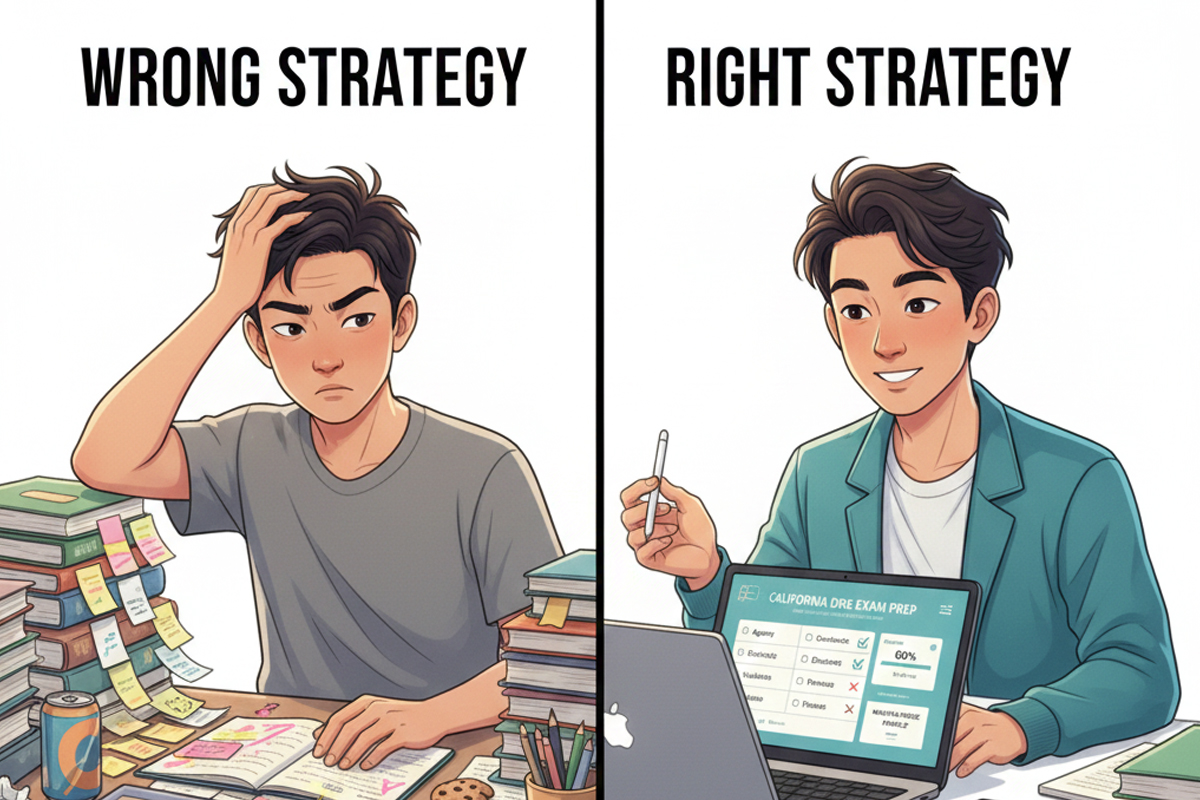
Failing once is common. Failing repeatedly happens only when students don’t change their approach.
Here’s your reset plan.
Give yourself a day to be upset. Then move into diagnosis-mode:
“Where exactly did things break down?”
Anchor everything to the California Real Estate Exam Guide and the Content Breakdown.
Use chapter quizzes, practice tests, and memory from the exam.
If timing or distractors tripped you up, revisit our Multiple-Choice Strategy article.
Slow down. Relearn. Retest.
If you need reassurance about retake limits, see How Many Times Can You Take the CA Real Estate Exam?
You have time—and unlimited attempts within your application window.
Your goal isn’t to “beat the test.”
Your goal is to perform like the licensee the DRE is willing to approve.
At ADHI Schools, everything we teach—including exam prep, crash courses, and strategy coaching—is built around California-specific DRE standards, psychometrics, and student performance data.
If you’re tired of guessing, overwhelmed with conflicting advice, or don’t want another exam fee on your credit card, we can help you approach the next attempt correctly, confidently, and strategically.
You don’t have to be the person who almost became an agent.
With the right structure, the right content, and the right test strategy, you will pass this exam.
Ready when you are.
Most students fail because they study the wrong material. The DRE blueprint emphasizes topics like Practice of Real Estate and Mandated Disclosures, Agency, and Contracts, not the random facts or formula-heavy topics many students focus on. Aligning your study plan with the actual DRE weighting dramatically improves pass rates.
Yes—mainly because the exam is a psychometric, scenario-based test, not a memorization test. Students who rely on flashcards or definitions often struggle with paragraph-style questions that require judgment, application, and analysis.
You must score at least:
The DRE uses raw scoring, not a curve. A miss is a miss—whether the question was “easy” or difficult.
This is extremely common. Practice tests often:
Students should treat practice test scores as data, not predictions. Using an Error Log to categorize missed questions is one of the most effective ways to improve.
Absolutely. The exam is a timed endurance test, and anxiety causes students to:
Using a simple reset phrase like “One question at a time” or “Slow is smooth” helps regain focus.
Yes. Many students understand the concepts but still fail due to:
Knowledge without a strategy leads to preventable mistakes.
California allows unlimited retakes within your two-year application window. There is no penalty for failing besides paying the exam fee again. See our guide: How Many Times Can You Take the CA Real Estate Exam?
You should follow a structured reset plan:
Repeat test-takers improve fastest when they take a data-driven approach, not a “study everything again” approach.
No. The DRE does not curve, scale, or adjust scores. Each question carries equal weight. Different exam forms are equated psychometrically to ensure fairness, meaning the difficulty level is balanced statistically—not curved.
Focus on the highest-weighted categories, which often include:
These areas make up a significant portion of the exam and must be mastered to pass. See our California Real Estate Exam Content Breakdown for details.

Founder, Adhi Schools
Kartik Subramaniam is the Founder and CEO of ADHI Real Estate Schools, a leader in real estate education throughout California. Holding a degree from Cal Poly University, Subramaniam brings a wealth of experience in real estate sales, property management, and investment transactions. He is the author of nine books on real estate and countless real estate articles. With a track record of successfully completing hundreds of real estate transactions, he has equipped countless professionals to thrive in the industry.

"Hey guys,
I took the exam today and passed!!!!
It only took me one try which was one of my goals. I took the online
classes and follow your suggestions so I took the crash course,
used the crash course app a lot, took 7 mock tests and went
confident to present the exam. Thank you for the great job you are
doing, you guys are awesome!!!! May God continue to bless you!"
Willie V.