
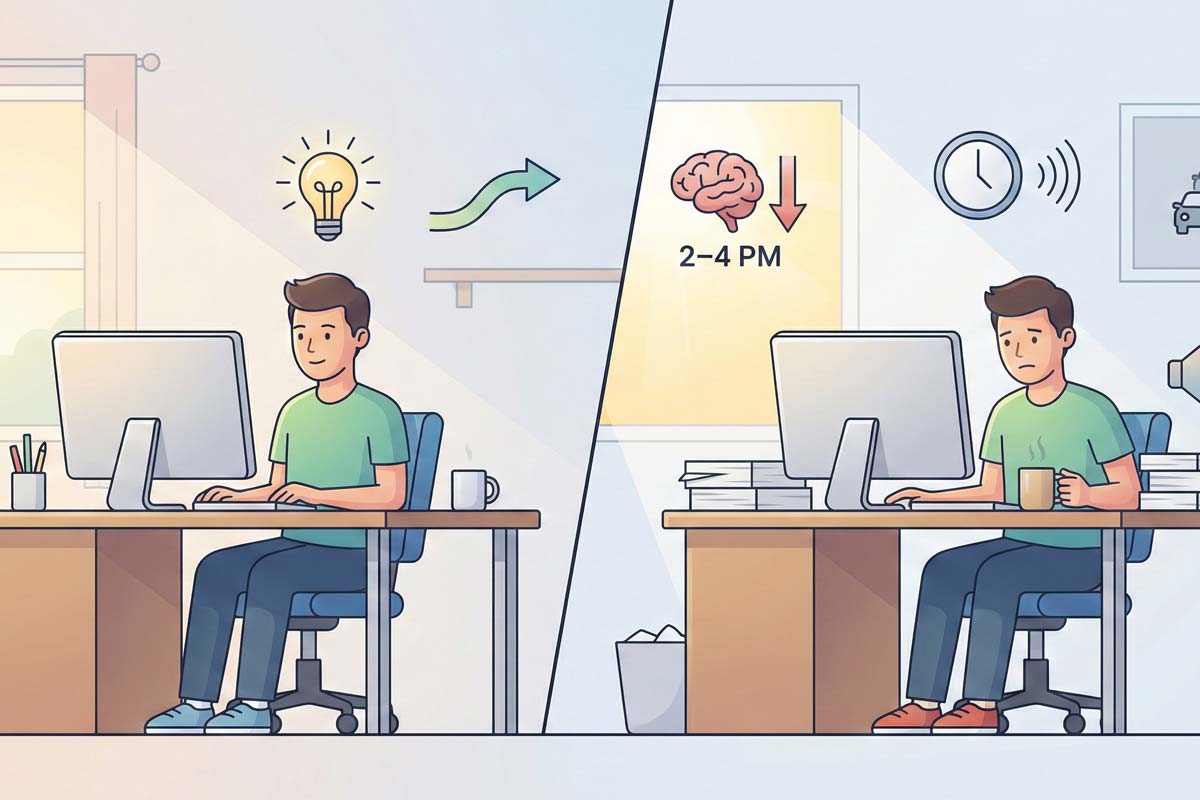
Selecting a date for your state licensing exam is a milestone, but selecting the right time of day is a strategy.
Most students treat the time slot as a matter of convenience—scheduling around work shifts or childcare. However, when you are preparing to sit for an exam that could determine your career future, convenience should be secondary to cognitive performance.
The Department of Real Estate (DRE) typically offers morning and afternoon sessions. The content of the exam does not change based on the time, nor does the scoring criteria. However, your ability to focus, recall information, and manage anxiety absolutely fluctuates. By aligning your exam slot with the two biggest variables—your biological chronotype and local logistics—you give yourself a statistical edge.
There is no officially mandated "correct" time that guarantees a passing grade. However, research suggests there is a best time for your specific physiology.
Cognitive science indicates that for approximately 75% of adults, analytical thinking and focus peak in the late morning. Conversely, the "post-lunch dip"—a documented circadian trough occurring between 2:00 PM and 4:00 PM—can significantly impact mental endurance. However, biology is adaptable; if you are forced into a time slot that doesn't match your rhythm, you can shift your circadian peak by taking practice exams at that specific time for a couple of weeks prior to the test.
But biology isn't the only factor. Your choice must also account for:
Because the 2026 California real estate exam contains no math questions and allows no calculators, the test consists entirely of conceptual questions, vocabulary, and scenario-based reading comprehension. You do not need calculation power; you need sustained mental endurance. You must choose a time slot that aligns with your peak mental alertness.
Your brain’s performance on a standardized test is influenced by three main biological factors: cortisol levels, body temperature, and decision fatigue.
Cortisol is the "waking hormone." For most people, it peaks around 30 to 45 minutes after waking up. This natural spike helps clear morning grogginess. If you schedule an 8:00 AM exam but usually wake up at 7:30 AM, you may be sitting in the testing chair before your brain has fully engaged.
Decision fatigue is real. As the day progresses, the brain becomes tired of making choices. By the afternoon, after navigating traffic, scrolling through emails, or handling domestic tasks, your "willpower battery" is depleted. Because the California exam is heavily weighted toward scenario-based questions ("What should the agent do next?"), decision fatigue is particularly dangerous here. It can lead to careless errors on nuance questions you actually know the answers to.
Since the DRE removed math from the exam, the test is less about formulas and more about linguistic nuance. Reading 150 or more scenario-based questions requires high-level executive function. If you are prone to afternoon slumps, the sheer volume of reading in a PM session can feel overwhelming compared to an AM session.
Morning slots (typically starting between 8:00 AM and 9:00 AM) are the most popular choice for first-time test takers, but they come with specific trade-offs.
Afternoon slots (typically starting between 1:00 PM and 1:30 PM) offer a buffer for those who need a slower start to their day.

Biology is important, but geography often dictates your schedule. California is vast, and the location of your test center should heavily influence whether you choose an AM or PM slot.
For example, if you are testing in San Diego or Oakland, an 8:00 AM exam requires arriving by 7:30 AM at the latest. This places you on the freeway during the absolute worst congestion of the day.
Remember: Traffic conditions are determined by your arrival time, not your appointment time. The stress of being late can spike your heart rate and scramble your focus before you even see the first question.
When evaluating specific California real estate exam testing centers, consider the local traffic patterns surrounding the facility. If the center is located in a high-density office park, parking might be scarce in the mid-morning but open in the early morning. Conversely, some centers have dedicated lots that fill up by 8:30 AM.
The DRE uses a "first come, first served" model through the eLicensing system.
Morning slots tend to fill up faster than afternoon slots because many professionals prefer to take the exam and then head to work. This is especially true during the busy spring season (Q1 and Q2), where morning availability can become scarce. Once you've chosen the testing time that aligns with your chronotype, make sure you know how to schedule the California real estate exam properly—popular morning slots often fill quickly. Delaying your scheduling may force you into a less ideal time block.
Your strategy for the day changes based on your clock.
For Morning Exams: Focus on a high-protein breakfast. Avoid heavy carbohydrates that induce sleepiness. Your goal is immediate, sustained energy. Arrive early enough to use the restroom and acclimate to the room temperature.
For Afternoon Exams: Eat a moderate lunch. A heavy meal right before a 1:00 PM test precipitates cognitive decline and drowsiness. Use the morning to relax, not to panic-study. Your arrival protocol changes slightly based on the time of day, understand what to expect on exam day regarding check-in lines and lobby congestion. Afternoon lobbies are often crowded with morning test-takers leaving as afternoon candidates arrive.
In the modern era, students often assume they can take the test at midnight from their home computer. This is a dangerous misconception.
Because it is currently impossible to take the California real estate exam online, you are bound to the physical constraints and operating hours of a brick-and-mortar test center. While rigid, this standardized schedule offers predictability. You cannot choose a random start time like 10:45 AM, and you cannot control the environment. This makes your choice of the standard AM or PM block even more critical. You must perform on their schedule, in person, under proctored conditions.
There is no magical time slot that makes the questions easier. The DRE creates a standardized difficulty level regardless of when you sit for the test. However, you can control the variables surrounding the test.
Aligning your biological clock with your testing schedule is just one component of a broader strategy found in our comprehensive California Real Estate Exam Guide. Success is about preparation—both of your mind and your logistics.
Is the morning or afternoon real estate exam easier? Statistically, neither exam is "easier." The difficulty level is identical, and time of day does not impact scoring. However, some students find morning exams subjectively easier because their brains are fresher and less fatigued by the day's events.
Do testing centers ever run behind schedule? Yes. While morning sessions almost always start on time, afternoon sessions can occasionally face delays if the morning check-out process runs long or if there are technical glitches at the facility.
Should I try a practice exam at the same time of day I plan to test? Yes. This is highly recommended. Taking a full-length simulated exam at the exact time of your scheduled test helps train your brain to be alert during that specific window, effectively shifting your circadian rhythm.
Should I drink coffee before the exam? If you normally drink coffee, yes. Do not change your caffeine routine on exam day. However, avoid drinking too much liquid immediately before the test, as unscheduled restroom breaks eat into your exam time.
Are morning exam slots quieter? Generally, yes. Morning sessions often have fewer distractions because the office building or testing complex hasn't fully "woken up" yet. Afternoon sessions may have more ambient noise from hallway traffic or street noise.
How early should I arrive for a morning exam? You should aim to arrive at the testing center at least 30 minutes before your scheduled start time. For an 8:00 AM exam, this means arriving by 7:30 AM to handle parking and check-in procedures.

Founder, Adhi Schools
Kartik Subramaniam is the Founder and CEO of ADHI Real Estate Schools, a leader in real estate education throughout California. Holding a degree from Cal Poly University, Subramaniam brings a wealth of experience in real estate sales, property management, and investment transactions. He is the author of nine books on real estate and countless real estate articles. With a track record of successfully completing hundreds of real estate transactions, he has equipped countless professionals to thrive in the industry.

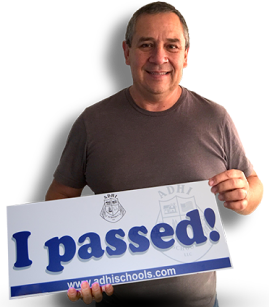
"Hey guys,
I took the exam today and passed!!!!
It only took me one try which was one of my goals. I took the online
classes and follow your suggestions so I took the crash course,
used the crash course app a lot, took 7 mock tests and went
confident to present the exam. Thank you for the great job you are
doing, you guys are awesome!!!! May God continue to bless you!"
Willie V.