
Imagine it’s Friday at 4:00 PM. You’re 14 days into a transaction in Irvine with a 21-day timeline.
The lender just called: the buyer’s debt-to-income ratio is blown because of a new car lease. Read more...
Imagine it’s Friday at 4:00 PM. You’re 14 days into a transaction in Irvine with a 21-day timeline.
The lender just called: the buyer’s debt-to-income ratio is blown because of a new car lease. Simultaneously, the appraisal came in $25,000 short, and the seller is refusing the Request for Repair because they feel "insulted."
In California’s deadline-driven, high-liability market, this is where most agents panic. They start "hustling"—calling everyone, venting, and hoping for a miracle.
But hope is not a strategy. After 20+ years of coaching California agents, I can tell you that a deal-killing mistake usually isn’t one big error—it’s a sequence of small misses: unclear expectations, missed deadlines, and sloppy communication.
To survive, you don't need more hustle; you need an operating system. California’s escrow structure—strict contingencies, statutory disclosures, and form-driven enforcement—leaves very little margin for improvisation. Mastering these Real Estate Agent Skills California is the difference between a top producer and a former agent.
What is a "Deal-Killer" in Practice?
In the California real estate ecosystem, a "deal-killer" is any process failure that leads to an unnecessary cancellation, a legal impasse, or a lender denial.
California contracts are uniquely deadline-driven. Whether you are using the standard C.A.R. 17-day contingency period or a shortened timeline, there is no room for "handling it later." My experience has shown that the fastest way to lose control of a deal is to negotiate by phone without a written recap email. When you lose the paper trail, you lose the deal.
Most Common Escrow Mistakes in California: The Top 10
1. Contingency Mistakes That Cost Commissions
Real Life: Assuming the "17-day period" is a suggestion and forgetting to deliver a Notice to Perform (NTP).
The Mechanism: It creates a "zombie escrow" where no one is committed, leading to a sudden, emotional cancellation on day 25.
Prevention: Every date goes in a shared calendar on Day 1. Never let a date pass without a formal removal or written extension.
Script: "The contract is our clock. If we don’t move today, we lose our leverage."
Deep Dive: Learn how to explain contract terms to clients clearly to avoid these timeline traps.
2. Poor Expectation Setting
Real Life: Telling a buyer "don’t worry, the seller will fix everything" before the inspection occurs.
The Mechanism: You’ve created a "fantasy" deal. When reality hits, the buyer feels betrayed.
Prevention: Conduct a "Pre-Escrow Reality Check." Explain that escrow is a series of hurdles, not a victory lap.
Script: "My job isn't to tell you what you want to hear; it’s to show you the obstacles before we hit them."
3. Disclosure and Document Sloppiness
Real Life: Delivering a messy, incomplete TDS (Transfer Disclosure Statement) late in the game.
The Mechanism: Late disclosures can re-open questions and trigger new review periods, giving the buyer a clean psychological "exit ramp" exactly when they are feeling most nervous.
Prevention: Sellers should complete all disclosures before going on the market.
Script: "We provide everything upfront so the buyer has no excuses to walk away later."
4. Repair Request Mistakes That Blow Up Negotiations
Real Life: Turning a Request for Repair into a personal conflict over cosmetic items.
The Mechanism: You lose the "Big Picture." The deal dies over a $500 water heater because the parties stopped looking at the math.
Prevention: Focus on "Health and Safety" first. Have a trade strategy—know what a roof repair actually costs before you ask for a credit.
Script: "We aren't solving feelings today; we are solving terms to get you to your next house."
Refine your approach: Review these negotiation tactics every California agent should know.
5. Appraisal Gap Mistakes in California
Real Life: The appraisal comes in $30k low, and you start complaining about the appraiser instead of the data.
The Mechanism: Blame creates paralysis. Without a data-driven plan, the buyer walks.
Prevention: Prepare an "Appraisal Package" for the appraiser at the start. If a gap occurs, have a three-way solution framework ready (buyer funds, seller price adjustment, or commission concessions where appropriate).
Script: "The data gave us a gap. Here are the three ways we bridge it to keep your move on track."
Strategy Guide: See our guide on how to handle appraisal gaps in California.
6. Multiple-Offer Confusion
Real Life: Picking the highest price—which happens to have the weakest financing and a 10-day close.
The Mechanism: The "highest price" often has the highest risk of "Buyer's Remorse."
Prevention: Use an offer comparison grid focusing on certainty and terms.
Script: "A high price is just a number on a page until the lender clears it. Let's look at the certainty."
Win the Bid: Master how to present and win multiple-offer situations.
7. Communication Blackouts (No Written Recap)
Real Life: Having a "great talk" with the other agent on the phone but never sending a follow-up email.
The Mechanism: "He said/She said" becomes the narrative when the deal gets tough.
Prevention: Every phone call ends with an email: "Per our conversation, we agreed to X..."
Script: "I'm going to send a quick recap of what we just discussed so we are both on the same page for our clients."
8. Failure to Control the Cancellation Pathway
Real Life: Letting the other side "drift" past deadlines without using professional forms.
The Mechanism: You lose the ability to control the narrative. If you don't use your forms, you are negotiating from "vibes," not the contract.
Prevention: Use the Notice to Perform (NTP) and Demand to Close Escrow (DCE) as professional tools, not weapons.
Script: "My seller requires me to issue this notice to keep our timelines in compliance with the contract."
9. Unforced Errors (Overpromising)
Real Life: Telling a buyer they can "definitely" build a pool or move a wall without checking local zoning or easements.
The Mechanism: Misrepresenting material facts leads to lawsuits and cancellations during the due diligence period.
Prevention: Never answer a question you aren't 100% sure of. Point to the experts (inspectors, city planning).
Script: "That’s a great question for the inspector/city. Let's get that in writing from them."
The 60-Second Escrow Triage Decision Tree
When a problem hits, stop. Don't react. Use this triage:
Is this a DEADLINE problem?
Action: Request/Grant an extension in writing today.
2.Is this a MONEY problem (Appraisal/Lending)?
Action: Identify the exact gap. Present 3 solutions: Seller credit, Buyer cash, or Price drop.
Is this an EMOTION problem?
Action: Pause. Label the emotion ("I can see you're frustrated"). Reframe to the goal: "Do you still want to be in [City] by next month?"
Quick Checklist: The Deal-Saver (Screenshot This)
Day 1: Calendar every contingency + "48-hour rule" reminders.
The Kickoff: Send a deadline email to all parties (Lender/Escrow/Title).
Weekly: Schedule a Tuesday "Lender Pulse Check."
Audit: Perform a disclosure completeness check by Day 2.
Paper Trail: Send a written recap after every negotiation call.
Escalation: Always have two options ready before calling your client with bad news.
The Escrow Operating System
Success in escrow is a repeatable cadence.
Phase
Action Item
Kickoff
Send a "Milestone Email" to all parties. Schedule an "Expectations Call."
Every Tuesday
Call the lender. Ask: "Is there any reason we won't fund on time?"
48 Hours Pre-Deadline
Confirm the inspection is scheduled or the appraisal is ordered.
Problem Hits
Identify issue → Draft Options A & B → Present recommendation.
Frequently Asked Questions
What are the most common reasons deals fall apart in California?
Beyond the "Big Three" (Appraisal, Inspection, Loan), most deals die because of "buyer's remorse" triggered by an agent who failed to manage the psychological timeline of the escrow.
What if the buyer’s lender changes the terms mid-escrow?
Immediately request a "Loan Commitment Letter" and have your backup local lender review the file. If the terms change significantly, it may trigger a new disclosure period.
How do I keep a deal together when the seller is emotional?
Stop talking about the house and start talking about their "Next Step." Remind them why they are moving. Emotions live in the present; logic lives in the future goal.
Stop Improvising. Start Operating.
Most agents don’t lose deals because they’re lazy—they lose deals because they’re running escrow on improvisation. In California, that is a recipe for a $0 commission check. If you want to move from "surviving escrow" to "mastering the market," you need the full professional skill stack.
Build Your Professional Operating System: Real Estate Agent Skills California
|
You’ve worked hard to build your business, but nothing halts momentum like a DRE deficiency notice—or worse, a license that slips into expired status. I’ve spent over 20 years helping California Read more...
You’ve worked hard to build your business, but nothing halts momentum like a DRE deficiency notice—or worse, a license that slips into expired status. I’ve spent over 20 years helping California agents and brokers at ADHI Schools navigate this process, and I’ve watched too many professionals pay an unnecessary "tax": late fees, avoidable delays, and lost commission because they didn’t budget for time and money.
If you plan ahead, the cost to renew a California real estate license is predictable. If you wait until the last minute, the price goes up—not just in dollars, but in stress.
The Quick Answer: CA Renewal Cost Snapshot
Below are the renewal fees set by the California Department of Real Estate (DRE). These figures reflect the official DRE fee schedule (fees effective July 1, 2024, and current as of March 2026).
License Type
On-Time Renewal Fee
Late Renewal Fee (within 2 years)
Salesperson
$350
$525
Broker
$450
$675
Important: These are DRE filing fees only. Your total cost also includes continuing education (CE), which is provider-dependent. A realistic "total budget" for an on-time renewal is typically:
Salesperson: ~$400–$480 (DRE fee + CE range)
Broker: ~$550–$625 (DRE fee + CE range)
The Fee You Can’t Avoid: DRE Renewal Fees
The DRE renewal fee is non-negotiable. The cleanest way to pay is through the DRE eLicensing system, because it creates a clear electronic transaction record and supports the DRE’s standard online renewal workflow.
The on-time renewal nuance most agents miss
If you renew on time, California Business & Professions Code Section 10156.2 permits you to continue operating under your existing license after its expiration date unless the DRE notifies you of a deficiency. Your renewal is considered "on-time" if your eLicensing transaction is completed—or your mailed application is postmarked—by midnight on your expiration date.
Why the late fee is a trap
Miss the deadline and a Salesperson renewal jumps from $350 to $525—a $175 penalty (a 50% increase). Most importantly, if your license is expired and you haven’t submitted the complete renewal application, you cannot perform any activities requiring a license until your renewal is officially processed.
Plan your submission: Check our guide on How to Submit Your CA License Renewal Application for the smoothest filing flow.
The Second Big Cost: Continuing Education (CE) Tuition
Renewing a real estate license in California requires 45 hours of DRE-approved continuing education. The cost depends on the provider and delivery method.
Typical CE cost range: ~$99–$199.
First renewal vs. Subsequent renewal: First-time renewals require individual courses in specific mandatory topics. For subsequent renewals, licensees whose licenses expire on or after January 1, 2023, have the option to complete a 9-hour CE survey course that covers the seven mandatory subjects.
Provider Tip: Bundled 45-hour packages are almost always the best value. Buying courses "à la carte" often leads to missing a required component and paying twice.
Hidden Costs That Blindside People (The "Late Tax")
Beyond standard fees, these cost multipliers can inflate your real total:
Deficiency delays: Typos or incorrect course numbers trigger DRE follow-up. While there is no "fine," the cost is measured in weeks of business disruption while you wait for manual processing.
Multiple licenses: If you maintain a corporation license or an additional officer license, each carries its own renewal fee under the DRE fee schedule.
Rush premiums: Waiting until the last minute for CE often results in less time to shop around to make sure you are getting the best deal on CE.
To stay organized, use our Checklist for Renewing a California Real Estate License.
3 Budget Scenarios: What Will You Actually Pay?
1) Proactive Salesperson (Clean & On-Time)
DRE fee: $350
CE package: $50–$120
Total: ~$400–$470
3) "Scramble" Renewal (Late Salesperson)
Late DRE fee: $525
Last-minute CE: Cost doesn’t change but you are less likely to cross shop if under time pressure.
Total: ~$625+ (Plus the risk of commission loss during the gap).
How to Avoid Paying More Than You Need To
Finish CE early: Build at least a 30-day buffer for any certificate issues.
Submit early: eLicensing accepts applications up to 90 days before expiration.
Save proof: Save or print the confirmation page as a PDF and screenshot the transaction/confirmation number immediately after paying.
Audit your application: Double-check your 8-digit CE course numbers to avoid the common renewal mistakes agents make.
Frequently Asked Questions
What is the late renewal fee in California for a real estate license?
The late renewal cost is $525 for Salespersons and $675 for Brokers. This applies if you renew within two years after your license expires.
If I renew on time, can I keep working after my expiration date?
In many cases, yes. If your renewal is submitted on time, California law (B&P 10156.2) may allow you to continue operating unless the DRE notifies you of a deficiency and instructs you to stop. That’s why submitting early and saving proof of your transaction is critical.
Is the CE cost included in the DRE fee?
No. The DRE fee covers state processing; CE is paid separately to your chosen education provider.
Can I renew early?
Yes—renewals can be submitted up to 90 days before expiration.
Do brokers pay more than salespersons?
Yes. An on-time Broker renewal is $450, while a Salesperson renewal is $350.
Your Next Steps
Budgeting is just step one. Timing is step two.
First: Read How Long Does It Take to Process a CA Renewal? so you submit early enough to avoid a gap.
Then: Follow the clean filing workflow in How to Submit Your CA License Renewal Application (and save your confirmation as proof).
Finally: Anchor your entire renewal strategy with the full field manual: California Real Estate License Renewal Guide.
|

Imagine this: You’re three days away from taking a career-best listing when your broker calls. Your license has officially expired but you had no idea.
At ADHI Schools, I’ve spent over 20 years Read more...
Imagine this: You’re three days away from taking a career-best listing when your broker calls. Your license has officially expired but you had no idea.
At ADHI Schools, I’ve spent over 20 years helping California agents navigate the DRE rules. I’ve seen hundreds of agents lose momentum because they treated their renewal like a "quick five-minute form." In reality, a single typo or a misunderstood deadline can trigger weeks of DRE renewal delays.
If you want to keep your license active and your commissions flowing, you need to avoid these 10 common California real estate license renewal mistakes.
The 10 Most Common Renewal Mistakes
1. Waiting Until the Final Week To Register For Courses
Why it happens: Agents prioritize lead generation over paperwork, assuming they can cram all the hours into one day.
What it costs: Professional paralysis. If you miss the window, your license is technically "Expired," meaning you cannot legally perform any licensed activity or claim a commission for work done during that gap.
Audit Trigger: Attempting to complete 45 hours of CE within 48 hours of your expiration date.
Hard Control: * The 9-Day Minimum: ADHI Schools requires that you schedule a minimum of 9 calendar days to complete 45 hours of CE.
The 15-Hour Cap: In practice, the DRE only allows credit for 15 hours of courses per 24-hour period. You cannot "speed-run" the 45-hour requirement in a single day.
The 8-Hour Study Lock: The system mandates 8 hours of study time per day before the final exams for those hours are unlocked.
Deadline: Aim to have your CE finished no later than Day 80 of your 90 day renewal window to leave a buffer for DRE processing.
Pro Tip: Before you gamble on a last-minute submission, read: How Long Does It Take to Process a CA Renewal?
2. Assuming CE is "Automatically" Posted
Why it happens: Thinking your education provider notifies the DRE on your behalf - CE providers don’t do this it must be done by the licensee.
What it costs: Your renewal can get delayed or kicked into manual review if your CE completion can't be verified cleanly.
The Fix: Manually verify your certificates and upload the course completion numbers to the DRE through eLicensing. Keep every completion certificate saved and ready for data entry.
3. Data Entry Typos in eLicensing
Why it happens: Rushing through the online portal on a mobile phone or tablet.
What it costs: Mismatched records that require manual DRE intervention, adding weeks to your renewal processing time.
The Fix: Only renew on a desktop with your physical license and CE certificates in front of you.
Pro Tip: Copy and paste your license number and eight digit course approval numbers directly from ADHI’s documents to avoid "fat-finger" errors.
4. Paying the Wrong Fee
Why it happens: Confusing "On-Time" fees with "Late" fees, or Salesperson fees with Broker fees.
What it costs: Underpayment stops the application entirely. Review How Much Does It Cost to Renew a CA Real Estate License? to ensure you are authorized for the correct amount.
The Fix: Double-check your current license status (Salesperson vs. Broker) and the date before submitting payment.
5. Submitting Without Completing All Courses
Why it happens: Agents assume they know the steps and skip a requirement (like the Fair Housing or Implicit Bias modules).
What it costs: An incomplete application triggers a manual review or a request for more information.
The Fix: Use a dedicated Checklist for Renewing a California Real Estate License before hitting "Submit."
6. Failing to Save the "Success" Screen
Why it happens: Thinking the email confirmation is instantaneous (it isn't always).
What it costs: No proof of "good faith" submission if there is a technical glitch.
The Fix: Take a screenshot of the final "Transaction Successful" page and the Transaction ID number immediately.
The "Paper Trail" Box: Save These 3 Things
The Transaction Confirmation: Displayed immediately after payment.
CE Certificates: Keep digital copies of all 45 hours of credit.
PDF Copy of Application: If renewing via mail (though eLicensing is safer).
7. Miscalculating the 2-Year Grace Period
Why it happens: Thinking you can still practice during the 2-year "late renewal" window.
What it costs: You can renew for up to two years after expiration, but you cannot perform licensed activity during that time.
The Fix: If you miss the deadline, stop all licensed activity immediately and file a late renewal application.
8. Using the Wrong Submission Path
Why it happens: Attempting a standard renewal when you are actually in "Reinstatement" territory with regard to fees.
What it costs: This can trigger delays, rework, or additional fees depending on your current status.
The Fix: Follow the correct steps in: How to Submit Your CA License Renewal Application
9. Broker Affiliation Mismatches
Why it happens: Changing brokerages near your renewal date without updating the DRE first.
What it costs: The DRE may flag the renewal if your supervising broker’s information doesn't match their current database records.
The Fix: Ensure your "Main Office Address" and "Responsible Broker" are updated in eLicensing before you start the renewal flow.
10. Ignoring Disclosure Requirements
Why it happens: Failing to disclose new criminal convictions or pending disciplinary actions as required.
What it costs: Serious licensing penalties for non-disclosure.
The Fix: Be transparent. If you have a reportable event, consult with a licensing expert and provide the required documentation upfront to avoid problems.
"If You're Already in Trouble" Triage
If you’ve already made a mistake, follow this decision tree:
"I submitted but it's not moving": Check the DRE’s current processing timeframes online. If they are processing applications from a date after yours, contact the DRE directly.
"My license is close to expiring": Use eLicensing renewal immediately. Do not mail it. eLicensing is typically faster and reduces avoidable delays compared to mail.
"It already expired": Stop all real estate activity. Check if you are within the 2-year window for a late renewal. You will pay a higher fee, but you won't have to retake the exam.
Always call the DRE at 877-373-4542 with questions.
The Clean Renewal Sequence
To avoid the headaches above, follow this 5-step countdown sequence:
Day 90: Confirm your eligibility window and verify your login on eLicensing and sign up for the 45 hour renewal courses.
Day 80: Finish your continuing education and download all certificates.
Day 75: Review the renewal checklist to ensure you meet all current DRE requirements.
Day 70: Submit correctly via eLicensing.
Day 69: Save proof of payment and confirm your status update on the DRE public database.
Ready to Renew?
Don't let a simple clerical error sideline your career. This article is just one part of our complete system to keep your license active. For the full, step-by-step breakdown of every requirement, fee, and deadline, see our: California Real Estate License Renewal Guide.
Pro move: Set 90/80/75/70-day reminders in your calendar using the Clean Renewal Sequence above to ensure you never miss a deadline.
|
This isn't just about choosing a cool name for your Instagram bio. This is about staying compliant with the rules of the California Department of Real Estate.
In California, the line between "clever Read more...
This isn't just about choosing a cool name for your Instagram bio. This is about staying compliant with the rules of the California Department of Real Estate.
In California, the line between "clever marketing" and non-compliance is thinner than most agents realize. Get the compliance setup right from day one so you can focus on selling—not defending your license.
The "Oh No" Inquiry: A $2,500 Marketing Mistake
Imagine an agent—we’ll call her Sarah. Sarah is talented, hungry, and just launched "Elite SoCal Properties" on Instagram. It’s a great name. It sounds established and sounds like a powerhouse.
Three months later, she gets a formal inquiry from the DRE.
The issue?
"Elite SoCal Properties" sounds like a standalone brokerage. Sarah is a salesperson, but her branding suggests she’s the responsible broker or operating an independent brokerage.
By the time she pays the citation and rebrands everything—from signs to business cards—she’s out thousands of dollars and months of momentum.
A lot of these problems don’t start with the DRE "finding you"—they start with a competitor or unhappy party filing a complaint. If your branding is sloppy, you're giving your rivals a weapon to use against you.
The Foundational Mindset: Why the DRE Cares
The DRE has one primary mission: Consumer Protection. When a consumer sees your ad, they need to know exactly who the responsible broker is on that transaction. If your branding obscures that identity, you are creating consumer confusion, which is a fast track to a formal inquiry.
To build a truly bulletproof practice, you need to understand how branding fits into the bigger picture of professional responsibility. I’ve mapped the compliance hierarchy in our California Real Estate Laws & Compliance Guide—treat it as your home base for staying out of trouble and to help understand What the California DRE Actually Enforces.
Team Name vs DBA vs Brokerage Name (California)
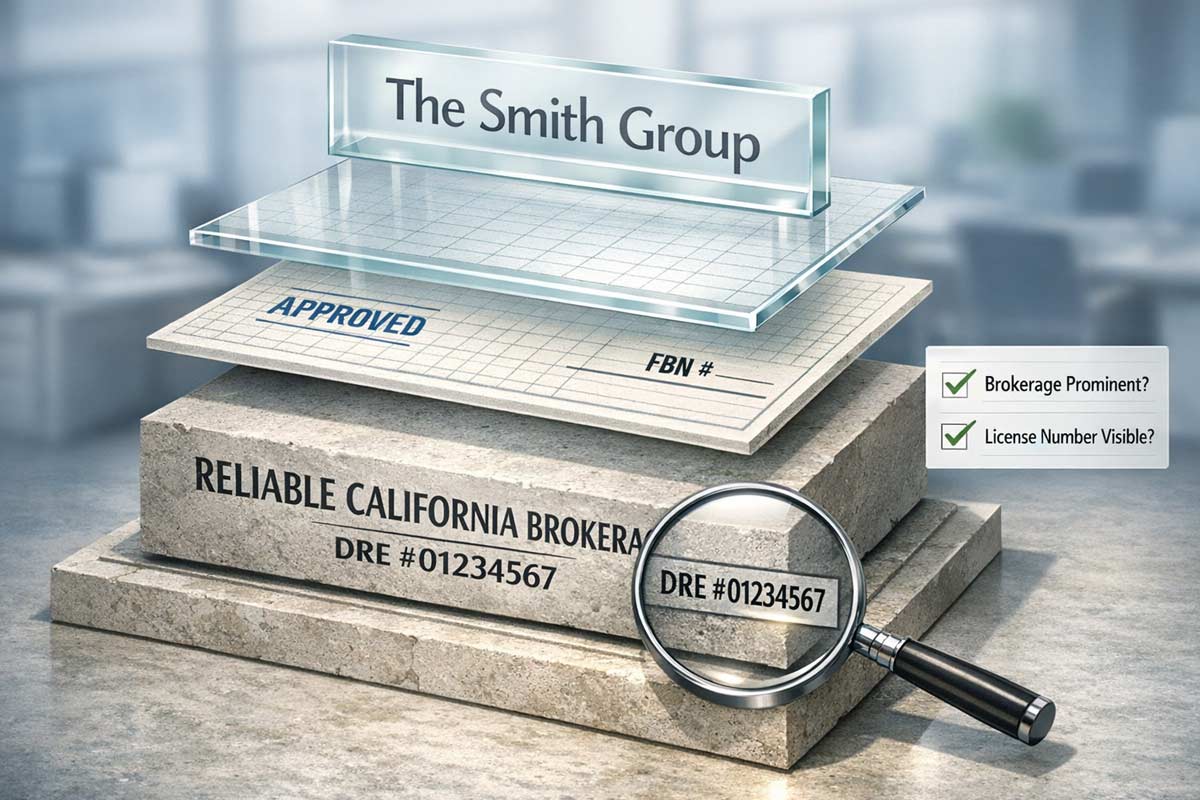
Before you print a single flyer, you need to understand the three layers of your professional identity. In California, the name that matters legally is the one tied to the broker’s license—which is why your broker must approve your entire setup.
Term
What it is
What can go wrong
Team Name
A marketing label for your group
Looks like an independent brokerage
DBA / FBN
Name used in advertising other than the broker's licensed name (handled through broker policy)
Used without approval / inconsistent disclosures
Brokerage Name
The responsible broker identity
Hidden or minimized on advertising
Your Team Name: This is your nickname. It identifies your specific group (e.g., "The Smith Group").
A DBA (Doing Business As): This is a legal alias. If the public-facing name is not your broker’s licensed name, your broker may need to treat it as a fictitious business name. Start with your broker's policy—don’t guess.
The Brokerage: Think of this as your “last name”. No matter how big your nickname gets, the responsible broker must always be visible and dominant.
60-Second Compliance Checklist
Brokerage name is clear and prominent on all media.
My name matches exactly what is on my DRE license.
My license number is on all "first point of contact" ads.
Team name does not imply an independent brokerage.
Broker approved the setup before I printed or posted anything.
If you can’t pass this checklist in 60 seconds, don’t print, don’t post and consult with your broker.
Screenshot this checklist. It's your Friday audit.
Walk-Thru Scenarios: Is Your Brand Compliant?
Scenario A: The "Pseudo-Brokerage" Team
The Name: "Golden State Realty Team."
Risk: High. Words like "Realty" can imply you are an independent firm, which is a major trigger for What the California DRE Actually Enforces.
Why it’s risky: It suggests the team is the licensed entity, not the broker.
Do this now:
Stop using this if the DRE hasn’t approved the DBA/Corporation.
Clear the name with your broker's compliance department first.
Scenario B: The Instagram "Solo-Preneur"
The Post: A "Just Listed" graphic with your phone number and "The Luxury Specialist." No license number. No broker logo.
Risk: High. It’s a technical violation that usually leads to a citation.
Why it’s risky: Every "first point of contact" material must disclose your license status. This is a core rule in Real Estate Advertising With Your License Number.
Do this now:
Place your DRE license number on all social media graphics.
Add your broker's name to your Instagram bio.
Audit your YouTube channel for the same info.
Scenario C: The Team Branding Confusion
The Setup: You’ve created a team and want to handle property management for your clients.
Risk: Critical. Confusing your branding with the entity authorized to handle money leads to Trust Fund Handling Rules for California Agents violations.
Why it’s risky: Only the broker (or an authorized escrow) can handle funds; your "team" is not a legal repository for client money.
Do this now:
Never imply your "team" is the escrow holder.
Ensure all contracts clearly state the licensed broker’s legal name.
Review all trust fund-handling procedures with your broker.
Team Name Words That Trigger DRE Scrutiny
These words aren’t automatically illegal—but they increase the odds your branding is interpreted as implying a brokerage, which triggers higher scrutiny:
Realty / Real Estate
Broker / Brokerage
Land Company
Associates (if it implies more than one licensee is the lead)
The Friday Afternoon Audit
I tell my students to take 15 minutes every Friday to audit their brand.
Here are the four questions that prevent most of the issues we see in Common DRE Violations and How to Avoid Them:
Is my broker’s name dominant? If I look at my business card, is the brokerage name clearly visible and correctly spelled?
Is my license number everywhere? Check your email signature, your Facebook "About" section, and your latest YouTube description.
Are my "first point of contact" materials compliant? This includes business cards, stationery, flyers, and even those magnetic car signs.
Is my name consistent? Does the name on my marketing match my legal name on my DRE license?
The Compliance Coach’s Corner (FAQ)
Q: Can I use ‘Realty’ in my team name if I’m a salesperson?
A: It’s high-risk. Words like "Realty" or "Real Estate" can make your team look like a standalone brokerage. If your broker allows it, your disclosures must be crystal clear and your broker’s identity must be dominant everywhere and the DBA approved.
Q: Can my team name include “Properties,” “Homes,” or “Estates”?
A: Usually, yes—but treat them like “Realty-lite.” If the name makes you look like the brokerage, your broker identity must be dominant and consistent everywhere and you likely need the DBA approved by the DRE.
Q: Does my team name have to appear on my business card or can it be social-only?
A: If you use it anywhere, it should be used consistently and always accompanied by your broker’s identity and your license number.
Q: If I change brokerages, can I keep my team name and handles?
A: Usually, yes—but you must update every single asset (bio, headers, thumbnails) to reflect your new broker immediately.
Q: What counts as ‘first point of contact’ advertising?
A: Business cards, stationery, websites, social media profiles, and any promotional flyers or signs. If it can generate a call, DM, or lead, treat it like advertising.
Q: Can our team have a separate website domain?
A: Yes, but the website itself must comply with all disclosure rules, prominently featuring the broker’s name and your license number on every page.
Q: If my broker has multiple DBAs, which one do I use?
A: Use the one that is officially tied to your license and the office where you are hung. When in doubt, ask your manager.
The Protected Path Forward
Compliance isn't a hurdle; it’s the foundation of a scalable career. When you set up your brand correctly, you’re telling your clients—and the DRE—that you are a professional.
Start with the full map: California Real Estate Laws & Compliance Guide
Then tighten your biggest public-facing exposure: Real Estate Advertising With Your License Number
Finally, run the ‘am I accidentally violating something?’ scan: Common DRE Violations and How to Avoid Them
The goal is simple: your brand should look professional without ever looking like an unlicensed brokerage.
|

You’ve passed the real estate exam, joined a brokerage, and printed your business cards. Now comes the hard part: actually talking to people. Whether it’s fumbling with a lockbox while a client looks Read more...
You’ve passed the real estate exam, joined a brokerage, and printed your business cards. Now comes the hard part: actually talking to people. Whether it’s fumbling with a lockbox while a client looks over your shoulder, blanking on a disclosure requirement mid-conversation, or fearing a lead will ask a question you can’t answer, these moments can stall a career before it starts.
In my 20+ years coaching California agents through the high-pressure "first 90 days," I’ve seen that a lack of confidence as a new real estate agent is the single most common reason new licensees stall out. Most agents don't quit because they lack talent; they quit because they lack a system to handle the discomfort of being new.
Confidence is not a personality trait; it is a byproduct of competence and repetition. You don’t need more "motivation"; you need more reps.
Key Takeaways
Action Creates Feeling: You will never "feel ready" until you start doing the work.
The 14-Day Shift: In my experience, agents who follow a structured "rep" schedule report a significant drop in call anxiety within two weeks.
Competence = Trust: Clients don't need you to be a veteran; they need you to be a calm, prepared professional.
The ADHI Confidence Loop
Elite agents don't wing it. They train like athletes. This loop is specifically designed for solo agents who don't have an assistant or a team lead to lean on. It is a critical layer of the broader skill stack every California agent must build. To accelerate your growth, use the ADHI Confidence Loop for 20 minutes every morning:
Learn: Study one specific micro-topic (e.g., how to explain a "contingency").
Script: Write out a 3-sentence explanation in your own voice.
Rehearse: Say it out loud 10 times. Reading silently only trains your eyes; speaking out loud trains your brain and mouth to work together under pressure. If you skip this step, the loop breaks.
Execute: Use that term in a real conversation or social media video today.
Review: Briefly note what felt clunky and fix it for tomorrow.
7 Tactical Ways to Build Confidence Fast
Mastering California Real Estate Agent Skills isn't about knowing everything; it's about having a reliable process. Use these seven tactics to build your professional backbone:
1. Own Your "Newness" with Default Scripts
Confidence is knowing what to say when you don't know the answer.
The Move: If a client asks about a specific disclosure or a recent price adjustment on a neighboring property you haven't studied yet, don't guess.
The Line: "I want to make sure I give you the most accurate data on that specific property—let me verify the latest records and get back to you by 4:00 PM."
Do this today: Write down three questions you're afraid of and draft your "I'll find out" response.
2. Practice Out Loud (Vocal Muscle Memory)
In my experience, agents who rehearse out loud freeze far less on live calls than those who only study silently. Speaking your scripts builds the muscle memory required to stay calm when a client pushes back.
Do this today: Record yourself explaining the home-buying process on your phone. Listen back. It will be awkward—that's the feeling of growth.
3. Eliminate "Jargon Paralysis"
If you’re afraid of looking like an amateur, you need to master real estate terminology fast. When you speak the language of the industry fluently, your internal anxiety drops.
Do this today: Pick the three terms that confuse you most and explain them to a friend until they understand them.
4. Use a Physical Pre-Call Cue
Anxiety lives in the body. Before picking up the phone, fix your physiology.
The Move: Stand up or sit upright with your feet planted. Never call from your car while slouched or cramped; your posture directly affects your vocal tone and perceived authority.
5. Track Inputs, Not Outcomes
You can't control if a lead says "yes," but you can control that you made 10 calls.
Do this today: Redefine a "win" as completing your daily outreach. This builds new real estate agent confidence by removing the fear of rejection.
6. The Post-Conversation Debrief
After every client interaction, ask yourself: "At what exact moment did I feel my heart rate spike?"
The Example: If you felt awkward when they asked about commissions, that is your signal to roleplay that specific objection tomorrow. This prevents a single awkward moment from becoming a mental block and improves your emotional intelligence as a real estate agent.
7. Leverage Checklists
Confidence is the absence of the "did I forget something?" feeling.
The Move: Build a "Go Bag" for your car with the essentials: a flashlight, extra batteries for lockboxes, and a printed Buyer Consultation checklist.
Do this today: Create a step-by-step checklist for a property showing so you can focus on the client, not the keys.
Low-Pressure Scripts for New Agents
To build communication skills that separate top agents from the rest, you must be authentic. Use these verbatim at first. It may feel robotic—that's normal. Confidence comes only after you have the foundation of repetition.
Script 1: The "Sphere" Introduction
Target: People you already know.
Script: "Hi [Name], I’m officially moving my focus into the [Neighborhood] real estate market. I’m spending my first 90 days building a resource list for local homeowners. If you ever need real estate advice or just want to know what the house down the street sold for, I’m your person."
Script 2: The "Just Looking" Response
Target: Leads who are hesitant.
Script: "I completely understand—most of my clients start out 'just looking' for months. My job is to make sure you have the best data so that when you are ready, you feel 100% confident. Is it okay if I send you a quick weekly update on what's actually selling?"
Script 3: Handling the "We’re Not Ready" Objection
Target: Keeping the relationship alive.
Script: "No problem at all. Real estate is about timing, and only you know when that's right. I'll keep an eye on the market for you in the meantime. If you see something that catches your eye, just reach out."
Confidence Killers (and how to fix them)
Unidentified Knowledge Gaps: If you don't understand the RPA (Residential Purchase Agreement), you will be subconsciously terrified of a listing.
Fix: Identify the essential skills every new California agent must master and tackle one contract section per day.
Taking Rejection Personally: A "no" is usually about their timing, not your talent.
Fix: : Treat every "no" as data. Your goal is to collect 10 "no's" a day to find the one "yes."
Productive Procrastination: Researching for 5 hours to avoid 5 minutes of calling is just a "fancy" way of being scared.
Fix: Cap your study time to 30 minutes. Real learning happens in the field.
Talking Too Much: Nerves lead to rambling.
Fix: Practice the "Power of the Pause." Ask a question and wait 3 seconds after they finish talking before you respond.
Trying to Sound "Fancy": Using complex jargon makes you sound insecure.
Fix: Speak like a human being. Clear is better than clever.
The 14-Day Confidence Plan
In my experience, agents who follow this plan report a significant drop in call anxiety by the final day. Once you finish this cycle, repeat it with new scripts and higher targets.
Day
Task 1: Vocal Reps (10 Min)
Task 2: Knowledge Gap
Task 3: The Action
1–3
Practice Intro Script out loud
Learn "Escrow" & "Earnest Money"
Call 5 people you know
4–6
Roleplay "Just Looking"
Learn "Contingency" periods
Text 10 "Resource" offers
7-9
Record your "Value Prop"
Learn "Title" & "Lien"
Visit 3 local Open Houses
10-12
Practice "Follow-up" scripts
Learn "Appraisal" vs "BPO"
Follow up with all leads
13-14
Review your progress
Final review of terms
Shadow a veteran agent's call
Success Metric: Success isn't a closed deal in 14 days; it's the ability to deliver your scripts without looking at a piece of paper.
FAQ
How long does it take to feel confident as a new agent?
Most agents find their "stride" after 20–30 real-world conversations. If you commit to 3 conversations a day, you will feel the shift within 10–14 days.
What if I’m naturally introverted?
Introversion can be an advantage in real estate because it usually comes with better listening skills. Confidence for introverts comes from being the most prepared person in the room. If you follow the scripts and checklists, you don't need to be "high energy" to be successful.
Confidence Compounds
Confidence is the glue that holds your business together. Without it, your knowledge stays trapped in your head.
But remember: if you skip building this skill stack now, your confidence problems will only resurface later when the stakes are higher and the commissions are larger.
Ready to move beyond the basics and master the full range of California Real Estate Agent Skills California? Confidence compounds—the sooner you build it, the cheaper the lessons are.
|

Passing the real estate exam is a milestone, but it isn’t the finish line.
The blunt truth that many schools won't tell you is this: The hardest part of real estate isn't the knowledge you've memorized—it's Read more...
Passing the real estate exam is a milestone, but it isn’t the finish line.
The blunt truth that many schools won't tell you is this: The hardest part of real estate isn't the knowledge you've memorized—it's performing under pressure.
In your first 90 days, you will face "jargon paralysis," inconsistent leads, and the crushing anxiety of an awkward conversation with a potential client. I’ve spent over 20 years at ADHI Schools building real-world competence in California agents, and I can tell you that the difference between the agents who wash out and those who thrive isn't luck. It is the intentional mastery of a specific "Skill Stack."
Key Takeaways
Execution Over Education: Real estate is a performance art; you must practice "doing," not just "knowing."
The 5-Layer Stack: Master Confidence, Communication, Terminology, EQ, and Self-Management.
Micro-Habits Win: 10-minute daily drills are more effective than 5-hour weekend cram sessions.
California Context: High consumer expectations in CA require a higher level of professional polish.
The New Agent Skill Stack (California Edition)
To succeed in the California real estate market, you need more than a license. You need a framework that allows you to handle complex transactions and high-stress negotiations.
1. Confidence (Execution Under Pressure)
What It Is: The ability to deliver information clearly even when you are uncertain or being challenged.
Why It’s Critical in California: California buyers and sellers are savvy. If they smell blood—or even a hint of hesitation—they will look for a more "experienced" veteran. To survive, you must learn how to build confidence as a new agent through repeated, controlled exposure to pressure.
Common Beginner Mistake: Over-apologizing for being new or saying "I don't know" without a confident follow-up plan.
10-Minute Daily Drill: Record yourself explaining agency on your phone. Listen back and delete "um," "uh," and "I think."
Improvement Signal: You stop feeling a "pit in your stomach" when the phone rings from an unknown number.
2. Communication (Clarity and Control)
What It Is: The art of leading a conversation rather than just participating in one.
Why It’s Critical in California: With high home prices, the stakes are massive. Clear communication prevents lawsuits and builds the trust necessary to close six-figure commissions. These are the communication skills that separate top agents from the rest in a crowded market.
Common Beginner Mistake: Talking too much. New agents often "oversell" because they are nervous, instead of asking discovery questions.
10-Minute Daily Drill:Practice "Active Listening" with a friend. Let them talk for two minutes; your only job is to summarize what they said back to them before responding.
Improvement Signal: Clients start saying, "I never thought of it that way," or "Thank you for explaining that so clearly."
3. Terminology (Speed-to-Competence)
What It Is: Fluency in the language of the California Residential Purchase Agreement (RPA) and local market trends.
Why It’s Critical in California: Ca: You lose authority the moment you misuse a term like "contingency" or "escrow." You need to understand how to master real estate terminology fast to gain instant respect from peers and clients.
Common Beginner Mistake: Using improper terms for important concepts, which can lead to misinterpretation of contract deadlines.
10-Minute Daily Drill:Open the RPA. Pick three paragraphs. Explain them out loud as if you were talking to a fifth-grader.
Improvement Signal: You can explain a "Notice to Perform" without looking at a cheat sheet.
4. Emotional Intelligence (EQ)
What It Is: Managing your own stress while navigating the high emotions of buyers and sellers.
Why It’s Critical in California: Real estate is a high-emotion, high-finance game. Emotional intelligence for real estate agents is what allows you to stay calm when a deal is falling apart at the eleventh hour.
Common Beginner Mistake: Taking a client’s frustration personally or getting "commission breath" (prioritizing your paycheck over their needs).
10-Minute Daily Drill: Journal about a recent stressful interaction. Identify exactly what triggered you and how you could respond with "neutral empathy" next time.
Improvement Signal: You remain the calmest person in the room during a heated negotiation.
5. Self-Management (Systems and Routines)
What It Is: The "bonus" skill. It is the ability to treat your career like a business, not a hobby.
Why It’s Critical in California: Without a boss hovering over you, it's easy to waste days on "busy work" that doesn't lead to a paycheck.
Common Beginner Mistake: Waiting for the "perfect time" to prospect instead of following a strict calendar.
10-Minute Daily Drill: Plan your next day's "Big 3" tasks the night before.
Improvement Signal: You start your workday at the same time every morning, regardless of how many appointments you have.
Why These Skills Matter More in the California Market
Skill
Why It Matters in CA
Daily Drill
Confidence
Defends your commission
Record and review your "elevator pitch."
Communication
Prevents transaction friction
Practice summarizing client needs.
Terminology
Establishes instant authority
Define 3 contract terms out loud.
EQ
Keeps deals from dying
Practice "Neutral Response" exercises.
Self-Management
Ensures long-term survival
Set your "Big 3" goals every evening.
Essential Skills Every New California Real Estate Agent Needs in the First 90 Days
Week
Focus Area
Primary Action
Week 1
The Lingo
Pick 5 terms from the RPA daily; define them without hesitation.
Week 2
The Script
Role-play "The Introduction" 10 times daily to build muscle memory.
Week 3
The Market
Visit 5 local open houses; practice asking listing agents high-value questions.
Week 4
The Routine
Execute a 2-hour "Lead Gen" block every morning; focus on EQ to handle rejection.
Success Metric: Success isn't a closed deal in 14 days; it's the ability to deliver your scripts without looking at a piece of paper.
Real-World Scenarios: Putting Skills into Practice
Scenario 1: The "New Agent" Question
Situation: A buyer asks, "How many homes have you sold?"
Default (Bad) Response: "Um, I'm actually new, but I'm really hardworking!"
Skilled Response: "I am a newer part of a team at my brokerage that has overseen hundreds of transactions, and I have the full resources of our office behind every move I make for you."
Skill Tied To: Confidence
Scenario 2: The Jargon Trap
Situation: A seller asks what "escrow" actually does.
Default (Bad) Response: "It’s like... where the money goes during the deal."
Skilled Response: "Escrow is a party that holds funds and documents to ensure all conditions of the contract are met before the title transfers."
Skill Tied To: Terminology
Scenario 3: The Cold Shoulder
Situation: You’re door-knocking and a neighbor tells you to "get a real job."
Default (Bad) Response: Getting angry, arguing back, or going home to quit.
Skilled Response: "I understand you're busy! Have a great afternoon," then moving to the next door without a change in heart rate.
Skill Tied To: Emotional Intelligence
Scenario 4: The Vague Lead
Situation: A lead says, "I'm thinking of moving soon."
Default (Bad) Response: "Great! Let me know when you're ready."
Skilled Response: "That's exciting. Usually, when people say 'soon,' they have a specific goal in mind—are you looking to be in a new home before the school year starts, or are you just testing the waters?"
Skill Tied To: Communication
Master the Foundation
Think of your first year as a “competence-building year.” Your goal isn't just to sell a house; it's to build a version of yourself that is capable of selling any house. Mastery doesn't happen in the classroom; it happens in the daily drills and the uncomfortable conversations you choose to have anyway.
This article is part of a comprehensive framework designed to move you from "licensed" to "competent." To see how these skills integrate into a long-term career strategy, explore our full guide on Real Estate Agent Skills California
|
Most new agents walk into their first listing appointment with a gut-level fear: “What if they ask how many homes I’ve sold?”
This fear stems from a misunderstanding of seller psychology. Sellers Read more...
Most new agents walk into their first listing appointment with a gut-level fear: “What if they ask how many homes I’ve sold?”
This fear stems from a misunderstanding of seller psychology. Sellers aren’t buying your resume. They are buying a process that protects their equity and reduces mistakes. They aren't looking for a "veteran" as much as they are looking for a professional with a predictable, low-risk system.
In my 20+ years of training thousands of California agents at ADHI Schools, I’ve seen rookies beat top producers because they prioritized clarity over charisma. If you try to wing it, you’ll feel it—and they’ll feel it.
Confidence doesn’t come from your track record—it comes from your sequence.
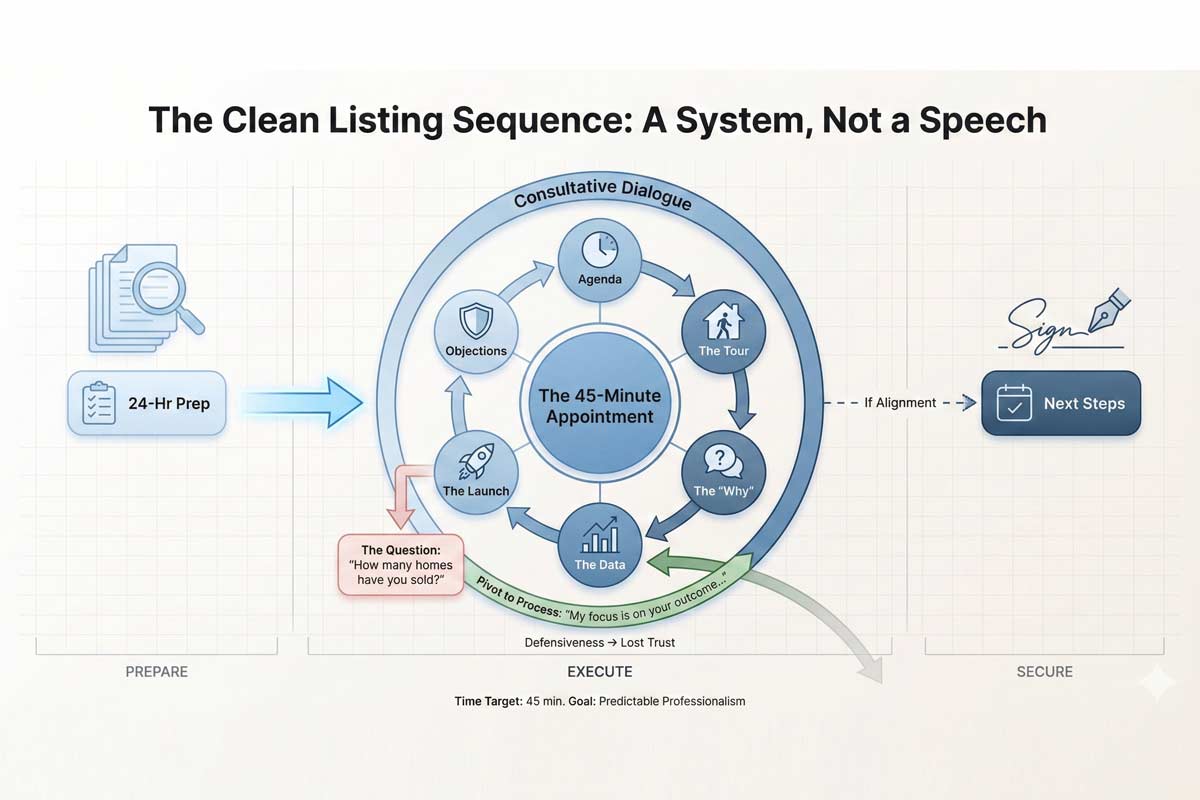
The 7-Step Clean Sequence (One-Page Summary)
Agenda Setting: Confirm the timeline and goal immediately.
The Tour: Walk the property with a consultant’s eye.
The "Why": Deep-dive into seller goals and timeline.
The Data: Review pricing using the three-bucket method.
The Launch: Explain the marketing and feedback loop.
Objection Handling: Resolve concerns using prepared scripts.
The Close: Confirm the decision and set next steps.
Time target: 45 minutes total (10 tour / 25 table / 10 close & next steps).
Pre-Appointment Prep: The 24-Hour Intel Phase
The appointment is won or lost before you ring the doorbell.
The Property Intel Checklist The "Big Three"
CMA: Prepare a Comparative Market Analysis with Actives (competition), Pendings (market direction), and Solds (the reality check).
Title Profile: Check for liens, multiple owners, or solar panel UCC filings.
The "Motivation" Call: 24 hours prior, call to confirm. Ask: "Aside from the price, what is the one thing that must happen for this move to be a success?"
The Minimalist Kit
Sellers can interpret overly flashy materials as in security. Data and a calm process read as competence. Bring an iPad or a neatly organized folder containing:
The CMA
A 1-page "Launch Plan"
The California Residential Listing Agreement (RLA)
A seller net sheet (to show their estimated proceeds at close)
First 5 Minutes: Setting the Frame
You’re the guide. Your job is to run a clean, low-drama decision meeting.
The "Agenda" Script
Warm Seller: "Thanks for having me over. My goal today is to see the home, hear your goals, and show you exactly how we’ll find the right buyer. Does that work for you?"
Skeptical Seller: "I know your time is valuable. I’ve set aside 45 minutes to go over the data and our strategy. At the end, we’ll both know if I’m the right fit to get this sold. Should we start with a quick tour?"
The Walkthrough: Tour Like a Consultant (Not a Compliment Machine)
The biggest mistake new agents make is acting like a guest. You’re there to audit the asset.
Ask, don’t tell: Instead of complimenting the kitchen, ask “When were these appliances last updated?” or “Any HVAC issues during peak summer?”
The “Stay or Go” list: Ask what’s staying vs. leaving (fixtures, appliances, smart devices). This prevents later disputes over chandeliers, Ring cameras, or mounted TVs.
What NOT to do:
Price during the tour: “I have some thoughts, but I want to sit down with the data first so I can give you an accurate range.”
Contractor cosplay: Don’t guess repair costs. Label it a point of inspection and move on.
Insult the house: Stay neutral. “This layout is unique” beats “This room is too small.”
If They Ask How Many Homes You’ve Sold (The Clean Answer)
Handle this moment with zero defensiveness.
The "High-Touch" Pivot
"Fair question. My model is high-touch: fewer clients at a time, tighter communication, and a very structured launch plan. You won’t be competing for my attention."
The "Team-Backed" Angle:
"Great question. I’m your point of contact, and I run the process. And I’m backed by my broker and transaction team on pricing, disclosures, and contract execution—so you get personal attention with professional oversight."
The Table Meeting: 3 Phases of Authority
Phase 1: Motivation Intake
Ask: "If this home doesn't sell for six months, how does that affect your plans?" If you don't know their "Why," you cannot handle their objections later.
Phase 2: Pricing Reality (The Three Buckets)
Show the data. "The market is telling us that homes like yours sell fast... or they start going stale and get negotiated down." We’ll define ‘stale’ using showing volume, online saves, and buyer feedback—not vibes. Understanding negotiation basics for new California agents is critical here—you aren't negotiating against the seller; you are negotiating with the market.
Phase 3: Strategy & Execution
Show them your Launch Plan. This includes professional media, reverse prospecting, and the "Feedback Loop" (your scheduled weekly update).
Objection Handling: Consultative Scripts
If you have practiced how to practice real estate scripts effectively, you will stay calm here.
Objection Handling: The Consultative Response
Objection
Consultative Response
"Another agent said it's worth more."
"Interesting. When they gave you that number, did they anchor it to sold comps, or was it more of a 'marketing price'? I’m not here to win the listing—I’m here to protect your outcome."
"We want to try a higher price."
"If we start too high, we'll miss our best buyers right out of the gate. Then, if we have to lower the price later, we're dealing with buyers who know we couldn't sell it—and that weakens our position."
"Will you cut your commission?"
"I’m happy to talk commission. The real issue is net outcome. My job is to protect your equity and reduce risk. If we cut the steps that produce the result, the price reduction usually costs more than the commission ever would."
"We’re interviewing others."
"I respect that. Professionalism is about finding the right fit. What are you looking for in an agent that we haven't covered yet?"
The Close: Moving to Signature
The Direct Close: "I’m confident we can hit your timeline. Are you ready to get the paperwork started so we can get the photographers out here Monday?"
The "Think About It" Close: "I understand. Usually, when people want to think about it, it’s because I haven't clarified something. Which part of the plan are you still weighing?"
New Agent Mistakes That Kill Listings
Talking Too Much: If you talk more than 30% of the time, you aren't listening.
Ignoring the "Quiet" Owner: The person asking the fewest questions often holds the veto power.
Defending the Price: Never "defend" a price. Let the data do the talking.
No Time Boundary: If you stay for 3 hours, you look desperate.
Tech-Dependency: Always have a paper backup of your presentation.
Over-Promising: Don't promise daily calls if you can't sustain them.
Hiding Your Status: Don't lie about being new; lean on your broker's track record.
Vague Next Steps: Never leave without a clear follow-up date and time.8.. Avoiding these new agent mistakes that hurt credibility is your fastest path to a "Yes."
FAQ: The First Listing Appointment
Q: Should I bring the listing agreement to the first meeting?
A: Bring it every time—even if you don’t pull it out. It signals preparedness and lets you move forward immediately if they are ready.
Q: What if they ask about my experience?
A: Pivot to your process. Experience is just a proxy for "Will you mess this up?" Prove you won't by being the most organized person they meet.
Q: How does this differ from working with buyers?
A: Listings are about asset management; buyers are about search and discovery. You should prepare for a first buyer consultation with the same level of systematic rigor.
Your Professional Foundation
The listing appointment for new agents is a test of your business operating system. You do not need to be the most famous agent in California to win; you just need to be the most prepared.
Read more to see how this fits into our broader California real estate career guide, continue building your library of systems.
Your next step: practice these scripts out loud until they feel natural.
|
Jargon Paralysis Is Real
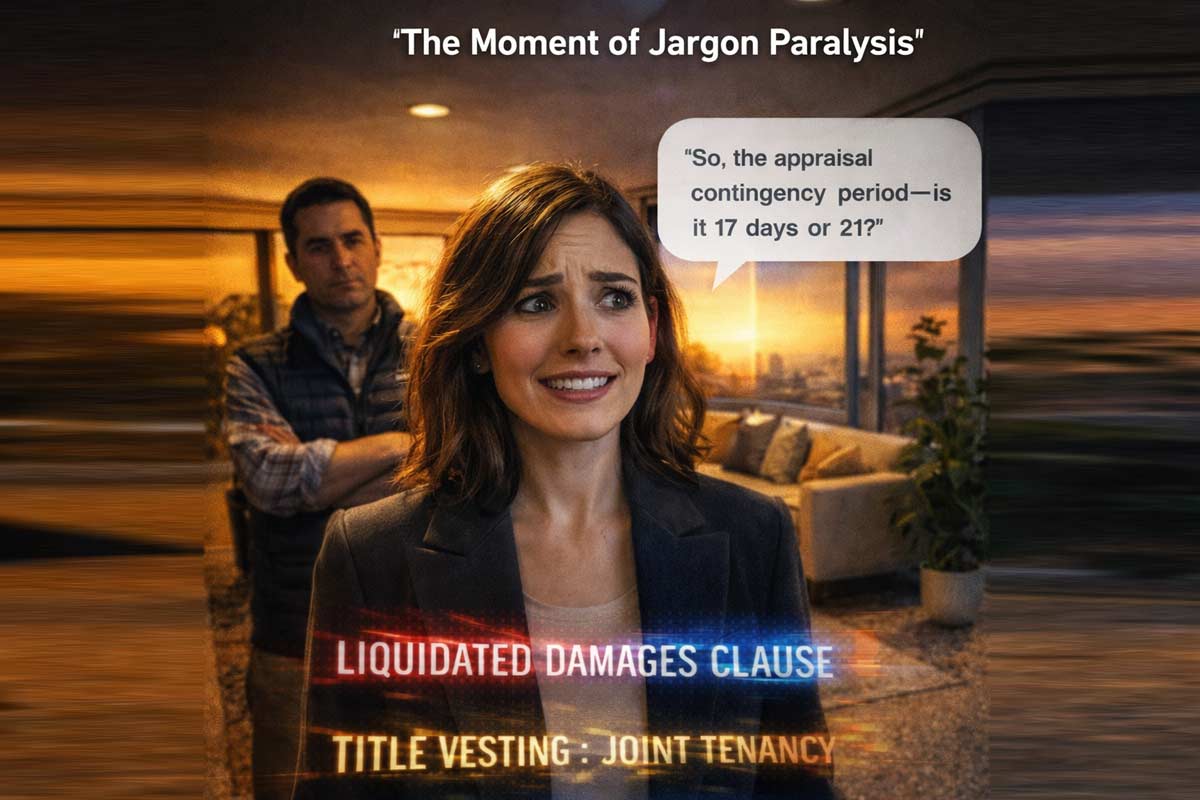
Every new agent fears the "Smartest in the Room"—that prospective buyer who walks into an open house with a question that rattles the rookie.
Their favorite weapon?
Technical Read more...
Jargon Paralysis Is Real
Every new agent fears the "Smartest in the Room"—that prospective buyer who walks into an open house with a question that rattles the rookie.
Their favorite weapon?
Technical jargon used in the wrong place. Imagine a visitor asking you about the status of contingencies and EMD increases before they’ve even toured the master bedroom.
The catch? There are no contingencies yet because there is no contract.
The truth is, terminology isn’t a measure of your intelligence; it’s simply a product of exposure, repetition, and usage. After 20+ years of coaching California agents at ADHI Schools, I’ve seen a consistent pattern: agents don’t fail because they lack ambition; they fail because they lack a system. To succeed, you must develop the Real Estate Agent Skills California agents need to handle contracts and conversations with poise. Mastering the language is the first step toward professional authority.
The Fastest Way to Learn Terms: “Definition → Context → Script”
Rote memorization is for passing the exam. Usage is for building a career. To master real estate terminology fast, stop reading a dry glossary and start using this 3-step framework:
Definition (Simple): What does it mean in plain English?
Context (Real Life): Where does this actually show up in a transaction?
Script (The "Say It Out Loud" Test): How do you explain it to a human being?
The 10-Second Rule
If you can’t explain a term in 10 seconds to a non-agent, you don’t “know” it yet. Your job isn’t to sound smart; your job is to help your clients understand.
The “Minimum Viable Vocabulary” (The 80/20 List)
You need to master the 20% of real estate vocabulary for beginners that drives 80% of real agent conversations. Focus on these clusters first:
1. Offers & Negotiation
Counteroffer: A rejection of the original offer with new proposed terms.
Liquidated Damages: A pre-agreed cap on how much of the buyer’s deposit the seller may retain if the buyer defaults.
Escalation Clause: A tool used in multiple-offer situations to automatically outbid competitors.
Client-safe sentence: : “Liquidated damages limit the seller’s claim on your deposit, even if a dispute arises, providing a layer of protection for both parties.”
2. Money & Financing
Pre-approval vs. Pre-qualification: Pre-approval is a verified commitment; pre-qual is often just a surface-level estimate.
Earnest Money Deposit (EMD): The "good faith" money a buyer puts down.
Points: Fees paid to the lender to "buy down" the interest rate. One point is one percent of the loan amount.
Client-safe sentence: “The earnest money deposit is your way of showing the seller you have skin in the game while we perform our due diligence.”
3. Escrow & Title (The California Reality)
In California, you’ll hear the phrase “opened escrow” constantly. In most California transactions, escrow, title, and recording are tightly sequenced, which is why agents who misuse these terms accidentally create false expectations around closing dates.
Escrow: A party holding funds and documents.
Preliminary Title Report: A report showing ownership history and liens.
Vesting: How the buyer legally holds ownership.
Client-safe sentence: “Escrow is the process that coordinates the paperwork and money until everything is ready to record with the county.”
4. Property & Valuation
Comps (Comparables): Recently sold homes used to determine value.
CMA: The report you create using those comps.
Appraisal: An official valuation required by the lender.
Client-safe sentence: “We look at 'comps'—homes similar to yours that sold recently—to ensure we're pricing your home to attract the best offers.”
Use-Case Learning: Stop Studying Terms Alone
Context is the ultimate teacher. If you want to learn the essential skills every new California agent must master, stop looking at terms in a vacuum.
The “Reading a Listing” Method: Pull terms from MLS remarks. If you see "as-is" or "probate," script an explanation for them immediately.
The “Offer Review” Method: Terms like "liquidated damages" appear in every negotiation. Practice explaining them before you ever open a contract with a client.
The “Escrow Timeline” Method: Map out a 30-day window. Which terms appear in Week 1 vs. Week 4?
Rapid Memorization Tools (No Corny Stuff)
Use these high-performance tactics to build your confidence as a new agent:
Digital Flashcards: Create your own deck using your "Definition → Context → Script" format.
The “Teach It Back” Method: Explain "Dual Agency" to a friend. If they look confused, your understanding isn't sharp enough.
“Term of the Day” Micro-habit: Pick one term from this real estate terms cheat sheet and use it in a conversation today.
The 7-Day Terminology Sprint
Day
Task
Day 1
Master 5 "Offer" terms + write scripts for each.
Day 2
Call a lender and ask them to explain "Points" and "Rate Locks."
Day 3
Read a full California Residential Purchase Agreement (RPA). Highlight unknowns.
Day 4
Focus on Escrow. Watch a video on the CA escrow process.
Day 5
"Teach it Back" day. Explain 10 terms to a non-agent.
Day 6
Practice the "Common Mistakes" section below. Say the fixes out loud.
Day 7
Review your personal glossary and add 3 new terms from local MLS listings.
Scripts: Sound Competent Without Faking It
Mastering the language is a core part of the communication skills that separate top agents from the rest.
When asked a definition: “The short version is [Definition]. The practical impact for you is [Context].”
When explaining a contract point: “Here is where that shows up in the contract. It’s a safeguard for your deposit.”
When you need to verify: “That’s an excellent technical question. Let me verify the latest escrow guidelines so I give you the most accurate answer.”
Common Terminology Mistakes New Agents Make
Even prepared agents trip up. High emotional intelligence for real estate agents means knowing when to slow down and clarify.
"Pre-qualified" vs. "Pre-approved": Never tell a seller your buyer is "pre-approved" if they only have a "pre-qual." It kills your credibility when the lender's deep dive finds an issue.
Misusing "Contingency": Don't say "the house is in contingency." Say "the contract is contingent upon [Inspection/Appraisal]."
Over-explaining: Don't give a 10-minute lecture. If they understand the term, move to the next step.
Master the Language, Master the Career
Terminology is the foundation of your professional house. Once you learn real estate terms quickly, you stop worrying about "sounding like a newbie" and start focusing on what matters: your clients.
FAQ
What are the most common real estate terms for new agents?
The most common terms revolve around the "Big Three": Financing (Pre-approval, EMD), Negotiation (Contingencies, Counters), and Closing (Escrow, Title).
How do I learn real estate terms fast?
Use the "Definition → Context → Script" method. Don't just memorize what a word means; practice how you will explain it to a client in 10 seconds or less.
What does ‘opening escrow’ mean in California?
In California, opening escrow means a neutral third party has received the signed purchase agreement and the buyer’s initial deposit, officially starting the closing process.
Pre-approval vs. pre-qualification—what’s the difference?
A pre-qualification is a surface-level estimate of what you might afford. A pre-approval is a formal commitment from a lender after they have verified your income, credit, and assets.
|
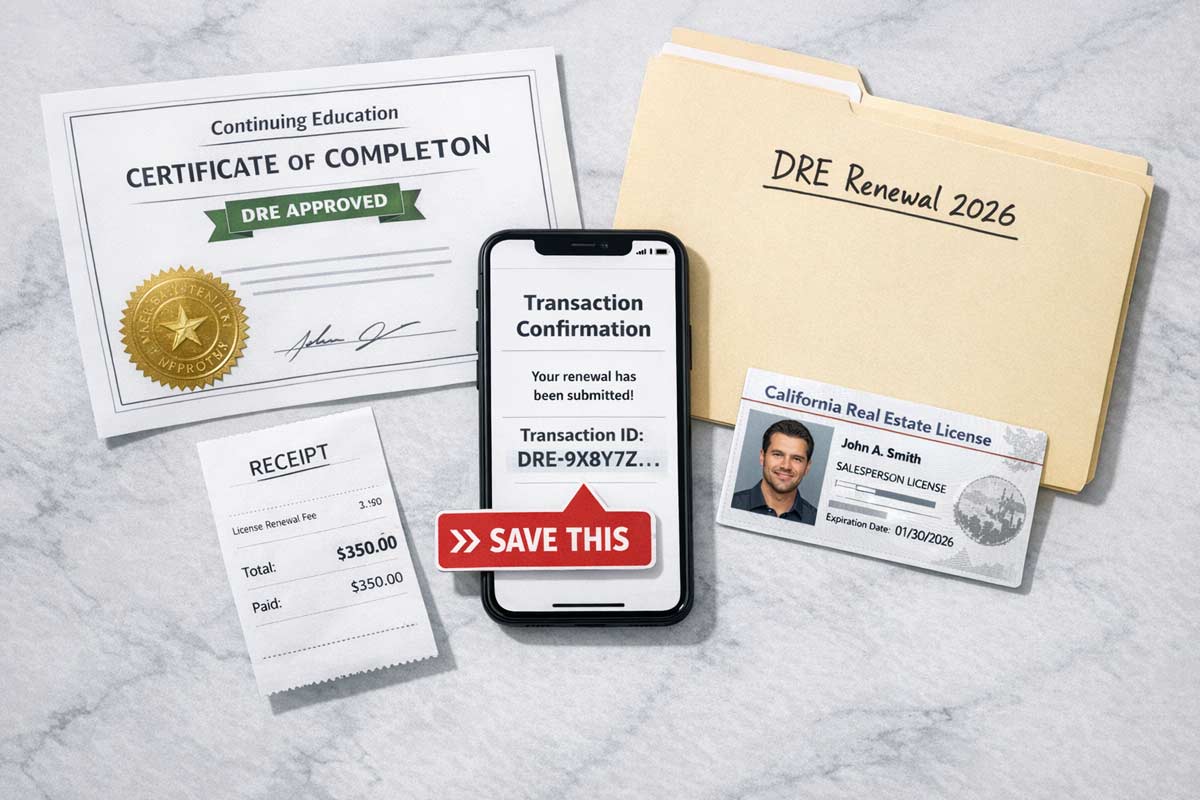
Renewing your California real estate license is a high-stakes administrative task. A single oversight—a mismatched name, an incomplete CE certificate, or a missed deadline—can trigger a deficiency Read more...
Renewing your California real estate license is a high-stakes administrative task. A single oversight—a mismatched name, an incomplete CE certificate, or a missed deadline—can trigger a deficiency notice or halt your ability to work legally. Your goal isn’t just to submit; it’s to achieve a clean, provable, and on-time renewal that avoids manual review and a potential late fee.
This checklist distills decades of experience into a direct, phase-by-step action plan. It is designed to steer you clear of the common data and documentation errors that cause renewal problems, helping to ensure that your submission is seamless from the moment you start your continuing education to the final confirmation.
The 30-Second "If You Do Nothing Else" Checklist
Verify expiration date via the DRE Public License Lookup today.
Finish CE early (target at least 15–30 days before your deadline).
Confirm CE requirements for your specific cycle (First-time vs. Subsequent).
Submit via eLicensing (renewals open 90 days before expiration).
Save proof immediately: Transaction ID + confirmation page PDF + timestamped screenshot.
The Phased Renewal Checklist
Phase 1: Prep (90–60 Days Out)
Audit Your DRE Profile
Why it matters: Your name should match across elicensing and CE records closely enough to avoid a manual review (same first/last; consistent format).
Common mistake: An old mailing address means you’ll miss critical DRE deficiency notices in the event you get mailed a letter.
Proof to save: Screenshot of your current “Licensee Information” page.
Verify CE Mix & Exemptions
Why it matters: Ensure your CE includes the required topic mix for your renewal cycle (mandated topics include agency, ethics, fair housing, implicit bias and others). Some licensees may qualify for a 70/30 exemption (age 70+ and 30 years in good standing) if applicable to you.
Common mistake: Taking a package that misses required topic coverage for your cycle.
Phase 2: Execution (60–30 Days Out)
Complete DRE-Approved CE
Why it matters: Only courses with valid DRE approval/provider info count. Finishing early gives you a buffer for provider or portal issues.
Common mistake: Assuming a course is DRE-approved without verifying the current approval status and provider number at the time of your completion.
What to check: Before you enroll or start a course, verify it is currently approved using the DRE’s Approved Courses Lookup.
Budget for Fees
Why it matters: Know your on-time vs late fee and keep your payment method ready.
(On-time renewal fees: $350 salesperson / $450 broker; late renewal within 2 years: $525 salesperson / $675 broker.)
Common mistake: Using a debit/credit card that is near its limit, has expired, or has new billing information the bank’s fraud filter flags, causing the transaction to fail.
How to fix: 2-3 days before submitting: confirm it’s not expired, has sufficient available credit, and its billing address matches your bank’s record.
Phase 3: Submission (30–10 Days Out)
Enter CE Details in eLicensing
Why it matters: Accurate entry of CE details prevents delays. Use the DRE-approved course/provider 8-digit identifiers exactly as shown on your certificate—don’t guess, don’t retype from memory if you can copy/paste.
Common mistake: Inverting digits in course approval numbers.
Proof to save: Screenshot of the “Review Information” page before you click submit.
Refer to: How to Submit Your CA License Renewal Application
Capture Submission Proof
Why it matters: I’ve seen agents see a “spinning wheel” and close the tab. Without a Transaction ID, you have no proof of filing if the system crashes.
Common mistake: Closing the browser before the “Success” page loads.
Proof to save (all three): Transaction ID, PDF of the confirmation page, and the confirmation email.
🚩 RED FLAG: PAUSE SUBMISSION IF...
You have new criminal charges or convictions since your last renewal (may require disclosure/review).
Your CE certificates haven’t been issued yet.
Submitting with these issues often triggers a deficiency notice. Review Common Renewal Mistakes Agents Make before you hit submit.
Phase 4: Monitoring & Escalation
Verify Status & Track Timeframes
Why it matters: Check the Public License Lookup after 24–48 hours to confirm the record is moving the right direction. These time frames are important so you are aware how long it takes to process a California real estate license renewal.
Escalation Protocol: If it doesn’t update, compare against published DRE renewal processing timeframes; if you’re beyond published dates, contact the DRE with your Transaction ID ready.
Proof to save: PDF printout/screenshot of your updated license record once it updates.
Handle Deficiency Notices (Don’t Panic-Resubmit)
Why it matters: When you get a deficiency notice, sloppy “resubmits” can create duplicate transactions and confusion.
Do this instead:
Match the deficiency line-item to your proof (certificates, receipt, Transaction ID).
Respond using the method the notice specifies.
Save a copy of everything you send + the date sent.
STEP 1 — VERIFY
Confirm your facts before you do anything else
Check license expiration date
Confirm renewal window is open (90 days before expiration)
Verify name + address match across DRE & CE records
Goal: No profile mismatches → no manual review
STEP 2 — COMPLETE
Finish the right CE, early
Complete DRE-approved CE for your renewal cycle
Confirm required topics are included (Agency, Ethics, Fair Housing, Implicit Bias, etc.)
Download final CE certificates (with provider + course numbers)
Goal: CE finished 15–30 days early
STEP 3 — SUBMIT
Enter data once, carefully
Enter CE details into eLicensing (copy/paste — don’t retype)
Submit renewal application + fee
Wait for the success confirmation screen
Goal: One clean submission, no errors
STEP 4 — PROVE
Lock in your paper trail immediately
Save Transaction ID
Download confirmation PDF
Take a timestamped screenshot of success page
Save confirmation email
Goal: You can prove on-time filing instantly
(Optional but Recommended)
STEP 5 — MONITOR
Verify it actually moved
Check license status after 24–48 hours
Save screenshot once status updates
Respond carefully if a deficiency notice appears
Goal: Catch problems early, avoid downtime
FAQ
How early can I renew?
You can renew via eLicensing starting 90 days before your expiration date.
Can I practice while my renewal is “Pending”?
If you renew on time, California law may allow continued operations after expiration unless the DRE notifies you of a deficiency. Practically: confirm your transaction is complete, watch for deficiency notices, and follow your broker’s compliance policy.
What if I miss the deadline?
Your license becomes expired and you cannot practice while expired. California generally allows late renewal for up to two years after expiration, but you’ll pay the late renewal fee (e.g., $525 vs $350 for salesperson; $675 vs $450 for broker).
Does my broker get notified?
Often, brokers monitor status through internal systems—but don’t rely on it. You are responsible for your own status.
This checklist ensures you don’t miss a step. For the full deep dive on requirements, fee schedules, and legal updates, visit our California Real Estate License Renewal Guide.
|

Your Real Estate License Number and Advertising
Imagine this: You’ve just spent $2,000 on a high-end video shoot for a new listing. The Reel goes viral—DMs, likes, and shares are pouring in. Then, Read more...
Your Real Estate License Number and Advertising
Imagine this: You’ve just spent $2,000 on a high-end video shoot for a new listing. The Reel goes viral—DMs, likes, and shares are pouring in. Then, you get a different kind of notification: a formal letter from the California Department of Real Estate (DRE).
A competitor noticed your license identification number was missing from the video. They filed a complaint through the DRE’s online portal in minutes. Now, instead of prepping for your open house, you’re prepping a response to a DRE investigator.
At ADHI Schools, I’ve spent over 20 years training agents to comply with the California Real Estate Laws.
If there is one thing I’ve learned, it’s this:
The DRE doesn't care how "aesthetic" your feed is; they care about consumer protection.
In California, your license identification number isn’t a suggestion—it’s a non-negotiable anchor for every piece of solicitation you put into the world.
TL;DR: Compliance at a Glance
Placement
Requirement Status
Bio / Profile
Required (If used for solicitation/first contact)
Individual Posts
Best Practice (Strongly recommended)
Website Pages
Required (On all pages you "own, control, and/or maintain")
Branded Signs
Required (If it identifies any individual licensee)
The Non-Negotiables: You must disclose your eight-digit license identification number AND your responsible broker’s licensed name. (Note: The broker's license number is generally optional if their name/logo appears).
Consequences:A DRE citation can include an administrative fine plus corrective actions.
The Core Rule: What Counts as "Advertising"?
Under Business and Professions Code and Commissioner’s Regulation 2773, any "solicitation materials intended to be the first point of contact with consumers" must include your license identification number. The DRE calls these "first point of contact" solicitation materials.
The Non-Negotiable Box
Licensee Name + License Identification Number.
Responsible Broker Identity: This must be the brokerage name as currently licensed with the DRE, not a nickname or team handle.
NMLS ID: Must also be included if you are performing mortgage-related acts.
The Operational Test: Content vs. Advertising
In practice, the DRE treats many consumer-inviting posts as solicitation.
Use this 3-part test: If a post contains
(1) your identity as an agent/broker,
(2) a specific property or service, and
(3) any invitation to contact, treat it as solicitation.
If the post has branding and services, even without an explicit CTA, it can still be construed as solicitation designed to incentivize a professional relationship.
Where Your License Number MUST Appear (Channel-by-Channel)
Instagram & TikTok
Required: Your license identification number must be in your Bio/Profile description if the profile is used for business.
Best Practice: Put “DRE #xxxxxxx” in your bio and on any post that could be screenshotted and shared. Legal standards focus on "first point of contact," but any single post can become that first interaction.
Common Mistake: Assuming a link aggregator (like LinkTree) counts as disclosure. The DRE expects disclosure on the solicitation surface itself, not hidden behind clicks.
YouTube & Shorts
Required: In the "About" section and the opening section of video descriptions.
Best Practice: For Shorts, where descriptions are often hidden, use an on-screen text overlay. Ensure it is legible on mobile and stays on screen long enough to be read.
Website (Agent & Team Pages)
Required: On all websites you own, control, and/or maintain. This includes agent bio pages, landing pages, valuation pages, and contact pages.
Note: This also applies to IDX or property search subdomains you control.
Placement: The footer works, but only if it’s present on every relevant page and not reduced to unreadable microtype. The type size must be no smaller than the smallest size type used elsewhere in the solicitation. ( 10 CCR § 2773)
Print & Digital Cards
Requirement: Mandatory for business cards, stationery, flyers, and mailers.
Digital Analog: Digital business cards and email signatures are explicitly viewed as "first point of contact" materials.
Yard Signs & Open House Signs
Branded Signs: If the sign displays the name of a licensee, disclosure rules trigger (§ 2773).
Unbranded Signs: A "For Sale" sign with no name, trademark, or branding (or only the responsible broker's licensed identity) is generally exempt.
The Reality of DRE Enforcement
Most complaints come with a single asset screenshot—one Reel frame or one flyer image. In practice, "it’s elsewhere on my site" is rarely a strong defense. If you’re wondering what actually gets the Department’s attention in the field, check out our report on What the California DRE Actually Enforces.
A pattern of sloppiness in your public-facing materials often signals deeper systemic issues to an investigator, which can lead to a wider review of Common DRE Violations and How to Avoid Them.
Traps: Common Compliance Misses
Collab Posts / "Featuring": If an ad names multiple licensees, you must include each individual license identification number.
Team Handle vs. Broker Name: A classic miss is a team page that shows a team name (e.g., "The Smith Group") but omits the responsible broker’s licensed name. Ensure your branding doesn't blur this line by reviewing the Team Name & DBA Rules for California Agents.
The 60-Second Compliance System
As a broker, here is exactly how I would protect your license: Systematize the boring stuff so you can focus on the selling.
The Locked Template: Create a "Footer Block" in Canva that includes your Name | DRE # | Responsible Broker's Licensed Name. Lock this as a template for all graphics.
The Bio Lock: Put your DRE# and responsible broker's licensed name in every social bio today.
The Monthly Audit: Set a recurring calendar invite to check (1) your last 5 posts, (2) your website footer, (3) your email signature, and (4) your top 2 directory profiles and team pages.
The same systems discipline required for advertising also applies to your backend operations, such as
Trust Fund Handling Rules for California Agents.
FAQ: Real-World Advertising Questions
Do I need my license number on every Instagram post?
If it functions as first point-of-contact solicitation, disclosure is required. Since any "real estate" post can become someone’s first contact via a share or search, the safest system is to include it by default.
Does a real estate team page need license numbers?
Yes. Every licensee featured on the page must have their license number displayed next to their name.
What if I’m just posting market updates?
If you are presenting yourself as a professional to attract clients, it’s solicitation. The DRE is very broad in its interpretation of "incentivizing" a consumer to contact you.
If you want the full compliance map for your career, start with our California Real Estate Laws & Compliance Guide. If you’re wondering what actually gets the Department's attention in the field, check out our report on What the California DRE Actually Enforces.
|