
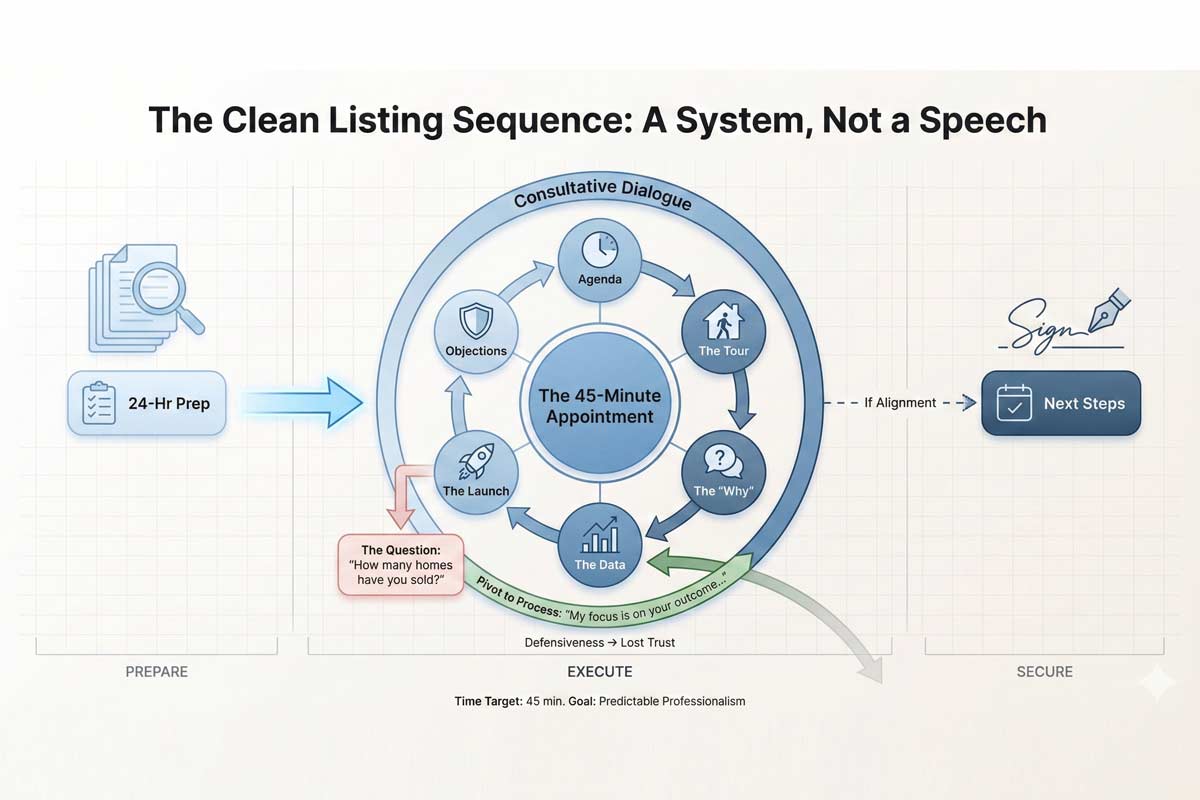
Most new agents walk into their first listing appointment with a gut-level fear: “What if they ask how many homes I’ve sold?”
This fear stems from a misunderstanding of seller psychology. Sellers aren’t buying your resume. They are buying a process that protects their equity and reduces mistakes. They aren't looking for a "veteran" as much as they are looking for a professional with a predictable, low-risk system.
In my 20+ years of training thousands of California agents at ADHI Schools, I’ve seen rookies beat top producers because they prioritized clarity over charisma. If you try to wing it, you’ll feel it—and they’ll feel it.
Confidence doesn’t come from your track record—it comes from your sequence.
Time target: 45 minutes total (10 tour / 25 table / 10 close & next steps).
The appointment is won or lost before you ring the doorbell.
CMA: Prepare a Comparative Market Analysis with Actives (competition), Pendings (market direction), and Solds (the reality check).
Title Profile: Check for liens, multiple owners, or solar panel UCC filings.
The "Motivation" Call: 24 hours prior, call to confirm. Ask: "Aside from the price, what is the one thing that must happen for this move to be a success?"
Sellers can interpret overly flashy materials as in security. Data and a calm process read as competence. Bring an iPad or a neatly organized folder containing:
You’re the guide. Your job is to run a clean, low-drama decision meeting.
Warm Seller: "Thanks for having me over. My goal today is to see the home, hear your goals, and show you exactly how we’ll find the right buyer. Does that work for you?"
Skeptical Seller: "I know your time is valuable. I’ve set aside 45 minutes to go over the data and our strategy. At the end, we’ll both know if I’m the right fit to get this sold. Should we start with a quick tour?"
The biggest mistake new agents make is acting like a guest. You’re there to audit the asset.
Handle this moment with zero defensiveness.
The "High-Touch" Pivot
"Fair question. My model is high-touch: fewer clients at a time, tighter communication, and a very structured launch plan. You won’t be competing for my attention."
The "Team-Backed" Angle:
"Great question. I’m your point of contact, and I run the process. And I’m backed by my broker and transaction team on pricing, disclosures, and contract execution—so you get personal attention with professional oversight."
Ask: "If this home doesn't sell for six months, how does that affect your plans?" If you don't know their "Why," you cannot handle their objections later.
Show the data. "The market is telling us that homes like yours sell fast... or they start going stale and get negotiated down." We’ll define ‘stale’ using showing volume, online saves, and buyer feedback—not vibes. Understanding negotiation basics for new California agents is critical here—you aren't negotiating against the seller; you are negotiating with the market.

Show them your Launch Plan. This includes professional media, reverse prospecting, and the "Feedback Loop" (your scheduled weekly update).
If you have practiced how to practice real estate scripts effectively, you will stay calm here.
The Direct Close: "I’m confident we can hit your timeline. Are you ready to get the paperwork started so we can get the photographers out here Monday?"
The "Think About It" Close: "I understand. Usually, when people want to think about it, it’s because I haven't clarified something. Which part of the plan are you still weighing?"
Q: Should I bring the listing agreement to the first meeting?
A: Bring it every time—even if you don’t pull it out. It signals preparedness and lets you move forward immediately if they are ready.
Q: What if they ask about my experience?
A: Pivot to your process. Experience is just a proxy for "Will you mess this up?" Prove you won't by being the most organized person they meet.
Q: How does this differ from working with buyers?
A: Listings are about asset management; buyers are about search and discovery. You should prepare for a first buyer consultation with the same level of systematic rigor.
The listing appointment for new agents is a test of your business operating system. You do not need to be the most famous agent in California to win; you just need to be the most prepared.
Read more to see how this fits into our broader California real estate career guide, continue building your library of systems.
Your next step: practice these scripts out loud until they feel natural.

Founder, Adhi Schools
Kartik Subramaniam is the Founder and CEO of ADHI Real Estate Schools, a leader in real estate education throughout California. Holding a degree from Cal Poly University, Subramaniam brings a wealth of experience in real estate sales, property management, and investment transactions. He is the author of nine books on real estate and countless real estate articles. With a track record of successfully completing hundreds of real estate transactions, he has equipped countless professionals to thrive in the industry.


"Hey guys,
I took the exam today and passed!!!!
It only took me one try which was one of my goals. I took the online
classes and follow your suggestions so I took the crash course,
used the crash course app a lot, took 7 mock tests and went
confident to present the exam. Thank you for the great job you are
doing, you guys are awesome!!!! May God continue to bless you!"
Willie V.