
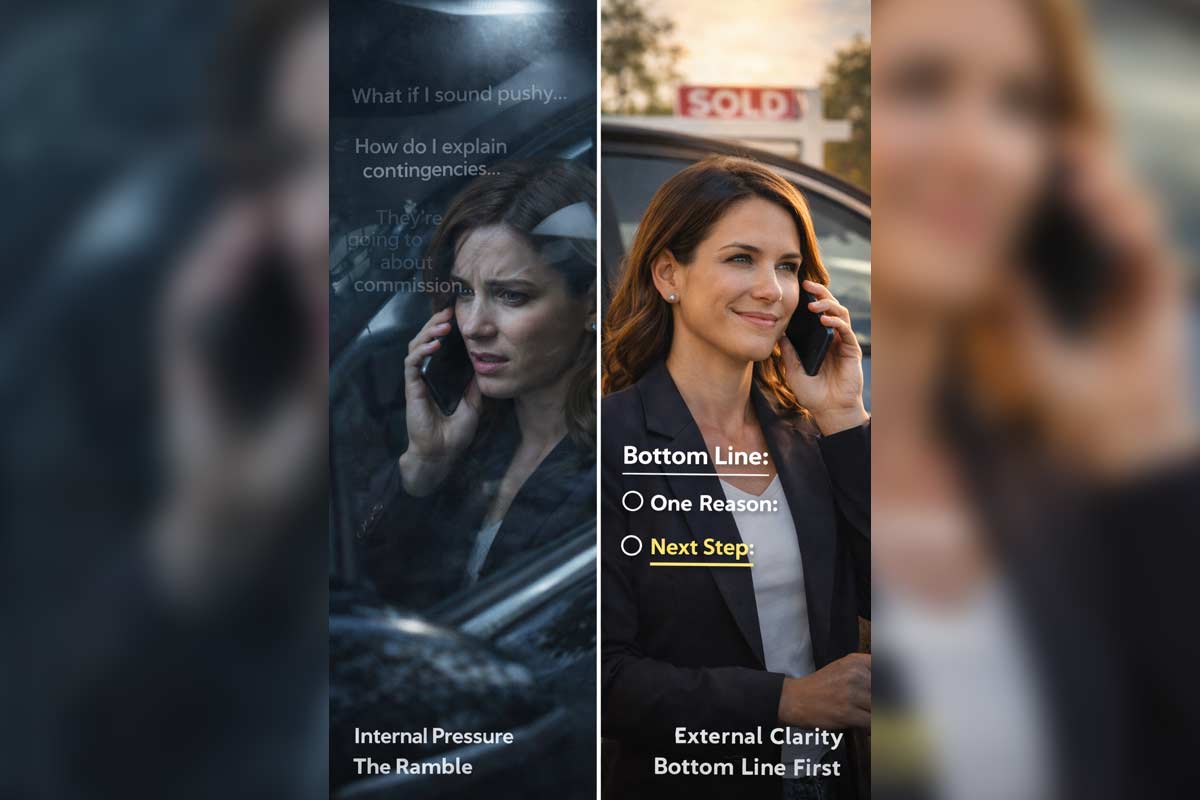
New agents sometimes wake up with a knot in their stomach. It isn’t the paperwork or the math; it’s the fear of the "awkward" conversation.
You worry about sounding like you don’t know what you’re doing. You fear a client asking a question you can’t answer, or worse, losing control at a $1.2 million listing appointment because you didn’t know how to pivot the conversation.
Real estate communication skills are the ability to ask the right questions, explain complex information clearly, control conversations under pressure, and guide clients toward confident decisions. Top agents treat communication as a trainable skill—not a personality trait.
After 20+ years of coaching California agents at ADHI Schools, I’ve seen that the "Top 1%" aren't always more charismatic than you. They simply use repeatable communication frameworks. They don't wing it; they follow a system that builds trust and projects authority.
Communication is the multiplier. You can have all the essential skills every new California agent must master, but if you can't communicate your value, those skills stay hidden.
Elite agents don't have one "personality." They toggle between four specific modes depending on what the client needs at the moment.
The Guide provides calm, structured direction when the client feels overwhelmed.
The Detective asks deep questions to find the "why" behind the "what."
The Translator takes complex legal or financial jargon and makes it simple. This is where you must master real estate terminology fast so you can explain it in plain English.
The Closer focuses on the next logical step without being "salesy."
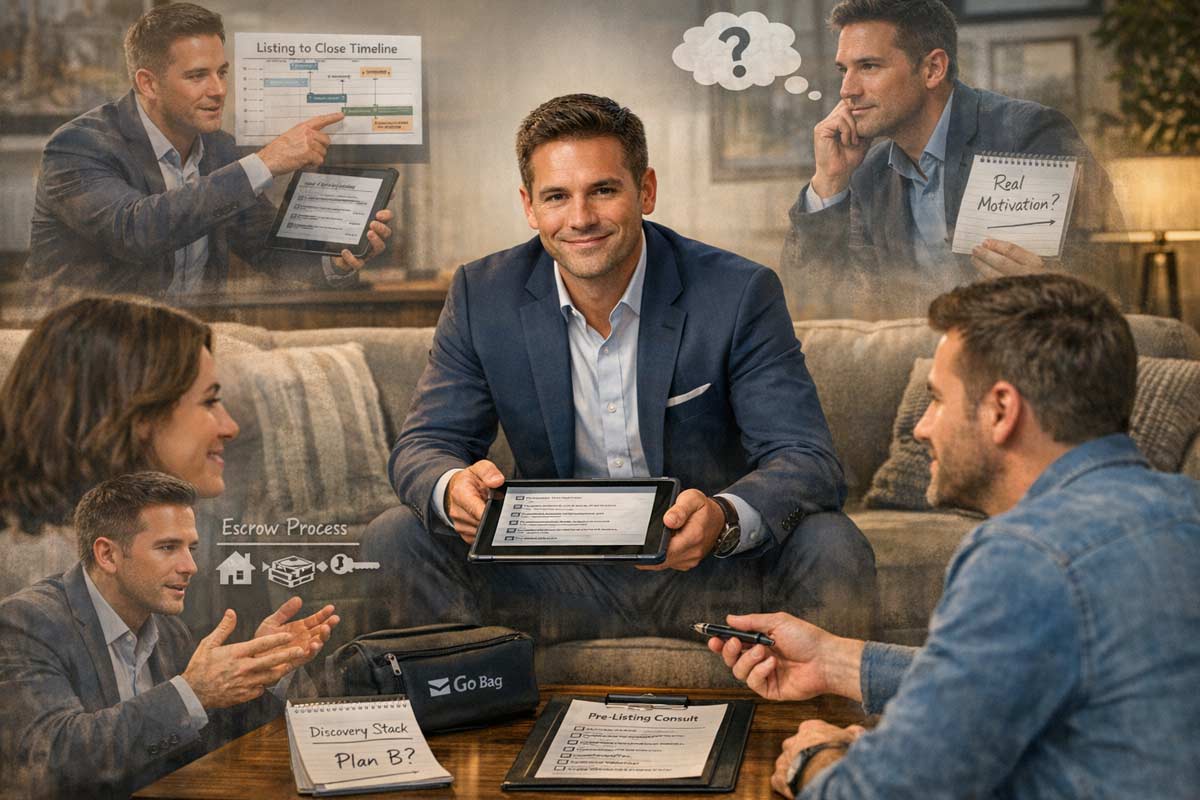
The agent who talks the most usually loses. On the other hand, the agent who asks the best questions wins. Use these high-quality questions to uncover the truth:
| Category | Better Question (The "Detective" Mode) |
|---|---|
| Motivation | "If you don't find a home in the next 90 days, what is your Plan B?" |
| Timing | "On a scale of 1–10, how much of a 'must' is moving by summer?" |
| Decision Makers | "Besides yourself, who else needs to see the property before we make an offer?" |
| Financing | "When you spoke with your lender, what was the monthly payment range you felt most comfortable with?" |
| Risk | "What is the one thing that would make you walk away from a deal, no matter how much you liked the house?" |
I’ve seen many deals die because an agent let a client "run" the process. To maintain control, use the Acknowledge → Label → Redirect → Confirm framework.
As a real estate agent developing emotional intelligence allows you to stay calm when a client gets aggressive or emotional, keeping the focus on the goal.
Scenario: A client wants to see 10 houses in one day without a pre-approval.
In California's high-stakes market, poor communication isn't just a minor mistake; it's a liability. I’ve seen promising careers stalled by these three avoidable outcomes:
When agents get nervous, they ramble. To stop this, use the Bottom Line First (BLF) system.
Pro Tip: : If communication feels like your weak point, start by mastering one skill at a time. Most agents begin by building confidence and learning terminology before tackling advanced objection handling.
Top agents don't "overcome" objections; they "solve" them.
Follow-up isn't "checking in." It's providing value.
"Hey [Name], thanks for touring that property on Main St today. I just found out the seller received two offers this afternoon. Based on what we saw, do you want to be the third, or should we move on to the listing on Oak St tomorrow?"
You cannot "think" your way into confidence. You have to "rep" your way there. As you build confidence as a new real estate agent, your speech will naturally become more fluid.
You can have the best marketing and the best local knowledge, but if you can't articulate your value, you'll always struggle to close. Master these frameworks, and you will stop feeling like a "salesperson" and start feeling like a consultant.
Developing your Real Estate Agent Skills California is a lifelong journey—and communication is the skill that makes every other skill visible to clients. Start with how you talk, and the results will follow.
1. How do I avoid sounding like a "pushy" salesperson?
Focus on the "Detective" mode. If you ask enough questions to truly understand the client's goals, your advice will feel like help rather than a sales pitch. Always prioritize their "why" over your "close."
2. What should I do if a client asks a question I don't know the answer to?
Never guess.
Say: "That’s a great question, and I want to make sure I give you the exact data on that. Let me verify that with my broker/title officer and get back to you by 3:00 PM." This builds more trust than a fake answer.
3. How do I handle a client who won't stop talking?
Use the "Redirect" framework. Wait for a natural breath, acknowledge their point briefly, and say, "That’s a great point—to make sure we stay on track for your 2:00 PM appointment, let's pivot quickly to the closing costs."
4. Is texting clients better than calling?
It depends on the urgency. If allowed, use text for quick updates and logistics. Use phone or Zoom for negotiations, bad news, or complex explanations where tone of voice is necessary to prevent misunderstandings.
5. How can I sound more confident when I'm brand new?
Confidence comes from having a "Next Step" ready. Even if you don't know the whole process, you should always know the very next thing that needs to happen. Leading the client to the next step makes you the authority.

Founder, Adhi Schools
Kartik Subramaniam is the Founder and CEO of ADHI Real Estate Schools, a leader in real estate education throughout California. Holding a degree from Cal Poly University, Subramaniam brings a wealth of experience in real estate sales, property management, and investment transactions. He is the author of nine books on real estate and countless real estate articles. With a track record of successfully completing hundreds of real estate transactions, he has equipped countless professionals to thrive in the industry.

"Hey guys,
I took the exam today and passed!!!!
It only took me one try which was one of my goals. I took the online
classes and follow your suggestions so I took the crash course,
used the crash course app a lot, took 7 mock tests and went
confident to present the exam. Thank you for the great job you are
doing, you guys are awesome!!!! May God continue to bless you!"
Willie V.