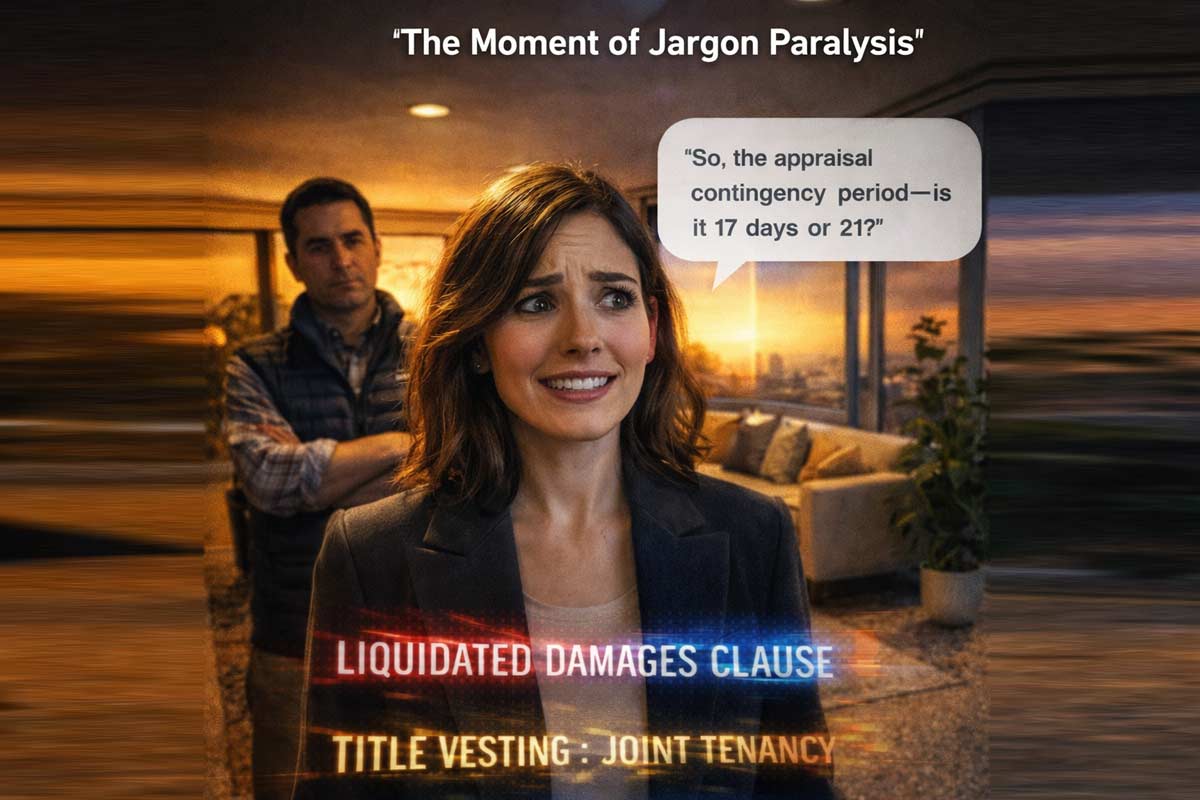
Every new agent fears the "Smartest in the Room"—that prospective buyer who walks into an open house with a question that rattles the rookie.
Their favorite weapon?
Technical jargon used in the wrong place. Imagine a visitor asking you about the status of contingencies and EMD increases before they’ve even toured the master bedroom.
The catch? There are no contingencies yet because there is no contract.
The truth is, terminology isn’t a measure of your intelligence; it’s simply a product of exposure, repetition, and usage. After 20+ years of coaching California agents at ADHI Schools, I’ve seen a consistent pattern: agents don’t fail because they lack ambition; they fail because they lack a system. To succeed, you must develop the Real Estate Agent Skills California agents need to handle contracts and conversations with poise. Mastering the language is the first step toward professional authority.
Rote memorization is for passing the exam. Usage is for building a career. To master real estate terminology fast, stop reading a dry glossary and start using this 3-step framework:
If you can’t explain a term in 10 seconds to a non-agent, you don’t “know” it yet. Your job isn’t to sound smart; your job is to help your clients understand.
You need to master the 20% of real estate vocabulary for beginners that drives 80% of real agent conversations. Focus on these clusters first:
In California, you’ll hear the phrase “opened escrow” constantly. In most California transactions, escrow, title, and recording are tightly sequenced, which is why agents who misuse these terms accidentally create false expectations around closing dates.
Context is the ultimate teacher. If you want to learn the essential skills every new California agent must master, stop looking at terms in a vacuum.
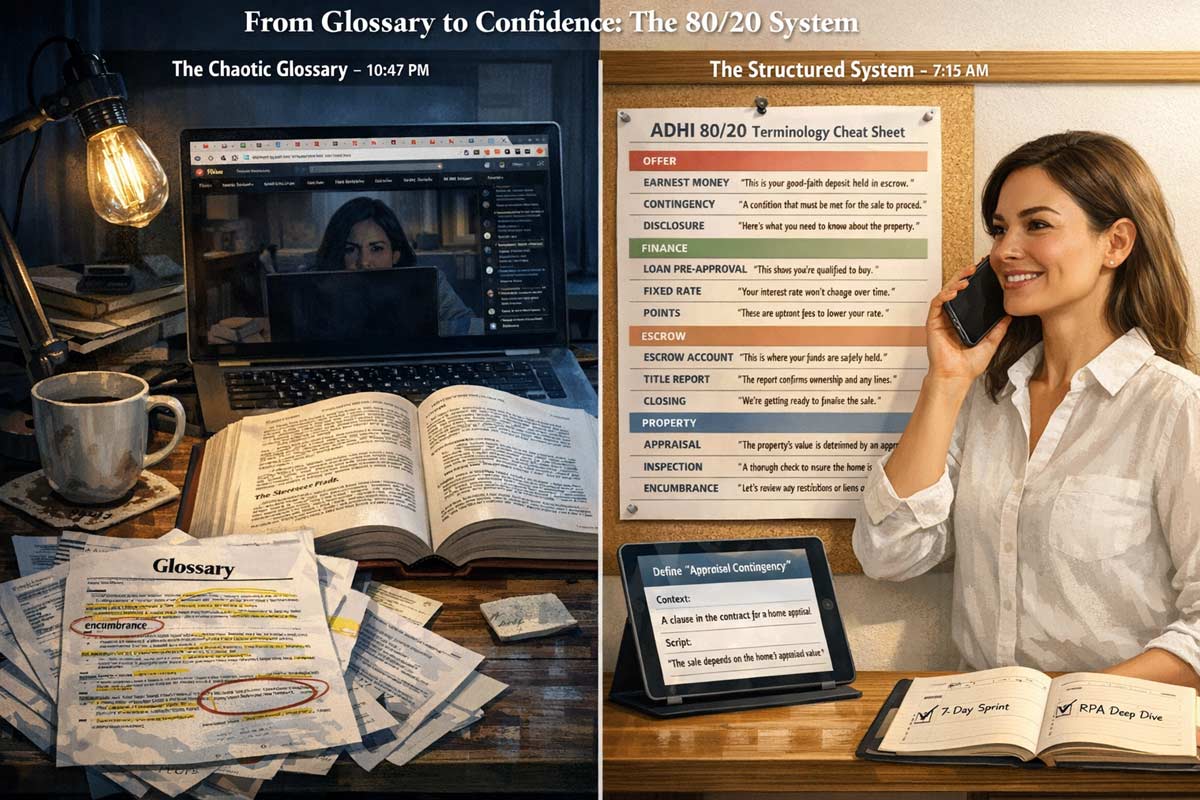
Use these high-performance tactics to build your confidence as a new agent:
| Day | Task |
|---|---|
| Day 1 | Master 5 "Offer" terms + write scripts for each. |
| Day 2 | Call a lender and ask them to explain "Points" and "Rate Locks." |
| Day 3 | Read a full California Residential Purchase Agreement (RPA). Highlight unknowns. |
| Day 4 | Focus on Escrow. Watch a video on the CA escrow process. |
| Day 5 | "Teach it Back" day. Explain 10 terms to a non-agent. |
| Day 6 | Practice the "Common Mistakes" section below. Say the fixes out loud. |
| Day 7 | Review your personal glossary and add 3 new terms from local MLS listings. |
Mastering the language is a core part of the communication skills that separate top agents from the rest.
Even prepared agents trip up. High emotional intelligence for real estate agents means knowing when to slow down and clarify.
Terminology is the foundation of your professional house. Once you learn real estate terms quickly, you stop worrying about "sounding like a newbie" and start focusing on what matters: your clients.
What are the most common real estate terms for new agents?
The most common terms revolve around the "Big Three": Financing (Pre-approval, EMD), Negotiation (Contingencies, Counters), and Closing (Escrow, Title).
How do I learn real estate terms fast?
Use the "Definition → Context → Script" method. Don't just memorize what a word means; practice how you will explain it to a client in 10 seconds or less.
What does ‘opening escrow’ mean in California?
In California, opening escrow means a neutral third party has received the signed purchase agreement and the buyer’s initial deposit, officially starting the closing process.
Pre-approval vs. pre-qualification—what’s the difference?
A pre-qualification is a surface-level estimate of what you might afford. A pre-approval is a formal commitment from a lender after they have verified your income, credit, and assets.
Founder, Adhi Schools
Kartik Subramaniam is the Founder and CEO of ADHI Real Estate Schools, a leader in real estate education throughout California. Holding a degree from Cal Poly University, Subramaniam brings a wealth of experience in real estate sales, property management, and investment transactions. He is the author of nine books on real estate and countless real estate articles. With a track record of successfully completing hundreds of real estate transactions, he has equipped countless professionals to thrive in the industry.

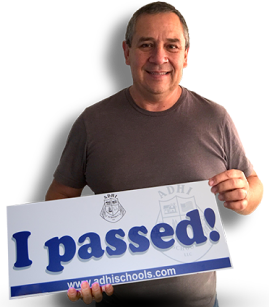
"Hey guys,
I took the exam today and passed!!!!
It only took me one try which was one of my goals. I took the online
classes and follow your suggestions so I took the crash course,
used the crash course app a lot, took 7 mock tests and went
confident to present the exam. Thank you for the great job you are
doing, you guys are awesome!!!! May God continue to bless you!"
Willie V.