If you're planning to sell real estate in California, you face a choice that could determine your career success: learn from a school that specializes exclusively in California's complex market, or settle Read more...
If you're planning to sell real estate in California, you face a choice that could determine your career success: learn from a school that specializes exclusively in California's complex market, or settle for generic national training that treats the Golden State as just another checkbox.
The stakes are higher than you might think. California's real estate exam has no national component—it tests exclusively on state-specific laws like seismic disclosure requirements, Mello-Roos districts, and water rights regulations that don't exist anywhere else. National programs often treat these critical topics as brief add-ons, while California-focused schools like ADHI Schools build their entire curriculum around mastering these requirements.
The difference isn't just academic. California agents who thoroughly understand state-specific regulations close more deals, avoid costly legal mistakes, and build stronger client relationships from day one. Your choice of real estate school directly impacts whether you'll enter this competitive market fully prepared or spend months catching up on knowledge you should have learned before taking your first listing.
Understanding ADHI Schools' California Focus
ADHI Schools operates exclusively in California, focusing solely on preparing students for the California real estate market. This specialization means our curriculum, instructors, and resources are dedicated entirely to California's real estate education requirements.
Unlike national real estate education providers that attempt to serve students across multiple states, ADHI Schools has chosen to concentrate on one market - California. This approach allows us to dedicate all our resources to understanding and teaching California's specific real estate laws, market conditions, and licensing requirements.
For students preparing for their real estate license, this focus means learning material directly applicable to California practice. Topics like California's Transfer Disclosure Statement requirements, the state's unique escrow process, and specific environmental hazard disclosures receive comprehensive coverage rather than brief mentions in a broader national curriculum.
The California Department of Real Estate requires 135 hours of pre-licensing education with specific topic coverage. The courses required are California Real Estate Principles, California Real Estate Practice and one elective course.
Schools like ADHI Schools who focus exclusively on California can structure their entire program around these requirements without needing to accommodate varying state standards.
Key Features of California-Focused Education
Curriculum Tailored to California Requirements
A California-specific curriculum addresses the state's unique real estate landscape in detail. Students learn about California Civil Code sections that govern real estate transactions, state-specific agency relationship requirements, and disclosure obligations, many of which simply don't exist in other states.
Important California topics that receive focused attention include:
Seismic safety disclosures and earthquake-related property issues
Wildfire hazard zones and related disclosure requirements
Mello-Roos community facilities districts
California's community property laws
Proposition 13 and its impact on property taxation
Regional water rights and agricultural property considerations
This specialized approach at a dedicated California real estate license school means students spend their time learning applicable California law rather than general principles that may need modification for state-specific practice.
Instructors with California Market Experience
ADHI Schools employs instructors who hold active California real estate licenses and have experience in the state's various markets. This local experience allows instructors to provide context and examples from actual California transactions.
Having instructors familiar with California's diverse regions—from the Bay Area's competitive market to the Central Valley's agricultural properties—can help students understand how state laws apply in different contexts. Our instructors can also share insights about regional variations in practice while maintaining focus on state-mandated requirements.
Think of it like this: learning from a California-based professional is like getting a tour of a city from a local instead of just reading a guidebook. They won't just show you the famous landmarks; they'll show you the hidden gems, the best shortcuts, and how to navigate the city like you've lived there for years. In real estate school, this means you'll learn about current local trends and the specific steps unique to the California real estate landscape.
Exam Preparation Focused on California's Test
The California real estate licensing exam includes questions specific to state law and practice and California does not have a national component. A California-focused program can dedicate all exam preparation time to the content actually tested on the state exam.
This targeted approach means ADHI Schools’ practice questions reflect California scenarios, calculations use California-specific examples, and real estate exam study materials align with the state's testing priorities. Students preparing for their real estate license exam can focus their efforts on mastering California requirements rather than trying to filter through multi-state content.
California's exam covers topics unique to the state, including specific environmental hazards, state-mandated disclosures, and California agency law. Real estate exam preparation materials designed specifically for California can address these topics in appropriate depth.
Comparing California-Specific and National Programs
Depth vs. Breadth in Real Estate Education
National real estate education providers typically offer programs that cover general principles applicable across multiple states, with state-specific supplements added for different markets. This approach provides flexibility for students who might practice in multiple states but may result in less detailed coverage of any single state's requirements.
Resource Allocation and Local Knowledge
Schools focusing on a single state can invest their resources in staying current with that state's changing regulations and market conditions. California frequently updates its real estate laws and regulations, and specialized schools can adapt their curriculum accordingly.
This focused approach also extends to support materials and resources. A California-specific real estate license school can provide state-focused textbooks, practice exams that mirror California's test format, and reference materials tailored to state requirements.
Professional Networks and Career Support
Students in California-specific programs study alongside others planning to work in the same state. This creates networking opportunities with future colleagues who will understand the same market conditions and regulations.
Additionally, California-focused schools may develop relationships with local brokerages and real estate professionals, potentially facilitating job placement and mentorship opportunities within the state. These connections can be valuable for new agents establishing themselves in California's competitive market.
Making an informed decision
When evaluating any real estate license school, including ADHI Schools, consider requesting specific information about:
Curriculum content and how it aligns with California requirements
Instructor qualifications and experience
Study materials and practice exam resources
Support services available to students
Format options that fit your schedule
Speaking with recent graduates or current students can also provide insights into the practical aspects of different programs.
Preparing for Success in California Real Estate
California's diverse real estate market requires agents who understand the state's specific regulations and requirements. Quality education focused on California's unique disclosure laws, agency relationships, and transaction procedures is essential for success.
Whether choosing ADHI Schools or another provider, ensure your program thoroughly covers California-specific content rather than generic national material. The state's complex regulatory environment demands comprehensive preparation tailored to local practice.
For aspiring California agents, investing in state-focused education makes practical sense. Programs like ADHI Schools that concentrate exclusively on California requirements can provide more targeted preparation for both licensing exams and professional practice.
When selecting your real estate license program, consider how each option aligns with your goals and learning style. California's competitive market rewards well-prepared professionals, making your educational foundation a crucial first step.
We would be thrilled to have you join us at ADHI Schools!
Love,
Kartik
|

A New Chapter After the Force
After years of dedication to the beat, the badge, and the public, hanging up the duty belt for the last time is a monumental transition. The structure is gone, but the Read more...
A New Chapter After the Force
After years of dedication to the beat, the badge, and the public, hanging up the duty belt for the last time is a monumental transition. The structure is gone, but the drive to serve and protect remains. For a growing number of California's retired police officers, that drive is finding a powerful new outlet: real estate.
You've spent decades responding to calls, building cases, and keeping communities safe. Now, as you face retirement, the thought of endless fishing trips or becoming a mall security guard doesn't exactly light a fire in your belly. You want something more—a second career that offers both financial rewards and that familiar sense of purpose that comes from helping people during life's pivotal moments.
Real estate isn't just another retirement gig—it's a natural evolution of your service. The skills you've honed on the force—reading people, negotiating under pressure, knowing every street and alley in your jurisdiction—these aren't just transferable to real estate. They're your secret weapons in an industry crying out for professionals with integrity and street smarts.
I wanted to write an article as your mission briefing to transition from law enforcement to real estate success, starting with your first objective: obtaining your real estate license.
Why Retired Police Officers Excel in Real Estate: Your Tactical Advantages
Your police career has given you a skill set that most real estate newcomers would pay dearly to develop. Let's break down your tactical advantages in this new field.
Unmatched Community Knowledge
You didn't just patrol neighborhoods—you know their DNA. You know which streets flood during heavy rain, where the best coffee shops are for client meetings, and which areas are experiencing real transformation versus just hype.
In the Field: While other agents are pulling up crime statistics on their laptops, you're telling clients, "This neighborhood has really turned around since they put in that community center in 2018. I worked with residents to start their neighborhood watch program." When a client asks about safety, you don't just quote statistics—you provide the kind of nuanced, street-level intelligence that builds immediate trust and confidence.
Built-in Trust and Integrity
Your badge meant something. It represented integrity, protection, and service. That reputation follows you into real estate, where trust is the currency that closes deals.
In the Field: When you hand a client your business card and they see your law enforcement background, their guard drops. They know you've been background-checked, polygraphed, and held to the highest standards. While other agents struggle to establish credibility, your service record speaks volumes. Clients sleep better knowing their agent once took an oath to protect and serve.
Expert Negotiation and Crisis Management
Every domestic dispute you've mediated, every standoff you've de-escalated, every hostile interview you've conducted—it's all been training for real estate negotiations.
In the Field: When a home inspection reveals foundation issues and your buyer wants to walk, you employ the same calm presence you used during high-stress calls. "Let's take a breath and look at our options," you say, channeling years of crisis management. You know how to keep all parties talking when emotions run high. That seller threatening to kill the deal over a $2,000 repair credit? You've handled far worse with far higher stakes.
Investigation and Attention to Detail
Your investigative skills translate directly to due diligence in real estate. You've been trained to spot what others miss, ask the right questions, and dig deeper when something doesn't add up.
In the Field: While reviewing disclosures, you notice inconsistencies other agents might miss. That "minor water damage" mentioned in passing? Your investigative instincts kick in. You know to check permit histories and point your buyer in the direction to verify claims. Your clients benefit from the same thoroughness you brought to case files.
A Commitment to Service
Real estate, at its core, is about protecting people's interests during one of the biggest financial decisions of their lives. Sound familiar? You're not changing careers—you're expanding your definition of "protect and serve."
In the Field: When you help a young family find a safe neighborhood with good schools, you're still protecting. When you guide seniors through downsizing so they can age in place comfortably, you're still serving. The uniform is gone, but the mission continues.
Discipline and Work Ethic
The self-discipline that got you through the academy, helped you make rank, and kept you sharp through rotating shifts? That's exactly what separates successful agents from those who wash out.
In the Field: While other new agents sleep in because "they don't have showings until noon," you're up at 0600 prospecting, returning calls, and preparing market analyses. You understand that in a commission-based business, discipline equals dollars. No sergeant is watching, but your internal standards haven't changed.
Your New Mission Briefing: How to Get Your California Real Estate License
Consider this your ops plan for transitioning to real estate.
Step 1: Meet the Basic Requirements (Background Check)
Before considering enrolling in a real estate license school, you need to clear these basic requirements:
Age: 18 or older (check)
Residency: California residency not required
Background Disclosure: The Department of Real Estate in California requires background clearance.
Step 2: Complete Your Academy Training (Pre-License Education)
California mandates 135 hours of training from a DRE-approved institution like ADHI Schools. Think of it as a mini-academy focused on real estate. You'll complete three courses:
Real Estate Principles (45 hours) - Your foundation course
Real Estate Practice (45 hours) - Field training manual
One Elective (45 hours) - Choose from specialties like Real Estate Finance or Legal Aspects of Real Estate at ADHI Schools
After years of roll call training, policy updates, and continuing education, this structured learning will feel familiar. Many retired officers report that the discipline of regular study actually helps with the retirement transition.
Step 3: Pass Your License Exam
The California Real Estate Salesperson Exam consists of 150 multiple-choice questions. Topics include:
Property ownership and land use controls
Agency law and fiduciary duties
Valuation and market analysis
Financing and lending practices
Transfer of property and escrow
Practice of real estate and mandated disclosures
You've passed promotional exams, POST certifications, and countless training assessments. This is just another test—one where proper preparation from a quality real estate license school makes all the difference.
Step 4: Find Your New Department (Sponsoring Broker)
Unlike your independent authority as a sworn officer, new agents must affiliate with a licensed broker. Think of it as choosing which detective bureau to join—you want one that values your experience and provides solid backup.
Choosing Your New Academy: Selecting the Right Real Estate License School
Picking the right real estate license school is like choosing between agencies—the quality of your training directly impacts your success in the field.
DRE-Approved Schools (Legitimate Academies Only)
Just as you'd only attend a POST-certified academy, only consider schools approved by the California Department of Real Estate. No shortcuts, no diploma mills.
Flexible Learning Options (Fitting Your Transition)
Online courses: Perfect for self-directed learners who want to move at their own pace
Night/weekend classes: Ideal if you're working part-time security or consulting
Comprehensive Exam Prep (Range Qualification)
Look for schools offering:
Practice exams that mirror the real test
Comprehensive study materials
Instructor support when you're struggling with concepts like 'easements' or 'fiduciary duties'
Instructor Experience (Your Field Training Officer)
Don't just learn the law; learn the business. Seek out a real estate license school where instructors are or have been active, successful agents. They can provide the "street smarts" that aren't in the textbook—how to actually convert leads, handle difficult clients, and navigate the real-world challenges of building a successful practice.
Job Placement & Brokerage Connections (Your First Assignment)
Top-tier schools like ADHI Schools have relationships with local brokerages. They often provide resources to help you find a sponsoring broker that aligns with your values—a crucial step for launching your career. Some schools even have dedicated placement specialists who understand the unique value retired officers bring to real estate.
Ready to begin your new mission? Your first objective is clear: enroll in ADHI Schools and begin your transition to real estate success.
.reg-now{
text-align: center !important;
border-radius: 50px !important;
margin-top: 40px !important;
margin-bottom: 40px !important;
}
@media (max-width: 428px){
.reg-now{
width: 100% !important;
display: flex;
justify-content: center;
}
}
ENROLL NOW
The Payoff: Financial Freedom and a Flexible Lifestyle
Your law enforcement career provided stability and a pension. A career in real estate offers something different but equally powerful: autonomy and uncapped potential.
Unlimited Earning Potential
In real estate, there's no salary cap or pay grade. Your income is a direct result of your effort and discipline—a concept you already live by. After decades of rigid pay scales where a 3% raise was cause for celebration, you can now earn what you're truly worth. You can earn a modest supplemental income to enhance your pension or build a six-figure business. The choice—and the effort—is yours.
Be Your Own Boss
While you work under a broker, you are essentially an independent contractor. You set your own hours. If you want to take Tuesday mornings off to go fishing or attend a grandchild's school event, you can. No more shift bids, no more denied vacation requests, no more mandatory overtime ruining weekend plans. This flexibility is one of the most sought-after benefits for those transitioning from a rigid, shift-based career.
Build a Lasting Business
You're not just earning a commission; you're building a personal brand and a business asset that can grow over time. Every client you serve becomes part of your network and a potential source of future referrals. Unlike a job you leave behind at retirement, your real estate business can continue generating income as long as you choose to work—or even be passed on to family members.
Your Next Chapter of Service Awaits
Your career protecting the public has prepared you for this moment. The skills are there. The integrity is proven. The drive to serve is ingrained in your DNA. A career in real estate isn't a departure from your life's work—it's a continuation of it in a new uniform.
The transition from badge to business card might seem daunting, but thousands of retired California officers have already made this journey successfully. They're earning more than they ever did in uniform, working when they want to work, and finding deep satisfaction in helping families achieve their dreams of homeownership.
Your next mission is clear. Take that first decisive step. Enroll in ADHI Schools, begin your training, and get your real estate license. A new, rewarding, and prosperous chapter is waiting for you to write it.
The badge may be retired, but your commitment to service is just beginning a new chapter. Welcome to your next beat—California real estate.
Love,
Kartik
|

How Healthcare Workers Excel in California Real Estate
Each year healthcare professionals in California make the leap from medical scrubs to real estate blazers. This remarkable trend isn't just about Read more...
How Healthcare Workers Excel in California Real Estate
Each year healthcare professionals in California make the leap from medical scrubs to real estate blazers. This remarkable trend isn't just about career change—it's about leveraging years of patient care experience into a thriving real estate career. If you're a healthcare worker considering this transition, obtaining your real estate license could be your gateway to a rewarding new profession. The journey begins with choosing the right real estate school.
This comprehensive guide will walk you through every step of transitioning from healthcare to real estate, highlighting why your medical background gives you a unique advantage in the property market.
The Natural Transition: Healthcare Skills That Transfer to Real Estate
Healthcare professionals possess an extraordinary skill set that translates seamlessly into real estate success. Your years of patient care have honed abilities that many new agents spend years developing. The empathy you've cultivated while caring for patients becomes your superpower when understanding client needs and navigating the emotional journey of buying or selling a home.
Communication skills developed in high-pressure medical environments also can prove invaluable when negotiating deals or explaining complex contracts. Just as you've translated medical terminology for patients, you'll find yourself demystifying real estate jargon for clients. Your ability to remain calm during medical emergencies can translate well into steady guidance through stressful real estate transactions.
The meticulous attention to detail required in healthcare—from medication dosages to patient charts—directly applies to reviewing contracts, managing timelines, and ensuring compliance with regulations. This precision becomes particularly valuable when attending real estate school where understanding legal requirements and documentation is crucial for obtaining your real estate license.
Your experience in building trust quickly with patients creates instant rapport with clients. Healthcare workers recognize the importance of actively listening and responding to both spoken and unspoken concerns. These interpersonal skills, combined with your problem-solving abilities, position you perfectly for success after completing your real estate education.
Your Path to a California Real Estate License: A Step-by-Step Guide
Obtaining your California real estate license requires completing specific educational requirements and passing the real estate examination. The California Department of Real Estate(DRE) mandates 135 hours of pre-licensing education, which must be completed at an approved real estate school before you can sit for the real estate license exam.
The first step toward your real estate license involves selecting three required courses: Real Estate Principles, Real Estate Practice, and one elective from an approved list. These courses provide the foundation for your real estate career, covering everything from property law to ethical practices. Most healthcare professionals find the structured learning environment familiar, though the content represents an exciting new domain.
After completing your coursework at ADHI Schools, you'll need to pass the California real estate license examination. This comprehensive test evaluates your understanding of real estate law, practices, and mathematical calculations. The sales license exam consists of 150 multiple-choice questions, and you must score at least 70% to pass. We recommend dedicating 2-3 weeks to focused exam preparation after finishing your real estate school courses.
The California real estate license requirements also include submitting fingerprints for a background check and paying the associated fees. The entire process, from enrolling in real estate school to receiving your active real estate license, typically takes 4-6 months for dedicated students. However, California allows up to one year to complete the educational requirements, accommodating healthcare workers who need to balance their current responsibilities.
Once you've passed the exam and met all California real estate license requirements, you'll receive your official license from the DRE. This credential opens doors to affiliating with a brokerage and beginning your new career. Remember, your real estate license must be renewed every four years, which requires completing additional continuing education courses.
Finding the Best Real Estate School for Your Healthcare Background
Selecting the right real estate school is crucial for your success, especially when balancing healthcare responsibilities with educational pursuits. California offers numerous accredited real estate schools, each with unique advantages for busy professionals. The best real estate school for your needs will offer flexible scheduling, comprehensive support, and a curriculum aligned with your learning style.
Online real estate schools like ADHI Schools have become increasingly popular among healthcare workers, offering the flexibility to study during breaks or after shifts. Our digital platform offers the same quality of education as traditional classrooms, while eliminating commute time. When evaluating an online real estate school, look for interactive elements, instructor accessibility, and robust exam preparation resources. Our top-rated real estate exam prep software even offers a mobile app, allowing you to study anywhere.
Our hybrid real estate school program combines online flexibility with periodic in-person sessions, offering the best of both worlds. This format works exceptionally well for healthcare workers who value face-to-face interaction but need scheduling flexibility. When researching any real estate school, verify their DRE approval status and read reviews from recent graduates, particularly those who made similar career transitions.
Consider the real estate school's exam pass rates and success of former students.The best real estate schools offer exam preparation courses, practice tests, and career placement assistance. Some schools even offer mentorship programs that connect new agents with experienced professionals, which can be invaluable during the transition from healthcare to real estate.
Investment and Timeline: Real Estate School Costs and Career Transition Planning
Understanding the financial investment required for your real estate education helps you plan your career transition effectively. Real estate school tuition with ADHI Schools ranges from $99 to $499 for the required pre-licensing courses, depending on the format.
Beyond our school costs, you should budget for your real estate license examination fee of $100 and the initial license fee of $350. Additional expenses include fingerprinting (approximately $90) and our legendary crash course to prepare you for the exam. Many healthcare professionals find that setting aside about $1,500 comfortably covers all expenses related to obtaining their real estate license, including some buffer.
The timeline from enrollment to active real estate license varies based on your dedication and schedule flexibility. You can complete the real estate license courses in as little as 54 days and the state will typically take about another 6 weeks of processing time. All in all, you can complete the real estate licensing courses and obtain your license in approximately four months.
Creating a realistic transition plan involves more than just scheduling real estate school. Consider when you'll reduce healthcare hours or transition completely. Many successful nurse-to-realtor professionals maintain part-time healthcare work during their first year in real estate, providing financial stability while building their client base. This gradual transition also allows you to support healthcare benefits while establishing your real estate business.
Financial planning should account for the variable nature of income from real estate. Unlike steady healthcare paychecks, real estate commissions fluctuate based on market conditions and personal performance. It’s prudent to have a few months of living expenses saved before making the complete transition from healthcare to real estate.
Practical Tips for Healthcare Workers Entering Real Estate
Completing real estate school alongside your healthcare role is entirely manageable—the real estate school coursework is flexible enough that you won’t need major schedule changes immediately. After obtaining your license, consider gradually shifting to part-time or per-diem healthcare hours to better serve your real estate clients. This approach ensures a stable transition without disrupting your current income.
Time management becomes crucial when juggling healthcare shifts and your real estate license courses. Consider creating a structured study schedule that aligns with your work routine. Many successful transitions occur when students similarly approach their real estate education to a clinical rotation, with dedicated hours and specific goals. Mobile learning apps from ADHI Schools also allows productive use of break times and commutes.
Develop your real estate business plan while still in school and remember to leverage your healthcare network from day one of your real estate journey. Inform colleagues about your new career path; many will become future clients or referral sources.
Maintain your healthcare license even after transitioning to a career in real estate. Many successful agents find that keeping their medical credentials active provides backup income options and enhances credibility with specific client demographics. Your healthcare background becomes a unique selling proposition, differentiating you in the competitive California real estate market.
The journey from healthcare to real estate represents more than a career change—it's a transformation that leverages your existing strengths while opening new professional horizons. Your patient care experience, communication skills, and ability to handle high-pressure situations position you uniquely for success in California's dynamic property market. By choosing the right real estate school and dedicating yourself to obtaining your real estate license, you're not starting over—you're building upon a solid foundation of professional excellence.
Whether you choose online or hybrid learning, your healthcare background has already equipped you with the discipline needed to succeed. Your real estate license opens the door to a rewarding career, allowing you to continue making a meaningful difference—now by helping clients find their perfect home. California's market needs professionals like you, who understand service, trust, and attention to detail. Your future clients are waiting for an agent with your unique blend of care and expertise.
Ready to get started? Enroll today at ADHI Schools and begin your journey!
Love,
Kartik
|

When choosing a California real estate license school, many students don't realize that the scope of their program can significantly impact their success. While comprehensive data on pass rates by Read more...
When choosing a California real estate license school, many students don't realize that the scope of their program can significantly impact their success. While comprehensive data on pass rates by program isn't publicly available from the California Department of Real Estate, industry observations suggest that students benefit from California-focused education over generic multi-state programs.
.comparison-table{
border-collapse: collapse !important;
margin: 10px !important;
padding: 10px !important;
}
.comparison-table th,.comparison-table td{
border: 1px solid gray !important;
border-collapse: collapse !important;
margin: 10px !important;
padding: 10px !important;
}
.comparison-table th{
text-align: center;
}
@media (max-width:428px){
.comparison-table{
max-width: 100%;
overflow-x: scroll;
}
}
California's real estate market operates under unique conditions that generic, multi-state programs cannot address with the depth and specificity needed for success. Schools like ADHI Schools, which focus exclusively on California real estate education, understand the nuances that generic programs miss entirely.
The difference isn't just about just getting your California real estate license – it's about building a foundation for long-term success in one of the nation's most complex and lucrative real estate markets.
California-specialized real estate schools dedicate 100% of their resources to helping you master CA-specific requirements, while national programs split their attention across 50 different state regulations. This focused approach can translate to higher pass rates and better career preparation.
The Problem with "One-Size-Fits-All" Real Estate Education
National real estate programs face a steep challenge: they're trying to serve 50 different states, each with unique laws, regulations, and market conditions. This approach can create several problems for our California students.
Generic content can lead to confusion on California-specific topics. When a course attempts to cover Florida's homestead exemptions, Texas oil and gas rights, and California's seismic hazard disclosures within the same curriculum, students become overwhelmed with irrelevant information. They spend valuable study time learning concepts they'll never use in California practice.
Resources get diluted across multiple states.
Many national programs must constantly update content for 50 different regulatory environments. This can mean less time spent perfecting California-specific materials and fewer resources dedicated to helping students master the CA DRE-approved curriculum requirements.
Instructors may lack deep California expertise.
Some multi-state programs use instructors who teach generalized content rather than professionals who've worked in California's unique market conditions. While they understand basic real estate principles, they may not provide insights into California's specific challenges and opportunities.
California-focused schools can dedicate 100% of their resources to your success in this state. Every lesson, every practice exam, and every instructor interaction is explicitly designed for California real estate success.
What California-Specialized Schools Do Differently
Deep Dive into California Market Conditions
California-specialized schools don't just teach generic real estate principles – they immerse students in the realities of California's market. This includes understanding California's unique property types, from San Francisco's condominiums to Los Angeles' multi-family properties, and the specific regulations that govern each.
Local Instructor Expertise
The difference between learning from someone who has read about California real estate and someone who has sold properties in California is profound. California-focused schools should employ instructors who've navigated actual California transactions, dealt with California Department of Real Estate regulations firsthand, and understand the practical application of state laws.
These instructors are familiar with the topics that the California real estate exam emphasizes most heavily. They've seen the common mistakes students make and can provide targeted guidance to avoid them.
Regular Updates on California Legislation and Market Changes
California's real estate laws are subject to frequent changes. Specialized schools stay current with these changes because they only have one state to monitor. They can quickly integrate new regulations into their curriculum, ensuring students learn the most current information.
Practice with Actual California Forms and Contracts
Generic programs may display sample contracts from multiple states. California-specialized schools ensure you're practicing with the forms representative of what you'll use in your career, from the California Association of Realtors' purchase agreement to disclosure forms specific to California law.
The Real Cost of Choosing a Generic Program: A Comparison
Feature
California-Specialist Schools (like ADHI Schools)
National Multi-State Programs
School Focus
100% California-dedicated
Split across 50 states
California-Specific Content
100% of curriculum
20-30% of curriculum*
Instructor Location/Experience
California-based with local market experience
Often remote with general knowledge
California Exam Prep Hours
40-60 hours of CA-specific preparation*
10-20 hours mixed with other states*
Local CA Market Training
Comprehensive coverage of regional markets
Generic market principles only
California Forms Practice
Extensive practice with actual CA forms
Limited or generic form examples
CA Law Update Frequency
Monthly updates on California changes
Quarterly updates across all states
Alumni Network Location
Concentrated in California markets
Scattered across multiple states
Post-License Career Support
California-specific career guidance
Generic career advice
Local Market Insights
Deep knowledge of CA trends and opportunities
Surface-level market information
Pro Tip: When evaluating schools, ask specifically what percentage of their curriculum is California-focused. If they can't give you a clear answer or the percentage is below 80%, you may be looking at a more generalized program.
Why Specialization Leads to Higher Pass Rates
California-focused schools achieve higher pass rates through several key advantages:
Targeted curriculum design means every lesson directly prepares students for California's unique exam content. While some national programs may include topics less relevant to California practice, specialized schools focus exclusively on what California students need to know.
Instructors who understand California testing patterns can guide students toward the most heavily tested topics. They know that California emphasizes certain disclosure requirements that other states barely cover, and they adjust their teaching accordingly.
Practice real estate exams that mirror California's style give students realistic preparation. California's exam has a distinct approach to testing concepts, and specialized schools ensure their practice materials match this style perfectly.
Understanding of DRE requirements goes beyond just meeting the minimum legal standards. California-focused schools understand what the California Department of Real Estate expects from successful candidates and design their programs accordingly.
Signs You're Looking at a California Specialist vs a Generic Program
Questions to Ask Schools:
What percentage of your curriculum is California-specific?
Are your instructors licensed and active in California real estate?
How often do you update your California content?
Can you provide California-specific pass rate data?
Do you offer networking opportunities with California professionals?
Red Flags to Watch For:
Course materials that frequently reference other states
Instructors who aren't familiar with current California market conditions
Generic practice exams that don't reflect California's testing style
Vague answers about California-specific content
Marketing that emphasizes "nationwide" rather than California expertise
What to Look For in Curriculum:
Detailed coverage of California disclosure requirements
Specific training on California real estate forms
Local market analysis and trends
California-specific case studies and examples
Regular updates reflecting California law changes
Frequently Asked Questions
Q: Do all online real estate schools work for California?
A: While all schools must be DRE approved to operate in California, approval doesn't guarantee specialization. Many approved schools offer generic programs that meet minimum requirements but don't provide the focused California education that leads to higher success rates.
Q: What makes a California real estate school different?
A: California-specialized schools dedicate their entire curriculum to California laws, markets, and practices. They employ California-based instructors with local experience and focus exclusively on preparing students for California's unique real estate environment.
Q: How do I know if a real estate school specializes in California?
A: Look for schools that market specifically to California students, employ California-based instructors, and can provide detailed information about their California-specific content percentage. Ask about their pass rates for California students specifically.
Q: Why do California-focused real estate schools have higher pass rates?
A: Specialized schools can dedicate 100% of their resources to California success. They understand which topics California emphasizes, use California-specific teaching methods, and provide practice materials that match California's exam style.
Q: Is ADHI Schools California-specific or national?
A: ADHI Schools focuses exclusively on California real estate education, dedicating all their resources to helping students succeed in California's unique market environment.
Local Market Expertise Matters
Los Angeles Real Estate Markets and Regulations
Los Angeles presents unique challenges that generic programs simply cannot address. From navigating the city's complex rent stabilization ordinances to understanding the intricacies of luxury property regulations in areas like Beverly Hills and Malibu, California-specialized schools provide the local knowledge that makes the difference between passing your exam and thriving in your career.
San Francisco Bay Area Specific Requirements
The Bay Area's real estate market operates under some of the most complex regulations in the nation. California-focused schools understand the nuances of San Francisco's condominium conversion laws, Berkeley's rent control ordinances, and the unique challenges of selling properties in earthquake-prone areas with strict retrofitting requirements.
San Diego Real Estate Considerations
San Diego's proximity to the Mexican border creates unique opportunities and challenges. California-specialized schools provide training on cross-border transactions, military housing considerations due to the large military presence, and the specific coastal commission regulations that affect property development and sales.
Sacramento and Central Valley Nuances
California's Central Valley represents a growing market with its own distinct characteristics. From agricultural property transitions to water rights issues, California-focused schools provide the specialized knowledge needed to succeed in these emerging markets.
Ready to Choose Your California Real Estate Education?
The choice between a California-specialized school and a generic national program will impact not just your exam success, but your entire real estate career. When you choose a California real estate school that dedicates 100% of its resources to your success in this state, you're investing in an education that understands California's unique challenges and opportunities.
Your California Real Estate School Evaluation Checklist:
Confirm the school is CA DRE approved
Verify that 100%+ of curriculum is California-specific
Check that instructors have California real estate experience
Ask about California-specific pass rate data
Confirm they provide actual California forms practice
Inquire about local market training and insights
Verify they offer California real estate exam prep that mirrors actual test conditions
Check for post-license California career support
Take Action Today: Don't let your real estate education be diluted by generic, multi-state programs. Explore California-specialist schools like ADHI Schools that provide the focused expertise you need to succeed in California's unique and lucrative real estate market.
Your California real estate career deserves an education that's as specialized and dedicated as you are. Choose a school that understands that in California real estate, location – and specialization – truly matters.
Ready to start your California real estate education with a school that specializes exclusively in California success? Research California-focused programs and ask the right questions to ensure you're getting the specialized education you deserve.
Love,
Kartik
|

California's teaching crisis has reached a tipping point, with 40% of educators considering leaving the profession. While real estate offers potential earning opportunities that can exceed teaching Read more...
California's teaching crisis has reached a tipping point, with 40% of educators considering leaving the profession. While real estate offers potential earning opportunities that can exceed teaching salaries , the transition requires careful consideration of financial risks, market realities, and lifestyle changes. This guide provides an honest assessment of both opportunities and challenges, helping teachers make informed decisions about whether real estate represents their best career move.
The convergence of teacher burnout and California's dynamic real estate market creates both opportunity and risk. While top-performing agents in premium real estate markets can earn $200,000+, the reality for most new agents is far different. Industry data shows that a large portion of real estate agents fail within five years, and first-year earnings can be below $40,000. Teachers must weigh potential rewards against the loss of stable income, comprehensive benefits, and predictable schedules.
The Teaching Crisis: Understanding the Exodus
California's teacher retention crisis has reached unprecedented levels. The primary drivers include:
Financial Pressure: Many teachers unable to afford housing near their schools
Compensation Issues: Many cite pay as the primary reason for leaving
Workload and Burnout: 70% report inadequate staffing; 44% experience frequent burnout
Credential Crisis: Teacher credentials have been dropping year over year for some time
The student-to-teacher ratio has reached nearly 46 students per teacher, among the highest nationally. These conditions drive educators to explore alternatives, but the question remains: Is real estate the right choice?
Real Estate Reality Check: Success Rates and Income Volatility
Before pursuing real estate, teachers must understand the harsh realities:
Failure Rates and Timeline to Success
A good portion of of new agents fail within the first five years
First-year median income: $8,330 (NAR Member Profile)
Only 14% of agents earn over $100,000 annually
Typical timeline to stable income: 18-24 months
Commission Reality vs. Marketing Hype
When articles cite "$16,000-$20,000 per transaction," they omit crucial details:
Brokerage splits: New agents typically give 30-40% to their broker
Actual take-home: That "$16,000" becomes lower after brokerage splits
Business expenses: Reduce net income by another 20-30%
Hidden Costs Most Articles Don't Mention
Annual expenses for California real estate agents typically include:
Association dues: $1,500-$3,000 (NAR, CAR, local associations)
MLS access: $500-$1,200
E&O insurance: $500-$1,000
Marketing budget: $5,000-$10,000 (websites, signs, advertising)
Technology/CRM: $2,000-$3,000
Transportation: $3,000-$5,000
Desk/franchise fees: $0-$12,000 (varies by brokerage)
Self-employment tax: 15.3% of net earnings
Total first-year costs: $15,000-$35,000 before earning a single commission
California Licensing: Requirements and Real Costs
California requires 135 hours of pre-licensing education: Real Estate Principles, Real Estate Practice, and one elective (45 hours each).
Updated 2024 Requirements
SB 1495 mandates enhanced implicit bias and fair housing training in all Real Estate Practice courses starting January 1, 2024.
Examination and Licensing Costs
State exam: 70% passing score required (105/150 questions)
Pass rate: 49-54% for first-time test takers
Total government fees: $540 ($100 exam + $350 license + $90 fingerprinting)
Education costs: $99-$499 with ADHI Schools
Total investment: $640-$1,100 minimum
Continuing Education
You must renew your real estate license with 45 hours of coursework every four years including mandatory courses in ethics, agency, trust funds, and fair housing.
Salary Reality: Breaking Down the Numbers
Teacher Salaries (Stable but Limited)
California median: $101,084
Los Angeles: $65,396
San Francisco: $74,794
Plus benefits valued at $12,000-$17,000 annually
Total compensation: $77,000-$118,000
Real Estate Agent Earnings (Variable and Uncertain)
First-Year Reality:
Median earnings: $8,330-$40,000
Most agents close 0-4 transactions
60% earn less than they spent on business expenses
Years 2-5:
Median earnings: $45,000-$75,000
Top 20% reach $100,000+
Bottom 50% still earn under $40,000
Established Agents (5+ years):
Regional averages: LA $209,106, SF $225,000, SD $198,106
These figures represent top performers, not typical agents
Include gross commission before splits and expenses
The Commission Math Teachers Need to Understand
Example: $800,000 home sale (California median)
Total commission (2-3%): $20,000
Agent/broker split (70/30): $14,000
Self-employment tax (15.3%): -$2,142
Business expenses (20%): -$4,000
Net income: $7,858
To match a $75,000 teaching salary, you need 9+ transactions annually—challenging for new agents.
Market Analysis: Opportunities and Risks
Current Market Conditions (2024-2025)
Median home price: $800,000 (projected $909,400 by 2026)
Sales forecast: 10.5% increase to 304,400 units
Active agents: Decreased from 226,300 to 220,400
Market Risks Often Overlooked
Interest Rate Sensitivity: Rising rates can eliminate buyers overnight
Seasonal Volatility: 40% of annual income may come in just 3-4 months
Economic Downturns: Real estate is highly cyclical
Competition: Experienced agents dominate during slow markets
Regulatory Changes: New laws can dramatically impact commissions
Regional Variations Matter
Bay Area: High prices but extreme competition (10,000+ agents)
Los Angeles: Moderate opportunity but high living costs
Central Valley: Lower prices mean smaller commissions
Rural Areas: Limited inventory and buyer pool
Work-Life Balance: The Hidden Trade-offs
What Teachers Lose:
Summers off: Peak real estate season requires maximum availability
Predictable schedules: Clients expect evening/weekend availability
Holiday breaks: Prime showing time when buyers have time off
Stable income: Commission fluctuations create financial stress
Comprehensive benefits: Health insurance, retirement matching gone
What Teachers Might Gain:
Flexible daily schedule: Control over midday activities
Unlimited earning potential: Top producers can exceed teaching pay
Entrepreneurial satisfaction: Building your own business
Variety: Every day and client is different
The Reality of "Flexibility"
While agents have theoretical schedule control, client demands often dictate availability. Successful agents work 50-60 hours weekly, including nights and weekends. The promised flexibility often becomes 24/7 availability.
Strategic Transition Planning: A Realistic Approach
Financial Preparation Checklist
Save 12-18 months of living expenses (not the often-cited 6 months)
Pay down high-interest debt before losing stable income
Budget for $10,000 in startup costs (licensing, marketing, survival)
Secure health insurance options before leaving teaching
Understand tax implications of self-employment
Recommended Timeline
Months 1-6: Research and soul-searching
Shadow successful agents
Attend real estate events
Calculate true financial needs
Consider personality fit
Months 7-9: Education while teaching
Complete pre-licensing courses
Join real estate forums
Build savings aggressively
Months 10-12: Gradual transition
Pass licensing exam
Interview brokerages carefully
Start part-time if possible
Build sphere of influence
Year 2: Evaluate and adjust
Assess financial viability
Decide on full-time commitment
Consider returning to teaching if needed
Questions to Ask Yourself
Can I handle 12+ months without stable income?
Am I comfortable with rejection and self-promotion?
Can my family handle the financial uncertainty?
Do I have a strong local network for referrals?
Am I prepared to work evenings/weekends indefinitely?
Have I considered all alternatives to real estate?
Making an Informed Decision
The transition from teaching to real estate can be rewarding for some, but it's not the "perfect career switch" often portrayed. Success requires:
Substantial financial reserves (not just optimism)
Realistic expectations about income timeline
Strong sales aptitude beyond just communication skills
Willingness to sacrifice work-life balance initially
Entrepreneurial mindset and self-discipline
Local market knowledge and connections
Red Flags to Reconsider:
Less than $10,000 in savings
Primary income earner for family
Uncomfortable with sales/self-promotion
Expecting immediate income
Seeking better work-life balance
No strong local network
Green Lights to Proceed:
18+ months expenses saved
Secondary income in household
Natural networker with sales aptitude
Realistic 2-3 year success timeline
Strong local connections
Genuinely passionate about real estate
Beyond the Hype
While some teachers successfully transition to real estate, the portrayal of it as an ideal career switch overlooks significant challenges. The reality includes high failure rates, substantial startup costs, income instability, and demanding work schedules that may exceed teaching responsibilities.
Teachers possess valuable transferable skills, but success in real estate requires additional competencies in sales, self-promotion, and business management. The financial rewards are possible but not guaranteed, and most new agents earn far less than teaching salaries for several years.
Before making this leap, thoroughly investigate all career alternatives, honestly assess your financial situation and risk tolerance, and consider starting part-time to test the waters. The teaching crisis is real, but the solution isn't necessarily real estate—it's finding the right career match for your skills, circumstances, and goals.
Remember: The best career transition is one made with full knowledge of both opportunities and obstacles, not one based on marketing hype or desperation to leave teaching.
Love,
Kartik
|

The Secret Weapon of Successful Investors
In today's fiercely competitive real estate market, securing profitable investment properties can feel like searching for a needle in a haystack. Investors Read more...
The Secret Weapon of Successful Investors
In today's fiercely competitive real estate market, securing profitable investment properties can feel like searching for a needle in a haystack. Investors frequently grapple with limited access to fresh listings, struggle to outmaneuver cash buyers, or experience frustration waiting on slow responses from third-party agents. What if there were a way to bypass these common roadblocks, giving you direct control and an undeniable advantage?
Obtaining a real estate license is rapidly becoming that secret weapon. This isn’t about becoming a full-time agent—it's about leveraging professional tools and insider knowledge to transform your investment strategy. For savvy investors, a real estate license is no longer optional; it's essential.
The "Insider Access" Advantage: MLS and Beyond
One immediate and profound benefit investors realize from becoming licensed is direct access to the Multiple Listing Service (MLS). The MLS offers comprehensive property data unavailable publicly, including detailed histories, past sale prices, previous listing photos, tax assessments, zoning information, days on the market, price adjustments, and more. Imagine having instant access to a property's complete transaction history. This would allow you to spot renovation patterns ideal for flips or reveal chronic issues other buyers might miss. You could also pinpoint motivated sellers by filtering for properties with multiple price reductions, lengthy market times, or expired listings ripe for negotiation.
Direct MLS access through your broker affiliation means viewing properties before they're publicly listed on platforms like Zillow or Redfin. This advantage positions you to secure lucrative deals before the broader market even realizes they're available.
Financial Gains: Saving and Earning Commissions
A real estate license significantly impacts your bottom line through substantial commission savings:
Personal Transaction Savings: When buying or selling your properties, representing yourself can dramatically reduce commission costs. For instance, saving 2–3% on a $500,000 property equates to $10,000–$15,000 in your pocket.
Buyer's Agent Rebates: By representing yourself, you can directly leverage a buyer’s commission as a closing credit, reducing upfront cash outlay.
Scaling Savings: If you regularly invest—perhaps buying two properties and selling one annually—commission savings quickly compound. Over five years, three annual transactions at $15,000 savings each total a remarkable $225,000, ready for reinvestment into future deals or property enhancements.
Additionally, your license facilitates negotiating favorable commission splits with your managing broker, ensuring substantial income potential from commissions earned representing others or referring deals externally—providing direct savings and supplemental income streams.
Enhanced Market Intelligence and Due Diligence
The educational journey of obtaining your real estate license provides far more than sales training. You'll gain comprehensive insights into property management, landlord-tenant regulations, environmental disclosures, appraisal basics , and contract intricacies.
This expertise directly enhances your due diligence:
Inspection Reports: Better interpret technical property inspection findings, ensuring costly repairs or hidden defects never catch you unaware.
Title and Zoning Issues: Immediately recognize and address title defects or zoning challenges before becoming entangled in problematic deals.
Risk Mitigation: Deep legal understanding helps prevent costly entanglements, such as violations of local rent control laws or environmental regulations.
This robust knowledge drastically reduces investment risk, protecting your portfolio from unexpected financial pitfalls.
Unlocking a Powerful Network & Credibility
Becoming licensed instantly elevates your profile, opening doors to valuable professional networks. Beyond just fellow agents, you'll effortlessly connect with experienced real estate attorneys, private money lenders, reputable appraisers, and specialized wholesalers who frequently prioritize licensed professionals for exclusive off-market opportunities.
These new relationships provide consistent deal flow, reliable market intelligence, and potential mentorship opportunities. Additionally, your license signals credibility to sellers, agents, and lenders, streamlining negotiations, ensuring smoother transactions, and securing more favorable terms, significantly enhancing your profitability and transaction success rate.
Greater Control Over Your Investment Deals
With a license, you gain comprehensive control over each transaction. You no longer rely on external agents to manage negotiations personally, oversee critical documentation, and facilitate timely closings. This autonomy eliminates third-party delays, aligns every step with your strategic investment vision, and accelerates your pace—ensuring that excellent opportunities never slip through your fingers due to slow communication or misaligned interests.
Beyond the Obvious: Unlocking Tax Advantages and Professional Deductions
While you will want to consult with your CPA for specifics, remember that another powerful—and often overlooked—advantage of being a licensed real estate professional may be the ability to unlock significant tax benefits. As a licensed agent actively investing, numerous business-related expenses can qualify as legitimate deductions, substantially reducing your taxable income.
Potential deductible expenses include:
Education and Licensing Fees: Costs incurred during your initial licensing and ongoing education requirements.
Professional Memberships: Fees paid to local and national Realtor associations or industry organizations.
Real Estate Tools and Software: Expenses for MLS access, real estate analytics software, CRM subscriptions, and marketing tools.
Home Office Expenses: Deductions for a home office space used exclusively for your real estate activities.
Mileage and Travel Costs: Costs related to property visits, client meetings, or industry events.
Moreover, active investors who obtain a license may potentially qualify as a "Real Estate Professional" under IRS regulations. Though qualifying requires dedication and specific activity thresholds, this designation can unlock substantial tax advantages, like deducting real estate losses against ordinary income. Always consult your tax professional, but know the potential upside can be considerable.
Your Blueprint for Investment Success
Ultimately, going to real estate school and obtaining a real estate license isn't just about credentials; it’s about strategically investing in your long-term investment success. It provides a clear pathway to greater profitability, security, and control. The advantages are clear and compelling, from direct MLS access unveiling hidden gems, substantial commission savings boosting your investment capital, and enhanced market intelligence protecting your decisions to unmatched transactional control and invaluable tax benefits.
This isn’t merely adding a skill—it’s equipping yourself with an unmatched toolkit designed to navigate and dominate complex real estate markets confidently.
Ready to amplify your investment strategy and seize these powerful advantages? Don’t let profitable deals pass you by—explore our top-rated real estate license programs today and begin your journey toward becoming a more informed, powerful, and profitable investor.
Love,
Kartik
|

The allure of a career in real estate is undeniable – the promise of uncapped earning potential, the flexibility of being your boss, and the satisfaction of helping clients achieve their homeownership Read more...
The allure of a career in real estate is undeniable – the promise of uncapped earning potential, the flexibility of being your boss, and the satisfaction of helping clients achieve their homeownership dreams. Yet, before this can materialize, aspiring agents must clear a foundational hurdle: obtaining their real estate license. This gateway comes with an initial financial outlay, encompassing state exam fees (typically around $100 for a salesperson's license in California and $350 for the license itself) and, crucially, the cost of pre-licensing education.
At ADHI Schools, real estate school tuition can range from a modest $99 to $499, depending on the package you select.
With this cost in mind, many embarking on this journey ask the question, "Will a prospective broker reimburse the cost of real estate school?"
The short answer is, for most people, don't count on it. Here's why: brokers are usually not keen on paying for your first real estate training. They see it as a risk. When a broker thinks about investing in a new agent, they're betting on that person's commitment, skill, and whether they'll succeed.
Now, you have all the drive and determination to finish your real estate school and pass that test. But from a broker's viewpoint, the harsh truth is that at least some people who start real estate training don't finish. They might not complete the courses, pass the real estate state exam, or even if they get their license, they might not end up actively working in real estate.
As the saying goes, having "skin in the game" – meaning you put your own money in – is a big motivator. When you pay for your real estate license school, you're naturally more invested in seeing it through. This risk of people not finishing is part of why brokers often hesitate to pay for training upfront.
This isn't to say that the idea of a broker offering to pay for tuition is entirely unheard of. There are anecdotal instances where brokers, perhaps spotting exceptional potential in an individual or driven by a pressing need to expand their team, express a willingness to cover these costs.
My own experience includes some encounters with brokers keen on financially supporting students. However, the caveat here is crucial: these good intentions often meet the harsh reality of student attrition. Even with the backing of the broker, the commitment to finish real estate school and pass the licensing exams can waver. This creates a significant disincentive for brokers to make such upfront investments without a mechanism for getting their money back.
Should a broker, against the odds, decide to offer tuition reimbursement, it's imperative to understand that this generosity almost invariably comes with contractual obligations. No business entity, particularly in a commission-based industry, will hand over funds without expecting some reciprocal commitment. The most common stipulation is a requirement for the newly licensed agent to work for that specific brokerage for a predetermined period, often ranging from one to two years. This ties the agent to the brokerage, ensuring the broker can benefit from the agent's production and justify their initial financial support.
Furthermore, these agreements may also include a repayment clause. If the agent chooses to depart from the brokerage before fulfilling the agreed-upon tenure, they must repay the reimbursed tuition. In some more stringent agreements, there might even be performance metrics or sales targets tied to the reimbursement, adding another layer of pressure for the new agent.
From the perspective of the aspiring agent, this introduces a question: Do you want this obligation to a particular broker as a student? While the immediate financial relief of having your real estate license school tuition covered is undeniably attractive, it comes at the cost of flexibility and autonomy. The real estate industry is vast and diverse, with many brokerages offering different cultures, training programs, commission splits, and support systems. For a new agent, the initial period after licensure is often a time of exploration and learning, where they can assess which brokerage aligns with their professional goals and personal working style.
Tying to a specific broker due to a tuition reimbursement agreement can severely limit this crucial exploration phase. What if, after a few months, you discover that the brokerage's training isn't as robust as you need, their systems don't match your target market, or perhaps the office culture isn't a good fit? A contractual obligation might prevent you from moving to a brokerage that offers better support, more lucrative opportunities, or a more harmonious environment, forcing you to endure a not-so-great situation or face the financial penalty of repayment.
Consider the broader spectrum of "reimbursement" as well. While direct tuition payment is rare, some brokerages offer more subtle forms of financial relief or investment in new agents. This might include waiving initial desk fees, subsidizing professional association dues for the first year, or providing free access to premium marketing tools or CRM software. These are less direct than tuition reimbursement but can still represent significant savings for a new agent launching their career. More commonly, a broker's " investment " in a new agent comes from robust training programs, experienced mentors, administrative support, and access to a supportive network. While these don't reduce the initial cost of real estate license school, they are invaluable resources that can directly impact an agent's earning potential and long-term success.
Ultimately, the most pragmatic and empowering approach for an aspiring real estate professional is to view the cost of real estate school and licensing fees as a necessary initial investment in their business. Like any entrepreneur who funds their startup, obtaining a real estate license is the first step in building an independent real estate career. Paying for your education ensures complete freedom to choose the brokerage that best suits your needs. It allows you to thoroughly interview multiple options, compare their value propositions, and select the environment where you can thrive.
While the dream of reimbursing your real estate school tuition by a broker is appealing, it remains a rare and often conditional offering. Brokers are inherently risk-averse, preferring that new agents demonstrate their commitment through their initial financial outlay. Should such an offer materialize, it will almost certainly come with contractual obligations that may limit your flexibility as a new agent. For the vast majority, self-funding your real estate license school (still less expensive than most other career routes) is the most straightforward path, offering the freedom and autonomy to truly choose your professional home and build a successful career on your terms.
Love,
Kartik
|

Are you dreaming about financial freedom? A real estate license could be your golden ticket! Sure, many aspiring agents focus on tuition costs, but you should be aware of a few other fees along the way. Read more...
Are you dreaming about financial freedom? A real estate license could be your golden ticket! Sure, many aspiring agents focus on tuition costs, but you should be aware of a few other fees along the way. But don't worry—these costs are tiny compared to the massive earning potential of real estate. Even just one successful transaction can cover these fees multiple times over!
My goal with this article is clear: transparently outline all potential costs, empowering you to budget smartly and confidently pursue a gratifying career that starts with ADHI Schools.
1. The California Real Estate Examination Fees (and Re-examination) – A Small Hurdle to a Big Reward
Securing your license involves a standard exam fee per attempt, a necessary step on your path to becoming a real estate professional:
Original Examination: Salesperson $100, Broker $150
Re-Examination: Salesperson $100, Broker $150
First Rescheduled Exam: Salesperson $40, Broker $45
Subsequent Rescheduled Exam: Salesperson $40, Broker $45
While multiple attempts can add up, you can significantly increase your chances of passing the first time! Our proven crash course at ADHI School's - available online at crashcourseonline.com - is designed to equip you with the knowledge and test-taking strategies needed to ace the California Real Estate Exam. This small additional investment in quality preparation can save money and time by boosting your confidence and readiness. Remember, this minor fee is a wise investment—one successful commission far outweighs exam costs, especially when you're well-prepared for success!
2. The California Real Estate License Fees – Your Official Gateway to Income
Beyond the real estate examination, there's a separate, crucial fee for the license application. Think of the exam fee as the cost to test your knowledge, while the license fee grants you the legal authority to practice real estate in California. This license is valid for four years, giving you ample time to build your business and secure numerous deals before needing to renew your real estate license.
Here's a breakdown of the application fees when filing with the DRE:
Salesperson (applying for exam and license together): Exam Fee ($100) + License Fee ($350) = Total $450.
Broker license (applying for exam and license together): Exam Fee ($150) + License Fee ($450) = Total $600.
If you choose to apply for your license separately after passing the exam:
Salesperson License Fee: $350
Broker License Fee: $450
Consider this fee your "ticket" to a career where your commissions can easily surpass thousands per deal, making this four-year investment incredibly valuable.
3. The Cost of the Live Scan Background Check – Ensuring Trust
All real estate professionals must complete a background check, typically costing around $80-$90. This fee is initially given to the Livescan provider directly and breaks down as follows: $49 of this goes to the DOJ/FBI and the balance is earned by the Livescan provider as a “rolling fee” for actually rolling your fingerprints.
This Livescan is crucial and here's why:
Public Protection: Real estate transactions involve significant financial investments and sensitive personal information. The state of California, through the Department of Real Estate (DRE), aims to protect the public from individuals who might pose a risk due to past criminal activities.
Trust and Integrity: Agents sometimes handle large sums of money, negotiate contracts, and have access to people's homes and financial details. The Livescan ensures a certain level of trustworthiness and integrity within the profession.
State Mandate: It's a legal requirement stipulated by the California Business and Professions Code to ensure that licensed professionals meet certain ethical and legal standards.
Comprehensive Check: Livescan is a digital fingerprinting process that submits your fingerprints directly to the California Department of Justice (DOJ) and the FBI for a thorough search of their criminal records databases.
In essence, it's a critical step to vet applicants and maintain the high standards of a profession that deals with people's most valuable assets.
4. Start-up Fees When You Sign With a Broker – Investing in Your Launchpad
Broker start-up fees vary based on training, technology, and resources provided.
These initial fees aren't simply costs—they're investments into valuable support, mentorship, and essential tools that accelerate your success.
This will vary depending on the company you work for.
You will want to discuss this with any potential broker before you pick one to work for.
5. Monthly Fees with a Broker / Desk Fees – Hopefully Sustaining Your Growth, Not Draining Your Wallet
Expect ongoing operational costs:
Desk Fees : Office space and utilities.
Technology Fees: Essential software and CRM.
Marketing Contributions: Collaborative advertising.
Training/Coaching Fees: Professional development.
Consider these as essential overhead—minimal expenses compared to the high-income opportunities they support.
6. Realtor Association Dues (National, State, Local) – Unlocking Your Competitive Edge
While holding a California real estate license allows you to practice, becoming a "REALTOR®" — and paying the associated dues — is often considered a non-negotiable step for serious residential agents.
These fees involve joining three integrated levels of associations:
National Association of REALTORS® (NAR): As the largest trade association in the country, NAR sets the professional standards and Code of Ethics that distinguish a REALTOR® from just a licensee. They also tirelessly advocate for private property rights and favorable real estate legislation at the federal level, protecting your future business.
California Association of REALTORS® (CAR): This state-level association provides invaluable California-specific resources, including an extensive library of standardized legal forms (essential for every transaction), a legal hotline for immediate advice, and a wealth of educational programs. CAR is also your voice at the state capitol in Sacramento, ensuring the industry's interests are represented.
Local Association of REALTORS®: This is your direct connection to your immediate market, like the Beverly Hills Board of Realtors or the Orange County Association of Realtors - this will vary based on where you live. Your local association typically provides direct access to the MLS, which is critical for listing properties, finding available homes for buyers, and accessing vital market data. They also offer hyper-local networking events, training tailored to your specific area, and localized advocacy.
Why are these "required" investments?
These collective dues are not just fees; they are your annual investment in the tools, credibility, and community that empower you to thrive. They grant you:
Crucial MLS Access: Without it, conducting modern real estate business is incredibly challenging.
Professional Credibility: Adherence to the REALTOR® Code of Ethics sets you apart.
Powerful Networking: Contact other agents for referrals, mentorship, and support.
Unrivaled Legal Resources: Access to forms, contracts, and legal hotlines to navigate complex transactions safely.
Essential Education & Training: Stay updated on market trends, legal changes, and best practices.
Industry Advocacy: Your dues support efforts to protect property rights and the real estate profession at all levels of government.
In short, these dues are the cost of unlocking your competitive edge and integrating yourself fully into the professional real estate ecosystem.
7. Advertising and Marketing Fees Once Licensed – Fueling Your Client Pipeline (and Your Income!)
Proactive marketing comes with some expenses:
Personal websites, professional photography
Online and print advertising
Open houses and CRM software
Networking events
These aren't merely expenses—they're strategic investments generating leads, building your brand, and significantly boosting income. Yes, there are costs beyond school tuition, but they're negligible when stacked against the enormous earning potential. One commission check (like $12,500 from a $500,000 home at 2.5%) easily covers all these investments—and more!
Don't be deterred by manageable fees; embrace them as wise investments in a lucrative, rewarding career. Budget smartly, start your journey, and unlock your incredible potential today!
Love,
Kartik
|
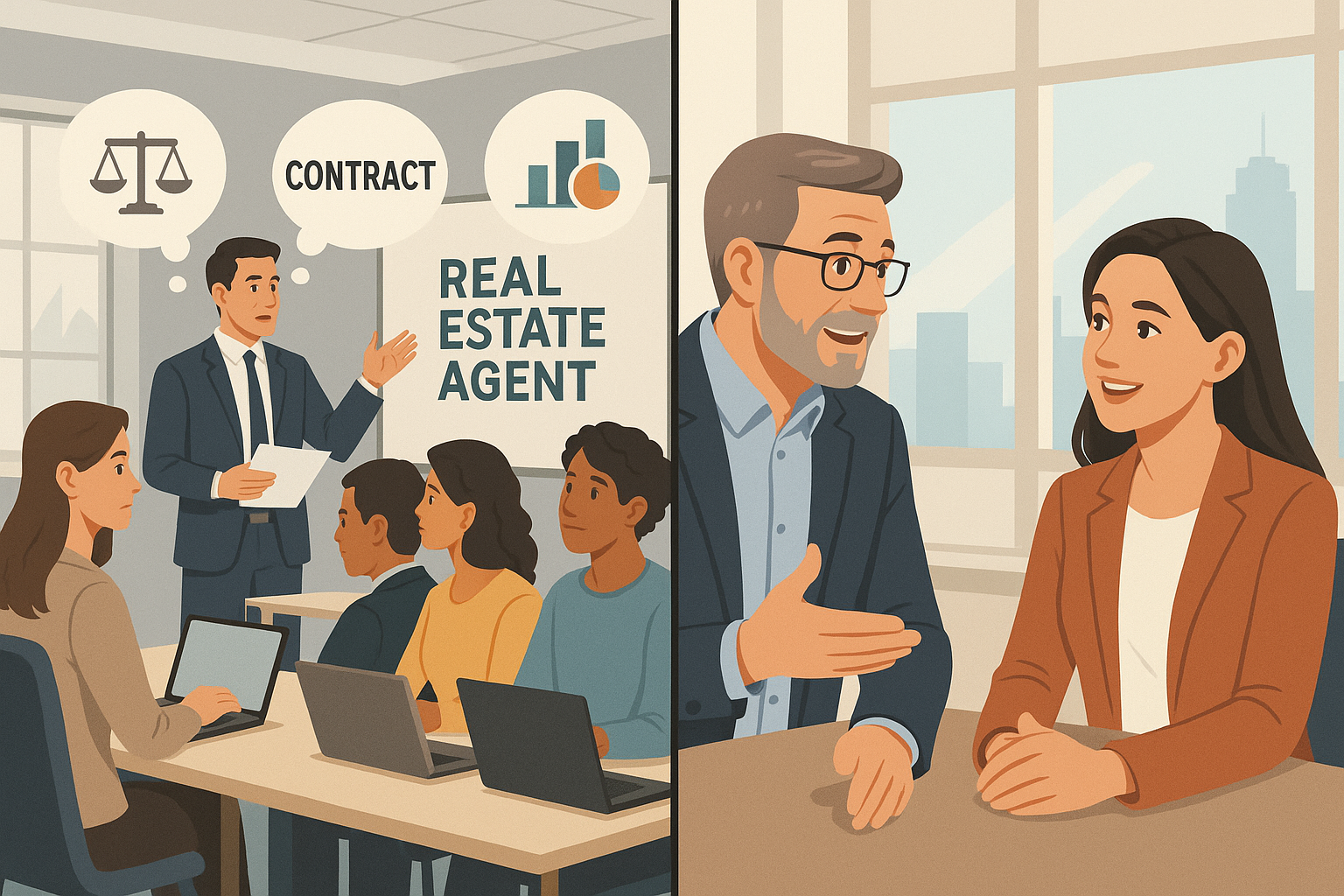
Embarking on a career in real estate is an exciting venture, but the path to success can sometimes feel overwhelming for new agents. As you navigate the complexities of lead generation, marketing, transactions, Read more...
Embarking on a career in real estate is an exciting venture, but the path to success can sometimes feel overwhelming for new agents. As you navigate the complexities of lead generation, marketing, transactions, and client management, you'll undoubtedly encounter two common terms: real estate coaching and real estate training. While often used interchangeably, they offer distinct benefits and cater to different needs. Understanding the nuances between the two is crucial for new agents looking to invest in their professional development wisely.
Real Estate Training: The Foundation of Knowledge
Think of real estate training as the classroom education for your real estate career. It's about acquiring fundamental knowledge, learning industry best practices, and understanding the "how-to" of the business.
Key characteristics of real estate training:
Structured Curriculum: Training programs typically follow a predefined curriculum, covering topics like contracts, agency relationships, ethics, marketing strategies, negotiation tactics, CRM software usage, and local market trends.
Broad Applicability: The information provided in training is generally applicable to a wide range of agents, regardless of their individual strengths or weaknesses.
Focus on Information Transfer: The primary goal is to impart knowledge and skills. This often involves lectures, webinars, workshops, manuals, and online modules.
Group Setting: Training can occur in a group setting, allowing for peer learning and questions.
Often Transaction-Focused: Many training programs focus on the mechanics of a real estate transaction, from listing to closing.
Examples: Pre-licensing real estate courses, broker-provided onboarding programs, real estate software tutorials, continuing education classes, and workshops on specific topics like social media marketing or and workshops on specific topics like open house strategies.
Who benefits most from real estate training?
New agents who are still learning the ropes, need to understand the legal and ethical frameworks of the industry, or require instruction on specific tools and processes will find training invaluable. It provides the essential building blocks for a successful career. Even experienced agents can benefit from training if it is timely and relevant to current events in the real estate industry.
Real Estate Coaching: Personalized Guidance for Growth
Real estate coaching, on the other hand, is meant to be a more personalized and iterative process focused on helping agents apply their knowledge, overcome specific challenges, and achieve their individual goals. It's less about what to do and more about how to do it effectively in the unique situation of an individual agent.
Key characteristics of proper real estate coaching:
Individualized Approach: Coaching is tailored to the agent's specific needs, strengths, weaknesses, and aspirations.
Action-Oriented: Coaches work with agents to develop actionable plans, set measurable goals, and hold them accountable for their progress - This personal accountability piece is an important distinction.
Focus on Application and Mindset: Coaching helps agents translate theoretical knowledge into practical application, address limiting beliefs, improve time management, and develop a winning mindset.
Problem-Solving and Strategy: Coaches help agents troubleshoot challenges, refine their strategies, and identify opportunities for growth.
Ongoing Support and Accountability: Coaching relationships are typically viewed as ongoing, with regular check-ins and performance reviews.
Examples: One-on-one sessions with a real estate coach, accountability partnerships, and personalized business planning sessions.
Who benefits most from real estate coaching?
New agents who have a grasp of the basics but are struggling with implementation, feeling stuck, or looking to accelerate their growth will benefit immensely from coaching. It's for those who want to refine their approach, develop stronger habits, and achieve higher levels of success.
A Word of Caution
Real estate coaching can turbocharge your career—but only if your coach has actually fought in the trenches. Beware of self-proclaimed 'gurus' who’ve never closed a deal themselves. These charlatans often dazzle with slick marketing and empty promises of overnight success, peddling textbook strategies they’ve never tested.
Real estate isn’t a theoretical playground—it’s a fast-paced, cutthroat industry defined by shifting markets, high-stakes negotiations, and emotionally charged clients. A coach without skin in the game can’t grasp these realities, leaving you with generic advice that crumbles under real-world pressure.
Steer clear of upselling imposters. If they haven’t survived a market crash, outmaneuvered a bidding war, or rebuilt their pipeline from scratch, their guidance is worthless. Demand proof of their sales track record: closed transactions, client testimonials, and battle scars.
Your career isn’t a lab experiment. Invest in coaches who’ve done it, not just taught it.
The Interplay: Why Both Are Important
It's not a matter of choosing one over the other; rather, real estate training and real estate coaching are complementary forces that contribute to a well-rounded and successful real estate career.
Training provides the knowledge base. You can't effectively implement strategies if you don't understand the fundamentals.
Coaching helps you apply that knowledge effectively. It bridges the gap between theory and practice, helping you navigate real-world scenarios.
For new agents, a common progression might look like this:
Initial Training: Complete pre-licensing courses and broker-provided onboarding to gain foundational knowledge and skills.
Early Coaching: Once you've entered the field, consider engaging a coach to help you set up your business, generate your first leads, and overcome initial hurdles.
Ongoing Training: Continue to attend workshops and continuing education to stay updated on market trends, legal changes, and new technologies.
Ongoing Coaching: As your business evolves, a coach can help you scale, refine your niche, improve your sales process, and navigate market shifts.
Making the Right Choice
When deciding between training and coaching (or how to incorporate both), consider the following:
Your current knowledge level: Are you completely new, or do you have a basic understanding?
Your specific challenges: Are you lacking fundamental knowledge, or are you struggling with implementation or mindset?
Your learning style: Do you thrive in structured learning environments, or do you prefer personalized guidance?
Your budget: Training programs often have a fixed cost, while coaching can be an ongoing investment.
By understanding the distinct roles of real estate coaching and real estate training, new agents can strategically invest in their professional development, build a strong foundation, and accelerate their journey towards a thriving career in real estate.
Love,
Kartik
|

From Classroom to Closing – ADHI Schools’ Playbook for New Agents Who Want to Win Early
Nearly every rookie in real estate believes success comes down to “working hard.” Yet industry numbers Read more...
From Classroom to Closing – ADHI Schools’ Playbook for New Agents Who Want to Win Early
Nearly every rookie in real estate believes success comes down to “working hard.” Yet industry numbers show that only a small portion of real estate licensees ever break into the top-earner tier. What’s the real difference? Top producers follow a systematic, six-pillar framework that blends discipline, strategy, and emotional intelligence. Below is that framework, rewritten for brand-new licensees and current ADHI Schools students so that you can plug it into your business on Day 1.
td {
padding: 20px;
font-weight: 500;
border: 1px solid gray !important;
border-style: dashed !important;
}
th {
padding: 20px;
text-align: center !important;
border: 1px solid gray !important;
border-style: dashed !important;
}
table {
border-collapse: collapse;
border: 1px solid gray !important;
border-style: dashed !important;
border-collapse: collapse !important;
}
@media (max-width: 428px) {
.table-wrapper{
max-width: 100%;
overflow: scroll;
}
}
1. Prospecting Power Hour
|

Congratulations—you completed the real estate license courses, passed the real estate exam and landed your license! Now the real work begins: prospecting, showings, more than a little paperwork, and Read more...
Congratulations—you completed the real estate license courses, passed the real estate exam and landed your license! Now the real work begins: prospecting, showings, more than a little paperwork, and a CRM that won't fill itself. Trying to do it all solo is the fastest route to 14-hour days.
The fix?
Delegate smart, even if your business is getting off the ground.
You might think, "I just got my license, and now I need to think about delegation?" The answer is a resounding "yes!" While our real estate license school focused on the essential knowledge to get you started, mastering the art of delegation early on is crucial for scaling and long-term growth as a businessperson.
Delegation doesn’t necessarily mean that you have a huge team - it's really about establishing efficiency right away.
Key Takeaways
Delegate Early, Not Later: Freeing up hours lets you close your first few deals faster—without the late-night inbox grind.
Start Simple: Begin by offloading administrative tasks or transaction coordination.
Leverage Cloud Tools: Simple online platforms can streamline communication and task management from the start.
Why Delegation is Your New Best Friend (Even as a Rookie Agent)
Your plate is likely full of learning the ropes: familiarizing yourself with the MLS, practicing your sales pitch, and getting comfortable with whatever CRM you have chosen. If every single administrative detail bogs you down, you'll burn out before closing your first few deals. Delegation, even in its simplest forms, means strategically offloading tasks so you can focus on revenue generating activities.
Focus on Client Connections: While our real estate license school taught you the legalities, remember that genuine client relationships are built on time and attention.
Hone Your Sales Acumen: The more you focus on lead generation, showing properties, and negotiating, the faster you'll build expertise and finalize transactions.
Build a Sustainable Business: Instead of just surviving, you build your foundation for consistent growth.
Delegation isn't just about handing things off; it's about innovative task management to ensure everything gets done accurately and efficiently, allowing your business to flourish.
Starting Smart: What to Delegate First
Even as a new agent, you can start identifying tasks that, while necessary, might be consuming valuable time you could be using to connect with potential clients or learn more about the market. Think about the areas that might be slowing you down:
Top Time-Drains to Delegate First
Early Transaction Prep: Even before a deal is fully underway, paperwork and coordination can be time-consuming.
Basic Marketing: Setting up social media posts, sending introductory emails, and creating simple flyers.
Consider tasks that are repetitive or don't require your direct, licensed expertise.
Your First Support System: Who to Consider
You're not ready for a whole team yet, but considering where your biggest time drains are will help you decide if and when to bring in support.
Rule of thumb: Once you're juggling ≥5 active buyers or your first two listings, you're ready for at least five virtual assistant hours/week.
Considering an Administrative Assistant (Part-Time/Virtual)
If your calendar is a mess, your inbox is overflowing, or you're spending too much time on data entry, even a few hours a week from a virtual administrative assistant could be a game-changer. Typical hourly rates for a virtual assistant are reasonable depending on where they are located.
They can handle:
Managing emails and phone inquiries.
Scheduling appointments and organizing your calendar.
Basic data entry and CRM maintenance.
Exploring a Real Estate Transaction Coordinator (Part-Time/Per Transaction)
Once you start getting escrows going, you'll quickly realize the sheer volume of paperwork and deadlines. A transaction coordinator (TC) specializes in this, even on a per-transaction basis. A TC typically charges around $350−$450 per deal. They can be invaluable for: Managing contracts, disclosures, and legal documents.
Ensuring all deadlines are met.
Communicating with lenders, title companies, and other parties.
If you go back 20 years the concept of a transaction coordinator wasn’t as wide spread as it is today. The thought was that agents should instead handle their first few deals themselves. Working every step—contract, disclosures, deadlines, contingencies, and escrow—gives them real-world insight no classroom can match. That hands-on immersion sharpens problem-solving, reveals common pitfalls, and builds confidence. After running a couple of transactions solo, they’ll have the practical know-how to supervise a TC effectively and deliver truly informed service to clients.
Work with your broker or manager to determine the right path for your first few deals.
Clear Expectations: Even for a simple task, be clear about what to do.
Finding Help: Look for local college students seeking internships or explore online platforms for virtual assistants. Networking with other agents might also reveal good recommendations.
Basic Onboarding: When you hire someone, even for a limited role, clearly explain your business, your processes, and what you expect. A simple checklist of their responsibilities can go a long way.
Tools to Make Delegation Easier
You don't need fancy software to start. Simple tools can help you manage tasks and communicate effectively:
Your CRM: Use your CRM to track client interactions and set follow-up reminders. Many CRMs have basic task management features.
Shared Documents/Cloud Storage: Tools like Google Drive or Dropbox can help you share documents and keep everything organized for anyone assisting you.
Simple Automation: Even setting up automated email responses for basic inquiries can save you time.
As you grow, you might look into more specialized task management tools, but for now, focus on what helps you keep things organized. Having clear, written steps for everyday tasks (Standard Operating Procedures or SOPs) is also constructive, even if they're just notes for yourself.
Mini SOP Example:
New Lead Intake Process (5 steps, 10 min total):
Receive Lead: Check email/CRM for new lead notifications.
Initial CRM Entry: Input name, contact info, lead source, and initial notes.
Automated Welcome Email: Trigger pre-written welcome email from CRM.
Calendar Invite: Schedule the initial call/meeting on the agent's calendar.
Task Assignment: Create a follow-up task for an agent in CRM.
Developing Your Support (and Yourself!)
Even with a small amount of delegated work, consider it a partnership.
Learn and Grow Together: Encourage whoever is helping you to learn more about the real estate industry. Your success is their success.
Feedback is Key: Provide clear and constructive feedback. This helps them improve and ensures tasks are completed to your standards.
Daily Focus: Even for a new agent, creating a "Daily Action Checklist" helps you stay focused on revenue-generating activities, knowing that other tasks are being handled.
A daily action checklist is crucial for new real estate agents because it maintains focus on revenue-generating activities, preventing distraction by administrative tasks. By knowing other responsibilities are delegated, agents can prioritize client interactions, lead generation, and showings. This structured approach builds discipline and efficiency, ensuring consistent progress toward closing deals. Ultimately, it maximizes productivity during a critical learning phase, establishing habits essential for long-term success.
The "Admin" Side of Having Help
Even for small engagements, think about:
Compensation Models: How will you compensate them? Hourly? Per task?
Legal Considerations: For very small, casual engagements, it might be simple, but as you grow, you'll want to understand the difference between independent contractors and employees. This is something you'll learn more about as your business expands.
Trusting the Process
As a new agent, wanting to control every detail is tempting. However, the essence of delegation is to train someone on a task and then trust them to do it. This frees you up to focus on what you're truly licensed to do: connect with clients, show properties, and negotiate deals.Your real estate license was the first step. Mastering delegation, even in its earliest stages, is how you truly begin to build a successful and sustainable real estate career. Don't wait until you're overwhelmed; start thinking about how to work smarter from day one.
Love,
Kartik
|

As a real-estate professional, your gross commission income (GCI) is the single most revealing number in your business. Nail it, and you’ll know exactly how every listing appointment, buyer tour, or Read more...
As a real-estate professional, your gross commission income (GCI) is the single most revealing number in your business. Nail it, and you’ll know exactly how every listing appointment, buyer tour, or marketing dollar converts to cash in your pocket. Miss it, and you’ll bounce between big months and famine months with no idea why.
.commission, th, td{
border:1px solid gray !important;
border-style: dashed !important;
border-collapse: collapse !important;
margin:10px !important;
padding:10px !important;
}
Below is a quick primer—plus practical tactics—for understanding, calculating, and growing your GCI. Wherever you are on the journey, remember that the first step is a solid education. If you still need to earn your license (or want better continuing-ed), check out the live, online, and self-paced options at ADHI Schools.
What Is Gross Commission Income?
Gross Commission Income is the total commission you earn on a transaction before any splits with a co-op agent, your brokerage, or taxes. Think of it as your top-line revenue—the raw fuel that powers the rest of your business.
Pro tip: Because GCI is pre-expense, it’s not your spendable income. Always account for splits, marketing costs, and Uncle Sam.
How to Calculate Gross Commission Income
Simple math, big insight:
GCI = Sales price x Commission Rate
Example: A $500,000 sale at a 2.5 % commission rate
$500,000 × 0.025 = $12,500 GCI
If your brokerage split is 70/30, you keep $8,750 before expenses. Knowing this formula lets you reverse-engineer goals: need $150k in GCI this year? Divide by your average GCI per deal and you’ll see exactly how many closings you need.
Five Proven Ways to Boost Your GCI
Close More TransactionsMore marketing → more leads → more closings. Diversify beyond your sphere: online leads, open houses, FSBOs, expireds, community events—anything that fills your pipeline.
Aim for Higher Price Points Selling in a higher-end market (or adding a luxury niche) instantly lifts your income per transaction. ADHI can help you level-up your branding for that space.
Negotiate a Better SplitTop producers have leverage. If your volume is climbing, discuss improved cap structures—or even a 100 % model—with your broker.
Invest in Marketing & BrandingConsistent social media, video, and geographic farming keep your name in front of prospects. Agents who brand relentlessly enjoy stronger lead flow and referral business.
Get a Real-Estate Coach Nothing accelerates income like coaching. Structure, accountability, and battle-tested systems can take agents from five figures to multiple six or seven. (ADHI offers private and group coaching for graduates—ask about it when you enroll.)
Commission Basics You Can’t Ignore
Variable
Typical Range
Why It Matters
Side of Deal
2 %–3 % per side
Double-ending can boost GCI but may limit referrals if not handled with care.
Brokerage Split
60/40, 70/30, 80/20, or caps
Splits (and desk/tech fees) dramatically affect your net. Negotiate wisely.
Fees & Overhead
Varies
Transaction coordination, MLS dues, marketing spend—all eat into net income.
Track Every Dollar
You can’t grow what you don’t measure. Use your CRM, a spreadsheet, or budgeting software to log:
GCI per deal
Brokerage splits & fees
Lead-gen and marketing costs
Transaction expenses
Net profit per month
Treat your real-estate practice like a business, not a hustle.
Ready to Earn More?
Understanding GCI is just step one. The agents who consistently hit—and exceed—their income goals follow a plan, track metrics, and invest in education.
If you’re still pre-license (or need post-license CE), start with a school that’s trained tens of thousands of California agents since 2003. Enroll today in ADHI Schools’ Real-Estate License Program (free 7-day trial available) and get the knowledge, tools, and support to maximize your GCI from day one.
Your commissions—and your future—begin with the right education. Let’s build that six- or seven-figure real-estate career together.
|

Dreaming of a flexible career with limitless potential and the freedom to set your own path? A career in real estate could be exactly what you're looking for. However, choosing the right time to dive into Read more...
Dreaming of a flexible career with limitless potential and the freedom to set your own path? A career in real estate could be exactly what you're looking for. However, choosing the right time to dive into your real estate education can significantly impact your early success—and May is uniquely positioned as the ideal month to begin your journey.
Why May? The Strategic Timing Advantage (Pre-Summer, Pre-Fall Market Rush)
May sits at the perfect juncture in the real estate calendar. Historically, the housing market heats up significantly through the summer and fall, meaning that starting your real estate coursework now positions you perfectly to leverage upcoming market peaks. Imagine completing your studies, passing your licensing exam, and hitting the ground running just as the demand for qualified agents spikes.
Starting your real estate education in May allows you to comfortably focus on absorbing critical industry knowledge without the immediate pressure and stress of a frantic market. Contrast this with starting in mid-summer—when you'd likely feel rushed, playing catch-up, and potentially missing prime opportunities in the bustling fall market.
The Advantages of Starting Your Journey Early
Procrastination might be tempting, but getting started earlier pays off dramatically in real estate:
Momentum and Confidence: Beginning your education in May helps build steady momentum, boosting your confidence as you gradually master essential concepts.
Comprehensive Preparation: You have ample time to thoroughly absorb and understand the material, ensuring you're genuinely ready for your licensing exam.
Networking Advantage: Starting earlier grants you extra time to build relationships with instructors, industry professionals, and fellow students—connections that can significantly enhance your early career success.
Taking control of your career transition now isn't just smart—it's empowering. By starting in May, you're proactively shaping your professional future on your own terms.
Understanding the Timeline: What Starting in May Looks Like
Our real estate program can be finished in about 8 weeks, depending on your pace and commitment level. Starting now, in May 2025, means you could realistically complete your course and prepare thoroughly for your licensing exam by mid-summer.
Here’s a simplified timeline if you start now:
May - June: Coursework and foundational learning.
July: Intensive exam prep and practice exams.
August: Licensing exam and application submission.
Late August to September: Receive your license and launch your real estate career, just as the market demand increases significantly.
By choosing May, you're not only timing your entry into the industry optimally; you're giving yourself the best chance to succeed right from the start.
Take the First Step: Join Our Enrollment Sessions
Ready to take action? You're invited to attend our upcoming enrollment information sessions at ADHI Schools, designed to guide you step-by-step through the process of becoming a licensed real estate professional.
Our enrollment sessions cover:
Course structure and what to expect
Licensing requirements and exam preparation
Career pathways and market insights
Sign up now for either our convenient online or engaging in-person sessions:
Online Self Study Sessions: Start anytime!
Instructor Led Sessions: Reserve your seat here!
Don't miss this ideal opportunity to strategically position yourself for success. Start your real estate journey this May and step confidently into a rewarding career.
Your future is waiting—make May your month!
|

California dreaming? Suppose your dreams involve navigating the exciting world of real estate and helping people find their perfect rental haven. In that case, a career as a property manager in Read more...
California dreaming? Suppose your dreams involve navigating the exciting world of real estate and helping people find their perfect rental haven. In that case, a career as a property manager in California might be your calling! With a booming rental market, diverse properties (from beachfront bungalows to chic city apartments), and a dynamic landscape of laws and regulations, California offers a unique and rewarding experience for property management professionals.
But hold on! Before you jump headfirst into showing properties and collecting rent, let's break down what it really takes to thrive as a property manager in the Golden State. This guide will be your roadmap, covering everything from licensing and essential skills to the quirks of the California market and the tech tools that'll make your life easier.
Licensed vs. Unlicensed: Finding Your Path
To begin, it's important to understand California property management licensing. Your role will determine whether you need a real estate license or not.
Licensed property managers hold a real estate license, which opens doors to a broader range of responsibilities and higher earning potential. Consider negotiating leases, collecting rent, and even representing clients in property sales. It's like having a VIP pass to the California real estate scene!
On the other hand, unlicensed managers might be working as a resident property manager, for example. Alternatively, they may be working as a w2 employee at a large apartment complex. Maybe they are an assistant to a licensed property manager and handling administrative tasks like coordinating maintenance. They're essential team members, but they must work under the supervision of a licensed broker. Think of it as being the Robin to a licensed Batman!
The Journey to Becoming a Licensed Pro
Ready to take the plunge and get your real estate license? Here's the lowdown:
Check the Basics: Make sure you're at least 18, have a high school diploma or equivalent, and are legally allowed to work in the U.S. (No surprises here!)
Hit the Books: It's time to dive into the world of real estate! Enroll in an accredited real estate school like ADHI Schools and complete the required coursework. You'll cover topics like real estate principles and practices and even choose an elective (hint: Property Management is excellent!).
Conquer the Exam: Once you've mastered the fundamentals, it's time to prove your knowledge. The California real estate license exam will test your understanding of national and state-specific laws, so study hard and utilize practice tests to boost your confidence.
Find Your Brokerage: Freshly licensed and ready to roll? Not so fast! In California, licensees must partner with a licensed broker who should be providing valuable mentorship, legal oversight, and a chance to learn the ropes from seasoned professionals.
Level Up with Certification (Optional but Recommended): Want to stand out? Consider earning a Property Management Certification from the California Association of Realtors (CAR) or the Certified Property Manager (CPM) designation from the Institute of Real Estate Management. It's not mandatory, but it adds serious credibility to your name and demonstrates your commitment to excellence.
Mastering the Property Management Game in California
Now that you've sorted out the licensing let's discuss the skills you'll need to succeed in the California market.
Marketing Maestro: California's rental market is competitive! You'll need to be a marketing whiz to attract tenants. Leverage online platforms like Zillow, social media, and even good old-fashioned networking to showcase your properties beyond basic listings.
Tenant Whisperer: Building strong relationships with tenants is key. Be responsive, approachable, and proactive in addressing their concerns. Remember, happy tenants = happy landlords!
Financial Guru: You must be comfortable with numbers, from collecting rent to managing budgets. Utilize property management software to streamline accounting tasks and provide transparent financial reports to owners.
Legal Eagle: California has a unique set of laws and regulations, including rent control (AB 1482), eviction rules, and security deposit limits. Stay informed and ensure your practices comply with all applicable laws.
Tech-Savvy: Embrace technology to boost efficiency. Property management software like AppFolio or Buildium can automate tasks, improve communication, and keep you organized.
Navigating the California Rental Landscape
California's rental market is as diverse as its landscape. Each region has quirks, from bustling city centers with sky-high rents to laid-back beach towns with seasonal demand.
Market Trends: Stay updated on rental trends in your area. For example, you might encounter fierce competition for units and strict rent control policies in San Francisco. In contrast, a beach town might experience seasonal fluctuations in demand.
Key Laws: Familiarize yourself with California-specific laws like AB 1482 (rent caps), eviction rules, and security deposit limits. These regulations can significantly impact your day-to-day operations.
Building Your Property Management Empire
Are you dreaming of running your own property management company? Here's how to get started:
Legal Foundation: In California, you'll typically need to form a corporation to operate a property management company. Make sure you obtain all necessary licenses and permits.
Operational Excellence: Set up efficient systems for rent collection, maintenance requests, and tenant communication. Invest in reliable property management software to streamline your workflow.
Client Acquisition: To attract clients, build a professional website, leverage social media, and network with real estate agents. Offer competitive rates and exceptional service to build a strong reputation.
FAQs: Your Burning Questions Answered
Q: Do I need a real estate license to manage properties in California?
A: It depends! If you're involved in activities like negotiating leases or handling rent, then yes, a license is mandatory. However, unlicensed individuals can perform limited tasks that do not require a real estate license.
Q: What's the average salary for a property manager in California?
A: Salaries can vary based on experience, location, and the types of properties you manage. However, you can expect to earn a comfortable living, with the average salary ranging from $68,000 to $85,000 per year. Major cities like San Francisco and Los Angeles often offer higher earning potential.
Q: Is the Property Management Certification (PMC) or Certified Property Management (CPM) designation essential?
A: While not required, the PMC from CAR can give you a competitive edge. It demonstrates your expertise and commitment to professional development, which can attract clients and employers.
Q: Can I manage short-term rentals like Airbnb in California?
A: Absolutely! However, local regulations regarding short-term rentals can vary significantly. Ensure you research and comply with your area's applicable permits and restrictions.
The Bottom Line: A Rewarding Career Awaits
Becoming a successful property manager in California requires dedication, knowledge, and a passion for real estate. Following the steps outlined in this guide, mastering essential skills, and staying informed about the ever-evolving California market, you can build a thriving career and help people find their perfect homes. So, are you ready to take on the challenge? The Golden State awaits!
Love,
Kartik
|

Is the exam difficult?
It will be if you don’t prepare. With a first-time pass rate hovering near 50%, the California Real Estate Exam is statistically one of the toughest licensure tests in the Read more...
Is the exam difficult?
It will be if you don’t prepare. With a first-time pass rate hovering near 50%, the California Real Estate Exam is statistically one of the toughest licensure tests in the nation.
Why is it hard?
It prioritizes application over memorization. You cannot simply recite definitions; you must apply legal concepts to complex scenarios.
The Good News:
It is entirely beatable. By shifting your focus from rote learning to conceptual understanding, you can pass on your first attempt.
Why Students Think the Exam Is Hard
Many applicants underestimate the depth of the exam, expecting simple vocabulary instead of complex legal scenarios.
If you are asking, "Is the CA real estate exam hard?" you are likely intimidated by the sheer scope of the material. Most students enter the pre-licensing phase expecting a simple vocabulary quiz. Instead, they are met with a massive volume of content ranging from Property Ownership and Land Use Controls to the intricate nuances of Agency Law.
The anxiety often stems from the unknown. The California Department of Real Estate (DRE) is responsible for protecting the public, and they design the test to screen for competence. The difficulty is intentional—it serves as a barrier to entry to ensure only qualified professionals obtain a license.
What Makes the Exam Actually Difficult
The real challenge lies not in the number of questions, but in the logic required to answer them correctly.
The structural basics are standard: 150 multiple-choice questions to be completed in 3 hours and 15 minutes. To pass, you need a score of 70% (105 correct answers). However, the format isn't the challenge—the question logic is.
The "Application" Trap The exam rarely asks simple definition questions like "What is a dual agency?" Instead, you will face paragraph-long scenarios that test your ability to think like an agent.
Example: “A buyer tells her agent she plans to rent out a detached ADU on the property. Which disclosure is the agent required to provide?”
Questions like these test practical application, not recall.
The "Best Answer" Dilemma A common source of failure is the "Best Answer" format. You may see four options, two of which appear legally correct. You must identify which one is the most correct based on DRE guidelines and fiduciary duty. This requires high-level critical thinking.
For a complete breakdown of the exam structure and weighted topics, refer to our comprehensive California Real Estate Exam Guide.
Pass Rates & What They Really Mean
Statistical trends reveal that nearly half of all test-takers fail on their first attempt.
The numbers provide a stark reality check. While data fluctuates by quarter, the DRE generally reports a first-time pass rate of roughly 50% for the salesperson exam. Statistically, the person sitting next to you at the testing center is likely to fail.
Why is the failure rate so high? It is rarely because the material is "impossible." It is because students underestimate the California real estate exam difficulty. Many treat it like a driver's ed test rather than a professional board exam.
Common Reasons People Fail
Failure often stems from specific, avoidable traps like vocabulary gaps and test anxiety.
As an instructor, I see the same patterns of failure repeat annually. The students who struggle generally fall into one of three specific traps:
Vocabulary Gaps: The exam utilizes precise industry lexicon. If you cannot distinguish between "void," "voidable," and "unenforceable" contracts, you cannot answer the question correctly.
Reading Speed & Comprehension: Rushing leads to missing key qualifiers like "EXCEPT," "NOT," or "MOST LIKELY," which completely invert the meaning of a question.
Test Anxiety: The pressure of the moment causes students to second-guess their first instincts, often changing correct answers to incorrect ones.
We have analyzed these pitfalls in detail. Before you schedule your test date, review our breakdown of Why People Fail the California Real Estate Exam to ensure you don't become a statistic.
How to Make the Exam Feel Easier
Strategic preparation, not just memorization, can significantly reduce the exam's difficulty.
You can flip the odds in your favor with specific real estate exam test-taking strategies:
Master "Real Estate Practice": This single subject area makes up approximately 25% of the exam. If you master Practice and Agency law, you have already conquered nearly half the test.
Simulate Test Conditions: Do not study on the couch. Practice taking 150-question blocks at a desk, in silence, without your phone. This builds the mental stamina required for a marathon.
Focus on Concepts: Don't memorize 5,000 practice questions. Understand the why behind the law. If you understand the concept of "Fiduciary Duty," you can answer ten different questions about it.
Quick Tip: If two answers sound correct, choose the one that protects the consumer—that’s how the DRE frames questions.
For a step-by-step study roadmap, check out our guide on Tips for Passing the CA Real Estate Exam on the First Try.
Mistakes to Avoid
Avoiding common logistical and mental errors is just as important as knowing the material.
The most dangerous mistake is the "I'll just wing it" mindset. While you can retake the exam, it comes with a significant cost—both financial and emotional. You must pay the exam fee again, wait for a new test date (which can take weeks), and delay your career launch.
If you are curious about the logistics of retaking the test, read How Many Times Can You Take the CA Real Estate Exam?—but your goal should be to never need that page.
Instructor Insights
Success requires discipline and a professional mindset, treating the study process like a job.
I have guided thousands of students through this process. The ones who succeed aren't necessarily the "smartest"—they are the most disciplined.
Successful students treat studying like a job. They prioritize physical well-being (sleep and nutrition) because a fatigued brain makes simple errors. They arrive at the testing center early to control their environment.
View the difficulty of this exam as a gatekeeper. It ensures that when you finally hand a client a contract involving hundreds of thousands (or millions) of dollars, you are competent, ethical, and ready.
Frequently Asked Questions
Is the California Real Estate Exam the hardest in the country? It is consistently ranked in the top 5 hardest state exams due to California's complex agency and disclosure laws, combined with a roughly 50% pass rate.
How many questions do I need to get right to pass? You need to answer 105 out of 150 questions correctly to achieve the required 70% score.
What happens if I fail the exam? You will receive a notification of failure with your actual percentage score. You can apply to retake the exam immediately, but you must pay the exam fee again.
Can I bring a calculator to the exam? Yes, but it must be a basic, non-programmable, silent calculator. The testing center usually provides a calculator function within the computer interface as well.
How long should I study before taking the exam? Most successful students spend 4–6 weeks explicitly reviewing for the state exam after completing their three required college-level courses.
|

Are you dreaming of a lucrative and exciting real estate career in California? Don’t let an unapproved “real estate school” derail your plans. Here’s how to ensure your education meets the California Read more...
Are you dreaming of a lucrative and exciting real estate career in California? Don’t let an unapproved “real estate school” derail your plans. Here’s how to ensure your education meets the California Department of Real Estate (DRE) standards.
California’s real estate market is booming, offering lucrative opportunities for aspiring salespersons, brokers, property managers, and more. However, you need the proper real estate education before you can tap into its potential. The California Department of Real Estate sets the standards for real estate education and approves schools that meet those standards. This helps you avoid scams and ensures you're getting the quality education.
In this article, I wanted to walk you through:
Why DRE approval matters and what it entails
Step-by-step instructions on verifying a school’s approval status
Red flags to watch out for
Different course format options and how to choose the best one
Potential career paths after completing your DRE-approved education
By the end, you’ll be fully equipped to choose the right DRE-approved school and kickstart your journey toward becoming a licensed real estate professional in California.
What is the DRE, and Why Is Its Approval Important?
The Role of the DRE
The California Department of Real Estate (DRE) is a state agency that protects people who buy, sell, or rent property. They do this by licensing agents, setting education standards, and enforcing real estate laws.
Its primary goals include:
Consumer Protection: Ensuring real estate professionals adhere to legal and ethical standards.
Licensing: Granting and renewing licenses for qualified salespersons and brokers.
Education Oversight: Approving and monitoring real estate schools and courses.
Why DRE Approval Matters
Validity of Your Coursework
When you enroll in a pre-licensing or continuing education course, the DRE must recognize that course as valid to qualify you for the state exam. DRE-approved schools must adhere to strict guidelines on curriculum, instructor qualifications, and operational practices.
Access to Quality Education
DRE approval helps ensure you learn the most up-to-date information relevant to California’s real estate market. This makes you better prepared for the real estate exam and more knowledgeable in serving clients once licensed.
Avoiding Consequences of Non-Approval
Choosing a school that isn't DRE-approved can lead to significant setbacks in your real estate career. The most immediate problem is that the coursework won't be recognized for licensing purposes. This means retaking those same real estate classes at a DRE-approved real estate school, costing you valuable time and money. You'll face the added expense of additional courses and the frustration of unnecessary delays.
These delays can create a ripple effect, causing you to miss time-sensitive job opportunities and lucrative commissions. While your peers who chose DRE-approved schools move forward, you'll face unnecessary setbacks. Choosing a DRE-approved education isn't merely about fulfilling a requirement; it's about creating a smoother path to licensure and building a strong foundation for a successful career. Making the correct choice now is a critical step toward achieving your goals in the competitive real estate market.
What Makes a Real Estate Course DRE-Approved?
When a school applies for DRE approval, its programs undergo a meticulous and comprehensive review. The DRE evaluates:
Curriculum Content
Material must be college-level equivalent, comprehensive, up-to-date, and aligned with California real estate laws and market trends, ensuring you learn the most relevant information to thrive in California's competitive real estate industry. By meeting these standards, you can be assured of receiving a high-quality education that equips you to excel in California’s competitive real estate industry.
Instructor Qualifications
Instructors must have relevant credentials and experience in real estate. Qualified instructors, with their relevant credentials and experience in real estate, can provide practical insights and prepare you effectively for the state exam.
Teaching Methods
The school’s teaching methods should be engaging and compelling, whether online, in-person, or hybrid. Proper instructional design increases your chances of retaining information and passing your exam.
School Operational Standards
Policies for record-keeping, customer support, and fair testing must meet specific criteria. A well-structured school environment helps ensure a smooth, hassle-free educational experience.
Different Course Formats: Online, In-Person, or Hybrid
One of your most important choices is deciding on the format that suits your learning style and lifestyle. Most DRE-approved schools like ADHI Schools offer one or more of the following:
Online Courses
Pros: Flexible scheduling, learning at your own pace, no commuting.
Cons: Less interaction may require stronger self-motivation.
Hybrid Programs (Combination of Online and Instructor-Led)
Pros: This format offers the best of both worlds: the flexibility of self-paced online learning combined with the engagement of live instruction. ADHI Schools' hybrid program, for example, allows you to complete your coursework online at your own pace while also offering optional live Zoom sessions with experienced instructors. This provides opportunities to ask questions, clarify concepts, and interact with your peers, all from the comfort of your home.
Cons: While ADHI's program eliminates the need for in-person attendance, scheduling conflicts can still arise if your availability doesn't align with the live Zoom session times. Also, keep in mind that active participation in live sessions will enhance your learning experience.
Choose the format that best aligns with your schedule, budget, and personal learning preferences. But remember, always confirm that the specific course format is DRE-approved. Your choice is significant and should align with your educational goals.
Step-by-Step Guide to Verify a School’s DRE Approval
Once you’ve identified a potential real estate school, use the steps below to confirm its DRE approval status. Remember, verifying a school’s credentials is your best defense against wasting time and money on non-compliant programs.
Visit the Official DRE Website
Go to the California Department of Real Estate (DRE) website, and search for “Approved Education Providers” under the “Examinees” tab.
Locate the List of Approved Providers
Find links labeled “Find an Approved Real Estate School” or “Approved Course List.”
This will direct you to the DRE’s searchable database of approved schools and courses.
Search by School Name or Location
Enter the school’s name as it appears on their website or documentation.
You may also search by city or course type (e.g., pre-licensing, continuing education).
Review the School’s Details
Check for the Sponsor ID or Approval Number.
Confirm the expiration date of the school’s approval to ensure it’s current. This is crucial as an expired approval could mean the school is no longer compliant with DRE standards.Verify that the courses you need (e.g., Real Estate Principles, Real Estate Practice) are listed under the approved curriculum.
Revisit the school’s website to confirm the same Sponsor ID or approval number is displayed. This step is important as it provides a second verification of the school's approval status.Ensure all course titles and codes match those listed on the DRE website. This diligent cross-checking process is a key part of your verification.
Contact the DRE if in Doubt
Call or email the DRE to verify a school’s legitimacy if you still have questions.
Red Flags: Warning Signs of Non-Approved Programs
While verifying a school’s DRE approval status is straightforward, it’s crucial to stay alert for warning signs that a program may be misleading or non-compliant. Ignoring these signs could lead to wasted time, money, and a subpar education.
Unusually Low Prices
Be highly suspicious of prices that seem suspiciously low. This is often a significant indicator of a scam or a non-approved course.
Guaranteed Exam Passing
No reputable school can guarantee you'll pass the state exam without diligent study and effort. Be wary of schools that make overly confident promises, especially if they offer guarantees of passing the exam, as these are often red flags. Such guarantees may be misleading, and attempting to collect on them can prove difficult.
Lack of Clear Contact Information
A school without a verified address, phone number, or email may be fraudulent.
High-Pressure Sales Tactics
Phrases like “Enroll now before we close admissions!” or “Limited spots left!” may indicate a dishonest operation.
Vague or Missing DRE Approval Details
If a school’s website doesn’t list a DRE Sponsor ID or discuss DRE approval, think twice before enrolling.
False Accreditation Claims
Some schools advertise bogus accreditations or affiliations. Double-check any claims with the accrediting body.
Unrealistic Job Placement Rates
Promises of extraordinarily high job placement rates or income guarantees after graduation are often misleading, as success depends on many individual factors.
Frequently Asked Questions (FAQ)
How do you check if a real estate school is DRE-approved?
Use the DRE’s searchable database on its official website or contact the DRE directly.
Can I complete my real estate pre-licensing courses entirely online?
Yes, many of the best DRE-approved online real estate courses offer the convenience of fulfilling your requirements virtually. Just ensure that the online format is approved, and you're all set.
What if I took a non-approved course accidentally?
If you accidentally take a non-approved course, you’ll likely have to retake it at a DRE-approved school. Non-approved coursework won’t count toward your license, potentially causing delays and extra expense.
Is ADHI Schools DRE approved?
Yes, our DRE Sponsor ID is S0348 and our continuing education ID is 6404.
How often does a school need to renew its approval?
The renewal period for real estate schools depends on the type of courses offered. Continuing Education (CE) courses typically require renewal every two years. However, for pre-licensing courses, there isn't a fixed renewal schedule, the course is valid as long as the material is up to date.
Choosing a DRE-approved school is a crucial step toward your California real estate license. This is more than just a formality; it's about getting a solid education that gives you the most current knowledge of real estate laws and practices. With this foundation, you'll be well-prepared, confident, and able to avoid costly mistakes on your path to licensure.
After completing your DRE-approved coursework, you’ll have exciting career paths to explore.
For instance:
Residential Real Estate Agent – Help individuals buy and sell homes.
Commercial Real Estate Agent/Broker – Focus on offices, retail spaces, or industrial properties.
Property Manager – Oversee rental properties and maintain landlord-tenant relationships.
Real Estate Appraiser (with further education) – Provide expert property valuations.
Real Estate Investor – Buy, flip, or rent properties for profit.
Real Estate Consultant – Advise clients on property trends, investment opportunities, and more.
California’s real estate industry is a vibrant landscape filled with endless opportunities, and the right education can pave the way for your success.
Key Takeaways
Verify a school’s DRE approval to ensure your courses count toward licensing requirements.
Choose an online, in-person, or hybrid format that aligns with your lifestyle.
Look for red flags like suspiciously low prices or false accreditation claims.
Don’t hesitate to contact the DRE directly for confirmation and peace of mind.
Key TakeawaysWant a faster, easier path to your California real estate license? ADHI Schools is DRE-approved, providing a streamlined and efficient way to complete your education. Enroll with ADHI Schools today and open the door to a thriving career in real estate.
Love,
Kartik
|
For many international real estate students, pursuing a career in the U.S. real estate market can be a stepping stone to long-term professional success. Whether you’re aiming to earn your real Read more...
For many international real estate students, pursuing a career in the U.S. real estate market can be a stepping stone to long-term professional success. Whether you’re aiming to earn your real estate license or simply want to broaden your industry knowledge, studying in a U.S. real estate school offers a unique opportunity to learn best practices, gain exposure to complex regulations, and connect with invaluable professional networks. However, before you dive in, it’s essential to understand the requirements and potential challenges to maximize your educational experience.
Below, I break down critical considerations—ranging from visa requirements to cultural nuances—and offer concrete examples, reputable resources, and practical tips to help foreign students earn their real estate license and thrive in the U.S. market.
Visa and Residency Requirements for Licensing
Navigating Immigration Status:
Before enrolling in a real estate education program in the United States, your first step should be confirming your immigration status and visa eligibility. Most University based international students attend University on a valid student visa (F-1 or M-1), which allows for full-time study at a recognized institution. Keep in mind, however, that certain states have specific eligibility criteria for licensing. For instance, some states may require that candidates be U.S. citizens or permanent residents, while others—like Florida or Texas—allow non-residents to apply but may require additional documentation of lawful presence.
Coordinating With Authorities:
It’s wise to consult both U.S. immigration authorities and the licensing board of the state where you plan to practice. For immigration resources, visit the U.S. Citizenship and Immigration Services (USCIS) website. For state-specific licensing requirements, check each state’s real estate commission or board. For example, prospective licensees in California can find information at the California Department of Real Estate (DRE). By verifying these details early, you’ll reduce surprises and streamline your path to a license.
Language Proficiency and Course Accommodations
Meeting English Language Requirements:
Real estate coursework in the U.S. is primarily taught in English, and proficiency is critical for passing real estate exams and understanding industry jargon. Strengthening your English skills—particularly real estate terminology related to escrow, mortgage underwriting, and zoning—is essential.
Cultural Sensitivity in Real Estate Interactions
Adapting Communication Styles:
Cultural nuances extend beyond language proficiency. Understanding American business etiquette, negotiation styles, and client expectations can enhance your effectiveness as a real estate professional. For example, straightforward communication, punctuality, and direct eye contact are often valued in U.S. business settings. Familiarizing yourself with local customs—such as the appropriate use of personal space, acceptable gift-giving practices, or how to address clients formally and informally—can help build trust and credibility.
Embracing Diversity:
The U.S. real estate industry is shaped by buyers, sellers, and investors from diverse backgrounds. Being sensitive to cultural differences—whether related to decision-making processes, family involvement, or religious considerations—can help you better serve a broad range of clients. Seek out cultural awareness workshops, or talk with mentors from various communities to understand common preferences and communication norms.
Understanding U.S. Property Law and Regulations
State-by-State Differences:
Real estate is regulated primarily at the state level, resulting in a patchwork of laws and licensing requirements. For example, New York’s continuing education rules differ significantly from those in Georgia or Washington State. Understanding local landlord-tenant statutes, disclosure obligations, environmental regulations, and other property-related laws is vital. The National Association of Realtors (NAR) and state real estate associations are excellent starting points for guidance and educational resources.
Federal Guidelines and Industry Ethics:
In addition to state-level rules, you’ll need to understand federal fair housing laws and anti-discrimination measures enforced by agencies such as the U.S. Department of Housing and Urban Development (HUD). Ethical standards, largely shaped by professional associations, promote consumer protection and industry integrity. Familiarizing yourself with these regulations ensures you serve your clients fairly and ethically.
Additional Credential Evaluations and Reciprocity Issues
Evaluating Foreign Credentials:
If you have a real estate-related degree or license from abroad, consider having your credentials evaluated by a recognized organization. Services like World Education Services (WES) or Educational Credential Evaluators (ECE) can review your transcripts and equate them to U.S. standards. While this may not exempt you from state pre-licensing courses, it can streamline the admissions process for certain schools or programs.
Examples of State Reciprocity Agreements:
Some states have reciprocity agreements allowing currently licensed agents from certain jurisdictions to bypass parts of the licensing process. To find out if reciprocity applies to you, consult your target state’s real estate commission—such as the Florida Real Estate Commission (FREC) —for up-to-date information on reciprocity agreements.
Tips for Succeeding as an International Candidate
Networking and Mentorship:
Building relationships is key to success in real estate. Attend local chapter meetings of organizations like the Asian Real Estate Association of America (AREAA) or ethnic-based real estate groups that welcome diversity. Seeking a mentor—perhaps through alumni networks or real estate professionals in your community—can provide valuable insights, career guidance, and introductions to potential employers.
Hands-On Experience:
Internships, job shadowing, or part-time roles at real estate brokerages help reinforce what you learn in class. By applying classroom concepts in real-world scenarios, you’ll develop confidence, sharpen communication skills, and gain critical exposure to the daily operations of a real estate office.
Hands-On Experience:
The U.S. real estate landscape evolves rapidly due to changing market trends, emerging technologies, and new regulations. Staying current might involve obtaining additional certifications, such as Accredited Buyer’s Representative (ABR®) or Certified International Property Specialist (CIPS), both offered by NAR. These designations can distinguish you from other foreign students seeking a U.S. real estate license and demonstrate your commitment to professional growth.
For those looking to study in real estate school USA programs, the journey is both challenging and rewarding. By understanding visa requirements, honing language and cultural competency, mastering U.S. property law, and being strategic about credential evaluation and reciprocity, international real estate students can confidently navigate the licensing process. With dedication, adaptability, and cultural sensitivity, foreign students can thrive and build a successful career in the diverse and dynamic U.S. real estate industry.
Love,
Kartik
|

Embarking on a career in real estate is a thrilling journey, filled with opportunities and challenges. It all begins with understanding and meeting the state licensing requirements, enrolling in a reputable Read more...
Embarking on a career in real estate is a thrilling journey, filled with opportunities and challenges. It all begins with understanding and meeting the state licensing requirements, enrolling in a reputable real estate school, and eventually making your first sale. As you progress, you'll accumulate experience, expand your network, and learn how to guide clients through one of their most significant financial decisions.
Real estate is not just about buying and selling homes. It also involves building trust, solving problems, and helping people reach their financial and personal goals. Knowing your role, possible earnings, and room for growth can help you picture yourself as a helpful expert in your community.
Understanding the Job: Duties and Earnings
Real estate agents help people list, market, and buy properties. Important tasks include:
Assisted sellers in setting the right price and preparing their homes for showings.
Guiding buyers through property visits, inspections, and paperwork.
Handling negotiations about offers, contingencies, and closing dates.
Managing legal documents and disclosures.
Maintaining good relationships with clients, other agents, lenders, and inspectors.
Your earnings in the real estate industry are directly linked to your ability to attract new clients, your dedication to learning, and the strength of your local market. While it's true that new agents might start with modest incomes, those who continuously enhance their skills, effectively market themselves, and build strong client relationships can eventually reach six-figure earnings. This level of success, however, is a result of perseverance, patience, and consistent effort.
Meeting Your State's License Requirements
Each state sets its own rules for getting a real estate license, but most will ask for the following:
Age and Education: You must often be at least 18 and some states might require you to have a high school diploma or equivalent.
Pre-Licensing Classes: You must finish course hours at an approved real estate school. Hours vary by state, usually between 60 and 180 hours.
Background Check: Some states require a check of your criminal history.
Licensing Exam: You must pass the state exam, which covers real estate laws, rules, and basic practices. The exam usually consists of multiple-choice questions that test your knowledge of these areas. It's essential to study the state-specific real estate laws and regulations, as well as general real estate principles, to prepare for the exam.Before signing up for classes, check your state's rules. Knowing what's required will help you move smoothly through the process.
Choosing Between Online and In-Person Real Estate School
Once you meet the basic requirements, you must complete pre-licensing courses. When picking a real estate school, consider online or in-person classes:
Online Schools: These offer flexible schedules and allow you to learn independently. They often cost less, which can help if you are on a tight budget.
In-Person Classes: Traditional classrooms let you talk directly with teachers and classmates. This can help if you learn better through face-to-face contact and want immediate feedback.
Hybrid Schools: Some schools, like Adhi Schools, offer the best of both worlds. They combine the flexibility of online learning with the engagement of live instruction through Zoom calls. This allows you to attend classes from anywhere while still benefiting from real-time interaction with instructors and classmates.
In any case, make sure your state approves the program. A good school will prepare you well for the state exam and the work ahead.
Studying for the Licensing Exam: Tips for Success
Passing the exam is a big step, so it pays to study well:
Study Guides and Flashcards: These tools help you understand complex ideas like property law and financing.
Practice Tests: Take as many sample exams as you can. This will help you get used to the question styles and avoid mistakes.
Consistent Study Times: Set a regular study schedule. Even short, daily review sessions can help you remember key facts.
Extra Help: If you struggle with certain topics, consider taking a test prep course or hiring a tutor who is familiar with the material.
Getting Your License and Finding the Right Brokerage
After passing the exam, you must apply for your license. This usually involves sending in an application, paying fees, and proving that you have finished all required coursework. Once you have your license, it's time to pick a brokerage where you will work under the guidance of a broker.
When choosing a brokerage, consider:
Reputation: A well-known brokerage can give you a strong start.
Training and Support: Look for a brokerage that offers training sessions, mentoring, and marketing help.
Commission Splits: Ask how your sales are divided between you and the brokerage.
Office Culture: A supportive workplace with friendly managers and coworkers can help you learn and grow faster.
From Finding Your First Client to Closing Your First Sale
With your license and a brokerage behind you, the next step is to attract clients. Begin by telling friends, family, and neighbors about your new career. As you gain confidence, use social media, attend local events, and reach out to community groups. Consider choosing a focus—such as working with first-time buyers, luxury homes, or rental properties—to stand out in a crowded market.
Your first sale might feel overwhelming, and things may go differently than planned. Don't worry—every experience, even the rough ones, will teach you important lessons. With each transaction, you'll learn more about your market, improve your negotiation skills, and become more comfortable guiding clients through the process.
Setting Goals and Building a Lasting Career
To become a real estate agent, you must meet your state's licensing rules, choose a reputable real estate school, prepare for and pass the state exam, and join a good brokerage. After that, long-term success depends on constant learning, honest relationships, and careful goal-setting. Remember that reaching your full earning potential takes time and patience. Each step—from the classroom to the closing table—builds the future you want in real estate.
Love,
Kartik
|

As a newly licensed real estate agent looking to build a robust client pipeline, you’ve likely heard the buzz about digital marketing channels—social media, paid ads, and content marketing.
Read more...
As a newly licensed real estate agent looking to build a robust client pipeline, you’ve likely heard the buzz about digital marketing channels—social media, paid ads, and content marketing.
However, email marketing is one of the most powerful, often underutilized tools at your disposal. Unlike social feeds that scroll by in seconds, emails land directly in your subscribers’ inboxes, offering a prime opportunity to nurture trust, credibility, and long-term loyalty. Through strategic, personalized emails, you can educate prospects, highlight your unique expertise, and position yourself as a go-to resource in your local market. Over time, these meaningful connections pave the way for loyal clients, repeat business and valuable referrals.
Email marketing is more than just a message—it’s your chance to build enduring relationships that translate into lasting success.
Why Email Marketing Matters for Real Estate Agents
Email marketing stands apart from other channels in several key ways. First, it’s personal. Your message arrives in a lead’s private inbox, free from the noise and distractions of social media. This direct connection lets you address subscribers by name, speak to their interests, and consistently provide valuable information.
Second, email marketing allows for pinpoint targeting. Not every lead is the same. Some may be first-time buyers who need help understanding mortgage options, while others are seasoned investors scouting their next opportunity. By segmenting your lists, you ensure your message resonates, increasing the likelihood of engagement and action.
Finally, emails support long-term relationship building—consistent messages filled with insights and educational content position you as a knowledgeable authority. Over time, this credibility makes clients more inclined to trust you when they’re ready to buy or sell—and more likely to refer your services to friends and family, instilling a sense of hope and optimism in the audience.
Building a Quality Subscriber List
A strong email strategy begins with attracting subscribers who genuinely care about what you offer. Quality outperforms quantity. Rather than stuffing your list with contacts with no genuine interest in real estate, focus on leads who find value in your expertise, reassuring the audience and boosting their confidence in their marketing strategy.
Create compelling lead magnets, which are essentially valuable resources or offers that you provide in exchange for a visitor's contact information. These could be a downloadable “10 Steps to Finding Your First Home” guide or a local market report that simplifies buying. Feature these offers prominently on your website’s landing page, social media posts, and in-person events such as open houses. Highlight the exclusive benefits subscribers will receive—early access to new listings, monthly tips on home maintenance, or insights into market trends. By emphasizing valuable content and sincere interest, you ensure the people on your list genuinely want to hear from you.
Crafting Engaging, Value-Packed Emails
The key to successful email marketing in real estate lies in delivering meaningful, easy-to-consume content. Start with a compelling subject line that sparks curiosity or promises immediate value: “5 Neighborhood Trends You Can’t Afford to Ignore” or “Your Quick Guide to Navigating Closing Costs.” Good subject lines can dramatically improve open rates.
Inside the email, keep messaging concise and organized. Use bullet points, short paragraphs, and strong visuals—such as property images, infographics, or charts showing market trends. Above all, deliver valuable insights, not just sales pitches. Share relevant statistics, offer practical tips, or highlight success stories from past clients who found their perfect home with your guidance. Add a clear call-to-action (CTA) that prompts readers to take the next step: book a consultation, explore a featured listing, or read a more in-depth article.
Segmenting and Personalizing Content
One-size-fits-all emails rarely inspire action. Instead, segment your subscribers based on their interests, homebuying stage, or other factors. For instance, first-time buyers might receive emails on understanding closing costs or securing the best mortgage rates, while sellers might see content focused on home staging and pricing strategies. Investors, on the other hand, might appreciate market forecast reports or rental yield calculators.
Personalization goes beyond using a subscriber’s name. Leverage customer relationship management (CRM) data to tailor content based on user behavior. If someone downloaded a guide on property investing, follow up with emails that explore up-and-coming neighborhoods or tax strategies. The more your emails feel like tailored advice rather than generic broadcasts, the more trust you’ll earn—and the more likely readers will be to engage and eventually convert.
Automating Nurture Sequences and Drip Campaigns
Automation can take much of the heavy lifting out of email marketing. Instead of manually sending emails individually, set up sequences triggered by specific actions. When a new lead subscribes to your list, automatically send a welcome email introducing yourself, explaining your services, and what they can expect from you. Follow up with drip emails over the next few weeks to slowly nurture the relationship.
A typical buyer drip campaign might include:
Step-by-step guidance on the homebuying process.
Timelines for due diligence.
Checklists for mortgage pre-approval.
Meanwhile, a seller sequence might focus on preparing a home for the market, understanding appraisal values, and maximizing the final sale price. When you introduce a call-to-action to schedule a showing or discuss listing options, your subscribers receive a consistent, credible value that warms them to work with you.
Establishing Authority and Trust
Your emails should reflect your expertise and position you as a trusted authority. Consider sending monthly market reports that simplify local real estate trends into easily digestible insights. Offer how-to guides for tackling common homeowner challenges or highlight local community features that make specific neighborhoods attractive.
Include stories of satisfied clients who overcame hurdles in their homebuying journey with your help. Share interviews with mortgage brokers, home inspectors, or interior designers. Host Q&A sessions via email or share recorded webinars that address common concerns. The more you present yourself as a knowledgeable, well-connected professional, the stronger your brand becomes—and the more credibility you create.
Measuring Success and Making Improvements
Data is your compass for continuous improvement. Track open rates (do your subject lines resonate?), click-through rates (are CTAs compelling?), and conversion rates (are leads taking desired actions?). Low open rates might indicate that you need more captivating subject lines, while poor click-through rates suggest that your content or calls to action need refinement.
Analyze unsubscribe rates to determine whether you’re emailing too frequently or providing irrelevant content. Implement A/B tests, a method where you compare two versions of an email or a landing page to see which one performs better, to compare different subject lines, email templates, or CTAs. Continuous monitoring and optimization ensure your email campaigns stay effective and align with your audience's evolving needs.
Advanced Strategies
Once you’ve mastered the fundamentals, consider taking your email marketing to the next level with more advanced tactics. A/B testing, for instance, allows you to compare two versions of a subject line, email copy, or CTA to see which performs better. You might test a data-driven subject line against one that highlights urgency. Over time, these experiments hone your messaging to resonate more deeply with your audience.
Another advanced technique is the use of dynamic content. With dynamic content, the email’s body can adapt based on subscriber attributes. For example, an investor might see rental property tips at the top of the email, while a first-time buyer might see mortgage checklists. This level of personalization enhances the reader’s experience and increases the likelihood of engagement.
Even if you are fresh out of real estate school, embracing email marketing as a newly licensed real estate agent can dramatically boost your visibility, credibility, and client conversion. By building a quality subscriber list, crafting compelling content, segmenting your audience, automating nurture sequences, and positioning yourself as a trusted authority, you’ll attract more leads and nurture them into satisfied clients who drive your business growth.
By embracing strategic email marketing, you’ll build a thriving, sustainable career that stands out in the competitive real estate landscape.
Love,
Kartik
|

Suppose you’ve ever considered launching a career in real estate. In that case, California’s dynamic and competitive market can be an appealing place to start—regardless of whether you live in Read more...
Suppose you’ve ever considered launching a career in real estate. In that case, California’s dynamic and competitive market can be an appealing place to start—regardless of whether you live in the Golden State. One common question that emerges for aspiring real estate professionals is: “Can I get a California real estate license if I live in another state?”
The short answer is yes.
California allows out-of-state residents to apply for and obtain a California real estate license. However, the process involves specific requirements, pre-licensing education, and careful preparation for the state’s licensing exam.
Below, we’ll break down the essential steps, examine reciprocity rules, discuss the role of pre-licensing courses, and highlight online exam preparation resources to help you earn your California real estate license—no matter where you live.
Understanding California’s Real Estate Licensing Requirements
California is known for its stringent requirements for becoming a licensed real estate salesperson. The California Department of Real Estate (DRE) administers the licensing process and does not impose a state residency requirement. If you meet the educational and examination standards, you can become a California real estate agent even if you reside in another state.
Key Licensing Requirements Include:
Age: You must be at least 18 years old.
Pre-Licensing Education: You need to complete 135 hours of California real estate courses, which typically include:
Real Estate Principles (45 hours)
Real Estate Practice (45 hours)
One elective course (45 hours) from a state-approved list (often Real Estate Finance, Legal Aspects of Real Estate, Property Management, or Real Estate Economics).
Passing the California Real Estate Exam: Once you’ve completed the courses and have your course completion certificates, you must pass the state’s real estate salesperson exam.
Background Check and Fingerprinting: Applicants must submit fingerprints for a criminal background check. While you are not required to live in California, you must complete your fingerprinting at an approved location.
Sponsorship by a California Real Estate Broker: You must work under a licensed California real estate broker after passing the exam. While you can live and work remotely, having a relationship with a California broker is essential since your license must be “hung” with an in-state brokerage.
Does California Offer Reciprocity?
Many states offer reciprocity or license recognition, a process where one state allows licensed agents from another state to practice real estate in their jurisdiction without having to meet all the state-specific licensing requirements. Unfortunately, California is not one of them. California does not waive its educational or testing requirements if you already hold a real estate license in another state. You must complete the full pre-licensing course load and pass the California state exam.
However, your prior real estate knowledge and experience may make the educational process and exam preparation easier. You must go through all the steps, but your familiarity with real estate principles, practices, and laws will give you a running start.
Completing Your Pre-Licensing Education from Out-of-State
Thanks to the rise of online education, out-of-state applicants can conveniently complete their California pre-licensing education from the comfort of their homes. Online real estate courses offer flexibility, allowing you to study at your own pace and according to your schedule. ADHI Schools provides a virtual classroom, interactive materials, and instructor support, giving you the power to shape your learning journey.
Even if you’re an out-of-state student, you can enroll in our online program, ensuring you receive quality education and training fully compliant with California’s licensing requirements. This support can give you the confidence you need to succeed in your real estate career.
Preparing for the California Real Estate Exam
Exam preparation is a crucial step in earning your California real estate license. The California salesperson exam is known for its challenging questions and detailed focus on state-specific laws and practices. There is no national exam in California.
You can start by reviewing all course materials and taking practice exams. Consider enrolling in a specialized California crash course focusing on critical exam concepts, test-taking strategies, and practice questions. This can be a powerful asset in ensuring you pass on your first attempt.For targeted, intensive exam preparation, check out CrashCourseOnline. We offer flexible study tools, practice quizzes, and on-demand videos designed to boost your confidence and readiness before you sit for the state exam.
Balancing Travel Logistics and Broker Association
While you can complete your courses and exam preparation online, you must consider the logistics of taking the California real estate exam in person. Currently, the DRE requires in-person testing at their approved exam locations within California. Depending on your home state, you’ll need to budget for travel, accommodation, and the time off to sit for the exam.
To work as a real estate agent in California, you must be affiliated with a California-licensed broker. This means finding a broker willing to sponsor you and hold your license.
While many brokers are open to working with remote agents, remember that you'll need a solid plan for serving California clients from out of state. This includes addressing how you'll handle:
Property showings: Can you partner with local agents for in-person showings, or will you rely solely on virtual tours?
Client meetings: Will you travel to California for meetings or primarily use video conferencing?
Legal document signings: How will you facilitate secure and efficient document signing from a distance?
Fortunately, technology offers solutions:
Virtual tours and video conferencing can bridge the geographical gap.
E-signatures streamline document execution
Collaboration with local agents can provide on-the-ground support.
Finding a sponsoring broker who understands and supports your remote work strategy is essential for success as an out-of-state agent in California.
Overcoming the Out-of-State Challenges
The biggest challenges for out-of-state applicants are often related to travel, logistical coordination, and developing a network in a state where you do not reside. However, as remote work becomes increasingly common, it’s not unheard of for real estate agents to live in one state and serve clients in another, mainly if they specialize in niche markets, vacation properties, or investment real estate.
To build your presence in California’s market, consider:
Networking Online: Join California real estate forums, attend webinars hosted by California brokerages, and participate in social media groups focused on California real estate investment.
Technology Tools: Harness virtual showings, digital marketing campaigns, and online lead-generation tools to reach clients.
Local Collaborations: Partner with local agents to handle property tours, open houses, and negotiations on the ground, ensuring that your clients receive full-service support.
Marketing Yourself as an Out-of-State California Agent
Once you secure your California real estate license, it’s time to think about how you’ll market yourself. Being an out-of-state agent doesn’t have to be a disadvantage. It can be a selling point if you position yourself correctly. For example, you can cater to buyers from your home state looking to invest in California properties. With your understanding of both markets, you can offer a unique perspective and guide clients through the sometimes complex process of purchasing real estate in another state.
Your online presence is key. Develop a professional website highlighting your California licensure, access to in-state listings, and any specialties you have—luxury homes, vacation rentals, or investment properties. Use social media platforms to showcase your knowledge of California real estate trends, property values, and emerging neighborhoods. Highlight the steps you’ve taken to get licensed in California, your partnerships with local professionals, and your dedication to serving clients in the Golden State.
Final Thoughts
While getting a California real estate license as an out-of-state resident involves some additional logistics, it is feasible. The state’s lack of residency requirements, the flexibility of online pre-licensing courses, and robust exam prep tools make it possible to earn your license from anywhere in the country. By choosing the right education provider you can streamline the process and ensure you’re ready to pass the California real estate exam.
Once licensed, you can leverage technology, build a brand, and thrive in one of the nation’s most lucrative real estate landscapes, even if you call another state home.
|