

It will be if you don’t prepare. With a first-time pass rate hovering near 50%, the California Real Estate Exam is statistically one of the toughest licensure tests in the nation.
It prioritizes application over memorization. You cannot simply recite definitions; you must apply legal concepts to complex scenarios.
It is entirely beatable. By shifting your focus from rote learning to conceptual understanding, you can pass on your first attempt.
If you are asking, "Is the CA real estate exam hard?" you are likely intimidated by the sheer scope of the material. Most students enter the pre-licensing phase expecting a simple vocabulary quiz. Instead, they are met with a massive volume of content ranging from Property Ownership and Land Use Controls to the intricate nuances of Agency Law.
The anxiety often stems from the unknown. The California Department of Real Estate (DRE) is responsible for protecting the public, and they design the test to screen for competence. The difficulty is intentional—it serves as a barrier to entry to ensure only qualified professionals obtain a license.

The structural basics are standard: 150 multiple-choice questions to be completed in 3 hours and 15 minutes. To pass, you need a score of 70% (105 correct answers). However, the format isn't the challenge—the question logic is.
The "Application" Trap The exam rarely asks simple definition questions like "What is a dual agency?" Instead, you will face paragraph-long scenarios that test your ability to think like an agent.
Example: “A buyer tells her agent she plans to rent out a detached ADU on the property. Which disclosure is the agent required to provide?”
The "Best Answer" Dilemma A common source of failure is the "Best Answer" format. You may see four options, two of which appear legally correct. You must identify which one is the most correct based on DRE guidelines and fiduciary duty. This requires high-level critical thinking.
For a complete breakdown of the exam structure and weighted topics, refer to our comprehensive California Real Estate Exam Guide.

The numbers provide a stark reality check. While data fluctuates by quarter, the DRE generally reports a first-time pass rate of roughly 50% for the salesperson exam. Statistically, the person sitting next to you at the testing center is likely to fail.
Why is the failure rate so high? It is rarely because the material is "impossible." It is because students underestimate the California real estate exam difficulty. Many treat it like a driver's ed test rather than a professional board exam.
As an instructor, I see the same patterns of failure repeat annually. The students who struggle generally fall into one of three specific traps:
We have analyzed these pitfalls in detail. Before you schedule your test date, review our breakdown of Why People Fail the California Real Estate Exam to ensure you don't become a statistic.
You can flip the odds in your favor with specific real estate exam test-taking strategies:
Quick Tip: If two answers sound correct, choose the one that protects the consumer—that’s how the DRE frames questions.
For a step-by-step study roadmap, check out our guide on Tips for Passing the CA Real Estate Exam on the First Try.
The most dangerous mistake is the "I'll just wing it" mindset. While you can retake the exam, it comes with a significant cost—both financial and emotional. You must pay the exam fee again, wait for a new test date (which can take weeks), and delay your career launch.
If you are curious about the logistics of retaking the test, read How Many Times Can You Take the CA Real Estate Exam?—but your goal should be to never need that page.

I have guided thousands of students through this process. The ones who succeed aren't necessarily the "smartest"—they are the most disciplined.
Successful students treat studying like a job. They prioritize physical well-being (sleep and nutrition) because a fatigued brain makes simple errors. They arrive at the testing center early to control their environment.
View the difficulty of this exam as a gatekeeper. It ensures that when you finally hand a client a contract involving hundreds of thousands (or millions) of dollars, you are competent, ethical, and ready.
Is the California Real Estate Exam the hardest in the country? It is consistently ranked in the top 5 hardest state exams due to California's complex agency and disclosure laws, combined with a roughly 50% pass rate.
How many questions do I need to get right to pass? You need to answer 105 out of 150 questions correctly to achieve the required 70% score.
What happens if I fail the exam? You will receive a notification of failure with your actual percentage score. You can apply to retake the exam immediately, but you must pay the exam fee again.
Can I bring a calculator to the exam? Yes, but it must be a basic, non-programmable, silent calculator. The testing center usually provides a calculator function within the computer interface as well.
How long should I study before taking the exam? Most successful students spend 4–6 weeks explicitly reviewing for the state exam after completing their three required college-level courses.

Founder, Adhi Schools
Kartik Subramaniam is the Founder and CEO of ADHI Real Estate Schools, a leader in real estate education throughout California. Holding a degree from Cal Poly University, Subramaniam brings a wealth of experience in real estate sales, property management, and investment transactions. He is the author of nine books on real estate and countless real estate articles. With a track record of successfully completing hundreds of real estate transactions, he has equipped countless professionals to thrive in the industry.

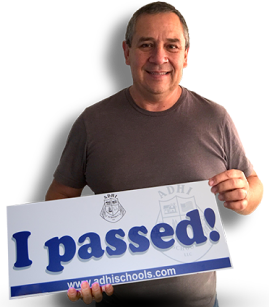
"Hey guys,
I took the exam today and passed!!!!
It only took me one try which was one of my goals. I took the online
classes and follow your suggestions so I took the crash course,
used the crash course app a lot, took 7 mock tests and went
confident to present the exam. Thank you for the great job you are
doing, you guys are awesome!!!! May God continue to bless you!"
Willie V.