Want to succeed as a real estate agent? Then you need to understand the challenges you’ll face in this fast-changing and competitive job. This article looks at the biggest problems Realtors deal with, Read more...
Want to succeed as a real estate agent? Then you need to understand the challenges you’ll face in this fast-changing and competitive job. This article looks at the biggest problems Realtors deal with, like finding clients, handling market changes, managing stress, and keeping up with new technology. It also shares simple tips to help you turn these challenges into opportunities for success.
Lead Generation and Prospecting
The Challenge:
Building a strong referral network, marketing effectively, and cutting through the noise in a competitive market is no easy feat. Consistently finding new clients can feel like starting from scratch again and again.
How to Overcome It:
Time Management for Leads: Dedicate specific blocks of time each week to prospecting, such as cold calls, follow-ups, or social media outreach. For instance, you could allocate Monday mornings for cold calls, Wednesday afternoons for follow-ups, and Friday mornings for social media outreach.
Leverage Technology: Use Customer Relationship Management (CRM) systems, social media scheduling tools, and email marketing platforms to stay organized and nurture leads more efficiently.
Niche Marketing: Specialize in a particular neighborhood or property type. Becoming the go-to expert in a defined market segment helps you stand out and attracts clients more naturally.
Managing Time Effectively
The Challenge:
Real estate agents must manage client showings, contract negotiations, paperwork, marketing campaigns, and more. Without solid time management, feeling overextended and burned out is easy.
How to Overcome It:
Time-blocking: Reserve set times for key activities—prospecting, client communication, and paperwork—and treat these appointments as you would a client meeting.
Delegation: Consider hiring a virtual assistant for administrative tasks. Offloading routine duties lets you focus on revenue-generating activities.
Set Boundaries: Be upfront about your availability with clients. Communicating when and how you can be reached ensures everyone’s expectations align.
Handling Difficult Clients
The Challenge:
Only some clients will be a dream to work with. Some are demanding, indecisive, or highly emotional, making it challenging to maintain professionalism and composure.
How to Overcome It:
Active Listening: Let clients voice their concerns without interruption. Understanding their perspective helps you respond with empathy and clarity.
Clear Communication: Spell out timelines, pricing strategies, and next steps from the start. Clear expectations reduce the risk of misunderstandings down the line.
Know Your Limits: If a client repeatedly crosses boundaries or proves impossible to please, it might be time to part ways respectfully. Protecting your professional well-being is vital.
Market Fluctuations and Uncertainty
The Challenge:
Economic shifts, interest rates, and changing consumer demands influence the real estate market. Adapting to these fluctuations can be nerve-wracking.
How to Overcome It:
Market Analysis: Stay informed by following local and national trends, connecting with mortgage professionals, and studying industry data. The more you know, the better you can advise clients and adjust strategies.
Diversify Your Skills: When sales slow, consider branching into property management, home staging, or real estate investing to keep income streams steady.
Strong Online Presence: Establish a robust digital footprint through a professional website, social media profiles, and online reviews. A solid online reputation not only helps you attract clients during market downturns but also positions you as a trusted expert, which can be particularly valuable when market conditions are uncertain.
Maintaining Motivation and Avoiding Burnout
The Challenge:
Irregular income, long hours, and high emotional stakes can take a toll on even the most driven agents. Staying motivated through the ups and downs is a constant struggle.
How to Overcome It:
Mindfulness and Self-Care: Incorporate stress-reduction techniques like meditation, exercise, or hobbies into your routine. Regular breaks and vacations aren’t luxuries—they’re necessities.
Realistic Goals: Set achievable targets and celebrate each milestone, no matter how small. Recognizing your successes helps maintain a positive outlook.
Community Support: Join networking groups or local associations. Hearing from peers who’ve faced similar challenges can provide new insights, encouragement, and a sense of camaraderie. Remember, you're not alone in this journey.
Technology and Staying Current
The Challenge:
Real estate tools, platforms, and marketing channels evolve at lightning speed. Keeping up—let alone staying ahead—can feel overwhelming.
How to Overcome It:
Continuous Learning: Attend webinars, take online courses, and join workshops to sharpen your tech skills. Staying curious keeps your expertise up-to-date.
Industry Events and Conferences: These are prime opportunities to discover new tools and best practices from other professionals who’ve tested them in the field.
Early Adoption: Embrace new platforms and features ahead of the crowd. Early adopters often gain a competitive advantage and signal to clients that they’re innovative and forward-thinking.
Turning Challenges into Opportunities
The truth about a real estate career is that it’s challenging—but those challenges help you grow and stand apart. By acknowledging the struggles, from lead generation to market uncertainty, you’ll be better equipped to handle them with resilience, adaptability, and a thirst for continuous learning.
Remember, every obstacle you overcome becomes another building block in your foundation of success. With the right mindset and strategies, you can transform the most demanding challenges into stepping stones toward a more fulfilling real estate career. Let these challenges inspire you to reach new heights in your profession.
Love,
Kartik
|

Can you handle the heat of California real estate? This high-stakes industry demands resilience, adaptability, and a thick skin. But for those who persevere, the rewards can be life-changing. If Read more...
Can you handle the heat of California real estate? This high-stakes industry demands resilience, adaptability, and a thick skin. But for those who persevere, the rewards can be life-changing. If you’re considering a career in California real estate, it’s essential to understand the stressors you’ll face and the strategies you can use to overcome them.
Why the California Market Is So Intense
California’s housing market is world-renowned, with median home prices often soaring well above the national average. According to data from the California Association of Realtors (C.A.R.), the state’s median home price is expected to be over $900,000 in 2025, compared to a national median hovering around $400,000. These sky-high prices create an atmosphere of fierce competition.
In many hot neighborhoods—whether it’s luxury estates in Beverly Hills, coastal properties in Laguna Beach, or tech-adjacent homes in the Silicon Valley area—buyers and sellers are playing a high-stakes game. As an agent, you’ll find yourself competing with thousands of others, as California boasts one of the country's largest concentrations of licensed real estate professionals.
From Licensing to Launching Your Career
Before listing your first property, you must tackle California’s licensing process. The state requires a minimum of 135 hours of pre-licensing education, covering real estate principles, practice, and one elective course, followed by a state exam with a notoriously low pass rate. The road to becoming a California real estate agent can be challenging, especially with other commitments. But see it as an investment in your future success. This rigorous licensing process equips you with the skills and knowledge needed to thrive in this competitive industry.
Once you’ve cleared this hurdle, the next step—finding the right brokerage—can also be stressful. The brokerage you choose affects your training, commission splits, and the support you’ll receive. Many new agents spend weeks researching and interviewing firms to find the best fit.
The Financial Roller Coaster
One of the most challenging aspects of working as an agent is handling the financial uncertainty. Unlike a salaried job, your income is directly tied to commissions, and deals can take time to close. If you’re starting, it might be weeks—or even months—before your first paycheck arrives. The state’s fluctuating market compounds this uncertainty: a dip in buyer confidence, an interest rate hike, or new housing regulations can stall transactions.
However, once you establish a steady client base and hone your negotiation skills, the financial rewards can more than justify the initial stress. This potential for substantial earnings should motivate you to push through the challenges and focus on the rewards that await.
Emotional Highs, Emotional Lows
Real estate transactions are among people's most significant financial and emotional decisions. For instance, buyers often experience a swirl of emotions—excitement about their new home, fear of making a wrong decision, and uncertainty about the future.
Sellers, on the other hand, may be sentimental about leaving a longtime home. As the agent, you’re the steady hand guiding them through the storm. You must remain calm during contentious negotiations, empathize with stressed clients, and diplomatically handle last-minute setbacks. If a deal falls through after weeks of effort, you and your clients may feel disappointed.
To thrive in our industry, you must develop emotional resilience. Active listening, empathetic communication, and setting clear expectations early on can help. Consider taking professional development courses on negotiation and client psychology. Over time, you’ll learn to navigate these emotional currents without letting them overwhelm you. And when you successfully hand over the keys to a family’s new dream home, the sense of accomplishment makes the stressful moments feel worthwhile. This emphasis on emotional resilience should empower you to handle the emotional demands of the job and feel prepared for the challenges ahead.
The California real estate market offers a diverse range of niches, each with its unique challenges. This variety should excite you about the potential for diversity in your career and the opportunity to find a niche that aligns with your personality and strengths.
Not all California agents face the same stressors. The state’s diverse markets allow you to specialize in different niches, each with its unique challenges:
Luxury Real Estate involves high commissions and high stakes. Ultra-wealthy clients often expect impeccable service, confidentiality, and extraordinary marketing efforts. The stress lies in catering to discerning tastes and meeting soaring expectations.
Commercial Properties involve complex transactions and longer timelines. Commercial deals often involve multiple stakeholders—investors, attorneys, lenders—and can last months. Patience and expertise in zoning, permits, and leases are essential.
Residential Starter Homes: Highly emotional buyers and sellers. Here, you’ll work with first-time homeowners who may need more hand-holding, translating into more frequent communication and potentially heightened stress.
Investment Properties or Flips: Data-driven transactions. Working with investors means crunching numbers, analyzing rental yields, and monitoring market trends closely. While less emotional, the pressure to deliver profitable results can be intense.
Choosing a niche that aligns with your personality and strengths can help you manage stress more effectively. Do you love the details and long timelines? Commercial might be your calling. Do you enjoy building personal relationships and guiding first-timers? Residential sales may be more fulfilling.
The Branding and Marketing Game
In a market as competitive as California’s, you’re not just selling homes—you’re selling yourself. Building a personal brand requires strategic marketing, from professional headshots and social media campaigns to consistent blogging or video tours. According to the NAR, over 50% of buyers found their home online, meaning your digital presence is crucial.
Brand-building can be stressful, especially when pouring money into ads or design work without immediate returns. Yet, strong branding pays off in the long run. Don't underestimate the power of your brand. It's more than just a logo; it's your reputation, your client magnet, and your key to long-term stability in the California real estate market.
Staying Ahead of the Curve
The real estate industry is always changing because of new technology, changes in the economy, and new rules. You can't just relax and expect things to stay the same. Tools like virtual tours, AI for estimating property values, and digital signing are becoming really important for the job. Keeping up with these changes is a must and can feel like you're running on a treadmill that keeps getting faster.
But, these challenges also offer opportunities. Agents who use these new tools can really stand out from others. Think of learning new things and researching the market not as boring tasks, but as important ways to help you succeed in the long run.
Coping with Stress: Strategies That Work
Knowing the challenges is one thing; handling them is another. Fortunately, there are tangible strategies that can help you cope:
Time Management: Use productivity tools and time-blocking techniques to avoid being “on call” 24/7. Setting specific times for showings, paperwork, and personal breaks helps prevent burnout.
Teamwork and Delegation: Once you're established, consider joining a real estate team or hiring an assistant. Offloading administrative tasks frees up mental space and allows you to focus on high-value activities.
Professional Development: Take courses on negotiation, marketing, and sales skills. Sharpening your skills not only improves performance but also boosts confidence.
Healthy Boundaries: Turn off your phone after a particular hour, and don’t hesitate to tell clients when you’re unavailable. Most clients will respect professionals who value their own time.
Support Networks: Ask colleagues, friends, and family for emotional support. Joining local real estate associations or online communities can also provide mentorship and camaraderie.
Implementing these measures can cushion some of the career’s inevitable stress. Over time, you’ll find it easier to thrive under pressure, transforming what initially felt overwhelming into a manageable (sometimes even invigorating) challenge.
Why It’s Ultimately Worth It
Despite the challenges—the unpredictable income, the emotional roller coasters, the constant need for reinvention—being a California real estate agent can be incredibly fulfilling. You’re helping people find homes where they’ll create memories, grow families, and start new chapters in their lives. Your success brings financial rewards, professional independence, and the satisfaction of mastering a demanding field.
This career isn’t for everyone. It requires grit, self-discipline, and a willingness to endure at least some stress. But for those who embrace the journey, California’s dynamic real estate scene offers a rare combination of personal growth, high earning potential, and the chance to make a real difference in clients’ lives.
Is a California real estate career right for you? If you’re resilient, adaptable, and passionate about helping people achieve their dreams, then the answer might be a resounding yes—stress and all. By understanding the pressures you’ll face, preparing yourself with the right tools and mindset, and staying focused on the rewards that await, you can carve out a thriving, meaningful career in one of the world’s most captivating real estate landscapes.
Love,
Kartik
|

In today’s competitive real estate industry, finding the right real estate license school can mean the difference between barely passing your exam and confidently launching a thriving career. While many Read more...
In today’s competitive real estate industry, finding the right real estate license school can mean the difference between barely passing your exam and confidently launching a thriving career. While many schools promise comprehensive real estate courses, high pass rates, and experienced instructors, only a few truly stand out as industry leaders. Among those top-performing institutions, ADHI Schools, founded by Kartik Subramaniam, has carved out a reputation for exceptional results, student-centered learning, and cutting-edge teaching methodologies.
If you’ve been researching how to pass the real estate exam on your first try, or if you’re trying to identify which real estate license courses will give you the best shot at success, this behind-the-scenes look at ADHI Schools can offer valuable insights. Let’s pull back the curtain to understand how Kartik Subramaniam’s leadership, the school’s unique curriculum, and its focus on student support help turn aspiring real estate professionals into licensed agents with long-term career prospects.
Understanding the ADHI Schools Difference
One of the first things prospective students notice when encountering ADHI Schools is the institution’s unwavering commitment to providing a comprehensive learning experience. Unlike some real estate license schools that offer generic coursework or outdated study materials, ADHI Schools has built a dynamic curriculum that evolves with the industry. Kartik Subramaniam, who established ADHI Schools to help more students pass the California real estate exam, ensures the school’s courses reflect current market trends, state regulations, and the skills most valued by today’s brokerages. The curriculum covers every facet a future agent needs to succeed, from the legal fundamentals of property transactions to emerging technologies in real estate marketing. This holistic approach prepares students for their licensing exams and gives them a solid foundation for the practical realities they’ll face in the field.
The Leadership & Vision of Kartik Subramaniam
At the core of ADHI Schools’ success story is Kartik Subramaniam, a seasoned instructor and real estate expert dedicated to helping others break into the industry. Subramaniam’s unique perspective, informed by years of hands-on experience in California’s real estate market, allows him to guide students through complexities that textbooks alone can’t convey.
His teaching philosophy balances theoretical knowledge with practical application. He understands that to master the material and pass the real estate exam, students need more than just memorization of facts; they need to think like real estate professionals. By sharing insights from his personal journey—both the wins and the challenges—Subramaniam makes the learning process more relatable, inspiring students to stay motivated and focused.
A Data-Driven Approach to Passing the Real Estate Exam
A key factor that sets ADHI Schools apart from other real estate license courses is its data-driven approach to exam preparation. Every year, the California Department of Real Estate releases data on pass rates, common areas of difficulty, and trends in exam questions. ADHI Schools’ team mines this data to refine course content and target the areas where students need the most support.
Students benefit from intensive practice exams, scenario-based quiz sessions, and personalized study plans that align with their strengths and weaknesses. This feedback loop ensures that the curriculum isn’t stagnant—it’s continuously updated to reflect the evolving landscape of the California real estate exam. When students sit for the test, they’ve been trained to anticipate its structure, navigate tricky questions, and manage their time effectively, giving them a significant advantage over less-prepared peers.
Interactive Learning: Beyond Traditional Classrooms
In an age where online education and self-paced study options abound, ADHI Schools understands that merely listing information online isn’t enough. To truly stand out as a top-performing real estate license school, ADHI invests in interactive learning tools that make studying effective and engaging. Students can delve into a variety of resources:
Video Lectures & Webinars: Led by Kartik Subramaniam and other seasoned instructors, these sessions break down complex topics into digestible segments, allowing students to revisit challenging subjects at their own pace.
Practice Quizzes & Mock Exams: Students can test their knowledge through online quizzes and timed mock exams that simulate the conditions of the actual licensing test. Detailed score reports highlight areas needing improvement.
Study Groups & Discussion Forums: Virtual communities allow students to connect, share insights, ask questions, and support one another. This collaborative environment often results in higher retention rates and camaraderie, boosting motivation.
Office Hours & One-on-One Support: Unlike other real estate courses that feel impersonal, ADHI Schools’ instructors are accessible for individual guidance. Students can schedule time to review their progress, clarify doubts, and craft personalized strategies for success.
Cultivating a Growth Mindset for Long-Term Success
Passing the real estate exam is a critical milestone, but it’s only the beginning of a long and potentially lucrative career. ADHI Schools and Kartik Subramaniam emphasize the importance of developing a growth mindset that encourages continuous learning and professional development. This mindset ensures that students don't hit a wall when they transition from exam preparation to working in the industry. Instead, they refine their skills, stay updated on market trends, and explore new opportunities.
From learning how to negotiate effectively to understanding the nuances of California’s housing regulations, these ongoing educational efforts often translate into better client relationships, more closings, and higher earnings. Students leave ADHI with a license and the confidence and strategic thinking necessary to excel in a competitive environment.
Leveraging Reputation and Alumni Success
In today’s digital landscape, reputation matters. You'll encounter countless testimonials and reviews when you research real estate license schools online. ADHI Schools stands out thanks to its track record of high pass rates and the tangible success stories of its alumni. Graduates who have trained under Kartik Subramaniam often move on to join reputable brokerages, start their agencies, or become top-producing agents in their markets.
These alumni frequently return to share their experiences through guest lectures, webinars, or mentor sessions. Their presence validates the school’s methodologies and gives current students real-life examples of what’s possible after passing the exam. By closing the loop between education and career-building, ADHI Schools fosters a tight-knit community of professionals who continue to support one another long after the coursework ends.
Staying Ahead of Industry Trends
Real estate isn’t static; it’s influenced by economic shifts, technological advancements, and changing consumer preferences. Staying ahead of these trends and incorporating them into the curriculum is an integral part of ADHI Schools' long-term strategy. Kartik Subramaniam and his team regularly update course materials with the latest insights on digital marketing techniques, property management technologies, and emerging niches.
Students who train at ADHI gain a forward-looking perspective that allows them to adapt and thrive as the industry evolves. This adaptability will enable them to pass the real estate exam with ease and make them resilient professionals capable of navigating challenges and seizing opportunities in a dynamic market.
Elevating the Standard of Real Estate Education
Choosing the right real estate license school is more than just picking a program that covers the basics; it’s about finding an institution that commits to your long-term success. With Kartik Subramaniam at the helm, ADHI Schools exemplifies what it means to provide a cutting-edge, student-focused education.
Their innovative curriculum, data-driven approach, and emphasis on interactive learning tools ensure that students don’t just memorize facts—they develop the critical thinking skills necessary to excel in the industry.
If you aim to confidently pass the real estate exam, launch a fulfilling career, and stay ahead of the curve, tapping into the resources and insights provided by ADHI Schools and Kartik Subramaniam could be your most brilliant move yet.
|

Embarking on a journey in the real estate industry doesn’t end once you’ve completed your real estate school courses and earned your license. Graduating from a reputable real estate school is the Read more...
Embarking on a journey in the real estate industry doesn’t end once you’ve completed your real estate school courses and earned your license. Graduating from a reputable real estate school is the first step in establishing yourself as a successful, full-time professional. The path from the classroom to closing your first ten deals requires a clear vision, strategic planning, consistent learning, and a willingness to adapt to the evolving market.
This 12-month real estate career roadmap breaks down the steps you must take after finishing real estate license school— from fine-tuning your exam preparation and connecting with a brokerage to building a thriving client base and celebrating post-license success. By following this timeline, you’ll understand precisely what to do after real estate school, making it easier to transform your real estate license into a sustainable, flourishing career.
Month 1-2: Solidifying Your Foundation After Real Estate School
Focus: Exam Prep, Brokerage Research, Personal Branding
As soon as you’ve finished your real estate school coursework, it’s time to focus on passing the state exam. The sooner you conquer this hurdle, the quicker you can start working with clients. Don’t overlook exam prep; this step is critical to your post-license success. Revisit your course materials, utilize any available online practice exams, and engage with peers from your real estate school study groups.
Simultaneously, start researching brokerages in your area. Look for a company that aligns with your values, offers robust training, provides mentorship opportunities, and emphasizes ongoing development. The right brokerage can accelerate your success by supplying valuable resources and market insights. While you’re at it, begin building your brand. Claim social media handles, set up a professional website, and consider a logo that reflects your target audience and niche.
Month 3-4: Passing the Real Estate Exam & Joining a Brokerage
Focus: Licensing, Mentorship, Initial Marketing
By now, you should have passed your real estate exam. This is a significant achievement that transforms you from a real estate student into a licensed professional. Next, it’s time to finalize your association with a brokerage. Ideally, choose one known for its supportive culture, ongoing training, and history of nurturing new agents. A brokerage that offers a mentorship program is invaluable, as seasoned agents can guide you through the nuances of transactions, local regulations, and building client relationships.
Start marketing yourself to your sphere of influence—friends, family, and acquaintances. Share your new role, highlight your affiliation with a reputable brokerage, and position yourself as a reliable point of contact for buying, selling, and investing in real estate. This initial outreach establishes the foundation of your database and can lead to early referrals.
Month 5-6: Developing Market Knowledge & Setting Goals
Focus: Local Market Research, Niche Specialization, Real Estate Tools
In the next couple of months, immerse yourself in your local market. Study neighborhood price trends, track recent sales, and learn to analyze the factors influencing property values. The more intimately you understand your territory, the easier it will be to advise clients, earn their trust, and negotiate favorable deals.
This period is also an excellent time to define your niche.
Consider what type of properties or clients you want to serve. You may excel working with first-time homebuyers, luxury listings, or investment properties. Specializing can help you stand out in a crowded field and streamline your marketing efforts, giving you a clear direction and focus in your career.
Invest in tools and software to boost efficiency—customer relationship management (CRM) platforms, digital marketing services, and transaction management systems. Mastering these tools not only helps you deliver a better client experience but also allows you to maintain an organized pipeline of leads, showings, and closings, empowering you to manage your business more efficiently.
Month 7-8: Lead Generation & Expanding Your Network
Focus: Prospecting, Real Estate Networking, Community Engagement
At this stage, your primary aim is to ramp up lead generation. Prospecting doesn’t have to be daunting; it can be as simple as hosting open houses, attending local events, or joining networking groups for professionals in complementary industries (mortgage brokers, interior designers, or home inspectors). The relationships you build now will pay dividends down the line.
Leverage your brokerage’s marketing resources. Participate in workshops, webinars, and coaching sessions on lead-generation strategies. Consider optimizing your online presence by creating content that answers common client questions, such as “How to select the right property?”
Month 9-10: Refining Your Skills & Building Client Relationships
Focus: Communication Skills, Negotiation, Client Referrals
By now, you’ve likely closed a few deals and gained experience working with different types of clients. Reflect on your successes and identify areas where you can improve. Consider enrolling in additional training or continuing education courses offered by your real estate school alumni network or professional associations. Improving your negotiation, presentation, and communication skills sets you apart from competitors who may rely solely on basic training.
Client satisfaction matters more than ever. Follow up with past clients for testimonials or referrals. Positive word-of-mouth can expand your client base without costly advertising. Personal touches—like a handwritten thank-you note after closing—reinforce your professionalism and dedication. These small gestures help foster long-term relationships that bring repeat business and consistent referrals, contributing to your post-license success.
Month 11: Scaling Your Real Estate Business & Diversifying Services
Focus: Listing Presentations, Real Estate Marketing Strategy, Continuing Education
With nearly a year under your belt, it’s time to consider scaling your business. If you’ve been primarily representing buyers, start targeting more listings. Listings often create a multiplier effect: representing a seller can attract multiple buyers from a single property, boosting lead generation.
Refine your real estate marketing strategy to showcase your listings through professional photography, video tours, and social media promotions. Explore partnerships with local businesses, such as interior designers or moving companies, that can elevate your brand's visibility. Continuously invest in your education—take advanced real estate and marketing courses, attend industry seminars, and earn certifications that strengthen your credibility and skill set.
Month 12: Celebrating Your Success & Planning Ahead
Focus: Review, Refine, Set New Goals
After 12 months in the industry, it’s time to review your progress. Have you reached your goal of closing your first ten deals? Reflect on what worked well and what could be improved. Review your lead sources—were some more fruitful than others? Did your brokerage relationship meet your expectations? Are you attracting the clients and listings you aimed for when you left real estate school?
Use this analysis to set new, more ambitious goals for the following year. Perhaps you’ll double your transaction volume, earn a specialized certification, or expand your team. The key is to remain adaptable and committed to ongoing growth. Real estate is dynamic, and professionals who embrace change are best positioned to thrive.
From Classroom to Closing: A Sustainable Real Estate Career
Completing real estate school and earning your license is only the beginning of a long, rewarding journey. Following this 12-month real estate career roadmap, you’ve learned precisely what to do after real estate school to transition smoothly from a new licensee into a confident, skilled agent who can handle any market challenge.
From acing your exam and choosing a supportive brokerage to mastering local market knowledge, boosting lead generation, and refining your negotiation skills, each step moves you closer to post-license success. Embrace continuous learning, prioritize client relationships, and keep a finger on the industry’s pulse. With dedication, strategy, and resilience, you can turn your initial investment in real estate school into a thriving career that lasts for years.
Love,
Kartik
|

Passing the real estate licensing exam is a significant milestone in your journey to becoming a real estate agent. The exam can be daunting, as it not only tests your knowledge but also your ability to Read more...
Passing the real estate licensing exam is a significant milestone in your journey to becoming a real estate agent. The exam can be daunting, as it not only tests your knowledge but also your ability to manage time and apply what you’ve learned. This can be particularly stressful if you're unsure of what to expect.
However, the use of practice real estate exams can significantly reduce this stress by providing a familiar format and helping you prepare for the actual test. These tests look and feel like the real thing, helping you get comfortable with the format before the exam day. A good real estate school will ensure you have these practice tests as part of your preparation. Instead of just telling you to study, the school will show you how and give you the tools to do it right.
While no real estate school has access to the exact questions on your state licensing exam (those are kept confidential!), rest assured that our practice exams are designed to thoroughly prepare you. We meticulously align our questions with the concepts and topics published by the Department of Real Estate and our team of expert instructors crafts each question to mirror the style and difficulty of the actual exam, ensuring you build the knowledge and confidence needed to succeed. Unlike the official exam, we provide detailed answer explanations and feedback, allowing you to learn from any mistakes and solidify your understanding.
Why Practice Exams Matter
Practice exams are not just a “nice-to-have” but a key part of preparing for your real estate test. Here are the main reasons they help:
They Feel Like the Real Test: Practice exams should show the types of questions you’ll face and how the test is structured. By taking them, you won’t be caught off guard when you see the actual exam.
They Show You Your Weak Spots: A practice exam helps determine what to study. Maybe you’re good at finance questions but struggle with laws about property ownership. Once you know your weak areas, you can focus on fixing them.
They Teach You to Manage Time: You only have so much time to answer all the questions on test day. Practice exams help you learn how to pace yourself so you don’t run out of time.
They Build Your Confidence: The more you practice, the more comfortable you’ll feel. One student, for example, was initially nervous about the test. After taking several practice exams on crashcourseonline, they got used to the question types, and their scores improved. When they took the exam, they felt much calmer and better prepared.
They Help You Remember What You Learn: Studying isn’t just about reading notes. Trying to answer exam questions helps lock information into your memory. You learn by doing, not just by looking over pages of text.
Choosing a Real Estate School That Helps You Succeed
Only some real estate schools put the same effort into helping you pass the exam. When picking a school, look for these features:
Suitable Study Materials: You’ll want to make sure the school’s lessons match what your state’s test will cover. Up-to-date textbooks, online lessons, and a clear course outline ensure you aren’t wasting time on outdated information.
Expert Feedback: Knowing which answers you got wrong is not enough. The best schools give detailed explanations and may even have teachers to help you understand why you missed a question. This way, you turn mistakes into lessons.
Flexible Schedules: Everyone’s life is different. Good schools offer different ways to learn—online classes, in-person sessions, or a blend of both—so you can fit studying into your routine.
A Good Reputation: Check out what past students have to say. If many people pass the exam after taking the school’s course, that’s a good sign. You can also review the school’s track record with your state’s real estate board.
How to Use Practice Exams Effectively
Having practice exams isn’t enough—you need to use them correctly. Here are some tips:
Copy the Real Test Setting: When you take a practice exam, act like it’s real. Find a quiet spot, set a timer, and try not to take breaks. Getting used to this feeling will help you stay calm on exam day.
Look at Your Mistakes: After you finish a practice exam, go through the answer key. Don’t just skip the questions you got wrong—study them. Find out why you missed them so you won’t repeat the same error.
Focus Your Review: If you notice you keep missing questions on a particular topic, spend extra time studying that area. By focusing on your weaknesses, you’ll use your study time more wisely.
Start Small and Build Up: Begin with shorter quizzes on single topics before trying a full-length practice exam. This helps you get used to the material step-by-step before facing the test.
Try Different Types of Practice Tests: Don’t stick to just one set of questions. Mix it up by using different practice exams. This way, you’ll see many question styles and won’t be surprised on test day.
Beyond the Exam
While the primary goal of practice real estate exams is to help you pass the licensing exam, the skills you develop through these tests will continue to benefit your career. These exams teach you to think on your feet, manage your time, and handle challenging questions. These same skills will be invaluable when you work with clients, discuss contracts, or explain property details. The long-term benefits of practice exams extend far beyond the licensing exam, making them a valuable investment in your real estate career.
Practice real estate exams are an innovative and powerful tool. They help you get comfortable with the test format, find and fix your weaknesses, manage your time, and become more confident. By choosing a real estate school that provides high-quality practice tests and offers solid support, you set yourself up for success—not just on exam day but for your entire career as a real estate professional.
Practice real estate exams are more than just a stepping stone to passing the licensing exam; they're a strategic tool for building a strong foundation for your entire real estate career. By familiarizing yourself with the exam format, identifying your weaknesses, and honing your time management skills, you'll gain the confidence and knowledge needed to excel.
Love,
Kartik
|
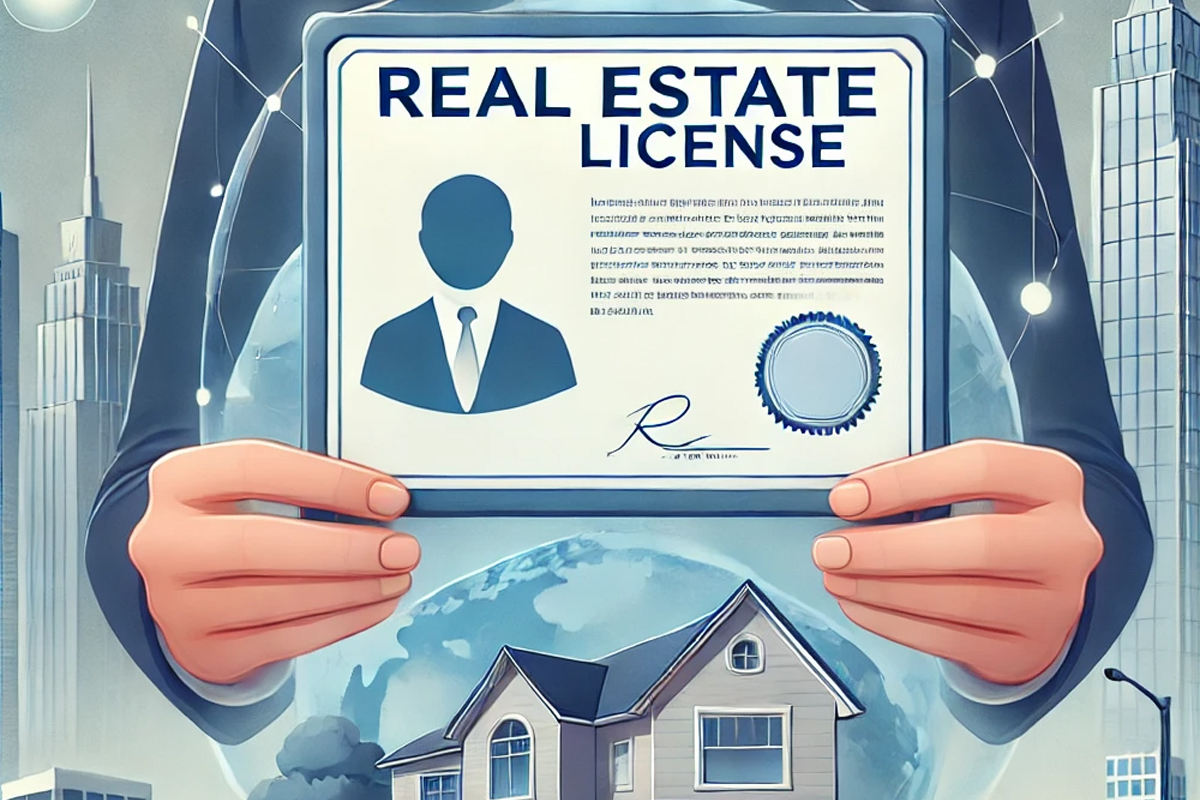
Even though the concept of a real estate license might seem straightforward, many might not appreciate its comprehensive role in a real estate professional's career. From ensuring legal compliance Read more...
Even though the concept of a real estate license might seem straightforward, many might not appreciate its comprehensive role in a real estate professional's career. From ensuring legal compliance to fostering market integrity, this license is the cornerstone of professional real estate practice. It's not just a legal requirement, but a fundamental pillar of the real estate industry. In this article, I wanted to delve into the true essence of a real estate license, its necessity, and the benefits it brings to both professionals and their clients.
Types of Real Estate Licenses
For those venturing into the real estate industry, the choice often boils down to two primary licenses:
Real Estate Salesperson: Allows you to conduct transactions under the supervision of a licensed broker.
Real Estate Broker: This position empowers you to operate independently, manage a team of salespersons, and potentially own your own brokerage. It's a testament to your expertise and a stepping stone to a successful career in real estate. Keep in mind that requirements vary by state. For example, one state may require 60 hours of pre-licensing education, while another may require over 250. Always research the regulations specific to your area. This empowerment is a testament to your expertise and a stepping stone to a successful career in real estate.
Why Are Licenses Important?
Real estate licenses serve several critical purposes:
Consumer Protection: Licensing ensures that practitioners meet minimum standards, safeguarding clients from unethical or unprofessional practices.
Professional Standards: Education and making candidates pass real estate exams help ensure that agents and brokers possess a solid grasp of real estate law, ethics, financing, property management basics, and market principles.
Market Trust: A licensed professional builds trust and credibility, drawing in clients who prioritize expertise and ethical standards. Your license represents more than a mere credential; it is a mark of reliability within the real estate community.
How to Obtain a Real Estate License
While the exact process varies by state, you’ll typically follow these steps:
Consumer Protection: Licensing ensures that practitioners meet minimum standards, safeguarding clients from unethical or unprofessional practices.
Meet Prerequisites: You must usually pass any required background checks.
Complete Pre-Licensing Education: Enroll in a state-approved real estate program covering real estate principles, laws, ethics, finance, and property valuation.
Pass the State Exam: After completing your education, you’ll take a state-administered exam. This test covers property law, financing, contracts, land use, and ethical practices. Success here ensures you have a foundational understanding of the industry’s core concepts.
Maintaining and Renewing Your License
Earning your license is just the start. To keep it active and in good standing, you’ll need to:
Fulfill Continuing Education Requirements: Stay up-to-date with evolving laws, market trends, and industry best practices by completing regular coursework.
Renew Your License Periodically: States usually require real estate license renewal every two to four years. Ensure you meet all renewal criteria, pay applicable fees, and submit the documentation on time.
Uphold Ethical and Legal Standards: Always comply with state regulations and industry ethics. Operating with an expired or revoked license can lead to fines, legal action, or permanent disqualification, significantly impacting your career and reputation in the industry.
The Benefits of Having a Real Estate License
Holding a real estate license offers several advantages:
Legal Authority: You can represent buyers, sellers, landlords, and tenants, earning commissions and building a rewarding career.
MLS Access: Gaining access to the Multiple Listing Service (MLS) provides a comprehensive database of properties, streamlining the search process and boosting your efficiency.
Expert Negotiation and Advocacy:Licensed professionals add value by advocating for their clients’ best interests. They use their market knowledge and negotiation skills to secure favorable terms, ensuring clients achieve their real estate goals.
Professional Growth: Join professional organizations—such as the National Association of Realtors ®—and benefit from industry resources, networking events, and advanced training programs. These organizations can provide you with valuable insights, networking opportunities, and access to advanced training, all of which can contribute to your professional growth and success in the industry.
Career Versatility: Explore various niches, from residential and commercial sales to property management, investment consultancy, and even luxury market specialization.
Certification: Additional certifications or designations, like working with first-time buyers or handling luxury properties, can demonstrate specializations. These certifications can enhance your credibility and marketability, showing potential clients you have specialized knowledge and experience in a particular real estate area.
Continuous Learning Needed: A license is the starting line, not the finish line. The industry evolves, and so must your knowledge and skills. Continuous learning is not just a requirement, it's a key to staying competitive in the real estate market. This emphasis on continuous learning is a reminder of the necessity of staying updated and competitive in the industry.
Next Steps
If you’re ready to begin your journey:
Research State Requirements and Enroll in Pre-Licensing Courses: Visit your state’s official real estate licensing board website and find an approved real estate school like ADHI Schools. This emphasis on research and preparation will make you feel equipped and ready to start your journey.
Join Professional Organizations: Consider joining the National Association of Realtors® or other reputable groups for ongoing education, market insights, and networking opportunities.
A real estate license is key to unlocking a dynamic, customer-focused career. With the proper preparation, dedication to learning, and commitment to advocating for your clients’ best interests, you’ll be well on your way to thriving in this rewarding industry.
Love,
Kartik
|

Starting in real estate school and breaking into the real estate world can feel like stepping into a high-pressure and rapidly evolving industry. There are contracts to learn, open houses to host, and Read more...
Starting in real estate school and breaking into the real estate world can feel like stepping into a high-pressure and rapidly evolving industry. There are contracts to learn, open houses to host, and a constant stream of new information to absorb. Yet, amidst all the hustle, one cornerstone of success rises above the rest: networking.
It shouldn’t be surprising that building a strong network is essential for new agents. The intimidating question is “How do you establish connections when you're just starting out?”
The good news is that networking isn't about being pushy or overly polished; it's about forming genuine relationships. In this guide, you'll find practical tips to help you build a thriving network based on authenticity and trust, helping to set your real estate career in motion.
Understand the Power of Networking in Real Estate
Forget the stereotype of the slick, fast-talking salesperson. In today's market, real estate thrives on relationships. Networking is the foundation of the industry, and success often comes down to trust and connection. Clients want to work with agents they know, like, and trust. Focus on providing value by:
Share helpful advice.
Stay informed about local market trends.
Position yourself as a resource.
When people see you as someone who genuinely cares about their needs, the business you want naturally follows.
Define Your Networking Goals
Before diving into events and meetups, take a moment to clarify your objectives.
Identify your target audience: Are you passionate about helping first-time homebuyers? Do you dream of working with luxury clients? Or are you drawn to investors? Knowing who you want to help will guide your networking efforts.
Set measurable goals: Instead of vague aspirations like 'meet more people,' aim to collect some stated number of new connections per month. This clear direction will keep you focused and motivated in your networking efforts.
Align with your career vision: Consider how your networking activities support your long-term goals. Are you working to become a top local agent or build a referral-based business? Keep the big picture in mind.
Start with Your Inner Circle
Leverage existing relationships: Friends, family, former colleagues, or even the barista at your favorite café can help spread the word about your new career. Who knows - Your most substantial network may already be within reach.
Announce your new role on social media: Share your excitement and update your profiles to reflect your new path. A simple post can spark conversations and referrals.
Ask for introductions: Don't be shy about asking your inner circle to connect you with people they know. A friend-of-a-friend introduction could lead to your first sale.
Attend Local Events and Join Real Estate Groups
Get out there and meet people face-to-face!
Participate in local events: Attend Chamber of Commerce meetings, charity fundraisers, and community festivals. Don't overlook smaller gatherings like HOA meetings or school fundraisers, which can also be great for meeting locals.
Join industry groups: Connect with peers through local real estate associations or online communities. Sharing insights with other professionals can open unexpected doors.
Volunteer and sponsor: Increase your visibility by sponsoring a local sports team, organizing a neighborhood cleanup, or volunteering at a soup kitchen. These activities build goodwill and name recognition.
Master the Art of the Elevator Pitch
Opportunities to connect often come at unexpected moments. Be prepared with a short, engaging introduction that highlights your value.
Craft a 30-second pitch: For example: "I'm a real estate agent who loves helping first-time homebuyers navigate the exciting journey to their dream home. I focus on making the process smooth and stress-free."
Or
“I’m a real estate agent who specializes in helping investors identify properties that align with their financial goals. Whether it’s finding undervalued assets, analyzing cash flow potential, or navigating complex transactions, I provide the expertise and resources to make every investment a strategic success.”
Be conversational: Your pitch should feel natural, not rehearsed. Practice until you can deliver it confidently.
Engage on platforms like LinkedIn, Instagram, and Facebook: Share your expertise and connect with potential clients and industry professionals. By consistently sharing helpful, engaging, or entertaining posts, newer agents can build trust and connection, making their eventual sales pitches more effective and well-received.
Post valuable content: You must schedule an appointment with a Share market updates, home-buying tips, and success stories to position yourself as a helpful resource.
Join local groups and forums: Participating in community discussions online is an easy way to make connections and grow your influence.
Collaborate with Other Professionals
Real estate doesn't exist in a vacuum.
Build partnerships: Form relationships with mortgage brokers, home inspectors, contractors, and interior designers. These professionals often refer clients and appreciate referrals in return.
Create mutual opportunities: For example, a mortgage broker could refer pre-approved buyers to you, while you could recommend their services to your clients. Collaboration helps everyone succeed.
Follow Up and Stay Top of Mind
Networking is just the first step. Staying connected turns acquaintances into clients.
Follow up promptly: Send a quick, personalized email or connect on LinkedIn after meeting someone.
Stay organized: Use a CRM or a simple calendar to track contacts and schedule follow-ups.
Add value regularly: Share helpful articles, send holiday greetings, or provide market updates to maintain relationships without overwhelming your contacts.
Be Consistent and Patient
Networking is a marathon, not a sprint. It's important to stay patient and committed to your efforts, knowing that every connection brings you closer to your goals.
Commit to consistency: Attend events regularly, engage on social media, and follow up with new connections. Over time, these efforts compound into meaningful relationships.
Celebrate small wins: Every connection counts, whether a new lead or a productive conversation.
Learn from setbacks: Only some contacts will lead to immediate results. Use each interaction as a learning opportunity and keep building.
Networking is the cornerstone of success for new real estate agents. By building genuine relationships, you can grow your business, establish trust, and position yourself as a go-to expert in your market.
Start small, stay consistent, and always look for ways to add value. Whether a friendly conversation at a local event or a thoughtful follow-up email, every connection brings you closer to your goals.
Your journey in real estate is just beginning—get out there and start building your network today!
Love,
Kartik
|

Only Sign with a Brokerage Once You Ask These 5 Questions!
Starting your real estate career or considering a move to a new brokerage is an exciting step, but it’s also one that requires careful thought. Read more...
Only Sign with a Brokerage Once You Ask These 5 Questions!
Starting your real estate career or considering a move to a new brokerage is an exciting step, but it’s also one that requires careful thought. Joining a brokerage is a lot like choosing a business partner—it’s a decision that can shape your career success, professional growth, and overall satisfaction. Before you commit, ask these five essential questions to ensure you’re making the right choice.
1. What Is the Brokerage’s Commission Structure and Fee Schedule?
Your earning potential starts with understanding how a brokerage structures its commissions and fees. To get the full picture, ask:
Splits and Caps: What percentage of commissions will I keep? Is there a cap after which I retain 100%?
Fees: Are there recurring costs for desk space, transaction processing, or other services?
Extras: Will I be charged for training, marketing tools, or technology platforms?
For instance, some brokerages might offer an 80/20 split with a $15,000 cap, while others may opt for a flat fee model. Knowing these details upfront helps you evaluate how much you’ll take home versus what you’ll invest in being part of the brokerage.
2. What Training and Mentorship Programs Do You Offer, Especially for New Agents?
A good brokerage invests in its agents’ success, especially if you’re new to the industry. Look for structured training and mentorship opportunities that will set you up for long-term growth. Key questions include:
Structured Training: Are there formal programs covering topics like contracts, negotiations, and lead generation?
Mentorship: Can I be paired with an experienced agent for one-on-one guidance?
Frequency and Costs: How often are training sessions held, and are they included in the fees?
For example, a brokerage that offers weekly training sessions and access to a dedicated mentor can provide the confidence and skills you need to thrive in the competitive real estate market.
3. How Does The Brokerage Generate Leads, and What Is the Lead Distribution Policy?
Leads are the lifeblood of a successful real estate career. It’s crucial to understand how a brokerage approaches lead generation and distribution. Here’s what to ask:
Lead Sources: Does the brokerage provide leads, and how are they generated (e.g., marketing campaigns, referrals)?
Distribution Policy: Are leads distributed evenly among agents, or based on experience or performance?
Agent Responsibility: If I’m responsible for generating my own leads, what support does the brokerage offer?
For example, some brokerages provide leads through their website and allocate them to agents on a rotating basis, while others require agents to handle their own lead generation entirely. Understanding this system will clarify your potential pipeline.
Pro Tip: Most real estate brokerages are not going to offer leads, but many teams will.
4. What Marketing and Technology Resources Does the Brokerage Provide?
In today’s digital-first world, having access to modern marketing and technology tools is a must. To evaluate the brokerage’s resources, ask:
Marketing Tools: Do they provide a personal website, branding materials, or social media support?
Technology Infrastructure: Are tools like CRMs, transaction management software, or e-signature platforms included?
Costs: Are these tools covered in my fees, or will I need to pay extra?
A brokerage that equips you with cutting-edge resources can save you time, enhance your professionalism, and help you attract more clients.
5. Can You Describe the Company Culture and Work Environment?
A positive and supportive work environment is crucial for both your productivity and well-being. To assess the brokerage’s culture, ask:
Values and Communication: What are the brokerage’s core values, and how do they guide day-to-day operations?
Team Dynamics: Are there opportunities for collaboration and support among agents?
Networking and Events: Does the brokerage host events, workshops, or team-building activities?
For example, a brokerage with a collaborative team environment and regular networking opportunities can help you build meaningful relationships and grow your business.
Pro Insight: Speak with Current Agents
Even if you are still in real estate school or preparing for the real estate exam, don’t hesitate to ask if you can speak with a few current agents at the brokerage. Their firsthand perspectives can provide invaluable insights into the work environment, the level of support offered, and what it’s really like to work there.
Your Success Starts with the Right Brokerage
Your future in real estate begins with the right foundation. Take these questions to your next brokerage meeting to ensure the brokerage aligns with your goals, values, and needs. Remember, the right brokerage isn’t just a place to work— they are a partner in your success.
Love,
Kartik
|

Whether you're a student preparing for the next steps after completing your real estate courses and passing the exam, or you’ve just received that thrilling 'Pass' notification, one question likely comes Read more...
Whether you're a student preparing for the next steps after completing your real estate courses and passing the exam, or you’ve just received that thrilling 'Pass' notification, one question likely comes to mind:
What’s next?
Passing the California real estate exam is a significant milestone—one that deserves to be celebrated. However, it's important to remember that this achievement is just the beginning of your journey toward becoming a licensed real estate agent.
In this article, I’ll guide you through the essential next steps to help you transform that hard-earned 'Pass' notice into a thriving real estate career.
Step 1. Receive Your Exam Results
The California Department of Real Estate (DRE) typically provides exam results quickly since the real estate exam is administered electronically. In rare cases—such as when the state’s computer systems are temporarily down—the test may be conducted using paper and pencil. However, this is an uncommon scenario and usually occurs only if technical issues arise.
In the past, the state released exam results immediately for test-takers, but this practice has been discontinued in recent years. One possible reason could be to prevent emotional reactions—whether celebratory or otherwise—in the hallways of exam centers. In rare cases where the exam is administered using pencil and paper, results may take longer to process.
Seeing that "Pass" notification is exhilarating, but remember, it doesn't mean you're officially licensed yet.
2. Submit Your License Application and Fingerprints
If you didn’t apply for your exam and license together—a step we highly recommend—you’ll need to submit your license application separately after passing the exam. Applying for both simultaneously saves time, as it allows the DRE to start processing your license immediately upon passing. If you only applied for the exam, submitting your license application afterward can add a month or more to the process.
To apply for your license after passing the exam, you’ll need to include proof of exam passage, fingerprints and the required real estate license fees. Be sure to double-check all documentation for accuracy to avoid delays.
California also requires all license applicants to complete a Live Scan fingerprinting process. This involves digitally scanning your fingerprints at an authorized location, such as a UPS store, police station, or private provider like ADHI Schools. A complete list of Live Scan locations is available on the California Department of Justice website. The DRE uses these fingerprints for a thorough background check.
3. Pay the Licensing Fees
Be prepared to pay the associated licensing fees, which include:
License application fee: Currently $350 for sales and $450 for broker
Live Scan fingerprinting fee: This fee varies depending on the location but typically ranges from $75-$90
4. Choose a Real Estate Brokerage
Be sure to start looking around before your license is approved!
As mentioned, you can begin exploring brokerages while waiting for the DRE. You must associate with a licensed real estate broker in California to activate your license. Choosing the right brokerage is a crucial decision for your career. Consider factors like:
Mentorship and Training:
Does the brokerage offer comprehensive training programs for new agents?
Are there experienced mentors available to guide you?
Do they provide ongoing professional development opportunities?
Commission Splits and Fees:
What is the brokerage's commission structure?
Are there any desk fees or other associated costs?
How are marketing and administrative expenses handled?
Reputation and Market Presence:
What is the brokerage's reputation in the community?
Do they have a strong market presence in your desired area?
What kind of marketing and branding support do they offer?
5. “Activate” Your Real Estate License With That Broker
Once you've selected a brokerage, they will help you officially activate your license through the DRE. Remember, you can only legally conduct real estate transactions once your license is placed with a broker.
6. Start Networking and Marketing Yourself
You're officially a California real estate agent! Now, it's time to hit the ground running.
Build Your Brand: Create professional business cards and establish an online presence through a website or social media profiles.
Join Industry Associations: Join the California Association of Realtors (CAR) and your local Multiple Listing Service (MLS). CAR offers valuable resources, education, and networking opportunities for California real estate professionals.
Network Actively:
Attend local real estate meetups and industry events to connect with other professionals.
Leverage LinkedIn to build your professional network and engage in industry conversations.
Attend community events and open houses, and network within your influence to build relationships with potential clients.
California-Specific Considerations:
California has a robust and competitive real estate market with specific licensing requirements. The process outlined here is unique to California and may differ from other states regarding fees, application timelines, and background check procedures.
Looking Ahead:
Remember, the journey doesn't end with getting your real estate license. To maintain your California real estate license and ensure continued success, you must stay informed about industry trends, legal updates, and best practices. Commit to ongoing learning and professional development to provide excellent service to your clients and stay ahead in this dynamic industry.
Passing the California real estate exam is a significant milestone, but the journey continues. By following these proven steps, you'll be on your way to launching a successful career in real estate. Stay proactive, embrace the learning process, and remember that dedication, resilience and hard work are key to thriving in this exciting industry.
Love,
Kartik
|
Choosing the right real estate school is a big step if you want to succeed in our industry. It's like picking the best map for a road trip—you need clear and reliable directions to reach your destination. Read more...
Choosing the right real estate school is a big step if you want to succeed in our industry. It's like picking the best map for a road trip—you need clear and reliable directions to reach your destination. The real estate school you choose should guide you, providing the essential knowledge and skill
|

Live Scan is an electronic fingerprinting process in California that captures fingerprints digitally and sends them directly to specific agencies, such as the California Department of Justice (DOJ) and Read more...
Live Scan is an electronic fingerprinting process in California that captures fingerprints digitally and sends them directly to specific agencies, such as the California Department of Justice (DOJ) and the Federal Bureau of Investigation (FBI), for a background check. This process is commonly used for employment, licensing, and certification purposes.
Here's how it typically works:
Fingerprinting Appointment: You must schedule an appointment with a Live Scan service provider. During the appointment, your fingerprints are taken electronically, without the need for the traditional ink and paper method.
Filling Out the Form: Before taking your fingerprints, you'll fill out a Live Scan form that includes your personal information and the type of background check required. This form will also specify the agencies that will receive your background check results.
Taking Fingerprints: The technician uses a scanner to capture images of your fingerprints. This process is quick and usually takes about 10 to 15 minutes.
Submission for Background Check: The fingerprints and your details from the Live Scan form are electronically transmitted to the appropriate agencies.
Processing: The DOJ and possibly the FBI process your fingerprints to check for criminal records or other relevant information.
Results: The background check results are sent directly to the employer or agency that requested them. The turnaround time can vary, but it typically takes a few days to a few weeks.
Privacy and Security: The data transmitted during the Live Scan process is encrypted to ensure privacy and security.
Live Scan is preferred over traditional methods because it's faster, and the digital method reduces the chance of errors commonly associated with ink fingerprinting.
An applicant for any real estate license is required to provide one set of fingerprints that are classifiable and accepted by the State Department of Justice (DOJ). Fingerprints can be taken either after applying for the examination or once the examination has been passed. If an applicant fails the examination, fingerprint processing fees will not be refunded. Social security numbers must be included on examination applications to ensure that the fingerprint reports are accurately matched and sent to the Department of Real Estate (DRE).
Fingerprints must be submitted through the DOJ's Live Scan Program, which captures and sends fingerprints to both the DOJ and the Federal Bureau of Investigation (FBI) using the Live Scan Service Request (RE 237) form, which is a PDF document. An original license will only be issued once the DRE has received and reviewed reports from both the DOJ and the FBI.
To have your fingerprints taken, bring the Live Scan Service Request (RE 237) form to a Live Scan service provider participating in the program. There is a fingerprint processing fee of $49, plus an additional fee charged by the Live Scan provider, both of which are payable directly at the service provider (not to the DRE). After having your fingerprints taken, submit a copy of the Live Scan Service Request (RE 237) form with Part 3 completed to the DRE.
For those not residing in California, you can get fingerprinted at a Live Scan service provider within California by following the instructions mentioned above, or outside of California using two FBI Applicant Fingerprint Cards (FD-258). If using fingerprint cards, take them to a local law enforcement agency to be filled out and send them directly to the DRE along with the completed license application, the license application fee, and the $49 fingerprint processing fee (a combined payment for exam/license and fingerprint fees is acceptable).
ADHI Schools is here to help you apply for the exam and we can even roll your fingerprints for you if you are local to Rancho Cucamonga. While the Livescan won’t give us a copy of your background check, be sure to disclose anything requested on the application in terms of background items. The DRE may not issue you a license if they deem that your background would warrant denial of a license.
Love,
Kartik
|

Choosing to start a career in real estate is exciting and full of opportunities. But before jumping in, it makes sense to find out what real estate school is about. Doing your homework helps you know what Read more...
Choosing to start a career in real estate is exciting and full of opportunities. But before jumping in, it makes sense to find out what real estate school is about. Doing your homework helps you know what to expect, making it easier to handle the challenges and succeed.
Real estate school should teach you more than just how to pass an exam; it gives you the skills and knowledge you need for your future job. It's essential to check that the school's courses match what you want from your career and that you're ready for the time and work it requires.
Knowing about our school's setup and what the classes are like helps you prepare better. It also shows you what it means to work in real estate, not just how to get your license.
In short, learning about real estate school before you enroll is a smart move. It helps you go in prepared and confident, ready to take on the challenges and grab the opportunities that come with a career in real estate.
Curriculum Deep Dive: Core Components of Your Real Estate Education
To become a licensed real estate agent in California, three specific courses are required: Real Estate Principles, Real Estate Practice, and one elective. Each course is designed to equip aspiring real estate professionals with the knowledge they need to succeed in the industry. Let's explore what each course covers, their importance, and why ADHI Schools recommends "Legal Aspects of Real Estate" as the elective course.
Real Estate Principles
The Real Estate Principles course lays the foundational knowledge every agent needs. It covers a broad spectrum of topics, including property ownership and land use controls, real estate law, and the nuances of property valuation. Understanding these principles is crucial as it provides the groundwork for making informed decisions in buying, selling, leasing, and managing real property. This course is essential because it teaches the theoretical aspects of real estate that are critical for passing the state licensing exam and effectively serving future clients.
Real Estate Practice
Real Estate Practice focuses on the day-to-day operations in real estate, such as listing, selling, leasing, buying, and managing property. This course provides practical knowledge on conducting real estate transactions, including marketing properties, understanding buyer and seller needs, and completing some contract forms. It also teaches critical skills in negotiation and closing transactions. This vital course bridges the gap between theoretical knowledge and practical application, preparing students for real-world real estate activities.
Elective Course: Legal Aspects of Real Estate
ADHI Schools strongly recommends "Legal Aspects of Real Estate " for the elective. This course dives deeper into the legal intricacies of real estate transactions and property law. It covers topics such as contracts, property rights, the legal implications of real estate finance, and recent changes in real estate law and tax regulations. Understanding these aspects is vital for anyone in the field, as it helps protect agents and their clients from legal pitfalls.
By completing these courses, students are well-prepared to take the California real estate licensing exam and embark on a successful career.
Learning Formats & Study Tips: ADHI's Modern Approach to Real Estate Education
At ADHI Schools, we recognize that real estate education needs to be flexible, accessible, and efficient. That's why we've tailored our course offerings to meet the demands of today's learners and industry standards, emphasizing the advantages of remote learning while addressing the limitations of traditional classroom settings.
Self-Study and Instructor-Led Courses
We offer two primary learning formats: self-study and instructor-led courses. Our self-study options provide the utmost flexibility, allowing students to progress at their own pace and schedule. This is ideal for those who need to balance other commitments, such as work or family, but still want comprehensive access to quality educational content.
Our instructor-led courses are delivered via Zoom for those who thrive under guided instruction. This format combines the convenience of online study with the benefits of live interaction. Students can engage directly with experienced instructors and peers in real time, enjoying a dynamic learning environment without commuting. This saves time, reduces travel costs, and lessens the environmental impact of traditional classroom settings.
The Outdated Model of In-Person Classes
Traditional in-person coursework must be updated for today's fast-paced, digital world. The future of real estate education lies in digital accessibility and interactive learning environments. In-person classes often need more flexibility than many aspiring real estate professionals. They can be a barrier to those who cannot commit to rigid schedules or travel to distant locations.
The Best of Both Worlds
Our Zoom-led instructor courses offer the best of both worlds: the ease of online access with the personalized touch of in-person training. This hybrid model ensures that all students, regardless of location or schedule, can benefit from high-quality real estate education and interactive sessions that foster a more profound understanding and retention of course material.
By choosing ADHI Schools, you're not just enrolling in a real estate school—you're embracing a modern, innovative approach to learning that prepares you for success in the real estate market. Our formats are designed to equip you with the knowledge and skills necessary to excel, utilizing traditional educational principles and cutting-edge technology.
Embarking on a new educational journey in real estate shouldn’t have to mean putting your life on hold. You don't need to be a full-time student to achieve your dreams of becoming a licensed real estate professional.
Prepping for the Real Estate Exam with CrashCourseOnline.com
Once you finish the pre-license courses, the next step is to prepare for the real estate exam. This is where you consolidate all your learning and prepare to succeed. A robust tool in your arsenal should be CrashCourseOnline.com, specifically designed to optimize your exam preparation.
CrashCourseOnline.com offers a comprehensive suite of resources tailored to the real estate license exam's structure and content. Familiarizing yourself with the exam format is essential, and our platform covers multiple-choice questions, simulations, and potential essay components. What sets CrashCourseOnline.com apart is its focus on interactivity and real-world simulation, providing practice exams that mimic the testing environment.
Our iPhone and Android apps make studying flexible and accessible, allowing you to prepare on the go and fit study sessions into your busy schedule. The apps are designed to enhance learning efficiency with features like timed quizzes, answer explanations, and progress tracking.
These tools help you master test-taking strategies such as question analysis, time management, and critical thinking under exam conditions.
Encouragement Every Step of the Way
We believe in encouraging our students through every step of their real estate education. At ADHI Schools, you're not just another student but part of a community that cares about your success. Our instructors are dedicated professionals who are as invested in your achievements as you are. They are readily available to help you navigate your courses and confidently prepare for the real estate exam.
Becoming a real estate agent is a personal and professional growth journey. With ADHI Schools, you have a partner in education who provides the tools and support you need to excel without overwhelming your daily life. Enroll with us, and take the first step towards a successful career in real estate with the flexibility and encouragement you deserve.
Love,
Kartik
|
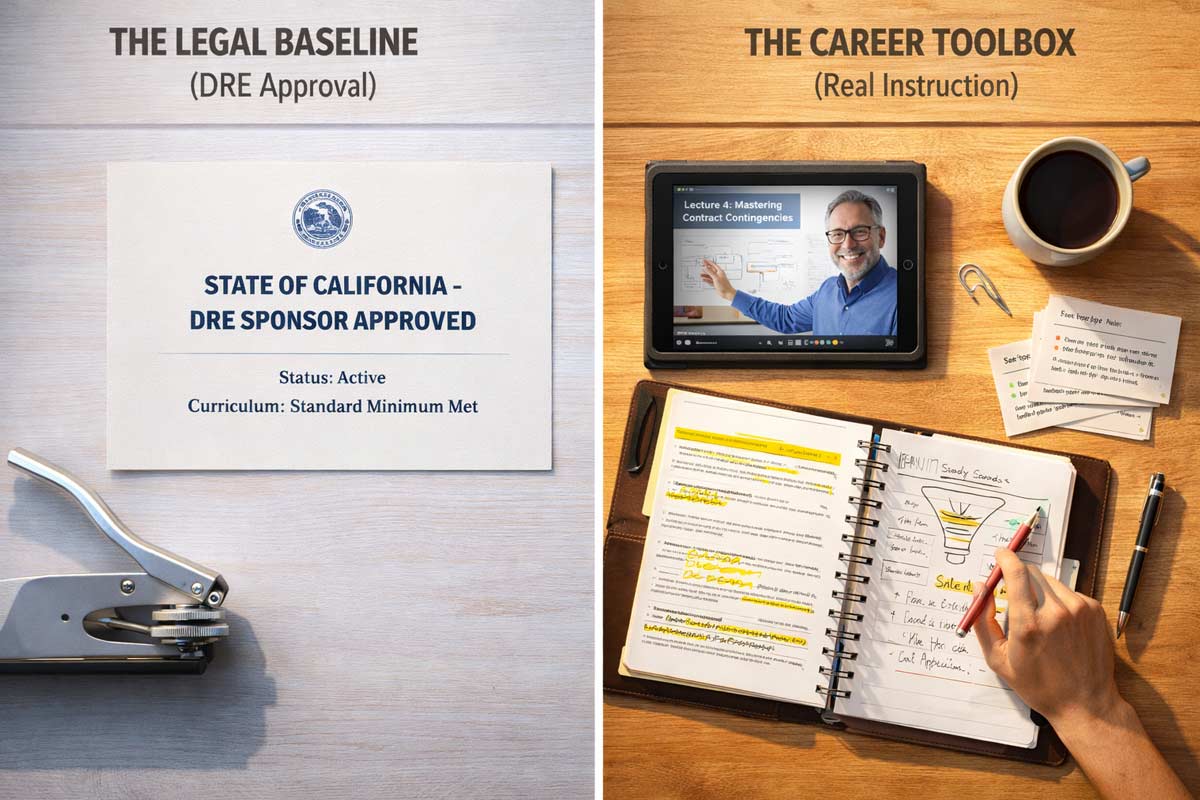
Selecting a real estate school is the first professional decision you will make in your new career. It is often the difference between getting licensed in six months or being stuck in a cycle of retakes Read more...
Selecting a real estate school is the first professional decision you will make in your new career. It is often the difference between getting licensed in six months or being stuck in a cycle of retakes and frustration two years from now.
Many prospective agents choose a school based solely on the lowest price or the flashiest marketing promise. However, a "cheap" course becomes expensive very quickly if the materials are outdated, the support is non-existent, or the curriculum fails to prepare you for the California Department of Real Estate (DRE) state exam.
Most students who come to us after failing elsewhere don’t lack effort—they lacked access to real instruction. After 20 years of helping students navigate this process, I’ve learned that the "best" school isn't a universal title—it’s the one that prioritizes actual learning over marketing optics.
Quick Take: The 30-Second Summary
Verify Legal Standing: Confirm a valid DRE Sponsor ID before looking at anything else.
Prioritize Support: Access to a human instructor is the primary factor in passing the first time.
Evaluate Exam Prep: Look for depth and rationales, not just a bank of "A, B, C, D" questions.
Scrutinize Policies: Treat "guarantees" as fine-print audits rather than quality indicators.
Step 1: Confirm the Legal Baseline (DRE Approval)
In California, you cannot sit for the state exam unless you complete three college-level courses from an approved provider. DRE approval is the absolute minimum legal requirement—it is not a rating of quality. It simply means the school has permission to offer the curriculum.
How to verify in minutes:
Ask the school for their DRE Sponsor ID.
Visit the DRE website to confirm their status is "Approved."
Check if they offer the three mandatory courses: Real Estate Principles, Real Estate Practice, and an elective.
To understand why this approval is just the starting line, read our guide on What Makes a Real Estate School DRE-Approved?
Step 2: Decide What Kind of Student You Are
The format of the school should match your lifestyle, not the other way around. A "self-paced" course is only a value if you have the discipline to finish it without a structured environment.
Learner Profile
Priority
Recommended Feature
The Full-Time Professional
Efficiency
High-quality mobile interface & clear PDF materials.
The Anxious Test-Taker
Stability
Live webinars or in-person coaching components.
The Fast-Tracker
Support
Responsive administrative teams for finishing certificates.
The Career Switcher
Practicality
Instructors who provide context through California examples.
Real-World Scenario: Many students choose a purely digital format because it's cheaper, only to realize months later they’ve stopped making progress because they have no one to ask for clarification.
Step 3: Instructor Access is the Hidden Difference-Maker
Many online schools are essentially "digital bookstores." They sell you the material and leave you to navigate it alone.
If you hit a wall while studying Agency or Valuation, you need a human answer. In high-volume, low-support environments, you might wait days for a canned email response. This delay kills your momentum.
When evaluating a school, ask: “If I don’t understand a concept, can I reach out to an instructor, or am I limited to a help-desk ticket?”
Instructional depth is what prevents failure. You can learn more about this in our guide on The Role of Instructors in CA Real Estate Education.
Step 4: Evaluate Prep Quality (Beyond the "Guarantee")
The goal is to pass the state exam on your first attempt. High-quality exam prep is about feedback loops, not just repetition.
The Baseline: A school that only gives you a score at the end of a quiz.
The Standard: A program that provides a detailed rationale for every answer (explaining why the correct answer is right and the others are wrong).
Scrutinizing the Guarantee:
Many schools market a Pass Guarantee. It is important to view these as administrative policies rather than trust signals. A guarantee is effectively a "post-failure" plan; it does not indicate the quality of the instruction itself. Often, the fine print requires multiple failures or specific prerequisites to qualify. Focus on the quality of the practice rationales—that is what keeps you from needing the guarantee in the first place.
Step 5: Know When a Crash Course Helps (and When It’s a Trap)
A crash course is a "gap-closer," not a foundation. If the primary pre-licensing courses were low-quality, a weekend session cannot replace 135 hours of lost learning.
The Readiness Benchmark: If you are scoring 70–75% on practice exams, a crash course can provide the "test-taking logic" to secure a pass. If you are scoring 50%, you likely need to revisit the core material.
For more on timing your prep, see: Are Crash Courses Worth It in California?
Step 6: Compare Total Cost & Friction
The "sticker price" of a real estate school is rarely the final cost. Look for "friction points" that lead to hidden expenses:
Extension Fees: Charges if you don't finish the course within a strict window.
Retake Fees: Fees for re-taking a course final exam.
Tech Friction: Outdated portals that don't work well on mobile or modern browsers.
Insider Tip: If a school’s support is slow during the enrollment process, it will likely be slower when you are waiting for your course completion certificates.
Step 7: The Simple Decision Checklist
Use this rubric to evaluate providers. Score them based on substance, not marketing.
DRE Approved: Verified Sponsor ID (Non-negotiable).
Direct Instructor Access: Can I get a human on the phone or email?
Feedback Loops: Does the exam prep explain the "why" behind the answers?
Policy Clarity: Are refund and retake policies written in plain English?
Format Fit: Does this match my actual daily schedule?
Frequently Asked Questions
Do I really need an exam pass guarantee?
Guarantees are secondary to instructional quality. A guarantee is relevant only after you have failed. Your priority should be finding a school with active instructor support and robust practice rationales—the tools that help you pass the first time.
Does DRE approval mean the school is "good"?
No. DRE approval only means the school meets the minimum legal curriculum requirements. It is a baseline for entry, not a measure of how well the school prepares you for a career or the state exam.
What should I prioritize if I work full-time?
Prioritize "support responsiveness." When your study time is limited to late nights or weekends, you cannot afford to wait days for a response to a question. You need a school that provides the resources to keep you moving forward.
Take the Next Step
Choosing a real estate school is about finding a partner for your licensure journey. A great school makes guarantees mostly irrelevant because the instruction is designed to help you pass the first time. To see how different programs compare across the state using this objective framework, view our guide to the best real estate schools in California.
|

The real estate industry is built on trust. Clients rely on agents to guide them through complex transactions, often involving significant financial and emotional investment. Maintaining this trust requires Read more...
The real estate industry is built on trust. Clients rely on agents to guide them through complex transactions, often involving significant financial and emotional investment. Maintaining this trust requires a solid commitment to ethical conduct, especially when managing conflicts of interest.
Definition of Conflict of Interest
A conflict of interest arises when an agent's interests or duties to another client interfere with their ability to act in the best interests of their current client. This can involve financial gain, personal relationships, or any situation where the agent's objectivity is compromised.
Imagine you're a real estate agent with two clients interested in the same house. One of the clients is a close family friend. Even though you might naturally want to help your friend more, as a real estate agent, you must treat both clients fairly and equally. This situation could lead to a conflict of interest because your relationship with your friend might influence your professional judgment. You can give your friend inside tips or encourage the seller to accept their offer over the other client's, even if it's not the highest offer. In real estate, agents must always act in the best interest of their clients and maintain professional integrity by avoiding any actions that could benefit them personally or favor one client unfairly over another.
Importance of Addressing Conflicts
Failing to address conflicts of interest can damage client relationships, lead to legal disputes, and tarnish an agent's reputation. Proactively managing these situations is crucial for maintaining professionalism and upholding the integrity of the real estate industry.
Common Scenarios Leading to Conflicts of Interest
Dual Agency: Representing the buyer and seller in a transaction presents a significant conflict. While allowed in some states with informed consent, it can be challenging to ensure both parties receive unbiased advice and negotiation.
Family or Personal Relationships: Transactions involving family members or close friends can create conflicts, even if the agent believes they can remain impartial. Perceived favoritism can undermine trust.
Financial Interests: An agent with a financial stake in a property or related business—like a real estate broker who also owns a mortgage company—can create a conflict if it influences their recommendations to clients.
Ethical Ways to Handle Conflicts of Interest
Full Disclosure: Openly disclose any potential or perceived conflict to all parties involved. This includes the nature of the conflict and how it might affect the transaction.
Obtaining Informed Consent: After full disclosure, obtain written consent from all parties acknowledging the conflict and agreeing to proceed with the agent's representation.
Refusing or Handing Off Representation: In some cases, the best approach is to decline or withdraw from the transaction to avoid compromising ethical obligations. This might involve referring the client to another agent.
Real Estate Board Policies: Navigating Conflicts of Interest
Local and national real estate boards, such as the National Association of REALTORS® (NAR), play a vital role in maintaining ethical standards within the industry. These organizations often establish detailed codes of ethics that serve as a framework for handling potential conflicts of interest and ensuring professional integrity.
For instance, the NAR's Code of Ethics and Standards of Practice outlines clear expectations for REALTORS® to act honestly, transparently, and in the best interests of their clients. Article 1 emphasizes the obligation to protect and promote clients' interests, while Article 2 requires the disclosure of all pertinent facts about a property that may affect its value or desirability. These principles guide agents in avoiding situations where personal or financial interests might conflict with their duty to the client.
Local real estate boards also adopt similar ethical standards tailored to their specific regions. These policies help agents navigate conflicts of interest, such as representing both a buyer and seller in the same transaction (dual agency) or having a financial stake in a property being sold. Boards often require agents to disclose such relationships fully and ensure the client's informed consent.
By adhering to these ethical guidelines, real estate professionals can maintain the trust of their clients and the public while fostering a culture of accountability and fairness within the industry.
The Bad Foundation Example
Imagine an agent representing a buyer discovers that the property they are interested in has significant, undisclosed foundation issues. The seller, eager to close the deal, pressures the agent to minimize the severity of the problem or avoid mentioning it altogether. However, the agent knows their fiduciary duty is to act in their client's best interest, the buyer.
Rather than succumbing to the seller's demands, the agent immediately informs the buyer about the potential foundation issues. They recommend that the buyer hire a licensed professional to conduct a thorough inspection before purchasing. By doing so, the agent ensures the buyer has all the necessary information to make an informed decision, demonstrating integrity and professionalism.
This example highlights the importance of upholding fiduciary duties, even in challenging situations. It underscores the agent's responsibility to prioritize their client's interests over external pressures, ultimately protecting them from potential financial or legal risks.
Best Practices for Real Estate Professionals
Training and Education: Continue education on ethical practices and conflict management to stay informed about best practices and legal requirements.
Consulting Legal Professionals: Consult a real estate attorney or experienced mentor for guidance when facing a complex conflict.
Maintaining Transparency: Prioritize transparency in all client interactions. Proactive communication and clear documentation can help prevent misunderstandings and mitigate potential conflicts.
Navigating conflicts of interest is an essential skill for real estate professionals. Agents can build trust, protect their reputation, adhere to ethical principles, prioritize client interests, maintain transparency, and contribute to a more moral and professional real estate industry.
Conflicts of interest are an inevitable challenge in the real estate industry, but how professionals handle these situations defines their integrity and success. Agents can confidently navigate these complexities by understanding the nature of conflicts, adhering to ethical standards, and leveraging tools like full disclosure and informed consent.
Addressing conflicts of interest is not merely about complying with rules—it's about building and preserving trust, the cornerstone of every client relationship. When agents prioritize their fiduciary duty, maintain transparency, and stay committed to ethical practices, they not only protect their clients but also enhance the professionalism and reputation of the industry.
Managing conflicts ethically is a hallmark of a successful real estate professional. Agents can foster stronger relationships and contribute to a real estate landscape defined by accountability, fairness, and trust by continuing to learn, consult, and apply best practices.
Love,
Kartik
|

Choosing the right real estate license school is a major step for anyone looking to succeed in California’s real estate market. A good real estate school will do more than teach you facts; they lay the Read more...
Choosing the right real estate license school is a major step for anyone looking to succeed in California’s real estate market. A good real estate school will do more than teach you facts; they lay the groundwork for your career. In California, to become a licensed real estate agent, you must pass a state exam that tests your knowledge and readiness to work professionally.
Your school should teach you about real estate laws, how to help clients buy and sell properties, and how to act ethically in your job. The education you get not only helps you pass your exam but also prepares you to face the challenges and grab the opportunities in the real estate world. So, picking the right school is crucial because it shapes your future as a professional agent.
The Importance of Accreditation
Accreditation is another crucial factor to consider when selecting a real estate license school. Accredited schools like ADHI Schools have been reviewed and validated for quality and efficacy by the Department of Real Estate. This isn’t just about meeting minimum standards; accreditation is a seal of quality that ensures the education you receive will be respected and recognized. It also signals to employers and clients that you have been trained under rigorous educational standards, boosting your credibility and professional standing in the competitive real estate industry.
Benefits of Online and Online “Live” Real Estate Courses
Online real estate courses offer several advantages, particularly in terms of flexibility, accessibility, and self-paced learning. These courses are ideal for those who have busy schedules or who live far from traditional classroom locations. They allow students to access materials at any time and from anywhere, making it easier to fit learning into a hectic lifestyle. Standout features of our online courses often include:
Video Tutorials: Engaging video lessons that can be paused and replayed, helping you to understand complex topics at your own speed.
Interactive Modules: Interactive learning experiences that keep you engaged and test your knowledge as you progress.
Mobile-Friendly Platforms: The ability to study on the go with courses optimized for smartphones and tablets, ensuring you can learn even when you’re away from your computer.
Hybrid Learning Options
Hybrid courses combine the best aspects of online and classroom learning. These programs typically involve a mix of online coursework to cover theoretical knowledge and scheduled in-person sessions for more practical, hands-on training. This format can be particularly beneficial as it offers:
Flexibility and Interaction: You can enjoy the flexibility of online learning while still benefiting from the interpersonal and experiential advantages of traditional classroom attendance.
Balanced Structure: The structure of hybrid models provides a balanced approach, catering to different learning preferences and needs.
The Value of Experienced Instructors
The experience and teaching styles of instructors at a real estate license school play a critical role in shaping the quality of education. Experienced instructors bring a wealth of real-world knowledge to their teaching, offering insights that go beyond textbooks and theoretical concepts. They are often well-versed in the latest industry trends and regulatory changes, which can provide students with a more comprehensive understanding of the real estate landscape.
Teaching style also significantly impacts learning outcomes. Instructors who employ interactive and adaptive teaching methods can cater to various learning styles, ensuring that all students grasp complex topics. This versatility is crucial for effectively preparing students for the varied scenarios they will encounter on the real estate exam and in their future careers.
The presence of knowledgeable instructors is particularly important for real estate exam success. These professionals can pinpoint the most important content that is likely to appear on the exam and provide students with strategies to tackle difficult questions. Moreover, their ability to clarify doubts and provide real-time feedback is invaluable in building confidence and competence among students.
CrashCourseOnline.com
CrashCourseOnline.com offers a unique advantage in real estate exam preparation with its comprehensive suite of study tools designed specifically for California real estate licensure. What sets CrashCourseOnline.com apart includes:
Tailored Content: All resources are specifically designed to meet the requirements of the California real estate exam, ensuring that students study the most relevant and up-to-date information.
Interactive Learning Tools: The platform includes interactive features like practice quizzes and real-time feedback, which help reinforce learning and build confidence as students see their progress.
Accessibility and Flexibility: With courses and materials available online, students can prepare on their schedule and at their pace, which is crucial for adult learners who may be balancing other responsibilities.
Expert Guidance: CrashCourseOnline.com provides access to seasoned real estate educators who offer live exam prep sessions. These sessions delve into exam strategies, breakdown challenging areas, and answer student questions in real time, providing a level of personalized preparation that can be hard to find elsewhere.
By using these preparation materials and engaging with platforms like CrashCourseOnline.com, students can greatly enhance their chances of success on the California real estate exam. The comprehensive resources and expert guidance available can give them a competitive edge in a challenging field.
Choosing the right real estate license school is a pivotal decision that can impact your career for years to come. As you make this decision, consider the following key factors:
Accreditation and DRE Approval: Ensure that the school is approved by the California Department of Real Estate and accredited by relevant authorities.
Learning Formats: Reflect on whether online, classroom-based, or hybrid learning environments suit your learning style and schedule best.
Experienced Instructors: Look for schools with knowledgeable and experienced instructors who can provide not only the curriculum but also valuable industry insights.
Support Resources: Evaluate the availability of student support services such as tutoring, forums, and dedicated staff to help you through your studies.
Exam Preparation: Consider the quality and effectiveness of the exam preparation materials offered, such as mock exams, study guides, and live prep courses.
It’s essential to do thorough research and choose a school that aligns with your career goals and educational needs. Take the time to read reviews, talk to alumni, and perhaps attend a few introductory sessions or webinars to get a feel for the school’s environment and offerings.
Ready to take the first step towards a successful career in real estate? Enroll today at ADHI Schools or start your preparation with CrashCourseOnline.com.
Love,
Kartik
|

How Long Does the California Real Estate Exam Take?
If you’re planning to become a real estate agent in California, one of the key steps is passing the California real estate exam. Knowing how long Read more...
How Long Does the California Real Estate Exam Take?
If you’re planning to become a real estate agent in California, one of the key steps is passing the California real estate exam. Knowing how long the exam will take helps in preparing effectively and managing your time on the day of the test. This article will cover everything you need to know about the duration of the exam and how to approach it efficiently.
Total Duration of the Exam
The California real estate exam is designed to test your knowledge in various real estate topics, including property ownership, laws, valuation, financing, and contracts. For the sales license exam, it consists of 150 multiple-choice questions, and you are given up to 3 hours to complete it. This means you have about 1 minute and 11 seconds per question on average. It’s a manageable pace if you're prepared, but rushing or spending too much time on a single question can impact your ability to finish the exam.
For those taking the broker exam, it is longer, consisting of 200 multiple-choice questions with 4 hours allotted to complete the exam.
Breakdown of the Exam:
Sales License Exam:
Number of Questions: 150 multiple-choice questions.
Time Allotted: 3 hours (180 minutes).
Broker Exam:
Number of Questions: 200 multiple-choice questions.
Time Allotted: 4 hours (240 minutes).
Key Considerations
Here are some tips to manage your time during the exam:
Practice Time Management: When practicing for the exam, completing practice tests within the time limit is crucial. This builds comfort with the pacing and prepares you for the actual test day. Our blog on Effective StudyTechniques for the Real Estate Exam offers additional insights and strategies.
Skip and Return to Hard Questions: If you encounter a tough question, it’s often better to move on and come back to it later. This approach ensures you don't waste too much time on any single question and that you cover more ground.
Read Questions Carefully: While keeping an eye on the clock, make sure to read each question thoroughly. Misreading can lead to easy mistakes.
Watch the Clock: Monitoring your time can help adjust your strategy on the fly, ensuring you answer as many questions as possible. Our additional resources provide tactics on maintaining a good pace throughout the test.
What Happens After the Exam?
Once you’ve completed the exam, the next step is to wait for your results. The California Department of Real Estate (DRE) typically provides results at the time the test is concluded, but sometimes it could take a few days.
The California real estate exam is a comprehensive test that requires thorough preparation and good time management. With different durations for the sales license and broker exams, it’s important to practice completing sample exams within the time limits to ensure you’re comfortable with the pacing. By preparing effectively, you’ll increase your chances of passing the exam and moving closer to your goal of becoming a licensed real estate agent.
|

Recent Changes to the California Real Estate License Exam
The California Department of Real Estate (DRE) has recently implemented changes to the real estate license exam, which may impact how Read more...
Recent Changes to the California Real Estate License Exam
The California Department of Real Estate (DRE) has recently implemented changes to the real estate license exam, which may impact how you prepare and take the test. Over the past few months, the DRE has stopped providing calculators and whiteboards during the exam. This shift means that test-takers will need to adjust their strategies to succeed without relying on these tools.
What This Means for You
No Calculators: The removal of calculators means you will have to complete any math-related questions manually. While there are hardly any math problems in the real estate exam, it’s still important to practice solving basic calculations, such as determining commission splits, prorations, or property taxes, without a calculator.
No Whiteboards: Previously, whiteboards were provided for taking notes or working through questions. Without them, you’ll need to rely on mental calculations and keep track of important points without jotting them down. This change highlights the importance of sharpening your memory and mental math skills during preparation.
How to Prepare for the California Real Estate Exam Without Calculators or Whiteboards
To succeed under these new conditions, follow these tips:
Practice Mental Math: Get comfortable doing basic real estate calculations in your head or on scratch paper. You can practice solving simple math problems regularly to ensure you’re prepared for the exam.
Memorize Key Formulas: Memorizing common real estate formulas (such as commission calculations, loan-to-value ratios, and property tax estimations) will help you tackle math questions confidently without needing a calculator.
Focus on Conceptual Understanding: The real estate exam is not just about numbers; it’s also about understanding important concepts such as property law, real estate finance, and contracts. The better you understand these topics, the more you can rely on your knowledge, even in math-related questions.
Take Mock Exams: Practice real estate exams are a great way to prepare under the new conditions. These simulations can help you get used to solving problems without additional tools and will give you a better sense of your readiness for test day.
How to Pass the California Real Estate Exam
Passing the California real estate exam requires more than just adjusting to the new no-calculator and no-whiteboard rules. Here are some key strategies to increase your chances of success:
Thoroughly Review the Course Material: A solid understanding of the topics covered in your real estate courses is crucial. Make sure you go over everything from property management to ethics and legal issues.
Attend Our Crash Course: Consider enrolling in our real estate crash course that focuses on exam preparation. These intensive reviews can sharpen your knowledge and fill any gaps before test day.
Take Multiple Mock Exams: Aim to consistently score above 80% on your practice tests. This will ensure you’re prepared and confident about your understanding of the material.
Stay Calm and Focused: Test anxiety can affect your performance, so be sure to approach the exam with confidence and a clear mind. Practice mindfulness or relaxation techniques leading up to the exam.
The recent changes to the California real estate license exam may seem daunting, but with the right preparation, you can still succeed. Focus on understanding key concepts, practice solving math problems manually, and simulate exam conditions to ensure you're ready.
Remember, passing the exam is just the first step toward a successful real estate career. Stay persistent and dedicated, and you’ll be well on your way to becoming a licensed real estate agent in California.
Love,
Kartik
|

Factors Influencing Real Estate Agent Income
The allure of the real estate profession is undeniable: the potential for financial freedom, flexible work schedules, and the satisfaction of helping clients Read more...
Factors Influencing Real Estate Agent Income
The allure of the real estate profession is undeniable: the potential for financial freedom, flexible work schedules, and the satisfaction of helping clients find their dream homes. Yet, the reality is that income in real estate can vary. While some agents earn well into the six or seven figures, others struggle to make ends meet. So, what factors influence real estate agent income?
Understanding these factors is essential for anyone considering a career in real estate, or for existing agents seeking to increase their earnings.
Location
Geographic location can play a major role in an agent's earning potential. Since most real estate agents earn a percentage of the sales price of a property, practicing in high-cost urban areas can lead to larger commissions. In contrast, agents in lower priced or more rural locations may deal with lower property values and, consequently, lower commissions. However, it's important to note that the cost of living can also vary significantly between locations.
While setting up shop in Beverly Hills might seem tempting, remember that high-priced areas often attract lots of agents because of the big commissions they can earn. In busy areas like Manhattan Beach or Newport Beach, there are so many agents that it becomes really competitive. To stand out, agents need to be great at marketing themselves, negotiating deals, and making connections. They also need to close deals regularly to afford the high cost of living in these areas and maintain their lifestyle.
Market Conditions
Economic factors like interest rates, housing demand, and local market trends can have a profound impact on agent income. When interest rates are low and demand is high, it's a seller's market, and agents can earn more. Conversely, in a buyer's market with high interest rates and low demand, transactions may be slower, impacting agent income. Additionally, seasonal fluctuations can affect real estate activity. Spring and summer tend to be busier seasons, while the market may slow down during the fall and winter months.
Experience and Skills
Experience levels often correlate with income. Seasoned agents have a larger network, better negotiation skills, and in-depth market knowledge. This allows them to close deals more and command higher commissions. Moreover, niche expertise and specialized knowledge in areas like luxury homes, commercial real estate, or investment properties can be lucrative. Continuous learning and professional development are also crucial for staying ahead in a competitive market.
Business Model and Commission Splits
The way commissions are split between a real estate agent and their brokerage can greatly influence their earnings. Common splits can vary widely, but an agent generally keeps more as they gain more experience and close more deals. Some brokerages offer even better terms or a 100% commission model, where agents keep all the commission but pay a monthly or transaction fee to the brokerage.
While these offers might sound good, agents should think carefully about what they might lose in terms of support and resources from traditional brokerages. For instance, brokerages offering lower splits often provide more resources, such as CRM systems or postcard marketing and mailing services. Therefore, while an agent on a higher split might earn more per deal, their overall profit could be lower as they might end up paying for these services out of pocket. Understanding the compensation structure is crucial when picking a brokerage because it directly impacts how much money an agent can make and their overall financial success.
Marketing and Lead Generation
Effective marketing and lead generation strategies are crucial for success in real estate. Agents need to create a strong online presence while utilizing social media. Digital marketing campaigns are a must to attract potential clients. Building a personal brand and establishing oneself as a trusted expert in a specific area can also lead to increased visibility and higher earnings. Lead nurturing and conversion strategies are equally important for turning leads into closed deals.
Client Relations and Reputation
Exceptional customer service and client satisfaction are key to generating repeat business and referrals. Agents who prioritize building strong relationships with their clients and providing a seamless experience are more likely to see long-term success. A positive reputation can lead to organic growth and increased income over time.
Specialization and Niche Markets
Specializing in certain types of properties or catering to specific demographics can be a strategic way to enhance income. By becoming the go-to expert in a niche market, such as eco-friendly homes, senior living communities, or vacation rentals, agents can attract a loyal clientele and potentially command premium commissions.
Real estate offers tremendous opportunities for motivated individuals to achieve financial success and build a rewarding career. However, it's essential to recognize that income is influenced by a multitude of factors.
By understanding these factors and adapting their strategies, agents position themselves for success in this dynamic industry.
When creating your business plan, keep the above factors in mind. You might not be able to immediately change where you practice, and reputation isn't built overnight, but you can always turn up the marketing and keep plugging away. Real estate sales is a career that is built brick-by-brick not overnight.
Love,
Kartik
|

In the competitive and often unpredictable world of real estate, success hinges not just on knowledge, but also on how well you prepare and adapt. I wanted to write an article exploring the critical roles Read more...
In the competitive and often unpredictable world of real estate, success hinges not just on knowledge, but also on how well you prepare and adapt. I wanted to write an article exploring the critical roles of a well-honed strategy and a resilient mindset, and offer practical advice for real estate professionals aiming to excel in their careers and navigate the complexities of the market confidently.
The Importance of Preparation
In real estate, meticulous preparation is key to managing a complex schedule effectively. For agents, staying organized is crucial for handling multiple listings, client meetings, and dynamic market conditions. A structured schedule allows for allocating adequate time to each client, providing personalized service that addresses unique needs and challenges. This readiness not only enhances professionalism but also builds trust and reliability among clients—cornerstones of long-term success in the industry.
Managing Distractions as a Self-Employed Agent
Distractions can undermine even the best-prepared agents. As a self-employed professional, it's vital to manage your time and workspace effectively. Setting a daily schedule mimicking a traditional office environment, creating a dedicated workspace, and using technology wisely can significantly enhance focus and productivity. Prioritizing tasks and taking regular breaks are also essential practices that help maintain efficiency and prevent burnout.
Maintaining focus can be difficult without the structured environment of a traditional office. Distractions are a significant challenge for real estate agents, mainly because many operate as self-employed professionals, which requires a high degree of self-management and discipline. Poor time management and reduced productivity can directly impact an agent’s ability to serve clients effectively. Real estate agents must respond quickly to client needs and market changes; thus, any delay or oversight caused by distractions can result in missed opportunities or diminished service quality.
Real estate can demand a high degree of accuracy in handling transactions and paperwork. Distractions that lead to errors can have serious consequences, potentially harming the agent’s reputation and client relationships. Managing distractions effectively is crucial for maintaining professionalism, ensuring client satisfaction, and upholding the reliability expected in the real estate industry.
Finding Solutions to Common Real Estate Problems
Real estate transactions involve multiple parties and interests, often leading to complex challenges. Whether dealing with property title issues, financing setbacks, or unexpected inspection results, there is always a potential solution. Effective strategies include:
Proactive Communication: Keep all parties informed to prevent misunderstandings and build trust.
Flexibility and Creativity: If initial solutions falter, think outside the box. For instance, if financing falls through, suggest alternative lenders or creative financing options like seller financing.
Leverage Expertise: Consult with seasoned colleagues or specialists, such as real estate attorneys or title agents, to gain new perspectives and solutions.
Stay Updated: Keeping abreast of changes in real estate laws and regulations can preempt and mitigate potential issues.
The Power of Positive Self-Talk
The way we converse with ourselves significantly influences our actions and outlook, especially in high-stakes situations like negotiations or competitive markets. Positive self-talk, such as affirming "I am a skilled negotiator" or "I can handle this challenge," can shift your perspective and boost your confidence, thereby enhancing your performance.
Consistency Leads to Mastery
Success in real estate isn't just about big moves; it’s also about the accumulation of small, consistent actions. Regularly engaging in activities that enhance your skills, like market analysis or client relationship management, builds expertise over time. This principle of consistency is particularly pertinent in real estate, where persistence and resilience often determine long-term success.
Embracing thorough preparation and maintaining an optimistic outlook are indispensable in enhancing your professional performance and managing personal challenges in real estate. By equipping yourself with the tools to find solutions and succeed, you can confidently navigate every aspect of your career. Remember, in the dynamic field of real estate, every problem indeed has a solution—it's up to you to find it.
Love,
Kartik
|

How Long Are California Real Estate Courses Valid?
For those considering becoming a real estate agent in California, several questions come to mind. One of the most common being: "Is a California Read more...
How Long Are California Real Estate Courses Valid?
For those considering becoming a real estate agent in California, several questions come to mind. One of the most common being: "Is a California real estate license worth it?" After all, you have to take some classes, study and pass and exam and obtain the license.
What if you want to dip your toe in the water and sign up for real estate school, but aren’t quite ready to apply for your license?
The good news is that once you complete your real estate courses, they don’t expire. You can take the exam whenever you're ready, as long as the rules don’t change.
Choosing the Right Real Estate School
Selecting a reputable real estate school like ADHI Schools is crucial. We are recognized for meeting the educational standards required by the state, ensuring that you're well-prepared not only for the exam but also for your future career in real estate.
Stay Updated with Legislative Changes
While the real estate courses don't expire, it's still important to keep an eye on changes in the law that might affect the validity of the courses. For example, a new law called Senate Bill 1495 (SB 1495) was introduced and took effect on January 1, 2024. This law added new requirements to the Real Estate Practice course, including topics on implicit bias and fair housing laws. These topics are designed to help you understand the underlying biases affecting housing decisions and learn the laws ensuring housing fairness.
If you plan to take your licensing exam after January 1, 2024, you must have completed a course that includes these new topics. If your previous courses didn't include these, you will have to retake this course.
Why It Matters
Choosing a school that stays updated with the latest legal requirements is essential. We ensure that our curriculum is always aligned with the latest laws, helping you avoid surprises when you decide to take your exam.
While the courses you take are valid indefinitely under current regulations, the requirements for becoming a licensed real estate agent can and sometimes do change. Being proactive and informed about these changes and choosing a reputable school can significantly impact your career.
Even Though the Education Doesn’t Expire - Apply for Your License Promptly
Once you've completed your real estate courses, it's crucial to take the next step and apply for your license without delay. Procrastination can be a significant hurdle. Lots of students, filled with relief and satisfaction after finishing their coursework, might feel tempted to take a break before applying for the license. However, delaying this critical step can lead to unnecessary setbacks.
Applying for your license immediately after completing your courses has several benefits. Firstly, the information you've learned is still fresh in your mind, which can be advantageous when taking the licensing exam. Secondly, beginning your career sooner rather than later allows you to capitalize on the momentum and enthusiasm you've built up during your studies with ADHI Schools.
Moreover, getting licensed quickly enables you to enter the real estate market when your drive is at its peak, potentially leading to a more successful start. Delaying the process might not only diminish your preparedness but could also impact your motivation and the likelihood of pursuing a career in real estate altogether.
In essence, treat the completion of your courses not as the finish line, but as a springboard into your real estate career. By applying for your license promptly, you ensure that you maintain the momentum necessary for a successful transition from student to practicing agent. Remember, in real estate, timing is everything, and the sooner you start, the sooner you can begin shaping your successful career.
In the end, a California real estate license is valuable, especially when you are well-prepared with the right education from the right real estate license school.
TLDR: Courses don’t expire in California, but sometimes the requirements to get a license change.
|