
TL;DR: The Negotiation Mindset
Preparation > Personality: You don’t win by being the loudest person in the room; you win by having the best data and a cleaner file.
Trade, Don't Cave: Read more...
TL;DR: The Negotiation Mindset
Preparation > Personality: You don’t win by being the loudest person in the room; you win by having the best data and a cleaner file.
Trade, Don't Cave: Never give a concession (like a price drop) without getting something in return (like a shorter contingency period).
The Silence Protocol: State your position, then stop talking. The first person to fill the silence usually loses leverage.
Negotiation isn’t about "winning" a fight; it’s about navigating a series of high-stakes trade-offs to reach a closing. For most new agents, the first counteroffer feels like a personal attack or a sudden emergency.
Negotiation is one piece of your first-year system—right alongside client consultations, scripts, and credibility. If you want the full roadmap for your first 12 months, start here: Start Your Real Estate Career in California.
Phase 1: Prep the File (Don’t Negotiate From Vibes)
New agents often enter negotiations with "hope" as their primary strategy. Professional negotiators use data. Before you pick up the phone to discuss an offer, you must be the most informed person in the transaction.
The Three-Point Data Anchor
The Comps: Have the 3 most relevant sales ready (closest match, most recent; expand the radius/time if the area is thin).
The Motivation: Why is the other party moving? A seller who already bought their next home has a different "pain point" than one testing the market.
The Broker's Pulse: Call the listing agent before writing the offer. Ask: "What is most important to your seller besides price?" Sometimes it’s a specific closing date or a rent-back period.
Phase 2: Set the Frame (The Pre-Negotiation)
The biggest mistake is starting the negotiation when you receive the counteroffer. The negotiation actually starts at your first client meeting. If you haven't managed your client's expectations, you’ll spend more time negotiating against them than against the other agent.
This is exactly why your first buyer consultation matters—your negotiation leverage is built before you ever write an offer. See: How to Prepare for Your First Buyer Consultation.
The Script: Managing the "Lowball" Urge
"I understand you want a deal, but in this market, an insulting offer doesn't start a negotiation—it ends the conversation. If we want them to take us seriously, we need to show them we are a serious, qualified buyer."
Phase 2B: Listing Appointments Are Where Negotiation Leverage Is Created
Most new agents think negotiation starts at the counteroffer. On the listing side, it starts when you set pricing strategy, condition expectations, showing windows, and how you’ll handle repairs and credits. If you can’t frame that conversation confidently, you’ll “give away” leverage later in escrow.
Read this before you take your first seller meeting: How New Agents Should Handle Their First Listing Appointment.
Phase 3: Make Clean Moves (State, Reason, Silence)
When it’s time to deliver an offer or a response, brevity is your best friend. In California's competitive market, "clean" offers move to the top of the pile.
Clean offers come with proof: a fully underwritten approval, verification of funds, and a timeline that matches the seller’s reality. A clean offer has a strong price, a solid lender, and minimal "clutter" (unnecessary personal property requests).
The Script: Delivering a Response
"My clients have reviewed your counter. We are coming up to [Price], but we are keeping the inspection period at 10 days to ensure a fast move for your seller. This is our best move to keep the deal together."
State your number. State your reason. Stop talking. If you want these to come out calm under pressure, you don’t “read” scripts—you drill them. Use this system: How to Practice Real Estate Scripts Effectively.
Phase 4: Trade, Don't Cave
A "concession" is a gift. A "trade" is a business move. If the seller asks for a $5,000 credit for repairs, don't just say yes or no. Use it to improve your client's position elsewhere.
The "If/Then" Strategy
"If we agree to the $5,000 repair credit, then we need the buyer to xxxxx." (Note: High-stakes moves like removing contingencies should only be done if your buyer is fully informed and your broker supports the strategy based on the specific file.)
"If we move the closing date up by two weeks, then we need the seller to leave the appliances."
The "Silence Protocol": 3 Rules for High-Stakes Calls
Strategic silence is the hardest skill for new agents to master because they feel the need to "sell" their position.
Deliver the "Hard" News: State the price or the refusal clearly.
Count to Ten (Internally): Do not add "I know it's a lot" or "My clients were thinking...".
Wait for the "Blink": Let the other agent respond first. They will often reveal their client's true bottom line just to fill the quiet.
Avoid These "New Agent Mistakes"
Most negotiation failures are really credibility failures. If you want the full “don’t look new” checklist, read: How to Avoid the “New Agent Mistakes” That Hurt Credibility.
The "Don't Say This" Table
Instead of saying...
Say this...
Why?
"My clients are really nervous."
"My clients are very focused on the inspection results."
Avoids sounding weak; stays focused on the contract.
"I'm new, so I'm not sure if..."
"I'll double-check the current market data and get back to you."
Protects your authority.
"They'll probably take $X."
"We are prepared to discuss terms that reflect current market value."
Never give away your client's bottom line without a formal counter and consent from your client.
Real-World Scenarios: From Battle to Close
Scenario A: The Multiple Offer Bidding War
The Situation: You represent a buyer. There are 5 other offers. The listing agent says, "Bring your highest and best."
The Play: Don't just raise the price. Negotiate on terms.
Script: "We’ve tightened our timelines and provided a full underwritten approval from the lender. We aren't just the highest offer; we are the most certain to close."
The Logic: Sellers take a slightly lower price if it means 100% certainty they won't have to go back on the market in three weeks.
Scenario B: Inspection Repair Credit Without Killing the Deal
The Situation: Buyer wants a $7,500 credit. Seller says no—“we’re not fixing anything.”
The Play: Offer two clean options (not a fight).
Script: “Totally understood. To keep momentum, we can do Option A: $X credit and we release inspection immediately, or Option B: no credit and we adjust price to reflect the defect based on contractor bids. Which is better for your seller?”
Logic: You’re trading certainty and speed for dollars—cleanly.
FAQ: California Negotiation Essentials
How do I negotiate if I’m a brand-new agent?
Lean on the data, not your tenure. When you cite specific comps and market trends, the other agent is negotiating against the market, not your experience level.
What matters most besides price in California negotiations?
Certainty and speed. In a high-demand market, sellers prioritize offers that limit contingencies (if safe), offer a fast closing, or provide a "rent-back" period that lets them move without stress.
How do I ask the listing agent what the seller wants?
Be direct. "Besides the price, what are the two most important things to your seller in an ideal offer?" This often reveals needs regarding the closing date or specific repairs.
Should I waive contingencies to win a bidding war?
Only under the guidance of your broker and after a thorough discussion with your buyer. It is a high-risk move that can lead to a lost deposit if the deal falls through. I would only recommend this is in a narrow set of scenarios where all parties are going into it with eyes wide open and fully understand the consequences.
Pre-Negotiation Checklist (Understand This Before Every Negotiation)
Before you counter, confirm you have:
3 Comps + Data Sentence: Why is your number justified?
The Motivation Matrix: Timeline, rent-back needs, and certainty.
Concession Menu: What will you trade (not give away) to get the deal?
Broker Approval: Direct guidance on high-stakes terms (contingencies/timing).
|

You’ve passed the real estate exam, hung your license with a broker, and got your first box of business cards.
Then, the silence hit.
Most new agents in California fall into the "motivation spiral." Read more...
You’ve passed the real estate exam, hung your license with a broker, and got your first box of business cards.
Then, the silence hit.
Most new agents in California fall into the "motivation spiral." You start with high energy, realize you don't have a boss telling you what to do, and quickly drift into "research" (scrolling Instagram) or "branding" (tweaking a logo no one has seen). Before long, the excitement turns to dread.
In my experience coaching thousands of new agents through ADHI Schools, I’ve seen this pattern over and over. Failure in this business rarely comes from a lack of talent; it comes from a lack of a plan and a measurable scoreboard. If you want to survive your first year, you need an operational field manual, not a 40-page theoretical document.
A business plan is not a static document. It’s a weekly operating system you should execute on even when you’re tired.
The 1-Page Real Estate Business Plan (Copy/Paste This)
A business plan is simply a set of decisions made in advance so you don’t have to "think" when you wake up.
The 60-Minute Build Checklist
Open a blank document and answer these points. If you spend more than an hour on this, you’ve drifted into procrastination.
Target Client: Pick two zip codes or one demographic (e.g., first-time buyers in Riverside).
Your Offer: Pick one "rookie-safe" value prop (see below).
Your ONE Lead Pillar: SOI, Open Houses, Cold Outreach, or Social Media.
Weekly Calendar: Set fixed blocks for prospecting and follow-up.
Weekly Activity Scoreboard: Define your "Input" numbers.
Budget & Runway: How much cash is in the bank today?
Tech Setup: Is your MLS, CRM, and e-signature software active?
14-Day Proof: Define what “working” looks like in two weeks (e.g., 20 conversations + 1 appointment held).
5 Rookie-Safe Offers (Choose One)
New agents often struggle with "positioning" because they lack a track record. Instead of selling "experience," sell a specific process:
The Hyper-Local Listing Concierge: "I run a pricing + prep timeline so sellers don’t guess—want me to walk you through it?"
The First-Time Buyer Roadmap: "I’ve mapped out the local lender and grant programs for first-timers; should I send you a copy?"
The Condo Seller Packet: "I have a pre-listing kit for this building with the HOA requirements and recent comps; want to see it?"
The Open House Matchmaking Offer: "I’ll send you the top 3 deals in your specific price range every Tuesday; want on the list?"
The Pricing & Prep Walkthrough: "I can give you a 30-minute walkthrough with a repair/ROI checklist to maximize your net; are you free Tuesday?"
To refine how you present these, review these Branding Tips for New California Agents.
The Scoreboard: The Numbers That Control Your Motivation
New agents quit because they focus on "closings," which are lagging indicators. You can’t control when a deal closes, but you can control how many people you talk to today.
When you feel the "dread" setting in, look at your scoreboard. In my experience, if the numbers
Activity (Input)
Weekly Target
Daily Target (Mon-Fri)
Why It Matters
New Conversations Logged
50
10
Finding "hand-raisers."
Follow-Ups
75
15
Most closings come from the 4th+ contact.
Appointments Held
2
—
Face-to-face (or Zoom) builds trust.
Contacts Added + Notes
50
10
If it isn't in the CRM, the lead doesn't exist.
are high, your progress becomes predictable. This is the secret to How to Stay Motivated as a New Agent.
Your Example Weekly Calendar (Copy/Paste)
You cannot manage what you do not schedule. Use this as your baseline:
Mon–Fri 9:00 AM – 11:00 AM: Lead pillar activity (Calls, Invites, DMs).
Mon–Fri 11:00 AM – 12:00 PM: Follow-up + CRM notes.
Tue/Thu 4:00 PM – 6:00 PM: Preview homes (Inventory research).
Sat/Sun: Open House (Host if possible; attend if you can't get one yet) + Sunday night prep.
Sun 7:00 PM – 7:20 PM: The 20-Minute Reset. Clean CRM, set follow-ups, and schedule next week’s prospecting blocks.
The 90-Day Execution Plan: A Brutally Specific Grind
Weeks 1–2: The Launch Phase
Build Your SOI List: Export your phone and email contacts. Goal: 120 names.
The Outreach Script: Call 5 people and text 5 people per day. "I’m with [Brokerage] now and I specialize in [Offer]. If you hear anyone mention buying or selling this year, I’d be grateful if you’d connect us."
The CRM: Log every single interaction.
Weeks 3–8: The System Phase
Implement 1-3-7-21: Follow up with every new lead on Day 1, Day 3, Day 7, and Day 21.
Market Knowledge: Preview 5 homes per week in your target zip codes.
Weeks 9–12: The Review & Diagnostic
The Scoreboard Audit:
If 0 conversations: You have a discipline/system issue.
If conversations but no appointments: You have an offer/script issue.
If appointments but no clients: You have a follow-up/conversion issue.
The Reset Rule: If you miss a day, don't spiral. Reset the clock to zero and start fresh tomorrow morning.
Choose Your ONE Lead Pillar (Stop the Chaos)
1. SOI/Referrals (Sphere of Influence)
Daily Actions: 5 calls, 5 texts, 5 social media interactions.
Success Metric (14 Days): 50 outreaches + 5 coffee meetings or consultations.
2. Open Houses
The Offer: "I’ll send you the 3 best buys in this neighborhood this week—text me your price range."
Daily Actions: Mon-Wed: Secure a listing. Thu-Fri: Prepare "Invite Lists." Sat-Sun: Host the event.
Success Metric: 10 guest sign-ins via QR code + 10 follow-up calls made by Monday noon.
3. Cold Outreach (Expireds/FSBOs)
Daily Actions: 2 hours of morning calls to homeowners who failed to sell or are trying to sell alone. Follow your brokerage policy and DNC rules; don't freestyle.
Success Metric (14 Days): 100 contacts + 10 real conversations + 1 appointment held.
4. Social Media Machine
Daily Actions: 3 short videos per week, 10 DMs to local followers, 1 weekly "market update" text to your SOI. Use these Social Media Best Practices for Realtors to ensure you’re actually creating leads.
Budget & Runway (The Part Everyone Avoids)
California is an expensive state for real estate professionals. You must know your "burn rate."
The Formula: Runway = (Savings / Monthly Burn)
Startup Estimate: DRE Fees, MLS dues, Association Dues (NAR/CAR), and E&O insurance. Treat $2,000–$4,000 as a planning estimate.
The Reality Check: If you don't have 6 months of savings, you probably need a "paid runway"—a side job, savings, partner income, or a brokerage lead source. Desperation is when agents start cutting corners on disclosure, honesty, and compliance. This financial pressure is a major reason Why Most New Agents Quit in the First Year.
“Busywork Traps” to Identify and Avoid
If a task doesn’t involve a conversation with a human, it’s likely a trap.
The Training Loop: Watching endless YouTube videos instead of prospecting.
Logo/Website Tinkering: Nobody cares about your font if you don't have a listing.
The CRM Perfection Trap: Rebuilding your CRM tags and pipelines instead of actually using it to call people.
The Checklist Rule: If the task doesn't directly create a conversation or an appointment, it's not a priority today.
Mini Case Studies: The Plan in Action
The "Passive Poster"
The Problem: Posted on Instagram daily but had 0 leads.
The Fix: Switched to the "Social Media Machine" pillar. They added 10 DMs per day to local residents.
Result: They secured two serious buyer consultations and a warm listing lead within 60 days.
The "Timid Rookie"
The Problem: Afraid to call their SOI.
The Fix: Used the "First-Time Buyer Roadmap" offer. It gave them a reason to call ("I have a new map for first-time buyers, want a copy?").
Result: Logged 50 CRM notes in a week and set their first "Appointment Held" by Friday.
Your Next 3 Steps
Fill out the one-page plan now. Don't wait for "perfect" clarity.
Set your weekly calendar. Use the template above to block your time.
Start your scoreboard. Log your first 10 conversations tomorrow morning.
Want the full roadmap?
Read our comprehensive guide: Start a Real Estate Career in California
It lays out the timeline, exact costs, and what to do first.
FAQ: Real Estate Business Planning
What should my real estate business plan include?
At a minimum, it must include your target market, your primary lead generation pillar, a daily activity scoreboard, and a budget for California-specific dues and fees.
Do I need a business plan to join a brokerage?
Technically, no. Most brokerages will hire anyone with a license. However, without one, you’re relying on hope instead of a system.
How many hours a day should a new agent prospect?
In my experience, a new agent should spend at least 2 hours every morning on lead generation and 1 hour on follow-up.
How much money do I need to start?
Aim for 6 months of living expenses. If you can’t, ensure you have a "paid runway" (side income) so you don't make desperate decisions out of financial fear.
How long should a business plan be?
One page. If it’s longer, you won't look at it. If you won't look at it, you won't follow it.
|

The “license high” is real.
You finish your real estate courses, pass the California state exam, and hang your license with a reputable brokerage. For a few weeks, adrenaline carries you. Then the Read more...
The “license high” is real.
You finish your real estate courses, pass the California state exam, and hang your license with a reputable brokerage. For a few weeks, adrenaline carries you. Then the silence hits. Your phone doesn’t ring. Your inbox is empty. The Instagram-ready office you built feels like a stage set for a play that never starts.
This is the Motivation Collapse—the predictable emotional drop-off that occurs when licensing ends and the tactical reality of real estate begins.
In my 20+ years of training and supervising thousands of California agents across multiple market cycles, I’ve learned that the ones who survive aren’t the most “inspired.” They are the ones who realized that motivation is not the problem; the lack of a structure is.
Diagnosis: Why New Real Estate Agent Motivation Dies
Before you can fix your motivation, you must understand why it’s failing. It isn’t a character flaw; it’s a structural misalignment.
Delayed Feedback Loops: Real estate has no immediate payoff. You can work 60 hours a week for three months and have $0 to show for it.
The “No Scoreboard” Problem: Without a boss or a clock-in system, you have no objective measure of success. If you didn’t close a deal today, you feel like you failed, even if you did the right work.
Toxic Social Comparison: You see "Top Producers" on social media posting about $10M listings. Comparing your "Chapter 1" to their "Chapter 20" leads to immediate FOMO.
Identity Whiplash: You went from being a "Student" with clear goals to a "Business Owner" with total ambiguity.
If this sounds like your current daily reality, you aren't failing; you're just operating without a scaffold.
This transition is one of the core reasons Why Most New Agents Quit in the First Year. If you’re still orienting yourself, start with our complete guide on how to Start a Real Estate Career in California before trying to optimize your mindset.
The Reframe: Discipline Over Feelings
Motivation is a feeling, and feelings are unreliable. If you only prospect when you "feel" like it, you don't have a business; you have a hobby.
The Trap of Productive Procrastination
I see this constantly: A new agent spends three weeks tweaking hex colors on a logo, another rewrites their bio for the tenth time, and another sits with ten CRM tabs open but makes zero calls.
None of those actions risk rejection—still the brain labels them as “work.”
In reality, this is just fear dressed up as an office task. To survive, you must pivot to discipline—doing the high-value, high-fear work precisely because you don’t feel like doing it. This is a foundational element I cover when teaching How to Create a Real Estate Business Plan (New Agents).
5 Survival Systems to Combat Real Estate Burnout
To stay in the game, stop chasing "inspiration" and implement these five operational systems.
Activity-Based Scoreboards: Stop tracking income; you can't control it yet. Start tracking inputs. Create a daily scoreboard for things you 100% control: outbound calls, hand-written notes, and face-to-face meetings scheduled. If you hit your numbers, you won the day—regardless of your bank balance.
Calendar-First Discipline: Your calendar is your only boss. Block 8:00 AM to 11:00 AM for lead generation. No email, no "office chatter," and no social media scrolling. If it isn't on the calendar, it doesn't exist.
Lead Generation Before Branding: You cannot brand a business that has no clients. I’ve watched agents spend thousands on lifestyle photography before they could even explain a California RPA. Priority 1 is direct outreach. Branding Tips for New California Agents should support your outreach, not replace it.
Energy Management (Not Hustle): The "24/7 hustle" narrative is a recipe for a short career. Identify your "Peak Energy" times for negotiations and "Low Energy" times for administrative tasks. Burnout is a system failure, not a lack of effort.
The Isolation Kill Switch: Isolation is where doubt festers. When you are a new agent, your own head is a "bad neighborhood"—don't go in there alone. Mandate a weekly meeting with your broker. Also, learn How New Agents Should Use Social Media in 2026 to build a professional community, not just to compare yourself to influencers.
Tactical Reality Check: What “Normal” Actually Looks Like
Many agents quit because they have a distorted view of the timeline. Here is the non-glamorous reality of a successful first year in the California market:
Timeline
The Reality of Progress
Months 1–3
Invisible Skill-Building. You are learning how to talk and handle rejection. Expect $0.
Months 4–6
The Pipeline Phase. Initial leads are warming up. You might enter your first escrow.
Months 7–12
The Stabilization Phase. Consistent daily activity starts to yield predictable closings.
Most agents quit in Months 2–4. This isn't because they failed at the job; it's because they failed to realize that "nothing happening" is often just invisible competence-building.
Zoom Out to the Career Arc
Motivation is a spark, but systems are the fuel. As you move through your first 18 months, you will find that "staying motivated" becomes less of a struggle because you are becoming competent. Confidence is simply the byproduct of repeated, disciplined action.
If you want to shorten the painful part of this curve, your next step isn’t finding more motivation—it’s choosing structure over motivation. Start with the fundamentals, then layer on the tactics.
FAQ: Staying Motivated as a New Agent
Q: How long does it take for a new real estate agent to get their first lead?
A: In California’s competitive market, a lead can be generated on Day 1 through your sphere of influence, but a "cold" lead typically requires 30–60 days of consistent daily prospecting before a pipeline begins to form.
Q: How many hours should a new agent spend on lead generation?
A: You should spend 70% of your work week on lead generation until you have at least three active escrows. In a standard 40-hour week, that is roughly 28 hours of direct outreach.
Q: What is the best way to handle the "slow periods" in real estate?
A: Shift your focus from "results" to "refinement." Use the slow periods to audit your systems, update your CRM, and increase your outbound volume to ensure the next peak arrives sooner.
|
TL;DR: The Agent’s Quick-Start Guide
The Mission: Transition from an "unpaid tour guide" to a "fiduciary consultant" by leading a structured diagnostic process.
The 15-Minute Phone Flow: A verbatim Read more...
TL;DR: The Agent’s Quick-Start Guide
The Mission: Transition from an "unpaid tour guide" to a "fiduciary consultant" by leading a structured diagnostic process.
The 15-Minute Phone Flow: A verbatim script to qualify leads and book the deep-dive consultation.
The 30-Minute Playbook: A timed framework for the in-person meeting to uncover "deal-killer" obstacles.
California Precision: Language focused on the C.A.R. RPA, contingency periods, and deposit protection.
The High-Stakes First Conversation
In the high-speed California market, a transaction rarely dies because of a bad inspection—it dies because of a missed question in the first meeting. I have seen countless escrows in markets like the Inland Empire or Orange County implode because an agent didn't verify if a down payment was liquid, coming from a 1031 exchange, or was a gift fund that hadn't yet been documented.
The buyer consultation is your Transaction Control Room. It is the single most important leverage point for preventing 90% of future transaction drama. By the end of this guide, you will have a word-for-word framework to build trust, verify financial credibility, and establish yourself as a professional advisor.
Agent Action: Print the 30-minute agenda in Section C and place it in a professional folder.
Psychology/Why It Works: : Buyers relax when the process is clearly led. When you lead with a visible agenda, you signal that you are a project manager capable of navigating the complex California disclosure environment.
The 5 Goals of a Flawless Buyer Consult
Before you conclude the meeting, you must have clarity on these five success metrics:
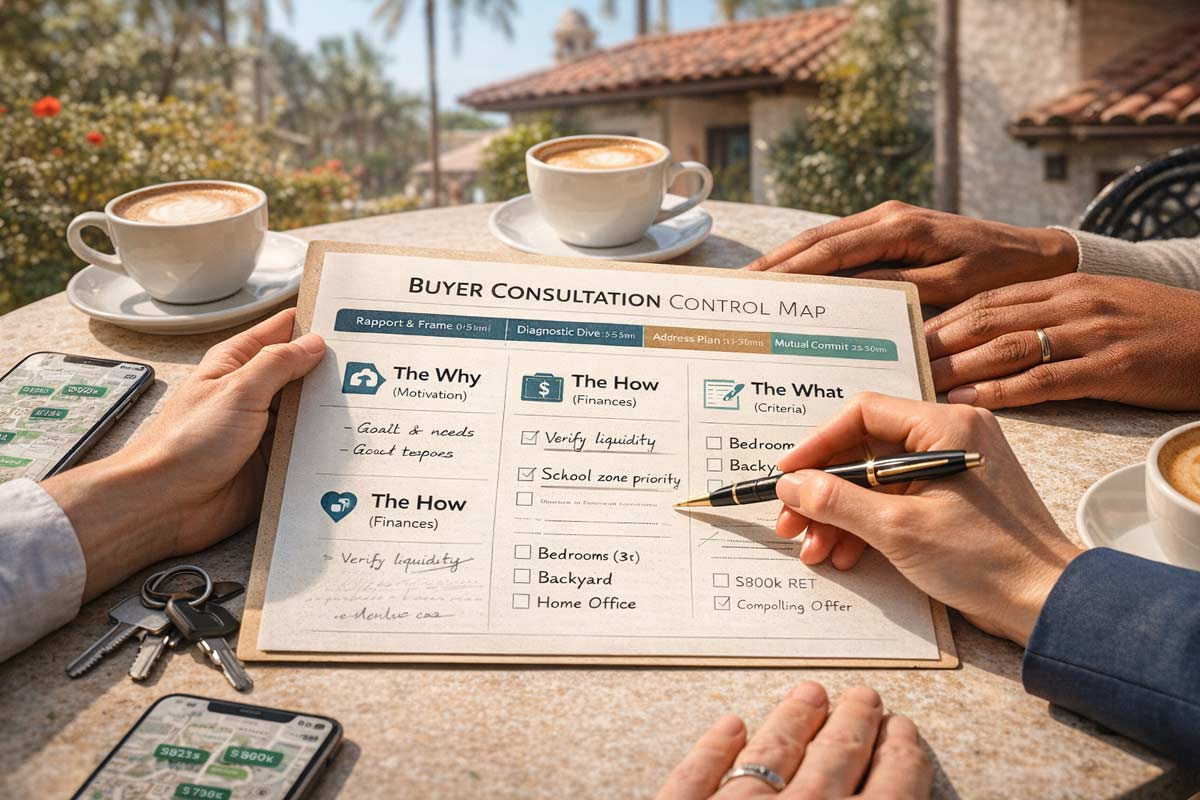
The “Why”: Their true motivation and "hard-stop" timeline (e.g., school start dates or lease ends).
The “How”: Verified financial readiness (Monthly comfort zone vs. max approval).
The “What”: Core non-negotiable criteria vs. lifestyle dealbreakers.
The “Process”: Understanding of the California RPA and how contingency windows protect the deposit.
The “Commitment”: Completion of "Gate 1" (Lender verification) and an agreement on the search cadence.
The 30-Minute Consultation Agenda: The Control Map
Time
Phase
Focus
Verbatim Transition Line
0–5 mins
Rapport & Frame
Establish the agenda and your role as a fiduciary.
"To respect your time and ensure we are prepared to win, I’ve prepared an agenda for our strategy session. Shall we dive in?"
5–15 mins
Diagnostic Dive
Uncover motivation, timeline, and financial documentation.
"Before we look at property, I want to understand the 'why' behind this move. What happens if you don’t find a home in 90 days?"
15–22 mins
Criteria & Reality
Separating needs from wants; neighborhood specifics.
"If we found a home that was perfect but lacked [Feature X], would that be a dealbreaker or a 'maybe'?"
22–27 mins
The CA Process
Explaining the RPA, speed of market, and disclosures.
"In California, clarity is our best tool. Let’s talk about how the contract protects your deposit during the investigation period."
27–30 mins
Next Steps
Securing the first "Commitment Gate" and scheduling.
"Based on our talk, I’m confident we can achieve this. Are you ready to follow the three steps we discussed to get started?"
THE CORE SCRIPT: Verbatim Dialogue
1. The 15-Minute Phone/Zoom Qualification (Initial Contact)
Agent Action: Use this flow to vet leads coming from your Open House Script Script or a recent Cold Calling Script session.
Step / You Say:
Buyer Response / Objection:
Your Verbatim Response:
Opener: "I'd love to help. To ensure you're in a position of strength, I always start with a 15-minute Strategy Call. Do you have your calendar?"
"Can't we just meet at the house today?"
"I understand! To ensure we are credible when we talk to the seller, I need to verify our strategy first. Does 4 PM work for our call?"
Objection: Weekends
"We only want to see houses this weekend."
"I'd love to show you. To be competitive, we need to have our strategy locked in before we hit the field. Let's do a 15-min call now to prep."
Objection: Signing
"We don't want to sign any exclusive agreements yet."
"No problem. Our first meeting is just to see if we're a fit. We'll review representation later per office policy when you're ready to view property."
Objection: Rates
"We're worried about these high rates."
"Valid concern. You may be able to refinance later if market conditions allow, but it’s not guaranteed. Let's find a payment that works today."
The Close (No Pre-App): "Most buyers find it helpful to talk to a local lender before we meet so we know our exact 'Comfort Zone.' Shall I have my partner call you?"
"We haven't talked to a bank yet."
"That's the best first step. I'll have them reach out so we have the numbers ready for our meeting on Tuesday."
2. Core Objection Handling + Consult Spine (In-Person)
0-5 mins: Establishing Leadership
You Say: "My goal today is to move you from 'browsing' to a position of credibility. In California, winning a home means being better prepared than the competition. We’re going to walk through your timeline, your monthly comfort zone, and the contract protections. Ready?"
5-15 mins: The Discovery (Motivation & Money)
You Say: "Regardless of what a bank says you're 'approved' for, what is the absolute maximum monthly check you want to write—including taxes and insurance? Regarding your down payment, are those funds currently liquid in a US bank account, or is any part of that a gift from family?"
If they say "I don't know": "That's exactly why we're meeting. Let’s look at recent sales in [Neighborhood] to see what that monthly payment might look like."
15-22 mins: Criteria vs. Inventory
You Say: "If a home is perfect but near a busy intersection, is that a 'Maybe' or a 'Hard No'?"
If they want to "Keep options open": "I understand, but in this market, being too broad leads to 'search fatigue.' Let’s pick the top 3 'must-haves' so we can act fast when they hit."
22-27 mins: The California RPA Talk
You Say: "In California, the contract provides windows for investigation, appraisal, and loan. Your deposit is generally protected during these windows, but that protection depends on the contract terms, timing, and your performance. We will follow broker supervision at every step to ensure your interests are guarded."
27-30 mins: The Path Forward (Commitment Gates)
You Say: "To get started, we follow these gates: 1. Verify your monthly comfort with my lender. 2. A 'Test Tour' to calibrate your criteria. 3. When you're ready to write offers, we'll formalize representation per office policy. Shall we schedule that tour?"
The Diagnostic Question Bank: Uncovering Deal-Killers
Agent Action: Use these categories to interpret buyer readiness. This is the same diagnostic level required for a successful Listing Presentation Script.
Category
The Questions to Ask
What the Answer Means (Interpretation)
Timeline
"When does your current lease end?" / "When do you start the new job?"
If 12 months, they are "researching."
Another Agent
"How long have you been looking, and have you worked with another pro?"
If they've seen 20+ homes and haven't bought, there may be a deeper motivation/finance issue.
Readiness
"If the perfect home hits on a Tuesday, can you see it that afternoon?"
If they insist on "weekend only," they will likely lose out on the best CA inventory.
Payment vs. Max
"If the bank approves $5k but your comfort is $4k, which number are we using?"
Always search within the "Comfort Zone" to prevent mid-escrow cold feet.
The “California Reality” Talk: Setting Process Expectations
In California, you are a project manager. Use this fiduciary-focused language:
The Credible Offer: "To be competitive, your offer needs to be credible. This means having a lender who has cleared your file. This documentation is commonly required for a credible offer and is sometimes requested by listing agents early in the process."
Contingency Removal Flow: "The RPA has default timelines for you to investigate the property. Deposit protection depends on your performance. Once contingencies are removed, the deposit is at risk if you fail to close. We move with precision at every gate."
The Disclosure Avalanche: "You will receive Natural Hazard Disclosures (NHD), Transfer Disclosures (TDS), and more. My role is to summarize the 'Red Flags' for you."
7 Deadly Sins of the First Buyer Meeting
Sin: Showing homes without a consultation.
Fix: Use the first showing as the "entry" to the strategy session.
Sin: Promising a "guaranteed" refinance.
Fix: "Rates may shift, but we must ensure you are happy with this payment today."
Sin: Failing to identify "Gift Fund" delays.
Fix: Ask: "Is the gift already in your account?" on Day 1.
Sin: Ignoring the "Contingent" Buyer.
Fix: Use your Door-Knocking Script knowledge to see if they have a home to sell first.
Sin: Talking more than listening.
Fix: Follow the 70/30 rule.
Sin: Letting the buyer dictate a "Weekend-Only" search.
Fix: Explain the speed of the CA market.
Sin: Failing to book the next "Gate."
Fix: Never leave the table without the Lender Call or the Test Tour on the calendar.
The Post-Consultation System: Templates
The Immediate Follow-Up Email
"Hi [Name], great meeting today! I’ve set up your custom search for [Area]. I’ve also introduced you to [Lender Name] via CC to verify your Monthly Comfort Zone. Looking forward to our 'Test Tour' this Sunday at 10:00 AM."
The 24-Hour Check-In Text
"Hey [Name], just checking in. Did you have a chance to connect with [Lender] yet? Once that’s verified, we can officially lock in our Sunday tour times. Let me know!"
The "Lost Buyer" Script
"Hi [Name], I haven't heard back, so I'll assume your plans have changed. I’ll pause your search for now. Out of curiosity, was there a specific factor that led to the change? Best of luck!"
The Agent’s One-Page Consultation Checklist
Before: Review their lead source (e.g., from a recent door-knocking or cold-calling session).
During: Verify "Hard-Stop" timeline and liquidity of funds.
During: Explain the RPA contingency flow and deposit risk.
After: Log motivation, timeline, funds source, and dealbreakers in CRM.
After: Schedule the next touchpoint immediately.
FAQ: California Buyer Consultation
"How do I bring up the representation agreement without scaring them?"
"This document simply formalizes my commitment to you. It ensures I am legally bound to protect your interests above everyone else's. We’ll review this in detail before we write our first offer."
"What if they’re not pre-approved—do I show homes?"
"I’m happy to do one 'test tour' so we can calibrate your criteria, but to be credible with sellers and protect your time, we'll need that pre-approval before the second outing."
"How detailed should my CRM notes be?"
Document the operational facts: Motivation, hard-stop dates, funds source, decision-makers, and current lender status. This builds the foundation of your California Real Estate Agent Skills Guide.
From Consult to Career
A professional buyer consultation is the anchor of a high-performance business. To build a sustainable career, you must bridge the gap between finding leads and managing transactions with precision. Whether you are winning a listing or securing a buyer, the principle is the same:
Control the process, or the process will control you.
For more advanced strategies on building your professional foundation, visit the California Real Estate Agent Skills Guide.
Disclaimer: This guide is provided for educational purposes by ADHI Schools. Real estate practices, forms, and laws are subject to change. Always consult with your designated broker regarding specific office policies and legal compliance.
|

TL;DR: Winning a listing in California isn't about being a "closer"; it’s about positioning yourself as the project manager for an owner’s equity. This guide provides a step-by-step system for the Read more...
TL;DR: Winning a listing in California isn't about being a "closer"; it’s about positioning yourself as the project manager for an owner’s equity. This guide provides a step-by-step system for the entire appointment—from the initial tour to the final signature.
Compliance Disclaimer: This article is for educational purposes only. All real estate activities in California must be conducted under the supervision of a licensed broker. Agents must comply with all California Department of Real Estate (DRE) regulations, Fair Housing laws, and local MLS rules. Always verify specific disclosure requirements and local "Clear Cooperation" policies with your broker.
The Role of the Professional Consultant
In the California market, homeowners are looking for a high-level advisor to navigate a complex legal and financial process. When you walk into a home, your goal is to provide a framework that reduces risk and protects the seller's final net check. Mastering this consultative dialogue is a core pillar of the California Real Estate Agent Skills Guide and is what separates top producers from those who simply "wing it."
1. Pre-Appointment Intelligence: The Foundation Call
Walking into a listing appointment blind is a primary cause of agent anxiety. Use this 5-minute conversation to identify potential deal-breakers and earn the right to lead the meeting.
The Script:
"I’m looking forward to our meeting on [Day] at [Time]. To make our time efficient, I have a few quick questions."
"What are the top two or three things you're looking for in the agent you hire to represent you?"
"Besides yourself, are there any other decision-makers who will be involved in the sale or the move?"
"On a scale of 1 to 10, how would you rate the condition of the home? What would it take to make it a 10?"
"If we agree on the marketing plan and the pricing strategy, is there any reason we wouldn't be ready to move forward with the paperwork that night?"
2. THE MAIN SCRIPT: The Consultative Flow
Part 1: The Arrival & The Tour
Stage Direction: Be warm, keep it professional, and stay standing. Let the seller lead the tour, but maintain control of the conversation.
Say: "Before we sit down, show me the home through your eyes. I’ll ask a few 'buyer-style' questions as we walk so I can hear how you describe the features. Also, point out any specific showing friction—like pets, work-from-home schedules, or any repairs you’ve been considering."
The Condition Conversation:
Say: "You mentioned the home is a [Number on a scale of 1-10]. Looking at this [Specific Room/Repair], do you feel this is something we should address before we go live to maximize your price, or would you prefer to price the home 'as-is' and prioritize a faster, more convenient sale?"
Why it works: It frames the repair as a strategic choice for the seller, not a personal criticism.
Part 2: Setting the Agenda & Discovery
Stage Direction: Transition to the kitchen or dining table. Sit where you can see all decision-makers.
Say: "Thank you for the tour. I have a three-part agenda: First, I want to understand what a 'win' looks like for you. Second, I’ll explain the process of taking the property to market. Third, we’ll look at the data to choose a list price. Does that work for you?"
The Discovery Questions (Defining Success):
"What is the one thing you don’t want to happen during this process?"
"Have you sold a home before? What was your favorite (and least favorite) part of that experience?"
"If you had to pick one: is price, timing, or certainty the most important to you?"
"If we received a full-price offer with your preferred closing date tomorrow, would you take it?"
Transition: If they are buying another property, this is the natural moment to mention your Buyer Consultation Script to ensure both sides of their move are synchronized.
Part 3: The Marketing & Launch Strategy
Say: "We don't just 'list' a home; we launch it. Depending on your needs for privacy or speed, we have a few options. Generally, a high-impact launch looks like this:
Professional Assets: High-end photography and 3D tours.
Proper Marketing: We market the property's features (e.g., 'remodeled kitchen,' 'quarter-acre lot') to reach the widest audience while remaining compliant.
The Launch Window: We often go live on a Wednesday or Thursday to build momentum for the weekend.
The Showing Window: Using a targeted Open House Script strategy, we aim to maximize market overlap and compress the showing window to create a sense of demand."
The Condition Conversation:
Say: "You mentioned the home is a [Number on a scale of 1-10]. Looking at this [Specific Room/Repair], do you feel this is something we should address before we go live to maximize your price, or would you prefer to price the home 'as-is' and prioritize a faster, more convenient sale?"
Why it works: It frames the repair as a strategic choice for the seller, not a personal criticism.
Part 4: The Pricing Decision Framework
Say: "The market determines value; I help you position the home to capture it. We generally look at three buckets:
Aspirational: Testing a higher price. This requires patience and may lead to price reductions.
Market Value: Pricing in line with recent sales to attract steady traffic.
The Competitive Launch: Pricing slightly under market to maximize visibility, which often drives the final price to its true ceiling."
The KPI Principle: "We will agree on activity targets based on your specific neighborhood and price point. If we don't see the expected engagement within the first 14 days, the market is telling us we need to adjust our position. Does that seem like a fair way to monitor our progress?"
3. Offer Strategy: Beyond the Price
Say: "Once offers arrive, I provide a summary that goes deeper than just the sales price. We focus on the 'net probability' of the deal:
Contingency Strength: We analyze how long until the buyer's deposit is truly non-refundable.
Appraisal Risk: We address potential appraisal gaps early to avoid mid-escrow price drops.
Lender Strength: I personally vet the buyer's lender to ensure they can close.
Credits/Concessions: We review the likelihood of buyer requests for repair credits, which can eat into your final check. My goal is to protect you from 'deal fall-apart' risk after you’ve already started packing."
4. Objection Playbook: Acknowledge → Clarify → Counsel → Question
"We want to wait until spring / when rates drop."
Acknowledge: "I understand wanting to time the market perfectly."
Clarify: "Are you more concerned about the price you’ll get for this home, or the rate you’ll get on the one you’re buying?"
Counsel: "In California, when rates drop, buyer demand can surge, but so does your competition. Right now, inventory is lower, which gives us more leverage. If you wait, you may get more for your home, but you’ll likely pay more for the next one."
Question: "Would you rather beat the spring competition or join it?"
"Can you cut your commission?"
Acknowledge: "I appreciate you bringing that up. Every dollar of your equity matters."
Clarify: "Are you asking because you’re looking to reduce the total cost of the sale, or have you heard a lower fee elsewhere?"
Counsel: "My fee covers the launch, the professional assets, and the negotiation process that protects your net equity from credits and concessions. If we cut the budget that finds the best buyers, it can result in a lower final check for you."
Question: "Do you want to optimize for the lowest fee or the highest probability of achieving your target net?"
"We don't want open houses / We want privacy."
Acknowledge: "I completely understand. Having strangers in your home is a big ask."
Clarify: "Is it a security concern, or just the inconvenience of the schedule?"
Counsel: "We can do showings by appointment only. However, a compressed showing window shows buyers they have competition, which is often what triggers higher offers. We can set a very limited window—say, two hours on a Saturday—to minimize the disruption."
Question: "If we focused on one managed window to maximize your price, would you be open to that?"
"We’re interviewing 3 agents—why should we choose you?"
Acknowledge: "You should! This is a major decision."
Counsel: "I’m not here to promise you the highest number just to get your signature. I’m here to implement a risk-management system. I focus on proactive marketing, vetting the buyers' financial strength, and a weekly communication loop so you are never left in the dark."
Question: "Do you want the agent who gives you the most optimistic number, or the agent with the most logical plan to protect your net?"
5. Closing: Three Ways to Get the Signature
The Decision-Recap Close: "You said your top priorities were moving by August and protecting your net equity. Based on our launch plan, this is the strategy that hits those marks. Shall we get the paperwork started?"
The "Next Step" Close: "I have the photographer's schedule open for Tuesday or Wednesday. Which works better for you so we can stay on our launch timeline?"
The "No-Sign" Control Move: "I respect that you need to discuss this privately. I’ll leave you the CMA summary, the Net Sheet, and our Launch Calendar. I’ll call you tomorrow—would 10:00 AM or 4:00 PM work better for a 5-minute check-in?"
6. Follow-Up: The "Movement" Sequence
If you are prospecting for new business using a Door-Knocking Script, the same persistence must apply to your follow-up.
Immediate Text: "Great meeting you. I've confirmed my photographer's availability for Tuesday. I'm sending the draft timeline and the three core comps we discussed to your email now."
The "Lost Listing" Move: If they choose another agent, send a polite note: "Congratulations on choosing a partner. I’m always looking to improve—was there one specific thing the other agent offered that I missed?" This is a professional Cold Calling Script technique that often leads to future opportunities even if you lose out on the immediate business.
7. The Printable One-Page Script (Rehearsal Guide)
1. The Agenda
"First, your goals; second, the launch plan; third, the price. Does that work?"
2. Discovery & Condition
"What is the one thing you don't want to happen?"
"Price, timing, or certainty—which is #1?"
"Address this repair now to maximize price, or sell 'as-is' for speed?"
3. Pricing Buckets
Aspirational: Testing the high end; requires patience.
Market: Pricing with the data to attract steady traffic.
Competitive: The "Launch Price" to maximize visibility and offers.
4. Key Objection Responses
Commission: "I negotiate to protect your net equity, not just my fee."
Wait: "Beat the spring competition or join it?"
Privacy: "We can compress the showing window to one managed time."
5. Offer Strategy
"We focus on contingency strength, appraisal risk, and credit protection to ensure we close."
6. The Close
"I have Tuesday open for photos. Shall we get started?"
"I'll call you tomorrow at [Time] for your decision."
FAQ: California Listing Appointments
"What is the Clear Cooperation Policy?"
Rules vary by local MLS and brokerage, but it generally requires a listing to be submitted to the MLS within one business day of being marketed to the public. This often increases exposure and can increase competition compared to "pocket listings." Keep in mind that your broker and local MLS guidelines govern the specific implementation.
"How should I dress?"
Clean, neutral, and professional. Aim for one step more polished than the seller’s everyday attire to reinforce your role as a consultant.
Master your craft. A script is just the foundation; your consistency is what builds the business. For a deep dive into the technical and interpersonal skills required to dominate the California market, visit our California Real Estate Agent Skills Guide.
|

Most new agents treat an open house like a museum tour. They stand near the kitchen, offer a bottle of water, and hope someone asks, "How do I buy this?"
After training California agents for over 20 Read more...
Most new agents treat an open house like a museum tour. They stand near the kitchen, offer a bottle of water, and hope someone asks, "How do I buy this?"
After training California agents for over 20 years, I can tell you that hope is not a strategy. If you leave the house with five names on a sign-in sheet but zero appointments, you didn't run an open house—you ran a free tour for the neighborhood.
The open house is a controlled conversation. Your goal is not to "sell" the house; your goal is to demonstrate enough competence that a visitor chooses you as their advisor.
The California Legal Guardrails
In California, compliance is how you protect your license during small talk. I’ve seen new agents lose trust instantly because they casually implied representation during small talk before establishing agency boundaries.
Agency Representation Clarity
In California, you need to be clear about who you represent to avoid "implied agency," but you don't need to be a buzzkill. Instead of a formal disclosure, weave your role into a question about their situation.
The "Listing Agent" Pivot
Instead of stopping buyers mid-sentence, wait for a natural beat in the conversation and use one of these:
The Casual Mention: "Just so you know how I fit into the puzzle—I’m actually representing the owners on this listing. Are you working with an agent to help you navigate the paperwork, or are you just out exploring on your own today?"
The "Resource" Angle: "Since I'm the listing agent here, I'm focused on the seller's side. If you have an agent already, that’s great—I’ll make sure they get all the reports. If you're unrepresented, I can show you how I help buyers stay protected in these neighborhood searches."
Fair Housing & Steering
Do say: “I can point you to objective resources like public safety data, school boundary maps, and commute-time tools so you can make an informed decision.”
The Gear Checklist: What to Bring
Property Info Packet: A clean, branded sheet with key specs.
The "Comps" Snapshot: A list of 3–5 nearby homes that sold in the last 6 months.
Property Info Packet QR: A flyer with a QR code linking to reports and info.
Sign-In System: Tablet or high-quality physical sheet with a heavy pen.
The "Field Notes" Pad: To jot down details about visitors after they leave.
Business Cards & Shoe Covers: Bring 20% more than you think you need.
The 10-Minute Pre-Open Setup
The Path: Open all interior doors and turn on every light. Identify the "bottleneck" (usually the kitchen) where you will spend most of your time.
3 Value Anchors: Know three facts not on the flyer (e.g., "The HVAC was replaced in 2023 per the seller").
The Safety Check: Ensure you have two exits. If a visitor makes you uncomfortable, trust your gut.
The Open House Flow (10–15 Minute Timeline)
A successful interaction should follow a repeatable system:
0–2 Minutes: Greeting + The Frame. Meet them at the door. Set the expectation for the visit.
2–6 Minutes: Rapport + Context. Let them walk the main area. Ask a "soft" question about their search.
6–10 Minutes: Qualification. Dig into their timeline, motivation, and representation status.
10–15 Minutes: The Strategy Invite. Offer the 15-minute Strategy Session.
How to Capture Contact Info Without Being Weird
If a visitor refuses the sign-in sheet, use these low-friction alternatives:
The QR Option: “No worries on the sheet—if you scan this QR code, it’ll pull up the info packet and I can text you the inspection highlights directly.”
The "Text-to-Get" Option: “If it’s easier, just text ‘PACKET’ to my cell at [Number] and I’ll auto-reply with the link to the disclosures.”
The Minimalist Approach: “I totally understand. If you just want to leave a first name and a phone number, I can send you price updates so you don't miss out.”
The Core Script (Word-for-Word)
The Greeting
Agent: "Hi! Welcome in. Are you folks from the neighborhood, or are you looking for a home in this area?"
The Frame (Sign-In Logic)
Agent: "For security and to ensure I can send you the info packet and property details later, we ask all guests to sign in. While you do that, what’s the one thing you’re looking for that this house must have?"
The Qualifying Question
Agent: "This is a great 3-bedroom, but a lot of people in this price point are also looking at [Nearby Neighborhood]. Have you had a chance to see anything over there yet?"
The Pivot to Value
Agent: "It sounds like you’re looking for a fixer with a view. I’m actually tracking a few homes that match your criteria but aren't widely marketed yet. Would you like me to send those over?"
The 12 Most Common Open House Situations
Situation
Exact Script to Use
Just Looking
"That is the best way to start. Is this the first one you've seen today?"
Have an Agent
"Great! I'll be a resource today. I can send the info packet to you and your agent."
Lowest Price?
"Sellers are looking for fair market value. I have a list of comps here if you'd like to see them."
What's Wrong?
"Every house has a story. I have the info packet and available reports via QR code here."
Roof/HVAC Age?
"I'll check the seller disclosures and listing file and text you the exact year today."
Take Offer Today?
"They are open to offers. Are you in a position to move quickly, or just testing waters?"
Silent Visitor
"Take your time. Tell me what you’re comparing this against—I might know a better fit."
Nosy Neighbor
"You know this street best. What should a buyer know about this block?"
The Investor
"Let’s chat for 2 minutes after this group leaves about cap rates for my other listings."
Tire-Kicker
"I need to stay near the door, but here's my card—the 3D tour is on our website."
Unrepresented
"Buying in CA is a chess match. Are you free Tue at 4:00 or Wed at 6:00 for a strategy session?"
Scouting Agent
"Welcome! Do you have a specific client in mind, or just keeping tabs on inventory?"
Neighbor Pivot: When you meet a neighbor who "knows everything," use that rapport to bridge into The Best Listing Presentation Script for California Agents.
Rookie Mistake List (Hard Truths)
Talking Too Much: If you are talking, you aren't qualifying. Ask a question, then wait.
Speculating on Price: Never say, "I think they'll take $X." It compromises the seller.
Getting Emotionally Hijacked: I once saw a rookie spend 40 minutes talking to a chatty neighbor while three qualified buyers walked through without a greeting. Stay focused.
The Open House Goal: 1 Next Step Per Qualified Visitor
A "lead" is only a lead if they are Qualified.
Qualified = Timeline + Motivation + Financing Clarity + Representation Status.
Your goal for every qualified visitor is a Buyer Consultation Script (California Agents) or a strategy session.
The In-Person Close
"Based on what you told me, you’ll save a lot of time if we do a quick 15-minute strategy session—just to map your timeline, financing, and what a winning offer looks like. What’s better: Tuesday at 4:00 or Wednesday at 6:00?"
The Follow-Up System
Same-Day Text (if they have opted-in): "Hi [Name]—great meeting you at [Street]. If you’re not already working with an agent, I’m happy to do a quick 15-min Strategy Session. Want to do Tue 4:00 or Wed 6:00?"
Same-Day Email: "Subject: As promised: [Street] Info Packet. Attached are the documents. I also included 3 similar homes I'm watching this week."
3-Day Follow-Up: "Hi [Name], did you have a chance to drive the neighborhood again? Most find the traffic is quieter on weekday evenings."
7-Day Follow-Up: "I'm calling 10 buyers who saw the house last weekend for seller feedback. What was your impression of the price vs. condition?"
The Skill Stack: Open House Activity Report
Mastering the open house is the foundation for all Real Estate Agent Skills (California). Use this workflow to turn one open house into three more leads:
The Neighbor Outreach Play:
Same Day: Write 3 bullets of buyer feedback (price/condition/feature complaints).
Next Day: Contact 10 neighbors: “We had X groups through; here’s what buyers are saying.”
Offer: A free “pricing range snapshot” for the block.
CTA: A 10-minute “sell-or-hold” consult.
This is the perfect organic reason to use your Door-Knocking Script for California Neighborhoods or a Use Cold Calling Script That Doesn’t Sound Salesy to demonstrate you are the neighborhood expert.
Frequently Asked Questions (FAQ)
Do I have to sign-in at an open house in California?
There is no state law requiring sign-ins, but it is a standard practice for property security and to fulfill your fiduciary duty to the seller to track interest.
What do I say if someone asks if it’s a safe neighborhood?
Avoid characterizing the area. Say: "I'm not permitted to provide subjective opinions on safety, but I can point you toward the local police department's public data page."
How do I follow up if they don't answer my first text?
Wait 48 hours and send a "Value-Add" follow-up: "Hi [Name], a similar house just hit the market two blocks away at a lower price point. Want me to send you the link?"
Next Step: A script is just the foundation; your consistency is what builds the business. For a deep dive into the technical and interpersonal skills required to dominate the California market, visit our Real Estate Agent Skills (California) to see how this fits into your broader business plan.
|
In my 20+ years helping candidates navigate the California Department of Real Estate (DRE), I have seen perfectly prepared students wait longer than needed for an exam date because of a minor clerical Read more...
In my 20+ years helping candidates navigate the California Department of Real Estate (DRE), I have seen perfectly prepared students wait longer than needed for an exam date because of a minor clerical error. The DRE is a high-volume agency that requires precision; a single mismatch between your ID and your application can lead to a delayed status that halts your progress until the error is corrected.
This guide is your operator’s manual for the DRE application process. Follow these steps to avoid preventable delays and move as efficiently as possible toward your exam date.
The "Fast Path" California Real Estate Exam Checklist
Use this checklist to verify your readiness before logging into the eLicensing system.
Verify Course Completion: Secure your three completion certificates from a DRE-approved provider like ADHI Schools.
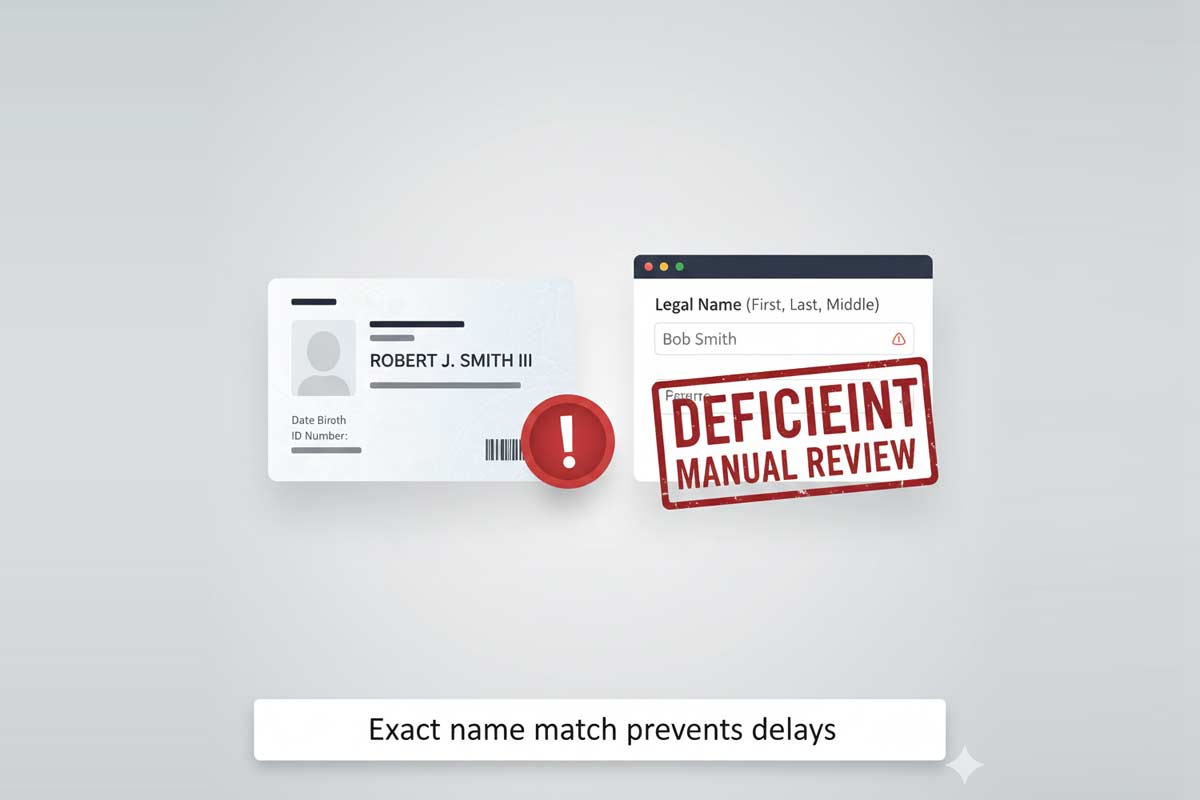
Match Your ID Exactly: Your application name and certificates must mirror your government-issued ID (including middle names, hyphens, and suffixes like Jr. or III).
Select Your Path: Choose "Exam Only" (not recommended) or "Combined Exam and License" (recommended).
Create eLicensing Account: Register your profile on the official DRE website.
Live Scan (Path Dependent): Complete fingerprints upfront if choosing the Combined path (recommended).
Prepare Disclosures: If you will be answering "Yes" to any background questions, gather relevant court records now.
Set Up Communication: Use a consistent email address and add the DRE domain to your "safe sender" list to avoid missing updates in your spam folder.
Review and Submit: Perform a final screen-by-screen review for typos before paying.
Note: Requirements change—always confirm current DRE fees and document standards in your eLicensing account.
Step 1: Confirm Your Eligibility
Before applying for the California real estate exam, ensure you meet the basic requirements:
Age: You must be 18 or older.
Integrity: You must be truthful on your application.
Education: You must have completed three DRE-approved courses: Real Estate Principles, Real Estate Practice, and one elective.
Don’t guess. Ensure your certificates are from a DRE-approved provider. If your document doesn’t clearly list the provider name and course titles exactly as shown on your completion certificate/transcript, contact your school before you apply.
Step 2: Choose Your Application Path
Selecting the wrong path is a major source of confusion for new applicants.
Salesperson vs. Broker: Most candidates begin with the Salesperson application. Broker forms are for those with two years of full-time experience or a qualifying degree as defined by DRE broker qualification rules.
Exam Only vs. Combined:
Exam Only: This allows you to schedule the test. You apply for the actual license only after you pass the exam.
Combined Exam and License: This is generally the most efficient route, but it requires you to have your fingerprints and documents perfectly organized upfront. Once you pass, the DRE can often move straight to the license issuance process.
Do I need Live Scan before I apply? If you choose the "Exam Only" path, no. If you choose the "Combined" path, yes—you must complete the Live Scan before submitting.
Step 3: Document Preparation and Name Consistency
In my experience, one of the most common causes of a Deficient application is a name mismatch. If your ID says "Robert J. Smith III" but your application says "Bob Smith," the DRE system may flag your file for manual review.
Have these ready:
Government-issued ID: Your government issued identification must mirror your course completion certificates.
Course Completion Certificates: You need the course titles and completion dates exactly as they appear on your certificates.
Background Documentation: Answer every background question on the application exactly as asked. If you answer "Yes" to any question regarding prior criminal convictions or charges (such as a DUI or expunged item), have the certified court records ready to avoid delays.
Step 4: Submit the Application in eLicensing
Using the eLicensing portal is significantly faster and more trackable than a paper application.
Login: Access the DRE eLicensing portal.
Select Application: Choose your path (Salesperson Exam or Combined).
Data Entry: Input your course details carefully.
Uploads: Attach clear, right-side-up PDF copies of your documents. Blurry photos or upside-down scans can trigger manual review delays.
Payment: Use a credit or debit card for immediate fee processing.
STOP: The Pre-Submit Review
Before you click "Submit," perform this quick check of the Common mistakes applicants make on DRE forms. This review is your best defense against avoidable delays.
Verify these points:
Is your Social Security Number or ITIN correct?
Did you upload all three required certificates?
Is your name an exact match for your ID and certificates?
Are your "Yes/No" background answers fully transparent and truthful?
Step 5: Fingerprints and Background Checks
For the Combined Path, you must complete a Live Scan at a participating service provider. The Live Scan operator must use the exact DRE-specific form and codes. If your name is misspelled on the fingerprint form, the DRE may not be able to link the results to your application, delaying approval until the results can be manually matched.
Step 6: What Status Changes Mean in eLicensing
Once submitted, your application enters the DRE queue. You can track progress via your portal. You may see statuses such as:
Processing: The DRE has received your application but has not yet reviewed it.
Additional information needed: Information is missing or incorrect. Check your email (and spam folder) immediately for a deficiency notice.
Exam Eligibility / Ready to Schedule: You are approved and can now select your exam date and location.
Pro Tip: Monitor the DRE Processing Timeframes page online. If their current processing date passes your submission date and you haven't heard anything, it's time to follow up.
Step 7: Fixing Problems Fast
If the DRE flags your application as Deficient, speed and precision are vital.
Missing Documentation: If a certificate failed to upload, log in and add the correct PDF immediately.
Specific Requests: If the DRE requests a name clarification or a document to explain a name change, provide exactly what they ask for without delay.
Incomplete Disclosures: If the DRE requests more info on a prior background issue, provide the certified records immediately.
Rushing is the primary cause of errors. Take ten extra minutes during the initial application to avoid the frustration of a pended file.
FAQ
How long does it take to get an exam date? Wait times fluctuate based on DRE volume. Check the "Current Processing Timeframes" on the DRE website for the most accurate estimate.
Can I change my exam date? Yes, you can reschedule via eLicensing. Rules and potential fees depend on how close you are to the exam date; confirm these details within your eLicensing account.
What happens if I fail the exam? You can apply for a re-take through eLicensing. You do not need to redo your education, but a re-examination fee will apply.
Secure Your Most Efficient Path
Don't let bureaucracy stand between you and your career. By being precise with your paperwork now, you ensure the cleanest possible path to the exam room.
For a complete look at the entire licensing process—from your first course to your first day at a brokerage—use our California Real Estate License Guide.
|

The Real Reason Cold Calling Feels “Salesy” (And How to Fix It Fast)
Most new agents pick up the phone like a hunter: “How do I get a listing? How do I get an appointment?”
That intent changes Read more...
The Real Reason Cold Calling Feels “Salesy” (And How to Fix It Fast)
Most new agents pick up the phone like a hunter: “How do I get a listing? How do I get an appointment?”
That intent changes your voice. You rush. You over-explain. You push.
To stop sounding salesy, you don’t need a “slicker” script. You need a cleaner objective:
Your job is not to sell on the first dial. Your job is to start a professional conversation.
To stop sounding salesy, you don’t need a “slicker” script. You need a cleaner objective:
We do that with a simple framework:
Permission + Local Context + Micro-Commitment
By the end of this guide, you’ll have 3 word-for-word scripts, a 10-point objection cheat sheet, and a 7-day plan you can run immediately.
The “Conversation-First” Framework: The 5-Step Blueprint
Here’s the structure closers use because it’s low-pressure and repeatable:
Permission Opener (disarm & respect)
Clear Reason for the Call (specific, local, honest)
Tiny Value Hook (a micro-insight)
Easy Diagnostic Question (invites dialogue, not defense)
Low-Pressure Next Step (a micro-commitment, not a meeting)
Script vs. Mindset: Rookie vs. Closer
Feature
Rookie (Salesy) Approach
Closer (Professional) Approach
Primary goal
Get appointment/listing now
Start a professional relationship
Opener
“Hi, I’m looking for the owner…”
“I know I’m calling out of the blue—quick question…”
Value hook
“I can get you top dollar!”
“A couple homes near you moved fast—local activity is changing.”
Handling “No”
Push harder or hang up
Offer a micro-exit (email / quick follow-up time)
Success metric
Appointments set
Quality contacts + scheduled follow-ups
Coaching note: You’re not trying to “win” the call. You’re trying to earn permission to continue.
Script #1: The Universal Permission Opener (Word-for-Word)
Never pitch someone who hasn’t agreed to listen.
Variant A: Friendly & Professional
“Hi [Name], this is [Your Name] with [Brokerage]. I know I’m calling out of the blue—do you have 60 seconds, or did I catch you at a bad time?”
Pacing: Say it slowly. Then stop talking.
Variant B: Neighborly Inquiry
“Hi [Name], [Your Name] here. I’m a local agent—do you mind if I ask you a quick question about the neighborhood?”
Variant C: Calm & Direct
“Hi [Name], [Your Name] with [Brokerage]. I’ll be brief—is now a bad time?”
(This often gets a “No, go ahead.”)
If they say “No” / “I’m busy” (Micro-Exits)
Don’t vanish. Preserve the relationship.
Text pivot: “No problem at all. Would it be easier if I just texted you a one-line local update instead?” (Follow your laws regarding opt-in text messaging)
Time lock: “Totally fair. Would later today or tomorrow morning be better for a 2-minute question?”
Your win: permission to call back at a specific time.
Script #2: California Circle Prospecting (Truthful Versions Only)
Circle prospecting = calling around a real market event (sale, listing, open house activity, inventory shift).Rule: Only say what you can verify. No fake buyers. No fake “off-market” talk.
Before you call: pick ONE true local fact
Examples you can verify quickly:
“A home around the corner sold fast.”
“Inventory is tight in this ZIP.”
“A few homes have been sitting longer recently.”
Keep it simple. You’re not delivering a data report—just a reason you’re relevant.
Version A (ONLY if true): You actually have an active buyer
“Hi [Name], I’m [Your Name] with [Brokerage]. I know this is out of the blue—do you have 60 seconds?”(Pause)“I’m calling because I’m actively representing a buyer looking for a home in this immediate area, and inventory has been tight.”
Diagnostic question (low pressure):
“Have you heard of anyone nearby who might be planning a move in the next few months?”
Version B (always safe): Inventory tracker (no fake buyer)
“Hi [Name], [Your Name] with [Brokerage]. Quick question—do you have 60 seconds?”(Pause)“I’m calling because I’m tracking inventory in this area for a few households who want to move locally, and I’ve noticed there hasn’t been much fresh activity right around you.”
Tiny value hook (no made-up stats):
“In some pockets nearby, homes have been moving quicker than people expect—so I’m checking in locally.”
Diagnostic question:
“If you ever moved—what would trigger it for you? More space, downsizing, job change…?”
Prefer face-to-face over phone? Use: Door-Knocking Script for California Neighborhoods
Script #3: Warm Follow-Up (After Open House, Sign-In, Lead Form)
This is where new agents stop being “random callers” and start being professionals.
Structure: Gratitude → Specific recall → Diagnostic → Easy offer
“Hi [Name], it’s [Your Name] with [Brokerage]. Thanks again for stopping by my open house at [Address] on [Day].”
“Quick question—when you left, was that home a hard ‘no,’ or are you still comparing options?”(Pause)“Based on what you told me you want, would it be helpful if I sent you two or three similar options to look at tonight?”
Coaching note: The goal is not to schedule a 60-minute meeting. It’s to earn the next conversation.
To generate better warm leads (and better follow-up notes), master: Open House Script for New Agents
The 10-Point Objection Cheat Sheet (California Edition)
Use this structure:
Acknowledge → Pivot → Ask (micro-commitment)
1) “Not interested.”
Rookie panic move: “Okay, bye.”
Closer response: “Totally understand. I didn’t expect you to be thinking about selling today. I’m just calling as a local resource—would you be open to me emailing you a one-line local update once in a while so you can track your equity?”
Goal: permission to talk (or permission for a short follow-up)
2) “I already have an agent.”
Rookie panic move: “Oh… okay.”
Closer response: “That’s great—having someone you trust matters most. Quick question: if they were unavailable and you needed a second opinion fast, would you be open to keeping one backup contact?”
Goal: permission to stay in their orbit
3) “Just send me the information.”
Rookie panic move: “What’s your email?” (and they vanish)
Closer response:“Happy to. Quick preference: are you more interested in what’s selling right now, or what your home might be worth in today’s market?”
Goal: steer them into a 2-question conversation, then capture contact
4) “How did you get my number?”
Rookie panic move: “Uhh… a lead provider?”
Closer response: “Fair question. I use lawful, reputable public-record and neighborhood data tools. And if you’d rather not be contacted again, just tell me and I’ll make sure you’re removed.”
Goal: keep trust + respect opt-out
5) “Call me later.”
Rookie panic move: “Okay.” (and they forget you)
Closer response: “No problem—what’s better: today at 5 or tomorrow morning? I’ll keep it to two minutes.”
Goal: lock a specific time
6) “Take me off your list / Stop calling.”
Rookie panic move: argue or explain
Closer response: “Absolutely. I’ll remove you right now. Have a good one.”
Goal: compliance and professionalism (protect your license and your broker)
7) “Are you calling to list my house?”
Rookie panic move: immediate pitch
Closer response: “Not necessarily. I’m calling to be a local resource and understand what homeowners are seeing and planning. If you ever moved, would you stay local or head somewhere else?”
Goal: open dialogue without pressure
8) “What’s your commission?”
Rookie panic move: quote numbers to a stranger
Closer response: “Good question. Fees depend on the service level and the situation. If you ever wanted to explore it, I’d walk you through a clear fee schedule—are you thinking about selling soon or just curious?”
Goal: determine intent and avoid negotiating on cold call
9) “Rates are too high / Market is awful.”
Rookie panic move: debate headlines
Closer response: “Totally fair—headlines are loud. That’s why I focus on local reality. Would it be helpful if I sent you a simple local snapshot so you can see what’s actually happening near you?”
Goal: permission to send local info
10) “Wrong number / I’m a renter.”
Rookie panic move: scramble into a pitch
Closer response: “Thanks for telling me—my mistake. Before I let you go, are you planning to buy in [City] this year, or not on your radar?”
Goal: only if the tone is friendly; otherwise exit clean
Next step when you actually secure a meeting:Prepare for that buyer consult with: Buyer Consultation Script (California Agents)
The System: Scorecard + 7-Day Launch Plan
New Agent Weekly Scorecard
Metric
Target (Week 1)
Notes
Dials
25–50/day
Consistency > hero days
Conversations (2+ min)
2–5/day
If 0, opener/timing/list issue
Contacts captured
1–3/day
Micro-commitment strength
Follow-ups scheduled
1–2/day
Lock times, don’t “floating follow-up”
Appointments
Bonus
Don’t obsess Week 1
Diagnosing your bottleneck (coach yourself)
Low conversations (e.g.,
|

The Anxiety is Real (And It’s Your Advantage)
You’re standing on a porch in an Irvine cul-de-sac or a tree-lined street in Sacramento. Your mouth is dry, your hands are slightly clammy, and you’re Read more...
The Anxiety is Real (And It’s Your Advantage)
You’re standing on a porch in an Irvine cul-de-sac or a tree-lined street in Sacramento. Your mouth is dry, your hands are slightly clammy, and you’re staring at the doorbell. You’re worried about being "that agent"—the annoying solicitor who gets the door slammed in their face.
Here is the truth: that anxiety is your greatest asset. In 20 years of coaching California agents, I’ve found that the "licensed and scared" rookie is often the most successful door-knocker because they are empathetic, not pushy. Using a door-knocking script for California neighborhoods isn't about "closing" someone on their porch; it's about professional neighborhood networking.
Reframe the task: You are a local expert providing data to homeowners in a complex market.
The Bridge Line: Your license lets you practice real estate. Prospecting skills like this get you paid.
The 3-Part Mindset: Permission, Context, Micro-Ask
To stop sounding "salesy," every interaction must follow this professional flow:
Permission: Acknowledge their time immediately.
Context: Why are you here specifically today? (e.g., a nearby sale or neighborhood report).
Micro-Ask: A low-stakes question that doesn't require a "yes" to a listing appointment.
Mastering these California Real Estate Agent Skills is the difference between random prospecting and a repeatable system.
The Pro’s Setup: What to Bring (and What to Avoid)
New agent panic usually stems from feeling unprepared. Carry yourself like a consultant by following this gear list:
The "Must-Have" List
Visible Name Badge: Clearly identifying your name and brokerage.
Minimalist Flyer: Exactly one relevant piece of data (e.g., a "Just Sold" flyer or Market Snapshot).
Slim Notepad & Pen: For taking notes after you walk away from the door.
Digital Contact Card: A QR code on your phone or a clean business card.
The "Never-Do" List
No Large Binders: These scream "long presentation" and trigger immediate rejection.
No Clipboard Theatrics: You aren't a city inspector; don't try to look like one.
Never Step Inside: Even if invited, politely decline to keep the interaction professional and safe.
Don't Ramble: If you can't get to your point in 20 seconds, you've lost them.
What to Say When the Door Opens (The 10-Second Version)
If you are nervous about the first few seconds, use this universal, low-pressure opener to lower the homeowner's guard:
"Hi, I'll be very brief—I'm [Name] with [Brokerage]. I’m just doing a quick neighborhood update to provide some info on [specific local house or report]."
Word-for-Word Scripts (For 6 Key Scenarios)
1. "Just Listed / Just Sold" Notice
Goal: Establish yourself as the active agent on the block.
The Opener: "Hi, I'll be brief—I’m [Name] with [Brokerage]. I wanted to give you a quick update that your neighbor’s home on Elm Street just hit the market/sold."
The Micro-Ask: "When a home like that moves, it usually impacts values on the rest of the street. If it's helpful, I can email you the final sales price once it closes so you have the data? If not, no worries at all."
Graceful Exit: "I'll get out of your hair—have a great day!"
2. Open House Invitation
Goal: Invite neighbors to build your local database.
The Opener: "Hi! I’m hosting an open house around the corner at 123 Maple this Saturday. We’re doing a 'Neighbors Only' preview from 10:00 to 11:00."
The Micro-Ask: "Are you curious what this one sells for compared to yours? What’s the best email to send you the final number after it closes?"
Next Step: To fill the room, pair this with an Open House Script for New Agents.
3. "Market Update" Knock
Goal: Provide value to identify future sellers.
The Opener: "Hi, I'm [Name]. I’m doing some research for a report on [Neighborhood] home values. Many neighbors are asking if the market is cooling off or staying hot."
The Micro-Ask: "I’m putting together a 1-page summary of local trends, like median days on market. Would you like me to email that over when it’s finished? No pressure either way."
4. "Buyer Need" / "Pick Your Neighbor"
Goal: Find off-market inventory for a specific client.
The Opener: "Hi, I’m [Name]. I’m working with a family who loves this specific street, but as you know, there’s nothing for sale right now."
The Micro-Ask: "Have you heard of anyone on the block mentioning a move? And totally separately—are you personally considering a move in the next year, or just staying put?"
Next Step: If they mention they might move, transition to the Buyer Consultation Script (California Agents).
5. The "Professional Valuation"
Goal: Move a "What's my home worth?" comment into an appointment.
The Script: "That’s the million-dollar question. Online 'Zestimates' are often off—sometimes by a lot—because they don't know your specific upgrades."
The Micro-Ask: "I can run a quick net sheet and comp set so you have a realistic range of what you’d walk away with in today’s market. Would you want to do that sometime next week?"
Next Step: If they say yes, be ready with The Best Listing Presentation Script for California Agents.
6. The "Professional Valuation"
Goal: End the interaction when they are busy or uninterested.
The Script: "I completely understand! If appropriate for your neighborhood, I’ll leave my card here—it has my cell if you ever have a quick real estate question. Have a great day!"
Objection Handling: Your Quick-Response Bank
Objection
Your Response (Validate + Exit)
"I'm busy."
"I apologize for the interruption! I'll leave this info here for you. Have a productive day."
"We have an agent."
"That's great! It's vital to have a pro you trust. If you ever need a second opinion, I'm always available."
"How'd you get my address?"
"I'm just working the immediate area today because of [Anchor Property/Report]—it's part of how I stay updated on the neighborhood!"
"Not interested."
"No problem at all! I appreciate your time. Have a great afternoon."
The Conversation Outcomes Scorecard
Outcome
Frequency
What to Do Next
No Answer
Most common
Move to the next door immediately.
Polite Rejection
Frequent
Log the address to avoid double-knocking.
Quality Conversation
Occasional
Log name + house color + specific topic.
Contact Captured
Rare / high-value
Send an immediate “nice to meet you” follow-up.
California Reality: Safety, Compliance, & Disclaimers
Professional Standard: Municipal solicitation ordinances and HOA rules vary significantly across California. Respect all posted “No Soliciting” signs and private property restrictions.
Disclaimer: This guide provides practical training on communication and marketing for real estate professionals. It does not constitute legal advice. Always check your local city ordinances, HOA rules, and brokerage policies regarding door-to-door canvassing.
Safety & Access Rules:
Respect gates and access controls; do not "tailgate" into private communities.
Stay outside the threshold at all times and maintain a 6-foot distance from the door.
Carry a charged phone and let a colleague know your route.
End any conversation immediately if your intuition flags a concern.
The Follow-Up System (The 2-Minute Rule)
The moment you walk away from a door where you had a conversation, stop and log it. In my years of coaching, I’ve seen that the "friendly follow-up" is where the commissions are actually made.
Text Message (follow all opt-in laws): "Hi [Name], it was great meeting you on [Street] today! Just sending my digital contact info so you have it. — [Your Name], [Brokerage]"
Value-Add Email: "Hi [Name], as promised, here is that market snapshot for [Neighborhood]. Inventory is currently [high/low] compared to last year. Let me know if you have questions!"
FAQs for Featured Snippets
Q: Is door knocking legal in California?
A: Rules vary by municipality and HOA. You must check local city ordinances, respect all "No Soliciting" signs, and respect gates or access controls in private communities.
Q: What is the best door-knocking script for California neighborhoods?
A: Use a "Context-Based" opener: "Hi, I'm [Name]. I'm not here to sell anything, I just wanted to share an update on a home that recently sold on your block."
Q: What is the best time to door knock?
A: Target 4:00 PM to 6:30 PM on weekdays or 10:00 AM to 12:00 PM on Saturdays for the highest engagement rates.
Q: How do I handle a "No Soliciting" sign?
A: Respect the sign and move to the next house. Maintaining a professional reputation is more important than any single lead.
Your "Quick Start" 1-Hour Plan (Do This Today)
Print 20 flyers for a "Just Listed" or "Market Update."
Pick a 20-house radius (avoid "No Soliciting" zones).
Knock doors 1-5. Your only goal is to say the script out loud.
Log every contact in your phone immediately.
Send a "nice to meet you" text (following all opt-in laws) within 60 minutes to anyone who shared contact info.
Door-knocking is just one spoke in your prospecting wheel. To round out your skills, pair this with the Cold Calling Script That Doesn’t Sound Salesy to keep your pipeline full regardless of the weather.
|

Key Takeaways:
The Supervision Standard: Your broker is a guardian of your license. If they aren't accessible, your professional standing could be at risk.
Effective Split Math: High splits often Read more...
Key Takeaways:
The Supervision Standard: Your broker is a guardian of your license. If they aren't accessible, your professional standing could be at risk.
Effective Split Math: High splits often mask overhead. Always calculate your take-home after potential brand royalties and monthly "junk" fees.
Proof over Promises: Never rely only on a recruiter's verbal promises. Demand to see the written Fee Schedule, Training Calendar, and E&O Policy page.
Compliance is Success: In California, a brokerage without a proactive, early file-review system for disclosures could be a significant professional liability.
TL;DR: The "Instant Exit" Checklist
A "Red Flag" is a symptom of a systemic failure. If a brokerage checks a bunch of these boxes—or any single box in Category 2 (Support & Compliance)—think long and hard about signing with them.
The Unavailable Broker: No designated backup for the Responsible Broker during nights or weekends.
The "Off-the-Top" Surprise: Commission splits calculated after a non-capped franchise royalty or brand fee is deducted.
Pay-to-Play Training: Mandatory monthly fees required even if you aren't closing deals.
Post-Closing Review: Files are audited only after the deal closes, leaving you exposed during the transaction.
Recruitment-Heavy Incentives: Internal focus on agent attraction that outweighs the focus on teaching the Residential Purchase Agreement (RPA).
“Your biggest risk isn’t a low split; it’s a high split with no support—leaving you with 100% of zero.”
Your License is Your Asset
While passing the California real estate exam is a monumental achievement, another important phase of your career begins the day you select a broker. In advising thousands of new licensees, I have watched many talented agents struggle early on because they chose a brokerage that provided zero operational protection.
What is a Brokerage Red Flag?
A red flag is any trait suggesting a brokerage prioritizes its own growth metrics over your professional development and legal safety. Conversely, a Green Flag system is one with transparent math, documented support standards, and a rigorous compliance framework.
Choosing a brokerage is not a branding exercise; it is choosing a Risk Management System for your license. In California, where disclosure requirements are complex, your broker’s supervision is your primary line of defense.
The 18-Point Brokerage Audit
Use these tables to guide How You Interview Brokerages in California. Demand the "Proof Artifact" for every category.
Category 1: Money & Fee Transparency
#
The Red Flag
The Recruiter Pitch
The Real Risk
Exact Verification Question
Proof Artifact
1
"Off-the-top" Fees
"It's a 90/10 split."
Brand royalties can drop your actual take-home significantly.
"Is my split calculated on Gross Commission or Net after brand fees?"
Written Fee Schedule
2
Hidden E&O Costs
"Insurance is included."
You may be liable for a significant out-of-pocket deductible per claim.
"What is my out-of-pocket deductible if a claim is filed against me?"
E&O Policy Dec Page
3
Mandatory Junk Fees
"Low monthly overhead."
Monthly desk/tech fees erode your capital while you are still ramping up.
"What is the total monthly cost to hang my license if I close zero deals?"
ICA (Fee Section)
4
Exit Fee Clawbacks
"Joining is free!"
You may owe "training reimbursements" if you move your license.
"Are there any financial penalties or fee clawbacks if I leave?"
ICA (Termination)
5
No Cap Clarity
"You keep 100% later."
"Caps" may only apply to the broker split, not the brand royalty.
"Does the annual cap include or exclude franchise/royalty fees?"
Commission Policy
6
Admin/Client Fees
"Standard processing."
Hidden fees charged to your clients can damage your reputation.
"Does the brokerage charge my clients any 'administrative' or 'compliance' fees?"
Written Admin Fee Policy
Category 2: Support & Compliance (The "Hard Pass" Category)
#
The Red Flag
The Recruiter Pitch
The Real Risk
Exact Verification Question
Proof Artifact
7
The "Ghost" Broker
"I'm always available."
If the broker is unreachable on weekends, you have no legal supervision.
"Who is the designated backup if the Responsible Broker is unreachable?"
Weekend Duty List
8
Delayed File Audit
"We review for closing."
Late audits can lead to serious legal exposure after the deal closes.
"When is the first compliance review performed on a new escrow?"
File Review SOP
9
Unsupervised AVIDs
"Just get it signed."
Failure to properly inspect (AVID) creates massive liability for new agents.
"Who specifically reviews my Agent Visual Inspection Disclosures?"
Compliance Checklist
10
No Support SLA
"Open-door policy."
You lose a deal because a contract emergency goes unanswered.
"What is the written policy for emergency response times on weekends?"
Escalation Procedure
11
No Legal Hotline
"Ask the manager."
Managers may give non-legal advice; you need expert guidance.
"Do agents have direct access to a legal hotline or staff attorney?"
Policy Manual
12
Part-Time Broker
"I still sell too."
A broker in personal production may prioritize their deals over your safety.
"Who on staff is responsible for performing daily compliance reviews?"
Review Staffing List
Category 3: Training & Culture
#
The Red Flag
The Recruiter Pitch
The Real Risk
Exact Verification Question
Proof Artifact
13
Unstructured Mentors
"Paired with a pro."
A producer may lack the protected time to review your first counter-offer.
"Is the mentor's time specifically compensated for teaching?"
Mentorship Syllabus
14
Video-Only Training
"1,000+ videos."
Passive watching does not build the skill of handling tough objections.
"What time is the weekly live roleplay or script practice session?"
Training Calendar
15
Recruiting Focus
"Growth incentives."
The office may prioritize agent attraction over production support staff.
"Can I see the names of the staff responsible for contract audit?"
Staff Roles List
16
No RPA Training
"You'll learn on the job."
You cannot explain the Purchase Agreement to a skeptical client.
"When is the next live class specifically covering the RPA?"
Training Syllabus
17
"Ramping" Leads
"We provide leads."
Leads are often old or recycled, wasting your prospecting time.
"How are leads distributed, and can I see the age of current lead inventory?"
CRM Lead Routing Rules
18
High Turnover
"We're growing fast!"
High churn indicates a lack of retention through support and value.
"Can I speak with two agents who have been in this office for 3+ years?"
Direct Agent References
The “High Split Trap” (Effective Split Reality)
While commission structures vary significantly across California, the underlying math remains constant. You should calculate your Effective Split.
Scenario: Your First $1M Deal ($25k GCI)
Illustrative scenario assuming you close after 6 months of ramp-up overhead and an example (assumed) 6% franchise royalty rate.
Item
90/10 Model (High Fee)
70/30 Model (All-In)
Gross Commission
$25,000
$25,000
Broker Split
($2,500)
($7,500)
Example (Assumed) Royalty (6%)
($1,500)
$0
Monthly Fees (6 months)
($1,500)
$0
NET TO AGENT
$19,500
$17,500
The Lesson: The 90/10 model netted more here, but if the 70/30 model provided a mentor who helped you close that deal one month faster, you would have gained production momentum that outweighs the split difference. Speed + Supervision often beats raw split.
Broker Access & the “Support SLA”
In California, contract deadlines are unforgiving. If you have a question about a counter-offer or a contingency removal at 4:30 PM on a Friday and your broker is unavailable, you risk a breach of contract for your client.
A Recommended Support Rule of Thumb:
Contract Emergencies: < 1-hour response window.
General Questions: < 24-hour response window.
If the broker is a solo practitioner with high personal production and no backup, verify the actual written support system. Don't assume access just because they were friendly during the interview.
Transaction Review & the Compliance Safety Net
California disclosure requirements (TDS, SPQ, AVID) are legally dense. A Green Flag brokerage uses a Safety Net approach:
Initial Review: Within 24–48 hours of an executed contract.
Milestone Audits: Systematic checks tied to key escrow events (e.g., disclosure package delivery or contingency milestones).
VID Audit: A review of your Agent Visual Inspection Disclosure language before it is delivered to the buyer.
Training Proof vs. Training Marketing
Recruiters sell "The Dream"; brokers sell "The System." To verify the training is real, you should treat the interview like a diagnostic exam. Demand these items:
The Calendar: Show me the classes from the last 30 days.
The Syllabus: Is there a written 30-60-90 day onboarding plan?
The "Why": Ask "What is the #1 mistake your new agents make on the RPA?"
Leads, Teams, and the Hidden Trade-Off
Before deciding Should You Join a Team or Go Solo, analyze the lead-gen model:
The Team is a "Ramp" if: They provide leads AND teach you the skills to eventually generate your own.
The Team is a "Treadmill" if: You are only allowed to work their scraps and you never learn to source business.
The Red Flag Scorecard
Score each 1-5 (1 = Poor, 5 = Excellent). If Compliance or Support SLA is below 4, this brokerage might be a "Pass."
Criteria
Score
Training Proof (Actual syllabus/calendar verified)
Support SLA (Documented response < 1 hour for emergencies)
Compliance Review (Audit within 24-48 hours of execution)
Fee Transparency (Written Schedule of Fees provided)
Mentorship Structure (Time specifically protected/compensated)
Lead Model Clarity (Clear path to self-generated business)
If You Already Joined a Bad Brokerage, Do This in the Next 30 Days
If you suspect you've made a mistake, take these steps:
Read Your Independent Contractor Agreement (ICA): Often, you cannot move a pending deal without a heavy fee.
Interview Early: Start interviewing Best Brokerages for New Agents in California before you resign.
Document Promises: If promised training never happened, keep a log of missed events.
Export Your CRM: Consider what happens to your contact data before you announce a move.
FAQ Section
Is a 100% commission brokerage good for new agents?
Usually no—unless it has documented supervision, training proof, and transparent fees. One disclosure error can create serious exposure that may cost more than any "saved" commission.
What is a "Franchise Fee"?
It is a royalty paid to a national brand. Always verify if it is calculated on the Gross commission and whether the cap applies to the royalty or only the broker split.
What is an E&O Deductible?
IErrors and Omissions insurance protects you, but many brokers have a deductible that can be several thousand dollars. You need to know if you are responsible for that out-of-pocket in the event of a claim.
Your first year in real estate is about survival and skill-building. The brokerage you choose should be your foundation, not your burden. By focusing on risk management and demanding proof, you ensure your career starts on solid ground.
Ready to build your career on a foundation of real education and support?
Start a Real Estate Career in California
|