

The “license high” is real.
You finish your real estate courses, pass the California state exam, and hang your license with a reputable brokerage. For a few weeks, adrenaline carries you. Then the silence hits. Your phone doesn’t ring. Your inbox is empty. The Instagram-ready office you built feels like a stage set for a play that never starts.
This is the Motivation Collapse—the predictable emotional drop-off that occurs when licensing ends and the tactical reality of real estate begins.
In my 20+ years of training and supervising thousands of California agents across multiple market cycles, I’ve learned that the ones who survive aren’t the most “inspired.” They are the ones who realized that motivation is not the problem; the lack of a structure is.
Before you can fix your motivation, you must understand why it’s failing. It isn’t a character flaw; it’s a structural misalignment.
If this sounds like your current daily reality, you aren't failing; you're just operating without a scaffold.
This transition is one of the core reasons Why Most New Agents Quit in the First Year. If you’re still orienting yourself, start with our complete guide on how to Start a Real Estate Career in California before trying to optimize your mindset.
Motivation is a feeling, and feelings are unreliable. If you only prospect when you "feel" like it, you don't have a business; you have a hobby.
I see this constantly: A new agent spends three weeks tweaking hex colors on a logo, another rewrites their bio for the tenth time, and another sits with ten CRM tabs open but makes zero calls.
None of those actions risk rejection—still the brain labels them as “work.”
In reality, this is just fear dressed up as an office task. To survive, you must pivot to discipline—doing the high-value, high-fear work precisely because you don’t feel like doing it. This is a foundational element I cover when teaching How to Create a Real Estate Business Plan (New Agents).

To stay in the game, stop chasing "inspiration" and implement these five operational systems.
Many agents quit because they have a distorted view of the timeline. Here is the non-glamorous reality of a successful first year in the California market:
Most agents quit in Months 2–4. This isn't because they failed at the job; it's because they failed to realize that "nothing happening" is often just invisible competence-building.
Motivation is a spark, but systems are the fuel. As you move through your first 18 months, you will find that "staying motivated" becomes less of a struggle because you are becoming competent. Confidence is simply the byproduct of repeated, disciplined action.
If you want to shorten the painful part of this curve, your next step isn’t finding more motivation—it’s choosing structure over motivation. Start with the fundamentals, then layer on the tactics.
Q: How long does it take for a new real estate agent to get their first lead?
A: In California’s competitive market, a lead can be generated on Day 1 through your sphere of influence, but a "cold" lead typically requires 30–60 days of consistent daily prospecting before a pipeline begins to form.
Q: How many hours should a new agent spend on lead generation?
A: You should spend 70% of your work week on lead generation until you have at least three active escrows. In a standard 40-hour week, that is roughly 28 hours of direct outreach.
Q: What is the best way to handle the "slow periods" in real estate?
A: Shift your focus from "results" to "refinement." Use the slow periods to audit your systems, update your CRM, and increase your outbound volume to ensure the next peak arrives sooner.

Founder, Adhi Schools
Kartik Subramaniam is the Founder and CEO of ADHI Real Estate Schools, a leader in real estate education throughout California. Holding a degree from Cal Poly University, Subramaniam brings a wealth of experience in real estate sales, property management, and investment transactions. He is the author of nine books on real estate and countless real estate articles. With a track record of successfully completing hundreds of real estate transactions, he has equipped countless professionals to thrive in the industry.

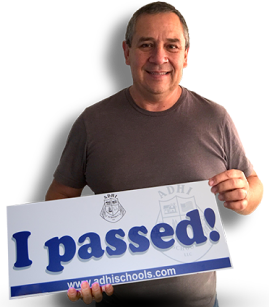
"Hey guys,
I took the exam today and passed!!!!
It only took me one try which was one of my goals. I took the online
classes and follow your suggestions so I took the crash course,
used the crash course app a lot, took 7 mock tests and went
confident to present the exam. Thank you for the great job you are
doing, you guys are awesome!!!! May God continue to bless you!"
Willie V.