
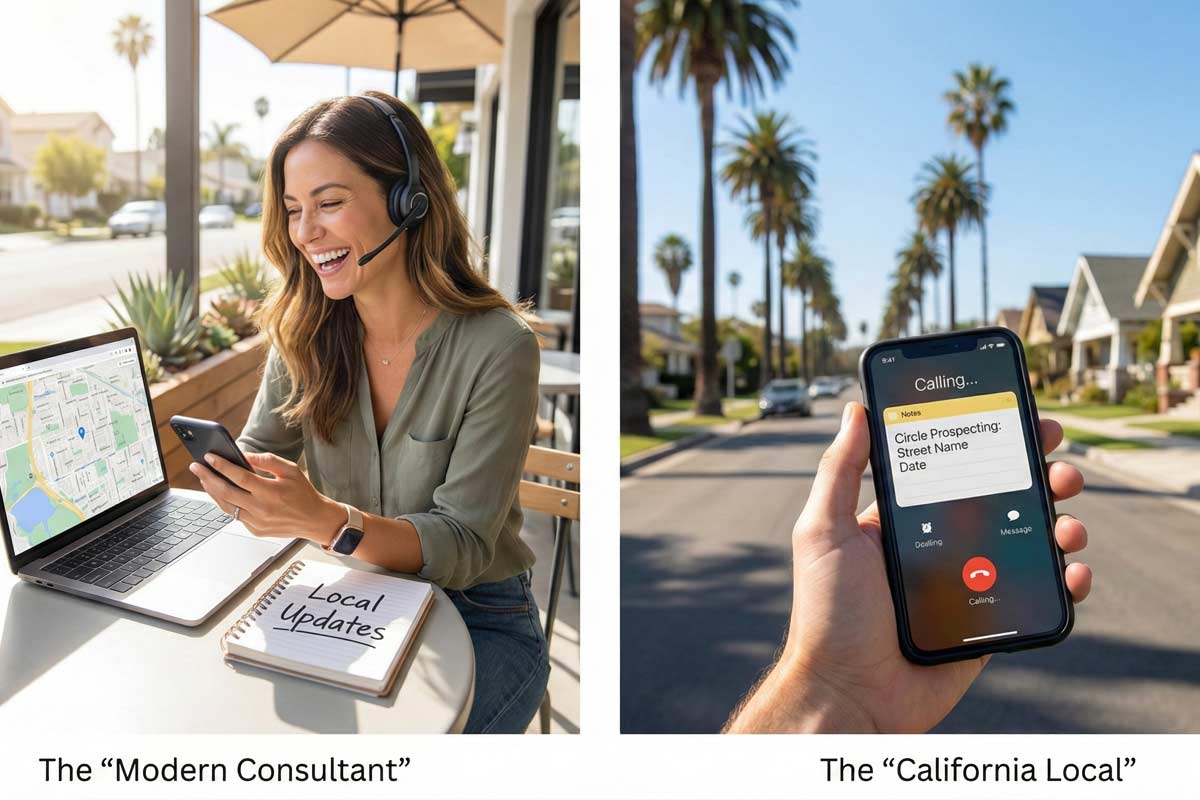
Most new agents pick up the phone like a hunter: “How do I get a listing? How do I get an appointment?”
That intent changes your voice. You rush. You over-explain. You push.
To stop sounding salesy, you don’t need a “slicker” script. You need a cleaner objective:
Your job is not to sell on the first dial. Your job is to start a professional conversation.
To stop sounding salesy, you don’t need a “slicker” script. You need a cleaner objective:
We do that with a simple framework:
Permission + Local Context + Micro-Commitment
Here’s the structure closers use because it’s low-pressure and repeatable:
| Feature | Rookie (Salesy) Approach | Closer (Professional) Approach |
|---|---|---|
| Primary goal | Get appointment/listing now | Start a professional relationship |
| Opener | “Hi, I’m looking for the owner…” | “I know I’m calling out of the blue—quick question…” |
| Value hook | “I can get you top dollar!” | “A couple homes near you moved fast—local activity is changing.” |
| Handling “No” | Push harder or hang up | Offer a micro-exit (email / quick follow-up time) |
| Success metric | Appointments set | Quality contacts + scheduled follow-ups |
Never pitch someone who hasn’t agreed to listen.
“Hi [Name], this is [Your Name] with [Brokerage]. I know I’m calling out of the blue—do you have 60 seconds, or did I catch you at a bad time?”
Pacing: Say it slowly. Then stop talking.
“Hi [Name], [Your Name] here. I’m a local agent—do you mind if I ask you a quick question about the neighborhood?”
“Hi [Name], [Your Name] with [Brokerage]. I’ll be brief—is now a bad time?”
(This often gets a “No, go ahead.”)
Don’t vanish. Preserve the relationship.
Your win: permission to call back at a specific time.
Circle prospecting = calling around a real market event (sale, listing, open house activity, inventory shift).
Rule: Only say what you can verify. No fake buyers. No fake “off-market” talk.
Examples you can verify quickly:
Keep it simple. You’re not delivering a data report—just a reason you’re relevant.
“Hi [Name], I’m [Your Name] with [Brokerage]. I know this is out of the blue—do you have 60 seconds?”
(Pause)
“I’m calling because I’m actively representing a buyer looking for a home in this immediate area, and inventory has been tight.”
“Have you heard of anyone nearby who might be planning a move in the next few months?”
“Hi [Name], [Your Name] with [Brokerage]. Quick question—do you have 60 seconds?”
(Pause)
“I’m calling because I’m tracking inventory in this area for a few households who want to move locally, and I’ve noticed there hasn’t been much fresh activity right around you.”
“In some pockets nearby, homes have been moving quicker than people expect—so I’m checking in locally.”
“If you ever moved—what would trigger it for you? More space, downsizing, job change…?”
Prefer face-to-face over phone? Use: Door-Knocking Script for California Neighborhoods
This is where new agents stop being “random callers” and start being professionals.
Structure: Gratitude → Specific recall → Diagnostic → Easy offer
“Hi [Name], it’s [Your Name] with [Brokerage]. Thanks again for stopping by my open house at [Address] on [Day].”
“Quick question—when you left, was that home a hard ‘no,’ or are you still comparing options?”
(Pause)
“Based on what you told me you want, would it be helpful if I sent you two or three similar options to look at tonight?”
Coaching note: The goal is not to schedule a 60-minute meeting. It’s to earn the next conversation.
To generate better warm leads (and better follow-up notes), master: Open House Script for New Agents
Use this structure:
Acknowledge → Pivot → Ask (micro-commitment)
Next step when you actually secure a meeting:
Prepare for that buyer consult with: Buyer Consultation Script (California Agents)
| Metric | Target (Week 1) | Notes |
|---|---|---|
| Dials | 25–50/day | Consistency > hero days |
| Conversations (2+ min) | 2–5/day | If 0, opener/timing/list issue |
| Contacts captured | 1–3/day | Micro-commitment strength |
| Follow-ups scheduled | 1–2/day | Lock times, don’t “floating follow-up” |
| Appointments | Bonus | Don’t obsess Week 1 |
Day 1–2: Warm-up (Sphere + friendly contacts)
No selling. Just practice Script #1 and listening.
Day 3–4: Circle prospecting
Run Script #2 (Inventory Tracker). Focus on earning permission to further communicate.
Day 5: Follow-ups
Call every lead you already have. Run Script #3.
Day 6: Practice & refine
Record yourself only with consent. If you sound salesy, you’re probably talking too much.
Day 7: Review & tighten
Pick ONE improvement (opener, diagnostic question, micro-commitment ask) and run it next week.
When you start getting seller conversations, you’ll need a tight appointment structure:
The Best Listing Presentation Script for California Agents
Cold calling is regulated and brokerage-dependent. Keep it simple:
“Hi [Name], this is [Your Name] with [Brokerage]. I’m a local agent tracking activity in your area and had a quick question. Call me back at [Number] when you can—thank you.”
“Hi [Name], [Your Name] with [Brokerage]. Thanks again for coming by [Address]. Quick question when you have a second—[Number].”
“Hi [Name] — this is [Your Name], a local agent in [City]. Would it be helpful if I texted you a one-line local update once in a while, or would you prefer I don’t?”
“Hi [Name], [Your Name] here. I can send 2–3 options that match what you mentioned (no spam). Is text okay, or is email better?”
Subject: Quick local snapshot (as promised)
Body:
Hi [Name],
As promised, here’s a quick local snapshot for [Neighborhood/City]. If you ever want the detailed version, I’m happy to send it.
— [Your Name], [Brokerage], [Phone]
There isn’t a magic time. Many agents see better pickup mid-week in late morning or early evening, but the best time is the time you’ll do consistently. Test two calling blocks for two weeks and compare your pickup and conversation rates.
Start with 25–50 dials/day and aim for 2–5 real conversations. If you’re getting zero conversations, don’t “dial harder”—fix your opener, list quality, and timing.
Make it specific and small: “I can send you a one-page local snapshot—what’s the best email for that?”
The cleanest micro-commitment is permission to email: “I can tell it’s not a good time—would it be okay if I emailed you my contact info so you have a local resource if you ever need one?”
Use Version B (Inventory Tracker). The truth is enough. You’re calling to learn, document, and offer a simple local snapshot—not to pretend you have secret inventory.
Slow down. Smile while you talk. Use short sentences. Then ask a question and stop talking. Nervous agents talk to fill silence—closers let silence do the work.
Cold calling isn’t about being a “natural.” It’s about running a professional process:
If you want the full skill stack (cold calling → open houses → consults → presentations), master more essential techniques in: Real Estate Agent Skills (California)

Founder, Adhi Schools
Kartik Subramaniam is the Founder and CEO of ADHI Real Estate Schools, a leader in real estate education throughout California. Holding a degree from Cal Poly University, Subramaniam brings a wealth of experience in real estate sales, property management, and investment transactions. He is the author of nine books on real estate and countless real estate articles. With a track record of successfully completing hundreds of real estate transactions, he has equipped countless professionals to thrive in the industry.


"Hey guys,
I took the exam today and passed!!!!
It only took me one try which was one of my goals. I took the online
classes and follow your suggestions so I took the crash course,
used the crash course app a lot, took 7 mock tests and went
confident to present the exam. Thank you for the great job you are
doing, you guys are awesome!!!! May God continue to bless you!"
Willie V.