Choosing a real estate school in California is the first major "business decision" you will make. It’s also the first time you’ll encounter the noise of the internet in the real estate world. If you Read more...
Choosing a real estate school in California is the first major "business decision" you will make. It’s also the first time you’ll encounter the noise of the internet in the real estate world. If you spend five minutes looking for student reviews of online real estate schools in California, you will find two extremes: glowing 5-star testimonials that sound like marketing copy, and 1-star "rage reviews" from students who felt abandoned by a computer screen.
In over 20 years of helping thousands of Californians through this process, I’ve noticed a consistent pattern: a school’s 'user experience' and its 'educational results' aren't always the same thing.
The truth?
Reviews are a tool, but only if you know how to read between the lines. Here is how to filter the noise and find a school that actually gets you licensed.
Quick Take: The 2026 Review Filter
Look for Outcomes, Not Ease: A "fast and easy" course often leads to a "difficult and repeated" state exam.
Check the Date: California DRE regulations and exam topics shift; reviews older than 12-18 months are less relevant.
Identify the Support Model: "Great support" should mean access to human experts, not just a technical help desk.
The Goal is the License: Prioritize reviews that mention "passing the state exam" over those that only mention "finishing the hours."
What Students Most Commonly Praise (and what it actually indicates)
When you see a 5-star review, you need to determine if the student is praising the convenience or the effectiveness.
“The platform was so simple and fast.”
In 2026, user experience matters, but "simple" can be a double-edged sword. If a platform is too simple, it may be because it lacks the depth required to pass a high-stakes exam. Students often praise a school for letting them click through quickly, but this rarely translates to retention. This is why many online real estate school reviews in California overemphasize convenience while underreporting exam outcomes. How long students should expect real estate school to take depends on the quality of the material, not just the speed of the software.
“Great support whenever I had a question.”
You must define what "support" means in these reviews. Does it mean a live person answered a question about contract law, or does it mean someone helped them reset their password? Real support—the kind that actually gets you licensed—is about how you learn, not just how the website works. Look for reviews that mention instructors who clarify complex topics like encumbrances or agency disclosure.
“The practice questions were just like the exam.”
This is the gold standard of praise. If multiple reviewers mention that the school's preparation tools mirrored the actual California State Exam environment, that is a high-value signal. It suggests the school prioritizes exam readiness over course completion.
While the exact exam questions are never public, a great program prepares you for the logic behind them. This ensures that no matter how a question is framed, you have the knowledge to answer it correctly.
What Students Most Commonly Complain About
Negative reviews are often more revealing than positive ones, but they require a "root cause" analysis.
“No one would help me / I felt like a number.”
The Root Cause: Many online schools are "set it and forget it" models. They provide the PDFs but no bridge to a human being.
How to Verify: Before enrolling, call the school. If you can’t get a human on the phone during business hours now, you won't get one when you’re stuck on Chapter 7 later.
“The materials felt outdated.”
The Root Cause: The California real estate market and laws change. A school using a curriculum from ten years ago is doing you a disservice.
How to Verify: Check if the school mentions 2026 updates or current DRE standards.
Do online real estate classes actually prepare you?
Only if the content reflects the current exam pool.
“I fell behind and lost my motivation.”
The Root Cause: Purely self-paced courses require 100% of the discipline to come from the student. Repeated complaints like this point to a system problem, not a character flaw.
The Reality: This isn't always the school's "fault," but it indicates a lack of an accountability framework. If you see this often, it means the school provides the "what" but not the "how" of staying engaged.
The Review Pattern Test: Your 3-Minute Audit
Don't read every review. Apply this framework to the top 20 reviews you find for any California real estate school.
Rule
What to Look For
The Specificity Rule
Does the reviewer mention a specific chapter, instructor, or "lightbulb moment"? (High Value)
The Recency Rule
Is the review from 2025 or 2026? Tech and DRE rules move fast. (High Value)
The Outcome Rule
Does it say "I passed the state exam"? That is the only metric that matters. (Highest Value)
The Support Signal Rule
Do multiple reviews mention access to instructors or real humans beyond tech support? (Trust Signal)
The 1-Star Filter
Is the reviewer mad about a refund policy they didn't read, or a fundamental lack of teaching? (Context is Key)
Student Checklist for Review Auditing:
Did the reviewer pass on the first or second attempt?
Does the school offer physical textbooks (often a sign of a more serious program)?
Are there mentions of "live" components or webinars?
Does the "clunkiness" mentioned in reviews affect the learning or just the aesthetics?
What Reviews Can’t Tell You (The "Hidden" Factors)
Even the best online real estate school reviews in California have blind spots. There are things you must verify directly with the school:
DRE Compliance: Is the school currently approved for the specific courses you need? Check the DRE website directly.
Repetition Logic: Does the system force you to review what you got wrong, or does it just let you move on?
Your Study Environment: A 5-star school won't help you if you’re studying on a phone in a noisy coffee shop. The optimal study setup for real estate school is as important as the curriculum itself.
Holding Periods: California law requires a minimum of 18 days per course. This is one reason timelines in reviews often conflict with reality. Some reviews complain about "delays" that are actually legal requirements the student didn't understand.
Decision Matrix: Which School Type Fits You?
Based on common student feedback, here is how to choose your path:
The "Busy Professional": Look for reviews mentioning mobile-friendly formats but high-quality physical books for weekend deep-dives.
The "Anxious Test-Taker": Prioritize schools with "heavy" practice question banks and live exam-prep crash courses.
The "Discipline Challenged": Avoid "pure" self-paced schools. Look for reviews that mention how to stay motivated during real estate school through instructor check-ins or structured schedules.
Reviews are Input, Not the Decision
In my experience, the students who succeed are those who treat their education like a job interview. They don't just look for the cheapest or "easiest" option. They look for a partner that provides the structure they lack and the expertise they need.
Reviews tell you about the experiences of others, but they don't guarantee your outcome. Your success depends on your ability to find a school that balances modern convenience with old-fashioned academic rigor.
To see how we categorize the different types of programs available today, view our complete guide on the Best Real Estate Schools in California.
|

You’ve passed the real estate exam, joined a brokerage, and ordered your business cards. Now comes the most pressing question every new California agent faces:
"Where do I get my first lead?"
The Read more...
You’ve passed the real estate exam, joined a brokerage, and ordered your business cards. Now comes the most pressing question every new California agent faces:
"Where do I get my first lead?"
The industry is flooded with marketing noise and subscription platforms promising instant closings. But after 20 years in the California real estate business, I’ve seen thousands of agents burn through their savings chasing the wrong leads. The truth is that lead sources are far less important than your lead-to-relationship conversion and your consistency.
A lead isn't a commission check; it’s an introduction. California markets are fragmented—what works in Riverside won't always work in West LA. To start a real estate career in California that actually lasts, you need a system, not just a tactic.
Key Takeaways
Trust over Tech: Your Sphere of Influence (SOI) remains the highest-converting lead source.
Sweat Equity: Open houses are the fastest way to meet "now" buyers without an upfront budget.
Speed Wins: The agent who follows up same-day—often within minutes—usually wins the client. This is often called “speed-to-lead”.
Local Authority: Consistency in a small "micro-farm" beats sporadic efforts across a whole city.
Best Lead Sources by Situation
Fastest results: Open houses + tight follow-up
No budget: SOI + community networking
If you hate cold outreach: Database + partner referrals
Long-term dominance: Micro-farm + simple local content
Commercial-lite path: Small lease deals + local owner conversations
Ranked: The Best Lead Sources for New Agents
Note: "Skill Level" refers to your conversion and communication skill, not your personality type.
Lead Source
Cost
Time-to-Result
Skill Level
Best For...
Sphere of Influence (SOI)
Free
Days/Weeks
Low
Immediate trust & referrals
Open Houses
Free/Low
Days/Weeks
Medium
Meeting unrepresented buyers fast
Open House Follow-Up
Free
Days/Weeks
Medium
Turning “tourists” into clients
Database + CRM Follow-Up
Free/Low
Weeks
Medium
Staying top-of-mind consistently
Local Partner Referrals
Low
Weeks/Months
Medium
Warm intros from lenders/escrow
Agent-to-Agent Referrals
Low
Weeks/Months
Medium
Relocation + overflow clients
Community Networking
Low
Weeks/Months
Medium
Trust-building (schools, chambers)
Micro-Farming (100–300 homes)
Medium
Months
High
Long-term local dominance
Rentals / Landlords
Low
Weeks/Months
Medium
Leads that become buyers later
FSBO / Expireds
Low
Weeks
High
High-volume conversations
Online Inbound Basics
Low/Medium
Months
Medium
Compounding flow (reviews)
Paid Leads (Optional)
High
Days/Weeks
High
Agents with a break-even mindset
The Core Strategy: Where to Start
1. Your Sphere of Influence (SOI)
Your SOI includes friends, family, and past coworkers. These are people who already want you to succeed.
Why it works: Trust is pre-built. You aren't "selling"; you're informing.
Scenario: Instead of a sales pitch, try: "I'm not calling to sell you anything—I just wanted to let you know I'm officially with [Brokerage]. If you ever have a quick question about what's happening in our neighborhood, I'm happy to be your resource."
Do this this week: Call 5 people a day. Update their contact info in your CRM.
2. Open Houses as a Lead Engine
Don't just "sit" in a house. Use it as a platform. Learning how new agents should hold open houses effectively can transform a boring Saturday into three new buyer representation agreements.
Why it works: You meet active buyers in a specific zip code.
Scenario: When a visitor walks in: "Thanks for coming by. Most people I meet here are either neighbors or looking to move in the next 90 days—which one are you?"
Do this this week: Ask a top producer in your office to host their listing open this weekend.
3. Building Your Database
Every person you meet belongs in a CRM. You must build a real estate database from scratch to automate your "top of mind" awareness.
A Simple Follow-Up Cadence
Day 0: Quick text + “What stood out to you at the house?”
Day 1: Phone call (short, human).
Day 3: Value add (neighborhood note or listing link).
Day 7: Call + clarify timeline.
Month 2+: Monthly market update + personal check-in.
Expanding Your Reach
Local Partner & Agent Referrals
Lenders, escrow officers, and out-of-area agents are massive referral sources.
Why it works: These are professional, warm introductions.
#1 Rookie Mistake: Asking for leads before offering any value.
Do this this week: Invite a local lender to coffee to learn about their specific programs.
Community Networking & Micro-Farming
Become the "Digital Mayor" of a small area. Focus on 100–300 homes (a micro-farm) or your local PTA/Chamber.
Why it works: It builds "omnipresence" in a small, manageable pond.
Do this this week: Draft a simple, one-page market update for your specific neighborhood.
Online Inbound & Rentals
Claim your Google Business Profile and gather reviews immediately. Additionally, don't ignore renters; in California, today’s tenant is often next year’s first-time buyer.
FSBO / Expireds
Why it works: These are people with high "intent to sell."
Compliance Reminder: Strictly follow the National Do Not Call (DNC) Registry, respect all opt-outs, and follow your brokerage’s specific outreach policies.
What to Avoid: The "New Agent Traps"
Paid Leads: The "High Tuition" Trap
Paid leads aren't evil—they're just expensive if you aren't ready. If you can't respond in under 5 minutes and don't have a conversion system, paid leads are just a donation to a tech company.
Small Commercial (The "Lite" Path)
You don’t need to be a commercial specialist on day one. Start commercial-lite: small retail/office leases and local owner conversations. Partner with a senior agent when complexity rises. Done right, it builds a professional reputation that feeds your residential business.
The 30-Day Lead Generation Operating System
Success requires strict new agent time management strategies.
Week 1: Set up CRM. Call everyone in your phone. Schedule two open houses.
Week 2: Execute follow-up cadence (Day 0–7). Meet one local partner.
Week 3: Start your 100-home micro-farm. Drop off a market report.
Week 4: Evaluate metrics. How many conversations did you actually have?
Weekly Scorecard
Contacts added to CRM: ________
Real estate conversations: ________
Speed-to-lead (Avg minutes): ________
Follow-up attempts: ________
Appointments set: ________
FAQ
What is the best lead source for new California real estate agents?
Your sphere of influence (SOI) is the highest-converting starting point because trust is built-in. Pair it with open houses for faster “now buyer” conversations.
Are open houses a good way to get clients in California?
Yes—they are one of the fastest ways to meet unrepresented buyers. The key is capturing contact info and running a same-day follow-up plan.
How quickly should I follow up with a new lead?
Same day—ideally within minutes. In California’s fast-paced market, the first agent to provide value and set the next step usually wins the client.
Can I get real estate leads for free?
Yes. SOI outreach, open houses, and partner relationships produce leads with $0 in ad spend; your main cost is time and consistency.
How many follow-ups does it take to convert a lead?
Many leads convert after 5–12 touches over weeks or months. Most new agents fail by stopping after the second attempt.
Are paid leads worth it?
Only if you have a proven conversion system and understand break-even math. Without these, they are "expensive tuition."
Is cold calling illegal in California?
It is not automatically illegal, but it is heavily regulated. You must follow the National DNC Registry, honor opt-outs, and follow brokerage policy.
Should I focus on buyers or sellers first?
Buyers are often easier to find early through open houses. Sellers usually require the trust and proof you build through consistent activity.
Can new agents get commercial leads?
Yes, via "commercial-lite" paths like small leases. Keep expectations realistic and how to find your first 3 clients as a new agent often involves starting with these accessible opportunities.
Build Your Career Foundation
Lead generation is the heartbeat of your business, but it only works if you have the competence to back it up. Focus on building a career system rather than chasing the tactic of the month. Remain consistent, lead with value, and treat every contact like a long-term relationship.
|
Starting a new career is an investment, and in California, the barrier to entry for real estate is relatively low. Naturally, finding an affordable path is a top priority for many students—whether you Read more...
Starting a new career is an investment, and in California, the barrier to entry for real estate is relatively low. Naturally, finding an affordable path is a top priority for many students—whether you are a career-changer, a busy parent, or a full-time worker.
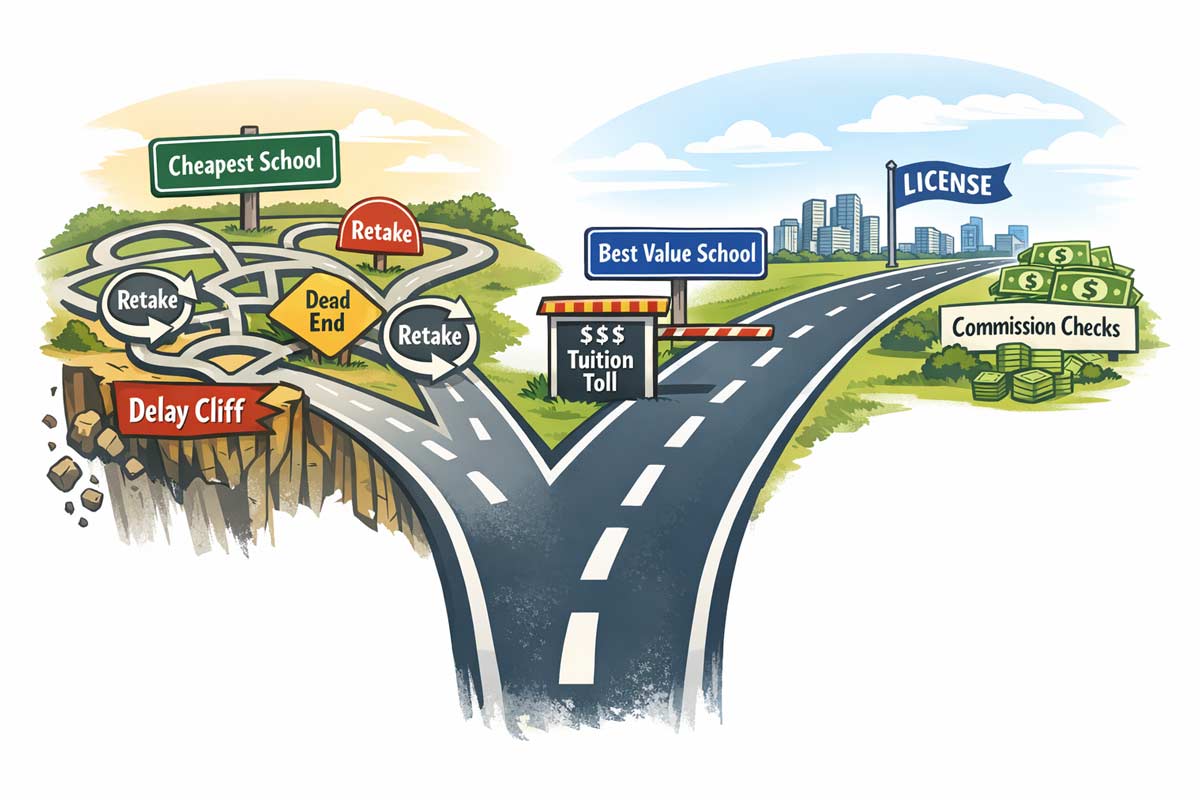
However, after 20 years of helping students navigate the California Department of Real Estate requirements, I’ve seen a consistent pattern: the "cheapest" school on paper can often become the most expensive in terms of time and frustration.
The goal isn't just to find the lowest checkout price; it’s to find the lowest total cost to get your license in your hand and start earning commissions.
What is the cheapest real estate school in California?
The Short Answer: The cheapest real estate schools in California are typically 100% self-paced, online programs that provide the mandatory 135 hours of DRE-approved coursework with minimal instructor support. While you will sometimes see these "budget" packages advertised for under $150, the real value is found by balancing the sticker price against support quality and exam prep depth to avoid the high costs of retakes and study delays.
What "Cheap" Really Means in Real Estate Education
When you see a price that seems too good to be true, it’s usually because the school has "unbundled" the experience. To offer a rock-bottom price, schools often cut the very things that help students actually finish.
Common characteristics of ultra-budget programs include:
Minimal Instructor Access: You are often left to learn the material entirely on your own with no one to ask when a complex concept like "Joint Tenancy" or "Agency Disclosure" gets confusing.
Limited Exam Prep: The 135 hours of required education is not the same as passing the state exam. Cheap programs often provide the bare minimum to meet legal requirements but leave you hanging when it comes to the actual test.
Slow Support Response: If you have a technical issue or a question about your certificate, a budget school might take days to respond.
Hidden Fees: Watch out for "add-ons" for proctoring fees, certificate processing, or course extensions if you don't finish within a tight window (e.g., 90 days).
The "True Cost" Framework
To evaluate if a school is actually a bargain, you have to look past the "Add to Cart" button. Use this framework to calculate the real investment required.
Cheap vs. Best Value: What Changes?
Feature
Ultra-Budget Program Pattern
Best-Value Program Pattern
Why it Matters
Support
Email only (24–48 hour delay)
Phone/Live Chat/Direct Access
Delays in answers lead to "study stall-outs."
Exam Prep
Basic PDF or none included
Simulated exams & video reviews
Passing the state exam the first time saves money on retakes.
Platform
Older, non-mobile friendly
Modern, responsive interface
If you can't study on your phone, you won't study as often.
Accountability
None (Self-study only)
Optional live sessions/reminders
Students in ultra-budget courses often stall out without structure.
Pros of Choosing the Cheapest Option
There are absolutely times when going for the lowest price is a smart, tactical move.
Lowest Upfront Spend: If cash flow is the primary barrier to entry, a budget program gets you into the system for the least amount of money today.
Maximum Flexibility: These programs are almost always self-paced, which is perfect for someone working a 60-hour week who can only study at 2:00 AM.
Great for Self-Motivated Learners: If you have a history of teaching yourself complex subjects and don't need a "coach," you can save money here.
Existing Support Systems: If you already have a mentor at a brokerage (or a family member in the business) teaching you the ropes, you may simply need a DRE-approved provider to log the required hours efficiently. For the full decision framework, see Best Real Estate Schools in California.
The Risks: When "Cheap" Becomes Expensive
In my experience, I’ve seen three "failure modes" for students who choose a school based solely on price:
The 9-Month Delay: A student buys a budget course, hits a boring chapter, has no one to talk to, and stops studying. Months later, the course expires, and they have to pay a "re-enrollment fee" just to start over.
The Retake Loop: A student finishes a cheap program but fails the state exam multiple times because the prep resources didn’t match the depth or style of the state exam. They end up spending more in DRE re-application fees.
The Tech Wall: The program doesn't work well on mobile devices, meaning they can only study when sitting at a desktop. This friction often leads to students giving up entirely.
What this means for you: If a $100 savings on tuition leads to a three-month delay in starting your career, you’ve actually "lost" thousands of dollars in potential commissions.
Decision Filter: Which Path is Yours?
You’re a good fit for the cheapest option if…
You are highly disciplined and never struggle with procrastination.
You are a "natural" test-taker who rarely needs extra help.
You are on a very strict budget and are willing to trade your time for a lower price.
You should pay for more support if…
You haven't taken a professional exam in several years.
You learn better by hearing and seeing rather than just reading.
You want a structured schedule to keep you on track.
If you find that you need more structure, you might look into the best online real estate schools in California that offer livestream options to keep you accountable.
How to Get the Lowest Price Without the Risk
If you are determined to go the budget route, follow these steps to protect your investment:
Verify DRE Approval: Never pay a dime until you verify the school on the DRE’s official list of approved education providers.
Check the "Format Fit": While self-paced is often the affordable online option, some schools offer "hybrid" models that provide a middle ground.
Audit the Exam Prep: Does the "cheap" price include a practice exam? If not, factor in the cost of a third-party prep tool later.
Look for "Hidden" Popularity: Sometimes the most popular real estate schools in California are affordable because of their high student volume, not because they cut corners on quality.
Set a Milestone Plan: Don't just "wing it." Commit to finishing one module every few days to ensure you don't hit expiration fees.
Cheapest by Format
Self-Paced Online: Always the lowest sticker price. Best for the "lone wolf" student.
Live Online / Livestream: Moderate price. This is often the fastest real estate license program because the fixed schedule prevents procrastination.
In-Person: Usually the highest cost. You are paying for the physical facility and the instructor's presence. However, the best in-person real estate schools in California often create higher completion momentum because the structure is built in—fixed times, real-time accountability, and fewer distractions.
FAQ
What is the cheapest way to get a real estate license in California?
The cheapest way is typically an online, text-based, self-paced course package. These packages cover the three required courses for a single flat fee.
How much do real estate schools cost in California?
You’ll commonly see pricing from roughly $125 for basic self-study to $900+ for in-person or premium livestream packages with heavy coaching.
Are cheap real estate schools DRE-approved?
Most are, but you must verify. If a school is not on the DRE's approved list, the state will not recognize your education, making the course a total loss.
How long does it take to finish the 135 hours?
Per DRE rules, a statutory course requires a minimum of 18 days of study before the final exam can be taken. For all three courses, the fastest you can legally finish is 54 days. Any program implying completion faster than that should be double-checked for compliance.
Cheap is a Tool
Choosing a real estate school is your first business decision as a future agent. If you have more time than money, a budget-friendly school can be a great tool. Just be sure you aren't sacrificing the support you need to actually pass the exam and start your career.
If you're still not sure which direction to head, check out our comprehensive guide to the Best Real Estate Schools in California to compare your options.
|

In twenty years of leading students at ADHI Schools, I have seen thousands of students start their licensing journey. At this point, I can tell pretty quickly whether a student will be licensed in four Read more...
In twenty years of leading students at ADHI Schools, I have seen thousands of students start their licensing journey. At this point, I can tell pretty quickly whether a student will be licensed in four months or still "working on it" in twelve.
The difference isn't intelligence or background. It often comes down to their environment.
Folks often treat real estate school like a hobby—they fit it into the gaps of their life. First-time passers treat it like a closing. They don't rely on motivation; they rely on a Passive-to-Active (PTA) System. If you do not intentionally design your study setup, your environment will design your failure.
Quick Take: The High‑Pass System
The Framework: The "PTA System" (Environment, Tools, Routine).
The Non‑Negotiable: Total phone isolation and a "Single‑Task" browser setup.
The Metrics: Shift from "hours logged" to "concepts mastered via active recall."
The Goal: Eliminate the 3–6 month "drift" that kills most real estate careers.
The PTA System: A 3‑Pillar Framework
To pass the California state exam on your first attempt, you must move from Passive Consumption (watching videos) to Active Recall (retrieving information). My PTA System is the architecture that forces this transition.
1. Environment: The Distraction‑Free Command Center
Your brain is a proximity‑based machine. If your phone is within reach, a portion of your cognitive load is dedicated to not checking it.
The "Clean Desk" Mandate: Your workspace should contain exactly three things: your device, your notes, and a glass of water. Anything else—mail, laundry, other work—is a cognitive leak.
Phone Isolation (The "Faraday" Rule): Your phone does not belong on your desk. It belongs in another room. Research shows that even a silenced phone face-down on a desk reduces cognitive capacity.
The Lighting Trigger: Use a dedicated lamp for studying. When that light is on, you are a real estate student. When it’s off, you’re a parent/employee/spouse. This "context anchoring" is how busy professionals finish the course in record time.
The "Minimum Viable Corner": Don't have an office? Use noise-canceling headphones and a specific placemat. These are your "walls."
2. Tools: The "Single‑Task" Tech Stack
Most students fail because they use tools that encourage multitasking. A tablet with 15 open apps is not a study tool; it’s a distraction device.
The Hardware Hierarchy: A desktop or laptop is the only professional choice. You need a keyboard for rapid note-taking and a screen large enough to view the course side-by-side with practice exams.
The Browser Lockdown: Use a dedicated browser (e.g., Firefox if you usually use Chrome) solely for real estate school. No social media logins, no saved "distraction" bookmarks.
Note‑Taking (The "Write‑to‑Recall" Method):
Do not transcribe the course. That is passive and useless. Write down questions, not answers. (e.g., instead of writing "Joint Tenancy requires 4 unities," write "What are the 4 unities of Joint Tenancy?").
The 20‑Minute "Sprints": Use a physical kitchen timer. Digging into your phone to set a timer is an invitation for a 20-minute Instagram detour.
3. Routine: The "20/2/1" Execution Plan
The biggest mistake I see is “binge studying.” Students try to pull 8‑hour sessions on Sundays. They retain nothing.
The Daily 20: Twenty minutes of practice questions every morning before the world wakes up. This keeps your "exam brain" sharp.
The Deep 2: Two hours of new curriculum mid‑week.
The Sunday 1: One full, timed practice exam.
The "Start Ritual": A 60‑second sequence (Water → Headphones → Login) that signals to your brain that the "Real Estate School" gear has engaged.
The "Exam‑Readiness" Upgrade (Why Passive Students Fail)
This is where most students lose a year of their lives. They mistake familiarity for mastery.
I’ve seen students who claim to have “read” the textbook but can’t pass a 150‑question practice test. They fell into the trap of passive reading. They chose a setup that made it easy to "watch" but hard to "do."
Do online real estate classes actually prepare you? Only if your setup forces you to answer questions. If your study routine doesn't involve being "wrong" at least 30% of the time during practice, you aren't learning—you’re just scrolling.
Kartik’s Reality Check: In two decades, I have never seen a student fail the state exam because they didn't "read enough." They fail because they didn't "retrieve enough." Your setup must be a retrieval machine.
Common Setup Failures (The "Don't" List)
If your current study habit looks like this, you are effectively choosing to fail:
The "Second Screen" Trap: Having the TV on or a movie playing while "going through the slides."
The "Highlighter Fallacy": Thinking that coloring a page yellow equals moving it into your long‑term memory.
The "Drift": Not knowing exactly which lesson you will tackle before you sit down.
Skipping Practice Tests: Waiting until the "end" of the course to see if you actually know the material.
Profile
The "Pass" Strategy
The Failure Mode
The Busy Pro
20‑min daily sprints
"I'll do it all on Saturday"
The Career Changer
Active recall / PTA System
Passive reading / Highlighting
The Academic
Practice test drilling
Over‑studying theory / No testing
Implementation: Choose Your Path
You are at a crossroads that determines how long real estate school should take. You can either drift through the material and hope for the best, or you can build a PTA system that guarantees a result.
Consistency is the byproduct of a good environment. If you find yourself constantly losing steam, read our analysis on how to stay motivated during real estate school. Usually, it’s not a lack of "willpower"—it’s a broken setup.
When you compare the Best Real Estate Schools in California, look for the one that doesn't just give you a login, but gives you a framework for success. Check the student reviews of online real estate schools and you’ll see that the ones who pass are the ones who treated the process with the professional rigor it deserves.
PTA System FAQs
Q: Is it okay to study at a coffee shop?
A: Only if you have noise‑canceling headphones and can handle the "Portable PTA Kit." If people‑watching is more interesting than the Law of Agency, stay home.
Q: Should I use digital flashcards?
A: Yes, but only if you create them yourself. The act of writing the question is 50% of the learning.
Q: What if I miss a week of my routine?
A: Do not try to "catch up" by doubling your hours. You’ll just burn out. Return to the 20/2/1 plan immediately. The system is designed to absorb life’s interruptions.
Q: How do I know if my setup is working?
A: By your practice test scores. If your scores aren't rising, your environment is likely too passive.
Q: Does the PTA system work for everyone?
A: It works for everyone who actually implements it. It is the converged "best practice" of 20 years of successful California brokers.
The Verdict
If you don’t design your setup, your environment will design your outcome. A professional career starts with a professional study habit. Build your PTA Command Center today, put your phone in another room, and start your first 20‑minute sprint.
Your future as a California agent depends on the systems you build today.
|
You’ve passed the real estate exam, your license is issued, and you’ve chosen a broker. Then, Monday morning hits. You sit at your desk, and the "post-license cliff" sets in: your calendar is empty, Read more...
You’ve passed the real estate exam, your license is issued, and you’ve chosen a broker. Then, Monday morning hits. You sit at your desk, and the "post-license cliff" sets in: your calendar is empty, and your phone isn't ringing.
The temptation for most new California agents is to reach for a credit card and buy leads. Every real estate office has that guest speaker pitching a magical "lead-gen tool" for $199 a month.
That is a short-term fix for a long-term problem.
In our industry, your database is your business. It is the only asset you truly own. One clean database can produce repeat clients for 10 years; one lead-buy produces, at best, a one-time conversation.
A database doesn’t magically create deals—it creates conversations, and conversations create appointments.
A "from scratch" database isn't about empty contacts—it's about missing the system for consistent, targeted follow-up.
By the end of this guide, you will have a clear, 30-day roadmap to move from zero contacts to a professional follow-up system that produces consistent commissions.
What a "Database" Actually Means
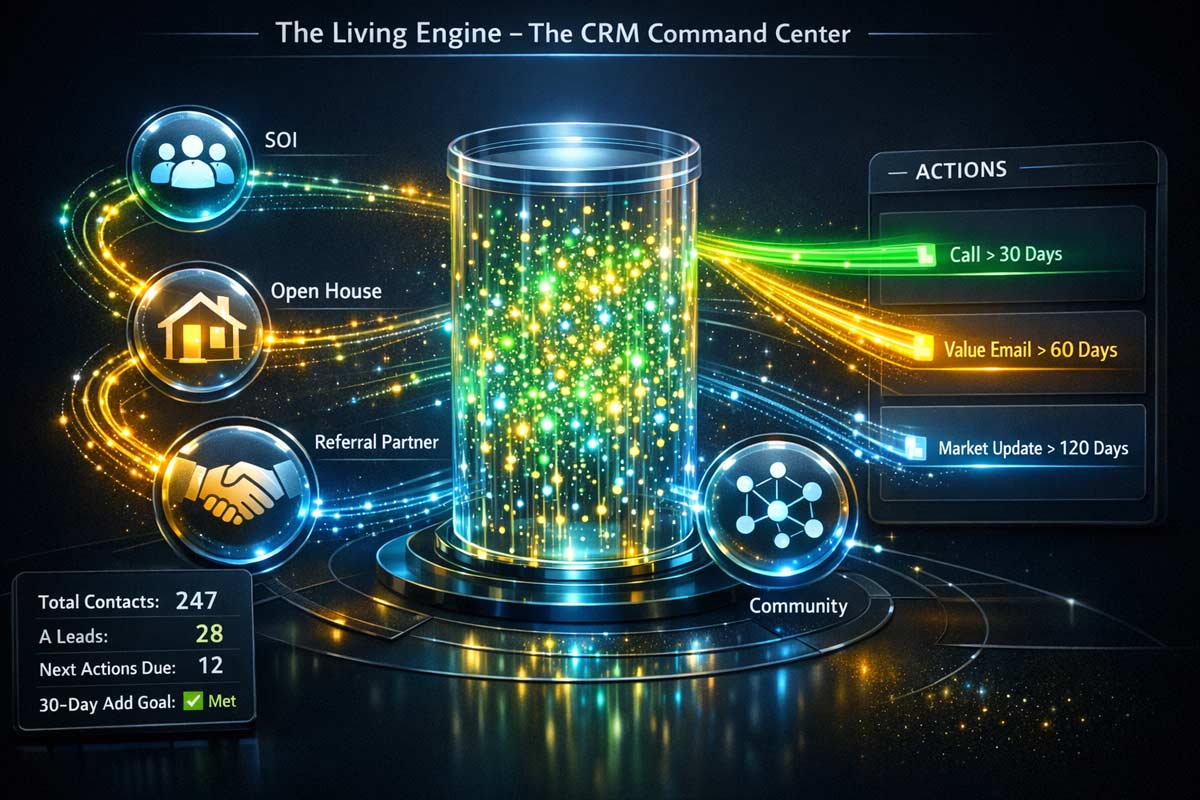
A database is not just a list of names or an exported CSV file from your phone. A database is a list with memory. It records context (notes) and creates the next action (follow-up date).
What Should You Track in a Real Estate Database?
To turn a contact list into a revenue-generating database, you need specific data points. If you don't know what columns to make in your spreadsheet, copy this exact template:
Full Name
Phone Number & Email
Preferred Contact Method (Text, Call, or Email)
City/Neighborhood (Crucial for California's hyper-local markets)
School District/Commute Corridor (The “why” behind their location)
Relationship Status (How do you know them?)
Source (Sphere, Open House, Referral, Social, Vendor)
Tags/Categories (A/B/C ranking, Buyer, Seller)
Last Contact Date
Next Follow-Up Date
Notes (Kids’ names, pets, hobbies, real estate goals)
Your First Database Rule: One Contact = One Next Action
If someone is worth saving, they’re worth scheduling. Every new entry in your system must have either:
A next follow-up date, OR
A "Do Not Contact" note.
There is no third option. Why: if it isn’t scheduled, it won’t happen.
Choose Your Tool (Without Overcomplicating)
Do not get stuck "tool shopping." You can lose weeks comparing software features while making zero phone calls.
Choose a system based on your current volume:
Google Sheets (0–100 Contacts): The fastest way to start. Google Sheets is free, searchable, and forces you to learn the mechanics of data entry.
Basic/Free CRM (100–300 Contacts): Many brokerages provide a CRM included when you join (like BoldTrail (formerly KV Core) or Chime). Use what you already have before paying for a third-party tool.
Full CRM (300+ Contacts): Only invest in premium platforms once you have a consistent lead flow and need advanced automation.
The Rule: If you have under 100 contacts, start with a spreadsheet. If you spend more than two days "researching" CRMs, you are procrastinating. Pick one and execute.
The 8 Best Places to Get Your First 100 Contacts
You aren't starting from zero; you’re starting from "unorganized." Here is where to find your first 100 entries:
Phone Contacts: Export your contact list. Don’t “clean first.” Import them, then add 25 per day for four days. Momentum beats perfection.
Past Coworkers: Start with 10 you’d confidently ask for advice. You were a professional before you were an agent; these people already trust your work ethic.
The Gym/School/Hobby Circle: Anyone you see at least once a month belongs in the database.
Vendors: Your lender, escrow officer, and local contractors. Tag these as “Vendors” to build a referral exchange.
Open House Sign-ins: This is your primary engine. Rule: If they sign in, they go into your database before you leave the property—while the conversation is still fresh enough to write real notes. Learn how new agents should hold open houses to maximize this capture.
Social DMs: Look at who “likes” your posts. Message them: “Hey [Name], I’m updating my professional directory—what’s the best email to send my local market reports to?”
Community Groups: Local neighborhood associations or Facebook groups (be the helper, not the solicitor).
Out-of-Area Agents: Tag them as “Referral Partners.” A small group of active agents outside your zip code can become your most consistent referral pipeline.
Clean Data Beats Big Data (Hygiene)
Before you chase "more contacts," fix the basics. A messy database is a useless database.
Standardize Names: "Mike Smith," not "Mike S." or "Dad's Friend."
One Primary Contact: Identify one main phone number and email per person.
Merge Duplicates: Do not have three entries for the same person.
Add "Source": Always know where a lead came from so you can track ROI later.
Fix Bouncebacks: If an email bounces or a number is wrong, update it the same day.
The "DNC" Tag: Create a "Do Not Contact" tag so you don’t burn relationships by calling people who asked you to stop.
Tagging & Segmentation: The Power of "A-B-C"
If you treat everyone in your database the same, you will burn out. You must segment your contacts so you know who to call first.
The Starter Tag Framework
Tag Category
Examples
Purpose
Ranking
A (Referral source), B (Met once), C (Cold)
Prioritizes your daily call list.
Timeline
Hot (0–3 mo), Warm (3–12 mo), Long-term
Focuses your energy on immediate deals.
Type
Buyer, Seller, Investor, Vendor, Referral Partner
Determines what kind of content you send.
Source
Open House, Sphere, Referral
Tracks which lead sources for new California agents are working.
The Follow-Up Operating System
Building the list is only 20% of the work. The remaining 80% is the follow-up. Successful agents use new agent time management strategies to ensure they aren't just "busy," but productive.
Follow-Up Cadence
"A" Leads (Referral Sources): Contact every 30 days.
"B" Leads (Met Once/Acquaintances): Contact every 60–90 days.
"C" Leads (Cold/Distant): Contact every 120–180 days (about twice a year) with broad value.
Value-Based Scripts
The "Permission" Text (Low Pressure, High Reply):
"Hey [Name]—quick question. Would it be helpful if I kept you posted when something notable happens in [Neighborhood] (sales, price changes, anything meaningful)? If yes, what’s the best email for you?"
The "Market Micro-Update" (Email/Text):
"Hey [Name], I saw that a house just like yours around the corner sold for [Price]. It's interesting to see how [City] is holding up right now. Let me know if you’d ever like a quick look at your current home value!"
The "Direct Ask" (Voice):
"I'm taking on a couple more clients this month. Who do you know that’s mentioned moving, upsizing, downsizing, or investing—even if it’s ‘later this year’?"
30-Day Build Plan
Follow this checklist to go from a blank screen to a functioning business engine.
The 30-Day Database Blueprint
Week 1: The Foundation. Create your spreadsheet using the template fields above. Import phone contacts. Apply "A, B, C" rankings to the first 50 people.
Week 2: The Reach Out. Add 25 more names. Send the "Permission" text script to everyone tagged "A" or "B."
Week 3: The Expansion. Log all responses. Call those who replied. Research how to find your first 3 clients as a new agent to convert these conversations into appointments.
Week 4: The Routine. Establish a "Minimum Daily Action": Add 5 new people, contact 5 existing people, and log 5 sets of notes.
Common Mistakes That Kill Databases
Over the last 20+ years, Kartik Subramaniam has seen thousands of students launch their careers.
The ones who fail usually hit these eight pitfalls:
Waiting until you "feel ready" to start calling.
Saving contacts with no notes (you will forget who they are).
Failing to use tags, leading to a "messy" list you eventually ignore.
No "Next Follow-Up" date— if it isn't scheduled, it won't happen.
Relying on "Likes"— social media engagement is not a database relationship.
Buying leads before you’ve exhausted your free sphere of influence.
Sounding like a salesperson instead of a local guide.
Ignoring Open Houses as a primary way to feed the database engine.
Kartik's Insider Tip: “I’ve seen agents turn a 'maybe next year' lead into a $30,000 commission simply because they had a 'follow up in 6 months' tag and actually made the call. Most agents quit after one 'no.' The database ensures you are there when the 'no' turns into a 'now.'”
Start Your Career the Right Way
A database is the difference between a "job" and a "business." Without it, you are unemployed every time a transaction closes. With it, you have a predictable stream of referrals and repeat clients.
If you are ready to move beyond the basics, it is time to look at the bigger picture of your professional development. If you’re building your first-year foundation in California, that’s the full roadmap.
Start a Real Estate Career in California →
FAQ
1. How many contacts should a new agent have?
Aim for 100 "met" contacts as quickly as possible. This is the baseline required to generate consistent referral traffic. Once you hit 100, aim for 250.
2. Do I need an expensive CRM to start in California?
No. A simple Google Sheet is often more effective for your first 100 contacts because it forces you to stay organized without the distraction of complex features.
3. What is a "Sphere of Influence" in real estate?
Your sphere of influence (SOI) consists of everyone you know personally who already likes and trusts you—friends, family, past coworkers, and neighbors. These are your warmest leads.
4. How often should I contact my database?
Contact "A" leads (referrals) every 30 days, "B" leads every 60–90 days, and "C" leads every 120–180 days (about twice a year).
5. What is the best way to ask for a referral?
Be direct but value-focused. Ask who they know that needs help navigating the current California market, rather than just asking for a name.
|
Choosing an online real estate school can feel like an endless loop of open tabs and conflicting opinions. And in real estate licensing, “close enough” isn’t close enough—if you enroll in a program Read more...
Choosing an online real estate school can feel like an endless loop of open tabs and conflicting opinions. And in real estate licensing, “close enough” isn’t close enough—if you enroll in a program that’s hard to use, light on support, or weak on exam prep, you don’t just lose money.
You lose momentum.
Over the last 20+ years, I have seen the same truth play out: the “best” online school isn’t a universal winner. It’s the one that fits how you actually learn and how your life actually runs. In the next 10 minutes, you’ll know which online format fits you, what to verify for compliance with the California Department of Real Estate, and which tradeoffs matter most—support, speed, or exam readiness.
What “Online” Really Means in 2026
In California, “online” can mean very different study experiences depending on the delivery method:
Self-Paced Online: Log in anytime. Move through modules/videos on your schedule. Maximum flexibility—requires self-discipline.
Livestream / Virtual Classroom: Scheduled sessions (often via Zoom-style platforms). Best for accountability and real-time instructor access.
Hybrid Programs: Self-paced core hours + optional live Q&A, crash reviews, or office hours to reinforce understanding.
Mobile-First Platforms: Purpose-built mobile study vs. “mobile responsive.” If you study during commutes or breaks, mobile usability becomes a deciding factor.
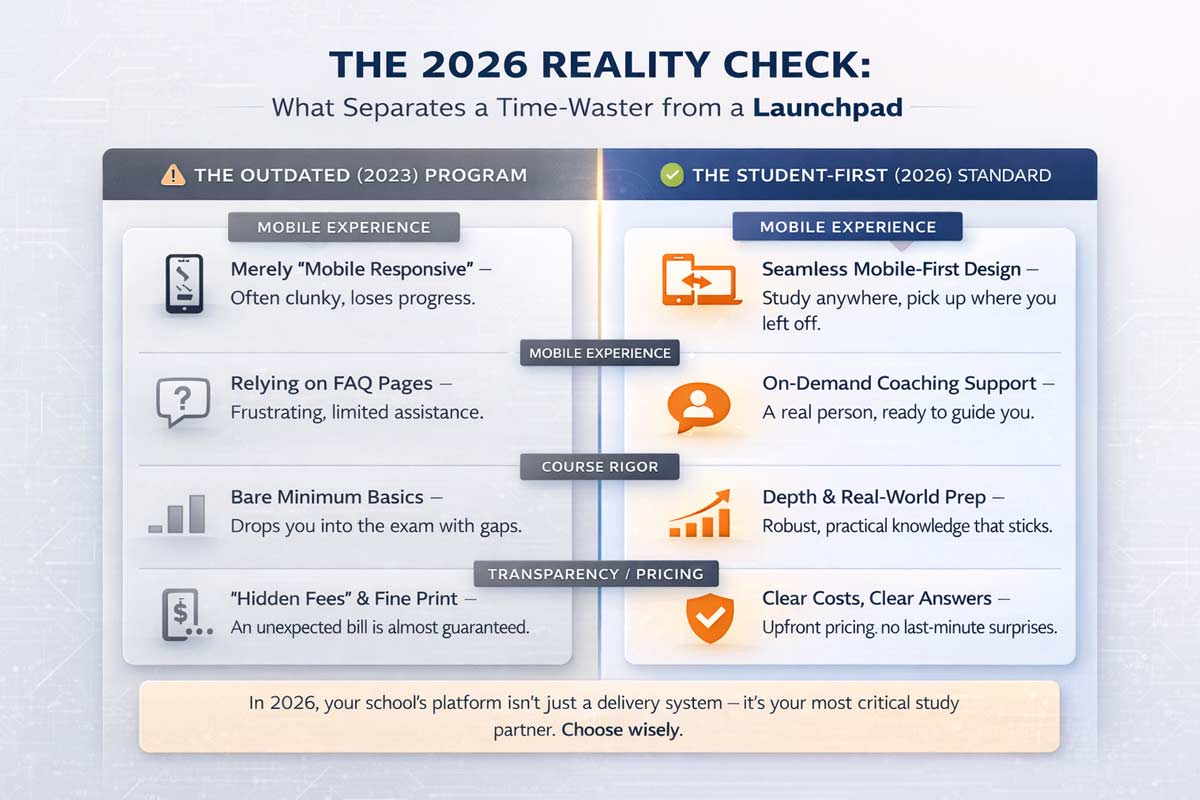
What’s Different About Online Schools Now (2026 Reality Check)
Three things separate “just acceptable” programs from programs that actually help students finish and pass:
Mobile-first study is no longer optional. The best programs let you move seamlessly between laptop and phone without losing your place.
Support quality varies wildly. “Support” is a buzzword unless you can reach a real person quickly when you’re stuck.
Course rigor matters more than ever. The DRE approves individual statutory courses and assigns sponsor IDs/approval numbers—so “thin,” outdated, or sloppy delivery isn’t just annoying; it creates avoidable exam friction.
The 2026 Rankings Framework: Finding Your “Best”
Instead of pretending there’s one perfect school for everyone, use this outcome-based framework. Find the category that matches your situation, then choose the program that checks the right boxes.
0. Best Overall for Most Students (The Balanced Choice)
What to look for: A structured path, real human support, strong real estate exam prep, and a clean user experience.
Red Flags: Unclear support channels, short access lengths (too little runway if life gets busy), and constant upsells for basics.
1. Best for Maximum Support (The “I Have Questions” Choice)
What to look for: Direct instructor access, weekly live Q&A, and a responsive student success team.
Red Flag: Ticket-only support with slow turnaround times when you’re on a deadline.
2. Best for Fast Completion (The “I Need This Done” Choice)
What to look for: A streamlined interface, clear progress tracking, and a smooth certificate process (no bottlenecks).
Red Flag: Clunky navigation that turns study time into frustration time.
Deep Dive: If speed is your primary driver, read the deeper breakdown here: Fastest Real Estate License Programs in California.
3. Best for Exam Prep Strength (The “One-and-Done” Choice)
What to look for: High-volume practice questions, exam-style simulations, and strong explanations (not just “right/wrong”).
Red Flag: Exam prep treated as a “bonus” instead of an essential part of passing.
4. Best for Budget-Focused Students (The “Value” Choice)
What to look for: Transparent pricing and packages that clearly include your required courses.
Red Flag: Teaser pricing that later charges extra for key items (certificates, support, prep tools).
Deep Dive: Before you pick the lowest sticker price, read the tradeoffs here: Cheapest Real Estate Schools in California (Pros & Cons).
🔶 The ADHI Standard (What a “Student-First” Program Should Include)
This isn’t about hype—it’s about what actually helps students finish. It’s also how ADHI designs programs internally:
Clarity: A step-by-step study path so you’re never guessing what’s next.
Support: Real help when you’re stuck (not a black-hole ticket system).
Prep Depth: Enough practice to build confidence before exam day.
Usability: Mobile-friendly study that fits into a working schedule.
No Surprises: Transparent inclusions so you’re not nickel-and-dimed later.
Use that as your checklist when comparing options—no matter what provider you’re looking at.
📘 Related Guides
Best In-Person Real Estate Schools in California
Cheapest Real Estate Schools in California (Pros & Cons)
Fastest Real Estate License Programs in California
Most Popular Real Estate Schools in California (Student Volume)
The Non-Negotiables Checklist
Quick note: the DRE approves individual statutory courses (and assigns sponsor IDs/approval numbers). Always verify the course approvals—not just marketing claims.
DRE Course Approval: Verify the specific course approval/sponsor ID in the DRE database (secure.dre.ca.gov).
Statutory Hours: Ensure the program satisfies the required 135 hours of statutory coursework.
Device Compatibility: Does it work smoothly on phone + laptop (without glitches)?
Access Duration: Enough time to finish without stress (6–12 months).
Refund Policy: Clear, written, and easy to find.
Online vs. In-Person: The Final Decision
A lot of students start by looking for the Most Popular Real Estate Schools in California, but popularity doesn’t guarantee fit.
Choose online if you need schedule flexibility and you’re comfortable learning independently. Choose in-person if you need a structured environment to stay consistent.
To compare online, in-person, cheapest, fastest, and popularity-based options side-by-side, use our Best Real Estate Schools in California hub.
FAQ
Is online real estate school allowed in California?
Yes—California allows pre-license/statutory coursework to be completed through approved offerings, including online formats, as long as the course is properly approved/listed. (California Department of Real Estate)
How do I verify DRE approval?
Use the DRE statutory course search and confirm the specific course approval and sponsor details. Remember: DRE approval is tied to courses (with sponsor IDs/approval numbers), not blanket marketing claims. (California Department of Real Estate)
Self-paced vs. livestream—what’s better?
Self-paced is best for flexibility. Livestream is best for accountability and real-time Q&A. Hybrid works well if you want both.
Can I finish faster online?
Online programs can help you move efficiently because you aren’t waiting for scheduled class dates. That said, California rules limit how quickly statutory courses can be completed: a single course may not be completed in less than 2½ weeks, and no more than two courses may be completed in any five-week period. (California Department of Real Estate)
Does an online school include exam prep?
It varies. Some include robust prep tools in the base package; others treat it as an add-on. If you want to pass with fewer attempts, prioritize programs in the “Exam Prep Strength” category.
How long do I have access to the course?
Access lengths vary by provider. The key is to choose enough runway so you don’t feel forced to rush if work or life gets busy.
Key Takeaways
Verify course approval (not marketing). Confirm sponsor/course approvals in the DRE database.
Choose the format that matches your life. Self-paced vs. livestream vs. hybrid is the real decision.
Exam prep is what gets you across the finish line. Courses earn credit; prep earns confidence.
Avoid surprise fees and weak support. Transparent inclusions + real help matter.
Plan your timeline around DRE pacing rules. 2½ weeks per course; max two courses per five weeks.
Ready to choose?
Compare online, in-person, cheapest, fastest, and popularity-based paths in our Best Real Estate Schools in California hub.
|

You’ve passed the real estate exam, your license is hanging at a brokerage, and the initial celebration has subsided. Now, you’re staring at a blank calendar and a quiet phone. It’s what I call the Read more...
You’ve passed the real estate exam, your license is hanging at a brokerage, and the initial celebration has subsided. Now, you’re staring at a blank calendar and a quiet phone. It’s what I call the “post-license cliff”. This moment is particularly acute in California, where high competition meets complex markets, and the pressure to “figure it out fast” can lead new agents toward expensive, ineffective shortcuts.
If you’re a new real estate agent in California wondering how to get your first clients without buying leads, this article is your playbook. Securing your first three clients isn't just about income—it’s about proof of concept. In my 20+ years of working in the California real estate market, I’ve noticed the agents who survive the first year are those who replace "hustle" with systems and processes.
What Success Looks Like in 30 Days
Before we dive in, let’s define a "win." Success in your first month isn't measured by closed escrows—it’s measured by inputs. These inputs work because they maximize trust-building touches, not impressions. If you follow this operating system, your 30-day scoreboard should look like this:
100+ Real Conversations (5 per business day)
40+ Contacts added to your database
4 Open Houses hosted
1–2 Buyer Consultations booked
Practice Over Profit: The First 3 Principle
This is the phase where most new real estate agents in California either build momentum—or quietly stall. Your first three clients are your learning labs. You are building the muscle memory of a professional. Success here comes from
Practice + Proximity + Follow-up
not expensive marketing.
Before You Prospect: Two Things You Must Set Up This Week
Before you pick up the phone, you need a professional foundation. California’s disclosure-heavy environment means your first clients are as much about the learning process as closing deals.
Broker Expectations: Sit down with your broker or team lead. Ask for (a) upcoming open house opportunities, (b) "floor time" for walk-ins (if this is still a thing in your area), and (c) their preferred CRM.
Compliance Guardrails: This is California—disclosures matter. Don’t wing it. Don't promise specific financial outcomes, keep all communications professional, and stay within your brokerage’s legal policies.
Pathway 1: The "Inner Circle" Strategy (The Database)
The Reality: Your first client is almost always someone you already know, or someone they know. People do business with people they trust.
The Action Plan: Stop "announcing" your career and start consulting. Use these micro-scripts to offer value:
The Call: "I’ve officially launched my real estate practice. I’m not calling for business—I just want to be your resource. If you ever need a quick valuation or want to know what’s moving in the neighborhood, I'm here."
The Text: "Hey! Just wrapped up my licensing. If you ever have a random real estate question or need a vendor recommendation, feel free to reach out!"
Micro-Credibility Boost:
Avoid: “I just got licensed and I’m looking for clients.”
Use: “I’m building my practice and want you to have a real resource.”
The 14-Day Follow-Up Cadence:
Day 0: Initial outreach (Call/Text).
Day 7: Value Touch (Send a quick, one-page market snapshot of their specific zip code).
Day 14: The Soft Ask: "I’m helping a few people find homes this month. Do you know anyone else thinking about a move this year?"
The Deeper Resource:
A "system" is simply: Name + Source + Last Contact + Next Action. In week one, a spreadsheet is fine. To move toward a sustainable pipeline, you need to build a real estate database from scratch.
Pathway 2: The Open House Capture & Conversion
The Reality: Open houses are one of the few places consumers actually expect to talk to an agent. It is a high leverage use of your time.
The Action Plan (The 3-Step Flow):
The Welcome: "Welcome! Are you from the neighborhood or just starting your search?"
The Qualification: "Have you seen anything else in this price point, or are you still getting a feel for the local inventory?"
The Close for the Next Step: "I have a list of three similar homes nearby that aren't on everyone's radar yet. Would you like me to send those over?"
A productive open house for a new agent isn’t measured by attendance—it’s measured by 2–3 follow-up conversations scheduled within 48 hours.
The Deeper Resource:
To turn a handshake into a contract, you need a specific follow-up method. Learn the full process in our guide: How New Agents Should Hold Open Houses in California.
Pathway 3: Leverage Office Inventory & Stale Leads
The Reality: While most agents chase "perfect" leads, you can find your first three clients by looking where others don't.
High-volume agents often ignore these opportunities because they require follow-up instead of marketing scale.
The Action Plan:
Support High-Volume Listings: Call top listing agents in your office. Offer to host their "stale" listings or prospect the surrounding neighborhood for them.
Renters-to-Buyers: Many people attending open houses are currently renting. Position yourself as the guide who helps them transition.
The Guardrails: Always follow "Do Not Call" rules and brokerage policy. Your job is service, not pressure. Once you've mastered these manual methods, you can explore broader lead sources for new California agents to scale.
The Two Moments That Start Real Careers
Moment #1: Someone trusts you enough to ask a "small" question (e.g., "What's my neighbor's house listed for?").
Moment #2: You followed up when the "rockstar" agent in your office forgot to.
Neither moment looks dramatic—but both are how real careers actually start.
Practical Pitfalls
Most new agents quit because they confuse activity with income-producing actions. This is how agents stay ‘busy’ for six months and exit the industry silently.
The below activities do NOT count as prospecting:
Perfecting your logo or business cards.
Scrolling Instagram for "content ideas."
Endlessly "tinkering" with CRM tags.
Watching "motivational" YouTube videos.
Re-designing your email signature.
The only 3 activities that count:
Real conversations
Intentional follow-up
Studying local inventory.
Managing this focus is the difference between a hobby and a career. Implement these New Agent Time Management Strategies to stay on track.
Your 30-Day Plan (Simple Version)
Week
Primary Focus
Daily Minimum
Week 1
Database Outreach + 1 Open House
5 Conversations
Week 2
Follow-ups + 1 Open House
5 Conversations
Week 3
Repeat + Book 1 Buyer Consult
5 Conversations
Week 4
Tighten Pipeline + Ask for Referrals
5 Conversations
Note: Five conversations means real two-way dialogue—not texts sent or DMs unanswered.
The Path Forward
Finding your first three clients is the hardest part of this business because it requires the most faith. But once you close that third deal, the "imposter syndrome" fades.
Mastering these first three clients is how you build a durable practice, not just a fleeting side hustle. For the complete framework on launching correctly—from mindset to long-term planning—your next step is our foundational guide: Start Your Real Estate Career in California.
|
If you are eyeing a career change or a major commission goal, you probably want your license like yesterday. But in California, "fast" is governed by two different clocks that most students confuse:
Read more...
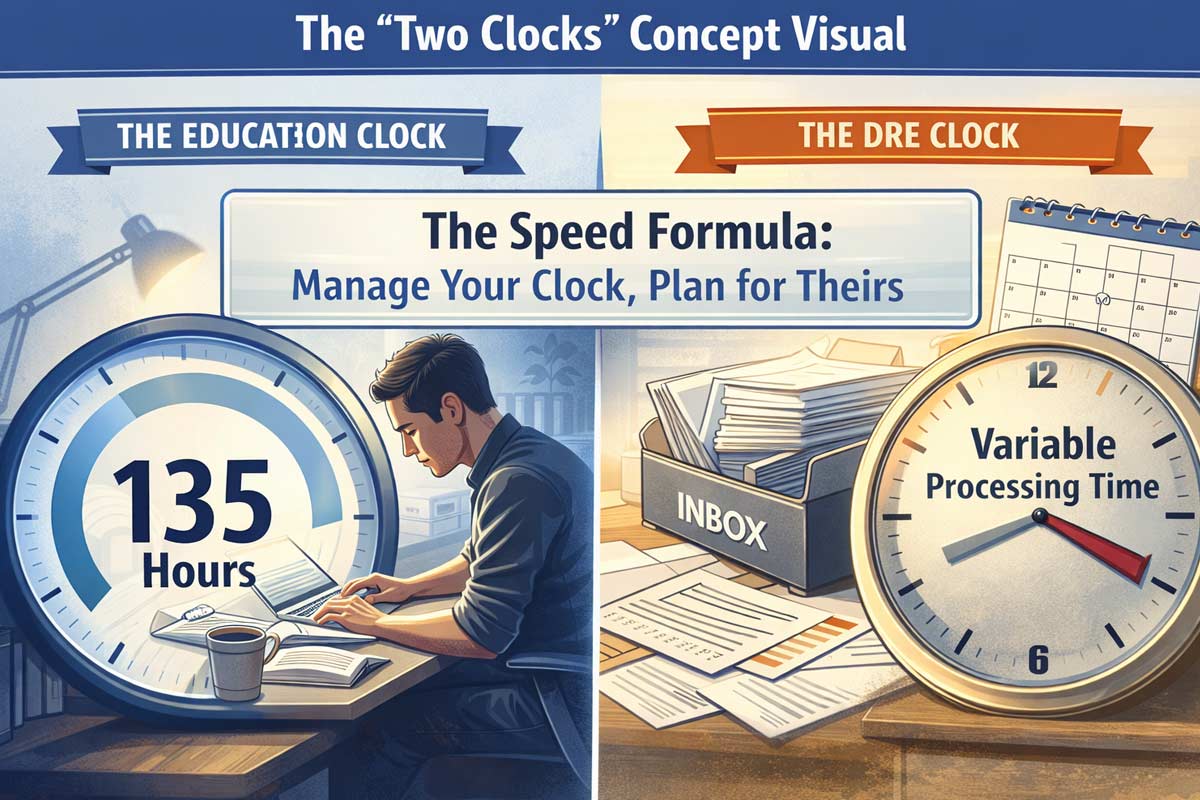
If you are eyeing a career change or a major commission goal, you probably want your license like yesterday. But in California, "fast" is governed by two different clocks that most students confuse:
The Education Clock: This covers the 135 hours of required coursework. Provider rules vary, and approved DRE-approved providers enforce a minimum access period before you can attempt a course final. The absolute "minimum" timeframe assumes you never miss a day of study and your provider’s pacing rules allow for aggressive, back-to-back completion.
The DRE Clock: This is the time it takes the Department of Real Estate (DRE) to process your exam/license application and move you forward in the system. The important detail is that processing speed isn’t fixed—it changes based on volume and the submission method. The most accurate way to set expectations is to check the DRE’s published Current Processing Timeframes and plan your education pace around that reality.
The "fastest" program isn't the one that makes empty promises; it’s the one that removes friction so you don't spend a single extra day in limbo.
TL;DR: The Speed Formula
Min. Education Time: Dependent on provider access rules - typically minimum of 54 days to complete all three courses. (18 days per course x 3 courses = 54 days)
DRE Processing: Varies by season—check DRE “Current Processing Timeframes” before you plan your target test month.
The Strategy: Finish your 135 hours while simultaneously preparing for the state exam so you pass on the first try.
What “Fastest” Actually Means in California
Speed is relative. A "fast" program helps you avoid the "Typical Path" where students stall out due to a lack of structure.
Phase
Typical Path
The Fast Path
135 Hours of Education
6–12 Months (Procrastination)
+/- 2 Months (Consistent Pace)
Application Submission
2 Weeks after finishing
Same day certificates arrive
Exam Prep
Starts after getting an exam date
Starts during the 135 hours
Passing the Exam
2–3 attempts
1 attempt (High Readiness)
The 4 Biggest Speed Levers (The Framework)
After 20 years of helping students at ADHI Schools, I’ve seen that speed isn't about how fast you read—it's about how you manage these four levers:
Format Fit: If you hate reading screens, a self-paced online course will be your slowest option because you’ll avoid it. Pick the format you will actually show up for.
Weekly Pace: Speed requires a calendar. We find that students who commit to 10 hours per week finish with the highest momentum.
Support Speed: When you’re stuck on a concept, waiting three days for an email reply kills your drive. Fast programs offer immediate clarity.
Completion Workflow: The fastest schools (like ADHI Schools) have automated certificate delivery and clear "Next Step" checklists. You shouldn't have to wonder how to apply for the state exam.
Speed Tip #1: The Concurrent Strategy
Don't wait until you finish your 135 hours to look at real estate exam prep. Start reviewing practice questions by your third week of study to keep the material fresh.
Fastest Education Formats (Pros/Cons)
There is no "best" format, only the one that keeps you moving.
Self-Paced Online
Best for: Highly disciplined individuals with erratic schedules.
Pros: Access 24/7; move as fast as the provider’s minimum access rules allow.
Cons: High "stall-out" rate. Without a teacher, many students stop mid-way.
Compare options in our guide to the Best Online Real Estate Schools in California (2026 Rankings).
Live Online (Livestream)
Best for: Career changers who need a "place" to be.
Pros: Scheduled classes prevent procrastination; real-time Q&A removes hurdles instantly.
Cons: You must adhere to the school's lecture calendar.
Check out the Best In-Person Real Estate Schools in California to see how structured environments compare to livestream.
The Hidden Bottlenecks That Slow People Down
Most students lose weeks to avoidable errors. I call these "Speed-Killers."
The Paperwork Trap: Sending an incomplete application to the DRE can result in a 60 day delay.
The Procrastination Gap: Taking a "break" between finishing Course 1 and starting Course 2.
The Overconfident Crammer: Trying to learn everything the night before the state exam, failing, and having to wait weeks for a re-take.
Speed-Killer Checklist:
Did you include your Live Scan (fingerprints) with your application?
Is your check/credit card info for the DRE accurate?
Have you scheduled 2 hours of study for tomorrow?
Speed Tip #3: Treat Live Scan like a first-week task
Many delays happen when students finish their education, then start gathering documents. If you’re trying to move fast, handle Live Scan and your application checklist early so you’re ready to submit immediately when certificates are issued.
How to Build a 30–60 Day “Fast Track” Plan
To finish the education portion efficiently, follow one of these blueprints:
Plan 1: The Aggressive Track (Full-Time Focus)
Monday–Friday: 3 hours of reading/quizzes (Morning block).
Saturday: 2 hours of review.
Goal: Complete each course the moment your provider’s access period allows.
Plan 2: The Busy Professional (Nights & Weekends)
Tuesday/Thursday: 2 hours (Evening).
Saturday/Sunday: 4 hours each day.
Goal: Finish the 135 hours in 8 weeks without burning out.
What to Look For in a “Fast” California Real Estate School
When evaluating schools, use this rubric to ensure they won't hold you back:
Transparent Access Rules: Do they explain their minimum course duration clearly?
Exam Prep Integration: Is the "how to pass" part of the "how to finish" process?
Mobile-Friendly: Can you knock out 15 minutes of reading while waiting for a coffee?
Alumni Volume: Large schools often have more streamlined systems. (See the Most Popular Real Estate Schools in California).
Price vs. Value: The Cheapest Real Estate Schools in California might save you $50 but cost you months in slow support or outdated materials.
FAQ
What is the fastest possible time to get licensed in California?
Realistically, the “fast track” is a few months, assuming you (1) keep a consistent weekly pace through the 135 hours, (2) submit your application immediately when your certificates are issued, and (3) prepare during the coursework so you pass on the first attempt. Because DRE volume changes, the most accurate planning tool is the DRE’s Current Processing Timeframes page.
Can I do all 135 hours in a weekend?
No. Pre-licensing is not the same as continuing education. A compliant pre-license program must document and administer the course in a way that matches the approved instructional time and delivery rules for licensing credit. If a provider implies you can complete the full 135-hour requirement in a weekend, the risk is simple: the credit may not hold up when you apply.
Does in-person make it faster?
Only if you are someone who won't study at home. Accountability is a massive speed booster.
Is self-paced always the fastest?
On paper, yes. In practice, no. Without a schedule, many students take a year to finish what should take two to three months.
What delays the DRE process?
Errors on the application, missing fingerprint receipts, or peak seasons when thousands of people apply at once.
Your Next Step
Speed is a byproduct of a good system. Choosing a program that aligns with your learning style is the single most important decision you will make. While you might be tempted by the "easiest" or "cheapest" option, the fastest way to start earning commissions is to choose a school that provides a clear, friction-free path to the state exam.
Ready to find the right fit?
Check out our comprehensive breakdown of the Best Real Estate Schools in California to compare programs and start your journey today.
TLDR: To get your California real estate license as fast as realistically possible, you must complete 135 hours of DRE-required pre-licensing education (Principles, Practice, and an elective) and then clear the DRE’s application + exam scheduling timeline. Course pacing depends on the provider’s access rules and your weekly schedule, while the DRE timeline fluctuates throughout the year—so the true “fast track” is finishing your education on a strict plan while preparing for the state exam at the same time, so you pass on the first attempt.
|
For a brand-new California real estate agent, the first few months can feel like a race against an empty pipeline. You have a real estate license and ambition, but you don't yet have the clients.
This Read more...
For a brand-new California real estate agent, the first few months can feel like a race against an empty pipeline. You have a real estate license and ambition, but you don't yet have the clients.
This is why the open house remains an undisputed "fast track" to success. It provides the high-volume conversation reps you need and the immediate lead capture required to build a business from zero.
Who This Article Is For:
New Licensees: (0–12 months) looking for a repeatable system.
The Systems-Minded: Agents who want to move from "hosting" to "converting."
In California, an open house is more than a public showing—it’s a high-intent prospecting event. When run correctly, it becomes one of the best repeatable lead sources available to a new agent (especially when paired with other proven lead sources for new California agents).
Fair warning - if you don’t capture usable contact info from guests, you can’t follow up—and the open house becomes a branding event instead of a pipeline event. To win, you need to transition from "showing a house" to "running an operating system."
The Open House Kit (What to Bring)
Your goal is to look calm and prepared—because prospects pair “prepared” with “competent.” Pack this like a pilot packs a flight bag:
Signage: 10–15 directionals + 1 main “Open House” sign.
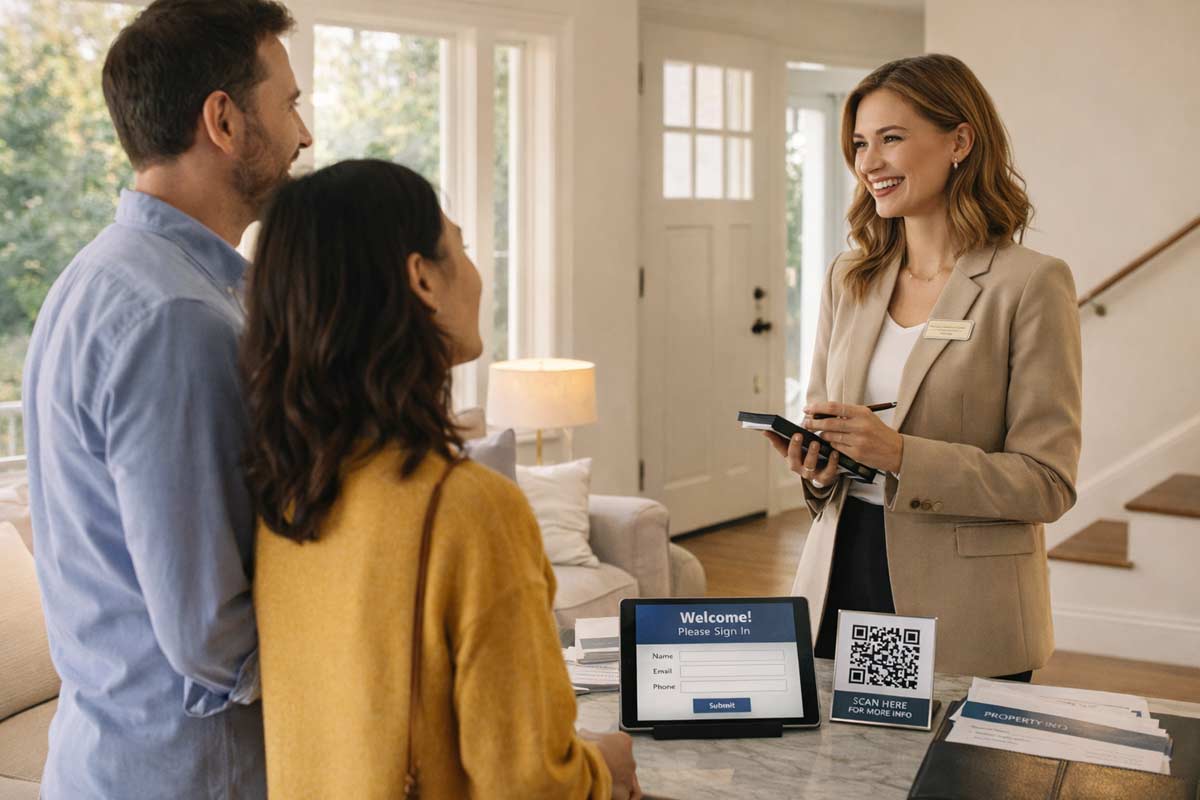
Lead Capture: QR placard + tablet sign-in + paper backup.
Property Materials: Feature sheets + disclosure packet access + MLS remarks.
Script Support: 1 small note card with your greeting + 3 discovery questions.
Ops Essentials: Pens, tape, small stapler, portable charger, water.
Safety Basics: Fully charged phone, keep keys on you, clear exit path.
California Note: Sign placement rules and HOA sensitivity vary by city—always confirm your brokerage standards and be respectful about placement to avoid fines.
The 90-Minute Open House Timeline (New Agent Checklist)
Follow this timestamped sequence to ensure you never look "scrambled":
45 minutes prior: Arrive at the property. Open all blinds, turn on every light, and do a quick "sanity sweep."
35 minutes prior: Signs placed + QR code placard at the entry.
25 minutes prior: Set up your "command center" (usually the kitchen island) with sign-in sheets and flyers.
15 minutes prior: Walk the "tour path" one last time. Rehearse your greeting.
Start: Greet guests warmly, but let them tour at their own pace.
During: Ask 2–3 discovery questions max. Jot down notes in between visitors.
End: Final lap, lock up, and retrieve signs.
30 minutes after: Enter all new leads into your CRM and tag them with specific notes.
Same Day: Send the first follow-up text to every "hot" prospect.
The Conversation System: Scripts That Convert
The biggest mistake new agents make is being too aggressive or too passive. Use these "Operator" scripts to gather data without the "salesy" vibe.
The Neighbor Line (The Listing Goldmine):
"Are you here because you’re curious about the value of your own place, or do you know someone thinking of moving into the neighborhood?"
The "We Already Have an Agent" Pivot:
"Perfect—then you’re in good hands. Are you already touring homes this weekend, or still narrowing neighborhoods?"
If Someone Refuses to Sign In:
"Totally fine—please take a look around. If you decide you want a feature sheet, or updates on similar homes in this school district, the QR code on the table makes it easy for me to send those over."
The Follow-Up Operating System
Every open house is a database-building event—log your leads the same day to avoid "lead decay."
To make this automatic, block time for it. The easiest way is to treat every open house like a scheduled workflow: 30 minutes after lock-up for CRM entry and 20 minutes that evening for follow-ups.
If you don’t protect that time, the week fills up and your leads decay—this is exactly why new agent time management strategies matter early in your career.
Email Template (Day 1)
Subject: Oak Street open house — quick follow-up
Body:
“Hi [Name] — great meeting you today at the Oak Street open house. Based on what you mentioned regarding your [Timeline] and [Specific Feature], I pulled 3 similar options currently on the market: [Links].
If you want, reply with your 'must-haves' and I’ll tailor a search for you. — [Your Name]”
California Compliance & Professionalism
As I have observed over 20+ years of training agents, professionalism in California is defined by how you handle the "gray areas."
Do
Don’t
Ask about timeline, financing readiness, and search criteria.
Ask about family status, religion, or national origin.
Offer disclosures and encourage professional inspections.
Speculate on protected-class suitability or schools.
Maintain a clear exit path and stay between guests and the door.
Follow people into small rooms or turn your back to a crowd.
Building Your System
Open houses work best when they’re part of a weekly prospecting cadence—so you’re not relying on luck, you’re running a pipeline. By using this system, you ensure that every weekend moves you closer to finding your first 3 clients as a new agent.
If you're ready to move beyond the "hosting" phase and start operating like a pro, it's time to Start a Real Estate Career in California with the right education and strategy.
FAQ: Open Houses for New Agents in California
Do I need to make everyone sign in at an open house?
No—but you do need a professional way to capture contact info if you want follow-up to be possible. Use a QR placard + soft language: “If you’d like a feature sheet, or updates on similar homes, the QR makes it easy for me to send them.” Some brokerages prefer a hard sign-in policy, others don’t—confirm your office standard.
What if the open house is dead and nobody shows up?
A slow open house still has value if you treat it like a pipeline block, not a social event. Use the time to:
Tighten your tour path + talking points,
Practice your script out loud,
Message neighbors and past visitors,
and review your follow-up workflow so you execute it automatically next time.
If your traffic is consistently low, pair open houses with other lead sources for new California agents so your week doesn’t depend on Saturday luck.
How many open house signs should a new agent use?
A good baseline is 10–15 directionals plus one main sign, placed at key turns that funnel traffic to the home. Keep them clean, consistent, and easy to read. Placement rules and HOA sensitivity vary by city—use good judgment and follow your brokerage policy.
What should I say when someone asks, “Is the seller desperate?”
Stay professional and stay factual. A clean response is: “I can’t speculate on motivation, but I can share what’s publicly available—price history, disclosures, and recent comparable sales.”
How do I follow up after an open house without sounding salesy?
Follow-up feels “salesy” when it’s vague. Make it helpful and specific:
“Here are 3 similar homes based on what you said.”
“Want disclosures/inspection reports sent over?”
“Do you want alerts for homes with [feature] in [area]?”
Then keep your cadence consistent—this is why new agent time management strategies matter early.
How soon should I follow up after an open house?
Same day is ideal—while the conversation is fresh. A simple standard:
Same day: quick text if opted-in
Day 2: “one helpful thing” (disclosures, comps, lender intro)
Day 7: soft next step
Log everyone into your CRM the same day so the open house becomes a true database-building event.
Should I sit or stand during an open house?
Stand if possible. Sitting signals “hosting.” Standing signals “present and available.” You don’t need to hover—just stay positioned so you can greet people without blocking the entry and maintain a clear safety posture.
How do I get clients from open houses if I’m not the listing agent?
By treating the home as the stage and the visitors as the opportunity. Your job is to:
Greet + create comfort,
Ask 2–3 discovery questions,
Capture contact info via value (disclosures, feature sheet, comps),
Follow up the same day.
|

Many aspiring agents begin their journey with a specific conviction:
"I need to be in a classroom”
It makes sense. To get a California real estate license, you must complete 135 hours of college-level Read more...
Many aspiring agents begin their journey with a specific conviction:
"I need to be in a classroom”
It makes sense. To get a California real estate license, you must complete 135 hours of college-level pre-licensing education. For many, the idea of sitting alone in front of a computer screen for weeks on end is a recipe for procrastination.
You aren’t necessarily looking for a physical desk; you are looking for the "in-person effect"—the structure of a schedule, the ability to ask a live human a question, and the accountability that comes from knowing a class is starting with or without you.
In this guide, we evaluate how to find the best in-person real estate schools in California and explore how modern "live instruction" provides a viable path for busy professionals.
Defining Your Options: Classroom vs. Live Online vs. Self-Paced
Choosing the wrong format is one of the most common reasons we see students struggle to reach the state exam. In California, the Department of Real Estate (DRE) permits both "Live" and "correspondence" (home study) formats. Most modern live-instruction programs—including those delivered via Zoom—are often classified as distance or correspondence delivery, but they aim to replicate the traditional classroom experience.
Format
Best For...
What You Get
The Trade-off
Physical Classroom
Total separation from home distractions.
In-room energy & local networking.
Commute time, parking, & rigid schedules.
Live Instructor-Led (Zoom)
The "In-Person Effect" without the drive.
Live real estate classes with real-time Q&A.
Requires a quiet space and stable Wi-Fi.
Self-Paced Online
Maximum flexibility or strict budgeting.
Pre-recorded or text-based modules.
Requires strong self-discipline and time blocks.
If you are currently weighing your budget against your learning style, you may want to cross-reference the cheapest real estate schools in California to see how these formats impact your total investment.
How to Evaluate Any "In-Person Style" Program
Based on my 20+ years of preparing California license applicants, a school shouldn't just be "near you"—it needs to be effective. Use these criteria to evaluate any provider:
DRE Approval & Compliance: Verify the school is legally vetted by the California Department of Real Estate for the required three courses.
Instructor Access: If you are stuck on a concept like Negative Amortization, can you get a live answer?
Schedule Reliability: Does the school have a consistent calendar, or do they frequently cancel sessions?
Student Support: Is there a team available to help with certificates and DRE applications?
Exam-Prep Synergy: The 135-hour certificates are the legal requirement, but the state exam is the hurdle. The most popular real estate schools in California often weave exam strategy into every live session.
The Reality of Physical Classrooms in California
Who Should Still Choose a Physical Classroom?
While digital options are growing, the traditional classroom still serves a specific group of learners. You should consider a true in-person school if:
You lack a quiet, private space at home to attend a live digital session.
You thrive on the physical energy of a room and prefer face-to-face networking.
You live or work within 15 minutes of a reputable classroom.
The "Commute Friction" Factor
In practice, we’ve observed that for students in high-traffic hubs like LA, Orange County, or the Inland Empire, the commute is the friction that kills consistency. If a class starts at 6:00 PM and you are stuck on the 405 or the 10, the stress of the drive often leads to missed sessions. In our experience, we often see completion rates fall off fast after two missed sessions.
For those who need to finish quickly, it’s worth comparing these logistics against the fastest real estate license programs in California.
The Modern Solution: Live Instructor-Led Zoom Classes
At ADHI Schools, we focus on delivering the "in-person effect" through scheduled, live-streamed sessions. This format is designed for the modern California life:
The Full-Time Professional: Join class after work without needing to find parking downtown.
The Parent: Stay home and engage in high-level instruction while remaining accessible to your family.
The "Accountability" Learner: You show up because there is a live expert waiting to teach you. This is why many consider it among the best online real estate schools in California for those who dislike traditional "self-paced" modules.
Related Deep Dives
The Big Picture: Best Real Estate Schools in California
Speed: Fastest Real Estate License Programs in California
Budget: Cheapest Real Estate Schools in California
Flexibility: Best Online Real Estate Schools in California
Reputation: Most Popular Real Estate Schools in California
Decision Framework: Finding Your Fit
Do you have the self-discipline to read 1,000+ pages of dry material alone?
Yes: Self-paced online might work.
No: You need a live instructor. (Go to Step 2).
Is there a DRE-approved physical classroom nearby and you can reliably attend?
Yes: Physical classroom is a solid option.
No: The drive will likely become a barrier. (Go to Step 3).
Do you want the structure of a classroom with the comfort of home?
Yes: Live Instructor-Led Zoom is your best bet.
No: If you just want the lowest price and no schedule, self-paced is your default.
FAQ: In-Person Schools vs. Live Instruction
Are in-person real estate classes required in California?
No. You can fulfill your 135-hour requirement via classroom or correspondence formats.
Is live Zoom considered "in-person"?
Legally, it is usually categorized as correspondence or distance learning, but functionally, it offers the same real-time interaction as a physical classroom.
What if I work full time?
Live Zoom instruction is a top choice for full-time workers. It provides the rigid schedule needed for discipline without the added 5–10 hours a week of California traffic.
Choosing Your Path
The "best" school is the one that fits your life well enough to let you finish. While a physical building has its benefits, the flexibility of live instructor-led classes has become the most practical option for many busy Californians.
Ready to see how ADHI Schools stacks up? Explore our comprehensive breakdown of the Best Real Estate Schools in California or join one of our upcoming live sessions to experience the "in-person effect" for yourself.
|