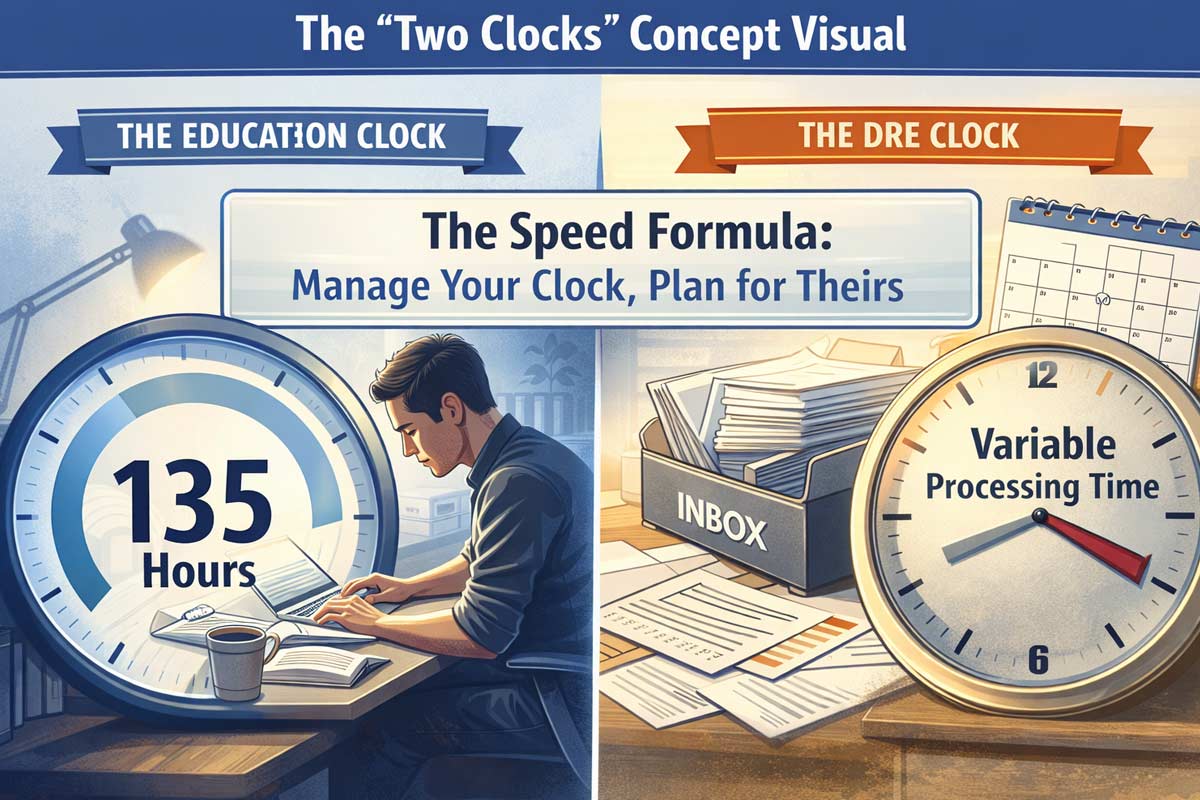
If you are eyeing a career change or a major commission goal, you probably want your license like yesterday. But in California, "fast" is governed by two different clocks that most students confuse:
The "fastest" program isn't the one that makes empty promises; it’s the one that removes friction so you don't spend a single extra day in limbo.
TL;DR: The Speed Formula
Speed is relative. A "fast" program helps you avoid the "Typical Path" where students stall out due to a lack of structure.
After 20 years of helping students at ADHI Schools, I’ve seen that speed isn't about how fast you read—it's about how you manage these four levers:
Don't wait until you finish your 135 hours to look at real estate exam prep. Start reviewing practice questions by your third week of study to keep the material fresh.
There is no "best" format, only the one that keeps you moving.
Most students lose weeks to avoidable errors. I call these "Speed-Killers."
Many delays happen when students finish their education, then start gathering documents. If you’re trying to move fast, handle Live Scan and your application checklist early so you’re ready to submit immediately when certificates are issued.
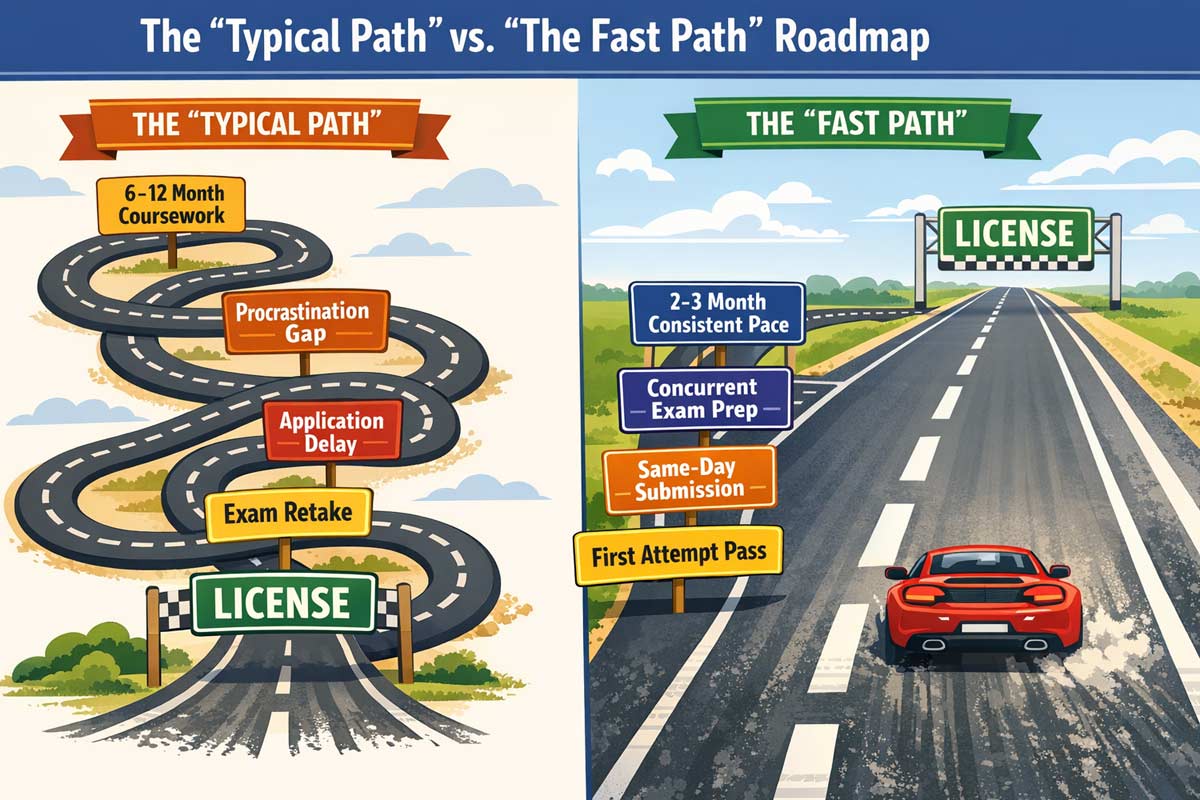
To finish the education portion efficiently, follow one of these blueprints:
When evaluating schools, use this rubric to ensure they won't hold you back:
What is the fastest possible time to get licensed in California?
Realistically, the “fast track” is a few months, assuming you (1) keep a consistent weekly pace through the 135 hours, (2) submit your application immediately when your certificates are issued, and (3) prepare during the coursework so you pass on the first attempt. Because DRE volume changes, the most accurate planning tool is the DRE’s Current Processing Timeframes page.
Can I do all 135 hours in a weekend?
No. Pre-licensing is not the same as continuing education. A compliant pre-license program must document and administer the course in a way that matches the approved instructional time and delivery rules for licensing credit. If a provider implies you can complete the full 135-hour requirement in a weekend, the risk is simple: the credit may not hold up when you apply.
Does in-person make it faster?
Only if you are someone who won't study at home. Accountability is a massive speed booster.
Is self-paced always the fastest?
On paper, yes. In practice, no. Without a schedule, many students take a year to finish what should take two to three months.
What delays the DRE process?
Errors on the application, missing fingerprint receipts, or peak seasons when thousands of people apply at once.
Speed is a byproduct of a good system. Choosing a program that aligns with your learning style is the single most important decision you will make. While you might be tempted by the "easiest" or "cheapest" option, the fastest way to start earning commissions is to choose a school that provides a clear, friction-free path to the state exam.
Ready to find the right fit?
Check out our comprehensive breakdown of the Best Real Estate Schools in California to compare programs and start your journey today.
TLDR: To get your California real estate license as fast as realistically possible, you must complete 135 hours of DRE-required pre-licensing education (Principles, Practice, and an elective) and then clear the DRE’s application + exam scheduling timeline. Course pacing depends on the provider’s access rules and your weekly schedule, while the DRE timeline fluctuates throughout the year—so the true “fast track” is finishing your education on a strict plan while preparing for the state exam at the same time, so you pass on the first attempt.
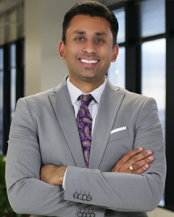
Founder, Adhi Schools
Kartik Subramaniam is the Founder and CEO of ADHI Real Estate Schools, a leader in real estate education throughout California. Holding a degree from Cal Poly University, Subramaniam brings a wealth of experience in real estate sales, property management, and investment transactions. He is the author of nine books on real estate and countless real estate articles. With a track record of successfully completing hundreds of real estate transactions, he has equipped countless professionals to thrive in the industry.

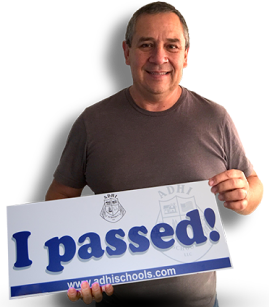
"Hey guys,
I took the exam today and passed!!!!
It only took me one try which was one of my goals. I took the online
classes and follow your suggestions so I took the crash course,
used the crash course app a lot, took 7 mock tests and went
confident to present the exam. Thank you for the great job you are
doing, you guys are awesome!!!! May God continue to bless you!"
Willie V.