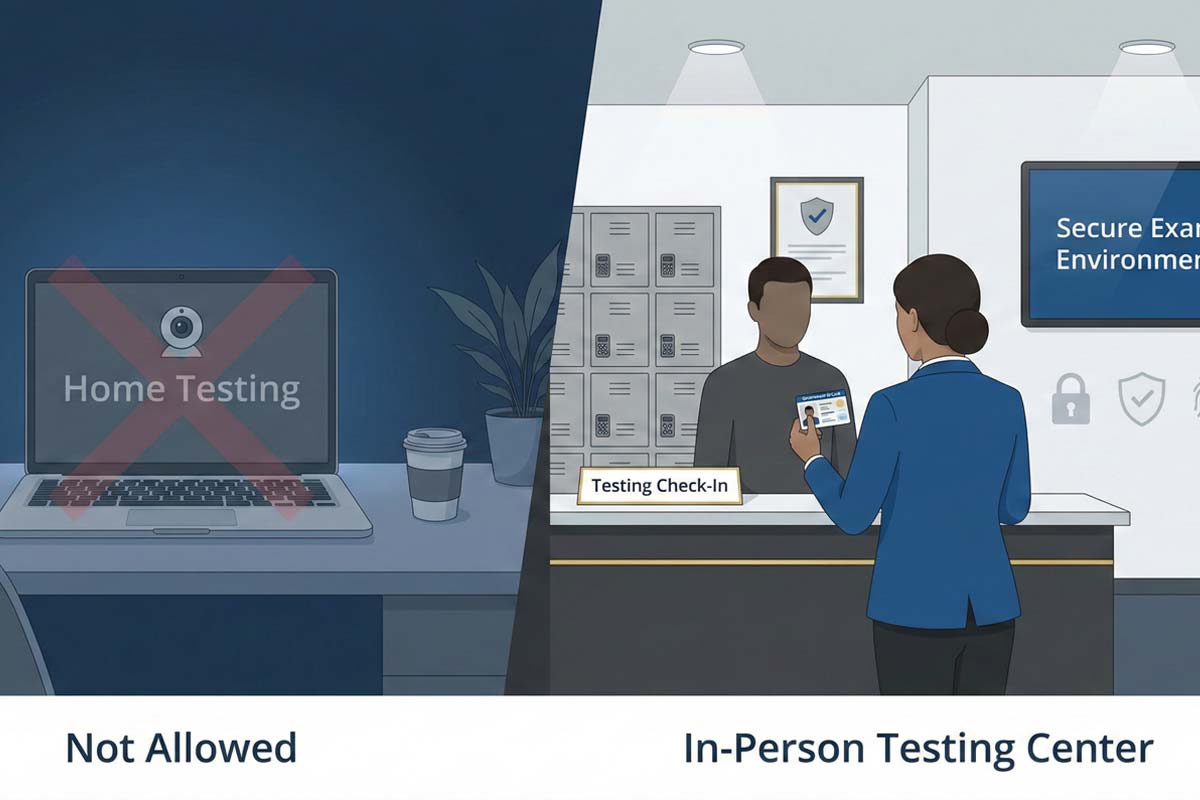
The short answer is no. You cannot take the California real estate salesperson or broker license exam online from your home or office.
While many states have adopted remote proctoring for their Read more...
The short answer is no. You cannot take the California real estate salesperson or broker license exam online from your home or office.
While many states have adopted remote proctoring for their licensing tests, the California Department of Real Estate (DRE) strictly requires all candidates to take the exam in person at one of five official testing centers.
As of 2026, the DRE has not adopted an online “remote” alternative for any candidates. While the state provides robust on-site accommodations for candidates with disabilities who apply for them, there is currently no option to take the exam off-site.
Why the California Real Estate Exam Is Not Offered Online
The DRE’s refusal to move the exam online revolves around one core principle: exam integrity.
The California real estate license grants significant legal and financial authority. To maintain the value of this license, the DRE must ensure that every person who passes the exam does so fairly and without outside assistance. Because California has the largest licensee population in the country, the risk of widespread fraud is higher here than in smaller states, leading to stricter protocols.
Many students are surprised by how different the DRE’s rules are from their school exams. Understanding this distinction early prevents confusion later in the process.
Security and Identity Verification
Remote proctoring—where a webcam watches you take the test—has improved, but it is not yet foolproof. The DRE enforces strict identity verification standards that are difficult to replicate remotely. At a physical test center, proctors can physically inspect government-issued IDs, verify that the person taking the test matches the photo, and ensure no one else is in the room.
Preventing Exam Subversion
California Business and Professions Code explicitly prohibits "subverting or attempting to subvert any licensing examination." This basically means trying to remove exam content from the site or cheat on the exam. The DRE views the controlled environment of a physical test center as the most effective way to prevent subversion techniques, such as using hidden earpieces, having a third party take the test, or accessing unauthorized notes.
By keeping the exam offline, the DRE ensures that the test score accurately reflects the candidate's actual knowledge, not their ability to bypass security software.
Why People Confuse Online Coursework With the Exam
A common source of confusion for students is the difference between pre-licensing education and the state licensing exam.
Pre-Licensing Coursework (Online Allowed): You can complete your required 135 hours of college-level education online. ADHI Schools offers these courses digitally, and the final exams for these specific classes are open-book and taken online.
State Licensing Exam (In-Person Only): Once you finish school and receive your certificates, you must apply to the state. The final hurdle—the state exam—is a completely separate event that must be taken at a DRE facility.
Students often assume the state uses the same rules as schools—it doesn’t. It is critical to mentally prepare for the shift from a relaxed home environment to a formal, secure testing facility.
The Only Approved Way to Take the Exam
Since remote testing is unavailable, you must schedule your exam at a designated proctoring facility. The DRE currently operates five locations across the state: Fresno, La Palma (Orange County/Los Angeles), Oakland, Sacramento, and San Diego.
Students often start by reviewing the California real estate exam testing centers before choosing where to test. It is important to note that you cannot use third-party testing sites (like Pearson VUE centers used for other exams); you must use one of these five specific DRE locations. Furthermore, availability varies by center, so securing a seat requires forward planning.
Once you have selected your location, you should also consider the best time to take the California real estate exam to ensure you avoid heavy traffic and align the date with your peak study readiness.
What the In-Person Testing Process Looks Like
Taking the exam in person is a formal process, similar to airport security. Understanding the protocol beforehand can help reduce anxiety.
Arrival and Check-In
You should plan on arriving at least 30 minutes before your scheduled exam time. Upon arrival, you will check in at the reception desk where your identification will be rigorously scrutinized. You must present a valid, current government-issued photo ID.
Security Measures
The testing room is a secure environment. You are not allowed to bring personal items to your desk. This includes:
Cell phones (must be powered off and stored).
Watches and smartwatches.
Wallets, purses, and backpacks.
Most centers provide small lockers for your personal belongings. Your arrival routine is similar to what’s described in what to expect on exam day, where the focus is on minimizing distractions so you can focus entirely on the questions.
Note-Taking Materials
You cannot bring your own scratch paper, and the DRE no longer provides any note-taking materials. Fortunately, the state exam no longer includes math questions, so you will not need to perform calculations during the test. All questions can be answered directly on the computer screen without the need for any written work.
Will California Ever Offer an Online Version?
The testing industry is moving toward remote proctoring, and large providers already have the technology to facilitate secure online exams.
However, the California DRE has historically been conservative regarding changes to the licensing process, often lagging behind national testing trends by 5 to 10 years due to regulatory caution. They prioritize the security of the "gatekeeper" exam over convenience. While they have modernized other aspects of the process, there have been no official announcements regarding a pilot program for online testing. For now, candidates should plan their timeline assuming they will need to travel.
What Parts of the Licensing Process Can Be Done Online?
While you can't take the test online, almost every other step of the licensing journey is digital. You can streamline your experience by handling the logistics from your computer.
Coursework: Complete all 135 hours of required education.
Application: Submit your exam and license application via the eLicensing system.
Scheduling: After completing your coursework, the next logistical step is understanding how to schedule the California real estate exam using the DRE’s online portal.
Results: While you don't get them instantly on screen, you can view your pass/fail status online shortly after the results are officially posted by the DRE.
Final Thoughts
The requirement to test in person ensures that every licensed agent in California has met the same high standard of competency. While it requires a bit more logistical planning than an online test, the process is straightforward if you are prepared.
Focus your energy on studying the material rather than worrying about the format. A solid grasp of the concepts in the California Real Estate Exam Guide is the best way to ensure that, when you sit down at that computer in the testing center, you are ready to pass.
Frequently Asked Questions (FAQ)
Can I use a calculator on the California real estate exam? No. This is a critical point where many online resources are outdated. You are not allowed to bring a calculator of any kind (including basic or silent models). Furthermore, the testing center does not provide calculators, and the exam software does not have a calculator function. There’s no longer any math on the exam.
Is the California real estate exam open book? No. The state licensing exam is closed book. You cannot use notes, textbooks, or outside resources during the test.
Can I take the California real estate exam out of state? No. You must take the exam at one of the five approved testing centers located within California (Fresno, La Palma, Oakland, Sacramento, or San Diego).
Is the exam on a computer or paper? The exam is electronic. You will sit at a computer terminal at the testing center to answer the multiple-choice questions. It is not a "paper and pencil" test, but strictly an in-person electronic exam.
What happens if I’m late to the testing center? If you arrive after your scheduled start time, you may be denied entry and will likely forfeit your exam fee. It is highly recommended to arrive at least 30 minutes early.
|
The California real estate exam isn’t a secret code you have to crack in order to pass. The DRE actually publishes a blueprint that tells the world exactly what’s on the test. Once you know how the Read more...
The California real estate exam isn’t a secret code you have to crack in order to pass. The DRE actually publishes a blueprint that tells the world exactly what’s on the test. Once you know how the questions are weighted, you can stop wasting time and start studying the right way and focusing on the things that matter.
I’m going to map it all out for you below.
But first, here is some good news: the biggest section on the exam isn’t necessarily the hardest one.
If you are just beginning your licensing journey, start with our comprehensive California real estate exam guide for a full roadmap.
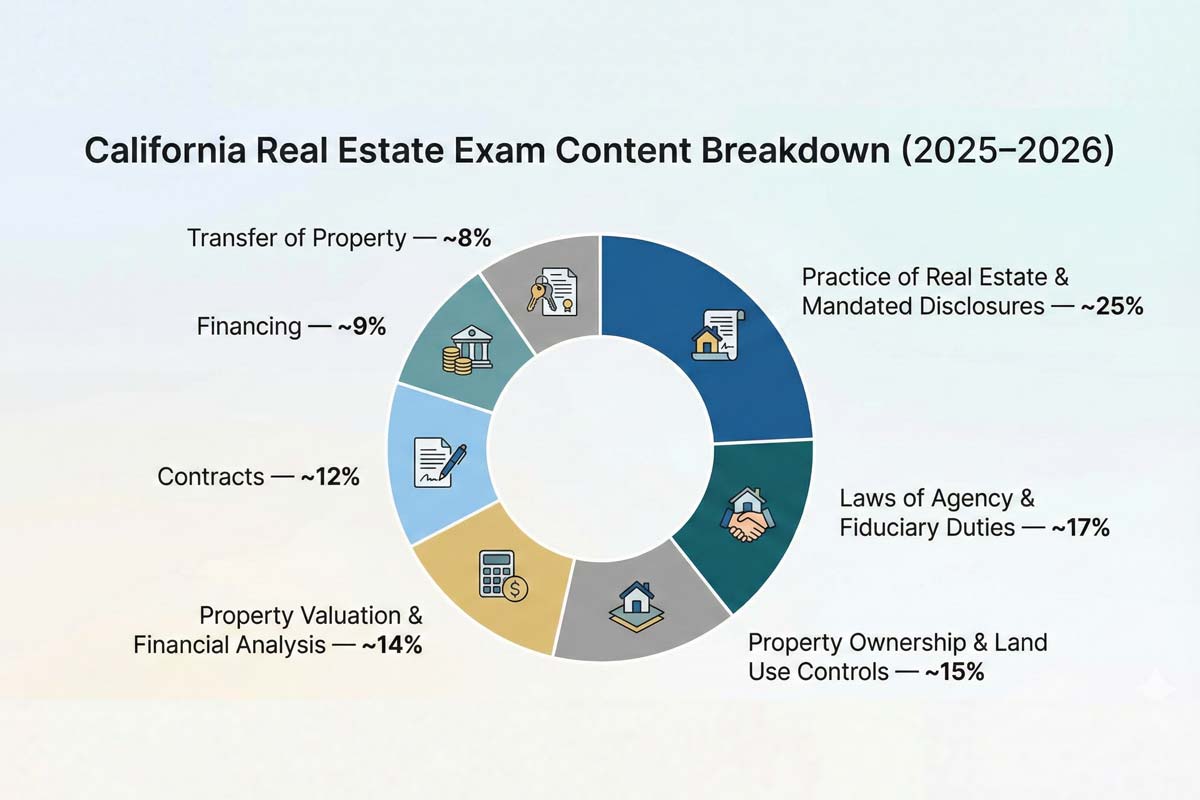
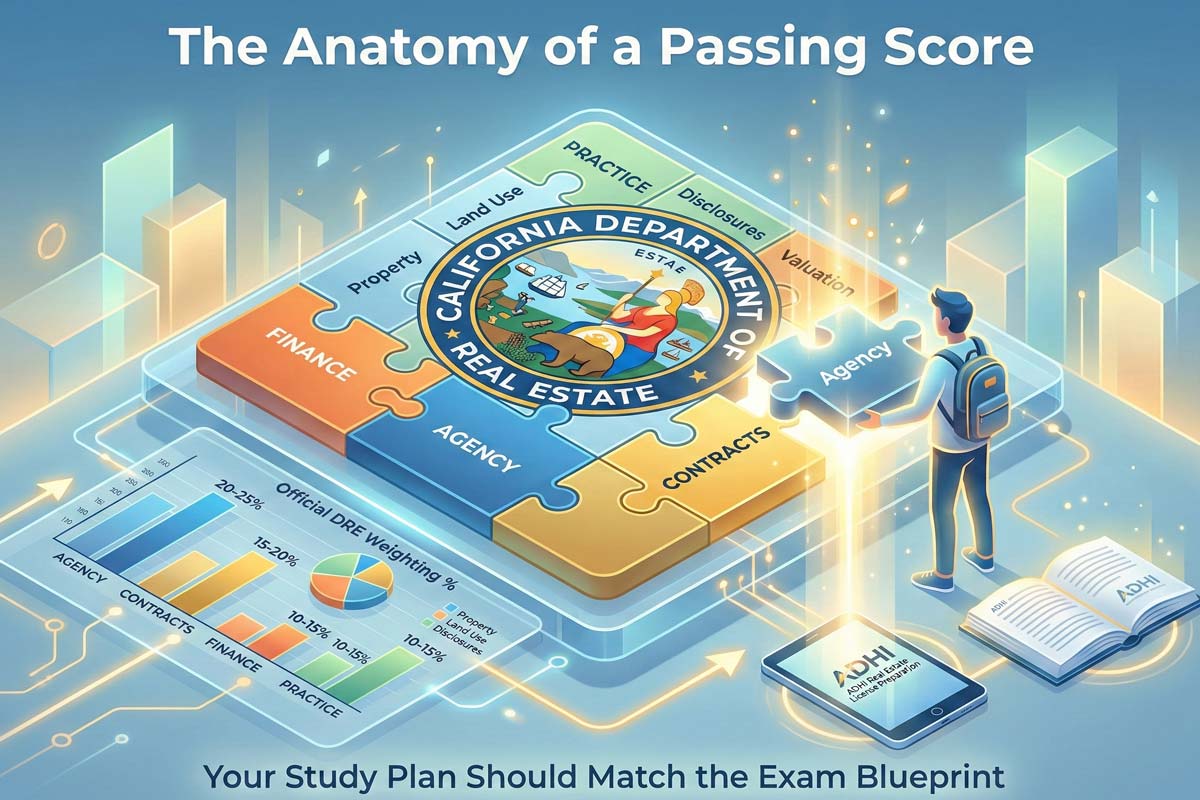
The 7 Major DRE Exam Categories
The DRE divides the exam into seven competency areas. While the official titles can sound academic, it is easier to understand them as the practical responsibilities of a licensee.
Property Ownership and Land Use Controls and Regulations: This tests your knowledge of what you are selling—the rights, interests, and restrictions attached to the land.
Laws of Agency and Fiduciary Duties: This covers who you represent and the legal obligations you owe to your clients.
Property Valuation and Financial Analysis: This requires you to understand how value is determined and how investment properties are analyzed.
Financing: This covers the systems, laws, and instruments used to borrow money for real estate.
Transfer of Property: This tests the mechanics of how ownership moves from one person to another (deeds, escrow, and title).
Practice of Real Estate and Mandated Disclosures: This is the "day-to-day" work of an agent, including fair housing, truth-in-advertising, and trust funds.
Contracts: This covers the agreements that make the transaction legally binding.
Which exam category is worth the most points? The Practice of Real Estate and Mandated Disclosures is the heavyweight champion of the exam, accounting for roughly 25% of the questions. However, as we will discuss below, this category is actually a mix of several different skill sets.
These seven categories are the standard framework for both the salesperson and broker exams.
Category-by-Category Weighting (2025–2026)
The DRE provides a percentage range for each topic. Below, we break down these weights into a practical study guide.
Practice of Real Estate and Mandated Disclosures (~25%)
What It Really Covers: This is the largest section of the exam. It includes Trust Fund handling, Fair Housing laws (Federal and State), the purpose of the Transfer Disclosure Statement (TDS), and strict rules regarding advertising and ethics.
Instructor’s Study Tip: Do not be intimidated by the 25% figure. This category is not one giant topic; it breaks down between disclosures, ethics, fair housing and general real estate practice scenarios. If you master Fair Housing and the rules of Trust Funds (commingling and conversion), you have conquered the hardest part of this section.
Laws of Agency and Fiduciary Duties (~17%)
What It Really Covers: This tests how agency is created (express vs. implied), how it is terminated, and the specific duties owed to principals versus third parties. It heavily features "dual agency" scenarios.
Instructor’s Study Tip: Focus on the timing of the Agency Disclosure Form (Disclosure, Election, Confirmation). The DRE loves to test on when these disclosures must happen in a transaction sequence.
Property Ownership and Land Use Controls (~15%)
What It Really Covers: This covers the different ways to hold title (Joint Tenancy, Community Property), encumbrances (liens, easements), and government powers (Zoning, Eminent Domain).
Instructor’s Study Tip: Understand the "Bundle of Rights." Many questions here are definition-heavy. If you know the difference between a specific lien and a general lien, you can pick up easy points here.
Property Valuation and Financial Analysis (~14%)
What It Really Covers: This is about appraisal theory (Cost, Income, and Market Data approaches) and economic principles of value (Substitution, Contribution).
Instructor’s Study Tip: Don't worry about complex math. The exam tests concepts, not calculations. Focus on knowing when to use the Income Approach (commercial/rentals) versus the Cost Approach (libraries/new schools).
Contracts (~12%)
What It Really Covers: This section deals with the validity of contracts (Competence, Mutual Consent, Lawful Object, Consideration) and the specific types of listings (Exclusive Right to Sell vs. Exclusive Agency).
Instructor’s Study Tip: Memorize the four essentials of a valid contract. Also, ensure you understand the "Safety Clause" in listing agreements—it’s a frequent exam target.
Financing (~9%)
What It Really Covers: This covers the primary vs. secondary mortgage markets, loan types (FHA, VA, Conventional), and consumer protection laws like TILA (Reg Z) and RESPA.
Instructor’s Study Tip: This is the smallest section for a reason. Do not spend weeks studying mortgage tables. Focus on the difference between the Trustor, Trustee, and Beneficiary in a Deed of Trust.
Transfer of Property (~8%)
What It Really Covers: This deals with deeds (Grant vs. Quitclaim), title insurance (CLTA vs. ALTA), and the escrow process.
Instructor’s Study Tip: This is often the easiest section to master because it is procedural. If you understand that a deed must be delivered and accepted to be valid (but not necessarily recorded), you are halfway there.
Salesperson vs. Broker Exam Content: What’s Different?
While both exams utilize the exact same seven categories, the lens through which you are tested changes.
The Salesperson exam focuses on the application of rules: "What form do I use?" or "What must I disclose?"
The Broker exam focuses on the above as well as a little more on supervision and management. In addition to the standard content, Broker candidates must understand:
Office management and supervision of salespersons.
Deeper liability regarding Trust Fund accounting.
More complex financial analysis and investment scenarios.
Is the content breakdown the same for salesperson and broker exams? Yes. The DRE uses the same "Content Outline" for both. However, the Broker exam contains 200 questions compared to the Salesperson's 150 and you have to score slightly better on the broker exam to pass.
For more on passing thresholds, read our breakdown of How the California Real Estate Exam is Scored.
How Content Weighting Should Shape Your Study Plan
Do not study every topic with equal intensity. The weighting reveals that the DRE values certain competencies over others.
High-Value vs. Low-Effort Topics
High-Value / High-Complexity: "Laws of Agency" and "Practice of Real Estate" combine for over 40% of your score. These require deep study because they are scenario-based. You cannot just memorize definitions; you must understand how to apply the law to a situation.
Low-Effort / Easy Points: "Transfer of Property" and "Property Ownership" often rely on static definitions (e.g., "What is a freehold estate?"). These are "low-effort" points. Master the vocabulary here to bank easy points, which gives you a buffer for the harder scenario questions.
Which exam topics give you the easiest points? Contracts and Transfer of Property. The rules in these sections are rigid and rarely change, making the questions straightforward if you know your definitions.
How the DRE Uses Weighting to Build and Score the Exam
The DRE uses a psychometric process called "equating" to ensure fairness. Whether you take the exam on a Tuesday in San Diego or a Friday in Oakland, the computer algorithm pulls questions to match this exact percentage blueprint.
Because the DRE uses this fixed blueprint, ADHI Schools’ practice exams mirror the real exam’s balance. When you take our mock tests, you are conditioning your brain to handle the exact distribution of topics you will face on test day.
How does knowing the content breakdown improve your odds on exam day?
It prevents panic. If you hit a hard run of Finance questions, you can relax knowing that Finance is only 9% of the exam. You can afford to miss a few hard finance questions and still easily pass if your Agency and Practice knowledge is solid.
To refine your testing tactics further, review our Multiple-Choice Strategy for the CA Real Estate Exam.
Mastering the blueprint gives you an immediate edge over other test-takers who are just memorizing flashcards without a plan.
Ready to start your structured preparation? Return to our California real estate exam guide to take the next step toward your license.
Frequently Asked Questions regarding DRE Exam Content
Do I need to pass each of the seven content areas individually?
No. Your score is cumulative. You do not need to score 70% in every single category to pass. For example, if you struggle with Financing (9%), you can make up for those missed points by scoring highly in Practice of Real Estate (25%) and Agency (17%).
Does the high weighting for Valuation and Financing mean there is a lot of math?
No. While Property Valuation (~14%) and Financing (~9%) make up nearly a quarter of the exam, the DRE focuses on concepts, not calculations. You will be tested on the principles of value and loan structures, but you will not be asked to perform complex arithmetic.
How strict are these percentages?
They are approximations provided by the DRE. On any given exam version, the specific number of questions may fluctuate slightly.
Is the "Practice of Real Estate" the hardest section because it is the largest?
Not necessarily. While it has the most questions (approx. 25%), many of them cover straightforward topics like Fair Housing and Truth-in-Advertising. Many students find the Laws of Agency section more difficult because it relies heavily on interpreting complex scenarios rather than memorizing facts.
|
If you're gearing up for your California licensing test, one of the most practical details to lock down is the exam's length. How many questions are on the California real estate exam? Knowing the exact Read more...
If you're gearing up for your California licensing test, one of the most practical details to lock down is the exam's length. How many questions are on the California real estate exam? Knowing the exact number is the cornerstone of an effective study plan and confident test-day pacing. Here’s the straightforward answer:
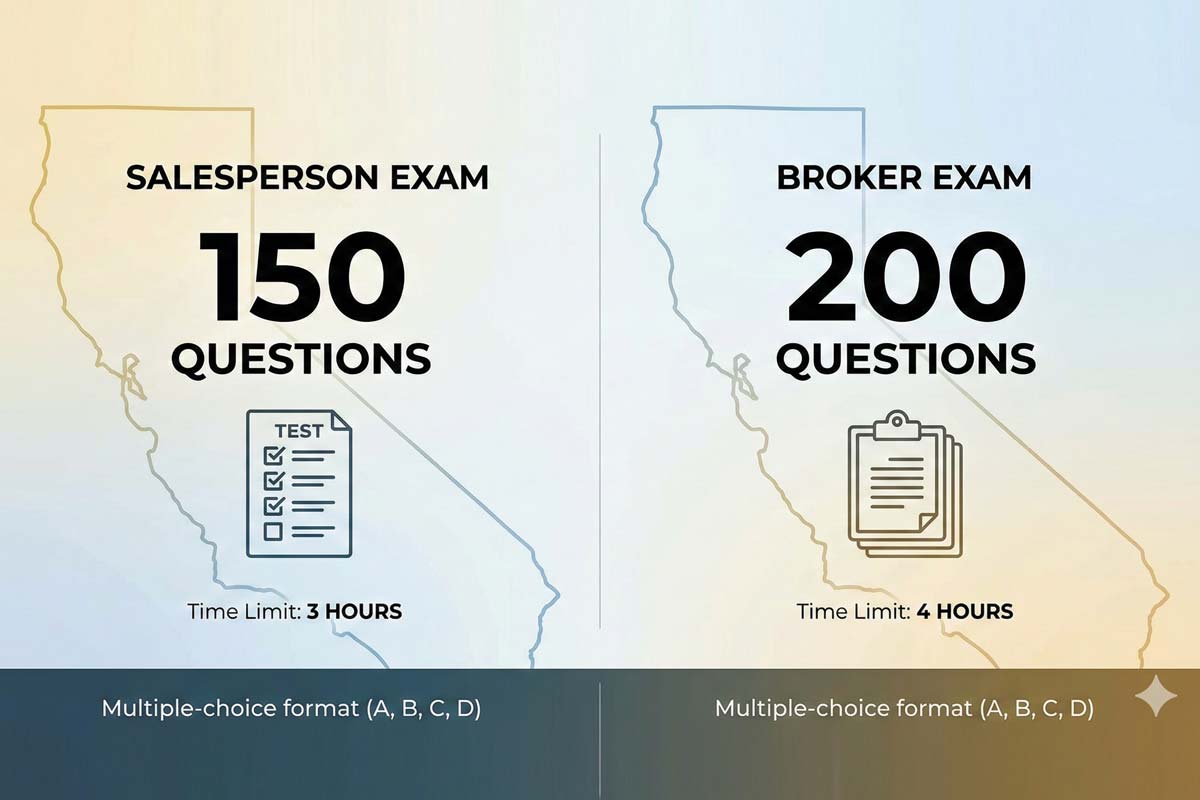
The California Real Estate Salesperson Exam contains 150 multiple-choice questions.
The California Real Estate Broker Exam contains 200 multiple-choice questions.
This structure directly influences your time-management strategy. For a full picture of the entire testing process, from scheduling to scoring, our California real estate exam guide walks you through every step. To see how these questions are distributed by topic, review our guide to what’s on the California real estate exam — it outlines all testable areas.
The Salesperson Exam Breakdown (150 Questions)
The salesperson licensing exam is a 150-question test, with every item presented in a multiple-choice format with four options (A, B, C, D). The questions are pulled from specific content areas with predetermined weighting. For example, roughly a quarter of the exam focuses on the Practice of Real Estate and Duties to Clients, while Financing makes up a smaller percentage. Understanding this weighting is critical for efficient study.
The Broker Exam Breakdown (200 Questions)
The broker exam increases in both scope and depth, featuring 200 multiple-choice questions, also in A, B, C and D format. While the core subject categories align with the salesperson test, the broker version delves slightly deeper into areas like real estate law, brokerage management, and trust fund handling. The additional questions reflect the content around supervisory knowledge required for a broker's license.
Time Management: The “Minute-Per-Question” Rule
With standardized time limits, a simple calculation gives you a powerful pacing tool:
Salesperson Exam: 150 questions / 180 minutes = 1.2 minutes per question.
Broker Exam: 200 questions / 240 minutes = 1.2 minutes per question.
This consistent pace is very manageable if you avoid getting stalled. The best approach is to answer known questions quickly, mark uncertain ones for review, and maintain forward momentum. Returning to challenging items at the end ensures you capture all the points available from questions you find easier.
Passing Scores: How Many You Can Get Wrong
It’s a relief to many students that perfection is not required. The passing percentages are clear:
Salesperson Exam: A 70% score means you need 105 correct answers. You can miss 45 questions and still pass.
Broker Exam: A 75% score requires 150 correct answers, allowing you to get 50 questions wrong.
This margin for error is built into the exam design. For a deeper look into the scoring process, including how "equating" questions work, our article on how the California real estate exam is scored provides clarity.
Format Consistency: Every Question Is Multiple Choice
Since the exam sticks to a simple four-option multiple-choice format, you don’t have to adjust your thinking from question to question. Learn one solid strategy and you can use it throughout the test—whether you know the answer or you’re narrowing it down to the best option. Honing this skill is a major part of effective preparation, and a dedicated multiple-choice strategy for the CA real estate exam can significantly boost your confidence and accuracy.
So, to recap: the sales license exam has 150 questions, and the broker test has 200 questions. When you understand the question count, timing, and pass thresholds, the exam stops feeling mysterious and becomes a numbers game you can win. With focused study and smart test-taking tactics, you’re well-positioned for success. For a complete step-by-step journey to your license, your central reference should always be our main California real estate exam guide.
Frequently Asked Questions
Q: Is there math on the California real estate exam? A: No. Since calculators are strictly prohibited, the DRE has removed math calculation questions from the test. You may need to recall specific numbers (like knowing there are 43,560 square feet in an acre), but you will not be asked to perform arithmetic.
Q: Do all 150 questions count toward my score? A: Treat every question as if it counts. While the DRE may include a few unscored "experimental" questions to test them for future exams, they are not labeled.
Q: Is the Broker exam harder than the Salesperson exam? A: Yes, primarily due to endurance. Answering 200 questions over 4 hours is a mental marathon. It also tests supervisory topics that aren't on the salesperson exam.
Q: What happens if I don't finish in time? A: Any blank answer is marked wrong. There is no penalty for guessing, so if you are running out of time, pick a letter and fill in every remaining bubble before the clock stops.
|
Most students walk into the California real estate exam feeling confident—until they start wondering how the DRE actually scores it. Is the test curved? Do different people get different versions? Does Read more...
Most students walk into the California real estate exam feeling confident—until they start wondering how the DRE actually scores it. Is the test curved? Do different people get different versions? Does getting exactly 70% guarantee a pass?
Here’s the truth:
The DRE does NOT curve the exam and you can absolutely pass on the first attempt once you understand how their scoring system works.
In this guide, I’ll break down every scoring rule the DRE uses—clearly, accurately, and in plain English—so you know exactly what it takes to pass.
If you’re just getting started, make sure you are also reviewing our full California Real Estate Exam Guide for the complete exam roadmap.
The California Real Estate Exam Scoring System Explained
The most important thing to understand is this:
The California real estate exam uses raw scoring, not curved scoring.
This is the backbone of how the DRE ensures fairness.
Minimum Passing Scores
Salesperson Exam: You must achieve the equivalent of 70%
Broker Exam: You must achieve the equivalent of 75%
Those percentages are absolute—not relative to how anyone else performs.
Why Raw Scoring Makes the Exam Fair
The California DRE uses a raw scoring system to determine a pass or fail. This means your score is based directly on the number of questions you answer correctly, measured against a fixed, non-negotiable threshold.
However, to ensure this raw score is a fair measure for every test-taker, the DRE employs a rigorous process of exam form equating before any candidate ever sees the questions.
What this means for you:
The target is fixed: You must achieve a set number of correct answers.
It is NOT a curve: Your score is never compared to other test-takers on your day. Equating adjusts the exam, not your grade based on others' performance.
In essence, raw scoring gives you a clear target, while expert equating guarantees that hitting that target means the same thing, no matter which exam form you receive.
Debunking the "Scaled Score" Myth
You'll hear many prep courses and forums talk about the DRE's "scaled scoring." This is a widespread misconception. The California DRE does not use a traditional scaled score to determine your pass/fail result.
Here’s the reality:
1. The DRE uses a raw score against a fixed standard.
Your exam is scored on a straightforward, raw percentage basis. To pass, you must correctly answer a specific percentage of questions (approx. 70% for salesperson, 75% for broker). The result is a direct comparison of your correct answers to this absolute benchmark.
2. "Equating" happens before you take the test, not after.
The process often mistaken for "scaling" is called equating. This is a psychometric calibration performed by the DRE during the exam development phase. Experts adjust and validate questions so that the difficulty of reaching the passing raw score is consistent across all exam versions. This means:
You are not compared to other test-takers.
Your score is not statistically manipulated after you finish.
The fairness is built into the exam design itself.
3. The system protects every test-taker.
By using equated exam forms with a raw score threshold, the DRE ensures that:
Every candidate faces an equivalent challenge to demonstrate competency.
No one is penalized for receiving a version with statistically “harder” questions.
The meaning of a "pass" is uniform across the entire state and testing period.
Think of it like a race:
A true "scaled" score might change the finish line based on who's running. The DRE's system, instead, carefully calibrates the track so that everyone runs the same distance to reach the fixed, unmoving finish line. Your raw score simply tells you if you crossed it.
You will NOT receive a numeric score when you pass
The DRE releases only:
PASS
FAIL
When you pass the exam, they do not tell you how close you were or how many you missed.
However, if you fail the exam, the DRE will report your overall score as well as how you did in each of the seven exam categories so you know where to focus your efforts.
Does the DRE Curve the Exam?
Let’s say it as clearly as possible:
No. The California real estate exam is NOT curved.
There is:
No bell curve
No percentile ranking
No grading against other students
How Fast the DRE Scores Your Exam
Since the state exam is computer based you receive your result immediately after finishing.
Important scoring rules
No partial credit
No appeals
No score breakdowns
Pass/Fail only
Retakes
If you fail:
You may retake the exam after paying the re-exam fee
Your previous exam performance has no impact on future tests
Common Myths About Exam Scoring
❌ Myth #1: “Only a certain percentage of students pass each day.”
False.
There is no quota. Passing is based only on your performance relative to the published standard.
❌ Myth #2: “If you test in the afternoon, your exam is harder.”
Completely false.
Versions are pre-set and rotated randomly.
❌ Myth #3: “Different categories are weighted differently for each student.”
Partially true but misunderstood.
The exam blueprint allocates topics by percentage, but every student receives the same category weighting.
Scaling does not adjust category weight per individual.
See our Exam Content Breakdown for exact percentages.
❌ Myth #4: “The DRE tells you your raw score if you call.”
They do not.
No one at the DRE can release that information.
Ready to Pass on the First Attempt?
If you want the highest probability of passing the first time, start with ADHI Schools.
ADHI offers:
California salesperson pre-license courses
Broker licensing courses
Live crash courses taught by real instructors
Exam prep tools that mirror the DRE’s weighting and question style
Our students pass because our test taking strategies are built around how the DRE actually scores the exam—not myths, shortcuts, or generic national content.
Is the California real estate exam curved? No. The California DRE uses a raw scoring system, not a curve. Your score is based solely on the number of questions you answer correctly, and it is never graded against or compared to the performance of other students.
What is the passing score for the California real estate exam? For the Salesperson Exam, you must achieve a score of 70%. For the Broker Exam, the passing threshold is 75%. These percentages are fixed and non-negotiable.
Does the DRE use scaled scoring? No. While the DRE uses a process called "equating" to ensure different versions of the test have the same difficulty level, this happens before you take the test. Your final grade is a simple raw score based on your correct answers, not a statistically manipulated "scaled" score.
Will I see my actual final score? Only if you fail. If you pass, the DRE only releases a "PASS" notification with no numeric score or breakdown. If you fail, you will receive your numerical score and a breakdown of your performance across the seven exam categories.
Is there a limit to how many people can pass each day? No. There is no quota for passing grades. Every single student who hits the required 70% (or 75% for brokers) will pass, regardless of how many other people are testing that day.
How long does it take to get my exam results? You will receive your results immediately. Because the California exam is computer-based, your pass/fail status is provided at the testing center the moment you finish.
Does the time of day affect exam difficulty? No. It is a myth that afternoon exams are harder. Exam versions are pre-set and rotated randomly; the time of day you test has absolutely no impact on which version you receive.
|

Worrying about your ID for the exam is more common than you think. Over two decades of teaching, I've seen that anxiety firsthand - often at the last minute (don’t do this!).
The good news Read more...
Worrying about your ID for the exam is more common than you think. Over two decades of teaching, I've seen that anxiety firsthand - often at the last minute (don’t do this!).
The good news is, this is one of the easiest problems to solve. Here’s the definitive guide to what you need.
Let me be totally direct:
Not every “photo ID” works.
Only four specific IDs are accepted.
Show up with the wrong one, and you won’t be allowed into the testing room.
Let’s break down exactly what the DRE requires — in plain English.
Why This Matters (Exam Day Consequences)
Here’s the hard truth:
If you don’t bring an approved ID, the DRE will NOT admit you to the exam site.
No exceptions.
No second chances that day.
No “but I have a picture of it on my phone.”
You’ll lose your exam slot, forfeit your fee, and have to reschedule — sometimes weeks out.
The ID rules are strict because they’re tied to exam security. Eligibility and education requirements are one thing.
Exam-day check-in is another.
The ONLY DRE Approved Forms of Identification
The California Department of Real Estate accepts only four IDs at check-in:
✔ Current state-issued driver’s license or DMV identification card
✔ U.S. Passport
✔ Foreign government-issued passport
✔ U.S. Military ID
That’s the entire list.
Some quick real-world examples:
Your Arizona or Texas driver’s license? ✔ Yes — totally valid. (Out-of-state examinees should also read our guide on Residency Requirements.)
Your passport from India, Mexico, or the Philippines? ✔ Yes — if it’s valid and unexpired.
Your military CAC card? ✔ Yes — fully acceptable.
The ID must be physical, valid, and unexpired.
The proctor must be able to check it in-hand at the door.
❌ What the DRE Will NOT Accept
If it’s not on the four-item list above, assume it’s not acceptable.
That includes:
❌ Student IDs
❌ Temporary paper licenses
❌ Digital IDs (Apple Wallet, Google Wallet, photos, screenshots)
❌ Work badges
❌ Costco or membership cards (I love Costco - but the card isn’t going to get you into the exam site! Not even the Executive one!)
❌ Photo bank/debit cards
Even if they have your picture.
Even if another agency randomly accepted them.
The DRE won’t.
❌ Expired or Damaged IDs (Important Clarification)
The DRE requires that your ID must be:
Valid
Unexpired
Able to clearly establish your identity
Here’s what that means in practice at DRE testing centers:
❌ Expired = Not accepted
Even by one day.
❌ Damaged enough that the proctor cannot verify your identity = May be rejected
The DRE does not publish a detailed “damaged ID list,” but proctors are required to reject IDs that look altered or cannot be read clearly.
The types of damage that often cause problems include:
Cracks that run through your photo or information
Peeling laminate that obscures text
Scratches across the photo
Chipped edges cutting into your name or expiration date
Water damage on a passport page
Warping that prevents scanning or visual verification
Minor cosmetic wear is usually fine.
But if your ID looks questionable or unreadable, you’re taking a real risk.
Bring the cleanest, most legible version of your ID — and if in doubt, renew it.
What If You Don’t Have One of These Approved IDs?
You’re not out of luck — but you need to plan ahead.
✔ If your driver’s license is expired
Renew at the DMV.
But remember: interim/temporary paper licenses are NOT accepted.
You must wait for the physical card.
✔ If you need a passport
Standard processing: 6–8 weeks
Expedited: 2–3 weeks
Don’t schedule your exam until you have the physical passport in hand.
✔ If you lost your only accepted ID
You’ll need to replace it before taking the exam.
The DRE will not make exceptions.
ID Rules vs. Eligibility Rules — Don’t Mix Them Up
A lot of students confuse exam-day identification with overall eligibility to take the exam.
Let’s separate them clearly.
Eligibility Requirements = What allows you to apply for the exam.
For a full breakdown of the application steps, read our definitive guide on how to get a real estate license in California.
These include:
Being at least 18
Having a valid SSN/ITIN
Completing the required courses
Passing a background check after the exam
Living in California isn’t a requirement
ID Requirements = What allows you to walk into the testing room.
Only four IDs qualify — nothing else.
Two different sets of rules.
📋 Quick Exam-Day Checklist (Screenshot This!)
Here’s the exact checklist I give my ADHI students:
✔ Bring one of the four approved IDs
✔ Verify it’s valid and unexpired
✔ Check that your name matches your DRE registration
✔ Bring a clean, readable ID (no cracks or peeling)
✔ Arrive 30 minutes early
✔ Leave your phone off and stored away
Follow this and your check-in will be smooth.
🔍 Myth vs. Reality (Rapid Clarifications)
Myth: “Any government ID should work.”
Reality: Only four specific IDs are allowed.
Myth: “The DMV temporary license counts.”
Reality: It doesn’t.
Myth: “If my ID is expired but I look the same, they’ll let me in.”
Reality: They won’t.
Myth: “Digital IDs are fine now.”
Reality: Not for the real estate exam.
Myth: “A slightly damaged ID is okay.”
Reality: Minor wear is fine, but if the damage affects readability or legitimacy, the proctor must reject it.
✅ You’re Now Fully Prepared
When you understand the ID rules, exam day becomes much less stressful.
Bring one of the four approved IDs.
Make sure it’s valid.
Make sure your name matches
And make sure the ID is readable and clearly establishes who you are.
Do that — and you’ll walk into the testing center confident, calm, and focused on one thing:
Passing.
You’ve got this.
FAQ: California Real Estate License ID Requirements
1. Does the DRE accept out-of-state driver’s licenses?
Yes. Any valid U.S. state-issued license or ID is acceptable.
2. Will they accept a temporary paper license from the DMV?
No. Only physical, permanent IDs are accepted.
3. Can I take the exam with a slightly damaged ID?
If it’s minor wear, usually yes.
If the proctor cannot clearly verify your identity, they may reject it. When in doubt, replace it.
4. Can I use a digital ID on my phone?
No. Digital IDs, photos, and screenshots are not accepted.
5. What if my name changed?
Bring legal documents linking your old and new names and update the DRE record early.
{
"@context": "https://schema.org",
"@type": "WebPage",
"url": "https://www.adhischools.com/blog/california-license-id-requirements",
"speakable": {
"@type": "SpeakableSpecification",
"xpath": [
"/html/body//section[1]",
"/html/body//section[2]"
]
},
"name": "California Real Estate License ID Requirements",
"description": "Exact DRE-approved identification requirements for California real estate exam day."
}
|
To get a California real estate license, you must complete 135 hours of approved coursework. These are the California real estate license education requirements set by the DRE. You don’t need a college Read more...
To get a California real estate license, you must complete 135 hours of approved coursework. These are the California real estate license education requirements set by the DRE. You don’t need a college degree, and you don’t need industry experience to get a sales license.
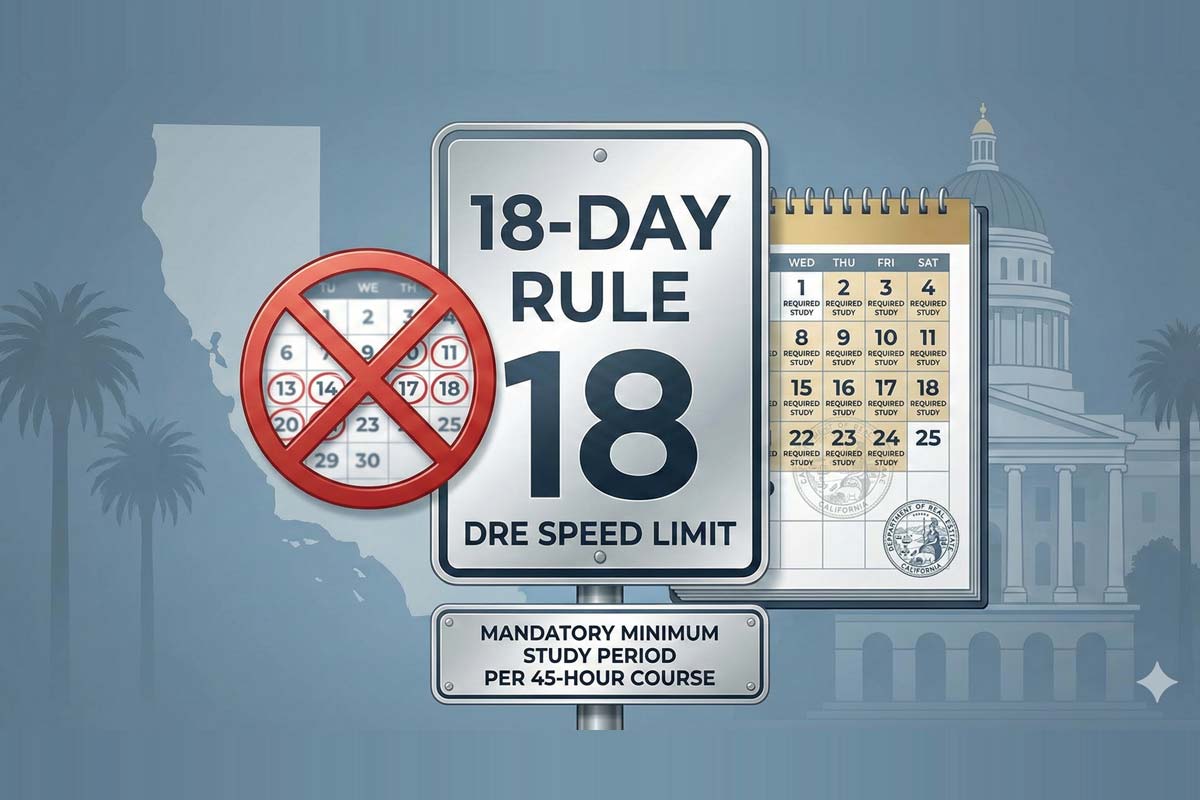
Voice Answer: You need 135 hours of DRE-approved coursework to qualify for a California real estate license. That includes Real Estate Principles, Real Estate Practice, and one elective. No degree is required. Each course must be completed over at least 18 days, which is a strict DRE timing rule.
You only need to complete three specific courses: Real Estate Principles, Real Estate Practice, and one approved elective. That’s the entire academic requirement.
These education rules form the core DRE prerequisites for exam eligibility. Once you finish the 135 hours and receive your certificates, you can apply for the salesperson exam. When your exam application is approved, remember that you'll need a valid photo ID (like a driver's license) to be admitted to the testing center on exam day.
There are no shortcuts, no alternative pathways (besides being a member of the California bar), and no substituted degrees unless directly listed in the law.
The system is strict but simple.
If you want more information or a deeper dive, check out our complete guide to getting your real estate license.
🔍 Myth vs. Reality: The College Degree
People often assume real estate is like accounting or law. They believe a degree unlocks the license. That myth stops students before they even start. The truth is blunt: The DRE does not require a degree.
You only need the mandated courses.
Some students do qualify through certain college courses they have taken in the past but most people will meet the education requirements through the standard 135-hour pathway. That’s why it’s important to understand the real rules.
Myth
Reality
Why it matters
You need a college degree.
You only need 135 hours.
Saves time and avoids unnecessary schooling.
Business majors skip everything.
Only specific real estate courses qualify.
Prevents false assumptions about automatic credit.
GPAs affect eligibility.
GPAs are irrelevant.
Removes anxiety about academic history.
These myths distract people from the simple path. Focus on what the DRE actually requires.
To be clear, I went to college at Cal Poly, got a degree and don’t regret it at all. That experience shaped a lot of how I teach today. College pushed real teamwork, deadlines, and problem-solving — all skills that translate directly into real estate, but the degree isn’t a requirement.
⭐ The "Big Three" Required Courses
Remember that California only requires one thing academically: Complete three 45 hour DRE-approved courses totaling 135 hours. Every applicant—whether new to the industry or coming from another field—must take these same classes.
Real Estate Principles
Consider this your foundation. It equips you with the vocabulary—from property types to agency laws—that you will face on test day. Many students make the mistake of underestimating this course. Don’t. Principles is the backbone of your future license.
Real Estate Practice
This course focuses on the day-to-day realities of the business. Disclosures, listings, offers, and client interactions dominate this material. It helps you think like an agent, not a test taker. Remember that the Real Estate Practice course must now contain an interactive implicit bias component according to SB1495.
One Elective
You can choose from options like Finance, Legal Aspects, or Property Management. The choice of the elective is less important than getting it done.
These are the only education requirements the DRE needs academically. Complete the Big Three, earn the certificates, and you’re eligible to apply for the real estate exam.
⏱️ The 18-Day Rule (Speed Limit)
Who doesn’t love speed? But California sets a hard limit. You cannot legally complete a 45-hour correspondence course in less than 18 days. This applies to every approved school, including ours. There is no workaround. There is no exception.
Why? The state wants meaningful study time. They want students to absorb the content instead of rushing through modules. So the DRE built this rule to slow you down. Schools must track your progress and enforce it.
You can take multiple courses at once, but each course has its own minimum timeline. That means the fastest anyone can complete the three courses is 54 days (18 days x 3 courses). Many providers imply faster completion. Don’t fall for it.
Plan your schedule with this rule in mind. You’ll finish more smoothly, and you won’t get flagged for rushing the material.
❌ The Mistakes That Slow Students Down
Most delays have nothing to do with the coursework. They come from preventable mistakes.
Here are the biggest pitfalls:
Choosing a difficult elective and stalling halfway through.
Forgetting to save course certificates for the state application.
Stopping mid-course and restarting later, losing momentum.
Using non-approved schools and discovering the courses don’t count.
Ignoring the 18-day rule and failing required chapter quizzes.
Failing to disclose a past background item. The DRE values honesty above almost everything else; attempting to hide a background issue causes more delays than the issue itself.
Each mistake adds stress and time. Avoid them and you’ll finish your education and licensing quickly and cleanly.
🧭 In My 23+ Years of Teaching…
Students sometimes fear math. They imagine complex loan calculations or high-level finance problems. But the exam isn’t built to stump you with math. The real challenge is vocabulary. California real estate uses precise language, and exam writers test your understanding of those terms.
I’ve watched strong students fail because they ignored terminology. I’ve also watched anxious students pass because they focused on consistent reading. The DRE expects you to know definitions, agency concepts, disclosures, and basic laws. That’s where the exam is won.
The best students build a pattern: short study sessions, steady note-taking, and quiz repetition. They avoid cramming. They respect the 18-day rule. They treat the material like the new language it is. Master the vocabulary and you stack the deck in your favor.
❓ Education FAQs
Q: Can I take the courses online?
A: Yes. The DRE allows fully online, self-paced courses through approved providers like ADHI Schools. Most students finish faster online because they control their study time.
Q: Do old college credits count?
A: Only specific real estate or real estate-adjacent courses qualify. General business classes don’t count. The DRE reviews transcripts individually.
Q: Do I need a degree?
A: No. Degrees are irrelevant. Only the three 45-hour courses matter for most applicants.
Q: Can I complete the courses faster than 18 days?
A: No. The 18-day rule is firm. Every 45-hour course requires a minimum of 18 days.
Q: What if I already took one of the courses?
A: If it’s from a DRE-approved provider or qualifying college program, you may use it. Keep your certificate or transcript.
Q: How long do most students take?
A: Many complete the 135 hours in 8–12 weeks.
Finishing the California real estate license education requirements is straightforward once you understand the system. Complete the Big Three, follow the 18-day rule, and avoid the common mistakes.
If you want the simplest possible path to finishing your 135 hours, check out our packages.
|
No, you don’t need to live in California to get your real estate license. But you do need to meet one specific requirement that’s often misunderstood. Before you spend money on real estate courses Read more...
No, you don’t need to live in California to get your real estate license. But you do need to meet one specific requirement that’s often misunderstood. Before you spend money on real estate courses or start planning your real estate exam, it’s important to understand how residency actually fits into the licensing process — and why it isn’t always a barrier.
Do I need to live in California to get my real estate license?
No, you don’t need to live in California to get your real estate license.
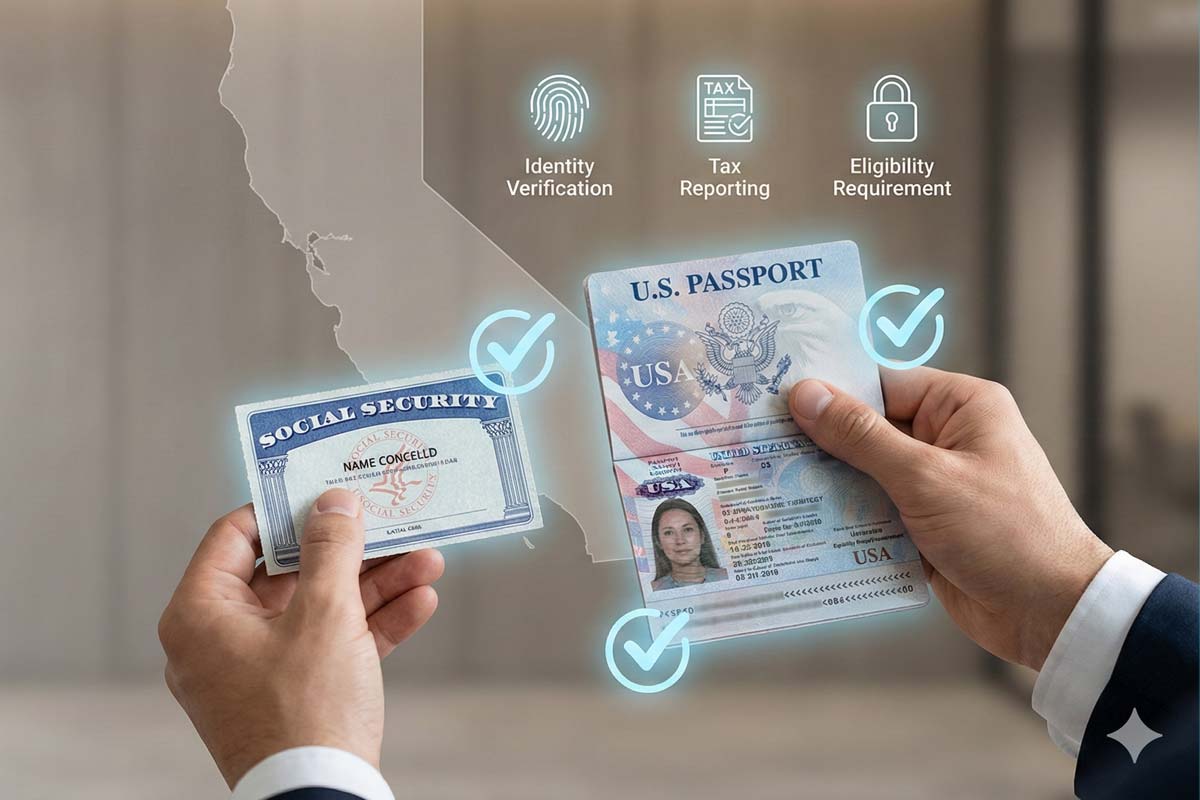
The DRE has no residency requirement. You only need a Social Security Number, a valid government-issued ID for the exam, and to take the test in person in California.
🔍 Myth: You Must Be a California Resident
This is completely false.
Your physical location — whether you live in Texas, Nevada, Oregon, or anywhere else in the U.S. — has zero effect on your eligibility.
The California Department of Real Estate (DRE) does not require:
A California address
A California driver’s license
California residency
Previous time spent in the state
You can complete the entire education portion from anywhere.
⭐ So What Is Required? A Valid SSN/ITIN
Here’s the real requirement that trips people up:
✔ You must have a Social Security Number (SSN).
This is the only “residency-adjacent” requirement — and it has nothing to do with where you physically live.
It’s strictly related to tax reporting.
If you have an SSN, you meet the identification requirement.
Residency doesn’t matter.
Your SSN does.
What About Identification? You Do Need a Valid, Acceptable ID
While residency doesn’t matter, the DRE does require that you provide valid government-issued identification when you take the state exam. This ID is used to verify your identity — not where you live.
Here’s what the DRE accepts:
✔ A current driver’s license (from any U.S. state)
✔ A state-issued ID card
✔A U.S. passport
✔ Military ID
And importantly:
❌ It does not need to be a California ID.
❌ It does not need to match a California address.
A Texas driver’s license, a Nevada state ID, a U.S. passport — all perfectly acceptable.
Your ID is simply used to confirm you are the person scheduled for the exam. It has nothing to do with proving residency, eligibility, or where you plan to live long term.
If your ID is expired, mismatched, or unusual, the DRE may not let you sit for the exam — so double-check that it’s valid and unexpired before test day.
🛠 What the Licensing Process Looks Like if You’re Out of State
If you’re living elsewhere in the U.S., here’s exactly what you can expect.
1. Complete the 135 Hours of Required Courses (Online)
This part is easy — all the courses can be done remotely from any state.
2. Submit Your Exam Application to the DRE
You’ll provide:
Your SSN
A mailing address (can be out-of-state)
Course certificates
3. Travel to California for the State Exam
The exam must be taken in person at a DRE-approved testing center.
4. Complete Fingerprinting (Live Scan) in California
You can do your LiveScan while you’re in California for the exam.
Can I Do My Fingerprints Out of State?Yes, but it requires "hard cards" rather than the electronic Live Scan. You will need two FBI Applicant Fingerprint Cards (FD-258).
Take these to a local law enforcement agency in your state to get fingerprinted, then mail the completed cards to the DRE with your application.Note on Fees: You must include the $49 fingerprint processing fee. The DRE allows you to combine this fee with your exam and license fees in a single payment.
5. Receive Your License
Your license will be mailed to you — even if your mailing address is outside California.
📋 The Real Residency Requirement Checklist
Here's what you actually need:
✔18 or older
✔ 135 hours of DRE-approved pre-license education
✔ Valid SSN
✔Pass the California state exam (in person)
✔ Live Scan fingerprinting in California
Here’s what you don’t need:
❌ California residency
❌ A California driver’s license
❌ A California mailing address
❌ Ever having lived in the state before
🧠 Why the Confusion Exists
A lot of the confusion comes from people mixing up:
DRE rules (state licensing)
Brokerage rules (company hiring policies)
Real estate practice laws (where you can legally work)
Let’s simplify:
👉 The DRE doesn’t care where you live.
👉 The DRE only cares that you can report income using your SSN and clear criminal background.
👉 You are licensed in California — not the state where you live.
🛡 In My 20+ Years of Teaching…
I’ve helped countless students who lived out of state:
Military personnel
College students home for the summer
Professionals planning to relocate later
Investors wanting a California license
Remote workers who never intended to move here
None of them were ever blocked by residency.
But some were concerned about background checks — and understandably so.
🏁 Final Word: Residency Isn’t a Requirement — But Your SSN Is
Here’s the plain-English truth:
California does not require you to live in the state.
California does require you to be identifiable for tax purposes.
If you have:
Your SSN,
Your courses,
And a trip planned for the exam,
You’re already on the right track.
Residency Requirement FAQs
1. Do I need to live in California to get my real estate license?
No. California has no residency requirement for real estate licensing. You can live anywhere in the U.S. and still qualify.
2. Can I use an out-of-state driver’s license for the California real estate exam?
Yes. Any valid U.S. government-issued ID — including an out-of-state driver’s license — is acceptable.
3. Is a Social Security Number required to get a California real estate license?
Yes. A valid SSN is required for tax reporting and identity verification. Residency has nothing to do with this requirement.
4. Can I take the California real estate exam if I live in another state?
Yes. You can complete all coursework remotely and apply from out of state, but you must travel to California to take the exam in person.
5. Do I need a California address to apply for the real estate exam or license?
No. You can use an out-of-state mailing address on your exam or license application.
6. Can I complete Live Scan fingerprinting outside California?
No. Live Scan must be completed in California, usually during your exam trip.
7. Will my out-of-state background check affect my eligibility?
California reviews background history regardless of your state of residence. Residency does not change how the DRE evaluates your record.
8. Do brokerages require California residency even if the state doesn’t?
Some brokerages have internal policies, but these are company rules, not DRE requirements.
📌 Next Steps
If you want more information or a deeper dive, here’s the complete California Real Estate License Guide, which walks you through the entire process in more detail.
🙋 Questions About Your Situation?
Email me anytime.
In 20+ years, I’ve seen every scenario — if there’s a path, we can help you find it.
|

You’ve spent weeks staring at practice real estate exams and memorizing the difference between joint tenancy and community property.
You passed.
You have that provisional sense of accomplishment. Read more...
You’ve spent weeks staring at practice real estate exams and memorizing the difference between joint tenancy and community property.
You passed.
You have that provisional sense of accomplishment. But here is the unvarnished truth: Passing the California real estate exam tested your memory. Choosing your brokerage will test your judgment—and the wrong choice can be more expensive than a failed test.
In California, your broker is your supervisor. Your brokerage isn't just a place to hang your license; it is a professional partnership where they are responsible for your conduct and you are responsible for their reputation. This interview is a risk audit.
Imagine this: It’s 8:00 PM on a Thursday. You’re in your first escrow. The buyer’s agent is screaming about a missed disclosure deadline on the Transfer Disclosure Statement (TDS). If you miss this window, you risk triggering cancellation disputes, the potential loss of your client’s deposit, a DRE complaint, and significant professional liability. You call your broker. It goes to voicemail. You call the office manager. No answer. You are alone, and your license is on the line.
New agents don’t fail because they lack “hustle.” They fail because they lack structured support. This guide is designed to transform you from a nervous applicant into a confident investigator.
THE 10-MINUTE PRE-INTERVIEW CHECKLIST
Do not walk into the office until you have these items in your hand:
The Scorecard: A physical copy of the scoring rubric found at the bottom of this guide.
My Goals Sheet: Your target hours per week and your monthly “keep the lights on” budget.
The Evidence Folder: A notepad ready to document specific proof (calendars, checklists, and fee schedules).
The Deal Timeline: A printed sheet showing the lifecycle of a deal (Offer → Acceptance → Disclosures → Contingencies → Closing) to ask exactly where their review gates occur.
1. Your Pre-Interview Intelligence Gathering
Before you step into an office, you need to know who you are talking to. Not every brokerage is built for a rookie. First, you must Decode the Model. Is this a training-centric firm, a “desk-fee farm,” or a high-volume team? If you aren't sure which path fits your personality, stop and read Should You Join a Team or Go Solo before you schedule the meeting.
Next, scan for online red flags. Look at their social media. Are they constantly recruiting “unlimited potential” but showing zero photos of actual training sessions? For a deeper dive into the specific warning signs I’ve seen over the last 20 years, see our guide on Red Flags When Choosing Your First Brokerage.
2. The Five-Point Interrogation (The System Audit)
Category 1: Training PROOF, Not Promises
Core Question: Does this brokerage have a repeatable system to turn a student into a producer?
Ask the Script: “Walk me through the exact training schedule for my first 30 days. Can I see the syllabus for your contract writing role-play?”
Proof to Demand: Demand to see a Live Calendar, a Course Syllabus, and an Invitation to sit in as a guest at the next session.
Good Answer: “We have a 4-week ‘Launch’ program. It’s live every Tuesday and Thursday. Here is a copy of the calendar; you are welcome to attend the 10 AM session this Thursday to see for yourself.”
Dangerous Answer: “We have an amazing culture of learning. Everyone here is an open book, and you can watch our library of videos whenever you want.”
Category 2: Broker Access & Supervision (Your License SLA)
Core Question: Who saves you when a deal goes sideways at 9:00 PM?
Ask the Script: “What is your agent-to-supervisor ratio? What is your guaranteed response time for a contract emergency? If you aren't available, who is the designated backup by name and title?”
Proof to Demand: Demand a Written Service Level Agreement (SLA) or a clear, documented protocol for after-hours support.
Good Answer: “Our ratio is 25:1. I am available until 9 PM, after which [Name], our Assistant Manager, takes over. We guarantee a 30-minute response for active escrows.”
Dangerous Answer: “We’re like a family here. Someone is always around, and you can just text the group chat if you get stuck.”
Category 3: Compliance & Risk Protection
Core Question: How do they prevent you from making a career-ending disclosure error?
Ask the Script: “Where is your transaction checklist stored and who enforces it? Show me your broker review gates in writing—at what exact points am I blocked from proceeding without your signature?”
Proof to Demand: Demand to see a Transaction Checklist.
Good Answer: “We use [Software]. You cannot send an offer or release contingencies until our compliance officer signs off on these four specific gates. Here is the checklist we use.”
Dangerous Answer: “We trust our agents to be professional. Just upload everything to the folder before the deal closes so we can pay you.”
REALITY CHECK: Policy Varies, Presence Doesn't Exact review gates vary by brokerage based on their specific insurance requirements and workflow, but the presence of these gates is non-negotiable. If there is no formal checkpoint, you are flying without a parachute.
Category 4: The TRUE Cost (Splits & Effective Split)
Core Question: What do I actually take home after the "house" takes its cut?
Ask the Script: “I need a written fee schedule. Show me a sample commission breakdown for a new agent on a $10,000 gross commission with your exact fees, E&O, and franchise costs deducted.”
Proof to Demand: Demand a Written Fee Schedule and a $10,000 Net Commission Sample Printout.
Good Answer: “Here is a printed sheet showing that on a $10k check, your take-home is exactly $6,200 after all costs. We call this your ‘Effective Split.”
Dangerous Answer: “We offer a 70/30 split, which is the best in the area! The other fees are just standard industry stuff that comes out at the end.”
CRITICAL: If you don’t understand how “off-the-top” fees can gut your paycheck, stop and read Commission Splits Explained for New Agents before you sign anything.
Category 5: Lead Flow Mechanics
Core Question: How are leads (if any) distributed, and what is the "pay-to-play" reality?
Ask the Script: “How are office leads distributed? If I take a lead from the office, what is the split? More importantly, do I own my Sphere of Influence (SOI) leads if I choose to leave?”
Proof to Demand: Demand to see the Lead Distribution Rules and the Lead Ownership clause in the independent contractor agreement.
Good Answer: “Office leads are round-robin to ready agents at a 50/50 split. Your personal sphere leads are yours to keep, and the split on those is 70/30.”
Dangerous Answer: “We have more leads than we know what to do with! If you’re hungry, you’ll get your fair share. We put everyone in the company CRM.”
REALITY CHECK: Lead Ownership Trap (Teams) I’ve seen agents join a team and bring in a $1.2M listing from their own cousin. Because they hadn't audited the agreement, the team leader took 50% despite providing zero help. Worse, when the agent left, the leader claimed "ownership" of the cousin in the CRM. Audit your lead ownership before you sign.
3. THE MASTER QUESTION LIST
Group these into your notes to pressure-test their operations.
Systems & Evidence
What is the agent-to-supervisor ratio for new licensees?
Show me your transaction checklist (redacted).
Can I see your broker review gates in writing?
Who is the backup supervisor by name and title when the primary is on vacation?
Money & Ownership
Show me a sample commission breakdown for a $10,000 gross check.
In the event of a claim, what is the E&O insurance deductible I am personally responsible for?
Do I own my Sphere of Influence (SOI) leads if I choose to leave the brokerage?
What happens to my pending escrows if I move to another firm?
Lead Generation
Are there mandatory floor time requirements?
Do teams require giving up ownership of SOI leads to the team CRM?
How many agents who joined in the last 6 months have closed at least 2 deals?
THE “3+1” NON-NEGOTIABLES
Walk out of the room if they cannot provide these four things:
A Written Fee Schedule: No verbal promises on splits.
The $10k Breakdown: A clear example of take-home pay after all deductions.
A Live Training Calendar: Proof that support is a schedule, not a theory.
A Designated Supervisor: A specific person (not a group chat) responsible for your file.
4. THE 5-MINUTE TIE-BREAKER
If you are comparing two brokerages, lay their proof side-by-side and compare only these four data points:
The Net Check: Which $10k breakdown is higher?
The Support Ratio: Which agent-to-supervisor ratio is lower?
The Training Density: Which calendar has more live sessions in the next 14 days?
The Review Gates: Which checklist has more mandatory "Stop" points before an offer is sent?
5. THE SCORECARD & DECISION TOOL
Grade each brokerage from 1 (Poor) to 5 (Excellent) in these categories:
Training Proof: (Syllabus shown/Guest invite offered)
Broker Access: (SLA committed/Backup named)
Compliance Systems: (Checklist shown/Review gates enforced)
Cost Transparency: (Written fee schedule/$10k breakdown provided)
Lead Mechanics: (Clear distribution rules/No SOI ownership traps)
The Walk-Away Rule: If Training, Broker Access, or Compliance average below a 4, do not join. No split compensates for a failed deal, a DRE complaint, or a damaged reputation in your first year.
Now that you know how to audit a firm, see our list of the Best Brokerages for New Agents in California to see who tends to score well on these criteria.
Your Career, Your Choice
The brokerage you choose is the most important business decision of your first year. Treat it like a million-dollar acquisition. Once you have chosen the right supervisor to protect your license, your next step is to master the roadmap to actually close deals. Follow our sequence to Start a Real Estate Career in California correctly.
Frequently Asked Questions
What if no brokerage in my area meets a “4” on the scorecard? Keep looking. In major California markets, there are hundreds of options. If you must compromise, never compromise on Broker Access or Compliance. You can buy your own training, but you cannot buy protection from a DRE audit or a ruined reputation.
What should I email the broker after the meeting if they didn’t provide proof? Send this: "Thank you for the time today. To help me make my final decision, could you please email over the written fee schedule, the $10,000 commission breakdown example, and the training syllabus for next month that we discussed?"
In the event of a claim, am I always responsible for the E&O deductible? Usually, yes. It can range from $1,000 to $5,000 or more. You need to know this number upfront so you can budget for it in your "keep the lights on" plan.
Should my broker review offers before submission in California? Yes. While the DRE allows for various supervisory structures, it is a professional best practice to have a broker or manager review your first several offers and disclosure packets to protect your license and your client.
How do I verify training is real? Ask to be a guest. A brokerage with a strong training program is proud to show it off. If they claim it is "proprietary" and can only be seen after you sign a contract, they are likely hiding a lack of substance.
|
If you have a criminal record and you’re considering getting a California real estate license, you’re probably carrying a heavy question:
“Will my past prevent me from becoming an agent?” Read more...
If you have a criminal record and you’re considering getting a California real estate license, you’re probably carrying a heavy question:
“Will my past prevent me from becoming an agent?”
And if you’re anxious, confused, or even scared to begin, you’re not alone. In over 20 years of teaching real estate students in California, I’ve answered this question more times than I can count — usually from people who are motivated, hardworking, and trying to rebuild their lives.
Here’s the truth, stated plainly:
A criminal record does not automatically disqualify you.
But it also does not guarantee that you’ll be approved — even if the offense was long ago, even if it was expunged, and even if you’ve made significant progress in your life.
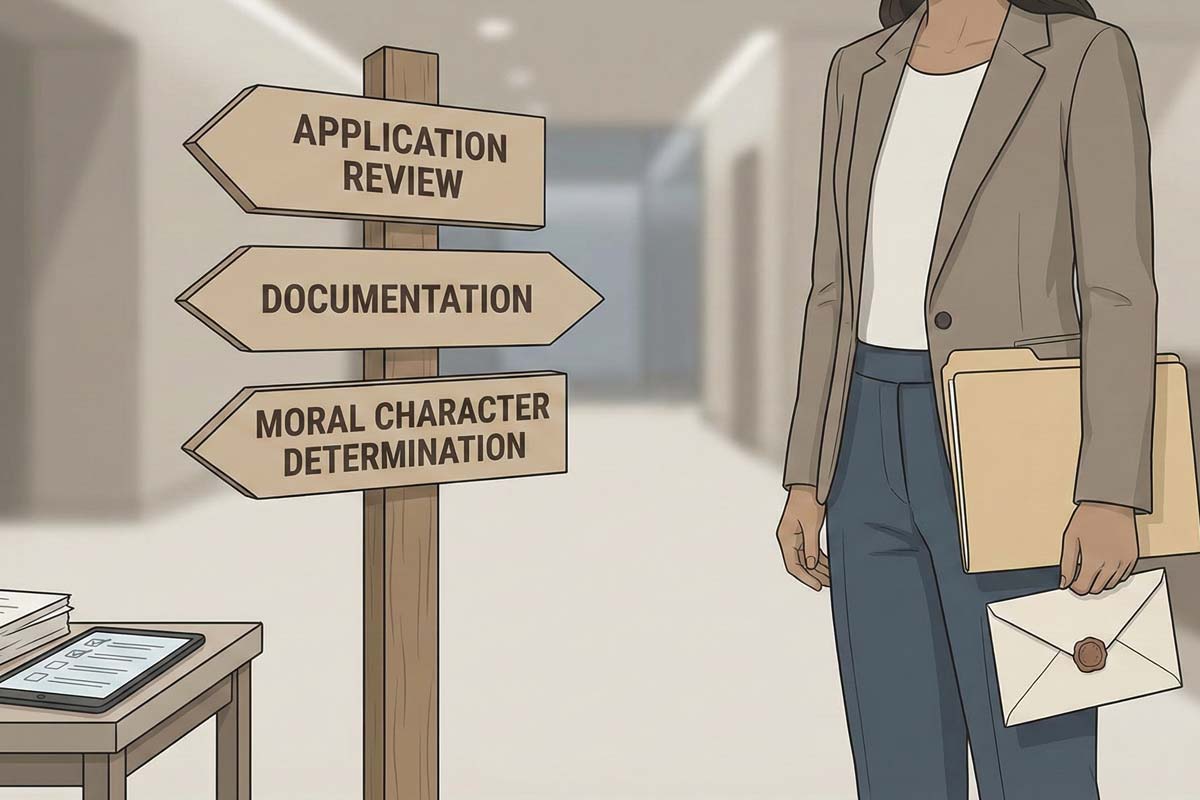
The California Department of Real Estate (DRE) reviews every applicant with a record through a detailed Moral Character Determination.
Some applicants are approved. Some are denied.
What determines the outcome?
Honesty, documentation, rehabilitation, and — importantly — the nature of the offense itself.
Before we get into the specifics, here’s one key distinction I tell all my students:
Eligibility rules and your government issued ID merely allow you to take the exam.
Moral character review determines whether you can actually receive the license after you pass.
You can start the process.
But whether or not you get the license depends on a thorough state review of your complete history.
How the DRE Evaluates a Criminal Record
“Moral Character” can sound vague or intimidating, but in practice it comes down to three things the DRE looks at:
1. Honesty
Did you disclose everything? Was it complete, accurate, and truthful?
2. Integrity
Does your conduct — past and present — demonstrate responsibility?
3. Trustworthiness
Can consumers trust you with confidential information, contracts, and money?
None of this is about perfection.
But it is about transparency and evidence of change.
The DRE’s review is strict.
Every applicant is fingerprinted, and the state receives full reports from both the DOJ and FBI. Nothing stays hidden. And the DRE expects disclosure of:
Every conviction ever — including DUIs, misdemeanors, and felonies
Convictions that were dismissed or expunged under Penal Code 1203.4
Any disciplinary action against a professional or business license
Any pending criminal charges
A conviction itself does not automatically lead to denial.
But failing to disclose often does.
If there’s one message I stress repeatedly, it’s this:
When in doubt, disclose. Every time.
A Realistic Understanding: Approval Is Possible — Not Guaranteed
Over the past two decades, I have had students with various criminal histories go on to become licensed real estate agents. I’ve also had students with similar histories get denied.
The difference usually comes down to:
The seriousness of the offense
The presence of fraud, dishonesty, or financial crimes
Time since the offense
Completion of probation
Documented rehabilitation
Consistency and truthfulness in disclosure
Whether the applicant took responsibility
To be clear:
Some offenses make licensure extremely difficult.
Crimes involving fraud, forgery, embezzlement, or financial misconduct carry significantly more weight because real estate involves handling money and sensitive documents.
Even with rehabilitation, these offenses may still result in denial.
I don’t say that to discourage you — I say it because you deserve accuracy, not false optimism.
The Fastest Path to Denial: Missing or Incomplete Disclosure
Let me be completely direct:
The DRE will find out everything, both before and after you are licensed.
Applicants are sometimes denied not because of the offense, but because:
Something wasn’t disclosed
A detail was incomplete
A conviction was “forgotten”
They assumed an expungement didn’t need to be listed
They relied on advice from friends or attorneys who said “don’t worry about it”
The DRE is crystal clear on this:
Failure to disclose is treated as an attempt to obtain a license by fraud or misrepresentation.
No school, no friend, and no online source can override what the DRE requires.
What You Should Do If You Have a Criminal Record
Over the years, I’ve developed a step-by-step approach I recommend to any student who is worried about their background. It doesn’t guarantee approval — nothing does — but it positions your application for the fairest review possible.
You can also contact the DRE at 877-373-4542 with other questions.
1. Obtain Your Complete Criminal Record
Do not guess.
Do not rely on memory.
Request:
DOJ criminal history
Court docket(s)
Final disposition records
Make sure you know the full picture:
The exact charges
Dates of arrest and conviction
Whether probation was completed
Whether fines were paid
Whether any part of the record was dismissed or reduced
The DRE will compare what you disclose to what the fingerprint report shows.
2. Prepare a Clear, Factual Statement of Explanation
Your Statement of Explanation matters — a lot.
A strong explanation includes:
What happened (factually, without minimizing)
Why it happened
What you learned
What’s changed in your life since
Why similar conduct won’t occur again
Avoid excuses. The DRE isn’t looking for justification — they’re looking for accountability.
3. Assemble Evidence of Rehabilitation
Rehabilitation is essential, especially for more serious offenses.
Evidence can include:
Letters of reference
Proof of stable employment
Documentation of treatment or programs completed
Community service records
Certificates from education or training
Court documents showing compliance
AA/NA attendance records (for substance-related offenses)
Counseling or therapy participation
The stronger and more organized this section is, the clearer your current character becomes.
4. Organize Your Documents for Submission
Think of this like preparing a professional portfolio.
Create a clean, organized packet containing:
All case information
All disclosures
Statement of Explanation
Rehabilitation documents
A chronological summary
Make it easy for the DRE reviewer to understand your history and see your progress.
If You Are Denied
If the DRE denies your application, the process does not necessarily end there.
You may:
Request reconsideration under Government Code 11521
Seek judicial review under Government Code 11523
Some applicants choose to consult an attorney experienced in administrative law to navigate deadlines and procedures.
Again — not a guarantee, but an available path.
The Bottom Line: Your Past Matters, but It Doesn’t Automatically Decide Your Future
A criminal record creates uncertainty in the licensing process — and you deserve a realistic understanding of that. Some applicants with records are approved. Some are denied. The outcome depends on honesty, documentation, accountability, and the specific facts of the offense.
But here’s what I can tell you after two decades of teaching:
You’re not disqualified from trying.
You’re not automatically denied.
And you’re not without a path forward at some point through the process.
If you approach the process carefully and truthfully, you give yourself the best chance at a fair review — and potentially, a career that can change your life.
When you're ready to take the next step or want help understanding the licensing process, we’re here to guide you every step of the way.
Q: Can I get a California real estate license with a felony?
A: Possibly. Felonies aren’t automatic denials, but the DRE reviews them under its moral character standards. Approval depends on disclosure, rehabilitation, and the specifics of the offense.
Q: Do I have to disclose expunged or dismissed convictions?
A: Yes. Even expunged or dismissed convictions must be disclosed. The DRE receives full DOJ/FBI fingerprint reports, and failing to disclose can lead to denial.
Q: What offenses make it hardest to get licensed?
A: Crimes involving fraud, dishonesty, theft, or financial misconduct face strict review and are the hardest to overcome. These may still result in denial even with rehabilitation.
Q: What does the DRE look at in a moral character review?
A: Honesty in disclosure, nature of the offense, completion of court requirements, time since the violation, and evidence of rehabilitation.
Q: What documents should I submit if I have a criminal record?
A: Court records, DOJ/FBI reports, a clear Statement of Explanation, and evidence of rehabilitation such as employment history and reference letters.
Q: Will the DRE find out if I don’t disclose something?
A: Yes. Fingerprint checks reveal all convictions, including expunged ones. Non-disclosure is one of the most common reasons for denial.
Q: What can I do if the DRE denies my application?
A: You may request reconsideration or pursue judicial review. Some applicants consult an attorney to navigate appeal deadlines.
Want even more information on getting your real estate license? Check out our comprehensive Real Estate License Guide.
|

If you're thinking about starting a real estate career in California, one of the first questions you’ll have is: “Do I even qualify?” Maybe you’re unsure whether your background will affect your Read more...
If you're thinking about starting a real estate career in California, one of the first questions you’ll have is: “Do I even qualify?” Maybe you’re unsure whether your background will affect your chances, whether you need to live in California, or if an out-of-state ID will cause problems.
I say all this having been in the real estate education business for over 20 years and answering this question almost daily.
At the end of the day, California’s real estate license requirements are far more accessible than most people expect. To get started, you only need to meet four core eligibility standards set by the California Department of Real Estate (DRE).
Before we break them down, one important distinction:
Eligibility rules determine whether you can apply for and take the exam. As long as you meet these, the state will let you take the test.
License requirements (Live Scan + SSN/ITIN submission) happen after you pass and you’re applying for your actual real estate license
Understanding these DRE eligibility requirements upfront can save you time, money, and stress. Let’s explore exactly what the state requires — and what it doesn’t.
The Four Pillars of California Real Estate License Eligibility
1. Age and Citizenship Requirements
You Must Be 18 or Older
California requires all real estate salesperson applicants to be at least 18 years old. No exceptions.
This means, if you're 17, you can finish your courses early, but you cannot apply or take the exam until your 18th birthday.
No Citizenship or Residency Requirement
This is where most misconceptions come from. The DRE does not require:
U.S. citizenship
California residency
Proof of legal presence or immigration status
California does not check immigration status at any point in the licensing process.
You can become a real estate agent in California even if you are not a U.S. citizen or permanent resident. Many years ago, there was a proof of legal presence document, but this has been eliminated.
What Identification Is Required
To take the exam, you must present a valid, government-issued ID such as:
U.S. driver’s license (any state)
U.S. state ID card
U.S. passport or passport card
U.S. military ID
Foreign driver’s licenses are not accepted for the real estate exam.
Your ID must be current, contain your photo and signature, and match the name on your exam registration and license application exactly.
SSN/ITIN Rules
After you pass the exam, the DRE will require either:
a Social Security Number (SSN), or
an Individual Taxpayer Identification Number (ITIN)
This requirement is only for the license stage and is tied to tax reporting and identity verification — not immigration enforcement.
2. Education Requirements
You Must Complete Three College-Level Courses
Before the DRE will schedule your exam, you must complete:
Real Estate Principles
Real Estate Practice
One approved elective, such as
Real Estate Finance
Real Estate Economics
Real Estate Appraisal
Legal Aspects of Real Estate
Property Management
Escrow
Courses must be taken through:
A California community college
A DRE-approved real estate school, like ADHI Schools.
An accredited online program
Online courses are fully acceptable if the provider is DRE-approved.
No High School Diploma or GED Required
The DRE does not require a high school diploma or GED.
However, success in the coursework and on the exam requires:
strong reading comprehension
good grasp of the English language (the real estate license exam is in English)
the ability to understand contracts and disclosures
3. Background Check and Moral Character
Live Scan Fingerprinting
Every applicant must complete a Live Scan background check. Live Scan is California’s electronic fingerprinting system used to check criminal history.
When does Live Scan happen?
After you pass the exam, when applying for the license, or
With the combined exam + license application (recommended)
Fingerprinting fees include the FBI/DOJ fee (currently $49) plus vendor fees, which vary by location.
What “Moral Character” Really Means
The DRE evaluates whether an applicant demonstrates:
honesty
integrity
trustworthiness
This is the legal standard for protecting consumers in real estate transactions.
A Criminal Record Does Not Automatically Disqualify You
This is another major misconception. A conviction is not an automatic denial.
The DRE evaluates:
the nature and seriousness of the offense
how long ago it occurred
evidence of rehabilitation
whether the offense relates to real estate activities
overall behavior and conduct
Full Disclosure Is Mandatory
Failure to disclose a conviction is often treated more seriously than the offense itself.
Be completely honest in your application — transparency increases your likelihood of approval.
4. Identification Requirements for the Exam and License
To take the exam, you must present:
valid U.S. government-issued ID or
a valid foreign passport
The ID must be:
current
government-issued
include photo + signature
match your exam registration and license application exactly
Name mismatches (initials, hyphens, missing middle names, recent name changes) are the #1 cause of exam-day problems.
Update your ID before scheduling your exam if anything has changed.
Who Qualifies for a California Real Estate License?
Here is a quick summary of the four eligibility pillars:
Eligibility Requirement
What the DRE Requires
What the DRE Does Not Require
Age
Must be 18+
No exceptions
Citizenship
SSN/ITIN for licensing
No legal presence or citizenship verification
Education
3 approved courses
No high school diploma
Background
Live Scan + honesty
Not automatically barred with a record
ID
Valid U.S. ID or foreign passport
No residency requirement
Once you meet these four requirements, the DRE will authorize you for the exam. After you pass and complete Live Scan, you’ll be eligible for your California real estate license.
You can find a more thorough breakdown of this information in our Real Estate License Guide.
Frequently Asked Questions
Do I need to live in California to get licensed?
No. California residency is not required.
Can undocumented individuals get licensed?
Applicants with an ITIN can obtain a real estate license. No proof of legal presence is required.
Are online real estate courses accepted?
Yes. Online courses are accepted if they come from a DRE-approved provider, like ADHI Schools, or accredited college.
Can you get licensed with a background event?
Yes. Background does not automatically disqualify you. The DRE evaluates each case individually based on honesty, rehabilitation, and relevance to real estate.
Ready to Take the Next Step?
If you meet the four eligibility requirements, you’ve already cleared the biggest early hurdle. With the right preparation and courses, thousands of new agents earn their California real estate licenses every year.
You could be next!
|