
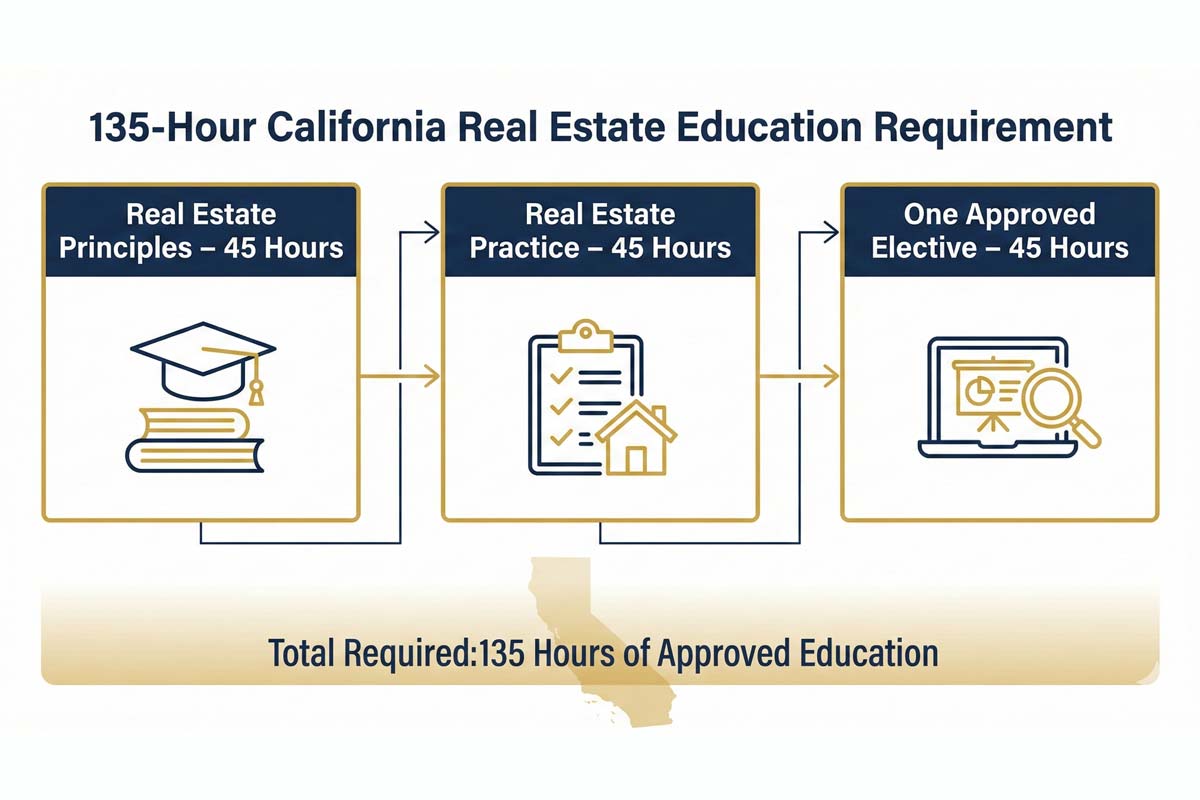
To get a California real estate license, you must complete 135 hours of approved coursework. These are the California real estate license education requirements set by the DRE. You don’t need a college degree, and you don’t need industry experience to get a sales license.
Voice Answer: You need 135 hours of DRE-approved coursework to qualify for a California real estate license. That includes Real Estate Principles, Real Estate Practice, and one elective. No degree is required. Each course must be completed over at least 18 days, which is a strict DRE timing rule.
You only need to complete three specific courses: Real Estate Principles, Real Estate Practice, and one approved elective. That’s the entire academic requirement.
These education rules form the core DRE prerequisites for exam eligibility. Once you finish the 135 hours and receive your certificates, you can apply for the salesperson exam. When your exam application is approved, remember that you'll need a valid photo ID (like a driver's license) to be admitted to the testing center on exam day.
There are no shortcuts, no alternative pathways (besides being a member of the California bar), and no substituted degrees unless directly listed in the law.
The system is strict but simple.
If you want more information or a deeper dive, check out our complete guide to getting your real estate license.
People often assume real estate is like accounting or law. They believe a degree unlocks the license. That myth stops students before they even start. The truth is blunt: The DRE does not require a degree.
You only need the mandated courses.
Some students do qualify through certain college courses they have taken in the past but most people will meet the education requirements through the standard 135-hour pathway. That’s why it’s important to understand the real rules.
These myths distract people from the simple path. Focus on what the DRE actually requires.
To be clear, I went to college at Cal Poly, got a degree and don’t regret it at all. That experience shaped a lot of how I teach today. College pushed real teamwork, deadlines, and problem-solving — all skills that translate directly into real estate, but the degree isn’t a requirement.
Remember that California only requires one thing academically: Complete three 45 hour DRE-approved courses totaling 135 hours. Every applicant—whether new to the industry or coming from another field—must take these same classes.
Consider this your foundation. It equips you with the vocabulary—from property types to agency laws—that you will face on test day. Many students make the mistake of underestimating this course. Don’t. Principles is the backbone of your future license.
This course focuses on the day-to-day realities of the business. Disclosures, listings, offers, and client interactions dominate this material. It helps you think like an agent, not a test taker. Remember that the Real Estate Practice course must now contain an interactive implicit bias component according to SB1495.
You can choose from options like Finance, Legal Aspects, or Property Management. The choice of the elective is less important than getting it done.
These are the only education requirements the DRE needs academically. Complete the Big Three, earn the certificates, and you’re eligible to apply for the real estate exam.
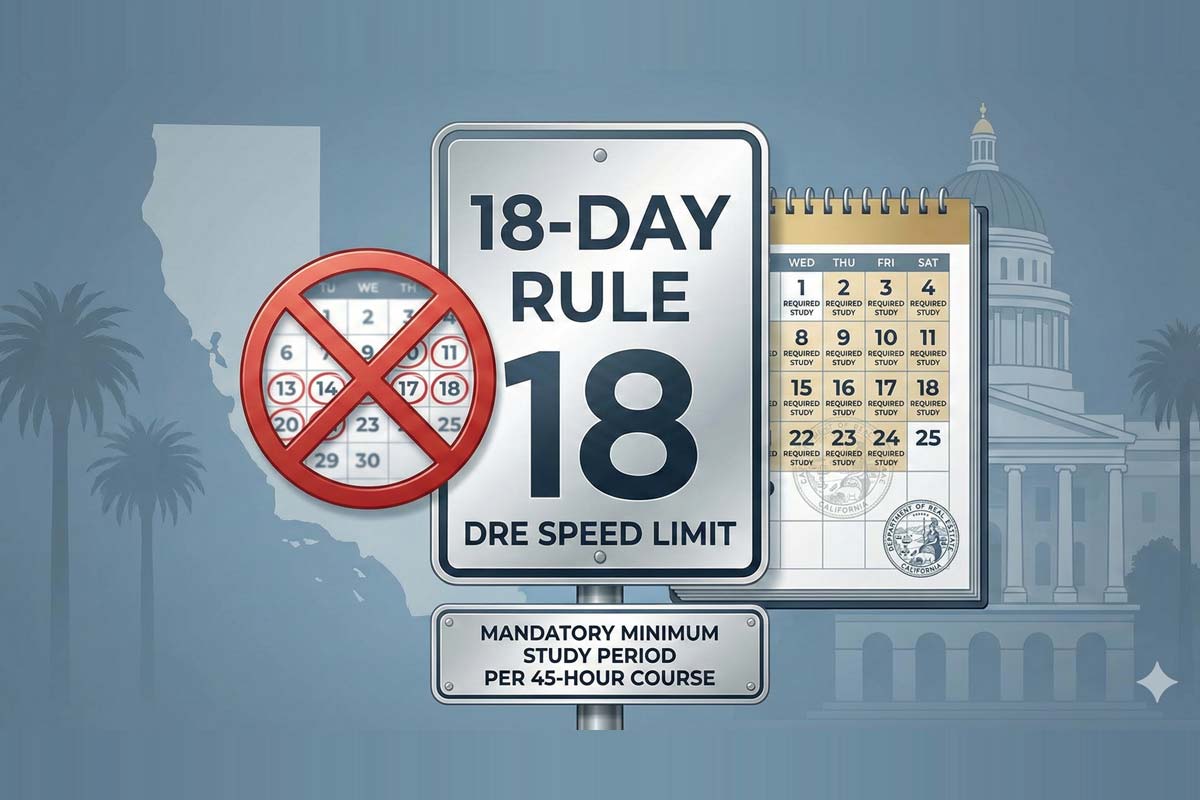
Who doesn’t love speed? But California sets a hard limit. You cannot legally complete a 45-hour correspondence course in less than 18 days. This applies to every approved school, including ours. There is no workaround. There is no exception.
Why? The state wants meaningful study time. They want students to absorb the content instead of rushing through modules. So the DRE built this rule to slow you down. Schools must track your progress and enforce it.
You can take multiple courses at once, but each course has its own minimum timeline. That means the fastest anyone can complete the three courses is 54 days (18 days x 3 courses). Many providers imply faster completion. Don’t fall for it.
Plan your schedule with this rule in mind. You’ll finish more smoothly, and you won’t get flagged for rushing the material.
Most delays have nothing to do with the coursework. They come from preventable mistakes.
Here are the biggest pitfalls:
Each mistake adds stress and time. Avoid them and you’ll finish your education and licensing quickly and cleanly.
Students sometimes fear math. They imagine complex loan calculations or high-level finance problems. But the exam isn’t built to stump you with math. The real challenge is vocabulary. California real estate uses precise language, and exam writers test your understanding of those terms.
I’ve watched strong students fail because they ignored terminology. I’ve also watched anxious students pass because they focused on consistent reading. The DRE expects you to know definitions, agency concepts, disclosures, and basic laws. That’s where the exam is won.
The best students build a pattern: short study sessions, steady note-taking, and quiz repetition. They avoid cramming. They respect the 18-day rule. They treat the material like the new language it is. Master the vocabulary and you stack the deck in your favor.
Q: Can I take the courses online?
A: Yes. The DRE allows fully online, self-paced courses through approved providers like ADHI Schools. Most students finish faster online because they control their study time.
Q: Do old college credits count?
A: Only specific real estate or real estate-adjacent courses qualify. General business classes don’t count. The DRE reviews transcripts individually.
Q: Do I need a degree?
A: No. Degrees are irrelevant. Only the three 45-hour courses matter for most applicants.
Q: Can I complete the courses faster than 18 days?
A: No. The 18-day rule is firm. Every 45-hour course requires a minimum of 18 days.
Q: What if I already took one of the courses?
A: If it’s from a DRE-approved provider or qualifying college program, you may use it. Keep your certificate or transcript.
Q: How long do most students take?
A: Many complete the 135 hours in 8–12 weeks.
Finishing the California real estate license education requirements is straightforward once you understand the system. Complete the Big Three, follow the 18-day rule, and avoid the common mistakes.
If you want the simplest possible path to finishing your 135 hours, check out our packages.

Founder, Adhi Schools
Kartik Subramaniam is the Founder and CEO of ADHI Real Estate Schools, a leader in real estate education throughout California. Holding a degree from Cal Poly University, Subramaniam brings a wealth of experience in real estate sales, property management, and investment transactions. He is the author of nine books on real estate and countless real estate articles. With a track record of successfully completing hundreds of real estate transactions, he has equipped countless professionals to thrive in the industry.

"Hey guys,
I took the exam today and passed!!!!
It only took me one try which was one of my goals. I took the online
classes and follow your suggestions so I took the crash course,
used the crash course app a lot, took 7 mock tests and went
confident to present the exam. Thank you for the great job you are
doing, you guys are awesome!!!! May God continue to bless you!"
Willie V.