
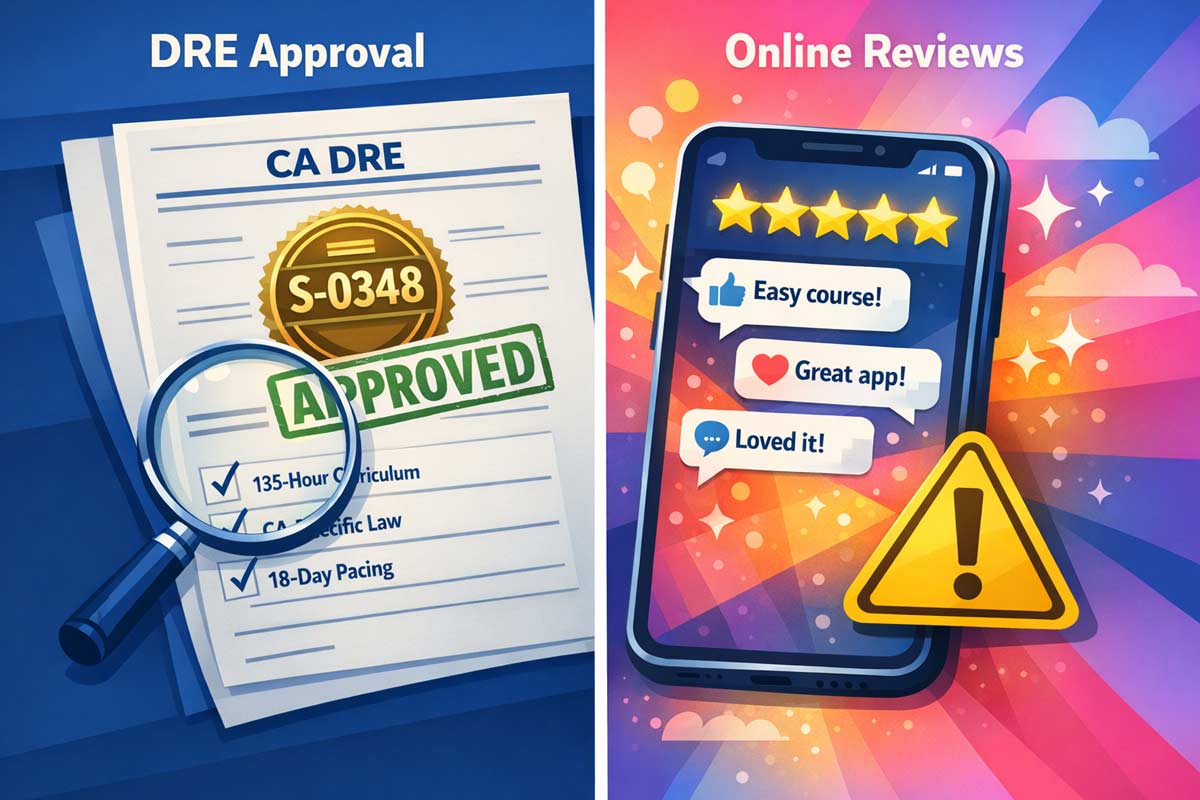
When you decide to get your California real estate license, your first instinct is likely the same as when you pick a restaurant: you check the reviews. You look for the highest star rating and the most testimonials.
In the world of professional licensing, that strategy can be a trap.
While reviews tell you about a user interface or how "easy" a course felt, they don't always tell you the one thing that actually matters: Is this a DRE-approved statutory course provider? Licensing isn't just a purchase; it is a regulatory process. To choose the right real estate school, you need a clear decision rule: DRE approval is the eligibility gate; reviews are a secondary quality filter.
The Quick Framework: DRE approval is the baseline requirement that helps ensure your education counts toward state requirements. Reviews only measure the student experience. You should always verify DRE approval by checking a school's “S-number” before evaluating their social proof. If you are comparing several providers, start with our guide on the Best Real Estate Schools in California.
In California, being a "DRE-approved course provider" means the California Department of Real Estate has reviewed the provider’s curriculum, delivery methods, and identity verification processes to confirm it meets statutory requirements.
To qualify for the real estate exam, you must complete three 45-hour courses (135 hours total):
DRE Approval is what makes this education count toward the requirement. It confirms that the provider and the specific course format you are taking are currently recognized for statutory credit. Online Reviews, while helpful for gauging the student experience, do not guarantee that a school has met these legal standards.
Online reviews are a helpful signal, but they rarely tell the whole story. Because many students are unaware of the underlying regulatory framework, they often review a school based on convenience rather than compliance. Before diving into stars, it is vital to understand how important online reviews are for real estate schools and where they sometimes fall short.
Focusing on a school’s status as a DRE-approved course provider in California protects you from the most common friction points in the licensing journey:

To cut through the noise, use this simple two-step gatekeeping process:
Before reading a single review, locate the provider’s "S-number" (Statutory Provider Number).
Once you’ve confirmed they are legit, use reviews to look for these "Operator-Level" details:
| Checkpoint | What it Proves | The Reality |
|---|---|---|
| DRE S-Number | Legal Eligibility | No verified S-number = you can’t confirm the courses will count toward the 135 hours. |
| 18-Day Pacing | Regulatory Compliance | Fast "hacks" can create compliance issues and delays. |
| Student Support | Educational Quality | You need help when California law gets complex. |
Use this checklist to vet any provider before you enroll:
"If a school has thousands of great reviews, doesn't that mean it's the best?" It means they are popular. While popularity is a sign of a functional business, it is not a substitute for regulatory standing. Always prioritize S-number verification first.
"What if a school says 'State Approved' but not DRE?" In California, the DRE is the only regulatory body that matters for your license. "State approved" is a vague term that could refer to a general business license.
"Can the DRE deny my education if I took it online?" Not if you used a DRE-approved statutory course provider. Online education is a standard, fully recognized path to licensure in California, provided the school and course delivery are approved.
With over 20 years of experience helping students navigate these hurdles at ADHI Schools, I have seen that the most successful students are those who treat the process with professional scrutiny.
Approval is the legal baseline.
After that, choose the provider whose structure and support fit your learning style.
Don't let a high star count distract you from the technical requirements of the law. Secure your eligibility first, then choose the provider that will actually help you pass the state exam.
Ready to see how the top providers compare? Check out our comprehensive guide: Best Real Estate Schools in California

Founder, Adhi Schools
Kartik Subramaniam is the Founder and CEO of ADHI Real Estate Schools, a leader in real estate education throughout California. Holding a degree from Cal Poly University, Subramaniam brings a wealth of experience in real estate sales, property management, and investment transactions. He is the author of nine books on real estate and countless real estate articles. With a track record of successfully completing hundreds of real estate transactions, he has equipped countless professionals to thrive in the industry.

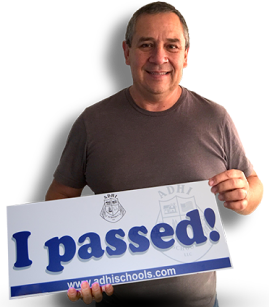
"Hey guys,
I took the exam today and passed!!!!
It only took me one try which was one of my goals. I took the online
classes and follow your suggestions so I took the crash course,
used the crash course app a lot, took 7 mock tests and went
confident to present the exam. Thank you for the great job you are
doing, you guys are awesome!!!! May God continue to bless you!"
Willie V.