
For most California real estate license hopefuls, the goal is simple: get licensed as quickly and efficiently as possible. However, in the rush to start a new career, students can fall into the trap of enrolling in programs that lack the proper state-mandated credentials.
The "cost" of choosing a non-DRE-approved provider isn't just the registration fee—it's the weeks, or even months, of wasted time and the frustration of having your state application delayed or rejected if the certificates don’t qualify. In my 20+ years of helping California students navigate licensing requirements, I have seen far too many people forced to start from scratch because they missed one simple verification step.
How do I avoid non-DRE-approved real estate schools in California?
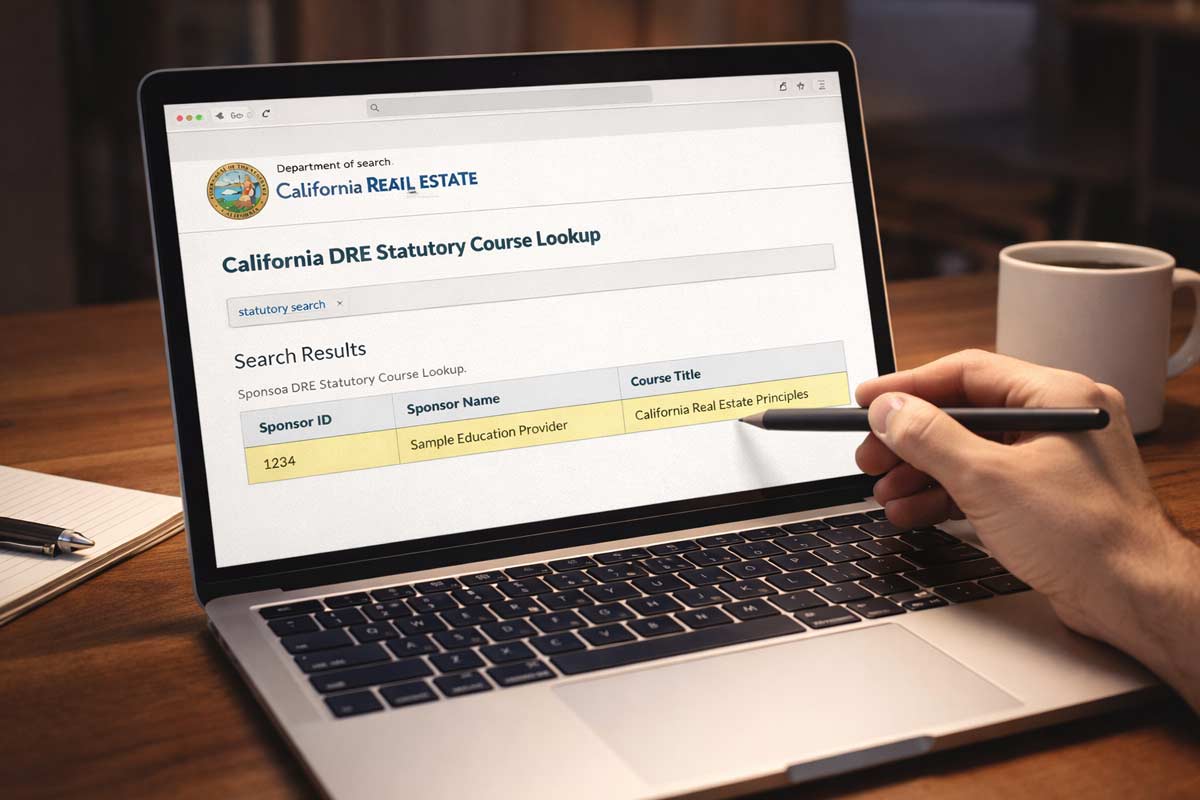
To avoid unapproved schools, verify the provider’s 4-digit DRE sponsor ID and specific course listing on the official DRE Statutory Course Search Page. Ensure the course titles match the DRE’s list of approved statutory courses (Principles, Practice, and an elective). Avoid any provider that uses vague terms like "state-aligned" without providing a specific DRE sponsor number.
It is important to distinguish between a program that is "legal" and one that is "DRE-approved" for pre-licensing credit. For example, a general real estate investing course can be legitimate education, but it won’t satisfy the DRE’s statutory pre-licensing requirements.
A company may have a professional website and high-production videos, but unless they are a DRE-approved statutory course provider, they cannot issue the certificates you need. In California, what matters is whether the sponsor and the specific statutory course are listed as DRE-approved. Once you confirm a provider is approved, online reviews for real estate schools become the next tool for judging actual support quality and course usability.
"Exam Prep" consists of practice questions designed to help you pass the test. "Pre-licensing" consists of the 135 hours of mandated education. If you just purchase a "Crash Course" thinking it satisfies the 135-hour requirement, your application may be rejected or delayed by the DRE.
Here’s the exact 5-step workflow I recommend students run before paying:
You don’t need to guess if a school is legitimate. Look for these evidence-based patterns that often indicate a program may not be authorized to provide credit:
If you suspect your school might not be approved, take these practical steps:
How do I check if a real estate school is DRE-approved in California?
Visit the official DRE Statutory Course Lookup and search by the school’s name or 4-digit Sponsor ID.
Are there lookalike real estate schools online?
Yes. Some websites are prep-only or lead-generation pages that can be mistaken for course providers.
Does ‘exam prep’ count for DRE credit?
No. Real estate exam prep is a study tool. You must still complete 135 hours of statutory education from an approved provider.
If a school is popular, does that mean it’s approved?
Not necessarily. Marketing reach does not equal approval. Always verify the DRE Sponsor ID before enrolling.
Do reviews matter if a school is approved?
Yes. Approval proves the school is legal; reviews prove the school is effective. Use both to make your decision.
What matters more: reviews or accreditation?
Accreditation (DRE Approval) is the "pass/fail" gate. Without it, reviews are irrelevant because the school cannot help you qualify for the exam.
Confirming that a school is legitimate is just the first step. Once you’ve filtered out non-approved providers, your goal shifts to finding a program that fits your learning style, timeline, and support needs.
DRE approval is the baseline—but the quality of instructors and the depth of materials are what determine your success on exam day. To see how the top-tier providers compare once you've done your due diligence, view our full breakdown of the Best Real Estate Schools in California.

Founder, Adhi Schools
Kartik Subramaniam is the Founder and CEO of ADHI Real Estate Schools, a leader in real estate education throughout California. Holding a degree from Cal Poly University, Subramaniam brings a wealth of experience in real estate sales, property management, and investment transactions. He is the author of nine books on real estate and countless real estate articles. With a track record of successfully completing hundreds of real estate transactions, he has equipped countless professionals to thrive in the industry.

"Hey guys,
I took the exam today and passed!!!!
It only took me one try which was one of my goals. I took the online
classes and follow your suggestions so I took the crash course,
used the crash course app a lot, took 7 mock tests and went
confident to present the exam. Thank you for the great job you are
doing, you guys are awesome!!!! May God continue to bless you!"
Willie V.