
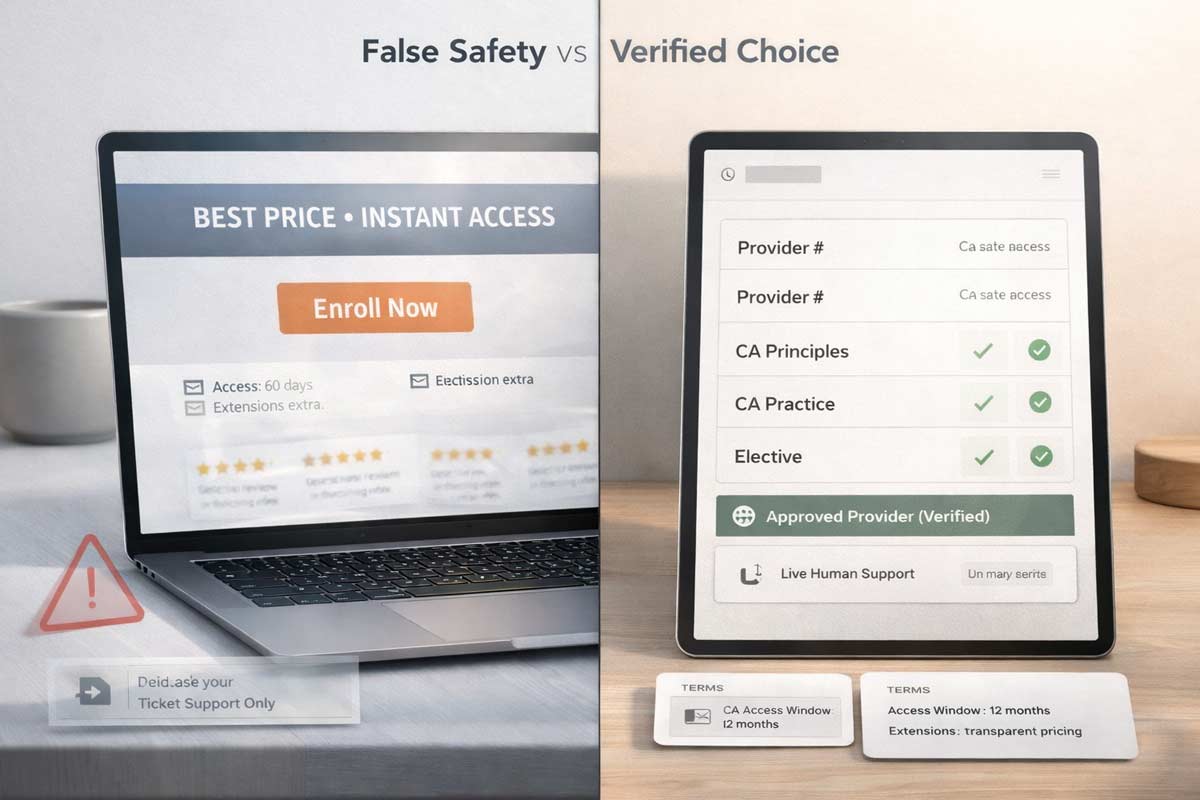
Most students don’t fail the California real estate exam because they aren't smart enough. They fail because they chose a school that created unnecessary friction—outdated materials, non-responsive support, or hidden costs that appear right when you’re ready to take your final exam.
The goal of this guide is to help you move past marketing claims and identify preventable mistakes by spotting red flags early. By using a framework of Fit, Verification, and Support, you can protect your investment and focus on getting your license.
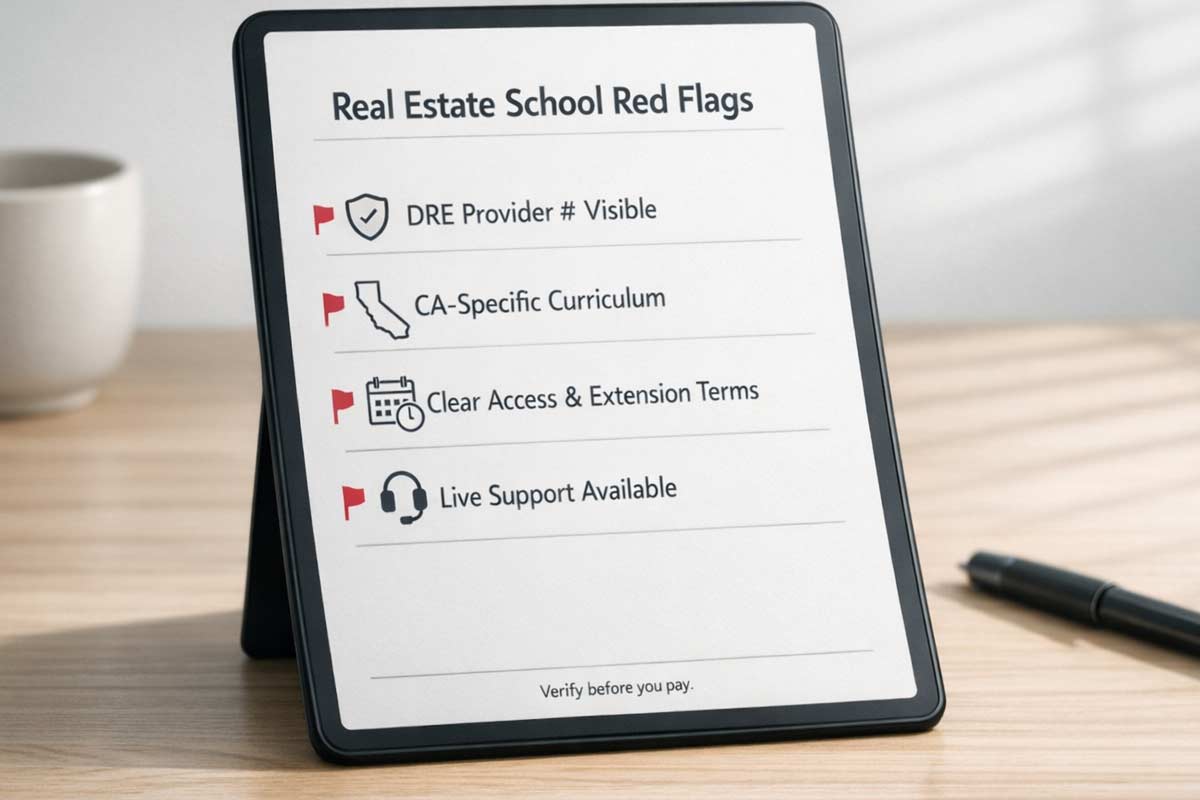
| The Red Flag | Why It Matters | The Verification Step |
|---|---|---|
| Missing Provider # | Your credits won't count toward your license. | Search the DRE Pre-license Statutory Course Provider list. |
| "Nationwide" Focus | You won't learn CA-specific laws or forms. | Confirm CA Principles/Practice mapping. |
| Hidden Extensions | The "cheap" price doubles after 60–90 days. | Read the "Terms" for course expiration rules. |
| No Live Support | You get stuck on complex CA-specific concepts. | Call the school to test response time before paying. |
In California, schools are not "licensed" like agents; they are approved statutory course providers. If a school is vague about this status, it is the ultimate red flag.
A legitimate school should be able to provide its DRE statutory course provider number easily. This number is your link to the Department of Real Estate's database. Without it, you have no guarantee that your completion certificates will be accepted.
What to do: Always verify legitimacy by cross-referencing their provider number on the DRE Pre-license Statutory Course Provider database before enrolling. You can also learn more about how to know if a real estate school is legit in California here.
California law is unique—especially regarding agency, trust funds, and disclosures. If a school cannot clearly show how their courses map to California Principles and Practice requirements, they may be selling you national content that won't help you pass the state exam.
In California, the real estate exam is 100% state-specific. Because there is no national component, studying for a national test is a waste of time when your goal is a California license.
What to do: Make sure you avoid unapproved or non-qualifying providers that use "one-size-fits-all" national textbooks by checking for California-specific course alignment.
Reviews are a great signal, but they require a critical eye to ensure you aren't falling for a "support black hole."
If you see fifty 5-star reviews all posted within the same week, or if they all use identical phrasing, they may be incentivized. More importantly, if reviews only mention the low price and never mention the quality of the instructor or the ease of the California-specific material, the school likely offers a "file-and-forget" experience.
A 1-star review about a student who didn't study is one thing; 1-star reviews about "no one answering the phone" or "weeks to get a certificate" are another.
What to do: Understand the importance of reviews for real estate schools by filtering specifically for keywords like "support," "response time," and "California."
DRE approval is a regulatory baseline for credit eligibility, but it does not guarantee a high-quality student experience.
If the only way to get help is a support ticket with a vague turnaround time, you will lose momentum. In a field as complex as real estate law, you need to know a human is available.
What to do: Test the school. Call their office during business hours. If you don't get a response within 24 hours, imagine how slow they will be once they already have your money. Remember, DRE accreditation matters more than online reviews for legal compliance, but human support is what gets you through the finish line.
A "loss-leader" price is often a trap for students who don't finish their 135 hours in a single month.
Some schools offer a very low entry price but only grant 60 or 90 days of access. If you need more time, they charge significant fees to "reactivate" your account.
If the refund policy is hidden deep in the "Terms of Service" or is non-existent, proceed with extreme caution. Legitimate providers are transparent about what happens if the course isn't a fit.
Even an approved school can be a "red flag" if it doesn't match how you learn. If you need accountability, a 100% self-paced, reading-only course might lead to a "support black hole" where you never actually finish.
When choosing a real estate school in California, look for a provider that offers a mix of formats—video, live sessions, and high-quality practice questions.
How do I check if a school is DRE approved?
Search the DRE’s "Pre-license Statutory Course Provider" database. If the name or provider number isn't there, your certificates will not be valid for the state exam.
Can I transfer course credit from one school to another in California?
Schools typically don’t "transfer" coursework into their platform. If you already completed a DRE-approved statutory course elsewhere, you keep that certificate, but you may need to complete any remaining required courses with a new provider.
What happens if I complete a course from an unapproved provider?
The DRE will not accept those education credits. Your license application will be deemed deficient or rejected until you complete qualifying coursework from an approved provider, costing you both time and money.
At ADHI Schools, we’ve spent 20+ years observing where students get stuck. We believe in transparency over "impossible guarantees." We encourage you to use the checklist above to compare us against any other provider.
Ready to see the difference?
Compare the Best Real Estate Schools in California and find your fit.

Founder, Adhi Schools
Kartik Subramaniam is the Founder and CEO of ADHI Real Estate Schools, a leader in real estate education throughout California. Holding a degree from Cal Poly University, Subramaniam brings a wealth of experience in real estate sales, property management, and investment transactions. He is the author of nine books on real estate and countless real estate articles. With a track record of successfully completing hundreds of real estate transactions, he has equipped countless professionals to thrive in the industry.

"Hey guys,
I took the exam today and passed!!!!
It only took me one try which was one of my goals. I took the online
classes and follow your suggestions so I took the crash course,
used the crash course app a lot, took 7 mock tests and went
confident to present the exam. Thank you for the great job you are
doing, you guys are awesome!!!! May God continue to bless you!"
Willie V.