The Real Numbers for Year One.
Disclaimer: Real estate income is highly variable. There are no salary guarantees. Your earnings depend on market conditions, brokerage choice, and individual effort. Read more...
The Real Numbers for Year One.
Disclaimer: Real estate income is highly variable. There are no salary guarantees. Your earnings depend on market conditions, brokerage choice, and individual effort. All numbers provided are scenario-based assumptions used to illustrate business mechanics, not a promise of future earnings.
Why You Can’t Find a Straight Answer
Searching for a "California real estate agent salary" is a frustrating exercise. You'll find averages from $45,000 to six figures—a range so wide it's meaningless. Here’s why: those numbers lump together top-performing veterans with brand-new agents who may go months without a single check.
After 20+ years coaching professionals at ADHI Schools, I can tell you the real question isn't about averages. It's about your first-year reality. Let's replace the confusing hype with a clear, mechanics-based framework you can use to plan your survival and success.
The Framework (The Only Formula That Matters)
To understand your income, you must stop thinking about a "paycheck" and start thinking about "net profit."
The Core Formula:
What You Sold × What You Keep × - What It Costs = Actual Check
As an example, let’s say you sold a $800,000 house and you are on a 70% commission split at a 2% commission.
$800,000 x 2% (gross commission earned) x 70% (your commission split) = $11,200
Every number we discuss below is an attempt to solve for that final variable. If you don't track these levers, you aren't running a business; you're just hoping for a miracle.
Quick Answer: Realistic First-Year Income Ranges (Scenario Models)
The following tiers represent common outcomes we see in the California market based on an $800,000 sales price and a roughly 70% commission split. These are model outputs based on assumptions, not guarantees.
Scenario Profile
Est. Closed Deals
Gross Comm. (To Brokerage)
Net to Agent (Pre-Tax)
The Part-Time Learner
1–2
$20,000 – $40,000
$10,000 – $25,000
The Hustling Newcomer
4–7
$80,000 – $140,000
$50,000 – $90,000
The Team Player
8–12
$160,000 – $240,000
$60,000 – $100,000
Context for the Math:
Part-Time: 10–15 hours/week; primarily referral-based.
Hustling: 40+ hours/week; includes weekly open houses and daily lead generation.
Team: High volume via provided leads; typically involves a 50/50 split with the team leader.
Important: These figures are pre-tax; taxes and your personal burn rate determine what is "livable."
Volatility Note: A single cancelled escrow can wipe out weeks of income projections.
Commission Math Decoded (From Sale Price to Your Bank Account)
Many new agents assume a 3% commission is a fixed rule. In reality, commission rates and splits vary by market and brokerage. This is a simplified model to show the mechanics.
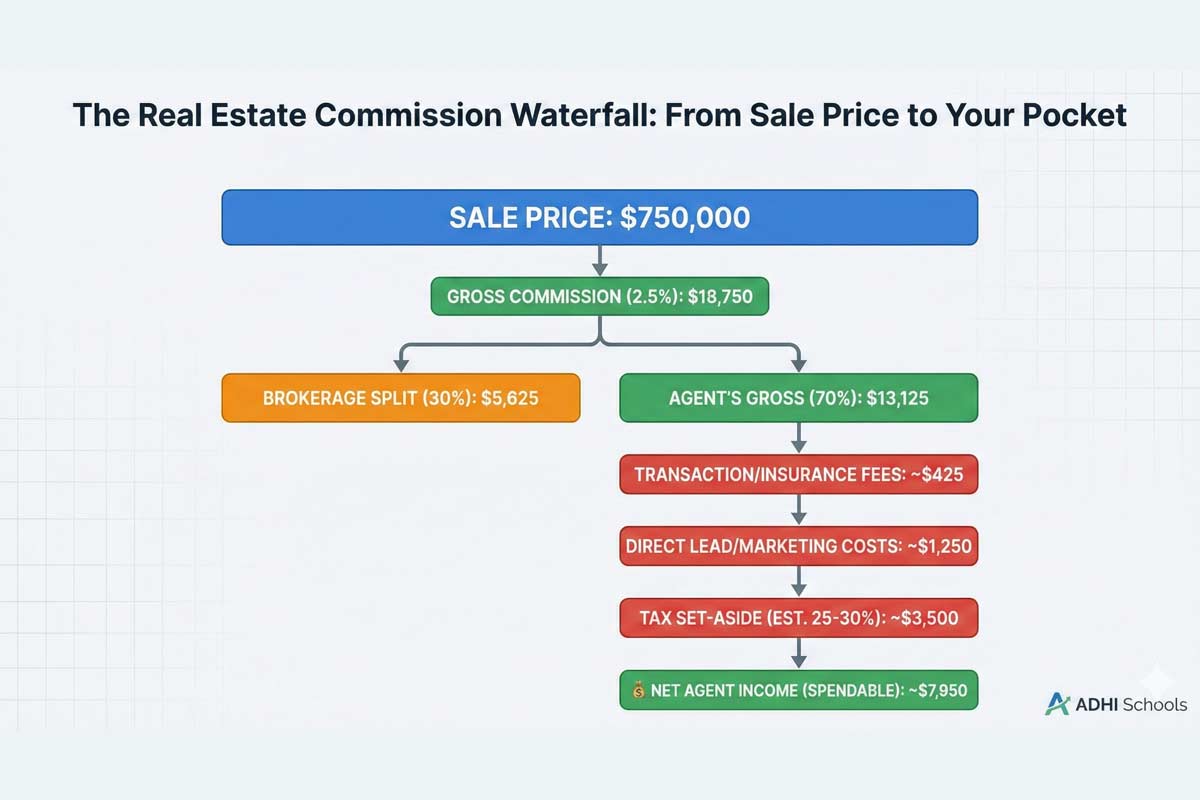
Example: The $750,000 Sale (Assumption Model)
Step
Assumption/Range
Remaining Balance
Sale Price
$750,000
—
Gross Commission to Broker (2.5%)
Model Assumption
$18,750
Brokerage Split (70/30)
Typical solo agent starting split
$13,125
Transaction/Insurance Fees
$250 – $600 (Per-deal variable)
$12,625
Direct Lead/Marketing Cost
$0 (Sphere) – $2,500 (Paid Leads)
$10,125
Tax Set-Aside
Varies by situation—confirm with CPA
Variable
The Takeaway: On a $750,000 sale, your actual spendable income is often less than half of the initial gross commission.
Timeline to Your First Commission Check (The Lag)
The biggest threat to a new agent isn't a lack of talent; it's a lack of capital during the "lag." Understanding how long it takes to start a real estate career is the first step in managing your cash flow, as the licensing process itself often takes a few months.
Once licensed, the wait for your first dollar of income is months, not weeks.
The Ramp: Active lead generation before an offer is accepted.
The Escrow: 30–45 days of waiting for the deal to fund and the check to clear.
Runway Reality: If you are going full-time, a 6–9 month cushion for living expenses is a common safety threshold.
What Slows You Down (Traps)
Administrative Perfectionism: Spending weeks on "branding" instead of talking to human beings.
Escrow Fallouts: In CA, inspections or loan issues can kill a deal late in the game, resetting your income timeline.
What Speeds It Up (Levers)
Focusing on Buyers: A motivated buyer can often be put into escrow faster than a listing can be prepped, staged, and marketed.
Open Houses: This is the fastest face-to-face way to meet unrepresented buyers without an upfront ad spend.
Hidden Expenses (Your First-Year “Cost of Existence”)
You are a business owner, and businesses have overhead. The "gotcha" is that expenses hit before income. You will be paying for access to the market while you are still trying to find your first client.
First-Year Expense Budget (Estimates)
Category
Item
Est. Annual Range
Fixed/Initial
Licensing, Exam, Fingerprints, Board Dues
$2,000 – $3,500
Operational
E&O Insurance, CRM, Signage
$1,500 – $4,000
Recurring Dues
Quarterly MLS Fees / Annual Association
$800 – $1,500
Transportation
Gas, vehicle maintenance, travel time
$1,500 – $4,000
Marketing
Mailers, Digital Ads, Lead Gen
$2,000 – $10,000+
TOTAL
$7,800 – $23,000+
Cash Flow Warning: Many board and MLS dues are due in full upon joining. Budget at least $2,000 for your "Day 1" operating costs.
Scenarios: Applying the Formula to Real Life
1. The Part-Time Learner
Assumptions: 2 deals/year ($800k avg), 70/30 split.
Math: ($40k Gross) x 0.70 = $28k. Minus $7k expenses.
Approx. Net Outcome: $21,000 (Pre-tax).
2. The Hustling Newcomer
Assumptions: 6 deals/year ($800k avg), 80/20 split (achieved via production or boutique brokerage; many start closer to 70/30).
Math: ($120k Gross) x 0.80 = $96k. Minus $15k expenses.
Approx. Net Outcome: $81,000 (Pre-tax).
Verdict: This is a common target for a dedicated full-time solo agent in their first year.
3. The Team Player
Assumptions: 10 deals/year ($800k avg), 50/50 team split.
Math: ($200k Gross) x 0.50 = $100k. Minus $8k expenses.
Approx. Net Outcome: $92,000 (Pre-tax).
What Moves the Needle Fastest (Highest-ROI Actions)
Lead Source Consistency: Pick two sources (e.g., Open Houses and Geographic Farming) and do them every week without fail.
Daily Lead Gen: A non-negotiable 3-hour block every morning dedicated to finding new business.
Database Mining: Your "Sphere of Influence" is your highest-ROI asset.
Common Mistakes That Keep New Agents Broke
Living on the Gross: Spending the full commission check and forgetting that a portion belongs to the IRS.
Compliance & Documentation: Missed signatures, missing disclosures, or late paperwork can delay funding and create liability.
Part-Time vs. Full-Time (The Financial Truth)
The reality of starting real estate part-time in CA is a common way to manage the financial gap while you learn the ropes. While your availability for mid-day tasks is limited—potentially extending your timeline—you bypass the immediate pressure of zero income during the ramp-up.
Fit Check (Should You Pursue This?)
Before diving in, ask yourself:
Runway: Do I have the cash to cover my life and my new business for several months?
Discipline: Can I work 40+ hours a week without a boss directing my daily tasks?
Risk: Am I comfortable with "lumpy" income where zero-dollar months are possible?
If you have the temperament, see if you align with the personality traits of successful California agents. If you're still on the fence, we have an honest assessment of whether you should become a real estate agent in California.
FAQs
“Do new agents really make $100,000 in their first year?”
It is possible, particularly in high-priced markets, but typically requires joining a high-volume team or having an existing, massive network.
“How many deals do I need to close to make $X in California?”
Don't use "rules of thumb." Use the formula: Calculate your local average price, subtract your broker's split, subtract your estimated expenses, and see how many deals it takes to reach your target.
“Is joining a team worth the split cut for a new agent?”
Usually. A 50/50 split of a closed deal is better than a 100% split of a deal that never happens. Teams offer immediate leads and coaching.
“What’s the fastest way to get my first commission check?”
Focusing on buyers is the most direct path to a contract, though "fast" in real estate still often means multiple weeks to months from meeting the client to getting paid.
“Can I survive on part-time real estate income in CA?”
Only if it is supplemental. Fixed costs remain the same whether you sell one house or twenty. You must close at least 1-2 deals a year just to cover your professional dues and expenses.
“What’s the biggest financial surprise for new agents?”
The self-employment tax and the fact that most business expenses hit your bank account before your first commission check does.
Key Takeaways + Your Next Step
You are a business: Gross commission is not your salary. Track your net income post-split and post-expense.
Mind the Lag: Budget for a multi-month ramp-up period.
Upfront Costs: Expect $2,000+ in startup fees before you can even begin marketing.
Now that you understand the math, the next variable is execution. If you want the step-by-step path from decision → licensing → first clients, the start a real estate career in California roadmap we use can help you build the right foundation.
TL;DR: * Gross vs. Spendable: You are a business owner. Your "take-home" is the remainder after brokerage splits, recurring dues, marketing costs, and tax obligations.
The Pipeline Lag: Due to licensing cycles and escrow, a common pattern we see is a multi-month wait for your first dollar of income.
Upfront Costs: Expect to pay $2,000–$4,000 in licensing and board fees before your first closing.
|
Fast Answer: Your 2026 Renewal Snapshot
If you are staring at a real estate license renewal notice (or dreading its arrival), here is the bottom line. Most (there’s an exception I will discuss in Read more...
Fast Answer: Your 2026 Renewal Snapshot
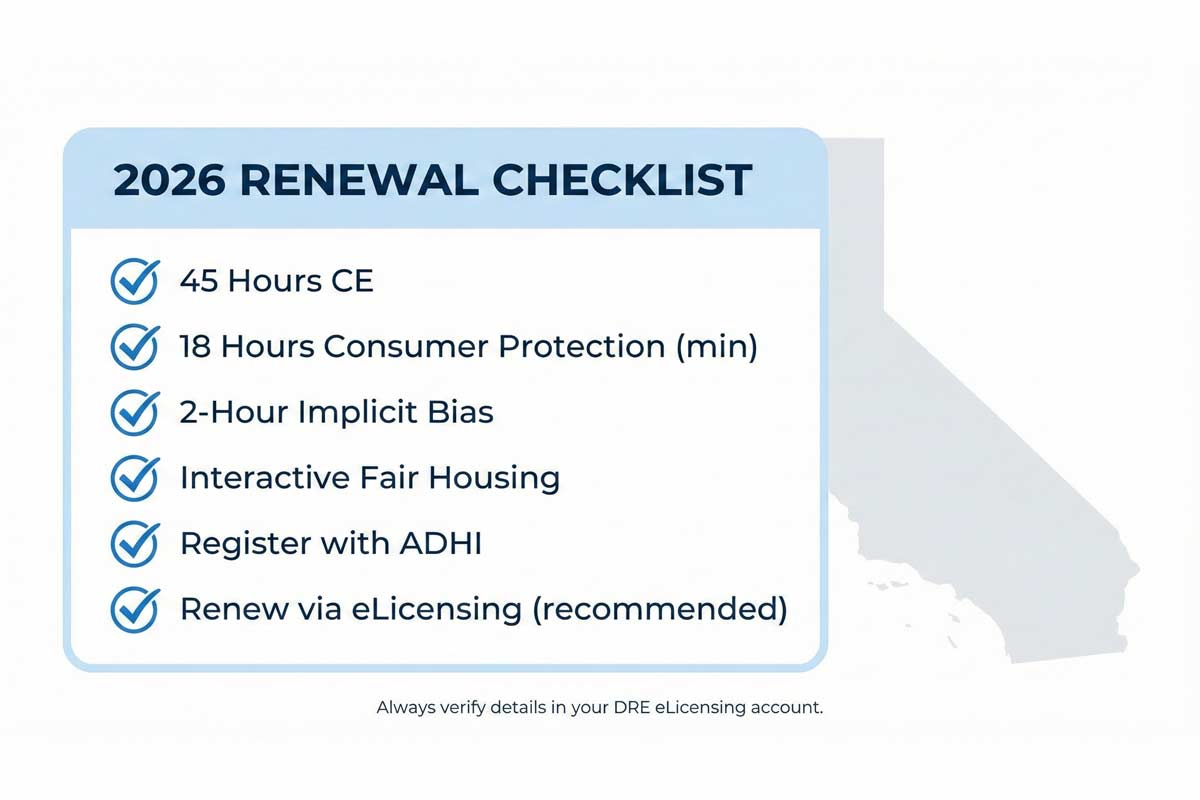
If you are staring at a real estate license renewal notice (or dreading its arrival), here is the bottom line. Most (there’s an exception I will discuss in a bit) licensees cannot renew their California real estate license without checking these boxes.
Total CE Hours: 45 hours (generally required, unless you qualify for the 70/30 exemption).
Renewal Cycle: Typically every 4 years.
The "New" Standards: If your license expires on or after Jan 1, 2023, you must have the 2-hour Implicit Bias course and the Interactive Fair Housing course. (Older certificates without these specific components will not satisfy current renewal requirements).
Submission Method: DRE eLicensing system (recommended and fastest) or mail (slower).
Earliest You Can Renew: Often about 90 days before expiration (check your eLicensing account for your specific window).
Absolute Minimum Time to Complete CE: ADHI Schools’ renewal program can be completed in about 8 days from the time of registration to completion. CE providers enforce a limit of 15 credit hours per 24-hour period to prevent "speed clicking" under DRE rules. This means you cannot cram 45 hours of course completion into a single weekend.
Who This Applies To (Read This First)
Before you buy a package, verify your status. The California real estate license renewal requirements for 2026 differ depending on where you are in your career.
First-Time Renewal vs. Subsequent Renewal
First-Time Salesperson: You cannot take the shortcut "Survey" course. You must take five separate 3-hour courses (Agency, Ethics, Trust Fund Handling, Risk Management, Fair Housing) plus the 2-hour Implicit Bias course, and at least 18 hours of Consumer Protection.
Subsequent Renewal (2nd, 3rd, etc.): You are eligible for the 9-hour Survey Course. Per DRE rules, this single course covers all 7 mandatory topics (the five above, plus Implicit Bias and Management & Supervision). It is streamlined, but you still must enter the completion details for the remaining hours.
Broker vs. Salesperson
Brokers: You must include "Management & Supervision" in the required subject set on your first renewal.
Salespersons: For subsequent renewals, Management & Supervision is effectively required because it is included in the standard 9-hour Survey Course.
Kartik’s Insider Note: "I’ve seen veteran agents assume they know the rules because they’ve renewed five times. Then they get flagged because they missed the Implicit Bias requirement or took a Fair Housing course that lacked the 'interactive' component. Don't coast on autopilot."
For a complete breakdown of the entire process from start to finish, bookmark our master California Real Estate License Renewal Guide.
The 2026 Renewal Requirements (Detailed Breakdown)
The DRE (Department of Real Estate) is strict about course validity. If your course completion dates or course numbers don't match the current requirements, your renewal may be flagged.
1. The 45-Hour CE Requirement
Most licensees must complete 45 hours of DRE-approved Continuing Education. These hours are broken down into Mandatory Subjects and Consumer Protection (with a limit on Consumer Service hours).
How Many CE Hours Are Required for CA License Renewal?
First-Time Salespersons: 5 separate 3-hour courses (Ethics, Agency, Fair Housing, Trust Funds, Risk Management) + 2-hour Implicit Bias + 18 hours Consumer Protection + remaining hours (Consumer Service max 27 hrs).
First-Time Brokers: 6 separate 3-hour courses (Adds Management & Supervision) + 2-hour Implicit Bias + 18 hours Consumer Protection + remaining hours.
Subsequent Renewals (All): 9-hour Survey Course or individual courses (covering mandatory topics) + 18 hours Consumer Protection + remaining hours.
2. The "Must-Have" Courses (Current Standard)
Two specific requirements trip people up the most:
Implicit Bias Training (2 Hours): This is non-negotiable. Does California Require Implicit Bias Training for Renewal? Yes, effective Jan 1, 2023.
Interactive Fair Housing: You cannot just read a PDF. The course must include an "interactive participatory component." While DRE mandates role-play, in online on-demand courses, this is typically built in as scenario-based interactions (you generally aren't performing live, but you must actively engage with the module).
3. Broker-Specific Rules
If you hold a broker license, you must ensure you are covered on "Management & Supervision."
Do Brokers Have Different CE Requirements in CA? Yes, specifically on the first renewal. Brokers must take "Management & Supervision" as a standalone 3-hour course. (On subsequent renewals, it is included in the 9-hour survey for everyone).
Timeline: When to Start (Don't Ignore This)
Real estate is stressful enough without losing your license because you forgot a deadline.
60 Days Out: Check your eLicensing account. Is your email address current? Do you have any citation fines outstanding?
45 Days Out: Purchase your CE package. Give yourself a buffer.
14 Days Out (The "Safe Zone"): Finish your exams. DRE systems can go down for maintenance. Certificates can get misplaced. Do not be the person finishing their exam at 11:30 PM on your expiration date.
Expiration Date: If you submit your renewal on time (before midnight), you can typically continue operating even if the processing takes a few days (under B&P Code 10156.2). However, if you miss the deadline, you are late. Once late, you cannot legally perform licensed activities until the renewal is fully processed.
Common Mistakes That Delay Renewal
After helping thousands of students, here are the real-world scenarios where I see agents get stuck.
Scenario A: The "Fast Reader" Trap
The Situation: Agent Mike waits until 3 days before his license expires. He buys a 45-hour package and tries to power through it in one weekend.
The Result: The renewal will be late. DRE rules require CE platforms to enforce a limit of 15 credit hours per 24-hour period once the exams are unlocked to prevent "speed clicking." Mike’s license expired because the platform physically wouldn't let him take the final exam in time.
Scenario B: The "Wrong Course" Disaster
The Situation: Broker Sarah takes a generic "Fair Housing" course from a cheap provider that wasn't updated for California's interactive requirement.
The Result: She submits her renewal. A week later, the DRE flags it: "Missing Interactive Component." She has to find a new course, pay again, and re-submit. What Courses Count Toward CE in California? Only those with specific DRE approval numbers that meet current legislative standards.
Step-by-Step: How to Renew Without Drama
Verify Your Expiration Date: Log into DRE eLicensing.
Complete Your 45 Hours: Ensure your provider gives you course completion certificates for each course. You will need the 8-digit Course Number for the next step.
Log in to eLicensing: Select "Renew License."
Enter Course Numbers: Use the 8-digit number printed on your CE completion certificate (the one eLicensing asks for) and the completion date exactly as they appear on your documents. Don’t share these secret codes with anyone.
Pay the On-Time Fee:
Salesperson: Check DRE fee schedule (approx. $350).
Broker: Check DRE fee schedule (approx. $450).
Print Your Receipt: If your application is on time and clean (no background issues), your status should update to "Licensed" with a new 4-year expiration date often immediately.
FAQ: Quick Renewal Answers
Q: Can I renew my license after it expires? A: Yes. You have a two-year "grace period" (Late Renewal). You must pay a higher late fee and you cannot practice real estate during this gap until the renewal is fully processed and your status shows "Licensed" again.
Q: Do I need to submit my printed certificates to the DRE? A: Usually, no. You enter the course numbers into eLicensing under penalty of perjury. However, the DRE can audit you. Keep your PDF certificates for at least 4 years.
Q: I am over 70 years old. Do I still need CE? A: Maybe not. If you are 70+ and have been licensed in good standing for 30 continuous years, you can apply for the "70/30 Exemption."
Q: How much does the renewal cost in 2026? A: Fees are subject to change. Always check the DRE fee schedule directly before paying.
Q: What is the difference between Consumer Protection and Consumer Service? A: Consumer Protection courses cover topics that directly protect the public (like laws and disclosures). Consumer Service courses focus on professional skills (like marketing). You must have at least 18 hours of Consumer Protection, meaning you are limited to a maximum of 27 hours of Consumer Service.
Don't Let a Paperwork Error Cost You a Commission
Renewal shouldn't be a guessing game. If you are approaching your deadline, get your CE done with a trusted provider like ADHI Schools, and get your application in early.
Need a deeper dive on the forms, fees, and reinstating a lapsed license? Read the full California Real Estate License Renewal Guide next.
|
It happens in a split second.
You’re negotiating a deal at 9:45 PM. The listing agent says, “My seller is worried your buyers can’t close.” To prove them wrong, you pull up your client’s Proof Read more...
It happens in a split second.
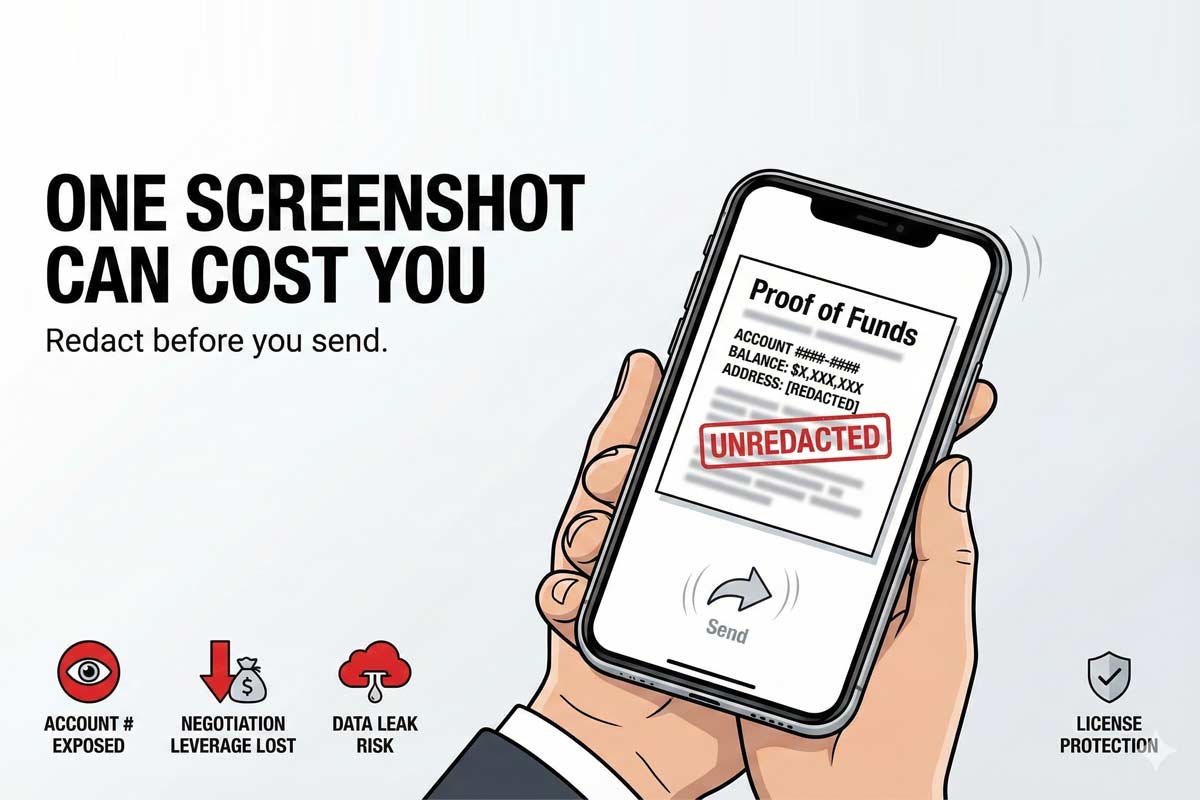
You’re negotiating a deal at 9:45 PM. The listing agent says, “My seller is worried your buyers can’t close.” To prove them wrong, you pull up your client’s Proof of Funds (POF) on your phone, take a screenshot, and text it to the listing agent.
You just sent a text containing your client’s full account number, current balance (which is $300k higher than the offer price), and home address to a third party.
That single screenshot just violated your client’s financial privacy and compromised their negotiating leverage (now the seller knows they can pay more). If that image gets forwarded or saved to an unsecured cloud, you may be blamed for the leak and exposed to discipline or civil claims.
Privacy in real estate isn’t just about being polite. It is about protecting your license from the kinds of complaints that start with “My agent gave away my personal information.”
What Counts as Confidential Client Information in California Real Estate?
Many agents think “privacy” just means not giving out the gate code. In reality, the definition is much broader. As an agent, you routinely handle private identity, financial, and negotiation information that can harm a client if mishandled.
The Four Big Categories:
Identity & Contact Info: Names, personal email addresses, phone numbers, and current home addresses.
Financials: Bank statements, 401(k) balances, credit score screenshots, and pre-approval letters with specific conditions.
Negotiation Strategy: Motivation ("They have to move by June"), bottom line ("They'll take $850K"), or urgency ("They're divorcing").
Transaction Documents: The purchase agreement itself, counter-offers, and transfer disclosure statements (TDS).
Safeguarding this data is a critical part of real estate practice. Understand the statutory framework that governs these responsibilities. Review the California Real Estate Laws & Compliance Guide, which outlines the baseline for agency relationships and duty of care.
What Can I Share With the Listing Agent?
The guiding principle for privacy is "Minimum Necessary." Share only what’s necessary to move the transaction forward, only with parties who need it, and never share strategy or financial details without explicit client authorization.
Who is a "Need-to-Know" Party?
Client(s): The principal.
Broker / Office Compliance: For file review and oversight.
Escrow / Title: As needed to open orders and clear title.
Lender: As needed for funding conditions.
Appraiser / Inspector: Only access/property details required for their job.
Other Side’s Agent: Minimum necessary to close; never client strategy.
The Golden Rule: If it helps your client’s position and you have permission, share it. If it hurts them or they haven’t authorized it, keep it private.
DO
DON'T
DO share the pre-approval letter (after redacting sensitive info).
DON'T forward a raw bank statement showing account numbers.
DO redact account numbers and excess balances before sending.
DON'T send full bank statements or unedited screenshots.
DO use secure transaction management platforms (DocuSign, SkySlope).
DON'T leave physical files visible in your car or on a coffee shop table.
DO discuss material facts about the property condition.
DON'T discuss your client’s divorce or job transfer as “negotiating leverage” without written consent.
Strict adherence to these boundaries is not optional
It is rooted in your Ethical Duties Under the California Business & Professions Code, which mandates that agents treat all parties with honesty while maintaining loyalty to their principal.
Can I Share Proof of Funds With the Listing Agent?
Yes, but you must do it carefully to balance credibility with privacy.
When it’s appropriate: To prove your buyer has the ability to close, especially for cash offers or large down payments.
What to send: A redacted bank statement or a letter from the financial institution stating "verified funds in excess of purchase price."
What NOT to send: Unedited statements, screenshots from your phone, or documents showing the client’s total net worth far beyond the purchase price.
How to send: Upload to a secure transaction platform or send a password-protected PDF link; avoid standard email attachments if possible.
Proof of Funds: What to Redact (And What Not to Send)
Sending unredacted financial documents is one of the most common ways agents expose their clients to identity theft and negotiation loss.
Redaction Rules That Are Non-Negotiable:
Black out account numbers: Show the last 4 digits only.
Black out SSN/DOB: They should not be visible in anything you transmit to the other side.
Remove full balances: Show only the amount needed to support the offer’s funding story (cash to close or down payment + reserves), and redact excess.
Remove home address: Unless necessary for the lender, black it out.
Convert to PDF: Never send screenshots; they are unprofessional and harder to secure.
Rename the file: Add "REDACTED" to the filename so you know it’s the safe version.
The 5 Most Common Privacy Failures (And the Fix for Each)
In 20+ years of training California agents, I’ve seen that most privacy violations aren't malicious—they are sloppy.
1. The "Forward" Button Fiasco
What happens: You forward an email chain to the lender or other agent, forgetting that three emails down, your client vented about their bottom line.
Why it’s risky: You just handed the other side your playbook.
Do this instead: Never forward chains. Start a new email. Copy-paste only the relevant text.
2. The Unredacted Proof of Funds
What happens: You send a bank statement showing $1.2M in liquid cash when the offer is only $900k.
Why it’s risky: The seller now knows your buyer can pay full price, weakening your client’s bargaining position.
Do this instead: Redact strictly. Only show enough funds to cover the down payment and closing costs.
3. The Screenshot Camera Roll
What happens: You take photos of checks, IDs, or docs. They save to your personal camera roll, which backs up to your family iCloud.
Why it’s risky: Your client’s IDs, account numbers, and private financial info are now mixing with your vacation photos.
Do this instead: Use a scanning app that saves directly to a secure drive or your transaction platform (e.g., SkySlope) and does not save to the camera roll.
4. The Accidental Group Text
What happens: You start a group text with the lender, escrow, and buyer, then accidentally add the Listing Agent to discuss repairs.
Why it’s risky: You might accidentally reveal your client’s desperation or strategy to the opposing negotiator.
Do this instead: Avoid group texts for strategy. Keep sensitive discussions verbal or in one-on-one emails.
5. Sloppy Fact Transmission
What happens: You are managing five deals and accidentally send Client A’s counter-offer to Client B, or mix up their repair requests.
Why it’s risky: Failing to verify what you share is a primary way to learn How to Avoid Misrepresentation in CA Transactions the hard way.
Do this instead: Verify the source and accuracy of every fact before you hit send.
If You Already Messed Up: Containment Protocol
If you realize you sent sensitive info to the wrong person, act immediately.
Ask recipient to delete: Call immediately (don't text) and ask them to delete the email/text and confirm.
Notify broker: Inform your manager so they can prepare for any fallout. Do not try to "fix it quietly"—that's how small mistakes become disciplinary events.
Notify client: Be professional and brief. "I inadvertently sent X to Y. I have asked them to delete it."
Document it: Keep a log of what happened and who received it.
Change access: If you sent a link to a folder, rotate the link or revoke access immediately.
Dual Agency: Confidentiality Rules That Will Get You Disciplined
Privacy becomes mission-critical when you represent both the buyer and the seller. Dual agency is where confidentiality mistakes happen fastest.
The Sealed Envelope Rule
Treat confidential strategy like it’s in a sealed envelope. You don’t open it for the other side. Information about material facts (the roof leaks) must flow freely. Information about price, terms, and motivation must stay sealed.
Mini Scenario:
Your buyer asks, "Why are they selling?"
Risky Answer (reveals confidential motivation): "They are getting divorced and need cash fast."
Safe Answer: "I can’t discuss the seller’s personal motivations, but I can address objective terms: timing, possession, and contingencies."
For a deeper dive into the specific disclosures and boundaries required here, refer to our Dual Agency in California (Legal Guide).
The Paper Trail & Systems: Your Privacy Operating Procedure
You need a repeatable system so you don't have to think about privacy—you just execute it.
Privacy Checklist Before You Hit Send:
Redaction: Are account numbers and SSNs blacked out?
Relevance: Does the recipient actually need this document?
Format: Is it a secure PDF link, or a loose screenshot?
Recipient: Did I check the "CC" line for accidental additions?
Your SOP
Centralize Docs: All documents live in your transaction management platform.
Naming Conventions: Name files clearly (e.g., "123_Main_St_POF_REDACTED.pdf") so you don't attach the wrong version.
Device Security: Enable 2-Factor Authentication (MFA) on your email. Your email is the master key to your client’s data.
Privacy is License Protection
Privacy is not about secrecy; it is about security. When you treat your client’s information with care, you build trust and maintain a clean file.
Tighten your systems. Redact the account numbers. Follow your broker's policy.
Protect the file, and the file will protect you.
(Note: General education only; follow your broker’s policies and consult counsel for specific legal questions.)
|
The single biggest mistake I see agents make during renewal isn’t failing a test—it’s finishing 45 hours of education only to realize none of it counts.
Just because a class is about real estate Read more...
The single biggest mistake I see agents make during renewal isn’t failing a test—it’s finishing 45 hours of education only to realize none of it counts.
Just because a class is about real estate doesn’t mean the California Department of Real Estate (DRE) accepts it for your license renewal. Your office sales training? Probably doesn’t count. That motivating weekend seminar? Likely doesn’t count.
If you rely on unapproved courses, you risk a lapse in your license status where you cannot legally conduct business.
Here is the no-nonsense guide to exactly what counts, what doesn’t, and how to verify your courses before you spend a dime.
The Fast Answer: What You Need to Know
If you are in a rush, here is the bottom line on course eligibility:
Only DRE-Approved Counts: If the provider doesn’t have a DRE Sponsor Number and the course doesn’t have a DRE Course Number, it does not exist in the eyes of the state.
The Math Matters: You must complete your Mandatory Subjects first, then a minimum of 18 hours of Consumer Protection. Only the remaining hours can be Consumer Service or Consumer Protection.
Interactive Rule: Your Fair Housing course must include an interactive participatory component where you role-play as both a consumer and a professional. A PDF-only read-through is not enough.
Implicit Bias is Mandatory: For licenses expiring on or after Jan 1, 2023, you must complete an Implicit Bias training course.
Verify First: Always check the course number in the DRE database before paying.
Start Here: If you are unsure about the big picture, bookmark our California Real Estate License Renewal Guide for the complete roadmap.
What Does “DRE-Approved” Actually Mean?
For a course to count toward your Continuing Education (CE), it must meet two criteria:
It is offered by a DRE-approved Sponsor (a school or provider).
The specific course has been reviewed and assigned a DRE Course Number.
The DRE measures education in “clock hours.” When we say you need 45 hours, we mean 45 credit hours approved by the state—not necessarily 45 hours of sitting in a chair if you are a fast reader, but the content must match that volume.
Crucial: You must receive an official Completion Certificate featuring an 8-digit certificate number. You should retain these certificates for four years after your renewal in case you are audited.
The 60-Second Decision Tree: What Counts for You?
What you need depends entirely on where you are in your career.
1. Are you a Salesperson renewing for the FIRST time?
What counts: You have a strict list. You need 5 separate three-hour courses in Ethics, Agency, Trust Funds, Fair Housing (with interactive role-play), and Risk Management.
Plus: You need a 2-hour Implicit Bias course and a minimum of 18 hours of Consumer Protection.
Warning: You cannot take the Survey Course yet. You must take separate, dedicated courses.
2. Are you a Broker renewing for the FIRST time?
What counts: Same as the salesperson list above, but you also need a course in Management & Supervision. For a deep dive on this, read Do Brokers Have Different CE Requirements in CA?
3. Is this your SECOND or SUBSEQUENT renewal (Broker or Salesperson)?
What counts: You have more flexibility. You can take a single Survey Course (which covers the mandatory subjects: Ethics, Agency, Trust Funds, Fair Housing, Risk Management, Management & Supervision, and Implicit Bias).
Plus: You need a minimum of 18 hours of Consumer Protection.
Remaining Hours: The rest of your 45 hours can be filled with either Consumer Protection or Consumer Service.
To check the exact math on totals, check out How Many CE Hours Are Required for CA License Renewal?
The Three Buckets: Mandatory, Consumer Protection, and Consumer Service
To build a valid 45-hour package, you need to prioritize the categories in this order:
1. Mandatory Subjects
These are the non-negotiables. The state requires you to stay updated on the laws that protect the public.
The List: Ethics, Agency, Fair Housing, Trust Fund Handling, Risk Management, Management & Supervision, and Implicit Bias.
The “Survey” Shortcut: If you are on a subsequent renewal, a 9-hour Survey Course counts as covering all these topics.
Note: Not sure if the new bias rules apply to you? Read Does California Require Implicit Bias Training for Renewal?
2. Consumer Protection (The "Primary" Elective)
This category is the gold standard for electives.
Requirement: You generally need a minimum of 18 hours in this category.
Definition: Courses that help you protect the client’s interest.
What Counts (Common Examples):
Real Estate Valuation/Appraisal
Property Management logic
Green Real Estate/Energy Efficiency
Real Estate Finance and Truth-in-Lending
Landlord/Tenant Relationships
3. Consumer Service (The "Leftover" Elective)
This is the most confusing category. These are courses that improve your skills but don't necessarily protect the public legally.
The Rule: Consumer Service hours only count after you have satisfied your Mandatory subjects and your 18 hours of Consumer Protection. You can fill the remaining gap with these.
What Counts (Common Examples):
Real Estate Marketing
Negotiation Skills
Computer Applications/Tech for Real Estate
General Sales Skills
My Advice: Stick to Mandatory + Consumer Protection. It’s the safest path to ensure you never accidentally short yourself on the required protection hours.
What Does NOT Count (Don’t Waste Your Money)
I have seen agents spend hundreds of dollars and weekends of time on things that count for zero hours toward renewal.
Training from your Broker: Unless your brokerage is an official DRE-approved CE sponsor and issued you a course number and certificate, that Tuesday morning sales training does not count.
Motivational Seminars: Tony Robbins is great, but the DRE doesn’t care. Personal development is not CE.
Pre-License Courses: You cannot retake “Real Estate Principles” and have it count for CE. Pre-license and Continuing Ed are two different legal buckets.
Out-of-State CE: Licensed in Nevada too? Your Nevada CE usually does not count for California unless that specific provider registered that specific course with the California DRE.
Expired Courses: If you took a CE course 5 years ago, you cannot use it for this renewal. It must be completed within your current four-year license term.
How to Verify a Course Counts (Step-by-Step)
Don’t trust the marketing on a website. Trust the database.
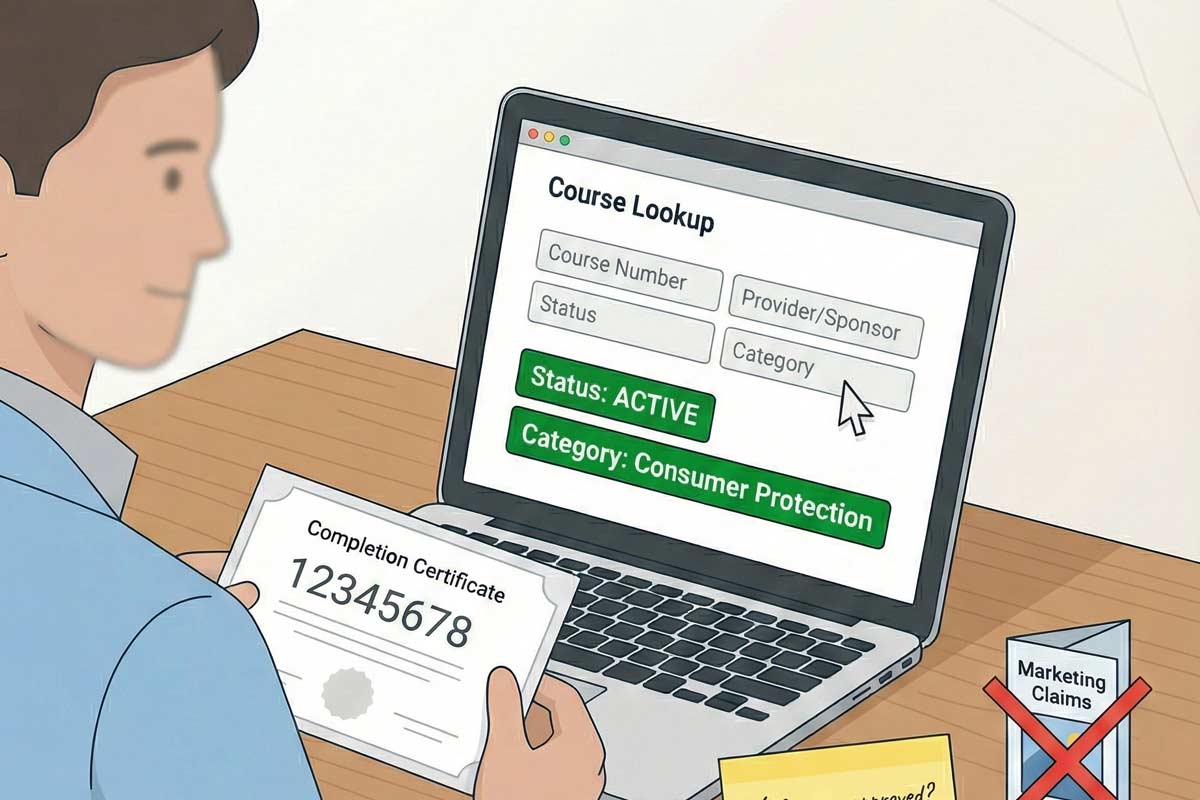
Get the Course Number: Ask the school for the 8-digit DRE course number.
Go to the Source: Visit the DRE’s Approved Continuing Education Courses lookup (on the DRE website).
Search: Enter the course number or the provider name.
Check the Status: Ensure the status is “Active.”
Check the Category: Make sure the category (e.g., Consumer Protection) matches what you need to fill your gap.
Verification Checklist:
Is the sponsor approved?
Is the course status "Active"?
Does the course category match my renewal requirements?
Will I receive a certificate with an 8-digit number immediately upon completion?
Real-World Scenarios: Where Agents Get Stuck
The “Cheap Bundle” Trap Agent Mark found a $30 renewal package online. He finished it in a weekend. When he uploaded it to eLicensing, he was rejected. Why? The bundle was old. The Fair Housing course lacked the required interactive participatory component (role-playing as both consumer and professional), and it was missing the Implicit Bias module entirely.
Lesson: Cheap often means outdated. Ensure the package is current for 2026 standards.
The “I Thought My Designation Counted” Trap Agent Sarah took a grueling 3-day course to get a luxury home designation. She assumed 24 hours of class time meant 24 hours of CE. It turned out the provider never registered the course with the California DRE. She got a nice pin for her lapel, but zero CE credits.
Lesson: Never assume. Check the DRE database.
Frequently Asked Questions
Do webinars count for CE? Yes, BUT only if the webinar provider is DRE-approved and they have a method to verify your attendance (like monitoring your login time or requiring exit quizzes). Live DRE-approved webinars are a valid way to knock out hours.
Can I repeat the same course every renewal? Generally, the DRE allows you to repeat courses in subsequent renewal cycles, provided the course material is still current and approved.
What is the difference between Consumer Protection and Consumer Service? Consumer Protection courses teach you how to protect the client (laws, disclosure, financing). Consumer Service courses teach you how to do your job better (marketing, computer skills). You must have at least 18 hours of Protection; Service hours only count toward the remaining balance.
How do I know if my Fair Housing course is “Interactive”? The course description should explicitly state it includes an "Interactive Participatory Component." The DRE requires this to include role-play as both a consumer and a real estate professional. If you just read a PDF and take a final exam, it likely does not meet the requirement.
What happens if my license expires before I renew? If you submit your renewal application and fees on time (before midnight of your expiration date), you can generally continue operating under B&P Code 10156.2 while the DRE processes it. However, if you are late, you enter a two-year grace period where you can still renew, but you cannot perform any licensed activity until your license is officially renewed.
What if I finish my CE early? That is great. You can upload your courses to the DRE eLicensing system up to 90 days before your expiration date. Do not wait until the last night.
Don’t Risk Your License
Renewing your license is not the time to experiment with unverified courses. The DRE audits renewals, and mistakes can delay your ability to work.
Make sure every hour counts. Stick to approved sponsors, verify your certificates, and get it done early so you can get back to selling.
Next Step: Ready to see the full roadmap? Go to our California Real Estate License Renewal Guide to get started.
|

Imagine it’s 7:42 PM on a Tuesday. You are the listing agent on a home in Los Angeles and your phone is buzzing non-stop. You have nine offers in your inbox, three agents texting you for a "verbal status," Read more...
Imagine it’s 7:42 PM on a Tuesday. You are the listing agent on a home in Los Angeles and your phone is buzzing non-stop. You have nine offers in your inbox, three agents texting you for a "verbal status," and a seller who is overwhelmed and asking:
"Can we just pick the highest one and be done?"
This is the moment where careers are made or broken.
In a hot market, multiple offer scenarios are a standard pressure test. They are also a frequent trigger for disciplinary action because, under pressure, agents often cut corners. They might get sloppy with communication, inadvertently "shop" an offer, or fail to present every option clearly. To survive this without risking your license, you need a system rooted in the California Real Estate Laws & Compliance Guide.
You need a process that protects you and serves your client. Here is exactly how to handle the multiple-offer pressure cooker without crossing legal lines.
The "All Offers" Rule (No Exceptions)
Let’s start with the absolute baseline. Under California fiduciary duties, a listing agent is expected to present offers and counteroffers promptly and diligently unless the seller has previously directed the agent otherwise in writing.
It doesn’t matter if the offer is $50,000 under ask. It doesn’t matter if it’s written on a standardized form or a less formal document—if it is a bona fide offer, the seller needs to see it.
Agents often get into trouble here by "pocketing" lowball offers because they don't want to waste their time. That is a violation of your fiduciary duty. To understand the risks of filtering information, read our guide on How to Avoid Misrepresentation in CA Transactions, which details why you must never lie about the existence or number of offers to drive up the price. If you claim you have five offers, you must actually have five offers in hand.
The Spreadsheet Method & The Paper Trail
When you are juggling six different offers, relying on your memory is a recipe for disaster. You need a standardized way to present data to your client so they can make an informed decision based on facts, not just the purchase price. There are so many components in determining what constitutes a “good” offer and certainly price is one piece of the puzzle, but what about downpayment? What about credit score? What about the “certainty of close”?
Step 1: Secure Written Instructions First
Before you even respond to the first agent, get the seller’s game plan in writing. Do they want to counter everyone? Do they want to accept the best one immediately? Do not act on a verbal "just handle it."
Step 2: Build the Summary
I teach my agents to build a "Summary of Offers" spreadsheet for the seller. It should include:
Offer Price: The headline number.
Down Payment & Loan Type: Cash vs. Conventional vs. FHA.
Earnest Money Deposit (EMD): Is it 1% or 3%? Is it released early?
Contingencies: Inspection, Appraisal, Loan. How long are the timelines?
Close of Escrow: Does it align with the seller’s move-out date?
Any other notes: When does the buyer want possession?
By stripping the emotion out, you help the seller see the net value. A higher offer with no lender commitment and 45-day contingencies is often worth less than a slightly lower, fully underwritten offer with a 10-day close.
Navigating the "Best and Final" Round
Once you have reviewed the initial batch, you rarely accept one outright. You usually issue a Seller Multiple Counter Offer (SMCO).
This is where the ethics get tricky. You must treat all potential buyers fairly. You cannot give one agent a "heads up" on the price to beat while keeping the others in the dark. Your Ethical Duties require you to treat all parties honestly and fairly, even if you strictly represent the seller.
The Script for "What’s the highest offer?"
Buyer’s agents will ask you: "What do we need to write to get it?" or "What is the top offer right now?"
Be very careful. In California, offer terms are not automatically "confidential" unless the parties have a written confidentiality agreement—but disclosure still needs to be seller-directed, truthful, and applied consistently to avoid misrepresentation or favoritism.
If you tell Agent A that the high mark is $850k, and they bid $855k, you have effectively "shopped" the other buyer’s offer without giving them a chance to respond.
The Safer Approach: Communicate to all parties: "We have multiple competitive offers. The seller is requesting your highest and best offer by 5:00 PM tomorrow. Please maximize your price and tighten your terms."
The Privacy Trap: What You Can and Cannot Share
When the heat turns up, it is tempting to leverage one buyer against another by sharing details. "Hey, I have an offer from a cash buyer, so you need to waive your appraisal."
Is that true? Or are you bluffing? If it’s true, you are likely safe (provided you have seller permission). If you are bluffing, you risk serious liability for misrepresentation and deceit.
Furthermore, you need to protect the data. You are collecting proof of funds, bank statements, and pre-approval letters. Adhering to strict Privacy Rules for Managing Client Information means you generally should not disclose the specific financial details or identity of a competing buyer to other agents. Keep those bank statements redacted or hidden when you are reviewing terms with anyone other than your client.
The Dual Agency Landmine
The most dangerous scenario in a multiple-offer situation is when you represent one of the buyers.
You are now a Dual Agent. You have a listing with five offers, and one of them is yours. The other agents will immediately suspect foul play. They will assume you are guiding the seller toward your buyer to increase your commission.
How to Handle It
Disclose to Principals: Disclose dual agency to the buyer and seller and obtain their written consent immediately.
Stay Neutral: Present and document all offers objectively; don’t use inside knowledge from one side to advantage the other.
Manager Review: Ensure that your broker and manager are in the loop.
The risks multiply when you are navigating Dual Agency in California. If another offer fits the seller’s criteria better, your job is to present that clearly and document the seller’s decision—even if it’s not the outcome you’d personally prefer.
Process Protects You
When the market is moving fast, you don't rise to the occasion; you fall to the level of your training.
If you don't have a systematic way to log, present, and counter offers, you will eventually make a mistake. You will forget to respond to an agent, or you will accidentally disclose a price cap when you shouldn't have.
Work with your broker or manager to create your spreadsheet template today. Script your "highest and best" response today. When that Tuesday night rush comes, you won't be panicking—you’ll be executing.
Note: This article is general education, not legal advice; when in doubt, follow your broker’s policy and get broker/legal guidance.
|

In my 20 years of training thousands of agents, I’ve seen a recurring trap. A new agent opens Instagram, sees a “top producer” touring a cinematic $10M Malibu estate or a Newport “day in the life,” Read more...
In my 20 years of training thousands of agents, I’ve seen a recurring trap. A new agent opens Instagram, sees a “top producer” touring a cinematic $10M Malibu estate or a Newport “day in the life,” and tries to mimic that luxury cosplay.
When they realize they don’t have the listing (or the lifestyle), they either stop posting or become a silent lurker—consuming content for hours under the guise of “research” while never actually talking to a prospect.
Here is the 2026 reality: Social media is a distribution channel for your professionalism. If your posts don’t create DMs and inquiries, you’re not marketing—you’re consuming with a headshot. The goal isn’t to go viral; it’s to build trust before you meet and start conversations that become appointments.
This system for new California real estate agents in 2026 plugs directly into your Real Estate Business Plan (New Agents).
The 90-Day Rule: One Platform, One Format
Stop trying to be “everywhere.” For the next 90 days, commit to one primary platform and one format: short-form vertical video. Pick the one you can do for 90 days without negotiating with yourself.
If you want local DMs fast: Choose Instagram. It is built for direct engagement and neighborhood tagging.
If you want evergreen inbound + search: Choose YouTube Shorts. This builds long-term authority and captures people searching for specific California relocation topics.
The Cadence: 3 posts per week + daily engagement (10 minutes minimum).
The 2026 Content Rules for California Agents
You don’t need out-of-state likes. You need California conversations.
Help > Hype: Answer one specific California real estate question per post. Save the “motivational” stuff for your Stories.
Local > Global: Mentioning a specific school district or a zoning change in your zip code proves you are the local expert.
Instructional > Inspirational: In a high-interest, high-complexity market, “How to buy” beats “Believe in your dreams” every time.
The 4-Bucket Content System
Use these repeatable buckets to look like a professional business, not a personal diary.
1. Clarity Content
Purpose: Explain one confusing real estate concept.
Post Idea: “Who pays the buyer’s agent in 2026 in California?”
Template: “I keep getting asked [Question]. Here is the 60-second answer for California buyers.”
Pro Tip: Use the exact words your last client used to ask the question.
2. Proof of Work
Purpose: Show the “invisible” work that builds trust.
Post Idea: “What I check in a prelim (and why it protects buyers).”
Template: “Most people think agents just open doors. Here’s what I did today to protect a client’s earnest money.”
Pro Tip: This is how you build a brand without closings. (See Branding Tips for New California Agents).
3. Local Intel
Purpose: Hyper-local, on-the-ground insights.
Post Idea: “The 3 streets in [Your City] where inventory is actually moving.”
Template: “If you’re trying to buy under $[X] in [County], here are 3 pockets where inventory is moving—and what’s different about each.”
Pro Tip: Tag the local coffee shop or park featured in the video.
4. Conversion Content
Purpose: A direct, low-pressure invitation to talk.
Template: “I'm looking for two families who want to move by summer. DM me ‘READY’—no pressure, just info—and I’ll send my market report.”
Pro Tip: Always end with one clear action: DM ‘COSTS’ (not ‘hit me up’).
Lead Magnet (Steal This)
Default Asset: “California First-Time Buyer: 7 Costs Nobody Warns You About” (PDF)
DM Keyword: “COSTS”
The “Don’t Lose Your License” Checklist
California advertising rules still apply online. Your social media presence often functions as advertising and your public identity as an agent.
DRE Compliance: Put your license number and brokerage name in your bio. On videos, include it in the caption or on-screen when the post is clearly intended to generate business.
No Legal Advice: Never give legal or tax advice. Use language like: “Here’s how this typically works in California—confirm details with your agent, broker, or attorney.”
Permissions: Don’t post client property/photos/details without written permission (and check broker policy).
Accuracy: Never imply you represented a party if you didn’t. (Read Why Most New Agents Quit in the First Year).
The 2026 Integrity Rule: Document reality. Post what you did, not what you wish you did. Your credibility is your only compounding asset.
Brokerage policies vary—when in doubt, follow your broker’s advertising rules.
The DM Bridge: Turn Comments Into Appointments
Use a permission-based close to move the conversation forward.
The “Hand-Raiser” Script:
“Thanks for liking that video on property taxes! Are you navigating a move in [City] right now, or just keeping an eye on things?”
The “Local Question” Script:
“That's a great question about the new development on Main St. I actually have the site plan. Want me to send it over? If yes, what email is best?”
The Weekly Scoreboard (The Anti-Quit Tool)
Social media success is measured in inputs. Build your scoreboard with How to Create a Real Estate Business Plan (New Agents).
Metric
Weekly Goal
Posts Published (Helpful/Local)
3
Outbound DMs
10
Conversations Started
5
Follow-ups Sent
15
Appointments Set
1
The Reality: If you hit these inputs for 12 weeks, you will create enough conversations that a client becomes likely—unless your follow-up system is missing.
Your 90-Day Execution Plan
Do this at the same time every day. Systems beat feelings. Use How to Stay Motivated as a New Agent when your emotions spike.
1. Minutes 0–20 (Engage)
Comment on 10 posts from local businesses or residents in the target area using these templates:
“This is super helpful—quick question: are you seeing this more in [City] or [County]?”
“Love this. If someone’s moving to [City], what’s the one mistake you see most?”
“Great post—if you had to pick one neighborhood to watch this month, which is it?”
Minutes 20–50 (Create)
Film one short video answering a question you heard during the week.
Minutes 50–60 (Distribute)
Post, reply to DMs, and update your scoreboard.
Re-center on the Career
Social media is a tool, not an end in itself. If you focus on being the most helpful agent in your zip code, the algorithm will eventually reward consistency.
FAQ
Which platform should I choose?
Pick Instagram if you want fast local DMs through engagement. Pick YouTube Shorts if you want evergreen search traffic and long-term authority.
How often should I post?
3 times per week. Quality and consistency are more important than daily noise.
What if I don’t have any listings yet?
Document your “Proof of Work.” Tour houses, study contracts, and report on the local market. Knowledge is your inventory until you have houses to sell.
Next Steps
Read the Master Guide: Start a Real Estate Career in California.
Define Your Brand: Use our Branding Tips for New California Agents to pick your “Clarity” topics.
Video Hooks for 2026:
“Before you waive anything in California, watch this…”
“The fastest way buyers lose leverage in [City] (and how to avoid it).”
“What the new commission rules actually mean for your pocketbook.”
|

You’ve spent weeks staring at practice real estate exams and memorizing the difference between joint tenancy and community property.
You passed.
You have that provisional sense of accomplishment. Read more...
You’ve spent weeks staring at practice real estate exams and memorizing the difference between joint tenancy and community property.
You passed.
You have that provisional sense of accomplishment. But here is the unvarnished truth: Passing the California real estate exam tested your memory. Choosing your brokerage will test your judgment—and the wrong choice can be more expensive than a failed test.
In California, your broker is your supervisor. Your brokerage isn't just a place to hang your license; it is a professional partnership where they are responsible for your conduct and you are responsible for their reputation. This interview is a risk audit.
Imagine this: It’s 8:00 PM on a Thursday. You’re in your first escrow. The buyer’s agent is screaming about a missed disclosure deadline on the Transfer Disclosure Statement (TDS). If you miss this window, you risk triggering cancellation disputes, the potential loss of your client’s deposit, a DRE complaint, and significant professional liability. You call your broker. It goes to voicemail. You call the office manager. No answer. You are alone, and your license is on the line.
New agents don’t fail because they lack “hustle.” They fail because they lack structured support. This guide is designed to transform you from a nervous applicant into a confident investigator.
THE 10-MINUTE PRE-INTERVIEW CHECKLIST
Do not walk into the office until you have these items in your hand:
The Scorecard: A physical copy of the scoring rubric found at the bottom of this guide.
My Goals Sheet: Your target hours per week and your monthly “keep the lights on” budget.
The Evidence Folder: A notepad ready to document specific proof (calendars, checklists, and fee schedules).
The Deal Timeline: A printed sheet showing the lifecycle of a deal (Offer → Acceptance → Disclosures → Contingencies → Closing) to ask exactly where their review gates occur.
1. Your Pre-Interview Intelligence Gathering
Before you step into an office, you need to know who you are talking to. Not every brokerage is built for a rookie. First, you must Decode the Model. Is this a training-centric firm, a “desk-fee farm,” or a high-volume team? If you aren't sure which path fits your personality, stop and read Should You Join a Team or Go Solo before you schedule the meeting.
Next, scan for online red flags. Look at their social media. Are they constantly recruiting “unlimited potential” but showing zero photos of actual training sessions? For a deeper dive into the specific warning signs I’ve seen over the last 20 years, see our guide on Red Flags When Choosing Your First Brokerage.
2. The Five-Point Interrogation (The System Audit)
Category 1: Training PROOF, Not Promises
Core Question: Does this brokerage have a repeatable system to turn a student into a producer?
Ask the Script: “Walk me through the exact training schedule for my first 30 days. Can I see the syllabus for your contract writing role-play?”
Proof to Demand: Demand to see a Live Calendar, a Course Syllabus, and an Invitation to sit in as a guest at the next session.
Good Answer: “We have a 4-week ‘Launch’ program. It’s live every Tuesday and Thursday. Here is a copy of the calendar; you are welcome to attend the 10 AM session this Thursday to see for yourself.”
Dangerous Answer: “We have an amazing culture of learning. Everyone here is an open book, and you can watch our library of videos whenever you want.”
Category 2: Broker Access & Supervision (Your License SLA)
Core Question: Who saves you when a deal goes sideways at 9:00 PM?
Ask the Script: “What is your agent-to-supervisor ratio? What is your guaranteed response time for a contract emergency? If you aren't available, who is the designated backup by name and title?”
Proof to Demand: Demand a Written Service Level Agreement (SLA) or a clear, documented protocol for after-hours support.
Good Answer: “Our ratio is 25:1. I am available until 9 PM, after which [Name], our Assistant Manager, takes over. We guarantee a 30-minute response for active escrows.”
Dangerous Answer: “We’re like a family here. Someone is always around, and you can just text the group chat if you get stuck.”
Category 3: Compliance & Risk Protection
Core Question: How do they prevent you from making a career-ending disclosure error?
Ask the Script: “Where is your transaction checklist stored and who enforces it? Show me your broker review gates in writing—at what exact points am I blocked from proceeding without your signature?”
Proof to Demand: Demand to see a Transaction Checklist.
Good Answer: “We use [Software]. You cannot send an offer or release contingencies until our compliance officer signs off on these four specific gates. Here is the checklist we use.”
Dangerous Answer: “We trust our agents to be professional. Just upload everything to the folder before the deal closes so we can pay you.”
REALITY CHECK: Policy Varies, Presence Doesn't Exact review gates vary by brokerage based on their specific insurance requirements and workflow, but the presence of these gates is non-negotiable. If there is no formal checkpoint, you are flying without a parachute.
Category 4: The TRUE Cost (Splits & Effective Split)
Core Question: What do I actually take home after the "house" takes its cut?
Ask the Script: “I need a written fee schedule. Show me a sample commission breakdown for a new agent on a $10,000 gross commission with your exact fees, E&O, and franchise costs deducted.”
Proof to Demand: Demand a Written Fee Schedule and a $10,000 Net Commission Sample Printout.
Good Answer: “Here is a printed sheet showing that on a $10k check, your take-home is exactly $6,200 after all costs. We call this your ‘Effective Split.”
Dangerous Answer: “We offer a 70/30 split, which is the best in the area! The other fees are just standard industry stuff that comes out at the end.”
CRITICAL: If you don’t understand how “off-the-top” fees can gut your paycheck, stop and read Commission Splits Explained for New Agents before you sign anything.
Category 5: Lead Flow Mechanics
Core Question: How are leads (if any) distributed, and what is the "pay-to-play" reality?
Ask the Script: “How are office leads distributed? If I take a lead from the office, what is the split? More importantly, do I own my Sphere of Influence (SOI) leads if I choose to leave?”
Proof to Demand: Demand to see the Lead Distribution Rules and the Lead Ownership clause in the independent contractor agreement.
Good Answer: “Office leads are round-robin to ready agents at a 50/50 split. Your personal sphere leads are yours to keep, and the split on those is 70/30.”
Dangerous Answer: “We have more leads than we know what to do with! If you’re hungry, you’ll get your fair share. We put everyone in the company CRM.”
REALITY CHECK: Lead Ownership Trap (Teams) I’ve seen agents join a team and bring in a $1.2M listing from their own cousin. Because they hadn't audited the agreement, the team leader took 50% despite providing zero help. Worse, when the agent left, the leader claimed "ownership" of the cousin in the CRM. Audit your lead ownership before you sign.
3. THE MASTER QUESTION LIST
Group these into your notes to pressure-test their operations.
Systems & Evidence
What is the agent-to-supervisor ratio for new licensees?
Show me your transaction checklist (redacted).
Can I see your broker review gates in writing?
Who is the backup supervisor by name and title when the primary is on vacation?
Money & Ownership
Show me a sample commission breakdown for a $10,000 gross check.
In the event of a claim, what is the E&O insurance deductible I am personally responsible for?
Do I own my Sphere of Influence (SOI) leads if I choose to leave the brokerage?
What happens to my pending escrows if I move to another firm?
Lead Generation
Are there mandatory floor time requirements?
Do teams require giving up ownership of SOI leads to the team CRM?
How many agents who joined in the last 6 months have closed at least 2 deals?
THE “3+1” NON-NEGOTIABLES
Walk out of the room if they cannot provide these four things:
A Written Fee Schedule: No verbal promises on splits.
The $10k Breakdown: A clear example of take-home pay after all deductions.
A Live Training Calendar: Proof that support is a schedule, not a theory.
A Designated Supervisor: A specific person (not a group chat) responsible for your file.
4. THE 5-MINUTE TIE-BREAKER
If you are comparing two brokerages, lay their proof side-by-side and compare only these four data points:
The Net Check: Which $10k breakdown is higher?
The Support Ratio: Which agent-to-supervisor ratio is lower?
The Training Density: Which calendar has more live sessions in the next 14 days?
The Review Gates: Which checklist has more mandatory "Stop" points before an offer is sent?
5. THE SCORECARD & DECISION TOOL
Grade each brokerage from 1 (Poor) to 5 (Excellent) in these categories:
Training Proof: (Syllabus shown/Guest invite offered)
Broker Access: (SLA committed/Backup named)
Compliance Systems: (Checklist shown/Review gates enforced)
Cost Transparency: (Written fee schedule/$10k breakdown provided)
Lead Mechanics: (Clear distribution rules/No SOI ownership traps)
The Walk-Away Rule: If Training, Broker Access, or Compliance average below a 4, do not join. No split compensates for a failed deal, a DRE complaint, or a damaged reputation in your first year.
Now that you know how to audit a firm, see our list of the Best Brokerages for New Agents in California to see who tends to score well on these criteria.
Your Career, Your Choice
The brokerage you choose is the most important business decision of your first year. Treat it like a million-dollar acquisition. Once you have chosen the right supervisor to protect your license, your next step is to master the roadmap to actually close deals. Follow our sequence to Start a Real Estate Career in California correctly.
Frequently Asked Questions
What if no brokerage in my area meets a “4” on the scorecard? Keep looking. In major California markets, there are hundreds of options. If you must compromise, never compromise on Broker Access or Compliance. You can buy your own training, but you cannot buy protection from a DRE audit or a ruined reputation.
What should I email the broker after the meeting if they didn’t provide proof? Send this: "Thank you for the time today. To help me make my final decision, could you please email over the written fee schedule, the $10,000 commission breakdown example, and the training syllabus for next month that we discussed?"
In the event of a claim, am I always responsible for the E&O deductible? Usually, yes. It can range from $1,000 to $5,000 or more. You need to know this number upfront so you can budget for it in your "keep the lights on" plan.
Should my broker review offers before submission in California? Yes. While the DRE allows for various supervisory structures, it is a professional best practice to have a broker or manager review your first several offers and disclosure packets to protect your license and your client.
How do I verify training is real? Ask to be a guest. A brokerage with a strong training program is proud to show it off. If they claim it is "proprietary" and can only be seen after you sign a contract, they are likely hiding a lack of substance.
|
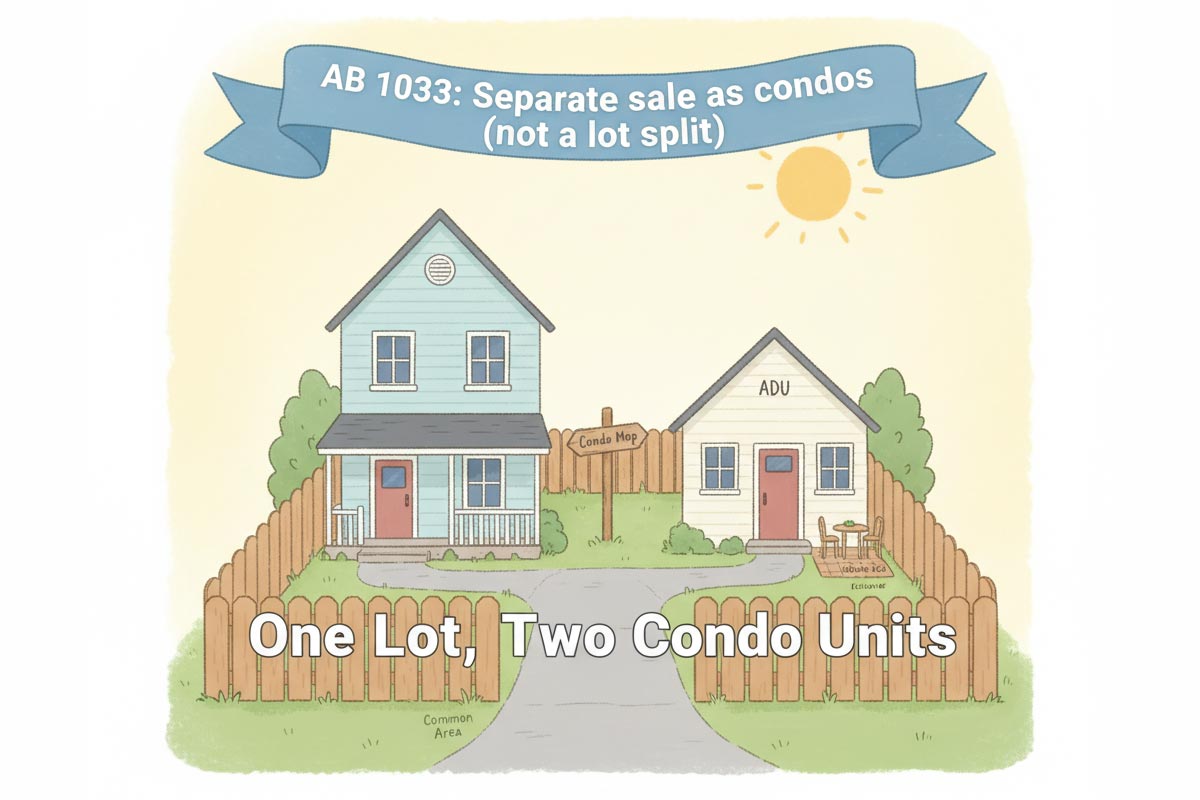
Assembly Bill 1033 has created a new class of real estate in California: the sellable ADU. In jurisdictions that opt in, homeowners can now convert their property into a condominium, allowing the ADU Read more...
Assembly Bill 1033 has created a new class of real estate in California: the sellable ADU. In jurisdictions that opt in, homeowners can now convert their property into a condominium, allowing the ADU to be sold separately from the main residence. This unlocks a brand-new listing category for agents but also brings the complexities of condo law, lender sign-offs, and extensive disclosures into what would otherwise be a simple residential sale. This guide provides the essential details you'll need to navigate these transactions confidently.
What AB 1033 Actually Does (and Why It's Not a "Lot Split")
AB 1033 allows cities and counties to pass an ordinance that lets a homeowner sell their ADU separately from the primary residence. However, it's critical to understand the legal method: this is not a lot split. Instead, you are creating a common interest development—essentially, a small, two-unit condominium project.
Here’s the practical distinction:
A lot split divides the land itself, creating two or more legally independent parcels. Each new lot is owned outright.
An AB 1033 conversion keeps the original lot intact. The land becomes a "common area" jointly owned by the owners of the main home and the ADU with each owner holding a separate interest in their airspace unit.
This brings up a common question: "Won't the two units have different Assessor's Parcel Numbers (APNs)?"
Yes, they most likely will. Once the condominium is legally created, the county assessor will typically assign a separate APN to each unit (the main home and the ADU). However, this is done for property tax purposes only. Since the units can be owned by different people, the county needs a way to send two separate tax bills. The assignment of an APN is an administrative function for taxation and does not change the legal fact that the property is a condominium on a single, shared lot—not two separate lots.
Ultimately, the state law only provides the framework; this entire process is only possible when a local city or county officially opts in and defines the specific local rules.
Where This Is Live (and why adoption is uneven)
Because AB 1033 is opt-in, the map is patchy. San José moved first —adopting an ordinance in July 2024 and green-lighting the state’s first ADU condo sale in August 2025. That milestone proved the concept and kicked off copycat discussions in other cities. Always verify local status before you market or write offers.
The Path for Sellers: From ADU to “micro-condo”
Think of the conversion as three intertwined tracks—legal mapping, habitability sign-off, and lender consent—followed by a familiar marketing and escrow period.
Confirm opt-in & pull the city checklist. If your city hasn’t adopted, you’re done. If it has, the checklist will mirror state guardrails but add local steps and forms.
Assemble the deal team early. You’ll need a land-use or condo attorney, title, a surveyor, and someone who can draft CC&Rs that divide maintenance and spell out access, parking, utilities, noise, and exclusive-use areas.
Plan the disclosure stack. In addition to the standard residential TDS and NHD and other mandated disclosures, the buyer will need condo docs (CC&Rs, bylaws, operating budget/reserves), the condo map/plan, any shared-elements easements, and recorded lienholder consents (more on that below).
Meet the safety inspection requirement. Before the map records, AB 1033 requires proof of a safety inspection—either a certificate of occupancy issued by the local agency or a HUD Housing Quality Standards (HQS) report by a certified inspector. Build time for this into your timeline.
Secure lender consent (non-negotiable). The condo map cannot record without written consent from each lienholder. Lenders can refuse or require conditions (e.g., refinancing, reserve thresholds, or revised collateral language). The consent must include specific statutory language and be recorded with the county. Start these conversations early—this is where otherwise clean deals can stall.
Sort utilities and notify providers. Separate meters may be required by local policy or utility providers; if not, the CC&Rs must clearly allocate costs, access, and shut-off rights. Upon condo creation, the homeowner must notify utility providers of the separate conveyance.
Record, list, and close. Once the map and consents are recorded, market the ADU as a condo. Expect the county assessor to assign separate APNs post-conveyance (timing varies by county). Underwriting, comps, and buyer expectations look different from a standard condo—see below.
The Buyer’s Reality: Financing, monthlys, and resale
Financing. These are condominium loans, and the smaller the unit, the more attention lenders pay to project questionnaires (reserves, insurance coverage, owner-occupancy mix, litigation). Be ready to provide the new HOA budget and reserve plan. Underwriters will model HOA dues and reserves into DTI.
Monthlies. Coach buyers on the full monthly picture: mortgage + taxes + HOA dues (with reserve contributions), potential special assessments, and shared insurance mechanics (e.g., master policy + HO-6). That clarity prevents cold feet at contingency removal.
Resale. Micro-condos trade more like cottages than flats: private entries, small footprints, and the presence (or absence) of exclusive-use outdoor space, storage, and parking drive value. Your comp set will be tiny condos, cottage courts, and—ideally—local ADU-condo comps as they emerge.
Some Documents That Protect Your Client (and you)
Statutory disclosures: TDS (Civ. Code §1102) and NHD (Civ. Code §1103 et seq.) still apply.
Condo packet: recorded CC&Rs, bylaws, operating budget and (if available) reserve study/plan, condo map/plan, shared-elements easements, utility agreements, lienholder consents, and any city notices or checklist forms.
AVID & over-disclosure: Map shared systems (sewer laterals, water lines, shared roofs/driveways) and note any open permits or variances. It’s hard to over-disclose on a first-generation product category.
HOA landmines (and how to avoid them)
Most post-closing drama comes from maintenance responsibility and use rules. Avoid ambiguity by:
Drawing a maintenance matrix that names each component (roof, siding, foundation, shared driveway/gate, landscape, fences, trash enclosure, shared meters) and assigns responsibility and inspection cadence.
Being explicit about exclusive use (patios, side yards, storage sheds) versus common area.
Setting realistic noise and parking expectations in the rules—especially where units are close.
Checking short-term rental rules at both city and HOA levels; do not imply rental income without verifying.
Utilities, access, and parking: the practical stuff
AB 1033 recognizes that upon separate conveyance, a local agency or utility may require a new or separate utility connection (and proportionate connection fees) where it wasn’t otherwise required for a standard, non-separately-conveyed ADU. If services remain shared, the CC&Rs need crystal-clear language on access, meter reading, maintenance, and billing. Record any access and utility easements so future owners—and lenders—aren’t guessing.
Pricing and positioning a micro-condo
Treat these like livable, detached cottages with condo paperwork. Price on privacy and function: no shared corridors, ground-level entries, outdoor space, light, and acoustic separation. Include a to-scale floor plan and a simple site plan (labeling the unit, parking, trash, and paths of travel). For buyers coming from apartment-style condos, the single-story cottage experience can command a premium per square foot despite smaller size.
Compliance notes your clients will thank you for
Don’t oversell “automatic.” Everything depends on local opt-in and meeting statutory conditions (inspection, mapping, consents).
Be precise about the past. Prior law had a narrow nonprofit exception; AB 1033 adds a broad condo pathway via local ordinance.
A quick case study: San José’s “first”
San José’s early adoption set the pattern: pass a clear ordinance, publish a homeowner-facing conversion guide, and coordinate internal teams (planning, building, and code enforcement). The city then approved the first recorded ADU condo in August 2025—an example that has helped normalize lender and title workflows statewide. Use that precedent when socializing the concept with your local stakeholders, but always cite your own city’s ordinance in contracts and disclosures.
What to do this week (agent checklist)
Build a local “opt-in” tracker. Keep links to city ordinances and checklists in one doc.
Collect a lender short-list. Identify originators who’ve already closed small-unit condos and will engage early on questionnaires and reserves.
Template your condo packet. Create a repeatable binder: TDS/NHD + CC&Rs + budget + map/plan + easements + utility agreements + lienholder consents.
Educate your farm. A one-page explainer for ADU owners can generate listing calls months before they’re ready to convert. Make sure to check with your broker on advertising compliance.
Bottom line: AB 1033 turns some backyards into starter homes—but only in jurisdictions that opt in, and only when you clear the condo law hurdles. The agents who win here will be the ones who master the process (mapping, inspection, lender consent), package the disclosures cleanly, and set expectations early on financing and HOA realities. Check with legal counsel and your broker to make sure you are staying compliant and you’ll be the first call when your market’s homeowners decide their ADU is ready for the big leagues.
|
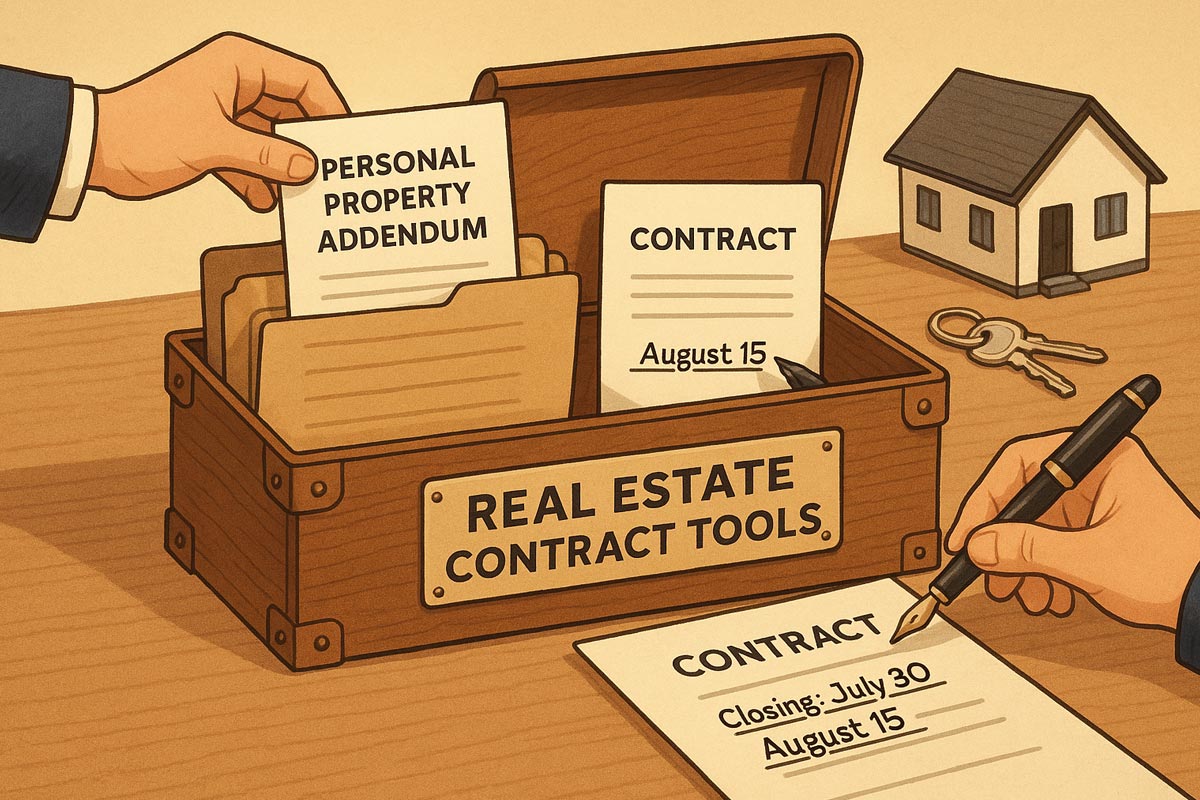
Real‑estate transactions live and die by what is written—and signed—in the contract. Yet nearly every deal, from a starter‑home purchase to a multimillion‑dollar commercial lease, must be tweaked Read more...
Real‑estate transactions live and die by what is written—and signed—in the contract. Yet nearly every deal, from a starter‑home purchase to a multimillion‑dollar commercial lease, must be tweaked after that first signature. That’s where two deceptively similar tools come in: the addendum and the amendment. Because the terms sound alike, many buyers, sellers, and even new agents mix them up—sometimes with expensive consequences.
This guide cuts through the confusion. You’ll learn the fundamental difference, see practical language examples, spot common pitfalls, and walk away knowing exactly which document to use, when, and why.
The Core Distinction: Adding vs. Altering
.table{
border: 1px solid gray !important;
border-collapse: collapse !important;
margin: 10px !important;
padding: 10px !important;
font-size: 16px !important;
}
th, td{
border: 1px solid gray !important;
border-collapse: collapse !important;
margin: 10px !important;
padding: 10px !important;
font-size: 16px !important;
}
th{
text-align: center !important;
}
@media(max-width:428px){
.table-responsive{
max-width: 100%;
overflow-x: scroll;
}
}
Tool
What It Does
One‑Sentence Analogy
Addendum
Supplements the contract by adding entirely new terms, conditions, or disclosures without touching existing text.
Like attaching a new appendix to a report.
Amendment
Modifies the contract by changing, deleting, or replacing language that is already there.
Like editing a paragraph in the report’s body.
Addendum Defined
An addendum (sometimes called a “rider” or “attachment”) is a separate, signed document that becomes part of the original agreement, but nothing in the original contract is struck, deleted, or replaced.
Analogy: You finished your book and later decide to add a bonus chapter—the original chapters stay exactly as written; you just hand readers an extra section.
Amendment Defined
An amendment rewrites part of the original agreement. You are altering the existing language—price, dates, contingencies, or even simple typos.
Analogy: You catch a typo in Chapter 3 of your book. Instead of adding a new chapter, you open the manuscript and correct that specific sentence.
When to Use Which: Practical Applications
Below are the most common scenarios you’ll encounter in both residential and commercial deals. For each, notice whether new material is added (addendum) or existing material is changed (amendment).
A. Addendum Scenarios & Examples
.table{
border: 1px solid gray !important;
border-collapse: collapse !important;
margin: 10px !important;
padding: 10px !important;
font-size: 16px;
}
th, td{
border: 1px solid gray !important;
border-collapse: collapse !important;
margin: 10px !important;
padding: 10px !important;
}
th{
text-align: center;
}
Scenario
Example Property Type
“Before” (excerpt)
Addendum Language (conceptual)
New contingency
Rural residence
Contract silent on septic system.
“This agreement is contingent on Buyer’s receipt and approval of a satisfactory septic inspection report on or before August 5.”
Personal property inclusion
Suburban home
Contract lists fixtures only.
“Seller shall include the following personal property at no additional cost: LG washer, LG dryer, and GE refrigerator (Model XYZ).”
Disclosure attachment
Pre‑1978 home
Contract mentions lead‑based paint but no form attached.
“Lead‑Based Paint Disclosure (EPA‑approved form) is attached hereto as Addendum A and incorporated herein.”
Lease pet clause
Apartment lease
Lease prohibits pets.
“Notwithstanding Paragraph 10, Tenant may keep one spayed cat under 15 lbs; Tenant assumes all liability for pet damage.”
Typical timing: Often drafted with the initial offer or immediately post‑acceptance (e.g., delivery of mandatory disclosures).
B. Amendment Scenarios & Examples
Scenario
Example Property Type
“Original Clause”
Amendment Language (conceptual)
Price change
Residential purchase
“Purchase Price: $500,000.”
“Paragraph 2 is hereby amended to state: ‘Purchase Price: $490,000.’”
Closing‑date extension
Vacant land
“Closing Date: July 30 2025.”
“Closing Date is amended to August 15 2025.”
Repair credit
Condo
“Seller to repair roof leaks.”
“Seller shall instead credit Buyer $7,500 at closing in lieu of repairs; Paragraph 12 is amended accordingly.”
Loan‑type switch
Single‑family home
“Buyer financing: FHA loan.”
“Paragraph 5 is amended to read ‘Conventional 30‑year fixed loan.’”
Scrivener’s error
Commercial lease
Suite number misstated as 320.
“Suite number corrected from 320 to 302; all other terms remain unchanged.”
Typical timing: After the contract is executed when inspections, financing, or negotiations reveal the need to alter agreed‑upon terms.
Quick‑Decision Flowchart – Addendum or Amendment?
Is the information completely new and not addressed anywhere in the contract?
Yes → Addendum
Are you changing, deleting, or replacing wording that already appears in the contract?
Yes → Amendment
Need to do both?
Use both documents (e.g., add a new contingency and extend closing).
Proper Formatting & Language Tips
Best Practice
Why It Matters
Reference the underlying contract by date, parties, and property address at the top of the addendum or amendment.
Prevents arguments over which agreement the change attaches to.
Number each addendum/amendment (e.g., “Addendum #1”).
Aids tracking when deal requires multiple modifications.
Use clear headings such as “Purchase‑Price Adjustment” or “Inspection Contingency Addendum.”
Improves readability for all parties and attorneys.
State the effective date (often the last dated signature).
Clarifies when obligations begin.
For amendments, quote the original clause before showing the revised language (or cite the paragraph number).
Reduces ambiguity over what is being altered.
Obtain signatures from every party to the contract (and their spouses if required by local law).
An unsigned modification is unenforceable.
Common Mistakes & How to Avoid Them
Using the wrong document: Adding a new contingency with an amendment may accidentally overwrite existing clauses.
Leaving blanks or ambiguous wording: Courts interpret vagueness against the drafter.
Missing deadlines: An addendum or amendment delivered after a contingency expires may be ineffective.
Relying on verbal agreements: In most states, real‑estate contracts must be in writing (Statute of Frauds).
Failing to attach required disclosures: Violations can trigger rescission rights or fines.
Pro Tip: Keep a running “contract log” noting each modification, date sent, date signed, and current key dates (closing, inspection, loan approval).
State‑Specific Variations
While the concepts of addendums and amendments are universal, forms and statutory disclosures vary:
California: The Residential Purchase Agreement (RPA) uses a “Contract Addendum” (CAR Form) for new terms and a separate “Amendment of Existing Terms” for changes; specific addenda are mandatory for HOA docs, Mello‑Roos, etc.
Texas: The Texas Real Estate Commission (TREC) publishes promulgated addenda (e.g., Third‑Party Financing Addendum) and employs a universal “Amendment to Contract” form.
New York: Attorneys often custom‑draft riders (addenda) at contract formation; later changes are typically handled via attorney letters that serve as amendments.
Always consult local forms and professionals to ensure compliance.
Key Takeaways
Addendum = Add. Amendment = Alter.
Use addendums to introduce brand‑new terms without disturbing the original text.
Use amendments to change terms that are already written.
Clear drafting, proper referencing, and obtaining all signatures are non‑negotiable.
Laws and standard forms differ by state—check locally.
Beyond your time in real estate school, understanding the difference between an addendum and an amendment gives you powerful leverage in negotiations and protects you from costly missteps. If you are a buyer, remember that before signing—or sending—either document, consult your real‑estate agent and, for complex or high‑value transactions, a qualified real‑estate attorney. With the right tool and sound advice, you’ll keep your deal on track and your interests safeguarded.
Love,
Kartik
|

You've enrolled in our real estate license school, studied diligently and successfully passed your real estate exam —congratulations! Many people mistake this license for the finished product, but it’s Read more...
You've enrolled in our real estate license school, studied diligently and successfully passed your real estate exam —congratulations! Many people mistake this license for the finished product, but it’s more accurate to think of it as the plot of land on which you will build your career. It grants you the legal right to build, but the land is currently empty - Now, it's time to build the house.
Transitioning from a newly licensed professional to a fully thriving one requires shifting from a student's mindset to that of a business owner. The reality of real estate can be challenging, but with the right skills and strategies, you can position yourself for lasting success.
Here are 13 essential and actionable skills every new real estate agent should master.
1. Set Clear Goals and Action Plans
In a commission-only profession, you are your CEO. Without a boss setting deadlines or a guaranteed paycheck providing structure, it's easy to drift. Setting clear, measurable goals moves you from a reactive to a proactive state, giving you a roadmap and a way to hold yourself accountable. Establish specific targets for client outreach, open houses, and social media engagement, reviewing your progress regularly to make necessary adjustments.
Action Step: Utilize goal-setting tools, such as the SMART (Specific, Measurable, Achievable, Relevant, Time-bound) framework for setting goals and don’t be afraid to use technology to track your progress.
2. Build a Financial Cushion and Manage Income Wisely
Real estate commissions fluctuate dramatically, and it's not uncommon for a new agent to take 3-6 months to close their first transaction. A financial cushion is not a luxury; it's a foundational business tool that allows you to make decisions from a position of strength, not desperation. This prevents you from taking on bad clients or making poor long-term choices to get a quick commission check.
Action Step: Use budgeting tools and automate monthly deposits into a separate savings account to build your emergency fund.
3. Embrace Technology for Efficiency
As a solo agent, your time is your most valuable asset. Technology provides leverage, enabling you to automate repetitive tasks and manage more clients than would be possible manually. A good Customer Relationship Management (CRM) system acts as your digital assistant, reminding you who to call and when, while other tools can streamline your marketing, freeing you up for income-producing activities.
Action Step: Invest in free or low-cost online tutorials to master key real estate tech tools, such as your CRM and a social media scheduler.
4. Develop Emotional Resilience
Rejection is a daily reality in real estate—offers get denied, buyers change their minds, deals collapse in escrow, and potential clients choose a different agent. Resilience isn't about not feeling disappointment; it's about processing it quickly and not letting one setback derail your momentum for the entire week. Viewing each "no" as data or a learning experience is key to long-term survival and motivation.
Action Step: Regularly engage with resources—such as books, articles, or talks—that focus on building resilience and developing a growth mindset to persevere through challenges.
5. Acquire Transaction Process Expertise
Your licensing exam taught you the law, but it can’t teach you the practical flow of a deal. Actual expertise means understanding the intricate dance between lenders, appraisers, inspectors, title officers, and the opposing agent. Knowing what happens when, who is responsible for what, and how to anticipate and solve problems is what makes you an invaluable guide for your clients.
Action Step: Attend continuing education seminars and workshops, and establish relationships with experienced professionals in related fields who can provide answers to your questions.
6. Honest and Transparent Communication
Trust is the currency of real estate. Many new agents, to please, are tempted to overpromise on a home's potential sale price or understate the market's challenges. This strategy inevitably backfires. Setting realistic expectations from the beginning, even when the news is not what the client wants to hear, builds a foundation of trust and establishes your reputation as a credible, honest professional.
Action Step: Create scripts or templates for common communications, such as market updates and negotiation strategies, to ensure you are always transparent and consistent.
7. Strategic Marketing on a Limited Budget
Effective marketing isn't about having the most significant budget; it's about having the most innovative strategy. The goal is to establish your brand as a knowledgeable, trustworthy local authority. Consistently providing value—through neighborhood highlight videos, blog posts on the buying process, or community event updates—attracts clients to you, shifting the dynamic from chasing leads to creating inbound opportunities.
Action Step: Plan your marketing with a quarterly content calendar and track your results using analytics tools to see what resonates with your audience.
8. Master Quick Responsiveness
In a world of on-demand everything, clients expect prompt communication. A quick response, even if it's to say, "I've received your message and will get back to you with details this afternoon," signals that you are professional, attentive, and that they are a priority. In a competitive situation, your responsiveness can be the single factor that makes a client choose you over another agent.
Action Step: Enable smartphone notifications for business inquiries and use apps like WhatsApp Business or Slack for efficient client interactions.
9. Understand Your Local Market Deeply
Online portals can provide anyone with data; your value lies in offering insight. Deep market knowledge means understanding the nuances that algorithms can't—why one side of the street is more valuable than the other, the reputation of local builders, upcoming zoning changes, or the traffic patterns around a specific school. This is the irreplaceable expertise that clients are paying for.
Action Step: Subscribe to local news alerts, regularly review new MLS listings and recent sales, and attend local open houses to deepen your firsthand expertise.
10. Choose the Right Brokerage
Your choice of brokerage is one of the most profound decisions for your career trajectory. This is your foundational support system. A brokerage isn't just a name on your sign; it dictates your training, access to mentorship, commission structure, and the overall culture you work in. Some larger brokerages offer brand recognition and extensive tools, while smaller boutique firms may offer more hands-on guidance.
Action Step: Conduct informational interviews with managers at multiple brokerages to evaluate their value proposition and identify the best fit for your career goals.
11. Master Lead Generation Techniques Lead generation is the engine of your business and the most direct income-producing activity you can perform. Successful agents do not passively wait for business to come to them; they build and work systems to make the phone ring. Whether you focus on your existing network (SOI), a specific neighborhood (geographic farming), or online ads, dedicating non-negotiable time to prospecting is essential.
Action Step: Schedule regular lead-generation activities into your calendar, like weekly SOI outreach calls, monthly neighborhood mailings, or regular participation in local community events.
12. Navigate Compliance and Legal Pitfalls
A real estate license gives you the power to handle what is often someone's most significant financial asset. That power comes with immense responsibility. A single mistake on a contract, a missed disclosure, or a violation of fair housing laws can result in a lawsuit that ends your career and damages your reputation. Meticulous attention to legal detail isn't optional; it's the bedrock of a professional practice.
Action Step: Regularly review your state's real estate regulations, participate in legal compliance workshops, and consult with your broker or an attorney for complex transactions as needed.
13. Find a Mentor or Join a Team
Real estate can be an isolating "every person for themselves" business, but it doesn't have to be. Joining a team or finding a mentor accelerates your learning curve exponentially. It allows you to learn from the successes and mistakes of others, provides a sounding board for difficult situations, and offers a collaborative environment to help you close your first deals with confidence.
Action Step: Actively seek mentorship through your brokerage or attend local real estate association events to connect with experienced professionals who are willing to share their knowledge.
By mastering these 13 actionable skills and strategies, you'll be far better equipped to overcome the inevitable challenges, build a sustainable and profitable business, and truly thrive as a real estate professional.
Love,
Kartik
|