Please be sure to check with your broker/manager on unique circumstances and that you are following local best practices.
The "Paper Trail" Rule: In California real estate, if it isn’t in writing, it didn’t happen. To protect your license and your client’s deposit, you must confirm: deadlines, deposit receipts, disclosure receipts, contingency periods, and repair agreements in the file.
Your buyer wants to write an offer.
Congratulations!
But as the initial rush of adrenaline fades, it’s replaced by a sinking feeling. You’re staring at the C.A.R. California Residential Purchase Agreement (RPA)—the 16-page "operating system" of your deal.
Your client is asking, "What does this paragraph mean?" and your managing broker is asking if you've seen the seller disclosures. I’ve spent over 20 years coaching agents through these moments. This guide is your pseudo-mentor-in-the-room to help you navigate the Residential Purchase Agreement California with confidence.
New Agent Quick-Start: 5 Things to Do Immediately After Acceptance
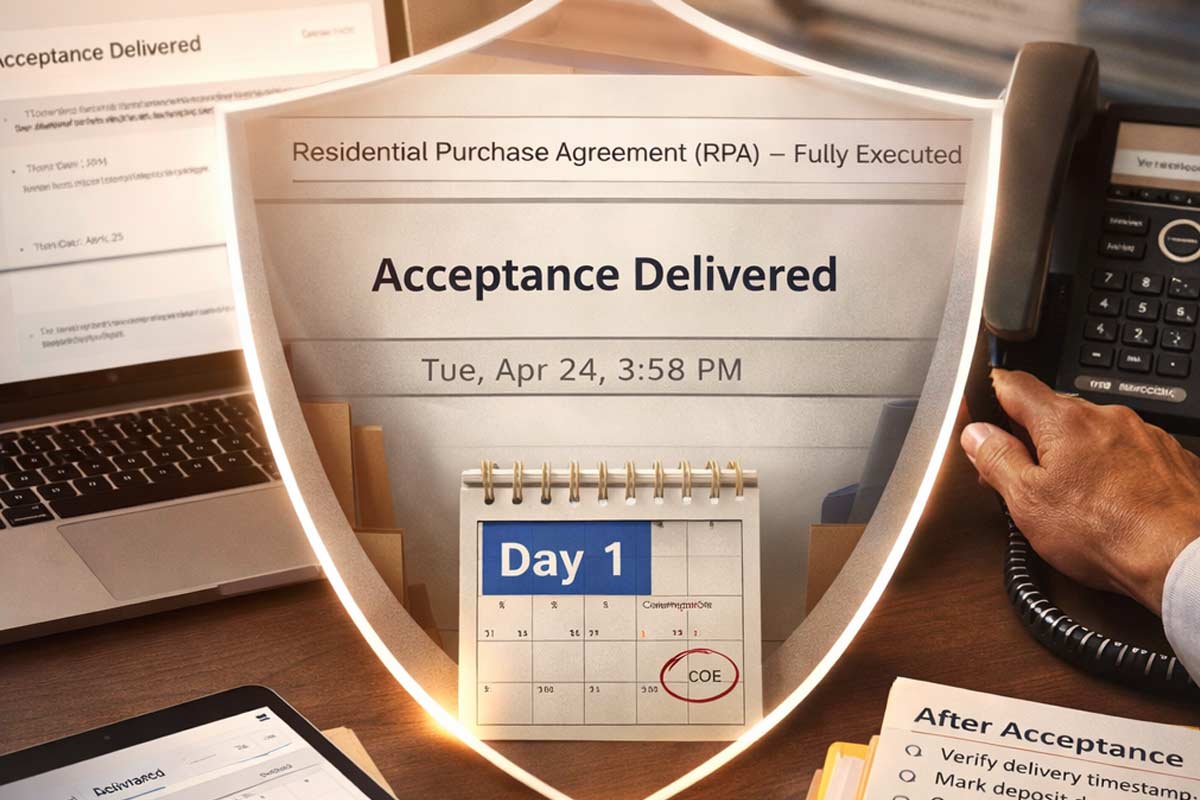
- Mark the Calendar: Calculate "Day 1" (the day after acceptance) and circle the COE date.
- EMD Verification: Call your buyer and ensure they have a verified phone number for escrow to confirm wire instructions.
- Audit the File: Confirm you have a fully executed RPA with all signatures and initials.
- Order Inspections: Initiate these immediately to ensure you stay within your investigation window.
- Confirm Delivery: Verify that the signed acceptance was delivered to the other side and document the timestamp.
What is the C.A.R. RPA?
The C.A.R. Residential Purchase Agreement (RPA) is the most commonly used standard-form contract used by California real estate agents to facilitate home sales. It acts as the legal "rulebook," outlining price, contingencies, and the specific responsibilities of both buyer and seller.
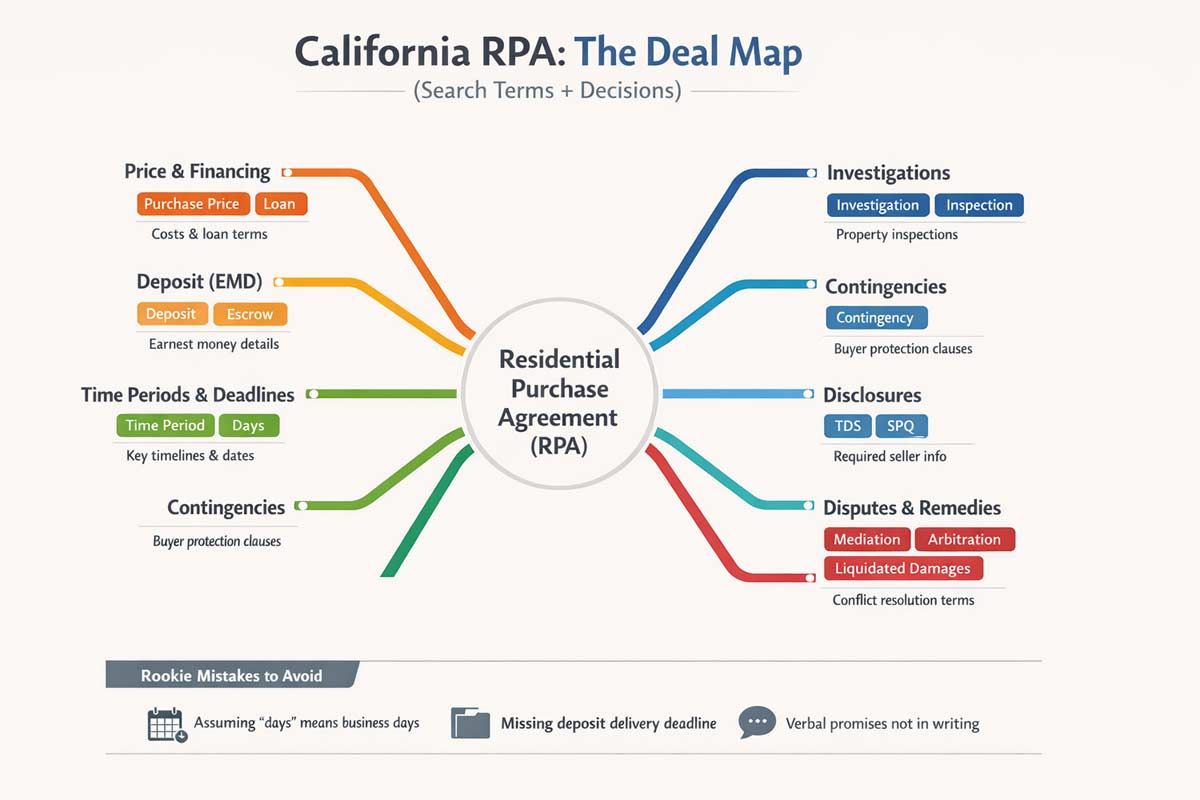
Main Parts of the RPA Explained:
- Agency & Representation Disclosures: Confirmation that the How to Explain Agency Disclosure Form AD was delivered (a separate, mandatory requirement).
- Price & Financing Terms: A summary of the purchase price, EMD, and loan details.
- Closing & Possession: When the buyer officially gets the keys.
- Inclusions/Exclusions: What stays (fixtures) and what goes (personal property).
- Allocation of Costs: Who pays for inspections, reports, and home warranties.
- Contingencies: The buyer’s "safety nets" for investigation and financing.
- Disclosures: The seller's history and knowledge of the property.
- Remedies: What happens in the event of a breach of contract.
Coaching Tip: Open your current digital RPA and use Cmd+F (Mac) or Ctrl+F (Windows) to search these specific keywords for quick navigation: Deposit, Escrow, Time Period, Days, Contingency, Investigation, Disclosures, Repair, Possession, Mediation, Arbitration, Liquidated Damages.
The RPA Map: Decisions & Search Terms
| Decision you’re making |
Search this in the RPA |
What it controls |
Rookie mistake |
Paper-trail proof |
| Price & Financing |
"Purchase Price", "Loan" |
Final sales price and loan terms. |
Leaving loan terms blank. |
RPA + Proof of Funds in transaction file. |
| Deposit (EMD) |
"Deposit", "Escrow" |
How much "skin" the buyer has in the game. |
Missing the delivery deadline. |
Escrow deposit receipt PDF + email confirmation. |
| Time Periods |
"Time Period", "Days" |
Every contractual deadline. |
Thinking "days" always means business days. |
Digital calendar with all dates circled. |
| Investigations |
"Investigation", "Inspection" |
The buyer's right to check the home. |
Not ordering inspections immediately. |
Reports + written agent confirmation. |
| Appraisal/Loan |
"Appraisal", "Lender" |
Buyer’s exit if value or loan fails. |
Promising "no problem" with value. |
Written appraisal/Loan status update. |
| Disclosures |
"TDS", "SPQ" |
Seller’s legal history of home. |
Late delivery (triggers exit rights). |
Signed Receipt of Disclosures acknowledgment. |
| Repairs/Credits |
"Repairs", "Request" |
Negotiated fixes or price drops. |
Promising repairs verbally. |
C.A.R. addendum + contractor receipts. |
| Possession |
"Possession", "Occupancy" |
When the buyer gets the keys. |
Giving keys before escrow closes. |
C.A.R. possession agreement in file. |
| Disputes |
"Mediation", "Arbitration" |
How you fight if things go south. |
Forgetting to check initials. |
Initial sections in signed RPA. |
When is the RPA Binding? (Acceptance & Delivery)
California purchase agreement explained: A contract is not binding just because everyone signed it. It is binding once there is Acceptance AND Delivery.
- Where to look: Search "Acceptance" and "Delivery."
- The Agent Move: Immediately after the final party signs, email the fully executed document to the other agent.
- Paper Trail: Save the email confirming acceptance was delivered with a visible timestamp.
Timelines, Days, and Deadlines
In California, time is a contractual commitment.
- Where to look: Search "Time Period" and "Days."
- The Evergreen Rule: In many contracts, if a deadline falls on a weekend or holiday, performance may roll to the next business day—confirm this in your specific contract and with your broker.
- Client Translation: "We treat every deadline as a hard commitment. If we miss one, the other side may gain the right to cancel our deal."
Inclusions & Exclusions: What Stays?
Arguments over refrigerators and chandeliers can kill a deal at the eleventh hour.
- Where to look: Search "Inclusions," "Exclusions," "Fixtures," and "Personal Property."
- Rookie Mistake: Writing "All appliances included" is too ambiguous.
- Paper Trail: Maintain a written list with photo confirmation. If anything is negotiated during the process, document it with a C.A.R. addendum or possession agreement (this could be done on a few different forms so confirm current form name/version with broker).
Contingencies: Inspection, Appraisal, and Loan
Contingencies are your buyer’s exit ramps. For a deep dive on how to manage these forms, see our guide on CAR Forms Every New Agent Should Know.
- Where to look: Search "Contingency" and "Investigation."
- The Agent Move: Use the RPA contingency removal (Form CR) to document every step.
- Client Translation: "These are your safety nets. We have a set period to do our homework. If the house isn’t what we thought, we can walk away with your deposit intact—as long as we act before the deadline."
Disclosures: Managing Risk
Late or corrected disclosures can reopen investigation windows or create new cancellation rights—treat disclosure delivery as a high-risk clock.
Coach Kartik's Experience: I once worked with an agent who delivered a supplemental disclosure two days before closing. Because it revealed a prior roof leak not mentioned in the SPQ, the buyer gained a fresh right to cancel, and they used it to renegotiate a $10,000 credit. Documentation is your shield here.
Repairs, Credits, and Allocation of Costs
- Where to look: Search "Costs," "Fees," and "Repairs."
- The Compliance Rule: Never promise a specific repair outcome until it is signed by both parties. Ensure the scope is in writing: who is doing the work, what is being fixed, by when, and how proof of completion will be delivered.
Cancellations: Notices and Defaults
Cancellations usually happen after a party fails to meet a deadline.
- Where to look: Search “Notice,” “Perform,” “Default,” “Cancel,” and “Remedies.”
- The Process: If a buyer misses a deadline, the seller typically issues a Notice to Buyer to Perform (NBP). If the buyer still doesn't comply within the window stated in the contract, the seller may have the right to cancel.
- Deep Dive: For a full map of this process, see Cancellation Rights in California Transactions.
Possession and Rent-Backs
- Where to look: Search "Possession" and "Occupancy."
- The Agent Move: If the seller is staying past the close of escrow, you need a C.A.R. possession agreement (confirm the current form name/version with your broker).
Dispute Resolution and Liquidated Damages
- Where to look: Search "Mediation," "Arbitration," and "Liquidated Damages."
- The Safeguard: Missing a deadline can trigger contractual remedies or cancellation rights—treat deadlines as hard and confirm with your broker.
- Wire Fraud Safeguard: I recently saw a spoof attempt where a buyer received "updated" wire instructions via email. Because they followed the rule to call a known number from the escrow company's official website, they realized the email was fraudulent and saved their $50,000 deposit.
- The Move: Confirm the last 4 digits of the account verbally before sending. See California Anti-Fraud Rules in Real Estate for more.
RPA Milestone Checklist
- Immediately After Acceptance:
- Within the Investigation Window:
- Before Contingency Removal Deadline:
- Before Close (COE):
From Agent to Professional
Mastering the RPA is about becoming a diligent project manager. It’s not about being a lawyer; it’s about protecting your client’s interests through every "search term" and "time period."
This guide is just one piece of the puzzle. For the full picture on staying lawsuit-free, visit our California Real Estate Laws & Compliance Guide.
FAQ
What is the C.A.R. RPA?
The RPA is the most commonly used standard-form contract for California home sales, detailing the terms, conditions, and timelines of the transaction.
Is the RPA legally binding?
Generally, yes, once signed by all parties and delivered. However, specific performance depends on meeting all conditions. Consult your broker for edge cases.
What’s the difference between acceptance and delivery?
Acceptance is the act of signing the agreement. Delivery is the act of providing that signed document to the other party (or their agent). Both must occur for the contract to be binding.
What does liquidated damages mean in plain English?
It is a pre-agreed amount (usually capped at 3% for owner-occupied residential property) that the seller can keep as a penalty if the buyer breaches the contract.
What happens if contingencies aren’t removed?
The contract stays alive, but the seller can issue a Notice to Buyer to Perform (NBP). If the buyer still doesn’t remove them within the cure period stated in the contract, the seller may have the right to cancel.
Can the seller cancel after acceptance?
Generally, no. The seller cannot cancel just because they got a better offer. They can usually only cancel if the buyer fails to perform on contractual obligations.
How do I prevent wire fraud in escrow?
Always verify wire instructions via a phone call to a known, trusted number from a prior transaction or the escrow company's official website.